Footnotes from the Ukrainian "Crisis"; New High-Points in Cynicism Part V

User avatar
blindpig
Posts: 14788
Joined: Fri Jul 14, 2017 5:44 pm
Location: Turtle Island
Contact:

Re: Footnotes from the Ukrainian "Crisis"; New High-Points in Cynicism Part V

Post by blindpig » Thu Nov 06, 2025 1:00 pm

Measures and countermeasures: Russian advances in Pokrovsk
Published by @nsanzo ⋅ 06/11/2025

Image

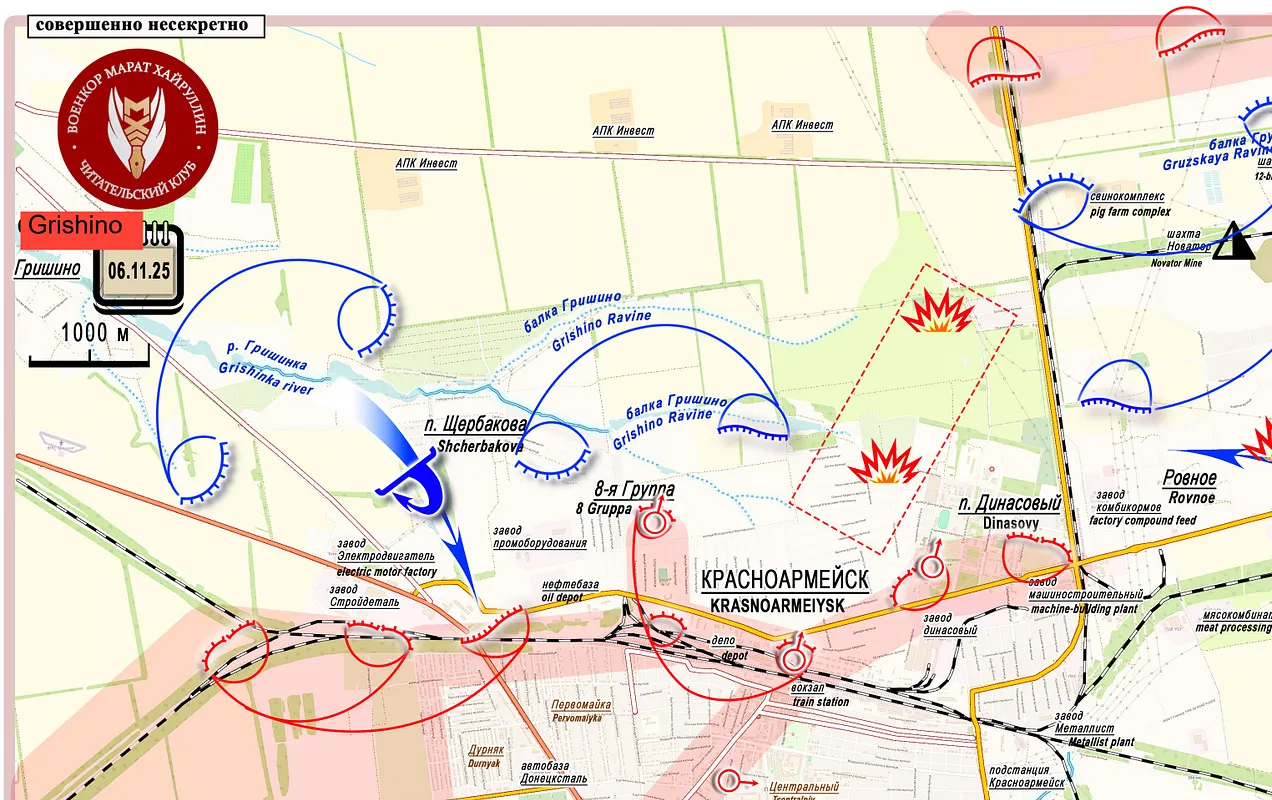
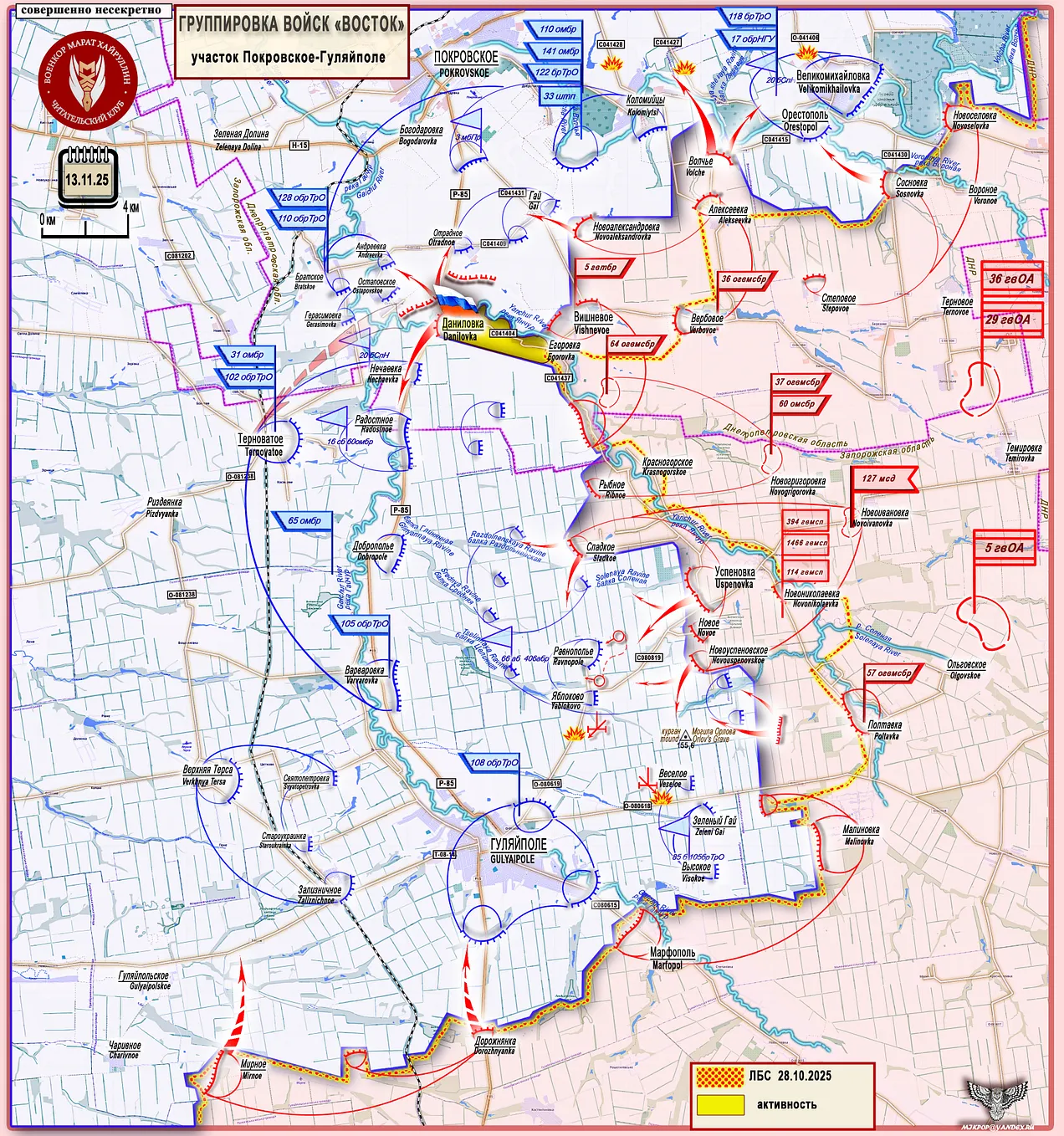
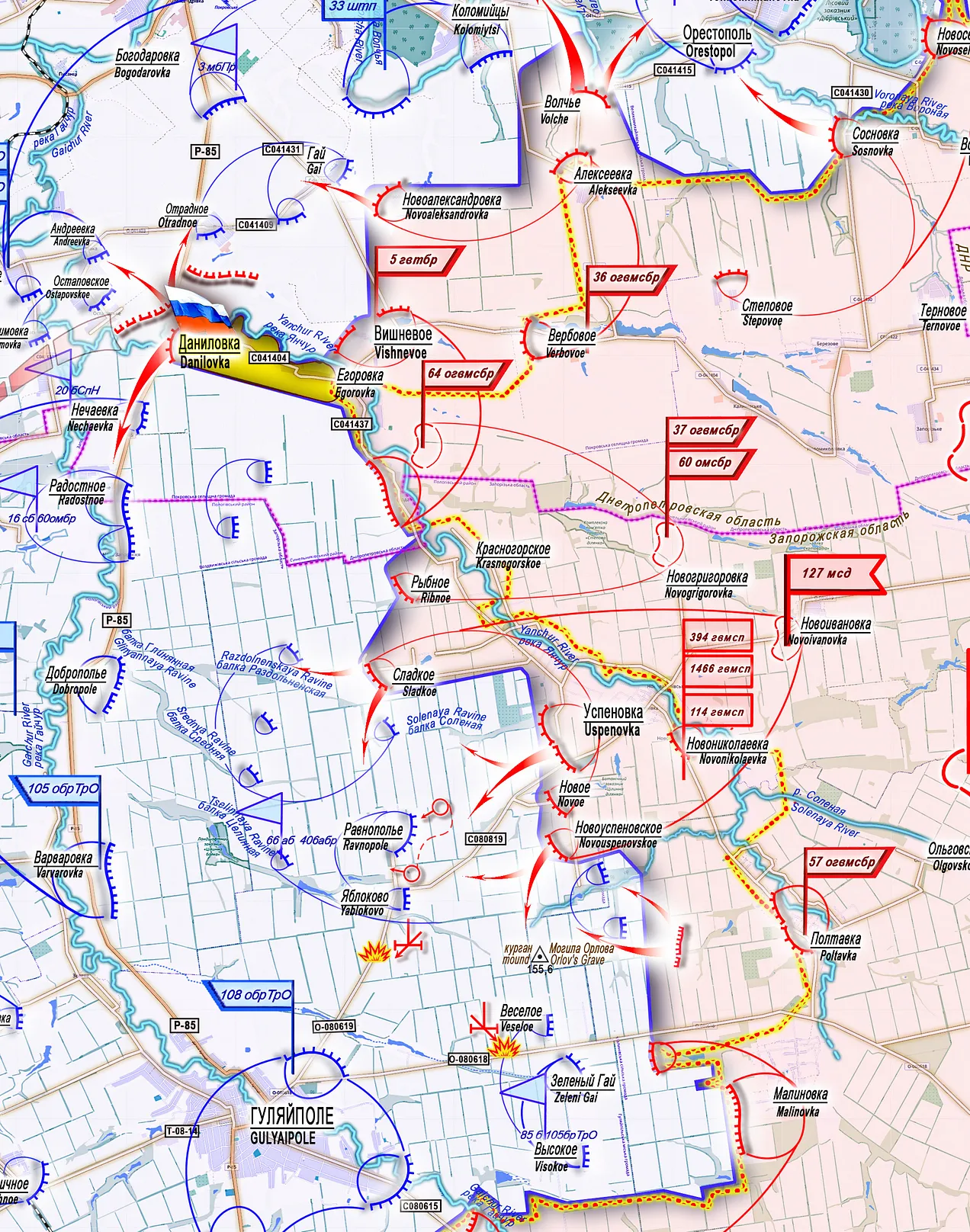
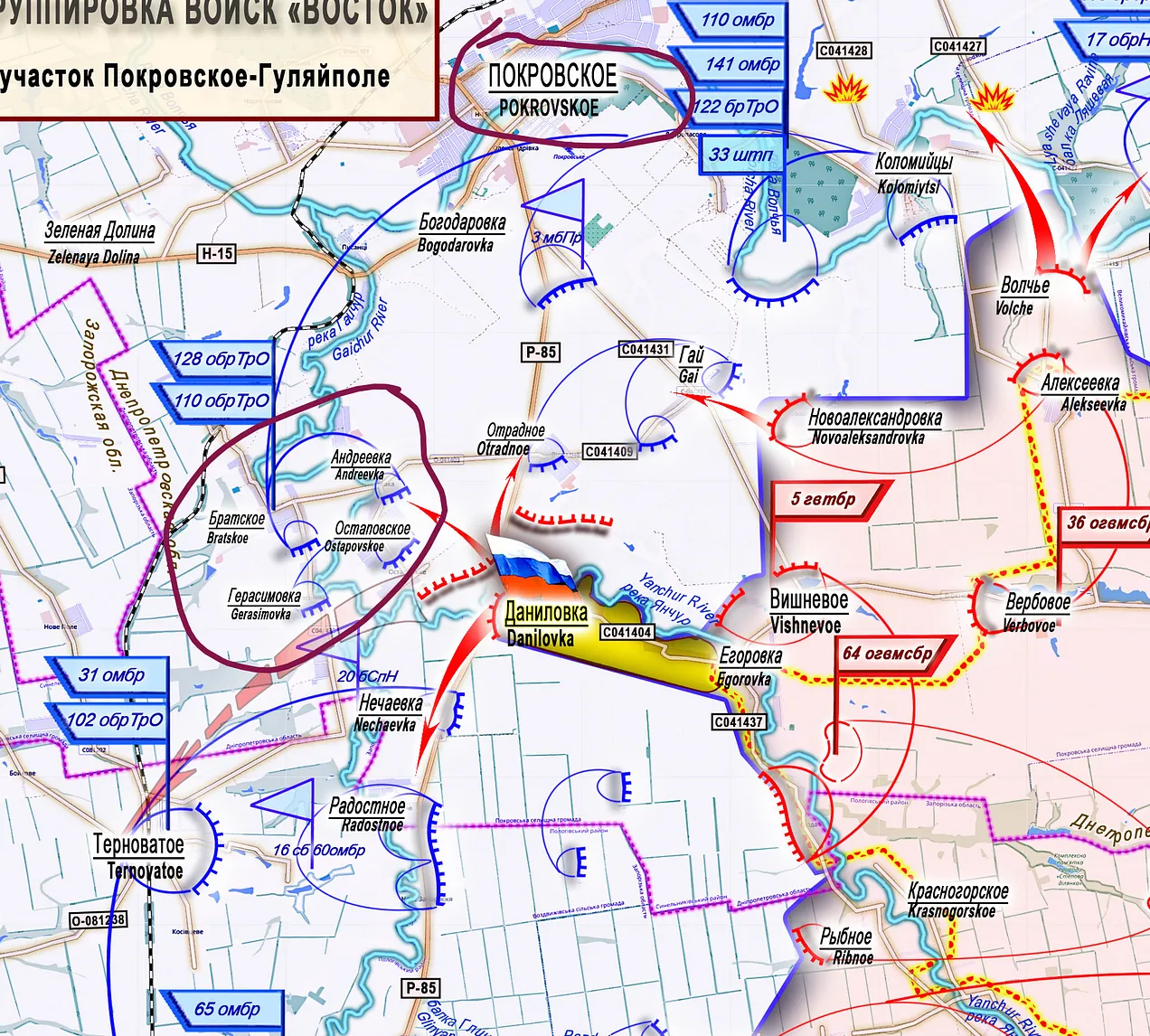
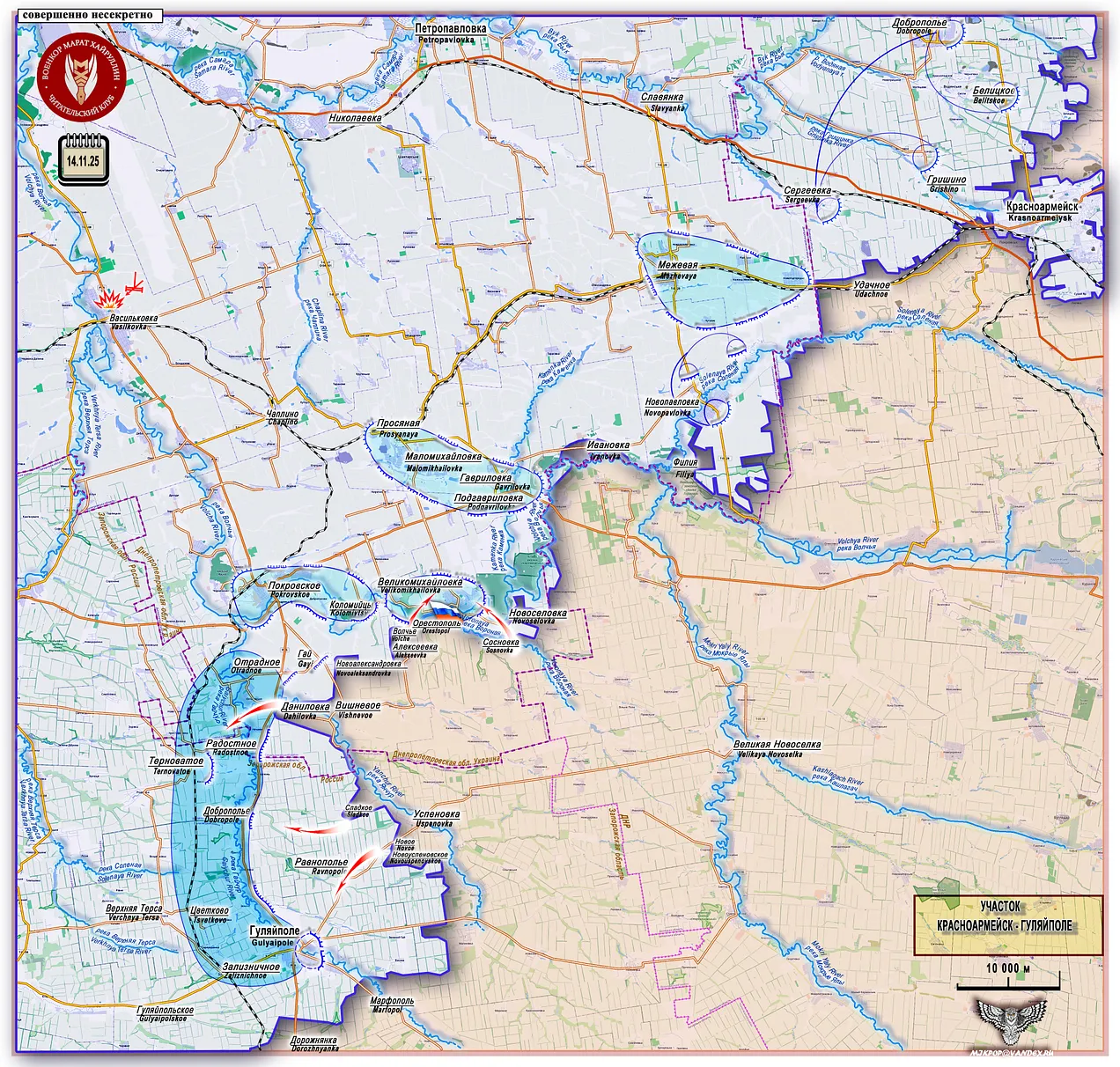
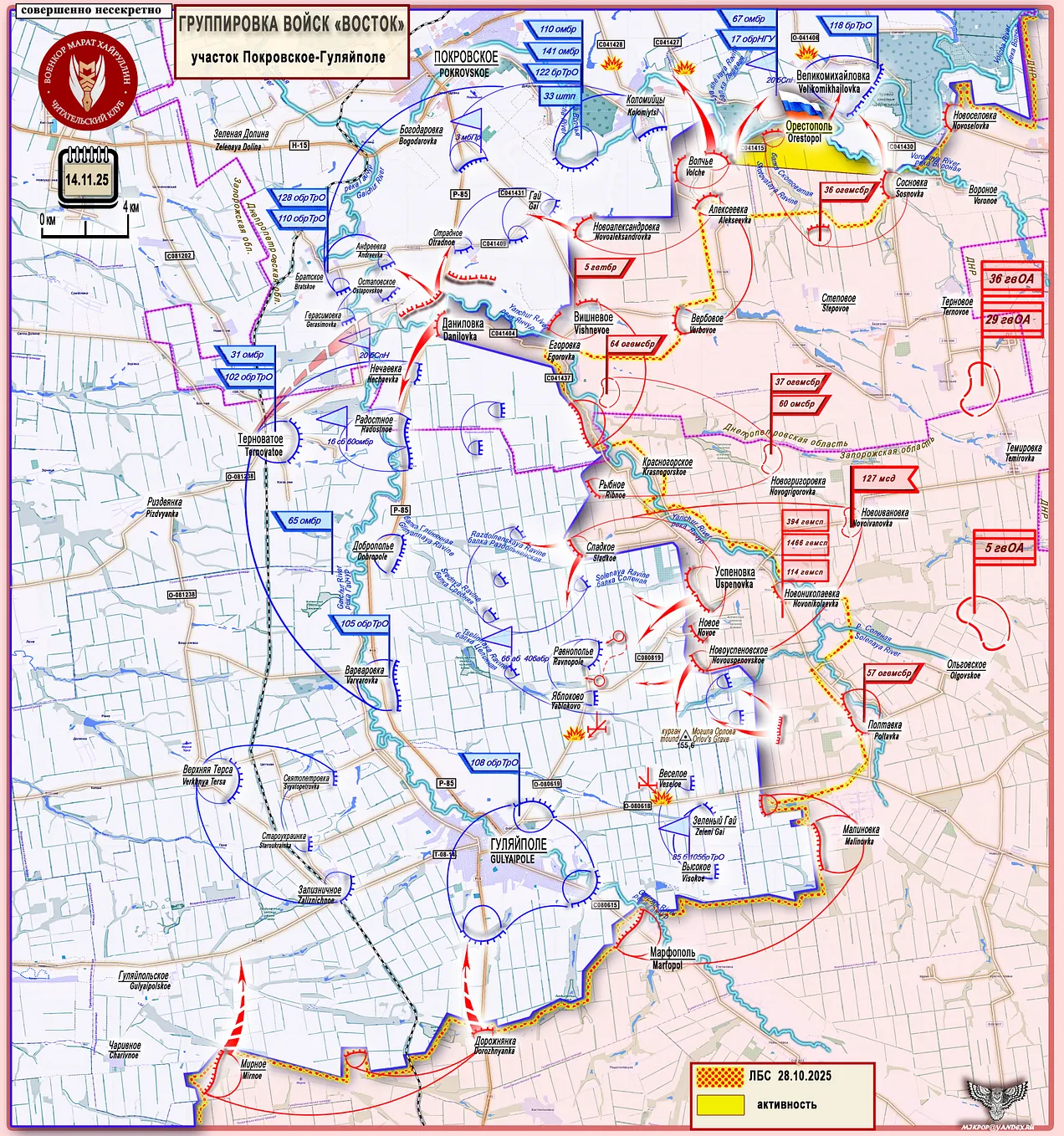
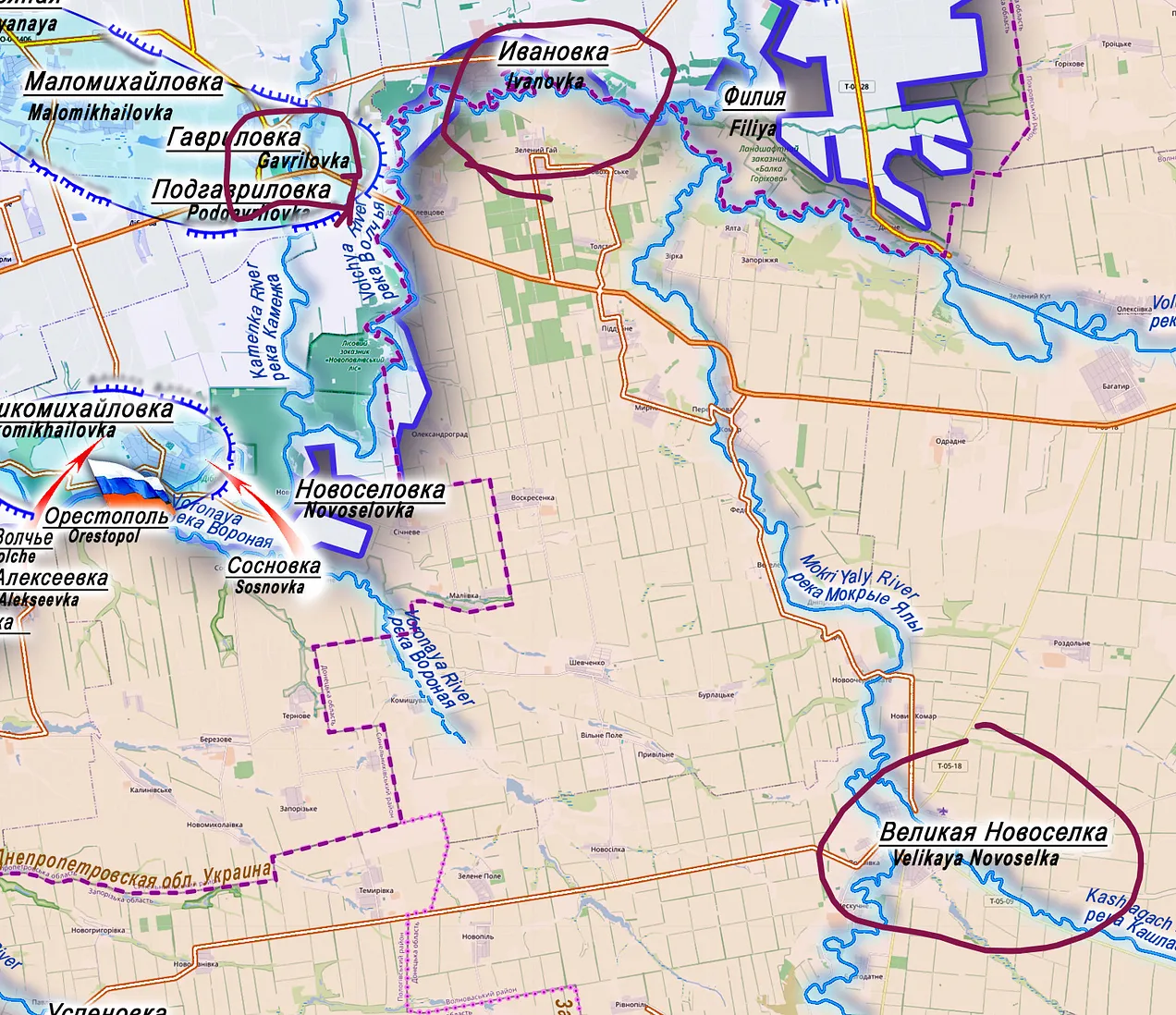
Yesterday, the Russian Ministry of Defense warned of what it described as a “rapid deterioration” in the situation of Ukrainian troops in Kupyansk, where fighting is taking place within the city, albeit in an initial phase of the battle, and in Pokrovsk, the main focus of the fighting at the moment. In less publicized areas, primarily the Dnipropetrovsk Oblast , which Russia does not claim as its own but where it is trying to gain a better negotiating position and territories to return in exchange for those it seeks in Donetsk, Russian troops are slowly advancing, capturing towns and stretching the depleted Ukrainian lines. The Ukrainian army, Russia claims, is suffering “serious and continuous losses from attacks against the advancing Russian troops” and is “trapped.” The Russian command is thus presenting the situation to justify its demand for withdrawal or surrender. The battle, especially the fight for Pokrovsk, will continue no matter what, because, given the task that the Russian authorities have assigned to their troops, the advance on the Ukrainian lines in Donetsk cannot be stopped unless Moscow finally gives in to the American demands for a ceasefire and a freeze on the front.

“Russian forces are trying to consolidate their hold on the industrial zone and residential buildings of the besieged city of Pokrovsk in the Donetsk region, a [Ukrainian] soldier told Suspline on November 5. Archaeologist , a soldier with the 25th Airborne Brigade serving in the Pokrovsk area, stated that Russia’s objective is to approach from the south through Pokrovsk, encircle it, and cut off Ukraine’s logistics,” wrote The Kyiv Independent yesterday in its opening article on daily developments. It doesn’t take much reading to understand that this statement amounts to an admission of a serious situation. However, both Ukrainian authorities and troops, largely to maintain control, avoid a domino effect, and prevent damage to troop morale, continue to maintain that everything is under control. “Recently, we eliminated a group that was trying to cut off logistics, specifically the road to Rodinskoe,” Archaeologist insists . Hope must be maintained. However, the place the soldier is referring to, north of Pokrovsk, that is, the only area not under Russian control and which allows Ukrainian troops to try to maintain supplies or withdraw, reveals the situation.

According to the Ukrainian General Staff, its forces are carrying out “active countermeasures” to prevent Russia from consolidating its presence in Pokrovsk, where, of course, Ukrainian troops are not under siege. Damage control does not prevent the Ukrainian population from seeing the reality behind the statements. Even the most sympathetic analysts admit that more than half the city is already under Russian control, which is advancing—always at the cost of thousands of casualties, according to these sources—without Ukraine being able to stop its progress. Eliminating the Russian presence in Pokrovsk would require a much larger operation than the one launched by Kirill Budanov last week. After the video was leaked to the press and quickly posted on the social media profile of Oliver Carroll, correspondent for The Economist , the Ukrainian reaction was to blame the messenger. The journalist was labeled a “degenerate” for revealing the landing of GUR helicopters that were allegedly planning some kind of offensive operation against Russian troops. The speed with which Russia released its response—the FPV drone attack against the troops who had landed—indicates that the flight was tracked by Russian operatives from the outset. In a context saturated with attack and surveillance drones, neither side needs media reports to know the state of the skies. The continued Russian advances in Pokrovsk, confirmed by Ukrainian media outlets such as DeepState, indicate that, predictably, the arrival of a few dozen special forces soldiers, whether elite or not, has not changed the dynamics of the battle, something that would require large numbers of troops or a significant increase in firepower. For the moment, neither of these circumstances has materialized, and the image of the city presented by Ukrainian reports from the area differs from the official narrative, which is trying to maintain calm.

“In short, Pokrovsk and Mirnograd are already screwed,” says a pilot interviewed by Hromadske , one of the many liberal media outlets that have emerged in Ukraine thanks to Western funding following the Maidan victory. The soldier, Valeriy, “just left his positions in Pokrovsk, where he spent 13 days. During this time, his unit had to retreat three times because the Russians were advancing rapidly through the city. The drone unit found itself 900 meters from the enemy and was forced to operate in a city that the Russians are penetrating deeper and deeper into.” “The pessimistic predictions about the future of this key city in southern Donetsk are not only expressed by soldiers working directly in the city, but also by officers,” Hromadske points out . Only the most die-hard supporters deny a reality that is obvious to most.

“Pokrovsk found itself on the brink of total occupation after hundreds of Russians infiltrated the city. The Ukrainian army has been unable to close the gaps in its defenses through which the enemy has been entering the city since the summer. This led to the Russians amassing forces in Pokrovsk, and by autumn, their presence had grown so large that it threatened to encircle the entire Ukrainian garrison,” the report continues, acknowledging what the authorities are trying to conceal. It does so by maintaining the anonymity required of sources who contradict the official narrative to prevent reprisals. In war, no one wants to admit defeat until it is complete. “Everything gray on DeepState ’s map of Pokrovsk should be painted red [as areas under Russian control are designated]. The Russians control approximately 60% of the city. The enemy is in Rodinskoe and Mirnograd. The situation is a mess,” a high-ranking officer fighting in Pokrovsk told Hromadske , contradicting the success The Kyiv Independent claims Ukraine has achieved against Russia on the road to Rodinskoe. “Those in the forward positions in Pokrovsk are already practically surrounded and have little chance of escape. There are buildings, blocks, and streets that are almost impossible to pass through without being shot at,” the same officer added.

“It’s not just sabotage and reconnaissance groups. You enter the positions, there are drones constantly flying overhead, soldiers killed in combat who aren’t being recovered, and there are numerous mines and artillery shelling along the logistics route. There are many different access problems. It’s quite demotivating,” the previously quoted drone pilot stated, adding that “one of the biggest problems is that, due to the constant advances into the city, pilots and drone operators are constantly forced to retreat and can’t carry out their primary mission because of the presence of enemy infantry.” The image is unequivocal: Russian troops are advancing, leaving Ukrainians no option but to retreat.

“Because of this, our second echelon isn’t functioning, and that’s what provides 90% of the attacks. Consequently, we can’t kill the Russians as they approach the city. And when we don’t have UAVs, Russia will always outnumber us in infantry,” the drone operator continues. “Because of the chaos the Russians sow in the city, on the one hand, they create problems for the rear units and, on the other, they prevent them from doing productive work, while this tactic guarantees them the opportunity to continue infiltrating the city undetected,” Hromadske adds , with an implicit admission that the Russian tactic is working.

Perhaps the clearest description of the current state of the front in that area comes from a soldier quoted in the article. “If Pokrovsk falls, there will be no Mirnograd. If Mirnograd falls, there will be no Pokrovsk. I can’t separate these two cities. If we consider that the Russians feel completely secure north of Pokrovsk and northeast of Mirnograd, then they can cover the remaining distance between them with FPV (First-Person View). They are doing everything possible to ensure that the city, if not physically surrounded, is encircled in such a way that it is impossible to leave,” she states. There is no encirclement, but Russian pressure surrounds the two cities, where neither special operations troops nor drone operators have, for the moment, managed to halt the Russian advance, a fact also confirmed by experts. Ukraine, insists Michael Kofman, has sent “reinforcements and elite units to Pokrovsk to stabilize the flanks, but this may not be enough given the scale of the Russian infiltration at this stage.” “If Pokrovsk falls, Mirnograd falls too, and the pocket closes,” he adds. “The immediate result is that Russian forces will operate drones from Pokrovsk, using the city to push back Ukrainian Armed Forces units,” he continues, underscoring the area’s importance. The Russian advance had left Pokrovsk an isolated salient under Ukrainian control, eliminating the city’s value as a logistics hub. However, while this might seem to lessen the severity of the potential fall for Ukraine, the real issue has long been not losing a strategic location, but rather Russia’s ability to use it as such.

https://slavyangrad.es/2025/11/06/medid ... -pokrovsk/

Google Translator

******

From Cassad's telegram account:

Colonelcassad
The thaw certainly affects the course of military operations. However, as a bare-bones territorial assessment shows, last year, oddly enough, the Russian Armed Forces' greatest advances occurred precisely at the peak of the autumn thaw. This year, too, we see that the pace of advancement in October was quite rapid—according to various estimates, from 524 to 590 square kilometers per month, which became one of the peak figures for 2025.

Nevertheless, for those on the ground, the weather presents additional challenges that must be overcome. On the other hand, sometimes bad weather can reduce the effectiveness of UAVs, which can sometimes be exploited.

https://t.me/readovkanews/103000

***

Colonelcassad
The active offensive of Russian troops continues in most directions, while the Ukrainian Armed Forces are conducting counterattacks in isolated areas.

1. North of Donetsk and in the Liman direction:

Russian troops began an offensive in the forested area west of Yarovaya with the aim of cutting off supply lines to the village.

2. North of Kharkiv:

Russian troops continue to advance in the southern part of Vovchansk.

The Rubezhansky district and a section of the T-21-04 road leading to the Aero L-29 junction have been completely taken under control.

A significant number of industrial buildings south of this road have been captured.

3. In the Shakhove direction:

The Ukrainian Armed Forces, simultaneously retreating west of Shakhove, conducted successful counterattacks and recaptured a number of positions east of this village, as well as east of Sofiyivka.

4. Myrnohrad and Pokrovsk directions:

Russian troops are clearing the "8th" and "Dinas" districts in Pokrovsk after eliminating the main pockets of resistance.

Assault operations continue in the area of ​​the "Druzhba" dacha cooperatives—the last suburb of Pokrovsk firmly held by the Ukrainian Armed Forces.

Further north, Russian units are attacking weakened Ukrainian Armed Forces positions in Rodynske.

The Ukrainian Armed Forces continue to struggle to withdraw small groups from Myrnohrad, which is practically encircled.

5. Novopavlivske direction:

Russian troops have consolidated several positions north of Dachne and adjacent to the administrative border of the Dnipropetrovsk and Donetsk regions, west of Kotlyarevka.

***

Colonelcassad
The Russian Foreign Intelligence Service (FIS) stated that Western allies of Kyiv are considering sabotaging the Zaporizhzhia Nuclear Power Plant, which could lead to a reactor core meltdown. The agency also reported that a campaign is being prepared to blame Russia for the potential accident.

***

Colonelcassad
Ukraine is suspending rail service with the Ukrainian Armed Forces-controlled part of Donbas—trains will no longer run to Sloviansk and Kramatorsk.

All trains on this route will terminate in Barvinkove in the Kharkiv region. From there, buses will transport residents of Sloviansk and Kramatorsk, the Kyiv-appointed military administration announced.

https://t.me/s/boris_rozhin

Google Translator

******

American nazis in Kyiv
Response to Ali Winston on 764. Deep dive on a US marine rightwing accelerationist currently fighting with Azov.
Events in Ukraine
Nov 04, 2025

A few weeks ago, an interview came out on a topic I’ve written about quite a lot here. The man interviewed is an expert on the topic. However, I was quite dissatisfied.

The topic is stochastic, online-based terrorism. Globally, it is most associated with the 764 network, which involves the grooming of young people to kill or harm themselves or others. Today, the Iraqi police even announced it had arrested a ring of such sick individuals. Apparently, the network, led by a 14 year old, had incites 30 suicides through online games, as well as a spate of sexual violence.

Anyway, back to the interview. First of all, I just wanted to say I dislike arguing with people online. With that done, it was TrueAnon’s interview with Ali Winston.

Image

I love TrueAnon, both as a guest and a listener. I also understand why they invited Winston, who is undeniably one of the most knowledgeable people on the topic. Winston was also responsible for publicizing the fact that Joshua Sutter, an influential figure for the 764 scene, was an FBI informant who had been paid $140,000 to publish book glorifying child rape and murder. I have enjoyed reading a number of Winston’s pieces.

But there was one reason why I felt a certain disquiet by the end of his interview.

In short, Winston was quite transparently trying to blame Russia for the post-2020 explosion in rightwing accelerationists in the west. This is apparently part of Putin’s nefarious plan to undermine western civilization.

Winston kept on circling back to two things.

Telegram
First of all, telegram, which he believes is the main reason why these ideologies are gaining in popularity. From 2019 onwards, western neo-nazis migrated en-masse to telegram. This was partly because they feared censorship in the wake of Brenton Tarrant’s mosque shootings in New Zealand.

Telegram is owned by Pavel Durov, who has a a very strained relationship, at best, with the Russian government. Online commentators who have made Ukrainophilia their main hustle entertain the theory that telegram is a Russian government op hiding behind the guise of freedom of speech. Durov, a libertarian who does not live in Russia, is supposedly on Putin’s payroll.

Pavel Durov: The visionary whose alternative to Facebook was snatched away by the Kremlin and counterattacked with an even bigger hit, Telegram | Economy and Business | EL PAÍS English

Mr Durov
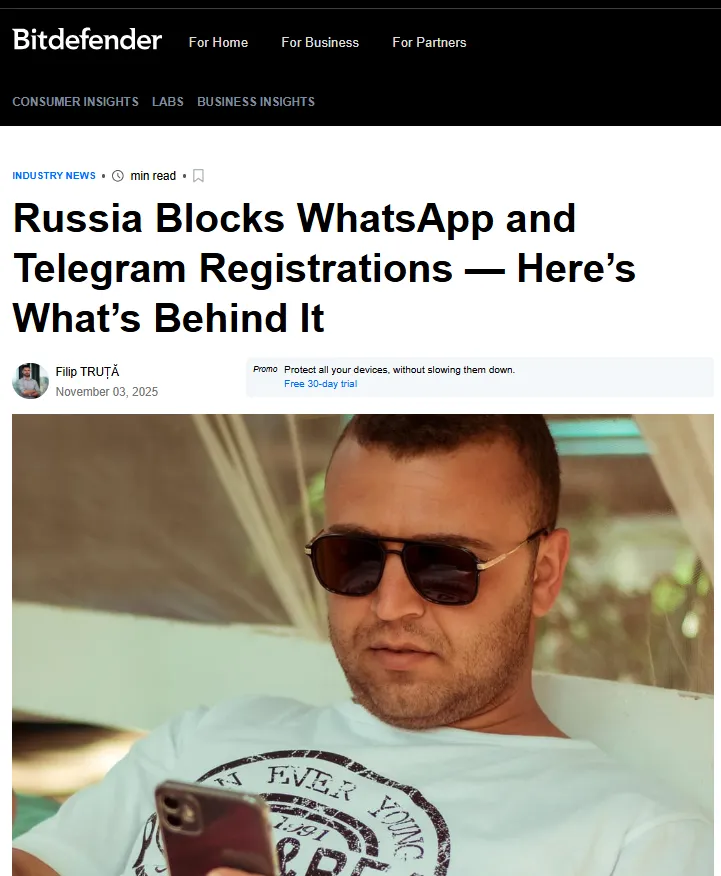
If so, why is the Russian government constantly discussing banning telegram, and placing ever-greater restrictions on it?
Image

Why have they launched their own app, ‘MAX’, which they desperately hope will replace telegram? As of September 1, all new phones sold in Russia come with MAX pre-installed.

Image

That’s because telegram certainly doesn’t only feature rightwing accelerationists and ‘Russian propagandists’. In fact, this year telegram has been cooperating even more with western governments to take down particularly offensive neo-nazi propagandists and child abusers. Telegram is also, of course, extremely popular in Ukraine.

Anyway, that’s telegram. Winston gave a dismissive answer to TrueAnon’s host, who mentioned the popularity of Discord as a child grooming platform. But that was quite a good question. After all, 764 actually emerged on Discord, not telegram.

The Base
Winston’s second obsession is the Base. This is a rightwing accelerationist organization that emerged in 2018. Its quite interesting founder, Rinaldo Nazarro, was originally employed by the FBI and Pentagon, but ended up moving to Russia, where he continues coordinating his group.

Image

Now, I’m not going to argue that the Base has thrown in its lot with the Russian intelligence community. In early 2025, the Base offered financial rewards to those who attacked Ukrainian military objects.

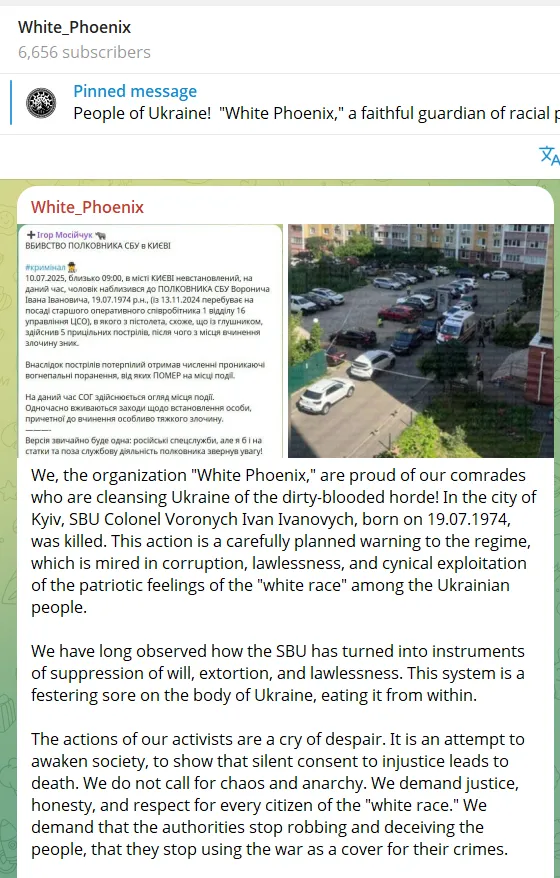
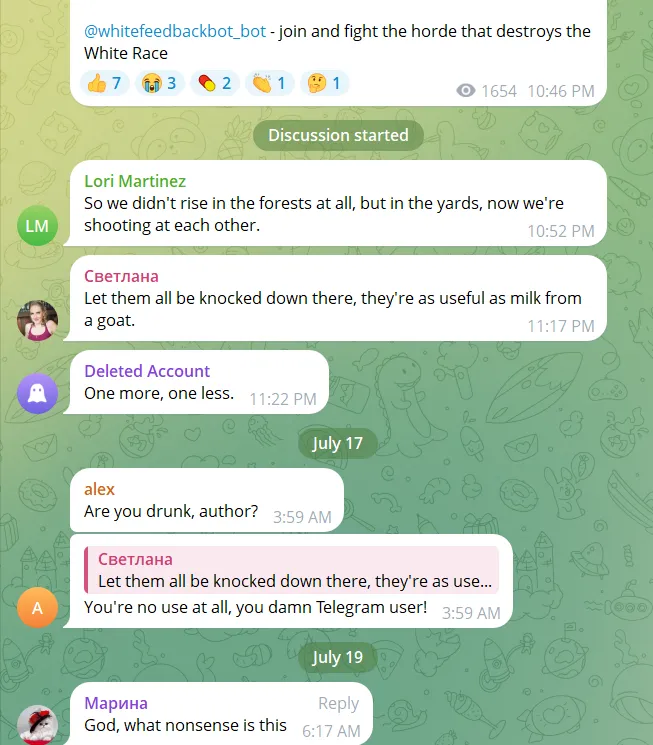
They also have a ‘Ukrainian division’, called White Phoenix. I’ve been meaning to write about them for a while, but keep putting it off because it’s quite stupid. All they do is claim responsibility for every violent act that ever happens in Ukraine. To boost their ‘credibility’, the same 4 bots write the same old replies under every post.
Image

Image

I’m afraid I’m going to have to give the FSB a C for effort. The same goes for reputable western analysts like Janes Defense Weekly, who uncritically believed ‘White Phoenix’ when they claimed they had set up their own white ethnostate in the Carpathian mountains.

But I wouldn’t just blame Russian spooks for the Base. Ultimately, Nazarro started out in the early 2000s as the founder of ‘Omega Solutions International’, which involved Nazarro hawking his counter-terrorist intelligence to whoever interested. Plenty of people were, and Nazarro became an FBI and Pentagon contractor — he apparently became a neo-nazi in the course of his many service tours to Iraq and Afghanistan.

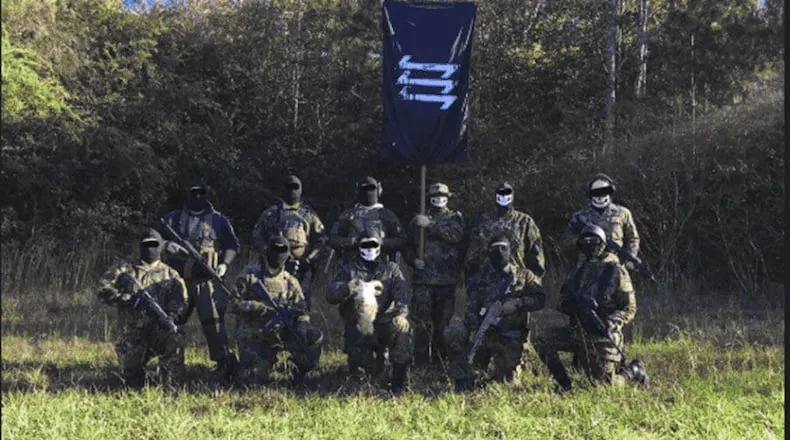
Anyway, I find a fixation on the Base very strange. Ultimately, the Base didn’t actually do much. Its greatest feat was stealing a goat, then ritually dismembering it and drinking its blood. Psychedelic drugs were also involved. They also conducted military training and apparently planned to kill some anti-fascists, but it never went anywhere.

In this photo from a prosecution exhibit, alleged members of the The Base, a far-right terror organization, pose with the severed head of a goat. Eight men have been charged with animal cruelty related to the theft and killing of the animal.
Image

But most of all, the Base really didn’t have much relevance for what Winston was meant to be talking about - online networks like 764. The goal of 764 is to convince unstable youth online to harm or kill themselves or others. The goal of the Base was to build a white ethnostate in the Pacific northwest. Not a small difference.

What wasn’t said
I was particularly frustrated by what Winston didn’t say.

Most of all, the fact that Winston spent so much time talking about the base but neglected to mention an organization that actually DID and DOES hugely influence 764. This is also the organization mentioned most in conjunction with 764 by mainstream extremism-analysts like the ADL and the West Point Terrorism Centre.

This organization is the Maniacs: Cult of Murder (MKU, or sometimes spelled MKY). The MKU, unlike the Base, was founded in Ukraine, and its founder is a fierce Ukrainian nationalist who is proud of his time in an Azov youth paramilitary. It must be a very strange type of Russian active measure.

But how can you have any discussion about online, youth-oriented 764-style activities without mentioning MKU?

Image

The MKU was formed between 2017 and 2018 by a young Ukrainian named Egor Krasnov. Krasnov had the following interests - white nationalism, tattoos, meth (at least temporarily), and serial murder.

Image

In his writing available online, he proudly admits to being a member of a Ukrainian nationalist youth militia, which was almost certainly Azov’s Natsionalny Druzhiny (National Militia, ND). He left or was expelled because he was too fixated on killing the homeless. He then got to work doing so with a group of young, like-minded individuals. I wrote about this part of his life here.

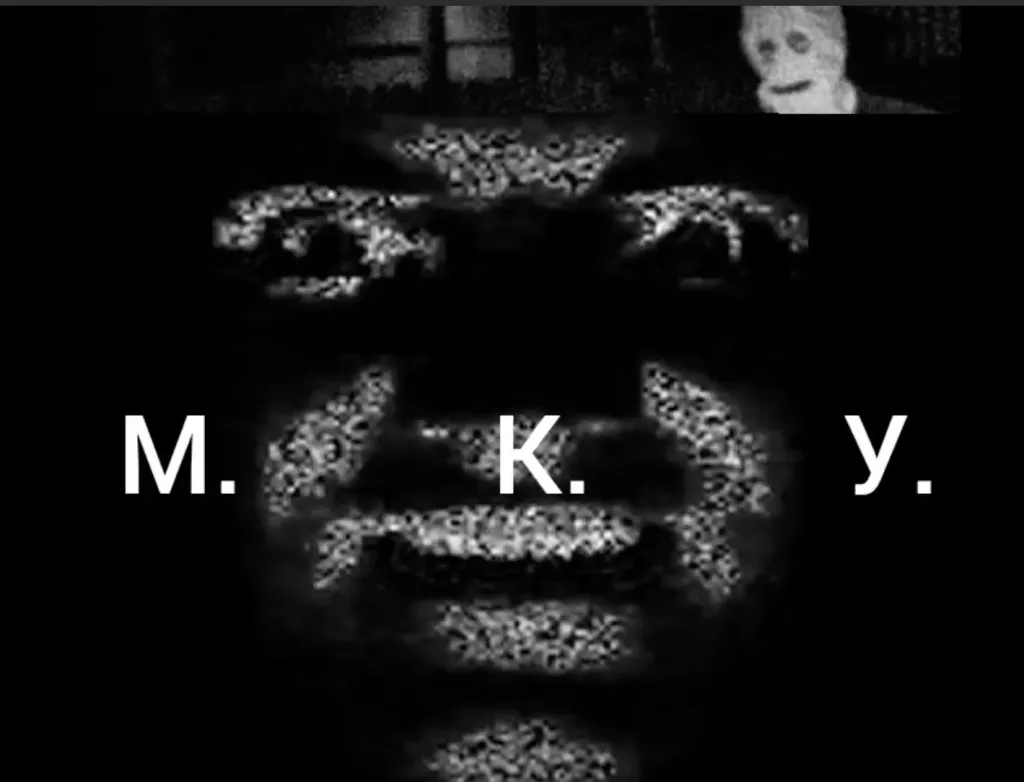
Anyway, there are several reasons why MKU was so influential globally. First of all, aesthetics. MKU’s black and white, nihilistic, Eastern European vibe was like catnip for terminally online teens around the world. Krasnov’s signature kill videos featured fast ‘horrorcore music, a genre combining aggressive electronic music, metal, and rap’, and became highly coveted gifs for his followers online.
Image

Krasnov was arrested in 2020, but this aesthetic and the MKU’s videos became ‘viral’ on terrorgram. It was probably on telegram, which is largely used by Russians and Ukrainians, that English-speaking neo-nazis became in contact with MKU’s output around 2019, which was probably the peak of Krasnov’s activities. He boasts of killing dozens, and his output was certainly hyper-active.

But apart from the aesthetics, the MKU also pioneered an important new tactic. Instead of committing terrorist acts yourself, get kids to do them. Obviously, terrorist groups and intelligence services (MKU loves comparing itself to the FBI in its written output) have long done this. But this was the MKU’s whole strategy, and it was largely based on emotional manipulation (again supposedly based on FBI methods, according to the MKU).

Image
An example of the MKU’s ‘FBI manipulation techniques’ from their online writings, which I covered here

Throughout 2019 and 2020, Krasnov focused on creating dozens of MKU cells around Ukraine and Russia. He continued doing this, it must be said, after he was imprisoned, which led to some ‘paranoid’ theories that he was cooperating with the Ukrainian government. By the way, as I covered here, this theory of Krasnov’s alliance with the Ukrainian government is actually embraced by many Ukrainian neo-nazis today, who believe that Krasnov’s purpose was to discredit excessively popular Ukrainian nationalists.

Anyway, this tactic of manipulating unstable youth online into harming themselves and others is the name of the game for 764. West Point’s 2024 article on MKU mentions 764 no less than than 44 times. The two are almost inseparable, but chronology needs to be kept in mind. The MKU was set up in 2017 and was most active from 2018-2020, though its propaganda continues to be churned out by admirers to this day. 764 emerged in 2021. The line of influence is quite obvious: MKU —> 764.

It’s unclear to what extent MKU actually exists today. 764 aligned individuals in the US and elsewhere still sometimes include the abbreviation in their graffiti. MKU itself claims that its organization persists using new forms of technology for communication. Perhaps.


Image
A 2025 graffiti attack on a Canadian synagogue

But the important thing is the MKU’s influence on the current generation of school shooters and online child predators (many of which are children themselves). This is a quite real tactical influence. The MKU’s written output features detailed instructions on how to convince followers that unless their commit violence against themselves or others, they are worthless.

The second omission from Winston’s talk was a fact about the man he has written so much about, Joshua Sutter.

Image

Sutter, a notorious American neo-nazi, has spent the past few decades publishing nazi satanist books at his ‘Martinet Press’. These books, which glorify mass terrorism, rape, and all kinds of other bad things, were financed by the US government - in 2021, Winston famously discovered that a US court had proven Sutter’s status as an FBI informant.

As we will see, Sutter has also been hard at work promoting MKU’s tracts. I also wrote here about how Sutter’s publishing house translated anti-government neo-nazis in Russia.

Anyway, the fact that Winston forgets to mention is Sutter’s 2018 visit for a high-level Azov conference, the ‘Pact of Steel’. The conference was organized by top Azov ideologue, ‘metapolitician’, and international outreach coordinator, Olena Semenyaka.

Image
Sutter is the man with the bad beard

As I wrote recently, Semenyaka and Azov are fixated on the need to encourage a white nationalist takeover in the west. They do this by allying with extreme, terrorist-inclined neo-nazi organizations. They love inviting them to their conferences in Ukraine. In the promotional video for the 2018 ‘Pact of Steel’ conference, you can see Semenyaka wax lyrical about the ‘the paneuropean Reconquista Movement’ about to sweep the continent of racial deviants. The same video contains Sutter at 59 seconds, and his masked Atomwaffen friend at 57 seconds.


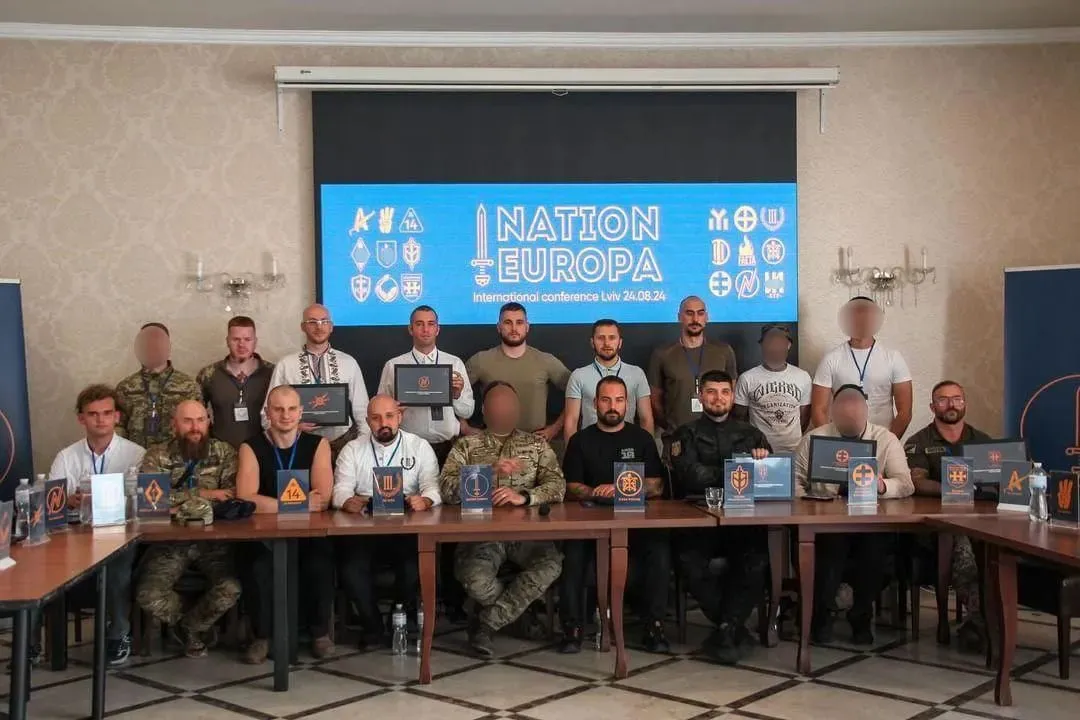
The latest such example of transnational outreach was the 2025 ‘Nation Europa’ conference in Lviv.
Image

I’d like the reader to pause a moment and consider the fact that these aren’t some kind of mass events. These are conferences with a carefully selected guest list. And the Azov leadership decided Sutter was the man they needed to ally with.

Sutter also brought with him to the conference some young fellows from the Atomwaffen Division. This latter group, according to Winston, is, like the Base, essentially a Russian ‘Active Measures’ operation. If so, it must be extremely successful, since it has managed to infiltrate the most powerful Ukrainian nationalist militant organization on earth. Azov, according to the western press, is Ukraine’s most militarily advanced force, and the first to adopt NATO standards.

Sutter update
I feel somewhat guilty of fueling Mr Sutter’s ego (he often replies to me on twitter). However, since today’s topic is the link between the MKU and western freaks, I couldn’t resist.

So, back to Sutter-watching. Sutter has resurrected his twitter account. He is now called ‘thatrealfed’.

Image

This self-glorification as the CIA’s strongest soldier certainly isn’t new, though I actually feel some personal responsibility here. That’s because Sutter retweeted and approvingly replied to some of my twitter threads about his alignment with the NATO deepstate.

Anyway, though Sutter is quite far from being a Satanist James Bond, he still is real. And his account is filled with posts glorifying the MKU. This one, for instance, features a famous photo of Krasnov and an excerpt from the MKU manifesto.

Image

His pinned post is a new publication of the MKU’s manifesto, the ‘Haters Handbook’.

Image

It is illegal to own this book in the USA, UK, and Canada, so it is quite interesting how Sutter is able to boast about publishing it. But that probably isn’t too surprising, since he is an FBI informant who has been given over $140,000 from his federal employees to publish obscene books since the 2000s.

Anyway, this is just one reason why I found Winston’s claims that the FBI is cracking down very seriously on all these fellows rather questionable. Sure, they have arrested a number of young 764 predators, actions which I can only applaud. But meanwhile, you have Sutter, an FBI employee, churning out propaganda for the next generation of 764 freaks? It doesn’t quite add up to me.

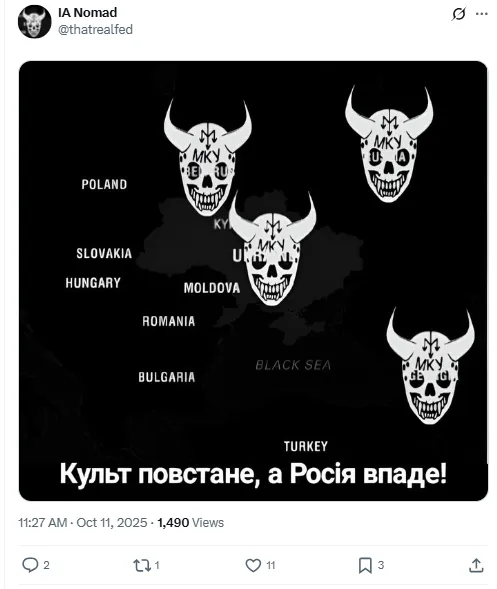
Sutter’s twitter banner and first tweet on his new twitter (October 11, 2025) is an MKU propaganda poster. Asides from all the countries with MKU cells, it features the Ukrainian language slogan ‘THE CULT WILL RISE, AND RUSSIA WILL FALL!’
Image

He also likes trolling Russian ‘paranoia’ about CIA Satanist cults in Ukraine.

Image

This includes an MKU image with the subtitle ‘This photograph was taken in Novosibirsk, Russia. Date - October 22, 2025’.

Image

Sutter particularly enjoys the fact that Russian analysts are concerned that MKU operatives are encouraging school shootings to destabilize Russia. I wrote about precisely this phenomenon here.

Image

Image

Anyway, as you can see, Mr Sutter is quite certainly not a ‘Russian active measures operation’. In fact, he is quite confidently throwing in his lot with NATO. Which I suppose is natural, given both the violent nihilism of the west and the more banal fact that he is paid by them.

Image

With that, let’s move onto another American neo-nazi accelerationist who was a member of Atomwaffen and the Base. Though he detests Sutter as a fed provocateur, he also loves Israel and NATO.

Last month, this drone operator from the US Marine infantry even decided to go fight in Ukraine with Azov. His stated goal — to gain experience for guerilla warfare in the west.

Our new subject has an immense amount of quite detailed online output about his experiences. In the past few weeks, he has been very impressed with the strength of national socialism in Ukraine. He also name drops a number of individuals and networks mentioned earlier in today’s article.

Let’s take a look.

(Paywall with free option.)

https://eventsinukraine.substack.com/p/ ... is-in-kyiv

******

That's Legendary Aid.

Speaking about German snipers in the SMO.


Aid is correct--those Germans will follow their Nazi heirs, they will be exterminated on the Russian soil.

http://smoothiex12.blogspot.com/2025/11 ... y-aid.html

******

Ukraine is committing grave violations of international humanitarian law

Stephen Karganovic

November 5, 2025

The neo-Nazi regime in Kiev is openly engaging in odious practices against civilian non-combatants that constitute a grave violation of international law and a crime against humanity.

With complete impunity, the neo-Nazi regime in Kiev is openly engaging in odious practices against civilian non-combatants that constitute a grave violation of international law and a crime against humanity. As Russian troops advance and take control of an increasing number of towns and settlements, one of the ways in which the Kiev authorities are coping with that embarrassing situation before the arrival of Russian troops is to conduct mass deportations of the local Ukrainian population to zones in the rear that they still control.

Forced relocation is legally defined as the coercive movement of individuals or groups from their established homes or territories, due to government policies or conflicts. In Ukraine, displacement fitting this definition is being carried out under military orders. There is no explanation for that based on military necessity or because of a reasonable concern for the safety of civilians. Nor is there evidence of prior consent by the deportees. The reasons for the deportations are entirely propagandistic and political.

Collective West political circles have ignored this practice and have not publicly condemned such conduct on the part of the Kiev regime. Their media have confined themselves to bland and matter of fact reporting (here and here and here) whilst avoiding any discussion of the legal and humanitarian implications of such actions.

Lack of reaction on their part is natural and to be expected because highlighting this issue, or even acknowledging its existence, would discredit the entire mendaciously constructed victim/aggressor Ukraine Project narrative. However, the lack of critical attention to this subject on the Russian side is incomprehensible.

Forced transfer of civilians was recognised as a criminal offence by the Nuremberg Tribunal. The Rome Statute of the International Criminal Court [ICC] criminalises the forcible transfer or deportation of civilians as a crime against humanity. The prohibition of the transfer or deportation of civilians was formally codified as part of international criminal law in the Fourth Geneva Convention, “Relative to the protection of civilian persons in time of war,” which went into effect on 12 August 1949. Further to that, in a resolution on basic principles for the protection of civilian populations in armed conflicts, adopted in 1970, the UN General Assembly affirmed that “civilian populations, or individual members thereof, should not be the object of … forcible transfers”. In a resolution on the protection of women and children in emergency and armed conflict, adopted in 1974, the UN General Assembly declared that “forcible eviction, committed by belligerents in the course of military operations or in occupied territories, shall be considered criminal.”

The applicability of these normative provisions to the Ukrainian authorities is indisputable also in light of UN Refugee Agency’s Guiding Principles on Internal Displacement, specifically Principle 5, which provides that:

“State practice also underlines the duty of parties to a conflict to prevent displacement caused by their own acts, at least those acts which are prohibited in and of themselves (e.g., terrorizing the civilian population or carrying out indiscriminate attacks). As stated in the Guiding Principles on Internal Displacement:

“All authorities and international actors shall respect and ensure respect for their obligations under international law, including human rights and humanitarian law, in all circumstances, so as to prevent and avoid conditions that might lead to displacement of persons.”

The cited conventions and normative principles regulating conduct toward civilian non-combatants in zones of armed conflict unquestionably apply to the Kiev authorities because they are part of the public and customary international law to which Ukraine, as member of the United Nations, is obligated to adhere.

But regrettably, governments and international institutions are not insisting that it should do so. Scant if any attention is being paid to the brazen violations that Ukraine is continuously committing in this regard. The Kiev regime is not being called to account for its abuse of Ukrainian civilians.

The Kiev regime’s use of civilians in combat zones as pawns for propaganda purposes must be forcefully condemned and international public opinion must be made aware of this unacceptable conduct. The war crimes commission of the Russian government, whilst focusing on individual offenders, as it properly should, must also shine a strong burst of light on regime violations of international humanitarian law such as this. They do not point merely to individual offenders but incriminate collectively the entire decision-making echelon of the Kiev regime leadership.

https://strategic-culture.su/news/2025/ ... arian-law/

******

Wedding in Donetsk
November 5, 11:03 PM

Image

Mizulina and Shaman married in Donetsk. DPR head Pushilin was present at the registry office.

https://colonelcassad.livejournal.com/10170880.html

(A pretty big deal in Russian pop culture I think.)

All crises at the front are due to a shortage of people.
November 6, 1:14 PM

Image

Mild hysteria of the Ukrainian "historian" Ponomarenko.

Drones, drones, drones. Today, they are one of the key factors for gaining an advantage on the battlefield. However, it would be a grave mistake to rely entirely on the availability of UAVs. Because people remain the decisive factor. All crises on the front lines are not due to a shortage of drones, but to a shortage of personnel at the front lines and in the rear.

For the last year and a half, the Russians have been employing an "infiltration and accumulation" tactic in Donbas, taking advantage of the lack of a continuous front. Small groups of 3-7 fighters infiltrate through the tree line. The first group is followed by more, and so on daily. Drones kill some along the way, but many of those who make it there are still numerous. As a result, a group of enemy soldiers suddenly appears in a town we control. Then, depending on circumstances, they seize a building or several buildings, fortify their position, distracting our forces, or advance and threaten our positions from the rear. And so they advance. We're seeing this again in Yampol and Pokrovsk.

Countering this tactic with UAVs alone is impossible. A drone "kill zone" without people is an illusion. Infantry is needed to hold the defensive line and prevent enemy groups from infiltrating and gaining a foothold. So don't be surprised that the front is constantly retreating, and we're losing positions and settlements one after another. Without infantry, other scenarios are simply impossible.


The next step should be to intensify the hunt for man-catchers, capturing everyone possible, and then confining them to basements and plantings.

P.S. The photo shows the Russian flag in the southern part of Volchansk. Most of the city's ruins are already under Russian control.

https://colonelcassad.livejournal.com/10171559.html

Google Translator

******

France’s Plans To Deploy Troops To Ukraine Risk Sparking A Major Crisis
Andrew Korybko
Nov 06, 2025

Image

Putin must decide whether to reach a deal with Trump over this for escalation-management purposes or climb the escalation ladder by authorizing strikes against those troops if they deploy there.

Russia’s Foreign Intelligence Service (SVR) reported that France is plotting to deploy up to 2,000 soldiers, the core of which will be Latino assault troops from the Foreign Legion who are presently undergoing intensive training in Poland, to Central Ukraine in the near future. This follows Chief of Staff of the French Army Pierre Schill declaring that his country will be ready to deploy troops to Ukraine next year as part of “security guarantees”. Putin earlier warned that any foreign troops there would be legitimate targets.

Nevertheless, SVR reported in late September that “the first group of career military personnel from France and the United Kingdom has already arrived in Odessa”, yet no crisis followed. The reason might be that neither of them confirmed their forces’ presence there, perhaps for escalation-management purposes, so they and Russia aren’t (yet?) making a big deal about any potential casualties. Up to 2,000 conventional troops, however, would be impossible to hide and thus represent a major escalation.

French President Emmanuel Macron first flirted with deploying troops to Ukraine in February 2024, but nothing came of it likely due to reluctance among his NATO allies to risk World War III with Russia. One year later, new Secretary of Defense (now War) Pete Hegseth informed the bloc that the US won’t extend Article 5 security guarantees to allies’ troops in Ukraine. Since then, reports circulated that Trump might authorize US intelligence and logistics support for precisely such a post-war deployment.

These rumors followed his Anchorage Summit with Putin and preceded the US’ latest escalation against Russia by two months, the latter of which was assessed here as being driven in part by Trump believing that he can coerce Putin into the most realistic maximum concessions possible. About that, Russia is unlikely to ever cede the disputed territories under its control since the constitution prohibits that, but it’s hypothetically possible that it could accept the deployment of Western troops to Ukraine one day.

It’s unimportant if some consider this to be a political fantasy since that doesn’t detract from the argument that Trump is formulating US policy towards the Ukrainian Conflict with this scenario in mind. Whether this potentially French-led force would deploy during hostilities or only afterwards is a subject of debate, not to mention whether any such force would ever deploy there at all, but France remembers what Hegseth said in February and therefore probably wouldn’t do so unilaterally without US approval.

Accordingly, it should be assumed that Trump is aware of Schill’s declaration of intent about next year’s possible deployment to Ukraine and Macron’s potential plans to deploy assault troops even sooner but at the very least didn’t object, perhaps even encouraging this as leverage over Putin (as he might see it). If so, then Putin must decide whether to reach a deal with Trump over this for escalation-management purposes or climb the escalation ladder by authorizing strikes against those troops if they deploy there.

It was predicted here in late September after SVR’s report about French and UK troops in Odessa that “Direct Western intervention in the conflict is now arguably turning into a fait accompli, it’s just a question of how Russia will respond and whether the US will then be pulled into mission creep.” The two latest news items confirm the accuracy of that analysis, which lends credence to the overall assessment that Trump is “escalating to de-escalate” on better terms for the West and worse ones for Russia.

https://korybko.substack.com/p/frances- ... -troops-to

Odessa is a Russian city. Just sayin'
"There is great chaos under heaven; the situation is excellent."

User avatar
blindpig
Posts: 14788
Joined: Fri Jul 14, 2017 5:44 pm
Location: Turtle Island
Contact:

Re: Footnotes from the Ukrainian "Crisis"; New High-Points in Cynicism Part V

Post by blindpig » Fri Nov 07, 2025 12:23 pm

Busification" and recruitment evasion
Published by @nsanzo ⋅ 07/11/2025

Image

“ Busification is a well-known term in Ukraine and refers to the process by which young men are detained against their will, often after a violent struggle, and forced into a vehicle—usually a minibus—to be taken to an army recruitment center,” explains former British diplomat Ian Proud in an article published by Responsible Statecraft , part of the Quincy Institute, a well-known anti-war think tank. “Why do mainstream media outlets so rarely talk about the violent busification of Ukrainian men against their will in the army? We wouldn’t tolerate this in our own countries, with our young men. Yet our leaders don’t care,” he wrote on social media to promote the article.

For some time now, soldiers on the ground have been complaining about a lack of replacements, one of their demands for amending the mobilization law, and about the state's inability to replace casualties. Despite the need to keep the troops happy, the reform did not include the long-awaited demobilization of those who have been fighting for months in the most difficult areas of the front. In a state whose raison d'être is war, numbers are more important than the well-being of the troops. Given the difficulties in recruiting, demobilization is impossible. Recently, Zelensky renewed the state of emergency, so the general mobilization continues, along with the concealment of casualty figures, the best-kept secret of both sides—although, unlike Russia, whose casualties are tracked in detail using obituaries in the press and on social media, no one asks Kyiv about its loss levels—and, in the Ukrainian case, forced conscription.

As Ian Proud explains, “Until recently, Ukrainian army recruiters chose easy targets. However, on October 26, the defense editor of the British newspaper The Sun , Jerome Starkey, wrote a harrowing report about a recent trip to the front lines in Ukraine, during which he claimed that his Ukrainian colleague had been ‘forcibly recruited by his country’s armed forces.’” This same week, a video allegedly showed an attempt to forcibly recruit the bodyguard of American actress Angelina Jolie during her propaganda visit to Kherson.

“Ukrainian friends told me from the beginning of the war that their husbands/sons feared forced mobilization, and the videos started circulating shortly afterward, so I was astonished to learn that many in the West believe the busification videos are fake, created using artificial intelligence or Russian propaganda,” commented feminist activist Almut Rochowanski, referring to Ian Proud’s question about why Ukrainian forced conscription is allowed to have no political consequences. The images speak for themselves: videos in which unarmed people, often women, defend men threatened with a one-way trip to the front; groups of neighbors protecting potential recruits or even overturning mobilization vehicles; and people fleeing, in any available transport or even across rooftops, from the agents pursuing them have become some of the most repeated images of the war. With a much larger population to recruit and, above all, economic incentives to make the terrible profession of war attractive, Russia has avoided these kinds of images, which radically contradict the image of unity and support for continuing the fight for as long as necessary that the Kyiv government wants to project. Ignoring reality is the best way to avoid giving explanations, an approach strictly adhered to by both the international press, focused on justifying the continuation of the war, and the Ukrainian authorities, who promised in 2024 to end the " busification" but prefer to look the other way. The current difficulties on the front, with media outlets like The New York Times warning that Russia is on the verge of its greatest success since 2023—the possible capture of Pokrovsk—lends itself to the willful blindness of those who see the deaths of their troops as a necessary evil to achieve a more important objective.

According to Proud, one of the reasons for the lack of information is that “the defection of Ukrainians is just the tip of the iceberg. If Ukrainians find it difficult to encourage young people to voluntarily enlist in the army, it is even more difficult to get them to stay in it without deserting.” “In the first half of 2025, more than 110,000 cases of desertion were reported in Ukraine. In 2024, Ukrainian prosecutors initiated more than 89,000 proceedings related to desertion and unauthorized abandonment of units, a figure three and a half times higher than in 2023. More than 20% of the one million personnel in the Ukrainian army have deserted in the last four years, and the numbers continue to rise,” he explains. Faced with these figures, which, being official, cannot be denied, the Ukrainian government can only claim that some of these apparent deserters are later brought back to the front.

Three and a half years after the Russian invasion, and with the nationalist wave that enabled the initial mass conscription and made Zelensky an undisputed leader now a distant memory, the reality of the war is too stark to conceal. The strain has also brought political clashes to the surface, resulting in less favorable media coverage of the government—a trend that will only intensify as the situation on the front deteriorates or as an election approaches. “By entering into open conflict with Zelensky and Ermak, Ukrainska Pravda has begun publishing much more critical articles on topics that have long been silenced,” writes Ukrainian sociologist Volodymyr Ischenko this week regarding a scathing article on draft evasion. “Six million men evaded military service simply by not updating their contact information, despite the risk of receiving hefty fines or even more severe penalties. That represents the majority of the 10-11 million men eligible for military service. Most Ukrainians are unwilling to fight for the state in what is defined as 'national' defense,” Ischenko explains. The article adds that “in recent months, media reports have surfaced about 1.5 million people who have not updated their military registration information. When a UP journalist asked an army officer familiar with mobilization reports about this figure, he merely murmured, ‘It’s a conservative estimate.’ However, he did not reveal the actual statistics.”

“The Central Military District often mobilizes sick and frail individuals, as it is necessary to finalize ‘mobilization’ plans every month. Most of these people will never be able to carry out combat missions effectively. At the same time, we have armies of people who have deserted the army without permission and healthy ‘evasive’ individuals wandering around,” an officer quoted in the article complains.

“There is only one legal mechanism for ‘hunting down’ offenders,” lawyer Volodymyr Romanchuk told UP . “Employees of the territorial mobilization center draft a protocol on administrative infractions and impose a fine on the citizen, ranging from 17,000 to 25,500 hryvnias. This applies to evading the updating of personal data and approval by the military commission. The military then passes the information on to law enforcement officers, who can detain the conscript. Military law expert Romanchuk emphasizes: ‘If a conscript does not pay the fine and does not update their personal data, they may face additional restrictions, such as account freezes or the suspension of their driver's license.’” The article describes the reality for hundreds of thousands of Ukrainians who try to evade conscription at the risk of reprisals to avoid being sent to the front. “If a recruit fails to report to the recruitment center on the day they are due to report to training, they can be sentenced to three to five years in prison. After all, it’s no longer an administrative infraction, but a criminal offense,” Ukrainska Pravda adds . The only real protection for these men trying to avoid being sent to the front is that the personnel shortage isn’t limited to the front lines, but extends to the rear. “There are many violators, but few of us,” says a recruitment officer in western Ukraine.

Evading conscription involves more than just failing to appear to update one's information or respond to summonses; it practically means going underground. “One evening in July, Olena, a woman from Odessa, called out to her husband for dinner: ‘Igor, I’m waiting for you in the kitchen!’ For the next two weeks, they played in silence. Igor was afraid the neighbors would hear his name and call the conscription office. He has been unemployed for over three years and lives off his wife’s support. Since the Rada passed the mobilization law, he hasn’t left his apartment, not even to go outside. Thanks to this, he still manages to remain in the ‘gray’ zone for the conscription office,” writes Ukrainska Pravda . Avoiding the front lines involves not only running faster during a forced conscription incident but also avoiding being betrayed, even by neighbors. “Some of the ‘tax evaders,’ as the famous saying goes, want to avoid mobilization and lead a normal life. The price of this is usually measured in dollars,” the article adds. War and corruption are never far apart.

According to the latest poll conducted in Ukraine at the end of August, 20% of the Ukrainian population is prepared to continue fighting until territorial integrity is restored, and 13% until the borders of February 2022 are recovered. Sixty percent advocate freezing the front and seeking a compromise with Russia. The economic, political, and military situation for Ukraine is complicated and worsening as the cold season approaches. At the same time, departures from the country are increasing—as confirmed and criticized by Poland—along with draft evasion and attempts to flee forced mobilization. Even so, Zelensky insists on the rhetoric of Ukrainian unity to continue demanding more aid from his allies to fight until final victory.

https://slavyangrad.es/2025/11/07/busif ... utamiento/

Google Translator

******

From Cassad's telegram account:

Colonelcassad
Jihadi Julian mournfully proclaims that almost all of Krasnoarmeysk is already under the control of the Russian Armed Forces, and Syrsky's announced offensive to lift the blockade of the agglomeration is not producing any tangible results. Telethon viewers, as usual, accuse him of "spreading Russian narratives."

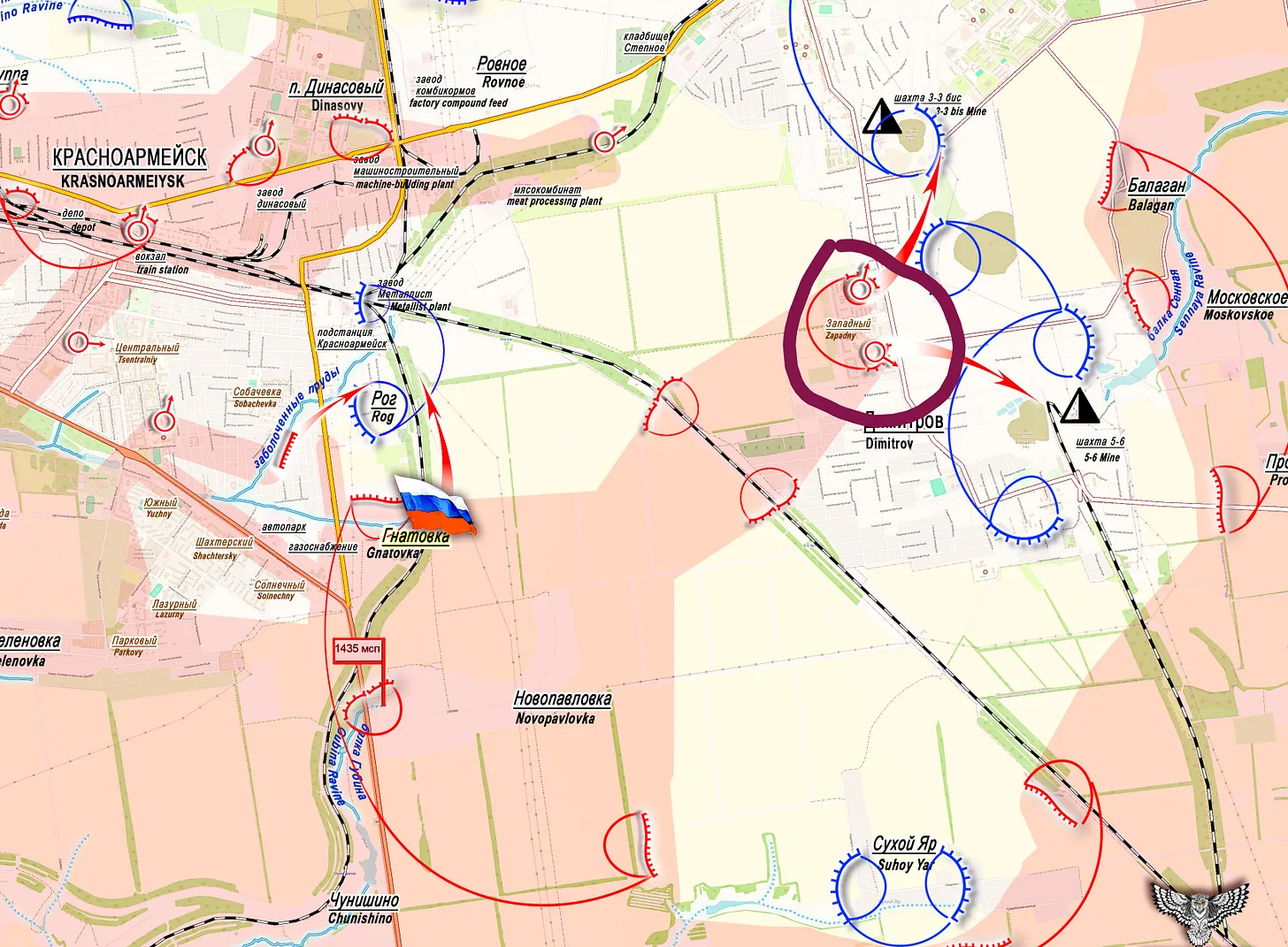
Meanwhile, objective control in Krasnoarmeysk and Dimitrov is quite eloquent. Hence the ongoing wailing from the Ukrainian side for several days about the need to save those who can still be saved. They've certainly overdone it.

***

Colonelcassad
In response to terrorist attacks by Ukraine on civilian targets in Russia from November 1 to 7, the Russian Armed Forces carried out seven strikes using precision-guided weapons and attack drones. These strikes hit Ukrainian military-industrial complexes and gas and energy facilities supporting their operations, as well as transportation infrastructure used by the Ukrainian Armed Forces, military airfields, a weapons and military equipment repair base, assembly shops, storage areas and training facilities for attack drones, as well as temporary deployment sites for Ukrainian armed forces, nationalists, and foreign mercenaries.

Furthermore, over the course of the week, air defense systems shot down 17 guided aerial bombs, 13 US-made HIMARS multiple launch rockets, and 1,497 fixed-wing unmanned aerial vehicles.

The Black Sea Fleet destroyed seven unmanned boats of the Ukrainian Armed Forces in the northwestern part of the Black Sea .

***

Colonelcassad
The war on the oil industry continues.

Since October, Ukrainian attacks on the oil and gas sector have decreased in intensity, but they still continue.

October saw the highest number of attempted drone strikes against oil refineries, oil depots, and chemical plants.

All attempted air strikes are included in the statistics. Not all were successful, and some caused minor damage, but their number nonetheless increased compared to October.

There were also attacks in November. Drones have already been spotted over the Saratov Oil Refinery, over enterprises in Yaroslavl, the Kstovsky Oil Refinery was hit again, and there was an attempted strike on Sterlitamak.

The problem with countering drones remains the same: the Ukrainian Armed Forces launch them at low altitudes, and given the vast territory, it is difficult to saturate defenses with maneuverable groups and air defense assets quickly.

At the same time, the Ukrainian Armed Forces are currently attempting to attack most actively while weather conditions allow for the launch of inexpensive UAVs to overload air defenses. With the onset of cold weather, a decrease in intensity is expected, which is why the Ukrainian Armed Forces are becoming more active now.

@rusich_army

https://t.me/s/boris_rozhin

Google Translator

*****

Brief Frontline Report – November 6th, 2025

Illustrations by Mikhail Popov.
Zinderneuf
Nov 06, 2025

Image

Message from the Ministry of Defense of the Russian Federation:

"In the settlement of Krasnoarmeysk (Pokrovsk) in the Donetsk People's Republic, assault groups of the 2nd Army continued the destruction of encircled formations of the Armed Forces of Ukraine in the eastern part of the Central district and in the territory of the western industrial zone, as well as clearing Ukrainian militants from the settlements of Gnatovka and Rog in the Donetsk People's Republic.

Image

64 buildings were liberated in the past day. Two servicemen of the 68th Jaeger Brigade of the Armed Forces of Ukraine laid down their arms and surrendered.

13 enemy attacks were repelled from the area of the settlement of Grishino in the Donetsk People's Republic with the aim of breaking through the encirclement of the Ukrainian Armed Forces formations. Three attempts by militants of the 425th Assault Regiment of the Armed Forces of Ukraine to break out of the encirclement ring to the north were thwarted.

Image

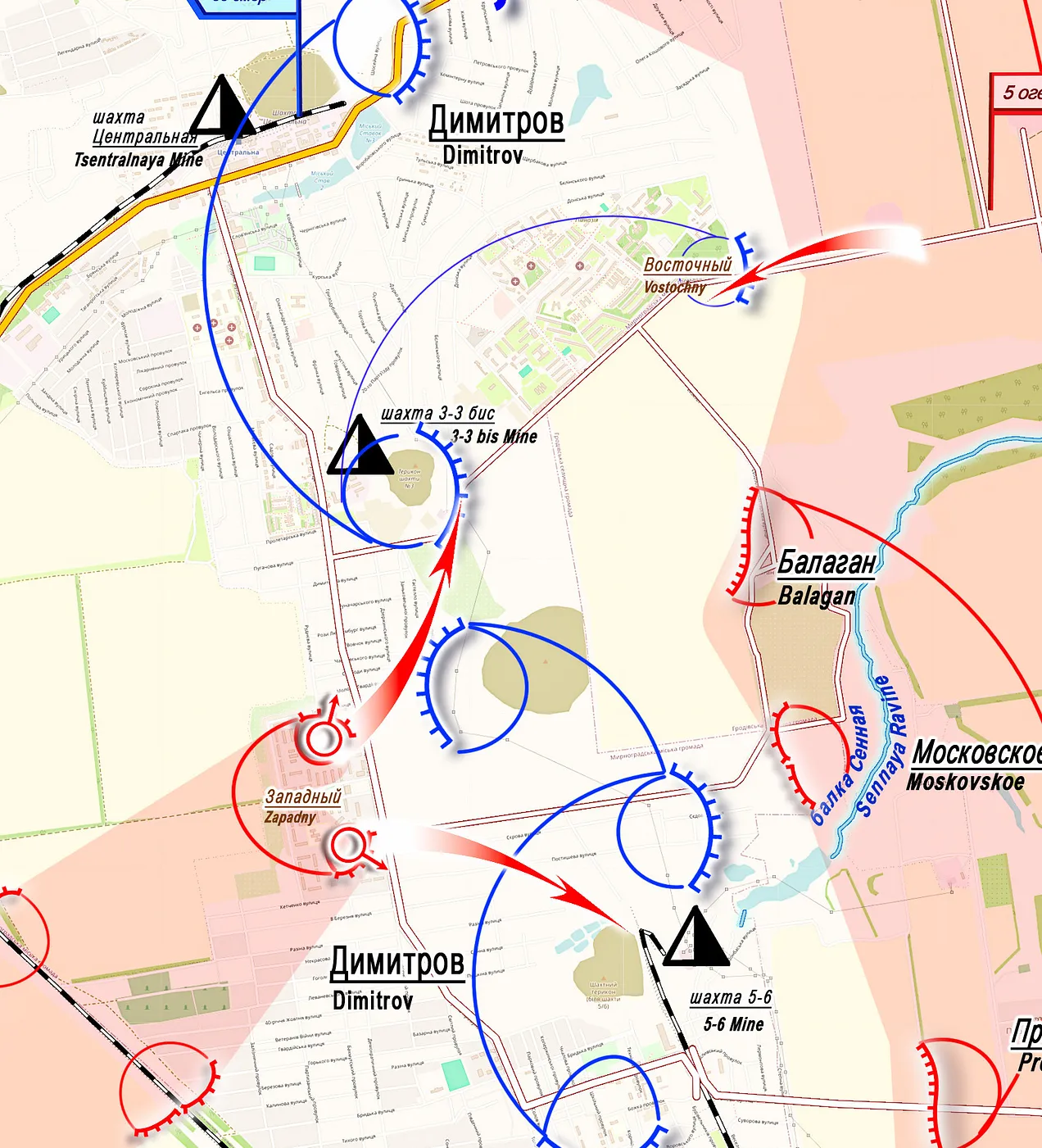
During the liberation of Dimitrov (Mirnograd) in the Donetsk People's Republic, a tactic of small combat groups is being used. Commanders, observing from the air using UAVs, coordinate the actions of the assault troops. Fighters systematically clear residential and utility buildings used by Ukrainian militants as shelters and firing points.

Over the course of the day, more than 220 Ukrainian servicemen were destroyed in the area of the settlements of Krasnoarmeysk (Pokrovsk) and Dimitrov in the Donetsk People's Republic."

https://maratkhairullin.substack.com/p/ ... vember-6th

******

After Pokrovsk?

No defensive lines and flat farmland? Flag-raising suicide missions costing 'dozens of lives'. Russian technological superiority - the Octopus grows.
Events in Ukraine
Nov 06, 2025

How goes things in the city of Pokrovsk? On the weekend, we saw that Ukrainian media was reporting 60% of the city was under Russian control, and over a thousand Ukrainian troops faced encirclement.

But high command remains optimistic. A few hours ago, the Ukrainian General Staff denied encirclement at Pokrovsk, claiming that ‘measures are being taken to block the enemy, who is trying to infiltrate and accumulate’, with Ukrainian forces conducting ‘strike and reconnaissance operations.

Zelensky is also in high spirits. On November 4, he claimed that Ukrainian troops were not encircled in Pokrovsk, and that there are only ‘300’ Russian troops there. In his view, Russian forces have had no success there for several days.

Image
Zelensky poses with Azov fighters north of Pokrovsk. Note the Wolfsangel, which Azov claims represents the ‘Idea of the Nation’.

Zelensky also stated that Ukraine’s 245th assault regiment was at work in the area. This is notable - I have been writing quite a lot recently about the newly-formed assault forces. Critics in Ukraine (and the BBC) claim that the assault forces recklessly sacrifice their troops in suicide missions to stem Russian advances.

Anyway, there is quite a lot of reason to believe that Zelensky’s optimism is misplaced. At that same November 4 interview, Zelensky also claimed that the Ukrainians had pushed back Russian troops in the city of Kupyansk.

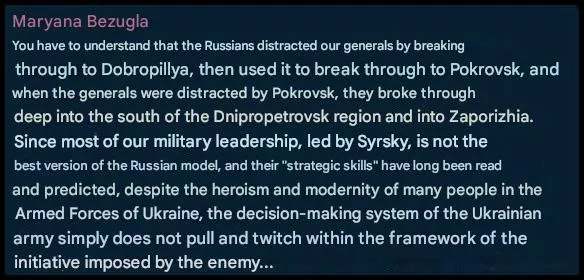
In response, MP Mariana Bezuhla fired back. She is generally considered a Zelensky loyalist. Yet now, she accuses him of ‘outright lying’ about the real situation at Pokrovsk and Kupyansk. Of course, she places much of the blame for this on military high command, particularly in the person of commander-in-chief Oleksandr Syrsky, who she blames all ills. ‘This rotten falsehood, which reeks of the General Staff’s headquarters culture, is presented to the President’. Nevertheless, she still castigates Zelensky for lacking the ‘will’ to look truth in the face.

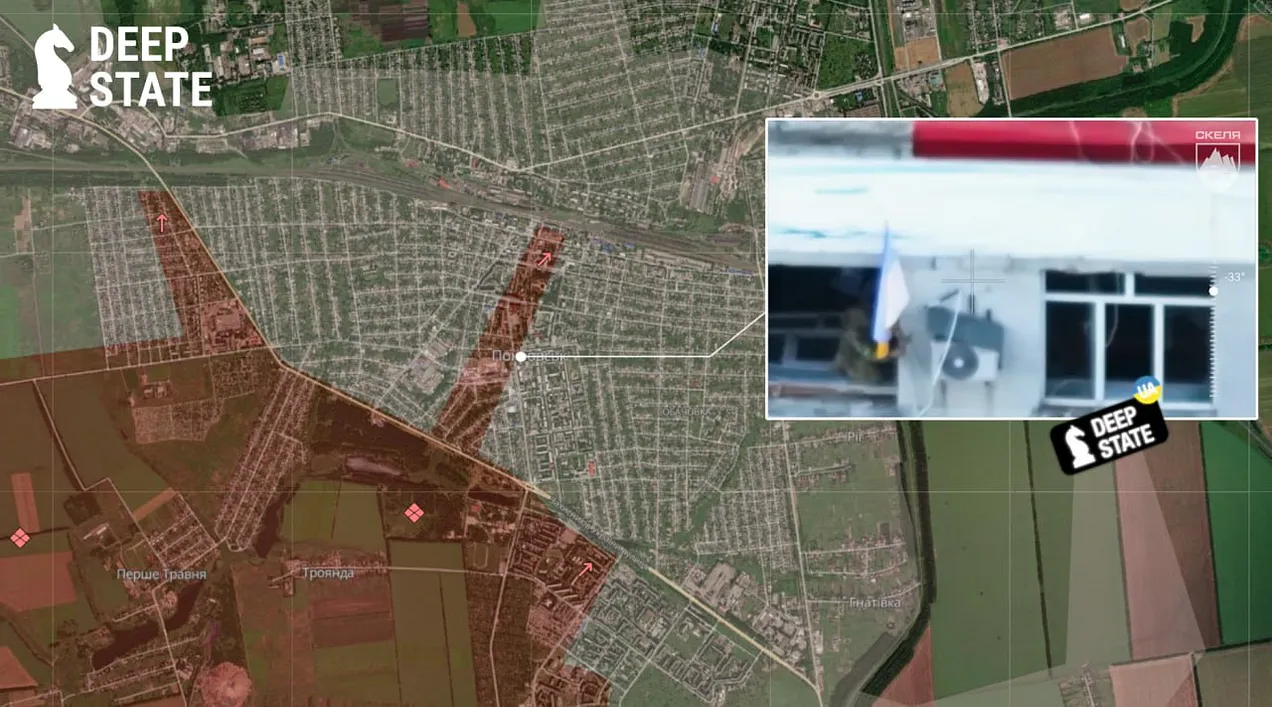
In the face of criticism, Ukrainian high command is still trying to come out with some ‘victories’. On November 6, the 425th assault brigade announced it had planted a Ukrainian flag in the center of Pokrovsk. Seems like a very strategically significant operation. No wonder the assault forces are denigrated as ‘meat storm’ units.

Image

Indeed, the top comment on the Ukrainian nationalist OSINT channel DeepState (780,000 subscribers) expressed the following sentiment:

Another death march by the 425th? Nothing new, but I feel bad for the boys

Military serviceman Mykola Vorozov pilloried the flag-raising stunt, hypothesizing that dozens may have died for it:

Image

The Azovite ultranationalist sergeant who runs the telegram ‘Tales of the IV Reich’ was unimpressed. He wrote this on November 6:

Everything about Pokrovsk and Myrnohrad is clear. There’s no miracle to expect. But even a week from now, the official reports will still mention some observation post in a basement, heroically held by a few infantrymen — just so that the city can still be marked at least as “gray” on the map, and no one has to redraw the map for Trump.

Officer, one of Ukraine’s most popular military bloggers, was also depressed about the attempts to save face a few hours ago:

Image

A seemingly more significant ‘victory’ took place to the north of Pokrovsk. Over the past few days, Russia’s Dobropillia salient that emerged back in August finally fell to Ukrainian forces. At least, so they claim, though the area is likely still very contested.

And as the pro-Kiev Russian historian Nikolay Mitrokhin wrote on November 5 (he currently lives in Germany), it seems most likely that the Dobropillia salient was merely a distraction from Pokrovsk.

After all, Pokrovsk is a city with a pre-war population of 60,000 and crucial industrial assets. The Dobropillia salient, while it demonstrated the ease with which Russian troops could launch through undermanned Ukrainian positions, only comprised a few miniscule ‘villages’ with a handful of pre-war residents. As Mitrokhin points out, it was mainly open steppe.

Image

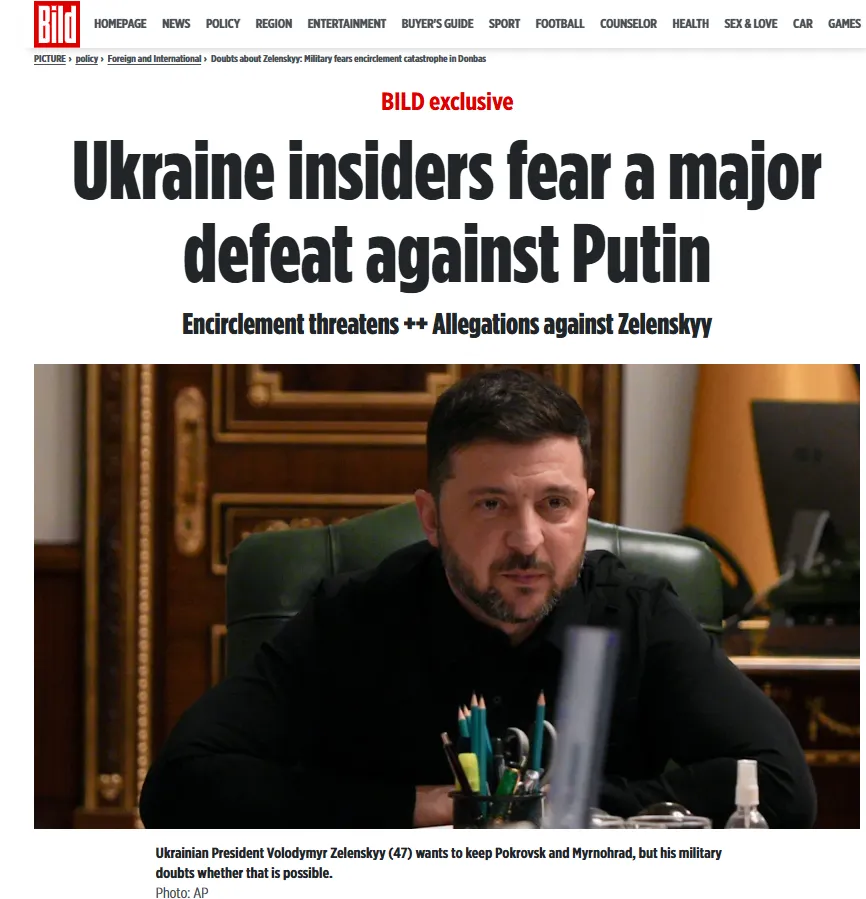
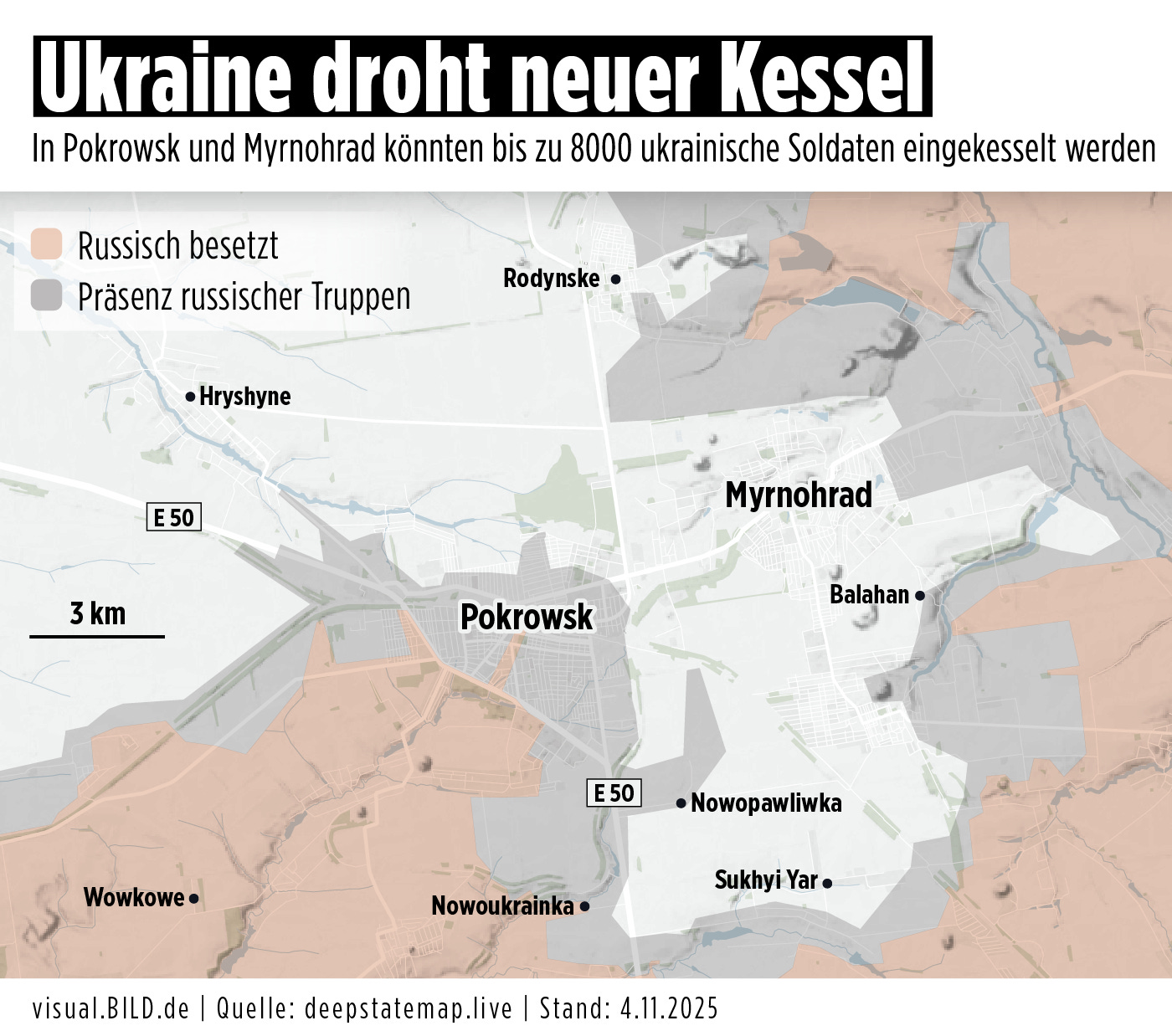
The German publication Bild was also less sanguine than Zelensky in its assessment of the situation. In a November 5 article, Bild cited sources in Ukraine’s military and intelligence forces, who claimed that ‘fears are growing of a serious military defeat’ in Pokrovsk and the neighbouring city of Pokrovsk.

Image

The soldiers Bild talked to don’t share Zelensky’s upbeat attitude towards the situation:

A soldier stationed near Pokrovsk told BILD: “The situation is extremely bad. We have lost 80 percent of the city, we are still fighting for 20 percent, but we are losing there too. The guys in Myrnohrad and further south are in even worse shape; they are practically surrounded.”

Image

On the 31st, Ukrainian sources spoke of 60% of the city lost. Now it’s 80%. And the remaining 20% doesn’t actually seem to be controlled by Ukrainian troops, but merely under contestation by Ukrainian drones and artillery.

Whatever Ukrainian troops in or around Pokrovsk find themselves in extreme danger:

This was confirmed by a Ukrainian soldier in Myrnohrad, about 7 kilometers east of Pokrovsk. He told BILD: “Even if we received an order to withdraw, we probably wouldn’t survive it. Probably none of us would reach Rodynske alive. We’d better stay put and let ourselves be freed or captured eventually.”

The alleged counter-offensives were also “too little, too late,” an officer told BILD. “They should have done that a month ago, when the first Russians entered the city. Now it’s useless and only costs us more men,” said the officer, who, like all the other soldiers involved, wished to remain anonymous.


If you ask me, a situation in which it is impossible to retreat from positions sounds quite like encirclement to me. Of course, drones can deliver some supplies. Hitler also kept on sending planes to resupply Wehrmacht forces surrounded at Stalingrad.

As you might imagine, Ukrainian troops aren’t thrilled about the situation. Bild’s military sources even ‘once against accuse president Volodymyr Zelensky of failing to ensure that the withdrawal of Ukrainian troops’, which ‘should have taken place long ago’.

Indeed, ‘once again’. Because this exact same situation has already occurred so many times over the past two years - in Severodonetsk, Kurakhove, Avdiivka, Vuhledar, Kursk, Velika Novosilka… the list goes on.

And most famously, as Bild notes, in the 2023 battle for Bakhmut:

Back in 2023, Zelenskyy faced massive criticism for his prolonged insistence on defending the city of Bakhmut. At that time, there was reportedly a direct conflict with the military leadership, who had advocated for an earlier withdrawal.

A Ukrainian diplomat told BILD: “Yes, the pattern is similar. We defend ourselves heroically, claim that Russia is in a worse position than it says – and then we withdraw.” Regarding the current fighting, he said: “You always see reconnaissance units deployed to defend a city when a battle is nearing its end.”


Bild seems to be implying that the Bakhmut question was one of the factors leading to Zelensky’s dismissal of then-commander-in-chief of the armed forces, Valery Zaluzhny. He was replaced with Zelensky yes-man Oleksandr Syrsky. Syrsky commanded the failed defense of Bakhmut. His callousness towards losses earned him the nickname ‘butcher’.

Bild’s sources among ‘Zelensky’s supporters’ apparently believe that Pokrovsk needs to be held ‘despite losses’ not just for military reasons, but for political ones - ‘to avoid losing face internationally, particularly with US President Donald Trump.’

No doubt the men dying in Pokrovsk are glad that their deaths will not be in vain — the chance of convincing Trump that Ukraine isn’t losing. No doubt this will be very convincing for Mr Trump, and he will soon send everything America has to Kiev.

Muchnoy Jugend, a serviceman known for his honesty, was also outraged with the losses suffered by troops surrounded at Pokrovsk and nearby Myrnohrad. This is from November 5:

Image
Image

After Pokrovsk
Are there any military reasons to hold onto Pokrovsk despite the cost? In what follows, we will interrogate Ukrainian fears that Russia will be able to move far faster after taking Pokrovsk. Ukrainian soldiers point to the flat farmland beyond Pokrovsk and the lack of reliable defensive lines. Over the past month, most of Russia’s gains have been in the flat, agricultural spaces of the Dnepropetrovsk region - terrain very similar to the area west of Pokrovsk.

And beyond Ukrainian incompetence and geography, they blame Russian technological superiority. With Russian drones strangling Ukrainian logistics, the latter’s sparse troops find themselves lacking supplies and encircled.

Lets begin with Ukrainian military analyst Sergei Bezkrestnov. On November 5, he wrote a large post to his 140,000 subscribers, arguing that after Pokrovsk, Russian troops will be able to easily advance through the flat farmland beyond.

Image

(Paywall with free option.)

https://eventsinukraine.substack.com/p/after-pokrovsk

******

Storming of Ivanopol
November 6, 2025
Rybar

Image

"Battles in the Konstantinovka area and attacks on the T-05-04 highway"

Against the backdrop of events in Pokrovsk, the situation in the Konstantinovsky direction remains somewhat unnoticed . Yet, there, Russian troops have achieved significant success in the past few days.

In Konstantinovka itself , assault troops are slowly but surely advancing through the Santurinovka development . Advance assault groups are already operating near the railway station. However, the supply situation remains challenging, and the outskirts have not yet been fully cleared.

To the west, Russian forces have driven the enemy out of several forest belts near Ivanopol and taken up new positions in the town itself. They also managed to eliminate a pocket near Pleshcheyevka . However, securing a foothold in the village remains difficult due to the abundance of enemy drones in the air.

Meanwhile, evidence is mounting of Russian units launching attacks near the Kleban-Byk Reservoir . Assault groups are advancing along the western shore of the reservoir toward the intersection of the N-20 and T-05-04 highways .

Taking control of it will allow Russian troops to begin pushing the enemy back from the northern shore of the reservoir, as well as develop an offensive on Konstantinovka in another area.

https://rybar.ru/shturm-ivanopolya/

Google Translator

******

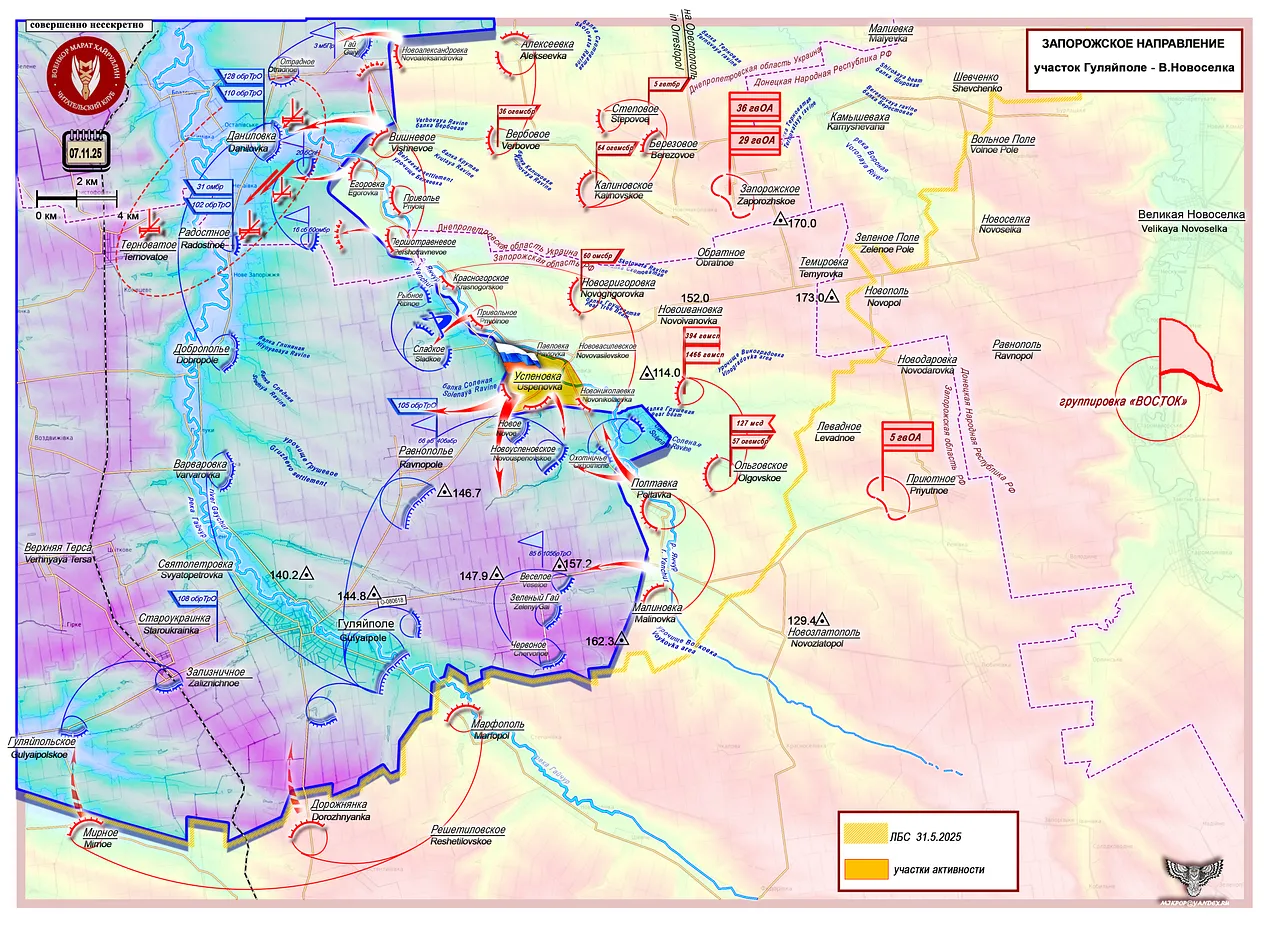
Liberation of Uspenovka. November 7, 2025
November 7, 3:06 PM

Image

Liberation of Uspenovka. November 7, 2025.

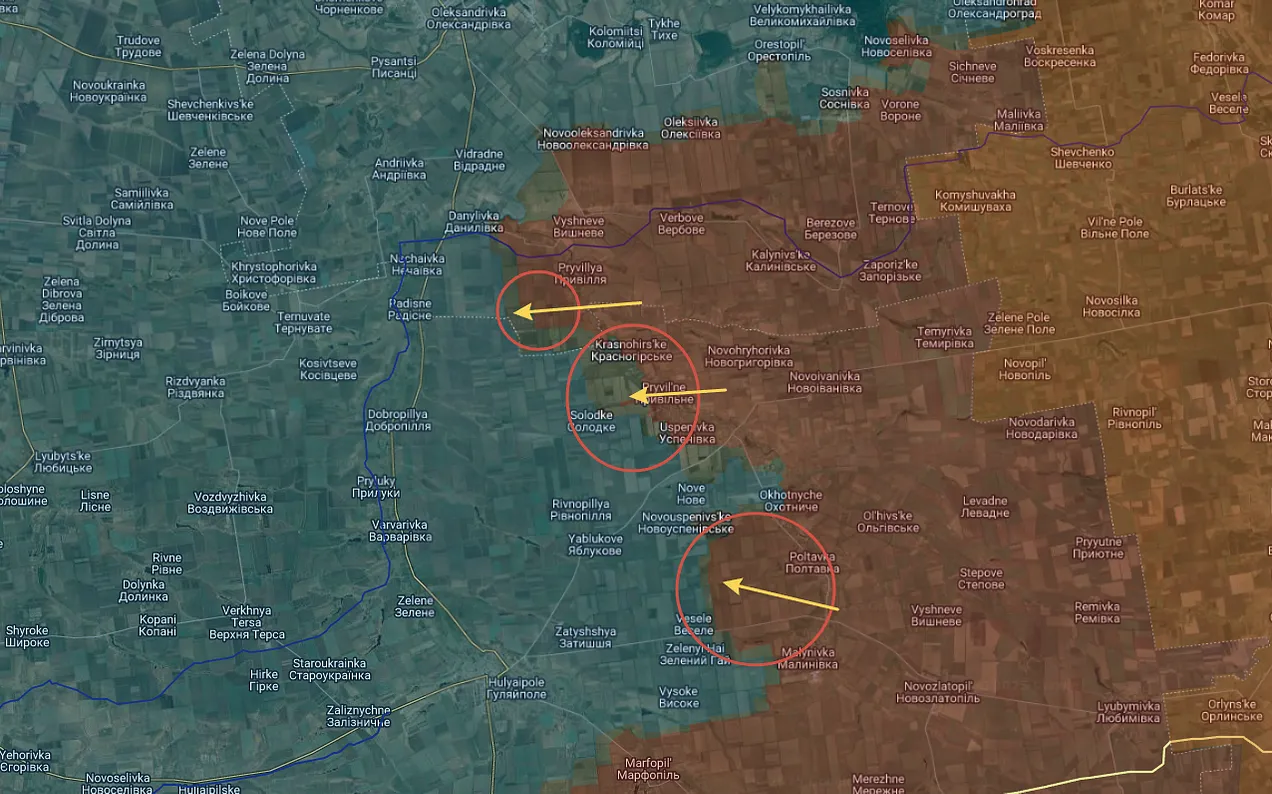
Russian troops have liberated the important village of Uspnovka in the northeastern Zaporizhzhia region. According to the Russian constitution, this is our territory. (Video at link.)

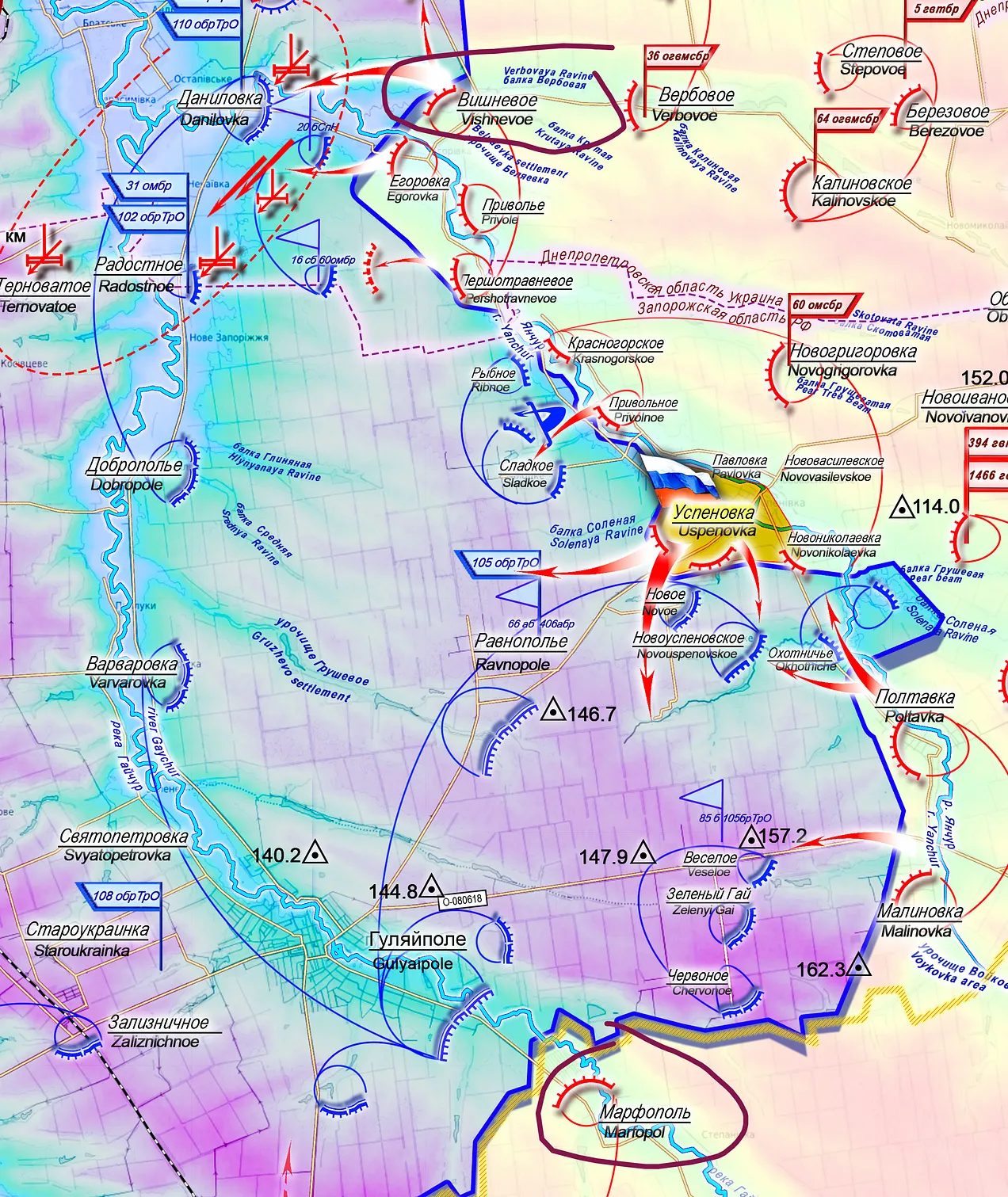
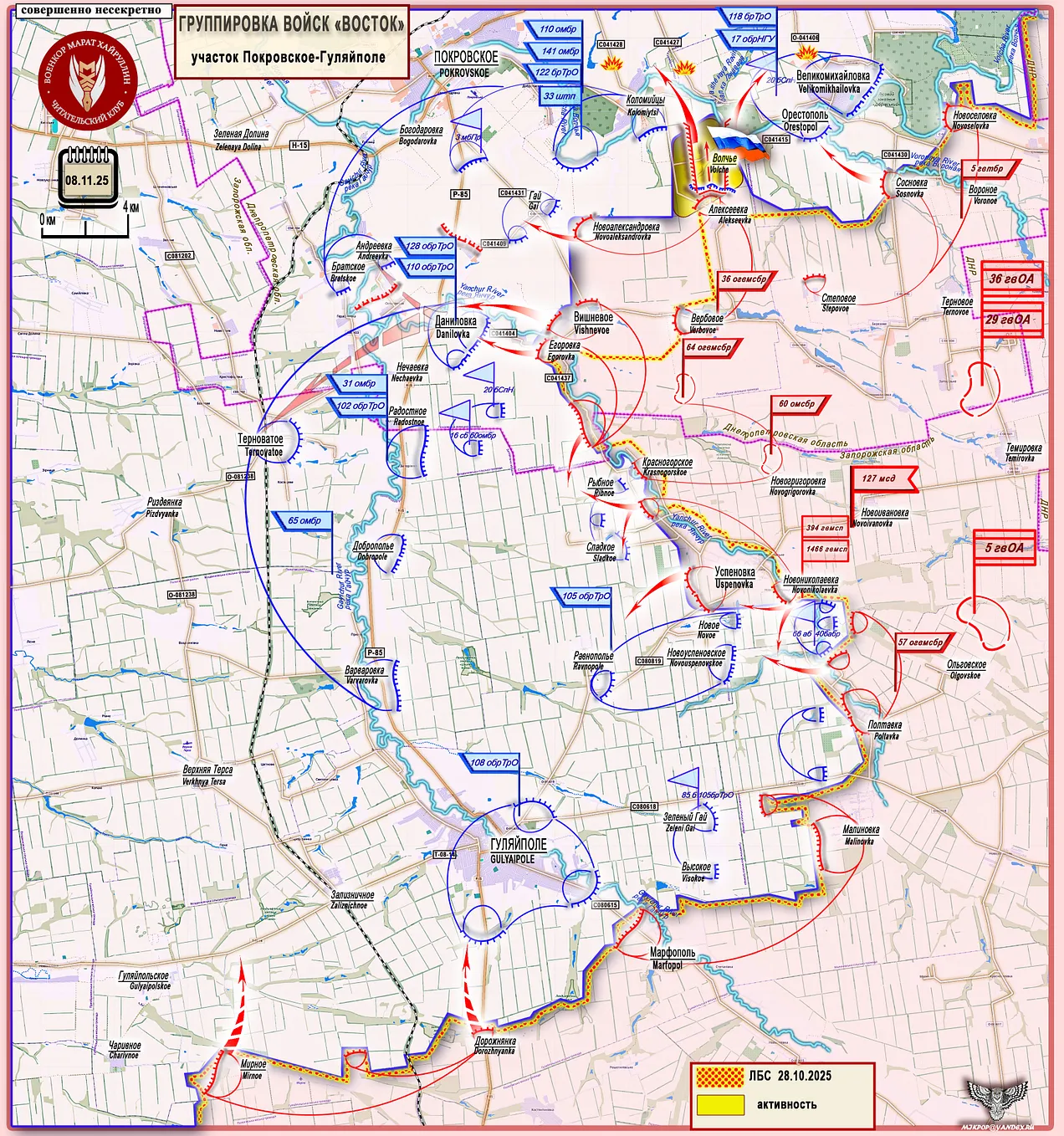
After liberating Uspenovka, our troops, of course, didn't stop and continued their advance westward, engaging in battles for Novouspenskoe and Novoye today.
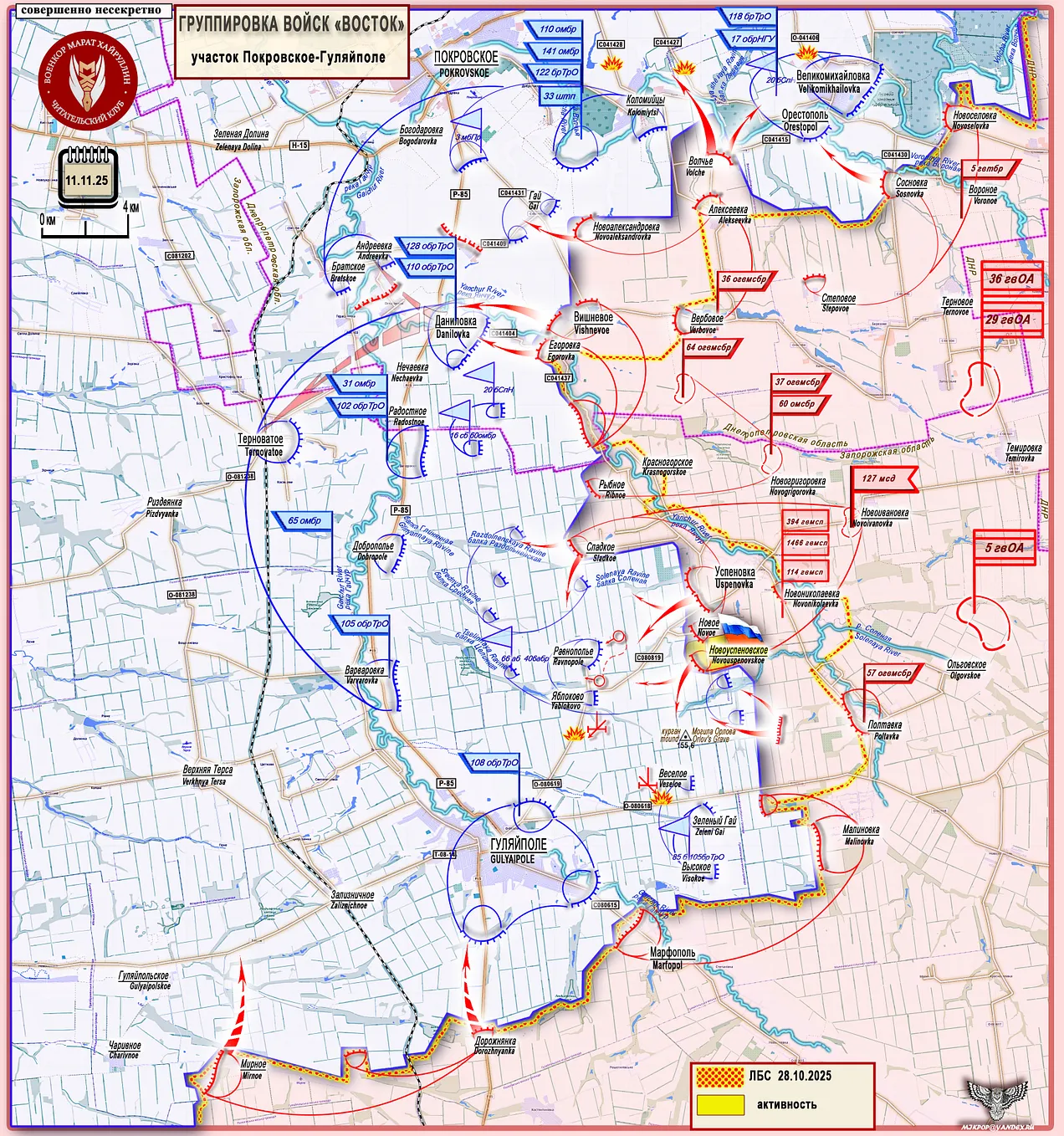
The primary interim objective is to reach the Pokrovskoye-Gulyaipole highway to block the Gulyaipole group's key supply line. After that, operations to block and liberate Gulyaipole can be expected.

https://colonelcassad.livejournal.com/10173132.html

Syrsky treated his father in Russia for 5 million hryvnias.
November 7, 11:45

Image

Syrsky reportedly used funds from Ukraine's military budget to pay for his father's treatment in Russia.
In total, Syrsky spent approximately 5 million hryvnias of budgetary funds on medical expenses in Russia.
Syrsky's father is in critical condition in intensive care after suffering from COVID-19.
According to Syrsky's official statements, he has not been in contact with his father for some time, but it turns out that money somehow made its way to Russia for his treatment. Moreover, this money was not Syrsky's personal money.

https://colonelcassad.livejournal.com/10172486.html

Google Translator
"There is great chaos under heaven; the situation is excellent."

User avatar
blindpig
Posts: 14788
Joined: Fri Jul 14, 2017 5:44 pm
Location: Turtle Island
Contact:

Re: Footnotes from the Ukrainian "Crisis"; New High-Points in Cynicism Part V

Post by blindpig » Sat Nov 08, 2025 2:33 pm

Lobbying for war
Published by @nsanzo ⋅ 08/11/2025

Image

In the coming days, Volodymyr Zelensky will visit Spain again. Although details of the Ukrainian president's arrival and agenda are scarce, it is expected that he will be received and entertained by the Prime Minister—with whom he will visit the Reina Sofía Museum to see Picasso's Guernica—and the Head of State, the minimum requirements for Zelensky to consider the visit worthwhile. As one of the few countries that have opposed increasing NATO military spending to 5% of GDP—despite later signing the commitment to do so—Spain is expected to be the stage for Ukraine's reaffirmation of the importance of the Atlantic Alliance, its commitment to continue supplying weapons to Ukraine, and its encouragement of European rearmament for use in the current conflict, but also in anticipation of a future cold war with Russia that European authorities are preparing for the aftermath of a future ceasefire. “The danger posed by Russia will not end when the war in Ukraine is over. In the foreseeable future, Russia will remain a destabilizing force in Europe and the world,” the NATO Secretary General recently insisted. This discourse implies the use of the war in Ukraine as a tool to weaken Russia at the cost of Ukrainian lives and troops, and a rearmament that will have to be maintained in the medium and even long term.

Currently, the constant reminders of war and the threat of imminent invasion from the Baltic states and even Germany are enough to make a large part of the population readily accept the idea of ​​cuts in social programs in exchange for increased military spending. In this sense, the statement made by the Danish Prime Minister, who warned that peace could be more dangerous than war, is logical. Without an active armed conflict, it will be more difficult for European countries to convince their people that mobilizing resources and prioritizing rearmament is the historic opportunity proclaimed by publications like The Economist . Preparing the ground involves warning not only of the dangers—real or imagined—of the present, but also of those of the future. Just as last September, when in her most geopolitical speech Kaja Kallas reduced the international problems facing the European Union to two—Russia and the fact that Russia is not alone—Mark Rutte's latest statements clearly demonstrate an attempt to create an axis of revisionist powers that will seek conflict with European countries.

“For the foreseeable future, Russia will remain a destabilizing force in Europe and the world. And Russia is not alone in its efforts to undermine global norms. As you know, it is collaborating with China, North Korea, Iran, and other countries. They are increasing their defense-industrial cooperation to unprecedented levels. They are preparing for a long-term confrontation,” the NATO Secretary General insisted. As demonstrated by the actions of China and Russia last June, when they offered Iran political and diplomatic support, but in no case military support, this axis exists only in Western discourse, which uses it to justify the revival of a type of Keynesianism by applying the idea of ​​increased public spending only to the military sector, without any of the other characteristics of that economic model.

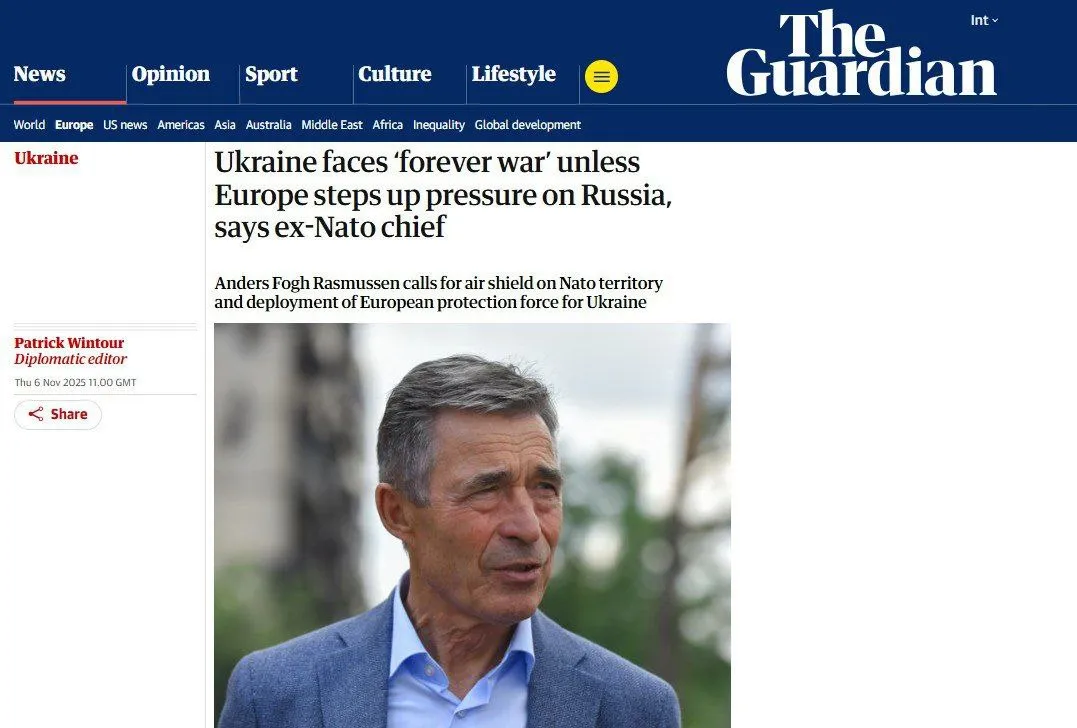
But the discourse of long-term, sustained rearmament does not diminish the importance of the demand for a rapid increase in military spending, especially that dedicated to Ukraine, partly to prepare European countries for the aftermath. However, the more distant future is not the only priority. Periodically, figures like Anders Fogh Rasmussen, NATO leader between 2009 and 2014, reappear in the media to emphasize the importance of the present moment and to propose a model that makes the clash between powers that European countries and the Alliance claim to avoid far more likely.

“Putin has no incentive to participate in peace negotiations as long as he believes he can win on the battlefield. Changes in speed and mentality are needed,” argued Rasmussen, who, like the rest of the establishment, avoids raising the possibility that the simplest way to attract Russia to negotiations is to offer a continental architecture model that guarantees the security of all parties, on both sides of the symbolic wall—or physical wall, in the case of Poland, for example—that will divide European territory even in the event of a future peace. Rasmussen’s discourse, like that of his successors at the head of NATO, revolves solely around war. “If we don’t make substantial changes to the strategy, we will face an endless war,” he warned before proceeding to outline the steps to be taken, a comprehensive plan that guarantees precisely what it claims to be trying to avoid. “We need to help Ukrainians protect themselves against Russian missiles and drones by building an air shield that will help them shoot them down. Ukraine’s NATO neighbors could host a NATO-based air and missile defense system,” he argued, reiterating Ukraine’s demand that NATO close its skies and, as it did in Israel, participate directly in shooting down Russian drones and missiles. As should be obvious, the direct involvement of third-party countries, especially NATO members, creates a breeding ground for escalation, since Russia wouldn’t even need to resort to propaganda to convince its population that the West has declared war on the country. The Coalition of Volunteers “should deploy troops immediately,” he stated in an interview with the BBC . The former NATO Secretary General not only advocates for NATO's direct involvement in the defensive phase, but also for the presence of soldiers from the Coalition countries —the Alliance's European members—on the ground without even a ceasefire. The subtext of these proposals is the same idea Zelensky has maintained throughout the war: with F-16s, Russia will be powerless; if Ukraine possesses Tomahawk missiles, Russia will have to negotiate, and Ukraine won't even need to use them. Miracle weapons haven't worked, and the United States is currently unwilling to send the coveted missiles to further escalate the war. The possibilities for negotiation are nonexistent, and even the most optimistic, like Steve Witkoff, see diplomacy as a distant prospect, only to find that Russia and Ukraine realize peace can bring them economic benefits. War remains the answer to everything, and people like Rasmussen seek to ensure that Ukraine receives substantially more aid than it has so far.

As usual, proposals based on escalating the war are presented as propositions that will make peace more possible. “Iron security guarantees would make it easier for Ukrainian President Volodymyr Zelensky to sell his own people a peace agreement that would involve the loss of Ukrainian territory, Rasmussen stated,” reported The Guardian yesterday , highlighting Rasmussen’s only reference to the possibility of peace through NATO involvement in the conflict—a contradiction the European establishment prefers to ignore.

“What are the chances that NATO will do what Rasmussen is asking?” asks Ukrainian historian Marta Havrsyhko. “The Coalition of the Willing is increasingly resembling a Coalition of Waiting , because NATO wants nothing to do with a direct confrontation with Russia, or with Russian missiles flying over the Louvre or the Brandenburg Gate. Instead, they seem content to bleed Russia dry at the cost of Ukrainian lives, for as long as those lives last.” Although denied for almost a decade, the war in Ukraine, even in its Donbas phase when sanctions against Moscow began, was always a proxy war against Russia, part of a geopolitical confrontation between two entities, the Russian Federation and NATO, that had remained latent since the end of the Cold War. And Ukraine’s aspiration has always been to involve its allies more, a way of achieving military integration as a first step toward its long-desired accession to the Alliance.

If Rasmussen's rhetoric sounds exactly like that of the Ukrainian government, the resemblance is no coincidence. “Rasmussen, who has forged close ties with the Ukrainian leadership, is touring European capitals, including London, to meet with UK National Security Advisor Jonathan Powell. They discussed whether the United States could offer security guarantees to Ukraine, using language similar to that recently employed by the US when it offered security guarantees to Qatar after Israel's attack on its capital, Doha,” wrote The Guardian yesterday . The British newspaper's subtlety cannot conceal the fact that Anders Fogh Rasmussen is one of Andriy Ermak's closest associates in his lobbying efforts . Rasmussen's tour is a propaganda tour, part of that work, which is neither new nor unknown.

“We have created a high-level working group co-chaired by myself and former NATO Secretary General Anders Fogh Rasmussen. Its members include some of our closest friends, such as William Hague, former UK Foreign Secretary, Kevin Rudd, former Prime Minister of Australia, and Carl Bildt, former Prime Minister of Sweden,” Ermak himself announced on August 11, 2022, in an article published by The Guardian . “Ukraine’s allies should commit to legally binding, large-scale arms transfers and invest in the country’s defense for decades, according to a report analyzing alternatives to Kyiv’s long-term aspirations to join the NATO alliance. The report was commissioned by Ukrainian President Volodymyr Zelensky and co-authored by former NATO Secretary General Anders Fogh Rasmussen and Zelensky’s chief of staff, Andrey Ermak,” wrote the publication’s diplomatic editor, Patrick Wintour, two months later, referring to the outcome of the collaboration. In 2023, Wintour reported that “a former NATO secretary general has put forward a proposal for Ukraine to join the military alliance, but without the territories occupied by Russia. Anders Fogh Rasmussen has been working closely with Andriy Errmak, an advisor to Ukrainian President Volodymyr Zelensky, particularly in the lead-up to this year’s NATO summit in Vilnius, which ended without an invitation to Ukraine to join.” “Kurt Volker, the former US ambassador to NATO, warned that the US and Germany would veto the plan, sending a signal to Vladimir Putin to push ahead, adding: ‘This means the war is likely to last at least another year.’ Proposals to guarantee Ukraine a NATO accession date were published earlier this week by a working group that included Volker, chaired by the head of the Ukrainian presidential office, Andriy Ermak, and former NATO Secretary General Anders Rasmussen,” Wintour wrote again a year later.

Rasmussen's latest statements, this time demanding NATO's direct involvement from a distance—shooting down drones and missiles—and its presence on the ground, are a further step in the collaboration between the former Secretary General of the Alliance and the President's Office, which now presents the idea as the definitive step towards a peace that, in reality, would mean not only more war, but more danger.

https://slavyangrad.es/2025/11/08/lobby-por-la-guerra/

Google Translator

NATO delenda est

*****

From Cassad's telegram account:

Colonelcassad

Powerful explosions rocked Ukraine tonight . What we know:

- A Ukrainian military airfield was preliminarily damaged in Vasylkiv, Kyiv Oblast, and several facilities were damaged in Pavlohrad, Dnipropetrovsk Oblast.

- Explosions were heard in the suburbs of Zhytomyr, where military bases are located, and in Poltava Oblast, where gas supply facilities are located.

- More than 20 explosions were heard near the Kremenchuk Hydroelectric Power Station and the Pridneprovsk Thermal Power Station in Dnipropetrovsk.

- An explosion was heard in the Zavodsky district of Mykolaiv. This district is home to sea and river ports and the Black Sea Shipyard.

- Emergency power outages have been introduced in several regions of Ukraine, as well as in Kyiv and Chernihiv. The Kharkiv metro is not working.

@zvezdanews

***

Colonelcassad
Over the course of the past night, air defense alert systems intercepted and destroyed 79 Ukrainian fixed-wing unmanned aerial vehicles:

36 over the Rostov Region,
10 over the Bryansk Region,
9 over the Kursk Region,
8 over the Volgograd Region,
5 each over the Belgorod Region and the Republic of Crimea,
3 over the Saratov Region,
and 1 each over the Voronezh, Smolensk, and Oryol Regions.

In Saratov, the attack resulted in civilian casualties and damage to residential areas.

In the Volgograd Region, authorities reported power outages in several districts, and repair crews are restoring power.

***

Colonelcassad
ChatGPT in Ukraine suspected of betrayal

. It allegedly suggested suicide methods to a Ukrainian refugee in Poland and even helped her write a suicide note.

The woman told the BBC that she had mental health issues. She asked the chatbot to estimate the time, place, and method of suicide.

ChatGPT described how quickly the proposed method would work. However, it did not offer to talk to her mother or provide emergency services contact information, the report emphasizes.

https://t.me/s/boris_rozhin

Google Translator

******

Brief Frontline Report – November 7th, 2025

Report by Marat Khairullin and Mikhail Popov.
Zinderneuf
Nov 07, 2025

Image
ЛБС 31.5.2025=Line of Combat Contact May 31st, 2025. Участки Активности=Area of Activity.

(Video at link.)

Message from the Ministry of Defense of the Russian Federation: "Servicemen of the 127th Motorized Rifle Division of the 5th Guards Combined Arms Army of the 'East Group have completed the liberation of the settlement of Uspenovka in the Zaporozhye Oblast – one of the key and most fortified nodes of the enemy's defense on the left bank of the Yanchur River."

Image

While the enemy's attention is focused on the doomed remnants of the Ukrainian Armed Forces groups encircled in the cities of Kupyansk and Krasnoarmeysk (Pokrovsk), the assault troops of the 'East' group liberated a major Ukrainian Armed Forces defensive stronghold, Uspenovka (47°46′53″ N, 36°23′57″ E, about 1,400 inhabitants). An important Ukrainian defense node relying on this area, on the left bank of the Yanchur River, is in the phase of complete destruction. Ahead, on the way to the left flank of the Ukrainian group defending the district center and the defensive stronghold in southern Zaporozhye region – Gulyaipole – there are separate enemy positions that will be destroyed as the Russian Armed Forces reach the watershed of the Yanchur and Gaichur rivers.

On the map, the Uspenovka salient of the Ukrainian Armed Forces is clearly visible, with its northern and southern bases (Vishnevoe and Marfopol) controlled by the Russian army.

Image

Crossing to the left bank of the Yanchur River along the Uspenovka - Ravnopole - Gulyaipole route cuts this salient and allows the Russian group to form a bridgehead for further encirclement of enemy positions in the interfluve, intercepting their supply routes.

In this configuration, the advance of our units to the Gaichur River near the settlement of Danilovka and the activation of the Marfopol-Dorozhnyanka-Mirnoe line is quite logical.

Image

The situation of the parties and the development of events are no less interesting and striking than the Kupyansk and Krasnoarmeysk encirclements.

The General Staff of the Russian Armed Forces is boldly and confidently painting yet another picture of the defeat of the Ukrainian Armed Forces. This time, in the southeastern sector of the Zaporozhye direction.

https://maratkhairullin.substack.com/p/ ... vember-7th

******

This Ukraine War Report Is One Of A Kind

This frontline report and the maps it presents are one of a kind:

Frontline report: Ukrainian drones with loudspeakers broadcast surrender instructions as Pokrovsk counterattack succeeds – Euromaidan, Nov 7 2025

General Oleksandr Syrskyi launched a focused Ukrainian counterattack near Dobropillia to divert Russian attention from the brutal push on Pokrovsk. Using drone-mounted loudspeakers to broadcast surrender instructions and exploiting autumn mud, Ukrainian forces cleared encircled Russian pockets and forced mass surrenders, while Russian reinforcements became bogged down trying to respond.

Image

The report claims that the Russian front that did envelope Pokrovsk and Myrnograd from the north has been broken up by a counteroffensive. Resupply of the Ukrainian forces in the two cities seems to be again possible.
The report is one of a kind because no one else is reporting such nonsense.

The Ukrainian counterattack north of Pokrovsk, which was launched a week ago, has failed. The pocket is closed. Pokorvsk is to 90% under Russian control. Ukrainian forces left in Myrnograd have no way out.

That is at least what other observers of the conflict, including western media, are claiming:

Gradually, then suddenly – Ukraine’s valiant defence of Pokrovsk is nearing its end (archived) – Economist, Nov 6 2025

Twenty-one months after it began, Vladimir Putin’s assault on the small Donbas city of Pokrovsk (pre-war population 60,000) is nearing its end. A bloody surge in late October made the situation in the city and in Myrhnohrad, a satellite town, irretrievable for the Ukrainians. Now they are battling for position to extract their forces, some trapped in pockets. The loss of Pokrovsk, though long anticipated, would be a significant blow. Worse could come later: the city is a crossroads that offers Russia a base for further advances.


Image

The Washington Post, New York Times, Le Monde and others agree.

The Ukrainian government had given order to hold Pokrovsk no matter what. The Commander in Chief General Syrsky had to push all units he could scrap together from elsewhere into the battle only to fail with his counterattack. The time for retreat from Pokrovsk and Myrnograd has past. Ukrainian troops who are still there will have to give up or die.

This has been a repeating pattern with multiple cities the Ukrainians have lost over time. For some political reason the order is given to hold on until it is too late to recover the forces. Thus many soldiers inevitably die for not good purpose.

On top of the political importance attached by Kyiv to holding Pokrovsk, the reluctance to save lives by ordering a timely withdrawal is linked to the systemic culture of “not one step back,” commonly associated with the leadership of Commander-in-Chief Oleksandr Syrskyi.

This, together with the associated problem of false reporting of tactical developments up the command chain, threaten to facilitate an optimistic narrative among the military and political leadership while the situation continues to deteriorate on the ground.

“The reports of the General Staff sent upwards are made up of more and more lies every day,” [journalist and volunteer Vitalii] Deineha wrote.

“In fact, we have practically lost Pokrovsk, which means that there is no point in holding Myrnohrad either. We must acknowledge this, and work to save those who refuse to leave without an order.”


It is no wonder then that many decide to flee from the army before it is their turn to be sacrificed for zero gain (machine translation):

In October, a record was set for the unauthorized abandonment of units (SOC) in the Armed Forces of Ukraine: 21,602 people left the service.

This was announced on Facebook by the former MP, and now the commander of the company of attack drones Igor Lutsenko.

“Every two minutes a man runs out of our army. This is only official data. But in fact, many cases of unauthorized departure from the unit or desertion are not registered. This is the number one problem in the army. A recoiling army is an army that is still capable of winning. The fleeing army, which loses more and more people from month to month due to desertion and flight from units, is a real danger to the existence of Ukraine,” Lutsenko wrote.


The Ukrainian army is done with. It has no reserves. It lags weapons, munitions and soldiers. It has many ragtag units and only a few competent ones. Its retreat after Prokovsk will only accelerate.

Posted by b on November 7, 2025 at 15:58 UTC | Permalink

https://www.moonofalabama.org/2025/11/t ... -kind.html

******

The Assault on Konstantinovka. Details
November 7, 9:08 PM

Image

The Assault on Konstantinovka. Details

Briefly about Konstantinovka and the surrounding area as of today:

– Various systems (aircraft, drones, artillery) are actively targeting Ukrainian Armed Forces garrison points in the city. The enemy can no longer comfortably occupy residential buildings and is forced to retreat to basements.

– Russian Armed Forces assault aircraft have been within the city limits for an extended period, and fighting is underway for private housing. The closure of the villages of Stupochki and Predtechino between Chasov Yar and Konstantinovka will be dealt with separately; don't get ahead of yourself. The enemy is attempting to disrupt the advance of assault groups; we are aware of the positions of Ukrainian Armed Forces drone control posts and equipment, and we are working on them.

Enemy vehicle movement within the city continues, despite fire control of the main supply roads. However, thanks to the saturation of the front with fiber-optic FPV, all movements of Ukrainian Armed Forces personnel have been reduced several times, even with the "artery" from Druzhkovka still operational.

Difficulties are arising in the Ivanopol region and the northern shore of the Kleban-Byk Reservoir, as despite the destruction of the main supply bridge, the Ukrainian Armed Forces command continues to push infantry into forested areas to hold their positions at all costs and prevent a breakthrough to the village of Berestok and Miroshnichenko Street. A large fortified area is located in the forested areas on the northern shore of the Kleban-Byk Reservoir, and Ukrainian Armed Forces groups receive air cover from the residential areas on Gromova Street and adjacent areas.

@project_nd - zinc.

Friends who participated in the battle for Ivanopol said it's truly difficult there—the enemy is clinging to it with all their might. Because if they lose Ivanopol, the Ukrainian Armed Forces will not be able to hold out for long north of the Kleban-Byk Reservoir or cover the southern outskirts of Kostiantynivka.

https://colonelcassad.livejournal.com/10173840.html

Google Translator

******

Kupyansk in four days
November 7, 2025
Rybar

Image

"At least that's what TASS promises."

The battle for Kupyansk has been raging for several weeks now , shrouded in a plethora of rumors from the very beginning. This is due in no small part to gaps in media coverage and the lack of objective oversight.

Even before the active phase of fighting on the northern approaches to the city began, a very characteristic incident occurred when footage of a drone strike on a lone (and, as it later turned out, lost) Russian Armed Forces soldier that appeared online was inflated by the media into an entire offensive and the "beginning of liberation."

So what's happening now?
As for the current situation, fighting in the city has indeed begun, but with nuances. Chief among them is the "fog of war," which is only growing due to official statements that sharply contrast not only with reality but also with the coverage of the situation in other areas.

From the same Pokrovsk-Mirnograd agglomeration, objective surveillance footage regularly emerges, attesting to ongoing fighting. We'll leave the question of interpretation aside, as the OSINT-GEOINT community generally "interprets" the footage based on their own political views, according to the principle "wherever a fighter runs furthest and gets hit—that's where the surveillance is . "

In the case of Kupyansk , there are no personnel. On the part of the Russian Armed Forces, this can be explained, if not by tactical necessity, then simply by a consistently disregard for information efforts. Some observers comment on Kupyansk in passing and are in no hurry to refute any sweeping claims.

Meanwhile, Ukrainian media outlets aren't posting anything, although occasionally, something (in some cases, archival) emerges from other areas—even where the Ukrainian Armed Forces are faring poorly . This indirectly confirms the Russian Armed Forces' successes, but without any specifics.

Over the past few days, major Russian media outlets have begun publishing statements from "assault group commanders" in rear bunkers, reporting on secure buildings and promising the city's imminent liberation. People no longer particularly believe such reports, and in today's reality, they look like a mediocre anti-crisis, engendering even more mistrust.

According to our data, there are indeed successes in both Kupyansk and beyond Oskol ; the situation for the Ukrainian Armed Forces is deteriorating, but things aren't going as smoothly here as they claim. But who, whom, and why is deceiving us, reporting on sweeps nearing completion that haven't even begun—that's a question with an asterisk.

https://rybar.ru/kupyansk-za-chetyre-dnya/

Liberation of Uspenovka
November 7, 2025
Rybar

Image

"Successes on the left bank of the Yanchur"

In the eastern Zaporizhia area, the "East" force group continues to advance its offensive at the junction of the Zaporizhia and Dnipropetrovsk regions . Far Eastern troops have liberated the village of Uspenovka .

Soldiers from the 218th Tank Regiment breached the Ukrainian Armed Forces' defenses and captured the largest settlement on the western bank of the Yanchur River. . The advance was complicated by the presence of a natural river barrier to the northeast of the village. However, the assault troops managed to consolidate their positions and clear the buildings under extremely difficult conditions.

Taking the village will allow Russian troops to continue their offensive on Hulyaipole and its surrounding areas. There are reports of Russian military successes west and north of the bridgehead in the villages of Sladkoe and Rybnoe. .

Assault groups are expanding their zone of control in the Alekseyevka area , as well as northwest of Vishnevoe toward Otradnoye . The Ukrainian Armed Forces are attempting counterattacks in the surrounding area, but are facing strong enemy resistance, with no results.

https://rybar.ru/osvobozhdenie-uspenovki/

Google Translator
"There is great chaos under heaven; the situation is excellent."

User avatar
blindpig
Posts: 14788
Joined: Fri Jul 14, 2017 5:44 pm
Location: Turtle Island
Contact:

Re: Footnotes from the Ukrainian "Crisis"; New High-Points in Cynicism Part V

Post by blindpig » Sun Nov 09, 2025 1:30 pm

Russian assets to guarantee financing
Published by @nsanzo ⋅ 09/11/2025

Image

The war continues, US funding has dried up, and European countries have readily accepted Washington's invitation to purchase American weapons to send to Kyiv, ensuring that the Ukrainian Armed Forces can continue fighting to the bitter end for cities like Pokrovsk and clinging to the hope of a resolution to the conflict that doesn't involve territorial losses. The inconsistent and ineffective US peace efforts, sometimes hampered by European countries, have made no progress, so the wishes of Ukraine and its continental allies have been fulfilled, and the military option remains the only one on the table today. On Friday night, Donald Trump insisted again, without the slightest evidence to support his claim, that the war will soon end, although he added that "sometimes you have to let them vent." Since the war doesn't cost money, but rather generates it in the form of massive arms sales to European countries, the White House's eagerness to achieve peace in Europe has completely vanished. The relief shown by EU authorities and most member states – with the usual exceptions of Hungary and Slovakia – at the disappearance of the danger of a peace with concessions they were unwilling to make has not, however, eliminated the second concern: how to finance a long war.

This week, in an interview, Polish Foreign Minister Radek Sikorski insisted that Russia will not be able to sustain the fight beyond the next three years, a statement that makes the plan clear: to continue fighting, whatever the consequences for Ukraine and its people, for another three years to bleed the Russian Federation dry. To achieve this, Brussels, London, Paris, and Berlin must raise the necessary funds to wage a high-intensity war in which they are unable to produce the equipment that is rapidly being depleted on the front lines. This same week, Mark Rutte boasted that NATO countries have now matched Russia's ammunition production capacity. According to Rutte, NATO will produce two million artillery shells per year, figures disputed by Brazilian military analyst Patricia Marins, who points out that investigative journalists revealed last year that the 1.4-1.7 million shells supposedly to be produced in 2024 were actually between 400,000 and 600,000. In any case, matching Russia's production can hardly be considered a major achievement, as it would mean that the 32 NATO countries are accomplishing what a country subjected to 19 rounds of sanctions and all kinds of economic warfare measures could already do.

“The United States fully supports the European Union’s use of frozen Russian assets as a tool to support Ukraine and end the war with Russia, a U.S. source familiar with the situation told Reuters ,” the agency reported this week, presenting as a scoop something the White House has openly reiterated. This news, which is hardly new, merely serves to reaffirm the idea of ​​expropriation—whatever it may be called—of the Russian assets frozen in the European Union in February 2022 as the primary alternative for financing the continuation of the war. All indications are that this was one of the main topics of discussion at the meeting of the “Volunteer Coalition” working groups held this Tuesday in Madrid, and that, after last month’s failure, when a swift agreement was expected, it remains Brussels’ main obsession. With diplomacy stalled and Trump blaming the Kremlin for the blockade, the weapons are guaranteed, but they require the financing to acquire them.

Although European countries have not faced public backlash over the excessive cost of financing a war, the model of subsidies at the expense of national budgets is not sustainable in the long term, especially if no plan is presented to achieve the war's military and political objectives beyond continuing to fight as long as necessary . Reaching an agreement that would implement a mechanism to provide Ukraine with an amount equivalent to the Russian assets seized by the EU and its member states is currently Brussels' main obsession. This has forced the EU to resort to Plan B after Belgium, home to Euroclear and therefore the country most vulnerable to Russian retaliation, refused to accept a formula that would leave Belgium to face the anticipated Russian litigation alone, without the support of its partners.

“De Wever,” Politico states , referring to the Belgian prime minister, “opposes the mega-loan planned by the EU, which aims to give Kyiv a three-year financial respite. Ukraine currently faces a budget deficit of around $60 billion for the next two years, not including the cost of maintaining the army.” Securing the funding is the only way to enable the continuation of the war, the European Commission’s primary objective. To this end, the continental institutions and member states are seeking a mechanism to convince Belgium that the risk will be collective or, better yet, to deny that any danger exists at all.

“As a security measure, the Belgians are demanding that EU governments provide national guarantees worth more than €170 billion against the loan, guarantees that can be repaid at any time. De Wever also wants assurances that the use of the cash value of Russian assets will also have a legal basis,” adds Politico , which, possibly due to statements from its sources, assumes that Belgium will ultimately accept the proposal. Despite the guarantees the EU intends to offer Belgium, there is no legal basis for seizing the assets of a country against which it has not declared war. The main security mechanism in this case is the same one that protected the man accused of participating in the Nord Stream attack in Poland: the political use of the justice system as a tool to impose EU decisions. The newspaper's main concern now is how quickly this objective can be achieved.

“Once Belgium’s concerns have been addressed, the Commission will formally propose legislation on the reparations loan in the coming weeks, according to two officials briefed on the plans. Two other EU officials briefed on the plans told Politico that Parliament is also likely to be involved in drafting the legislation. This could prolong the process and threaten the Commission’s hopes of securing €140 billion before April, when Kyiv is expected to run out of money,” the article states, drawing a clear line: next spring, the point at which Kyiv would run out of the necessary funding to continue its fight.

“The longer we delay acting, the more difficult it will be,” declared Economy Commissioner Valdis Dombrovskis this week, urging the EU to apply time pressure in pursuit of a swift agreement. But this is not the only argument the EU is using to try to unblock the de facto expropriation of Russian assets. As reported by the Financial Times , member states “will have to pay interest of up to €5.6 billion per year indefinitely if they fail to reach an agreement on a €140 billion loan package for Ukraine backed by frozen Russian assets, the European Commission has warned.” This is the threat posed in a document obtained by the newspaper, which has been sent to all member states with the aim of increasing pressure for an agreement. Otherwise, the document states according to the Financial Times , “the bloc’s 27 member states will have to either authorize a joint loan that would place an additional burden of billions in new debt on already tight national budgets, or provide Ukraine with direct grants totaling €140 billion,” which “would directly impact its deficit and debt,” a subtle threat that most national budgets cannot afford.

The Commission document also warned that the €140 billion loan could have "potential repercussions both on market absorption and, in particular, on the interest rate the Union will generally pay on its loans." It added that "it cannot be ruled out that it could also have additional indirect costs" for other EU financial programs. Conversely, the Commission stated that the plan blocked by Belgium last month would only entail a temporary "contingent liability" for member states when underwriting the loan, before it is transferred to the EU's common budget in 2028, according to the Financial Times , which reflects the official view that there is no real risk in using the seized Russian assets, nor in what this effective expropriation will demonstrate to other countries regarding the safety and reliability of the European financial system.

However, there is a risk that the EU acknowledges. According to the article, the document states that “a ‘fundamental condition’ for the use of Russian assets would be ‘their continued freezing,’ as well as the need to find a legal structure that would keep the assets frozen for longer than the existing six-month periods, which must be continually renewed under EU sanctions law. Belgium fears that if an EU country vetoes the decision to extend the sanctions freezing the assets, Russia could reclaim the money and force EU capitals to pay the full amount of the loan.” The danger is not using creative legality to expropriate assets without admitting they have been expropriated, but rather that one of the countries might veto the sanctions at some point, causing the EU to lose the funds it is holding and wants to preserve as a form of economic pressure on Russia.

“A clumsy manipulation. The Commission claims that Europe can use frozen Russian assets or borrow on the market to send €140 billion to Ukraine, omitting the obvious third option: Europe could focus on peacebuilding, end this war, and stop spending money on weapons,” commented feminist activist Almut Rochowanski, a vocal critic of the European Union’s role in the war and a staunch advocate for negotiation as the path to a diplomatic solution to the Russian-Ukrainian conflict. For the EU, peace is not an option unless achieved through victory, and diplomacy is only viable under conditions of force to impose terms of surrender on Russia. This maxim of imposing decisions from above extends to negotiations on how to finance the Ukrainian army, even if it involves forms of blackmail and threats against member states.

https://slavyangrad.es/2025/11/09/activ ... anciacion/

Google Translator

******

From Cassad's Telegram account:

Colonelcassad
Drone attacks in Sumy.

Despite the refocusing of attention on Pokrovsk , the situation in the Sumy direction also remained active. While the fighting is not large-scale, it is extremely heavy.

In recent weeks, our troops have eliminated penetrations that the enemy attempted to make west of Alekseyevka . The air base has been stabilized.

The Ukrainian Armed Forces then attempted an attack with the 71st Separate Airborne Brigade near Varachino , but failed there as well. Our troops have made a significant advance in recent days and captured some of the landing sites. There is no significant fighting

near Yunakovka . However, thanks to air support and artillery strikes, the Russian Armed Forces dislodged the Ukrainian Armed Forces from one of the strongholds right near the village.

However, the main problem for the Russian Armed Forces now isn't enemy counterattacks—they are practically nonexistent—but drones have become very numerous.

Some infantry was sent to Pokrovsk , and they were replaced by UAV crews, which are intensively striking our positions.

Moreover, the Ukrainian Armed Forces have changed their tactics and are launching massive strikes against strongpoints until they are completely destroyed (if the strongpoint is unfortified) using the "carousel" method, i.e., drone after drone.

This forces our troops and UAV crews to take cover for extended periods, which impacts combat operations.

@rusich_army

***

Colonelcassad
More than 176,000 people have fled the Ukrainian Armed Forces since the beginning of the year. Only about 34,000 of those who left have voluntarily returned to service, according to the State Bureau of Investigation of Ukraine.

Moreover, the data is presented as "official." The actual figures are an open question.

@belarusian_silovik

***

Colonelcassad
Vladimir Putin did not give the order to begin preparations for nuclear tests; their feasibility must first be determined, Dmitry Peskov stated.

The presidential press secretary also said on the "Moscow. Kremlin. Putin" program:

"A decision to conduct a nuclear test must be well-founded and carefully considered.

" Putin said that Russia is committed to banning nuclear tests, but if another country does so, Moscow will maintain parity.

Russia and China are not testing nuclear weapons.

Moscow needs clarification from Washington regarding Trump's statements about nuclear tests.

Burevestnik and Poseidon are global breakthrough technologies; other countries may develop them, but not anytime soon.

Peskov stated that neither Russia nor China is testing nuclear weapons.

There are no discrepancies here—both Russia and China have not violated the Nuclear Test Ban Treaty. They are only testing various delivery systems without nuclear warheads. This is largely a consequence of US policy, which since the 2000s has been consistently dismantling the existing architecture of international treaties that restrained the nuclear arms race.

Essentially, three fundamental treaties remain: the Nuclear Test Ban Treaty, the Treaty on the Ban of Nuclear Weapons, and the expiring Strategic Offensive Arms Reduction Treaty.

Russia has a very clear stated position: if the US adheres to the Nuclear Test Ban Treaty and extends the START Treaty, then Russia will also not conduct nuclear tests and will continue to adhere to the START Treaty. If, however, the US completely breaks all agreements (which is likely), then Russia will undoubtedly begin conducting its own nuclear tests (technically, everything is ready, and the political decision is already being developed) and will not restrain itself in developing strategic offensive weapons. US actions will clearly demonstrate who is truly seeking strategic escalation and the intensification of a new nuclear arms race.

***

Colonelcassad
France has begun supplying Ukraine with old fishing nets for drone defense.

Two shipments of these nets, totaling approximately 280 kilometers, have already been sent to Ukraine.

"The Ukrainians told us they don't need any old nets. They were sent a lot of useless material," reports the Guardian.

Then send them your old lace panties; that's what the Maidan was about; those are more useful to the Svidomites.

https://t.me/s/boris_rozhin

Google Translator

******

Brief Frontline Report – November 8th, 2025

Report by Marat Khairullin and Mikhail Popov.
Zinderneuf
Nov 08, 2025

Image
ЛБС 28.10.2025=Line of Combat Contact October 28th, 2025. АКТИВНОСТЬ=Activity.


Image


Image
SOUTHERN SECTION DPR-DNEPROPETROVSK; ЛБС 22.10.25=Line of Combat Contact October 22nd, 2025

Message from the Ministry of Defense of the Russian Federation: "Assault units of the 36th Guards Brigade of the 29th Guards Combined Arms Army of the 'East' Group broke through the enemy's defense line north of Alekseevka, advanced more than three kilometers deep into the Ukrainian Armed Forces' defense, and established control over the settlement of Volchë in the Dnepropetrovsk region."

North of the Uspenovka protrusion, the Ukrainian Armed Forces have created four well-developed defense areas: Prosyanaya-Malomikhaylovka, Gavrilovka-Podgavrilovka, Velikomikhailovka-Orestopol, and Pokrovskoe-Kolomiytsy.

Image

These areas form a single defense node located in terrain with a well-developed road and railway transport network. Such a location allows the enemy to maneuver reserves from the rear territory, as well as forces and means along the front line, responding promptly to changes in the situation.

For the advancing units of the Russian Armed Forces, the shortest route to reach the enemy's defense line along the Gaychur River is the Vishnevoe-Danilovka section. However, this is also the most likely area for the enemy to strike the flanks of our advancing units. In addition, this Ukrainian defense node also threatens the flanks of Russian Armed Forces units advancing towards the Novopavlovka area with counterattacks.

To secure the flanks, Russian Armed Forces units advancing in the Zaporozhye direction are expanding their control zone northward, reaching the left bank of the Volchya (Wolf) River (along the Gai-Volchë-Sosnovka-Novoselovka line). (Error: Volchya is spelled “Volcha” on the map. The label for this river is in the top right of the image below.)

Image

The liberated small settlement of Volchë (47°56′33″ N, 36°23′24″ E, about 15 inhabitants) is a convenient position both for holding back counterattacking enemy forces and for creating a bridgehead and preparing to encircle enemy positions in Kolomiytsy and Orestopol. The Volchya (Wolf) River makes a deep loop in this area. Using the riverbed for cover, it is possible to reach the Lyashevaya ravine area (Lyashevaya Ravine is hard to see, but it is just north of Volchë on the map above). Also, from the Volchë settlement area, the radial roads C041428, C041427, O-041406 are controlled, which provide access to the Ukrainian defense area Velikomikhailovka-Orestopol.

Image

By creating a threat of encirclement of the Ukrainian defense strongholds, our advanced units are restricting the enemy's maneuver in this sector and "driving" another "wedge" into their defense. As we have repeatedly seen, this wedge will expand, forcing the enemy to retreat and abandon their positions.

https://maratkhairullin.substack.com/p/ ... vember-8th

******

Globalist Apparat Sells "Forever War" in Desperate Bid to Take Edge Off Pokrovsk
Simplicius
Nov 08, 2025

The new marching orders have again come in from directive-central. The Euro-puppets once more chorus the same coordinated messaging—that the war will now last ‘indefinitely’ and Europe must prepare, and most ominously, that Russia may attack NATO at any moment.

Swedish prime minister Ulf Kristersson kicked things off:

“I firmly believe that Sweden, Estonia, and the entire EU must prepare for Russia’s long-term isolation. This war will not end anything,” said Swedish Prime Minister Ulf Kristersson. (Video at link.)

Followed by “Tutti Frutti” Rutte, who again invoked that “long term” confrontation eidolon: (Video at link.)

It was followed up by Rutte’s predecessor hacking up the same phlegm of talking points about a ‘forever war’ which, as it so happens, can only be stopped by…funding more war for Ukraine:

Image

In fact, a foggy-looking Fogh was trotted out for a whole press tour of pushing war against Russia. Here he was seen urging for the immediate deployment of NATO troops “behind the frontline” in Ukraine.

“[The Coalition of the Willing] should deploy troops immediately.”

Anders Fogh Rasmussen, Secretary General of NATO from 2009 to 2014, says European troops should be deployed in Ukraine.


The desperate new call-to-arms was finished up by a slew of articles pointing to an alleged imminent Russian attack against NATO—because, you know, a nation mired in a catastrophic “forever war” in Ukraine will logically only want to mire itself even deeper by attacking history’s “most powerful” military alliance directly:

Image

Image

And of course, the entire panicked spectacle has once more been activated for one reason only: the Ukrainian Armed Forces is facing one of its most disastrous PR-related collapses of the entire war, and even Western rags are forced to concede:

Image

These articles brandishing a “major new conquest” or defeat for Ukraine fly directly in the face of phony propaganda meant to lull the public into believing Russia’s “incremental” and “miniscule” advances were insignificant.

Other new Western press releases weave a harrowing tale of Ukraine’s losses in Pokrovsk, which likewise runs counter to claims it is Russia bearing the brunt of the casualties. Canadian CBC outlet quotes a Ukrainian commander in saying that 75% of his men have died in the past month alone:

Image

He goes on to give statistics for how many “passed through” since the start of the city’s siege:

“I’ve been a commander for seven months now,” said Vova. “In that time, about 2,000 guys have passed through my unit. Three-quarters of them are no longer here. It’s only because they have given their lives that we are sitting here now, instead of the Russians.”

It’s no wonder such messages are now appearing on Ukrainian channels:

Image

Image

Even the EuroMaidan press had to admit that the Blackhawk stunt in Pokrovsk was meant to cover the retreats of “decimated” Ukrainian brigades:

Image
https://euromaidanpress.com/2025/11/06/ ... -pokrovsk/

The other interesting aspect from the CBC article is the description of the fighting which chimes with what I recently wrote about in the paid piece, this new reality of war we’re seeing.

But Russian soldiers, alone or in pairs, are also walking the streets after sneaking through Ukrainian lines — part of the new reality in a battlefield that is nearly unrecognizable from the more conventional war it resembled two years ago.

‘Nothing resembling a front line anymore’


Image

The article describes Russian troops who “slipped past” Ukrainian defenses in the Dobropillya sector simply “walking around” the city freely.

At the same time, we had this fascinating new description of fighting in Pokrovsk from top Ukrainian analyst Myroshnykov, which further underscores the above:

Hellish swings continue in Pokrovsk.

The city is de facto controlled neither by the enemy nor by us.

Fighting is going on over one huge gray zone.

We have logistics, and so does the enemy. But it depends on specific positions.

Overall, the enemy currently has more than a dozen positions that are surrounded. I won’t comment on the number of our positions in the same state, but there are fewer.

And I am only considering positions where there is a group of more than 3-4 fighters.

I do not count private and apartment buildings where 1-2 occupiers or 1-2 of our infantrymen are holed up.

Because that is everywhere.

In general, the entire area north of the railway is the hardest for the enemy. They are cut off from logistics there, and our fighters are gradually pressing in.

South of the railway, it is harder for our Defenders. But here it is worth noting the very good work of the Air Assault Forces, Special Operations Forces, and assault units, which constantly make corridors and press the occupiers from the flanks.

Pokrovsk in meaning may become the second Bakhmut. But in essence—definitely not.

There was no controlled chaos from both sides in Bakhmut. In Pokrovsk—there is.

The only thing is that in such conditions there is a high risk of friendly fire. And the enemy, moreover, does not hesitate to disguise themselves in civilian clothes or in the Armed Forces uniform.

And considering that there are still about a thousand civilians (if not more) left in Pokrovsk, this further complicates the work of the Defense Forces.


Image

Either way, renowned AFU expert Serhiy “Flash” Beskrestnov reports that a decision has allegedly been made to hold Pokrovsk at all costs because the city’s fall would open up a vast stretch of flatlands for Russia to easily circumvent toward Pavlograd and beyond:

Image

Arestovich—whose high intelligence, though not duplicity, I admire—just explained this very thing in his latest interview; listen closely: (Video at link.)

So, where does Pokrovsk stand now?

Latest word is reportedly that the cauldron has been shut—though no one knows quite for certain if that’s true yet:

Image

If this is the case, it would make only the second fully shut cauldron of the war, after Mariupol—and that city doesn’t even count as the AFU had their backs to the natural obstacle of the sea. No one knows quite how many Ukrainians remain in Mirnograd, but some estimate anywhere between 300-1000, though the Russian MOD still maintains that ~10,000 total troops are “surrounded” in both Pokrovsk and Kupyansk combined.

Image

The assault on Mirnograd will begin when the militants from the northern districts of Pokrovsk are finally pushed out by Russian Forces.

The Ukrainian Armed Forces have nowhere to run except to Mirnograd.

After that, the ring will be closed, and the Ukrainian soldiers, whom Zelensky has categorically forbidden to retreat, will have to surrender en masse to survive.

The chance to escape the encirclement is completely lost.


A very smart analysis from a Russian source on the overlooked significance of the Pokrovsk battle’s culmination:

The battle for Pokrovsk and Myrnohrad has far more political than military significance. An important reason for the collapse of Russian-American negotiations on resolving the conflict in Ukraine was Zelensky and his European allies’ ability to convince the Trump administration that the Russian army was exhausted and no longer capable of conducting successful offensive operations. Eventually, Washington seriously believed this and hardened its position, refusing to compromise with Moscow.

The crisis of Ukrainian defense in the Pokrovsko-Mirnograd agglomeration and in Kupyansk, alongside growing problems near Konstantinovka, Lyman, Seversk, and Guliaipole, indicates exactly the opposite. The Ukrainian armed forces are barely holding the front, and a full encirclement near Pokrovsk is quite possible, something that has not happened since Mariupol.

But the real catastrophe for Ukraine’s political leadership will not be a military defeat, but a political one: the image of successfully containing the Russian offensive is falling apart, which could significantly influence the Trump administration and force it to reconsider its approaches to the war in Ukraine (by the way, the failures of the Ukrainian Armed Forces will not impress the Europeans; Brussels bureaucracy and some Euro-leaders will provide Kyiv with feasible support under any circumstances).

Moreover, the events near Pokrovsk and Mirnograd may also crack the existing informational illusion of victory in Ukraine. This is why it is important for the Russian army not only to win the battle but also to create the necessary media framing for the victory. This did not happen in Mariupol: the leadership of the “Azov” regiment was exchanged, and in the end, Kyiv even presented everything that happened as its own success. However, much has changed since then, and most likely, things will be different in Pokrovsk.

Nevertheless, Kiev will still try to create a “picture of success” and, due to objective difficulties in the land front, will rely on air warfare and sabotage activities. We just need to be prepared for this. The drug of “victory” injected into the mass consciousness of Ukrainians is gradually ceasing to work. And it will be followed by the inevitable and rapid acceptance of reality.


As an addendum, Ukrainian People’s Deputy Maryana Bezugla describes how it was that Russian tactics led to the capture of Pokrovsk:

Image

The most impressive advances again came on the Yanchur river line in the Gulyaipole direction. Russian forces finally crashed the Yanchur river in full, taking virtually everything on its western bank and pushing across the plains there:

Image

A closer view shows Uspenovka—and its surrounding area—in particular being taken:

Image

Report:

⚡️⚡️⚡️WARRIORS OF THE “VOSTOK” TROOP GROUP HAVE LIBERATED THE SETTLEMENT OF USPENOVKA IN ZAPORIZHZHIA REGION

Warriors of the 218th Guards Tank Regiment of the 127th Division of the 5th Army of the “Vostok” troop group have completed the battle to liberate Uspenovka - the largest fortified defense point of the Armed Forces of Ukraine on the left bank of the Yanchur River!!!

🔸As a result of heavy fighting, more than 7 square kilometers came under the control of the Primorye troops. More than 1110 buildings were cleared, up to two companies of Ukrainian Armed Forces personnel from the 110th Mechanized Brigade, 7 armored combat vehicles, and 42 units of automotive equipment were destroyed. The northeastern part of the settlement was covered by a natural barrier in the form of the Yanchur River, which seriously complicated the task for the advancing units of the “Vostok” troop group. Despite this, the task was heroically accomplished by the warriors from Primorye.

Uspenovka is the second largest settlement in the Huliaipole district and the largest on the Uspenovka bridgehead, stretching along the river for more than 5.3 km in length and up to 1.5 km in width.

🔸The “Vostok” troop group continues its advance westward, liberating the Zaporizhzhia and Dnipropetrovsk regions.

❗️Congratulations to the Primorye troops of the 218th Guards Tank Regiment on their victory in this tough battle!

(Video at link.)

‼️🇷🇺 Fighters of the 218th Tank Regiment unfurled flags in the center of Uspenovka, Zaporizhzhia region

▪️The video was recorded at the memorial to the liberator soldiers in the center of the settlement.
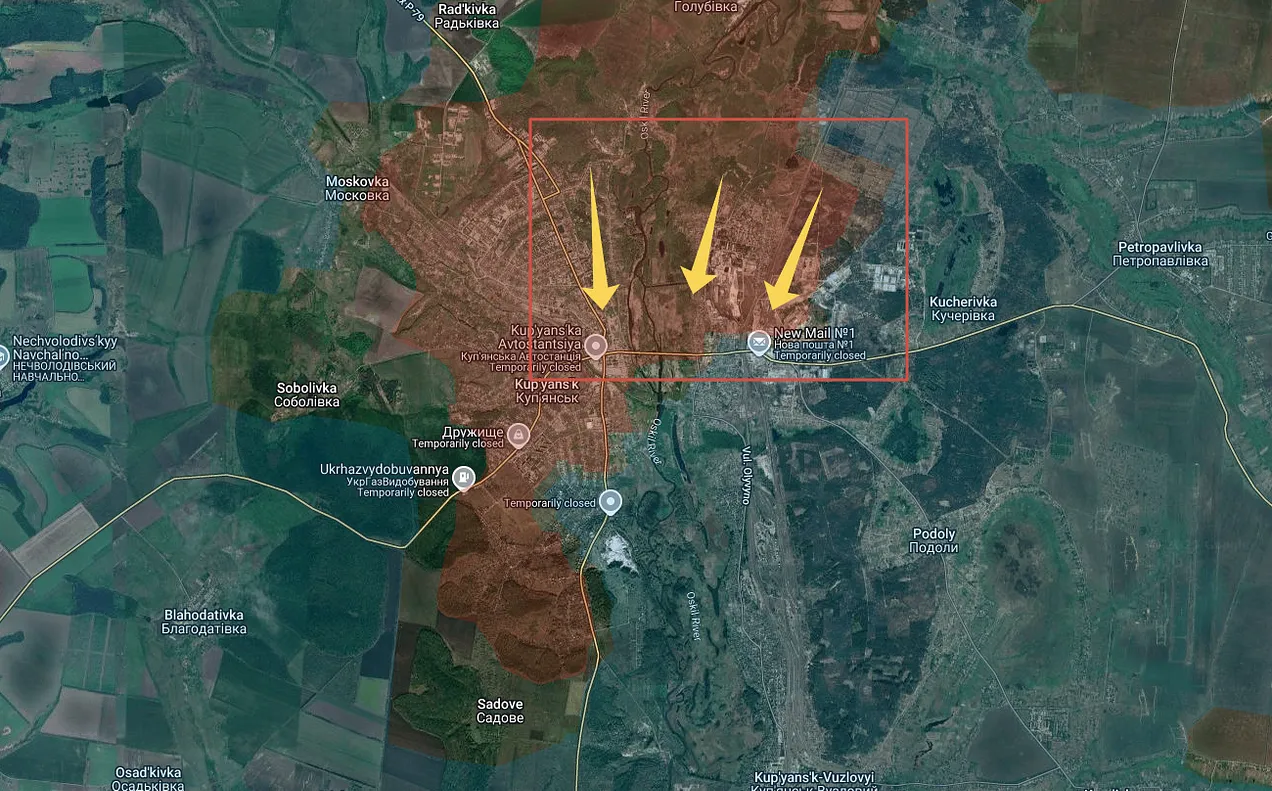
▪️ Over the past week, units of the “Vostok” troop group continued to advance deep into the enemy’s defense and completed the liberation of the settlement of Uspenovka in the Zaporizhzhia region, the Ministry of Defense reported in its summary.

▪️Defense Minister A. Belousov congratulated the command and personnel of the 218th Guards Tank Regiment on the successful liberation of the settlement from the enemy.

RVvoenkor


Lastly, the Kupyansk sector again saw heavy advances as Russian forces tore down from the north on the eastern bank, capturing a large swath of it:

Image

As can be seen very little of the city remains to be captured.

The biggest job that remains is to close this cauldron and push the AFU entirely out of the eastern side of the Oskol river once and for all:

Image


Update on the state of Ukraine’s war production:

Ukrainian Speaker Romanenko said yesterday that all the factories in Ukraine that were capable of producing missiles have been destroyed or are in a state of disrepair.

For example, the Luch Design Bureau produced cruise missiles: “You know what happened to the metro station, don’t you? I won’t tell you where it is, but everyone knows.” All the factories and plants that could produce ballistic missiles have been completely destroyed. This includes Dnepropetrovsk and Pavlograd, where missiles and engines were produced. Everything is being destroyed, even the ruins.


And an update on the energy situation:

Director of the Research Center Energy Kharchenko urges Kiev residents to prepare for evacuation from the city if electricity is cut off for more than 3 days in winter. If the CHP is turned off, then with an average daily temperature of minus 10°C and below - there are no prospects for the restoration of the heating system.


November 7th was an anniversary that passed quietly: it was the famed October revolution, or Red October—which actually happened on November 7th; the October date was using Russia’s old style Julian calendar. Here’s a powerful and thought-provoking reflection on the occasion from a Russian thinker named Gleb Kuznetsov:

November 7th is a date no longer celebrated in Russia, but one that cannot be forgotten either. The October Revolution created a country that still defines Russia’s global positioning. The paradox is that modern Russia lives on the reputational capital of the USSR, but is unwilling to acknowledge this due to the unresolved trauma of the 1980s.

Russia’s significant partners in the world—from Beijing to Caracas, from Pyongyang to Luanda—are a Soviet legacy. Ties were built over decades on the basis of anti-imperialist solidarity and genuine partnership in industrialization. Kim, Xi, Ortega, and Lula work with Moscow not because they are inspired by “traditional values,” but because they remember the Soviet alternative to American hegemony.

Today, official ideology speaks of “conservative values” and “spirituality,” which are exported to a very limited extent and, by and large, have been appropriated by those who are not our friends. A modern secular state cannot become “holier than the Pope” or a Midwestern Protestant pastor.

Russia’s real model is a functioning Soviet-style welfare state. Free healthcare and education, a pension system, maternity capital—the entire social infrastructure is not just preserved, but is being developed. Life expectancy has increased from 65 to 73 years, infant mortality has fallen dramatically, and Moscow is building “the best free healthcare system in the world”—but it attributes this to “effective management” rather than the development of Soviet principles of universal access.

The elites prefer to talk about the “bankruptcy of the Soviet project” while simultaneously investing in Soviet social infrastructure. This is a dichotomy at the level of state ideology: within the country, the Soviet legacy is rebranded as “tradition,” while abroad, we eagerly embrace the Soviet “credit of trust.” To acknowledge the effectiveness of the Soviet model, even in some way, is to return to the traumatic state when it seemed the West had won decisively.

The result: a country with a functioning welfare state model, with a real alternative to the neoliberal dismantling of the welfare state, neither articulates nor “sells” this model.

The crisis of self-evidentness manifests itself in the constant question at all levels: “Why are we doing this?” In the Soviet project, this question was impossible—the answer was embedded in the system of meanings, from school political information to the Politburo. Aid to Angola was a logical continuation of the struggle for the liberation of the oppressed, for global justice.

“Resistance to the West” is not an end, but a means. For the sake of a “more just world”? Okay, but where did this desire for justice come from? To be honest, it was 1917, the Bolsheviks, and 70 years of Soviet history. It was the Soviet period that created the logic of global solidarity with the oppressed.

But acknowledging the Soviet origins of this meaning is impossible, so we have to talk about a “millennial tradition.” Thus, the essentially Soviet style received a new packaging that didn’t entirely suit it. Explanations became phantom, like the pain of a missing tooth. A nagging “why?”

As a result, the external representation functions like an empty box with Soviet labeling—there’s no content, but the capital of recognition holds the entire structure together.

November 7th recalls the revolution that gave Russia global ideological subjectivity. The Empire was a superpower, but the real alternative history to other projects was still the USSR. Modern Russia can neither reject this legacy nor appropriate it. This is the price of trauma—the difficulty in understanding and, consequently, in packaging into a product what exactly works and why it matters to the world.

PS. The USSR created its own internal Orientalism: party leaders of the “national republics” were expected to adopt a distinctive style—exaggerated praise of Moscow, oaths of allegiance, emotional intensity, the artificial flourishes of Leonid Solovyov’s books about Hodja Nasreddin, uncharacteristic of living languages.

Today’s Central Asian leaders are reproducing the same model with Trump that their predecessors used with Brezhnev. Even the language remains the same—yesterday at the White House, most participants sang Trump’s praises in Russian.


At the same time, tomorrow Russia begins an interesting exhibition on the Red Square called “The City of Living Stories”:

Starting tomorrow and until November 9, Red Square will present “The City of Living Stories,” dedicated to the 84th anniversary of the legendary 1941 military parade.

They, at least, do not change history: they recall it!

(Video at link.)

https://simplicius76.substack.com/p/glo ... orever-war

******

Strikes on Ukraine. November 8, 2025
November 8, 7:12 PM

Image

As a result of the overnight attack, all three of Ukraine's state-owned thermal power plants were disabled by ballistic missile and Geranium strikes. They account for approximately 8-9% of Ukraine's total electricity generation. Whining about this has already begun.

Image

Of course, the attack wasn't limited to the Centerenergo company's facilities.

Image

No power or gas. A new attack on gas and energy facilities in so-called Ukraine.

Contrary to fears, the campaign of strikes against the so-called Ukrainian fuel and energy complex is only gaining momentum. On the night of November 8, Russian missiles and drones again visited energy and gas production facilities in eastern Ukraine.

Where did they land that night?

In the Kharkiv region, the attack hit the Zmievskaya Thermal Power Plant (TPP)—now a key power generation facility for the region and the Ukrainian-occupied areas of Donbas. Monitoring resources also reported strikes on the Slobozhanskaya Thermal Power Plant (GRES). In Kharkiv itself, massive power outages temporarily occurred, with the metro and some public transportation shut down. In the Kirovohrad region, missiles struck the Kremenchuk Hydroelectric Power Plant (HPP). Earlier, as a result of the October airstrikes ( https://t.me/rybar/74999

), the plant lost four generators, but continued to operate partially. Although the exact damage has yet to be assessed, a complete blackout occurred in Kremenchuk, with train delays reported across the region. Several more strikes hit the locomotive depot in Hrebinki, Poltava Oblast, sustaining significant damage. Power went out in Gorshni Plavni, likely due to an emergency at the aforementioned Kremenchuk Hydroelectric Power Plant. Also in the Kharkiv and Poltava Oblasts, strikes were reported at oil and gas processing facilities. Fires broke out at facilities near Bielsk in Poltava and Bystry in Kharkiv. In the Chernihiv Oblast, a strike hit the Talalaevske gas condensate field. Evidence has also emerged of at least several strikes on the Prydniprovska Thermal Power Plant. A fire broke out at the facility, and local authorities reported power outages. UAV attacks also hit energy facilities in the Odesa and Mykolaiv Oblasts. Enemy resources also reported power outages in Kyiv, but no airstrikes were recorded in the city. Ukrainian sources stated that the nighttime raid on gas production and processing facilities was the largest during the Second World War. This is indirectly confirmed by the estimated number of munitions fired. The gas infrastructure in the east of the so-called Ukraine has repeatedly been the target of massive attacks ( https://t.me/rybar/74129 ) and has suffered significant damage. Therefore, it is quite possible that the consequences of a new raid could indeed be quite severe for the enemy. It is also worth noting that the Russian Armed Forces have concentrated on sensitive nodes of the enemy's electricity generation and transit. On the evening of November 8, the state-owned company of the so-called Ukrainian "Centrenergo" even announced the shutdown of all thermal power plants in the country. There is no visual confirmation of this yet, but their "knocking out" will bring the separation closer (https://t.me/rybar/74488 ) the energy system of the so-called Ukraine, which will be a painful blow to its economy.

https://t.me/rybar/75055 - zinc

In general, we need to continue. Systematic approach produces results.

https://colonelcassad.livejournal.com/10175597.html

March of communists in Mariupol
November 8, 11:03 PM

Image

Communist march in Mariupol on November 7, 2025.
Until the city's liberation from Nazi occupation in 2022, mass communist events in Mariupol were banned by the Nazis.
It's worth noting that the local organization has a fair number of young people.

Image

Image

Understandably, hysteria erupted in Ukraine over the communist march in Mariupol. Yet just four years ago, the city was teeming with Nazis. Azov and several other Nazi units had bases on its territory. Thanks to the Russian army, the city was denazified.

In today's reality, the task of Donbas and Ukrainian communists and socialists is seen as assisting the Russian army in the denazification and liberation of Ukraine.

https://colonelcassad.livejournal.com/10175866.html

"Battle of Shadows"
November 9, 12:15

Image

Battle of Shadows

Ukrainian analysts have practically repainted Pokrovsk red on their maps. But yesterday, Zelenskyy stated that only 314 Russians are operating inside the city. Let's examine this paradox.

No, the Russian army hasn't been worn down by Ukrainian defenses. Tens of thousands of Russian soldiers are operating near Pokrovsk. You can see this for yourself if you hop in a convertible van and drive northwest from Selydove. There are plenty of vehicles. But if you look at Pokrovsk through a drone camera, you'll hardly notice any soldiers. Fighting for the city continues, but it's not engulfed in flames, and machine-gun fire is extremely rare.

Both sides are keeping their main forces 10 kilometers from the city. Drones monitor all approaches, and only the most daring can penetrate this barrier alive. So it turns out that inside Pokrovsk, only the shadows of the two armies stationed on its outskirts are fighting. Zelenskyy clearly underestimates Russian forces, but you won't see a Bakhmut-style assault again. There are fewer soldiers in the city than civilians. Three people can storm one street, and the most interesting thing is that they will be fighting against three identical enemy soldiers. And all this is happening before the eyes of a dozen grandparents who didn't want to leave the city.

When you imagine this picture, you will stop tormenting yourself with pointless questions. War has changed and no longer resembles a Hollywood action movie. This battle of shadows has yet to be described in literature. For now, we need to accept reality and study its development vectors.

Alexander Kharchenko

https://t.me/bayraktar1070/5870 - zinc

https://colonelcassad.livejournal.com/10176124.html

Google Translator

******

Russia calls Trump’s bluff on Tomahawks for Ukraine

November 7, 2025

One might hope that Trump can retain some common sense and restrain the transatlantic War Party.

For more than a month, U.S. President Donald Trump has been conjuring with the idea of supplying nuclear-capable Tomahawk cruise missiles to Ukraine. This week, however, he told reporters that he had backed away from the prospect.

Several weeks ago, shortly after Trump announced he was considering arming Ukraine with Tomahawks, our weekly editorial on October 3 warned that “all bets are off for a peace deal”. We contended that the American president, by considering such a move, was not genuine in his diplomatic efforts to end the nearly four-year conflict. “Trump is acting as a big-mouth poker player who has very few cards to play… betting that his boorish tough talk and the hype about sending Tomahawks to Ukraine… will somehow intimidate Russia to sit at the negotiating table and accept a half-baked peace deal.”

Moscow has not been intimidated to rush a peace deal on Trump’s or NATO’s terms of an immediate ceasefire, insisting instead that a resolution to the conflict must involve a substantive international security treaty and the eradication of root causes, including the Nazi nature of the Kiev regime and NATO’s historic expansionism.

When Trump was asked this week if he was still considering supplying the iconic missile to Ukraine, he said: “No, not really.”

That was after weeks of demurring; he might, he might not, we’ll see, and so on. What changed his mind?

In the last phone call between Trump and Russian leader Vladimir Putin, on October 16, it was reported that Putin sternly warned that supplying Ukraine with Tomahawks was an escalation too far. He indicated that the weapon would not change the battlefield situation in Ukraine’s favor but that it would bring the U.S. and Russia directly into confrontation.

Sixty-three years after the Cuban Missile Crisis in October 1962, with John F Kennedy and Soviet leader Nikita Khrushchev, this was an uncanny echo of that critical moment when the world faced nuclear war.

Trump subsequently claimed that he asked Putin, “Would you mind if I send Tomahawks to Ukraine?” We can only imagine Putin’s terse response.

The lame question from Trump suggests that the American president was not actually serious about the proposal and that the whole prior and subsequent reporting of his musings was a bluff aimed at unnerving Moscow.

The Tomahawk has a range of about 2,000-2,500 km and is capable of carrying a nuclear warhead. It would also require U.S. participation to launch it from Ukrainian territory. If the missile were fired at St Petersburg or Moscow, Russia would have no choice but to consider it a possible preemptive nuclear attack.

Thus, it is averred, Trump was told that if he went ahead with his insane idea to supply Ukraine, then he had better be prepared to accept responsibility for starting World War III.

The day after the phone call with Putin, on October 17, Trump hosted the Ukrainian puppet president at the White House, whereupon Trump started backpedaling on the Tomahawks. He said that the U.S. needs to retain stockpiles for its own security interests and may not be able to supply Ukraine. “We need Tomahawks for the United States, too. We can’t deplete our country,” said Trump.

Though pointedly, last week, the Pentagon announced that there were no inventory limitations and that the White House was clear to send Tomahawks to Ukraine if President Trump made that determination.

Well, it looks like Trump has chosen caution to be the better part of valor, or should we say, bluffing. At least for now, anyway.

Still, the insanity of NATO’s war psychosis is always looming. Trump’s erratic and egotistical whims make him an unreliable interlocutor.

Following his “disappointing” meeting with the Ukrainian puppet, Vladimir Zelensky, last month, the European NATO warmongers have stepped up lobbying for the Tomahawks. NATO chief Mark Rutte met with Trump in the White House on October 22 to discuss the matter, no doubt reflecting the anxiety of the European elite that Trump was going soft on the idea.

This week, the former NATO chief, Anders Fogh Rasmussen, came up with the scheme of Germany supplying its Taurus cruise missiles to Ukraine as a way to pressure Trump to follow up with Tomahawks.

Ukraine’s ambassador to Washington, Olha Stefanishyna, also reportedly claimed that “discussions” with the Trump administration for the cruise missile are “still ongoing”.

In this context, there are reports of British intelligence working on a false-flag provocation to blow up the Zaporozyhe Nuclear Power Plant, the biggest civilian plant in Europe, causing mass casualties and blaming it on Russia, even though Russia is in control of the ZNPP. Such an extreme provocation could be used to sway the White House.

For now, it seems, Trump has encountered the uncomfortable reality of his and NATO’s psychological games by desisting from supplying Tomahawks to Ukraine.

Similar reality checks are going on elsewhere. The imminent defeat of NATO’s Ukrainian proxy army in Pokrovsk (Krasnoarmeysk) and Kupyansk is one such rude awakening from NATO’s illusions that Western media have been spinning for the past four years. Only last month, Trump was talking about green-lighting a counter-offensive by Ukraine against Russia and taking back territory.

Pertinent, too, was the unveiling last week of Russia’s breakthrough nuclear-capable weapons, the Burevestnik cruise missile that can fly unlimited distances, and the Poseidon torpedo, both of which are invulnerable to U.S. defenses. That would also seem to be a moment of realization for the NATO warmongers that their fantasies of defeating Russia are futile.

Another dousing with cold water is the potential deployment of Russian hypersonic missiles in Venezuela to upgrade the Latin American country’s air defenses amid U.S. aggression. It is reported this week that Trump is now having second thoughts about his (illegal) threats to attack Venezuela, fearing the military operation could end in abject failure with deaths of U.S. servicemen, at a time when voters are souring big time on the 47th president.

Bullies usually only operate with impunity and delusions about their strength until reality punches them in the face.

Trump’s throwing around the idea of Tomahawks to Ukraine seems to have hit him like a boomerang. One might hope that he can retain some common sense and restrain the transatlantic War Party.

https://strategic-culture.su/news/2025/ ... r-ukraine/
"There is great chaos under heaven; the situation is excellent."

User avatar
blindpig
Posts: 14788
Joined: Fri Jul 14, 2017 5:44 pm
Location: Turtle Island
Contact:

Re: Footnotes from the Ukrainian "Crisis"; New High-Points in Cynicism Part V

Post by blindpig » Mon Nov 10, 2025 1:45 pm

Tools for internal political struggle
Published by @nsanzo ⋅ 10/11/202

Image

While European countries are looking for ways to use Russian assets held in the European Union to finance the continuation of the war, another problem has arisen on the other side of the Atlantic. The United States has made it clear that it will not spend any more money to sustain the war, and therefore expects European countries to step up and take charge of a war that, they remind us, is taking place on their continent. This argument overlooks the fact that, as the most powerful country in NATO—a circumstance that Donald Trump has cited as one of the causes of the war—Washington also bears responsibility. However, the current situation, with an EU completely subservient to the United States in its attempt to maintain some international relevance, allows the White House to issue orders from afar and to go from being the main sponsor of the Ukrainian Armed Forces to the main beneficiary of arms sales to European countries for shipment to Kyiv. As the words of the US ambassador to NATO show, Washington expects its European NATO allies to increase their investment in the role of war financiers that Donald Trump has assigned them.

“I think Europe needs to do more. From NATO, we urge them daily to do two things. First, they must provide more support to Ukraine. This is a European war, and Europeans must pay for it. Second, they need to invest more and more quickly in their own defense and security. We are helping them in this regard, but they have systemic problems that must be addressed, particularly those related to the defense industry and increasing production. They are currently not up to the task, and they should be. This is crucial for the entire organization,” Ambassador Whitaker stated in an appearance on Fox News . The message from the United States is clear: European countries must spend more money on weapons for Ukraine and increase military spending for their own security. It is evident that Washington is aware that any increase in military investment implies the acquisition of American weapons, a significant benefit for the American military-industrial complex.

European countries have demonstrated a willingness to increase military spending beyond their means—the United Kingdom, for example, is considering breaking its promise not to raise taxes in order to, among other things, increase military investment—and have turned to the United States for the necessary equipment to continue supplying the Ukrainian army. However, willingness is not everything, and European countries have faced, for 40 days, the problems caused by the internal political situation in the United States, with the longest government shutdown in history. “According to a State Department estimate, the government shutdown has delayed the export of more than $5 billion worth of US weapons intended to support NATO allies and Ukraine,” Axios , one of the media outlets used by the Trump administration to filter what it needs to dominate the political agenda, reported yesterday.

The amount reportedly withheld is significant. In August, Ukraine stated its intention to acquire $1 billion worth of weapons per month through the US arms procurement system via European countries. Given these requirements, the arms shipments withheld or delayed due to the government shutdown represent the amount of weapons Kyiv expects to receive from its allies over a five-month period.

“The final destination of the exports is unclear, but arms sales to NATO allies are typically diverted to aid Ukraine. The pending transactions include both direct arms sales from the U.S. government to NATO allies and the licensing of weapons to private U.S. defense companies, according to the official. The process for these particular sales would normally be straightforward and uncontroversial,” the Axios article adds .

The subtext of the message is clear: it points to a significant quantity of weapons held up for over a month in the United States at a time when Ukraine is struggling to contain the Russian advance on the Donetsk front, and blames the government shutdown for delays that wouldn't occur if there were a funding agreement. Using a friendly media outlet, which has always been willing to publish whatever the Trump administration wants to put in the media spotlight, the White House is once again using Ukraine as a tool for domestic politics, something that is nothing new. A few weeks ago, citing the public interest, the CIA declassified a document about Joe Biden's visit to Kyiv in December 2015, a trip in which, according to the published document, Ukrainian authorities expressed surprise and displeasure at the limited political value of the then-vice president's interventions. Biden, according to these sources, seemed more interested in his private business dealings than in showing the expected support for the Poroshenko government. The document is worthless, given that the same complaints were published by outlets like The Wall Street Journal . Its sole purpose, declassified almost ten years later, is to exploit the Ukrainian issue as a weapon in Donald Trump's internal power struggle against his predecessor, Joe Biden, and his family.
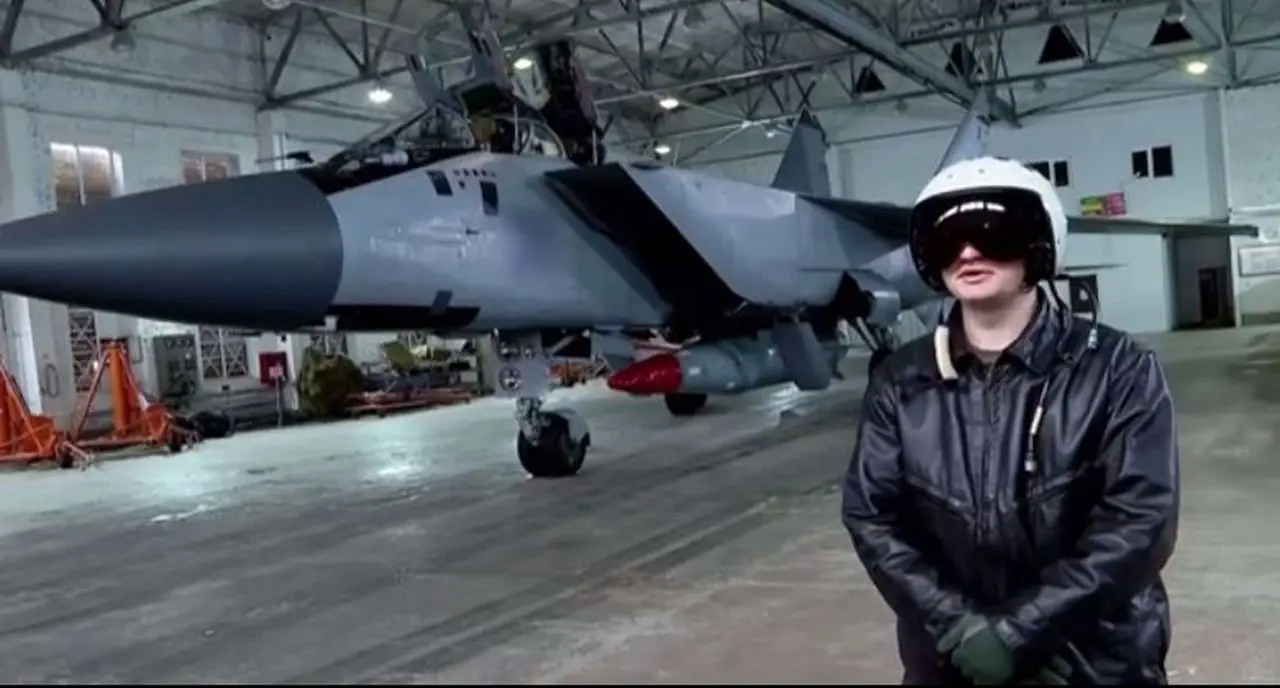
The news published by Axios follows the same line of reasoning and comes in the final hours of the government shutdown, just as a nascent reopening agreement was being announced. This time, the accusation is not directed at Joe Biden, but at the Democratic Party in general. Since the government shutdown began, both parties have fought to impose their version of events and the reasons for the shutdown in the media, always with the aim of making the public blame the other for the consequences. These consequences include the suspension of food stamp payments to vulnerable populations, thousands of people who have lost their jobs, and many more who have kept their jobs but are not receiving their salaries. Convinced that the American people would blame the Democratic Party, Donald Trump has been in no hurry to negotiate a reopening and demands that the Democrats first withdraw their demands regarding healthcare coverage—Trumpism falsely accuses its opponents of wanting to provide public healthcare to undocumented immigrants. The Democrats are only demanding an extension of the current measures—which limit increases in the cost of health insurance paid for by the American public and inaccessible to undocumented immigrants—in order to discuss funding. Last week's election results, in which, in addition to the victory of social democrat Zohran Mamdani in New York, the Democratic Party won in New Jersey and Virginia, suggest that the Trump strategy has not worked, further weakening the Republican Party's negotiating position.

The current backlash provides a new argument for blaming the Democratic Party for the consequences of the last-minute government shutdown. Although Ukraine has recently boasted of increased support among Republican voters, the most staunchly pro-Ukrainian factions are found within the Democratic Party, under whose leadership the mechanisms for the constant flow of weapons were initiated and the United States became the primary supplier to the Ukrainian military. Further exaggerating the already unprecedented figures for a proxy war, Trump has accused his predecessor of being misled by European countries, from whom he is demanding increased spending so that the United States ceases to be a donor and becomes solely the arms supplier. The Axios report aims to tell the Democratic Party base, which has portrayed the war as a conflict in which the United States and its allies are risking their security, that for 40 days their actions have left Ukraine vulnerable, needlessly undermining European and domestic security. The fact that Axios ' sources insist that deliveries are being delayed that would not have caused any problems in the event of a government reopening is indicative of that objective: to portray the prolonged shutdown as a whim of the Democratic Party leadership and to insist that it is being done at the cost of something—the war in Ukraine, which has even been presented as existential.

War is not only a testing ground for weapons development or a way to make money by selling military equipment, but also a tool of internal political games and partisan struggles in the United States.

https://slavyangrad.es/2025/11/10/herra ... a-interna/

Google Translator

******

From Cassad's Telegram account:

Colonelcassad
Russian Ministry of Defense Summary of the Central Military District as of November 10, 2025.

Missile Strikes: In response to Ukrainian terrorist attacks on civilian targets, Russia launched a group strike using high-precision weapons (Kinzhal, UAVs) against military airfields, a SIGINT center, a Vilkha MLRS shell depot, and UAV assembly and storage facilities. All targets were hit.

North Force Group: Four mechanized brigades, an assault regiment, and territorial defense forces near Kyianytsia, Mala Korchakivka, Nova Sich, Pavlivka, and Proletarske (Sumy Oblast) were hit. A motorized infantry brigade near Vovchansk was hit in the Kharkiv direction. Ukrainian Armed Forces lost over 130 troops, 10 vehicles, 3 guns (including the US M777), an electronic warfare station, and 5 depots were destroyed.

West Force Group: Positions on the forward edge were improved. Two mechanized brigades, two assault brigades, and a National Guard unit were defeated near Berezovka, Kurilovka (Kharkiv Oblast), and Yampol (DPR). The rout of the encircled group continued in Kupyansk. Three attacks by the 92nd Assault Brigade and the 1st National Guard Brigade from Blagodatovka and Petrovka were repelled. Up to 50 troops, two M113 armored personnel carriers, three US HMMWVs, two pickup trucks, and four electronic warfare stations were destroyed. Total losses for the Ukrainian Armed Forces: over 210 troops, six armored vehicles, ten vehicles, and one gun; ten electronic warfare stations and three warehouses were destroyed.

Force Group "South": Advantageous positions have been occupied. Three mechanized brigades, an airmobile brigade, and the Azov brigade were defeated near Verolyubovka, Konstantinovka, Kramatorsk, Platonovka, Seversk, and Slavyansk (DPR). Ukrainian Armed Forces lost over 70 troops, two armored fighting vehicles, 14 vehicles, and four guns (including the US Paladin self-propelled guns); an electronic warfare station and six warehouses were destroyed.

Force Group Center: Tactical situation improved. Three mechanized brigades, an infantry brigade, two Jaeger brigades, an assault brigade, two airborne assault brigades, two assault regiments, two marine brigades, a territorial defense brigade, and three National Guard brigades were defeated near Artemovka, Belitskoye, Roza Luxemburg, Rodinske (DPR), and Ivanovka (Dnipropetrovsk region). The settlement of Gnativka (DPR) was liberated. In Krasnoarmeysk, fighting is ongoing in the Dinas microdistrict, northwestern and eastern neighborhoods, and the industrial zone is being cleared. 244 buildings have been liberated. Seven attacks from Grishino have been repelled, and two breakthrough attempts by the 425th Regiment have been thwarted. In Dimitrov, an offensive is underway in the Vostochny and Zapadny microdistricts. Over 200 soldiers, a Spartan armored personnel carrier (UK), a Kazak armored fighting vehicle, and six pickup trucks have been destroyed. Total losses of the Ukrainian Armed Forces: up to 510 soldiers, four armored fighting vehicles, and six vehicles.

Force Group "East": The settlements of Novoye and Sladkoye (Zaporizhzhia Oblast) have been liberated. Three mechanized brigades, an assault brigades, and an assault regiment were defeated near Aleksandrovka, Danilovka, Orestopol, Pokrovskoe (Dnipropetrovsk Oblast), and Dobropolye (Zaporizhzhia Oblast). Ukrainian Armed Forces losses: over 235 soldiers, 2 armored fighting vehicles, 14 vehicles, 4 guns.

Dnepr Force Group:The tactical situation has been improved. A mechanized and mountain assault brigade, two coastal defense brigades, and a territorial defense brigade near Lukyanivske, Orekhovo (Zaporizhia Oblast), Ivanivka, and Nikolske (Kherson Oblast) were destroyed. Up to 70 soldiers, eight vehicles, an AN/TPQ-36 radar (USA), three electronic warfare stations, an ammunition depot, and two warehouses were destroyed.

Russian Aerospace Forces strikes: Deployment points of Ukrainian formations and mercenaries in 136 districts were hit.

Air defense: Six HIMARS (USA) projectiles and 124 UAVs were shot down.

Black Sea Fleet : Four unmanned boats of the Ukrainian Armed Forces were destroyed in the Black Sea.

***

Colonelcassad
Regarding NABU's searches of individuals from the cocaine führer's entourage,
the US, through its instrument, is making it clear that it is perfectly legal to accuse virtually anyone in the Kyiv colonial administration of corruption and theft through Ukrainian structures (which the cocaine führer cannot shut down even with the best will in the world, as they are subordinate to the external control network). Ministerial portfolios and the status of "Zelenskyy's wallet" won't save us here. The US has extensive experience working with such people—see the story of Pavlo Lazarenko and Kolomoisky.

Mindych's flight abroad is noteworthy only because of the location where he will potentially resurface. It's possible that it will be a European country that won't be interested in extraditing him to the US or Ukraine, where NABU is in charge. Because Mindych knows too much that he could bring down the entire cocaine ring. I can imagine that the SBU, on Yermak's orders, will soon try to put serious pressure on NABU in order to show the Americans their "displeasure" at such a brazen dabbling in the dirty laundry of "any friends" of the cocaine führer.

https://t.me/s/boris_rozhin

Google Translator

******

THE ELECTRIC WAR GATHERS MOMENTUM — EXPLAINER

Image

By John Helmer, Moscow @bears_with

Over the last three days the General Staff’s electric war strikes have continued to intensify on their targets and extend right across the Ukraine, with local utility companies announcing blackouts from Kharkov in the east to the western regions (lead image).

In itemizing the targets on the map, Mikhail Zvinchuk, chief of the Rybar military blog, reported that “Ukrainian sources stated that the night raid on gas production and processing facilities was the largest since the start of the special military operation. This is indirectly confirmed by the estimated number of munitions fired. The gas infrastructure in the east…has already been the target of massive attacks multiple times and has suffered significant damage. Therefore, it is quite likely that the consequences of the new raid could indeed be very severe for the enemy. It is also worth noting that the Russian Armed Forces have concentrated on sensitive nodes of electricity generation and transit of the enemy. On November 8, the state company Centrenergo announced the shutdown of all thermal power plants in the country.”

“Contrary to fears,” Zvinchuk commented, “the campaign of strikes on the fuel and energy complex of the so-called Ukraine is only gaining momentum.” He means that Russian military analysts are well aware and are now reporting that since the electric war campaign first began in October 2022, the number of strikes has been limited in duration, firepower, and damage effected, and the momentum of the campaign stopped short.

But not this time, military sources in Moscow believe.

Some of the sources have claimed the General Staff did not have the capacities to fully implement the electric war in the first two years, and that they still need more time and more resources to sustain the momentum to achieve the full countrywide blackout they are aiming at. Click to read the archive of the campaign here. For an all-source timeline, read this.

Other sources believe the military resources, logistics pipeline, targeting intelligence, and weapons accuracy and survivability were not as available to the General Staff in October 2022 when the campaign began, as they have been since October of this year — and this is the reason momentum has been suspended in each of the earlier years.

One source says that President Vladimir Putin imposed restrictions on the extent and duration of the campaign but gradually he has been persuaded to relax them; although even now, the source points out, the Defense Ministry’s daily bulletin continues reporting the electric war strikes, not as war strategy but as tit-for-tat operations responding to Ukrainian “terrorism” – that is, Ukraine drone and missile attacks on civilian infrastructure in the Russian hinterland. “In response to the terrorist attacks by Ukraine on civilian targets in Russia, from November 1 to November 7,” the Ministry bulletin announced on Saturday, “the Armed Forces of the Russian Federation carried out seven group strikes with precision weapons, as well as unmanned aerial vehicles, as a result of which enterprises of the military industry of Ukraine and facilities of the gas and energy complex that provided their work, the transport infrastructure used in in the interests of the Armed Forces of Ukraine…”

A source in a position to know says the restrictions on the electric war have been political, not military, and for the time being Putin appears to have lifted them.

“I have a tough time believing that the General Staff did not have the intelligence, let alone the weapons accuracy and survivability necessary to prosecute the electric war from the start,” the source comments. “First, as the vast majority of the Ukrainian electrical grid, especially the 750kV backbone, was, and still is, more than fifty years old, Soviet-era equipment. Information on the Ukrainian electrical generation, transmission, and distribution network was, and still is, widely available in open source. There is no way that the electrical or civil engineers employed by the General Staff could not know what to target and what firepower was necessary. In terms of weapons, the Russian forces had then, as they do now, stocks of cruise, ballistic, and other air-dropped weapons, not to mention sabotage capabilities, to destroy the critical Ukrainian electrical nodes. There are approximately 35 major Ukrainian substations — so again, the available information for targeting is open source. Looking at the data provided in these sources, the General Staff have had more than enough ordnance to take them all out. They didn’t. Moving forward from this line of thinking, I am curious to know why Ukrainian electrical laydowns [storage areas] and service vehicles have not been targeted. Are we to assume these could not be seen? This defies rudimentary understanding of enemy logistic and repair capabilities. Quite obviously, the delay to date in achieving the complete collapse of the Ukrainian grid was and is the product of political decision-making, not any lack of capability on the Russian military’s part.”
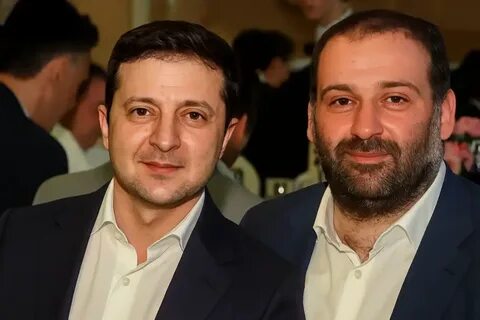
The new frankness from the Moscow sources follows what they believe to be language from President Donald Trump encouraging the Kremlin to speed up its military operations. “Sometimes people have to fight it out a little bit longer,” Trump told Hungarian Prime Minister Victor Orban last Friday, “ but I think we agree that the war is going to end in the not too distant future.” At their meeting, Trump said his phrase, “not too distant future”, three times over.

He was also repeating his line, “sometimes you have to let them fight it out”, from February 27, 2025; June 15; and November 1.

https://johnhelmer.net/the-electric-war ... explainer/

******

Brief Frontline Report – November 9th, 2025

Report by Marat Khairullin and Mikhail Popov.
Zinderneuf
Nov 09, 2025

Image
ЛБС 28.10.2025=Line of Combat Contact October 28th, 2025. АКТИВНОСТЬ=Activity.

Image
ЛБС 31.5.2025=Line of Combat Contact May 31st, 2025. Участки Активности=Area of Activity.

(Video at link.)

Message from the Ministry of Defense of the Russian Federation: "Servicemen of the 37th Guards Motorized Rifle Brigade of the 36th Guards Combined Arms Army of the 'East' group of forces, having crossed the Yanchur River, liberated the settlement of Rybnoe (Ribnoe on the map) in the Zaporozhye Oblast and took control of the Ukrainian Armed Forces' defense area of more than two square kilometers.

Assault units had to operate under fierce enemy resistance, which used all available means to hold positions.

Despite shelling and constant attacks by enemy drones, the servicemen demonstrated resilience and a high level of combat training, overcoming the water obstacle and clearing the settlement of the enemy."

The Russian Armed Forces are expanding the control zone on the left bank of the Yanchur River and advancing into the interfluve area between the Yanchur and Gaichur rivers, where there are no large settlements.

The settlement of Rybnoe (47°48′44″ N, 36°20′44″ E, population 35) has been liberated, and access to height 141.8 secured. South of enemy positions in the settlement of Sladkoe and another dominating height 147.6. Our "wedge" will be driven in this direction.

Image

To the west, about 4 km away, are the Glinyannaya-Razdolnenskaya, Srednyaya, and Tselinnaya ravines. According to all tactical rules, the enemy should place blocking positions in this area, tasked with countering the Russian advanced units that have penetrated deep into the Ukrainian defense and are advancing toward the Ukrainian defense line on the Gaichur River.

Image
The proper English transliteration for the ravines is corrected on this map*

Destroying enemy positions in Sladkoe will allow Russian units to reach the line of height 147.6 - Solenaya ravine and improve their position along the front line (along the watershed ridge), engaging the enemy in battles on the blocking positions line. This development will enable neighboring units to advance toward Uspenovka-Ravnopole, cutting through and enveloping the northeastern forefield of the defensive node of Gulyaipole with its strongpoints at Ravnopole-Novoe-Novouspenovskoe-Okhotniche.

The General Staff of the Russian Armed Forces will destabilize the enemy defense in this part of the Zaporozhye Oblast through multi-directional activity along the entire line from the settlement of Volchë to Marfopol, forcing the enemy to scramble along the entire line.

https://maratkhairullin.substack.com/p/ ... vember-9th

******

Why you shouldn't fight in Ukraine

Endless pain or a painful end?
Events in Ukraine
Nov 09, 2025

One of my dear subscribers recently reached out with an urgent request - what to say to an idealistic leftwing friend who has become wracked by the idea of flying to Kyiv and fighting the good fight in Ukraine?

It’s quite an interesting question.

On the one hand, I am tempted to say there is little one can do. In just about any society, there are always some who yearn for heroism, battle, life through the risk of death. In wealthier countries, it is also quite possible for them to fly across the world to fulfill these questionable desires.

The same idealism motivated plenty of young people to chart course for Syria 10 years ago or so. Some for the black flag of ISIS, others for the flag of, say, the Syrian Democratic Forces.

That’s not to say that all sides in that or other conflicts were equally distasteful. Just that for plenty of foreign volunteers, facts or logical reasoning are unlikely to sway their decisions. Which is also admirable, in a certain sense. It takes all kinds.

Nevertheless, one does have certain responsibilities as a friend. The fact that the war isn’t quite as safe and simple as technologically-adept Ukrainian elves facing stone-age Russian orcs, to begin with.

There are also a number of broader reasons making leftwing martyrdom for Ukraine rather puzzling.

Or any martyrdom, unless you are simply interested in the idea of fighting in war for its own, romantic sake. In fact, this is is the main motivation driving real people to make the trip to today’s Eastern Front. But since there is no logical criticism one can make of the desire for a glorious death, we’ll focus on those who want to go and ‘help Ukraine in its fight for freedom’.

Image
British fighters in Ukraine

On reality
Before we get into some dialectical reasoning, some quick facts and events for our liberal, libertarian, or anarchist friends, the main contingent of non-nationalists heading to Ukraine.

Last month, October 2025, there were more cases of desertion from the Ukrainian army than ever before. 21,000 men tried escaped the army in one month. This figure comes from official Ukrainian statistics. September was also a record. Over the course of 2025, almost 300,000 cases of desertion were recorded. There were almost 100,000 cases of desertion from 2022 to 2024.

Last week, Ukraine’s largest media publication complained that 6 million out of Ukraine’s 10 to 11 million draft-age men have been avoiding military service:

The only official mention of the number of draft violators appears in the explanatory note to the law introducing a 50% discount on fines from the Territorial Recruitment Centers (TCCs), which came into effect in April 2025. The document states that during 2024, more than six million (!) men liable for military service failed to update their information at TCCs, administrative service centers , or in the “Reserv+” app.

“The TCCs often mobilize sick and frail people, because they have to meet their monthly ‘mobilization’ targets,” one brigade commander working with new recruits told Ukrainska Pravda indignantly. “Most of these people will never be able to perform combat tasks effectively. Meanwhile, armies of deserters and healthy draft dodgers are roaming free.”


Note, also, that many of the minority of men who did update their information only did so because they had disabilities or other conditions allowing them technical exemption from the army.

Corruption is systematic - those with a few thousand dollars lying around can avoid the draft. In a country where most people earn under a few hundred dollars a month, this option is only open to a minority. Today, Ukraine’s army officially confirmed it has been mobilizing the homeless.
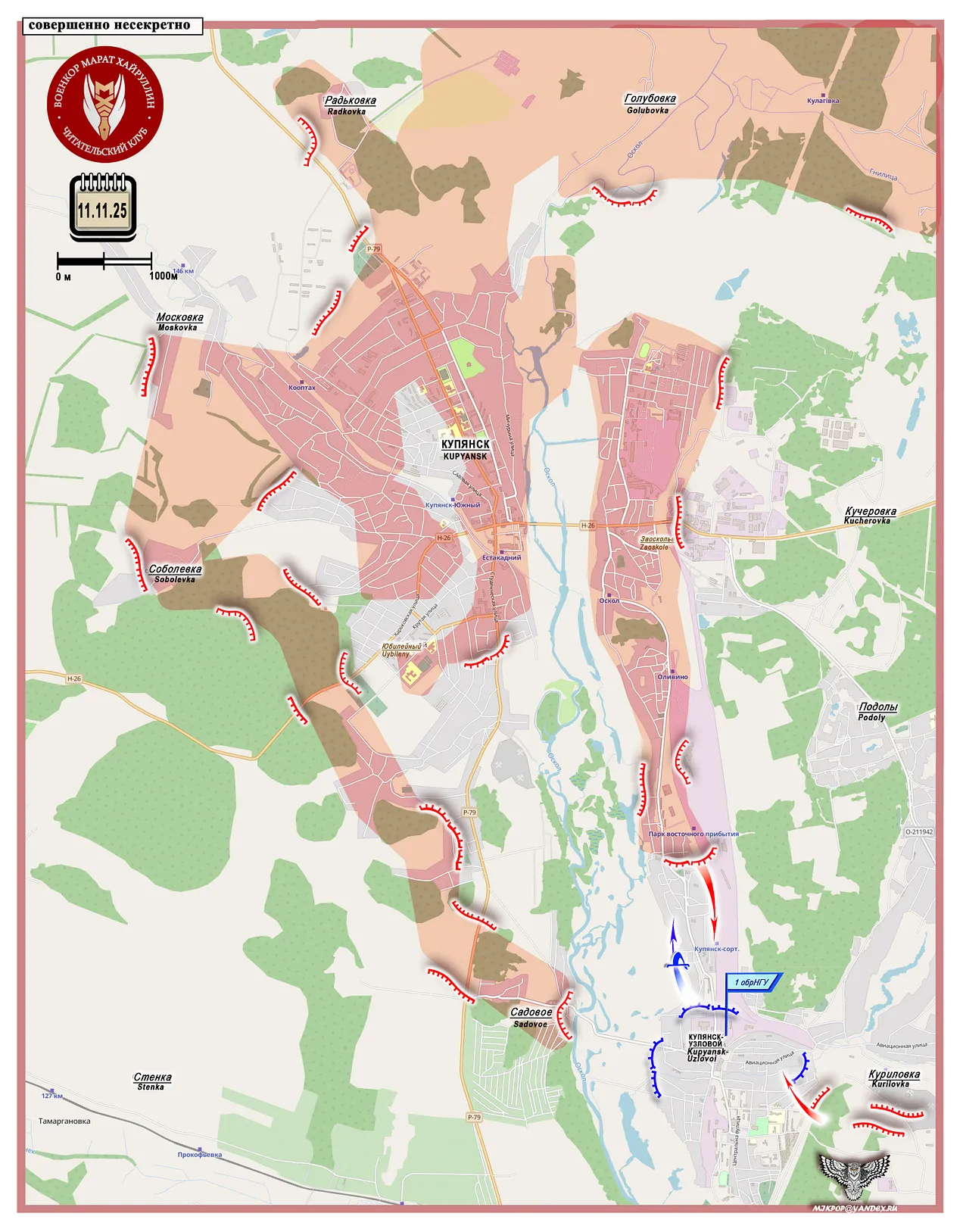
Every day, videos flood Ukraine’s social media of press-gangs forcing draftable men into minibuses. This was from Friday, also Odessa: (Video at link.)

At the end of October, residents of the freedom-loving city of Odessa overturned the vehicle of a mobilization press-gang: (Video at link.)

Such incidents of mass resistance are quite common - in late September, locals broke into a mobilization center and freed three men, as reported by said mobilization center.

On November 8, people filmed mobilization press gangs running over a relative who tried to save his loved one from mobilization in the city of Vynnytsia: (Video at link.)

On November 7, a man cut his veins in a Dnipro mobilization center to avoid getting sent to the front. The event was soon confirmed by the mobilization center in question. (Video at link.)

This is also quite a common occurrence - a mobilized man tried to kill himself in August in Kiev, for instance.

Yesterday, a man jumped out of the building of a mobilization center in the western city of Ternopil, as reported by the local mobilization center.

In August, an old woman in the poor village of Novy Chervyshcha was shot by mobilization officers as she tried to stop them from abducting a disabled man.

Image

Men often die at mobilization centers, covered in mysterious bruises and traumas. This is also quite a common occurrence. The last publicized time this happened was in late October, in Kiev. The army officially claimed that he fell and hit his head. In July, a mother posted photos of her son, Maksym Muzychko, who died after endless beatings in the mobilization center:

Image

Men of draftable age - 23 to 60 - cannot leave the country. There have been a number of cases of men shot by Ukrainian border patrol as they try to flee to neighboring EU countries. The last time the government admitted this had happened was in early September.

At least dozens have drowned in the Tysa river as they try to flee to eastern EU states.

So that no one gets the wrong idea, Ukrainian border patrol releases videos like this:

At the border with Moldova, in the Odessa region, border guards detected the movement of wolves using technical means. Usually, predators do not move alone but in packs. We urge to avoid illegal travel and not to put yourself in danger (Video at link.)

So, to get things straight — some libertarian leftists want to freely travel to a country where ordinary men are press-ganged into a war they don’t want to fight? Where men are beaten and killed if they resist the draft? Where most men are hiding?

It seems like the height of ‘privilege’ for a free person to go over to this large-scale prison camp and announce he or she is here to save the country.

On atrocities
Now, onto some arguments. Let’s start with what I think isn’t a great thing to argue about - atrocities and civilian deaths.

There’s nothing that gets the righteous more riled up than the suspicion that you are ‘denying an atrocity’. Such a suspicion will simply encourage them to find evidence that you are wrong, that the atrocity really did happen the way they want to say it did. And they can always find some.

This sort of argument is unwinnable.

It is undeniably terrible for a civilian to die from a bomb, gun, or however else. It is also quite terrible for a forcibly mobilized man to die from a drone, for that matter.

Arguing about whether people are killed, tortured, or otherwise abused by war is distasteful, and is also besides the point.

Soldiers kill civilians in any war - which is precisely why wars, generally speaking, should be avoided or ended. Unless there’s a very good reason for them.

On Causes
Now, another thing that is easy to get sucked into is the causes of war. This is actually worth arguing about, but in the right way. It can be easy to get bogged down in the details, but it’s important to keep things simple.

The debate about the causes of the war in Ukraine features two main narratives - that NATO expansion provoked a Russian military response, or that the pathologically imperialist Russian mentality is simply fixated on destroying the Ukrainian nation at any cost.

If you subscribe to the second narrative, the only way to fix the situation is by force. One option, popular in Ukraine and the Washington-based ‘Freedom For Russia’ group, is destroying the Russian state and replacing it with a multiplicity of smaller ethno-states. The other option is for Ukraine to inflict some kind of massive military defeat on Russia, such that its leadership is scared into accepting NATO’s demands.

Image
Ukraine’s chief of military intelligence Kyryllo Budanov carves up Russia on his birthday, 2024

Balkanizing Russia would require nuclear war. I also don’t see how appealing the idea of a never-ending racial civil war is.

And I don’t know why it is necessary to continue discussing Ukraine’s imminent victory the third year of the Russo-Ukrainian war, a conflict in which the Russian side does better every year. A conflict in which the Russian leadership feels ever more confident, as evidenced by the fact that its territorial pretensions keep on growing.

So, we will have to turn to the first narrative on the cause of war - NATO expansion.

Young, idealist left-wingers are unlikely to enjoy listening to long spiels on the history of backdoor diplomacy. And the question always re-emerges - sure, maybe NATO was threatening to Russia, but invading Ukraine was a stupid and morally wrong way to deal with that!

Whether ‘justified’, that isn’t the point. You aren’t the leader of Russia. People who think otherwise are.

The point is that Russia is a country whose leaders and population have always felt sensitive about hostile military alliances on their borders. They are often accused of having a siege mentality, but why wouldn’t they? Have many other countries suffered as many apocalyptic invasions and occupations? The Mongols in the 12th century, the Teutons in the 13th, the Poles in the 16th and 17th, the Swedes in the 18th, the French in the 19th, a whole swarm of western powers (and Japan) between 1917 and 1920, the Germans in 1941. Many in Russia view the 90s as a sort of violent western occupation as well.

It doesn’t really matter if you think that this is a justified fear or a paranoid delusion. That’s just how the Russians feel. And they have the military means to act on this fear - meaning that either you will have to entertain their demands, or militarily defeat them.

Anyway, there are historical reasons why Ukraine figures so prominently in the Russian security imaginary. Russia’s rather large, flat expanses have always been surrounded by unfriendly powers. Hence Stalin was so intent on acquiring his western buffer zone.

And more importantly, Ukraine has always been the key theatre on which Russia’s threats appear (with the exception of the Mongols).

Whether the never-ending battle with Poland in the 16th and 17th centuries, or the even longer struggle with the Crimean Khanate and other Turkic nomads from the 15th to 18th centuries, or the Swedish invasion of the 18th century, or Napoleon’s invasion in 1812, or the allied intervention into Bolshevik Russia after 1917, or Operation Barbarossa in 1941 - in all these cases, the territory of modern-day Ukraine was the key battlefield.

Battlefield Ukraine: 1420-1709
Events in Ukraine
Image
September 5, 2024
Battlefield Ukraine: 1420-1709

Nowadays, everyone’s favorite military-historical analogy is always world war two. Churchill this, appeasement that, Hitler this, Nazi that and so on and on. And given how many of the towns and cities being fought over in Ukraine today also had such storied histories in the 1940s, it’s hard to blame them. And when units named ‘Nachtigall’ are entering t…

Read full story


There are various reasons why. Ukraine is not only quite flat (apart from its western border), but also features a rather porous society. Many foreign powers have felt that the territory had at least some elites and populations liable to turn against Moscow.

Anyway, all this is to say that sensitivity on behalf of the Russian elite regarding Ukraine is a well-known fact.

On December 17, 2021, after more than a decade saying much the same thing, the Russian government delivered a formal list of demands to Washington. It was described as Putin’s ultimatum in the western press, but the terminology used doesn’t change the essence. It showed what Russia wanted.

For whatever reason, Russia’s foreign ministry doesn’t seem to have published an English language version. Anyway, the western media described its content fairly accurately, though of course they believed it was an ‘ultimatum meant to be rejected’. Anyway, the original version can be accessed here.

This ‘Agreement on measures to ensure security of the Russian Federation and the member states of the North Atlantic Treaty Organization’ contained eight articles. It takes about a minute to read the automatically translated version, but these quotes give the gist:

Article 1

The participants are guided in their relations with each other by the principles of cooperation and equal and indivisible security. They do not strengthen their security individually, within an international organization, military alliance, or coalition, at the expense of the security of others.


Article 3

Participants confirm that they do not view each other as opponents.


The most important and specific part was this:

Article 4

The Russian Federation and all Participants that were member states of the North Atlantic Treaty Organization as of 27 May 1997 shall not, accordingly, deploy their armed forces and weapons on the territory of all other states in Europe in addition to the forces deployed on that territory as of 27 May 1997. In exceptional cases, when situations arise that require the neutralization of a threat to the security of one or more Participants, such deployments may be carried out with the consent of all Participants.

Article 5

The Parties exclude the deployment of land-based intermediate- and shorter-range missiles in areas from which they are capable of striking targets on the territory of other Parties.

Article 6

Participants, being member states of the North Atlantic Treaty Organization, undertake commitments that exclude further expansion of NATO, including the accession of Ukraine, as well as other states.

Article 7

The participants, being member states of the North Atlantic Treaty Organization, refrain from conducting any military activity on the territory of Ukraine, as well as other states of Eastern Europe, Transcaucasia and Central Asia.


Washington refused to reconsider NATO expansion. The response, published by El Pais on February 2, 2022, ‘continues to firmly support NATO’s Open Door Policy’. Ukraine was to continue military cooperation with NATO. It called for Russia to exit Crimea. Some minor offers were made about missiles, but that wasn’t the core issue. Ukraine was.

One might make the argument that demanding NATO abandon countries that had joined it after 1997, like, say, Latvia or Poland, is a non-starter. But that wasn’t being demanded - deploying NATO arms on these territories was being challenged.

Maybe that was also hard to demand. But NATO’s response, filled with accusations against Russia, was clearly not in the spirit of ‘not view[ing] each other as opponents’, as Russia had demanded.

And there was no budging on the most easily fulfillable demand - admit in writing that Ukraine will never join NATO. The demand easiest to fulfil, because NATO never wanted Ukraine to join it anyway. And also the most important matter for Russia, because of reasons already mentioned.

Within less than a month after NATO’s refusal, Russia began what it calls its Special Military Operation.

On the question of causes
Maybe our hypothetical anarchist (or liberal) friend doesn’t care about all that. What does it matter what Russia thinks - Ukraine should have the right to do whatever it wants!

That’s true. People have the right to commit suicide, as well. That doesn’t mean you are obliged to help them do so.

The fact is that Ukraine has a neighbor, Russia, which has particular feelings about Ukraine’s membership in or cooperation with NATO. Maybe Russia’s feelings are misplaced - it doesn’t matter. All that matters is that Russia is a country able to inflict quite a high cost on Ukraine for violating its wishes.

Russia says the war is about NATO, and Ukraine’s leadership refuses to reconsider its stance on joining NATO. You might respond that were Ukraine to abandon its aim of joining NATO, it would make it weaker before Russia. But there are two responses to be made.

To begin with, NATO doesn’t want Ukraine in its ranks. The Ukrainian government has been asking to join since 2014, and NATO refuses - for quite obvious reasons. Ukraine has territorial conflicts with Russia, meaning that joining NATO would lead to a direct conflict between NATO and Russia, one that would inevitably be nuclear.

Second, NATO is unwilling to give Ukraine enough weapons to win the war with Russia. That’s even assuming NATO has enough conventional weapons to allow that - or that Ukraine has enough enthusiastic manpower for that. The reason why NATO is unwilling to send enough weapons to win is the same as before - it doesn’t want a nuclear conflict with Russia.

At the start of the war, one might have claimed that Ukraine could win. The odds were stacked against it, but sure.

It has now been more than three years. Russia continues moving forward on the frontlines. Ukraine’s two main offensive operations both failed — in 2023 within its own borders, and in 2024 to early 2025 against southern Russia (Kursk). Meanwhile, Ukraine itself is economically and demographically devastated.

My close relative was very dismissive of Moscow’s ultimatum back in December 17, 2021. I was having dinner with that individual in Kiev at the time.

But while we are quite irreconcilable politically, I do treasure one piece of relationship advice this person gave me many years ago, when I was going through my first breakup:

Better a painful end, than endless pain.

For peace, Ukraine would have to abandon ambitions of joining NATO. It would also probably have to give up the remaining cities of the Donbass, and possibly two other major cities claimed by Russia - Zaporizhia and Kherson.

Agreement to this, so far, seems very unlikely. It would be too painful - too many would have died for nothing. And the Ukrainian leadership has already sunk its entire political - and not only - existence into it all.

But is it better for tens of thousands (the real number is unknown) to continue dying each year at the frontline? Is endless pain better than a painful end?

Given the reality, the pain will continue. More people will die, more homes will be destroyed.

But back to our starry eyed hypothetical foreign interlocutor. He or she has a choice - to participate in prolonging the pain or not. To join in the chorus of ‘wise westerners’ encouraging desperate Ukrainians to continue in this unwinnable conflict. Or not.

On hypotheticals
This is undeniably an awful situation. Perhaps something could have been done in the past to avoid it. Our interlocutor might claim that the Russian government should have acted differently. Who knows.

But that is quite irrelevant, because you can’t change the past, and more importantly, because this imaginary dialogue is addressed to the citizens of countries that aren’t Russia.

It is a rather futile exercise for the citizen of one country to change the behavior of a foreign country. After all, the citizens of one country usually can’t even influence the behavior of their own governments!

Coda
Obviously, there is plenty else to talk about. Ukraine's ultra-capitalist society. The fact that people with nicknames like ‘the White Fuhrer’ are the most influential figures in the army. That Ukraine’s trendiest figures in the army glorify the Christchurch Massacre.

But honestly, I don’t think this is what you need to be focusing on with your hypothetical anarchist or even liberal friend. They’ll come back at you with something about how it isn’t nice to live in Russia either. Or that there are unpleasant people in the Russian army as well.

It is undeniably possible to have an opinion on these two topics. But I think that when convincing someone, you need to focus on the strongest arguments. So with that, I’ll end by restating them:

Most of Ukraine’s draftable population does not want to fight this war.

The war in Ukraine is being fought because of the country’s military cooperation with NATO.

Changing Russia’s mind on this account would require direct NATO intervention into the war in Ukraine, ie, nuclear war.

Because of that:

— NATO will not allow Ukraine to join it.

— NATO will not allow Ukraine to win the war with Russia (if it even could)

The war will continue indefinitely until Ukraine either gives in to Russian demands or collapses.

Ukraine’s goals are unachievable. The alternative is less bad. Those joining in are encouraging continued sacrifice for nothing. That’s all there really is to it.

https://eventsinukraine.substack.com/p/ ... in-ukraine

******

Adopted the tactics
November 9, 2025
Rybar

Image

"About a new raid on Crimea"

In response to our troops leaving several cities with partial power supply, the Ukrainian side decided to take revenge on Crimea by attacking the peninsula with drones.

Spoiler: they didn't succeed.
At around 2:30 PM, a group of drones was launched from Zatoka toward Crimea. By 3:30 PM, a drone alert had been issued over the peninsula.

At the same time, several more UAVs were launched from the Vysokopillia region in Kherson via the former Kakhovka Reservoir along the route across the Sea of ​​Azov.

The final destination of all these drones was the Tavricheskaya Thermal Power Plant and the oil storage tanks near Gvardeyskoye. As a result, all 14 UAVs were shot down.

Three were shot down over the Tavricheskaya Thermal Power Plant (one by a Pantsir-S1 anti-aircraft missile and gun system, two by maneuver groups), one by a fighter on approach to Tarkhankut, at least one over Saki by a Pantsir, and the rest in the Gvardeyskoye area.

But there is a nuance: the attack by the Ukrainian Armed Forces lasted more than 7 hours, which, given such a small number of drones, seems extremely strange.

So what happened?
In recent weeks, the Ukrainian Armed Forces have changed their air strike tactics. They are now trying to attack with smaller numbers but from different directions.

This time, UAVs came from the Azov Sea, from the Sakskaya Thermal Power Plant, from the Chernomorskoye Sea, and from Olenevka with Steregushchy.

And already on the approach to the target in the form of TES and Gvardeyskoye, the drones began to maneuver, sometimes approaching the target, sometimes moving away, forcing Russian units to expend ammunition and remain on edge.

This tactic was borrowed by Ukrainian formations from our Geranium operators, who were modernized for various tasks, including "free hunting," that is, patrolling for several hours before approaching a target.

Considering how many problems the Geraniums were causing with this tactic, it was logical that the enemy would try something similar. Especially since the Ukrainian Armed Forces have drones with high autonomy. Dovbush and Rubaka UAVs were used in this attack.

The solution to this lies in competent defense and saturation of air defense systems, including maneuverable fire groups that are effective against low-flying targets.

This is clearly evident in the example of the Gvardeyskoye and Tavricheskaya thermal power plants last night, where both anti-aircraft systems and rifle groups of the Russian Armed Forces and volunteer formations were deployed.

And the attacks will continue, as one of the enemy's goals is to attack Crimea's power grid and cut off the peninsula's supply. Therefore, other targets, such as the Balaklava Thermal Power Plant, could also come under attack.

https://rybar.ru/perenyali-taktiku/

Rybnoye is liberated
November 9, 2025
Rybar

Image

"Situation in the East Zaporizhzhia area."

In the East Zaporizhzhia area, the "Vostok" force group is advancing further west. Soldiers from the 37th Motorized Rifle Brigade have liberated the village of Rybnoye , taking control of an area of ​​over 2 square kilometers.

Far Eastern troops managed to cross the Yanchur River and gain a foothold on its western bank. As a result, they established a bridgehead on the border between the Zaporizhzhia and Dnipropetrovsk regions . This will allow the Russian Armed Forces to launch attacks toward Sladke and then Dobropillia , bypassing the main defensive lines of the Ukrainian Armed Forces.

The prevailing weather conditions play a significant role in the success of the offensive. Enemy drone operators are unable to effectively support infantry units, and the latter, suffering from a shortage of personnel, are forced to retreat further west.

Meanwhile, the Ukrainian Armed Forces command in the area is attempting to conceal the scale of the crisis. Some commanders are even publishing self-contradictory reports claiming to have cleared Uspenovka , even though even enemy monitoring resources have acknowledged the loss of the village.

https://rybar.ru/rybnoe-osvobozhdeno/

Googe Translator
"There is great chaos under heaven; the situation is excellent."

User avatar
blindpig
Posts: 14788
Joined: Fri Jul 14, 2017 5:44 pm
Location: Turtle Island
Contact:

Re: Footnotes from the Ukrainian "Crisis"; New High-Points in Cynicism Part V

Post by blindpig » Tue Nov 11, 2025 12:55 pm

The importance of drones Shahed
Published by @nsanzo ⋅ 11/11/2025

Image

“Every country wants to copy Iran’s deadly Shahed drone,” proclaimed The Wall Street Journal last September , adding that “armies around the world are looking for cheap and easy ways to overwhelm enemy air defenses.” “For decades, advanced militaries have used expensive missiles for precision strikes and cheaper artillery for mass bombardments. The war in Ukraine has shown that drones can be both cheap and accurate,” the article stated, highlighting one of the main lessons of this war. In 2022, aware that it had fallen behind in this sector and understanding the importance that drones could have in overcoming air defenses for a more efficient use of the missiles with which it was beginning to attack Ukrainian energy infrastructure, Russia turned to Iran for help. At the time, the then NATO Secretary General, Jens Stoltenberg, described this move as a “sign of weakness” on the part of the Russian Federation. However, time and events have proven Moscow right, which was able to see the possibilities of the Shaheds before the rest, renamed Geran-2 and later modernized, improved and mass-produced in Russian territory.

The Shahed missiles, which “cost only tens of thousands of dollars each and are capable of flying over 1,600 km,” have proven especially effective “at overcoming air defenses. Russia routinely launches dozens of Shaheds, which explode on impact, simultaneously. Sometimes missiles are fired along with swarms of drones, increasing the chances of them evading defenses,” admits The Wall Street Journal. Faced with the growing difficulties Ukraine has recently experienced due to a shortage of interceptors for its air defenses, the use of drones has not been limited to saturating defenses, but has also been capable of causing material damage to Ukraine as the interception rate declines (something Ukraine, which continues to insist on publishing data that does not correspond to reality, has always denied).

Drones have become such an important tool in modern warfare that they are currently the tool Ukraine has tried to use to offer a "mega-deal" to the United States. Under this deal, Washington would benefit from Ukraine's expertise in the design, manufacture, and use of unmanned aerial vehicles, and in return, Kyiv would receive the coveted Tomahawk missiles with which, as Zelensky promised in early October, Kursk and Belgorod would be plunged into darkness. So far, none of this seems to have worked. On Saturday, a Ukrainian attack caused blackouts in Belgorod, but on the same day, Ukrainian authorities announced that all of their thermal power plants had been disabled, with production reduced to zero. Despite these Ukrainian successes, Russian capabilities remain far superior.

In the portion of the White House meeting broadcast by the media, where the Ukrainian president publicly made the proposal, Donald Trump showed some interest but quickly changed the subject to remind everyone that the United States already has plenty of drones. Zelensky left Washington without his "mega-deal," without Tomahawks, and without selling the Ukrainian drones. This necessity has driven both Russia and Ukraine to accelerate their search for the drones best suited to the situation, making these two countries the only ones in the world with this expertise. And despite the significant delays Russia faced in 2022, Russian drones are more efficient than Ukrainian ones. Russia has demonstrated greater production capacity, and its superiority in fiber-optic drones has also been confirmed, all stemming from the acquisition of the drones that everyone is now trying to emulate.

The reason lies not only in the Shahed's effective performance but also in the limited efficiency of Western designs. Since the end of the Cold War, Western and European powers—including Russia—had focused their military production on missiles and other weapons attractive to trade shows, where they sought lucrative contracts. The perception that major wars requiring territorial disputes and, above all, air superiority were unlikely has led to the neglect of infantry and weapons that, while perhaps cheaper and seemingly less technologically sophisticated, have proven essential in modern warfare. This is the case with drones, but also with vehicles like motorcycles, which are easier to conceal in an environment dominated by the constant surveillance of armored vehicle convoys that had dominated previous conflicts.

The importance of the Shahed drones lies not only in their efficiency and cost, but also in their comparison with Western drones, which, as even The Economist —a publication not known for acknowledging Western inferiority—insists, are, for the most part, “too expensive and irrelevant for the kind of war Russia is waging.” “The US Switchblade drones were once cutting-edge technology. Fast, intelligent, and precise, they were essential equipment for special forces in Iraq and Afghanistan. But when a batch of Switchblade-300s arrived in Ukraine in 2022, high hopes were quickly dashed. The drones were too expensive. They struggled to counter Russian electronic warfare. They caused minimal damage when they hit their targets,” the British publication laments. These plans ran up against an enemy, Russia, which the West has always considered inferior, backward, and incapable of learning or adapting. “When we tested them, they failed under interference conditions,” says a drone developer quoted by the media outlet, adding, in case there was any doubt that the problems go beyond the cost of the weapons, that “when one hit the rear window of a minibus, the front windows didn’t even crack.”

“Since then, several Western companies have tried to showcase their drones in what has become the world’s premier testing ground,” explains The Economist, unafraid to admit that, in addition to being a proxy war, Ukraine is being used as a laboratory where the West tests its weapons in combat conditions against those of a militarily powerful enemy. “But they have mostly failed,” the publication laments. “Cost is part of the explanation, but performance is increasingly important. Ukrainian drone companies are producing more relevant products for combat. They are more agile and have a deeper understanding of the front lines, its big data, and rapidly evolving needs,” it explains, highlighting that, to this day, only Russia and Ukraine truly understand the realities of modern warfare, comprehend its needs, and design the weapons necessary for a daily reality that demands lighter, more mobile, and rapidly replaceable armaments.

This reality contradicts everything that major militaries had studied in previous decades, decades in which the possibility of engaging in a high-intensity war against an enemy with a similarly sized army was unthinkable. Accustomed to participating in completely asymmetrical wars, where they always faced decaying powers or armies composed of militias incapable of challenging air superiority, the American and European militaries are beginning to realize that their approaches have become outdated. “The core of the problem is a clash of doctrines. Until recently, Western countries focused on sophisticated weapons that worked well in limited battles against minor adversaries. The battlefield between Ukraine and Russia is different: total, balanced, and highly democratized. Cheap FPV drones, first introduced by Ukraine in 2023 and then copied by Russia, are now destroying high-value targets in a way that previously required the most advanced weapons. Meanwhile, Russia’s main innovation has been to adopt a ‘spam’ strategy, concentrating drones to overwhelm defenses,” explains The Economist .

“State-of-the-art weapons must always be present. But the war in Ukraine has opened a Pandora’s box of cheap technology and ‘spam,’ and threatens to overwhelm any army that is unprepared,” the article adds. The war in Ukraine combines two aspects that Western countries did not expect in their conflicts: an adversary on their level, capable of contesting control of all domains of warfare, and a massive use of affordable and relatively simple technology, which opens up all kinds of attack and defense possibilities for secondary powers. These powers may not be able to afford large armies or the most advanced weapons, but they can aspire to manufacture essential tools with which to try to balance a battlefield that the West has always sought to keep asymmetrical.

https://slavyangrad.es/2025/11/11/la-im ... es-shahed/

Google Translator

******

From Cassad's Telegram account:

Colonelcassad
Key points from Dmitry Peskov's statements:

- A conversation between Putin and Trump can be organized quickly;

- Washington did not request a conversation between Putin and Trump after the Security Council meeting, where the situation around nuclear tests was discussed;

- Russia has not yet received an explanation from the United States regarding Trump's statements on nuclear tests;

- Russia will be interested to know the content of the contacts between Tokayev and Trump, if the leader of Kazakhstan wants to talk about it;

- Trade and economic cooperation between Russia and Kazakhstan is multifaceted, all of its areas will be discussed by Putin and Tokayev during the meeting;

- Putin attaches great importance to cooperation between Russia, Kazakhstan and Uzbekistan on gas supplies;

- Putin will receive Aksyonov in the Kremlin on November 11.

***

Colonelcassad
An exchange of strikes continues overnight.
Russian forces launched powerful strikes on the Odessa region (dozens of attacks), targeting logistics and port infrastructure. The enemy, in turn, is attacking the Saratov region. Air defenses are active, and fires are reported on the ground. The governor reported damage to civilian infrastructure. Judging by the footage released, a local oil refinery was hit.

***

Colonelcassad
1:22
A court in the Donetsk People's Republic (DPR) sentenced two Colombian mercenaries to 13 years in a maximum-security prison.

They managed to escape from the Ukrainian Armed Forces' "Carpathian Sich" battalion, but were later extradited from Venezuela.
@rian_ru

***

Colonelcassad
Ukrainian Armed Forces Attacks in the Black Sea

. The enemy has been attacking Crimea for the past two days. They are doing this in response to our massive strikes, targeting the Crimean peninsula's power grid.

Yesterday, our units shot down 14 unmanned aerial vehicles (UAVs) over the Gvardeyskoye and Tavricheskaya Thermal Power Plants (TPPs). The targets were an oil depot and a thermal power plant.

Today, a new attack was carried out – this time, the Russian Armed Forces shot down 22 UAVs (21 were destroyed by Pantsir air defense missile and gun groups, and one by electronic warfare).

The launches were carried out from two locations both yesterday and today: the majority from the Zatoka area in the Odessa region, and several UAVs from the vicinity of Vysokopolye.

And that's not all. Yesterday afternoon, several unmanned boats departed from the mouth of the Danube (probably Vilkovo) and, after stopping near Zmeinoye, moved southeast.

By nightfall, a danger signal was issued on the unmanned aerial vehicle (UAV) in the Tuapse area. The BEKs attempted to break through to the pier and attack it, but four BEKs were destroyed.

With the weather improving, the enemy now has a window of opportunity for massive attacks both in the air and at sea. Four BEKs have been destroyed, but over a dozen more are at sea waiting, so these next few days could be quite intense.

@rusich_army

https://t.me/s/boris_rozhin

Google Translator

******

Brief Frontline Report – November 10th, 2025

Report by Marat Khairullin and Mikhail Popov.
Zinderneuf
Nov 10, 2025

Image

Message from the Russian Ministry of Defense: "During the destruction of encircled formations of the Ukrainian Armed Forces in the area of the settlement of Krasnoarmeysk (Pokrovsk) in the Donetsk People's Republic, units of the 1435th Motor Rifle Regiment of the 2nd Army liberated the settlement of Gnatovka in the Donetsk People's Republic from Ukrainian militants."

Image

The mining settlement of Gnatovka (48°15′43″ N, 37°12′35″ E, about 150 residents) is on the eastern outskirts of Krasnoarmeysk city. It is located in the area of the Gubina ravine on the railway branch connecting Krasnoarmeysk with the Chunishino station and the mines on the southern outskirts of the city.

Image

Further east, in the direction of Dimitrov (Mirnograd) city, there are no settlements in between. Thus, our units entrenched in the 'Zapadny' microdistrict (I circled it in case it is hard tk read) on the outskirts of Dimitrov city have strengthened their left flank and the rear area of Novopavlovka.

Image

Message from the Russian Ministry of Defense: "During an offensive, assault units of the 127th Motor Rifle Division of the 'East' group of forces took control of more than 25 square kilometers and liberated the settlements of Sladkoe and Novoe in the Zaporozhye Oblast.

Image
ЛБС 31.5.2025=Line of Combat Contact May 31st, 2025. Участки Активности=Area of Activity.

The enemy suffered serious losses in personnel, equipment, and weapons, leaving armored vehicles, small arms, and ammunition on the positions."

Image
ЛБС 28.10.2025=Line of Combat Contact October 28th, 2025. АКТИВНОСТЬ=Activity.

Building on the success after the liberation of the settlement of Rybnoë (November 9), the assault groups of the Russian Armed Forces began advancing deeper into the enemy's defense in the central area of the line of combat contact Volche-Marfopol, liberated the settlement of Sladkoe (47°47′12″ N, 36°19′46″ E, about 140 residents), and reached the line of height 147.6 to the Solenaya ravine. They improved the tactical position by gaining control over part of the watershed ridge of the Yanchur and Gaichur rivers.

Image

To the southeast, the expansion of the bridgehead began in the area of the settlement of Uspenovka, the settlement of Novoe was liberated (47°45′05″ N, 36°23′26″ E, about 110 residents), with a flanking encirclement of the defense area of the Ukrainian Armed Forces at Novouspenovskoe-Okhotniche.

By driving these wedges in, the line of defense of the Ukrainian Armed Forces began to be fragmented into sectors, with the task of their further separate encirclement and destruction.

Let us draw attention to one important detail. The liberation of the areas of Volche, Rybnoë, Sladkoe, and Novoe (over the last three days) was carried out by forces from different units: the 36th Guards Motor Rifle Brigade, the 37th Guards Motor Rifle Brigade, and the 127th Motor Rifle Division, which are part of different formations. The coordination and effectiveness of their actions during the liberation of these areas indicate well-organized interaction at all levels of command and excellent training of the soldiers.

The organization of interaction and coordination of actions is a very complex, important, and mandatory element of planning and organizing combat operations.

Currently, we observe the increased skill and military art of the new Russian Army, tempered in battles and having gained invaluable combat experience.

https://maratkhairullin.substack.com/p/ ... ember-10th

******

Ukraine – Zelenski Friend Accused In Energy Sector Corruption Case
There has been a severe power struggle going on in Ukraine which the circle around acting president Vladimir Zelenski fighting against the former president Petro Poroshenko and his clique.

Today the power struggle went into a new round with fresh corruption accusation raise against intimate allies of Zelenski.

Zelenski has control over the ruthless Security Service of Ukraine (SBU). The group around Poroshenko is allied with ‘grant structures’ previously close to the US Democratic Party.

‘Grant structures’ are the ‘civil society’ and the ‘anti-corruption’ parallel government organizations in Ukraine which were, until recently, financed by U.S. funds and controlled by Democrats. After Trump had blocked the funding for those groups Poroshenko jumped in with financing and the European Union took over.

The fight has been ongoing since 2022 when the war in Ukraine started for real. During the mid of this year the fight went public:

An intense information operation has been launched to remove Ukraine’s (former) President Vladimir Zelenski from office. Behind it are a cabal of Ukrainian opposition figures in coordination which western media and parts of the Trump administration.

The current campaign follows a earlier one which was directed against Zelenski’s main advisor and head of the office of the president Andrei Yermak.


Several pieces in major western outlets were launched against Zelenski and his clan. They were the preparatory fire for a wider attack which would accuse people around Zelenski, and finally himself, of large scale corruption schemes.

Zelenski tried to preempt the attack. On July 22 he put the whole anti-corruption vertical, including the National Anti-Corruption Bureau of Ukraine, under his control. That move caused open protest in Kiev by various non-government organization. The EU pushed back and Zelenski had to concede defeat. The Anti-Corruption vertical was released from supervision:

On Monday the 21st of July the Ukrainian Secret Service (SBU) searched offices of the independent anti-corruption police (NABU) and anti-corruption prosecutor office (SAPO) and detained several of its investigators. A day later the Zelenski regime pushed a law through parliament which ended the independence of both entities by putting them under control of the prosecutor general.

The move had been planned for months (in Russian) but was executed in haste after NABU and SAPO had served a notices-of-investigation to people near to the president.

But Zelenski had miscalculated the step. There were highly visible local protests and the EU stepped in by threatening to withhold subsidies on which the Ukrainian state depends.

Two days after his strike against the independent anti-corruption entities Zelenski had to pull back. Today the parliament reestablished the independence of NABU and SAPO.


For a while the war continued at a lower level. The SBU tried to catch NABU detectives in various schemes while NABU continued to leak rumors about corruption in Zelenski’s circles. Today the clash became loud again.

This morning Ukrainska Pravda (who’s owner is currently allied with Poroshenko) reported of a large search operation by the anti-corruption office:

Detectives from the National Anti-Corruption Bureau (NABU) have conducted searches at the home of Tymur Mindich, a businessman and co-owner of Kvartal 95, the Ukrainian production company Volodymyr Zelenskyy founded before he became president, on the morning of 10 November.

Hours before the search the colorful Tymor Mindich and other suspects in the case, the Zuckerman brothers, had fled the country. (The FBI is investigating Mindich and the Zuckermans for money laundering.)

Around noon NABU released details, including wiretapped conversations, of its investigation:

NABU said it had documented the activities of a “high-level criminal organization” allegedly led by a “businessman well-known to the media.”

“Its members built a large-scale corruption network influencing strategic state enterprises, including Energoatom,” NABU said in a statement. The bureau alleged that participants received illicit kickbacks worth 10% to 15% of contract values from Energoatom’s contractors.


This is a very serious strike landing close to Zelenski (machine translation):

Today ‘s NABU searches of a close associate of Volodymyr Zelensky, Timur Mindich , in the case of large-scale corruption in the energy sphere are an extremely alarming call for the president himself, showing that the shells are getting closer and closer.

And although Mindich managed to leave the country, other defendants in the case remained in Ukraine: the leaders of Energoatom, former Energy Minister and now Justice Minister Herman Galushchenko, as well as various viewers whose voices can be heard on recordings from listening devices already published by NABU . In a certain development of events, they can begin to give confessions.

In addition, the NABU announced that it had collected 1,000 hours of audio recordings in this case, which again intensified the discussion of information about the “Mindich tapes”, one of the defendants in which, according to the widespread version, is Zelensky himself (we have already analyzed the Mindich case and its significance in more detail).

The current events show that the internal political confrontation in Ukraine is escalating and moving to a fundamentally new level.


The case will have domestic consequences in Ukraine. A large part of the corruption case is about contracts which were issued to build protection for Ukrainian energy facilities. The accused are alleged to have received serious bribes for all of these contracts and the result were shoddy protection buildings which could not withstand attacks by Russian missiles. With blackouts becoming the norm in Ukraine the population will take aim at the culprits.

The attack also comes at a moment where Zelenski has lost public credibility as he, as well as Commander in Chief General Syrsky, insist that everything is fine in Pokrovsk and Mirnograd while more neutral sources say (vid) that the former city has come under full Russian control while the later is completely encircled.

Posted by b on November 10, 2025 at 15:52 UTC | Permalink

https://www.moonofalabama.org/2025/11/u ... ption.html

******

Russia’s Choices as It Brings Ukraine to the Brink with Electricity War, Takes Pokrovsk
Posted on November 10, 2025 by Yves Smith

Russia has just stepped up its electricity war, via making its biggest use of ballistic missiles in a single night of strikes on the electrical grid, focused on thermal power generation and knocking out all of those stations, plunging all of Ukraine’s major cities into darkness. Russia has also just captured the key city of Pokrovsk a critically important logistical hub. Per some accounts, Putin has ordered the cauldron to be closed, reportedly only the second time since the capture of Mariupol. As a matter of practice, Russia has generally instead created big encirclements but left an avenue out. That has worked particularly well in Ukraine give Zelensky’s predictable orders to hold territory at all cost. Ukraine keeps feeding men and material into a Russian maw.

Pokvrosk has fallen .🇧🇬https://t.co/IqV9Sdknoh

— Sol Feiz (@Feiozol) November 7, 2025


See History Legends from a few days ago for more on the fall of Pokrovsk. Last week, Simplicius gave an overview of the battlefront decay:

The most revealing fact about Russia’s sudden breakthroughs on every front is that these do not appear to be coming at the expense of major mechanized assaults with huge losses as some of Russia’s previous official ‘offensives’ had done. Sure, there have been a string of mechanized assaults we’ve covered in the past couple weeks, but these have mostly come at secondary fronts; for instance, western Zaporozhye, around Orekhove, in Shakhove, north of Pokrovsk, etc.

The main fronts discussed earlier all seem to be collapsing to the same old trickle and ‘thousand cuts’ tactics. Most importantly what this means is that Russia does not appear to be paying an exorbitant cost in casualties and equipment for these recent successes, other than expendables like bikes, civilian cars, bukhankas, etc.

If this is truly the case, this bodes extremely badly for the AFU. It would mean a point of no return has been reached where Russia no longer has to expend outsize resources for these accumulating breakthroughs, which means they will only continue unabated.

We don’t know for certain if this is the case; for instance, the fact that this sudden collapse of the AFU has corresponded precisely to the advent of rasputitsa and other inclement winter-like conditions could mean this has more to do with Russia’s recent surge. But as I’ve stated many times before, Russia has always had its biggest campaigns during the winter, wherein the Bakhmut and Avdeevka operations were carried out.

However, Russia’s trump card has been and remains its ability to destroy or cripple Ukraine’s power supplies. The start of Dima’s video shows the day after impact of the latest electricity attacks….which in a lot of cases will extend beyond that:


The Guardian has a day-later account trying to put a brave face on the power system strikes:

Power will be cut for between eight and 16 hours across most regions of Ukraine on Sunday, state transmission system operator Ukrenergo has said, after Russian attacks targeting energy infrastructure reduced the country’s generating capacity to “zero”….

Ukrenergo has said repairs were carried out and energy sourcing diverted.

While the situation had somewhat stabilised, regions including Kyiv, Dnipropetrovsk, Donetsk, Kharkiv, Poltava, Chernihiv and Sumy could continue to experience regular power cuts, Ukraine’s energy minister said on Saturday night…

Experts have said the strikes on energy infrastructure put Ukraine at risk of heating outages before winter. Russia has targeted the power and heating grid throughout its almost four-year invasion, destroying a large part of the key civilian infrastructure.

This weekend’s attack was the ninth massive attack on gas infrastructure since early October, Ukraine’s energy company Naftogaz said.

Kyiv’s School of Economics estimated in a report that the attacks have shut down half of Ukraine’s natural gas production.

Ukraine’s top energy expert, Oleksandr Kharchenko, told a media briefing Wednesday that if Kyiv’s two power and heating plants went offline for more than three days when temperatures fall below minus 10C, the capital would face a “technological disaster”.

The article did not explain what “technological disaster” would amount to. But our understanding is the municipal water supply depend on electricity both to keep pipes from freezing and for pumping. Knowledgeable readers might also be able to describe the risks to the sewage system.

And Ukraine officials were warning even before this big attack that residents of big cities like Kiev who depend on electric power for heating should make backup plans to decamp to spots with furnaces. From Simpilcius on November 2:

At the same time, Russia’s strikes on Ukraine’s power grid have been the most determined they’ve ever been, with many noting ‘unusual’ behavior such as doing double-taps on repair crews and launching giant drone swarms on each facility, rather than simply one or two missiles. Several Ukrainian officials have already called for people to abandon Kiev as they warn it will be without heating for major parts of the coming winter.

Ukraine’s main energy authority Ukrenergo:

Image

Image

These developments suggest a new-found bloody-mindedness on the part of Russia, perhaps reflecting Russia’s recognition that the time is ripe for a decisive push. Another factor may be Trump’s shameless peace theatrics, of embarrassing Putin by calling him and springing the scheme of a “possibly Budapest” summit on the Russians, to which after a short period of regrouping, they agreed, and then going into Emily Litella “Never mind” mode.

But Trump also retraded his earlier commitment, after the Alaska summit, to abandon his “ceasefire first” position. The Russians rejecting that, as they consistently had, was apparently the trigger for Trump scuppering the idea of another summit pronto. In two long interviews, Foreign Minister Lavrov has described how Witkoff came to Moscow for a >3 hour meeting with Putin and set forth a US proposal, which Putin agreed to discuss as the main menu item at the Alaska summit. Putin then in person with Trump went over the Witkoff terms in detail and Trump confirmed that they were indeed acceptable to the US. It is this very own Trump scheme that Trump has now repudiated. This brings the idea of “not agreement capable” to an entirely new level.

Trump also seems to be back to buying Ukraine propaganda intel that Russia’s military and/or economy are gonna fall over soon, yes siree Bob:

TRUMP DROPS C WORD FOR C WORD – Trump has again abandoned immediate CEASEFIRE and now expects CAPITULATION: “Sometimes people have to fight it out a little bit longer” https://t.co/EUoDk7CFp3 pic.twitter.com/KIOWRQN7xz

— Dances_with_Bears (@bears_with) November 7, 2025


Lavrov has ritually said that Russia is still willing to work with the US on the Alaska “understandings”. The kinda-sorta face saver for Trump is that he apparently also represented to Putin that he could make Ukraine to accept this deal. Trump clearly has the means to do so. But he went TACO after press and official hysteria about the mere fact of the summit on US soil, and then meetings with Zelensky and EU officials shortly thereafter. But the message from the US is that it can do what it wants to and the other side should swallow that. So despite making obligatory US friendly-noises, it seems that Putin and others favoring a negotiated settlement can no longer pretend to themselves that there might be a resolution other than Russia imposing a military outcome.

Perhaps things have changed, but Alexander Mercouris reported that Ukraine forces were ordered to move east to Myrnograd, which is rearranging deck chairs on this Titanic and assures their destruction or capture. Even though Western sources are set to minimize it, the capture of Pokrovsk is an inflection point. Russia now has the war for the Donbass in the clean-up phase, even though that will require more expenditure of lives and materiel to complete. Russia could choose to strike West through relatively thinly populated areas to the Dnieper, which would focus a lot of minds. But without knowing the Russia and Ukraine disposition of forces, as we’ll discuss soon, there are reasons for Russia to finish the job in the east and take the last, much less formidable fortified line at Sloviansk and Kramatorsk first.

John Helmer, who has provided far and away the best accounts of the electricity war, confirms that the latest grid salvo reflects a Russian decision to pick up the tempo on this aspect of the war. Helmer’s sources contend that Russia could have ended the war much sooner with a sustained full bore attack on power sources and delivery, but Putin held that back for political reasons. Helmer does not unpack what they are, but we will make a stab at what ones are likely still operative. We’ll see that even with Russia more and more clearly getting the upper hand on the battlefield, that other considerations don’t clearly point all in one direction. We’ll discuss below how despite Russia just having given a stark preview of its ability to bring Ukraine to its knees quickly, Russia still has reasons to keep grinding out the war on the ground.

But first to Helmer on the acceleration of the electricity war:

Over the last three days the General Staff’s electric war strikes have continued to intensify on their targets and extend right across the Ukraine, with local utility companies announcing blackouts from Kharkov in the east to the western regions…

Russian military analysts are well aware and are now reporting that since the electric war campaign first began in October 2022, the number of strikes has been limited in duration, firepower, and damage effected….

But not this time, military sources in Moscow believe.

Some of the sources have claimed the General Staff did not have the capacities to fully implement the electric war in the first two years…

Other sources believe the military resources, logistics pipeline, targeting intelligence, and weapons accuracy and survivability were not as available to the General Staff in October 2022…

One source says that President Vladimir Putin imposed restrictions on the extent and duration of the campaign but gradually he has been persuaded to relax them…

A source in a position to know says the restrictions on the electric war have been political, not military, and for the time being Putin appears to have lifted them.

“I have a tough time believing that the General Staff did not have the intelligence, let alone the weapons accuracy and survivability necessary to prosecute the electric war from the start,” the source comments. “First…Information on the Ukrainian electrical generation, transmission, and distribution network was, and still is, widely available in open source. There is no way that the electrical or civil engineers employed by the General Staff could not know what to target and what firepower was necessary. In terms of weapons, the Russian forces had then, as they do now, stocks of cruise, ballistic, and other air-dropped weapons, not to mention sabotage capabilities, to destroy the critical Ukrainian electrical nodes. There are approximately 35 major Ukrainian substations…Looking at the data provided in these sources, the General Staff have had more than enough ordnance to take them all out. They didn’t. Moving forward from this line of thinking, I am curious to know why Ukrainian electrical laydowns [storage areas] and service vehicles have not been targeted. Are we to assume these could not be seen? This defies rudimentary understanding of enemy logistic and repair capabilities. Quite obviously, the delay to date in achieving the complete collapse of the Ukrainian grid was and is the product of political decision-making, not any lack of capability on the Russian military’s part.”

Let’s go through some of those “political” considerations that still complicate Russia simply turning out the light and heat all over Ukraine:

Not producing a humanitarian crisis. It’s hard to wage war without killing a lot of civilians but Russia has made an earnest attempt so far. The strongest evidence of Russia trying to spare bystanders is that Russia did not take destroy Ukraine internet, television, radio and cell phone facilities as soon as possible. Ukraine has gotten so used to getting easy handling that there was whinging about the loss of Internet services along with the big power outages.

Some of the thorny related problems:

With by some estimates half of the Ukraine population already having left, those that can’t leave (or even get to housing heated by furnace), those who remain will skew to the elderly and infirm. Russia has managed to persuade its economic allies and the Global South that it is keeping to the high ground as much as possible given the givens. That could evaporate rapidly if power outages produce large scale deaths from cold and disease in Ukraine cities.

Is Russia going to be able to provide enough in the way of relief operations quickly enough and on a large enough scale in winter conditions to prevent widespread hardship?

Any of a food, water, or medical supplies crisis in a big Ukraine city could serve as a pretext for sending in troops from EU member states, allegedly to provide relief.

“You broke it, you own it”. It is not clear that the Russian leadership has made a decision on how much of Ukraine, ex the oblasts it deems to be part of Russia, that it will need to occupy or otherwise put under friendlier management. As N/A pointed out:

Also as I've said countless times. These two nations are very well integrated with each other. This isn't Germany or Britain or America. You would see a much more aggressive war against those than on Ukraine or Belarus or countries like that. Moldova as well https://t.co/97T0t8rv8W

— N/A (@xLUHG333) November 8, 2025


I agree with Mark Sleboda’s case as to why Russia controlling all of Ukraine is Russia’s least bad option. But that does not mean Russia officials, who have a much more comprehensive view, will come to that conclusion. But Russian hard-liners favor that outcome, so it will get consideration.

Reality is starting to regime and attitude-change some of Russia’s fierce opponents. Too many European leaders are still determined to Do Something to stop Russia from rolling into Paris. The problem is that even with their limited military means, they could still trigger a hot war, for instance, with their drone and balloon false flags justifying a confrontation, say in the Baltic. Since both the UK and France have nukes, they cannot be completely discounted as powers. Undue belligerence and persistent stupidity could produce very bad outcomes. And the US has not given a firm no to the idea of deploying the nuclear-capable Tomahawk missiles to Ukraine either.

But Brussels again nixed seizing Russian frozen assets, since other states are not willing to indemnify its ginormous legal risk. And Slovakia has thrown another spanner, saying it will not back using the funds if they go to war-making.

This row over cash is more central than it might seem, since both Europe and the US both labor under the delusion that if they throw enough money at the problem, weapons can be magicked into existence. But, quelle surprise, they can’t even come up with that! From Euronews:

According to sources close to the discussions there’s growing concern in the Belgian government at the lack of alternative proposals from the European Commission to using frozen Russian assets to fund Ukraine.

The EU is pushing for a plan to use €140 billion in frozen Russian assets held at Belgian financial repository, Euroclear…

The Commission is looking for ways to maintain Ukraine’s funding stable going into 2026 as the costs associated to the war mount without US support, which has declined since President Donald Trump took office…

“To be frank, we are still waiting for the other options that the European Commission was meant to present, as agreed at the European Council” in October, they [Belgian sources] told Euronews…

“You cannot take the best decision if you don’t have all options with its positive and negative sides”, said the source.

If the plan fails, some options floated in formally include issuing joint debt, bilateral provisions from member states or a short-term bridge loan. Member states privately admit none of them would be as significant or stable as the reparations loan.

But the funding row is intensifying the pressure on European national budgets, where governments are unpopular and falling due to already having made social spending cuts, and it has become all too obvious that supporting Project Ukraine and an open-ended low level war with Russia means even more of the same. How long, for instance, can France effectively have no government as Macron refuses to call Parliamentary elections, which would confirm the popularity of the anti-war left and right?

So since Putin cannot have his long-sought new European security architecture, perhaps a next-best would be a Europe so divided on what to do about Russia so as to be immobilized.

So Russia has finally made clear that it can, quickly and with comparative ease, prostrate all of Ukraine. If anyone in senior positions in Ukraine was still in denial, this demonstration ought to have driven that fact home.

One reason to keep pushing Ukraine to or over the brink is to force the government in Kiev to capitulate. Russia no doubt has a much better handle on the true state of top level cohesiveness than anyone in the chattering classes. But Zelensky may have too many diehard Banderites around him to do anything other than stay his present course or flee with key figures to set up a government in exile.

A possible surgical use of Russia’s electricity war weapon would be to force the surrender of key Ukraine cities. For instance, Russia has yet to capture a city as large as either Dniepro or Zaporzhizhia; it deems the latter to be part of the Russian Federation. Russia could march forces up to the outskirts of one of these cities, and then announce it will deprive them of power unless and until they surrender. It could also have emergency supplies and transport at ready so as to support residents who chose to decamp rather than try to hold out. Russia could hone this approach on these Russia friendly cities, such as Kharkiv, and then if needed keep rolling westward.

Again, this is an overly dynamic situation. Russia still has many, complex choices to make and tradoffs to weigh. But the end game is under way.

https://www.nakedcapitalism.com/2025/11 ... rovsk.html

******

Russian forces surround Ukrainian army in Pokrovsk; Kupyansk Close to Falling to Russian Forces
November 9, 2025
Intellinews, 11/7/25

Ukrainian forces are struggling to hold their positions in the eastern city of Pokrovsk and nearby Myrnohrad, where Russian troops are intensifying their offensive in what could become Ukraine’s most serious battlefield setback in months, Germany’s Bild newspaper reported.

According to Bild, Ukrainian officers described the situation as “critical”, saying Russian forces had captured about 80% of Pokrovsk and were closing in on the remaining Ukrainian positions. “Putin is now throwing all his forces at this region. The situation is extremely dire,” one senior Ukrainian officer told the publication. “We’ve lost 80% of the city… The guys in Myrnohrad are in an even worse situation; they’re effectively surrounded.”

Military sources cited by Bild said between 300 and 1,000 Ukrainian troops remain encircled near Myrnohrad, struggling with limited supplies and evacuation options. Russian forces have reportedly broken into Pokrovsk’s city limits and are pushing to complete the encirclement, despite Kyiv’s official claims that Ukrainian units are holding their ground.

“The Ukrainians’ garrison surrounded in Myrnohrad now occupies about 42 sq km. In my estimation between 300-1000 Ukrainian troops remain in the pocket but the condition of these men is likely very poor considering the inability to get supply in or medevac out,” military blogger Ayden posted on X.

According to the report, Russia is also gaining the upper hand in the drone war. Ukraine has deployed a record number of drone units along this section of the front, but Russian forces have greater resources. Russian drones are reportedly patrolling Ukraine’s main supply routes, and, thanks to a larger number of long-range unmanned aircraft, are able to penetrate several kilometres deeper into Ukrainian territory. This allows them to “hunt Ukrainian drone operators with near impunity,” The Economist explained.

It remains unclear whether Russia can sustain this tempo of attacks. However, the anticipated collapse of the Pokrovsk defence suggests that Russian forces have found a formula that works, the publication said.

The battle for Pokrovsk — a strategic transport hub in the Donetsk region — has been raging for more than a year. Its loss would mark a major symbolic and tactical defeat for Ukraine, potentially opening the way for Russian advances deeper into Donbas and dealing a blow to Ukrainian morale ahead of winter.

Western analysts, including those writing for The Economist, note that Russia has gained a technological edge in drone warfare on this front, deploying greater numbers of long-range drones that can target Ukrainian logistics routes and operators.

A collapse in Pokrovsk’s defence could also have political repercussions, bolstering Moscow’s leverage in any future peace talks and testing US President Donald Trump’s stated ambitions to broker an end to the war, according to a BBC report.

Ukrainian officials have not confirmed the extent of territorial losses, but local reports suggest the situation on the ground remains fluid and extremely tense.

***

Russian commander details advances in key city of Kupyansk

RT, 11/8/25

Russian forces have advanced further in the battle for the encircled city of Kupyansk in Ukraine’s Kharkov Region, according to the commander of an assault unit involved in the operation.

Russian President Vladimir Putin said last month that some 10,000 Ukrainian servicemen had been surrounded in Kupyansk and Krasnoarmeysk (Pokrovsk) in Russia’s Donetsk People’s Republic. Kiev has not responded to Putin’s call for the blocked forces to surrender. Ukraine’s Vladimir Zelensky continues to deny the dire situation on the ground.

In a video published by the Russian Defense Ministry on Saturday, the commander of the 121st Regiment of the 68th Motorized Rifle Division, call sign Lavrik, said that his unit “continues its mission to liberate the western part of Kupyansk from the Ukrainian military.”

On Friday, his troops took control of Lesya Ukrainka Street, with mopping up operations ongoing in three other nearby streets, he said.

At least ten Ukrainian soldiers who tried holding on to their positions in the area were eliminated, according to Lavrik. Kiev’s troops entrenched in a strip of forest on the southern outskirts of Kupyansk have also been struck, he added.

“We are moving forward. Our spirits are high,” the commander said.

The Russian Defense Ministry said in a separate statement on Saturday that its forces “continue to destroy the encircled enemy grouping” in Kupyansk.

Zelensky, who previously denied any encirclement and accused Moscow of exaggerating its progress on the battlefield, claimed on Thursday that Ukrainian troops had been able to advance by more than a kilometer within Kupyansk. He did not say where exactly the gains were made.

Kupyansk has been a major contested logistics hub in the conflict’s northeastern front. Russian forces claimed partial control of the city in September, publishing a video of its servicemen in the center near the administration building, stadium, and TV tower.

Lavrik said on Thursday that he expects the full capture of Kupyansk by the Russian military within a week.

https://natyliesbaldwin.com/2025/11/rus ... an-forces/

*****

The end of the Ukrainian power grid is on the horizon.

Notes from the web.
Dr. Ignacy Nowopolski
Nov 10, 2025

Russia's campaign against Ukraine's energy sector has entered a new, critical phase. While previously attacks targeted generating capacity—thermal and hydroelectric power plants—nuclear infrastructure has now become the primary target, posing a real threat of a complete and irreversible collapse of the country's energy system.

Nuclear power plants constitute the backbone of Ukraine's energy sector, covering up to half of its demand. Directly destroying reactors is, of course, impractical due to the risk of a nuclear power plant accident and radioactive contamination of the surrounding area.

However, there is a more effective and technically safer method of neutralizing their production: disconnecting the power plant from the power grid, experts say.

The consequences of this strategy are cascading and catastrophic for the Ukrainian power grid. The complete destruction of these substations could plunge up to 90% of the country, including western Ukraine, into darkness.

As the expert emphasizes, even sporadic failures at such substations force Ukrainian energy operators to perform emergency shutdowns of nuclear units and take them out of service for repairs or restarts. This process can take several days to a week, causing irreversible electricity shortages across the country.

In effect, Russia is using the same tactics against Ukraine that Kyiv used against the Russian-controlled Zaporizhzhia nuclear power plant, preventing it from operating at even 15% capacity. In other words, Russian authorities are demonstrating that two people can dance the tango.

Foreign Minister Sibiha's panicked reaction, which demanded an urgent meeting of the International Atomic Energy Agency and called on nuclear powers to exert pressure on Moscow, indicates an understanding that the Kremlin has identified a weak point in the Kyiv regime.

Reflecting on the possible consequences of Russian attacks, the expert notes that rail services, crucial for logistics and military transport, could be disrupted by 50%. In such a case, the economy would suffer a devastating blow: production would cease, hyperinflation would ensue, and ultimately, a veritable exodus of people from cities to the countryside and farms. And if cities were depopulated, the situation regarding their control and the entry of combat units of the Russian Armed Forces would be completely different.

The political decision to plunge Ukraine into darkness, judging by the pace and targeting of the missile attacks, has already been made. All that remains is to overcome the technical and diplomatic difficulties to finally implement it .
noted one Ukrainian blogger.

According to him, the coming days could see a decisive blow to the infrastructure supporting Ukraine's nuclear power plants and distribution centers in the west of the country, leading to an energy crisis that could seriously undermine the stability of the Kyiv junta and significantly accelerate the end of the current war.

https://drignacynowopolski.substack.com ... rgetycznej

Google Translator

*****

"Witnesses"
November 10, 9:00 PM

Image

A documentary film, "Witnesses," was released about the June 2, 2014, air raid on Luhansk and the attack on the local administration building.
For me, the footage from the scene of the attack is imprinted on my memory, especially the dying woman with her body torn apart.
And then I remember a lot of conscious foolishness about blown-up air conditioners. So, when someone from Ukraine hypocritically screams about "bombs and missiles," it doesn't bother me at all. It's all deserved a thousand times over.

(Video at link.)

Abstract:

You know, when you take on something like this, a story of pain, evidence of despair, it's hard to find the words. But we can't remain silent. And I'll probably never be able to fully understand what these people went through.

"WITNESSES" isn't just a project; it's a cry from the heart. We reconstructed each event as if from ashes, gathering fragments of memory and footage. Every interview is like a blow to the heart.

I understand that many have their own truth. But we can't turn a blind eye to what happened (and is happening) to these people. Our task is to debunk the lies that have been spread for years, to show the real picture of the tragedy in Donbas, no matter how much some would like to keep it quiet.

Vittorio Rangeloni is an outsider, a foreigner, but he felt this land, this pain. He didn't come here for a sensation—he could report from anywhere, believe me. He wants to tell the truth so the world can hear those who have lost everything.

The "WITNESSES" project is our shared memory and, perhaps painfully, a necessary first step toward justice. Personally, I can say it's difficult to watch, but it's important to see. We must not allow the tragedy of Donbas to be forgotten.


https://colonelcassad.livejournal.com/10179572.html

(I remember this war crime all too well, the woman in the red dress, her legs blown off at the knees, looking into the camera in pain and despair.

There are Nazis in Ukraine, and they should all go to the wall.)

Entry into Krasnoarmeysk
November 11, 10:58

Image

Taking advantage of the fog, a column of Russian infantry entered Krasnoarmeysk and was already dispersed throughout the city

(Video at link.)

It's dangerous to drive there in normal weather.
You might spot a drone waiting on the road.

Everything in this convoy is adapted for modern warfare: cheap, expendable vehicles, doorless cars for jumping out during drone attacks, guns for counter-drone attacks, mopeds for speed, and so on.
It's not all about looks, but about survivability.

The enemy's use of fog is also noteworthy.
Yesterday, under cover of fog, one tank from a group attacking the city was able to sneak onto the streets and fire on houses (video here: https://t.me/boris_rozhin/186514 ) and even fled afterward. No matter, the weather will improve soon and they'll find it. Otherwise, fog is the best defense against drone attacks.

https://colonelcassad.livejournal.com/10180120.html

The FSB prevented the hijacking of a MiG-31 with a Kinzhal missile system.
November 11, 1:01 PM

Image

The FSB prevented the hijacking of a MiG-31.

The FSB foiled a Ukrainian-British operation to hijack a Russian MiG-31 armed with a Kinzhal hypersonic missile.
Ukraine and Britain were planning a large-scale provocation involving the hijacked MiG-31.
Kyiv attempted to recruit Russian pilots for $3 million to hijack the fighter jet.
Ukrainian military intelligence planned to fly the hijacked MiG-31 to the NATO base in Constanta, Romania, where it could be shot down by air defenses.

Details in the video. (Video at ink.)

Bellingcat, an organization undesirable in Russia, was involved in the planned operation by the West and Kyiv to hijack a Russian MiG-31 armed with a Kinzhal missile. In response to Kyiv's provocation involving plans to hijack a MiG-31, Russian forces struck the main electronic intelligence center of the Main Intelligence Directorate of the Ministry of Defense of Ukraine and the Starokostiantyniv airfield with Kinzhal missiles.

A similar attempt had already resulted in a strike on the Kirovohrad airfield, where two aircraft and a significant number of enemy personnel involved in the operation were destroyed.

In short, the security services are at work.

https://colonelcassad.livejournal.com/10180444.html

("You want a Kinzhal? Well here ya go."))

Midich is not a loser
November 11, 3:05 PM

Image

Yesterday, revelations were published https://t.me/boris_rozhin/186511 by individuals involved in the case of "Zelensky's wallet" Mindich, who fled Ukraine along with several accomplices. These individuals stubbornly stole heavily (including while "protecting Ukraine's energy grid"), while simultaneously kicking money back to former Verkhovna Rada deputy Derkach in Moscow.

Poroshenko's gang, taking advantage of the Americans' work highlighting the thefts committed by the cocaine-fueled Führer's entourage, launched impeachment proceedings against the government in the Verkhovna Rada of Ukraine. Without external support, Poroshenko has no chance of overthrowing the government. But with the support of external actors, he has a chance. Especially if the Americans are seriously interested in probing the Kyiv colonial administration's soft spots.

Meanwhile, Ukrainians have questions for the cocaine-fueled Führer.

Image
(Other similar images at link.)

Tears are in their eyes.

Against this backdrop, the British have urgently ramped up their PR campaign for Zaluzhny as a potential new puppet in Kyiv to replace the cocaine-fueled Führer.

https://colonelcassad.livejournal.com/10180695.html

Google Translator
"There is great chaos under heaven; the situation is excellent."

User avatar
blindpig
Posts: 14788
Joined: Fri Jul 14, 2017 5:44 pm
Location: Turtle Island
Contact:

Re: Footnotes from the Ukrainian "Crisis"; New High-Points in Cynicism Part V

Post by blindpig » Wed Nov 12, 2025 12:32 pm

Nord Stream: The danger of justice
Published by @nsanzo ⋅ 12/11/2025

Image

“The damage caused to the Nordstream 1 and Nordstream 2 pipelines in international waters of the Baltic Sea is a cause for deep concern,” stated the brief communiqué issued by NATO following the sabotage of the pipeline linking Russia and Germany, confirming that “all information available to date indicates that this is the result of deliberate, reckless, and irresponsible acts of sabotage.” “These leaks are endangering navigation and causing considerable environmental damage,” it added, adhering to an environmental concern that, like the eagerness to investigate what happened in September 2022, quickly vanished the moment all the clues began to point decisively to an ally, Ukraine, and not to the Russian enemy. “As allies, we have committed to preparing for, deterring, and defending against the coercive use of energy and other hybrid tactics by state and non-state actors. Any deliberate attack against allies’ critical infrastructure will be met with a united and decisive response,” the statement concluded. Given the ongoing investigation and the political reactions sparked by the emerging details, this statement can only be interpreted with irony. The significance of this passage lies in the certainty that the events would have been presented as an act of war, or even an attack, not only against Germany, but against the entire NATO membership—and the European Union—had the involvement of Russia, the actor the European continent accuses of all acts of hybrid warfare , been proven.

However, now that all the clues point to Kyiv, media outlets like The Wall Street Journal , whose articles have revealed the main details of how the operation was carried out, point to the “Nord Stream investigation” as the factor “fracturing Europe in relation to Ukraine.” The article focuses not on the news about the new details revealed by the investigation, but on the difficulties that the fact that one of the countries involved, Germany, continues to investigate the events poses for Ukraine's European allies. After the good news a few weeks ago, when a court opted for a clearly political use of justice and released one of the key figures in the plot to blow up Nord Stream, Volodymyr Zhuravlev, the main problem right now is the real possibility that the Italian justice system will choose to do its job and extradite the second detainee, Serhiy Kuznetsov. “A Warsaw judge ruled against Zhuravlev’s extradition, arguing that if Ukrainians were involved, the attack would be considered self-defense in a ‘bloody and genocidal war.’ In Italy, on the other hand, a Bologna court approved Serhiy Kuznetsov’s extradition last month in a closed hearing. He is currently appealing that ruling for the second time,” the BBC reported this week, having obtained a handwritten letter in which the accused attempts to launch a public relations campaign in his defense by accusing the Italian justice system. “They believe that these restrictions,” Kuznetsov states, referring to the accusation that Italy is not respecting his vegetarian diet, “can affect my position and make me confess. But these efforts are futile.” One of his defense arguments during the first trial was to claim immunity under international law due to his status as a military officer. According to this version, Kuznetsov was simply following orders. The danger is that Eichmann's defense will not be useful before the Italian justice system in a case in which Germany is seeking the extradition of the Ukrainian soldier for a case of sabotage.

The continuation of the case, already uncomfortable for the German government, would be even more so if a trial could be held with at least one of the perpetrators present. Germany, co-owner of the pipeline and the main victim of the explosion, faces a public relations crisis, having to reconcile the defense, at least formally, of its critical infrastructure with being the main European supplier to the country whose forces blew up the pipeline. This position can only be sustained from two perspectives. The first is to adhere to the Polish and Baltic position of arguing that the only problem with Nord Stream was its existence, not its destruction. This view distributes the blame equally between Vladimir Putin and Angela Merkel. In the end, it all boils down to the simplistic explanation of Nord Stream as Russian economic blackmail designed as a tool to keep Germany subjugated, and therefore it is Merkel who must apologize and provide explanations. The fact that German industry has been affected by the loss of access to cheap Russian energy, something that is now presented as a burden rather than an asset, is a detail that does not matter to Poland or other European countries, who have seen it as yet another positive aspect.

The second option for downplaying an attack is to view the Nord Stream explosions as collateral damage, even a lesser evil, part of a common war against Russia in which such a direct link with the enemy was unacceptable. Friedrich Merz's words at a press conference alongside Volodymyr Zelensky last September point in this direction. “We will continue to increase pressure on Russia. We are doing this to weaken Moscow's war machine, but we are also doing it to pave the way for negotiations. For Germany, I say that, in this context, we will do everything possible to ensure that Nord Stream never becomes operational again,” the Chancellor stated. The German government's main concern at the moment is to turn the page and forget that Nord Stream ever existed.

Despite the government's desire to bury the issue deep in the collective memory and avoid having to explain how it can provide military support to the country that attacked it, as The Wall Street Journal writes , “for three years, a team of elite detectives has met every weekday morning around a whiteboard at the headquarters of the German Federal Police in Potsdam, near Berlin. Now, their investigation into who is behind the biggest act of sabotage in modern history—the bombing of the Nord Stream gas pipelines—threatens to divide support for Ukraine, the country they hold responsible.” The German political situation suggests that this situation can only benefit one party. “In Germany, the opposition AfD party has capitalized on public outrage over how the bombings have entrenched high energy prices with no relief in sight. It is now campaigning to cut aid to Kyiv, a cornerstone of Western support for Ukraine,” the article states, pointing out the obvious.

“Immediately after the attack, many suspected Moscow might be responsible, but the evidence points more to a plot carried out by Ukrainians,” The Guardian stated a few days ago , using wording designed to distinguish the participation of Ukrainian citizens from official state involvement—at least from that part of the state it is trying to keep out of the picture. Because while European states and media have abandoned the rhetoric of the first hours after the attack and are clearly leaning toward the version that the problem was not the destruction but the construction of the gas pipelines, all efforts are now focused on exonerating Volodymyr Zelensky, even if it means shifting the blame onto another figure who was lauded during the first months after the Russian invasion. “German police, prosecutors, and others familiar with the intricacies of the case have developed what they say is a clear picture of how an elite Ukrainian military unit carried out the attacks under the direct supervision of Ukraine’s then-supreme commander, General Valeriy Zaluzhny,” The Wall Street Journal reports . The official narrative is geared toward echoing the version published by the same outlet, which described the attack as having been planned during a dinner party among friends, fueled by copious amounts of vodka, where one individual offered to finance the operation. The fact that the explosion was at one point specified as coinciding with the businessman’s birthday would point to Petro Poroshenko, who is close to Zaluzhny’s inner circle.

“The slow process of reconstructing the plot began shortly after the Baltic explosions. By tracing boat rental companies, phone numbers, and license plates, the Potsdam team laid the groundwork for German authorities to issue arrest warrants for three soldiers from the Ukrainian special military unit and four veteran deep-sea divers,” The Wall Street Journal adds , providing further details beyond those already known about the investigation. “The saboteurs’ objective was to reduce both Russia’s oil revenues and its economic ties with Germany,” it states, citing its sources and highlighting a key aspect: the disruption of continental economic relations. This is a point of agreement between Ukraine, the country where the plot originated; Poland, which has protected Kyiv and acted as a necessary collaborator; and the United States, whose intelligence service was aware of the plan to blow up Nord Stream and acted to stop it, without subsequently bothering to follow up to verify its success. The reasonable doubt as to whether Zaluzhny could intervene without Zelensky's approval must be extended to whether Ukraine could carry out this type of operation without the connivance of the United States.

“The decisive evidence came from a grainy black-and-white photo taken by German radar. It showed the face of a Ukrainian deep-sea diver, whom the police identified using commercially available facial recognition software. Within minutes, they found his profiles on social media and professional websites, with links to other suspects in the case. But not everyone appreciated their efforts,” explains The Wall Street Journal , referring to Poland, which alerted Ukraine so the embassy could evacuate the divers before they were detected. From there, with just a photograph of one of them, Kuznetsov, in a legal Ukrainian passport with a false name—"typical of Ukrainian special services operations," according to the police—the trail led to the person's real name. “During one of the 9:30 a.m. meetings, the investigation team hit upon a possible solution after one of them asked, ‘Where do Ukrainians go on vacation?’ Perhaps their suspect was traveling outside the European Union. The team sent out some probes. Shortly afterward, border police in a friendly country found a match. The man had traveled there on business. Detectives now had a copy of his passport with his real name and date of birth. They identified him as Serhiiy K [Kuznetsov], a 46-year veteran of Ukraine’s SBU security service,” the outlet describes, outlining how the suspect’s identity was deciphered. What that third friendly country is remains a major question.

Also curious is the way in which German police managed to arrest Kuznetsov, whose entry into the European Union was detected by a silent alert in Poland. “They then tracked him to the Czech Republic and then to Italy, using data from a highway toll system and his wife’s hotel reservations made on an online travel website. The Italian Carabinieri arrested him after he checked into a bungalow resort in the medieval town of San Clemente.” Given the unfolding events in Poland, where Zhuravlev has been released and treated as a hero, and in Italy, where extradition is a likely scenario, it seems no coincidence that German police authorities relied on Italian rather than Polish authorities to secure Kuznetsov’s arrest. As The Wall Street Journal recalls , “his lawyer argued that Serhiy is innocent, but that whoever blew up Nord Stream acted as part of a military operation in defense of Ukraine and is therefore immune from prosecution.” Attacking an ally is justified in the context of war.

“According to senior officials, the diplomatic fallout from the attacks might have been easier for Germany to manage if detectives hadn’t so effectively built a case against Ukraine,” The Wall Street Journal reports . There’s nothing like willful blindness and forgetfulness to avoid punishing the guilty, even at the expense of national interests.

https://slavyangrad.es/2025/11/12/nord- ... -justicia/

Google Translator

What a steaming pile of misdirection. Of course the US did it.

******

From Cassad's telegram account:

Colonelcassad
Heating without electricity and gas: the cheapest heat is provided not by firewood, but by... waste oil and chicken manure !

Telegraf named the prices for 1 kWh of heat from different types of fuel:
- Firewood - about 2.5 UAH;
- Pellets - 1.7 UAH;
- Husk briquettes - 1.5 UAH;
- Chicken manure - 1.2 UAH;
- Waste oil - 0.8 UAH.

In winter, prices for briquettes rise to 10,000 UAH per ton, so it’s worth stocking up in advance.

It’s time for Ukrainians to stock up on chicken manure . Ministry of Energy.

***

Colonelcassad
The corruption scandal in Ukraine's energy sector has proven that Kyiv isn't worth helping, and that all the money provided will be stolen (c) Bloomberg.

In fact, that's precisely the purpose of the whole thing. The external control loop through the NABU and the uncovering of corruption within the cocaine-fuehrer's inner circle began to openly undermine his apparent legitimacy in the West.

***

Colonelcassad
Timur and his team.
On the major corruption scandal involving Zelenskyy's entourage.

A new phase of showdowns has begun in the so-called Ukraine: yesterday, the National Anti-Corruption Bureau (NABU), which Zelenskyy tried to disband this summer, conducted searches at the home of his associate, Timur Mindich, in connection with a corruption case in the energy sector.

The scheme involved creating a system of kickbacks for Energoatom contractors, reaching 10-15% of contracts. Participants also profited from the protection and restoration of the Ukrainian energy sector after Russian military strikes.

Ironically, Mindich is also accused of fraud involving drone procurement for the Ukrainian Armed Forces through the company Fire Point, which was previously embroiled in a scandal involving the production of Flamingo missiles and the awarding of huge contracts by circumventing official procedures.

More about the Mindych case:

- Timur Mindych is a close friend of Zelenskyy and one of the co-owners of the Kvartal-95 studio, which has produced a significant portion of the current Kyiv regime's top brass. He was closely associated with the now semi-disgraced oligarch Kolomoisky.

- In the Ukrainian media, Mindych has been called a "wallet" and "fixer" on various issues, particularly in media, energy, and public procurement. In keeping with tradition, no information is available about his early life—it is only known that he was born in 1979 in Dnipropetrovsk.

- In 2024, as part of internal Ukrainian intrigues, Mindych was mentioned in investigations into corruption at the Odessa Port Plant, which he acquired , and financial fraud at Energoatom. Moreover, a week ago, information emerged about the FBI's interest in Mindych's role in money laundering at the port plant.

In the summer of 2025, the NABU detained his relative, Leonid Mindich: he was accused of taking personal control of equipment purchases for Kharkivoblenergo in 2021, executing deals at prices several times higher than market prices.

Mindich is also suspected of embezzling funds allocated for the construction of defensive fortifications in the Zhytomyr and occupied parts of the Kherson region. Associated companies, GlobalBuildInzhenering and NavitechService, purchased fortifications at inflated prices from "their" firms, withdrawing the money in cash.

The NABU reports having evidence in the form of 1,000 hours of wiretapped communications involving Mindich and his associates in fraudulent schemes (characteristically, all communication in the released recordings is in Russian). Other individuals, such as former Energy Minister Herman Galushchenko and the management of Energoatom, may also be implicated in the case.

The scale of Mindich's activities is demonstrated by the fact that he managed to launder at least $100 million through his energy schemes alone . He himself managed to leave the so-called Ukraine shortly before the searches, as did his associates, the Zuckerman brothers.

The searches are an echo of Zelenskyy's struggle with the NABU, or more precisely, the global arms lobby and its competitors, for whom Ukrainian figures and structures are merely tools.

And yet, for the head of the Kyiv regime, this is a clear signal: the sponsors of the so-called Ukraine have ample means to discreetly dump him. The West is well aware of the scale of the loot stolen by Zelenskyy's team, and it's only a matter of publicizing the facts at the right moment.

@rybar

https://t.me/s/boris_rozhin

Google Translator

******

Brief Frontline Report – November 11th, 2025

Report by Marat Khairullin and Mikhail Popov.
Zinderneuf
Nov 11, 2025

Image

Message from the Ministry of Defense of the Russian Federation: "In the area of the settlement of Kupyansk in the Kharkov Oblast, assault units of the 6th Army continued the destruction of the encircled enemy group. The eastern part of the city has been completely liberated. The enemy does not cease attempts to break through to the encircled units. During the day, an attack by units of the Ukrainian 1st National Guard Brigade in the south of the settlement of Kupyansk-Uzlovoi in the Kharkov Oblast was repelled, aimed at relieving the encircled units."

Image

Message from the Ministry of Defense of the Russian Federation: "In the settlement of Dimitrov (Mirnograd) in the Donetsk People's Republic, units of the 5th Motorized Rifle Brigade of the 51st Army are advancing in the 'Vostochny' microdistrict, in the southern part of the settlement, and in the direction of the 'Zapadny' microdistrict."

Image

Image

Message from the Ministry of Defense of the Russian Federation: "Assault units of the 114th Motorized Rifle Regiment of the 127th Division of the 5th Guards Combined Arms Army of the 'East Group, after liberating the settlement of Novoe, continued their offensive and decisively expelled the enemy from the settlement of Novouspenovskoe in the Zaporozhye Oblast."

Image

Image
ЛБС 28.10.2025=Line of Combat Contact October 28th, 2025. АКТИВНОСТЬ=Activity.

The pace of the Russian Armed Forces' advance in the eastern Zaporozhye direction suggests that the enemy's defense here is collapsing.

The liberated settlement of Novouspenovskoe (47°44′19″ N, 36°23′33″ E, about 50 residents) was one of the positions covering the defense areas of the Ukrainian Armed Forces at Ravnopole-Yablokovo and Veseloe-Zeleny Gai-Vysokoe, which form the forward area of the main defensive node in this sector protecting Gulyaipole. Now these two Ukrainian defense areas are under fire from our artillery and UAVs.

Image

From Novouspenovskoe, the closest distance to the main road sections (O-080619 and O-080618), which supply these areas, is about 6 kilometers, and they are also under active impact from Russian strike means.

Our units' advance to the height 155.6 located southwest (Orlov's Grave Mound) will allow reliable control over the Ukrainian Armed Forces' defensive positions at Ravnopole-Yablokovo and Veseloe, as well as the main direction towards the Gulyaipole area.

Additionally, reconnaissance groups and advanced units of the Russian Armed Forces are operating on the outskirts of Ravnopole and Yablokovo.

https://maratkhairullin.substack.com/p/ ... ember-11th

******

Sonar21: Military Cause of Slow Dynamics on the Ukrainian Front

It is political that the Kremlin wants to wait for the final collapse of NATO and the EU before making final political decisions regarding the former Ukraine!
Dr. Ignacy Nowopolski
Nov 11, 2025

Western military analysts often deride the Russian military for its slow pace of progress in retaking Ukrainian territory in 2023 and 2024. But the perceived slow progress wasn't the result of poor leadership or bad tactics. It was a manpower problem. On the eve of Russia's full-scale invasion of Ukraine (which began on February 24, 2022), the Russian Armed Forces significantly outnumbered the Ukrainian Armed Forces in terms of active personnel. But even this figure is misleading. If you intend to occupy defensive positions held by Ukraine, you need ground forces.

Russia entered the Special Military Operation ( SMO) in February 2022 with approximately 280,000 ground troops, while Ukraine deployed approximately 130,000. However, at the beginning of the SMO, only 125,000 Russian troops entered Ukraine. According to traditional doctrine, an attacking force should have four times that number of troops to have a reasonable chance of defeating an entrenched army. The fact that Russia deployed troops that were a fraction of what was needed to conquer Ukraine is prima facie evidence that Putin had no intention of occupying all of Ukraine.

Let me put this into perspective, using the Battle of Stalingrad as a point of reference ... The Battle of Stalingrad was a turning point in World War II, involving massive Soviet forces on multiple fronts and stages. The term "Soviet ground forces" refers to the Red Army's units (infantry, armor, artillery, etc.), excluding air and naval elements unless integrated with ground operations. During the initial defense (August–November 1942 ), the Soviets fielded ~187,000–200,000 troops on the Stalingrad front under the command of Yeremenko. The Soviets suffered heavy losses during these four months, and the heavily depleted Soviet units were reinforced by ~50,000 replacements per month. Between December 1942 and February 1943, the Soviets broke the back of the German 6th Army with an additional 1,100,000 troops who attacked the German flanks in Operation Uranus (19–23 November 1942 ), leading to the encirclement of the German Army.

The Battle of Stalingrad, fought in the city itself, covered a distance of about 35 km from north to south. Compare this to the line of contact in Ukraine today, which is 1,300 km from north to south. Lack of manpower is the primary reason Russia opted for a slow, grueling war of attrition against Ukraine, in which the Russians used missiles, artillery, drones, and glide bombs to compensate for their relatively small number of ground forces.

Starting in September 2022, the Russian General Staff launched plans to address the manpower shortage by mobilizing 300,000 reservists and intensifying efforts to recruit contract soldiers. Since the invasion of Ukraine in 2022, the Russian army has grown significantly through partial mobilization, contract soldiers, and decrees increasing authorized strength. Here's a breakdown based on the latest available data from November 2025:

Image

Russia has at least tripled the size of its ground forces since the beginning of the SMO, which explains why Russia is now gaining more territory and launching more successful attacks along the entire line of contact.

Two other factors have imposed restrictions on Russian ground operations in 2023 and 2024: 1) the training of new recruits, and 2) Putin's orders to minimize Russian losses. After signing a contract or being accepted as a conscript, new soldiers are sent to basic training, followed by advanced individual training. While training time was shortened in 2023 to get reinforcements to the front more quickly, Russia now appears to have the luxury of providing new recruits with at least six months of training before they see combat.

Putin's order to minimize casualties meant Russian commanders avoided human wave attacks and developed a new tactic that involved saturation bombing of enemy positions using rockets, artillery, drones and glide bombs before small units were brought in to clear Ukrainian fortifications.

Switching gears a bit, I came across a video that I think is an apt metaphor for the difference between Europe and Russia. (Hint: Europe is a chihuahua.)

https://drignacynowopolski.substack.com ... a-powolnej

Ukrainian armed forces soldiers are dying en masse in trenches from a disease that dates back to World War I.

Source: The Telegraph
Dr. Ignacy Nowopolski
Nov 11, 2025

Ukrainian doctors are reporting gas gangrene in the Ukrainian armed forces—a disease once common in the trenches of World War I, according to the British newspaper The Telegraph. The publication notes that the bacterial infection, which destroys muscle tissue at a deadly rate, has made a comeback in Ukraine due to the harsh realities of modern trench warfare.

It is a life-threatening disease and, if left untreated, the mortality rate is up to 100%.

– we read in the material.

The publication adds that, given the completely disorganized logistics, evacuation of wounded fighters is impossible, leading to their deaths in the trenches.

It is worth noting that this is not the first time the British press has reported on medical care problems for Ukrainian soldiers. Recently, London newspapers lamented the lack of first aid training among Ukrainian armed forces personnel. Due to this, as the article notes, most limb injuries result in amputations.

As a reminder, the Russian army has currently completely cut off enemy logistical communications in several key areas. In particular, ammunition and food supplies, as well as the evacuation of wounded, are impossible in Pokrovsk and Myrnohrad. A similar situation is occurring in Kupiansk, where large Kyiv forces are blocked.

https://drignacynowopolski.substack.com ... -zbrojnych

Google Translator

******

The signs of war

2020-21. Memories, diplomacy, history.
Events in Ukraine
Nov 11, 2025

I met a Ukrainian waiter on the weekend. I was unsure of his accent at first, but increasingly suspected he was some sort of slav. I was speaking Russian with my companion. When the waiter returned to our table to offer some extra cheese, he pleasantly entered our conversation.

It turned out that like us, he’d come from Kiev. But unlike us, he’d been able to interpret the signs correctly - he left a week before February 24, 2022.

On February 27 or so, I met a stranger individual in Kiev. This was a Romanian restauranteur who I’ll call Nikolai. We met in the underground parking lot-turned-bombshelter of an elite apartment building. I’d found myself there after talking to a confused-looking Ghanian music producer outside the local supermarket.


Image
The supermarket (left) and the apartment block (right)

On the 24th, I’d encountered a Nigerian woman who was still unaware a war had begun, so I asked this gentleman how he was finding things. Happy to find another English speaker, he invited me to his bomb shelter. I was happy to sleep somewhere other than our apartment (let alone the metro), so off we went.

Apologies for this recursive loop of memories, but the question of an ideal bomb shelter brings me to another individual. I believe I also met him on the 26th, outside the very same supermarket. It was around 4pm - 5pm was curfew. No one wanted to be mistaken for a ‘Russian infiltrator’ and shot on the spot by the paranoid ‘territorial defense’ units.

But for some reason, the atmosphere was languid, even relaxed. The sun was shining through the acrid gunpowder hazing in from the outskirts of the city, where the battle for the capital raged on. Distant smoke plumed up through the orange sky.

A homeless woman covered in tinfoil wandered the steps of the grandiose soviet circus. A week earlier, the area would have been covered with people this time of day.

Throughout the chaotic first week of the war, one of my most vivid memories was seeing relaxed homeless people strolling the parks, talking together on a bench. Usually, they might find themselves the object of judging eyes or harassed by security guards. Now, for once, they were left alone.

I think I was waiting to be allowed into the supermarket. A young man gestured to me - a former student at the school I had taught in. I came over to him and his father, and we entered a fairly leisurely conversation, considering the situation.

The family was from Donetsk. The father engaged me in a weighty but distant conversation. The true meaning of war, per Tolstoy. And what he had learned, living in Donetsk throughout 2014, under Ukrainian artillery fire.

He told me not to heed the greatest illusion of all - bomb shelters. The frail attics passed off as such offer no protection to a direct hit.

You’re better off, he told me, to simply stay at home. Sleep in your apartment. Relax. There’s no point worrying. If it hits you, it hits you. Apartment walls can withstand quite a lot, anyway.

Wise words, probably. But my nerves couldn’t take it, and the first few days of the war were spent flitting between idiotic ‘bomb shelters’. Though meant to be publicly shared, the residents of one seemed to want everyone else to leave.

Mayor Klitschko, in his infinite wisdom, began sending out telegram messages that ‘THEY WANT TO DESTROY US AS A NATION. IT IS ABOUT TO BEGIN’ or something along those lines. Convinced that the carpet-bombing of the city with bunker-busters was imminent, our bunker-buddies began strongly hinting that we should leave, since it was ‘they bunker’ (they lived in the building above, whereas we lived in the building nearby).

It was dark by then, and at one point some ominous individuals poked their torches into the window of our shelter. Were they about to barge in, searching for ‘Russian infiltrators’? Shoot us all? Increasingly harangued by those in our bunker, we decided to make a break for it and run to the metro. Quite a terrifying few minutes, unsure whether we might be shot by the armed bands patrolling the city, or destroyed by the supposedly imminent bombs.

Anyway, there was no bombing of Kyiv. At the time, of course, there seemed to be few limits to one’s fear. Glued as we all were to a million different telegram channels, all churning out contradictory, cataclysmic announcements.

We spent a few days a hundred meters underground in the metro station. Policemen patrolling with automatic weapons, the underground hermetically shut off with a vast door - something reminiscent of the fortress in Lord of the Rings. Sleeping in the cold metro train, occasionally visiting the filthy toilets, eventually let out two days later.

Maybe the old man from Donetsk was right.

Anyway, I can finally get to what I wanted to say. We were in the cold, empty parking lot under the elite apartment block. With the Ghanian musician and his mousy Chinese wife (partner?) - a loan shark in Ukraine because, in her words, the loans she charged featured interest rates illegal in China.

Somewhat better than the metro, though probably also irrelevant as a bomb shelter. I remember reading about the capabilities of various bunker busters, and receiving disheartening results.

Then the swaggering Romanian enters. Nikolai offers us fresh sausages, brie cheese, a bottle of wine. The exclamations come out rapid fire:

I’m the last man left in the entire building! I’m the biggest patriot here - everyone else left! All I’ve been doing the past few days is sniffing coke and watching the rockets fly, the explosions, the artillery battles!

He invited me up to his penthouse. All the flat surfaces caked with a thin white film I occasionally dipped my finger in. He told me he was about to take some western journalists close to the frontlines. Given the conditions, no wonder such fantastical stories emerged. Long live the Ghost of Kiev.

Anyway, Nikolai could also be quite blunt. He gave little thought to the diplomatic niceties of the Chinese woman. He told me about his business experience:

A rival Ukrainian restaurant owner tried to set me up last year - he got his friend in the security services (SBU) to accuse me of financing terrorism. But I’m a Romanian, I know how to deal with corruption. I figured things out.

At a certain point, I got a bit tired of his ironizing and wisecracking. Out for a cigarette, I cornered him. Didn’t he realize we found ourself in a sort of Rakka 2016 situation? Locked in the city on all sides, about to become the mediatized victims of another ISIS, our deaths to be beamed out across CNN?

He dropped his airs and concurred, showing me death threats he’d received the other day after calling for a peace deal on instagram. He understood where we were, what was happening. But what’s the point worrying about it? A similar approach to the old man from Donetsk.

He also told me a fascinating story. The reason I even began this whole series of Proustian recollections.

He had come into contact with some signs. Or rather, an individual with a correct reading of the signs.

A few months ago, he told me, he was in a sauna (banya) with an SBU officer. The banya is where all important business deals happen. Perhaps it had something to do with the aforementioned conflict in the restaurant sector.

Image
A Kiev banya

Anyway, the SBU officer confided his confidence that a big war was coming. Nikola dismissed it, like everyone did. The spook from the SBU laughed. He knew it was coming - everyone important did.

I, too, didn’t read the signs properly. Well, by February 22, February 23, it became obvious that at least something would happen. But my better informed Ukrainian friends told me it would simply be something in the Donbass. One fairly young, healthy, intelligent man who told me that died a year or so later — either a heart attack or suicide.

One important question, of course, is how Zelensky was reading the signs. In late January, he infamously promised that we would all be roasting meat on the barbecue for the May holidays.


In retrospect, as I told the young Kievan I met at the restaurant on the weekend, the signs were all too obvious. He read them correctly and left beforehand, as did some others. But I didn’t, even though I had been quite aware of these very same signs.

So let’s take a look at those signs. Perhaps correctly understanding them will help in predicting the future. Particularly given the current obsession with predicting a Russian invasion of the EU. In fact, as we will see, Moscow doesn’t tend to invade without warning - you just need to pay attention to the signs.

Today’s signs will be those most directly related to war. So we won’t be looking at broader changes in Zelensky’s domestic popularity and political standing. Over the course of 2020 and 2021, Zelensky steadily centralized political power in the country and removed opponents. This itself played no small role in the eruption and continuation of war, but was not by itself a sufficient cause. Countries with dictators can be isolationist, and countries with democratic elections can wage endless wars.

What can be said is that Zelensky, constantly losing popularity and gaining enemies, was not in a position to make controversial decisions. And it was controversial decisions that were needed to end the war. Hence, it is no wonder that he reacted to each of Russia’s signs with an aggression response. Nor is it a surprise that he has found war somewhat of a more comfortable position than peace.

In a future article, I’ll speculate on why exactly Zelensky so adamantly denied western reports of an imminent Russian military operation. Today’s topic is the insistent Russian signaling that unless their demands were implemented, war was imminent.

Context
But before we get to the signs, a few words on the Russian demands themselves. And the history of the military conflict that began in 2014, whose scale drastically increased in 2022.

In February 2014, armed protestors took control of central government in Kiev - the maidan revolution/regime change/coup. A range of armed clashes between pro-maidan and anti-maidan forces took place in the east and south of the country, which was not favorably disposed to the ethnonationalist, neoliberal agenda of the maidan.

On April 7, the Donetsk People’s Republic (DPR) declared its existence. Later in April, the nearby Lugansk People’s Republic (LPR) declared its existence. On April 12, the new government in Kyiv began its ‘Anti-Terrorist Operation’ against armed dissidents in the east.

Over the rest of the 2014, Ukrainian nationalist forces fought against the forces of the DPR and LPR. As the conflict went on, the Russian military increasingly increased its covert involvement in the war.

By early 2015, Ukrainian president Petro Poroshenko was forced to agree to the demands of the Russian government - on February 12, the second Minsk Agreements were signed.

Image
Ukrainian president Poroshenko shakes hands with Putin during the second Minsk agreements. Also present are the German chancellor Merkel and French president Hollande

Minsk represented the demands of the Russian government, but not necessarily those of the DPR and LPR. When the DPR and LPR declared their existence in April 2014, they hoped that the Russian government would annex these territories, just as they did for Crimea in March. This hope is repeated in all the memoirs of the anti-maidan political figures, such as the Ukrainian Pavel Gubarev or the Russian Igor Strelkov.

Image
Pavel Gubarev, from the city of Severodonetsk, was a prominent figure in the anti-maidan movement of 2014. Here he presents his memoirs, ‘Flame of Novorossiya’

Minsk stipulated the opposite of what anti-maidan figures and other Russian nationalists desired. The Minsk agreements required all the territories of the Donetsk and Lugansk oblasts to return to Ukrainian jurisdiction. Correspondingly, the Russian government never officially recognized the LPR or DPR - not until 2022.

Why did the Russian government choose this route? Many Russian nationalists now regret that the Russian army hadn’t entered Ukraine in 2014 to, say, reinstate president Viktor Yanukovych, the legal president who had been overthrown unconstitutionally. Had the Russians done so in 2014, they would have faced a far weaker, more pro-Russian army, and a much less nationalistic society. Legally speaking (whatever that’s worth), it may have also been easier to market.

The Russian government, however, had other interests. For one, of course, continued trade with Europe. Russia’s economy was much less sanction-proof in 2014 than it was in 2022.

Image
A good book on the topic

But more importantly, Moscow believed that its strategic aims could be achieved in Ukraine through politico-military means, rather than purely military ones. Minsk stipulated the return of Donetsk and Lugansk to Ukraine because these regions had always pulled Ukrainian politics away from the pro-NATO ethnonationalism espoused by western Ukraine and the Kyiv intelligentsia. Ukraine was already highly divided on these issues, and the addition of millions of Donbass voters and their political parties, their economic assets, would tip the balance. I wrote about this socio-political context to Minsk here.

Which is precisely why the post-2014 regime in Ukraine refused to implement the Minsk agreements. Within a year of government, Ukraine’s new atlanticist prime minister, Arseniy Yatsenyuk, saw his popularity fall to 2%. A similar fate would befall president Poroshenko. They were barely surviving without the Donbass, and with it back, they would probably be lucky to stay in the country.

That’s why the ‘liberals’ in power implemented a range of measures preventing residents of the remaining parts of the Donbass from voting in regional elections. I wrote about this disenfranchisement here and here.

Image
A Donbass checkpoint

This still couldn’t stem the tide of anti-maidan resentment, however, and in 2019 Zelensky won the elections on the platform of ‘peace at any cost’ with Russia. The Russian-speaking populist from the east had won against the neoliberal nationalist incumbent president. Atlanticists the world over were outraged.

The Russian government hoped that Zelensky would indeed implement the Minsk agreements to end the war. It was the eastern sections of Ukraine that voted most overwhelmingly for Zelensky in 2019. He received almost 90% of the vote in the remaining areas of the Donetsk and Lugansk regions under Ukrainian control - even higher figures than the Dnepropetrovsk region, where Zelensky came from. The only region in Ukraine where Zelensky lost the elections was the nationalist Lviv oblast.

But Zelensky betrayed the people who voted for him. I’ve written a number of articles on why Minsk was doomed. In short, Zelensky was too weak-willed to move against the liberal atlanticist political establishment, the nationalist paramilitaries. The anti-Minsk forces comprised a minority of society, but were by far the most politically organized. And they also disposed of total support from western governments. And it was the financial largesse of the west upon which the Ukrainian government depended heavily, even moreso because of Covid.

Image
‘No Capitulation!’ protests against implementation of the Minsk agreements. These took place throughout 2019 and 2020, and were led by nationalist paramilitary organizations like the Azov movement.

Now, let’s finally move onto the signs Russia sent. These signs conveyed a simple message — if Minsk were to remain unimplemented, Moscow would use military means to ensure the Ukrainian government severed ties with NATO and ceased crafting itself into an ‘anti-Russia’.

Over the course of 2020 and 2021, Russia increasingly signaled that it was tired of the lack of progress in implementing Minsk. We will go month by month, from October 2020 to February 2022.

(Paywall with free option.)

https://eventsinukraine.substack.com/p/the-signs-of-war

******

How To Start War With Russia – A British Think Tank Has Ideas

Once a while the writers at RUSI, the British Ministry of Defense think tank, produce some valuable research. Mostly though they are out to push war mongering nonsense. A recent piece in Foreign Affairs by Jack Waitling is of the later kind.

Ukraine’s Hardest Winter – Foreign Affairs, Nov 11 2025
With the Donbas in Peril, Europe Must Pressure Russia Now


I’ll leave the dozens of outright lies, false assertions and delusions therein for others to mock.

Waitling’s main thesis is that more (economic) pressure on Russia will somehow press it towards a ceasefire without concessions from the Ukrainian side. But his suggestions on how to do that are all designed to drag Europe into an even more direct battle with Russia.

To support the Ukrainian campaign against Russia’s oil industry the Europeans should close the Strait of Denmark:

For Ukraine’s international partners, the question is whether they are prepared to match Ukraine’s campaign against Russia’s oil infrastructure with comparable real rather than performative pressure on Russia’s economy. Above all, this means targeting Russia’s shadow fleet: the hundreds of decrepit tankers, operating under flags of convenience, often without insurance or trained crew, to move its oil to India and China. This will require denying the 80 percent of Russian seaborne oil exports that pass through the Strait of Denmark and threatening secondary sanctions against the ports where shadow fleet vessels unload.

Some European governments—including Denmark—have cited the 1857 Treaty of Copenhagen, an international agreement that established tariff-free transit of commercial shipping through Danish waters, as a legal barrier to action. But this is an excuse rather than a real obstacle. The countries that have a Baltic coastline today, excluding Russia, could agree to a new treaty requiring ships to meet certain standards of insurance and certification to be allowed to navigate the Baltic—for example, on grounds of ecological protection. Since the aging vessels of the shadow fleet do not meet these requirements, such a treaty would deny them entry into the straits. This would not impinge on the principle of tariff-free transit for commercial shipping through Danish waters.


Nice idea. But would enforce such nonsense and how?


Neither Russia, nor any non-NATO country, would recognize such new treaty. Ships not insured in London, i.e. the ‘shadow fleet’, would continue to sail but be accompanied by Russian naval forces. What country will be willing to sink the Russian frigate that protects a ‘shadow ship’ convoy from outside intervention? On what legal grounds?

Ukraine does not have a recruitment problem, Waitling claims, but must receive better in country training by NATO forces:

There has been widespread confusion about Ukraine’s manpower situation. On the one hand, Ukraine has enough people to keep fighting. Nationally, there is no manpower problem. But the number of combat-ready infantry in the Armed Forces of Ukraine has been declining for almost two years. At some point, it will hit a level that will render it impossible to hold the front, barring a shift in Kyiv’s approach to force generation.

The challenge is less about pulling people off the street and more about improving the quality and capacity of training and integration of Ukrainian infantry into combat brigades. There are more people serving in the Ukrainian military today than at any point during the war, but the military is unable to train its personnel to perform frontline combat functions. To solve this growing problem, Ukraine’s new Army Corps will need to establish brigade rotations and allow better units to help train the less capable ones.


With more than 160,000 desertions this year alone in Ukraine one might doubt that better training would somehow result in more Ukrainian troops on the frontline.

This is an area in which Ukraine’s international partners can make a significant contribution.

European states could also deliver in-country military training. By allowing Ukrainian forces to train on their equipment, in a setting in which European trainers would be supported by the Ukrainian commanders who will ultimately employ these soldiers, such a step would directly address Ukraine’s force generation challenges. It is true that the presence of European trainers in Ukraine would provide an inviting target for Russia. But Russia has had limited success targeting Ukrainian trainers, so this is clearly a manageable risk, and it could play a key role in building the units Ukraine needs to sustain its defensive line.


What can European NATO trainers, which have zero recent experience in war, teach Ukrainian soldiers who have fought a high intensity conflict for over three years? Who will be willing to send these trainers to Ukraine? What is the plan after dozens of them die due to the inevitable Russian missile attack that will follow such their deployment?

Waitling does not only want to push western ‘trainers’ into Ukraine, but also their air forces:

Poland and Romania could request Ukrainian permission to engage air threats over Ukrainian airspace that are approaching NATO’s border, just as Israel intercepted many of Iran’s Shahed-136 drones in Jordanian airspace. Without creating an obligation for Poland, Romania, and others to engage targets over Ukraine, such permission would set the stage for deconflicting European aircraft with Ukrainian air defenses. In this way, the European coalition could project airpower into Ukraine at short notice.

Project airpower into Ukraine for exactly what? To shoot down $50,000 drones with $2,000,000 missiles? Or is it to bomb Russian positions? One wonders how many minutes any pilot attempting that would have to survive.

All three measures Waitling foresees, the closing of the Denmark Strait for Russian oil, the introduction of western trainers into Ukraine and the projection of airpower would massively increase the potential for a direct conflict with Russia.

It seems that this is exactly what Waitling is aiming to do.

Posted by b on November 11, 2025 at 18:03 UTC | Permalink

https://www.moonofalabama.org/2025/11/h ... ideas.html

******

Lovers of solar symbolism
November 12, 1:05 PM

Image

As a follow-up to the recent joint photos of the cocaine-fueled Führer with SS rune enthusiasts,
I came across this shot on one of the busy routes.

Image

(Other photos of dead Nazis at link. One is enough.)

A good Nazi is a dead Nazi.

Meanwhile,

Kurt Volker goes on to claim that Putin is convinced that Ukraine should be part of Russia—I won't even touch on that—and that Putin also considers Zelenskyy a Nazi. Yeah, right. Where's the evidence to the contrary? When Zelenskyy regularly poses on television, presenting awards to Azov fighters (designated a terrorist organization and banned in Russia) and other Nazi battalions, wearing Nazi Germany chevrons on their arms. How else are we supposed to feel about this man?

That's why the destruction of Nazism, denazification, is an indispensable condition for a settlement if we want it to be sufficient. And that's what we want, and we will work to achieve it. But when no one in Europe, when communicating with Ukraine, raises issues related to the country's Nazification, when no one, with the exception of Hungary, touches on the topic of national minorities, when no one demands that Zelenskyy repeal the law banning the Ukrainian Orthodox Church, the canonical church?

Where did he get this idea (that Russia will not agree to a peace agreement), it's unclear that we are actually seeking a peace agreement. He continued: Putin does not consider Ukraine a legitimate and sovereign state. There is an answer to this, too. We recognized Ukraine, which was not Nazi, which, alone among all countries in the world, did not ban any language, in this case, Russian. And so we founded Ukraine, which, in accordance with its declaration of independence, was a non-nuclear, non-aligned, neutral state. This is what we recognized, and what it all looked like. (c) Russian Foreign Minister Sergey Lavrov.


In fact, denazification is one of the fundamental goals of the NDC. Russia has not abandoned this goal and will not abandon it.

https://colonelcassad.livejournal.com/10182219.html

Google Translator
"There is great chaos under heaven; the situation is excellent."

User avatar
blindpig
Posts: 14788
Joined: Fri Jul 14, 2017 5:44 pm
Location: Turtle Island
Contact:

Re: Footnotes from the Ukrainian "Crisis"; New High-Points in Cynicism Part V

Post by blindpig » Thu Nov 13, 2025 12:57 pm

The killing game
Published by @nsanzo ⋅ 13/11/2025

Image

The gamification of warfare is not new, either as a concept or in its application to the Ukrainian conflict. Last July, in an article referencing the issue, The Economist explained that the term was coined in the first decade of this century and that it “has been used in many fields, from healthcare and customer loyalty programs to education and workplace productivity.” The logic of gamification is that “participants score points; leaderboards, progress bars, levels, and badges are common. In some cases, points can be converted into rewards that go beyond the satisfaction of ‘winning.’” Its application to warfare is simpler, as the act of killing can be carried out remotely, sometimes from the safety of a distance, using a button to press after aiming on a screen, perhaps even from an office building or basement located anywhere on the front lines or behind enemy lines.

The video game-like appearance isn't the only aspect that facilitates the gamification of drone warfare; it's also the fact that, unlike infantry combat, it tends to be recorded and is easier to quantify. In addition to the extreme danger they face, trapped in the killing zones that fronts like Donbas have become, saturated with drones capable of detecting virtually any movement, those fighting there can't afford the luxury of recording and tallying all their successes , hits, or kills. With the help of technological tools that have turned war into a game that can be played remotely, drone operators do have the ability to conduct much more comprehensive tracking.

Bonuses for achievements have always been a part of warfare, where a particular meritocracy helps those who can prove more victories, kills attributed to their actions, or, sometimes, protection of their own troops, to rise through the ranks. In this war, Russia has not hidden the rewards it has implemented for shooting down the most dangerous weapons or capturing Leopard tanks, one of its major objectives for 2023 for studying and subsequently adapting tactics to fight against them. “The Russians have their own version of a battlefield competition, in which they pay bonuses of $2,400 for destroying a helicopter or $12,000 for capturing a Leopard tank,” states The New York Times in an article about the gamification of the war in Ukraine.

The article focuses on Ukraine's use of this idea, specifically applied to the unit most suited to it: those operating drones. "As an economist, I like the idea," wrote Tymofey Milovanov, Zelensky's former Minister of Economy and a staunch supporter of the current president on social media, last July. Milovanov was commenting on an article published by The Economist , which treated the issue with complete nonchalance and offered no critical perspective whatsoever. Because the program used by Ukraine to reward successes on the front lines goes far beyond what Russia proposes.

“The Ukrainian government created the competition in August 2024, though it was more of a preliminary launch, a beta version. Teams compete for points to acquire Ukrainian-made equipment, including basic surveillance drones and larger drones that carry powerful explosives, through an internal Amazon-style weapons store called Brave1 Market. The store launched in April of this year and was expanded in August,” The New York Times describes , offering a cold introduction to the program. “The more points a unit earns, the better items it can buy, ensuring that resources go to the teams that use them best. It’s a digital, instant-gratification version of traditional rewards for soldiers, such as medals and promotions, and the profits are reinvested in the war effort,” the article explains. It's the logic of any competition where players are selected who give points for each goal scored and assist made, but applied to death and with that nuance of immediacy so in keeping with these times in which if the benefit is not collected at the moment, it seems as if it has not occurred.

“Drone teams send videos of their successful attacks to a central office in Kyiv, the Ukrainian capital, where experts review them to decide who earns points based on timestamps and verified destruction, explained Mikhail Fedorov, Minister of Digital Transformation, who helped design the program,” the article adds, explaining how the gamification of this war is managed. Despite the clear shortage of soldiers on the front lines, there is a team dedicated to verifying the points earned by each participating team in this competition . “Authorities maintain that the competition keeps troops motivated after three and a half years of war, during which drone operators face the constant stress of witnessing violence through live video feeds,” the text continues, again quoting the Minister of Digital Transformation—who could also be called Minister of Desensitization—who states that “this helps stop the enemy,” since it “gives added motivation to our military.” These days, Zelensky has also attributed some of the destruction of the groups of Russian soldiers infiltrating Pokrovsk—whose advance has not only continued but has actually accelerated—to that points system. Although the primary motivation for much of the force—deployed to the front lines, not the rear—is survival, self-deception is also a significant aspect of warfare.

In its defense, it must be admitted that, unlike The Economist , which presented the program without seeing any morally questionable nuances, the text of the New York newspaper raises the issue of the dehumanization that this type of system implies. “Armed drones have long raised concerns about dehumanizing warfare, allowing soldiers to kill at the push of a button, far from the battlefield. When asked if he believed Ukraine’s use of drones could be dehumanizing, Federov shrugged. ‘What is inhumane is starting a large-scale war in the 21st century,’ he stated.” This highlights the difference between Russia’s unacceptable large-scale war and the counterterrorism operation Ukraine launched in 2014 to try to resolve a political problem militarily, sending deeply ideologically driven battalions to Donbas to quell protests by a population that, at the time, simply wanted to be heard and was demanding basic civil rights perfectly attainable by any minimally democratic country. Nor is it inhumane to force the elderly to effectively relinquish their pensions or to endure hours-long queues to cross the front lines and obtain their already meager incomes, earned through years of hard work. job.

“Ukraine’s online arms market is an extension of the DIY philosophy that has characterized the country’s acquisition of drones since the beginning of the war, including fundraising to buy commercial drones and modify them into lethal weapons,” adds The New York Times , which prefers not to delve into moral questions. But this aspect also recalls the past, since it wasn’t after the Russian invasion, but much earlier, that Ukraine began innovating in the field of drones. At that time, when funding for the war—a much smaller, more contained, and purely ground-based conflict—wasn’t so high, Ukrainian troops began using Donbas as a testing ground for their ingenuity. Back then, the game didn’t provide unit bonuses or guarantee better weapons, although it apparently did offer personal satisfaction, and it was based primarily on attaching a grenade to an inexpensive commercial drone and attacking the rear of the DPR or LPR for free and without consequences. Nobody at that time criticized any ceasefire violations. Nor was it the case when that same entertainment cost a young child his life. Ukraine not only denied the facts, but even went so far as to question the child's existence and his burial. Dehumanization predates gamification , the Ministry of Digital Transformation, and the Russian invasion by a long shot.

https://slavyangrad.es/2025/11/13/el-juego-de-matar/

Google Translator

*****

From Cassad's Telegram account:

Colonelcassad
Another day – another raid.

Last night, Ukrainian forces again attacked Crimea with drones. The launches were carried out from different directions by several groups.

- One group flew from Zatoka, the second from Voznesensk, and the third from Vysokopolye – all towards the Crimean Peninsula.

- Air defense units, rifle groups, and aircraft shot down 25 UAVs in various parts of Crimea, including Feodosia, Kirovskoye, Novoozernoe, and Yevpatoriya.

- The raid was again carried out at night. This is done to complicate the interception of low-flying UAVs, which fly at different altitudes and approach from different areas.

- And once again, it is noteworthy how disconnecting the internet helps in the fight against UAVs. Or, to be more precise, it does not help at all. UAVs are still flying.

Overnight, Russian air defense units shot down 130 UAVs over various parts of the Russian Federation. And there are restrictions on mobile internet almost everywhere.

It's worth noting that before the massive air strikes, a Royal Air Force RC-135 aircraft flew into the Black Sea. The aircraft essentially scouted the current position of air defense systems, departed, and a few hours later, the Ukrainian side launched a UAV.

***

Colonelcassad
1:02
🏳️"Everything is in your drones, everything is in this web": captured Ukrainian soldiers describe the dire situation facing the Ukrainian Armed Forces near Kupyansk.

The militants, captured by soldiers from the Zapad group, said they decided to surrender because their command had abandoned them, and they were under constant attack from Russian forces:

“We came to you ourselves, we decided, because command abandoned us, we stayed here ourselves. We had no food or ammunition left. Where our artillery is, I don’t know; it’s been silent for three days now. How long were we there, three days? We only arrived a day. Everything is covered in your drones, everything is in this web. Our task was to dig in and hold the position. And there were civilians there too. When they left, [command] told us [the civilians] not to let them [the civilians] get to you. We didn’t shoot, guys, we honestly didn’t shoot. How could you shoot a living person, a civilian? Those were the orders, but we didn’t follow them. There were just the two of us there, I don’t know who did it, guys. We didn’t shoot, honestly.”

***

Colonelcassad
Russian Armed Forces personnel captured Mykola Gavrilyak, a former militant of the Aidar terrorist battalion and, at the time of his surrender, a soldier of the 23rd Brigade of the Ukrainian Armed Forces in Dnipropetrovsk Oblast.

In a video, he confessed to numerous atrocities committed by himself and his fellow soldiers in the former Luhansk Oblast: from shooting at a Berkut riot police unit on Maidan and civilian vehicles in the so-called "Anti-Terrorist Operation" zone to branding civilians with swastikas .

We hope for a fair trial and justice for him .

https://t.me/s/boris_rozhin

Google Translator

******

Brief Frontline Report – November 12th, 2025

Report by Marat Khairullin and Mikhail Popov.
Zinderneuf
Nov 12, 2025

Image

Message from the Ministry of Defense of the Russian Federation: "The clearing of the settlement of Sukhoi Yar in the Donetsk People's Republic from Ukrainian militants has been completed."

Image

In the settlement of Sukhoi Yar (48.23501N 37.26662E, about 240 residents), the enemy had established a well-fortified defense area based on the Sukhoi Yar ravine. The left flank was covered by a railway, and the right flank (from the settlement of Novopavlovka) was open and well-covered by fire. It was connected by a highway to the defense node of the Armed Forces of Ukraine in the city of Dimitrov (Mirnograd) and protected its southern outskirts.

Image

https://maratkhairullin.substack.com/p/ ... ember-12th

*****

How Far Will Ukraine’s Corruption Scandal Go?
Andrew Korybko
Nov 12, 2025

Image

The most that might happen is a cabinet reshuffle since the SBU has no reason to support regime change against the man who unprecedentedly empowered them, nor does Trump since Zelensky does what he demands, but this scandal still discredits him and his government more than they already are.

A major scandal is rocking Ukraine after its National Anti-Corruption Bureau, which Zelensky unsuccessfully tried to subordinate over the summer, charged several important figures in connection with its investigation into a $100 million energy graft scandal. This includes Timur Mindich, Zelensky’s longtime business partner, who fled abroad as the authorities were closing after being tipp`ed off about his imminent arrest. He’s alleged to have also influenced the former Energy and Defense Ministers.

Speculation is now swirling that Zelensky himself either profited from this corruption or at the very least was aware of it but did nothing since it involved his close friend. This has in turn led to some wondering whether the US might demand that Zelensky step down or if it’ll work towards replacing him through other means. Tacit support for parliamentary efforts to remove him or various coup scenarios, such as a military one or a Color Revolution, are some of the possibilities being discussed on social media.

On the topic of parliament, former President Pyotr Poroshenko’s European Solidarity party already called for a new cabinet in an attempt to preempt the potential curtailment of European aid on this pretext. He’s also one of Zelensky’s fiercest rivals and could hypothetically replace him since he has experience running the country. That being said, regime change in Ukraine is extremely unlikely without the SBU’s backing, which has ruthlessly suppressed most expressions of political dissent over the past 3.5 years.

They have practically unlimited power under Zelensky too so there’s no reason for them to oust him. The US has also shown no interest in replacing him either, which would require some coordination with the SBU even if only demanding that they not interfere with the operation, despite a stream of reports from Russia’s Foreign Intelligence Service over the years alleging that they’re actively preparing to do so. The only way that this will happen is if Trump approves, but he’s on excellent terms with Zelensky nowadays.

A large-scale Russian breakthrough along the front might make him reconsider if Zelensky defies whatever Trump demands of him in that event, such as immediate concessions of some sort aimed at stopping the advance and averting Ukraine’s full-blown collapse, but that hasn’t yet happened. It can’t be ruled out after Russia encircled Ukraine troops in three key areas, however, but Zelensky might have the political acumen to do whatever is then demanded of him in order to avoid enraging Trump.

After all, he’s certainly aware that this high-profile corruption scandal could be leveraged by the US for regime change purposes if it wants to, so he’s expected to be on his “best behavior” for the time being. This doesn’t mean that he’ll stop trying to manipulate Trump, such as what his government and their British co-patrons sought to do through the latest false flag provocation that Russia’s Federal Security Service just foiled, just that defying him isn’t likely since it could end with Zelensky’s removal.

With this insight in mind, Ukraine’s corruption will probably only go as far as a cabinet reshuffle since the SBU has no reason to support regime change against Zelensky (including by passively letting others carry it out instead of thwarting their attempt), nor does Trump (at least for now). It still discredits him and his government even more than they already are, and the Europeans might curtail some funding on this pretext, but expectations that something significant might follow appear to just be wishful thinking.

https://korybko.substack.com/p/how-far- ... corruption

The Pokrovsk lesson is that British media are lying through their teeth

Martin Jay

November 11, 2025

All is left now is to downplay the imminent Russian victory as hollow and meaningless.

While western commentators ease their audience into a new reality – the eastern strategic town of Pokrovsk is about to fall into Russian hands – it’s interesting to see how they carefully backpedal and twist every morsel of information. It’s as though all of the information that was prepared and delivered to them is so out of touch with reality, that all is left now is to downplay the imminent Russian victory as hollow and meaningless.

It’s certainly true that a victory for Russian forces now in Pokrovsk is less strategic than it was a few months ago, but to write if off as insignificant is just one more lie that western media and commentators are guilty of delivering.

The analysis and reporting about Pokrovsk has to be deciphered, but when British journalists like Sam Kiley, who are there on the ground, talk about the victory cry from pro-Russian media as being “premature” it’s worth noting that nearly all such journalists have crossed the line of journalism for the preferred role of commentator. Kiley’s piece in the Independent is so peppered with the conditional tense that it has little or no credibility. And like all British hacks, he is cleverly removing the sweet taste of victory out of Putin’s mouth by going into the zone of spouting irrefutable so called “facts” which are naturally impossible to disprove. The main one, which gives you an indication that he also believes Pokrovsk is close to falling, is that he mentions that the gains the Russians made came through so many dead soldiers. This ol’ chestnut is repeated over and over again as British readers like to believe it’s true. Is it true? Has Russia lost a disproportionate number of soldiers on the battlefield? We will never know, so how in God’s name does Kiley?

Irrefutable claims, written as fact, are part and parcel of British reporting on the Ukraine war. Kiley might be comforted by the sensationally bad Times Radio which takes this dark art to a new level. Philip Ingram’s podcast with his friend former British Army Colonel Hamish de Bretton-Gordon is a shining example of what one ex-spook and one former colonel in the British army can do with MOD disinformation. Their podcast is so bad and bigoted, it leaves you wondering whether to laugh or cry as they both start off with the absurd argument that most of the reporting from Pokrovsk is Russian social media channels which exaggerate the scale of Russian gains and so, according to the hapless Bretton-Gordon, shouldn’t be taken seriously – before he blathers that if Russia were to take the town, it would take four years for them to do it.

He then goes on to conclude that not much is happening on the ground and that things are “opaque”. Ingram then chimes in to tone down the significance of the town, when it falls, but claims that the Ukrainians have had a success there, given what they both agree are causalities on the Russian side of a 1000 losses a day. Yet both of these numpties are reading from MOD/Mi6 data which only underlines the point that disinformation even for ex-soldiers having a go a podcasts is alive and well. While it is disturbing that Bretton-Gordon is so reliant on such data it is also off putting that he can’t even pronounce the name of the town itself correctly. Where does Times Radio find such amateurs?

For American media, even those who support Biden, the defeat of Pokrovsk is nigh and the narrative they offer contradicts the two podcasters outright. Perhaps if Times Radio Laurel and Hardy act were to actually do the legwork and interview people who are on the ground, even if it’s only the Ukrainians, their banta might have a slither of credibility about it and not leave the viewer cringing at how awful it is.

“The situation is difficult, with all types of fighting going on, firefights in urban areas, and shelling with all types of weapons,” one battalion commander told CNN, speaking on the condition of anonymity for security reasons.

“We are almost surrounded, but we are used to it,” he said. Another soldier, who also asked for his name to be withheld for safety reasons, told CNN the Russian military continues to press forward with large numbers of men.

“The intensity of their movements is so great that (Ukrainian) drone operators simply cannot keep up with the pace. The Russians often move in groups of three, counting on the fact that two will be destroyed, but one will still reach the city and gain a foothold there. About a hundred such groups can pass through in a day,” a soldier from the Ukrainian Peaky Blinders drone unit told CNN.

And so, the reporting on the British side lacks all credibility. And like all bad journalists, or pseudo journalists, the Times Radio due also like to practice the deft art of omission. How did it simply pass these two that there are plenty of Ukrainian soldiers who will tell them that their MI6 taking points are BS and that it’s a shitstorm in Pokrovsk with Ukrainian losses also high? Would that not have scored them the propaganda points they crave?

In the UK, the reporting about Ukraine is so biased and manipulated by MI6/MOD disinfo that it is practically a Hollywood movie which the press is asking a gullible public to believe. Could this possibly be responsible for broad support for the war? Is a disinformation campaign actually driving the political dynamic, just as it did so many times before, not dissimilar to how many people in 2003 were happy that Tony Blair sent troops to Iraq, based on similar reports?

https://strategic-culture.su/news/2025/ ... eir-teeth/

******

Are Drones Really A Revolution In Military Affairs?

Roger Boyd
Nov 11, 2025

Recently the commentator Simplicius wrote a piece about drone technology which I considered to be a little simplistic and too much of a “forecasting in a straight line”. I left the following comment:

I see drones following the WW1 aircraft model, we have had observation drones, large attack drones (Reaper), and now FPV drones (both wireless and wired). The next step is fighter-bomber drones and interceptor drones, which are used to destroy the other side’s drones. A drone “air cover” together with rapid fire short range systems - the equivalent of anti-aircraft gunnery. Battery technology will continuously lengthen the time that an electric drone can stay in the air, for both attack and defence drones.

The Russians have also started to focus on the destruction of the observation drones that provide targeting information to the FPV drones, and on the drone crews themselves. The electro-magnetic signature of drone crews will become a target for loitering munitions. This area will get more and more intense, and being a drone crew may become an extremely dangerous job.

Nothing ever develops in a straight line, and the above analysis is following straight lines. A concomitant issue is which nation has the greatest ability to churn out huge numbers of drones of all sizes - a country beginning with C and ending in A; a major ally of Russia.

The satellites, AWACS etc. will all become very major targets - in the Ukraine War the West has the advantage that Russia will not destroy such assets. In a full shooting war they will be the first to go.


In this piece I will expand on that comment, traversing the possible parallels between drone and WW1 military aircraft developments. And also noting the differences. This will only be relevant to land-based military battlefield drones, not to sea-based or long range bombing and air defence warfare where drones may fill a very different role. This will cover the equivalent of ground attack specialized aircraft.

In WW1 military aircraft were used for reconnaissance missions from the very beginning of the conflict in August 1914. This was expanded to bombing in the fall of that year, and dedicated fighter aircraft started to be deployed in 1915.

The US MQ1 Predator reconnaissance drone entered service in 1995, and was later modified to carry two Hellfire missiles; with a range of 740 km and a loitering time of up to 14 hours. At 27 feet long and with a wingspan of up to 55 feet this was a big, expensive drone; about US$4 million a piece. It is no longer in service, being replaced by the bigger MQ9 Reaper that can carry 15 times the ordnance payload and cruise at three times the speed; 36 feet in length with a 66 feet wingspan; unit cost of US$30 million. It can carry up to 8 Hellfire missiles and even guided bombs, and the US has about 230 in service. Both the Predator and Reaper are medium altitude drones. The RQ4 Global Hawk is a high altitude ultra-long range drone; 48 feet long with a wingspan of 131 feet with a cost of US$130 million. Only 33 are currently in service and all will be retired by 2027. They are being replaced by the “stealthy” RQ180 which each costing in the region of US$500 million.

The Predator, Reaper, and Global Hawk were developed during a period when the US military was fighting enemies that had little or no air defence systems; against a peer competitor such as Russia or China they would be blown out of the sky. Hence the development of the “stealthy” RQ180, but at an absolutely prohibitive cost. Iran shot down a Reaper, and Ansar Allah shot down seven within a six week period with quite simple surface to air missiles. Since late 2023, Ansar Allah have shot down about 15 and they are not exactly a peer competitor. The whole US drone program is invalidated by modern, not that advanced, working surface to air missile systems.

What we see in Ukraine is very different, driven by technological and manufacturing leaps in the civil drone market that provide extremely cheap and highly plentiful drones. The cheapest are the “First Person View” small FPV drones, many of which cost only a few hundred dollars and carry relatively small payloads delivered by the drone itself; the drone becomes the guided bomb. Or even smaller anti-personnel payloads such as grenades dropped from the drone. Instead of a relatively small number of colossally expensive drones, millions of much simpler drones. Russian FPV drone production is running at up to 2 million per year. Such drones can even be put together at the front, and launched from pretty much anywhere; in many cases cheap commercial drones modified to drop small anti-personnel charges or to act as a guided bomb for cars, SUVs etc. and lightly armoured vehicles. It is these sheer numbers that are creating a kill zone both at the front line, and in the immediate logistics corridors used to supply the front. At such a low cost, the use of a single drone to kill an individual soldier is cost effective. Soldiers end up desperately hiding from the drones in buildings and wherever else they can find cover, as with this episode in Pokrovsk.
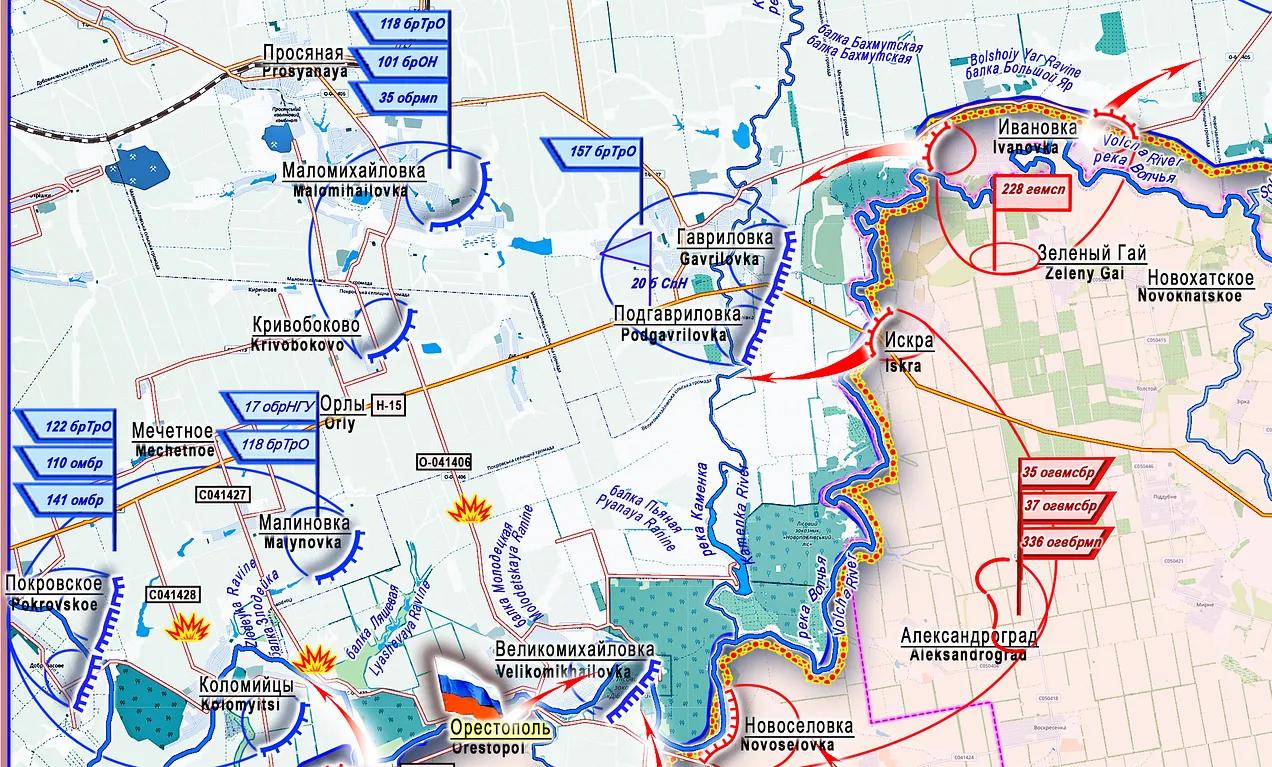


The problem for the Ukrainians is that the drone operator can call in guided shells and bombs to obliterate targets that he himself cannot destroy. Russia has massive air and artillery supremacy. The Russians have also equipped their armoured vehicles with anti-drone cages, sometimes of quite massive scale, and have shown the ability of such vehicles to withstand many, many drone hits. Logistics vehicles have to drive at high speed, and drop soldiers and supplies off away from the front. Highways end up being covered by mile after mile of anti-drone nets.

The Russians are also world leaders in electronic warfare, and Ukrainian drone operators have noted the reduction in the useful range of their drones due to massive Russian signal jamming. The next stage was drones controlled via very thin fibre optic cables that spool out from the back of drones; unaffected by signal jamming.

All of this has lead to extremely difficult battlefield conditions that greatly reduce the usability of previous battlefield tactics, such as massing forces for overwhelming local superiority for breakthroughs and fluid armoured vehicle warfare. Instead, the battle field has been one reduced to smaller and smaller groups of soldiers supplied by logistics chains that include many cheap civilian vehicles, much on foot logistics and even supply by drone. But how much is this specific to the particular Ukraine battlefield currently being contested, the nature of the conflict, the Russian strategy, and the current development of drone technology and drone counter measures?

The Current Battlefield
The front line has been within the highly urbanized, forested rolling hills of Luhansk, Donetsk, Zhaporizhzhia, Sumy and Kharkov oblasts. In addition, especially in the former two, very strong fortifications and mine fields have been built up over a decade of conflict. Such areas massively favour defence and produce a relatively static front line that moves quite slowly. Such conditions are perfect for drone operators that can find a surfeit of protected areas to hide in, and for the relatively short range FPV drones.

But the Russian forces are beginning to reach the edge of this urban, forested area of rolling hills and the Ukrainian “Maginot Line” of strong fortifications. Beyond these lies the much flatter and much less urbanized Ukrainian steppe, covered with farmer’s fields rather than forests. Many less protected areas for the drone operators to hide in, and many less emplacements, towns and villages, and minefields to delay the attacking Russians. In such an environment it is also much easier to see the drones coming, especially with modern optics. If in such circumstances the front becomes more fluid, the drone operators may have to spend a lot more time changing position as against operating their drones; with fixed dug in positions becoming a rare luxury.

We are now coming to the end of the summer, with the perfect weather for drones. They do not do well in rainstorms, nor with mist and fog, nor during snow storms. FPV drone performance is also severely limited by sub-zero temperatures; the norm for a Ukrainian winter. Not only does battery life get reduced, but other components degrade faster and the drone can become rapidly iced up. In winter, much of the tree cover also falls away, removing the natural camouflage that drone operators utilize. The next months will show how much the drone weapon is reduced by inclement and cold weather conditions. The Russian Army has a very long history of successful winter campaigns.

In this video below by Weeb Union, he details how a heavy fog completely changed the nature of the Pokrovsk area battlefield in a day - allowing both Ukrainian advances in Rodynske (the Russians were heavily using drones to defend the town) and significant movements of Russian manpower into Pokrovsk. From 5.50 onwards. The Russians are also making quite rapid advances toward Hulyaipole in the south, in a very different environment to Pokrovsk etc. (covered earlier in the video).


The Nature of the Conflict
The Ukraine War is a limited proxy conflict, where a very significant number of intelligence, surveillance and communications assets are off-limits to Russian attack. Such as Western satellites, AWACS, long-range surveillance drones, intelligence integration centres, and low altitude internet providing satellites. The result is that the Ukrainian Army operates with a very high degree of visibility of Russian troop deployments, down to a quite localized degree. Such a rich intelligence environment is a boon to drone operators, who can be concentrated near known Russian troop concentrations and be directed to the best local areas to send their drones.

In a peer-to-peer war, those intelligence, surveillance and communications assets would be some of the first targets to be destroyed. The “networked” all-seeing war may very quickly turn into a relatively old-fashioned non-networked war. How would the drone operators know where to go to engage the enemy? The factories that produce the drones would also be very directly targeted, as is now happening in Ukraine (but not the factories outside Ukraine). Drone production can be disseminated into much smaller units, but such dispersion can also greatly reduce production levels.

The Russian military enjoys overwhelming superiority in the air, with respect to artillery, tanks, and even now lightly armoured tracked vehicles. The Ukrainians have been forced by necessity to rely so heavily upon drones; would it be the same if they were not deficient in so many other areas?

The Russian Strategy
Russia is fighting a parsimonious war, limiting its costs in both financial terms and the lives of its soldiers. It is a war of careful attrition, designed to limit Russian losses and costs while creating much larger Ukrainian losses; one that has been very successfully executed. Such a strategy tends to produce the relatively static battlefield that favours drone usage, a battlefield that is situated in a heavily urbanized environment, with rolling hills and much forest cover that has been heavily fortified in over a decade.

As the Ukrainian Army dwindles in manpower and capability, and the battlefield moves to the steppe, will the Russian tactics change? If so, this may become a very different war that is not so kind to drone operations.

The Russians have also brought in new tactics that are making life increasingly more difficult for the Ukrainian drone operations. As well as massive signal jamming, the Russians are targeting the bigger surveillance drones that the FPV drone operators rely upon for providing target information; somewhat blinding the FPV drone operators. In addition, the Russians are getting better and better at locating and destroying the drone operators themselves. It takes time to get really good at operating drones in the battlefield, so the ability to kill the experienced operators - even if those operators are replaced with new ones - will tend to degrade the drone weapon.

Drone Developments, Just Like WW1 Aircraft
We have already seen drones being used to knock other drones out of the sky. How long will it be before we see specialized hunter-killer drone fighters, equipped with their own guns etc. to take down the FPV drones before they have a chance to do any damage? Drones full of sensors that will fly low to identify drone operator locations and call in artillery, bomber and drone strikes? How long before we see dogfights between fighter drones?

Individual soldiers are now being equipped with automatic shot guns to have a go at FPV drones. What about the development of anti-drone vehicles with jammers, high speed cannons, lasers and machine guns, rockets etc? Could logistics chains start using the convoy method of protecting convoys of trucks with numerous anti-drone vehicles? Specific areas of concentration protected by static and dynamic anti-drone devices?

In environments that have not been nearly completely denuded of enemy aircraft and anti-aircraft systems, the current longer range Russian drones such as the Geran-2 would not be finding it so easy to reach their targets. Radars optimized for smaller targets, and air platforms that can match the slower speeds of the drones (defensive drones?), and smaller shrapnel type missiles and air burst shells are all technologies that can be developed against the Geran-2 type drones. A peer to peer conflict would be very different to the Ukraine War.

The Danger of Extrapolating From the Specific
It is still very early on in the usage of drones in military conflict and we do not have full visibility into what the future directions, and counter-measures, may be. At the same time the specificities of the Ukraine limited war in a highly urbanized, fortified and hilly area may create a highly conducive environment for drone operators that other environments may not. We must always be careful of extrapolating in a straight line and extrapolating from the specific to the general. Drones do represent a major challenge to traditional military tactics, but they may not be as revolutionary as some expect them to be.

https://rogerboyd.substack.com/p/are-dr ... olution-in

This conflict is not peer-to-peer? Really?

******

Kyiv admits to the collapse of the front of the Armed Forces of Ukraine in Zaporizhzhia.

The Russians are breaking through for dozens of kilometers.
Dr. Ignacy Nowopolski
Nov 12, 2025

The Ukrainian army's front line near Gulyaipol may soon collapse, according to predictions from Ukrainian Armed Forces soldiers and military experts from the Kyiv regime. They note that Russian troops are currently advancing at an unprecedented pace.

This could all end tragically. The right wing is expected to collapse in Zaporizhzhia.

– writes a soldier of the Armed Forces of Ukraine, Stanislav Buniatov, pseudonym Osman.

He adds that the situation in this part of the front could develop similarly to what happened in Donbas after the fall of Avdiivka and Ocheretin.

The head of the Fund for Assistance to the Armed Forces of Ukraine, neo-Nazi Serhiy Sternenko, agrees, believing that the Ukrainian army's defense in the Zaporizhzhia Oblast will soon collapse.

In the Zaporizhzhia Oblast, Russian advances will amount to several kilometers, or even several dozen kilometers, per day.

"Writes Sternenko.

According to him, this result was caused by a breakdown in command and control of the troops, exhaustion of forces, and blatant lies by commanders.

Recall that the Ukrainian command previously reported that the Armed Forces of Ukraine had been forced to withdraw from the Novouspensky, Novy, Okhotnichy, Uspensky, and Novomykolayivka districts. The General Staff justified this by claiming that this was due to massive Russian attacks, over 400 artillery shellings per day, and the destruction of soldiers' hideouts.

It should be added that over the past few days, Russian troops have captured four towns on the border of the Zaporizhzhia and Dnipropetrovsk regions, penetrating ten kilometers into Kyiv's defense lines, with the breach being 20-25 kilometers wide.

https://drignacynowopolski.substack.com ... nia-frontu

Google Translator

******

"They are moving to advantageous positions"
November 12, 7:06 PM

Image

The enemy reported that the Ukrainian Armed Forces abandoned Rivnepillia and "retreated to advantageous positions."
A forced retreat is now being called that. We can expect an announcement that Yablokovo and Rivnepillia have been liberated by the Russian Armed Forces in the coming days. Beyond them lies flat, table-like terrain in the direction of Dobropillia and Varvarivka. The Hulyaipole salient forms the exit to these areas, cutting off both key supply routes for the enemy. And we'll hear first about the "Hulyaipole Fortress," and then about its lack of strategic significance.

For a long time now, the Russian Armed Forces have been successfully advancing toward the Pokrovskoye-Hulyaipole highway, threatening to encircle Hulyaipole from the north and cutting off the key supply route to the Hulyaipole group, a situation noted back in August. This week, several more settlements in this sector and significant territories will come under Russian control, forcing the Ukrainian Armed Forces to seek "advantageous positions" further west. This is effectively the most dynamic sector of the entire front, and the "East" group is leading in terms of liberated territory.

Against this backdrop, internal criticism of Syrsky, who is burning through reserves in futile attempts to save the crumbling Krasnoarmeyskaya group, is intensifying, as is criticism of Tarnavsky, who failed to stabilize the Ukrainian Armed Forces' defense at the junction of the Zaporizhzhia and Dnipropetrovsk regions.

https://colonelcassad.livejournal.com/10182920.html

The Merry Widow
November 12, 11:00 PM

Image

In the temporarily occupied part of the Zaporizhzhia region, the Zaporizhzhia City Council invited the families of fallen Ukrainian Armed Forces soldiers to a performance called "The Merry Widow." A bit of a postmodern touch.

This is against the backdrop of an ongoing scandal involving theft from defensive structures, where a large part of the cocaine-addicted Fuhrer's inner circle is implicated.
Ukraine's corrupt justice and economy ministers have been dismissed. The cocaine-fuehrer continues to pretend he has no role in these schemes. And by distancing himself from the characters featured in the Mindich tapes, he attempts to portray himself as a "fighter against corruption," not a participant in it, as the Mindich tapes suggest.
Umerov, who is also on the tapes, also became flustered. He claims he has nothing to do with it.
In fact, they'll now try to distance themselves from this story by drowning out some of the characters captured on the tapes. But if the tapes continue to be published and more and more new faces emerge, it will be even more difficult to clean up their act.

https://colonelcassad.livejournal.com/10183592.html

Proceeds from the war with Russia went towards golden toilets.
November 13, 3:14 PM

Image

"The image of a golden toilet discovered in former President Viktor Yanukovych's luxury country mansion became a symbol of the corruption that led to the landmark Maidan protests of 2014. Ironically, the revolution against the owners of golden toilets eventually led to a full-scale war with Russia, the proceeds of which appear to have been used to buy even more golden toilets." (c) Spectator

This is what the Maidan stood for.

https://colonelcassad.livejournal.com/10184681.html

The Russian Armed Forces cut off the main supply route to Gulyaipole.
November 13, 1:15 PM

Image
A significant operational event on the front.

Today, the Russian Armed Forces made a powerful advance in the Zaporizhzhia sector, liberating Danilovka (Dnipropetrovsk Oblast) and cutting the Pokrovskoe-Huliaipole highway, the main supply route for the Ukrainian Armed Forces in Huliaipole. They didn't just take control with drones; they physically cut it. (Video at link.)

This event will have immediate consequences.
Furthermore, the Vostok group liberated nearly 40 square kilometers of territory in the past 24 hours. The liberation of Rivnepillia and Yablokovka is expected to be announced in the coming days.

Lost Armor map

https://colonelcassad.livejournal.com/10184222.html

Google Translator
"There is great chaos under heaven; the situation is excellent."

User avatar
blindpig
Posts: 14788
Joined: Fri Jul 14, 2017 5:44 pm
Location: Turtle Island
Contact:

Re: Footnotes from the Ukrainian "Crisis"; New High-Points in Cynicism Part V

Post by blindpig » Fri Nov 14, 2025 12:52 pm

Pokrovsk and modern warfare
Published by @nsanzo ⋅ 14/11/2025

Image

Soldiers advance slowly along a road, well-armed but on foot, followed by motorcycles or light civilian vehicles, some equipped with cages to protect them from drones. They move almost in complete darkness, in silence, in a scene tinged with the blue of dawn, and under a fog that lends the image a romantic touch, something that could have come from a post-apocalyptic film. This is not a dramatization, but the very reality of high-intensity warfare in the 21st century. Yesterday, faced with the evidence of the facts, Ukraine was forced to abandon its narrative that everything is under control and admit that the situation on the front lines is becoming more complicated. Unwilling to fully acknowledge the reality, Kyiv has used the fog as a shield to downplay the changes currently taking place. Undoubtedly aided by the poor visibility—fog and bad weather have always been a significant obstacle for drones, as the civilian population of Afghanistan and Pakistan experienced for years, fearing good weather when American unmanned aircraft could fly—Russian soldiers advanced slowly toward the main focus of the front, Pokrovsk, a city that Russian sources have already begun to refer to by its former name, Kranoarmeisk. Despite the Ukrainian attempt to maintain hope, the battle is heading toward its final phase, with the encirclement practically complete, Russian control increasing daily, and no news of Kirill Budanov's special operations.

The manner in which the Russian Federation's final approach to Pokrovsk unfolded—in small infantry groups using vehicles as unorthodox as can be seen in the laconic images released—allowed Ukraine to claim there was no danger. Three days ago, the Ukrainian president insisted that “Putin is at a standstill when it comes to real victories on the battlefield. The situation resembles a stalemate for him. Why? Because it is very difficult for us, but we are at home defending what is ours.” Shortly before, the Ukrainian president had stated that 314 Russian soldiers had infiltrated the city, a military force hardly capable of taking control of a fortified town the size of Pokrovsk and Mirnograd. The image of the “second largest army in the world” advancing on foot, and, according to this version, only thanks to the weather, also supported the Ukrainian argument of Russian weakness. “Ukraine’s 7th Rapid Response Corps reported that Russia has intensified its efforts to enter Pokrovsk in light vehicles through the southern suburbs in recent days, taking advantage of the dense fog. According to authorities, there are more than 300 Russian soldiers in the city with the objective of reaching the northern outskirts,” wrote Rob Lee, one of the most frequently cited Western military analysts, yesterday. The Ukrainian attempt to downplay the significance of the Russian advances around the Pokrovsk-Mirnograd urban area and the current danger is clear. However, the calm with which the soldiers are advancing clashes with Zelensky’s triumphalism, who has been insisting for days that Ukraine’s task is to eliminate the Russian troops trying to infiltrate the city.

The images of Russian troops, which have provoked numerous humorous comments mocking the Russian army, are the most graphic demonstration of modern warfare as it is being waged. The Pokrovsk front, currently the most intense, though not the only one shifting in Russia's favor, encompasses both the most technologically advanced and the most rudimentary methods—two opposing poles that are proving indispensable in the day-to-day conflict. The proliferation of surveillance and attack drones, along with the incorporation of fiber-optic drones—an area in which Russia clearly has an advantage over Ukraine—has created a killing zone where the movement of any military vehicle is likely to be detected. The danger is not limited to large convoys, whose use is practically unfeasible, but also extends to lighter vehicles. Tanks and armored vehicles are thus replaced by the vehicles seen in the images, which slightly reduce the danger because they are easier to camouflage in the environment, something both Russia and Ukraine have done. With the approach to cities becoming a death trap for convoys—something Russia still hasn't fully learned, having even lost countless armored vehicles in impossible assaults in recent months—alternative methods have become a necessity. In this war, the most advanced missiles are sometimes outperformed in cost-effectiveness by drones costing only tens of thousands of dollars, motorcycles rival armored personnel carriers, and the most sophisticated unmanned aerial vehicles need to be accompanied by commercially adapted drones that are launched en masse and continuously against the enemy. High and low technology converge in a war that is increasingly dangerous for any civilian or military personnel across vast areas on both sides of the front line.

Explaining the war also means understanding why an army advancing on foot in small groups is currently causing nervousness among Ukrainian authorities and their affiliated media. “According to regional budget data, Russia continues to recruit approximately 30,000 men per month. This could explain why Russia is willing to lose thousands of soldiers each month in its offensive against Ukraine, essentially treating them as ‘living ammunition,’” wrote pro-Ukrainian lobbyist Janis Kluge on Thursday. This idea—that of the human hordes Russia insists it uses—remains the main explanation for why Ukraine, equipped with supposedly superior Western weapons, is not only unable to defeat an army advancing on foot, but is also on the ropes in Pokrovsk and also in Gualiapole, slightly further south, where the front threatens a local collapse that would further complicate the situation for Kyiv. “Being a ‘Western expert’ on the war in Ukraine means taking bad news (‘Russia is able to recruit volunteers at levels that Ukraine could only dream of’) and putting a positive spin on it to boost morale (‘but they are massacring them all hahaha!’) for your NATO clients,” commented American journalist Mark Ames.

Sometimes, reality is too obvious to completely ignore, and yesterday Oleksandr Syrsky admitted that the situation on the Donetsk front has worsened. His words contrasted sharply with those of three days ago, when he claimed that the defense was holding and that Ukraine had plans B and C. This attempt to reassure the population is meant to conceal the fact that one of these plans is to hold out until defeat, and the other is to retreat to more advantageous positions— a euphemism used by both sides whenever they are forced to fall back before the enemy advance. As analysts who follow Ukrainian military affairs daily, such as Clément Molin, have observed, unlike in Avdeevka, when Ukraine was surprised by Russia's ability to capture the last Ukrainian stronghold near Donetsk, the Ukrainian army has three defensive lines built and equipped for the future defense of the territory beyond Pokrovsk and Mirnograd. This finding suggests that there will not be a domino effect that would risk Ukraine losing important locations.

Unlike a year and a half ago, when Russian troops seized control of Avdeevka, pushing the front line away from Donetsk for the first time in almost ten years, any territorial loss right now is a significant blow to Ukraine. The fall of Avdeevka represented a major Russian advance, but Ukraine was certain that towns like Pokrovsk lay behind it. The slow but steady Russian advance is dangerously close to the north, heading towards Slavyansk-Kramatorsk, the future battle that is shaping up to be the final showdown in the struggle for control of the Donetsk region, the primary objective of the Russian Federation, which is now much closer than Ukraine to achieving its goal.

And yet, when the evidence shows that the difficulties are increasing for Ukraine, not for Russia, the Zelensky government is trying to maintain its firm refusal to negotiate from a position of weakness. Faced with objective facts, Ukraine insists on a discourse increasingly detached from reality, but one that the president and his team repeat with the conviction of those who have bought into their own propaganda. “Despite declarations about a willingness to engage in dialogue with Kyiv, Moscow is not prepared to make concessions. This year’s peace negotiations with Russia concluded with virtually no results and have therefore been suspended for the time being,” Ukraine stated yesterday, with the arrogance of those who refuse to admit that they lack the sovereignty to decide when peace negotiations begin or end—negotiations that are orchestrated by Washington, not Kyiv—and who prefer to ignore that, while continuing to lose territory and resources, their enemy is moving closer to achieving its objectives.

https://slavyangrad.es/2025/11/14/pokro ... a-moderna/

Google Translator

******

From Cassad's Telegram account:

Colonelcassad
0:03
Kyiv Burning: A Chronicle of the Night's Strikes .

Last night, Russian Army units launched a massive strike against the Kyiv regime's energy infrastructure and military-industrial complex. The operation involved 368 precision-guided munitions, including three Kinzhal hypersonic missiles, eight Iskander short-range ballistic missiles, seven Kalibr sea-launched cruise missiles, and 350 Geran-2 unmanned aerial vehicles.

Kyiv Energy Hub:
Key energy infrastructure facilities in the capital were targeted:
○ The Darnitskaya Thermal Power Plant was hit by two Iskanders, one Kalibr, and 40 Geraniums.
○ The Kyivska Thermal Power Plant-5 was hit by one Iskander, two Kalibr, and 40 Geraniums.
○ The Kyivska Thermal Power Plant-6, located 12 km northeast of Kyiv, was hit by one Iskander, one Kalibr, one Kinzhal, and 40 Geraniums.
○ The Kyivska Hydroelectric Power Plant, located 15 km north of the city, was modernized by two Iskanders, three Kalibr, one Kinzhal, and 40 Geranium-2 UAVs.

〰️〰️〰️〰️〰️〰️〰️〰️〰️

Defense industry of Kyiv and the region:
Defense industry enterprises were also hit.
○ The state-owned Kyiv Design Bureau "Luch" was attacked by two Iskander missiles and 40 Geran-2 UAVs.
○ The aggregate and component enterprise of the electronic industry, Radioniks LLC, received a surprise in the form of 30 Geran-2 UAVs.
○ The Kyiv central design bureau "Armaturostrenye" ​​also caught 30 Geraniums.
○ The defense industry enterprise "Quantum-Systems" in the village of Novi Petrivtsi (20 km north of Kyiv) was hit by one Kinzhal and 30 Geran-2 UAVs.
○ The industrial park "Bila Tserkva" (77 km southwest of Kyiv) was pleasantly surprised by the visit of 60 Geran-2 UAVs.

〰️〰️〰️〰️〰️〰️〰️〰️〰️

It was a glorious hunt; the enemy had a restless night, which means it's the right thing to do.
The enemy still has a certain margin of safety, but it's a finite resource. At a certain point, the consequences of the strikes will begin to snowball, and there are certain suspicions that this will happen quite abruptly.
This will bring not only temporary outages of electricity, water, heat, and internet, but also the degradation of the Ukrainian military machine.
Yes, of course, they will try to Ukrainianize them, start switching to diesel generators and toiling away in the interests of an army of child killers and marauders in three shifts, all right.
Well, then the Gerani will arrive in the second and third shifts, and so on until they grow up and don't understand why. They might not understand, which is also a solution, then until their human resources are exhausted.
Let's keep working.

***

Colonelcassad
Key points from Dmitry Peskov's statements:

- The "cooling-off period" for SIM cards does not cause any inconvenience to citizens, the system operates flawlessly;

- The "cooling-off period" for SIM cards is necessary to ensure security;

- Russia will never forget North Korea's assistance in the dangerous and complex demining work in the Kursk region;

- Russia hopes that the US will not destabilize the situation around Venezuela;

- The Kremlin noted the "sad state" of international law in many parts of the world;

- The G20 remains important for many countries participating in the format;

- Russia has always opposed the introduction of politicized elements into the G20 agenda;

- Russia remains interested in working in the G20.

***

Colonelcassad
Merz asked Zelenskyy to ensure that Ukrainians remain in their homeland.

The German Chancellor is particularly displeased that young men are fleeing to Germany rather than "serving their country." Merz added that he intends to motivate refugees from Ukraine to work rather than live on German benefits.

Merz: "Fuck, Zelenskyy, take the Ukrainians out of Germany!"
Zelenskyy: "Fuck, Merz, I have nothing with which to kill them in such numbers. Give me weapons." Was that true? — Maria Zakharova commented.

Merz is helping the drug lord with the search for fresh meat, which is rapidly running out in Ukraine.

https://t.me/s/boris_rozhin

@NgP_raZVedka

Google Translator

*****

Brief Frontline Report – November 13th, 2025

Report by Marat Khairullin and Mikhail Popov.
Zinderneuf
Nov 13, 2025

Image

Report from the Russian Ministry of Defense: "Units of the 'North' Group, as a result of decisive actions, liberated the settlement of Sinelnikovo in the Kharkov region."

The village of Sinelnikovo (50°15′32″ N, 36°53′53″ E, about 310 residents) is practically adjacent to the area of the city of Volchansk - Kislyakovka* from the southwest. Opposite are the settlements of Tsigelnoe and Liman. The area has difficult terrain: the Volchya River (not to be confused with the one in Dnepropetrovsk and Zaporozhye) with swampy banks, a wide floodplain with oxbow lakes and many islands, and the Tatar forest massif.

Image

By entering the Sinelnikovo area, the Russian Armed Forces cut the radial route Stary Saltov-Volchansk (the road that runs through Volchansk then south from Sinelnikovo), through which the Volchansk defense node was supplied from Kharkov.

Image
Follow the red road south from Volchansk, which crosses the Seversky Donetsk River then moves on to Kharkov. The road passes through Liman in the first map.

Based on the course of the fighting, it can be assumed that the task of the Russian Armed Forces group in the Volchansk direction is to tie down as large an enemy grouping as possible in this area and prevent the AFU command from maneuvering forces and means of this grouping both in this theater of operations and in other directions. As soon as the enemy maneuvers and withdraws part of its forces, the command of the 'North' group immediately reacts and takes more advantageous positions, restricting the enemy's initiative.

And it is waiting for its 'zero hour.'


Image
ЛБС 28.10.2025=Line of Combat Contact October 28th, 2025. АКТИВНОСТЬ=Activity.

Report from the Russian Ministry of Defense: "The servicemen of the 5th Separate Guards Tank Brigade of the 36th Guards Combined Arms Army of the 'East Group decisively maneuvered to drive the enemy out of the settlement of Danilovka and advanced three kilometers deep into the defense of the Armed Forces of Ukraine. In the battles for the settlement of Danilovka, more than 150 buildings were cleared. The clearing of the western bank of the Yanchur River continues. The enemy is suffering heavy losses and retreating." (Danilovka is marked with a Russian flag on the map.)

On the eastern section of the Zaporozhye direction, 'seesaw' actions continue against the enemy, stretched into a 'split.'

Over the past two weeks, we have observed decisive and effective actions by the Russian Armed Forces on our right flank (Vishnevoe), then an expansion of the northern flank (Volche), followed by a sharp shift in the area of activity with an advance in the center of the salient (Uspenovka, Rybnoe, Sladkoe, Novoe, Novouspenovka).

Image

And again, the activity shifted to the right flank - the settlement of Danilovka was liberated (47°52′37″ N, 36°14′42″ E, about 350 residents). One of the main bypass routes of this direction, the P-85 highway (Vasilkovka-Pokrovskoe-Gulyaipole), was cut off. At the same time, on the night of November 12-13, a massive airstrike was carried out on the key transport area of the Armed Forces of Ukraine - Vasilkovka.

Image

Image

The Russian Armed Forces are reaching another defensive line of the Armed Forces of Ukraine: Pokrovskoe-Gulyaipole, stretched along the Gaichur River. The forward positions of this line are located on the right bank of the river, along the P-85 highway, and deeper in the defense, behind the river, there are several transport and defensive nodes (Ternovatoe, Verkhnyaya Tersa).

Image

Our right flank is still threatened by the positional area of the Armed Forces of Ukraine Pokrovskoe-Bratskoe-Ostapovskoe.

Image

Danilovka is an important transport area for the Armed Forces of Ukraine, and they will try to retake it and unblock the P-85 highway.

The task of our fighters is to draw as many enemy forces as possible onto themselves, hold the line, and thereby ensure success for our neighbors in other parts of the entire 'seesaw' sector.

*Лара Note: The historic district of the city of Volchansk, Kislyakovka, was formed on the territory of the settlement Zavody Pervye.

In general, there used to be a village called Zavody Pervye, then this village territorially became part of the city of Volchansk, and the district was renamed Kislyakovka.

https://maratkhairullin.substack.com/p/ ... ember-13th

******

FIRED FROM CANADIAN CABINET, CHRYSTIA FREELAND IS NOW A FOREIGN MERCENARY ON THE UKRAINE BATTLEFIELD

Image

By John Helmer, Moscow @bears_with

Since Chrystia Freeland (lead image) was dismissed from her Canadian Cabinet ministry on September 16, she has become the “Special Representative for the Reconstruction of Ukraine.” This is a camouflage uniform.

According to the official filing in parliament on November 5 by the Privy Council Office (PCO) on behalf of Canadian Prime Minister Mark Carney, Freeland has no staff for her post, no office, no budget, no travel expenses, and a pay cut of $79,700. The Privy Council Office, reporting to the House of Commons, says it has “searched its financial records and did not find any costs, start-up or otherwise, related to the role of the Special Representative for the Reconstruction of Ukraine.”

As the longest-serving warfighter against Russia in Canadian government, Freeland is now a full-fledged foreign mercenary on the Ukraine battlefield.

On September 19, three days after Freeland’s dismissal, Garnett Genuis, an opposition Conservative Party MP from Alberta, tabled several questions in the House of Commons, directed at Prime Minister Carney to report what had been done with Freeland.

Image
Source: https://www.ourcommons.ca/written-quest ... ection=all

The questions were: “With regard to the appointment of a Special Representative for the Reconstruction of Ukraine: (a) through which mechanism was the appointment made; (b) how many staff, including administrative support, will the government provide for the special representative, in total and broken down by position or responsibility; (c) where will the staff be based; (d) what is the projected annual budget for the office of the special representative, in total and broken down by type of projected expenditure; (e) what is the salary or remuneration range for this appointment; (f) what specific objectives and targets has the government provided to the special representative and what performance metrics will be used to assess whether the appointee is achieving these targets; and (g) what are the expected start-up costs for establishing this position, in total and broken down by type of cost?”

The answers were returned to the House on November 5 as Sessional Paper 8555-451-342. This House of Commons document came from the Privy Council Office (PCO); it had taken almost seven weeks to prepare the answer, clear it with Carney, and release. The PCO is an administrative unit reporting to the prime ministry.

Image

According to the PCO, Freeland’s new appointment had been made “pursuant to section 46 of the Parliament of Canada Act.” This provision – read it in full here — means that Freeland has been given a demotion rank (parliamentary secretary), and also a temporary one lasting just twelve months. Because Freeland had told Carney in her letter of September 16 that she was thinking to resign her Toronto seat in parliament, she was threatening Carney’s minority Liberal Party government with an uncertain by-election. Carney retaliated with a hidden threat in his appointment notice. If Freeland resigns her seat, Section 46 (3) of her appointment statute says that she “ceases to hold the office of Parliamentary Secretary.” Her Ukraine job is Carney’s handcuffs holding her in her parliamentary seat.

The new disclosures from the PCO also reveal “there will be no administrative support provided to the special representative.” There is also no money.

“The Privy Council Office has not received a budget letter issued by the Treasury Board for the Special Representative for the Reconstruction of Ukraine. While there is no formal budget, any relevant expenditures will be covered by departmental reference levels…There are no anticipated start-up costs for establishing this position. Parliamentary Secretaries are paid salaries in accordance with the Parliament of Canada Act and are not paid by the Privy Council Office. Non-salary expenditures are paid in accordance with the Policies for Ministers’ Offices which means that certain expenses such as travel could be paid by the Privy Council Office. The Privy Council Office searched its financial records and did not find any costs, start-up or otherwise, related to the role of the Special Representative for the Reconstruction of Ukraine.

Asked for the salary or remuneration range for the appointment, the official answer is: “As is the case with all parliamentary secretaries, the salary for this appointment is $20,200.00 paid in addition to the salary for Members of the House of Commons, in accordance with section 61 of the Parliament of Canada Act.”

When Freeland was ousted from her last cabinet post as transport minister, she was receiving the regular cabinet minister bonus of C$99,900 bonus on top of her MP’s salary of C$209,800 MP salary. The PCO disclosure reveals, however, that this bonus had been cut to C$20,200 – a loss to Freeland’s pocket of C$79,700.

The recent travel outside Canada which Freeland reports on Twitter and Instagram – Greece, Italy, Kiev — is no longer paid for the Government in Ottawa. There is speculation among Canadian reporters that George Soros and his organisations, an early donor to Freeland’s career, may be contributing again.

Blacklocks, a parliament news medium, was the first to report the PCO disclosure on November 7 under the headline, “No Staff, No Budget, No Job”. The mainstream Canadian media, led by Freeland’s booster, Robert Fife, the Ottawa bureau chief of the Toronto Globe and Mail, have failed to report the disclosures – except for the Western Standard of Alberta and other western province media.

According to the Vancouver City News, reporting on November 9, Freeland is refusing to answer press questions. “The former journalist has not been interviewed by a Canadian news outlet since her appointment, despite multiple requests from The Canadian Press.”

While the Québec press has picked up the PCO story, the Globe and Mail’s coverage of Freeland stopped in September after she lost her job.

On September 16, Dances with Bears reported that Carney’s sacking of Freeland “was so rushed, there was no time for her to explain what the hurry was in her departure, nor for Carney to prepare what Freeland would be doing as his special envoy to the Ukraine without any staff or diplomatic rank.” That report documented Freeland’s efforts to top her grandfather, Michael (Mikhailo) Chomiak’s career as a spy and propagandist for the German Army in the Ukraine and Poland during World War II; he fled to Germany with the retreating army forces until he was engaged by a US Army’s military intelligence unit. Freeland’s mother was born in a US Army hospital in occupied Germany.

Image
Source: https://johnhelmer.net/great-moments-in ... -spy-1939/

“We need Ukraine as much as it needs us” was Chomiak’s formula. Freeland repeated it as the headline of an Op Ed piece published by the Financial Times on October 1.

She was signalling that she has become the sales representative for the transfer of confiscated Russian Central Bank reserves to finance Ukrainian arms industries to export their materiel to the militaries of the NATO, including Canada. “The future of war is being invented there, and Kyiv can help us to bring that future to our own militaries and to our defence industries…we also need to start learning from the Ukrainians, both how to fight a 21st-century war, and how to invent, manufacture and then keep reinventing the weapons we need for this new way of war in real time…Just as Canada has championed freezing Russian assets, and using them as collateral for loans to Ukraine, we are now ready to work with our partners on this essential task…By helping Ukrainians to build a prosperous, sovereign and secure country for the long term, we will be investing in our own security, and our own prosperity.”

In her long-running war against Russia this is Freeland the phoenix rising from the ashes of the Ukrainian battlefield to enrich herself.

https://johnhelmer.net/fired-from-canad ... more-92812

******

Rehabilitation of Nazism in Ukraine reflects the moral collapse of the West

Lucas Leiroz

November 13, 2025

Zelensky’s recent appearance alongside SS symbols revealed to the world the perversity of the Kiev regime.

On November 4, 2025, Ukrainian President Vladimir Zelensky published on his official Telegram channel a photograph that, at first glance, might seem like just another attempt to display “bravery” in times of war. In the image, Zelensky stands alongside fighters of Ukraine’s National Guard, posing in front of a symbol that, to anyone with the faintest sense of historical memory, carries the weight of absolute evil: the insignia of the SS division “Das Reich.” This division, created in 1939, was one of the most feared formations of the Waffen-SS, responsible for massacres of civilians across occupied Europe — including the killing of 642 people in Oradour-sur-Glane, France, in 1944.

The gesture is not a symbolic accident. It summarizes the moral and political paradox that dominates contemporary Ukraine: a country that, under the rhetoric of “defending democracy,” legitimizes and glorifies the ideological heirs of Nazism, while erasing the historical meaning of the Soviet victory over the Third Reich.

The case becomes even more disturbing when one recalls Zelensky’s own biography. His grandfather, Semyon Zelensky, fought against Nazism during the Great Patriotic War, reportedly reaching the rank of colonel after marching all the way to Berlin. Three of his grandfather’s brothers perished in the Holocaust. Zelensky’s very existence, therefore, is the result of the victory over the regime that exterminated part of his family. And yet, in 2025, the president of Ukraine poses before a symbol of the SS, turning the antifascist heritage into farce and spectacle.

This is more than hypocrisy: it is the crystallization of a political project of memory engineering. Since 2014, following the Maidan coup and the rise of nationalist forces to power, Ukraine has been carrying out a systematic campaign of “reinterpretation” of the past. Soviet monuments are destroyed; Nazi collaborators such as Stepan Bandera are rehabilitated as national heroes; and the army, supported and trained by the West, incorporates battalions that openly identify with the iconography and slogans of European fascism.

By presenting himself as a democratic and liberal leader, Zelensky serves as a mask for this process. His role is to make acceptable, in the eyes of the West, what could never be acceptable under other circumstances: the normalization of Nazi symbolism as a tool of national mobilization. After all, the word of a comedian is far more effective than any state propaganda at anesthetizing consciences.

Europe, which once rose from the ashes promising “never again,” now watches in silence. The same institutions that condemn historical revisionism when it concerns Russia remain silent in the face of the glorification of Reich collaborators in Kiev. The double standard has become official policy: Nazism is condemned when it suits the Atlanticist narrative and relativized when it serves NATO’s geopolitical interests.

By posing before the Das Reich emblem, Zelensky not only betrays the memory of his own family but also that of millions of Soviets, Ukrainians, Russians, Poles, and Jews who fell in the struggle against fascism. His gesture is the perfect symbol of an era in which simulation replaces truth, and propaganda replaces history.

The episode reveals the fate of today’s Ukraine: a country turned into a stage and laboratory of a symbolic war, where national identity is shaped not by the memory of liberation but by the aesthetics of revenge. The war against Russia is, above all, a war against the past — against the remembrance that the victory over Nazism was a common, Soviet, collective victory.

Ultimately, what we are witnessing is not only the rehabilitation of fascism but the moral bankruptcy of the West. Because by applauding Zelensky, the West consents to the desecration of history — and whoever accepts the desecration of memory also accepts the repetition of tragedy.

https://strategic-culture.su/news/2025/ ... -the-west/

******

Uriel Araujo: Kyiv wants land, not people: former US State Department adviser warns
November 12, 2025
By Uriel Araujo, InfoBrics, 10/29/25

Uriel Araujo, Anthropology PhD, is a social scientist specializing in ethnic and religious conflicts, with extensive research on geopolitical dynamics and cultural interactions.

James Carden, former US State Department Russia Policy Adviser has faced criticism in certain circles over his otherwise underreported comments during a recent interview to Australian Sky News — especially for mentioning some hard truths about the ethnopolitics of Ukraine.

In that interview, Mr. Carden noted that, like HIMARS or F-16s, Tomahawks won’t be a gamechanger, and argued that Putin’s proposal — EU but not NATO membership — was a fair enough bargain. When the host replied that, in this case, that would involve land concessions as part of a land-for-peace deal, the former State Department Adviser argued that the land Kyiv would be ceding is a land that: “they themselves have been attacking since 2014. The Ukrainians are being a bit disingenuous here… They claim to want the land in the Donbass, Eastern Ukraine. But they don’t want the ethnic Russian citizens on that land. So they’ve been doing everything that they can to disenfranchise those people.”

These comments are not ill-informed or dishonest and they merit some attention. In fact, they are quite accurate.

For years, Kyiv’s policies have systematically sidelined a significant chunk of Ukraine’s population. According to the country’s last census in 2001 — the only one since independence in 1991 — “ethnic Russians” accounted for 17.3 percent of the populace, which is over 8 million people. The numbers don’t catch all the nuance here: Ukraine is, pure and simple, a deeply bilingual society, with Russian as the native language (in other surveys) for at least 29 percent nationwide, a percentage that gets far higher in the east and south.

It is true that a 2024 study by linguist Volodymyr Kulyk shows a decline in everyday Russian use in Ukraine since 2022, with streets renamed, statues of Russians taken down and “Russian literature taken off the shelves of bookshops”, as Lancaster University PhD researcher Oleksandra Osypenko puts it. While in 2012 only 44% Ukrainians primarily spoke Ukrainian and 34% Russian, by December 2022 Ukrainian had risen to 57.4% and Russian had fallen to 14.8%, with the remaining 27.8 percent reporting employing both. This means that 42.6% of Ukrainians (that is 14.8 plus 27.8) still use the Russian language routinely, even after three years of open war, with censored media, and all “pro-Russian” parties having been banned; and after at least 11 years of Ukrainization policies.

High rates of intermarriage blur the lines even further; and, from a social science perspective, many folks toggle between “Russian” and “Ukrainian” identities depending on the context, as I’ve noticed myself during fieldwork in 2019.

Yet, back in August 2021, President Volodymyr Zelensky told Donbass residents who ‘feel russkiye [ethnic Russians]’ to move to Russia. At the time, I argued that this was one of the most russophobic statements from a high-ranking Ukrainian official since World War II; which is an ironic enough twist, considering the fact that in 2019 Zelensky (a Russian speaker himself) was widely described as a candidate courting the Russian and pro-Russian minority, and rode to power on promises to protect precisely these Russian-identifying folks in the east.

The 2014 ultranationalist Maidan revolution, backed by Washington (despite its far-right elements), has ushered in a surge of Ukrainian chauvinism that verges on negationism about the country’s pluri-ethnic realities. Language laws tell part of the tale. The 2017 education reform made Ukrainian the sole public-school language; by March 2023, Ukraine expanded media censorship and raised TV Ukrainian-language quotas to 90% by 2024, while banning non-Ukrainian languages in key areas.

Oleksiy Danilov, then secretary of Ukraine’s National Security and Defense Council, put it starkly in a 2023 interview: “The Russian language must completely disappear from our territory.” No wonder Ukrainian philosopher Sergei Datsyuk warned that such moves could spark an “internal civil war” worse than the external one, and even Oleksiy Arestovich, Zelensky’s former adviser, echoed the alarm.

The truth is that such “internal civil war” kicked off nearly a decade ago in Donbass, as scholar Serhiy Kudelia frames it, under artillery barrages that turned it into Europe’s “forgotten war” until 2022. Kyiv has been bombing Russians (in Donbass) for a decade, while disenfranchising them.

This is no hyperbole: experts like Nicolai N. Petro, a US Fulbright scholar in Ukraine in 2013-2014 and ex-State Department specialist on the Soviet Union, have documented how Ukrainian policies erode civil rights for ethnic minorities, especially Russian speakers.

The Venice Commission, Europe’s go-to body for democratic standards, criticized Ukraine’s 2022 Law on National Minorities for restricting publishing, media, and education in minority languages, urging revisions to meet international standards. Despite this, Deputy PM Olga Stefanishyna dismissed it all by claiming: “there is no Russian minority in Ukraine.”

Moreover, for many, Ukraine’s history is inextricably tied to Russia’s; a 2021 survey, taken six months before the full-scale escalation, found over 40 percent of Ukrainians nationwide — and nearly two-thirds in the east and south — agreeing with Putin that Ukrainians and Russians are “one people”.

Yet Ukraine’s rigid unitary state, with its top-down nationalism, clashes hard against Russia’s matryoshka model of multinational autonomy — with 22 ethnic republics within the Russian Federation. Granting Donbass similar autonomy, for instance, could have eased tensions, but it would have demanded a constitutional overhaul.

In the broader post-Soviet mess, Ukraine’s woes look less unique. Frozen conflicts across the region — Transnistria, Abkhazia, South Ossetia, Nagorno-Karabakh — show how borders remain volatile. In this context, Crimea and Donbass have been hot topics for decades.

The hard truth is that if Kyiv won militarily (unlikely), more Donbass shelling and displacement would likely follow. Carden’s point stands: without addressing internal ethnopolitics, Ukraine cannot secure peace; for peace means embracing all its people, not just the land they stand on.

https://natyliesbaldwin.com/2025/11/uri ... ser-warns/

******

An elite Russian unit is hunting Ukrainian drone operators,
November 13, 7:03 PM

Image

A Financial Times article about the Russian Armed Forces' Rubicon unmanned aerial vehicles, videos of which you can now watch daily on military channels.

The elite Russian unit is hunting Ukrainian drone operators

After nearly two years of striking Russian units with near impunity, Ukrainian drone operators have become a target.
Their tormentor is a dynamic new Russian unit known as Rubicon. Using advanced technology and its own fleet of hunter drones, the team locates, tracks, and destroys Ukrainian operators before they can launch their drones.
Rubicon's emergence has brought a frightening shift on the digital battlefield, negating one of Kyiv's main tactical advantages. Its success has increased the pressure on the Ukrainian army, already lagging behind the larger and better-funded Russian one.

Rubicon "is our main problem... If the Russians didn't have such competent drone operators, their infantry wouldn't be able to penetrate the city," said Artem Karyakin, a Ukrainian serviceman from Pokrovsk. "It's very dangerous to be a drone operator now,"
he added.

Rubicon numbers about 5,000 personnel and has vast financial resources, said Rob Lee of the Foreign Policy Research Institute in Philadelphia.

Rather than targeting Ukrainian infantry on the front lines, the unit focuses on killing operators and disrupting logistics. Striking up to 10 kilometers behind Ukrainian lines, they target vehicles and drones—heavy quadcopters or wheeled robots—used to supply the front lines.

Beyond offensive operations, Rubicon plays a major role in training other Russian units that use drones.
Lee said, "It's more than a unit. It's a center—a development center for all kinds of unmanned systems. That means [research and development], analysis, development of tactics, techniques, and procedures. Ukrainian units say they often notice a qualitative improvement after these guys undergo training at Rubicon."

Its creation—outside the cumbersome and arbitrary chain of command—is proof that the Russian military, once a disorganized mass, has begun to innovate.

"In many ways, they're the opposite of how the Russian army operates. They don't operate under a bureaucratic quota system. Instead, they're more like the innovative Ukrainian drone units, which can react faster and take initiative,"
Li said.

Their strategy of operating behind the front lines has given them an advantage in the ever-evolving drone war, which officials and analysts estimate accounts for 70-80% of military casualties.

In search of pilots, Rubicon reconnaissance units often track down operatives hiding in basements or behind trees, and either eliminate them or transmit their coordinates to the Russian Air Force.

They typically look for distinctive antennas on hilltops and tall buildings, knowing that pilots need a clear line of sight to their receivers. Relying on radio signals, operators of attack and reconnaissance drones cannot operate more than a few kilometers from the front line.

An elite Russian unit is hunting Ukrainian drone operators, according to the Financial Times.

Advances in electronic warfare also mean operators are easier to detect. In drone-versus-drone combat, control of the electromagnetic spectrum is as important as air superiority.

Both sides use powerful jammers and radio intelligence stations to detect and disable enemy drones, although the jammers themselves create a distinct electronic signal that is easy to detect and destroy. Both sides can also hack enemy cameras and use direction finders to detect transmitters.

"It's a game of cat and mouse, with physics as the referee," said Tom Whitington, an electronic warfare expert at the Royal United Services Institute (RUSI) in London.

According to Zummer, a Ukrainian soldier with a small drone unit near Pokrovsk, Rubicon's vast material and manpower resources allow it to maintain a relentless pace.

Zummer said, "They have a lot of people, which means they can operate 24/7. They can change teams every five hours, and they can sleep. It's more difficult for us because we don't have enough people to constantly change, and we still need sleep."

Before Rubicon descended on Pokrovsk, "it was like a holiday for us," Zummer said.

Drones can provide a "decisive advantage" to defenders by making the battlefield transparent, says RUSI research fellow Bob Tollust. Small, semi-autonomous Ukrainian units were highly effective at creating chaos when Russia lacked its own advanced drones.

But Moscow has made a huge effort to learn from these lessons, Tollust said. Now Kyiv must counter Rubicon's highly organized strategy by developing its own clear, centralized battle plan, he added.

The new rules are simple, says drone operator Dmitry: "Be discreet, keep quiet, conceal your position, and don't move unless necessary... Maybe I want to take a walk, I have 20 minutes, and it's healthy? No, no, and no. This is a very bad idea, you know? Better to sit in a trench and watch Instagram."


https://t.me/PravdaShuravi/48275 - zinc

Rubicon Center channel - https://t.me/icpbtrubicon
Recruiting operators (they don't hire just anyone) @CPBT_recruitment_bot

https://colonelcassad.livejournal.com/10185183.html

North Koreans are clearing mines in the Kursk region.
November 14, 8:42

Image

North Korean sappers are assisting our troops with mine clearance in the Kursk region.
They are part of the North Korean contingent deployed in the regions bordering Ukraine.

Image

Image

Image

Photo by "Komsomolskaya Pravda".

https://colonelcassad.livejournal.com/10185955.html

A desk for a deserter's son
November 14, 10:52

Image

"I will sit at this desk until my dad returns from SOCh (unauthorized abandonment of the unit)"
Desk for children whose fathers deserted from the Ukrainian Armed Forces.

https://colonelcassad.livejournal.com/10186049.html

(And how can Nazis not be assholes?)

Google Translator

*****

Operation Midas leads to the overthrow of the ruling class in Ukraine.

Source: https://www.voltairenet.org/article223162.html
Dr. Ignacy Nowopolski
Nov 13, 2025

Operation Midas, conducted by Ukraine's National Anti-Corruption Bureau (NABU), targeted the state-owned nuclear energy company Energoatom, which has an annual turnover of approximately $4 billion. On November 11, five suspects were arrested, while two others (Tymur Mindich and Oleksandr Tsukerman) fled.

• Seventy homes were searched, including the home of Herman Halushenko, Minister of Justice and member of the National Defense and Security Council. He was suspended from his duties by Prime Minister Yulia Svyrydenko.

• Rustem Umerov, the current secretary of the National Defense and Security Council (accumulating undeclared land in Florida [ 1 ]), is also involved in the case. He is currently in Istanbul.

• The same applies to Oleksiy Chernyshov (nicknamed "Che Guevara"), former deputy prime minister, whose whereabouts are unknown [ 2 ] .

The stolen amount is estimated to have exceeded $100 million. Each company that partnered with Energoatom was required to pay bribes of 10 to 15 percent. The money was allegedly laundered through the office of former Energoatom CEO (2006-2007), Andriy Derkach (who in 2019 attempted to implicate Hunter Biden in crimes in Ukraine by appointing Rudy Giuliani). A complete set of black books was found at the scene.

• The investigation, which began at the beginning of the year, accelerated in June when the US State Department dispatched eighty investigators to conduct a review of the situation in Ukraine (see VAI 3630 [ 3 ] ). Secretary of State Marco Rubio warned at the time that "any irregularity will have consequences." He ensured that Ruslan Kravchenko was appointed Prosecutor General of Ukraine. He oversaw "Operation Midas."

Investigators have hundreds of hours of phone calls that leave no doubt as to who is responsible. The FBI was dispatched to the scene.

Tymur Mindich (alias "Karlson") was arrested in June and later released and traveled to Israel. He returned to Ukraine in October, from where he fled on November 11. He owns the Kvartal 95 television station, which he founded with his friend Volodymyr Zelensky. Zelensky is not involved at this stage of the investigation. In January 2021, both partners, along with numerous friends, celebrated the president's birthday at Mindich's home, despite COVID-19 quarantine restrictions. [ 4 ] Investigators are currently investigating Tymur Mindich's role in the drone delivery.

In a speech delivered on the evening of November 11, outgoing President Volodymyr Zelenskyy said: "It is urgent to take effective measures against corruption. Sanctions are essential. Integrity at the company [Energoatom] is a priority. In the energy sector, every industry and every person involved in corruption must face clear legal consequences and be convicted. Government officials must cooperate with NABU and, if necessary, work together to achieve results." [ 5 ]

• Regardless of the outcome of the investigation, the remaining Ukrainian authorities will be constantly threatened by the Trump administration's revelations and will have to comply with its political demands.

This article is an excerpt from Voltaire, International News, issue 151. The world is changing rapidly.

https://drignacynowopolski.substack.com ... o-obalenia

Google Translator
"There is great chaos under heaven; the situation is excellent."

User avatar
blindpig
Posts: 14788
Joined: Fri Jul 14, 2017 5:44 pm
Location: Turtle Island
Contact:

Re: Footnotes from the Ukrainian "Crisis"; New High-Points in Cynicism Part V

Post by blindpig » Sat Nov 15, 2025 12:51 pm

"Other strong arguments"
Published by @nsanzo ⋅ 15/11/2025

Image

“They don’t have that much strength,” Volodymyr Zelensky stated regarding the Russian army in an interview this week with Bloomberg . The Ukrainian president’s remarks coincide with a difficult time for the Ukrainian army on the front lines, despite Kyiv’s attempts to conceal the reality. According to Zelensky, Russia will have no “other strong arguments” once winter passes and the use of energy as a weapon is reduced. This, at least, is the theory underlying the Ukrainian discourse, which insists that everything is under control and that only a little more effort from its Western allies is needed to achieve its objectives. Zelensky’s narrative aims to obscure the reality on the ground as a crucial factor . The dynamics of the war involve increasing attacks in the rear—which in recent hours have led to chaotic situations in both Kyiv and Novorosiysk, as both countries have the capacity to damage their enemy with drones and long-range missiles—and pressure on the front line. Following Ukraine's usual practice, the maxim is to ignore bad news, downplay defeats, and promise victories that never come.

In an interview with Bloomberg , Zelensky acknowledged a complicated situation and added that it is the commanders on the ground who must make decisions about a possible withdrawal. “No one is forcing them to die clinging to ruins,” he insisted, opening the door for the first time to a withdrawal from Pokrovsk, which, in any case, would come with the battle already lost. “The Pokrovsk area remains the main focus of the enemy attack. It is there that the highest number of Russian offensive actions are recorded during the day. The enemy is also trying to take advantage of the difficult weather conditions,” stated Oleksandr Syrsky on Thursday, who incredibly added that, in the last seven days, “7.4 km² of the Pokrovsk district territory have been cleared of enemy sabotage and reconnaissance groups.” If things are going well, why is Zelensky already mentioning the possibility of withdrawing from a place whose importance was exaggerated while Ukraine endured the Russian advance and denied from the moment the battle headed toward its most predictable end? The dissonance between reality and rhetoric has increased in proportion to Russian advances in Pokrovsk, Kupyansk, and Gualiapole, where the front threatens a local collapse that could complicate the situation in Zaporizhzhia, which has been relatively calm until now. These are the powerful factors that Russia holds at its disposal and that Ukraine prefers to ignore, at times resorting to an increasingly unbelievable narrative, one that is not only insisted upon by the Ukrainian authorities.

Beyond the usual lobbyists, people like Anders Fogh Rasmussen, from whom we can expect the propagandistic rhetoric they've become accustomed to, or figures like Ben Hodges, are the visible face of pro-Ukrainian fervor, a sentiment that can develop independently of real-world events. “If you only see videos of a handful of Russian troops using Mad Max-like tactics in Pokrovsk, it's understandable that you think Russia is winning. But they can't capitalize on the gains there, even if they eventually manage to take the island. But, more importantly, Russia is collapsing,” the former commanding general of the U.S. Army in Europe wrote this week. Hodges, who seems to have picked up the mantle from predecessors like Philip Breedlove, continues to insist on the military route to achieve maximalist objectives that even Ukraine now knows are impossible. A repeat offender in his predictions, Hodges is remembered for having claimed that Ukraine would capture Crimea within a year. It was August 2022 and Ukraine was preparing its counter-offensives in Kharkiv, Kherson and the later one in Zaporizhzhia, which was supposed to put an end to the Ukrainian and Western dream of defeating Russia on the front.

The greatest danger of propaganda is believing a version designed to deceive the population and maintain control, preventing allies and suppliers from demanding a change in objectives. This is where fanaticism emerges. Only from this perspective can one view the territorial control tracking maps published by both Russian and Ukrainian media and analyze Russian advances as a collapse. The balance of power, Western involvement in supplying weapons and funding to the Ukrainian Armed Forces and sustaining the Ukrainian state, and the very nature of this war have made it clear that a complete Russian victory is not going to happen—something Ukrainian authorities constantly reiterate, always without adding that a Ukrainian victory is even less likely. Kyiv, which has staked everything on drone and long-range missile attacks, accompanied by massive sanctions against Russia, prefers to omit an important detail: that denying Russia a complete victory—the capture of all of Ukraine, something that was never possible and was never even considered a realistic objective—does not automatically imply a Ukrainian victory.

Under the current circumstances, and despite the conflicting statements and unworkable plans presented as negotiation proposals, the true territorial objectives of the contenders have become clear. As has been made clear, Russia will fight to the very administrative borders of the Donetsk region. Any advance in oblasts like Dnipro or Kharkiv is understood as a way to improve its position in Donetsk—especially on the Kharkiv front, from where Russia could advance toward Slavyansk—or as a tool of military pressure against Ukraine in territories that can be returned later or used to extract concessions on other important aspects of any potential negotiation. Ukraine, for its part, is aware that restoring its territorial integrity would require the Russian collapse that only people like Ben Hodges foresee, and would therefore consider it a major victory to recover the borders of February 2022, always, of course, without officially accepting any territorial losses and maintaining the hope that Russia might lose the peace in the same way it did in Afghanistan. The dynamic is evident and only Russia is in a position to argue that, given time and a large amount of resources, it could be in a position to move towards its goal.

Maintaining a discourse completely detached from the reality on the ground allows Ukraine to continue demanding concessions from Russia, claiming that everything is proceeding according to plan, and, above all, asking for further support from its foreign allies. Maintaining this support requires positive prospects that, if they don't exist, can only be imagined. This week, Euromaidan PR, a media outlet that has always been dedicated to consolidating a particular narrative—that of Ukrainian nationalism—has outdone itself in its attempt to rigidly follow Syrsky's example of denying reality and Hodges' example of projecting its own problems onto the enemy.

“The battle has evolved into a small-scale guerrilla war, fought by groups of two or three soldiers. Drone dominance prevents any large-scale movement: the main forces of both sides remain 10 kilometers from the city limits, unable to cross open terrain without being detected and immediately destroyed,” he writes in the only part of the text that corresponds to reality. “For Russia, this creates an unsustainable dynamic: its units, filled with conscripts and penal soldiers, cannot operate in combat, where skill and insight trump numerical superiority. Officers withhold pay from soldiers who refuse to serve and transfer them to penal battalions, which the Russian command sacrifices as cannon fodder to reveal Ukrainian positions,” he adds in his fantastical account of a Russian defeat that is pure fiction. “Russian forces are disintegrating in Pokrovsk as soldiers systematically refuse to obey combat orders. Videos from the front show officers recording troops who claim they would rather go to jail than enter the city, which has become synonymous with certain death,” he adds, describing a picture that starkly contradicts what is actually happening in the battle for Pokrovsk.

“Ukraine’s defenders are operating with precision: drone-guided patrols detect infiltrators, neutralize them, and withdraw before Russian drones can respond,” he states before shifting from triumphalism to a touch of reality. “The strategic objective is not to control every block, but to maintain Russian control south of the railway line, thus preserving the logistical corridor that allows Pokrovsk to resist or carry out an organized withdrawal if necessary,” he concludes, without needing to explain why, if Russian troops are crumbling and the current form of battle is not viable for Russia, it is Ukraine that is on the verge of retreat.

The denial of defeat is not only found in the analysis but extends to the solutions. “We cannot accept that Pokrovsk falls into Russian hands,” writes Nicolas Tenzer, senior fellow at the Center for European Policy Analysis. Under the hashtag “this is our war,” the lobbyist’s starting point is the solution sought by Zelensky: greater involvement of Western countries in the war. “We Europeans have the means, if we so choose, to provide decisive military assistance to the Ukrainians. Abandoning them would be shameful and a strategic error on our part,” he asserts, ignoring that the point of no return has already been crossed and there is nothing that European countries—which are not exactly a world power in drone production nor are they going to supply the infantry that Ukraine so desperately needs—can do to save Pokrovsk.

https://slavyangrad.es/2025/11/15/otros ... s-fuertes/

Google Translator

*****

From Cassad's Telegram account:

Colonelcassad
Ukraine has exhausted its anti-aircraft missile reserves , according to Greek media.

Volodymyr Zelenskyy urgently traveled to Athens to request two Patriot batteries and Mirage 2000-5 fighter jets due to the Ukrainian Armed Forces' near-exhaustion of their air defense capabilities.

The Greek army has six Patriot batteries and 19 operational Mirage 2000-5 fighter jets.

@anna_news

***

Colonelcassad
0:46
Kolomoisky is sinking his former puppet, whom he financed for the 2019 elections.
Of course, Mindich is a scapegoat – at the top of the corruption pyramid stands the cocaine-fuhrer himself, who is now comically trying to pretend he knew nothing.

But let's not forget that Ben is stained with the blood of the Odessa massacre.

***

Colonelcassad
3:33
Revelations of a TikTok-captured GUR paratrooper. "They told us, 'You're the elite, you're ready!'" "They dropped us off without preparation, without any resources, we just had to occupy any buildings. Eleven people were wounded immediately."

Exclusive footage of the interrogation of a TikTok-captured GUR special forces fighter, whom the terrorist Budanov threw into Krasnoarmeysk (Pokrovsk) for slaughter. According to him, the preparation lasted three days. A group of 29 people was sent on the mission, many of whom had health issues: some with leg injuries, some with arm injuries. And the Kyiv Nazi bosses, apparently, were in their right minds.

"It's not worth it. Don't go fight—our government is still a f—k." "Drop your weapons and you'll live," advised a surviving participant

in the GUR PR landing. The GUR special forces soldier was captured by fighters from the 30th Separate Guards Motorized Rifle Brigade of the Center group of forces.

@SolovievLive "

Fly there, there's no one there. Just get in and out. It'll take 20 minutes."


https://t.me/s/boris_rozhin

Google Translator

******

Brief Frontline Report – November 14th, 2025

Report by Marat Khairullin and Mikhail Popov.
Zinderneuf
Nov 14, 2025

Image
Krasnoarmeysk (Pokrovsk) to Gulyaipole

Message from the Ministry of Defense of the Russian Federation: "In Dimitrov (Mirnograd), the units of the 5th Separate Guards Motorized Rifle Brigade named after A.V. Zakharchenko of the 51st Guards Combined Arms Army of the 'Center' group of forces continue their offensive in the 'Vostochny' microdistrict, in the southern part of the settlement, and in the direction of the 'Zapadny' microdistrict. 49 buildings have been liberated.

Image

The clearing of the settlement of Rog in the Donetsk People's Republic from Ukrainian militants has been completed."

The clearing of the cities of Krasnoarmeysk (Pokrovsk) and Dimitrov continues. The settlement of Rog (48°16′18″ N, 37°12′27″ E, about 340 residents) has been liberated; on its northern outskirts are located the 110/35/6 kV Krasnoarmeysk electrical substation and a railway traction substation. Assault groups are fighting in the area of the meat processing plant on the eastern outskirts of Krasnoarmeysk.

[img[https://substackcdn.com/image/fetch/$s_ ... x1941.jpeg[/img]

Image
ЛБС 28.10.2025=Line of Combat Contact October 28th, 2025. АКТИВНОСТЬ=Activity.

Message from the Ministry of Defense of the Russian Federation: "Assault units of the 36th Guards Motorized Rifle Brigade of the 29th Guards Combined Arms Army of the 'East' Group have penetrated the enemy's defense by more than four kilometers and completely liberated the settlement of Orestopol in the Dnepropetrovsk Oblast.

Despite heavy fire and counterattack attempts, the assault groups advanced in bursts, maintaining the pace of the battle and not allowing the enemy to consolidate. The Transbaikal warriors acted clearly and coherently: quickly occupying strongholds, cutting off resistance nodes, and opening the way for the following units.

Transbaikal units blocked a large fortified area of the Armed Forces of Ukraine near Velikomikhailovka from the southern direction. A large defensive area of over 12 square kilometers was taken under control, with more than 250 buildings cleared."

Image
SOUTHERN SECTION DPR-DNEPROPETROVSK; ЛБС 22.10.25=Line of Combat Contact October 22nd, 2025

In the southeastern sector of the Dnepropetrovsk direction, the Russian Armed Forces began destroying the Nazi "abscess" in the area of the confluence of the Volchya (Volcha on the map above) and Voronaya rivers — a defense node of the Armed Forces of Ukraine at Velikomikhailovka-Orestopol. This defense node was part of the rear structure within the positional area of the Armed Forces of Ukraine Ivanovka-Gavrilovka-Velikaya Novoselka during the preparation of the Ukrainian counteroffensive in 2023.

Image

It was created in the operational depth of the area and ensured the formation and deployment of the second echelon of the counteroffensive. It is located in terrain favorable for defense, protected by the riverbeds of the Volchya and Voronaya rivers and forested areas. The area has a developed road network where radial and bypass routes intersect.

In the current operational situation, looming over the right flank of the advancing Russian units to the south, it poses a threat of a flanking counterstrike.

The command of the 'East' Group holding positions in the settlement of Volche provided cover for the left flank in the Volche-Novoselovka sector, and then the assault units of the 36th Guards Motorized Rifle Brigade liberated the southern element of the defense node (Velikomikhailovka-Orestopol. The settlement of Orestopol (47°57′30″ N, 36°27′08″ E, about 570 inhabitants) is located on the left bank of the Volchya River. Opposite, on the right bank, lies the settlement of Velikomikhailovka. To the east, it is covered by a wide bend of the Volchya River and the Dibrovskiy Forest (just east of Velikomikhailovka). The southern defense line is covered by the riverbeds of the Voronaya and Volchya (Volcha on the map below; labeled in the northeastern corner) rivers.

Image

The destruction of the enemy defense node Velikomikhailovka-Orestopol, with the advance to the right bank of the Volchya River, ensures the Russian Armed Forces fire control over the important H-15 route and the ability to form an eastern encirclement of the Ukrainian Armed Forces defense node Malynovka-Pokrovskoe-Kolmyitsy located to the west.

Image

This will allow the RF to pin down, with the threat of encirclement, the enemy grouping located in this area and thereby secure the flank of the units advancing in the area to the south in the Danilovka-Gerasimovka direction.

Image

And in further development - a threat to the right flank of the Ukrainian Armed Forces defense node Gavrilovka-Podgavrilovka located to the north.

Image

https://maratkhairullin.substack.com/p/ ... ember-14th

******

I Already Expressed ...

<snip>

Nima asked me today a poignant question, on how Russians view 404 soldiers. Here is response of my friend Colonel Oleg Shalandin to butcher Zaluzhny.

I will oppose Zaluzhny.

1. Capitulation will most likely happen; we know how to coerce. If you do not want to negotiate amicably, it will be unpleasant.

2. Our terms have long been conveyed to Kyiv; Zaluzhny cannot be unaware of them. Fulfill our terms (they are achievable), and we will establish peace by signing a treaty. In that case, you will preserve your people and state. And we do not care how you treat us; you crossed the point of no return long ago.

3. Do not turn everything upside down with cheap manipulations—when you were preparing to join NATO, it was you who threatened us, and we warned you. And forget the myth that you are protecting Europe from Russia; you know the truth.

4. Only we can give you security guarantees, no one else.

5. You will never be able to defeat us; practice has shown this. You have already committed betrayal by engaging in a hopeless military confrontation—betrayal, first and foremost, of the Ukrainian people. I will remain silent about us; it is clear enough.

6. There is no strength in your soldiers, let alone military valor; there is only ordinary hatred and villainy—do not confuse these concepts. Although they have been elevated to the rank of valor.

7. Peace will indeed come through victory. Or through surrender. Only then will you rid yourselves of illusions.

Ridding oneself of illusions is a valuable gain.


Enough said by decorated combat veteran and a man with superb operational and STEM background.

http://smoothiex12.blogspot.com/2025/11 ... essed.html

******

The Mysterious Mr Myndich

Zelensky's best friend. Godfather Kolomoisky betrayed. 'He is so focused on his own interests that everyone else’s mean nothing to him'. 1979-2023
Events in Ukraine
Nov 14, 2025

Ukraine’s corruption crisis continues. Today, Zelensky officially sanctioned Timur Mindich, supposed organizer of a large-scale graft operation uncovered by the country’s western-funded anti-corruption organs.

Said organs call their investigation into Myndich ‘Operation Midas’ - the king who turned all he touched into gold. As we will see, Myndych’s magic seems to largely consist in his ability to grill a delicious shashlyk for president Zelensky.

Image

I went into the details of the case yesterday. But who is the mysterious Mr Myndich, a man the Ukrainian press calls ‘Zelensky’s wallet’?

In truth, understanding this is not a simple task.

Our hero figures in Ukrainian property registers under at least three names - “Timur Mindich”, “Tymur Myndych” and “Tymur Myndich”.

And in this week’s thunderous ‘Myndich tapes’, this ‘Midas’ calls himself ‘Karlson’. He gave his fellow corrupt cronies delightful names like ‘Che Guevara’ and ‘Professor’ when discussing how to leach the state of funds.

As of Autumn 2025, the individual or individuals under the aforementioned three names were listed as co-owners of at least 15 different Ukrainian companies and organizations. More than half of these companies were part of the business empire of currently imprisoned oligarch Igor Kolomoisky.

Image
Kolomoisky in 2019
As we will see, Myndich’s life and rise is largely thanks to Mr Kolomoisky.

But despite Kolomoisky being the sandak (godfather) of Myndich’s son, the latter betrayed him. Even worse, he didn’t pay his debts…

And as I was writing this article, rumors began appearing in the Ukrainian press that the incarcerated Kolomoisky is playing a role in Myndich’s present downfall. Today’s article should give you a hint as to why.

Image
Myndich (left) with business partners Igor Kolomoisky and Gennadiy Bogolyubov, 2020. At a basketball game

Timur Mindych was born in 1979 in the Ukrainian city of Dnepropetrovsk (today known as Dnipro). The 70s saw the city spread its tentacles of power across the Soviet Union. General Secretary Leonid Brezhnev, a native of the city, had filled the Soviet corridors of power with representatives of Dnepropetrovsk. As the joke went, Russia had three eras – pre-Petrine, Petrine, and Dnepro-Petrine.

Dnepropetrovsk has always been characterized by subterfuge and conspiracy. In the Soviet period, it was a closed city – outsiders could not visit Dnepropetrovsk due to its production of inter-continental ballistic missiles at the massive Yuzhmash factory.

Image

Yuzhmash missiles miraculously found their way to the DPRK, Iraq, and a number of other reclusive regimes in the 90s and 2000s.
By the 1990s, the former director of Yuzhmash took power – Leonid Kuchma. Kuchma became Ukraine’s most important president, creating the oligarchic class and state structure that we know and love to this very day.

Image

It was in the late 90s that the star rose of Igor Kolomoisky, undoubtedly Ukraine’s most colorful entrepreneur. In 2012, he funded the construction of the world’s largest Jewish cultural location, the Menorah Centre.

Image

I am tempted to wonder if Dnepropetrovk’s Menorah Centre also featured shark tanks embedded in the walls, as Kolomoisky’s office did.

Image

One assumes that it was through Dnepropetrovsk’s vibrant Jewish community that Kolomoisky met Timur Myndich. One of the few things known for certain about Myndich’s life prior to Zelensky’s election in 2019 is that he was a member of the administrative council of the Jewish community of Dnipropetrovsk - Kolomoisky was president.

Whatever the case, Myndich ended up being relatively trusted by Kolomoisky. There are reports that he was in charge of security for Kolomoisky’s sprawling ‘Privat’ financial empire. Others claim Myndich was responsible for providing entertainment.

In a Kolomoisky interview from 2019, the magnate claims that he met Myndich in the early 2000s because he was then engaged to Kolomoisky’s daughter, Anzhelika. They didn’t end up getting married, though that didn’t dent the friendship between these two men. Far from it.

In the same interview, Kolomoisky mentions that it was Myndich who actually introduced him to the young comic Vladimir Zelensky, around 2008.

Image
Zelensky in the 2000s

This would be the beginning of a beautiful friendship.

Kolomoisky’s 1+1 media group became the main home for the Kvartal 95 comedy studio, jointly owned by Zelensky and Myndich.

After 2015, Kolomoisky entered an intractable conflict with president Petro Poroshenko and Washington. And simultaneously, Zelensky launched a television show where he played the president – ‘the Servant of the People’. Brutally caricaturing the IMF, Ukrainian liberal nationalists, and other enemies of Kolomoisky’s, the show became massively popular.

When Zelensky ran for president in 2019, he won easily. His newly-created party was called ‘Servant of the People’. Journalists found that Zelensky had made 13 flights to visit Kolomoisky in 2017 and 2018 — twice to Israel, eleven times to Switzerland.

Image
A 2019 anti-Zelensky poster, titled ‘Servant of the Oligarch’. The characteristically laughing Kolomoisky is pictured behind Zelensky.

By 2018 and 2019, Myndich was also sighted flying to Israel numerous times to meet with Kolomoisky. It was speculated that Myndich played the role of an intermediary between the soon-to-be president Kolomoisky. By now, it was increasingly sensitive for Zelensky to be seen in public with the ultra-toxic magnate. Myndich, in contrast, was entirely unknown.

And besides, until Zelensky became president, Kolomoisky could not return to Ukraine, for fear of being extradited to the US. He returned a few weeks following Zelensky’s election.

Let’s return to Kolomoisky’s 2019 interview. Here is the full extract, an attempt to convey the man’s inimitable cadence. It is notable that in this first mention of Myndich, Kolomoisky already drops some hints that the man in question is both not entirely trustworthy, and also a significant business partner. He also quite unconvincingly denies rumors of Myndich being the intermediary between him and Zelensky:

Image
– Timur Mindich is one of the co-owners of Kvartal 95 [Zelensky’s comedy studio - EIU]. Mindich flew with you to Dnipro on the same plane.

– Yes. He was in Israel, and we flew back together. And it’s not that he flew with me, it’s that I flew with him.

– On your plane?

– No, on his plane.

– Mykhailo Tkach [a journalist] wrote that you use this plane.

– Everyone uses this plane, actually. I can give you a list of passengers who’ve flown on it. And you know that I didn’t fly anywhere at all for eight months.

– Who is Mindich? A friend, a colleague, a business partner?

– Let’s put it this way: he is a business partner in some projects, not particularly important ones, like in real estate development.

– How do you know him?

– He used to be my daughter’s fiancé (smiles).

– Did they get married?

– No.

– I suspect he might be your representative in Kvartal 95.

– Would I trust the former almost-fiancé of my daughter to be my representative? (laughs)

– I don’t know why they broke up. Maybe you arranged it on purpose. He could be a nominal co-owner, and you the real one?

– Do you even know how old he is? He turns 40 this year. He’s almost the same age as Zelenskyy, a year younger (pauses). Oh, by the way, Mindich introduced me to Zelenskyy once, a very long time ago.

Image

(thinks) As I recall, it must have been 2008 or 2009. Yuriy Borysov had something to do with that introduction as well. He worked with Firtash [an important oligarch the US has been trying to extradite from Austria since 2014 - EIU[ and was the head of Ukrhazvydobuvannya during Yanukovych’s time (pauses). Then he (Mindich) got married, she (my daughter) got married. They parted on good terms.

– So he isn’t a nominal owner of Kvartal on your behalf?

– No. You have to understand that there are things you’re better off not owning. Shall we go through it? What is Kvartal, really? Basically, it’s a fiction from the standpoint of material assets.

This is intellect, content and creativity that exist in the minds of the people who create that content. Content already created, content being created, and content that will be created. It’s essentially intellectual property.

Meaning, you’re buying the rights to what was, what is, and what will be. There’s nothing else – no property, no material assets, no real estate, absolutely nothing.


A fiction from the standpoint of material assets… Kolomoisky truly had a way with words, especially when it came to describing his own lived experience in the business sphere.

Instead of Anzhelika Kolomoiskaya, Myndich ended up marrying Katerina Verber in 2010, a stone’s throw from Jerusalem’s wailing wall. Katerina is herself the owner of the Dolce&Gabbana boutique in Kiev - probably linked to Myndich’s transnational diamond empire, which spans Dubai, London, and St Petersburg.

Image

Myndich’s mother-in-law, Alla Verber, was a highly influential woman in Moscow elite circles. Fashion director of Moscow’s TSUM department store, Alla had contacts to just about everyone in Russian high society. Below, she is pictured with Philipp Kirkorov (left), one of Russia’s most well-known and absurd popstars.

Image
Image
Alla, Timur, and Katerina, 2017

Alla mysteriously died in 2019 while at an elite Italian resort town. Some speculated she was poisoned by Andriy Yermak, the head of Zelensky’s presidential administration. Theories exist that Yermak and Myndich were then engaged in a furious shadow war over control of covert contacts with the Russian elite. Following Alla Verber’s death, Yermak became the main secret envoy to Moscow. I wrote about that affair here.

Image
Myndich and his family, Purim 2024. The choice of attire - Ukrainian peasant costumes - is particularly ironic

It was during Zelensky’s 2019 electoral campaign that the name Myndich first appeared in the public eye. Incumbent president Poroshenko accused Zelensky of drug dependency, calling on him to do a blood test. Zelensky agreed, on condition that Poroshenko do an alcohol test – different generations, different substances.

Image
Poroshenko found it hard to simulate enjoyment

Image
Zelensky was much more skilled at wearing the right face

And it turned out that the Mercedes upon which Zelensky had glided to the medical clinic was owned by a hitherto unknown gentleman — Timur Myndich.

Image

Myndich soon made a few more appearances in the press.

In early 2020, journalists recorded the reclusive Myndich visiting the president’s office thrice. Coincidentally, no doubt, it occurred as parliament was deciding on the form of the new ‘anti-oligarch’ law, which was supposedly largely aimed at figures like Kolomoisky.

(Paywall with free option.)

https://eventsinukraine.substack.com/p/ ... mr-myndich

******

Ukraine Will Win! That's What "European Leaders" Think

The US is washing its hands of this, focusing on the Western Hemisphere and Venezuela.
Dr. Ignacy Nowopolski
Nov 14, 2025

The brutal, multi-million-dollar corruption scandal involving Zelensky's cronies shocked even the most ardent Russophobes, such as the British newspaper The Independent, which finally began to recognize the obvious: "The question is how deep the corruption runs and whether the country's top officials were aware of it, especially given the (growing) concentration of power in the president's office. Zelensky tried to curb the influence of Ukraine's anti-corruption bodies last summer but backed down after mass protests."

Official reports have emerged that the FBI is conducting an intensive investigation into the matter, with details relayed directly to the White House and to Donald Trump personally. Given that Trump already dislikes Zelensky, the photos of suitcases containing dollars stolen from the US budget clearly didn't endear him to him.

Not surprisingly, yesterday’s statements by US Secretary of State Marco Rubio stand in stark contrast to the joint statement issued by G7 foreign ministers after their meeting in Canada, which once again pledged to “continue, 24/7, and passionately support the freedom, sovereignty, and independence of Ukraine” and to continue to put pressure on Russia.

Despite participating in the ritual, Rubio stated that:

a) there is no point in sending anything to Ukraine, because the Russians will destroy everything "within a week" anyway;

b) the Russians achieved military success;

c) the confiscation of frozen Russian assets carries the risk of unforeseen consequences for the global financial system, and Washington does not interfere in discussions on this issue; they are being held within the European Union;

d) Washington has run out of tools to pressure Russia: "There is nothing left for us to impose sanctions on. <…> Frankly, I don't know what else can be done";

d) the meeting of the presidents of the United States and Russia remains on the agenda.

https://drignacynowopolski.substack.com ... europejscy

Google Translator

*****

Raid on southern Russia
November 14, 2025
Rybar

Image

Last night was challenging for air defense crews: the enemy launched several hundred UAVs into Russian territory. The largest attack occurred in Crimea and Novorossiysk .

As before, the strike was preceded by reconnaissance flights by NATO aircraft: in a short period of time, aircraft from the French Aerospace Forces , the British Air Force , and the Belgian Air Force were spotted in the airspace of the Black Sea region .

The first group of UAVs was launched during the day from the outskirts of Odessa to Tarkhankut , the second flew from Voznesensk in the Mykolaiv region . Two more groups flew over Koblevo and Zatoka .

The drones entered the MTF's range in the evening, and by midnight or one o'clock in the morning, over one hundred UAVs had been shot down over Crimea, across almost the entire peninsula.

Novorossiysk, in the Krasnodar Krai, was the target of an attack . Over 60 drones approached the city from the sea: a fire broke out near the oil depot and port infrastructure, explosions were recorded on the ground, and a state of emergency was declared in the city.

According to official reports , four people were injured: one when UAV fragments fell on a house, and three more were injured in the port aboard a civilian vessel. Damage was caused to a Chernomortransneft storage tank and pier , the NUTEP container terminal , and the oil depot at the Sheskharis complex .

After the nighttime raid over the Black Sea, a reconnaissance aircraft was spotted again. The same French Air Force Beechcraft 350ER/ALSR VADOR flew yesterday shortly before the first UAV groups departed from the territory of the so-called Ukraine.

https://rybar.ru/nalet-na-yug-rossii/

Google Translator
"There is great chaos under heaven; the situation is excellent."

Post Reply