
Pied Pipers of the "Left", Leading Those Seeking Change Into a Dead End: Perry Anderson.
A Very Western Marxist Serving the Capitalist Oligarchy
Roger Boyd
Sep 13, 2025
Perry Anderson is Professor of History at UCLA, Los Angeles (a position that he has held for two and a half decades) and very much represents the “Western Trotskyist” academic grouping, while being instrumental in the success of the New Left Review; where he was the editor for two decades from 1962.
Coming from an upper middle-class / lower upper class family, he went to school at Eton and then studied for his BA in French and Russian Literature & Language at Worcester College, Oxford from 1956 to 1959. His position as the editor of New Left Review established him among the major left British thinkers in the decades of the 1960s and 1970s. He then moved into academia as the Professor of Politics & History at the New School, New York University from 1985 to 1987, and then into his current position at UCLA. He has held numerous fellowships and visiting professorships across mostly Europe and the US, together with a stint at the World Bank as a consultant from 1986 to 1988. To say that he has absolutely no personal knowledge of being working class, or even middle class, is to state the obvious and at no time did he engage in any activism that may have connected him with the working class. A class that he has no real knowledge of, but ironically one that he sees as the central subject that would lead a socialist transformation. He has also spent little time working with intellectuals and activists outside the West.
He was a brilliant scholar, but one theorizing within the confines of an intellectual periodical and the halls of academia about things that he had no direct knowledge of, or participation in. As with many of the leading post-WW2 Western Marxist scholars he stands out from the likes of Gramsci, who combined a very direct knowledge of economic want and extensive social and political activism with his theorizing; practice and praxis. As was the case with the communist revolutionaries in the Soviet Union, China, Cuba and many Latin American and African nations. As George Souvlis states in this article:
At the same time, Anderson never became an activist. Rather, he was a politically and theoretically informed intellectual, akin to those of the Eurocommunist parties that he condemned in Considerations on Western Marxism. This particularity was also reflected in his method, which lacked any explicit reductionism — of ideas or politics — to the economic level.
He remained within an analytical framework that privileged the geopolitical conflict between the October Revolution and its enemies as determinant factors of emerging ideas. This epistemological suggestion is not very different from the Weberian tradition, where the Political functions as an autonomous sphere in relation to the economy.
A historical-materialist approach on the level of ideas would, instead, be closer to that presented in works on the history of political thought by Ellen Meiksins Wood. Her approach to political ideas is, instead, defined by a set of regulating concepts such as social relations, property forms, and state formation.
Like the Western Marxists, Anderson also cherry-picked Gramsci when he formulated his work. Another such example is Souvlis, a Western Marxist that misrepresents and cherry-picks Gramsci himself to laughably declare Gramsci as being within his own camp. Souvlis though does capture the taming of Marxism, especially in the Anglo-Saxon world, into an intellectual discipline kept within a gilded academic careerist cage constructing self-referential works and arguing over theoretical differences that hold no challenge to the capitalist oligarchy.
In the 1980s, Marxism was challenged by other theoretical paradigms from within academic fields that had progressive political connotations — not by a social movement that could reshape and redirect its priorities.
This is why Anderson’s narration notes the antagonism between different theoretical traditions within university structures, not outside of them. British and American universities could continue to “host” the Marxist tradition since here the Left never posed a substantial challenge to their status quo.
The establishment did not erase Marxism completely, but integrated it as another theoretical tradition separated from political practice. Adopting this line of reasoning, one could argue that Anderson’s trilogy on Marxism was itself a product of this defeat. Its impasses, therefore, should be interpreted according to these seismic shifts in the world-system, rather than as failures of specific theoretical paradigms in the Marxist canon or the author himself.
It is notable that Anderson spent his last two decades in academia in California, utterly disconnected from struggles outside the West and even outside the front door of the academy. As he sunk into the gilded careerist cage of academia:
Debates within the Marxist canon on issues of theory and strategy were substituted by intra-academic discussions concerning the proper method in the discipline of intellectual theory. His self-understanding as a Marxist attempting to challenge the fallacies of political reformism and non-dialectical theory was thus replaced by the adoption of methods from within university milieus.
Unlike Gramsci, Anderson did not use an explicitly Marxist analytical framework in his historical analyses of political thought in contrast to the Amsterdam School that fully embraced Gramsci’s historical materialism. Anderson recently wrote a piece for the London Review of Books, a place where tamed Marxist thought can be published, which quite well details the surface elements of the ongoing capitalist crisis but in no way delves into the realities of capitalist oligarchic dominance. Falling into the false dichotomy between the Democrats and Republicans, rather than seeing both as instruments of the oligarchy and representing differences of opinion and changes in the methods deemed applicable within the oligarchy; from the manufactured consent of performative bourgeois democracy to greater authoritarianism and even outright fascism.
Anderson notes the upsurge of left-wing activism and parties in the mid-2010s (e.g. Syriza, Podemos, Corbyn in the British Labour Party, Saunders in the Democratic Party), but then seems to suffer complete memory loss for the following years of the utter defeat and/or oligarch co-option of those left wing movements; apart from a quick note about the treachery of Syriza. He also utterly misses the German capitalist ruling class role in nurturing the AfD as their own tool of deepening neoliberalism. He does note the ideological knots tying up many on the left when it comes to dealing with working people’s concerns about mass immigration, but this is surface tactics not deep insight. He falls into considering neoliberalism and populism as being opposites when they are in fact different oligarch strategies of social control, with the right-wing populist AfD being neoliberal to its core. As is the Trump administration with its implementation of Project 2025, as are Starmer and Farage, as is the French National Rally and as is Meloni of Italy.
It is notable that his examples of social revolutions without the need for overarching ideological underpinnings are the Brazilian bourgeois “revolution” of Vargas in the Brazil of 1930 and the opening up of China lead by Deng Xiaoping in the 1980s after the end of the Cultural Revolution. The former was actually a member of the oligarchy that came to power through a bourgeois armed revolution, ruled as a dictator for most of his period in power, and brutally put down a number of popular attempts at proletarian revolutions. The success of Deng’s policies rested upon the ideological, social and economic strengthening of China under Mao. Like many Trotskyists, Anderson greatly exaggerates the “chaos” of the Cultural Revolution while ignoring the positive effects for the vast majority of the population that lived outside the major cities. He ends up sounding very much like a progressive social democratic reformer rather than a Marxist, this for a man celebrated as one of the greatest Marxist thinkers of the post-WW2 world. In this he falls very much within the category of post-WW2 ivory-tower captured leftists that Losurdo and Rockhill so well identify.
In the introduction to the English translation of Losurdo’s Western Marxism, Jennifer Ponce De Leon and Gabriel Rockhill note that the book is an explicit rejoinder to Anderson’s Considerations of Western Marxism and that Anderson’s work exhibits much of the “patronizing Eurocentrism, idealism, and complicity with imperialism” that is redolent within the very Western Marxism that he is criticizing. They also note Anderson’s bizarre classification of Gramsci (and Lukacs) as Western Marxists. Also, Anderson’s complete mischaracterizations of Stalinism, which would of course be expected from a Trotskyist.
As Losurdo notes, Anderson laughably stated in the postscript to his book that socialism did not exist anywhere in the world; utterly ignoring the real existing socialism of Cuba, China, the Soviet Union and even Burkina Faso under Thomas Sankara. Displaying the “never perfect enough” Trotskyist ideological dead end, and the superiority complex of Western ivory-tower Marxists. Fundamentally, Western Marxism tends to be a fanciful ideology that calls for the destruction of the state in very much the same way that neoliberalism does, while Eastern Marxism understands the core role of the state as a tool of class struggle against capitalist and other ruling class oligarchies. In this way, Western Marxism acts as an impediment to real change; exactly why its fully house-trained and domesticated academics can be tolerated by the bourgeois academy. Pied pipers leading those that want change on a self-defeating theoretical journey that redirects and saps their revolutionary energy, while achieving comfortable upper middle class lives for themselves.
https://rogerboyd.substack.com/p/pied-p ... ding-those
Ideology
Re: Ideology
"There is great chaos under heaven; the situation is excellent."
Re: Ideology
Imperialism, Multipolarity, and Palestine
It is a continuing source of frustration that an important segment of the left holds the view that weakening the United States’ long-established grip on the top rungs of the hierarchical system of imperialism is-- in itself-- an attack on imperialism.
Many of our friends, including those who claim to aim at a socialist future, mistakenly see an erosion in the US position as the imperialist system’s hegemon as necessarily a step guaranteeing a just future, lasting peace, or a step towards socialism.
While it is true that those fighting the most powerful nation-state in the imperialist system for sovereignty, for autonomy, for a path of their own choosing always deserve our enthusiastic and complete support, victory in that fight may or may not secure a better future for working people. They may, as happened so often in the anti-colonial struggles of the post-war period, find themselves cursed with a power-hungry, exploitative, undemocratic local ruling class continuing or expanding the oppression of the people, but maybe with a more familiar face.
Or they might suffer the replacement of a former, declining or defeated great power by another more powerful great power. Germany and Turkey, defeated in World War I, lost many of their colonies to the victors; after World War II, some of Japan’s colonies were recolonized, falling into the clutches of another superior power; and, of course, Vietnam defeated France, only to be oppressed into the US sphere of interest-- a result decisively overturned by heroic Vietnam.
To contend that the decline or fall of the US as the leading great power in the imperialist system could close the book on imperialism is to grossly misunderstand imperialism. Imperialism lingers as a stage of capitalism as long as monopoly capitalism exists.The ultimate battle against imperialism is the struggle against capitalism.
We must not confuse the participants in the global imperialist system with the system itself, any more than we should equate individual capitalist corporations with the capitalist system itself.
History offers no example of a global or semi-global power falling or removed from the heights of its domination leading to a period of world-wide peace and prosperity. Neither the fall of the Roman or the Eastern Roman Empire or the Holy Roman Empire ushered in such a period of harmony. Nor did the rise and fall of the Venetian Republic, the Dutch Republic, or the Portuguese or Spanish colonial empires of the mercantilist era. In Lenin’s time, the rivalries challenging Britain’s global dominance brought world war rather than peace. And its aftermath brought no harmony. Instead, capitalist rivalries with Germany and Japan generated even more devastating aggression and war. And with the dissolution of the once dominant British Empire after the war, the US assumed and brutally enforced its position at the top of the hierarchy of global powers.There is no reason to believe that matters will change with the US knocked off its reigning perch. Capitalism and its tendency toward war and misery persist.
Thus, history provides no evidence for the supplanting of a unipolar world with a sustainable multipolar capitalist world of mutual respect and harmony. Multipolarity alone, as a solution to the oppression of imperialism, is, in fact, never found in world history.
Of course it may be factually true that United States dominance of the world imperialist system may be on the wane. Certainly, the decisive defeat in Vietnam was an enormous setback to the US government’s ability to dictate to weaker states. Further the defeat in Afghanistan after a twenty year war shows a weakening. The defiance of the DPRK and Cuba’s resilience also show limitations to US imperialism today.
Further, the rise of Peoples’ China as an economic powerhouse and as a sophisticated military power is perceived by the US government as both an economic and military adversary, though there is no reason to believe that the PRC presents any greater threat to the imperialist system than does the Papal State. Both today express well-deserved outrage at the worst excesses of imperialism, but make little material contribution to its overthrow.
Marginalizing, weakening, or defanging the arch-imperialist power is to be welcomed, though the left should suffer no illusion that the action would be an end to imperialism, a decisive blow against the capitalist system, or of long-lasting benefit of working people.
A recent example of the multipolarity fallacy-- the romantic illusion that imperialism is only US imperialism-- is the many leftist reports on the early September meeting of the Shanghai Cooperation Organization (SCO) attended by President Xi, President Putin, Prime Minister Narendra Modi and other Eurasian leaders. Professor Michael Hudson enthused that:
The principles announced by China’s President Xi, Russian President Putin and other SCO members set the stage for spelling out in detail the principle of a new international economic order along the lines that were promised 80 years ago at the end of World War II but have been twisted beyond all recognition into what Asian and other Global Majority countries hope will have been just a long detour in history away from the basic rules of civilization and its international diplomacy, trade and finance.
Hudson foresees a new economic order fulfilling a promise made eighty years ago. But he doesn’t tell us how a new capitalist international order will be different from the earlier capitalist international order, apart from the idealistic words of its advocates. He doesn’t explain how the inter-imperialist rivalries associated with capitalist great powers are to be avoided. He fails to show how the competitive, cut-throat nature of capitalist social-relations can be somehow tamed. He builds his case around high-minded words uttered at a conference, as if those or similar words were not uttered eighty years ago at the Bretton Woods conference.
Much has been made of the warm announcement by Xi and Modi that they are “partners not rivals”. But as the insightful Yves Smith relays:
A new Indian Punchline article, India disavows ‘Tianjin spirit’, turns to EU, reviews the idea that India is jumping with both feet into the SCO-BRICS camp is overdone. Key section from that post:
….no sooner than Modi returned to Delhi, External Affairs Minister S. Jaishankar had lined up the most hawkish anti-Russia gang of European politicians to consort with in an ostentatious display of distancing from the Russia-India-China troika.
To underscore the skepticism of the Indian Punchline article, Modi chose not to attend the virtual BRICS trade summit subsequently called by Brazilian President Lula da Silva.
In his place, minister Jaishankar chose the occasion to raise the issue of trade deficits with BRICS members, noting that they are responsible for India’s largest deficits and that India is expecting to secure a correction-- hardly a gesture of mutual confidence in India's BRICS brothers and sisters. It is more an example of geo-political bargaining.
Nor does Peoples’ China embrace the romantic idealism of our leftist friends”, as the following quote asserts:
“China is very cautious about working with these two countries [Russia and PDRK]. Unlike what is depicted in the West as them being allies, China is not in the same camp. Its view of warfare and security issues is very different from theirs,” said Tang Xiaoyang, chair of the department of international relations at Tsinghua University, pointing out that Beijing hasn’t fought a war for more than four decades. “What China wants is stability on its borders.”
One might conclude that the left’s hope in a BRICS led new, more just international order is little more than a chimera. BRICS appears to be, at best, an opportunistic economic alliance, with neither the political or military weight to press multipolarity on a unipolar world.
*****
There is. as well, a theoretical argument for a left investment in the idea of multipolarity as an answer to imperialism. It is an old argument. It was crafted by Karl Kautsky and advanced in an article entitled Ultra-imperialism and published in Die Neue Zeit in September, 1914, just a month after the beginning of World War I.
In short (I deal with the arguments more fully here, here, and here), Kautsky argued that the great powers would divide the world up among themselves and resolve to avoid further competition and rivalry. They would recognize the irrationality and counterproductiveness of aggression and war, opting for a harmonious imperialism that Kautsky called “ultra-imperialism”. He maintained that:
The frantic competition of giant firms, giant banks and multi-millionaires obliged the great financial groups, who were absorbing the small ones, to think up the notion of the cartel. In the same way, the result of the World War between the great imperialist powers may be a federation of the strongest, who renounce their arms race.
Similarly, today’s multipolaristas/ultra-imperialists envision a world in which a covey of powerful countries will expel the US from its leadership of the global capitalist system for its bad behavior, with its EU satrapy falling in line. In its place, they will create a new “harmonious”, “win-win” order that will eliminate the inequalities between the “global north” and the “global south”. The en-actors and enforcers of this new order will be a motley crew of class-divided, capitalist-oriented states led by an equally motley crew, including despots, theocrats, and populists. All but one of the BRICS+ espouse anything other than a firm allegiance to capitalism; most are hostile to any alternative social system like socialism.
Lenin, in a 1915 introduction to Bukharin’s Imperialism and World Revolution, mocked Kautsky’s argument and ideas like ultra-imperialism:
Reasoning theoretically and in the abstract, one may arrive at the conclusion reached by Kautsky… his open break with Marxism has led him, not to reject or forget politics, nor to skim over the numerous and varied political conflicts, convulsions and transformations that particularly characterise the imperialist epoch; nor to become an apologist of imperialism; but to dream about a "peaceful capitalism." "Peaceful" capitalism has been replaced by unpeaceful, militant, catastrophic imperialism… In this tendency to evade the imperialism that is here and to pass in dreams to an epoch of "ultra-imperialism," of which we do not even know whether it is realisable, there is not a grain of Marxism… For to-morrow we have Marxism on credit, Marxism as a promise, Marxism deferred. For to-day we have a petty-bourgeois opportunist theory -- and not only a theory -- of softening contradictions (quoted in my article cited above)
The key relevant thoughts here are “peaceful capitalism”, “Marxism on credit”, and “softening contradictions”. Lenin is shocked at Kautsky-- a self-styled Marxist-- even entertaining the notion of a peaceful capitalism, an idea that violates the very logic of capitalist social relations; it should be a wake-up call to multipolaristas.
“Marxism on credit” is a mockery of the notion that counting on some hoped for agreement between capitalist great powers to tame imperialism is as foolish as running your credit card to its limit. For multipolaristas, it is pushing the day of reckoning with capitalism off into the far, far distant future.
Likewise, Kautsky “softens” the contradiction between rival capitalist states by imagining an impossible agreement to guarantee “harmonious” relations, a proposition Lenin completely rejects. Concisely, Lenin sees Kautsky’s opportunism as a retreat from the socialist project. The same can be said for the multipolarity project.
Far too many on the left refuse to look at multipolarity through this lens of Lenin’s theory of imperialism, especially as expressed with considerable clarity in his 1916 pamphlet, Imperialism.
Regarding the promise of multipolarity, Lenin here offers a hypothetical scenario where imperialist powers do manage to cut up the world and arrive at an alliance dedicated to peace and mutual prosperity. Would that idealized multipolar system-- what Kautsky calls “ultra-imperialism”-- succeed in eliminating “friction, conflicts and struggle in all and every possible form”?
The question need only be stated clearly enough to make it impossible for any other reply to be given than that in the negative… Therefore in the realities of the capitalist system, and not in the banal philistine fantasies of English parsons [Hobson], or of the German “Marxist,” Kautsky, “inter-imperialist” or “ultra-imperialist” alliances, no matter what form they may assume, whether of one imperialist coalition against another, or of a general alliance embracing all the imperialist powers, are inevitably nothing more than a “truce” in periods between wars. Peaceful alliances prepare the ground for wars, and in their turn grow out of wars; the one is a condition for the other, giving rise to alternating forms of peaceful and non-peaceful struggle out of one and the same basis of imperialist connections and the relations between world economics and world politics. [Lenin’s emphasis]
Thus, while capitalism persists, Lenin makes the case for unabated intra-class struggle on the international level, struggles that manifest as inter-imperialist rivalry and war.
Of course it is possible to reject Lenin’s argument, even Lenin’s theory of imperialism. It is also possible to praise Lenin’s views as relevant for its time, but inapplicable today, in light of the many changes in global capitalism. That would be to say that the system of imperialism that Lenin set out to analyze no longer exists, replaced by a different system.
There is a precedent for correcting Lenin’s theory. Kwame Nkrumah, writing in 1965, showed that imperialism had largely abandoned the colonial project in favor of a more rational, efficient, but still brutally exploitative form of imperialism: neo-colonialism. His book, Neo-Colonialism: The Last Stage of Imperialism makes that case persuasively.
One cannot assume that Lenin’s is the final word on today’s imperialism.
And that is the tactic that Carlos Garrido takes in his recent essay, Why Russia and China are NOT Imperialist: A Marxist-Leninist Assessment of Imperialism’s Development Since 1917. Garrido ambitiously explores many subjects in this brief essay, including the errors of “Dogmatic Marxist-Leninists”, the place-- if any-- of Russia and the PRC in the imperialist system, Marxist methodology, the contemporary status of finance capital, Michael Hudson’s notion of super imperialism, the significance of Bretton Woods and the abandonment of the gold standard, as well as the relevance of Lenin’s theory of imperialism to today’s global economy.
Addressing all of these issues would take us far away from the current discussion, though they deserve further study.
To the point, he writes:
It appears to me that the imperialist stage Lenin correctly assessed in 1917 undergoes a partially qualitative development in the post-war years with the development of the Bretton Woods system. This does not make Lenin “wrong,” it simply means that his object of study – which he correctly assessed at his time of writing – has undertaken developments which force any person committed to the same Marxist worldview to correspondingly refine their understanding of imperialism. Bretton Woods transforms imperialism from an international to a global phenomenon, embodied no longer through imperialist great powers, but through global financial institutions (the IMF and the World Bank) controlled by the U.S. and structured with dollar hegemony at its core.
He adds that with Nixon’s move from the gold-standard, “imperialism becomes synonymous with U.S. unipolarity and hegemonism.”
This is wrong. As Garrido affirms, “Imperialism [in Lenin’s time] was not simply a political policy (as the Kautskyites held), but an integral development of the capitalist mode of life itself.” [my emphasis]
Likewise imperialism today is not a set of political policies, but an essential expression of contemporary capitalism.
Yet Garrido follows Kautsky in confusing today’s imperialism with a set of political policies: Bretton Woods and the US withdrawal from the gold- standard. The entire post-war trade and financial infrastructure was the result of policy decisions. They were shaped not by a “new” imperialism, but by the overwhelming economic power of the US after the war. As Garrido knows, that asymmetry is being challenged today, but it is a challenge to the policies or the power enjoyed by the US and not to the imperialist system.
The “transformation” that Garrido believes he sees is simply a reordering of the international system that existed before the war with New York now replacing London as the financial center of the capitalist universe. It is the replacement of the vast colonial world and the bloody rivalries and shifting alliances and hierarchies of the interwar world with the creation of a neo-colonial system dominated by the US and reinforced by its assumption of the role of guardian of capitalism in the Cold War. The monopoly capitalist base is qualitatively the same, but its superstructure changes with historical circumstances. The Bretton Woods system and the later discarding of the gold standard reflect those changing circumstances.
How does Garrido’s “new” imperialism function?
What matters is that capitalism has developed into a higher stage, that the imperialism Lenin wrote of is no longer the “latest” stage of capitalism, that it has given way – through its immanent dialectical development – to a new form marked by a deepening of its characteristic foundation in finance capital. We are finally in the era of capitalist-imperialism Marx predicted in Volume Three of Capital, where the dominant logic of accumulation has fully transformed from M-C-M’ to M-M’, that is, from productive capital to interest-bearing, parasitic finance capital.
Garrido’s reference to volume III of Capital would seem to be at odds with mine and others’ reading of that volume. In chapter 51, the last complete chapter, Marx, via Engels, brings matters back to the beginning, to commodity production. He dispels the view that there is any independent source of value in distribution-- in circulation, rent or “profit”. It is wage labor in commodity production that produces value in the capitalist mode of production. That is why Marx notes in Volume III that “The real science of modern economy only begins when the theoretical analysis passes from the process of circulation to the process of production.” (Vol. III, International Publishers, p.337).
Of course Marx acknowledges stock markets and would not be shocked by the financial sector's suite of exotic instruments like derivatives and swaps. Marx explains them under the rubric: "fictitious capital”. By “fictitious” Marx means forward-looking-- promissory notes against future value or “bets”. They circulate among capitalists and are acquired as contingent value. They become attractive in times of overaccumulation-- the super-concentration of capital in few hands-- when investment opportunities in the productive economy grow slim. And they disappear miraculously when the future that they depend upon does not materialize.
Garrido’s misunderstanding of the international role of finance capital leads him to make the claim that “...the lion's share of profits made by the imperialist system are accumulated through debt and interest.” At its peak before the great crash of 2007-2009, finance (broadly speaking, finance, insurance, real estate) accounted for maybe forty percent of US profits; today, with the NASDAQ techs, the percentage is likely less. But that is only US profits. With deindustrialization, industrial commodity production has shifted to the PRC, Indonesia, Vietnam, India, Brazil, Eastern Europe, and other low-wage areas and the US has become the center of world finance. If commodity production sneezes, the whole edifice of fictitious capital collapses, along with its fictitious profits.
As all three volumes of Capital explain in great detail, commodity production is the basis of the capitalist mode of production and wage-labor is the source of value, not the mystifying maneuvers of Wall Street grifters.
Garrido joins many leftist defenders of multipolarity in decoupling imperialism from the capitalist system, whether through revising the mechanism of exploitation, denying the logic of capitalist competition and rivalry, or redefining its characteristics. Garrido’s unique contribution to this maneuver is to locate the injustice of imperialism not in labor exploitation, but in “debt and interest”.
In the world of left multipolaristas, the real anti-imperialists are the BRICS states (for Garrido, Russia and the PRC). But for those of a lesser theoretical bent, for those reluctant to go into the weeds of theoretical debate, we have a handy litmus test: Palestine. If a genocidal assault on the Palestinian people by a greater-Israel theocratic state is the signal imperialist act of this moment, where are these anti-imperialists? Have they organized international opposition, stopped trade, imposed sanctions, withdrawn recognition or cooperation, sent volunteer fighters, or otherwise offered material resistance?
In the past, Chinese and Soviet material, physical aid benefited Vietnam fighting imperialism; the Soviets pushed to the brink of war to support Cuba against imperial threats in the early 1960s; the Cubans fought and died in Angola against imperialism and apartheid in the 1970s and 80s. Even the US joined the Soviet Union in thwarting British, French, and Israeli imperial designs on the Suez Canal in 1956.
Will today’s acclaimed “anti-imperialists” step up or is multipolarity all talk?
Greg Godels
zzsblogml@gmail.com
http://zzs-blg.blogspot.com/2025/09/imp ... stine.html
It is a continuing source of frustration that an important segment of the left holds the view that weakening the United States’ long-established grip on the top rungs of the hierarchical system of imperialism is-- in itself-- an attack on imperialism.
Many of our friends, including those who claim to aim at a socialist future, mistakenly see an erosion in the US position as the imperialist system’s hegemon as necessarily a step guaranteeing a just future, lasting peace, or a step towards socialism.
While it is true that those fighting the most powerful nation-state in the imperialist system for sovereignty, for autonomy, for a path of their own choosing always deserve our enthusiastic and complete support, victory in that fight may or may not secure a better future for working people. They may, as happened so often in the anti-colonial struggles of the post-war period, find themselves cursed with a power-hungry, exploitative, undemocratic local ruling class continuing or expanding the oppression of the people, but maybe with a more familiar face.
Or they might suffer the replacement of a former, declining or defeated great power by another more powerful great power. Germany and Turkey, defeated in World War I, lost many of their colonies to the victors; after World War II, some of Japan’s colonies were recolonized, falling into the clutches of another superior power; and, of course, Vietnam defeated France, only to be oppressed into the US sphere of interest-- a result decisively overturned by heroic Vietnam.
To contend that the decline or fall of the US as the leading great power in the imperialist system could close the book on imperialism is to grossly misunderstand imperialism. Imperialism lingers as a stage of capitalism as long as monopoly capitalism exists.The ultimate battle against imperialism is the struggle against capitalism.
We must not confuse the participants in the global imperialist system with the system itself, any more than we should equate individual capitalist corporations with the capitalist system itself.
History offers no example of a global or semi-global power falling or removed from the heights of its domination leading to a period of world-wide peace and prosperity. Neither the fall of the Roman or the Eastern Roman Empire or the Holy Roman Empire ushered in such a period of harmony. Nor did the rise and fall of the Venetian Republic, the Dutch Republic, or the Portuguese or Spanish colonial empires of the mercantilist era. In Lenin’s time, the rivalries challenging Britain’s global dominance brought world war rather than peace. And its aftermath brought no harmony. Instead, capitalist rivalries with Germany and Japan generated even more devastating aggression and war. And with the dissolution of the once dominant British Empire after the war, the US assumed and brutally enforced its position at the top of the hierarchy of global powers.There is no reason to believe that matters will change with the US knocked off its reigning perch. Capitalism and its tendency toward war and misery persist.
Thus, history provides no evidence for the supplanting of a unipolar world with a sustainable multipolar capitalist world of mutual respect and harmony. Multipolarity alone, as a solution to the oppression of imperialism, is, in fact, never found in world history.
Of course it may be factually true that United States dominance of the world imperialist system may be on the wane. Certainly, the decisive defeat in Vietnam was an enormous setback to the US government’s ability to dictate to weaker states. Further the defeat in Afghanistan after a twenty year war shows a weakening. The defiance of the DPRK and Cuba’s resilience also show limitations to US imperialism today.
Further, the rise of Peoples’ China as an economic powerhouse and as a sophisticated military power is perceived by the US government as both an economic and military adversary, though there is no reason to believe that the PRC presents any greater threat to the imperialist system than does the Papal State. Both today express well-deserved outrage at the worst excesses of imperialism, but make little material contribution to its overthrow.
Marginalizing, weakening, or defanging the arch-imperialist power is to be welcomed, though the left should suffer no illusion that the action would be an end to imperialism, a decisive blow against the capitalist system, or of long-lasting benefit of working people.
A recent example of the multipolarity fallacy-- the romantic illusion that imperialism is only US imperialism-- is the many leftist reports on the early September meeting of the Shanghai Cooperation Organization (SCO) attended by President Xi, President Putin, Prime Minister Narendra Modi and other Eurasian leaders. Professor Michael Hudson enthused that:
The principles announced by China’s President Xi, Russian President Putin and other SCO members set the stage for spelling out in detail the principle of a new international economic order along the lines that were promised 80 years ago at the end of World War II but have been twisted beyond all recognition into what Asian and other Global Majority countries hope will have been just a long detour in history away from the basic rules of civilization and its international diplomacy, trade and finance.
Hudson foresees a new economic order fulfilling a promise made eighty years ago. But he doesn’t tell us how a new capitalist international order will be different from the earlier capitalist international order, apart from the idealistic words of its advocates. He doesn’t explain how the inter-imperialist rivalries associated with capitalist great powers are to be avoided. He fails to show how the competitive, cut-throat nature of capitalist social-relations can be somehow tamed. He builds his case around high-minded words uttered at a conference, as if those or similar words were not uttered eighty years ago at the Bretton Woods conference.
Much has been made of the warm announcement by Xi and Modi that they are “partners not rivals”. But as the insightful Yves Smith relays:
A new Indian Punchline article, India disavows ‘Tianjin spirit’, turns to EU, reviews the idea that India is jumping with both feet into the SCO-BRICS camp is overdone. Key section from that post:
….no sooner than Modi returned to Delhi, External Affairs Minister S. Jaishankar had lined up the most hawkish anti-Russia gang of European politicians to consort with in an ostentatious display of distancing from the Russia-India-China troika.
To underscore the skepticism of the Indian Punchline article, Modi chose not to attend the virtual BRICS trade summit subsequently called by Brazilian President Lula da Silva.
In his place, minister Jaishankar chose the occasion to raise the issue of trade deficits with BRICS members, noting that they are responsible for India’s largest deficits and that India is expecting to secure a correction-- hardly a gesture of mutual confidence in India's BRICS brothers and sisters. It is more an example of geo-political bargaining.
Nor does Peoples’ China embrace the romantic idealism of our leftist friends”, as the following quote asserts:
“China is very cautious about working with these two countries [Russia and PDRK]. Unlike what is depicted in the West as them being allies, China is not in the same camp. Its view of warfare and security issues is very different from theirs,” said Tang Xiaoyang, chair of the department of international relations at Tsinghua University, pointing out that Beijing hasn’t fought a war for more than four decades. “What China wants is stability on its borders.”
One might conclude that the left’s hope in a BRICS led new, more just international order is little more than a chimera. BRICS appears to be, at best, an opportunistic economic alliance, with neither the political or military weight to press multipolarity on a unipolar world.
*****
There is. as well, a theoretical argument for a left investment in the idea of multipolarity as an answer to imperialism. It is an old argument. It was crafted by Karl Kautsky and advanced in an article entitled Ultra-imperialism and published in Die Neue Zeit in September, 1914, just a month after the beginning of World War I.
In short (I deal with the arguments more fully here, here, and here), Kautsky argued that the great powers would divide the world up among themselves and resolve to avoid further competition and rivalry. They would recognize the irrationality and counterproductiveness of aggression and war, opting for a harmonious imperialism that Kautsky called “ultra-imperialism”. He maintained that:
The frantic competition of giant firms, giant banks and multi-millionaires obliged the great financial groups, who were absorbing the small ones, to think up the notion of the cartel. In the same way, the result of the World War between the great imperialist powers may be a federation of the strongest, who renounce their arms race.
Similarly, today’s multipolaristas/ultra-imperialists envision a world in which a covey of powerful countries will expel the US from its leadership of the global capitalist system for its bad behavior, with its EU satrapy falling in line. In its place, they will create a new “harmonious”, “win-win” order that will eliminate the inequalities between the “global north” and the “global south”. The en-actors and enforcers of this new order will be a motley crew of class-divided, capitalist-oriented states led by an equally motley crew, including despots, theocrats, and populists. All but one of the BRICS+ espouse anything other than a firm allegiance to capitalism; most are hostile to any alternative social system like socialism.
Lenin, in a 1915 introduction to Bukharin’s Imperialism and World Revolution, mocked Kautsky’s argument and ideas like ultra-imperialism:
Reasoning theoretically and in the abstract, one may arrive at the conclusion reached by Kautsky… his open break with Marxism has led him, not to reject or forget politics, nor to skim over the numerous and varied political conflicts, convulsions and transformations that particularly characterise the imperialist epoch; nor to become an apologist of imperialism; but to dream about a "peaceful capitalism." "Peaceful" capitalism has been replaced by unpeaceful, militant, catastrophic imperialism… In this tendency to evade the imperialism that is here and to pass in dreams to an epoch of "ultra-imperialism," of which we do not even know whether it is realisable, there is not a grain of Marxism… For to-morrow we have Marxism on credit, Marxism as a promise, Marxism deferred. For to-day we have a petty-bourgeois opportunist theory -- and not only a theory -- of softening contradictions (quoted in my article cited above)
The key relevant thoughts here are “peaceful capitalism”, “Marxism on credit”, and “softening contradictions”. Lenin is shocked at Kautsky-- a self-styled Marxist-- even entertaining the notion of a peaceful capitalism, an idea that violates the very logic of capitalist social relations; it should be a wake-up call to multipolaristas.
“Marxism on credit” is a mockery of the notion that counting on some hoped for agreement between capitalist great powers to tame imperialism is as foolish as running your credit card to its limit. For multipolaristas, it is pushing the day of reckoning with capitalism off into the far, far distant future.
Likewise, Kautsky “softens” the contradiction between rival capitalist states by imagining an impossible agreement to guarantee “harmonious” relations, a proposition Lenin completely rejects. Concisely, Lenin sees Kautsky’s opportunism as a retreat from the socialist project. The same can be said for the multipolarity project.
Far too many on the left refuse to look at multipolarity through this lens of Lenin’s theory of imperialism, especially as expressed with considerable clarity in his 1916 pamphlet, Imperialism.
Regarding the promise of multipolarity, Lenin here offers a hypothetical scenario where imperialist powers do manage to cut up the world and arrive at an alliance dedicated to peace and mutual prosperity. Would that idealized multipolar system-- what Kautsky calls “ultra-imperialism”-- succeed in eliminating “friction, conflicts and struggle in all and every possible form”?
The question need only be stated clearly enough to make it impossible for any other reply to be given than that in the negative… Therefore in the realities of the capitalist system, and not in the banal philistine fantasies of English parsons [Hobson], or of the German “Marxist,” Kautsky, “inter-imperialist” or “ultra-imperialist” alliances, no matter what form they may assume, whether of one imperialist coalition against another, or of a general alliance embracing all the imperialist powers, are inevitably nothing more than a “truce” in periods between wars. Peaceful alliances prepare the ground for wars, and in their turn grow out of wars; the one is a condition for the other, giving rise to alternating forms of peaceful and non-peaceful struggle out of one and the same basis of imperialist connections and the relations between world economics and world politics. [Lenin’s emphasis]
Thus, while capitalism persists, Lenin makes the case for unabated intra-class struggle on the international level, struggles that manifest as inter-imperialist rivalry and war.
Of course it is possible to reject Lenin’s argument, even Lenin’s theory of imperialism. It is also possible to praise Lenin’s views as relevant for its time, but inapplicable today, in light of the many changes in global capitalism. That would be to say that the system of imperialism that Lenin set out to analyze no longer exists, replaced by a different system.
There is a precedent for correcting Lenin’s theory. Kwame Nkrumah, writing in 1965, showed that imperialism had largely abandoned the colonial project in favor of a more rational, efficient, but still brutally exploitative form of imperialism: neo-colonialism. His book, Neo-Colonialism: The Last Stage of Imperialism makes that case persuasively.
One cannot assume that Lenin’s is the final word on today’s imperialism.
And that is the tactic that Carlos Garrido takes in his recent essay, Why Russia and China are NOT Imperialist: A Marxist-Leninist Assessment of Imperialism’s Development Since 1917. Garrido ambitiously explores many subjects in this brief essay, including the errors of “Dogmatic Marxist-Leninists”, the place-- if any-- of Russia and the PRC in the imperialist system, Marxist methodology, the contemporary status of finance capital, Michael Hudson’s notion of super imperialism, the significance of Bretton Woods and the abandonment of the gold standard, as well as the relevance of Lenin’s theory of imperialism to today’s global economy.
Addressing all of these issues would take us far away from the current discussion, though they deserve further study.
To the point, he writes:
It appears to me that the imperialist stage Lenin correctly assessed in 1917 undergoes a partially qualitative development in the post-war years with the development of the Bretton Woods system. This does not make Lenin “wrong,” it simply means that his object of study – which he correctly assessed at his time of writing – has undertaken developments which force any person committed to the same Marxist worldview to correspondingly refine their understanding of imperialism. Bretton Woods transforms imperialism from an international to a global phenomenon, embodied no longer through imperialist great powers, but through global financial institutions (the IMF and the World Bank) controlled by the U.S. and structured with dollar hegemony at its core.
He adds that with Nixon’s move from the gold-standard, “imperialism becomes synonymous with U.S. unipolarity and hegemonism.”
This is wrong. As Garrido affirms, “Imperialism [in Lenin’s time] was not simply a political policy (as the Kautskyites held), but an integral development of the capitalist mode of life itself.” [my emphasis]
Likewise imperialism today is not a set of political policies, but an essential expression of contemporary capitalism.
Yet Garrido follows Kautsky in confusing today’s imperialism with a set of political policies: Bretton Woods and the US withdrawal from the gold- standard. The entire post-war trade and financial infrastructure was the result of policy decisions. They were shaped not by a “new” imperialism, but by the overwhelming economic power of the US after the war. As Garrido knows, that asymmetry is being challenged today, but it is a challenge to the policies or the power enjoyed by the US and not to the imperialist system.
The “transformation” that Garrido believes he sees is simply a reordering of the international system that existed before the war with New York now replacing London as the financial center of the capitalist universe. It is the replacement of the vast colonial world and the bloody rivalries and shifting alliances and hierarchies of the interwar world with the creation of a neo-colonial system dominated by the US and reinforced by its assumption of the role of guardian of capitalism in the Cold War. The monopoly capitalist base is qualitatively the same, but its superstructure changes with historical circumstances. The Bretton Woods system and the later discarding of the gold standard reflect those changing circumstances.
How does Garrido’s “new” imperialism function?
What matters is that capitalism has developed into a higher stage, that the imperialism Lenin wrote of is no longer the “latest” stage of capitalism, that it has given way – through its immanent dialectical development – to a new form marked by a deepening of its characteristic foundation in finance capital. We are finally in the era of capitalist-imperialism Marx predicted in Volume Three of Capital, where the dominant logic of accumulation has fully transformed from M-C-M’ to M-M’, that is, from productive capital to interest-bearing, parasitic finance capital.
Garrido’s reference to volume III of Capital would seem to be at odds with mine and others’ reading of that volume. In chapter 51, the last complete chapter, Marx, via Engels, brings matters back to the beginning, to commodity production. He dispels the view that there is any independent source of value in distribution-- in circulation, rent or “profit”. It is wage labor in commodity production that produces value in the capitalist mode of production. That is why Marx notes in Volume III that “The real science of modern economy only begins when the theoretical analysis passes from the process of circulation to the process of production.” (Vol. III, International Publishers, p.337).
Of course Marx acknowledges stock markets and would not be shocked by the financial sector's suite of exotic instruments like derivatives and swaps. Marx explains them under the rubric: "fictitious capital”. By “fictitious” Marx means forward-looking-- promissory notes against future value or “bets”. They circulate among capitalists and are acquired as contingent value. They become attractive in times of overaccumulation-- the super-concentration of capital in few hands-- when investment opportunities in the productive economy grow slim. And they disappear miraculously when the future that they depend upon does not materialize.
Garrido’s misunderstanding of the international role of finance capital leads him to make the claim that “...the lion's share of profits made by the imperialist system are accumulated through debt and interest.” At its peak before the great crash of 2007-2009, finance (broadly speaking, finance, insurance, real estate) accounted for maybe forty percent of US profits; today, with the NASDAQ techs, the percentage is likely less. But that is only US profits. With deindustrialization, industrial commodity production has shifted to the PRC, Indonesia, Vietnam, India, Brazil, Eastern Europe, and other low-wage areas and the US has become the center of world finance. If commodity production sneezes, the whole edifice of fictitious capital collapses, along with its fictitious profits.
As all three volumes of Capital explain in great detail, commodity production is the basis of the capitalist mode of production and wage-labor is the source of value, not the mystifying maneuvers of Wall Street grifters.
Garrido joins many leftist defenders of multipolarity in decoupling imperialism from the capitalist system, whether through revising the mechanism of exploitation, denying the logic of capitalist competition and rivalry, or redefining its characteristics. Garrido’s unique contribution to this maneuver is to locate the injustice of imperialism not in labor exploitation, but in “debt and interest”.
In the world of left multipolaristas, the real anti-imperialists are the BRICS states (for Garrido, Russia and the PRC). But for those of a lesser theoretical bent, for those reluctant to go into the weeds of theoretical debate, we have a handy litmus test: Palestine. If a genocidal assault on the Palestinian people by a greater-Israel theocratic state is the signal imperialist act of this moment, where are these anti-imperialists? Have they organized international opposition, stopped trade, imposed sanctions, withdrawn recognition or cooperation, sent volunteer fighters, or otherwise offered material resistance?
In the past, Chinese and Soviet material, physical aid benefited Vietnam fighting imperialism; the Soviets pushed to the brink of war to support Cuba against imperial threats in the early 1960s; the Cubans fought and died in Angola against imperialism and apartheid in the 1970s and 80s. Even the US joined the Soviet Union in thwarting British, French, and Israeli imperial designs on the Suez Canal in 1956.
Will today’s acclaimed “anti-imperialists” step up or is multipolarity all talk?
Greg Godels
zzsblogml@gmail.com
http://zzs-blg.blogspot.com/2025/09/imp ... stine.html
"There is great chaos under heaven; the situation is excellent."
Re: Ideology
Considerations regarding the programs of communist parties
The program of a Marxist party must be more than just a document, but a living guide to action, defining the strategic and tactical goals in the struggle for communism. It serves as the ideological core, cementing all the multifaceted activities of a working-class party, subordinating organizational development, strategy, and tactics to the ultimate goal—the construction of a communist society.
The program must be a theoretical continuation and development of the "Manifesto of the Communist Party," the "Critique of the Gotha Program," and other programmatic works by Karl Marx and Friedrich Engels. It must also be a continuation and development, in a broad sense, of the Lenin-Stalin program. And, of course, it must exclude everything that led to the collapse of communism in the USSR.
And the modern experience of the CPC and the WPK demonstrates that without a scientifically based and principled program, the party cannot be a unified, monolithic organism capable of consistently defending its line in the face of a constantly changing situation and fierce class struggle.
The modern era, characterized by a deepening general crisis of capitalism and new challenges to communism, confirms Lenin's enduring truth: the struggle for the purity of Marxist-Leninist theory has been and remains the decisive condition for the success of the working class. It is the program that accumulates in clear, verified formulations everything that has been theoretically substantiated, summarized, and tested by the practice of class struggle, including both historical experience (the USSR) and contemporary achievements (the Workers' Party of Korea, the Communist Party of China, the Communist Party of Vietnam, and other parties in power). Every idea in the program must be formulated to serve the communist struggle and motivate forward movement.
The party program is not dogma, but it is inviolable. It is a concise formulation of theory. The specific objectives of a given stage of the class struggle lose their urgency as they are resolved, so the program evolves. If changes in reality are not adequately reflected in the program, it is effectively supplemented by decrees of governing bodies and speeches by leaders. This was the case under Stalin, when the formalism of democratic centralism, coupled with the objective political complexities of the pre-war, wartime, and post-war periods, hindered the program's updating.
Scientific centralism can be defined as the unquestionable authority of leaders during their lifetimes: Stalin in the USSR, the Kims in North Korea, and Xi Jinping in China. It is these leaders who formulate programmatic provisions, complementing the formal party program. They ensure the unity of theory and action, the development of decisions based on in-depth analysis, and unconditional discipline in their implementation, preventing the party from falling behind reality and the program from becoming an abstract declaration.
Stalin, by the way, noted that if the constitution records the gains, then the program is what must be won.
The core, unshakable tenet of any genuine Marxist program has been and remains the proposition that the dictatorship of the working class is a necessary condition for the transition to communism. At one time, the program of the RSDLP was the only one to pose this question with revolutionary frankness, while the parties of the Second International, sliding into opportunism, either ignored it or openly rejected it. Modern opportunists and revisionists, like their predecessors, attempt to emasculate this fundamental tenet of Marxism, replacing it with abstract arguments about democracy (including workers' and proletarian democracy), which conceal a reliance on spontaneity (khvostism). The experience of the CPC and the WPK convincingly demonstrates that only firm state power of the working class , exercised through various forms of popular sovereignty, is capable of suppressing the resistance of overthrown exploiters, defending the gains of communism, developing productive forces, and building a new society. Firm state power exercised by the party led by communists .
The experience of the USSR, China, North Korea, Cuba, Vietnam and other socialist countries shows that the more actual democracy there is, the closer the collapse of power and the party .
The rejection of the dictatorship of the working class, no matter the pretext, inevitably leads to the restoration of capitalism, as demonstrated by the bitter fate of the USSR and several Eastern European countries. Scientific centralism in party structure protects against opportunistic degeneration and guarantees the implementation of the dictatorship, preventing the erosion of the class essence of power and ensuring the implementation of the general line .
The historical struggle over the Bolshevik program that unfolded at the Second Congress of the RSDLP now appears, from the vantage point of the past century, not simply as an intra-party dispute, but as a fundamental clash of two irreconcilable methodologies—revolutionary and opportunist. The essence of this confrontation is crystal clear: can the working class, led by its party, become the hegemon of the historical process, or is it doomed to remain an appendage of the bourgeois system, fighting only for short-term economic concessions.
Lenin's position, brilliantly formulated in "What Is to Be Done?" and further developed by Stalin, was that a spontaneous workers' movement inevitably falls under the influence of bourgeois ideology and the bourgeoisie. The task of a new type of party, however, is to be an active agent, instilling communist consciousness in the proletarian masses, channeling their struggle into a consistent revolutionary struggle for political power. It was precisely this role of a conscious vanguard that opportunists of all stripes, from Martynov to Trotsky, rejected, in fact opposing the doctrine of the dictatorship of the working class.
Doesn't this sound familiar? Martynov said:
“In the development of modern socialism, layers of the working class, varying in their level of consciousness, reached, practically and gropingly, individual problems and solutions that their ideologists discovered, synthesized, and theoretically substantiated.”
Against Stalin's position:
"The labor movement must unite with socialism; practical activity must be closely linked with theory, thereby giving the spontaneous labor movement a social-democratic meaning and physiognomy... We, Social Democrats, must prevent the spontaneous labor movement from following a trade unionist path; we must guide it into a social-democratic channel, infuse this movement with socialist consciousness, and unite the advanced forces of the working class into a centralized party. Our duty is to always and everywhere lead the movement, energetically combating all—be it enemy or 'friend'—who stand in the way of achieving our sacred goal."
AND:
“The spontaneous development of the workers’ movement,” wrote Lenin, “is heading precisely towards its subordination to bourgeois ideology… Our task, the task of social democracy, is to combat spontaneity, to divert the workers’ movement from this spontaneous striving for trade unionism under the wing of the bourgeoisie and to draw it under the wing of revolutionary social democracy.”
Opportunism places precisely the same bet on spontaneity today, affirming, praising, and extolling party democracy while rejecting scientific centralism! This isn't so difficult to understand if one grasps the essence of opportunistic spontaneity.
The modern experience of leading communist parties, such as the Workers' Party of Korea (WPK) and the Communist Party of China (CPK), confirms Lenin's and Stalin's—that is, scientific-centralist—positions. Their successes are based, firstly , on the unconditional primacy of the party as the guiding and directing force of the state and society, consistently implementing scientific theory rather than drifting with the tide of spontaneous processes; secondly , on unconditional subordination to the leaders. The principle of scientific centralism, in this case in the form of the leaders' authority, ensures unity of will, thought, and action, and is a direct legacy and development of the organizational principles championed by the Bolsheviks in their struggle against the "Economists" and "Mensheviks."
The historical experience of developing and fighting for the Bolshevik program serves as an enduring lesson for the communist movement. It teaches that a program is not a rigid document, but a living guide to action, based on fidelity to the principles of Marxism-Leninism and their creative application to specific historical conditions.
At the same time, the historical experience of the Bolshevik Party program and the experience of modern communist parties shows that the updating of the program occurs through the programmatic directives of the leaders. Even in the DPRK, additions and amendments to the WPK program were not so frequent, despite the dramatic changes in the global situation that directly impacted the construction of communism.
Our experience is that the de facto program for breakthroughism is currently the complex of the most fundamental works, primarily by V.A. Podguzov. That same Breakthrough Minimum .
It is completely natural that no guidelines can cancel the provisions of dialectical materialism and everything that constitutes the main thing in Marxism-Leninism.
An important aspect of the Marxist understanding of the party program is Lenin's thesis from 1920 that the plan for the electrification of the country - GOELRO - became the second program of the party!
"Our party program cannot remain just a party program. It must become a program for our economic development; otherwise, it is useless as a party program. It must be supplemented by a second party program, a work plan for reconstructing the entire national economy and bringing it up to date with modern technology. Without an electrification plan, we cannot move on to real construction."
This is an example of when the leaders’ guidelines complement the party’s program.
A remarkable decision in every sense of the word was the decision of the 19th Congress of the CPSU to consider “Economic Problems of Socialism in the USSR” as an equal supplement to Stalin’s work program.
The program is an important component in connecting theory with specific people and in the process of setting slogans for the struggle.
The history of the Stalinist and post-Stalinist periods of the CPSU reveals that, with regard to the topic under discussion, party members were divided into two categories: for those whose program was a simple policy document demanding recognition (often in words), and for those whose program was a laconic expression of Marxist-Leninist theory (with the actual program supplemented by the leaders' programmatic documents). What was the primary purpose of the program as a document for true communists? Propaganda! A communist, program in hand, went to the masses to clearly demonstrate the fundamental conclusions of the class struggle, its goals, and its prospects.
Thus, in scientific centralism, the program's function has shifted toward propaganda. The program should not be the only thing that unites party members. Unity must be ensured by a correct understanding of the program, that is, a unified tract theory, dialectical theory . The program remains a powerful propaganda weapon.
A. Mashin, with the participation of A. Redin
, 09/30/2025
https://prorivists.org/109_programm/
The program of a Marxist party must be more than just a document, but a living guide to action, defining the strategic and tactical goals in the struggle for communism. It serves as the ideological core, cementing all the multifaceted activities of a working-class party, subordinating organizational development, strategy, and tactics to the ultimate goal—the construction of a communist society.
The program must be a theoretical continuation and development of the "Manifesto of the Communist Party," the "Critique of the Gotha Program," and other programmatic works by Karl Marx and Friedrich Engels. It must also be a continuation and development, in a broad sense, of the Lenin-Stalin program. And, of course, it must exclude everything that led to the collapse of communism in the USSR.
And the modern experience of the CPC and the WPK demonstrates that without a scientifically based and principled program, the party cannot be a unified, monolithic organism capable of consistently defending its line in the face of a constantly changing situation and fierce class struggle.
The modern era, characterized by a deepening general crisis of capitalism and new challenges to communism, confirms Lenin's enduring truth: the struggle for the purity of Marxist-Leninist theory has been and remains the decisive condition for the success of the working class. It is the program that accumulates in clear, verified formulations everything that has been theoretically substantiated, summarized, and tested by the practice of class struggle, including both historical experience (the USSR) and contemporary achievements (the Workers' Party of Korea, the Communist Party of China, the Communist Party of Vietnam, and other parties in power). Every idea in the program must be formulated to serve the communist struggle and motivate forward movement.
The party program is not dogma, but it is inviolable. It is a concise formulation of theory. The specific objectives of a given stage of the class struggle lose their urgency as they are resolved, so the program evolves. If changes in reality are not adequately reflected in the program, it is effectively supplemented by decrees of governing bodies and speeches by leaders. This was the case under Stalin, when the formalism of democratic centralism, coupled with the objective political complexities of the pre-war, wartime, and post-war periods, hindered the program's updating.
Scientific centralism can be defined as the unquestionable authority of leaders during their lifetimes: Stalin in the USSR, the Kims in North Korea, and Xi Jinping in China. It is these leaders who formulate programmatic provisions, complementing the formal party program. They ensure the unity of theory and action, the development of decisions based on in-depth analysis, and unconditional discipline in their implementation, preventing the party from falling behind reality and the program from becoming an abstract declaration.
Stalin, by the way, noted that if the constitution records the gains, then the program is what must be won.
The core, unshakable tenet of any genuine Marxist program has been and remains the proposition that the dictatorship of the working class is a necessary condition for the transition to communism. At one time, the program of the RSDLP was the only one to pose this question with revolutionary frankness, while the parties of the Second International, sliding into opportunism, either ignored it or openly rejected it. Modern opportunists and revisionists, like their predecessors, attempt to emasculate this fundamental tenet of Marxism, replacing it with abstract arguments about democracy (including workers' and proletarian democracy), which conceal a reliance on spontaneity (khvostism). The experience of the CPC and the WPK convincingly demonstrates that only firm state power of the working class , exercised through various forms of popular sovereignty, is capable of suppressing the resistance of overthrown exploiters, defending the gains of communism, developing productive forces, and building a new society. Firm state power exercised by the party led by communists .
The experience of the USSR, China, North Korea, Cuba, Vietnam and other socialist countries shows that the more actual democracy there is, the closer the collapse of power and the party .
The rejection of the dictatorship of the working class, no matter the pretext, inevitably leads to the restoration of capitalism, as demonstrated by the bitter fate of the USSR and several Eastern European countries. Scientific centralism in party structure protects against opportunistic degeneration and guarantees the implementation of the dictatorship, preventing the erosion of the class essence of power and ensuring the implementation of the general line .
The historical struggle over the Bolshevik program that unfolded at the Second Congress of the RSDLP now appears, from the vantage point of the past century, not simply as an intra-party dispute, but as a fundamental clash of two irreconcilable methodologies—revolutionary and opportunist. The essence of this confrontation is crystal clear: can the working class, led by its party, become the hegemon of the historical process, or is it doomed to remain an appendage of the bourgeois system, fighting only for short-term economic concessions.
Lenin's position, brilliantly formulated in "What Is to Be Done?" and further developed by Stalin, was that a spontaneous workers' movement inevitably falls under the influence of bourgeois ideology and the bourgeoisie. The task of a new type of party, however, is to be an active agent, instilling communist consciousness in the proletarian masses, channeling their struggle into a consistent revolutionary struggle for political power. It was precisely this role of a conscious vanguard that opportunists of all stripes, from Martynov to Trotsky, rejected, in fact opposing the doctrine of the dictatorship of the working class.
Doesn't this sound familiar? Martynov said:
“In the development of modern socialism, layers of the working class, varying in their level of consciousness, reached, practically and gropingly, individual problems and solutions that their ideologists discovered, synthesized, and theoretically substantiated.”
Against Stalin's position:
"The labor movement must unite with socialism; practical activity must be closely linked with theory, thereby giving the spontaneous labor movement a social-democratic meaning and physiognomy... We, Social Democrats, must prevent the spontaneous labor movement from following a trade unionist path; we must guide it into a social-democratic channel, infuse this movement with socialist consciousness, and unite the advanced forces of the working class into a centralized party. Our duty is to always and everywhere lead the movement, energetically combating all—be it enemy or 'friend'—who stand in the way of achieving our sacred goal."
AND:
“The spontaneous development of the workers’ movement,” wrote Lenin, “is heading precisely towards its subordination to bourgeois ideology… Our task, the task of social democracy, is to combat spontaneity, to divert the workers’ movement from this spontaneous striving for trade unionism under the wing of the bourgeoisie and to draw it under the wing of revolutionary social democracy.”
Opportunism places precisely the same bet on spontaneity today, affirming, praising, and extolling party democracy while rejecting scientific centralism! This isn't so difficult to understand if one grasps the essence of opportunistic spontaneity.
The modern experience of leading communist parties, such as the Workers' Party of Korea (WPK) and the Communist Party of China (CPK), confirms Lenin's and Stalin's—that is, scientific-centralist—positions. Their successes are based, firstly , on the unconditional primacy of the party as the guiding and directing force of the state and society, consistently implementing scientific theory rather than drifting with the tide of spontaneous processes; secondly , on unconditional subordination to the leaders. The principle of scientific centralism, in this case in the form of the leaders' authority, ensures unity of will, thought, and action, and is a direct legacy and development of the organizational principles championed by the Bolsheviks in their struggle against the "Economists" and "Mensheviks."
The historical experience of developing and fighting for the Bolshevik program serves as an enduring lesson for the communist movement. It teaches that a program is not a rigid document, but a living guide to action, based on fidelity to the principles of Marxism-Leninism and their creative application to specific historical conditions.
At the same time, the historical experience of the Bolshevik Party program and the experience of modern communist parties shows that the updating of the program occurs through the programmatic directives of the leaders. Even in the DPRK, additions and amendments to the WPK program were not so frequent, despite the dramatic changes in the global situation that directly impacted the construction of communism.
Our experience is that the de facto program for breakthroughism is currently the complex of the most fundamental works, primarily by V.A. Podguzov. That same Breakthrough Minimum .
It is completely natural that no guidelines can cancel the provisions of dialectical materialism and everything that constitutes the main thing in Marxism-Leninism.
An important aspect of the Marxist understanding of the party program is Lenin's thesis from 1920 that the plan for the electrification of the country - GOELRO - became the second program of the party!
"Our party program cannot remain just a party program. It must become a program for our economic development; otherwise, it is useless as a party program. It must be supplemented by a second party program, a work plan for reconstructing the entire national economy and bringing it up to date with modern technology. Without an electrification plan, we cannot move on to real construction."
This is an example of when the leaders’ guidelines complement the party’s program.
A remarkable decision in every sense of the word was the decision of the 19th Congress of the CPSU to consider “Economic Problems of Socialism in the USSR” as an equal supplement to Stalin’s work program.
The program is an important component in connecting theory with specific people and in the process of setting slogans for the struggle.
The history of the Stalinist and post-Stalinist periods of the CPSU reveals that, with regard to the topic under discussion, party members were divided into two categories: for those whose program was a simple policy document demanding recognition (often in words), and for those whose program was a laconic expression of Marxist-Leninist theory (with the actual program supplemented by the leaders' programmatic documents). What was the primary purpose of the program as a document for true communists? Propaganda! A communist, program in hand, went to the masses to clearly demonstrate the fundamental conclusions of the class struggle, its goals, and its prospects.
Thus, in scientific centralism, the program's function has shifted toward propaganda. The program should not be the only thing that unites party members. Unity must be ensured by a correct understanding of the program, that is, a unified tract theory, dialectical theory . The program remains a powerful propaganda weapon.
A. Mashin, with the participation of A. Redin
, 09/30/2025
https://prorivists.org/109_programm/
"There is great chaos under heaven; the situation is excellent."
Re: Ideology
Pacifism and Power: Losurdo’s Dialectic of Non-Violence and Empire
Posted by Internationalist 360° on October 13, 2025
Prince Kapone

How the gospel of peace became the moral language of empire—and why revolution must reclaim it from liberal hands.
The Saints of Surrender
They tell us that peace is sacred, that if we just bow our heads and love our enemies, the world will change. They build monuments to the men who didn’t fight back—Gandhi in Delhi, King in Washington, the Dalai Lama in Hollywood—and they call this “the moral conscience of humanity.” But Domenico Losurdo reminds us that every conscience has a class character. The saints of non-violence didn’t fall from heaven; they were raised on the soil of empire, watered by guilt, and harvested by those who feared revolt more than they feared injustice. His Non-Violence: A History Beyond the Myth is not a hymn to purity but an autopsy of ideology.
Losurdo begins with a simple but heretical observation: non-violence, like every political doctrine, has a history—a history written in the contradictions of empire. The gospel of peace is not universal; it emerged from the anxious heart of Christian Europe, torn between the blood on its hands and the salvation it preached. Tolstoy’s pacifism was not born in the fields of the peasantry but in the despair of an aristocrat who had seen the abyss and wished to wash it away with moral confession. Gandhi, heir to both empire and Tolstoy, translated this moral anguish into a political language fit for colonial management: resistance without insurrection, dignity without power. It was genius as strategy, but tragedy as history.
Losurdo doesn’t sneer at Gandhi or King; he studies them like a dialectician studies a paradox. How could men so committed to justice end up canonized by the very order they resisted? The answer, he shows, lies in the political function of their sainthood. Non-violence works best when the empire needs to rebrand. It offers moral theater in place of revolution. It turns defiance into devotion. Every statue of a barefoot pacifist in bronze stands where a barricade might have been. Every quote about love disarms the exploited who might otherwise have learned to hate productively.
In the liberal imagination, violence belongs only to the savage and the tyrant. The policeman’s gun, the sanction strangling a nation, the factory floor wringing out a worker’s life—these are never called violent. Only the response of the oppressed earns that name. Losurdo’s scalpel cuts through this hypocrisy. He reminds us that the greatest violence of all is the slow, bureaucratic, everyday destruction called “order.” Non-violence, when divorced from its material context, becomes the moral alibi of that order. It teaches the colonized to aspire to sainthood instead of sovereignty.
To call this book timely would be an understatement. In an age where protest is livestreamed and pacified in the same breath, Losurdo’s history feels prophetic. Every NGO workshop on “strategic non-violence,” every foundation grant to train activists in “peaceful regime change,” is the latest chapter in the same long story—the weaponization of moral virtue. And yet Losurdo’s purpose is not cynicism. It is liberation through demystification. To understand how non-violence became an instrument of domination is the first step toward recovering it as a conscious, revolutionary choice—not a commandment handed down by empire, but a tactic wielded by the oppressed on their own terms.
This is where the essay must begin: not with saints, but with power. Not with moral purity, but with political clarity. Losurdo asks us to stop worshipping the symbols of surrender and start reading the world as it is—a battlefield where every idea wears a uniform. Before we talk of peace, we must know whose peace it is, who pays for it, and who is buried beneath it. Only then can non-violence be rescued from the museum of liberal virtue and returned to the arsenal of human liberation.
The Genealogy of a Myth
Losurdo traces the story of non-violence not as a moral evolution, but as an ideological mutation. What begins as a whisper in the conscience of empire becomes a chorus that drowns out rebellion. The early Christian pacifists, persecuted by Rome, spoke against worldly power; but as soon as their church fused with the empire, their peace became policy, their meekness became doctrine. The Sermon on the Mount turned into the spiritual sedative of the oppressed. “Render unto Caesar” became the first great slogan of moral disarmament. Losurdo follows this lineage like a forensic investigator, showing how every stage of its development carries the fingerprints of class rule.
By the nineteenth century, the contradictions of industrial capitalism had produced a new priesthood of peace. Count Tolstoy, trembling at the cruelty of czarist Russia, turned his disgust into a religion of withdrawal. He denounced the violence of the state yet recoiled from the organized resistance of the masses. His pacifism was an aristocrat’s repentance—a way to cleanse the soul without changing the system. Losurdo doesn’t mock him; he understands that moral revulsion without revolutionary direction becomes its opposite: paralysis. It was from this soil of guilty privilege that Gandhi drew his seed.
When Gandhi inherited Tolstoy’s mantle, he translated it from Christian guilt into Hindu metaphysics, but the class logic remained intact. His doctrine of ahimsa—non-violence as universal truth—was born in a colony whose rulers commanded the world’s largest army. To practice non-violence under British domination was not merely an ethical stance; it was an impossible wager. Gandhi’s genius lay in turning submission into spectacle, suffering into strategy. Yet Losurdo warns us not to confuse strategy with ideology. The empire saw in Gandhi a useful prophet: a man who could discipline a rebellious population while baptizing its submission in moral grandeur. Non-violence, for the colonizer, became a form of crowd control dressed as enlightenment.
Losurdo’s point is not that Gandhi was a traitor; it’s that his sainthood was constructed precisely because he was safe to sanctify. The British lion could afford to praise the lamb it had already eaten. And so, after Gandhi, the myth of non-violence took on a global life of its own. It became the moral export of a world system built on war. Hollywood would later frame it in close-ups and slow motion, NGOs would package it as “civic resistance,” and universities would teach it as a science of social change. The oppressor had found the perfect dialectical inversion: rebellion without revolution, struggle without rupture.
By unearthing this genealogy, Losurdo forces us to ask the forbidden question—who benefits when the oppressed renounce violence? The answer, as always, is written in capital letters across the ledger of history. The plantations of the Americas, the mines of South Africa, the sweatshops of Asia—none were liberated by moral persuasion. The ruling class respects only that which threatens it. Every gain the people have made—from the Paris Commune to the Cuban Revolution—was paid for in blood. To erase that truth is to erase history itself.
But Losurdo does not celebrate bloodshed for its own sake. He seeks to reintroduce materialism into morality, to remind us that peace without justice is the tranquility of the graveyard. His genealogy of non-violence is not an argument against peace, but against pacification. It is a warning to every generation that the moral vocabulary of the oppressor will always masquerade as universal truth. And it is a challenge to the revolutionary: if you wish to end violence, you must first dismantle the system that requires it. That is the true meaning of humanism—not to suffer beautifully, but to struggle consciously.
The Morality of the Master: Non-Violence and the Class Struggle
Every ruling class needs a language to conceal its violence. The landlords call their greed “order.” The factory owners call their exploitation “progress.” The imperialists call their plunder “civilization.” Into this lexicon of lies they added another jewel—“non-violence.” Losurdo shows how pacifism, stripped of context, functions as the moral ideology of the master. It condemns the slave’s uprising as barbarism while blessing the slaveholder’s whip as law. What it fears is not brutality, but insurrection. Non-violence, in its liberal form, is a weapon of class discipline aimed at the conscience of the oppressed.
Here Losurdo turns to Lenin’s demolition of Tolstoy. For Lenin, the old count was a mirror reflecting the contradictions of his age—repulsed by the cruelty of czarism but incapable of joining the collective struggle that could overthrow it. His pacifism, Lenin wrote, was the “cry of a man crushed by the contradictions of his environment,” not a solution to them. Losurdo revives this insight for our own time. The moral protester who refuses to dirty their hands in politics becomes, however unwillingly, the priest of paralysis. Every sermon against “extremism” is a hymn to property.
The working class has always been lectured on restraint. When it strikes, it is told to negotiate. When it revolts, it is told to pray. The bourgeoisie insists that change must come peacefully—meaning without cost to itself. Losurdo drags this hypocrisy into daylight. He reminds us that every so-called “peaceful transition” in history was backed by the threat of organized force. The abolition of slavery, the eight-hour day, the right to vote—none were granted by polite request. They were seized, wrested from the hands of those who swore they would never yield. To demand non-violence from the exploited is to demand their continued exploitation.
Losurdo’s argument is not a hymn to bloodshed but to clarity. Violence, he insists, is not an ethical category but a social one. The violence of the oppressed is reactive, born of necessity; the violence of the oppressor is structural, born of power. To equate the two is to erase the difference between the boot and the neck. Yet this is precisely what bourgeois morality does. It condemns the storm while praising the calm that preceded it—the calm of hunger, humiliation, and despair. In this way, pacifism becomes the highest form of complicity.
In the modern world, this logic has been refined to a science. Corporate media praise “peaceful protests” so long as they pose no real threat to capital. The moment resistance grows teeth, it is branded “terrorism.” The non-violent are televised; the insurgents are buried. Losurdo’s Marxist scalpel cuts through this theater of virtue. He restores to the concept of violence its dialectical meaning: as both the symptom of oppression and the instrument of liberation. To reject violence in the abstract is to reject the very process through which humanity has broken its chains.
Thus the question is not whether violence is moral, but whether it is necessary—and against whom it is directed. A system that feeds on human suffering cannot be reformed with compassion alone. History, Losurdo reminds us, is a slaughterhouse not because the oppressed love blood, but because the ruling class refuses to surrender its feast. The tragedy is not that revolutions are violent; the tragedy is that they must be. Only when exploitation itself is abolished will non-violence cease to be a privilege of the powerful and become a right of all.
When the Pacifists Met the Fascists
Losurdo’s history reaches its critical test in the twentieth century—the era when pacifism confronted the naked brutality of fascism and failed. The liberal dream of reason and dialogue met the cold steel of Hitler’s tanks, Mussolini’s militias, and the imperial armies that had trained them in conquest. The apostles of non-violence preached patience as the world burned. They mistook the roaring engines of war for the noise of misunderstanding. Losurdo shows that beneath their good intentions lay a deeper cowardice: the inability to grasp that peace without justice is merely organized submission.
In the years between the two world wars, “peace” became an industry. Conferences, manifestos, and petitions multiplied, while colonial slaughter in Africa and Asia continued uninterrupted. European pacifists could weep for Verdun yet ignore the Congo. Their non-violence was provincial—it defended white civilization from its own nightmares while leaving the colonized to theirs. Losurdo calls this the moral double standard of pacifism: universal in language, selective in application. Its horizon ended at the borders of empire. The same moralists who denounced Bolshevik revolution as violence cheered the imperial “civilizing missions” that starved and bombed the Global South.
The rise of fascism exposed this hypocrisy. The bourgeois pacifist, terrified of social revolution, preferred appeasement to resistance. Better to negotiate with Hitler than to arm the working class. Better to lecture the antifascists on civility than to join them in battle. Losurdo dissects this pathology with surgical precision: pacifism, when detached from the struggle against exploitation, inevitably sides with reaction. The call for peace becomes a call for order, and order is always the slogan of those who rule. In this sense, pacifism and fascism are not opposites but dialectical twins—one moralizes domination, the other militarizes it.
World War II shattered the illusion that evil could be shamed into surrender. It took the Red Army, not the Sermon on the Mount, to tear the swastika from Europe. Yet after the smoke cleared, the victors wrote a new mythology: fascism had been defeated by “the free world,” not by socialist arms or colonial uprisings. And into this myth they folded a sanitized pacifism to regulate the postwar order. The horror of the camps was turned into an argument against revolution itself: never again should humanity resort to violence—even against fascism. Losurdo identifies this as the final twist of the knife—the transformation of anti-fascism into a moral taboo against resistance.
This rebranding of pacifism would serve the Cold War perfectly. Western powers could bomb Korea and Vietnam while quoting Gandhi. They could overthrow governments in the name of peace. The pacifist vocabulary, now globalized, became an instrument of imperial legitimacy. Losurdo forces us to confront the irony: the same civilization that worshipped non-violence in theory practiced industrial violence in fact. It preached peace to the poor and sold weapons to the rich. It canonized Gandhi while assassinating Lumumba.
Through this historical lens, Losurdo’s argument cuts deep. The failure of pacifism was not merely strategic; it was ontological. It could not recognize the world as a battlefield of classes and empires because to do so would require choosing a side. And neutrality, as every colonized person knows, is a luxury of the powerful. When the fascists came, the pacifists clung to neutrality—and neutrality marched under the banner of the swastika. To defend humanity required something more dangerous than moral purity. It required partisanship.
By the time Losurdo closes this chapter, the lesson is unmistakable. Pacifism without power is surrender disguised as virtue. The oppressed cannot afford to worship peace in a world organized by war. To seek non-violence without dismantling imperialism is to negotiate with the hangman over the softness of the rope. The next phase of Losurdo’s inquiry, then, turns to the aftermath of these betrayals—to how the empire rebuilt its moral arsenal by canonizing selective saints and burying revolutionary sinners.
Sanitized Rebellion: Gandhi, King, and the Liberal Canon of Peace
By the mid-twentieth century, empire had learned its lesson. It could not outlaw rebellion outright—it could only curate it. Losurdo shows how the same powers that once condemned Gandhi as a seditionist and King as an agitator later canonized them as icons of conscience. Their images were scrubbed clean, their politics embalmed in marble and parades. The radical became respectable. The cry for land and bread was translated into the language of moral uplift. What could not be crushed by force would be neutralized by reverence.
Losurdo insists that Gandhi’s genius was tactical, not transcendental. His campaigns drew upon the masses’ capacity for sacrifice and discipline, yet the colonial administrators quickly discovered their silver lining: a movement that disciplined itself was a movement that could be managed. The empire learned to prefer moral drama to material struggle. Gandhi’s ahimsa could embarrass the empire, but it could not expel it; and once the British left, it remained as a spiritual inheritance that counseled moderation, compromise, and the rejection of revolutionary socialism. In this, Losurdo finds the enduring contradiction of non-violence: it mobilizes the oppressed but confines them within the boundaries of the permissible.
The same script was replayed across the Atlantic. Martin Luther King Jr. began his career as an organizer against segregation and economic exploitation. By the end of his life, he had condemned capitalism and imperial war itself—positions that rarely appear in the state-approved curriculum. The FBI called him dangerous; history textbooks call him saintly. In the long war against Black liberation, the U.S. state converted a revolutionary into a monument. Losurdo treats this not as coincidence but as policy: the conversion of resistance into ritual. Non-violence, once a living method of struggle, became an instrument of social control, a kind of civic religion that taught the colonized of the internal empire how to suffer politely.
The moral spectacle of non-violence thus became part of the imperial aesthetic. Television beamed images of disciplined protestors facing riot police, and the liberal viewer was moved to tears—tears that required no transformation. The problem was not injustice, but incivility; not exploitation, but hatred. The demand for liberation was rewritten as a plea for reconciliation. Losurdo calls this the “theater of virtue”: a stage where dissent performs obedience for the cameras. Once the curtain falls, the same police state that applauded King’s speeches raids the homes of Black radicals who chose a different path.
Every empire needs its saints. They humanize domination. The British have their Gandhi, the Americans their King, the global liberal order its Dalai Lama. Each serves as a moral alibi for violence conducted elsewhere. The saint assures the world that goodness survives, even as the bombs fall. Losurdo’s critique is merciless because it is material: he measures sainthood not by words, but by consequences. Who benefits from the canonization of peace? Who profits when resistance is stripped of its teeth? The answer is found in every boardroom, embassy, and university where the language of non-violence now circulates as soft power.
Losurdo’s excavation leaves us standing amid the ruins of sincerity. He does not deny the courage of Gandhi’s marches or King’s marches through Montgomery; he asks instead what became of that courage once it was franchised by empire. Moral resistance became a brand—exported, funded, and franchised in the name of democracy. As the twentieth century gave way to the twenty-first, a new phase began: the globalization of non-violence as a weapon of soft-power conquest. And this is where Losurdo’s historical scalpel cuts deepest—into the color revolutions, the NGO revolts, and the corporate coups sold to the world as “people’s power.”
The Empire of Peace: Color Revolutions and the New Machinery of Consent
By the dawn of the twenty-first century, non-violence had completed its metamorphosis—from spiritual doctrine to political technology. Losurdo tracks its mutation across continents, from Gandhi’s ashram to the strategy manuals of Western intelligence agencies. The same slogans that once condemned empire now fuel it. “People Power” becomes a code word for regime change; “civil resistance” a euphemism for soft invasion. What began as a moral appeal to conscience ends as a logistical model for subversion. The empire no longer needs to send marines when it can send memes.
Losurdo identifies this as the highest stage of pacifist counterinsurgency. After the failures of Vietnam and the spectacle of Iraq, Washington discovered that moral optics could achieve what military force could not—legitimacy. In Serbia, Georgia, Ukraine, and beyond, the export model was perfected: youth movements trained in “strategic non-violence,” funded by Western NGOs, coached by public-relations firms masquerading as civil-society organizations. The script is familiar—protests swell, cameras roll, the state responds, and within days the world is told that tyranny has fallen to the power of peace. Behind the stage lights stand the usual sponsors: the State Department, the National Endowment for Democracy, USAID, the Open Society networks. The pacifist becomes the proxy.
Losurdo calls this phenomenon “the globalization of the non-violent pantheon.” The empire has learned to baptize its conquests in moral water. Just as Christianity once sanctified the crusades, humanitarianism now sanctifies intervention. Every soft coup is accompanied by the rhetoric of peace and human rights. Every new client regime poses as the fulfillment of Gandhi’s dream, while the bombs continue to fall somewhere else. Losurdo dissects this with the precision of a surgeon: non-violence, divorced from anti-imperial struggle, becomes a weapon in the arsenal of imperialism itself.
In this new order, the battlefield is psychological. The spectacle of peaceful protest is broadcast globally, framing imperial power as the guardian of democracy and dissent. Meanwhile, the same governments that fund “non-violent revolution” abroad criminalize protest at home. The lesson is clear—non-violence is permissible only when it serves capital’s agenda. The moment it challenges property, it becomes extremism. Losurdo’s insight anticipates the digital age of managed dissent, where hashtags replace barricades and moral outrage is monetized into content.
Yet Losurdo’s critique is not cynical; it is revolutionary. He does not dismiss non-violence outright—he rescues it from the clutches of empire. He reminds us that non-violence, to be meaningful, must confront power, not beg for mercy. It must refuse to become a franchise of the global North’s moral economy. When the oppressed choose peace on their own terms, it can be a weapon of discipline and solidarity. But when peace is prescribed by those who hold the gun, it is merely a new form of occupation.
The so-called “color revolutions,” for Losurdo, represent the latest dialectical inversion of moral struggle. They turn resistance into brand management, activism into export policy. The empire, having lost faith in its own ideals, now sells them wholesale. And as the empire’s own legitimacy collapses under the weight of inequality and war, it clings to the image of non-violence like a relic—a moral fig leaf covering the nakedness of domination. What Losurdo exposes is not just hypocrisy but continuity: the same imperial system that once used the cross and the musket now wields the hashtag and the halo.
Here the circle of history closes. Non-violence, born as conscience within empire, ends as empire’s conscience itself. The pacifist, once persecuted by power, is now employed by it. Losurdo’s historical method leaves no escape from this conclusion: in the absence of revolutionary struggle, peace becomes profitable. The NGOs call it freedom; Wall Street calls it stability. The colonized world calls it what it has always been—occupation by other means. And it is from this bitter realization that Losurdo leads us toward his final question: if both violence and non-violence can be co-opted, what remains for those who still believe in liberation?
Revolutionary Humanism: Beyond the Fetish of Purity
Losurdo ends where all true dialecticians begin—with contradiction. If empire can weaponize both the gun and the olive branch, what then is the path of the oppressed? He refuses the easy answers of both the moralist and the militarist. Violence, he insists, is neither a commandment nor a curse; it is a relation born from history. To abolish it, one must abolish the conditions that make it necessary. Until that day, the oppressed do not owe the world pacifism—they owe it survival.
The liberal world prefers the opposite lesson. It wants martyrs, not revolutionaries; saints who die quietly, not comrades who organize. Its museums are full of the former. Losurdo reminds us that every empire builds its pantheon out of those it once feared. Gandhi and King stand enshrined beside the very institutions that strangled their causes. This is not reconciliation—it is containment. The ideology of non-violence becomes a liturgy of defeat, teaching the colonized to find dignity in despair. The task of revolutionaries, Losurdo implies, is to desecrate these shrines and return their idols to history, where they can fight again.
For Losurdo, the antidote to pacifist illusion is not cynicism but revolutionary humanism—a humanism grounded not in suffering but in struggle. He finds this spirit in those who refused to separate ethics from emancipation: in the Haitian revolutionaries who shattered slavery’s theology, in the Soviets who buried fascism, in the Vietnamese who forced empire to taste its own medicine. Their violence was not hatred of life, but defense of it. They fought because peace had become impossible under the old order. “Those who make peaceful revolution impossible,” Losurdo echoes, “make violent revolution inevitable.”
To understand Losurdo is to understand that moral purity is a trap. The oppressed do not have the luxury of choosing the conditions under which they fight. The question is not whether struggle will be violent, but whether it will be emancipatory. A riot in the ghetto, a strike on the dock, a guerrilla war in the jungle—each is a response to a system that made peace conditional on obedience. Non-violence, when it is conscious of this, becomes something different: a tactic, not a theology. Violence, when disciplined by purpose, becomes something different too: the birth cry of the new world.
Losurdo’s final lesson is simple but devastating: morality that ignores material power is immorality in disguise. To speak of peace while profiting from plunder is to baptize bloodshed in the language of virtue. To preach non-violence to the hungry is to ask them to starve with grace. Real peace requires the destruction of the system that feeds on war—capitalism itself. Anything less is sentimental cruelty. Revolutionary humanism demands we love humanity enough to fight for it.
And so Losurdo leaves us at the crossroads where every generation must choose. The road of moral comfort leads back to empire, paved with good intentions and decorated with statues of non-violent saints. The road of liberation is rough, uncertain, and soaked in the blood of those who walked before us. But it is the only road that leads forward. To take it is not to reject peace—it is to demand a peace worthy of the living. That is Losurdo’s challenge, and it remains ours: to turn morality from a sermon into a strategy,
https://libya360.wordpress.com/2025/10/ ... nd-empire/
Posted by Internationalist 360° on October 13, 2025
Prince Kapone
How the gospel of peace became the moral language of empire—and why revolution must reclaim it from liberal hands.
The Saints of Surrender
They tell us that peace is sacred, that if we just bow our heads and love our enemies, the world will change. They build monuments to the men who didn’t fight back—Gandhi in Delhi, King in Washington, the Dalai Lama in Hollywood—and they call this “the moral conscience of humanity.” But Domenico Losurdo reminds us that every conscience has a class character. The saints of non-violence didn’t fall from heaven; they were raised on the soil of empire, watered by guilt, and harvested by those who feared revolt more than they feared injustice. His Non-Violence: A History Beyond the Myth is not a hymn to purity but an autopsy of ideology.
Losurdo begins with a simple but heretical observation: non-violence, like every political doctrine, has a history—a history written in the contradictions of empire. The gospel of peace is not universal; it emerged from the anxious heart of Christian Europe, torn between the blood on its hands and the salvation it preached. Tolstoy’s pacifism was not born in the fields of the peasantry but in the despair of an aristocrat who had seen the abyss and wished to wash it away with moral confession. Gandhi, heir to both empire and Tolstoy, translated this moral anguish into a political language fit for colonial management: resistance without insurrection, dignity without power. It was genius as strategy, but tragedy as history.
Losurdo doesn’t sneer at Gandhi or King; he studies them like a dialectician studies a paradox. How could men so committed to justice end up canonized by the very order they resisted? The answer, he shows, lies in the political function of their sainthood. Non-violence works best when the empire needs to rebrand. It offers moral theater in place of revolution. It turns defiance into devotion. Every statue of a barefoot pacifist in bronze stands where a barricade might have been. Every quote about love disarms the exploited who might otherwise have learned to hate productively.
In the liberal imagination, violence belongs only to the savage and the tyrant. The policeman’s gun, the sanction strangling a nation, the factory floor wringing out a worker’s life—these are never called violent. Only the response of the oppressed earns that name. Losurdo’s scalpel cuts through this hypocrisy. He reminds us that the greatest violence of all is the slow, bureaucratic, everyday destruction called “order.” Non-violence, when divorced from its material context, becomes the moral alibi of that order. It teaches the colonized to aspire to sainthood instead of sovereignty.
To call this book timely would be an understatement. In an age where protest is livestreamed and pacified in the same breath, Losurdo’s history feels prophetic. Every NGO workshop on “strategic non-violence,” every foundation grant to train activists in “peaceful regime change,” is the latest chapter in the same long story—the weaponization of moral virtue. And yet Losurdo’s purpose is not cynicism. It is liberation through demystification. To understand how non-violence became an instrument of domination is the first step toward recovering it as a conscious, revolutionary choice—not a commandment handed down by empire, but a tactic wielded by the oppressed on their own terms.
This is where the essay must begin: not with saints, but with power. Not with moral purity, but with political clarity. Losurdo asks us to stop worshipping the symbols of surrender and start reading the world as it is—a battlefield where every idea wears a uniform. Before we talk of peace, we must know whose peace it is, who pays for it, and who is buried beneath it. Only then can non-violence be rescued from the museum of liberal virtue and returned to the arsenal of human liberation.
The Genealogy of a Myth
Losurdo traces the story of non-violence not as a moral evolution, but as an ideological mutation. What begins as a whisper in the conscience of empire becomes a chorus that drowns out rebellion. The early Christian pacifists, persecuted by Rome, spoke against worldly power; but as soon as their church fused with the empire, their peace became policy, their meekness became doctrine. The Sermon on the Mount turned into the spiritual sedative of the oppressed. “Render unto Caesar” became the first great slogan of moral disarmament. Losurdo follows this lineage like a forensic investigator, showing how every stage of its development carries the fingerprints of class rule.
By the nineteenth century, the contradictions of industrial capitalism had produced a new priesthood of peace. Count Tolstoy, trembling at the cruelty of czarist Russia, turned his disgust into a religion of withdrawal. He denounced the violence of the state yet recoiled from the organized resistance of the masses. His pacifism was an aristocrat’s repentance—a way to cleanse the soul without changing the system. Losurdo doesn’t mock him; he understands that moral revulsion without revolutionary direction becomes its opposite: paralysis. It was from this soil of guilty privilege that Gandhi drew his seed.
When Gandhi inherited Tolstoy’s mantle, he translated it from Christian guilt into Hindu metaphysics, but the class logic remained intact. His doctrine of ahimsa—non-violence as universal truth—was born in a colony whose rulers commanded the world’s largest army. To practice non-violence under British domination was not merely an ethical stance; it was an impossible wager. Gandhi’s genius lay in turning submission into spectacle, suffering into strategy. Yet Losurdo warns us not to confuse strategy with ideology. The empire saw in Gandhi a useful prophet: a man who could discipline a rebellious population while baptizing its submission in moral grandeur. Non-violence, for the colonizer, became a form of crowd control dressed as enlightenment.
Losurdo’s point is not that Gandhi was a traitor; it’s that his sainthood was constructed precisely because he was safe to sanctify. The British lion could afford to praise the lamb it had already eaten. And so, after Gandhi, the myth of non-violence took on a global life of its own. It became the moral export of a world system built on war. Hollywood would later frame it in close-ups and slow motion, NGOs would package it as “civic resistance,” and universities would teach it as a science of social change. The oppressor had found the perfect dialectical inversion: rebellion without revolution, struggle without rupture.
By unearthing this genealogy, Losurdo forces us to ask the forbidden question—who benefits when the oppressed renounce violence? The answer, as always, is written in capital letters across the ledger of history. The plantations of the Americas, the mines of South Africa, the sweatshops of Asia—none were liberated by moral persuasion. The ruling class respects only that which threatens it. Every gain the people have made—from the Paris Commune to the Cuban Revolution—was paid for in blood. To erase that truth is to erase history itself.
But Losurdo does not celebrate bloodshed for its own sake. He seeks to reintroduce materialism into morality, to remind us that peace without justice is the tranquility of the graveyard. His genealogy of non-violence is not an argument against peace, but against pacification. It is a warning to every generation that the moral vocabulary of the oppressor will always masquerade as universal truth. And it is a challenge to the revolutionary: if you wish to end violence, you must first dismantle the system that requires it. That is the true meaning of humanism—not to suffer beautifully, but to struggle consciously.
The Morality of the Master: Non-Violence and the Class Struggle
Every ruling class needs a language to conceal its violence. The landlords call their greed “order.” The factory owners call their exploitation “progress.” The imperialists call their plunder “civilization.” Into this lexicon of lies they added another jewel—“non-violence.” Losurdo shows how pacifism, stripped of context, functions as the moral ideology of the master. It condemns the slave’s uprising as barbarism while blessing the slaveholder’s whip as law. What it fears is not brutality, but insurrection. Non-violence, in its liberal form, is a weapon of class discipline aimed at the conscience of the oppressed.
Here Losurdo turns to Lenin’s demolition of Tolstoy. For Lenin, the old count was a mirror reflecting the contradictions of his age—repulsed by the cruelty of czarism but incapable of joining the collective struggle that could overthrow it. His pacifism, Lenin wrote, was the “cry of a man crushed by the contradictions of his environment,” not a solution to them. Losurdo revives this insight for our own time. The moral protester who refuses to dirty their hands in politics becomes, however unwillingly, the priest of paralysis. Every sermon against “extremism” is a hymn to property.
The working class has always been lectured on restraint. When it strikes, it is told to negotiate. When it revolts, it is told to pray. The bourgeoisie insists that change must come peacefully—meaning without cost to itself. Losurdo drags this hypocrisy into daylight. He reminds us that every so-called “peaceful transition” in history was backed by the threat of organized force. The abolition of slavery, the eight-hour day, the right to vote—none were granted by polite request. They were seized, wrested from the hands of those who swore they would never yield. To demand non-violence from the exploited is to demand their continued exploitation.
Losurdo’s argument is not a hymn to bloodshed but to clarity. Violence, he insists, is not an ethical category but a social one. The violence of the oppressed is reactive, born of necessity; the violence of the oppressor is structural, born of power. To equate the two is to erase the difference between the boot and the neck. Yet this is precisely what bourgeois morality does. It condemns the storm while praising the calm that preceded it—the calm of hunger, humiliation, and despair. In this way, pacifism becomes the highest form of complicity.
In the modern world, this logic has been refined to a science. Corporate media praise “peaceful protests” so long as they pose no real threat to capital. The moment resistance grows teeth, it is branded “terrorism.” The non-violent are televised; the insurgents are buried. Losurdo’s Marxist scalpel cuts through this theater of virtue. He restores to the concept of violence its dialectical meaning: as both the symptom of oppression and the instrument of liberation. To reject violence in the abstract is to reject the very process through which humanity has broken its chains.
Thus the question is not whether violence is moral, but whether it is necessary—and against whom it is directed. A system that feeds on human suffering cannot be reformed with compassion alone. History, Losurdo reminds us, is a slaughterhouse not because the oppressed love blood, but because the ruling class refuses to surrender its feast. The tragedy is not that revolutions are violent; the tragedy is that they must be. Only when exploitation itself is abolished will non-violence cease to be a privilege of the powerful and become a right of all.
When the Pacifists Met the Fascists
Losurdo’s history reaches its critical test in the twentieth century—the era when pacifism confronted the naked brutality of fascism and failed. The liberal dream of reason and dialogue met the cold steel of Hitler’s tanks, Mussolini’s militias, and the imperial armies that had trained them in conquest. The apostles of non-violence preached patience as the world burned. They mistook the roaring engines of war for the noise of misunderstanding. Losurdo shows that beneath their good intentions lay a deeper cowardice: the inability to grasp that peace without justice is merely organized submission.
In the years between the two world wars, “peace” became an industry. Conferences, manifestos, and petitions multiplied, while colonial slaughter in Africa and Asia continued uninterrupted. European pacifists could weep for Verdun yet ignore the Congo. Their non-violence was provincial—it defended white civilization from its own nightmares while leaving the colonized to theirs. Losurdo calls this the moral double standard of pacifism: universal in language, selective in application. Its horizon ended at the borders of empire. The same moralists who denounced Bolshevik revolution as violence cheered the imperial “civilizing missions” that starved and bombed the Global South.
The rise of fascism exposed this hypocrisy. The bourgeois pacifist, terrified of social revolution, preferred appeasement to resistance. Better to negotiate with Hitler than to arm the working class. Better to lecture the antifascists on civility than to join them in battle. Losurdo dissects this pathology with surgical precision: pacifism, when detached from the struggle against exploitation, inevitably sides with reaction. The call for peace becomes a call for order, and order is always the slogan of those who rule. In this sense, pacifism and fascism are not opposites but dialectical twins—one moralizes domination, the other militarizes it.
World War II shattered the illusion that evil could be shamed into surrender. It took the Red Army, not the Sermon on the Mount, to tear the swastika from Europe. Yet after the smoke cleared, the victors wrote a new mythology: fascism had been defeated by “the free world,” not by socialist arms or colonial uprisings. And into this myth they folded a sanitized pacifism to regulate the postwar order. The horror of the camps was turned into an argument against revolution itself: never again should humanity resort to violence—even against fascism. Losurdo identifies this as the final twist of the knife—the transformation of anti-fascism into a moral taboo against resistance.
This rebranding of pacifism would serve the Cold War perfectly. Western powers could bomb Korea and Vietnam while quoting Gandhi. They could overthrow governments in the name of peace. The pacifist vocabulary, now globalized, became an instrument of imperial legitimacy. Losurdo forces us to confront the irony: the same civilization that worshipped non-violence in theory practiced industrial violence in fact. It preached peace to the poor and sold weapons to the rich. It canonized Gandhi while assassinating Lumumba.
Through this historical lens, Losurdo’s argument cuts deep. The failure of pacifism was not merely strategic; it was ontological. It could not recognize the world as a battlefield of classes and empires because to do so would require choosing a side. And neutrality, as every colonized person knows, is a luxury of the powerful. When the fascists came, the pacifists clung to neutrality—and neutrality marched under the banner of the swastika. To defend humanity required something more dangerous than moral purity. It required partisanship.
By the time Losurdo closes this chapter, the lesson is unmistakable. Pacifism without power is surrender disguised as virtue. The oppressed cannot afford to worship peace in a world organized by war. To seek non-violence without dismantling imperialism is to negotiate with the hangman over the softness of the rope. The next phase of Losurdo’s inquiry, then, turns to the aftermath of these betrayals—to how the empire rebuilt its moral arsenal by canonizing selective saints and burying revolutionary sinners.
Sanitized Rebellion: Gandhi, King, and the Liberal Canon of Peace
By the mid-twentieth century, empire had learned its lesson. It could not outlaw rebellion outright—it could only curate it. Losurdo shows how the same powers that once condemned Gandhi as a seditionist and King as an agitator later canonized them as icons of conscience. Their images were scrubbed clean, their politics embalmed in marble and parades. The radical became respectable. The cry for land and bread was translated into the language of moral uplift. What could not be crushed by force would be neutralized by reverence.
Losurdo insists that Gandhi’s genius was tactical, not transcendental. His campaigns drew upon the masses’ capacity for sacrifice and discipline, yet the colonial administrators quickly discovered their silver lining: a movement that disciplined itself was a movement that could be managed. The empire learned to prefer moral drama to material struggle. Gandhi’s ahimsa could embarrass the empire, but it could not expel it; and once the British left, it remained as a spiritual inheritance that counseled moderation, compromise, and the rejection of revolutionary socialism. In this, Losurdo finds the enduring contradiction of non-violence: it mobilizes the oppressed but confines them within the boundaries of the permissible.
The same script was replayed across the Atlantic. Martin Luther King Jr. began his career as an organizer against segregation and economic exploitation. By the end of his life, he had condemned capitalism and imperial war itself—positions that rarely appear in the state-approved curriculum. The FBI called him dangerous; history textbooks call him saintly. In the long war against Black liberation, the U.S. state converted a revolutionary into a monument. Losurdo treats this not as coincidence but as policy: the conversion of resistance into ritual. Non-violence, once a living method of struggle, became an instrument of social control, a kind of civic religion that taught the colonized of the internal empire how to suffer politely.
The moral spectacle of non-violence thus became part of the imperial aesthetic. Television beamed images of disciplined protestors facing riot police, and the liberal viewer was moved to tears—tears that required no transformation. The problem was not injustice, but incivility; not exploitation, but hatred. The demand for liberation was rewritten as a plea for reconciliation. Losurdo calls this the “theater of virtue”: a stage where dissent performs obedience for the cameras. Once the curtain falls, the same police state that applauded King’s speeches raids the homes of Black radicals who chose a different path.
Every empire needs its saints. They humanize domination. The British have their Gandhi, the Americans their King, the global liberal order its Dalai Lama. Each serves as a moral alibi for violence conducted elsewhere. The saint assures the world that goodness survives, even as the bombs fall. Losurdo’s critique is merciless because it is material: he measures sainthood not by words, but by consequences. Who benefits from the canonization of peace? Who profits when resistance is stripped of its teeth? The answer is found in every boardroom, embassy, and university where the language of non-violence now circulates as soft power.
Losurdo’s excavation leaves us standing amid the ruins of sincerity. He does not deny the courage of Gandhi’s marches or King’s marches through Montgomery; he asks instead what became of that courage once it was franchised by empire. Moral resistance became a brand—exported, funded, and franchised in the name of democracy. As the twentieth century gave way to the twenty-first, a new phase began: the globalization of non-violence as a weapon of soft-power conquest. And this is where Losurdo’s historical scalpel cuts deepest—into the color revolutions, the NGO revolts, and the corporate coups sold to the world as “people’s power.”
The Empire of Peace: Color Revolutions and the New Machinery of Consent
By the dawn of the twenty-first century, non-violence had completed its metamorphosis—from spiritual doctrine to political technology. Losurdo tracks its mutation across continents, from Gandhi’s ashram to the strategy manuals of Western intelligence agencies. The same slogans that once condemned empire now fuel it. “People Power” becomes a code word for regime change; “civil resistance” a euphemism for soft invasion. What began as a moral appeal to conscience ends as a logistical model for subversion. The empire no longer needs to send marines when it can send memes.
Losurdo identifies this as the highest stage of pacifist counterinsurgency. After the failures of Vietnam and the spectacle of Iraq, Washington discovered that moral optics could achieve what military force could not—legitimacy. In Serbia, Georgia, Ukraine, and beyond, the export model was perfected: youth movements trained in “strategic non-violence,” funded by Western NGOs, coached by public-relations firms masquerading as civil-society organizations. The script is familiar—protests swell, cameras roll, the state responds, and within days the world is told that tyranny has fallen to the power of peace. Behind the stage lights stand the usual sponsors: the State Department, the National Endowment for Democracy, USAID, the Open Society networks. The pacifist becomes the proxy.
Losurdo calls this phenomenon “the globalization of the non-violent pantheon.” The empire has learned to baptize its conquests in moral water. Just as Christianity once sanctified the crusades, humanitarianism now sanctifies intervention. Every soft coup is accompanied by the rhetoric of peace and human rights. Every new client regime poses as the fulfillment of Gandhi’s dream, while the bombs continue to fall somewhere else. Losurdo dissects this with the precision of a surgeon: non-violence, divorced from anti-imperial struggle, becomes a weapon in the arsenal of imperialism itself.
In this new order, the battlefield is psychological. The spectacle of peaceful protest is broadcast globally, framing imperial power as the guardian of democracy and dissent. Meanwhile, the same governments that fund “non-violent revolution” abroad criminalize protest at home. The lesson is clear—non-violence is permissible only when it serves capital’s agenda. The moment it challenges property, it becomes extremism. Losurdo’s insight anticipates the digital age of managed dissent, where hashtags replace barricades and moral outrage is monetized into content.
Yet Losurdo’s critique is not cynical; it is revolutionary. He does not dismiss non-violence outright—he rescues it from the clutches of empire. He reminds us that non-violence, to be meaningful, must confront power, not beg for mercy. It must refuse to become a franchise of the global North’s moral economy. When the oppressed choose peace on their own terms, it can be a weapon of discipline and solidarity. But when peace is prescribed by those who hold the gun, it is merely a new form of occupation.
The so-called “color revolutions,” for Losurdo, represent the latest dialectical inversion of moral struggle. They turn resistance into brand management, activism into export policy. The empire, having lost faith in its own ideals, now sells them wholesale. And as the empire’s own legitimacy collapses under the weight of inequality and war, it clings to the image of non-violence like a relic—a moral fig leaf covering the nakedness of domination. What Losurdo exposes is not just hypocrisy but continuity: the same imperial system that once used the cross and the musket now wields the hashtag and the halo.
Here the circle of history closes. Non-violence, born as conscience within empire, ends as empire’s conscience itself. The pacifist, once persecuted by power, is now employed by it. Losurdo’s historical method leaves no escape from this conclusion: in the absence of revolutionary struggle, peace becomes profitable. The NGOs call it freedom; Wall Street calls it stability. The colonized world calls it what it has always been—occupation by other means. And it is from this bitter realization that Losurdo leads us toward his final question: if both violence and non-violence can be co-opted, what remains for those who still believe in liberation?
Revolutionary Humanism: Beyond the Fetish of Purity
Losurdo ends where all true dialecticians begin—with contradiction. If empire can weaponize both the gun and the olive branch, what then is the path of the oppressed? He refuses the easy answers of both the moralist and the militarist. Violence, he insists, is neither a commandment nor a curse; it is a relation born from history. To abolish it, one must abolish the conditions that make it necessary. Until that day, the oppressed do not owe the world pacifism—they owe it survival.
The liberal world prefers the opposite lesson. It wants martyrs, not revolutionaries; saints who die quietly, not comrades who organize. Its museums are full of the former. Losurdo reminds us that every empire builds its pantheon out of those it once feared. Gandhi and King stand enshrined beside the very institutions that strangled their causes. This is not reconciliation—it is containment. The ideology of non-violence becomes a liturgy of defeat, teaching the colonized to find dignity in despair. The task of revolutionaries, Losurdo implies, is to desecrate these shrines and return their idols to history, where they can fight again.
For Losurdo, the antidote to pacifist illusion is not cynicism but revolutionary humanism—a humanism grounded not in suffering but in struggle. He finds this spirit in those who refused to separate ethics from emancipation: in the Haitian revolutionaries who shattered slavery’s theology, in the Soviets who buried fascism, in the Vietnamese who forced empire to taste its own medicine. Their violence was not hatred of life, but defense of it. They fought because peace had become impossible under the old order. “Those who make peaceful revolution impossible,” Losurdo echoes, “make violent revolution inevitable.”
To understand Losurdo is to understand that moral purity is a trap. The oppressed do not have the luxury of choosing the conditions under which they fight. The question is not whether struggle will be violent, but whether it will be emancipatory. A riot in the ghetto, a strike on the dock, a guerrilla war in the jungle—each is a response to a system that made peace conditional on obedience. Non-violence, when it is conscious of this, becomes something different: a tactic, not a theology. Violence, when disciplined by purpose, becomes something different too: the birth cry of the new world.
Losurdo’s final lesson is simple but devastating: morality that ignores material power is immorality in disguise. To speak of peace while profiting from plunder is to baptize bloodshed in the language of virtue. To preach non-violence to the hungry is to ask them to starve with grace. Real peace requires the destruction of the system that feeds on war—capitalism itself. Anything less is sentimental cruelty. Revolutionary humanism demands we love humanity enough to fight for it.
And so Losurdo leaves us at the crossroads where every generation must choose. The road of moral comfort leads back to empire, paved with good intentions and decorated with statues of non-violent saints. The road of liberation is rough, uncertain, and soaked in the blood of those who walked before us. But it is the only road that leads forward. To take it is not to reject peace—it is to demand a peace worthy of the living. That is Losurdo’s challenge, and it remains ours: to turn morality from a sermon into a strategy,
https://libya360.wordpress.com/2025/10/ ... nd-empire/
"There is great chaos under heaven; the situation is excellent."
Re: Ideology

Ignore Marxism if you prefer barbarism
Originally published: Links International Journal of Socialist Renewal on October 11, 2025 by Raju J Das (more by Links International Journal of Socialist Renewal) | (Posted Oct 20, 2025)
Marxism offers a scientific framework for analyzing social and environmental problems under capitalism, grounding its approach in reason and evidence while rejecting empiricism, atomism and idealism–an approach increasingly urgent amid attacks on science.1 Its political economy reveals how social structures–especially, structures of relations of property, production, and exchange–produce effects unevenly across time and space, generating suffering rooted in capitalism, imperialism and the state, and reinforced by the oppression of women and marginalized groups.
At the same time, Marxism emphasizes human agency: people can identify and use openings within social structures to challenge the constraints they impose. Going beyond narrow disciplinary boundaries, it treats the core pillars of society–economy, politics, culture, nature and the body–as interconnected and operating across local, national and global scales, while promoting internationalism and anti-imperialism. Capitalism is understood as a contradictory totality, generating crises–economic, democratic, environmental, and health-related–through exploitation, dispossession, financialization, and class differentiation. The state protects capitalism through consent and coercion, and it is also a terrain of struggle where demands are pressed.
Marxism advocates a de-colonization of the mind in the class sense–de-bourgeoisfication of consciousness. It advocates for a specific type of demands to be made on the system–these are transitional such as housing, employment and automatically inflation adjusted living wages for all. Radical and critical, Marxism links analysis to action, connecting struggles for democratic, social and ecological rights to the broader fight for a truly democratic, peaceful and environmentally sustainable society beyond capitalism, imperialism, racism and exploitation. Powerful but evolving, Marxism, grounded in dialectical materialism and its rigorous theories of value, surplus, accumulation, crisis and the class character of the state and consciousness, develops further through self-critique and critical engagement with non-Marxist ideas, without compromising its fundamental principles.
***
Marxism represents the ripest product of humanity’s finest intellectual traditions. Marxism is scientific and comprehensive because of its materialist and dialectical commitment. It is critical. It is radical. It is a tool for radical change.
Marxism provides an explanation of the world’s problems under capitalism based on reason and evidence, with the aim of preparing ordinary people for radical social transformation. Precisely for this reason, Marxism has often been met with skepticism and hostility, constantly having to defend its legitimacy and relevance. Non-Marxist thinkers often ignore, distort or vilify it.
The comprehensive scope of Marxism includes four main components: philosophy, social theory, political economy, and political and cultural theory. In particular, Marxism is armed with: a dialectical and materialist philosophy; a social theory–called historical materialism–focussed on the primacy of class relations; the centrality of the political economy of (crisis-ridden) production and exchange; political theory including class character of the state and of ideas, and advocacy of popular struggle for self-emancipation.
Marxism’s philosophy of materialist-dialectics is one that rejects irrationalism, superstition and idealism.2 This is important given the right-wing attacks on the scientific world outlook today. The relational worldview of Marxist philosophy encourages its adherents to see things (or objects) in the world in terms of their contradictory and necessary relations/processes, which are manifested as things. It also rejects empiricism, eclecticism, atomism and methodological individualism.
Marxism’s materialist conception of history examines the relation between objective forces and class-subjectivity, including individual thought and action.3 Contrary to the charge of structural determinism, Marxism explains humanity’s problems in terms of structures of relations/processes (capitalism, imperialism, the state, etc.) without neglecting human agency. In Marxism, to possess agency is to make use of opportunities that structure the present to go beyond the constraints that structures impose. Even enslaved men and women fight for their liberty.4
Marxism analyzes an object in terms of its content and (varying social-spatial) forms. The content versus form distinction is fully mobilized by Marxists when they comprehensively examine society at multiple historical levels: class relation, capitalism (or feudalism, slavery, etc) as a form of class relation, specific forms of capitalism (and specific forms of other class societies such as slavery and feudalism), and capitalism (or other forms of class society) as it operates in a specific time and place.
Marxist political economy provides a multi-layer understanding of society and its relationship with nature: it examines social relations (of production and exchange) that set up certain mechanisms, which in turn produce certain effects–problems–that are experienced by people unevenly in time and space. These mechanisms are those of: commodification (of all use values and labour); competition (among commodity producers); monopolization (development of monopolies); class differentiation; proletarianization; exploitation; alienation; crisis-formation; national oppression (imperialism); globalization (or, universalization of capitalist relations); uneven (and combined) development; and so on.
These mechanisms in turn produce major problems confronting humanity, including absolute and relative material deprivation or immiserization; diseases of poverty; economic slow-down and precarity, subjugation of women and minorities, endless wars, resource depletion and catastrophic climate change, as well as a turn to right-wing authoritarian politics and culture. Marxism says that capitalism not only produces these problems; its contradictions also prompt ordinary men and women to imagine an alternative future and to fight for it.
Marxism moves beyond the common tendency to analyze the world through the narrow lenses of individual academic disciplines. Instead, it offers a uniquely interdisciplinary–particularly political-economic–framework that provides a comprehensive understanding of the fundamental pillars of society: economy, politics, culture, nature and the body, as well as their interrelations and of the ways in which these pillars are subjected to what Leon Trotsky called the universal law of uneven development, both in time and in space. Marxism’s comprehensive character lies in its multi-scalar approach: it examines society and its relationship with nature at local, sub-national, national and global scales. The international scale has ultimate primacy.
Marxism recognizes capitalism’s ability to develop productive forces and yet Marxism is not blind to global capitalism’s unevenness. Many non-Marxists accuse Marxism of Eurocentrism, one that is relevant mainly to Europe and its geographical outposts around the world. The fact of the matter is that Marxism is useful to the world at large, to the North and to the South.
Marxism’s comprehensive nature is also indicated by the fact that, armed with its materialist-dialectical philosophy, Marxist political economy firmly places the emphasis on the capitalist economic system as a totality as being behind humanity’s problems. This totality is constituted by: commodity production, which is exploitative and operates in relation to, and alongside, exchange and financialization, class differentiation and preliminary accumulation (in its modern forms). Vladimir Lenin said: “Marx’s economic theory alone has explained the true position of the proletariat in the general system of capitalism” (italics added).5
Marxism’s dialectical approach treats capitalist society not as harmonious but as full of objective and systemic contradictions, which drive change and cannot be resolved as long as capitalism exists. There are at least six of them. There are contradictions between: a) socialized production of use-values and their appropriation by private owners, b) the national-scale framework of the capitalist state and global-scale character of the capitalist economy, and above all, c) the development of productive forces and capitalist social relations of production and exchange.
From these three contradictions arise several additional ones. First is the contradiction between human beings’ social-emotional need for harmonious interaction with others to flourish, and the competitive, antagonistic relations–including hatred or anti-love–towards fellow human beings that capitalism promotes. These competitive relations appear not only in the workplace and labor market, as Marxist theory of alienation has suggested, but also in social hostility toward minorities, who are wrongly blamed for broader societal problems.
Second is the contradiction between capitalism’s need for a healthy, educated labor force and the exhaustion of that same force under the system: workers are burdened with reproductive work and insufficient wages to meet all their needs.
Third is the contradiction between capitalist production and exchange, which requires the physical environment as a means of production and as a space for waste, and the environmental degradation that capitalism inevitably causes. With respect to the last, not only Karl Marx, as widely recognized, but also Lenin have advanced the theory of metabolic rift.
All the contradictions mentioned above have huge implications for understanding economic development, wars and health and environmental crises. These contradictions fundamentally make it impossible for humanity to meet their social-ecological and emotional needs and to live in peace. So, these objective contradictions propel class struggle between common people and the large-scale owners of land and capital, a struggle which is uneven across time and space in its intensity, but which is inevitable, even if its actual outcome is not.
Contrary to much of the non-Marxist thinking, according to which the state is class-neutral, Marxist political theory insists that the capitalist economic system is fundamentally protected by the state, which uses a spatially and temporarily varying combination of three strategies: meagre concessions, consent (capitalist ideology), and coercion. By unpacking the true nature of the state, Marxism aims to remove the unreasoning trust that most people currently have in the ability of the state, run by their favorable political parties or bureaucrats and assisted by actors in civil society (for example many NGOs) to solve their problems.
To Marxism, the state is a class state and there is a limit to what it can do for the masses in a significant and durable manner and without politically weakening the masses through its so-called concessions. The state is a problem. It is not a solution. But it is also a terrain for, and of, people’s struggle–for people to make demands. These demands must include transitional demands that reflect the needs of the people (for example, employment for all with an automatically inflation-adjusted living wage for all) even if the ruling class says it cannot meet these demands.6
Marxism is a critical social science. It has served as a tool of critical explanation, and explanatory critique, of the world and of the ideas about it. It is ruthlessly critical of everything existing, including itself. It treats important ideas about how a society fundamentally operates (its basic tendencies) as ultimately reflecting class interests. Ideas, more or less, socialist or bourgeois.
Marxism is critical of the existing world for its various inadequacies including the fact that it fails to meet the interests (needs) of the masses. Marxist critique is from the standpoint of society of the future and the future of society (the socialist transformation that the contradictions in the present-day society point to). And it is critical of existing ideas about the world on both philosophical and scientific grounds, and on the ground that the ideas of the ruling class and its organic intellectuals ultimately reflect the interests of the ruling classes and of their state (or of top layers who manage the affairs of the state).
To a large extent, the ideas of the ruling class are ruling ideas which have colonized the minds of many. Marxism advocates a de-colonization of the mind in the class sense–de-bourgeoisfication of consciousness. It is not enough to dispossess the capitalist class and its state. A revolution of culture and consciousness is also necessary.
Marxism is not only critical but also radical. “Theory … becomes a material force as soon as it has gripped the masses. Theory is capable of gripping the masses as soon as … it becomes radical. To be radical is to grasp the root of the matter”; that is, it explains people’s problems in terms of their roots in class relations, production and exchange, character of the state, and so on (Marx).
Marxism not only describes and explains the social-economic world but also points to what is to be done about the various injustices and problems. Marxist politics is much more comprehensive than any alternative political program in that it advocates struggles for general democratic rights and those of women and minorities, and struggles for economic and ecological concessions, as part of the fight for proletarian state power–to expropriate capitalists and large landowners–and establish a truly democratic society beyond the rule of capital, a society without imperialism and racism and genocide, a society based on love, care and solidarity.
The outcome of class struggle can lead either to a society that is qualitatively better than the one we live in, or to social and ecological barbarism. Only a Marxist political vision can guide the exploited and oppressed toward choosing socialism over such barbarism.
Marxism matters because of its insistence on the unity between ideas and practice.7 While practice informs ideas, ideas also inform practice. Marxism not only intellectually engages with the world as it is. It also presents a vision of a future post-capitalist society that is prosperous, egalitarian, popular-democratic, solidaristic, sustainable and peaceful.
Marxism is a powerful body of ideas, but it is not infallible. It must constantly evolve through self-critique and critical engagement with non-Marxist work. Marxism cannot dismiss the possibility of learning from other perspectives, especially since general social processes operate in concrete contexts and produce concrete effects about which Marxists may not always be fully aware. At the same time, in engaging with non-Marxist thought, Marxism must remain grounded in its core philosophical and political-economic principles–and in its revolutionary purpose.
Intellectual work is not necessarily the same as academic work. And, Marxism excludes academicism, that is “the belief in the self-contained importance of theory” (Trotsky).
“It is impossible to genuinely master Marxism if you do not have the will for revolutionary action. Only of Marxist theory is combined with that will and directed toward overcoming the existing conditions can it be a tool to drill and bore. And if this active revolutionary will is absent, then the Marxism is pseudo-Marxism, a wooden knife which neither stabs nor cuts”.8
Raju J Das is Professor at York University, Canada. His recent books include: Marxist class theory for a skeptical world ; Marx’s Capital, Capitalism, and Limits to the State ; Contradictions of capitalist society and culture ; The challenges of the new social democracy ; and Theories for Radical Change . His edited book, The Power of Marxist Thought (with Robert Latham and David Fasenfest) was released in July 2025. Das serves on the editorial board and on the manuscript review committee of S cience & Society: A Journal of Marxist Thought and Analysis . More information about his work is available at rajudas.info.yorku.ca
Notes:
1. This article draws on Das, R. 2025. Marxism and non-Marxism in the world of ideas: A dialectical view, Critique, 53:2. A much shorter version of the text of this Links article was delivered by the author at the inaugural session of the Power of Marxist Thought Conference at York University, Toronto on September 26 2025.
2.‘The philosophy of Marxism is materialism…[which] has proved to be the only philosophy that is consistent, true to all the teachings of natural science and hostile to superstition’ and indeed to all forms of idealism as such’ (Lenin, V. 1913. The Three Sources and Three Component Parts of Marxism) https://www.marxists.org/archive/lenin/ ... ar/x01.htm).
3.‘Only the materialist conception of history can … open up the possibility for a broad, coherent, and intelligent view of a specific system of social economy’. (Lenin, V. 1998. Book Review: A. Bogdanov. A Short Course of Economic Science. https://www.marxists.org/archive/lenin/ ... gdanov.htm)
4. On this, see an excellent recent book by McNally (McNally, D. 2025. Slavery and capitalism: A new Marxist history. Oakland: University of California Press.)
5. Lenin, 1913. op. cit.
6. The transitional demands stem ‘from today’s conditions and from today’s consciousness of wide layers of the working class and unalterably leading to one final conclusion: the conquest of power by the proletariat’ (Trotsky, 1938). These demands link the immediate demands to the task of seizing power. (Trotsky, L. 1938. The transitional program https://www.marxists.org/archive/trotsk ... p-text.htm)
7.‘Marx’s philosophical materialism alone has shown the proletariat the way out of the spiritual slavery in which all oppressed classes have hitherto languished’ (Lenin, 1913, op. cit.).
8. Trotsky, L. 1973. Problems of everyday life. New York: Monad press, pp. 114-115.
https://mronline.org/2025/10/20/ignore- ... barbarism/
"There is great chaos under heaven; the situation is excellent."
Re: Ideology
Marxism and capitalism
The human world doesn't rest on empty talk and silly ideas. Behind every look, every thought, lies the solidity of the real circumstances that gave rise to them. And when someone speaks of politics, they speak of life, of struggle, of that ancient force that drives man—consciously or not. Any theory is a tool forged in the fire of struggle, and any method is the brain that wields that tool.
Political views don't fall from the sky. They are born of life itself—hard, hard-won, full of contradictions. Those whose lot it is to work develop their theories to explain why the world is the way it is, and what it should become. Those who wield capital and power create their own to maintain this world.
There's more than just a dispute between them. It's a clash of elements: one class fights for survival, the other for dominance. The ruling class is richer not only in gold but also in words. It has schools, newspapers, and universities to justify everything it does. But even their most subtle reasoning cannot hide the rottenness of their true meaning: some live by their own labor, others by the labor of others.
Centuries ago, all this seemed like a storm, but with each era, man understood more and more. Each new generation of the oppressed carried the torch of knowledge forward, illuminating the path to the ideals of Freedom and Equality.
Freedom is the cry of a slave breaking free from the whip. Equality is the thirst for a fair division of the bread earned with sweat. These two concepts, like two stars, have guided working humanity through the darkness of centuries. And whenever the ground beneath their feet became fertile—when the economic foundation matured—revolution sprouted from it.
Old worlds crumbled like rotten trees. The slave state, class barriers, and tsarist rule—all of this hindered a new breath of life, hindered the growth of a new way of life. But when people realized their strength, when a feeling awoke in their hearts that they could live differently—then a fire would start. And this fire was called revolution. There was only one problem: the revolution was led not by the oppressed and exploited, but by the new exploiters.
In the capitalist era, everything became even more complicated. Capitalism and imperialism remain the crowning glory of the old world—the last and most cunning frontier of greed and animal instincts . Capitalists learned to speak in terms of freedom and hide chains under slogans of equality. Outwardly, everything seemed as if the ideals had come true: everyone is free, everyone is equal. But inside, lies and the old exploitation lurked. Wage labor became a new form of slavery, and democracy a mask for the dictatorship of capital.
And then something new was needed. Not a cry, not a prayer, but science. Marx and Engels took the experience of centuries, the suffering of millions, and transformed it into a coherent theoretical understanding. They showed that behind all the storms of class struggle lie laws, and they must be understood.
Thus was born Marxism—not just a theory, but the worldview of the working class, its reason and will . And if history unfolds as necessity dictates, one day this worldview will become the property of all humanity—free, equal, without want or fear.
Marxism is not just a theory; it is a science . A science that is strengthened in practice. Marxist theory is not just words, but knowledge gained both in the quiet of the study and in the fire of struggle, through suffering and spilled blood. It is a method— the only true way to look at the world and understand what is wrong with it . Only on the basis of Marxism is victorious revolutionary organization possible.
Marxism studies not simply reality, but the movement of matter, of society as matter. It examines life in its formation and decline. It explores the laws by which one thing dies to give way to the new. At the foundation of our world lies labor—the eternal reproduction of life, material and spiritual. People enter into social reproduction relationships not out of whim, but because they must—because there is no other way to live. And these relationships, called productive, are the basis for power, morality, faith, mysticism, even dreams…
For millennia, these relationships have divided humanity into antagonistic camps. There have always been those who labored and those who enjoyed the fruits of others' labor. Slave and master, peasant and feudal lord, worker and capitalist—different faces of the same drama. Ever since man first decided that his own kind could be forced to work, the world has followed the path of violence and subjugation. Private property became its god, and class struggle its breath.
Since then, man has marched forward—through blood, hunger, and suffering. And the chains of exploitation have changed only in form. Slavery has taken on a thousand guises, but its essence has remained the same. And each new turn of history has given birth to a new form of struggle, a new word, a new struggle.
And now comes Marxism. It doesn't just study these chains; it knows how to break them. It sees the law of social development the way an engineer sees the blueprint of a machine. It knows that every living thing in the world goes through its own journey—birth, growth, aging, and death. And if the old order rots, if it rests on lies and violence, then a new one will take its place—one in which man will no longer be a slave.
How many times has the proletariat overthrown the government, but without a leader and without a party, it lost? Because maintaining power isn't simply about seizing a building or a square. It's about building your own state, your own system of society, which, like a gigantic mechanism, can't function without the proper wheels and gears.
Among those who stand under the banner of Marxism, disagreements arise. These disagreements, like heated debates, are always rooted in class struggle. Just like at the beginning of the century, when Stalin furiously denounced all factions and opponents of Leninism. The Mensheviks, the Economists, the Trotskyists—their mistakes were not accidental; they served the interests of those who did not want to see the world any other way. History knows no soft compromises when it comes to revolution. Here, you are either with the people or with the enemy. Every hesitation, every mistake, is a step backward, a victory for those who wish to preserve the old order. And there is no room for the weak. Only a decision developed through consciousness and knowledge leads to victory.
In dusty offices, stuffy universities, musty parliaments, scientists, theorists, and politicians teach that truth is born in debate, that the most beautiful way to gain knowledge is through debate. But this is not so. Truth does not arise from the chatter of words. It emerges in the silence of reflection, in deep internal dialogue, in the work of thoughts built on a solid foundation of knowledge. Discussions and arguments are merely a reflection of disagreements. They do not solve problems. Only through knowledge, through a clear understanding of circumstances, through practical struggle, does true knowledge come.
If two people are equally competent, they can exchange ideas and enrich each other. This isn't a debate, it's collaboration. And that's precisely what the people need—not empty talk, but work, work with a purposeful vision for the future. And if in this struggle—on the field of ideas and on the field of life—the people move forward, then the leader will be their support, and theory will serve as a weapon.
Marx, Engels, Lenin, Stalin, and other communist revolutionaries firmly established that there are no compromises in theory . Theory is not a marketplace where one can bargain. Truth is inflexible . Communism is a science, and science knows no mercy for error. Therefore, there can be no debate on theoretical matters; debate is a sign of disunity and uncertainty. If an organization argues about theory, it does not reach the truth but asserts its own version of the truth.
Capitalism is the ultimate form of slavery . The most sophisticated, the most vile. Under it, man is shackled not so much by iron chains as by chains of habit, debt, machines, and fear. Capitalism, more than anything else, plays on the basest in man. Under capitalism, slavery reached its apogee—not external, but internal, spiritual. If a slave knew he was a slave, if the shackles clanged on his feet and the whip cut his skin, then the modern wage slave, amid the roar of machines, the hum of machinery, and the whisper of water coolers, considers himself free. Although he doesn't feel it, because the heart and soul are sometimes harder to deceive than the mind.
It is as if no man stands above another directly any more—now it is capital that stands above the workers, this soulless, cold force, created by the hands of men, but living by its own laws, like a monster that grew out of the laboratory of human labor.
A world where dead labor absorbs living labor, where accumulation becomes a god, and man becomes a pawn, meat, a battery.
The oligarchs, the owners of capital, are leading the Earth to self-destruction . If not nuclear, then ecological. They are leading society toward even greater non-slavery.
But there is light in this darkness. Every form of slavery carries within itself the seed of liberation, and capitalism, as the final and highest form of enslavement, created all the conditions for its own demise. In its greed, it developed technology, raising productive forces—and therefore, humankind—to unprecedented heights. The urban proletarian, compared to the peasant or slave, stands an order of magnitude higher in intelligence, action, and organization.
This is a step toward a society where man will no longer rule over man, where work will become the joy of creation, not a burden of survival. This requires two achievements: ending poverty and freeing ourselves from exhausting physical labor, so that the mind can become the primary tool; and solving three problems: overcoming the opposition between city and village, between industry and agriculture; educating the individual for a communist society; and destroying the dominance of routine labor—this soul-destroying disease of everyday life. This is the scientific answer to the questions of Freedom and Justice.
This was Stalin's plan for building communism! A plan in which communism ceased to be an ideal, a dream, an aspiration, and became a practical task. A plan in which engineer and poet, peasant and worker, scientist and soldier were to unite in one great cause—the cause of liberation. This was not a utopia, but a concrete blueprint for the future, laid out in the genius's final book , included in the party program and subsequently betrayed.
Now we're living under capitalism again. Now we need a workers' organization and a new Bolshevism again . We need a revolution again that will stop the counterrevolution.
Scientifically speaking, revolution is the moment when the old reaches its limit, exhausts itself, and perishes, giving birth to the new in the throes of its own denial . It's not just the seizure of power—it's an entire era when society, breaking its shackles, transforms from a class-based society into a human one, from a world of slaves and masters into a world of free, genuine people. We were on the path of revolution, but we've rolled back. It happens! Lenin and Stalin foresaw this.
Leninist-Stalinist Bolshevism is not just a doctrine, not just a policy. It is an entire culture, a human race. It is a will forged of iron, and a mind tempered in real struggle. It emerged from the very essence of Marxist science, but it became more than just a theory—it became a way of life, a special way of life. There was no room for softness, half-tones, or pretense.
The most essential characteristic of Bolshevism, after its scientific nature, is truth . Simple, crude as a hammer, and sharp as a sickle. A Bolshevik doesn't say what he doesn't do, and doesn't do what he doesn't say. Lenin and Stalin stood by their words: they didn't hide behind diplomacy, they didn't play a double game. Their policy wasn't just science—it was conscience . This was their authority, such that millions trusted them without a shadow of a doubt.
Bolshevism demands clarity and sacrifice. It demands that people rise above themselves, above their comfort, above fear. It demands that they understand that revolution is not a moment or a slogan. It is humanity's journey from darkness to light, from want to abundance, from slavery to freedom and equality. And those who walk this path must be prepared to go to the end—even if the road leads through storms.
How to re-forge Bolshevism, which is so different from modern parties with very communist names and empty content?
Where are those who are capable of pursuing a class approach in the matter of repeating Bolshevism?
Only breakthroughs. Only scientific centralists.
Who, if not them?
A. Mashin
10/31/2025
https://prorivists.org/110_marxism/
Google Translator
The human world doesn't rest on empty talk and silly ideas. Behind every look, every thought, lies the solidity of the real circumstances that gave rise to them. And when someone speaks of politics, they speak of life, of struggle, of that ancient force that drives man—consciously or not. Any theory is a tool forged in the fire of struggle, and any method is the brain that wields that tool.
Political views don't fall from the sky. They are born of life itself—hard, hard-won, full of contradictions. Those whose lot it is to work develop their theories to explain why the world is the way it is, and what it should become. Those who wield capital and power create their own to maintain this world.
There's more than just a dispute between them. It's a clash of elements: one class fights for survival, the other for dominance. The ruling class is richer not only in gold but also in words. It has schools, newspapers, and universities to justify everything it does. But even their most subtle reasoning cannot hide the rottenness of their true meaning: some live by their own labor, others by the labor of others.
Centuries ago, all this seemed like a storm, but with each era, man understood more and more. Each new generation of the oppressed carried the torch of knowledge forward, illuminating the path to the ideals of Freedom and Equality.
Freedom is the cry of a slave breaking free from the whip. Equality is the thirst for a fair division of the bread earned with sweat. These two concepts, like two stars, have guided working humanity through the darkness of centuries. And whenever the ground beneath their feet became fertile—when the economic foundation matured—revolution sprouted from it.
Old worlds crumbled like rotten trees. The slave state, class barriers, and tsarist rule—all of this hindered a new breath of life, hindered the growth of a new way of life. But when people realized their strength, when a feeling awoke in their hearts that they could live differently—then a fire would start. And this fire was called revolution. There was only one problem: the revolution was led not by the oppressed and exploited, but by the new exploiters.
In the capitalist era, everything became even more complicated. Capitalism and imperialism remain the crowning glory of the old world—the last and most cunning frontier of greed and animal instincts . Capitalists learned to speak in terms of freedom and hide chains under slogans of equality. Outwardly, everything seemed as if the ideals had come true: everyone is free, everyone is equal. But inside, lies and the old exploitation lurked. Wage labor became a new form of slavery, and democracy a mask for the dictatorship of capital.
And then something new was needed. Not a cry, not a prayer, but science. Marx and Engels took the experience of centuries, the suffering of millions, and transformed it into a coherent theoretical understanding. They showed that behind all the storms of class struggle lie laws, and they must be understood.
Thus was born Marxism—not just a theory, but the worldview of the working class, its reason and will . And if history unfolds as necessity dictates, one day this worldview will become the property of all humanity—free, equal, without want or fear.
Marxism is not just a theory; it is a science . A science that is strengthened in practice. Marxist theory is not just words, but knowledge gained both in the quiet of the study and in the fire of struggle, through suffering and spilled blood. It is a method— the only true way to look at the world and understand what is wrong with it . Only on the basis of Marxism is victorious revolutionary organization possible.
Marxism studies not simply reality, but the movement of matter, of society as matter. It examines life in its formation and decline. It explores the laws by which one thing dies to give way to the new. At the foundation of our world lies labor—the eternal reproduction of life, material and spiritual. People enter into social reproduction relationships not out of whim, but because they must—because there is no other way to live. And these relationships, called productive, are the basis for power, morality, faith, mysticism, even dreams…
For millennia, these relationships have divided humanity into antagonistic camps. There have always been those who labored and those who enjoyed the fruits of others' labor. Slave and master, peasant and feudal lord, worker and capitalist—different faces of the same drama. Ever since man first decided that his own kind could be forced to work, the world has followed the path of violence and subjugation. Private property became its god, and class struggle its breath.
Since then, man has marched forward—through blood, hunger, and suffering. And the chains of exploitation have changed only in form. Slavery has taken on a thousand guises, but its essence has remained the same. And each new turn of history has given birth to a new form of struggle, a new word, a new struggle.
And now comes Marxism. It doesn't just study these chains; it knows how to break them. It sees the law of social development the way an engineer sees the blueprint of a machine. It knows that every living thing in the world goes through its own journey—birth, growth, aging, and death. And if the old order rots, if it rests on lies and violence, then a new one will take its place—one in which man will no longer be a slave.
How many times has the proletariat overthrown the government, but without a leader and without a party, it lost? Because maintaining power isn't simply about seizing a building or a square. It's about building your own state, your own system of society, which, like a gigantic mechanism, can't function without the proper wheels and gears.
Among those who stand under the banner of Marxism, disagreements arise. These disagreements, like heated debates, are always rooted in class struggle. Just like at the beginning of the century, when Stalin furiously denounced all factions and opponents of Leninism. The Mensheviks, the Economists, the Trotskyists—their mistakes were not accidental; they served the interests of those who did not want to see the world any other way. History knows no soft compromises when it comes to revolution. Here, you are either with the people or with the enemy. Every hesitation, every mistake, is a step backward, a victory for those who wish to preserve the old order. And there is no room for the weak. Only a decision developed through consciousness and knowledge leads to victory.
In dusty offices, stuffy universities, musty parliaments, scientists, theorists, and politicians teach that truth is born in debate, that the most beautiful way to gain knowledge is through debate. But this is not so. Truth does not arise from the chatter of words. It emerges in the silence of reflection, in deep internal dialogue, in the work of thoughts built on a solid foundation of knowledge. Discussions and arguments are merely a reflection of disagreements. They do not solve problems. Only through knowledge, through a clear understanding of circumstances, through practical struggle, does true knowledge come.
If two people are equally competent, they can exchange ideas and enrich each other. This isn't a debate, it's collaboration. And that's precisely what the people need—not empty talk, but work, work with a purposeful vision for the future. And if in this struggle—on the field of ideas and on the field of life—the people move forward, then the leader will be their support, and theory will serve as a weapon.
Marx, Engels, Lenin, Stalin, and other communist revolutionaries firmly established that there are no compromises in theory . Theory is not a marketplace where one can bargain. Truth is inflexible . Communism is a science, and science knows no mercy for error. Therefore, there can be no debate on theoretical matters; debate is a sign of disunity and uncertainty. If an organization argues about theory, it does not reach the truth but asserts its own version of the truth.
Capitalism is the ultimate form of slavery . The most sophisticated, the most vile. Under it, man is shackled not so much by iron chains as by chains of habit, debt, machines, and fear. Capitalism, more than anything else, plays on the basest in man. Under capitalism, slavery reached its apogee—not external, but internal, spiritual. If a slave knew he was a slave, if the shackles clanged on his feet and the whip cut his skin, then the modern wage slave, amid the roar of machines, the hum of machinery, and the whisper of water coolers, considers himself free. Although he doesn't feel it, because the heart and soul are sometimes harder to deceive than the mind.
It is as if no man stands above another directly any more—now it is capital that stands above the workers, this soulless, cold force, created by the hands of men, but living by its own laws, like a monster that grew out of the laboratory of human labor.
A world where dead labor absorbs living labor, where accumulation becomes a god, and man becomes a pawn, meat, a battery.
The oligarchs, the owners of capital, are leading the Earth to self-destruction . If not nuclear, then ecological. They are leading society toward even greater non-slavery.
But there is light in this darkness. Every form of slavery carries within itself the seed of liberation, and capitalism, as the final and highest form of enslavement, created all the conditions for its own demise. In its greed, it developed technology, raising productive forces—and therefore, humankind—to unprecedented heights. The urban proletarian, compared to the peasant or slave, stands an order of magnitude higher in intelligence, action, and organization.
This is a step toward a society where man will no longer rule over man, where work will become the joy of creation, not a burden of survival. This requires two achievements: ending poverty and freeing ourselves from exhausting physical labor, so that the mind can become the primary tool; and solving three problems: overcoming the opposition between city and village, between industry and agriculture; educating the individual for a communist society; and destroying the dominance of routine labor—this soul-destroying disease of everyday life. This is the scientific answer to the questions of Freedom and Justice.
This was Stalin's plan for building communism! A plan in which communism ceased to be an ideal, a dream, an aspiration, and became a practical task. A plan in which engineer and poet, peasant and worker, scientist and soldier were to unite in one great cause—the cause of liberation. This was not a utopia, but a concrete blueprint for the future, laid out in the genius's final book , included in the party program and subsequently betrayed.
Now we're living under capitalism again. Now we need a workers' organization and a new Bolshevism again . We need a revolution again that will stop the counterrevolution.
Scientifically speaking, revolution is the moment when the old reaches its limit, exhausts itself, and perishes, giving birth to the new in the throes of its own denial . It's not just the seizure of power—it's an entire era when society, breaking its shackles, transforms from a class-based society into a human one, from a world of slaves and masters into a world of free, genuine people. We were on the path of revolution, but we've rolled back. It happens! Lenin and Stalin foresaw this.
Leninist-Stalinist Bolshevism is not just a doctrine, not just a policy. It is an entire culture, a human race. It is a will forged of iron, and a mind tempered in real struggle. It emerged from the very essence of Marxist science, but it became more than just a theory—it became a way of life, a special way of life. There was no room for softness, half-tones, or pretense.
The most essential characteristic of Bolshevism, after its scientific nature, is truth . Simple, crude as a hammer, and sharp as a sickle. A Bolshevik doesn't say what he doesn't do, and doesn't do what he doesn't say. Lenin and Stalin stood by their words: they didn't hide behind diplomacy, they didn't play a double game. Their policy wasn't just science—it was conscience . This was their authority, such that millions trusted them without a shadow of a doubt.
Bolshevism demands clarity and sacrifice. It demands that people rise above themselves, above their comfort, above fear. It demands that they understand that revolution is not a moment or a slogan. It is humanity's journey from darkness to light, from want to abundance, from slavery to freedom and equality. And those who walk this path must be prepared to go to the end—even if the road leads through storms.
How to re-forge Bolshevism, which is so different from modern parties with very communist names and empty content?
Where are those who are capable of pursuing a class approach in the matter of repeating Bolshevism?
Only breakthroughs. Only scientific centralists.
Who, if not them?
A. Mashin
10/31/2025
https://prorivists.org/110_marxism/
Google Translator
"There is great chaos under heaven; the situation is excellent."
Re: Ideology
From Philistines to Marxists
The leftist generations of twenty years ago didn't need to mobilize their will. They organized rallies, printed leaflets, went to the gates, endlessly squabbled on LiveJournal, drowned in quotations, joined parties and organizations, created film clubs, and did everything in between. They were extremely active. But they turned out to be incompetent because they hadn't studied and frankly disregarded theory.
Reasonable voices, especially the revolutionary ones, urged them to come to their senses and stop wasting their time. V.A. Podguzov—read about him—fought against anarcho-primitivism in the RCWP. Many leftists of the 1990s, 2000s, and 2010s didn't even pay attention to the programs of the organizations they belonged to or collaborated with. For them, the most important thing was action. In politics, they were guided by instinct, and in their thinking, by protest and a superficial anti-capitalism.
In 2018, the article " What can we do? " began with the following:
“It will not be news that every second person who turns to leftist ideas with sympathy argues in the spirit of the need to do something practical, something that will almost immediately lead to a revolutionary effect.
It should be explained to such a person: everything you propose, everything that comes to mind, has been done before, and time and again. Arch-revolutionary leaflets, entryism into the Communist Party of the Russian Federation, direct action, the creation of trade unions, participation in elections, the founding of consumer cooperatives, the creation of endless parties, study groups, video clips, hunger strikes, small deeds, the anticipation of a revolutionary situation, and the arming with the ideas of the Frankfurt School, "Che Guevarism," "Maoism," "Marighellism," "Zapatismo," and, of course, rallies, pickets, marches, "human chains," strikes, appeals, appeals, resolutions, manifestos, associations, schisms, unions, secret societies. There have even been idiots in the Russian left movement who have blown up monuments and planted bombs in law enforcement offices. Everything existed, and some of it even exists relatively successfully to this day.
There is nothing that a new person could enrich the practice of the left movement with; everything has been invented and tested before you, dear neophytes.
There are plenty of people on the left who are willing to do something, to put their efforts to use, in some way. However, there has been, and still is, no evidence of any direct communist activity among them."
Now, in this sense, the left has intellectualized, stopped chasing after the workers like they've been stung, and has finally become interested in Marxism. All the old Udaltsovism has faded away, because it's ineffective and holds no interest for the new generations of leftists.
The 2018 article went on to predict:
"Connecting with the masses via the internet solves many of the tedious practical problems that revolutionaries of the past faced. Now, let us repeat, anyone interested in communism can easily find our newspaper and begin the process of self-education, that is, the growth of their political consciousness. Newcomers are often frustrated that such people are few today. And that's true, but there are significantly more of them than there were ten years ago. And there will be even more of them tomorrow. But to offer them ready-made food for thought, it is necessary, among other things, to develop Marxism, persistently conduct propaganda, and train propagandists, agitators, and organizers."
And it was further noted:
"Sooner or later, we, the breakthroughists, will provide a precise blueprint for communist construction, a popular and comprehensive exposition of dialectical materialism, a relevant program for the struggle for political power for the working class in Russia and the world—in other words, we will craft a projectile of the necessary caliber. And only with this theoretical foundation can we productively advance the communist movement toward victory."
Eight years later, we remain far from fulfilling this duty. But some significant and necessary work has been accomplished. Overall, a body of material has been created, the study of which can at least inspire any leftist to become a Marxist. And at best, with due diligence, it would be a good idea to master dialectical materialism.
Young leftists have grown wiser, and yet, in strict accordance with the dialectic of spontaneous development, they've contracted paralysis of will . Calls are increasingly being made for breakthroughs to act as evil teachers: to urge, to force, to question. But this, of course, doesn't work and can't work, because discipline by the rod is based on punishment, while communist discipline is based on the awareness of necessity. If one lacks the strength to force oneself, then there's a lack of awareness.
Why, in this regard, were previous generations of leftists so active and had no problem mobilizing their will? Was their awareness of necessity truly unimpeded? Not quite. Instead of willpower, they developed habit, a habit of protest. These were generations with a slightly different upbringing, caught in the familiar conditions of counterrevolutionary change and the upheaval of everything. That is, there was a component of necessity—a desire to urgently do something, to wage an urgent heroic struggle against the bourgeoisie—but there were serious problems with recognizing the quality of this necessity. Therefore, their practice was meager and led nowhere.
Today's youth is different. But this is merely a different kind of philistinism that will have to be overcome. We must understand that even the most active, proletarianizing strata of youth will not reach Bolshevism on their own. We need heroes who will educate themselves, overcome stupidity and weakness, melancholy and pessimism, and calmly engage in the theoretical form of class struggle. An organization will emerge around them.
What about the political turn of the masses?
The political situation is changing very rapidly. What seemed impossible or highly unlikely yesterday is becoming reality today. Even near-term predictions are being shattered daily. And people are becoming accustomed to this. Capitalist society as a whole is characterized by unpredictability, but now the global capitalist system is in such an agony that uncertainty has become commonplace.
The hope that uncertainty, the politicization of society, the storms of conflict, and the knots of contradiction will create conditions for a constant influx of proletarians toward Marxist theory is unfounded. At least, not to the desired extent.
At the beginning of the 20th century, the Bolsheviks' work intersected between the immediate conclusions of Marxism on the need to build a communist society and the political consciousness of the masses. These included the question of peace after the outbreak of the first imperialist war, the question of land, the national question, the question of power (the overthrow of the autocracy, then the provisional government, and the creation of a Soviet republic), and the question of economic development (industrialization and collectivization). It was the concrete, historical resolution of these questions that became the forms of organizing social life and state administration, which Lenin and Stalin imbued with communist content.
Therefore, the formula “national in form, socialist in content,” applied to culture, was in essence also realized in other spheres in a more general form— specifically social in form, communist in content .
Within the framework of a current program for the struggle for political power and, in particular, a precise blueprint for communist construction, along with a popular and comprehensive exposition of dialectical materialism, we must formulate similarly pressing questions and galvanize people to address them practically. First, we must formulate the questions and address them with the utmost precision theoretically , drawing on both Stalin's experience and that of existing socialist countries. Then, with the necessary human resources, we must propose a program of action.
Roughly speaking, every young dialectical materialist, every aspiring breakthrough, must prepare himself not only as a theorist, propagandist, agitator, organizer, but also as an administrator (in the good sense of the word).
All this may sound quite pompous, but without a team of genuine, dedicated communists, not only will power be impossible to retain, but it's now impossible to seize. Note that the Russian proletariat, taught by the turmoil of the 1990s and the metamorphoses of power after 2014, is wary of... radical change. All these CIA tactics of orange coups, liberal, pro-Western oppositions, pseudo-governments in exile, all these Tikhanovskys-Navalnys-Guaidos-Machados-Kasparovs-Khodorkovskys-Rudys are needed by the American imperialists to destabilize inconvenient regimes and bargain with them. This is understandable. But perhaps the more important role of this genuine Western democracy is to discredit real revolution as such. Just as in the 19th century, autocracy declared revolution to be nothing more than turmoil, sedition, and anarchy, today's bourgeois propagandists teach that revolutions are always Maidan protests. And a large portion of the proletariat believes this, seeing Putin as a defender of their interests.
So, organizing the proletariat into a working class and raising the people to a victorious communist revolution without the Party of Scientific Centralism is also impossible because the era when hearts, eyes, and pulsing veins demand change is gone. Change is happening before our eyes every day; the proletariat demands that we reflect, organize, set goals, and develop strategy and tactics.
In light of the above, I'd like to share a couple of observations that I believe may be useful to young leftists embarking on the valiant task of self-education, self-organization, and the fight for communism. These are primarily answers to questions I've had myself and have gleaned from my own personal practice, including the practice of thinking through them.
I. The composure is not feigned
When a young leftist is persistent enough to become more or less familiar with the revolutionary positions on the fundamental issues of Marxist-Leninist theory and compare them with the primary sources of Marx, Engels, Lenin, and Stalin, they begin to understand who is right and who is wrong in the communist movement. This is followed by a rapprochement with our publications: correspondence, attempts at writing, and so on.
At this stage, one encounters the way of thinking, acting, and relating to the disruptors, which contrast as sharply with the typical order and habits of the leftist movement as our own views. I encountered this myself, and even found it frightening, but years later, I understood why V.A. Podguzov operated this way. And I became like him.
By experiencing a wide variety of emerging situations, discussing them, and consulting with senior colleagues, I tried to formulate an unspoken style developed within the magazine's editorial staff. It can be described with various examples and characteristics. Ideologically uncompromising. Thoughtful. Pedagogical. Conscientious. Responsible. And so on and so forth. Even more can be said in reverse: not allowing for laxity, not focused on immediate results, not chasing fashion, unhurried, excluding fuss, and so on.
Perhaps the closest in terms of character is imperturbable .
In history, equanimity as a manifestation of character is associated with two completely different phenomena.
Firstly , with theology and religious preaching, which were prescribed to maintain equanimity and asceticism. In general, theologians had done nothing useful for the national economy for a thousand years, and out of boredom, they not only developed winemaking but also unearthed many rational insights into specific matters.
Secondly , with the noble fashion for behaving differently from commoners. All these dandies and dandies specifically trained themselves to maintain a calm demeanor, because it seemed to elevate them above the crowd, instilling a sense of self-worth and a winning spirit.
Naturally, neither should be considered the source of equanimity. Because the equanimity described above is feigned , intended to impress, to gain false authority, to imbue them with a sense of sacredness. Communists are simple people, themselves of ordinary origin, and must not be cut off from the people, otherwise they will degenerate .
Breakthrough equanimity as an element of our style stems from confidence in our rightness, in the rightness of our cause, in the victory of communism, in the correctness of scientific centralism.
So the first point I'd like to make is that the equanimity of disruptors shouldn't be feared; it's necessary. On the contrary, we should study theory more thoroughly, because, as we remember Marx:
“The ideas that take possession of our thoughts, that subjugate our convictions, and to which reason chains our conscience, are bonds from which one cannot break free without breaking one’s heart; they are demons that a man can conquer only by submitting to them.”
The younger generation, due to its higher intelligence than previous generations, but lower knowledge and weaker character, is extremely unsure of literally everything. They have demons everywhere, fleeing from them. From childhood, they are raised with an extreme level of doubt, irresponsibility, and a psychological vulnerability to fear of the truth. I have repeatedly noted that those under 25 or 30 are psychologically uncomfortable with accepting the objectivity of scientific truths. All of this is the pernicious influence of bourgeois propaganda in the form of positivism, relativism, and pragmatism.
II. Originality, secondary nature, primary nature
The second point is seeing oneself in the communist movement. It's very difficult to eradicate this petty-bourgeois virus of communist arrogance and careerism.
That same year, 2018, the newspaper published an article entitled " Intellectual Spirit and Party Spirit ," which noted that the old shop-floor discipline and collectivism no longer played the same role. Now everyone thinks like intellectuals, considering themselves important figures. The economic structure, the place of the majority in the system of social production, and the job function shape the psychological perception of reality.
When leftists discuss communism, organization, and tactics, it's always the same: me, me, me, me, me. It's always about this "me," the beloved self. Today, being a cog in the system is both terrifying and despicable, and undesirable. Rotten liberalism is ingrained in people's minds with their mother's milk. Many leftists can't even comprehend what they're talking about.
They read the demand to educate themselves to the level of leaders, hear "a bad soldier is one who..." and that's it. They feel like they're practically Lenins, or at least Yaroslavskys, compared to the admirers of Puchkov, Zhukov, Semin, Batov, Komolov, and Volkova.
And we are talking about the correct revolutionary orientation, about seriousness, about the scale of the tasks at hand and high demands on oneself.
"I have great hope," writes V.A. Podguzov, "for capitalism itself, which, with its abominations, will strengthen young people's conviction in the need to work truly in the field of mastering Marxism. The strength of a publishing house's director's authority depends entirely on the quality of his personal training and publications. For a Marxist, it is important to work conscientiously while he lives. A socio-political journal is not a theater in which the director himself can be a lousy actor, like Zakharov or Lyubimov. Therefore, Marxists have no choice but to insist even more insistently on urging the 'cogs and bolts' to study communism in order to grow into the main bolt." And while there are objectively “screws and pins,” the best thing for them is to begin consciously LEARNING to think, without overestimating the initial level of their thinking, to learn to write and implement routine technical, material, financial tasks of the organization, to be an asset to the editorial board, and subsequently to the party, without prodding, coercion, in the most conscientious manner, like a soldier of the party, like the hero of Jack London’s story “The Mexican,” like Pavka Korchagin, and not to whine.
True victorious marshals emerge from those who consciously and diligently toiled in the soldier's stead. But a party soldier who, like Gorbachev, Yakovlev, Gaidar, and so on, no matter what they did in the party, thought only of how to steal the marshal's baton from their commander, has no future."
Why did Lenin die a happy man? A young leftist's answer will inevitably be tinged with vanity: "Well, how could it be?" Lenin became this and that, he will be remembered, he will be celebrated, his name will be on everyone's lips... and so on. This is deeply ingrained psychologically in people, especially young people. They criminally believe that in the cause of communism, it is possible and necessary to combine the personal and the public, to find balance, and so on . This is mistaken.
Balance can only be found by combining domestic, family, professional, and communist affairs. And only in time—that is, quantitative, not qualitative. In other words, you can't be a communist in political matters and yet a mediocre bourgeois at home and work.
Many people are unclear about what a calling is: a life's work.
Being a communist is a calling. There are no communists for whom the personal means anything, who skillfully combine their communism with other aspects of their personality. Being a communist is not a set of ideas, a profession, an inclination, a characteristic, and so on, but a personal quality . A quality of a high order, in keeping with a communist society proper. Communists are not born, but made, and to a large extent consciously, by realizing the potential of their abilities and their social essence.
The erroneous self-perception in communism inevitably gives rise to the problem of originality . A young leftist wants, above all, to find his own signature style, charisma, and become a recognizable figure. This is flattering. He doesn't want to pore over papers. He wants to appear striking and memorable. So, instead of scientific originality and authority, he becomes a mere sham.
True, such cases are rare among Breakthrough supporters. Typically, people with this mindset join something flashier, more popular, and more fashionable.
But this false self-perception in communism also occurs in another form: when all that remains is a reluctance to be secondary. How many times have we heard this: "I won't write, because everything I can write is already in the magazine and written much better than I can."
The fact that this is wrong and why has already been discussed. In this regard, I'll add an observation.
I remember well when mentally working with theory and writing materials weren't research. I wasn't researching anything and could only reproduce what I agreed with, albeit in my own words. And then it seemed to me that everything had already been discovered and written; all that remained was to study it further and apply it.
I remember well the moment when these notions vanished like smoke. Gradually, I reached a level of understanding of Marxist-Leninist theory where, on the contrary, almost all themes and questions in the theory, even those already fully developed, revealed themselves as possessing enormous potential for deepening, refining, and moving from the achieved order of truth to a higher one. And this is not to mention the many social phenomena about which virtually nothing scientific has yet been said.
So I testify: if it seems to you that everything is almost clear, it is only because the level of your understanding is not as high as you would like it to be.
The derivative nature of theoretical and propaganda work isn't just normal. Derivativeness is the very path that leads to something new and original. Fearing derivativeness means holding back progress.
In fact, if you study the legacy of the classics in depth, you can also find stages of derivativeness, not only in Stalin, who, far from being embarrassed, proudly flaunted it. So the platitude is proven: geniuses are not born, but made. But unfortunately, it has to be repeated.
Redin
10/30/2025
https://prorivists.org/110_lefts/
Google Translator
The leftist generations of twenty years ago didn't need to mobilize their will. They organized rallies, printed leaflets, went to the gates, endlessly squabbled on LiveJournal, drowned in quotations, joined parties and organizations, created film clubs, and did everything in between. They were extremely active. But they turned out to be incompetent because they hadn't studied and frankly disregarded theory.
Reasonable voices, especially the revolutionary ones, urged them to come to their senses and stop wasting their time. V.A. Podguzov—read about him—fought against anarcho-primitivism in the RCWP. Many leftists of the 1990s, 2000s, and 2010s didn't even pay attention to the programs of the organizations they belonged to or collaborated with. For them, the most important thing was action. In politics, they were guided by instinct, and in their thinking, by protest and a superficial anti-capitalism.
In 2018, the article " What can we do? " began with the following:
“It will not be news that every second person who turns to leftist ideas with sympathy argues in the spirit of the need to do something practical, something that will almost immediately lead to a revolutionary effect.
It should be explained to such a person: everything you propose, everything that comes to mind, has been done before, and time and again. Arch-revolutionary leaflets, entryism into the Communist Party of the Russian Federation, direct action, the creation of trade unions, participation in elections, the founding of consumer cooperatives, the creation of endless parties, study groups, video clips, hunger strikes, small deeds, the anticipation of a revolutionary situation, and the arming with the ideas of the Frankfurt School, "Che Guevarism," "Maoism," "Marighellism," "Zapatismo," and, of course, rallies, pickets, marches, "human chains," strikes, appeals, appeals, resolutions, manifestos, associations, schisms, unions, secret societies. There have even been idiots in the Russian left movement who have blown up monuments and planted bombs in law enforcement offices. Everything existed, and some of it even exists relatively successfully to this day.
There is nothing that a new person could enrich the practice of the left movement with; everything has been invented and tested before you, dear neophytes.
There are plenty of people on the left who are willing to do something, to put their efforts to use, in some way. However, there has been, and still is, no evidence of any direct communist activity among them."
Now, in this sense, the left has intellectualized, stopped chasing after the workers like they've been stung, and has finally become interested in Marxism. All the old Udaltsovism has faded away, because it's ineffective and holds no interest for the new generations of leftists.
The 2018 article went on to predict:
"Connecting with the masses via the internet solves many of the tedious practical problems that revolutionaries of the past faced. Now, let us repeat, anyone interested in communism can easily find our newspaper and begin the process of self-education, that is, the growth of their political consciousness. Newcomers are often frustrated that such people are few today. And that's true, but there are significantly more of them than there were ten years ago. And there will be even more of them tomorrow. But to offer them ready-made food for thought, it is necessary, among other things, to develop Marxism, persistently conduct propaganda, and train propagandists, agitators, and organizers."
And it was further noted:
"Sooner or later, we, the breakthroughists, will provide a precise blueprint for communist construction, a popular and comprehensive exposition of dialectical materialism, a relevant program for the struggle for political power for the working class in Russia and the world—in other words, we will craft a projectile of the necessary caliber. And only with this theoretical foundation can we productively advance the communist movement toward victory."
Eight years later, we remain far from fulfilling this duty. But some significant and necessary work has been accomplished. Overall, a body of material has been created, the study of which can at least inspire any leftist to become a Marxist. And at best, with due diligence, it would be a good idea to master dialectical materialism.
Young leftists have grown wiser, and yet, in strict accordance with the dialectic of spontaneous development, they've contracted paralysis of will . Calls are increasingly being made for breakthroughs to act as evil teachers: to urge, to force, to question. But this, of course, doesn't work and can't work, because discipline by the rod is based on punishment, while communist discipline is based on the awareness of necessity. If one lacks the strength to force oneself, then there's a lack of awareness.
Why, in this regard, were previous generations of leftists so active and had no problem mobilizing their will? Was their awareness of necessity truly unimpeded? Not quite. Instead of willpower, they developed habit, a habit of protest. These were generations with a slightly different upbringing, caught in the familiar conditions of counterrevolutionary change and the upheaval of everything. That is, there was a component of necessity—a desire to urgently do something, to wage an urgent heroic struggle against the bourgeoisie—but there were serious problems with recognizing the quality of this necessity. Therefore, their practice was meager and led nowhere.
Today's youth is different. But this is merely a different kind of philistinism that will have to be overcome. We must understand that even the most active, proletarianizing strata of youth will not reach Bolshevism on their own. We need heroes who will educate themselves, overcome stupidity and weakness, melancholy and pessimism, and calmly engage in the theoretical form of class struggle. An organization will emerge around them.
What about the political turn of the masses?
The political situation is changing very rapidly. What seemed impossible or highly unlikely yesterday is becoming reality today. Even near-term predictions are being shattered daily. And people are becoming accustomed to this. Capitalist society as a whole is characterized by unpredictability, but now the global capitalist system is in such an agony that uncertainty has become commonplace.
The hope that uncertainty, the politicization of society, the storms of conflict, and the knots of contradiction will create conditions for a constant influx of proletarians toward Marxist theory is unfounded. At least, not to the desired extent.
At the beginning of the 20th century, the Bolsheviks' work intersected between the immediate conclusions of Marxism on the need to build a communist society and the political consciousness of the masses. These included the question of peace after the outbreak of the first imperialist war, the question of land, the national question, the question of power (the overthrow of the autocracy, then the provisional government, and the creation of a Soviet republic), and the question of economic development (industrialization and collectivization). It was the concrete, historical resolution of these questions that became the forms of organizing social life and state administration, which Lenin and Stalin imbued with communist content.
Therefore, the formula “national in form, socialist in content,” applied to culture, was in essence also realized in other spheres in a more general form— specifically social in form, communist in content .
Within the framework of a current program for the struggle for political power and, in particular, a precise blueprint for communist construction, along with a popular and comprehensive exposition of dialectical materialism, we must formulate similarly pressing questions and galvanize people to address them practically. First, we must formulate the questions and address them with the utmost precision theoretically , drawing on both Stalin's experience and that of existing socialist countries. Then, with the necessary human resources, we must propose a program of action.
Roughly speaking, every young dialectical materialist, every aspiring breakthrough, must prepare himself not only as a theorist, propagandist, agitator, organizer, but also as an administrator (in the good sense of the word).
All this may sound quite pompous, but without a team of genuine, dedicated communists, not only will power be impossible to retain, but it's now impossible to seize. Note that the Russian proletariat, taught by the turmoil of the 1990s and the metamorphoses of power after 2014, is wary of... radical change. All these CIA tactics of orange coups, liberal, pro-Western oppositions, pseudo-governments in exile, all these Tikhanovskys-Navalnys-Guaidos-Machados-Kasparovs-Khodorkovskys-Rudys are needed by the American imperialists to destabilize inconvenient regimes and bargain with them. This is understandable. But perhaps the more important role of this genuine Western democracy is to discredit real revolution as such. Just as in the 19th century, autocracy declared revolution to be nothing more than turmoil, sedition, and anarchy, today's bourgeois propagandists teach that revolutions are always Maidan protests. And a large portion of the proletariat believes this, seeing Putin as a defender of their interests.
So, organizing the proletariat into a working class and raising the people to a victorious communist revolution without the Party of Scientific Centralism is also impossible because the era when hearts, eyes, and pulsing veins demand change is gone. Change is happening before our eyes every day; the proletariat demands that we reflect, organize, set goals, and develop strategy and tactics.
In light of the above, I'd like to share a couple of observations that I believe may be useful to young leftists embarking on the valiant task of self-education, self-organization, and the fight for communism. These are primarily answers to questions I've had myself and have gleaned from my own personal practice, including the practice of thinking through them.
I. The composure is not feigned
When a young leftist is persistent enough to become more or less familiar with the revolutionary positions on the fundamental issues of Marxist-Leninist theory and compare them with the primary sources of Marx, Engels, Lenin, and Stalin, they begin to understand who is right and who is wrong in the communist movement. This is followed by a rapprochement with our publications: correspondence, attempts at writing, and so on.
At this stage, one encounters the way of thinking, acting, and relating to the disruptors, which contrast as sharply with the typical order and habits of the leftist movement as our own views. I encountered this myself, and even found it frightening, but years later, I understood why V.A. Podguzov operated this way. And I became like him.
By experiencing a wide variety of emerging situations, discussing them, and consulting with senior colleagues, I tried to formulate an unspoken style developed within the magazine's editorial staff. It can be described with various examples and characteristics. Ideologically uncompromising. Thoughtful. Pedagogical. Conscientious. Responsible. And so on and so forth. Even more can be said in reverse: not allowing for laxity, not focused on immediate results, not chasing fashion, unhurried, excluding fuss, and so on.
Perhaps the closest in terms of character is imperturbable .
In history, equanimity as a manifestation of character is associated with two completely different phenomena.
Firstly , with theology and religious preaching, which were prescribed to maintain equanimity and asceticism. In general, theologians had done nothing useful for the national economy for a thousand years, and out of boredom, they not only developed winemaking but also unearthed many rational insights into specific matters.
Secondly , with the noble fashion for behaving differently from commoners. All these dandies and dandies specifically trained themselves to maintain a calm demeanor, because it seemed to elevate them above the crowd, instilling a sense of self-worth and a winning spirit.
Naturally, neither should be considered the source of equanimity. Because the equanimity described above is feigned , intended to impress, to gain false authority, to imbue them with a sense of sacredness. Communists are simple people, themselves of ordinary origin, and must not be cut off from the people, otherwise they will degenerate .
Breakthrough equanimity as an element of our style stems from confidence in our rightness, in the rightness of our cause, in the victory of communism, in the correctness of scientific centralism.
So the first point I'd like to make is that the equanimity of disruptors shouldn't be feared; it's necessary. On the contrary, we should study theory more thoroughly, because, as we remember Marx:
“The ideas that take possession of our thoughts, that subjugate our convictions, and to which reason chains our conscience, are bonds from which one cannot break free without breaking one’s heart; they are demons that a man can conquer only by submitting to them.”
The younger generation, due to its higher intelligence than previous generations, but lower knowledge and weaker character, is extremely unsure of literally everything. They have demons everywhere, fleeing from them. From childhood, they are raised with an extreme level of doubt, irresponsibility, and a psychological vulnerability to fear of the truth. I have repeatedly noted that those under 25 or 30 are psychologically uncomfortable with accepting the objectivity of scientific truths. All of this is the pernicious influence of bourgeois propaganda in the form of positivism, relativism, and pragmatism.
II. Originality, secondary nature, primary nature
The second point is seeing oneself in the communist movement. It's very difficult to eradicate this petty-bourgeois virus of communist arrogance and careerism.
That same year, 2018, the newspaper published an article entitled " Intellectual Spirit and Party Spirit ," which noted that the old shop-floor discipline and collectivism no longer played the same role. Now everyone thinks like intellectuals, considering themselves important figures. The economic structure, the place of the majority in the system of social production, and the job function shape the psychological perception of reality.
When leftists discuss communism, organization, and tactics, it's always the same: me, me, me, me, me. It's always about this "me," the beloved self. Today, being a cog in the system is both terrifying and despicable, and undesirable. Rotten liberalism is ingrained in people's minds with their mother's milk. Many leftists can't even comprehend what they're talking about.
They read the demand to educate themselves to the level of leaders, hear "a bad soldier is one who..." and that's it. They feel like they're practically Lenins, or at least Yaroslavskys, compared to the admirers of Puchkov, Zhukov, Semin, Batov, Komolov, and Volkova.
And we are talking about the correct revolutionary orientation, about seriousness, about the scale of the tasks at hand and high demands on oneself.
"I have great hope," writes V.A. Podguzov, "for capitalism itself, which, with its abominations, will strengthen young people's conviction in the need to work truly in the field of mastering Marxism. The strength of a publishing house's director's authority depends entirely on the quality of his personal training and publications. For a Marxist, it is important to work conscientiously while he lives. A socio-political journal is not a theater in which the director himself can be a lousy actor, like Zakharov or Lyubimov. Therefore, Marxists have no choice but to insist even more insistently on urging the 'cogs and bolts' to study communism in order to grow into the main bolt." And while there are objectively “screws and pins,” the best thing for them is to begin consciously LEARNING to think, without overestimating the initial level of their thinking, to learn to write and implement routine technical, material, financial tasks of the organization, to be an asset to the editorial board, and subsequently to the party, without prodding, coercion, in the most conscientious manner, like a soldier of the party, like the hero of Jack London’s story “The Mexican,” like Pavka Korchagin, and not to whine.
True victorious marshals emerge from those who consciously and diligently toiled in the soldier's stead. But a party soldier who, like Gorbachev, Yakovlev, Gaidar, and so on, no matter what they did in the party, thought only of how to steal the marshal's baton from their commander, has no future."
Why did Lenin die a happy man? A young leftist's answer will inevitably be tinged with vanity: "Well, how could it be?" Lenin became this and that, he will be remembered, he will be celebrated, his name will be on everyone's lips... and so on. This is deeply ingrained psychologically in people, especially young people. They criminally believe that in the cause of communism, it is possible and necessary to combine the personal and the public, to find balance, and so on . This is mistaken.
Balance can only be found by combining domestic, family, professional, and communist affairs. And only in time—that is, quantitative, not qualitative. In other words, you can't be a communist in political matters and yet a mediocre bourgeois at home and work.
Many people are unclear about what a calling is: a life's work.
Being a communist is a calling. There are no communists for whom the personal means anything, who skillfully combine their communism with other aspects of their personality. Being a communist is not a set of ideas, a profession, an inclination, a characteristic, and so on, but a personal quality . A quality of a high order, in keeping with a communist society proper. Communists are not born, but made, and to a large extent consciously, by realizing the potential of their abilities and their social essence.
The erroneous self-perception in communism inevitably gives rise to the problem of originality . A young leftist wants, above all, to find his own signature style, charisma, and become a recognizable figure. This is flattering. He doesn't want to pore over papers. He wants to appear striking and memorable. So, instead of scientific originality and authority, he becomes a mere sham.
True, such cases are rare among Breakthrough supporters. Typically, people with this mindset join something flashier, more popular, and more fashionable.
But this false self-perception in communism also occurs in another form: when all that remains is a reluctance to be secondary. How many times have we heard this: "I won't write, because everything I can write is already in the magazine and written much better than I can."
The fact that this is wrong and why has already been discussed. In this regard, I'll add an observation.
I remember well when mentally working with theory and writing materials weren't research. I wasn't researching anything and could only reproduce what I agreed with, albeit in my own words. And then it seemed to me that everything had already been discovered and written; all that remained was to study it further and apply it.
I remember well the moment when these notions vanished like smoke. Gradually, I reached a level of understanding of Marxist-Leninist theory where, on the contrary, almost all themes and questions in the theory, even those already fully developed, revealed themselves as possessing enormous potential for deepening, refining, and moving from the achieved order of truth to a higher one. And this is not to mention the many social phenomena about which virtually nothing scientific has yet been said.
So I testify: if it seems to you that everything is almost clear, it is only because the level of your understanding is not as high as you would like it to be.
The derivative nature of theoretical and propaganda work isn't just normal. Derivativeness is the very path that leads to something new and original. Fearing derivativeness means holding back progress.
In fact, if you study the legacy of the classics in depth, you can also find stages of derivativeness, not only in Stalin, who, far from being embarrassed, proudly flaunted it. So the platitude is proven: geniuses are not born, but made. But unfortunately, it has to be repeated.
Redin
10/30/2025
https://prorivists.org/110_lefts/
Google Translator
"There is great chaos under heaven; the situation is excellent."
Re: Ideology
The Petty Bourgeoisie in the Thought of Amilcar Cabral and Walter Rodney
Posted by Internationalist 360° on November 1, 2025
Issa Shivji

A deep exploration of Cabral’s and Rodney’s thoughts on the petty bourgeoisie and class struggles in Africa
On Petty Bourgeoisie
One of the most debated ideas of Cabral is the suicide of the petty bourgeoisie. Much has been written on this idea, a few in context but much out of context, thinking of it as a dictum or an edict. In revisiting this statement, I want to locate it in its historical and political context: why was it said, in what context and with what political purpose in mind. Cabral and Rodney always emphasized the specificity of discourse – to be concrete and contextual and discuss concepts and ideas emanating from our own specific conditions and political practices. Before I do this, it is relevant to discuss the social category of petty bourgeoisie which both Cabral and Rodney use freely in their writings. This is important because the use of the social category of petty bourgeoisie, particularly in the political context, by Cabral and Rodney, is slightly different from the Marxist classics.
In the Communist Manifesto (1850) (in Fernbach 1973, vol. I: 62-98), Marx and Engels seem to imply that in the European situation, there are two types of petty bourgeoisie. The “old” petty bourgeoisie (artisans, shopkeepers, etc.) who were remnants from the pre-capitalist formations, feudalism in the case of Europe. The “new’ petty bourgeoisie, on the other hand, is formed in developed capitalism ensconced between the bourgeoisie and the proletariat[2], “fluctuating between proletariat and bourgeoisie and ever renewing itself as supplementary part of the bourgeois society.” (ibid. 89) The idea of the fickle nature of the petty bourgeoisie oscillating between the bourgeoisie and the proletariat is formulated more graphically by Marx in his polemical text against Proudhon. He describes Proudhon as a petty bourgeois who is “continually tossed back and forth between capital and labour …” (Marx & Engels, 1976, vol. 6: 178). The fickle or unreliable nature of petty bourgeoisie has remained with us and is often deployed in polemical writings. However, we do not find this in Cabral or Rodney who took the role of petty bourgeoisie seriously notwithstanding its fickle nature. This is where once again Cabral’s and Rodney’s caution that we should desist from generalizations and be contextually specific.
There is another important point to add in reference to Marx’s writings on the petty bourgeoisie. From his historical conception of the petty bourgeoisie as an intermediary class, without independent material interests[3]Marx could not envisage the petty bourgeoisie to get into political power on its own and become a ruling class serving its own interests. Even where it does get into state power, it is objectively serving the interests of the bourgeoisie (see, for instance, Marx 1852). This is important because in some of Rodney’s writings we do come across the idea of the petty bourgeoisie as the ruling class (Rodney 1990: 54-55.). More on this later.
Matters stand differently when it comes to colonial and neo-colonial formations which was the dominant framework for Cabral and Rodney. On the place and political role of the petty bourgeoisie, there are certain commonalities and significant differences between Cabral and Rodney.
Firstly, the most important difference between the European situation and struggles that Marx was writing on, and the African situation, is the central factor of imperialism. Whereas in the European case the formations and the transitions from one to another were largely autonomous dependent on internal social and political contradictions which were ultimately decisive, in the colonial and neo-colonial situations, internal contradictions were muted under colonialism. The internal contradictions between classes and social groups come to the surface after independence under neo-colonialism. In the anticolonial struggle almost all colonized people are fighting against the colonial power. As soon as independence is achieved, social classes and groups begin to assert their own interests, albeit under the overall hegemony of imperialism (Cabral 1969: 57 et. seq.).
Secondly, in the colonial and neo-colonial situation the petty bourgeoisie is more than an intermediary. Tethered to the metropolitan bourgeoisie under colonialism and tied to the international bourgeoisie in various ways under neo-colonialism, the petty bourgeoisie, or at least large sectors of it, are transmission belts. Its privileged position and perks are best served by playing second fiddle to the international bourgeoisie.
Thirdly, national liberation in Africa, whether through armed struggle or “peaceful means”, is a kind of alliance between classes, led by the petty bourgeoisie, or some sectors of it. On this Cabral and Rodney agree. The leadership of the petty bourgeoisie was seen as almost inevitable. The petty bourgeoisie under colonialism was the class nearest to the colonial state apparatus, or in it; had a broader view of the world than the working people; had some education to articulate the demands of the people; knew the colonial ways of the Europeans, and had a personal interest in fighting for independence given that it subjectively felt the racial discrimination and the humiliation of petty European officials, their bosses, in spite of the latter being less qualified. This is the point made by Cabral giving his own example. Cabral was a highly qualified agronomist in the colonial civil service but earned far less than his Portuguese boss whom he could have “taught his job with my eyes shut” (ibid.: 52). Cabral added that such discrimination and affront suffered by the African petty bourgeoisie mattered “when considering where the initial idea of the struggle came from.” (ibid) This ought not to be generalized because there are cases in many African countries where the initial ideas for freedom and independence came from some sectors of the working people, even though in such cases too, eventually, the leadership landed in the hands of the more educated petty bourgeoisie.
Fourthly, while both Cabral and Rodney drew from Marxism their classification of the petty bourgeoisie, their application was not slavish. Cabral did an astute analysis of what he called “the social structure in Guinea” (Cabral 1964 in Cabral 1969: 46-61.). In this analysis Cabral separately considers the town and rural areas of Fulas and Balante. He characterizes Fula as semi-feudal in which there are two main classes, the chiefs and the peasants. In between these two classes, are intermediate social groups like artisans and Dyulas (itinerant traders) who could be classified as petty bourgeois. Balantes hardly had much stratification, land was communally owned, instruments of production were privately owned and the product went to the one who laboured. In towns, he identified several groups including workers (for example, dockworkers), European bourgeoisie and petty bourgeoisie, African petty bourgeoisie of different social gradations, African workers in shops employed by European merchants and commercial houses, prostitutes, thieves and other déclassé elements.
In his synthesis of the social stratification of Africans, he sees higher and middle officials and liberal professionals as a group. Then follow petty officials, commercial employees, and small farm owners as petty bourgeoisie (ibid.: 48) He is somewhat hesitant to place higher officials and liberal professionals in the petty bourgeoisie but makes a rather tantalizing observation: “… if we were to make a thorough analysis the higher African officials as well as the middle officials and members of the liberal professions should also be included in the petty bourgeoisie” (Ibid.). I venture to say that Cabral was inclined to include this group in the African petty bourgeoisie. (In our East African debates of the 1970s, such a group was unambiguously included in the petty bourgeoisie, (see Shivji 1975, passim).
What is perhaps most interesting in this essay is not so much the analysis of the social structure, which is somewhat schematic, but Cabral’s political analysis of the attitude of each class and social group to national liberation and social revolution. This is rooted in the actually existing social conditions of Guinea-Bissau though in its methodology, Cabral seems to lean heavily on the classical Marx. He refuses to call workers he identifies as the working class or ‘proletariat’. His argument was that there could not be a proletariat in absence of a national bourgeoisie. By the same token, he refuses to call déclassé elements lumpen proletariat since there cannot be a lumpen proletariat in absence of a proletariat. It is difficult to agree wholly with this logical argument. But then one must keep in mind that Cabral was writing this in 1964 based on the actually existing conditions in Guinea-Bissau. He did not have behind him the experience of independent African countries since most of them had become independent only a couple of years by then. He could not be expected to predict developments in independent African countries which did experience the development of the proletariat and some bourgeoisie albeit dependent bourgeoisie, mostly compradorial classes in both public and private sectors (see below).
Another interesting point to observe in Cabral’s analysis is that he does not consider the peasantry as a revolutionary force. Although the peasantry is most exploited, that does not by itself make the peasantry a revolutionary agency (ibid: 51). And he certainly did not see revolutionary potential in the déclassé elements, what is traditionally called the lumpen proletariat. In both these respects, he departs from Frantz Fanon, who considered the working class as some kind of a labour aristocracy and the peasantry as the revolutionary force (Fanon, 1967; see also Macey 2000: 390 et seq.). In fact, Fanon disagreed with the MPLA, which based its struggle in urban areas and neglected the peasantry (Macey ibid).[4]
Whereas Cabral’s conception was based on the experience of Guinea-Bissau (and he always emphasised this and refused to generalise), Rodney’s arose from his experience of the Caribbean and East Africa where he participated in the vigorous debates of 1960s and ‘70s taking place at the University of Dar es Salaam. At the time, the term petty bourgeoisie was in vogue to the extent that many of us involved in those debates took it for granted that it was the petty bourgeoisie which was in power, albeit as a dependent class. Rodney writing in 1974 (Rodney 1975, & 1975a) and in 1975 (Rodney 1990) continued to adhere to the concept of the petty bourgeoisie, sometimes even calling African states as petty bourgeois states. In hindsight, we can legitimately ask whether not recognising the differentiation of the petty bourgeoisie in state power after independence was correct. As a participant in those debates, I had tried to develop the concept of the bureaucratic bourgeoisie particularly after 1967 nationalisations In Tanzania.
My argument then was that the petty bourgeoisie, having lacked an economic base when it came to power, had sought to create such a base through nationalisation in which the accumulation was collective by the state while consumption was individual. My position was that the state had become the site of accumulation for the collective interest of the whole bureaucratic bourgeoisie though consumption remained individual. Yet, I continued to include the bureaucratic bourgeoisie in the petty bourgeoisie. I did not fully develop the argument that in fact the petty bourgeoisie had morphed into a bourgeoisie, a bureaucratic bourgeoisie. One commentator on the earlier version[5] of my Class Struggles in Tanzania observed that the author always bracketed the term in inverted commas, implying perhaps a tentative formulation or that the class was not yet fully developed (Foster-Carter: 1973: 12-24). I later changed my position recognising the bureaucratic bourgeoisie as a class. (see, for instance, Shivji et al 2020: book 3: passim). It is not clear if Rodney changed his position.
In his Hamburg lectures in 1978, Rodney had come a long way from his hopes for Tanzania’s Ujamaa and his tentative formulations on class and class struggle. According to his biographer, Rodney, while giving some credit to the nationalism of the Tanzanian petty bourgeoisie, showed surprise on how the bureaucratic bourgeoisie had abandoned the ujamaa project and embedded itself in the international capitalist system (Zeilig 2022: 268-283). I cannot conclusively say that Rodney had now come to accept that the bureaucratic bourgeoisie had developed into a class in itself because I have not heard or read the original lectures. The biographer, however, quotes one statement from the lectures which I find pregnant as if Rodney was moving towards identifying the bureaucratic bourgeoisie as a class-in-itself. “The idea of class struggle does not suit a bureaucratic bourgeoisie or any sector of the petit-bourgeoisie, because it’s an idea that speaks about the negation of their own existence over time” (ibid.: 284). Be that as it may, what is important for the purpose of this paper is to underline that in Rodney we do not find a full-fledged analysis that the petty bourgeoisie in power had morphed into some kind of a bourgeoisie.
There is another piece of analytical observation by Rodney which I find both refreshing and illustrative of his refusal to apply slavishly theories developed elsewhere. In his conversation with the comrades of the Institute of Black World which was over a period of two days on April 30 and May 1, 1975, he said:
We still have a large peasantry. Do we treat them as petty commodity producers and as a consequence as members of petit bourgeoisie, or do we see them as part of the working people, the producers in our country? What do we do with the large number of unemployed? Thirty-three per cent of our population is unemployed. Do we call them “lumpen proletariat” and with all that that implies – that they’re outside the working class, that they are even in some ways anti-social – or should we understand that this is a fundamental part of the thrust of capitalism to keep our working people from having the right to work. (Rodney 1990: 107)
In this observation, Rodney is hinting at an extremely useful concept, the concept of the working people. Inspired by Rodney, this author has developed the concept of the working people further (Shivji 2017). I consider Rodney’s concept of the working people as his most important contribution to the theory of class and class struggle in Africa and the Caribbean.
Let us return to Cabral. Did Cabral think that the petty bourgeoisie in power would morph into some kind of a bourgeoisie either through the state or in alliance with the comprador bourgeoisie outside the state? Remember, Cabral did not have the experience of neo-colonialism behind him. He was in a sense extrapolating yet his observations are very sharp and revealing. In his 1966 essay on ‘The Weapon of Theory’, Cabral begins to talk about the possible class structure and class struggles under neo-colonialism. He argues that “imperialist action takes the form of creating a local bourgeoisie or pseudo-bourgeoisie, controlled by the ruling class of the dominating country.’ (Cabral 1969: 82) “Pseudo” because in Cabral’s main thesis this class is incapable of releasing the free development of productive forces or, in the language of class, is incapable of becoming a true national bourgeoisie.[6] Fanon well describes the characteristics of the “national middle class” (pseudo-bourgeoisie in the words of Cabral or compradorial class in the language of East African debates) in his oft-quoted celebrated passage: ‘in underdeveloped countries no true bourgeoisie exists; there is only a sort of little greedy caste, avid and voracious, with the mind of the huckster, only too glad to accept the dividends that the former colonial power hands out to it. This get-rich-quick middle class shows itself incapable of great ideas or of inventiveness.”[7] (Fanon 1967: 141)
Elsewhere Cabral describes succinctly the differentiation of the petty bourgeoisie once in power: “the creation of a native pseudo-bourgeoisie which generally develops out of a petty bourgeoisie of bureaucrats and accentuates the differentiation between social strata and intermediaries in the commercial system (compradorial), by strengthening the economic activity of local elements, opens up new perspectives in the social dynamic, mainly by the development of the urban working class, the introduction of the private agricultural property and the progressive appearance of an agricultural proletariat.” (Cabral 1969: 82) This comes close to my analysis of Tanzania in Class Struggles but unlike Cabral, both Rodney and I (I now believe wrongly) continued to talk about the bureaucratic bourgeoisie as a part of the petty bourgeoisie. That, writing as early as 1966, Cabral could almost foresee the morphing of the petty bourgeoisie into a bourgeoisie after independence, is not only prescient but the result of Cabral’s deep theoretical insights and powerful belief in the socialist revolution as the most viable option for progress in a neo-colony. Contemplating a socialist path, Cabral had already begun to think of the possible class enemies that the working people would have to face. We will return to this subject again in the next two sections.
On Petty Bourgeoisie Committing Suicide
There are two places where Cabral is deploying the idea of the petty bourgeoisie committing suicide. In both these cases, the context is his political discussion on the possible trajectory of the petty bourgeoisie which led the national liberation movement, as it was poised to take over state power on the morrow of independence. In his essay on the ‘Brief Analysis’, Cabral says that the petty bourgeoisie has only two options, either “ally itself with imperialism and reactionary strata in its own country” or “ally itself with the workers and peasants” in which case “Are we asking the petty bourgeoisie to commit suicide?” “Because if there is a revolution, then the petty bourgeoisie will have to abandon power to the workers and the peasants and cease to exist qua petty bourgeoisie”.[8] (Cabral 1969: 57) The second place he comes back to the question of petty bourgeoisie committing suicide is in his 1966 theoretical essay ‘The Weapon of Theory’.
Before dealing with this, let me make one thing clear. Unlike Rodney, Cabral states very clearly that the petty bourgeoisie is not capable of retaining political power and becoming a ruling class, even if it comes to power, because it lacks an economic base. It is essentially a service class not involved in the process of production (ibid.: 89) This is very much in line with the classical Marxist view of the petty bourgeoisie discussed above.
Cabral argues that for the petty bourgeoisie to retain power that national liberation puts in its hands, it has two options. The first option is “to give free rein to its natural tendencies to become more bourgeois, to permit the development of a bureaucratic and intermediate bourgeoisie, in the commercial cycle, in order to transform itself into a pseudo-bourgeoise” which means allying itself with imperialism and reinforcing neo-colonialism (emphasis mine). The second option is not to betray the objectives of national liberation which means “strengthen its revolutionary consciousness, … reject the temptation of becoming more bourgeois and the natural concerns of its class mentality, … identify itself with the working classes …This means that in order to truly fulfil the role of the national liberation struggle, the revolutionary petty bourgeoisie must be capable of committing suicide as a class in order to be reborn as revolutionary workers, completely identified with the aspirations of the people to which they belong.” (emphasis mine) (Cabral 1969: 89)
There is no concept of the petty bourgeoisie committing suicide in Rodney although he too urged the people of middle classes, in the words of Eusi Kwayana, “to a commitment to service of the masses of the working people.” (Kwayana n.d.: 130). Rodney also talked about certain sectors of the petty bourgeoisie like intellectuals to “ground” with the people to be able to play a revolutionary role (Rodney, Patricia et al, 2013: 300). Fanon, on the other hand, in his formulations, comes very close to the formulation of Cabral. The “authentic national middle class in an under-developed country is to repudiate its own nature in so far as it is bourgeois” and “make itself the willing slave of that revolutionary capital which is the people”. (emphasis mine) (Fanon 1967: 120) In other words, as Cabral had said, Fanon was urging the “national middle class” “to betray the calling fate has marked out for it, and to put itself to school with the people …” (ibid).
I conclude this discussion on the idea of the petty bourgeoisie committing suicide by underscoring four important issues of methodology and perspective that are embedded in Cabral’s approach. Firstly, Cabral’s approach is political based on class and not some reified or metaphysical perspective although he uses words like “reincarnate’, “reborn” and such like. Secondly, in this context, Cabral is not talking about going back to the roots or “return to the source” or identifying with the masses or return to culture/tradition. Rather he is calling on the petty bourgeoisie to repudiate its class nature (Fanon above) and “acquire … a working-class mentality”[9] (Cabral 1969: 55).
Thirdly, Cabral’s formulation in ‘The Weapon of Theory’ that the petty bourgeoisie should commit suicide “as a class” has often troubled me. Did he mean the whole of the petty bourgeoisie committing suicide which would be absurd or some individuals from the petty bourgeoisie committing suicide? After carefully re-reading the essay and its context, I came to the conclusion that the phrase “as a class” is not a reference to the petty bourgeoisie as a social category. He is rather implying that the petty bourgeoisie betrays, so to speak, its petty bourgeois class nature to become more bourgeois. Thus, Cabral is talking about the nature or aspiration of the petty bourgeoisie to become bourgeois which it is called upon to repudiate so as to become revolutionary and join the working people in their historical role to transcend the system of capitalist imperialism.
Finally, let me reemphasize that the context of this idea was the transition from anti-colonial national liberation to post-colonial revolution. Cabral was already thinking and agonizing over what would happen after the victory of national liberation, that is whether the country would fall into neo-colonialism and therefore under the hegemony of imperialism, or advance to a social revolution. This marks out Cabral from many of his contemporary African leaders, including those of Marxist orientation, of national liberation. This takes me to my final section of this paper.
National Liberation and Social Revolution
Rodney says somewhere: “Our predicament at the present time throws up new questions. Neo-colonial man is asking a different set of questions than the old colonial man.” (Rodney 1990: 69) And he goes on to urge his audience not to get trapped in the colonial moment where the struggle is of the whole people, Africans, against the dominant Europeans. Under neo-colonialism, the new question is whether Africans are a homogenous mass or differentiated into classes. And if they are differentiated, then against which class or classes are the working people struggling.
Rodney was raising these questions almost fifteen years after the independence of most African countries and therefore had the benefit of the experience of neocolonialism and internal class struggles. Cabral did not have that benefit. Cabral was writing only a couple of years after the independence of some African countries and before his own country became independent. Therefore, in Rodney’s formulation, Cabral was the “old colonial man” raising and grappling with new questions of the neocolonial man. Cabral combined in him both the “old colonial” and the new “neo-colonial” man. In this respect, Cabral was ahead of his times. He was raising questions of social revolution beyond national liberation and positing a possibility of national liberation seamlessly flowing into anti-imperialist, anti-capitalist social revolution. This is contrary to the widely held belief in many national liberation movements then of two stages, first the national democratic stage and then the socialist stage.[10] This position also suggests that Cabral appreciated the limits of nationalism spawned by anti-colonial struggles while at the same time seeing in it a potential to advance to social revolution. Presumably he would have called this a ‘national liberation revolution’ rather than simply national liberation with an ultimate goal of independence and state sovereignty.
In the context of training cadres for national liberation, in his 1964 essay, Cabral observes: “we realized that we needed to have people with a mentality which could transcend the context of the national liberation struggle …” (Cabral 1969: 55). Cabral is already thinking in terms of transcending the anti-colonial struggle. Referring to the historical situation where imperialism is dominant and socialism is consolidating itself in the large part of the world, Cabral reiterates the necessity of eliminating imperialism. Thus, there are only “two possible paths for an independent nation: to return to imperialist domination (neo-colonialism, capitalism, state capitalism), or to take the way of socialism.” (ibid.: 87) Needless to say then that for Cabral social revolution meant a revolution against imperialism and capitalism and to go to “the way of socialism”.
Almost sixty years down the line, virtually all African countries have taken the path of neo-colonialism entangled woefully in the imperialist web. Cabral’s hope and wish for national liberation to transform into a social revolution was dashed, even in his own two countries (Guinea-Bissau and Cape Verde) for whose liberation he sacrificed his life.
The neo-colonial and neo-liberal reality of the African world has been so pervasive, that some scholars, even radical ones, are damning national liberation struggles for which thousands of people sacrificed their lives. Cabral indeed showed some reservations about the national liberation struggles but with a different motivation and without repudiating the anti-imperialist struggle against colonialism. His major concern was that the national liberation struggle for independence and self-determination should become a national liberation revolution which would seamlessly flow into a socialist revolution.
Cabral asked whether national liberation could simply be taken as a revolutionary trend or required a deeper analysis? “n fact I would even go so far as to ask whether, given the advance of socialism in the world, the national liberation movement is not an imperialist initiative.” (Cabral 1969: 58) He continued with a series of rhetorical questions:
Is the judicial institution which serves as the reference for the rights of peoples to struggle to free themselves a product of the peoples who are trying to liberate themselves? Was it created by the socialist countries who are our historical associates? It is signed by the imperialist countries, it is the imperialist countries who have recognized the right of all peoples to national independence, so I ask myself whether we may not be considering as an initiative of our people what is in fact an initiative of the enemy? (ibid.)
Cabral then proceeds to answer his own questions explaining why he was raising them in the first place.
This is where we think there is something wrong with the simple interpretation of the national liberation movement as a revolutionary trend. The objective of the imperialist countries was to prevent the enlargement of the socialist camp, to liberate the reactionary forces in our countries which were being stifled by colonialism and to enable these forces to ally themselves with the international bourgeoisie. The fundamental objective was to create a bourgeoisie where one did not exist, in order specifically to strengthen the imperialist and the capitalist camp. … … We are therefore faced with the problem of deciding whether to engage in an out and out struggle against the bourgeoisie right from the start or whether to try and make an alliance with the national bourgeoisie, to try to deepen the absolutely necessary contradiction between the national bourgeoisie and the international bourgeoisie which has promoted the national bourgeoisie to the position it holds.” (ibid.: 58-59)
The international situation has changed enormously since Cabral was raising these questions. The socialist camp does not exist anymore. But the imperialist capitalist camp does. It has become even more ferocious than ever before. The comprador classes which wield state power in our countries are hand in glove with the international bourgeoisie. Within the process of classes and class struggles, the revolutionary forces of the working people have to continuously face the question of building broad alliances so as to isolate the reactionary forces. In this context, if there are enduring lessons to learn from Cabral then they are these.
One, the absolute importance of doing a concrete analysis of our concrete conditions, in particular that of the class structure. Two, to try and understand politically the attitude of each class and social stratum towards the revolution as opposed to imposing revolutionary agency doctrinally. Third, build an ideological hegemony of the working people in civil society by engaging in intellectual and ideological struggles with the dominant hegemony both to dent the credibility of the ruling ideology but, even more important, to develop a “pedagogy of the oppressed”, to use Paulo Freire’s revolutionary concept (Freire 1970, 1993). Three, to be cautious of populist regimes which may mouth nationalist or anti-imperialist slogans. Four, radical scholars need to be cautious of some ruling classes deploying anti-imperialist slogans or even struggling for state sovereignty while at the same time using the repressive state apparatus against their own people. This does not necessarily mean that radical intellectuals may not lend critical support to such struggles depending on each concrete situation.
And, finally, to identify non-dogmatically the classes and forces with which revolutionary forces of the working people can ally at each conjuncture. All this involves organization on which also Cabral had some very profound observations to make. A discussion on revolutionary organisations would have to await another occasion.
The youth of Africa, or Generation Z[11] as the Kenyan youth called themselves, have a lot to learn from Cabral.
Cabral’s legacy endures. It teaches, inspires and mobilises, all at the same time.
Issa Shivji is a Professor Emeritus of Law, University of Dar es Salaam, Dar es Salaam, Tanzania. First Nyerere University Professor of Pan-African Studies (2008-2013).
Endnotes
[1]* Slightly revised version of the paper presented to the International Symposium entitled ‘Amilcar Cabral: a national and universal heritage’ in commemoration of the centenary of Cabral’s birth held at Cabo Verde and Guinea-Bissau from 9th to 12th September, 2024. I am grateful to Dr Carlos Cardozo for inviting me and to Dr Godwin Murunga, through CODESRIA, for enabling me to travel to Guinea-Bissau.
My thanks to Natasha Shivji and Amil Shivji for reading the draft and making useful comments.
[2] The bourgeoisie and the proletariat are the main social classes in Marxist thought. The bourgeoisie own the means of production (capital) and use it to exploit the labour of the wage-earning proletariat. The class structure leads to conflict between the two main classes in society,
[3] In Marxist political economy ‘material interests’ refers to those interests which arise from the specific role a class plays in the process of production. This is distinguished from ‘privileges’ that a class or sector of it may enjoy arising from its social status or role in the sectors servicing, directly or indirectly, production or related processes.
[4] The veteran Pan-Africanist revolutionary C. L. R. James also considered the peasantry in Africa a revolutionary force (James 2012: 60). Robin Kelly in his introduction to the book points out that “Insisting that the peasantry – in this case ex-slaves – could be a revolutionary force in and of itself was not entirely new. Indian Communist M. N. Roy had made a similar point in his 1920 debate with Lenin over the national-colonial question.” (ibid.:18)
[5] The earlier version was called ‘Tanzania: The Class Struggle Continues’ which I had shared with a group of comrades including Rodney before it was first published in 1973 in a mimeographed form by the Institute of Development Studies, University of Dar es Salaam.
[6] In the language of Samir Amin this class is incapable of developing an autonomous economy based on its own internal, rather than external, logic. (Amin 1990: xii)
[7] Fanon uses the term “national middle class” and “national bourgeoisie” interchangeably. This is probably a carry-over from the historical French discourse in which the rising bourgeoise was considered a middle-class, between the aristocracy and the peasantry, in the transition from feudalism to capitalism. In the situation of Africa, Fanon could be referring to some kind of a compradorial class or a petty bourgeoise, which is doubtful. Fanon never uses the term comprador or petty bourgeois.
[8] In the ‘Brief Analysis’, he again talks about the petty bourgeoisie having to commit suicide if it wanted to identify its interests with that of workers and peasants. However, by doing this it will not lose “by sacrificing itself [because] it can reincarnate itself, but in the condition of workers and peasants” (Cabral 1969: 59).
[9] Cabral is using this phrase in the context of training cadres who were from different social categories but is equally applicable to the petty bourgeoisie.
[10] For a more nuanced stageist argument see Slovo 1988. Joe Slovo was then the General Secretary of the South African Communist Party which was closely allied with the African National Congress (ANC), then the leading national liberation movement of South Africa.
[11] For some snippets of the struggle of Gen-Z in Kenya, see Durrani 2024: 14 et seq. Since this was written we have seen more Gen Z uprisings like in Morocco and Madagascar.
References
Amin, Samir, 1990, Preface to Azzam Mahjoub, ed., Adjustment or Delinking? The African Experience, London: Zed Books, pp. ix-xvi.
Cabral, Amilcar, (1964) 1969, Brief Analysis of the Social Structure of Guinea in Cabral, Revolution in Guinea; An African People’s Struggle, London: Stage I, pp. 46-61.
Cabral, Amilcar, (1966) 1969, The Weapon of Theory in Cabral, Revolution in Guinea: An African People’s Struggle, London: Stage I: pp. 73-90.
Durrani, Shiraz, 2024, From Mau Mau to RutoMustGo: Essays on Kenya’s Struggle for Liberation, Nairobi: Vita Books, pp.14-20.
Fanon, Frantz, 1967, The Wretched of the Earth, London: Penguin Books.
Foster-Carter, A., 1973, The Sounds of Silence; Class Struggle in Tanzania in MajiMaji No. 11, August 1973, pp. 12-24, Dar es Salaam: TANU Youth League, University of Dar es Salaam.
Freire, Paulo, (1970), 1993, Pedagogy of the Oppressed, 30th Anniversary Edition, New York & London: continuum.
James, C. L. R., 2021, 3rd edn., A History of Pan-African Revolt, Oakland: PM Press.
Kwayana, Eusi, n.d., Walter Rodney: His Last days and Campaigns, Birmingham: R. Ferdinand-Lalljie Publishers.
Macey, David, 2000, Frantz Fanon: A Life, London: Granta Books.
Marx, Karl & Engels, Frederick, (1850), 1973, The Communist Manifesto in David Fernbach, ed, 1973, The Revolutions of 1948, vol. I, pp. 62-98, London: Penguin Books.
Marx, Karl, 1847, The Poverty of Philosophy in Marx & Engels, 1976, Collected Works, vo. 6, pp. 104-212.
Marx, Karl, 1852, The Eighteenth Brumaire of Louis Bonaparte in Fernbach, David, Surveys from Exile, 1973, vol. 2, pp. 143-249.
Rodney, Patricia et al, 2013, Walter Rodney and Amilcar Cabral: Common Commitments and Connected Praxis in Firoz Manji & Bill Fletcher Jr. eds. 2013, Claim No Victories: The Legacy of Amilcar Cabral, Dakar: CODESRIA and Ottawa: Daraja Press, pp. 297-314.
Rodney, Walter, (1975) 1990, Walter Rodney Speaks: the Making of an African Intellectual, Trenton, N.J., Africa World Press.
Rodney, Walter, 1975, Aspects of the International Class Struggle in Africa, the Caribbean and America (Paper presented to the 6th Pan-African Conference in Dar es Salaam).
https://www.marxists.org/subject/africa ... ruggle.htm
Rodney, Walter, 1975(a), Class Contradictions in Tanzania.
https://www.marxists.org/subject/africa/rodney- walter/works/classcontradictions.htm
Shivji, Issa G., 2017, The Concept of the Working People in Agrarian South, 6(1): 1-13.
Shivji, Issa. G., 1975, Class Struggles in Tanzania, Dar es Salaam: Tanzania Publishing House. Also published by Monthly Review Press, New York, 1976.
Shivji, Issa G., et al, 2020, Development as Rebellion: A Biography of Julius Nyerere, Dar es Salaam: Mkuki na Nyota.
Slovo, Joe, 1988, The South African Working Class and the National Democratic Revolution available at
https://www.marxists.org/subject/africa ... lution.htm
Zeilig, Leo, 2022, A Revolutionary for Our Time: The Walter Rodney Story, Chicago: Haymarket Books.
Source: Pambazuka News
https://libya360.wordpress.com/2025/11/ ... er-rodney/
Posted by Internationalist 360° on November 1, 2025
Issa Shivji
A deep exploration of Cabral’s and Rodney’s thoughts on the petty bourgeoisie and class struggles in Africa
On Petty Bourgeoisie
One of the most debated ideas of Cabral is the suicide of the petty bourgeoisie. Much has been written on this idea, a few in context but much out of context, thinking of it as a dictum or an edict. In revisiting this statement, I want to locate it in its historical and political context: why was it said, in what context and with what political purpose in mind. Cabral and Rodney always emphasized the specificity of discourse – to be concrete and contextual and discuss concepts and ideas emanating from our own specific conditions and political practices. Before I do this, it is relevant to discuss the social category of petty bourgeoisie which both Cabral and Rodney use freely in their writings. This is important because the use of the social category of petty bourgeoisie, particularly in the political context, by Cabral and Rodney, is slightly different from the Marxist classics.
In the Communist Manifesto (1850) (in Fernbach 1973, vol. I: 62-98), Marx and Engels seem to imply that in the European situation, there are two types of petty bourgeoisie. The “old” petty bourgeoisie (artisans, shopkeepers, etc.) who were remnants from the pre-capitalist formations, feudalism in the case of Europe. The “new’ petty bourgeoisie, on the other hand, is formed in developed capitalism ensconced between the bourgeoisie and the proletariat[2], “fluctuating between proletariat and bourgeoisie and ever renewing itself as supplementary part of the bourgeois society.” (ibid. 89) The idea of the fickle nature of the petty bourgeoisie oscillating between the bourgeoisie and the proletariat is formulated more graphically by Marx in his polemical text against Proudhon. He describes Proudhon as a petty bourgeois who is “continually tossed back and forth between capital and labour …” (Marx & Engels, 1976, vol. 6: 178). The fickle or unreliable nature of petty bourgeoisie has remained with us and is often deployed in polemical writings. However, we do not find this in Cabral or Rodney who took the role of petty bourgeoisie seriously notwithstanding its fickle nature. This is where once again Cabral’s and Rodney’s caution that we should desist from generalizations and be contextually specific.
There is another important point to add in reference to Marx’s writings on the petty bourgeoisie. From his historical conception of the petty bourgeoisie as an intermediary class, without independent material interests[3]Marx could not envisage the petty bourgeoisie to get into political power on its own and become a ruling class serving its own interests. Even where it does get into state power, it is objectively serving the interests of the bourgeoisie (see, for instance, Marx 1852). This is important because in some of Rodney’s writings we do come across the idea of the petty bourgeoisie as the ruling class (Rodney 1990: 54-55.). More on this later.
Matters stand differently when it comes to colonial and neo-colonial formations which was the dominant framework for Cabral and Rodney. On the place and political role of the petty bourgeoisie, there are certain commonalities and significant differences between Cabral and Rodney.
Firstly, the most important difference between the European situation and struggles that Marx was writing on, and the African situation, is the central factor of imperialism. Whereas in the European case the formations and the transitions from one to another were largely autonomous dependent on internal social and political contradictions which were ultimately decisive, in the colonial and neo-colonial situations, internal contradictions were muted under colonialism. The internal contradictions between classes and social groups come to the surface after independence under neo-colonialism. In the anticolonial struggle almost all colonized people are fighting against the colonial power. As soon as independence is achieved, social classes and groups begin to assert their own interests, albeit under the overall hegemony of imperialism (Cabral 1969: 57 et. seq.).
Secondly, in the colonial and neo-colonial situation the petty bourgeoisie is more than an intermediary. Tethered to the metropolitan bourgeoisie under colonialism and tied to the international bourgeoisie in various ways under neo-colonialism, the petty bourgeoisie, or at least large sectors of it, are transmission belts. Its privileged position and perks are best served by playing second fiddle to the international bourgeoisie.
Thirdly, national liberation in Africa, whether through armed struggle or “peaceful means”, is a kind of alliance between classes, led by the petty bourgeoisie, or some sectors of it. On this Cabral and Rodney agree. The leadership of the petty bourgeoisie was seen as almost inevitable. The petty bourgeoisie under colonialism was the class nearest to the colonial state apparatus, or in it; had a broader view of the world than the working people; had some education to articulate the demands of the people; knew the colonial ways of the Europeans, and had a personal interest in fighting for independence given that it subjectively felt the racial discrimination and the humiliation of petty European officials, their bosses, in spite of the latter being less qualified. This is the point made by Cabral giving his own example. Cabral was a highly qualified agronomist in the colonial civil service but earned far less than his Portuguese boss whom he could have “taught his job with my eyes shut” (ibid.: 52). Cabral added that such discrimination and affront suffered by the African petty bourgeoisie mattered “when considering where the initial idea of the struggle came from.” (ibid) This ought not to be generalized because there are cases in many African countries where the initial ideas for freedom and independence came from some sectors of the working people, even though in such cases too, eventually, the leadership landed in the hands of the more educated petty bourgeoisie.
Fourthly, while both Cabral and Rodney drew from Marxism their classification of the petty bourgeoisie, their application was not slavish. Cabral did an astute analysis of what he called “the social structure in Guinea” (Cabral 1964 in Cabral 1969: 46-61.). In this analysis Cabral separately considers the town and rural areas of Fulas and Balante. He characterizes Fula as semi-feudal in which there are two main classes, the chiefs and the peasants. In between these two classes, are intermediate social groups like artisans and Dyulas (itinerant traders) who could be classified as petty bourgeois. Balantes hardly had much stratification, land was communally owned, instruments of production were privately owned and the product went to the one who laboured. In towns, he identified several groups including workers (for example, dockworkers), European bourgeoisie and petty bourgeoisie, African petty bourgeoisie of different social gradations, African workers in shops employed by European merchants and commercial houses, prostitutes, thieves and other déclassé elements.
In his synthesis of the social stratification of Africans, he sees higher and middle officials and liberal professionals as a group. Then follow petty officials, commercial employees, and small farm owners as petty bourgeoisie (ibid.: 48) He is somewhat hesitant to place higher officials and liberal professionals in the petty bourgeoisie but makes a rather tantalizing observation: “… if we were to make a thorough analysis the higher African officials as well as the middle officials and members of the liberal professions should also be included in the petty bourgeoisie” (Ibid.). I venture to say that Cabral was inclined to include this group in the African petty bourgeoisie. (In our East African debates of the 1970s, such a group was unambiguously included in the petty bourgeoisie, (see Shivji 1975, passim).
What is perhaps most interesting in this essay is not so much the analysis of the social structure, which is somewhat schematic, but Cabral’s political analysis of the attitude of each class and social group to national liberation and social revolution. This is rooted in the actually existing social conditions of Guinea-Bissau though in its methodology, Cabral seems to lean heavily on the classical Marx. He refuses to call workers he identifies as the working class or ‘proletariat’. His argument was that there could not be a proletariat in absence of a national bourgeoisie. By the same token, he refuses to call déclassé elements lumpen proletariat since there cannot be a lumpen proletariat in absence of a proletariat. It is difficult to agree wholly with this logical argument. But then one must keep in mind that Cabral was writing this in 1964 based on the actually existing conditions in Guinea-Bissau. He did not have behind him the experience of independent African countries since most of them had become independent only a couple of years by then. He could not be expected to predict developments in independent African countries which did experience the development of the proletariat and some bourgeoisie albeit dependent bourgeoisie, mostly compradorial classes in both public and private sectors (see below).
Another interesting point to observe in Cabral’s analysis is that he does not consider the peasantry as a revolutionary force. Although the peasantry is most exploited, that does not by itself make the peasantry a revolutionary agency (ibid: 51). And he certainly did not see revolutionary potential in the déclassé elements, what is traditionally called the lumpen proletariat. In both these respects, he departs from Frantz Fanon, who considered the working class as some kind of a labour aristocracy and the peasantry as the revolutionary force (Fanon, 1967; see also Macey 2000: 390 et seq.). In fact, Fanon disagreed with the MPLA, which based its struggle in urban areas and neglected the peasantry (Macey ibid).[4]
Whereas Cabral’s conception was based on the experience of Guinea-Bissau (and he always emphasised this and refused to generalise), Rodney’s arose from his experience of the Caribbean and East Africa where he participated in the vigorous debates of 1960s and ‘70s taking place at the University of Dar es Salaam. At the time, the term petty bourgeoisie was in vogue to the extent that many of us involved in those debates took it for granted that it was the petty bourgeoisie which was in power, albeit as a dependent class. Rodney writing in 1974 (Rodney 1975, & 1975a) and in 1975 (Rodney 1990) continued to adhere to the concept of the petty bourgeoisie, sometimes even calling African states as petty bourgeois states. In hindsight, we can legitimately ask whether not recognising the differentiation of the petty bourgeoisie in state power after independence was correct. As a participant in those debates, I had tried to develop the concept of the bureaucratic bourgeoisie particularly after 1967 nationalisations In Tanzania.
My argument then was that the petty bourgeoisie, having lacked an economic base when it came to power, had sought to create such a base through nationalisation in which the accumulation was collective by the state while consumption was individual. My position was that the state had become the site of accumulation for the collective interest of the whole bureaucratic bourgeoisie though consumption remained individual. Yet, I continued to include the bureaucratic bourgeoisie in the petty bourgeoisie. I did not fully develop the argument that in fact the petty bourgeoisie had morphed into a bourgeoisie, a bureaucratic bourgeoisie. One commentator on the earlier version[5] of my Class Struggles in Tanzania observed that the author always bracketed the term in inverted commas, implying perhaps a tentative formulation or that the class was not yet fully developed (Foster-Carter: 1973: 12-24). I later changed my position recognising the bureaucratic bourgeoisie as a class. (see, for instance, Shivji et al 2020: book 3: passim). It is not clear if Rodney changed his position.
In his Hamburg lectures in 1978, Rodney had come a long way from his hopes for Tanzania’s Ujamaa and his tentative formulations on class and class struggle. According to his biographer, Rodney, while giving some credit to the nationalism of the Tanzanian petty bourgeoisie, showed surprise on how the bureaucratic bourgeoisie had abandoned the ujamaa project and embedded itself in the international capitalist system (Zeilig 2022: 268-283). I cannot conclusively say that Rodney had now come to accept that the bureaucratic bourgeoisie had developed into a class in itself because I have not heard or read the original lectures. The biographer, however, quotes one statement from the lectures which I find pregnant as if Rodney was moving towards identifying the bureaucratic bourgeoisie as a class-in-itself. “The idea of class struggle does not suit a bureaucratic bourgeoisie or any sector of the petit-bourgeoisie, because it’s an idea that speaks about the negation of their own existence over time” (ibid.: 284). Be that as it may, what is important for the purpose of this paper is to underline that in Rodney we do not find a full-fledged analysis that the petty bourgeoisie in power had morphed into some kind of a bourgeoisie.
There is another piece of analytical observation by Rodney which I find both refreshing and illustrative of his refusal to apply slavishly theories developed elsewhere. In his conversation with the comrades of the Institute of Black World which was over a period of two days on April 30 and May 1, 1975, he said:
We still have a large peasantry. Do we treat them as petty commodity producers and as a consequence as members of petit bourgeoisie, or do we see them as part of the working people, the producers in our country? What do we do with the large number of unemployed? Thirty-three per cent of our population is unemployed. Do we call them “lumpen proletariat” and with all that that implies – that they’re outside the working class, that they are even in some ways anti-social – or should we understand that this is a fundamental part of the thrust of capitalism to keep our working people from having the right to work. (Rodney 1990: 107)
In this observation, Rodney is hinting at an extremely useful concept, the concept of the working people. Inspired by Rodney, this author has developed the concept of the working people further (Shivji 2017). I consider Rodney’s concept of the working people as his most important contribution to the theory of class and class struggle in Africa and the Caribbean.
Let us return to Cabral. Did Cabral think that the petty bourgeoisie in power would morph into some kind of a bourgeoisie either through the state or in alliance with the comprador bourgeoisie outside the state? Remember, Cabral did not have the experience of neo-colonialism behind him. He was in a sense extrapolating yet his observations are very sharp and revealing. In his 1966 essay on ‘The Weapon of Theory’, Cabral begins to talk about the possible class structure and class struggles under neo-colonialism. He argues that “imperialist action takes the form of creating a local bourgeoisie or pseudo-bourgeoisie, controlled by the ruling class of the dominating country.’ (Cabral 1969: 82) “Pseudo” because in Cabral’s main thesis this class is incapable of releasing the free development of productive forces or, in the language of class, is incapable of becoming a true national bourgeoisie.[6] Fanon well describes the characteristics of the “national middle class” (pseudo-bourgeoisie in the words of Cabral or compradorial class in the language of East African debates) in his oft-quoted celebrated passage: ‘in underdeveloped countries no true bourgeoisie exists; there is only a sort of little greedy caste, avid and voracious, with the mind of the huckster, only too glad to accept the dividends that the former colonial power hands out to it. This get-rich-quick middle class shows itself incapable of great ideas or of inventiveness.”[7] (Fanon 1967: 141)
Elsewhere Cabral describes succinctly the differentiation of the petty bourgeoisie once in power: “the creation of a native pseudo-bourgeoisie which generally develops out of a petty bourgeoisie of bureaucrats and accentuates the differentiation between social strata and intermediaries in the commercial system (compradorial), by strengthening the economic activity of local elements, opens up new perspectives in the social dynamic, mainly by the development of the urban working class, the introduction of the private agricultural property and the progressive appearance of an agricultural proletariat.” (Cabral 1969: 82) This comes close to my analysis of Tanzania in Class Struggles but unlike Cabral, both Rodney and I (I now believe wrongly) continued to talk about the bureaucratic bourgeoisie as a part of the petty bourgeoisie. That, writing as early as 1966, Cabral could almost foresee the morphing of the petty bourgeoisie into a bourgeoisie after independence, is not only prescient but the result of Cabral’s deep theoretical insights and powerful belief in the socialist revolution as the most viable option for progress in a neo-colony. Contemplating a socialist path, Cabral had already begun to think of the possible class enemies that the working people would have to face. We will return to this subject again in the next two sections.
On Petty Bourgeoisie Committing Suicide
There are two places where Cabral is deploying the idea of the petty bourgeoisie committing suicide. In both these cases, the context is his political discussion on the possible trajectory of the petty bourgeoisie which led the national liberation movement, as it was poised to take over state power on the morrow of independence. In his essay on the ‘Brief Analysis’, Cabral says that the petty bourgeoisie has only two options, either “ally itself with imperialism and reactionary strata in its own country” or “ally itself with the workers and peasants” in which case “Are we asking the petty bourgeoisie to commit suicide?” “Because if there is a revolution, then the petty bourgeoisie will have to abandon power to the workers and the peasants and cease to exist qua petty bourgeoisie”.[8] (Cabral 1969: 57) The second place he comes back to the question of petty bourgeoisie committing suicide is in his 1966 theoretical essay ‘The Weapon of Theory’.
Before dealing with this, let me make one thing clear. Unlike Rodney, Cabral states very clearly that the petty bourgeoisie is not capable of retaining political power and becoming a ruling class, even if it comes to power, because it lacks an economic base. It is essentially a service class not involved in the process of production (ibid.: 89) This is very much in line with the classical Marxist view of the petty bourgeoisie discussed above.
Cabral argues that for the petty bourgeoisie to retain power that national liberation puts in its hands, it has two options. The first option is “to give free rein to its natural tendencies to become more bourgeois, to permit the development of a bureaucratic and intermediate bourgeoisie, in the commercial cycle, in order to transform itself into a pseudo-bourgeoise” which means allying itself with imperialism and reinforcing neo-colonialism (emphasis mine). The second option is not to betray the objectives of national liberation which means “strengthen its revolutionary consciousness, … reject the temptation of becoming more bourgeois and the natural concerns of its class mentality, … identify itself with the working classes …This means that in order to truly fulfil the role of the national liberation struggle, the revolutionary petty bourgeoisie must be capable of committing suicide as a class in order to be reborn as revolutionary workers, completely identified with the aspirations of the people to which they belong.” (emphasis mine) (Cabral 1969: 89)
There is no concept of the petty bourgeoisie committing suicide in Rodney although he too urged the people of middle classes, in the words of Eusi Kwayana, “to a commitment to service of the masses of the working people.” (Kwayana n.d.: 130). Rodney also talked about certain sectors of the petty bourgeoisie like intellectuals to “ground” with the people to be able to play a revolutionary role (Rodney, Patricia et al, 2013: 300). Fanon, on the other hand, in his formulations, comes very close to the formulation of Cabral. The “authentic national middle class in an under-developed country is to repudiate its own nature in so far as it is bourgeois” and “make itself the willing slave of that revolutionary capital which is the people”. (emphasis mine) (Fanon 1967: 120) In other words, as Cabral had said, Fanon was urging the “national middle class” “to betray the calling fate has marked out for it, and to put itself to school with the people …” (ibid).
I conclude this discussion on the idea of the petty bourgeoisie committing suicide by underscoring four important issues of methodology and perspective that are embedded in Cabral’s approach. Firstly, Cabral’s approach is political based on class and not some reified or metaphysical perspective although he uses words like “reincarnate’, “reborn” and such like. Secondly, in this context, Cabral is not talking about going back to the roots or “return to the source” or identifying with the masses or return to culture/tradition. Rather he is calling on the petty bourgeoisie to repudiate its class nature (Fanon above) and “acquire … a working-class mentality”[9] (Cabral 1969: 55).
Thirdly, Cabral’s formulation in ‘The Weapon of Theory’ that the petty bourgeoisie should commit suicide “as a class” has often troubled me. Did he mean the whole of the petty bourgeoisie committing suicide which would be absurd or some individuals from the petty bourgeoisie committing suicide? After carefully re-reading the essay and its context, I came to the conclusion that the phrase “as a class” is not a reference to the petty bourgeoisie as a social category. He is rather implying that the petty bourgeoisie betrays, so to speak, its petty bourgeois class nature to become more bourgeois. Thus, Cabral is talking about the nature or aspiration of the petty bourgeoisie to become bourgeois which it is called upon to repudiate so as to become revolutionary and join the working people in their historical role to transcend the system of capitalist imperialism.
Finally, let me reemphasize that the context of this idea was the transition from anti-colonial national liberation to post-colonial revolution. Cabral was already thinking and agonizing over what would happen after the victory of national liberation, that is whether the country would fall into neo-colonialism and therefore under the hegemony of imperialism, or advance to a social revolution. This marks out Cabral from many of his contemporary African leaders, including those of Marxist orientation, of national liberation. This takes me to my final section of this paper.
National Liberation and Social Revolution
Rodney says somewhere: “Our predicament at the present time throws up new questions. Neo-colonial man is asking a different set of questions than the old colonial man.” (Rodney 1990: 69) And he goes on to urge his audience not to get trapped in the colonial moment where the struggle is of the whole people, Africans, against the dominant Europeans. Under neo-colonialism, the new question is whether Africans are a homogenous mass or differentiated into classes. And if they are differentiated, then against which class or classes are the working people struggling.
Rodney was raising these questions almost fifteen years after the independence of most African countries and therefore had the benefit of the experience of neocolonialism and internal class struggles. Cabral did not have that benefit. Cabral was writing only a couple of years after the independence of some African countries and before his own country became independent. Therefore, in Rodney’s formulation, Cabral was the “old colonial man” raising and grappling with new questions of the neocolonial man. Cabral combined in him both the “old colonial” and the new “neo-colonial” man. In this respect, Cabral was ahead of his times. He was raising questions of social revolution beyond national liberation and positing a possibility of national liberation seamlessly flowing into anti-imperialist, anti-capitalist social revolution. This is contrary to the widely held belief in many national liberation movements then of two stages, first the national democratic stage and then the socialist stage.[10] This position also suggests that Cabral appreciated the limits of nationalism spawned by anti-colonial struggles while at the same time seeing in it a potential to advance to social revolution. Presumably he would have called this a ‘national liberation revolution’ rather than simply national liberation with an ultimate goal of independence and state sovereignty.
In the context of training cadres for national liberation, in his 1964 essay, Cabral observes: “we realized that we needed to have people with a mentality which could transcend the context of the national liberation struggle …” (Cabral 1969: 55). Cabral is already thinking in terms of transcending the anti-colonial struggle. Referring to the historical situation where imperialism is dominant and socialism is consolidating itself in the large part of the world, Cabral reiterates the necessity of eliminating imperialism. Thus, there are only “two possible paths for an independent nation: to return to imperialist domination (neo-colonialism, capitalism, state capitalism), or to take the way of socialism.” (ibid.: 87) Needless to say then that for Cabral social revolution meant a revolution against imperialism and capitalism and to go to “the way of socialism”.
Almost sixty years down the line, virtually all African countries have taken the path of neo-colonialism entangled woefully in the imperialist web. Cabral’s hope and wish for national liberation to transform into a social revolution was dashed, even in his own two countries (Guinea-Bissau and Cape Verde) for whose liberation he sacrificed his life.
The neo-colonial and neo-liberal reality of the African world has been so pervasive, that some scholars, even radical ones, are damning national liberation struggles for which thousands of people sacrificed their lives. Cabral indeed showed some reservations about the national liberation struggles but with a different motivation and without repudiating the anti-imperialist struggle against colonialism. His major concern was that the national liberation struggle for independence and self-determination should become a national liberation revolution which would seamlessly flow into a socialist revolution.
Cabral asked whether national liberation could simply be taken as a revolutionary trend or required a deeper analysis? “n fact I would even go so far as to ask whether, given the advance of socialism in the world, the national liberation movement is not an imperialist initiative.” (Cabral 1969: 58) He continued with a series of rhetorical questions:
Is the judicial institution which serves as the reference for the rights of peoples to struggle to free themselves a product of the peoples who are trying to liberate themselves? Was it created by the socialist countries who are our historical associates? It is signed by the imperialist countries, it is the imperialist countries who have recognized the right of all peoples to national independence, so I ask myself whether we may not be considering as an initiative of our people what is in fact an initiative of the enemy? (ibid.)
Cabral then proceeds to answer his own questions explaining why he was raising them in the first place.
This is where we think there is something wrong with the simple interpretation of the national liberation movement as a revolutionary trend. The objective of the imperialist countries was to prevent the enlargement of the socialist camp, to liberate the reactionary forces in our countries which were being stifled by colonialism and to enable these forces to ally themselves with the international bourgeoisie. The fundamental objective was to create a bourgeoisie where one did not exist, in order specifically to strengthen the imperialist and the capitalist camp. … … We are therefore faced with the problem of deciding whether to engage in an out and out struggle against the bourgeoisie right from the start or whether to try and make an alliance with the national bourgeoisie, to try to deepen the absolutely necessary contradiction between the national bourgeoisie and the international bourgeoisie which has promoted the national bourgeoisie to the position it holds.” (ibid.: 58-59)
The international situation has changed enormously since Cabral was raising these questions. The socialist camp does not exist anymore. But the imperialist capitalist camp does. It has become even more ferocious than ever before. The comprador classes which wield state power in our countries are hand in glove with the international bourgeoisie. Within the process of classes and class struggles, the revolutionary forces of the working people have to continuously face the question of building broad alliances so as to isolate the reactionary forces. In this context, if there are enduring lessons to learn from Cabral then they are these.
One, the absolute importance of doing a concrete analysis of our concrete conditions, in particular that of the class structure. Two, to try and understand politically the attitude of each class and social stratum towards the revolution as opposed to imposing revolutionary agency doctrinally. Third, build an ideological hegemony of the working people in civil society by engaging in intellectual and ideological struggles with the dominant hegemony both to dent the credibility of the ruling ideology but, even more important, to develop a “pedagogy of the oppressed”, to use Paulo Freire’s revolutionary concept (Freire 1970, 1993). Three, to be cautious of populist regimes which may mouth nationalist or anti-imperialist slogans. Four, radical scholars need to be cautious of some ruling classes deploying anti-imperialist slogans or even struggling for state sovereignty while at the same time using the repressive state apparatus against their own people. This does not necessarily mean that radical intellectuals may not lend critical support to such struggles depending on each concrete situation.
And, finally, to identify non-dogmatically the classes and forces with which revolutionary forces of the working people can ally at each conjuncture. All this involves organization on which also Cabral had some very profound observations to make. A discussion on revolutionary organisations would have to await another occasion.
The youth of Africa, or Generation Z[11] as the Kenyan youth called themselves, have a lot to learn from Cabral.
Cabral’s legacy endures. It teaches, inspires and mobilises, all at the same time.
Issa Shivji is a Professor Emeritus of Law, University of Dar es Salaam, Dar es Salaam, Tanzania. First Nyerere University Professor of Pan-African Studies (2008-2013).
Endnotes
[1]* Slightly revised version of the paper presented to the International Symposium entitled ‘Amilcar Cabral: a national and universal heritage’ in commemoration of the centenary of Cabral’s birth held at Cabo Verde and Guinea-Bissau from 9th to 12th September, 2024. I am grateful to Dr Carlos Cardozo for inviting me and to Dr Godwin Murunga, through CODESRIA, for enabling me to travel to Guinea-Bissau.
My thanks to Natasha Shivji and Amil Shivji for reading the draft and making useful comments.
[2] The bourgeoisie and the proletariat are the main social classes in Marxist thought. The bourgeoisie own the means of production (capital) and use it to exploit the labour of the wage-earning proletariat. The class structure leads to conflict between the two main classes in society,
[3] In Marxist political economy ‘material interests’ refers to those interests which arise from the specific role a class plays in the process of production. This is distinguished from ‘privileges’ that a class or sector of it may enjoy arising from its social status or role in the sectors servicing, directly or indirectly, production or related processes.
[4] The veteran Pan-Africanist revolutionary C. L. R. James also considered the peasantry in Africa a revolutionary force (James 2012: 60). Robin Kelly in his introduction to the book points out that “Insisting that the peasantry – in this case ex-slaves – could be a revolutionary force in and of itself was not entirely new. Indian Communist M. N. Roy had made a similar point in his 1920 debate with Lenin over the national-colonial question.” (ibid.:18)
[5] The earlier version was called ‘Tanzania: The Class Struggle Continues’ which I had shared with a group of comrades including Rodney before it was first published in 1973 in a mimeographed form by the Institute of Development Studies, University of Dar es Salaam.
[6] In the language of Samir Amin this class is incapable of developing an autonomous economy based on its own internal, rather than external, logic. (Amin 1990: xii)
[7] Fanon uses the term “national middle class” and “national bourgeoisie” interchangeably. This is probably a carry-over from the historical French discourse in which the rising bourgeoise was considered a middle-class, between the aristocracy and the peasantry, in the transition from feudalism to capitalism. In the situation of Africa, Fanon could be referring to some kind of a compradorial class or a petty bourgeoise, which is doubtful. Fanon never uses the term comprador or petty bourgeois.
[8] In the ‘Brief Analysis’, he again talks about the petty bourgeoisie having to commit suicide if it wanted to identify its interests with that of workers and peasants. However, by doing this it will not lose “by sacrificing itself [because] it can reincarnate itself, but in the condition of workers and peasants” (Cabral 1969: 59).
[9] Cabral is using this phrase in the context of training cadres who were from different social categories but is equally applicable to the petty bourgeoisie.
[10] For a more nuanced stageist argument see Slovo 1988. Joe Slovo was then the General Secretary of the South African Communist Party which was closely allied with the African National Congress (ANC), then the leading national liberation movement of South Africa.
[11] For some snippets of the struggle of Gen-Z in Kenya, see Durrani 2024: 14 et seq. Since this was written we have seen more Gen Z uprisings like in Morocco and Madagascar.
References
Amin, Samir, 1990, Preface to Azzam Mahjoub, ed., Adjustment or Delinking? The African Experience, London: Zed Books, pp. ix-xvi.
Cabral, Amilcar, (1964) 1969, Brief Analysis of the Social Structure of Guinea in Cabral, Revolution in Guinea; An African People’s Struggle, London: Stage I, pp. 46-61.
Cabral, Amilcar, (1966) 1969, The Weapon of Theory in Cabral, Revolution in Guinea: An African People’s Struggle, London: Stage I: pp. 73-90.
Durrani, Shiraz, 2024, From Mau Mau to RutoMustGo: Essays on Kenya’s Struggle for Liberation, Nairobi: Vita Books, pp.14-20.
Fanon, Frantz, 1967, The Wretched of the Earth, London: Penguin Books.
Foster-Carter, A., 1973, The Sounds of Silence; Class Struggle in Tanzania in MajiMaji No. 11, August 1973, pp. 12-24, Dar es Salaam: TANU Youth League, University of Dar es Salaam.
Freire, Paulo, (1970), 1993, Pedagogy of the Oppressed, 30th Anniversary Edition, New York & London: continuum.
James, C. L. R., 2021, 3rd edn., A History of Pan-African Revolt, Oakland: PM Press.
Kwayana, Eusi, n.d., Walter Rodney: His Last days and Campaigns, Birmingham: R. Ferdinand-Lalljie Publishers.
Macey, David, 2000, Frantz Fanon: A Life, London: Granta Books.
Marx, Karl & Engels, Frederick, (1850), 1973, The Communist Manifesto in David Fernbach, ed, 1973, The Revolutions of 1948, vol. I, pp. 62-98, London: Penguin Books.
Marx, Karl, 1847, The Poverty of Philosophy in Marx & Engels, 1976, Collected Works, vo. 6, pp. 104-212.
Marx, Karl, 1852, The Eighteenth Brumaire of Louis Bonaparte in Fernbach, David, Surveys from Exile, 1973, vol. 2, pp. 143-249.
Rodney, Patricia et al, 2013, Walter Rodney and Amilcar Cabral: Common Commitments and Connected Praxis in Firoz Manji & Bill Fletcher Jr. eds. 2013, Claim No Victories: The Legacy of Amilcar Cabral, Dakar: CODESRIA and Ottawa: Daraja Press, pp. 297-314.
Rodney, Walter, (1975) 1990, Walter Rodney Speaks: the Making of an African Intellectual, Trenton, N.J., Africa World Press.
Rodney, Walter, 1975, Aspects of the International Class Struggle in Africa, the Caribbean and America (Paper presented to the 6th Pan-African Conference in Dar es Salaam).
https://www.marxists.org/subject/africa ... ruggle.htm
Rodney, Walter, 1975(a), Class Contradictions in Tanzania.
https://www.marxists.org/subject/africa/rodney- walter/works/classcontradictions.htm
Shivji, Issa G., 2017, The Concept of the Working People in Agrarian South, 6(1): 1-13.
Shivji, Issa. G., 1975, Class Struggles in Tanzania, Dar es Salaam: Tanzania Publishing House. Also published by Monthly Review Press, New York, 1976.
Shivji, Issa G., et al, 2020, Development as Rebellion: A Biography of Julius Nyerere, Dar es Salaam: Mkuki na Nyota.
Slovo, Joe, 1988, The South African Working Class and the National Democratic Revolution available at
https://www.marxists.org/subject/africa ... lution.htm
Zeilig, Leo, 2022, A Revolutionary for Our Time: The Walter Rodney Story, Chicago: Haymarket Books.
Source: Pambazuka News
https://libya360.wordpress.com/2025/11/ ... er-rodney/
"There is great chaos under heaven; the situation is excellent."
Re: Ideology

Neo-Fascism and the Ideology of Desire: On Michel Clouscard’s Critique of Freudo-Marxism
By Daniel Tutt (Posted Nov 12, 2025)
Originally published: Daniel's Journal (more by Daniel's Journal)
When Nietzsche discovered Stendhal it was rather late in his life, but he remarked that reading Stendhal was “one of the most beautiful strokes of fortune of my life.” This is exactly how it felt for me to discover Michel Clouscard. It was Marx who woke me from a dogmatic slumber out of left-Nietzscheanism; Clouscard set off a different alarm bell for me. He is a thinker who identifies the unifying logic of entire systems of thought that have seduced me, from French theory to Freudo-Marxism. It is a tragedy, if not a minor conspiracy, that his work has never been translated into English. This is a fact that warrants our consideration.
How could a bestselling author in France, known for his Marxist analysis of post-1968 society (most notably his 1981 work Le Capitalisme de la séduction/Capitalism of Seduction) not have received a proper translation into English? As with many things in the publishing world, the story as to why Clouscard has been ignored is not a conspiracy; it is driven by the perceived need to shelter post-’68 French thought from criticism. But this may be changing as the bubble of popularity surrounding “French Theory”—as it has come to be pejoratively called—has popped. In any just world, Clouscard should emerge like the Owl of Minerva at dusk to reveal this constellation of thought, what truly ties it together, what makes it an ideology, i.e., Clouscard shows the ways that French Theory becomes the expression of the class worldview of the new middle strata. In this way, his work fulfills Marx’s maxim that inaugurates the tradition of historical materialism, namely that
The ideas of the ruling class are in every epoch the ruling ideas, i.e. the class which is the ruling material force of society, is at the same time its ruling intellectual force. The class which has the means of material production at its disposal, has control at the same time over the means of mental production, so that thereby, generally speaking, the ideas of those who lack the means of mental production are subject to it.[1]
It is clear that Clouscard is an enemy and a threat to the Theory Industry, and this is explainable by the fact that the publishing industry, as well as the left academy in the West, is by and large anticommunist. Clouscard, like Lukács, has a reputation as a so-called Stalinist thinker. This smear can do a great deal of damage to the general reputation of a thinker; it can lead readers to refuse to take the time to investigate his work, for that is how rumors function…or it can make his thought seem uninteresting or dogmatic. Nothing is farther from the truth! Clouscard is not a Stalinist. His thought is forged in the period of “destalinization,” as he writes in his work La Bête Sauvage: Metamorphosis of Capitalist Society and Revolutionary Strategy: “Socialism must be of total transparency. It is an anti-Machiavellianism: total alignment of ends and means. The best proof of de-Stalinization is indeed this strategy of self-management which demands peace and democracy.” The May ’68 generation of French philosophers (Deleuze, Foucault, Derrida etc.) are significant thinkers in their own right, yet Clouscard helps us to detect the way their thought forms a “neo-mandarinite” philosophy. He shows how the application of their work, especially to politics, fulfills the class imperatives of the new middle strata.
Admittedly, I have marginal French skills—a continual work in progress—but I have sought out unpublished translations from the Clouscard Circle to read as much as I possibly can from his wider oeuvre. Last summer, I spent many nights and early mornings reading all that I could get a hold of by Clouscard. The Clouscard Circle in France is a lovely group of comrades including Aymeric Monville and Dominique Pagani, the two leading Clouscardian thinkers working today. (Aymeric joined me on my podcast, Emancipations, to discuss the main threads of Clouscard’s work, from his dissertation to his final ambitious book The Paths of Praxis, which attempts to stake out a Marxist ontology.)
Clouscard’s Singularity
What makes this thinker capable of waking someone from a dogmatic slumber? Well, it begins with his style: Clouscard combines a Cartesian-theses style of argumentation with a proleptic mode of address. He writes most often in short theses that contain a meditation on the coming society, addressed to society not as it is but as it is being formed, as it materially transforms through the asynchronous and uneven development of capitalism itself. Clouscard argues consistently that the changes in the capitalist system brought on following the Second World War have given rise to a recomposition of the bourgeoisie that has two primary features: the exclusion of the working class and the regulating of class continuity across all of its anarchic economic mutations. In his most popular book, Capitalism of Seduction, Clouscard poses a dialogue between his reader, whom he calls the “honest man,” and his interlocutor, the “leftwing intellectual,” who suffers from amnesia.
Beyond his style, Clouscard’s method emerges out of a distinct lineage of Marxist thought, indebted to Lukács and Lucien Goldmann. In his first major work, Being and Code, Clouscard extends the insights of Goldmann in his magisterial work The Hidden God—a study of the class worldview of the bourgeoisie and the ideologies that have been utilized to placate egalitarianism and eventually Marxism. Goldmann shows the ways that Pascal’s thought is undergirded by a class worldview congruent with the material interests of the bourgeoisie at a moment in which their legitimacy was under threat. Pascalian thought is bound up with a class project, but this project is elusive and seductive; its appeal is to the class forces of a specific aspiring bourgeoisie who find themselves atomized and alienated in a world that they fundamentally refuse to change at a material level. Pascalianism offers a strategy to confront this crisis of the ruling class, which I have written about here and in chapter six of my book How to Read Like a Parasite. Overall, what Goldmann demonstrates is that a philosophical system formulates a class worldview, and that this system (as in the case of Pascal and later of Kant) often emerges as a deviation from the consensus but can veer into a counterrevolutionary force.
Freudo-Marxism and the Ideology of Desire
What makes a philosophical system complicit with the ruling class? The only way to identify this complicity is to begin with a serious critique of the political economy of class composition of capitalism. I want to turn to Clouscard’s work Neo-Fascism and the Ideology of Desire to demonstrate this method of critique. Here Clouscard analyzes the thought of Freudo-Marxism in the work of Wilhelm Reich, Herbert Marcuse, and Gilles Deleuze by analyzing the effects of their discourses and by identifying the lines of continuity that link it together. The first possible criticism of this approach would likely be scholastic, namely that Clouscard ignores serious theoretical differences across these thinkers’ works. But this misses the ideological thrust of the critique Clouscard brings out.
What is Freudo-Marxism for Clouscard? It is a form of “cultural terrorism” meant for a neo-mandarinate class. Overall, it theorizes the transition to a new society of intensive bourgeois consumption from the standpoint of the new middle strata.
The new middle strata are the amalgamation of demographic and cultural surpluses from the traditional bourgeoisie and the working class. They represent either upward social mobility or a relative social descent. In any case, things need to be recycled. Permissive ideology resolves the problem of this transfer. What occurs is thus a rejection of moral values of the “repressive” kind for the bourgeoisie and the working class.[2]
Freudo-Marxism charts its way in its critique of political economy with a fundamental focus on consumption, while leaving productive repression untouched. This is congruent with Deleuze and Guattari’s moving away from labor-based exploitation and alienation as the locus of Marxist praxis. Taken as a whole, Freudo-Marxism is caught within the following problematic: how do we reconcile emancipation and repression in a single discourse? The changes in the mode of production following the war are what Clouscard refers to as “neo-capitalism,” and he argues that Freudo-Marxist schemas have not adequately analyzed the new political economy. This leads to Freudo-Marxism becoming an ideology that Clouscard identifies as participating in the new political economy, but in ways that reinforce class imperatives of the new middle strata, not the working class. The wider aim of Freudo-Marxism is to emancipate the old bourgeoisie (that of the nation’s executives, provincial notables, and administration, forming the traditional middle classes) by inculcating the consumption models of radical liberalism (i.e., libertarianism) and destroying the moralizing models (those of commodity scarcity) of the old bourgeois class.
In Clouscard’s view, the emphasis that Marcuse places on the predominance of the consumer society contains an ethical underpinning common to Freudo-Marxism. Marcuse’s theory that the proletariat has become pacified by consumer society and deprived of its former revolutionary agency has the effect that his commitment to “revolutionary theory” bottoms out into a virtue ethics for the petty bourgeoisie. Historically, it is the libidinal investment of “consumption quotas” and individual restraint and austerity that are the means by which petty bourgeois virtues are established, and Clouscard links Freudo-Marxists to this same puritan ethic based on the maxim: “deprivation justifies having.” Such is the paradox that drives the principle of the so-called “consumer society.”[3]
This brings us to the core political economy of class that Clouscard finds as the major blind spot—the Oedipal hole—of Freudo-Marxists, namely, that they exclude the working class from consumer society:
There are two essential reasons why the working class cannot enter the consumer society: firstly, it has produced the objects it owns. This is the purpose of socialism: consumption by the producer, but without the surplus value (and he only partially takes back his production). Secondly, the use of these objects in everyday practice is not libidinal. It remains functional, reduced to a new technicality of everyday life. Aesthetic investment, which begins with design, is still insignificant. At the limit, in their distractive function, these goods merely ensure the recreation of productive force (the function of traditional subsistence goods, according to the new needs for relaxation and recuperation required in industrial and post-industrial societies).[4]
This is the origin of “libidinal economy” in Clouscard’s view. It begins with a specific type of petty bourgeois consumption in objects of desire that transcends all the determinations of needs and goods produced by the modes of production. Libidinal economy thus creates a neo-Kantian antinomy out of the political economy between need and desire. Clouscard summarizes its shared maxim as follows: “We need to go beyond this prefabricated destiny of the metaphysical and scientific hiatus between need and desire to propose the unitary field of knowledge.” This makes for an artificial split in reality itself, because the market of desire has no existence of its own. This is where Freudo-Marxism is insufficiently Marxist; it does not demonstrate how desire is an effect of the logic of production. And this is precisely how Freudo-Marxism veers into an idealism by not adequately accounting for the dialectical and productive interrelation between need and desire. Freudo-Marxism instead denounces virtue, the authority of the father, of the old order, even as it relies on a new permissive consumptive order that is based on processes of accumulation to realize their new class authority. Freudo-Marxists eschew the productive forces and the means of production as if they were nothing more than amenities to the permissive. In this way, Freudo-Marxism becomes an ideology of the new middle classes that is made possible because it is an ideology that lives beyond the virtuous economy of accumulation.
This universe is guided by a new logic of meaning that we know in post-structuralism as the logic of the “signifier.” Clouscard casts serious doubts on the very economy of the signifier in its Lacanian and post-structuralist elaborations. This is an argument that he develops in his final work The Paths of Praxis, where he states that it is effectively an “ante-predicative concept,” i.e., the signifier is totally untethered from productive determinations. It is based on a pre-discursive beginning, prior to history, an innocence prior to relations of production. This results in a naive and reactionary substantialism that he criticizes in Lacan. Why, for example, is Lacan’s theory of the mirror stage “before” the process of socialization? The universe of the signifier is a relational system that can afford to forget the object, the having, the merchandise, which are nonetheless its material supports. Clouscard writes that the new middle strata can reproduce its social being solely through the manipulation of this signifier, without ever participating in the order of the signified and the referent, i.e., in the production and consumption processes of the dominated classes. What Clouscard is drawing attention to is a confusion of the universe of language that formulates the wider theory of the signifier, which he sees as creating a rarefied discourse, sheltered by a scholastic bubble of jargon. This “signifier universe” of discourse creates an arbitrary barrier that requires mastery of an opaque language is order to attain the virtue of this new libidinal economy (class barriers on education).
The Neo-Fascism of Freudo-Marxism
Clouscard argues that Freudo-Marxism brings about a new practice of transgressive emancipation which is justified by scientistic neo-positivism, by an anthropology of ideological extrapolation based on the new sciences (ethnology, linguistics, psychoanalysis, etc), and by a neo-Kantian epistemology. This neo-Kantianism is bound up with the wider assessment of political economy on which Freudo-Marxism is based. In this perspective, political economy creates the transition from use value (need) to exchange value (desire), and Freudian-Marxism places desire in a metaphysical position, prior to need. The figure of the liberated “schizophrenic” reveals itself to be a stripping away and exclusion from the expressive functions of social reality, from all sociability and even sociality. In this stripping away, it experiences a total availability to desire, to original intentionality. The “schizo” bears witness to true life, whereas survival would be nothing more than the shameful submission of the political person.[5]
There are two fundamental theses of Freudo-Marxism that guide its praxis, but both of them are completely upside down: (1) The proletariat has already integrated into the bourgeoisie, and (2) that revolution can still be achieved by the system’s marginals on the basis of internal contradiction. Clouscard shows that these two theses are both invalidated by the study of the stratification of social classes in the new society according to standard of living and type of life. Anti-Oedipus best reveals the transition from consumer society to neo-fascism because it expresses the maximum exaltation of the model of transgressive emancipation, but this model of emancipation results in what Clouscard calls an escalation towards a neo-fascist anthropology.
When the instrumentalized subject no longer behaves according to the role assigned by neo-capitalism, when it becomes recalcitrant, perversity becomes the very form of desire. In such cases, molecular machines of desire (since they are self-produced and self-managed) are faced with the supreme fantasy of castration, lack and the forbidden. The functioning of the machinery is called into question in principle. This results in a mutiny of the subject who is trying to escape from the exchange value and commodity value that neo-capitalism has conferred on human persons. Who is even claiming the status of the political person, who is even demanding the re-appropriation of his or her production? This revolt, therefore, must be savagely put down and the libertine becomes a great Nietzschean lord and villain. The function of Freudo-Marxist activism is thus set on breaking down all resistance in the “molar” field, i.e., the field of the Nation (from Republicans, Democrats, secularists, and socialists). But what this permits is the rise of an immoralist social disorder in which big business is capable of reigning unchallenged. At the limit (happy schizophrenia), there are no constraints, no laws: “the body without organs” could finally be fulfilled in the disappearance of all signifiers.
There is something quite prophetic in Clouscard’s analysis of Freudo-Marxism in the age of our present survivalist economy in a decaying neoliberal social order. The sort of desire that is sought out in Freudo-Marxism cannot adequately develop in an economy of survival. Yet the praxis of Freudo-Marxism accelerates beyond the strangle hold of this material change in capitalism from its Fordist welfare and Marshall Plan protectionism and stability: it insists that in order for desire to develop, we must leave the order of need and necessity and escape the three ontological determinations of being, gender, and the individual. The monstrous paradox that we now face in assessing the legacy of Freudo-Marxism is how liberalism has managed to accommodate its radicalism. Liberalism, Clouscard writes, “brings the gift of sexual freedom at the price of political submission.” And this is where Freudo-Marxism forges a reliance on left-liberalism often in opposition to any appearance of the old molar institutions and the left that would advocate a social revolution. Freudo-Marxism regresses into a counterrevolutionary doctrine.
Moreover, he argues that the fundamental perversity of Anti-Oedipus is meant to propagate a revolutionary practice leads to cultural neo-fascism because its anthropology is built on an anti-social system. Neo-fascism is defined as a terroristic cultural strategy of liberal societies that works off of parasitic consumption. It insists that desire is without lack and without the mediation of labor, the two bases of recognition in social life.
The exasperation of class struggle (the moment of state monopoly capitalism) turns the anthropology of passage (which is Freudo-Marxism) into cultural neo-fascism. The situation of petty-bourgeois individualism has become neurotic, an objective neurosis because it is overdetermined by the economic-political. This social pathology has two sides. In opposition and contestation, it’s schizophrenia, which identifies narcissistic autism with transcendentalism, desire with transgression. This desire, in its realization, reveals an aggressiveness that even becomes paranoia in its conquest of power.[6][/i]
Notes
[1] Marx, Karl The German Ideology, “Part I: Feuerbach. Opposition of the Materialist and Idealist Outlook, ‘The Illusion of the Epoch.'”
[2] Michel Clouscard, Metamorphoses of the Class Struggle, trans. Takin Raisifard (Le Temps des cerises, 1996), 18.
[3] Michel Clouscard, Neo-Fascism and the Ideology of Desire (unofficial translation).
[4] Clouscard, Neo-Fascism and the Ideology of Desire, 13–14.
[5] In his dissertation Being and Code, Clouscard identifies the genealogy of the “schizo” intellectual in line with the “sublime intellectual,” which he associates with the three types of intellectuals in the wake of Kant: “The three possible statuses of the bourgeoisie can be defined in terms of their ideological use and deviation from the Kantian corpus. The bourgeoisie of the avoir and the notables arrogates to itself the seriousness, claims the duty (reduction to moralism of the ethics of the Critique of Practical Reason). The bourgeoisie of the Encyclopédie, with Polytechnique, attained the status of engineers and technicians who would enable the development of capitalism (reduced to the positivism of the Critique of Pure Judgment). As for the younger Flaubert, spurned by reality (the status of father and eldest son), all that’s left for him to do is claim the absolute elsewhere (reduced to the romanticism of the Critique of Judgment).”
[6] Michel Clouscard, Neo-Fascism and the Ideology of Desire (unofficial translation), 48.
https://mronline.org/2025/11/12/neo-fas ... o-marxism/
"There is great chaos under heaven; the situation is excellent."
Re: Ideology
Anti-Communism Week
November 17, 1:27 PM
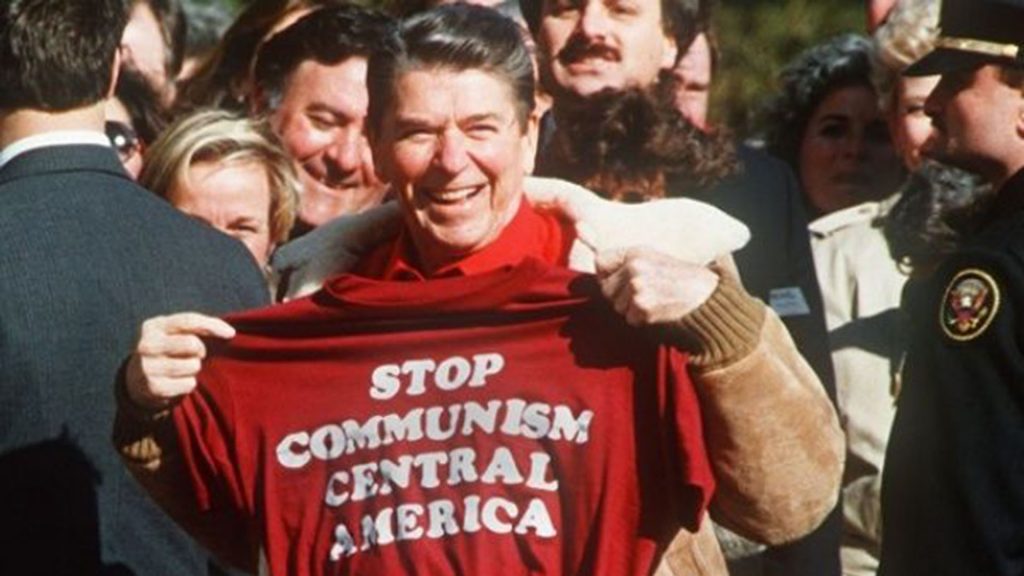
It turns out Trump has instituted new holidays in the United States, namely "Anticommunism Week," which is celebrated from November 2nd to 8th. The celebrations, however, were largely unspectacular, with a series of window-dressing events and bombastic statements about the need to "fight the poison of communism." The further the regime moves to the right, the more vigorously it begins to fight communism. Nothing has changed here since Nazi Germany and Fascist Italy.
In practice, however, this is being done in anticipation of the upcoming attempts to overthrow the regimes in Venezuela, Nicaragua, and Cuba.
https://colonelcassad.livejournal.com/10191671.html
Google Translator
Damn, how did I miss that?
Make no mistake folks, it's either them or us, and by us I mean the world wide working class.
Or, if you prefer:
I cannot choose, either brings tears...
November 17, 1:27 PM
It turns out Trump has instituted new holidays in the United States, namely "Anticommunism Week," which is celebrated from November 2nd to 8th. The celebrations, however, were largely unspectacular, with a series of window-dressing events and bombastic statements about the need to "fight the poison of communism." The further the regime moves to the right, the more vigorously it begins to fight communism. Nothing has changed here since Nazi Germany and Fascist Italy.
In practice, however, this is being done in anticipation of the upcoming attempts to overthrow the regimes in Venezuela, Nicaragua, and Cuba.
https://colonelcassad.livejournal.com/10191671.html
Google Translator
Damn, how did I miss that?
Make no mistake folks, it's either them or us, and by us I mean the world wide working class.
Or, if you prefer:
I cannot choose, either brings tears...
"There is great chaos under heaven; the situation is excellent."