Venezuela

The fightback
User avatar
blindpig
Posts: 14788
Joined: Fri Jul 14, 2017 5:44 pm
Location: Turtle Island
Contact:

Re: Venezuela

Post by blindpig » Wed Nov 12, 2025 2:30 pm

Under a (naive) logic of controlled scalability
A think tank proposes to the Pentagon how it should attack Venezuela
November 11, 2025 , 3:37 pm .
Image
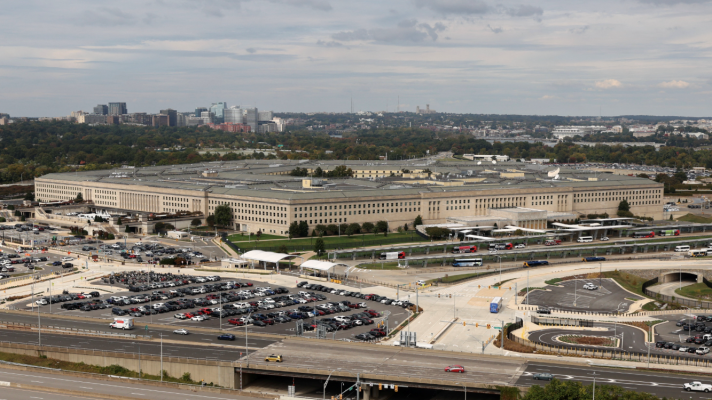
The Pentagon, headquarters of the United States Department of War, located in Arlington County, Virginia, near Washington DC (Photo: Reuters)

The Center for Strategic & International Studies (CSIS) —one of the most influential national security think tanks in Washington, with close ties to the Pentagon, the State Department and the military-industrial complex— published a report that expresses a technical and calculated reading of the US military deployment in the Caribbean from August 2025.

Its tone is deliberately neutral, but its analytical framework reveals an operational logic typical of the American establishment: war as a problem of force management, scalability thresholds, and theories of victory.

While the report may be described as a propaganda document, it is more accurate to call it cognitive groundwork; not to convince the Venezuelan public, but to legitimize options before foreign policy audiences in the US and allies.

This is one of the main objectives of American think tanks when publishing their reports, especially those like those of CSIS, that is, organizations that are well embedded in the cracks of decision-making power in Washington.

The data: selective precision and structural omissions
CSIS boasts of using "data," and indeed offers concrete figures:

2,200 marines from the 22nd Marine Expeditionary Unit (MEU) ;

10 F-35s in Puerto Rico;

150 members of the Special Operations Forces (SOF) on the Ocean Trader;

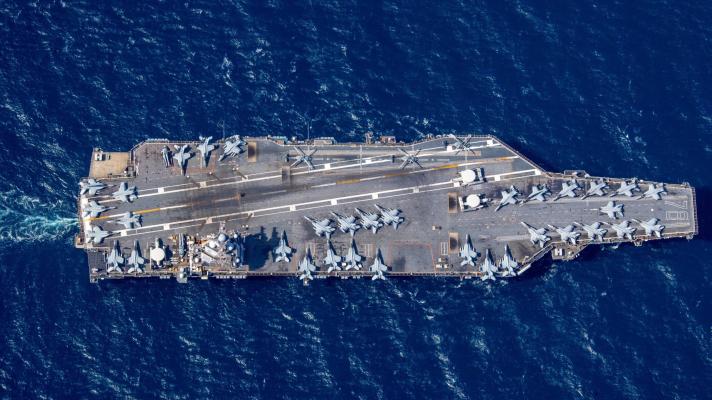
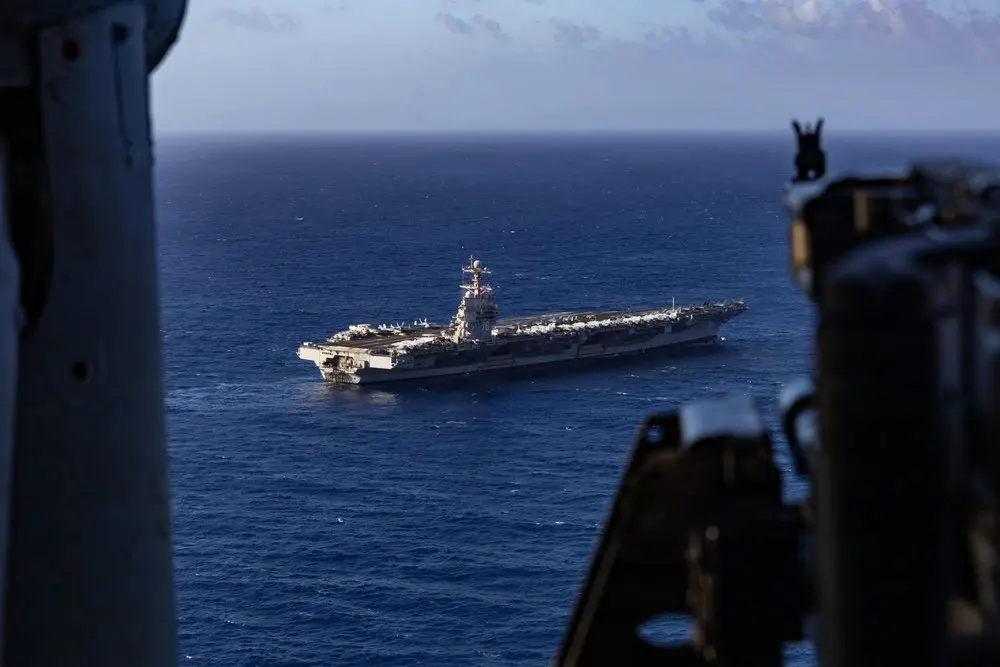
4,500 crew members on the USS Gerald R. Ford plus 960 in its escorts;

Around 170 Tomahawk missiles were launched into the area with the arrival of the Carrier Strike Group (CSG).

The report also provides data on the operational readiness of the Bolivarian National Armed Forces (FANB).

These are plausible numbers, derived from open sources, satellite observations, official statements, and air and naval movement records. In short, there is no evidence of falsification, but there is evidence of curation: CSIS systematically omits any data that complicates the narrative of absolute asymmetry.

The status of Venezuelan electronic warfare systems , which could affect the accuracy of GPS-guided munitions such as JDAMs, is not mentioned .

The ability to disperse and camouflage critical assets (command centers, radars, SAM batteries ), a tactic learned from conflicts in Ukraine and Syria, is not addressed .

The vulnerability of US surface ships—especially aircraft carriers—to asymmetric threats—anti-ship missiles, maritime drones, or smart mines—is not in question.

The report takes for granted unrestricted maritime dominance, as if the US Navy's doctrine called littoral operations in contested environments (LOCE) had not already recognized the limits of CSGs in low-cost A2/AD (anti-access/area denial ) environments.

Furthermore, CSIS treats the "150 SOF on the Ocean Trader" as neutral data, without contextualizing that this vessel —a converted logistics support ship— has been used in covert operations in Africa and the Caribbean for decades.

Its deployment is strategic: it facilitates influence operations , sabotage, and support for non-state actors without leaving a diplomatic trace.

Therefore, this is not a deployment of "conventional warfare"; it is hybrid warfare in its purest form.

CSIS implicitly acknowledges this by mentioning that the forces deployed are insufficient for an invasion, but sufficient for "air and missile strikes".

That distinction is crucial: the threshold of "realism" is no longer invasion, but air coercion and systemic destabilization.

The narrative of the "archer with a drawn arrow"
One of the report's most revealing metaphors is that of the archer with the arrow drawn taut : the U.S. is no longer preparing; it is deciding.

The arrival of the Ford CSG—a combat group designed for power projection in high-intensity scenarios—is presented as a symbolic point of no return:

" Poorly structured for anti-drug operations, ideal for attacks against Venezuela."

This interpretation is not innocent: CSIS is pointing out that the deployment has already transcended its official justification (fighting drug trafficking) and entered a phase of coercive deterrence, at least in the Caribbean, while continuing operations in the eastern Pacific.

In this sense, the objective (for now) is not to overthrow President Maduro by force (because there is no way to do so), but to create the conditions for his collapse under pressure. The report makes this explicit: the initial attacks would be "to see what effect they have."

It is a logic of shock and assess , not of shock and awe (Iraq style).

Here CSIS reveals its close ties to Pentagon planning:

Three sets of targets are considered: cartels (legal justification), the Maduro government (political objective), and dual-use facilities (bridge between the two).

Targets that fragment internal control are prioritized: security forces, military telecommunications, barracks.

Civilian economic targets (refineries, energy) are avoided, not for humanitarian reasons, but for calculation: a "short war" requires a viable "day after".

It's remarkable how CSIS, in ruling out attacks on civilian infrastructure, doesn't do so on ethical grounds, but because "GDP already contracted by 80% between 2013 and 2020." In other words, according to their own narrative, there's nothing left to destroy that isn't already destroyed, and what remains is necessary for the "post-Maduro transition." They should call it managing destroyed assets, not compassion.

Structural biases in CSIS analysis
Although the report avoids ideological language, its assumptions reveal deeply ingrained biases:

Technocentric vision. It reduces warfare to firepower, sensor range, and number of platforms. It underestimates factors such as morale, social cohesion, popular resistance, or the government's capacity to mobilize.

Military determinism. It assumes that the balance of power determines the political outcome. But in asymmetric conflicts, political will and persistence often overcome technical superiority (see Vietnam, Afghanistan).

Deliberate underestimation of third parties. Russia "can't offer much"; China isn't mentioned. This isn't a mistake: it's strategic wishful thinking . CSIS needs to believe that Venezuela is a manageable regional problem, not a global front. But that interpretation is strategically flawed, because if Moscow or Tehran decide to directly provide services and expertise on the ground, for example, the cost calculation for the U.S. would change drastically.

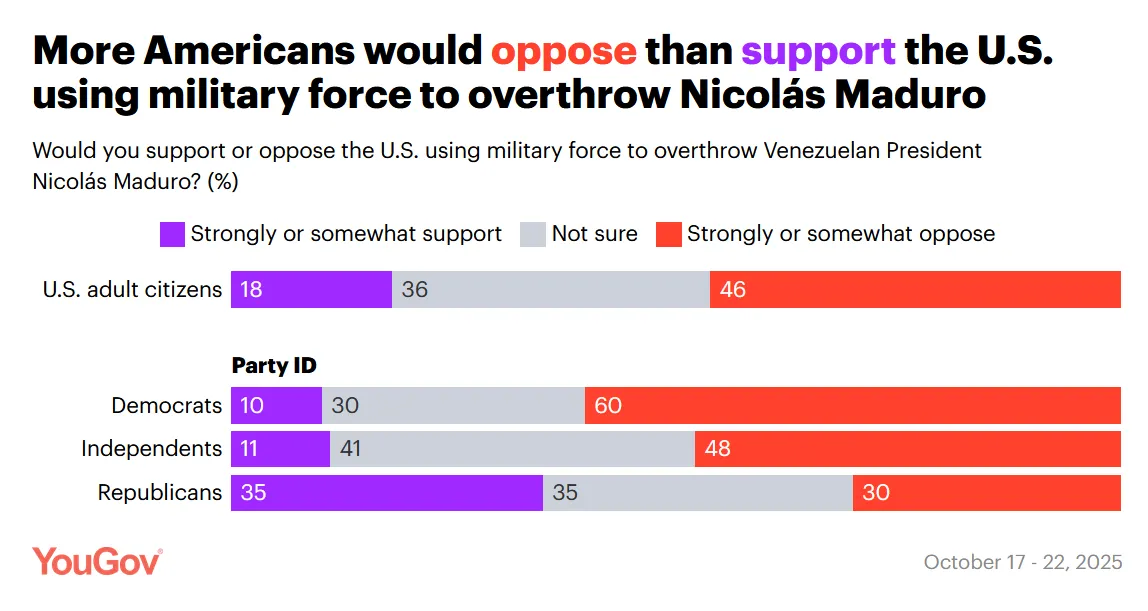
There is also a critical omission: no analysis of American public opinion. CSIS assumes that Trump can escalate his power without domestic political cost, but polls show that a majority of Americans oppose military interventions in Latin America, especially after Afghanistan.

A prolonged air campaign with casualties (albeit minimal) or intelligence errors (civilian targets) could generate domestic resistance that even Trump could not ignore.

A transitional document between coercion and war
The CSIS report normalizes war; it doesn't offer a prophecy. It's a manual for making decisions with eyes more or less open, but with fingers on the trigger.

Its value lies in its technical transparency: it exposes the real limits of the current deployment (insufficient for invasion, sufficient for coercion), the escalation thresholds (initial attacks, then measurement, then prolonged air campaign) and the political traps of the "day after" (a factor in which they have failed to impose even as a assumption because they do not possess political assets of guarantee, such as Juan Guaidó, Edmundo González Urrutia or María Corina Machado).

Its danger lies in what it silences: the Venezuelan agency, the non-militarized social resistance, the capacity for improvisation in environments of scarcity, and the fact that no government collapses solely due to external pressure if it maintains internal cohesion and popular support.

CSIS understands war as a chain of rational decisions. But in Venezuela, as in so many places, history is not written solely with missiles and F-35s: it is also written with loyalty, will, and strategic thinking.

These are variables that do not fit into a table of forces.

https://misionverdad.com/venezuela/un-t ... -venezuela

US energy ambitions in Venezuela
Clara Sánchez

November 11, 2025 , 2:50 pm .
Image
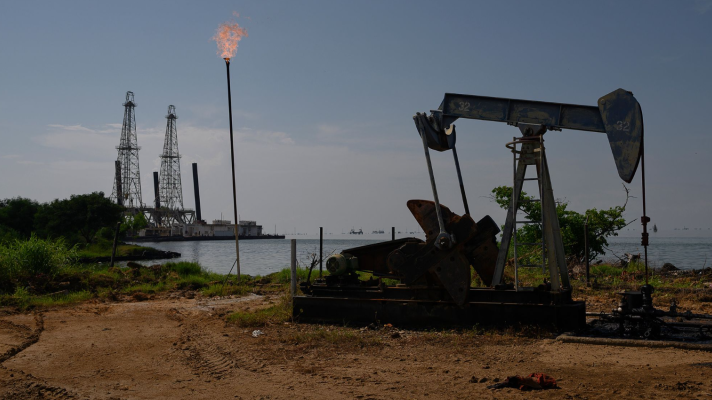
Ensuring energy independence as a matter of US national security is a channel to justify regime change in Venezuela (Photo: Getty Images)

In the emerging multipolar world, energy is indispensable amidst the accelerated development and adoption of artificial intelligence (AI). This is simply because there is no AI without energy. Therefore, whoever controls energy sources will dominate AI and, consequently, control the multipolar world? Or at least, become a power center in the emerging new global order. This is precisely what the United States seeks to secure by attempting to invade Venezuela to guarantee its energy independence from its closest geopolitical competitors: China and Russia.

A flyover of the multipolar world: from Marco Rubio to the G7
The multipolar world envisioned by the Liberator Simón Bolívar more than 200 years ago, to achieve balance in the universe among the different parts of the globe, has, with technological change, the declining pole of unipolar power that emerged after the Cold War, desperate to get a piece of the pie in the new global governance.

A world acknowledged by the new US Secretary of State, Marco Rubio, who stated that we have reached the point where there is evidence of a multipolar world, and the best example of this is the "multiple great powers in different parts of the planet."

And in this context, it assumes that the US is facing a confrontation, primarily "with China and, to some extent, with Russia," as well as with Iran and North Korea, among others, thus validating the National Security Strategy called "Biden's Decisive Decade" of 2022, which considers these actors as the main geopolitical competitors, therefore needing to increase its national power for global projection and especially its military power in the areas of cyber and space dominance, missiles with greater capacity, artificial intelligence, and quantum systems; with energy security associated with climate security being the second main global challenge to face.

This multipolarity was also recognized at the 61st Munich Security Conference in 2025, which serves as the G7's strategic platform, by assuming that today's world is already different, referring to an emerging new order shaped by multipolarization that "describes both a global shift in power towards a greater number of actors around the world and increasing polarization."

Consequently, this Conference's position is that greater multipolarity leads to a more conflict-ridden world, lacking shared rules and with less multilateral cooperation. Therefore, it advocates, in contrast, "depolarization," arguing that "instead of benefits, it entails a fragmentation that reduces the global pie" for those who have wielded unchecked power since the Cold War.

In this sense, recognizing that there is a loss of power from those who unilaterally exercised everything on the globe to its redistribution in different ascending poles in the world, pointing from that platform to the motivation of a "depolarization", meanwhile, not to continue fragmenting the "global pie" instead of stimulating a better interaction between them for a global balance.

The United States, hemispheric security, and the doctrine of containment
This multipolar scenario is what has taken Trump and the United States back to the nineties with the United States' hemispheric security doctrine in relation to Latin America and the Caribbean that began to develop with the New World Order announced by George HW Bush.

Hemispheric security, which was discussed in the OAS in 1991, with contributions in 1995 and approved in 2003, once the concept of new and multiple threats became relevant after 9/11 in 2001***, definitively supplanting Truman's Doctrine of Containment of Communism.

Although the latter has also been used to contain Russia geopolitically in recent years.

And why are we going back to the past?

US energy independence: A return to the past
This answer is clearly given by the US Secretary of State: "One of the big mistakes that was made was the unilateral disarmament with respect to energy production, by not fully utilizing energy resources," referring to coal and the lower unused US oil capacity, contrary to what China has done.

Energy remains a matter of national security for the United States; in fact, Rubio states, "They must be able to have a reliable and consistent source of energy, or they would be in serious trouble." He makes it clear that without it, their planes wouldn't fly, their ships couldn't sail, and their economy wouldn't function.

Because, although the US maintains a narrative of energy independence and non-dependence on other countries that it began to develop from the first oil crisis in 1973 and has become in the last two decades the largest producer of crude oil on the planet (20.7%), the reality is that it has reserves of barely 4% of the global total to sustain the largest consumption in the world (18.7%), indicating that, in relation to reserves-production, the depletion of this corresponds to a forecast of between 10 and 11 years.

While for natural gas it has reserves, according to its production, estimated to be used in only 13 years.

Meanwhile, putting the United States in a desperate position to control maritime routes, the Arctic, Canada, the Panama Canal or the Gulf of Mexico; guaranteeing its vital space of the "global pie" in the multipolar world.

83% of the US energy matrix is ​​hydrocarbon-based
In fact, one of the first actions carried out by the Trump Administration was the creation of the National Energy Dominance Council for the development of a national energy leadership strategy, whose purpose is the production of more energy, where mainly the Secretary of the Interior, the Secretary of Energy and the now called Secretary of War converge.

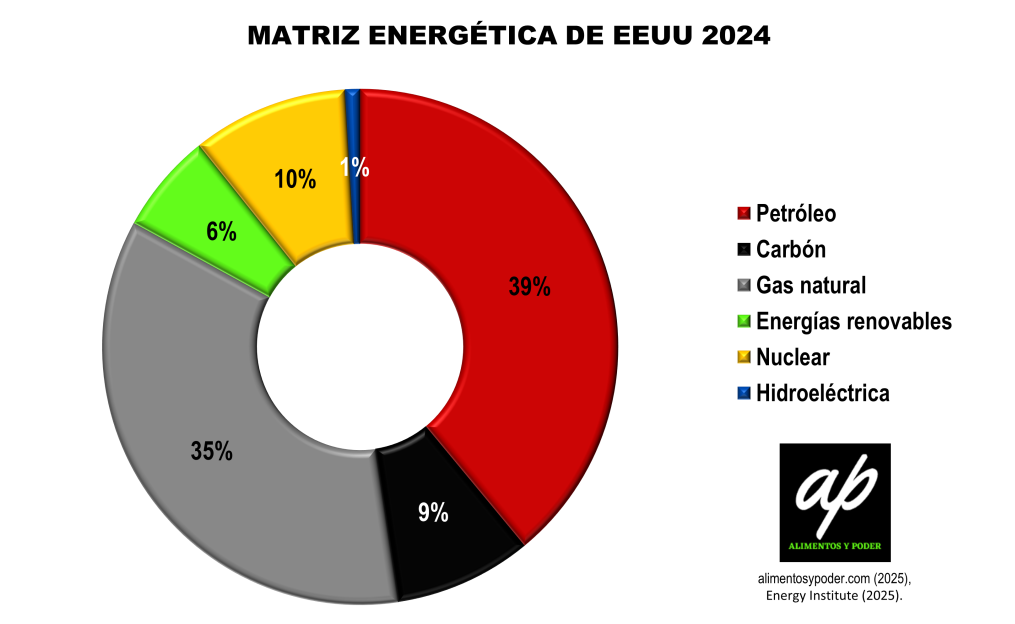
This logic responds pragmatically and directly to the energy matrix of the United States, which is supported by oil and gas at 74%, with black gold representing 39% of the pie, making this a strictly hydrocarbon-based consumer society.

And that in terms of energy, in recent years, its hydrocarbon consumption of oil and gas increased from 68% to 74% between 2019 and 2024 (see image 1).
Image
Image 1. US energy matrix (2024) (Photo: Food and Power)

In this sense, oil and gas are the backbone of the US economy, whose dependence will continue to hover around 70%, at least until 2050, according to EIA estimates [8] , meanwhile, fundamental for any energy transition in the multipolar world.

Firstly, oil and natural gas enable the practical and economic development of renewable energies as a backup to their intermittency, and secondly, they are the main source for supplying the industry with high-tech materials for renewable sources, making these dependent on the hydrocarbon industry to manufacture turbines, blades, cells, among many other components.

And while natural gas is where 40% of the electricity in the US is generated, together with oil it sustains the modern-consumerist American lifestyle today.

The arms race for energy and artificial intelligence
In this multipolar emergency, Marco Rubio also reveals one of the biggest concerns of the US: "Any country that has energy resources that are profitable will dominate AI, which will dominate many fields," including technological innovation in the oil and gas industry.

An AI that will need an extraordinary amount of energy that the world does not currently produce to feed it.

And as previously noted, in addition to the supply of oil and gas necessary for the US to maintain its status of growth, development and consumption, especially in a multipolar world in a reliable, safe, continuous and affordable way, AI comes to play another fundamental role so that this declining power can stay afloat and, as stated at the Munich Security Summit, keep a piece of the "global pie".

Therefore, energy, which is a matter of national security for the United States, increases in vital importance for the development of AI in the next five years.

According to Burgum , the new US Secretary of the Interior who heads the National Energy Dominance Council, the US is "in an arms race for artificial intelligence with China" and the only way to win is with "more electricity".

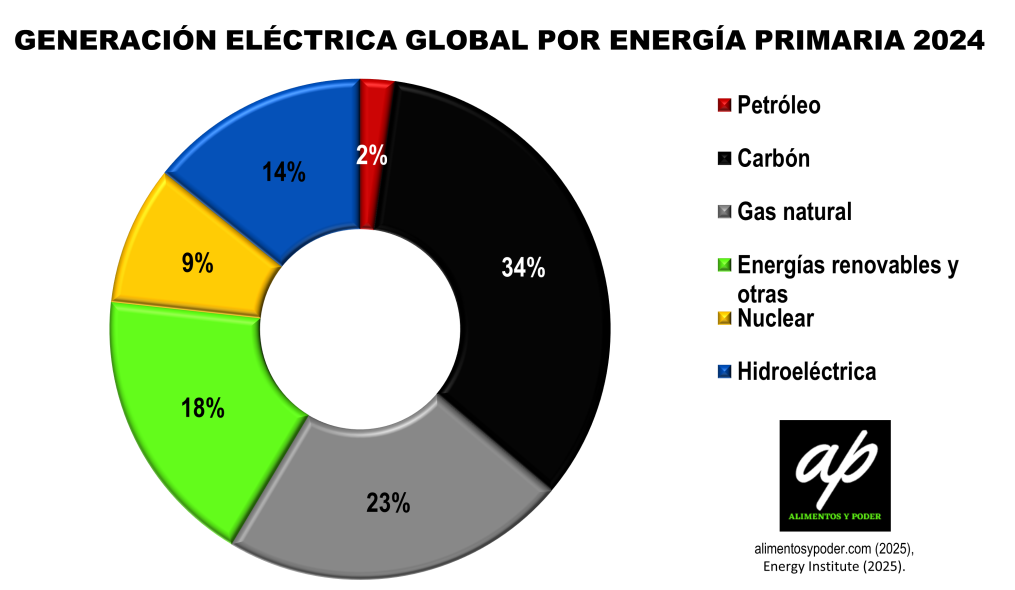
Electricity that currently comes from fossil fuels at 60% globally (see image 2), mainly from coal (34%) and whose main production center is located in China.
Image
Figure 2. Global electricity generation by primary energy (2024) (Photo: Food and Power)

This deepens the race to control energy sources for power generation to supply AI data centers in a baseline scenario, which currently consumes 1.5% of global electricity with conventional servers, reaching 3% in 2030; doubling with the installation of accelerated servers, which would be responsible for 70% of the growth in server electricity demand between 2025 and 2030, generating uncertainty regarding estimated consumption.

The US and China together consume 80% of the electricity for AI data centers today.

While in the US, 40% of the electricity for data centers comes from natural gas, in China it's 70% from coal. And although progress is being made in the development of renewable energies, and these are expected to cover the additional electricity demand for AI in the future, it's estimated that fossil fuels will continue to have a high share of electricity generation for AI by 2050, at 40%.

Fossil fuels for the global industrial, transportation, commercial and residential systems
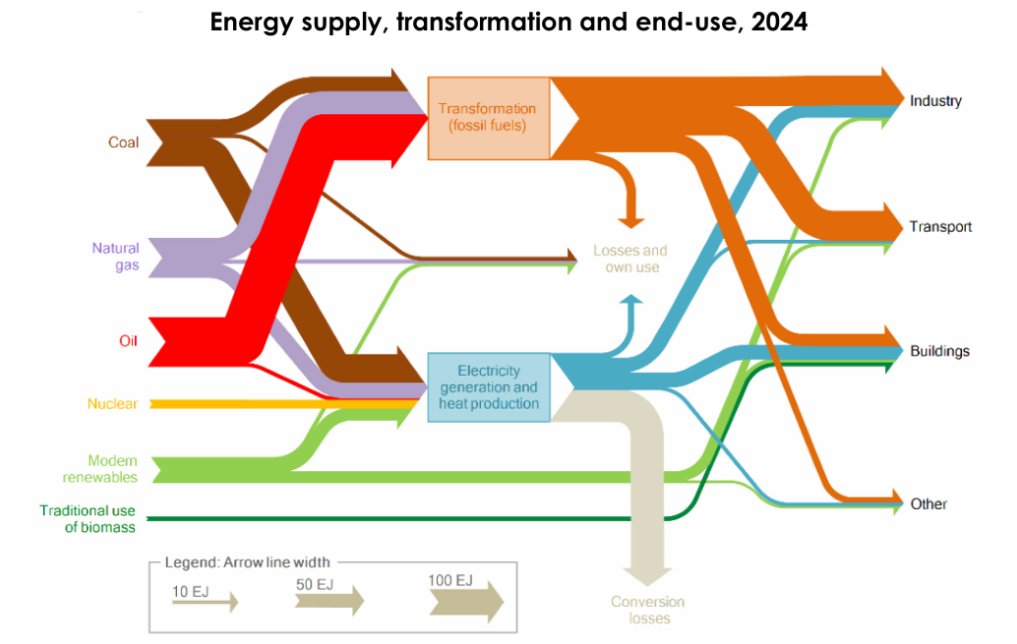
Therefore, the supply of reliable and secure energy is the challenge for the implementation of AI, not only for data centers, whose consumption is growing four times faster than global electricity consumption, but also to continue powering the entire global industrial, transport, commercial and residential system that is currently maintained with fossil fuels and will continue to be important to meet the increased energy demand by 2030 (see image 3).
Image
Figure 3. Energy supply, transformation and end use (2024) (Photo: International Energy Agency)

An example of this is ensuring the supply of energy to homes.

A hyperscale AI-centric data center (100 MW) currently consumes as much electricity as 100,000 homes per year; those under construction will consume 20 times more (2,000 MW), as much as the energy needed for 2 million homes; and the largest one planned will consume the energy (5,000 MW) of up to 5 million homes. For comparison, Ecuador has 5.1 million homes.

In transportation, oil and gas still have to support the demand for more than 1.4 billion vehicles worldwide, because, although sales of electric and hybrid cars reached a record high in 2024, non-electric vehicles still account for 78% of annual sales and represent 95.5% of the world's vehicles.

Furthermore, fossil fuels will continue to be vital for the petrochemical industry in the production of polymers, synthetic fibers, biofuels, and other products.

And, to make matters worse, the extraction and supply of fossil fuels, nuclear fuel, and critical minerals are necessary for the components of energy equipment, forming the basis of the current energy system.

Venezuela in the current energy landscape
In this multipolar landscape, the US wants to secure its share of the pie in Latin America and the Caribbean, rich in strategic natural resources, not only in Venezuela, with which it wants to guarantee its oil, gas, and other minerals in a reliable, secure, continuous, nearby, and cheap manner for the coming decades, given the instability in other regions, as essential elements for the energy transition; but also by trying to close the access that China has gained despite the blockade, while attempting to contain Russia, the heart that is also supplying the Asian giant with vital resources.

John Bolton and Mark Esper (former National Security Advisor and former US Secretary of Defense during Trump's first administration) stated that Trump was obsessed from the beginning with the intention of invading Venezuela in 2017 to overthrow President Nicolás Maduro, and it was Mike Pompeo (Trump's former Secretary of State) who suggested that the US should not tolerate, referring to the Monroe Doctrine, China, Russia, and Iran interfering in their affairs and their backyard.

Bolton's goal, according to him, is to have full access to Venezuelan oil resources after Nicolás Maduro's presidency; something Trump himself confirmed in 2023 when he loudly proclaimed that when his first term ended, "Venezuela was about to collapse. We would have taken it over and gotten all that oil. But now we're buying it," making it clear that access to the resource is not enough for the US, for example, with the licenses granted to Chevron; what is being proposed is theft.

And it remains relevant in Trump's second administration, as his Energy Secretary Chris Wright stated that "President Trump wants to use the strength of the United States or energy independence to force change in Venezuela."

In this sense, making it clear that guaranteeing energy independence as a matter of US national security is a channel to justify regime change in the country, even using force.

Venezuela is no longer the oil satellite of the United States
This preliminarily includes two actions that the U.S. has taken against Venezuela to maintain Venezuelan hydrocarbon resources as its strategic reserve and guarantee its "energy independence" in the future, and which have failed:

First, with the coercive policy of sanctions aimed primarily at the heart of the Venezuelan oil industry, it could not prevent Venezuela from making sovereign use of its hydrocarbon resources by diversifying its market and strategic alliances with other countries; and second, it did not prevent other actors from buying Venezuelan oil while it was disrupting the market.

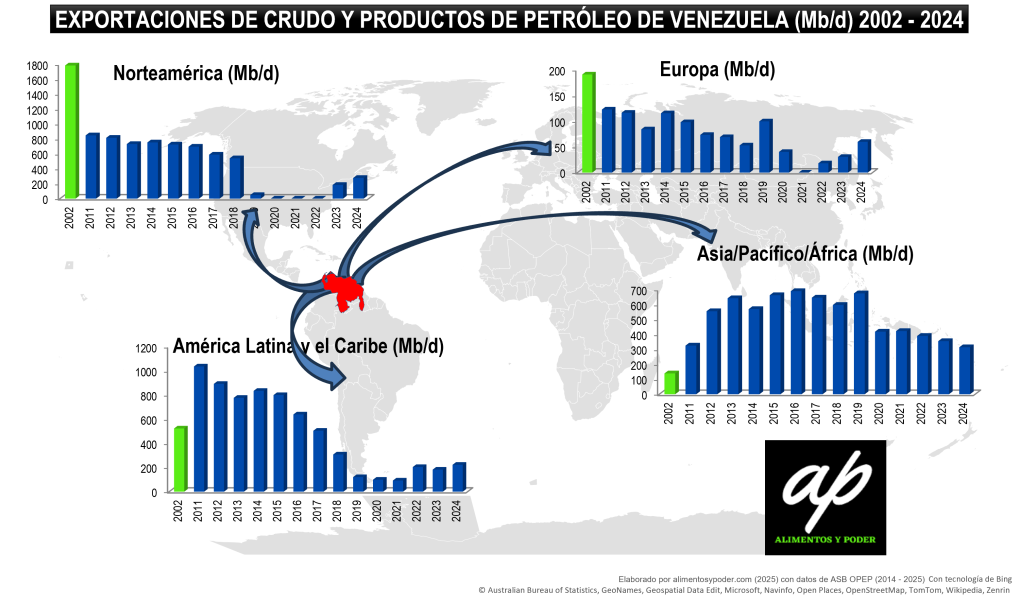
In fact, while the United States did not buy a single barrel of oil from Venezuela, exiting the Venezuelan oil business, Venezuela found buyers in other regions, mainly in Asia, causing other actors to enter the game (see image 4).
Image
Image 4. Exports of crude oil and petroleum products from Venezuela (2002-2024) (Photo: Food and Power)

Therefore, Venezuela did not lose buyers; on the contrary, it expanded and strengthened a market other than the United States, and with this broke its exclusive dependence on selling its oil to that country.

And this is what is shown by the desperation shown by the US when it began on September 2, 2025, the bombing of boats suspected of drug trafficking in the Caribbean, whose remaining evidence shows that it was fishermen who were killed by this irrational policy of the Trump administration.

The bombings began just as the Alula floating oil platform, the first of its kind in South America, was arriving at Lake Maracaibo in Venezuela from the port of Zhoushan in China. According to reports, it will be operated by Concord Resources Corp (CCRC) as a strategic partnership with PDVSA to reactivate wells and increase oil production in the country, which is already around one million barrels per day. The goal is to further increase production by 60,000 barrels per day by the end of 2026.

It is difficult for the US to accept that Venezuela has not only overcome the blockade, recovered its economy, and is the fastest-growing country in Latin America and the Caribbean for the past four years, but is also losing part of the global pie to its geopolitical competitors in the emergence of a multipolar world, and with it, total and exclusive access to energy that could allow it to play a role in the struggle for control of artificial intelligence.

Consequently, Venezuela ceased to be the oil satellite of the United States and demonstrates that it can continue developing its hydrocarbon industry without it, while playing a key role in the emergence of a multipolar world.

Final considerations
For the United States, having a greater capacity to supply energy to itself and its allies improves its influence when it comes to instigating conflicts, including diplomatic ones worldwide, strengthening its national security.

This includes its path to control Artificial Intelligence in its dispute primarily with China, and it makes this explicit in the agreement signed with the United Kingdom where AI is considered "the technology that defines our era"; therefore, it seeks to accelerate its development, lead the nuclear age, guarantee the energy supply chain for total independence, achieve quantum advantage, and secure 6G.

And keeping Meta, Google, Amazon, Microsoft and Digital Realdy as its main corporate players in this race, currently the top five operators with the largest data center capacity globally (MW) (see image 5), is a priority in the competition to dominate AI.

Image
Image 5. The top five operators with the largest global data center capacity (MW); they consume 82% of the energy among the top 20 in the world, according to the IEA (2025) (Photo: Food and Power)

And in this sense, the supply of hydrocarbons is fundamental to advancing in the mastery of AI, as well as to maintaining the American way of life, including the development of renewable energies.

A move to shape the emergence of the emerging world in its own image and likeness, meanwhile, controlling energy sources is central to the technological revolution of the multipolar world: controlling Artificial Intelligence.

*** These threats range from "terrorism, transnational organized crime, drugs, corruption, money laundering, illicit arms trafficking, extreme poverty, social exclusion, natural and man-made disasters, HIV/AIDS, environmental degradation, human trafficking, cyberattacks, accidents involving hazardous materials such as oil, radioactive materials, and toxic waste, weapons of mass destruction, among others. Furthermore, the new concept of security includes democracy, the rule of law, human rights, international humanitarian law, multilateralism, and, of course, the concept of human security (which includes food security with its antecedents dating back to 1974) as a foundation for democratic states" (Sánchez Guevara, 2023). Geopolitics and food colonization .

https://misionverdad.com/opinion/la-amb ... -venezuela

Google Translator
"There is great chaos under heaven; the situation is excellent."

User avatar
blindpig
Posts: 14788
Joined: Fri Jul 14, 2017 5:44 pm
Location: Turtle Island
Contact:

Re: Venezuela

Post by blindpig » Thu Nov 13, 2025 3:41 pm

Image

White House insiders knew of 2020 Venezuela coup in advance, files show
Max Blumenthal and Wyatt Reed·November 12, 2025

Documents released by a federal court provide new and disturbing details of Trump associates’ attempt to orchestrate a coup against a government they clearly did not understand. This is an unprecedented look at the players and their plots – from terrorism to false flags – that may inform the looming US military assault on Venezuela.

The man the government blames for it all, Jordan Goudreau, provided evidence to The Grayzone that:

He signed a $221 million contract with Venezuela’s Juan Guaidó as the US schemed in public and in private to designate him the legitimate president of the country.
High-ranking Trump officials including Elliot Abrams, John Bolton, the top CIA official in Latin America, and a top NSC advisor appeared to know about his invasion plot, and may have been involved in its planning.
Trump associates formed a shady company to pursue profits in a post-Maduro Venezuela after a Guaidó associate urged them to “act now, get companies and get paid.”
The CIA and an intelligence-linked propaganda firm called The Rendon Group carried out sabotage of critical Venezuelan infrastructure “for a decade or so.”
A proposal delivered to VP Pence’s office included plans to conduct “false flag” operations in Venezuela, spread hepatitis within the country’s military, and fund the schemes through the “expropriation” of “drug product.”
Roen Kraft, a wealthy intelligence-tied financier recruited to fund aspects of the operation, told the FBI that he concluded “if Venezuelans see something they will steal it,” accusing Guaidó’s pals of pocketing $200,000 in humanitarian aid money.
Participants in the plot told the FBI they viewed the Venezuelan opposition as hopelessly corrupt after witnessing its leaders blow huge sums “on hookers, thousand dollar bottles of wine, and nail appointments for their girlfriends.”


On the morning of May 3, 2020, two small vessels powered by outboard motors prowled through the coastal waters of Venezuela’s La Guaria region. Unlike the fifteen speedboats recently sunk by the US Navy, they weren’t alleged to be carrying drugs. Instead, they held something far more alarming – former US special forces soldiers hoping to be received as liberators by the Venezuelan people.

Alongside the handful of Venezuelans they had trained in the Colombian jungle, former Green Berets Airan Berry and Luke Denman planned to set off a violent national insurgency which would culminate in the toppling and kidnapping of the President of Venezuela, Nicolas Maduro.

Hours later, the pair were videotaped on the docks of a fishing village, face-down and hogtied by the very Venezuelans they believed they were saving. Officially, the ill-fated coup d’etat was known as Operation Gideon. But it would come to be known popularly as the “Bay of Piglets,” a comical redux of the failed 1961 CIA-backed invasion of Cuba’s Bay of Pigs.

Eight Venezuelan exiles were killed amid the aborted 2020 incursion, and prison interviews with the two captured Americans soldiers were subsequently broadcast to TV audiences across Venezuela. In the footage, Berry and Denman made clear that authorization for the operation went all the way to the top of the US government, pointing directly to President Trump as chief executor of the mission.

Trump’s then Secretary of State, Mike Pompeo, denied any “direct” involvement by the US. In the years since, the US has sought to cast the plot as an unauthorized operation carried out by a rogue mercenary named Jordan Goudreau. The decorated former Green Beret, who’s since become the face of Operation Gideon, was arrested in 2024 and now faces 14 charges over the federal government’s allegation that he conspired to smuggle weapons through Colombia in the runup to the failed plot. The charges carry a maximum combined sentence of 10 years.

In interviews with The Grayzone, however, Goudreau insisted he was personally recruited to lead a coup against Venezuela’s government by the head of Donald Trump’s security team, Keith Schiller, and that the operation proceeded with the full knowledge and support of the US government.

Now, Goudreau’s legal team has gained access to previously unseen evidence about the figures who he says orchestrated the planned coup. The Grayzone is among the first publications to have reviewed the material, which includes FBI interviews with participants in the plot which demonstrate foreknowledge by top Trump associates, leaders of the government of Colombia, CIA officers and assets, and officials working directly under Vice President Mike Pence and Trump. The documents contain strong suggestions that at various stages the US government monitored and supported the operation, which was sponsored by American financiers close to Trump, as well as Venezuelan opposition leaders financed by Washington.

Behind the cloak of high-minded objectives like “democracy promotion” and holding “bad actors” to account, the Beltway operatives and spooks who allegedly recruited Goudreau to lead them to Caracas were driven by little more than greed. Hungry for a cut of Venezuela’s vast oil and mineral wealth, and eager for lucrative contracts on the day after Maduro’s departure, the white collar coup plotters embarked on a quest for plunder that ended in infamy.

The files reviewed by The Grayzone also include surreptitiously recorded discussions, emails and elaborate plans for coups and terrorist attacks concocted by influential Venezuelan opposition figures. Taken together, they paint a deeply unflattering portrait of the political circle which the US has trained and sponsored over the course of two decades. Among the allegations most frequently leveled by those involved in Operation Gideon was that top opposition figures were not only clownish degenerates, but prone to stealing from their patrons in Washington.

Those exposed for profligate corruption in the Operation Gideon files are poised to take power if the US military show of force ordered by Trump this October winds up toppling Venezuela’s government. They include two opposition leaders derided by a US financier of the operation as “Beavis and Butt-head,” as well as their former boss, Leopoldo Lopez, and his understudy, Juan Guaidó – who’s described in one FBI file as a potential recipient of funding from unnamed “drug dealers.”

However, the only figure to have faced criminal penalties for Operation Gideon in the US is the former Green Beret who executed it. Facing years of hard time in a federal penitentiary, Goudreau has skipped bail and disappeared. Before absconding, he participated in several interviews with The Grayzone, and provided us with an “intel brief” arguing that he would have never been in a position to lead a private army into Venezuela without the knowledge and blessing of the Trump White House.

‘We Have Many Options For Venezuela’
Once seen as a solid US ally and reliable Cold War intelligence collaborator, Venezuela’s relationship with Washington began to fray when it elected the populist Hugo Chavez in 1998. The charismatic army officer, who came to prominence upon leading an unsuccessful revolt against a repressive and unpopular neoliberal government in 1992, plunged headfirst into an ambitious plan to fund mass anti-poverty campaigns by nationalizing Venezuela’s oil fields.

In the following decade, Chavez’s initiative increased Venezuelan standards of living and oil production, reducing extreme poverty by two-thirds as revenue from oil exports quadrupled. But it was less popular in Washington, which responded in 2002 by orchestrating a coup d’etat that deposed the president for nearly 48 hours before spontaneous mass demonstrations and loyal factions of the military restored him to power.

After Chavez’s untimely death in March 2013, his preferred successor and Foreign Minister, Nicolas Maduro, was elected months later. Within a year, then-President Barack Obama enacted sweeping sanctions against Venezuela, leveling claims of human rights abuses to justify targeting the country’s oil sector, and setting the stage for a series of violent regime change operations.

As tensions rose between the elected Venezuelan government and its US-backed antagonists, fueling violent opposition-led street riots that paralyzed the country’s economy, Maduro ordered the dissolution of Venezuela’s opposition-controlled National Assembly and called for new elections in 2017. In response, Trump escalated further, threatening to invade the country if Maduro refused to step down.

“We have many options for Venezuela, including a possible military option, if necessary,” Trump told reporters during a press briefing that August.

Maduro was subsequently declared the winner of a snap 2018 presidential election, which the Trump administration condemned as illegitimate. The next year, the Trump administration declared the previously obscure National Assembly leader Juan Guaidó as Venezuela’s president, citing a little-known clause of the country’s constitution which it insisted invalidated Maduro’s hold on power.

Washington’s recognition of Guaidó enabled the theft of Venezuela’s gold reserves from the Bank of England, as well as the expropriation of its most valuable asset, Citgo, the international arm of its state-owned PDVSA oil company. By wresting billions of dollars of wealth from the elected government in Caracas, the US government not only fueled poverty and mass migration, it invited corruption from the Venezuelan opposition figures funded from the stolen assets.

However, like past plots to depose Venezuela’s socialist leadership, Guaidó’s pretend presidency would peter out in embarrassing fashion. Its demise began with a failed February 2019 operation to force huge shipments of USAID-supplied goods across the Venezuelan-Colombian border.

The death of Venezuela Aid Live
The plan aimed to breach the country’s borders under humanitarian cover, ramming caravans of trucks into the country, then accusing Maduro of cruelly rejecting aid for a supposedly desperate population if his security forces obstructed the hostile intervention. If the Venezuelan government failed to prevent the aid caravans from entering the interior, its loss of control would inspire a wider rebellion.

But the humanitarian propaganda stunt ended in almost immediate ignominy when its initial wave failed to breach a phalanx of border guards, and bands of frustrated Venezuelan opposition hooligans torched the aid, while making off with the rest. An attempt to blame the burning of millions of dollars worth of aid on Maduro’s forces failed as well when The Grayzone’s Max Blumenthal and numerous local reporters exposed the opposition’s responsibility.

A slapdash Live Aid concert held simultaneously in the border town of Cúcuta, Colombia sponsored by neoliberal British oligarch Richard Branson was no less successful, with much of its proceeds looted by Venezuelan opposition figures. Polling found less than 1% of concertgoers stuck around to help after the star-studded concert.

Image

Meanwhile, opposition-aligned media revealed that Guaidó’s cronies had embezzled massive sums of money that had been promised to Venezuelan soldiers who defected to Colombia and joined the anti-Maduro rebellion. In the end, the turncoat soldiers were left penniless in the border town of Cúcuta while top Guaidó henchmen blew their cut of the aid money on prostitutes and lavish hotels. Two of those would-be putschists, Freddy Superlano and his cousin, Carlos José Salinas, were found unconscious in their hotel room after being drugged and robbed by two prostitutes they had apparently paid with money intended for destitute Venezuelans.

For his part, Guaidó was photographed in the days before the aid stunt on the Colombian side of the border with top leaders of the notorious Los Rastrojos drug cartel, who reportedly smuggled him into Venezuela.

Image

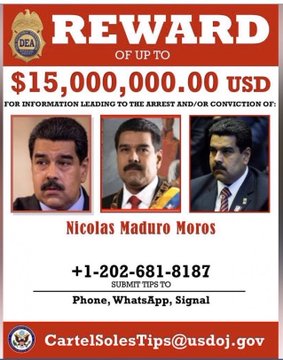
Following the failure of the humanitarian intervention, and with options for toppling Maduro dwindling, the Trump administration took an extraordinary measure clearly designed to incentivize private coup plots. On March 26, 2019, Trump’s Department of Justice offered a $15 million reward for information leading to Maduro’s capture.

At the time, Goudreau was exploring an invasion of Venezuela to gather the bounty and make himself a mercenary superstar. Following tours of duty in Iraq and Afghanistan, where he earned distinction from fellow special forces operators for his human intelligence skills, Goudreau set out for work in the private security field. He worked at least one Trump campaign rally, with a photo posted on his security firm’s Instagram account showing him among the president’s security detail in Charlotte, NC in 2018. A year later, he was among the team that provided security at the ill-fated Live Aid concert on the Colombian-Venezuelan border a month before.

It was around this time that Goudreau said he was introduced to Keith Schiller, a longtime head of security for Donald Trump and point-man on several Trump family foreign ventures.

In early 2019, Schiller was one of a handful of Trump associates, Beltway lawyers, and resource-hungry industrialists who banded together to seek out lucrative contracts in a fantasy post-Maduro Venezuela. Operating under the name “Global Governments,” the shadowy group would quickly come to leave its mark on Venezuela — though not in the way its founders intended.

Image
Keith Schiller seated on the left of Jared Kushner during a 2017 trip to Iraq

Monetizing regime change
In an interview with The Grayzone’s Max Blumenthal, Goudreau said the Global Governments team had a simple set of motives: “They wanted business contracts. They wanted a way to monetize the aftermath of a Maduro-free Venezuela.”

Besides Schiller, those listed in internal documents as members of “The Team” include:

Roen Kraft, a senior adviser for logistics and transportation for the company whose first name is publicly unlisted, but appears to be Timothy. According to a Global Governments associate, “Kraft dealt in energy, oil, gas, mining, was experienced and capable in international business and was a logical fit for these roles. Kraft also had dealt with these things in Nigeria which was a hostile country to work in.” Kraft later told the FBI he was positioned to provide funding for subsequent humanitarian interventions in Venezuela, and recoup his losses in the form of oil profits and contracts on the day after Maduro’s ouster. It is unclear if Kraft is an heir to the Kraft cheese fortune, as has been reported by some outlets.
Nestor Sainz, a former State Department desk officer and DC-based operative, took on a role in Global Governments to bridge his Beltway contacts with his ties to the Venezuelan opposition. FBI interviews of Global Governments associates indicate Sainz cultivated ties to several close associates of the top power broker of the US government-backed Venezuelan opposition, Leopoldo López.
Gary Compton, the “counsel and lobbyist to energy magnate T. Boone Pickens for over twenty years” was described as an oil and energy expert by his Global Governments associates. He was listed as a former partner at the law firm of Travis Lucas, who was frequently present during company meetings related to Venezuela.
German Chica, a Venezuelan opposition figure who appeared occasionally in Global Government meetings as a liaison to anti-Maduro forces. Chica was a governor of the Luna Foundation, which was supposedly dedicated to women’s rights, and listed Global Governments as a partner.
Andrew Davis, chairman of the Catalan America Council, which lobbied for Catalan independence from Spain.
Travis Lucas was not listed as a former member of the Global Governments team, however he acted as Schiller’s Washington-based lawyer. Having legally represented then-Vice President Mike Pence and then-Secretary of State and former CIA Director Mike Pompeo, Lucas offered the company a potential line to the Trump administration’s upper echelon.

Image
A Global Governments prospectus contains biographies of its high-profile associates.

Global Governments established its first and only client early in 2019 when Sainz reached out to Dick Morris, the celebrity Republican consultant, to pitch the company’s plans for raking in lucrative contracts after the toppling of Maduro. According to Sainz, Morris contacted his brother-in-law, Chris Larsen, who headed an international construction firm called Halmar, and expressed strong interest in the project.

In early February 2019, Larsen arrived at Global Governments’ office in DC to discuss the path forward with Kraft, Sainz and German Chica. Dick Morris was also on hand for the meeting. Apparently Larsen liked what he heard, because according to Sainz, he became the first and only client Global Governments signed for its post-Maduro gold rush.

The Jersey construction baron sent an initial retainer fee of $16,000 to Global Governments, pledging six more over the next six months. After shelling out close to $100,000, however, Larsen bailed on the project, as it seemed to be going nowhere fast.

According to an FBI document, “Sainz said it had been several months and they had not done anything for Larsen and understood why he wanted to leave. When the check arrived from Larsen it was cashed and divided between the Global Governments team.”

Though Global Governments struggled to get off the ground, Sainz told the FBI that it was clear the firm was preparing a military-style operation in Venezuela – a perception which Goudreau confirms was widely shared.

“The first meeting we had, all of us together with Global Governments, everybody knew I was going to do a military coup,” Goudreau said.

(Much, much more at link.)

https://thegrayzone.com/2025/11/12/wh-i ... uela-coup/

******

Unconventional defense, political organization and production
The fundamental role of the Venezuelan population in the face of military threats
November 12, 2025 , 12:26 pm .

Image
Faced with scenarios of internal upheaval induced by external factors, one of the antidotes has been the construction of popular participation in comprehensive security and defense (Photo: Infomoney)

The increasingly less covert US military deployment, ostensibly under the guise of an "anti-drug operation," has the clear objective of regime change in Venezuela. The scenarios range from a direct military attack against the Venezuelan government to the creation of an internal rupture, accelerated by mercenaries hired from Washington, that would break the cohesion of the Bolivarian National Armed Forces (FANB), among other effects.

The Venezuelan population has reacted in a way that is, perhaps, unexpected to the psychological pressure exerted by the global media. There is no visible unrest in the streets, and, as those same media outlets have reported , the majority rejects foreign intervention in the country. Many questions arise from this social behavior, requiring an analysis of the factors that might help answer them.

The scenarios proposed for a regime change
Recently, the first scenario has been attempted through false flag operations , such as those orchestrated from Guyana. On several occasions, armed actors have provoked armed confrontations with security forces from the neighboring country occupying the Essequibo region in order to establish a casus belli that would lead to a US military occupation.

It is well known that Secretary of State and Acting National Security Advisor Marco Rubio intends to use the dispute with the neighboring country as a trigger for such a scenario. Furthermore, the hypothesis that the recent flights of US fighter jets, bombers, and reconnaissance aircraft are intended to provoke reactions—or errors—from the Venezuelan Armed Forces (FANB) to justify this is not being ruled out .

The media-savvy opposition figure ostentatiously displays her desire for internal strife within the Venezuelan military. The rhetoric she employs includes passages of excessive anxiety that foreshadow scenes of mass military desertion "in search of redemption." In contrast, last week The New York Times revealed that Trump "is reluctant to approve operations that could endanger U.S. troops or result in an embarrassing failure," which, if true, is understandable.

The second scenario attempts to replicate the violent escalations of 2014 and 2017, adding the element of criminal gangs , as was tested on July 29, 2024, after the presidential elections. The failed swarming tactic consists of creating pockets of violence in different regions of the country through the use of weapons to create conditions that lead to the first scenario.

Establishing the narrative of a "repressive government" serves Washington and the opposition it sponsors by activating well-established mechanisms of color revolution, which, as in Libya and Syria, pave the way for the militarization of the conflict under the guise of defending civilians. Indeed, in both scenarios, which have their own ramifications and variations, the population plays a decisive role.

the role of the population in a war scenario
The reasons for the internal rupture are complex because the opposition has lost political influence, and therefore its ability to mobilize support, but also because terrorist plots aimed at creating chaos have been consistently dismantled. Furthermore, actors infiltrated within the country have been detected and neutralized , in many cases with the help of social intelligence, that is, information from the civilian population.

On the other hand, as the militaristic threat of the Trump administration intensified, the Venezuelan government called on its people to enlist in order to "transition from a peaceful revolution to an armed revolution." This transition relies on the Bolivarian National Militia, created by Commander Hugo Chávez in 2009 as a volunteer corps, a civilian complement to the FANB (National Bolivarian Armed Forces), with the objective of defending national sovereignty and peace. What for years functioned as an auxiliary body formalized its role in 2020 when it was elevated to the status of the fifth component of the FANB, granting it unprecedented institutional weight.

President Maduro has stated that Venezuela's strategy in the face of threats from the United States is "primarily defensive," encompassing "diplomatic and political struggle." However, he warned that if "Venezuela were attacked, it would immediately enter a period of armed struggle in defense of the national territory" and "constitutionally declare the republic in arms." This is a military strategy of irregular resistance that, based on Bolivarian doctrine, assumes that, just as the Liberator mobilized entire populations against an empire, Venezuela is called upon to resist any foreign power through a total mobilization of its citizens.

In this regard, the Vice President for Political Affairs, Citizen Security, and Peace, Diosdado Cabello, described the strategy for a potential conflict as "not conventional warfare. It's a different kind of war, and we have to move to that phase and prepare ourselves." He added, "We're going to wage it in every part of the country, on every terrain, on every front, and with whatever resources we have at hand."

Are there conditions ripe for social confrontation?
The socio-economic difficulties, a consequence of the blockade and sanctions, have been viewed by Washington as a breeding ground for social discontent to carry out its destabilizing work in a hidden way without having to resort to an armed invasion.

The Venezuelan government has implemented various strategies for national economic stabilization and is not without its challenges in this area. It has also addressed the socio-political front by deepening actions that strengthen the organizational fabric of grassroots power.

In this regard, the government has redirected social investment and allocated resources to be managed by grassroots social organizations. To this end, national popular consultations (CPN) have been held, beginning with a series of community meetings—or citizens' assemblies—in which spokespeople propose priority projects to address the collective problems of their communities. These range from the construction of schools and street lighting to support for community-based businesses.

Based on their Concrete Action Agendas (CAAs), each commune or communal circuit chooses, universally, directly, and secretly, the project to be implemented and then manages the allocated resources. The concept aims at community self-governance and seeks to territorialize the exercise of democracy based on Articles 5 and 62 of the Constitution, as well as establish conditions to achieve the so-called "fourth transformation"—Social Transformation—envisaged in the 7T Plan , which is the 2025-2031 government plan. Some facts:

During 2024, two CPNs were held, the first on April 21 and the second on August 25; these reflected 2,259 water projects, 1,319 road projects, 1,239 habitat projects, 1,153 electricity projects, 873 education projects and 798 sanitation projects.
On February 2nd of this year, 36,685 initiatives proposed by the People's Power throughout the national territory were voted on, and the formation of the Popular Self-Government Rooms began in order to achieve direct contact between the central government and the 5,334 communal circuits.
On April 27, during the second National Citizens' Conference (CPN) of 2025, 36,612 proposals were submitted nationwide, and voting took place in 5,718 polling stations across the country. At that time, the Minister of Communes, Ángel Prado, stated that Venezuela had invested $148 million in communities over the course of a year and had consolidated 14,000 projects.
On July 27, the third National Youth Council (CPN) of the year was held, focusing on projects submitted by young people. A week later, President Maduro reported that, up to that date, 23,455 projects had been approved by vote, 70% of which had already been completed by the communities themselves and "delivered as works that positively impact schools, housing, health centers, access roads, local infrastructure, among other areas."
The fourth National Public Investment Conference (CPN) will be held on November 23. The president announced that 13% of the projects are for economic entrepreneurship and production; 42% are focused on public services such as roads, water, electricity, health, and education; 5% on security; 27% are for social programs; 5% are for justice of the peace and community centers; and 6% are for scientific projects.
Faced with the extremist aspiration to create an internal conflict, the population is making progress in improving collective living conditions through popular organization and the exercise of territorial politics; this minimizes the conditions for social confrontation because political differences are resolved through dialogue and the collective construction of solutions.

The ACAs, as local development plans, allow for the deepening of participatory democracy and the revitalization of leadership for political representation and the construction of new social consensus.

What remained of the humanitarian excuse
The war against Venezuela is not a recent issue. In any confrontation, it is necessary to surround the target and cut off its supplies: the spirit of the sanctions and blockade measures implemented by the United States.

This is how the health and nutrition of the population were affected by these measures. Researcher Clara Sánchez has highlighted that, starting in 2015, undernourishment reappeared and increased "proportionately to the number of unilateral coercive measures imposed." She adds that, according to the FAO, this scourge reached its highest level in 2019.

The ongoing regime change operation was anchored in the narrative of a food crisis as a "channel to carry out a 'humanitarian' military intervention in the country, endorsed by the international community," while sectors of the extremist opposition stole national assets in collusion with the Trump and Biden administrations. With the "complex humanitarian emergency" narrative having failed, both the opposition and its allies in Washington shifted gears and are now criminalizing those they considered victims less than two years ago: Venezuelan migrants.

Last September, the president announced that the country has food reserves equivalent to 101 days of consumption, the highest figure in the nation's history. He added that the country produces and supplies 100% of the food consumed domestically, while also generating a surplus that allows for exports.

The economy has been growing for 18 consecutive quarters, and this recovery, which, as mentioned, is not without its challenges, is due to a strategy based on the 13 Productive Engines that combine structural recovery in sectors that have traditionally sustained the economy, such as hydrocarbons, with the incorporation of other non-traditional sectors.

The farming and fishing sectors, part of the social base of food production, have contributed strengths in the food sector:

With the participation of both sectors, undernourishment decreased from 17.6% between 2021 and 2023 to 5.9% between 2022 and 2024. This represents a recovery of more than 66%.
The national primary production of plant and animal food has not stopped growing in the last six years and in 2024 it rose to 6.2%.
Venezuelan farmers have increased coffee exports by 500% in the first half of the year, compared to the previous year, demonstrating the sector's capacity to export.
Last September, 15,400 peasant councils were revitalized and, in assemblies, they elected their respective spokespeople for organization and training, productive economy, and territorial defense and national sovereignty.
Malnutrition in children under 5 years of age fell from 14.8% in 2019 to 1.2% in 2024, according to the World Health Organization (WHO).
Fishing activity and industrial processing in the fishing sector has increased by over 7% this year.
The products of "Blue Venezuela" —fishing and aquaculture— have reached 33 countries, with a 225% increase in their international marketing.

Image

Organization in food-producing sectors such as fishing has generated results that dismantle the "humanitarian excuse" (Photo: Archive)
Faced with internal upheaval induced by external factors, the antidote has been the building of popular participation in comprehensive security and defense, local politics, and food sovereignty. This is due to a degree of social cohesion based on collective achievements, the deepening of governance practices, and the division among sectors opposed to Chavismo.

The attempt to dismantle the Bolivarian Republic remains in force in an extremist sector that opted for anti-politics and that assumed the so-called "electoral route" as a device to sharpen the confrontation and seek the implosion of electoral participation.

A broader perspective has allowed for a clearer understanding of the results; extremism has lost influence among its followers, and its errors are as evident as the sponsorship and leadership that transnational elites exert over the extremist opposition. Their agendas have become detached from the people, and it would seem that María Corina Machado's capitulationist promises to these elites confirm this.

https://misionverdad.com/venezuela/el-r ... -militares

Google Translator

******
Migration From Venezuela: Did 7+ Million Really Leave the Country to Flee Socialism?
November 12, 2025

Image
A group of Venezuelan migrants in Florida, USA, hold a Venezuelan flag and placards. Photo: BBC.

By Justin Podur and Joe Emersberger – Nov 11, 2025

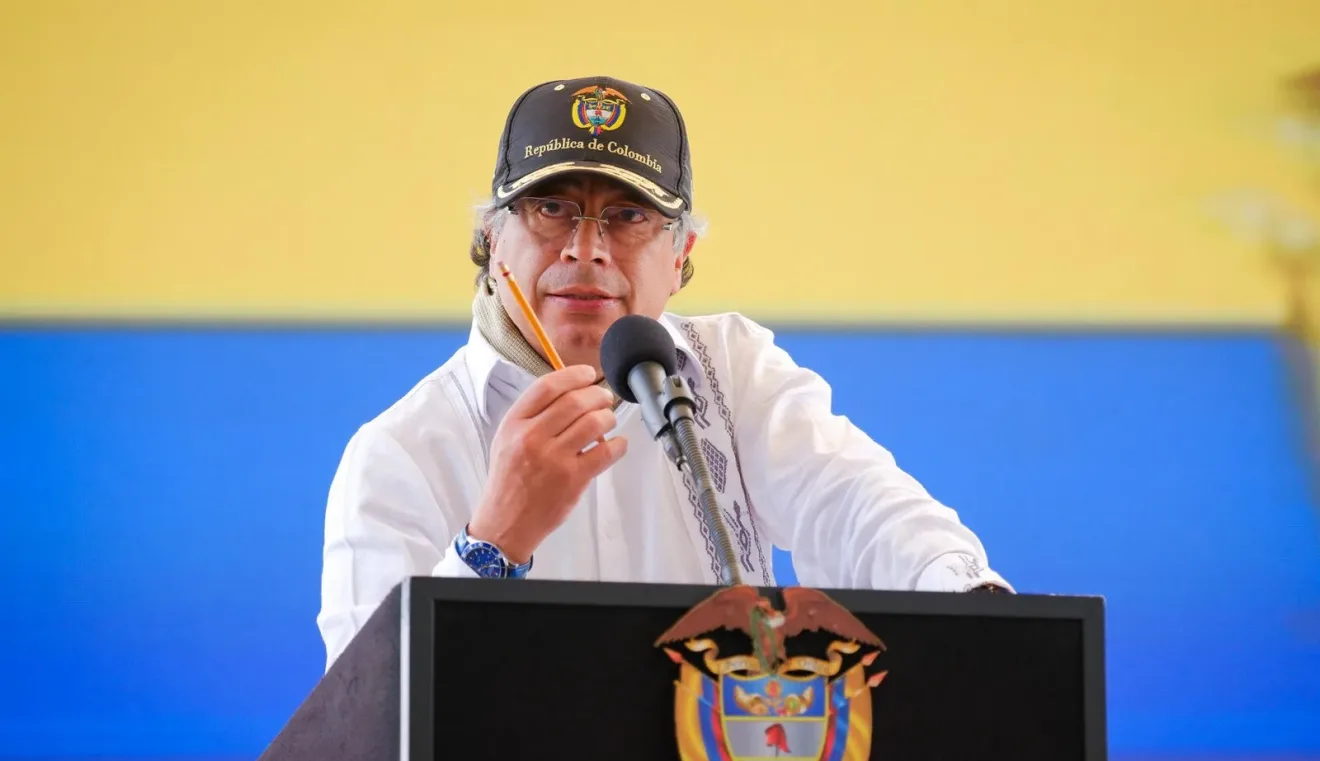
Daniel Coronel, a journalist with the US-based television network Univision, recently interviewed Colombian president Gustavo Petro. At about the 55 minute point of the interview, Coronel said to Petro that “the misery and repression that Venezuela has suffered at the hands of Maduro’s dictatorship has caused millions to flee.”

This little quip, this off-hand remark, is actually one of the major remaining regime change talking points about Venezuela.

We’ve addressed most of the others – the elections, the constitution, the notion that Venezuela is an “extraordinary threat” to the US—in our book. In a recent substack, we addressed the newest lie: that Venezuela is a meaningful source of drugs to the US.

In this one we address the idea that Venezuela should be destroyed because supposedly seven million Venezuelans have fled socialism.

We believe that anti-Maduro sources have 1. grossly exaggerated the scale of migration from Venezuela since 2015, 2. ignored that US sanctions have caused such migration as did occur, and 3. also ignored mass migration from US client states like Ecuador.

Image

Pre-2015 lies about the scale and causes of Venezuelan migration
By the time Chavez died in 2013, Venezuela’s GDP per capita was close to achieving the historical peak it reached in 1977, After reaching that peak in 1977, Venezuela went through decades of ruinous decline. By 1992, the New York Times reported that “only 57% of Venezuelans are able to afford more than one meal a day.” But migration from Venezuela, compared to other Latin American countries, was never very significant despite this disaster. Despite outlandish claims in anti-Chavez media, emigration was still not significant while Chavez was in office, enacting policies to enable Venezuela’s recovery from the post-1977 decline.

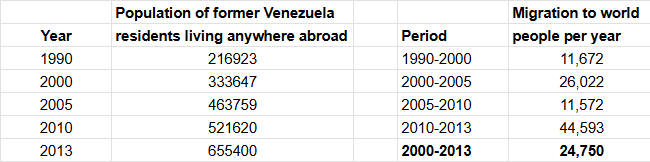
In 2011, the Venezuelan newspaper El Universal erroneously reported a World Bank figure for the total number of Venezuelan-born people living anywhere else in the world as of 2010 (521,000)—a figure that included people who had left Venezuela in any year—as the total number of Venezuelans who left in 2010 alone.

In 2015, Reuters uncritically cited an anti-Chavez academic (Tomas Paez) who claimed that 1.5 million Venezuelans had left Venezuela since Chavez took office in 1999 – in other words that about 100,000 Venezuelans per year had left between 1999 – 2015. World bank figures at the time suggested about 25,000 Venezuelans per year left Venezuela during most of that period, about one quarter the number Reuters had uncritically accepted from Paez, and one twentieth the number El Universal had reported in 2011. [1]

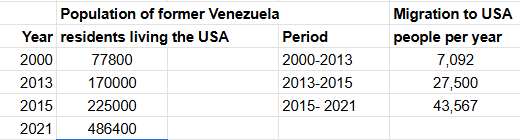
Table 1
Image

2015 – 2017 migration from Venezuela begins to take off for real
As a result of US sanctions and an oil price collapse, migration from Venezuela did, indeed, begin to explode in 2015. A few months before Hugo Chavez died of cancer in 2013, he urged his supporters to vote for Nicolas Maduro as his successor. They did. Maduro won the snap election that was held in April 2013. But Maduro was immediately hit with violent US-backed protests that year – and then again in 2014 and 2017. Adding to Maduro’s difficulties, in the last quarter of 2014, the high oil prices on which Venezuela’s economy depended collapsed by half, and remained very low for years.

Early in 2015, Obama added to the pressure by imposing broad economic sanctions on Venezuela. Obama’s apologists deny the significance of the sanctions by saying they merely outlawed dealing with seven Venezuelan government officials that the US accused of human rights abuses. But this ignores the problem of “over compliance” with US sanctions, built into their design: scaring investors away from dealing with Venezuela at all. In addition to the sanctions, Obama officials successfully pressured banks not to make low risk loans to Venezuela’s government.

The combined impact of collapsed oil prices and Obama’s malevolence did indeed cause a sharp increase in migration. One way to confirm that migration from Venezuela did indeed begin to take off is to look at the number of Venezuelans arriving only in the US. If the US had some powerful political incentive to do so, it would certainly exaggerate the number of Venezuelan migrants in the United States, but it has no need to do that. Even with the very low numbers of Venezuelan migrants—receiving only 7% of the migration that has been claimed since 2015—it has treated them in an astoundingly cruel and lawless manner. According to Pew Research, as of 2024, Venezuelans were still only the ninth largest Latino group living in the United States despite the rapid growth in its population in recent years.

According to Pew Research, Venezuelan migration to the USA averaged 7,000 people per year between 2000 to 2013. It increased to 28,000 per year by 2015; then to about 44,000 per year in the 2015-2020 period. [2] Trump caused migration to accelerate when he dramatically intensified US sanctions on Venezuela in August of 2017, and then again in 2018, 2019 and 2020.[3]

Table 2
Image

A suspiciously low level of Venezuelan migration to the US
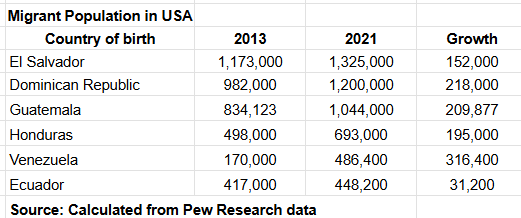
Today, UN Population Division data claims that 7.6 million people have left Venezuela since 2015. If that were accurate then one should expect to see a vastly higher number of Venezuelan migrants in the US. As of 2021, the UN Population Division claimed that over 5 million had left Venezuela since 2015. But as of 2021 (see below) the number of Venezuelan migrants in the US remained lower than from other Latin American countries that have much smaller populations than Venezuela: El Salvador, Guatemala, Dominican Republic, and Honduras.

In the case of Ecuador, which has roughly half Venezuela’s population, its migrant population in the US was very close to Venezuela’s in 2021. During the 1990s and early 2000s, migration from Ecuador to the US skyrocketed. As shown in Table 3, between 2013 – 2021 migration slowed tremendously., But as of 2024, Ecuador, which has been under disastrous pro-US rightwing rule since 2017 (as it was during the 1990s and early 2000s) provides the second largest growing Latino migrant community in the US after Venezuela according to Pew Research.[4]

Table 3
Image

Reliable data collection and collaboration with the Lima Group don’t mix
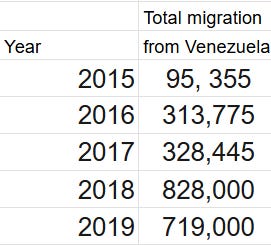
As of 2020, the UN Population Division had been reporting that just under 2 million Venezuelans had migrated from 2015 – 2019, about half the figure other UN agencies were reporting. The much higher figures were the ones widely amplified by western media. But the UN Population Division dramatically revised its numbers upward around the time of a conference that took place in Ottawa on June 17, 2021. The conference was held to raise money for Venezuelan migrants and refugees. It was hosted by the Canadian government “in collaboration with” the UNHCR, the UN Refugee Agency, and the International Organization for Migration.”

In 2017, the Canadian government spearheaded the formation of the Lima Group. Canada recruited rightwing Latin American governments into this group which had the explicit aim of overthrowing Maduro—“reporting democracy in Venezuela” as they put it. After 2019, the Lima Group recognized the US-appointed Juan Guaido as the interim president of Venezuela. The Lima Group was joined by Bolivia in 2020 while the country was run by the US-backed fascist dictator, Jeanine Áñez.

We should not have to explain how damning it is that various UN agencies that provide data on migration from Venezuela were openly collaborating with the Lima Group. Moreover, as Venezuelan researchers with SURES have pointed out, increased estimates of Venezuelan migrants leads to increased budgets for UN agencies and NGOs who work with them. As one of us (Emersberger) observed, other UN agencies, including UNICEF, have made extremely dubious revisions to historical data that appear motivated by a desire to bolster US propaganda.

Ignored estimates, and trends that would have emptied Venezuela by now
The surveys done by anti-Maduro Venezuelan academics (ENCOVI surveys) suggest about 2.3 million people left Venezuela between 2015 to 2019. (Data in Table 4 below is taken from ENCOVI surveys here and here.) [5] That’s very similar to what the UN Population Division estimated before it drastically revised its data upwards.

Table 4: ENCOVI Estimates
Image

In a February 2019 interview with the BBC, President Maduro gave an estimate of “no more than” 800,000 Venezuelans who had migrated in the previous two years (2017 and 2018).[6] That’s not far off what ENCOVI estimated.

Anti-Maduro Venezuelan economist Francisco Rodriguez noted in a 2024 paper that Venezuela’s economy has been in recovery since 2020 posting four straight years of positive economic growth despite US sanctions. Rodriguez observed that UN agencies have documented a big reduction in the rate of migration from Venezuela since 2020. But their estimates were so high from the 2015-2018 period that they had to come way down regardless of any economic recovery. At the rate the UN Population Division claims Venezuelan migration was accelerating between 2015 to 2018, Venezuela would have been completely empty by 2023 had the trend continued.[7] Despite this, all accounts confirm that there are indeed Venezuelans still in Venezuela.

A Venezuelan researcher explained to us the various problems with double counting that can occur, setting aside deliberate manipulation of the data (which we believe occurred). She told us that a large number of Venezuelans returned during the COVID pandemic, often through uncontrolled points (trochas). People often returned then migrated again creating one possibility for double counting. It is not clear how many people work in border areas near Colombia but actually continue to reside in Venezuela, or get counted as residing in Colombia despite having moved to another country.

We do not deny that there has been a massive and unprecedented amount of migration from Venezuela since 2015, but we do not believe the numbers cited in western media. No one should blindly accept claims made by UN agencies and NGOs that have a track record of serving US imperialism, especially when Washington ramps up the pressure on an official enemy.

https://orinocotribune.com/migration-fr ... socialism/

******

A Picture's Worth a Thousand Words
Karl Sanchez
Nov 12, 2025

Image
Photo from Cambrio magazine

Unfortunately, because the main article is behind a pay/subscription wall, there’s little text to go with the image. The image has a caption imprinted over it that isn’t visible:

Imprisoned with Nicolás Maduro: the photo that reveals the ultimate goal of the United States against President Petro (Posted on November 9, 2025 at 3:00 am)

Here’s the small amount of text freely provided:

A document that outlines the five steps that the president of the United States will take against Gustavo Petro was exposed in a photo taken a few weeks ago that until now had gone unnoticed. CAMBIO reveals the history of the ‘Trump Doctrine’, a strategy that is being fulfilled to the letter and would have as its ultimate objective to take the Colombian head of state to jail.

Petro is standing, looking at the camera and dressed in the characteristic orange suit that identifies most inmates in US prisons. His back is on a tape measure that allows the president’s height to be “identified.” It’s the same background used in the famous mugshots, the gringo police photos that are taken of everyone arrested.


Very little about the incident is available online in any language. Fortunately, UPI has this brief report that provides this excerpt from the Cambio article:

According to Cambio, the first paragraph of the document held by Blair outlines five steps against the Colombian president, three of which are already underway.

The five are designating additional cartels as foreign terrorist organizations, supporting pro-U.S. leaders in the Western Hemisphere, imposing targeted sanctions on Petro, his family and associates, countering corrupt and anti-U.S. criminal activities, and launching a comprehensive investigation into Petro’s campaigns and their foreign financing.


When the search term is changed from Cambio Trump Doctrine to Petro Trump Doctrine, the number of articles vastly increases. Colombiaone has this report published on 10 November that provides more details:

A political storm has erupted across Latin America and Washington after the accidental revelation of what appears to be a classified U.S. government plan known as “The Trump Doctrine for Colombia and the Western Hemisphere.” The controversy began when a White House photographer inadvertently captured an image in the Oval Office showing a folder held by a senior American official. The folder displayed the faces of Colombian President Gustavo Petro and Venezuelan leader Nicolas Maduro, alongside the title of the alleged document.

The photograph, which circulated rapidly through media and diplomatic circles, has fueled widespread speculation about a formalized U.S. strategy aimed at sanctioning, investigating, and even seeking criminal prosecution of Petro and Maduro. Although the White House has not confirmed the authenticity of the document, several senior political observers and insiders have described it as a blueprint for the Trump administration’s foreign policy toward leftist leaders in Latin America.

According to preliminary reports, the document outlines a five-point plan emphasizing a “hard power” approach. The measures include designating additional criminal cartels as Foreign Terrorist Organizations (FTOs), supporting pro-U.S. leaders in strategic Latin American nations, imposing selective sanctions on Petro, his family, and close allies, combating corruption and anti-American activities, and launching a full-scale investigation into Petro’s campaign financing and alleged foreign connections.

At the center of this controversial plan appears to be Senator Bernie Moreno, a Republican from Ohio of Colombian descent, whose name reportedly appears on the last page of the file. Moreno, an emerging political ally of Donald Trump, has long advocated for stronger U.S. intervention in Latin America’s “narco-regimes” and for curbing the influence of leaders he describes as “anti-democratic.”…

President Gustavo Petro has responded to the revelations surrounding the Trump Doctrine with strong and direct language, framing the issue as a matter of national security for Colombia. During a press conference in Bogota, Petro stated that if such a plan indeed exists, it “represents a serious threat to the sovereignty and stability of Latin America.” He warned that the region “cannot and should not be subjected to any kind of chantaje — blackmail — from any foreign power.”


I suggest reading the omitted portions of the report and the article that follows it where Petro apologized for “the political genocide:”

[T]he Colombian state on Sunday made public an act of acknowledgment and apology to the victims of the extensive process of political extermination against the Patriotic Union (UP), a Colombian left-wing party during the 1980s and 1990s.

IMO, Team Trump neocons want to see the return of the Death Squad Days and the Fascist Dictatorships they supported, which is what the accidental leaking of the “Doctrine” signifies. The bloodlust present within Team Trump is clearly visible in the extrajudicial murders of innocents by the Outlaw US Empire who are being accused of crimes—absent of any evidence—that are not capital crimes within the Empire.

Evil is clearly afoot—escalating—again. The worst of the Outlaw US Empire is again on the march supporting genocide in Palestine, regime change wherever it sees an opening. This is a global problem that must be solved, not just in Palestine but everywhere the Outlaw US Empire has a footprint.

https://karlof1.substack.com/p/a-pictur ... sand-words

*****

Colombia Orders Suspension of Intelligence Cooperation With US Over Extrajudicial Strikes in Caribbean
November 13, 2025

Image
Colombian President Gustavo Petro. Photo: Colombian Presidential Office/File photo.

XTelegramRedditWhatsAppLinkedInFacebookThreadsMessengerWeChatMastodonEmailPrintCopy LinkShare
Caracas (OrinocoTribune.com)—Colombian President Gustavo Petro has ordered his nation’s intelligence agencies to suspend communications and other dealings with their counterparts in the US empire as long as Washington continues its extrajudicial strikes against small boats in the region.

“I order to all levels of public security forces’ intelligence to suspend communications and other dealings with US security agencies,” Petro announced via social media this Tuesday, November 11.

“Such a measure will remain as long as missile attacks on boats in the Caribbean persists,” he explained. “The fight against drugs must be subordinated to human rights of the Caribbean people.”


US campaign’s international backlash
The Colombian president’s decision adds to a similar measure taken earlier by the UK, which suspended a small part of its intelligence cooperation with Washington in response to the recent US military strikes. The United Nations has notably labeled the US military operation as extrajudicial executions.

Mainstream media has reported that the UK decision was made in response to fears in Downing Street that the information shared with Washington could be used to identify targets in the Caribbean for strikes, wherein the legality of said strikes is questioned by international organizations and experts.

On numerous occasions, President Petro has described the US attacks on boats allegedly linked to drug trafficking as assassinations, and has urged Washington to respect international law.

Due to his criticism of the US operations in the region, the US regime has launched a campaign against him and Colombia. This has included adding Petro to the infamous Clinton List of sanctioned personalities, revoking his visa, canceling US financial assistance to Colombia, and even threatening the nation with land attacks.

Regional warnings and intelligence value
Colombia’s Foreign Ministry has asserted that “85% of the actionable intelligence used by the Southern Inter-Institutional Joint Task Force came from Colombia,” within the framework of Operation Orion.

Venezuelan President Nicolás Maduro has made warnings that the US military operation, allegedly framed in the “war on drugs,” in reality aims at regime change to seize Venezuela’s natural resources, primarily oil.

Venezuela claims that Washington’s threat is not only against the country, but against the entire region, which was declared a Zone of Peace at the 2014 summit of the Community of Latin American and Caribbean States (CELAC). Last Monday, Petro warned that US greed for natural resources poses a threat to both Venezuela and Colombia.

Civilian casualties
So far, the US military operations have taken the lives of 75 civilians from undefined countries. The obscurity of the US operation continues to withhold information about the victims: however, nationals of Venezuela, Colombia, and Trinidad and Tobago have been confirmed among those murdered by the US empire, and an Ecuadorian national was reported as a survivor.

https://orinocotribune.com/colombia-ord ... caribbean/

He should make that permanent. However, it is safe to assume that the US 'owns' significant Columbian military leadership which could make things dicey. Honestly, I'm surprised Petro has survived this far despite his tip-toeing around US sensibilities.They know he's a 'commie'...
"There is great chaos under heaven; the situation is excellent."

User avatar
blindpig
Posts: 14788
Joined: Fri Jul 14, 2017 5:44 pm
Location: Turtle Island
Contact:

Re: Venezuela

Post by blindpig » Sun Nov 16, 2025 6:18 pm

President Maduro Urges US People to Stop Their Government’s War on Venezuela
November 15, 2025

Image
Venezuelan President Nicolás Maduro speaks at the Meeting of Jurists in Defense of International Law closing event, Caracas, November 14, 2025. Photo: Radio Miraflores.

Venezuelan President Nicolás Maduro called on the people of the United States to stop “the frenzied hand of whoever orders the bombing, killing, and waging of war in South America and the Caribbean.”

He emphasized that the people of the United States must play a leading role in stopping what could be a tragedy for the entire region. “It was the people of the United States who took to the streets, alongside the peoples of Europe, to end the Vietnam War, the massacre in Vietnam,” he said on Friday, November 14, at the closing event of the Meeting of Jurists in Defense of International Law, held in Caracas as part of the activities of the National Council for Sovereignty and Peace.

He also urged the youth of the United States to do everything to derail conflicts in South America and the Caribbean. “This is about raising awareness among the US youth—it is a generation that is rising up based on values,” he said. “The vast majority of the US people do not want war in the world, and even less do they want a war in America.”

President Maduro pointed out that the violations of human rights and international law committed by the US government are not only against Venezuela but against the whole of South America and the Caribbean. “Therefore, we cannot allow a new Nazi-fascist current to be imposed on our continent today. We must knock on doors to raise the people’s awareness,” he emphasized.

He added that the coups against former Venezuelan Presidents Isaías Medina Angarita and Rómulo Gallegos were orchestrated by the United States, because it considered Venezuela its oil colony.

He further added that the United Nations Charter and the bodies that emerged from it have been battered, neutralized, and are currently nonexistent. “We are at a moment when the people themselves must fight for their freedom and dignity above all else,” he emphasized.

He declared that peace and international law will prevail in Latin America, and that “our peoples will fight to ensure that they prevail… If all the conscious peoples of this America rise up against imperialism and its attempt to start a war, who can stand against us? No one.”

The president emphasized that the Revolution of the South is based on the promise of unity and sovereignty in the region, with an anticolonialist and anti-imperialist vision.

He reiterated that Venezuela has been fighting colonialism and imperialism for over 200 years.

He underscored that this struggle is based on international law, grounding the rights of the peoples of South America and the Caribbean, as well as their self-determination. This conviction implies that each country is entirely free to define its own political, social, and economic model.

In this regard, President Maduro referred to some of the wars around the world generated by the US to impose its economic interests upon free peoples.

Furthermore, he praised the march held by Venezuelan youth in Caracas in defense of the homeland and peace.

Venezuela cannot become the Gaza of South America
During his speech, President Maduro condemned the genocide in the Gaza Strip committed by the US and the Zionist entity, emphasizing that the same cannot be allowed to happen in Venezuela.

“I also say to the people of the United States: humanity has already suffered enough pain from the genocide in Gaza. There is no longer anyone in the world who does not call what is happening in Gaza a genocide,” he said.

He added that polls conducted in the United States show that, for the first time, “the majority of the population, and especially young Americans, describe what is happening in Gaza as genocide. A ceasefire agreement was signed, but it has been violated by the Zionist entity every day. More than 600 Palestinians, including children and women, have been killed by bombs dropped by the Zionist entity” since the declaration of the ceasefire.

“Do we want another Gaza, now in South America?” he asked. “I know that the answer is a no. Here, peace and international law will prevail.”


Declaration of the Meeting of Jurists in Defense of International Law
During the closing session, the president of the Venezuelan National Assembly, Jorge Rodríguez, said that the event was not convened merely “to think, reflect, and study, but to condemn the grave crimes” committed by the US in the Caribbean.

Rodríguez read out the final declaration of the two-day meeting:

Categorically condemn all forms of interference, coercion, unilateral coercive measures, or aggression that violate the sovereignty and self-determination of the peoples.
Demand strict observance of international law, bilateral and multilateral treaties, and the United Nations Charter as the sole means for the peaceful resolution of conflicts.
Call upon the community of jurists in all countries to monitor and report to the appropriate bodies any violations of international law that endanger the stability of the Caribbean region and the world.
Express due concern and condemnation of the recent extrajudicial executions, carried out illegally and unilaterally in the Caribbean Sea by the Armed Forces of the United States of America, which constitute violations of human rights and international law in every sense and in all respects.
Urge the United States government to cease its military operations in the Caribbean Sea and its threats against Latin America.
Establish a broad league of jurists in defense of international law to evaluate the necessary means to formally file a complaint before competent international bodies regarding the threat posed by the United States in the Caribbean.
Urgently reactivate regional multilateralism and the Community of Latin American and Caribbean States (CELAC) in response to the grave threats posed by the United States in the Caribbean to fulfill the January 2014 proclamation declaring the region a “zone of peace.”
Urge governments around the world to adopt a clear position condemning the violation of international law and the escalation of violence against the Bolivarian Republic of Venezuela and the region.
Organize awareness-raising activities and public debates on the grave threats looming over the Caribbean region.
Reaffirm before the world that lasting peace can only be built on the foundations of social justice, equity, and full respect for human rights and international law.


(Últimas Noticias) by Carlos Eduardo Sánchez, with Orinoco Tribune content

Translation: Orinoco Tribune

https://orinocotribune.com/president-ma ... venezuela/

Yeah, mebbe I should contact my senator Lindsey Graham too....

*****

War without evidence: how the US fabricates threats to act without limits
November 14, 2025 , 1:13 pm .

Image
On Tuesday, November 11, 2025, the USS Gerald R. Ford joined the United States military deployment in the Caribbean (Photo: Archive)

Over the past few weeks, the United States has intensified its military presence in the Caribbean and the Eastern Pacific in what it describes as a response to emerging threats in the region. Recent statements by senior U.S. officials, along with large-scale operational movements, have reignited debates about the nature and scope of this strategy. At the same time, media outlets and research centers have revealed information that adds new layers of complexity to the criteria, objectives, and procedures behind these deployments.

The result is a scenario full of contradictory signals: an official discourse that appeals to hemispheric security, military actions that are carried out without maximum transparency, and governments in the region reacting with caution or concern to the possible scope of this dynamic.

Rubio and the hemisphere doctrine
The official discourse from Washington has begun to construct a narrative in which the United States is waging a "defensive war" within its own hemisphere. This premise is repeated in both public statements and classified documents cited by The Intercept . Secretary of State Marco Rubio is one of the most direct proponents of this line. During his recent trip to Canada, he stated that "the United States has the right to defend its hemisphere" and that "no one in Europe decides how we protect our security." With this stance, the administration attempts to distance itself from any external questioning of the legality of its military operations.

Meanwhile, The Intercept revealed that the Justice Department drafted a classified legal opinion to justify the use of lethal force in the Caribbean and the Pacific. This opinion relies on a list of 24 alleged "designated terrorist organizations" that supposedly include the Tren de Aragua, the ELN, factions of the Sinaloa Cartel, and even the so-called, nonexistent Cartel of the Suns. Most of these groups were unaware they had been included in a category that implies being in "armed conflict" with the United States, and there is no verifiable evidence that they pose a real threat of that nature.

This discursive framework has a twofold effect. On the one hand, it expands what the Executive can do without consulting Congress: it asserts that the attacks are not "police operations" but acts of ongoing war, which, according to the official narrative, would authorize the preventive and lethal use of force. On the other hand, it establishes a parallel universe in which the White House can declare armed enemies without due process or independent verification, thus transferring the logic of the "war on terror" to the Latin American context.

The justification is built on a vocabulary of imminent threats and alleged links to drug trafficking, even though congressional reports themselves indicate that the military does not always know the identity of those it is attacking. Lawmakers who accessed the classified report described the legal argument as "unconvincing," and some experts consulted by The Intercept called it outright "a phantom war." Even so, this narrative framework has allowed Washington to claim "sovereign authority" to act unilaterally in the Caribbean, even when the facts do not support official claims.

The parallel universe of the "war on narcoterrorism"
The discursive shift that frames these operations as part of an "armed conflict" does not exist in a vacuum. The hemispheric defense narrative is combined with concrete military actions that alter the geopolitical balance of the Caribbean and project a broader intention than simple "drug interdiction." The arrival of the aircraft carrier USS Gerald R. Ford , with more than 5,000 crew members and 75 aircraft, better encapsulates the magnitude of the U.S. commitment: a permanent and flexible presence, capable of operating in multiple directions and scenarios.

This expansion coincides with a wave of deadly attacks targeting Venezuelan, Colombian, and Mexican vessels in the Pacific. The common element is unilateralism; Washington acts even without international backing, congressional authorization, or verifiable evidence. The "narco-terrorist" label thus functions as a legal passport to circumvent existing laws and, simultaneously, as a tool for expanding the territorial reach of this exceptional framework.

The Intercept's revelations, particularly the creation of classified enemy lists and the use of opaque intelligence to justify attacks, reveal an intervention model anchored in a combination of lethal force at a distance and an expansive definition of threat. In this sense, the region becomes a testing ground for a doctrine of undeclared war, in which the enemy is declared retroactively and faits accomplis supersede the law.

The Caribbean, South America, and the Pacific, within this framework, constitute a strategic corridor where US hegemony is being reconfigured following its relative decline in other global theaters. Pressure on Venezuela occupies a central, but not exclusive, place: the architecture of "armed conflict" allows for its expansion into other countries without altering the underlying narrative. The result is an environment of gradual militarization, where the boundary between security and covert operations becomes blurred.

This situation presents regional challenges that cannot be resolved solely through diplomatic declarations. The unilateral creation of a state of war, even without formally admitting it, creates a risk of escalation that affects several countries simultaneously and redefines the rules of the game in the hemisphere.

In that sense, Venezuela's response through military exercises and the activation of territorial defense structures is the right decision in a scenario where any incident can acquire strategic dimension and where deterrence becomes the only real guarantee of sovereignty.

https://misionverdad.com/globalistan/gu ... in-limites

Google Translator
"There is great chaos under heaven; the situation is excellent."

User avatar
blindpig
Posts: 14788
Joined: Fri Jul 14, 2017 5:44 pm
Location: Turtle Island
Contact:

Re: Venezuela

Post by blindpig » Mon Nov 17, 2025 2:47 pm

Venezuela Reports Localized Sabotage of Power Grid; Satellite Communications Disrupted
November 16, 2025

Image
View of a section of an electric grid. File photo.

The National Electric Corporation (CORPOELEC) of Venezuela reported a “new criminal sabotage” that caused the collapse of three transmission towers in the municipality of Juan Antonio Sotillo, in the state of Anzoátegui.

CORPOELEC reported that personnel were already deployed to begin repair work, particularly on the infrastructure extending across the Vidoño Hill area, to restore electricity service to the affected communities in a progressive and safe manner.

Sabotage against the electrical system and other public services has been a constant since the start of the US-led hybrid war against Venezuela in the early 2000s. These attacks have increased in intensity since 2019 after far-right opposition politician Juan Guaidó declared himself “interim president” and was recognized by the United States and its vassal states.

Below is the full text of the CORPOELEC statement:

The National Electric Corporation (CORPOELEC) informs the Venezuelan people that, this Saturday, November 15, the National Electric System (SEN) was victim of a new criminal sabotage that caused the collapse of three transmission towers in the municipality of Juan Antonio Sotillo in the state of Anzoátegui. The intention of the sabotage was to destabilize an essential public service for the people of eastern Venezuela.

In response to this attack, our workers were deployed immediately to the affected area, following the immediate response protocols established by the national government led by President Nicolás Maduro.

With dedication and commitment, the technical staff has begun work on repairs, specifically of the infrastructure that extends across the Cerro Hill area, to restore electricity service to the communities in a progressive and safe manner.

This sabotage underscores the brutality of an unconventional war that threatens the well-being of our people. Nevertheless, Venezuelans continue reaffirming, in a firm and unequivocal manner, their conviction to be free and independent, forging their own path.

We urge the Venezuelan people to remain confident and rest assured that the dedication, commitment, and patriotic spirit of our workers will ensure the continuity and efficiency of the service that Venezuelans deserve.

Caracas, November 15, 2025


Venezuela experiences satellite jamming
Meanwhile, Venezuelans have been experiencing signal jamming in recent days. Caracas residents have reportedly started noticing that satellite signals are being jammed. The incident is affecting satellite positioning systems of cars as well.

Although some media outlets have reported that “GPS signals” are being jammed in Venezuela, the country does not use the GPS but the Russian GLONASS system. Nevertheless, all satellite positioning systems are susceptible to electronic warfare.


It is noteworthy that the Venezuelan government has yet to make any public statement on this matter. Moreover, it is not clear whether the signal jamming is part of the US military aggression against Venezuela or whether it is part of the Venezuelan security response. However, according to analysts, the silence of the Venezuelan authorities may be attributed to security concerns.

The satellite signal jamming, however, may be a cause for alarm, as it is similar to signal jamming done by the US against Iran before striking Iranian nuclear facilities earlier this year. Therefore, the current failures in the Venezuelan GLONASS system may be an indication of an imminent US strike in the national territory.

https://orinocotribune.com/venezuela-re ... ions-down/

(And why does Trump's 'talks' palaver stink of the conciliatory talk before the strike on Iran?)

Venezuela Repatriates 577 Migrants from US, Surpassing 17,000 Returnees Amid Ongoing US Military Aggression
November 16, 2025

Image
Venezuelan migrants arriving on flight 85 of the Return to the Homeland Plan, November 13, 2025, receiving comprehensive attention upon arrival in Venezuela. Photo: IG/@minjusticia_ve.

XTelegramRedditWhatsAppLinkedInFacebookThreadsMessengerWeChatMastodonEmailPrintCopy LinkShare
Caracas (OrinocoTribune.com)—Venezuela received 577 repatriated migrants from the United States this week, on board two flights that landed at Simón Bolívar International Airport in Maiquetía, La Guaira state.

Flight number 86 of the Return to the Homeland Plan landed on Friday, November 14, carrying 298 nationals deported from El Paso, Texas, United States. This group consisted of 240 men, 47 women, and 11 minors. Venezuelan officials mistakenly referred to this flight as number 87 in initial communications.

It was preceded by flight number 85, which arrived on Wednesday, November 12, from Texas, with 279 Venezuelan migrants: 218 men, 47 women, and 14 children. Both flights were operated by the US airline Eastern.


This week’s arrivals bring the total number of Venezuelans repatriated from the US to 17,053 since February of this year, after Caracas and Washington, which have had no diplomatic relations since 2019, signed a migrant deportation agreement that remains in place despite unprecedented US military threats against Venezuela since August, when a US military operation was launched under the war on drugs argument.

The US military operation, which till now has involved lethal strikes on small boats in the Caribbean and the eastern Pacific, has been labeled by United Nations experts as extrajudicial killings that violate international law. Similarly, within the US, experts and legislators have called the operation illegal. So far the controversial operation has claimed the lives of 79 civilians in the region, nationals of Venezuela, Colombia, Trinidad and Tobago, along with an Ecuadorian survivor.


Context of the migration crisis
Most Venezuelan migrants in the US originally left after being affected by the economic crisis between 2015 and 2020, a direct consequence of illegal US sanctions against Venezuela.

Following a massive smear campaign and incidents of xenophobic violence in the US, alleging Venezuelan migrants were criminals or mental health patients, the US government began detaining and deporting them. This occurred despite the majority of migrants having no criminal records and many having legal regularization procedures underway.

Comprehensive support for returnees
Venezuelan authorities receive the repatriated migrants following the protocols of the Return to the Homeland plan. The comprehensive care provided upon arrival includes healthcare, psychological support, and legal and socioeconomic checks.

The Return to the Homeland plan was launched by the government of President Nicolás Maduro in 2018 to repatriate free of cost Venezuelans in vulnerable situations stranded abroad. The program is aimed at assisting those who have been victims of xenophobia and exploitation, in order to ensure their dignified and safe return. It offers comprehensive support to facilitate a successful and trauma-free reintegration into Venezuelan society.

https://orinocotribune.com/venezuela-re ... ggression/

******

Venezuela Reshapes Ruling Party Structure Through Mass Neighborhood Assemblies

Image
November 17, 2025 Hour: 9:40 am

More than 3 million people elected new grassroots committees.

Between Nov. 8 and 9, Venezuela experienced an event unlikely to go unnoticed in the history of Latin American political organizations. During those two days, 145,465 neighborhood assemblies were held, with an average of 20 participants each. The result was that more than 3 million people elected Comprehensive Bolivarian Grassroots Committees (CBBI), which now serve as the primary structure of the United Socialist Party of Venezuela (PSUV).

“I have with me the first minutes that were prepared during your assemblies, handwritten, with fresh ink from the people. I don’t know of any organizing experience more powerful than this,” Venezuelan President Nicolas Maduro said during a meeting of the PSUV National Leadership.

While much of the continental left debates how to rebuild ties with grassroots communities, the Bolivarian Revolution opted to call for massive neighborhood assemblies — and people showed up.

A Collective Cell

At the PSUV’s 5th Congress, Venezuelan socialists decided to create a new party structure supported by three levels: the Comprehensive Bolivarian Grassroots Committees, the Comprehensive Bolivarian Community Commands, and the Chavez Battle Units (UBCH), which operate as territorial centers of the party.

The change in model is significant. Until now, each street had a single leader responsible for local mobilization. That role has been eliminated, replaced by an elected committee with defined responsibilities: political education, propaganda, community action, territorial planning and preparation for comprehensive defense. In this way, one-person leadership is replaced by a collegial direction with a direct popular mandate.

“When Commander Hugo Chavez called us to form the party’s promoting committees, he had absolute clarity about the strategic horizon: to build a great mass party but also a party with a Gramscian spirit capable of training the cadres of the Revolution,” PSUV Vice President Jorge Rodriguez said.

The reference to Antonio Gramsci is no coincidence. The Italian theorist argued that a revolutionary party should function as a “collective intellectual,” capable of training leaders while organizing the masses. That is precisely the goal in Venezuela, where the PSUV seeks to turn each neighborhood committee into a mobilization nucleus, political school and agent of social transformation.

Venezuela now presents a practical answer to a theoretical problem that the Latin American left has discussed for decades without fully resolving: How can effective popular power be built?

“The PSUV is the only party on this continent that has reached this higher level of popular organization in the 21st century. The Comprehensive Bolivarian Grassroots Committees will catapult the PSUV as a global reference,” Rodriguez said.


The text reads, “All of Venezuela must firmly commit to promoting the consolidation of the Comprehensive Bolivarian Grassroots Committees (CBBI). Blessed be the day we swore to grow and organize ourselves even further from the grassroots of the people. Long live the common people!”

Commander Hugo Chavez’s Doctrine

Venezuelan President Maduro insisted that this restructuring materializes a political vision laid out nearly two decades ago.

“One of the great strengths of our Revolution is its coherence between thought and action, between theory and practice, between what we write in our founding documents and what is lived in every community,” he stressed.

The Political Action Strategic Lines that Chavez drafted when founding the PSUV already included the idea that the fundamental support of the Bolivarian Revolution must be rooted in every neighborhood and parish.

This was based on the idea that grassroots urban and rural communities generate socialist and participatory actions that directly clash with the interests of the old capitalist culture. At the local level is where popular power exists — and where the social base of support is either won or lost. Today, this doctrine has 145,000 concrete implementation points.

PSUV Secretary Diosdado Cabello detailed the five directives of the 5th Congress that frame this restructuring. The first seeks to strengthen the popular movement, articulating 27 social sectors in an action plan spanning this year and the next.

The second aims to transform the old structures of state governments and municipalities through new governing methods: the Seven Transformations (7T), the Concrete Action Agenda, the Map of Dreams, and the Communal Government Rooms. From party leadership, and alongside all regional and territorial leaders, the structure supports, articulates and strengthens existing forms of popular organization.

The fourth directive addresses organization for comprehensive defense, raising the capacity to — if necessary — transition from unarmed struggle to armed struggle, and strengthening communication and international engagement. The fifth grants the PSUV president full authorization to make any decisions necessary to ensure compliance with those strategic tasks.

But it is the third directive that ties the organizational framework together through the creation of the Comprehensive Bolivarian Grassroots Committees as the foundation of the new party structure.


The text reads, “With overflowing joy and exemplary discipline, the people of Aragua took center stage in the Great March of Swearing-In of the Comprehensive Bolivarian Grassroots Committees, demonstrating their firm commitment to the defense of the Homeland and peace.”

Geopolitical Assessment

President Maduro outlined the balance of forces as follows: “The Bolivarian Revolution has reached a political, social and territorial strength that is unprecedented.”

He also listed its assets: the proven ability to win elections, defeat attempts at violent destabilization, resist blockades and economic sanctions, neutralize invasion attempts and confront hybrid aggression.

Maduro highlighted that socialist leadership emerging from the streets, a consolidated civic–military–police union and a broad segment of the country — economic, social, cultural, religious — converge in the National Council for Sovereignty and Peace, where even democratic opposition parties, business sectors and faith communities participate.

Maduro then posed a direct question: “What does the far right have?” He answered without hesitation: “What they once called ‘leadership’ dissolved. The Venezuelan far right has become a ghost, a figure without body, without territory, without people. They dissolved themselves politically, destroyed by their ambition, dependency on foreign money and absolute disconnection from national reality.”

While the far-right opposition bets on international pressure, the Bolivarian Revolution maintains tangible organizational structures and 145,000 committees operating in every quadrant of the country. It also plans to activate 4,000 communities during the communal elections scheduled for Nov. 23.

Additionally, 1.2 million farmers took part in the Peasant Congress, which led to the creation of the Ezequiel Zamora National Peasant Union.

Simon Bolivar as Ideological Axis

President Maduro emphasized: “Bolivar is the backbone of our identity because he embodies the processes of Indigenous resistance, Afro-descendant struggle, the emancipation led by our liberators, and republican construction. Bolivar was not just a man. He was a cause. And today that cause is ours.”

The reference to the Liberator is linked to concrete tasks. In the Bolivarian committees, members study foundational documents in the construction of a militant identity, including Simon Bolivar’s Jamaica Letter and Angostura Speech, as well as Commander Hugo Chavez’s Blue Book.

Ideological formation is part of the basic program. The committees are not just electoral machinery but also hubs of political thought. Thus, the Network of Comprehensive Bolivarian Grassroots Committees will evolve into Community Coordination Commands, forming a tiered structure rising from the street to the neighborhood, the parish and the municipality.

“To accompany and strengthen — with love, solidarity and selflessness — the communal councils and communes. The party and the communes do not compete; they complement each other. Popular power and the party must walk together,” President Maduro said.

In this way, the PSUV consolidates an organizational model that breaks with the traditional logic of Latin American political parties, where party structures often overshadow or replace social movements. In Venezuela, the strategy is the opposite: the PSUV accompanies, articulates and strengthens existing forms of popular organization.

https://www.telesurenglish.net/venezuel ... ssemblies/
"There is great chaos under heaven; the situation is excellent."

User avatar
blindpig
Posts: 14788
Joined: Fri Jul 14, 2017 5:44 pm
Location: Turtle Island
Contact:

Re: Venezuela

Post by blindpig » Tue Nov 18, 2025 4:27 pm

What Is Really Happening in Venezuela? US Attacks and Economic Situation Explained
November 17, 2025

Image
A pro-government march in Caracas, Venezuela against Donald Trump and US attacks, in Caracas in 2019. Photo: Ben Norton.

An analysis of Donald Trump’s attacks on Venezuela, the economic impact of US sanctions, and the similarities and differences with the successful Western regime-change war on Syria.

A Chinese journalist interviewed Geopolitical Economy Report editor-in-chief Ben Norton about the situation in Venezuela, and his analysis was translated into Chinese. The following were his original remarks in English:

QUESTION: Ben, you have traveled around Latin America extensively, including in Venezuela. I would like to hear your comments on Maduro. Is his government well supported by the Venezuelan people, or may he face a similar fate like Syria’s Bashar al-Assad? As you know, Trump is planning attacks inside Venezuela. So do you think Maduro’s government will fall like Assad’s?

MY ANSWER: There are indeed some parallels between Venezuela and Syria, but there are more differences than similarities.

Venezuela is very divided politically, but in general, the Bolivarian Revolution initiated by previous President Hugo Chávez and continued by current President Nicolás Maduro still has a lot of support from poor and working-class Venezuelans. Most rich people and elites are pro-US and anti-government. Many of them have left the country, but there are still some in Venezuela (especially in wealthy areas like Chacao).

In Venezuela, most people are tired of political conflict and violence, and they simply want stability. The right-wing opposition does not have many active supporters inside the country. Whenever they try to hold a protest, only a few hundred people show up. However, while they are small in number, they still have a lot of power concentrated in private companies, media outlets, and Western government-funded “NGOs”.

Maduro will not be overthrown by people inside Venezuela. The only possible way I think the Venezuelan government will fall is if the US military invades Venezuela and/or wages a direct war inside Venezuelan territory, bombing Caracas — like what the US did to Iraq, Libya, Yugoslavia, Panama, Grenada, etc. (although the tactics used were different in each of those wars).

Trump has already ordered the US military to kill dozens of Venezuelans in illegal, extrajudicial executions in international waters. Thus far, he has not launched direct attacks inside Venezuela, although he confirmed that he authorized the CIA to carry out destabilization operations inside the country.

There are reports that Trump plans to bomb targets inside Venezuela. This would be an extreme act of aggression, and is quite possible, even likely. I don’t think he will send US troops into Venezuela — it is certainly possible, but it would be very unpopular at home, especially among his so-called “MAGA” base.

If I were forced to make a prediction, I would say there is a 66% chance that the US military launches attacks inside Venezuelan territory, with missiles and/or airstrikes; and a 25% chance that US troops invade the country and try to take control of ports, airports, major roads, and/or oil fields.

Image

Polls show that Trump’s war on Venezuela is very unpopular inside the US. A slight majority of Americans, 55%, would oppose a US invasion of Venezuela; whereas only 15% would support it. A clear plurality, 45%, oppose using the US military to overthrow President Maduro; while just 18% support this. However, public opposition has never stopped Washington before.

In fact, scientific studies show that public opinion has no impact on US government policy.

Image

Economically, Venezuela has suffered extreme hardship under illegal US sanctions and an economic embargo, which has blocked Venezuela from accessing the US-dominated international financial system and prevented Venezuela from exporting its oil and fixing/updating its oil infrastructure, causing government revenue to shrink by a staggering 99% (according to the top UN expert on sanctions, the special rapporteur Alena Douhan).

However, Venezuela’s economy is in a better state today than it was during the previous US-led coup attempt in 2019-20, which caused hyperinflation. The inflation rate has fallen a lot. Real wages have risen. Food and everyday necessities are affordable. The economy has dollarized a lot, however, which erodes the monetary sovereignty of the Venezuelan government.

The latest US attacks will likely end up increasing support for the Venezuelan government, because it will make it clear that there are only two realistic options: either Maduro or a right-wing US puppet — like the US government-funded far-right coup leader María Corina Machado, whom Washington wants to put in power, and who has been open about the fact that she wants to privatize Venezuela’s massive oil reserves and sell off the country’s assets to US corporations.

One clear similarity between Venezuela and Syria was the economic warfare waged by the West.

The Syrian government fell in part because the US/EU “Caesar” sanctions had devastated the economy. Syria could not get access to hard currency, and thus had very high inflation. The Syrian military was unable to pay its officers and soldiers, so they were not willing to fight. There were also shortages of food and oil. Syria was blocked from accessing its oil and wheat fields, which were militarily occupied by the US.

One major difference is the Western-sponsored war on Syria, which started in 2011.

The Syrian state was significantly weakened by more than a decade of war. Moreover, Syria had been invaded by multiple foreign powers, including the US, Turkey, and Israel. Large parts of its territory were not under the control of the central government, but rather by extremist groups and mercenaries funded and armed by the US, Turkey, Israel, Saudi Arabia, the UAE, and Qatar.

The situation is Venezuela is not like that. There were violent coup attempts by US-backed far-right extremists in 2014 and 2017, but nothing close to the levels of violence seen in the war in Syria.

QUESTION: In Maduro’s first and second term, the economy was in very bad shape. Why it is now getting better?

MY ANSWER: The US sanctions on Venezuela started in 2015, when Obama declared Venezuela to be a supposed “national security threat”. The global price of oil also crashed from 2014 to 2016. Both factors caused huge economic problems in Venezuela.

The illegal US sanctions then escalated significantly under Trump in 2017. And in 2019, Trump imposed an economic embargo on Venezuela (like the illegal US blockade of Cuba, which has gone on for more than six decades, in violation of international law).

This means that Venezuela was not able to export oil, which was the source of the vast majority of government revenue. The UN special rapporteur on unilateral coercive measures, Alena Douhan, reported that Venezuela lost 99% of government revenue due to the US sanctions. The UN expert also emphasized that these unilateral US sanctions are illegal, violate the human rights of Venezuelans, and devastated the economy.

The US sanctions caused a significant shortage of dollars and other hard currency in Venezuela, which meant that the central bank was not able to stabilize the national currency, the bolivar. Moreover, there were enormous attacks by currency speculators based in the US, with the help of Florida-based black market groups like DolarToday. The central bank also tried to maintain a fixed exchange rate throughout these speculative attacks, which meant it bled the little hard currency it had to try to defend the bolivar. Together, these factors caused hyperinflation in Venezuela.

Another very important factor to consider is that the vast majority of the technology and oil infrastructure that had been used in Venezuela for the past century had been designed by Western companies. The oil industry had been nationalized by Chávez, but the technology it relied on was still the intellectual property of US and European corporations.

So the sanctions prevented Venezuela from repairing its oil equipment and buying the new machinery needed to maintain and modernize its oil infrastructure. This caused a huge fall in Venezuela’s petroleum output.

In fact, the US government’s Energy Information Administration (EIA) boasted in 2019 — during a US-sponsored coup attempt — that Venezuelan crude oil production had fallen to its lowest level since 2003 (following another US-backed coup attempt). The EIA even admitted that US sanctions were a factor that contributed to this significant decline.

Image

The situation in the past few years has gotten better because Venezuela was able to replace some of its oil machinery with technology from Iran, Russia, and China. Technicians from Iran, Russia, and China also helped Venezuela to repair and update its oil infrastructure.

This meant that Venezuela was able to export more crude, primarily to China. Oil output today is still much lower than it had been before the US sanctions began in 2015, but it is slowly rising, and is now more than 1 million barrels per day, which is the highest level since the last US-led coup attempt, during Trump’s first term.

This means that Venezuela is now earning more hard currency, which it can use to stabilize its own currency and reduce inflation.

The economic situation has significantly improved in the past few years. In fact, inflation has been higher in Argentina, under its US-backed libertarian President Javier Milei, than it was in Venezuela.

QUESTION: Are there other Latin American countries that are helping or aiding Venezuela?

ANSWER: Cuba and Nicaragua have helped Venezuela. But they are very small and don’t have many resources, and are both suffering from illegal US sanctions as well. They are mostly providing political and diplomatic support.

The right-wing governments in Latin America are all extremely pro-US and anti-Venezuela. Many of the left-wing governments are more independent in their foreign policy, but they are afraid of getting too close to Venezuela, because of the threats by the US government, particularly the threat of secondary sanctions; and also because of right-wing backlash at home.

Venezuela’s neighbor Colombia has historically been the most loyal US ally in the region, and its government was dominated by wealthy right-wing oligarchs for decades. Today, for the first time, Colombia has a left-wing government, led by President Gustavo Petro.

Petro has publicly criticized the US and vocally opposed its attacks on Venezuela. In response, Trump imposed sanctions on President Petro and his family. This was a blatant act of aggression against Colombia’s sovereignty, and a clear example of US meddling in the country’s internal affairs. It was also obviously meant as a threat against other leaders in the region, so they don’t speak out and challenge the US war.

That said, Petro is still afraid of getting too close to Venezuela, because of the attacks by the right-wing media outlets inside Colombia, and because elections are coming up in 2026, and he doesn’t want his left-wing allies to be hurt.

US-backed right-wing forces are gaining influence in many parts of Latin America. The war against Venezuela is part of a larger strategy by the US empire to weaken left-wing anti-imperialist resistance, strengthen right-wing oligarchic groups that will serve US corporate interests, and impose US hegemony across the region.

(Geopolitical Economy) by Ben Norton

https://orinocotribune.com/what-is-real ... explained/

Report: Trinidad & Tobago Army Kept in Dark on US Southern Command Drill
November 18, 2025

Image
A US Marine belonging to the 22nd Marine Expeditionary Unit fires an M27 infantry automatic rifle during a live-fire range at Camp Santiago, Puerto Rico. Photo: X/@Southcom.

Caracas (OrinocoTribune.com)—A local Trinidad and Tobago news outlet reported on Sunday that the country’s army had not been informed about military exercises the United States expects to conduct only a few miles off the coast of Venezuela in Trinidad and Tobago. Analysts see this new development as a provocation by US imperialism and the submissive Trinidadian government.

“These exercises start tomorrow, and we haven’t received any word,” an anonymous source told The Trinidad Guardian on Saturday. “Orders were issued on Friday, but no details on the joint training were included. Sometimes, instructions arrive after exercises begin, but given the scale and involvement of foreign troops, this is unusual.”

Unexpectedly, on Friday, the Trinidadian Ministry of Foreign Affairs announced that military drills between the US Marine Corps’ 22nd Marine Expeditionary Unit (MEU) and the country’s Defense Force would be conducted between November 16 and 21.

A U.S. Marine with @22nd_MEU fires an M27 infantry automatic rifle during a live-fire range on Camp Santiago, Puerto Rico. @USMC @MARFORSOUTH pic.twitter.com/E1Pko6JeSI

— U.S. Southern Command (@Southcom) November 17, 2025

The source noted that local personnel are normally provided sufficient time to mobilize and prepare for joint training with foreign militaries. “This is normally coordinated through the Defense Forces headquarters,” the source said.

According to the source, specific information must be provided to authorized officers beforehand to avoid leaks. “We don’t want a soldier flagged for gang affiliation or other problems to participate in this type of training,” it was explained.

The report indicated that protocol stipulates that such exercises must be coordinated with the heads of the Regiment and the Coast Guard, and the use of weapons and ammunition must be approved by Trinidadian Customs authorities.

Speaking on condition of anonymity, a source said that as of Saturday morning, senior officers had received no information and first heard about the drill from the Minister of Foreign and CARICOM Affairs Sean Sobers, who announced the operation during a media briefing on Friday. However, multiple Trinidadian military sources told Guardian Media that even senior officers had not been briefed.

The local news outlet said it reached out repeatedly to Defense Minister Wayne Sturge and Chief of Defense Staff Capt Don Polo, but neither responded by press time on Saturday.

On Saturday afternoon, the US Southern Command posted on social media an image of an MV-22B Osprey tilt-rotor aircraft conducting flight operations from the USS Iwo Jima in the Caribbean. Similar aircraft were seen at the Chaguaramas heliport earlier this year during training exercises.

This report suggests that there may be friction within the Trinidadian Defense Forces or that Prime Minister Kamla Persad-Bissessar is abusing her powers. The prime minister has been heavily criticized for blindly supporting the controversial US military operation that has so far taken the lives of 83 civilians throughout the region, including innocent Trinidadian nationals.

Reports of gas scarcity on the island have been circulating on social media for the last few days, and images have shown long lines of cars at gas stations. Some blame the Trinidadian government for the situation, accusing it of being unable to secure energy deals with Venezuela due to its submissiveness regarding US aggression against Venezuela. In late October, Venezuela halted its energy cooperation with Trinidad and Tobago in response to the island nation’s complicity with the illegal US actions and killings in the region.

https://orinocotribune.com/report-trini ... and-drill/
"There is great chaos under heaven; the situation is excellent."

User avatar
blindpig
Posts: 14788
Joined: Fri Jul 14, 2017 5:44 pm
Location: Turtle Island
Contact:

Re: Venezuela

Post by blindpig » Thu Nov 20, 2025 2:34 pm

The looting lobby
Machado's agenda to sell Venezuela piece by piece
November 19, 2025 , 11:20 am .

Image
Privatize, hand over, auction off: that's what María Corina Machado's international campaign to give the country away to US capital is all about (Photo: Bloomberg)

María Corina Machado has established herself as a political operator for US capital, dedicated to promoting the transfer of Venezuela's strategic resources to the major financial and corporate centers of the Western world.

His public activity focuses on participating in business forums and international conferences where he offers the country as a territory open to foreign investment, in exchange for political support and media visibility.

In recent weeks, this international projection has been boosted by his Nobel Peace Prize and invitations to high-profile events in the United States and Europe, where he insists on the total liberalization of the Venezuelan economy and the sale of national assets as ways of "reconstruction".

But behind the technocratic language and the euphemisms of modernization, what Machado is presenting is a plan of systematic plunder, designed so that foreign capital can directly appropriate the country's energy, mining and territorial wealth under the guise of "democratic transition".

His speech coincides with a new phase of aggression by Washington against Venezuela and the region, which combines covert military actions in the Caribbean with a campaign of criminalization framed as the supposed fight against drug trafficking.

In that context, Machado's narrative of openness, privatization and "investor confidence" is part of the power architecture that the United States is deploying to regain control over the Venezuelan energy map.

Land of Grace: the economic architecture of dispossession
The "Venezuela Land of Grace" plan , presented during the 2024 presidential election campaign, is the document that most accurately encapsulates the economic vision that María Corina Machado and her team are presenting to international organizations and foreign investors. Under the promise of "recovering productivity" and "reintegrating Venezuela into the global market," the document outlines a path for dismantling the state and handing over national assets to international financial centers.

The program is based on three core principles:

Reducing the size of the state under the euphemism of "optimizing its size," which in practice means eliminating subsidies, social policies, and protection programs that guarantee basic rights.
Debt controlled by multilateral organizations such as the IMF, the World Bank and bilateral credit agencies, which is equivalent to mortgaging the country's economic and financial policy to the dictates of the international financial system.
Mass privatization of public companies and assets, particularly in the oil, gas, electricity and mining sectors, amputating the State of its main sources of income and economic sovereignty.
Although the plan's official discourse invokes concepts such as efficiency, modernization, and macroeconomic stability, its structure replicates the same structural adjustment mechanisms applied by the International Monetary Fund in Latin America during the 1990s: reductions in public spending, privatization of the energy sector, and liberalization of the labor market. Historically, it represents a restoration of the classic neoliberal model, updated to the current predatory phase of US big capital.

The foreseeable outcome of this model is the consolidation of a dependent, extractive economy, geared towards the export of raw materials and subordinated to the interests of Western financial capital. It envisions an unrestricted opening where transnational corporations would assume direct control of the country's main sources of wealth: oil, gas, minerals, electricity, and logistical infrastructure.

The most alarming aspect of the document is its view of the state as a mere passive administrator, whose function would be limited to guaranteeing "legal security" for investors. In short, "Land of Grace" is a roadmap for the subordinate reintegration of Venezuela into the pro-US neoliberal order.

From the trillion dollars to the international energy lobby
Following the publication of the "Land of Grace" plan, María Corina Machado has deepened her strategy of internationally promoting the plunder through a series of forums and meetings with organizations linked to the financial and energy power of the United States.

One of the most emblematic was his intervention, in June 2025, before the Council of the Americas (AS/COA), a consortium created by David Rockefeller in the 1960s, historically associated with the State Department and the large corporations of the hemisphere.

In that session, presented as "The Trillion-Dollar Opportunity ," Machado outlined a 15-year plan to an audience of bankers and oil executives to mobilize $1.7 trillion in foreign investment, focused on energy, mining, agricultural land, and freshwater. In her speech, she offered the complete privatization of PDVSA, the opening of oil and gas reserves to foreign capital, and the sale of millions of hectares falsely classified as "undeveloped land."

The core of this proposal was conceived within the Venezuela Working Group of AS/COA itself, comprised of Machado's advisors, former officials of the "Guaidó interim government," and representatives of NGOs and business networks such as Cedice Libertad et al . This group acts as a corporate lobbying platform, connecting former operators of the Guaidó project with oil companies and investment funds seeking to re-enter the Venezuelan market under Washington's tutelage. In practice, Machado presented herself as the civilian intermediary for this economic operation.

Just a few months earlier, in March 2025, Machado had appeared via video at CERAWeek , a major annual conference in the global energy industry, organized by S&P Global in Texas. There, she reaffirmed her proposal to hand over the Venezuelan oil industry to private management, guaranteeing "full property rights" to transnational corporations and "legal security" for their investments.

He also promised tax incentives and auctions of oil fields to US companies, openly aligning himself with Washington's new energy doctrine, which under the Trump administration seeks to reconsolidate US dominance in the global production and export of hydrocarbons.

From her platform, Machado projects the same plan that Washington seeks to implement with sanctions and blockades, transforming politics into a tool to facilitate access for North American corporations to the Venezuelan subsoil.

Even opposition economists have warned of the implications of this handover. Oil expert Rafael Quiroz argued that "the sale of our oil company will only benefit well-established economic groups both inside and outside the country" and that the proposal "threatens national sovereignty."

Transnational capital no longer requires an allied government in Caracas: it suffices to have local spokespeople who validate its logic of dispossession in international forums. Machado has assumed this role with precision; her voice serves as a political guarantee to funds, oil companies, and multilateral organizations that Venezuela can be reopened to plunder under new legal and media guises.

A sustained offensive under an institutional facade
While Washington attempts to reorganize its influence in Latin America through sanctions, military operations in the Caribbean, and media campaigns of criminalization, a parallel discursive offensive is being deployed that seeks to naturalize Venezuelan dependence, incorporating it once again into the circuit of energy domination of the Global North.

María Corina Machado, with the symbolic endorsement of awards and international forums, lends a face and language to this strategy, offering Venezuela as an economic zone of exploitation under foreign tutelage.

This dynamic does not aim at an eventual conquest of internal power, which today seems unfeasible to them, but rather at maintaining the legitimacy gap, necessary to justify international pressure on the country and sustain the narrative of "pending transition".

From that position, the aim is to undermine the principle of sovereignty, erode the capacity of the Venezuelan State to manage its resources, and perpetuate the economic and political blockade under new formats.

The real danger lies in the structure of interests that underpins Machado's statements: energy corporations, financial think tanks , and multilateral organizations that serve as an indirect platform for US foreign policy.

His speech is merely the imperial echo of a broader offensive, one that seeks to reconfigure Latin America as an energy reserve and geoeconomic control space, with Venezuela as its epicenter.

https://misionverdad.com/venezuela/la-a ... -por-pieza

Google Translator
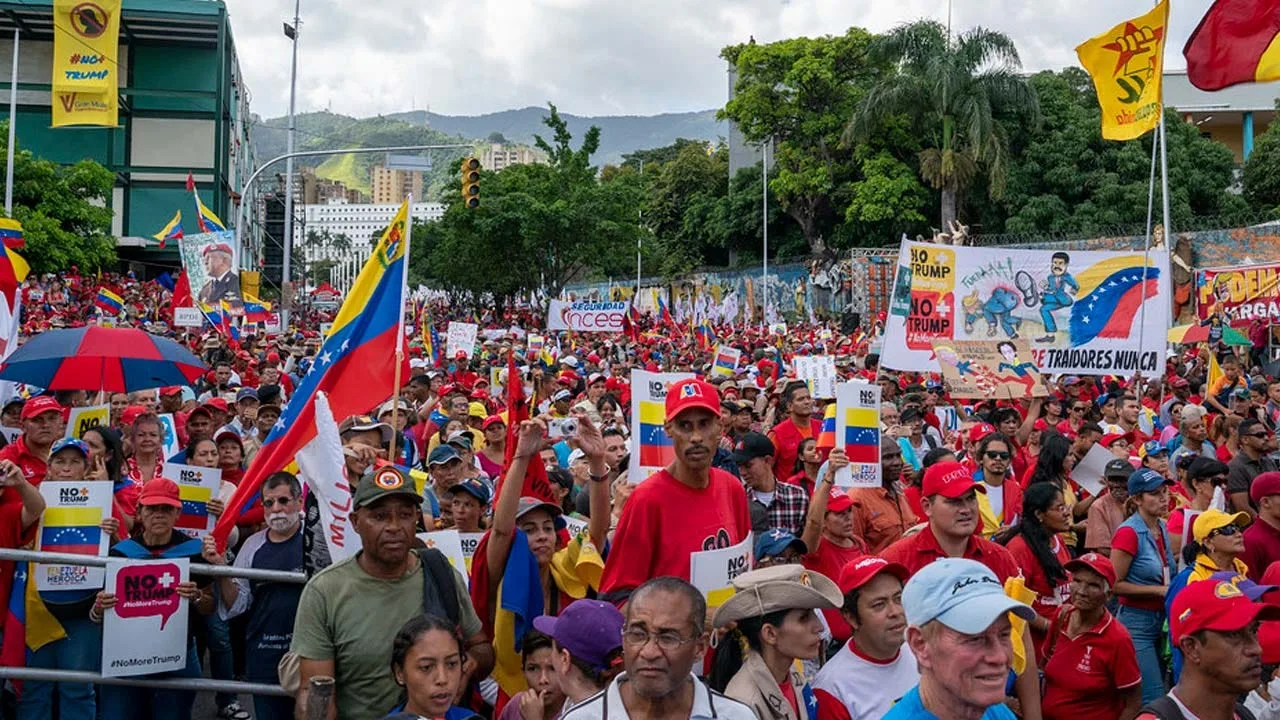
"There is great chaos under heaven; the situation is excellent."

User avatar
blindpig
Posts: 14788
Joined: Fri Jul 14, 2017 5:44 pm
Location: Turtle Island
Contact:

Re: Venezuela

Post by blindpig » Sat Nov 22, 2025 2:37 pm

Bush And Rubio Are Rocking The Political Cradle Of María Corina Machado
November 21, 2025

Image
Jeb Bush (left) and Marco Rubio (right) shake hands during a Florida fundraising in 2015. Photo: Joe Raedle/Getty Images/File photo.

By Misión Verdad – Nov 20, 2025

The recent announcement of the Nobel Peace Prize awarded to María Corina Machado constitutes a political move that distorts and reduces the award to an absurd instrument of geopolitical legitimization for actors aligned with the interventionist interests of the US empire.

The de-legitimization of the award stems from the fact that Machado’s candidacy was directly promoted by then-Senator Marco Rubio, through the letter he addressed to the Norwegian Committee in 2024.

This promotion is not accidental. It is part of an organic relationship spanning more than a decade, in which Machado has consistently operated as a useful piece within the political network that Rubio orchestrates from Washington.

This network not only responds to the ideological logic of the most extremist or conservative sectors of the Republican Party, but also to a powerful pressure structure composed of conservative think tanks, federal contractors, retired intelligence operatives and, particularly, the corporate groups of the oil lobby, who have opted for a model of political change in Venezuela subordinated to their own corporate and geostrategic calculations.

In this context, María Corina Machado has functioned as an external spokesperson and political operator for this political-financial faction, aligning herself without nuance with the agendas of pressure, illegal sanctions, and foreign tutelage promoted by Rubio and his entourage.

Operator of the transnational oil company
The web of interests that drives María Corina Machado did not originate in Venezuela. Her main political support comes from the Bush-Rubio lineage and the Texas oil complex historically associated with ExxonMobil, the American Petroleum Institute, and energy conglomerates.

The organic relationship that Machado maintains with Marco Rubio, one of the main political heirs of this structure, directly inserts her into that corporate lobbying system, which has used tensions with Venezuela as a geostrategic platform to reposition US oil power in the Caribbean.

Rubio’s support for Machado should be read as the logical continuation of a political project that originates from Bush capital, is fueled by Texan financing, and is pointing towards the expansion of ExxonMobil’s energy interests. Rubio was molded by Jeb Bush, sponsored by Texas oil donors, and turned into a key operator of the sanctions policy against PDVSA.

That same apparatus, which includes contractors, neoconservative foundations, and financial networks linked to the Gulf of Mexico, is the one that supports the consecration of Machado as a “democratic” figure. Consequently, the economic plans that Machado has promoted are a direct translation of that ideological and corporate matrix.

Her insistence on privatizing the oil industry, fragmenting PDVSA, opening the Venezuelan energy market under criteria of free foreign operation and “competition,” and handing over strategic areas to international consortiums coincides exactly with the design that ExxonMobil and its operators have promoted for Venezuela from time immemorial.

Ultimately, this is the historical agenda of the Texas oil ecosystem to reshape Venezuela’s energy structure to its advantage.

Thus, Machado’s oil vision responds to the same principle that guides Rubio: to dismantle state control of Venezuelan oil and replace it with a model aimed at maximizing the presence of US corporations, especially those with which the Bush family and Rubio’s circle have maintained direct links.

And all of this was reflected in 2005, when María Corina met at the White House with then-President George W Bush, in a meeting that symbolized her formal entry into the power networks that orbit around that Bush family.

That meeting was the confirmation that Machado is part of the political-business circuit that, from Washington, has promoted the intervention, the dismantling of PDVSA, and the energy recolonization of Venezuela.

She is the figure functional to the strategic needs of that network, acting in a manner equivalent to an operator, or, in cruder terms, a political puppet, whose narrative, proposals, and actions are systematically aligned with the interests of the political and corporate class linked to the Bush-Rubio-ExxonMobil axis.

Image
President George Bush Jr. received María Corina Machado in the Oval Office in 2005. Photo: White House.

Think Tanks: extremist platforms
Machado’s projection is neither spontaneous nor the product of independent recognition.

Her appearances in US regime events are part of an architecture carefully designed by the most extreme political-intellectual faction in Washington, whose think tanks, media, legislators, and operators have given her spaces that no foreign figure would obtain without direct political patronage.

To appear in these closed, competitive, and deeply ideologized circuits, an internal “bridge” is required, and that bridge has been precisely the Bush-Rubio axis and the oil and neoconservative lobby networks associated with it.

Machado’s entry into this constellation was marked early on by her links with US leadership programs such as Young Global Leaders (2005 and 2011) and Yale World Fellows (2009), both funded by institutions and foundations that operate as a kind of seedbed of pro-US thought.

And that’s not to mention her close ties to the National Endowment for Democracy (NED). From that moment on, her career began to align with the interests of the centers of power that shape regime change doctrines and economic pressure strategies against sovereign nations.

Over the past decade, that network has consistently provided her with visibility:

• In 2014, she was registered by another country [Panama] as an alternate envoy to the OAS and participated in a joint event of the Center for Strategic and International Studies (CSIS) and the Atlantic Council, in the context of her intervention in the Permanent Council.
• In June 2023, she returned to CSIS to speak about the opposition primaries, a space typically reserved for US figures linked to the national security apparatus.
• In February 2024, she was presented at the Atlantic Council, another bastion of interventionist thinking, to analyze the Venezuelan electoral scenario. The panel was organized by directors with close ties to the US State Department and to funders in the energy sector.
• In October 2024, she participated in a panel at the Georgetown Institute of the Americas, dedicated to the “democratization of Venezuela,” where she shared the stage with academics linked to the neoconservative establishment.
• On February 26, 2025, she appeared on Triggered, Donald Trump Jr.’s show, aligning herself with Trumpism.

These appearances are part of a coordinated political strategy. Machado has been carefully positioned within the circuit of the most aggressive US think tanks and media outlets regarding regional intervention, which operate as legitimizing hubs for figures who fulfill a geopolitical function useful to the US entity.

Her distinguished record with the NED
Her curriculum is marked from the beginning by her connection with the National Endowment for Democracy (NED), one of the central pillars of US soft power.

Her NGO, Súmate, emerged in the early 2000s precisely at the moment when Washington was expanding its policy of “unconventional” intervention in Latin America and was looking for new local operators to make its regime change agenda in Venezuela viable.

Súmate itself acknowledged in its 2004 report having received direct funding from the NED, an institution then headed by Carl Gershman, a figure closely linked to the neoconservative circles of the George W. Bush administration. Under his leadership, and with the influential lobbyist Vin Weber at the head of the Board of Directors, the NED increased its budget for Venezuela, quadrupling the funds allocated before and after the April 2002 coup.

For the NED, Machado represented what Gershman described as a “natural ally of the United States.” In this context, Súmate was designed as a platform parallel to the National Electoral Council, with logistical and financial support from the promoters of the NED. The cooperation between Machado and the US foreign policy apparatus was not limited to financial matters.

A diplomatic cable leaked by WikiLeaks revealed the level of direct communication she maintained with the US Embassy in Caracas. In the document, classified as “confidential,” Machado and Alejandro Plaz approached Ambassador William Brownfield seeking strategic guidance regarding potential legal action against them.

It must be noted that this same ambassador, William Brownfield, is known for calling for “accelerating the collapse of PDVSA” as part of the pressure against Venezuela.

According to the cable, Machado asked the ambassador if it was preferable for her cause to accept prison, go into hiding, or request asylum, to which the US diplomat responded by even evaluating the “political value” that her imprisonment would have.

The text details how the embassy recommended that Machado activate specific international networks: Amnesty International, the US Congress, Moisés Naím, and even representatives of the lobbying firm Patton Boggs, hired by the Venezuelan government itself in Washington.

The document also records the Canadian ambassador’s willingness to facilitate refugee status for Machado and her family. In short, María Corina Machado is not a political leader who emerged from Venezuelan dynamics, but rather a carefully constructed creation of the extremist, conservative, and corporate faction in the US empire.

Her career is the result of that power system: funded by the NED, promoted by the Bushes and Rubios, backed by the Texas oil lobby and legitimized by the think tanks of that system. Machado embodies that same old project of turning Venezuela back into a US protectorate.

(Misión Verdad)

Translation: Orinoco Tribune

https://orinocotribune.com/bush-and-rub ... a-machado/

Evidence Shows Machado Fled Venezuela; President Maduro Sets New Oil Goal
November 22, 2025

Image
Far-right Venezuelan politician María Corina Machado presented a 100-day plan to guarantee profits for US companies in Venezuela. Photo: AS/COA.

XTelegramRedditWhatsAppLinkedInFacebookThreadsMessengerWeChatMastodonEmailPrintCopy LinkShare
Caracas (OrinocoTribune.com)—Venezuelan Interior Minister Diosdado Cabello made a series of accusations against far-right politician María Corina Machado during his weekly program Con El Mazo Dando on Wednesday. He revealed that the government possesses videos showing how she fled the country.

Cabello stated that Venezuelan security agencies have information and evidence detailing Machado’s departure from national territory as she planned to attend the Nobel Peace Prize ceremony scheduled for December 10 in Oslo, Norway.


“We have videos, recordings, audios, and other things, so that later they cannot say it was an extraction operation like they said with the people from Vente Venezuela who were in the Argentinian embassy in Caracas,” he added.

Mainstream media and the Nobel Peace Prize committee itself claim Machado is a hero for supposedly remaining in Venezuela despite the alleged repressive nature of the government. However, the evidence shows that the Venezuelan government knows exactly where she is.

Minister Cabello also linked Machado to a group of Colombian paramilitaries that recently launched terrorist bombings in Colombia near the Venezuelan border. According to Cabello, these individuals were allegedly hired by María Corina Machado to enter Venezuela and carry out terrorist acts in December.

Political landscape and oil target
Despite reports claiming a collapse of the Venezuelan military due to an unprecedented US military build-up in the region, with over 15,000 troops and warships, or massive far-right protests aiming to destabilize the Chavista government, none of these scenarios have materialized. Many point to the poor condition of the Venezuelan far-right opposition, with Machado seen as the main reason for its dispersion and unprecedented fragmentation.

Meanwhile, on Thursday, President Nicolás Maduro said that the country will reach a production target of 1.2 million barrels of oil per day, an objective driven by the Venezuelan oil workers.

The information was released during a televised ceremony in preparation for the Constituent Congress of the Working Class, where President Maduro emphasized crucial progress in energy matters.

“The first gas shipment to Colombia is ready at the border, pending only some technical and financial details before dispatch,” he said. This announcement underscores Venezuela’s commitment to recovering its oil production capacity and beginning a new phase in gas supplies to the region, strengthening bilateral integration after Trinidad and Tobago was separated from the gas agreements negotiated with Venezuela for several years.

Petro’s post
Maduro noted that this is only the beginning, as Venezuela and Colombia must become increasingly united in an integrated, prosperous economy with growing binational trade and investment. He reiterated the need for them to remain guided by the Bolivarian vision of emancipation, freedom, peace, and mutual respect.

However, on Thursday night, Colombian President Gustavo Petro wrote a social media post intervening in Venezuelan internal affairs, a move that many analysts consider an attempt to position himself better in front of the US.

Petro called for a “shared transition government” in Venezuela, alleging that one sector cannot impose itself on another. Analysts consider that Petro’s understanding of Venezuela’s political reality is not rooted in the actual correlation of forces within the country.

They claim that Petro’s proposal is particularly counter-productive, considering fake news circulating on social media about an alleged negotiation between President Maduro and the US government for an imaginary safe way out of power.

https://orinocotribune.com/evidence-sho ... -oil-goal/

*****

Ideology and crime in the "Manifesto of Freedom"
Walking on the borderline between liberalism and fascism
November 21, 2025 , 11:11 am .

Image
"The Tightrope Walker", 1923 (Photo: Paul Klee)

"Every Venezuelan is born with inalienable rights granted by our Creator, not by men."

"Manifesto of Freedom": María Corina Machado


This phrase, which opens the programmatic document of María Corina Machado published in The Washington Post , can be naively read as a mere rhetorical invocation of human dignity, but it is something more: a theological-political declaration, a restitution of the "natural order", where rights are founded not on popular sovereignty or the social contract, but on a divine providence that sanctions property, private initiative and unequal hierarchy.

The subject of this order is the property-owning individual (and never the citizen), whose freedom is measured by their capacity to accumulate, defend, and expand their dominion. It is here that the ambiguity begins: a dialectic between the discourse of classical liberalism and the logic of contemporary fascism.

Is the Manifesto of Freedom a government plan? Yes, in the conventional sense, but it goes further: it is a liturgy of restoration, a symbolic rite that seeks to erase two decades of historical experience and reinstate an era—the Venezuela before Chavismo—as the only legitimate horizon of politics.

But this restitution is conceived only as a purge: of institutions, of actors, of memories. And it is in this operation that liberal discourse slides toward fascism .

The text thus presents itself as an ideological, and even structurally psychological and class-based, diagnosis of Machado, who does not hide his aims even with the Nobel Peace Prize propaganda on his conscience. Let's see.

Liberalism as the theodicy of the market
The Manifesto presents itself as the heir to freedom of expression, popular sovereignty, and a limited state. But it actually reveals a different genealogy. Following the German philosopher Franz Hinkelammert, it is not a liberalism that defends rights against power, but rather a religion of the market that replaces rights with property and duties with calculation.

The text states: "When people prosper as a result of their work, all other human rights follow as a consequence." Here, in fact, it is not affirming a democratic principle: it is repeating, almost verbatim, the doctrine of Ludwig von Mises : there are no natural rights, only property rights; and whoever does not own property has no right to live.

This is the same logic that, according to Hinkelammert, leads Friedrich Hayek to justify traditional population control—famines, plagues, infant mortality—as "natural" regulatory mechanisms. In the Manifesto, the right to life is equated with the right to protect property.

"Every individual has the right to protect his life, his family, his property and his liberty."

Note well: property = life. This is not a linguistic oversight; this invocation announces a morality where the defense of property—individual or national—legitimizes the elimination of the obstacle. It is the logic that, historically, allowed British and American liberals to create and celebrate concentration camps before the Nazis perfected them (as the Italian historian Domenico Losurdo shows in * A Counterhistory of Liberalism *). Systemic violence is an integral part of liberalism: it is its repressed potential, ready to be unleashed when the class order is threatened.

The purge as a condition of freedom
The second pillar of the Manifesto is restitution : returning what was stolen, recovering what was lost, restoring trust. But what is meant by "theft"? Not only the expropriation of property, but the usurpation of political meaning. Chavismo here is the existential Other, the ultimate enemy that has "corrupted the nation" and "must be eradicated"; not defeated, much less convinced, but eliminated.

This is the logic of fascism in our time , according to the Portuguese sociologist Boaventura de Sousa Santos: radical indifference toward the humanity of the other, justified as a defense of civilization. In the Venezuelan case, this logic has been at work since 2002: oil sabotage as a "strike for democracy" or the violent street protests as "civic resistance." Machado institutionalizes this logic both discursively and operationally.

When he states, "Peaceful civic protest does not threaten the country: it strengthens it," he is not defending dissent; he is drawing a line: what is peaceful is what does not challenge the structure of ownership and power. What it does challenge—workers' mobilization, community organizing, the defense of the oil state—is, by definition, "not peaceful," and therefore, "illegitimate."

Thus, the "freedom" of the Manifesto is only for some, since it presupposes the annihilation of others. In this, the classic Herrenvolk scheme is repeated : the democracy of the ruling class, where citizenship is defined by racial, cultural, and political exclusion.

In Venezuela, this exclusion is articulated as Chavismo = illegitimacy. It's about depoliticizing a people through violence and intimidation.

The civil war machine
The Manifesto promises to reform the Armed Forces and the police, restore trust, and promote legitimate self-defense. But behind this institutional rhetoric lies a project of brute force against organized dissent.

The notion of "legitimate self-defense" is key. In international law, this concept permits the use of force in the face of imminent aggression. But in the Machado regime's worldview, the imminent aggression is Chavismo itself: a presence that must be crushed. Hence the numerous calls for foreign military intervention.

Hence, since 2014, the opposition has justified the violence as a "proportional response": burning public infrastructure because there is inflation, killing police officers because there is repression.

This is the logic of contemporary fascism: civil war as a form of anti-government pressure. Not a declared war, but a permanent tension; violence is delegated to non-state and diffuse actors (violent protesters, hitmen, mercenaries, narco-paramilitaries) and then reabsorbed as a political program.

That was Mussolini's strategy (from power) in the 1920s, celebrated by The Economist and Winston Churchill. Today, in Venezuela, it is being repeated under the name of freedom.

Venezuela as a laboratory of totalitarian neoliberalism
The Manifesto proposes a selective State: present in repression, absent in social protection; strong in the defense of capital, weak in the guarantee of rights.

The promise to "liberate state-owned companies and return the exploitation of the oil sector to the ingenuity of free men and women" is not a commitment to efficiency, that much is clear. It is a planned handover: first, the destruction of the public productive apparatus (through sanctions, sabotage, and induced corruption); then, its sale to transnational capital—especially American capital—under the argument that only they possess the "ingenuity" to govern what the Venezuelan people, and even their best technocrats, do not know how to manage.

We have already witnessed this strategy during the "oil opening" of the last decade of the 20th century. As the Italian economist Clara Mattei documents in The Order of Capital , austerity is not an economic policy: it is a technology of domination.

The European researcher recalls that, in fascist Italy of the 1920s, social cuts, wage suppression, and mass privatization were the driving force of the capitalist order. And thus celebrated by international liberals—Einaudi, Churchill, the Times —as the only possible path against the "Bolshevik threat."

Today, Machado occupies the same position: the technocratic-populist figure who promises to "fix the finances" while paving the way for accumulation by dispossession. His discourse is deliberately ambiguous: he speaks of "democracy" but refuses to recognize elections; he defends "human rights" but demands foreign military intervention.

This ambiguity is deliberately strategic. It allows him to mobilize urban middle classes (terrified by the crisis, seduced by the myth of order) and, at the same time, guarantee capital that the regime change will be restorative.

Between worship and crusade
María Corina Machado is not a fascist in the classical sense: she doesn't have a single party, she doesn't wear uniforms, and she doesn't create figures for the cult of personality. But she actively participates in the construction of a social fascism—in the terms of Sousa Santos—where democracy is maintained as a façade, while the economy is surrendered to the market and politics is subjected to the logic of the enemy.

Their fascism is practical: a willingness to symbolically and materially exterminate the Other when that Other stands in the way of accumulation. Similarly, their liberalism is functional: a moral justification for inequality, disguised as individual ethics.

Machado walks this border—between liberal discourse and fascist practice. But she is not alone. She is accompanied by a global constellation of figures who share her ideology: Javier Milei, who calls the dismantling of the welfare state "freedom"; Donald Trump, who calls the international destabilization of trade "justice"; Benjamin Netanyahu, who calls genocide "defense."

Venezuela, in this context, would be a laboratory. A space where the viability of a project that aspires to reconcile what history has separated—the velvet glove of liberalism and the iron fist of fascism—must be tested.

It is now that we must clearly understand that when the market becomes a god, human beings become sacrifices. A religion to which Machado is a faithful servant, by origin and by destiny.

https://misionverdad.com/venezuela/cami ... l-fascismo

Google Translator
"There is great chaos under heaven; the situation is excellent."

User avatar
blindpig
Posts: 14788
Joined: Fri Jul 14, 2017 5:44 pm
Location: Turtle Island
Contact:

Re: Venezuela

Post by blindpig » Sun Nov 23, 2025 3:11 pm

Trump Begins New Phase of Venezuela Escalations...but Is It Just a Ruse?
Simplicius
Nov 22, 2025

Buried beneath the theater of the Ukraine war’s terminal crescendos, Trump’s administration has quietly tightened the noose around Venezuela.

As standard to the neocon Uniparty, this comes only a week or two after DNI Tulsi Gabbard somewhat surreally boasted that this administration heralds the end of “regime change” operations:

Image

How absurd can the mounting hypocrisies of the terminally-mad empire get before they runneth over?

Bloomberg reports that ‘Russian tankers’ have been forced to ‘idle’ near Venezuelan waters by American warships.

Image

The Russian vessel, the Seahorse, was en route to Venezuela to deliver a fuel cargo on Nov. 13 when a US destroyer, the USS Stockdale, positioned itself in its path. The Russian vessel changed course, heading toward Cuba, and the warship sailed near Venezuelan territorial waters toward Puerto Rico. The Seahorse has since tried to approach Venezuela twice, but turned back both times, and remains idling in the Caribbean.

Other OSINT operators have taken it further, and believe a full naval blockade of Venezuela’s economic corridor is in effect:

No one is reporting this, but the AIS data overwhelmingly shows tankers of Chinese or Russian origin are stopped or are not transiting in and out of Venezuelan waters over the past 24 hours.

Image

This naturally comes only days after Venezuela’s national assembly approved a 15-year extension of Russia’s PDVSA and Roszarubezhneft to operate two oil fields in the country’s south:

Image
https://www.reuters.com/business/energy ... 025-11-20/

Upon further digging, though, one finds that the US’s actions may not be quite as severe as the above blockade rumors suggest, but the overtures are clearly being put in place for major intensification:

They are still doing business as usual, the Seahorse was not intercepted it was warned from land and stopped but it’s back on course.

This account tracks the movements in the area, and reports that the Russian ships ended up successfully offloading their oil and sailed back to Russia.

Image

As stated, the early stages of economic pressure terror on Venezuela have begun, particularly with the news that a major oil plant in the country has suddenly gone up in flames two days ago, just as US warships had begun to hector incoming Russian and Chinese oil tankers—presented below in juxtaposition with the obviously ‘coincidental’ Trump announcement just a couple weeks prior:

Image


Despite the obvious links to the CIA, a US congressman absurdly essayed to pin the plant explosion on Maduro himself, as part of the manifest information campaign meant to destabilize Venezuela by sabotaging the president’s public mandate:

Image


The overall plan is clear. Trump intends to use ‘strategic ambiguity’ to put massive psychological pressure on Maduro’s administration, by weakening public support via a regime of uncertainty about the country’s economic future, general prosperity, and stability.

The reason is, as ‘rumored’ reports last week had indicated, Trump is uncertain about the success of any major military action against Venezuela; in short, Trump is afraid to walk into a giant blunder and face humiliation at the hands of one of South America’s largest military forces.

That means Trump may be leaning towards simply using the large American buildup in conjunction with various instruments of economic terror as a lever to bring down Maduro; these, of course, would also be used in conjunction with CIA and potential special forces covert ops to ‘trigger’ certain events in the country at convenient moments, particularly when the economic terror campaign has reached a certain needed culminating point.

Case in point:

Multiple airlines have cancelled their flights to Venezuela after the FAA warned of a “potentially hazardous situation” when flying over the country, according to Reuters.

Per DW, six airlines have cancelled their flights.


Cancelled flights, rerouted maritime and economic supply lines, mass-psychological and political pressure, etc. In essence, a slow strangulation campaign in conjunction with the sabotage of key energy infrastructure nodes throughout the country. That’s not to mention strikes on what are alleged to be narco-boats, which even US JAG lawyers contend to be illegal:

Image

This entire campaign is strongly coordinated around the ‘thematic’ messaging of Maduro’s clearly specious ties to what appears to be an entirely fictitious “drug cartel”. Several journalists have now expressed that the ‘Cartel de los Soles’, comically claimed by Rubio to be led by Maduro himself, in fact does not even exist:

Image

Enlargement of the above from CNN and The Guardian:

Image

So, we have a fictitious cartel with Maduro as the ‘grand mafioso leader’, and for this the country must endure economic sabotage—a fairly trite script, used in various iterations in the past by the ‘Rules Based Order’; see: Libya.

Now, as of this very writing Reuters reports that the US stands poised to heavily escalate its terror campaign against Venezuela into a ‘new phase’ “in the coming days”:

Image
https://www.reuters.com/world/americas/ ... 025-11-22/

WASHINGTON, Nov 22 (Reuters) - The United States is poised to launch a new phase of Venezuela-related operations in the coming days, four U.S. officials told Reuters, as the Trump administration escalates pressure on President Nicolas Maduro’s government.

The “options” being weighed by the US, according to ‘anonymous officials’ who’ve spoken to Reuters, naturally include the direct overthrow of Nicolas Maduro:

Two U.S. officials told Reuters the options under consideration included attempting to overthrow Maduro.

At the same time, WaPo reports that Trump intends to drop propaganda leaflets over Caracas itself:

Image
https://www.washingtonpost.com/national ... -proposal/

The Trump administration has proposed a psychological operation to demoralize the Venezuelan leader and encourage him to flee the country, according to people familiar with planning.

The leaflets are intended to rouse disorder amongst the populace in the hopes they do Trump’s dirty work for him in ousting Maduro, before the US is forced to lay a ‘heavier hand’.

According to WaPo:

The leaflets were expected to contain information on a $50 million reward for assistance leading to Maduro’s arrest and conviction, the people said, speaking on the condition of anonymity to discuss sensitive planning for a potential operation. In August, U.S. officials increased the reward from $25 million, citing his 2020 indictment for corruption, narcoterrorism and drug trafficking.

Maduro’s 63rd birthday is this Sunday the 23rd, so this plan—if decided upon—could be launched literally within hours.

But as always with Trump, there appears to possibly be some hidden motives beneath the Monroe-doctrine machismo and faux-Americana bravado. It seems ever-wily Trump could be angling to make some ultimate deal with Maduro, as several reports have indicated that the naval buildup is merely meant to bring leverage for just that:

Maduro privately offered the U.S. access to a large share of Venezuela’s massive oil reserves—about 300 billion barrels—to avoid a military confrontation.

Trump initially rejected the deal, but a senior official now says those talks may still be alive, and the deployment of the aircraft carrier is partly meant to pressure Maduro for more leverage in the negotiations.

Source: NYT

#BREAKING Trump said that he will soon speak with Nicolás Maduro, and that he has “something very specific to say.”


In the meantime, Maduro aptly summarizes to his people precisely the plan outlined earlier in this piece: (Video at link.)
POLLHow do you believe the latest standoff will resolve?
US strikes and coup attempt 44%

Trump-Maduro clinch headline "deal" 56%
992 VOTES · 2 DAYS REMAINING
https://simplicius76.substack.com/p/tru ... -venezuela
"There is great chaos under heaven; the situation is excellent."

User avatar
blindpig
Posts: 14788
Joined: Fri Jul 14, 2017 5:44 pm
Location: Turtle Island
Contact:

Re: Venezuela

Post by blindpig » Mon Nov 24, 2025 2:41 pm

Venezuela Under Siege: A Hundred Deaths at Sea – Hundreds of Thousands by Sanctions
Posted by Internationalist 360° on November 21, 2025
Roger D. Harris

Image
The USS Gerald R. Ford aircraft carrier enhances air and ballistic missile capabilities for SOUTHCOM operations near Venezuelan shores. (@SA_Defensa)

Washington is targeting the Venezuelan people in an escalating regime-change offensive, combining open military violence with an economic siege that has quietly claimed far more lives.

Most of the world looks on in disbelief at the now-routine murders on the high seas off Venezuela’s coast – serial killings that the newly minted War Department calls Operation Southern Spear.

On October 31, UN High Commissioner for Human Rights Volker Türk condemned the attacks, saying that the “mounting human costs are unacceptable.” The People’s Social Summit in Colombia (November 8-9) excoriated Washington. Four days later in Caracas, a meeting of jurists from 35 countries denounced the “homicidal rampage.” The Military Law Task Force of the National Lawyers Guild charged “egregious war crimes and violations of international human rights, maritime, and military law.”

Even The New York Times, an outlet that is not squeamish about US atrocities, described Washington’s flimsy drug-interdiction rationale as being “at odds with reality.”

The notion that the US – the world’s leading consumer of illegal narcotics, the major launderer of trafficking profits, and the cartels’ favored gun runner – is concerned about the drug plague is ludicrous.

In reality, Venezuela is essentially free of drug production and processing – no coca, no marijuana, and certainly no fentanyl – according to the authoritative United Nations World Drug Report 2025. The European Union’s assessment of global drug sources does not even mention Venezuela.

Most inconveniently for Mr. Trump, the US Drug Enforcement Agency (DEA) 2025 National Drug Threat Assessment does not list Venezuela as a cocaine producer and only as a very minor transit country. Nor is Venezuelan President Nicolás Maduro cited as a drug trafficker.

The State Department is designating the so called Cartel de los Soles, allegedly headed by Maduro, as a Foreign Terrorist Organization (FTO), However, the entity is nowhere to be found in the DEA assessment for the simple reason that it does not exist.

Meanwhile, the body count from the killing spree is nearing one hundred, yet not an ounce of narcotics has been found. In contrast, the Venezuelan government has seized 64 tons. Clearly Washington’s intent is not drug interdiction but regime change.

Sanctions kill

As horrific as the slaughter by direct US military violence against Venezuela may be, a far greater contributor to excess deaths has received scant media attention. The toll from sanctions is well over a hundred-fold larger.

Sanctions are not an alternative to war but a way of waging war with a less overt means of violence – but deadly, nonetheless.

Sanctions, more properly called illegal unilateral coercive measures, are as lethal as the missiles Washington rains down on small boats in the southern Caribbean and the Pacific from Ecuador to Mexico.

Economists Mark Weisbrot and Jeffrey Sachs demonstrated that US sanctions imposed 2017-2018 drastically worsened Venezuela’s economic crisis and directly contributed to an estimated 40,000 excess deaths.

By 2020, former UN Special Rapporteur Alfred de Zayas estimated a death toll of over 100,000. An expert in international law, de Zayas argues that sanctions function as collective punishment, harming civilians rather than government officials.

Washington is now escalating its regime-change offensive – while maintaining the sanctions – precisely because Venezuelans have successfully resisted the punitive measures.

Sanctions disproportionately kill children

A peer-reviewed scientific report in The Lancet reveals that a disproportionate number of the sanction’s victims globally are children under the age of five. In fact, the study finds that more human life is extinguished by sanctions than by open warfare.

The SanctionsKill! Campaign describes itself as an activist project to expose the human cost of sanctions and what can be done to end them. They are inviting health workers to sign a letter to the US Congress and the executive branch to end these child-killing sanctions.

Drawing from The Lancet study, the health workers’ letter details how sanctions are particularly deadly for small children by:

Provoking increases in water-borne illnesses and diarrheal diseases
Causing low birth weight
Exacerbating hunger and malnutrition
Denying lifesaving cancer care and organ transplants
Obstructing access to and import of antibiotics and other common medicines
Hindering sanctioned countries from receiving assistance during natural disasters
Among the signatories are Margaret Flowers, MD, a pediatrician and long-time health reform advocate; professor emeritus Amy Hagopian, PhD, at the University of Washington and former chair, International Health Section, American Public Health Association; internist Nidal Jboor, co-founder of Doctors Against Genocide; and pediatrician Ana Malinow, National Single Payer leader.

Others include health policy professor Claudia Chaufan, MD and PhD, York University; child and adolescent psychiatrist Claire M. Cohen, MD, National Single Payer, PNHP; and Kate Sugarman, MD, Georgetown Law School and George Washington School of Medicine.

Their letter concludes that there is a clear consensus in the literature that broad unilateral economic sanctions have devastating health and humanitarian consequences for civilian populations: “This is a global public health crisis caused by US government policy. We implore you to fulfill your inescapable obligation to end it…Imposing such collective punishment on the innocent is morally reprehensible.”

Sanctions and slaughter

Blogger Caitlin Johnstone quips: “civilized nations kill with sanctions.” That the US kills by both sanctions and open military force does not prove her wrong. Rather, it demonstrates that today’s US empire is not civilized.

Because open warfare is more dramatic than unilateral coercive measures, there is a danger that child-killing sanctions are becoming normalized.

Indeed, this form of hybrid warfare by the US impacts roughly one-quarter of humanity. History shows – as in the case of the 1961 John F. Kennedy sanctions against Cuba – that once imposed, sanction regimes are politically difficult to end.

The campaign against unilateral coercive measures is as central to the struggle for peace as opposition to overt military aggression. Sanctions are not a benign substitute for war; they are an additional mechanism of lethal collective punishment.

PS: The health-workers’ letter will not be submitted until early 2026, so health professionals of all disciplines still have time to sign on.

https://libya360.wordpress.com/2025/11/ ... sanctions/

******

Image

Geopolitics, resistance and the battle for Venezuela: A conversation with Atilio Borón
By Cira Pascual Marquina (Posted Nov 24, 2025)

Originally published: Venezuelanalysis.com on November 22, 2025 (more by Venezuelanalysis.com) |

With U.S. warships stationed off Venezuela’s coast and a new regional right-wing bloc forming under Washington’s tutelage, the Western hemisphere is entering a volatile phase. Yet today’s confrontation unfolds in a world very different from the one that allowed the U.S. to dictate regional politics with little resistance in the past. China’s rise, the return of progressive governments in key countries, and projects like the Bolivarian Revolution challenged U.S. power. In this changing landscape, few analysts have been as persistent or as lucid as Argentine Marxist thinker Atilio Borón.

Here, Borón offers a broad and urgent reading of the current escalation: why Venezuela remains a strategic target, how Washington is trying to reorganize the continent, and what lessons can be drawn from Hugo Chávez’s political and pedagogical legacy. His analysis covers both the dangers of the present moment and the strengths that could prevent a wider military attack from the empire.

Cira Pascual Marquina: How do you understand the current continental situation and specifically Washington’s recent military build-up and attacks in the Caribbean?

Atilio Borón: Latin America has long been described as a continent in dispute, and today that dispute is sharper than ever. The region has become the most important arena in a global contest in which the United States is trying to reassert control to oppose new actors that are gaining ground.

For decades, Washington largely relied on soft power to manage the hemisphere. What we are witnessing now, however, is an open display of brute military force. I would even dare say—although this deserves deeper study—that this is the largest imperialist air-naval military buildup in our region since the October 1962 Missile Crisis.

Why? Because the world system is undergoing a dramatic transformation. There is no returning to the global landscape of fifteen years ago. New actors have emerged with decisive weight, fundamentally reshaping geopolitics. Take China: in the late twentieth century and even at the start of this century, U.S. strategists hardly took it seriously. I recall attending a major international seminar in Buenos Aires in the late 1980s where U.S. economists projected that China would only begin to matter around 2030. History has proved them spectacularly wrong.

Let’s look at the numbers. In 2000, total trade between Latin America and the Caribbean with China was about $12 billion a year. By 2005—the year the U.S.-led Free Trade Agreement of the Americas was defeated in Mar del Plata—that figure had already jumped to $50 billion. By 2024, according to the Economic Commission for Latin America and the Caribbean [ECLAC], it had reached approximately $538 billion. This alone helps explain why U.S. foreign policy today can be summarized in three words: keep China out.

But the problem for Washington is that keeping China out is no longer possible. China is already the main trading partner for Brazil and Chile, likely for Colombia as well, and the second-largest for Mexico and Argentina. And globally, China maintains significant economic ties—through trade, investment, or both—with more than 140 countries. China is here to stay.

India also has a growing presence in the region, though with a lower profile, while Russia plays a role in infrastructure and defense projects in several countries. All of this is unfolding in a region that is extraordinarily rich in natural resources—resources the United States desperately needs.

Take the case of rare earth minerals. Roughly 80% of known global deposits are in China, and China controls close to 90% of the world’s processing capacity. Some Latin American countries have smaller reserves, and Washington is now scrambling to secure access to them in Chile, Argentina, Brazil, and even Venezuela.

CPM: How does this new global balance of power affect Washington’s strategy in Latin America and the Caribbean today?

AB: First, it’s important to understand the new situation in the region. Unlike the early 2000s, when progressive governments confronted the imperialist order openly and in a relatively unified bloc, today the landscape is more mixed. There was indeed a conservative reflux, but the old status quo was never fully restored, and new progressive dynamics have emerged.

Mexico now establishes cautious but meaningful limits to U.S. pressure. For the first time in 200 years, Colombia has a popular government under Gustavo Petro. Honduras is governed by Xiomara Castro, and her party’s next candidate, Rixi Moncada, is leading the polls. Venezuela continues to resist in ways few expected, despite the enormous weight of unilateral coercive measures, while Cuba remains a beacon for the region.

Washington is desperately trying to assemble a new anti-Venezuela, anti-Cuba, anti-Nicaragua axis. It leans heavily on figures such as Argentina’s Javier Milei, El Salvador’s Nayib Bukele, and the narco-linked Daniel Noboa in Ecuador.

This is what’s behind what some are calling a kind of “mini-FTAA”: a draft free-trade agreement between Argentina, Ecuador, El Salvador, Guatemala, and, of course, the United States. But in reality, this is more than a trade agreement. It is an imposition. Of its nineteen restrictive provisions, sixteen are U.S. demands. Consider the absurdity of allowing the export of live cattle from the United States to Argentina, a country whose very identity is tied to its cattle industry.

But beyond this desperate attempt to pry open markets, Washington’s real objective is straightforward: lithium, rare earth minerals, and hydrocarbons. Everything else is secondary.

CPM: Why does Venezuela remain a central target for Washington, and what explains the US’s new military escalation?

AB: Venezuela has always been considered a high-priority security concern for the United States. Historically, U.S. oil corporations played a decisive role in exploiting Venezuela’s oil fields. However, that changed after Hugo Chávez came to power, and later, these companies lost even more ground as a consequence of the US’ own blockade against the country.

Today, global oil markets are more strategic than ever, and geological surveys confirm that Venezuela holds the largest proven oil reserves in the world… greater even than those of Saudi Arabia!

These reserves have an additional strategic advantage: they are just four to five days away from U.S. refineries, compared to roughly thirty-five days from the Persian Gulf. This means shipping is cheaper and safer, especially given that the U.S. maintains around forty military bases overseeing the Caribbean. With such advantages at stake, it is no surprise that the Bolivarian Revolution’s nationalization of the oil industry and its affirmation of national sovereignty proved intolerable to Washington.

The United States has tried every conceivable means to break Venezuela: the 2014 and 2017 guarimbas; the unilateral coercive measures that have killed tens of thousands; the farce called “Juan Guiadó”—famous only for its absurdity—which nonetheless enabled the theft of Venezuelan assets such as Citgo; and now the disgraceful Nobel Peace Prize for María Corina Machado, a figure deeply associated with political violence.

Having failed on all these fronts, Washington is now turning to military options. Yet these, too, are extremely complex. When the U.S. invaded Panamá in 1989 to remove Noriega, it deployed 26,000 Marines, and it still took a month to secure Panama City.

The idea of invading Venezuela is the stuff of pure fantasy, and U.S. strategists probably know it. Still, Washington might adopt an “Israeli-style” strategy: striking critical infrastructure such as the Guri Dam, refineries, or airports, inflicting enormous damage. Yet this approach also has its limits: if the U.S. intends to seize Venezuela’s oil, it cannot destroy all of the country’s energy infrastructure in the process.

What makes the situation especially dangerous is Trump’s instability and recklessness. His personal and legal crises—including documented links to Jeffrey Epstein—have eroded confidence in him even among Republicans.

Given this scenario, Venezuela must call for international solidarity and decisive political action. China, in particular, should respond to the U.S. naval escalation in the Caribbean by deploying its own fleet around Taiwan, without firing a single shot. Such a move would send an unmistakable message: aggression has consequences. If Washington attacks Venezuela today, it will move against China tomorrow. A preemptive signal is therefore essential, both for China’s security and for Venezuela’s.

CPM: What is the importance of Hugo Chávez’s legacy during this time of imperialist aggressions?

AB: Chávez is an extraordinary figure in contemporary history, not only of Venezuela, but of our continent and the world. He revived the Bolivarian legacy and the emancipatory vision of Latin America’s independence movements, restoring the principles of national sovereignty and self-determination at a moment when they had been gravely eroded.

One of his greatest achievements was the political education of the Venezuelan people, carried out not only through Aló Presidente but through countless public interventions and, above all, by example. This helps explain why the popular response to the recent call for voluntary enlistment in the Bolivarian Militia was so massive. It is never easy to ask people to risk their lives for their country, but Chávez—and now President Maduro—have succeeded because the Comandante planted a seed that took deep root in the idea of the Patria Bonita: a beloved and dignified homeland.

Today, we must do everything possible to prevent the imperialist offensive against Venezuelan soil from being carried out. The situation is dangerous not only for Venezuela, but for the entire continent and indeed for the world. Pete Hegseth, the current U.S. Secretary of War—someone with no battlefield experience, and a figure with a record of racism and misogyny—adds to the danger through sheer incompetence.

It’s no coincidence that Admiral Alvin Holsey, a seasoned military professional, resigned as head of SOUTHCOM after seeing what was being planned.Thanks to Venezuela’s preparedness, its alliances, and its global connections, the country is far from isolated. It has important international relations. For these reasons, I believe the worst-case scenario can still be avoided. But if Venezuela is attacked, one thing is certain: there will be unity and the will to defend the Patria.

https://mronline.org/2025/11/24/geopoli ... lio-boron/
"There is great chaos under heaven; the situation is excellent."

User avatar
blindpig
Posts: 14788
Joined: Fri Jul 14, 2017 5:44 pm
Location: Turtle Island
Contact:

Re: Venezuela

Post by blindpig » Tue Nov 25, 2025 2:47 pm

U.S. Military Campaign Aims to Seize Venezuela’s Oil: Rep. Salazar

Image
U.S. military deployment in the Caribbean sea. X/ @HayatAlwasat

November 25, 2025 Hour: 7:58 am

The Republican politician openly admitted interventionist motives.
On Monday, U.S. Republican lawmaker Maria Salazar bluntly confessed that the real intention behind the military campaign in the Caribbean Sea launched by President Donald Trump’s administration is to enter Venezuela to steal its oil.

“We’re about to go in. We need to go in,” the congresswoman, whose parents are Cuban, said, referring to the military deployment Trump has maintained since August under the pretext of combating international drug trafficking.

“Venezuela for the American oil companies will be a field day because it will be more than a trillion dollars in economic activity. American companies can go in and fix the oil rigs and everything that has to do with the Venezuelan petroleum companies, with oil and the derivatives.”

“The Venezuelans have the largest reserves of oil in the world, more than Saudi Arabia. This is going to be a windfall for us when it comes to fossil fuels. For American oil companies, Venezuela will be a field day because it will mean more than a billion dollars in economic activity,” the Florida representative declared.


Through Instagram, Venezuelan legislator Tania Diaz, who is also vice president of Training and Ideology for the United Socialist Party of Venezuela (PSUV), reacted critically to those statements.

“I present to you the living example of political parasitism. Salazar has climbed positions on the shoulders of Latin American migrants in the United States — the same people she now denies and mercilessly throws into the pit of the Alligator Alcatraz jail. Salazar ignores her origins and dishonors her grandparents. She betrays her own people. She spits on her ancestors.”

“Today she shamelessly confesses the intention to steal Venezuela’s oil. She exposes the despicable intentions of people of her ilk. There is no politics here, much less any hint of democracy. She thinks and acts like the eternal parasites. They neither work nor produce and are used to ripping the lifeblood from other organisms to survive,” the Venezuelan lawmaker said.

“They will be left wanting… No one can come to steal our country’s future. ‘Here we have a free people and a sovereign homeland’,” Diaz concluded, recalling the words of the late Commander Hugo Chavez, the historic leader of the Bolivarian Revolution.

https://www.telesurenglish.net/u-s-cari ... p-salazar/
"There is great chaos under heaven; the situation is excellent."

Post Reply