Footnotes from the Ukrainian "Crisis"; New High-Points in Cynicism Part V

User avatar
blindpig
Posts: 14788
Joined: Fri Jul 14, 2017 5:44 pm
Location: Turtle Island
Contact:

Re: Footnotes from the Ukrainian "Crisis"; New High-Points in Cynicism Part V

Post by blindpig » Tue Nov 25, 2025 12:41 pm

Ukraine presents its red lines
Published by @nsanzo ⋅ 25/11/2025

Image

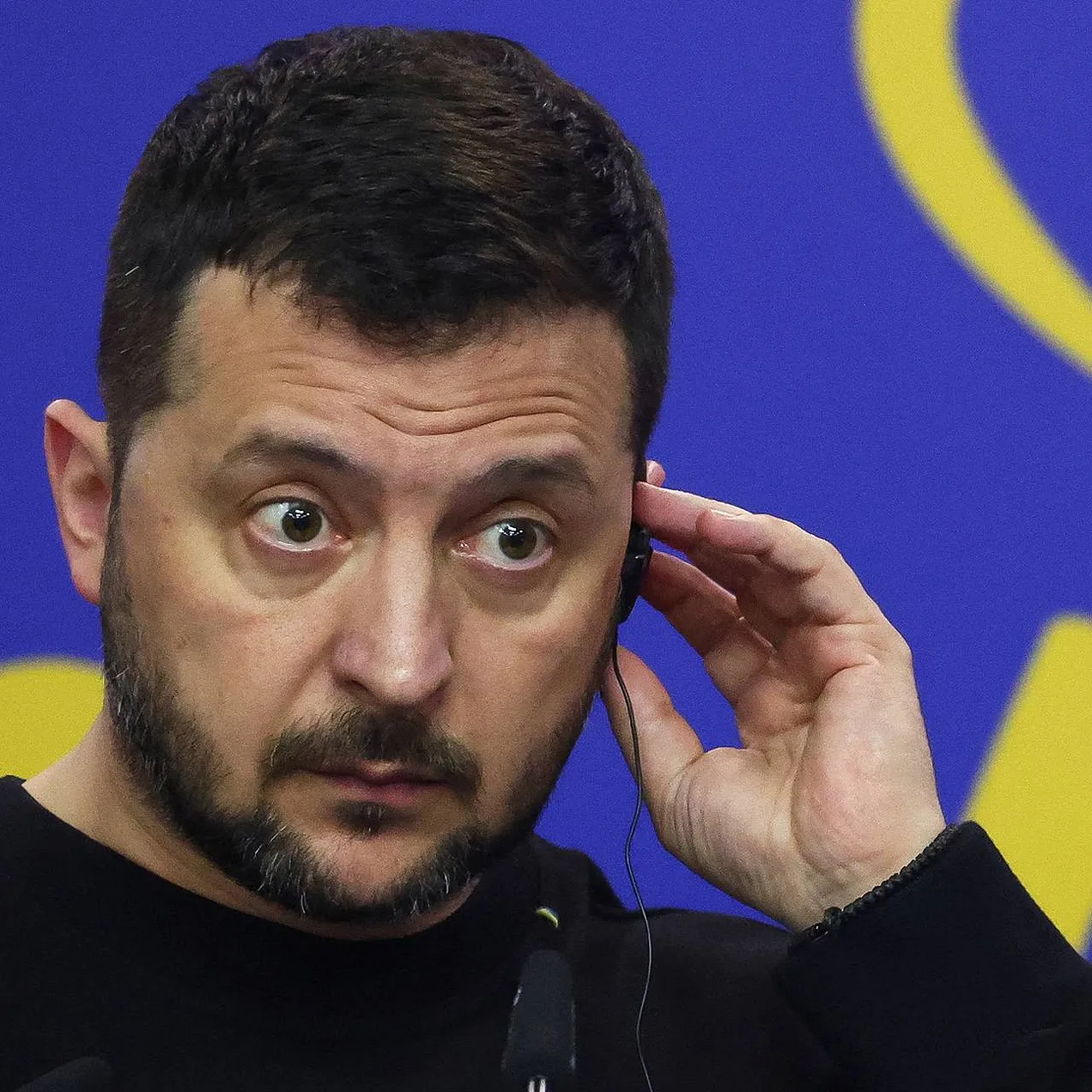
“No one will support it,” declares the BBC headline in its article featuring interviews with Ukrainian soldiers on the front lines reacting to the US peace plan, which Ukraine is negotiating and refining with Washington in Geneva. Despite the headline's forcefulness, which is also the phrase chosen for its promotion on social media, the article reveals, buried amidst calls to continue the war until final victory, a dissenting opinion. “It's time to agree to at least something,” says a soldier nicknamed Snake . “Let them keep it,” he states, referring to the part of Donetsk still under Ukrainian control. “There's practically no one left in the cities and towns… We're not fighting for the people but for the land, all while losing people,” he adds, breaking with the logic of Ukraine's war in Donbas, which has always been about territory, not a population it distrusts, since 2014.

The struggle for territory and its borders is also the basis upon which the opposition of European countries—the European Union and the United Kingdom—is building these days, as the fate of the negotiations hangs in the balance. For the first time since the beginning of Trump's clumsy diplomatic attempt, lacking personnel with the capacity to work effectively and knowledgeable about the conflict, negotiations are currently taking place on the basis of a document that addresses all the important issues of the Russo-Ukrainian war—territory, security, reconstruction, humanitarian and social issues—and the broader political conflict within which it is framed—geopolitical aspects and the confrontation between Russia, the European Union, and NATO—and which both Kyiv and Moscow have accepted as a starting point. Reflecting the reality of this war, in which only Russia possesses the autonomy afforded by not depending on third-party countries, Ukraine's position and its willingness to negotiate are dictated by the United States, which subtly suggests that it could halt its intelligence and even arms supplies if it perceives a lack of will for peace.

Acknowledging this reality, Axios reported yesterday that the Ukrainian president has agreed to negotiate based on the 28-point plan, which, according to various media outlets, has already been significantly modified to address Ukrainian concerns, as he understood he could not afford to reject it. Ukraine boasts of its successes, insisting that, in its current state, almost nothing remains of the original plan, which now has only 19 points instead of 28. According to the same source, the pressure was increasing by the hour. As The Washington Post reported over the weekend , citing Pentagon officials, the United States agrees with Russia in its assessment that Moscow's troops could militarily seize the Donbas territory they claim. Following this, the Russian offer would be less generous than it currently is. According to several Ukrainian media outlets yesterday, the United States has warned Ukraine of the possibility of losing all of Donbas within the next twelve months.

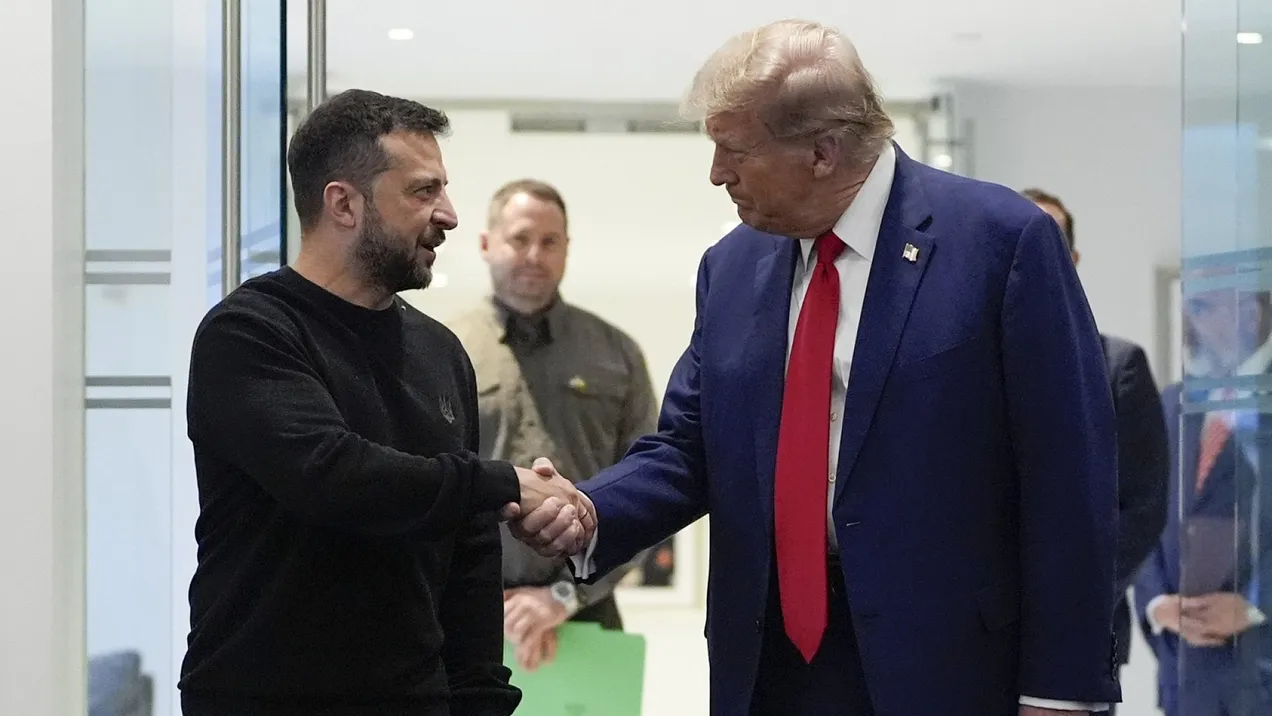
As was evident after the first meeting between the delegations led by Marco Rubio and Andriy Ermak, the Ukrainian strategy is directly linked to that of the European Union and the United Kingdom, and it involves a division of labor that, as usual, seeks to avoid angering Donald Trump. On Sunday, the US president again attacked Ukraine, referring to its leadership by putting the word in quotation marks—a show of contempt that cannot be ignored. Yesterday, several media outlets indicated the possibility of a visit by Zelensky to the White House sometime this week or early next week. The existing doubts stem from the fear that the meeting will end like the heated scene in the Oval Office or the Ukrainian president's last visit to Washington, a similar argument, albeit this time in private.

The chosen tactic is for Ukraine to work on those points where it can obtain improvements in the document without causing major controversy, while, on the sidelines, the EU continues to draw the real red lines and demand points that it knows will make an agreement impossible. “Ukraine’s commitment to a just and lasting peace is clear. Putin’s imperialist aims have not changed. We must increase the pressure on the aggressor. Immediate use of frozen Russian assets, a tougher sanctions package, and EU tariffs where necessary. And we continue to support Ukraine,” wrote Estonian Prime Minister Kristen Michal, after having “discussed coordinated steps” with António Costa, Ursula von der Leyen, and the leaders of the EU countries. “We welcome the significant progress made in yesterday’s meetings between the United States and Ukraine in Geneva. Some issues remain to be resolved, but we continue to support the process. Any decision that falls under the purview of the EU or NATO will be discussed and decided by EU and NATO members separately,” added the Finnish Foreign Minister, clearly indicating the intention of the European Union and the Atlantic Alliance to prevent the concessions that the US plan guaranteed Russia in terms of security and guarantees against the expansion of the Cold War pact to its borders.

To all this must be added the joint statement from the chairs of the Foreign Affairs Committees of the European Parliaments, which affirms that “our goal has always been, and remains, a just and lasting peace based on international law and fully respecting Ukraine’s territorial integrity, independence, and sovereignty. Such peace cannot be achieved by appeasing or rewarding the aggressor; it requires sustained pressure on Russia and unwavering support for Ukraine for any solution to succeed.” After insisting that “Ukraine cannot be subject to limits on its armed forces or restrictions on its domestic or international policies”—a clear reference to the official status of the Russian language and other internal political aspects that appeared in Witkoff’s 28-point plan and the issue of neutrality—the statement adds that “at the very least, Russia must withdraw its troops from the occupied territories and cooperate with international organizations to ensure accountability for those responsible for atrocities.”

In addition to demanding what, in practice, amounts to voluntary and unconditional surrender, the statement makes yet another demand: the ceasefire that Germany, France, and Poland demanded last May as a 48-hour ultimatum. “Any negotiations must begin with an immediate ceasefire,” it insists, emphasizing that “Ukraine’s sovereignty—including its right to choose its own alliances—and justice for the crimes committed during the war are non-negotiable red lines.”

The statement is a prime example of the European Union's stance—even more belligerent than Ukraine's—which in February 2022 decided to use Ukraine as a pawn in a proxy war aimed at the complete defeat or utter weakening of its historical enemy, Russia. Since then, the EU has failed to formulate a plan for achieving this victory, whether through military or political means. On Sunday, during his appearance on the political program Meet the Press , US Treasury Secretary Scott Bessent described a European official boasting about the nineteenth package of sanctions against Russia. "If you have to impose 19 packages, you've failed," the US official emphasized. More sanctions against Russia and more weapons for Ukraine remains the European Union's sole plan. Even after the plan's publication, which both Russia and Ukraine quickly took seriously, the EU has remained detached from the unfolding events. Just as last spring, when the EU kept insisting on continuing to fight until Russia was weakened even after Ukraine had opened the door to a ceasefire, Kyiv began to make moves in the direction of negotiating on the basis of Witkoff's proposal while Kaja Kallas mocked it with her "two-point plan" and demand for territorial integrity.

On Thursday, the same day Donald Trump's 28-point plan was published, Bloomberg reported that the UK was accelerating plans to send troops to Ukraine. “The UK has identified which military units it would send to Ukraine after a series of reconnaissance visits to the country, ensuring it is prepared to deploy troops quickly should the latest efforts to revive peace talks fail. Britain updated its plans to send troops to Ukraine as part of the so-called Coalition of Volunteers after conducting a readiness review and completing reconnaissance missions in Ukraine over the summer, Defense Secretary John Healey said. Military chiefs have determined which personnel they would deploy and where their headquarters would be located, as part of plans by a 30-country grouping led by the UK and France to support Ukraine,” the outlet wrote. The disconnect between European countries and the reality and nature of the war continues to grow.

“In the end, I would easily bet that there will be no peace plan, for a simple reason I have often emphasized: there cannot be one with Russia. But this is not actually bad news, quite the opposite, at least if the Europeans prove they are up to the task,” wrote Nicolas Tencer, senior fellow at the Center for European Policy Analysis, with a candor that other lobbyists lack. His message encapsulates the stance reflected in the actions of EU countries and institutions. This position is complemented by Ukraine’s negotiating strategy, which seeks to improve the US plan on the less crucial issues, thereby gaining credibility as a government that desires peace. Ukraine then hopes that Donald Trump will side with Zelensky and include some of its demands in the offer to Russia, forcing Russia to reject any agreement.

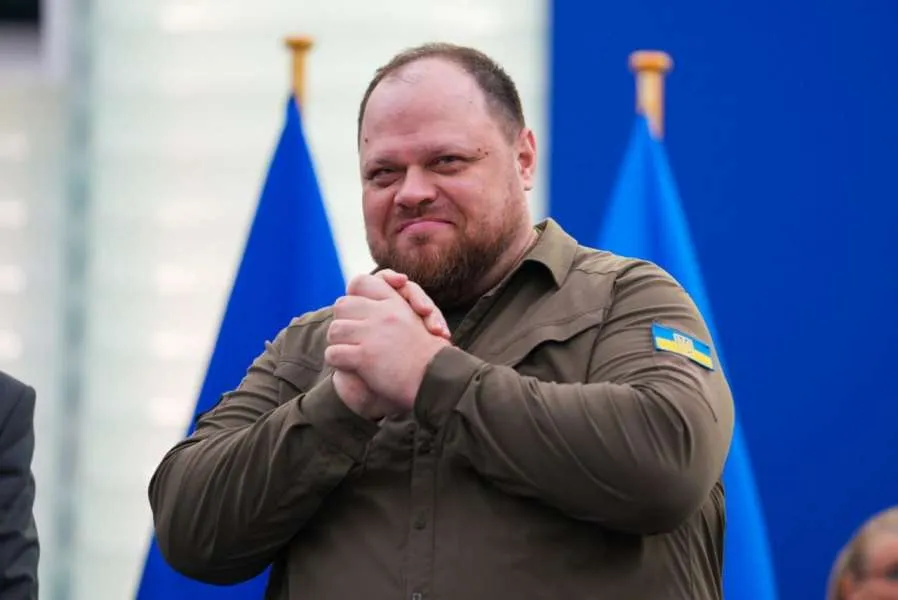
“The Ukrainians claimed they ‘had no mandate’ to make decisions about territory—particularly to cede land, as the original draft of the plan suggested—which, according to their country’s constitution, would require a national referendum. The new draft, according to Kyslytsya, bore little resemblance to the previously leaked version of the peace proposal that had caused a stir in Kyiv. ‘Very little remains of the original version,’ he said. ‘We have developed a solid body of convergence and some things on which we can compromise,’ he stated. ‘The rest will require leadership decisions,’” the Financial Times wrote yesterday . The modus operandi is clear: as in Istanbul, the Ukrainian delegation can only negotiate those issues that, while important, will not determine peace. Meanwhile, as fervently pro-Ukrainian media outlets like Visegrad 24 reported yesterday , “Ukraine has outlined its ‘red lines’ in the peace negotiations after reviewing the US peace plan. The Speaker of the Verkhovna Rada, Ruslan Stefanchuk, specified Ukraine’s non-negotiable points. Any restriction on the size of the Ukrainian Armed Forces is unacceptable. Ukraine’s right to join alliances cannot be limited. The country will not recognize the loss of its territories. Ukraine’s accession to NATO and the EU must be part of future security guarantees.” These red lines are exactly the same as those established by the various authorities of the European Union and its member states.

Announcing “great progress,” President Donald Trump stated yesterday that “something good might be happening.” His optimism stems from Ukraine’s chosen negotiating style, which has already yielded some concessions regarding prisoner exchanges, the return of prisoners, and, according to RBC-Ukraina , the Energodar nuclear power plant. He also believes the European Union is his strongest ally in making the plan unacceptable to Russia. On Sunday, Marco Rubio claimed to know nothing of a European counterproposal. This is unnecessary; his logic lies in the Ukrainian red lines, which, like the EU’s, aim to force Moscow to publicly express its rejection, as Dmitry Ushakov did yesterday. This would repeat the cycle of April and August, in which, after a strong push toward negotiations, diplomatic silence returned, along with the logic of increased military supplies to Ukraine and sanctions against Russia.

https://slavyangrad.es/2025/11/25/ucran ... eas-rojas/

Google Translator

******

From Cassad's telegram account:

Colonelcassad
Key points from Sergey Lavrov's statements at the press conference:

- The West has consistently thwarted the progress achieved in Ukraine;

- Europe has "failed on every count" in its actions regarding Ukraine since 2014;

- Kyiv has still not responded to the proposal to create three working groups;

- Macron's statements on Ukraine are dreams that have nothing to do with a settlement;

- European politicians are trying to distract their population from the economic failure in Ukraine;

- Russia appreciates the position of the United States, which is showing initiative for a Ukrainian settlement;

- Europeans are starting to think about what will happen next, since Ukraine is "not forever";

- European politicians are leaking information to undermine the Alaska agreement;

- Russian diplomacy works professionally, not leaking information before official agreements;

- Russia is not rushing the United States with the negotiation process on Ukraine;

- Russia expects the United States to inform it of the results of consultations with Ukraine and Europe in the near future.

***

Colonelcassad
Massive airstrike on southern Russia.

Overnight, the enemy launched a massive attack on Crimea, the Krasnodar Krai, and the Rostov Oblast using more than 200 drones.

The Russian Ministry of Defense reported the downing of at least 249 drones, primarily over the Krasnodar Krai, where the majority were shot down.

Over 80 drones were also destroyed over Crimea and the Black Sea, and over two dozen more over Taganrog and the Sea of ​​Azov.

Air defense units, working together with aircraft, did a great job, shooting down almost all of the drones. Only a few hit Taganrog, as well as several civilian buildings in Novorossiysk.

Unfortunately, there were fatalities and injuries as a result of these attacks. Three people have already been killed in Taganrog, and over a dozen people were injured in Taganrog and Novorossiysk.

The launch sites were again the same as before. In the Odessa Oblast, launches were carried out from Buyalyk, Odessa, and Zatoka. Four Neptune anti-ship missiles were also launched from there, shot down near Crimea.

The airstrike in southern Russia, which resulted in casualties, once again demonstrates how practical talk of negotiations is right now – the Ukrainian regime is not interested in them.

More fatalities, again due to UAV attacks. Meanwhile, recently, a civilian vehicle was hit near Krasnaya Polyana in Crimea, killing two people.

We would like to pay special attention to how the internet shutdown works. No less than 249 UAVs with the internet down – does it look like the measures are working? And footage of the attacks is once again circulating online from various angles.

***

Colonelcassad
This evening, fairly optimistic reports are coming in from three cities at once.

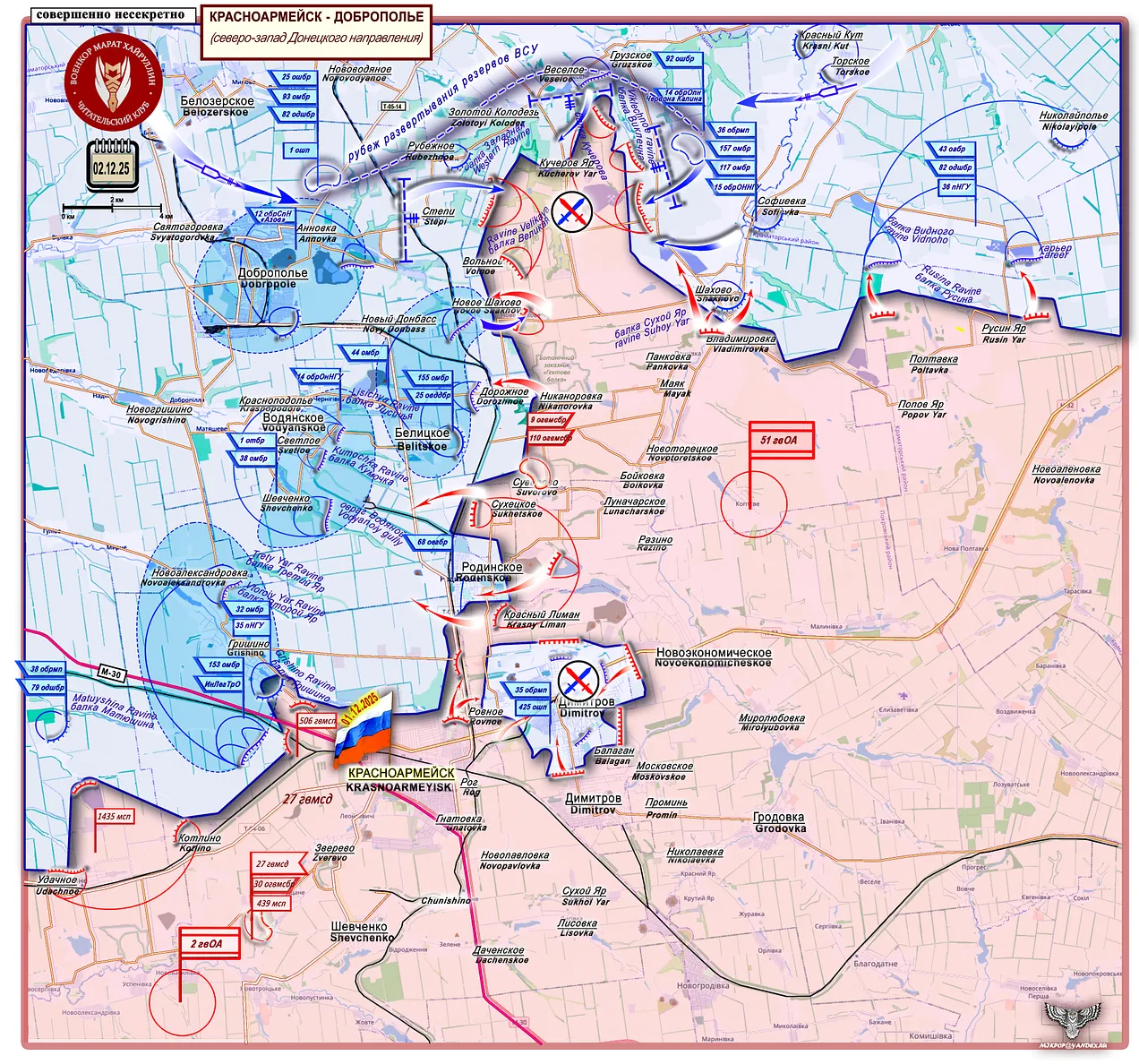
1. In Dimitrov, our troops have advanced on both the western and eastern outskirts of the cauldron, with an obvious desire to cut the encircled group into two parts (all in the classic manner). Simultaneously, a pocket south of Dimitrov is being cleared.

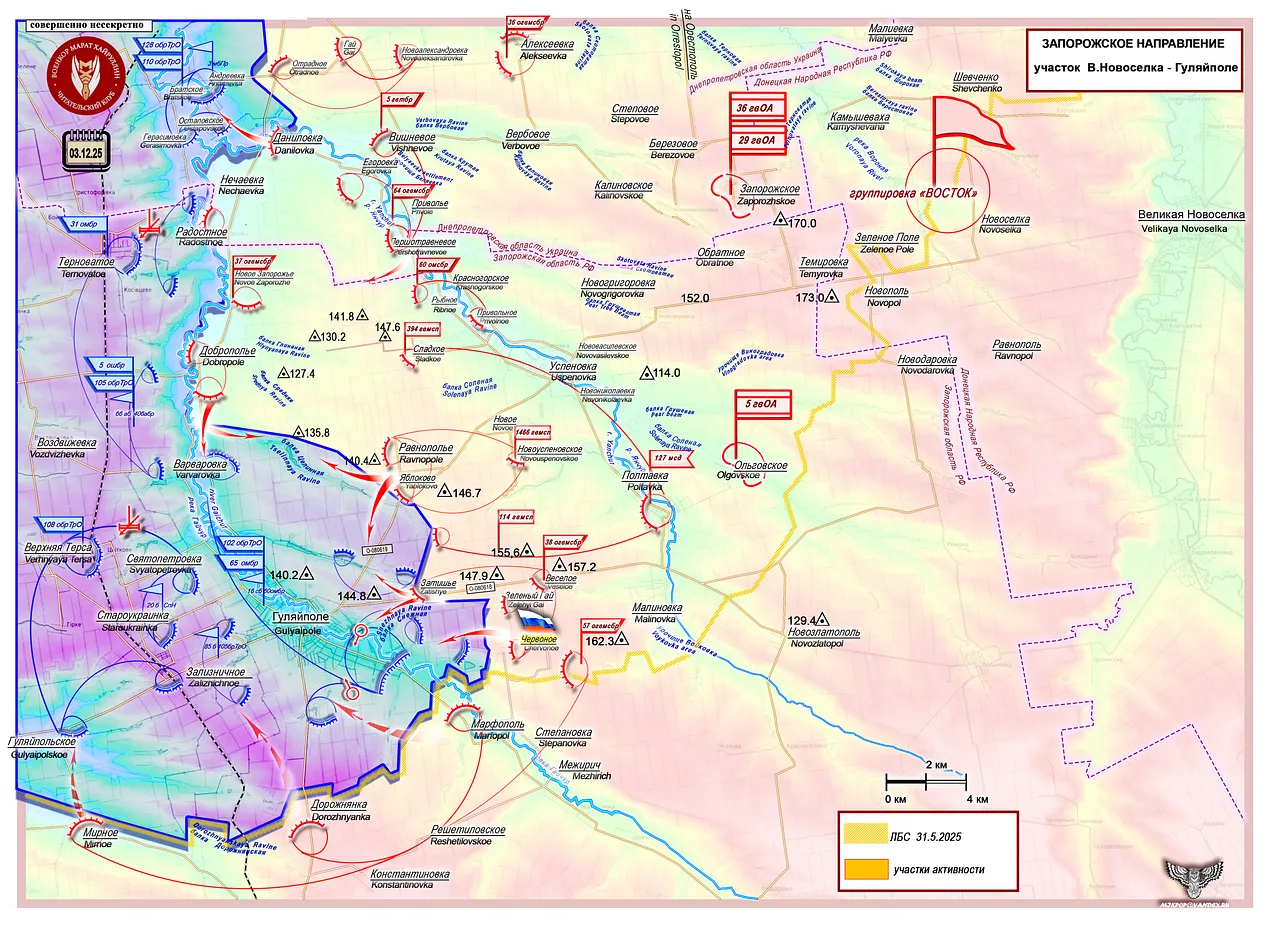
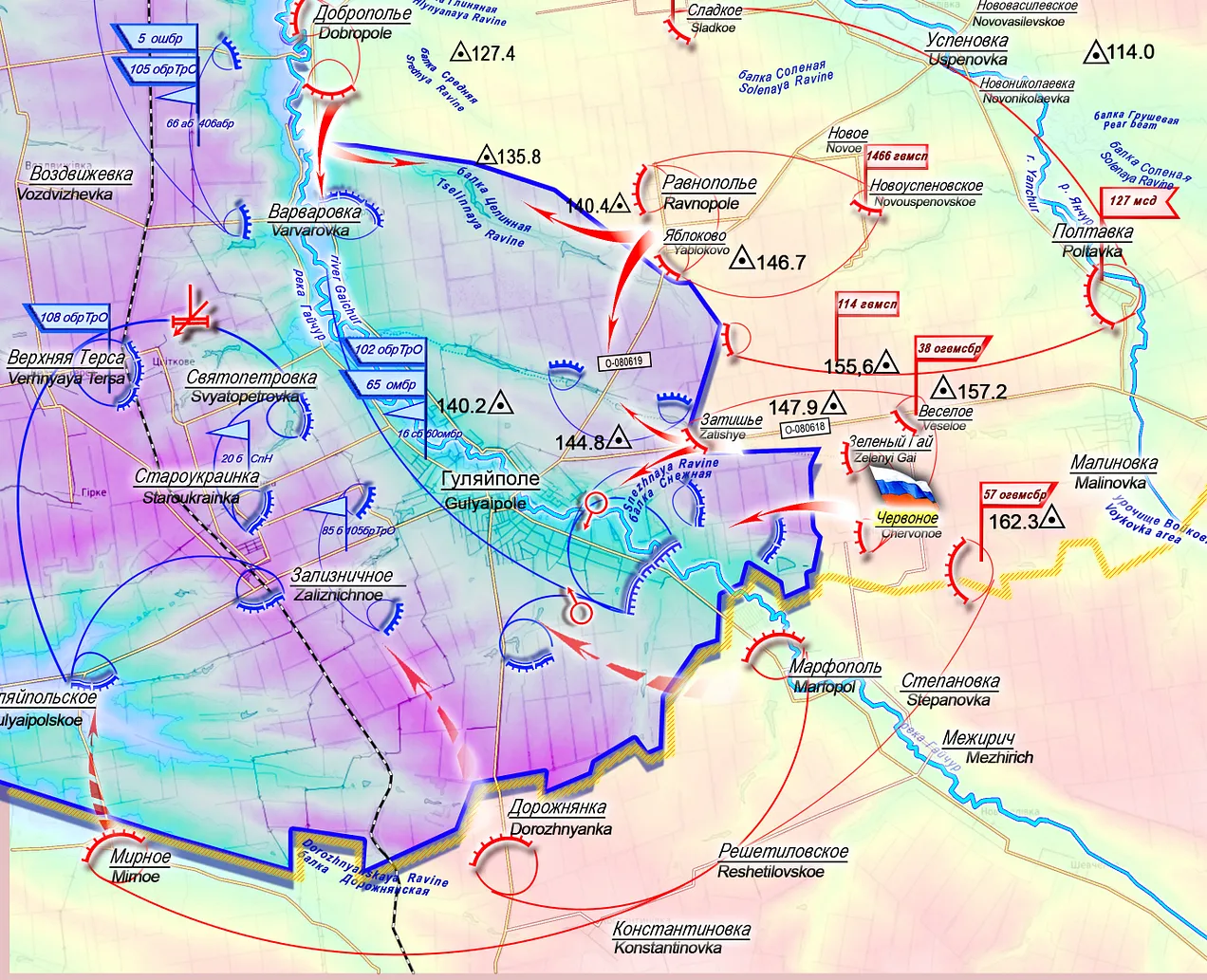
2. In Hulyaipole, fighting continues on the outskirts of the city. The Russian Armed Forces are increasing the pressure. Over 30 kilometers of territory have been liberated in the past 24 hours. The assault on Hulyaipole began even earlier than expected. North of Hulyaipole, the enemy continues to roll back across the Gaichur River.

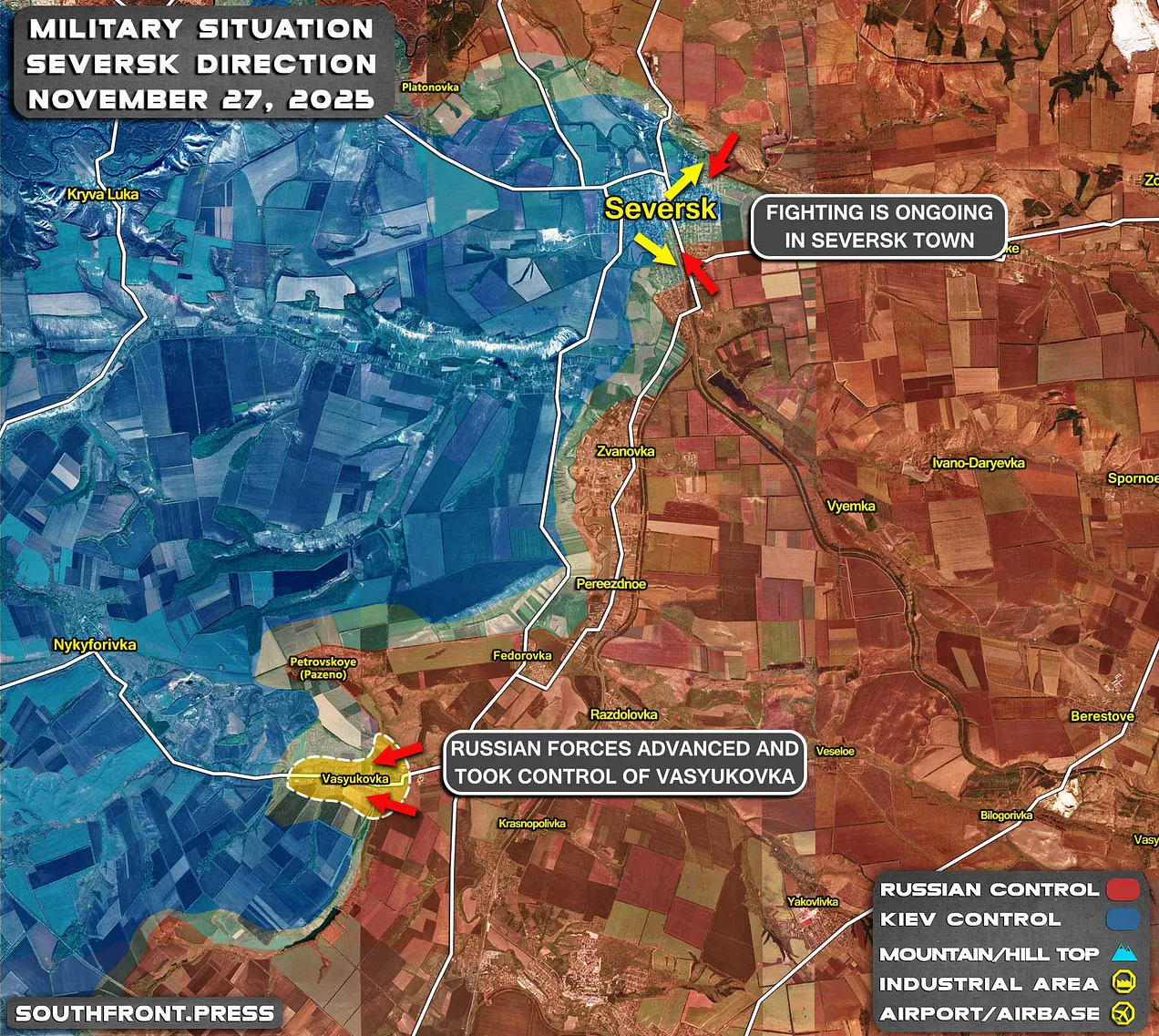
3. In Seversk, 3rd Army forces have entered the northern part of the city and are fighting in the urban area. Our assault groups are also fighting in the southeastern and southern parts of the city. The history of the Seversk salient is nearing its end. After the liberation of Seversk, the salient will disappear from the news. Our troops have also cut the road to Seversk west of Zakotnoye.

https://t.me/s/boris_rozhin

Google Translator

******

Brief Frontline Report – November 23rd, 2025

Summary by Marat Khairullin and Mikhail Popov.
Zinderneuf
Nov 23, 2025

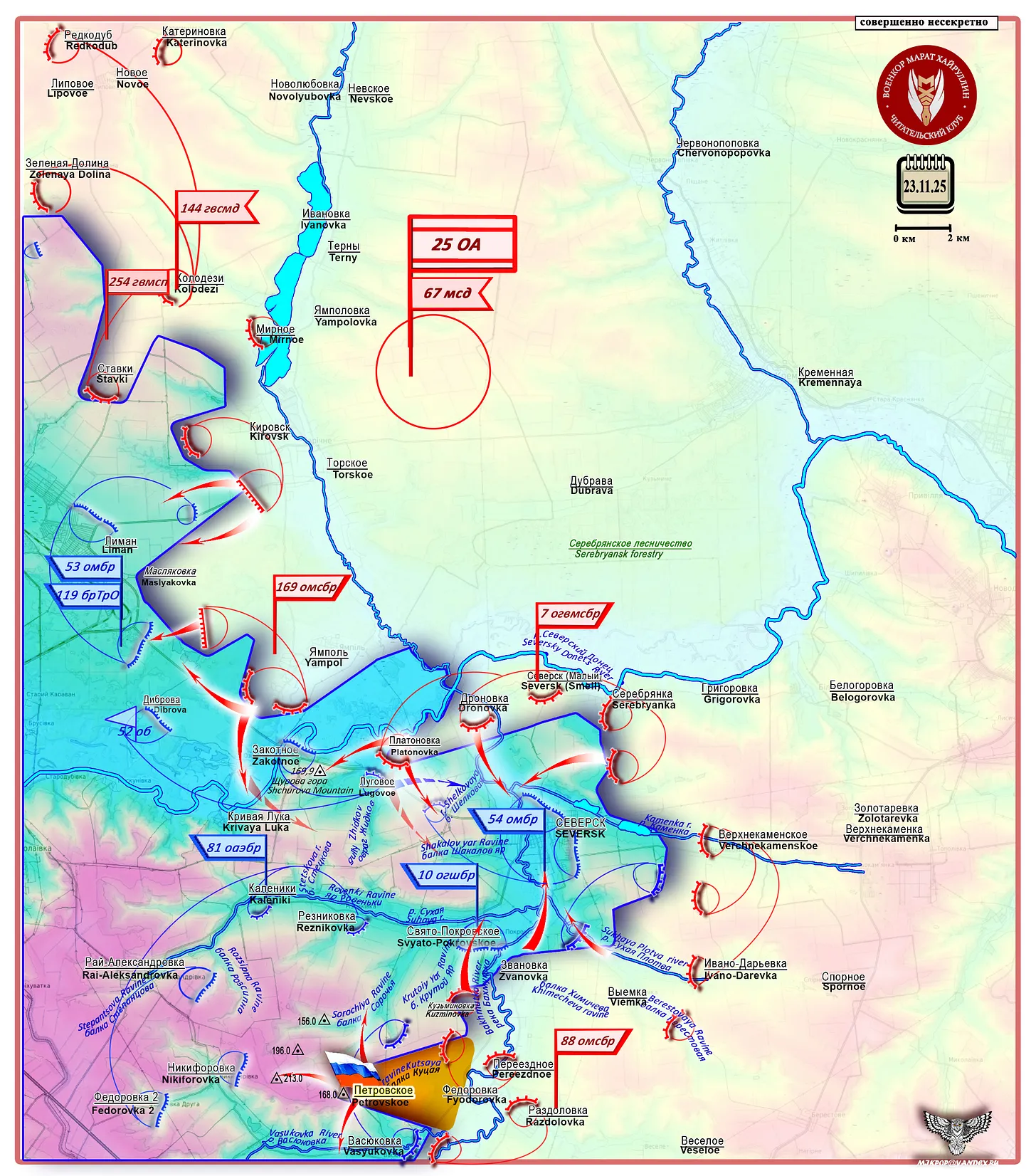
Message from the Russian Ministry of Defense: "Units of the 'South' Group, as a result of decisive actions, liberated the settlement of Petrovskoe (Pazeno) in the Donetsk People's Republic."
Image

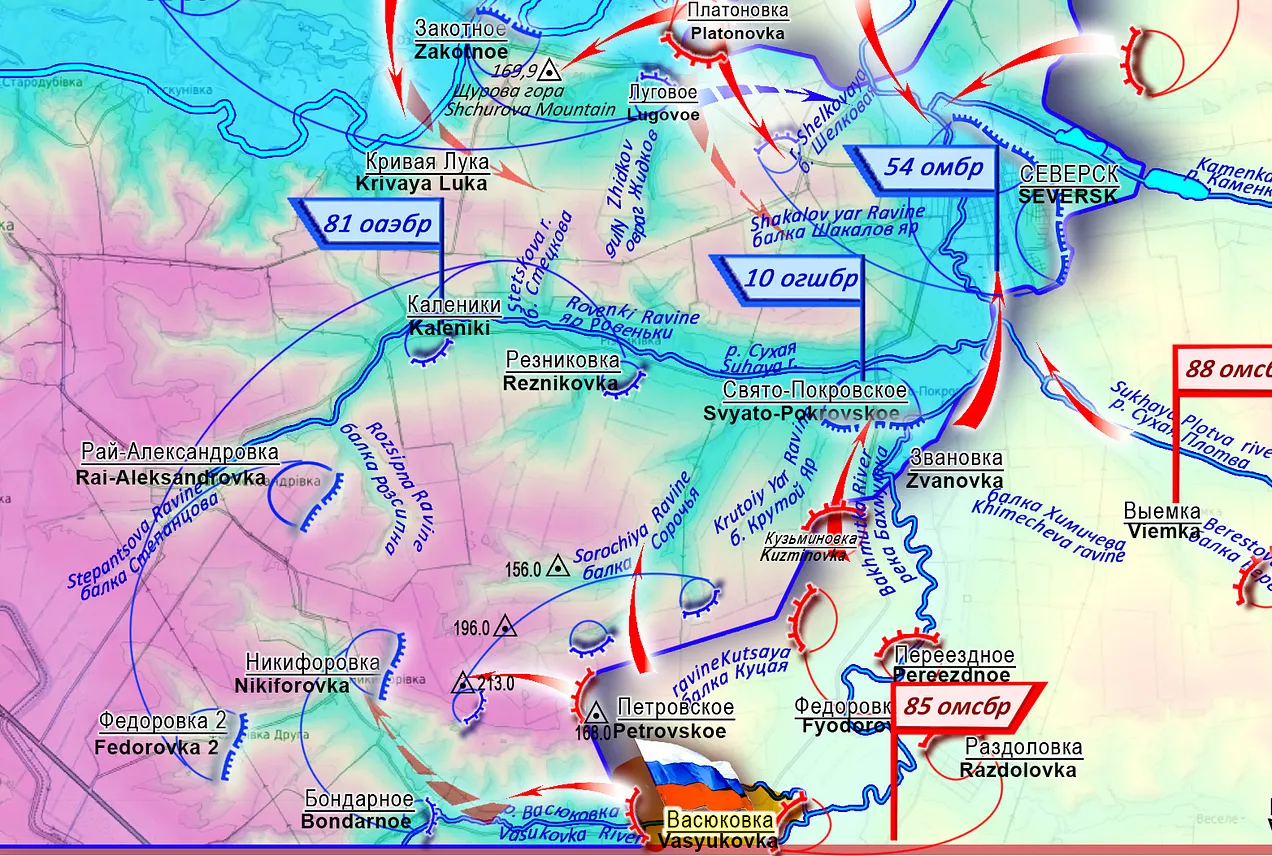
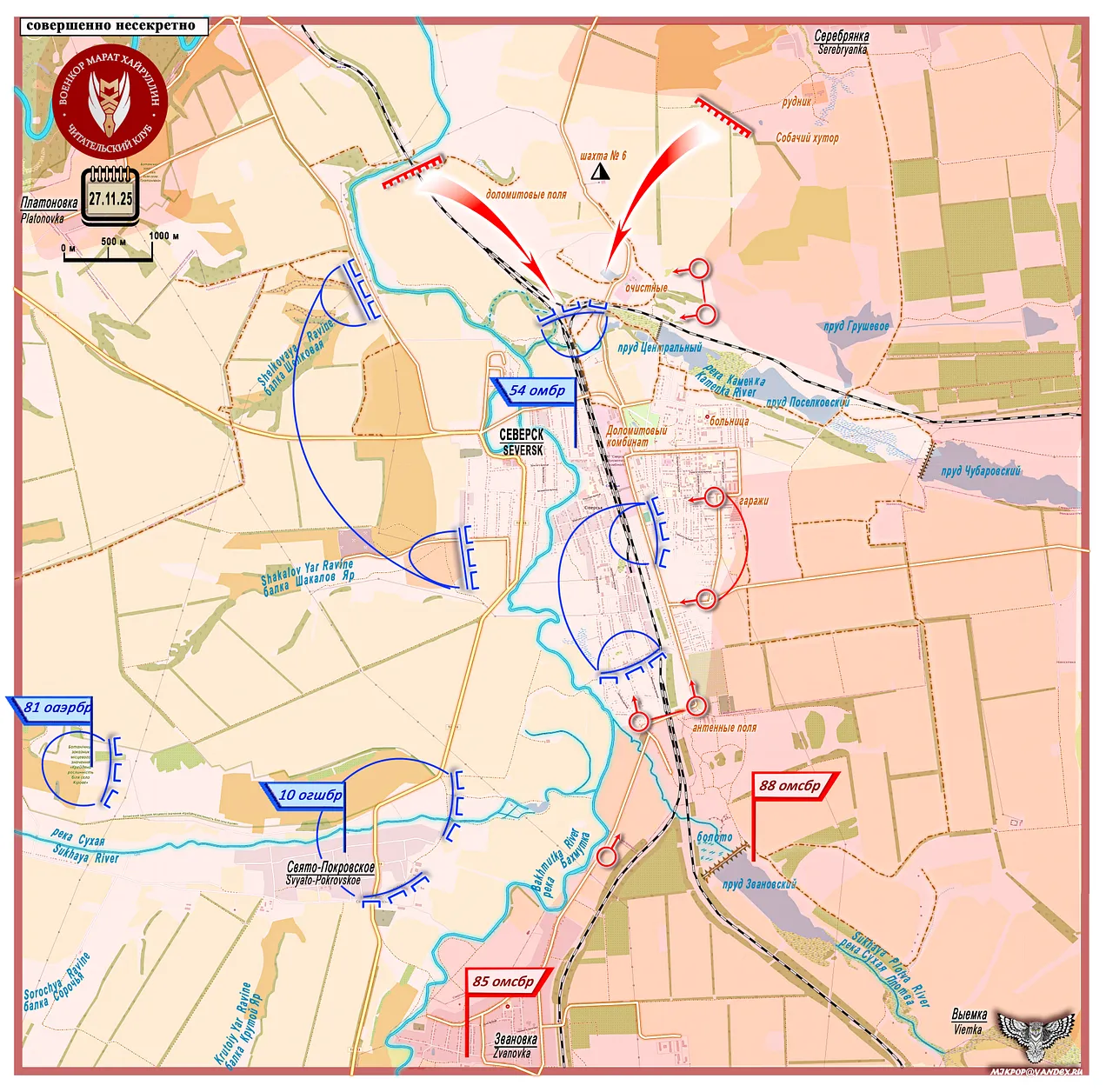
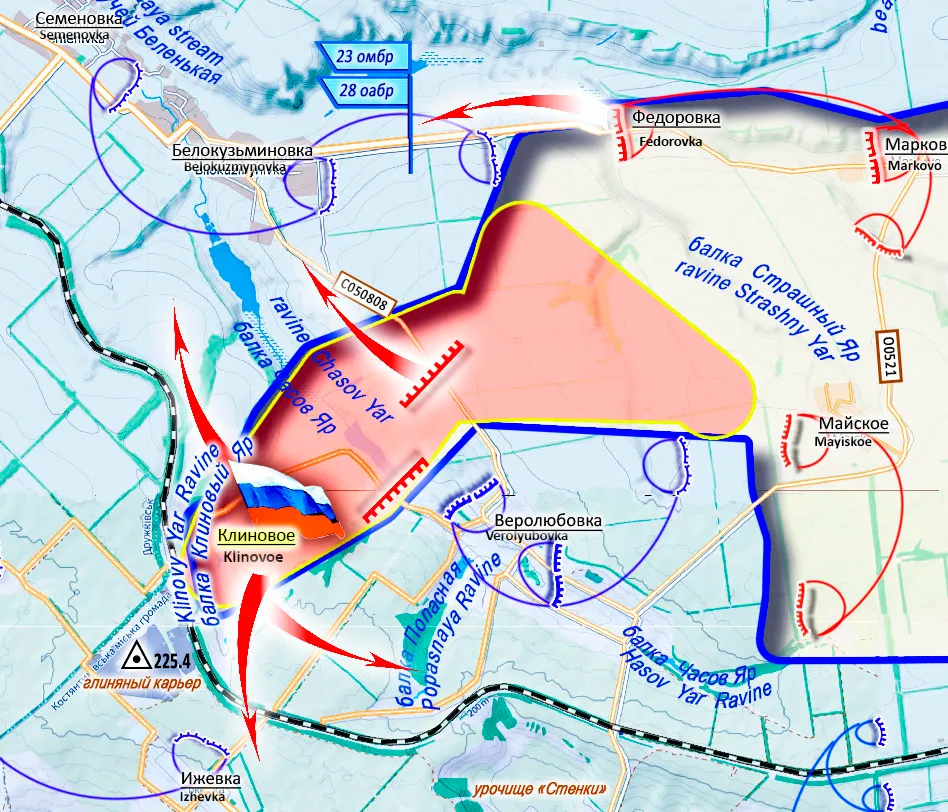
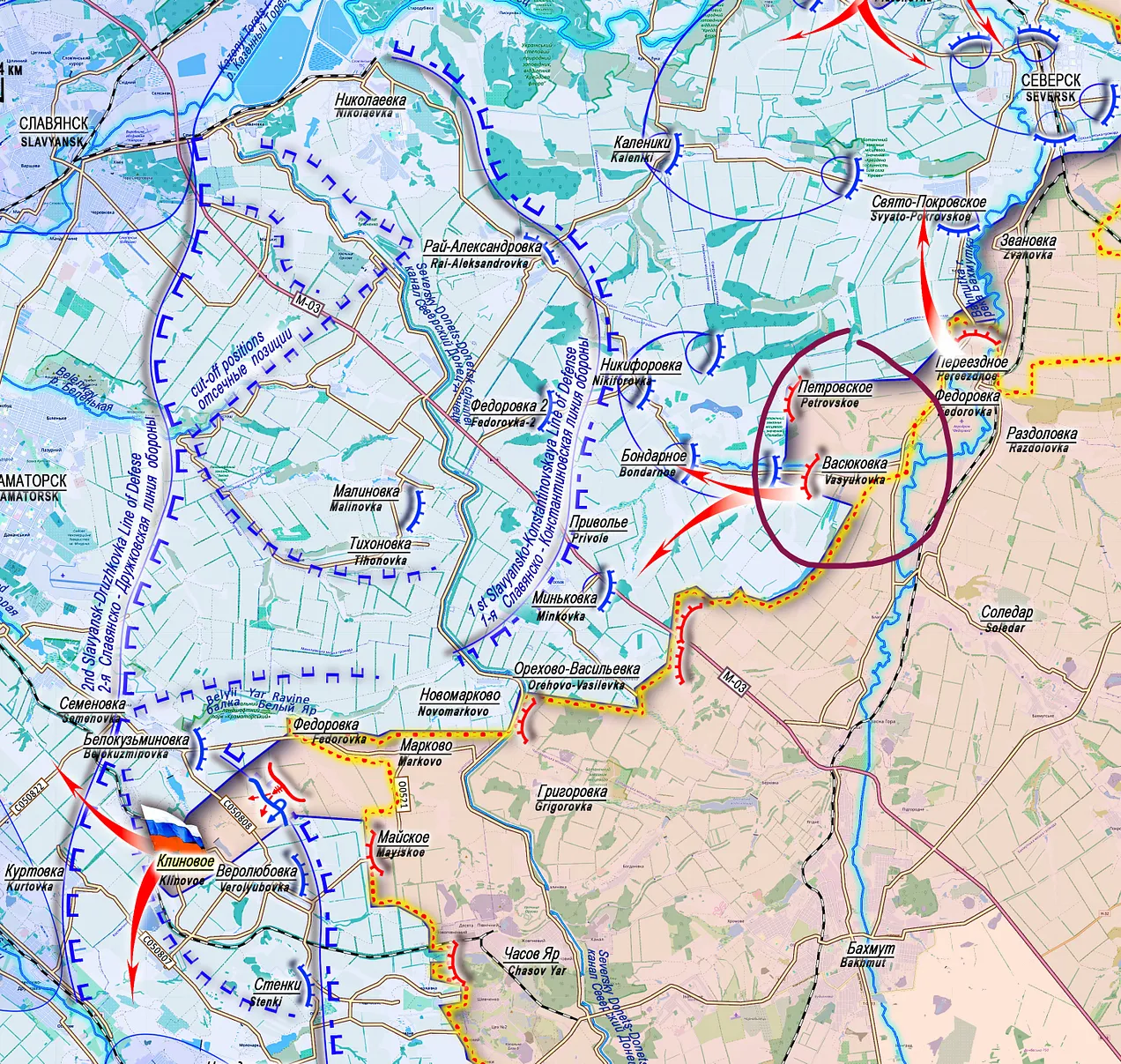
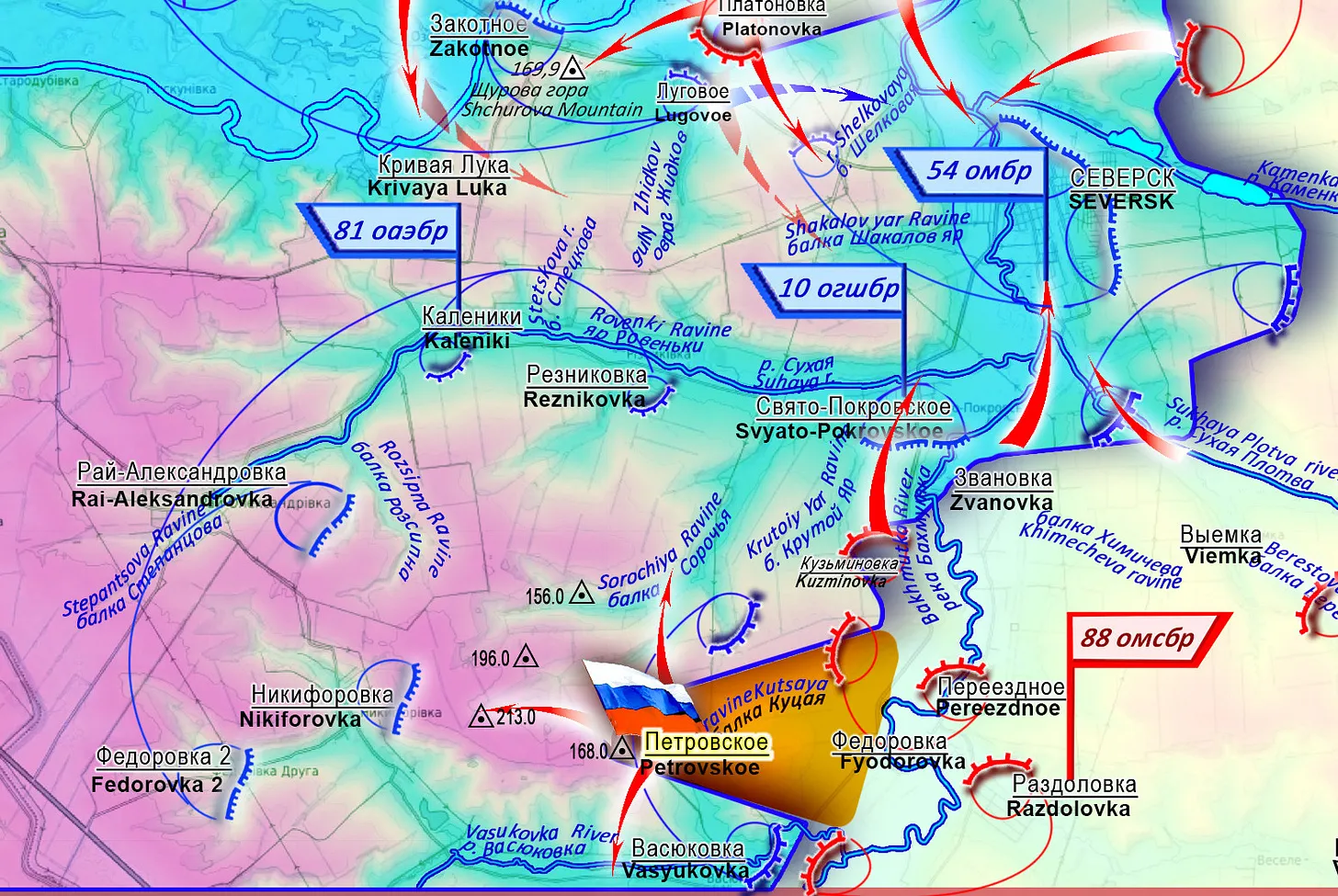
The Russian Armed Forces continue to develop bridgeheads on the southern front of the Seversk direction. On November 22, the settlement of Zvanovka was liberated. Our assault units are advancing to the line of the Suhaya River. There is a threat to the left flank of the advancing group from the positional area of the Armed Forces of Ukraine coming from Reznikovka - Kaleniki - Rai-Aleksandrovka. Securing their left flank, units of the 88th Separate Motorized Rifle Brigade advanced about 4 kilometers westward from the Fedorovka/Fyodorovka line and liberated the small settlement of Petrovskoye/Pazeno (Ukr.) (48°46′02" N, 37°58′30" E, about 20 residents). Here is the exit to the watershed ridge of the Sorochiya ravine and the Vasyukovka River, from which most of the interfluve of the Suhaya and Vasyukovka rivers is controlled.
Image

Positions in this area provide our assault units advancing from the south with access to the settlement of Kirovo (Svyato-Pokrovskoe) and the formation of a southern encirclement of the city of Seversk.

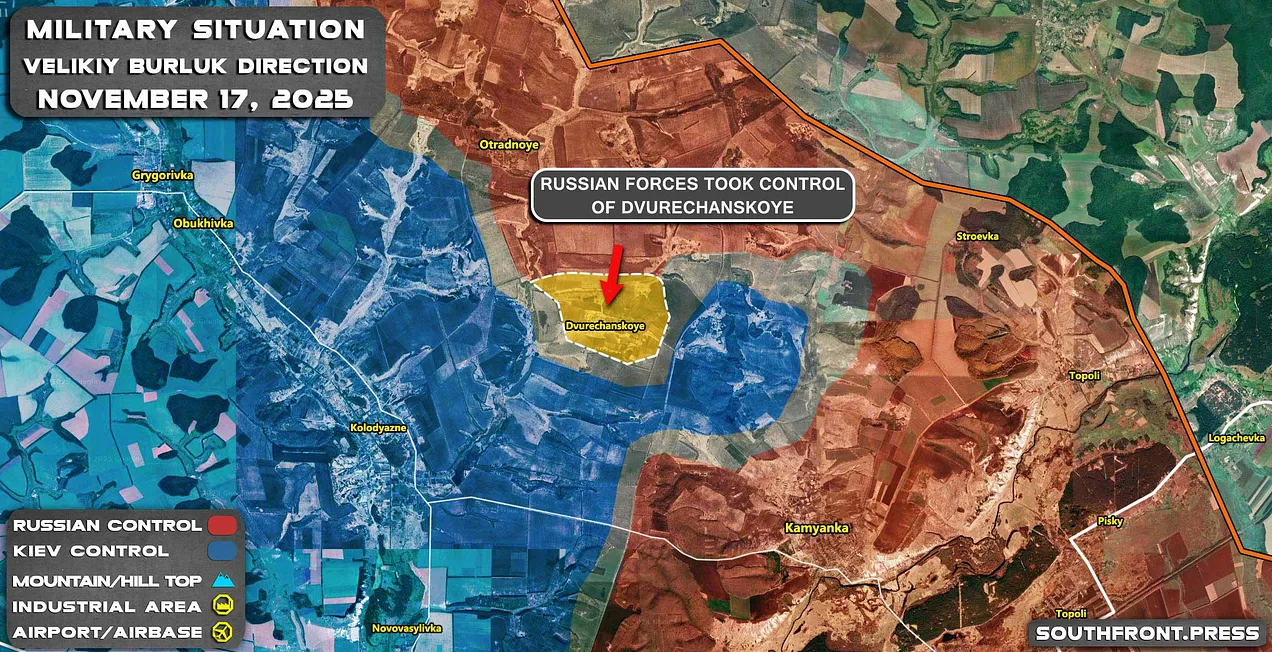
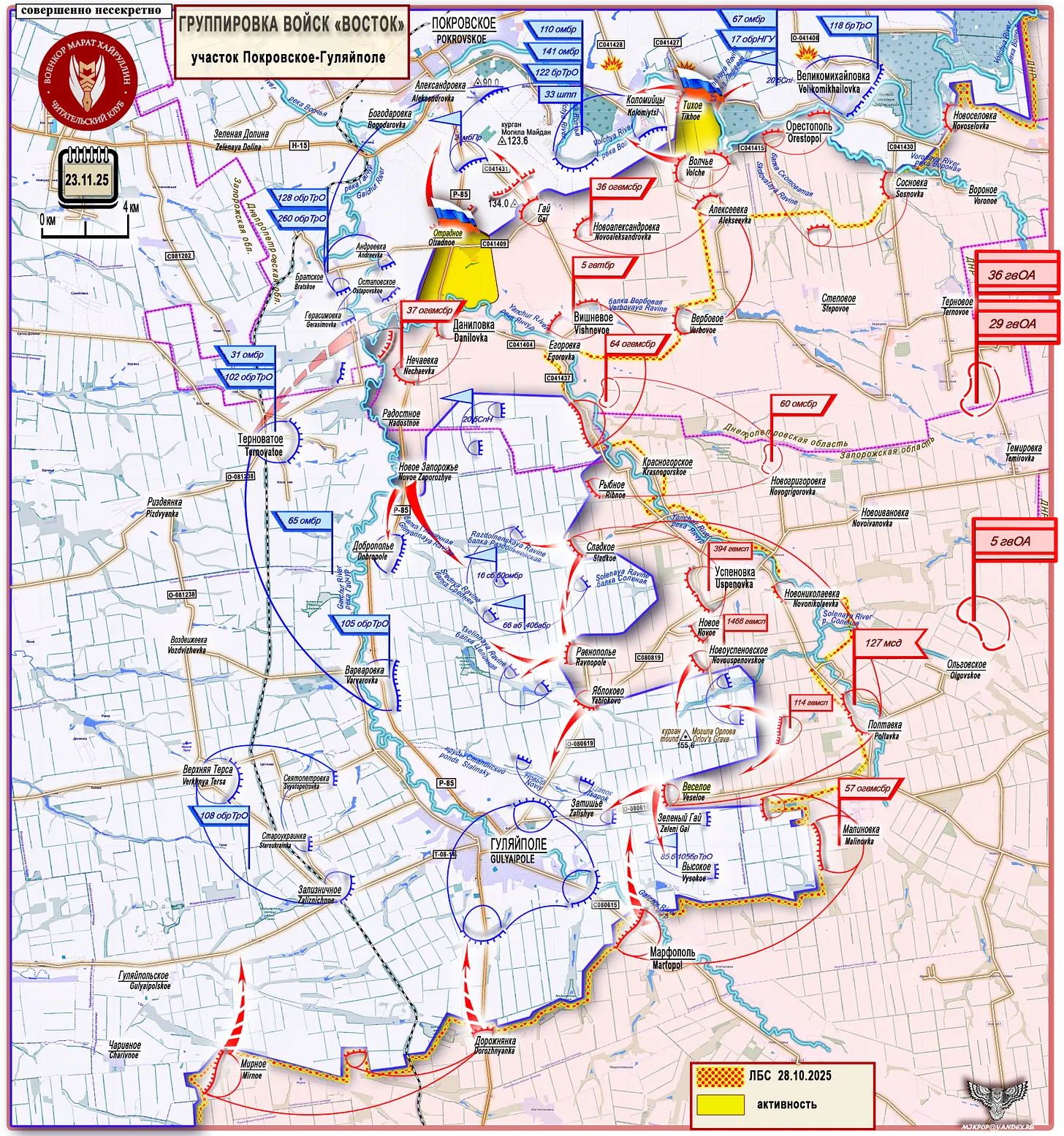
Message from the Russian Ministry of Defense: "Assault units of the 36th Guards Motorized Rifle Brigade of the 29th Guards Combined Arms Army of the 'East' Group made a decisive breakthrough to the north and west and expelled the enemy from the settlements of Tikhoe and Otradnoe.

(Video at link.)

During the assault, more than 10 units of equipment were destroyed. The enemy suffered personnel losses. Attempts by Ukrainian militants to counterattack were unsuccessful."
Image
ЛБС 28.10.2025=Line of Combat Contact October 28th, 2025. АКТИВНОСТЬ=Activity.

On the eastern front of the Zaporozhye direction, the command of the 'East' group demonstrates the art of alternating multidirectional strikes. This tactic requires masterful troop management, coordination of actions (in place and time) of units of neighboring parts and formations, as well as support units, and their clear interaction. The enemy's defense is being "cut into pieces."

After a week of activity directed southward along the right bank of the Gaichur River, there is a sharp change in the direction of movement—north toward the Volchya River line and the Pokrovskoe defense area.

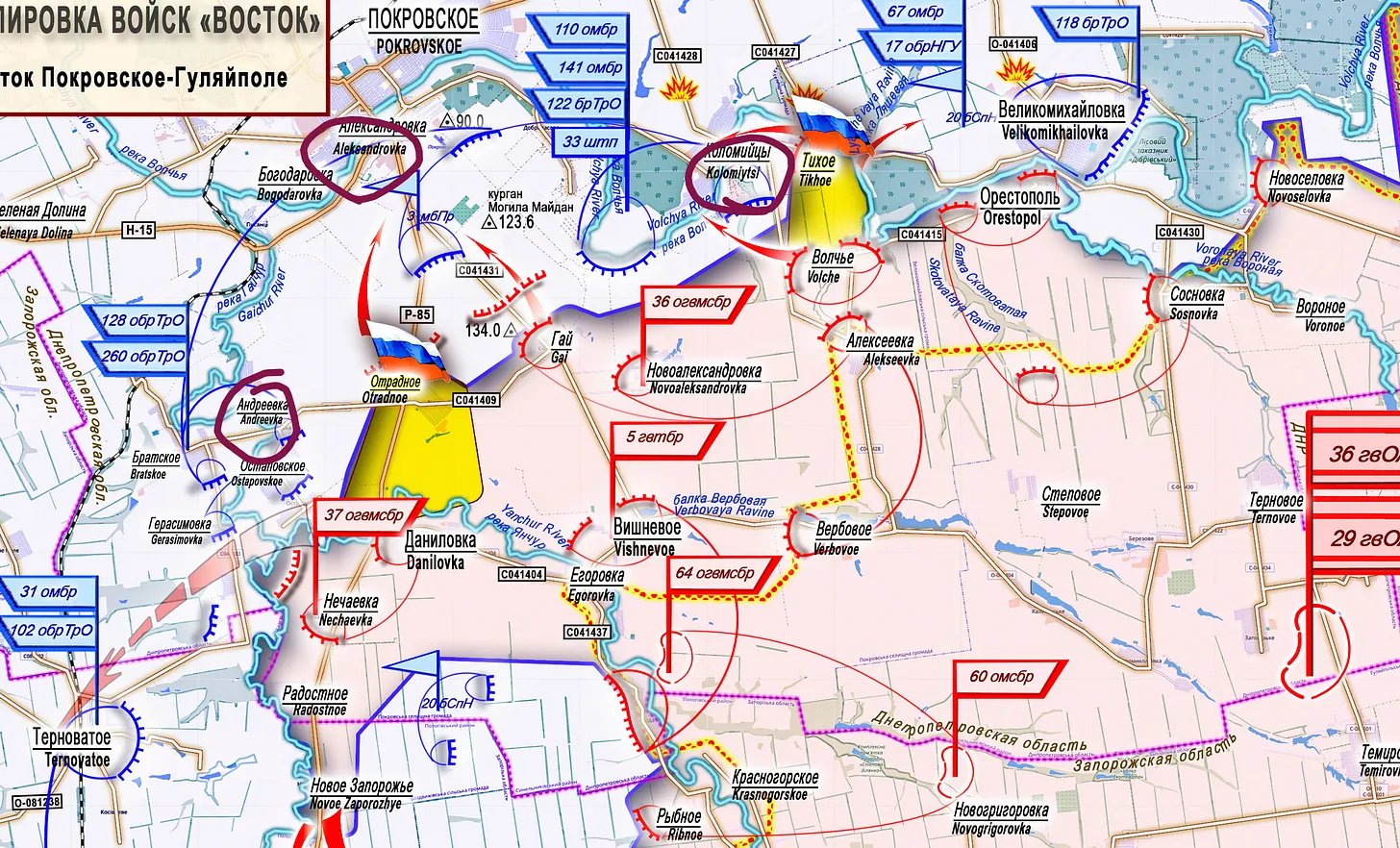
Assault groups of the 37th Guards Motorized Rifle Brigade liberated the settlement of Otradnoe (47°54′20″ N, 36°14′58″ E, about 160 residents). Here, another road junction connecting the enemy's defense flanks on the Ternovatoe - Velikomikhailovka line, in the defense area of the Armed Forces of Ukraine near Kolomyitsi - Aleksandrovka - Andreevka, was taken under control.
Image


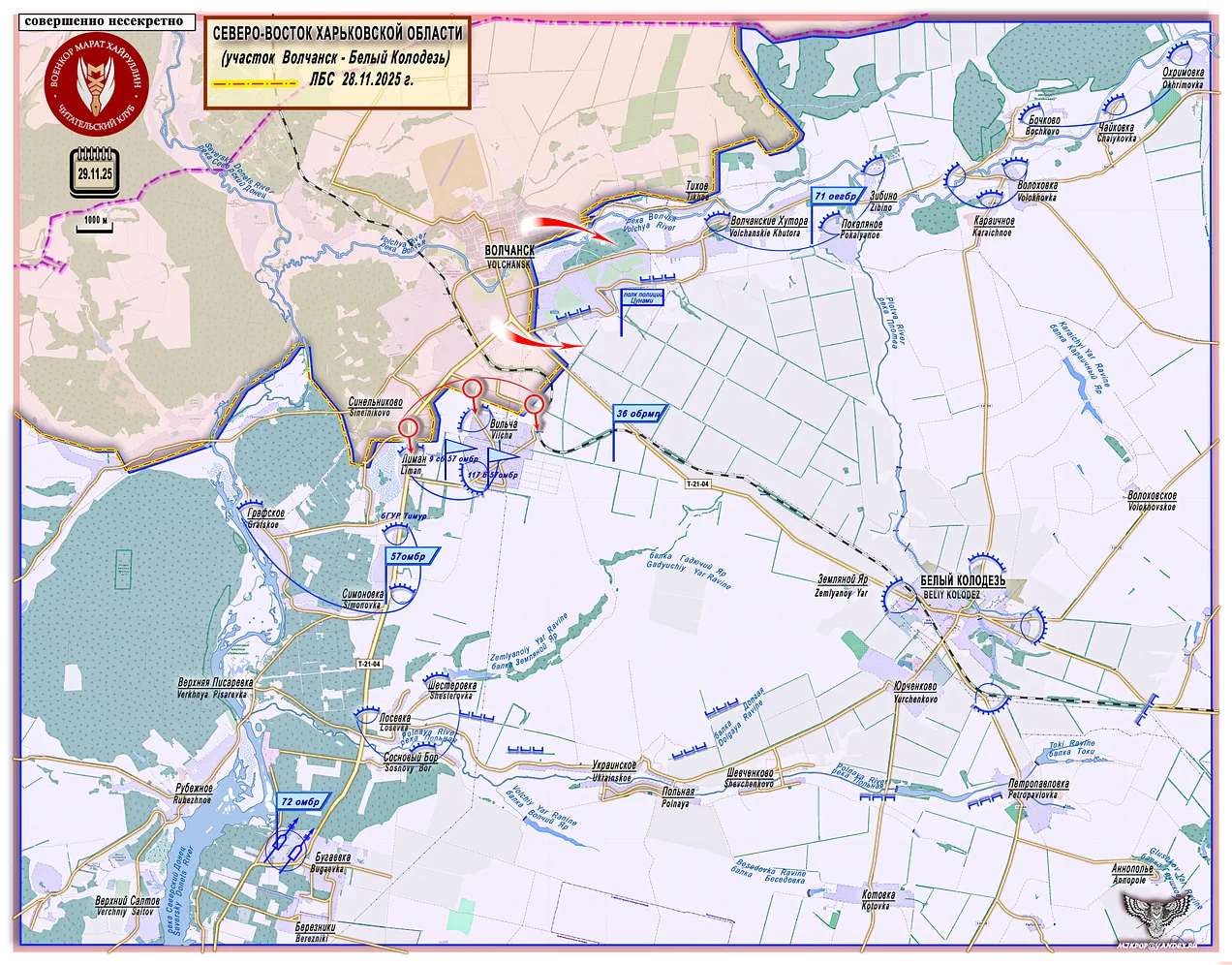
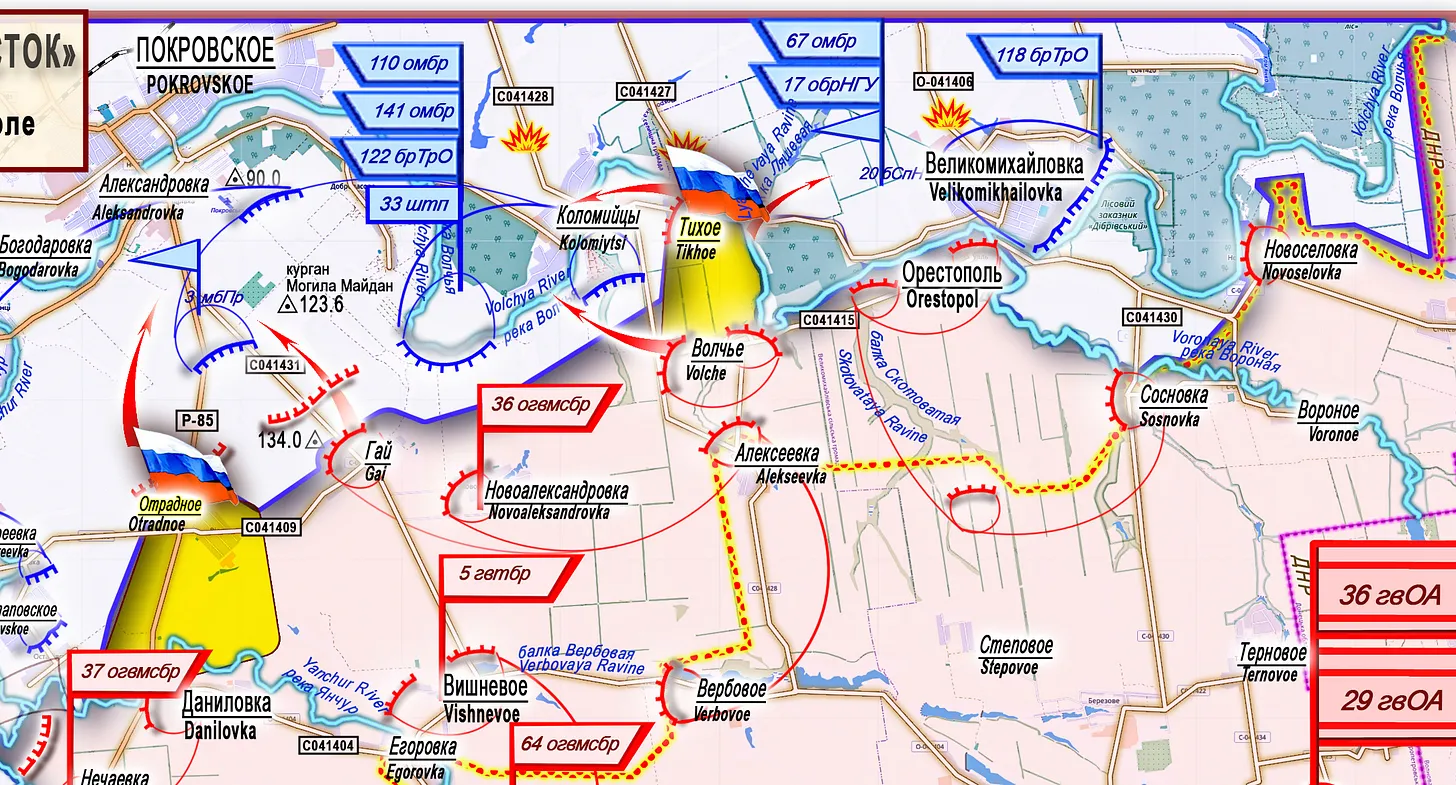
In the east, units of the 36th Guards Motorized Rifle Brigade made a 3-kilometer breakthrough in the area of the settlement Volche and the Volchya River. They liberated the settlement of Tikhoe (47°58′03″ N, 36°22′06″ E, about 120 residents), reached the left bank of the Volchya River, and gained full control over road C041428, which connects the AFU defense areas (on the opposite bank) Velikomikhailovka and Kolomyitsi (via the highway north of where the map cuts off), as well as over the exit of the Lyashevaya ravine (the text is a bit obstructed, but you can see the blue just northeast of Tikhoe).
Image

Both AFU defense areas are now threatened with encirclement.

The 'East' group has begun clearing the remaining territory of the interfluve between the Volchya and Gaichur rivers.

https://maratkhairullin.substack.com/p/ ... ember-23rd

******

The Current State Of The 28-Point Plan

My assessment of the Trump’s 28-Point Ukraine Plan was not correct:

The plan as it is is dead in the water, stillborn or however you may want to characterize this collection of ill-defined, non-binding and ridiculous clauses. No one will ever accept it.

Russia’s President has somewhat accepted the plan when he said that it could “serve as a foundation for a final peace settlement”. He complained however that no U.S. contact was willing to discuss the details with Russia:

The reason, in my opinion, is the same: the US administration has so far been unable to secure consent from the Ukrainian side, as Ukraine is opposed to it. Apparently, Ukraine and its European allies continue to entertain the illusion that they can inflict a strategic defeat on Russia on the battlefield. I believe this position is not so much the result of insufficient competence – I will not go into that now – but rather stems from an absence of objective information about the actual situation on the ground.

Either Kiev’s leadership lacks objective reporting about the developments on the front, or, even if they receive such information, they are unable to assess it objectively. If Kiev refuses to discuss President Trump’s proposals and declines to engage in dialogue, then both they and their European instigators must understand that what happened in Kupyansk will inevitably occur in other key areas of the front. Perhaps not as quickly as we would prefer, but inevitably.

And overall, this development suits us, as it leads to achieving the goals of the special military operation by force, through armed confrontation. However, as I have repeatedly stated, we remain ready for peace negotiations and for resolving issues through peaceful means. However, this, of course, requires substantive and meaningful discussion of all aspects of the proposed plan. We are prepared for this.


The Europeans issued their own plan which is just a repeat of their old demand of a ceasefire without conceding any of Russia’s demand. They are obviously trying to prevent an agreement.

But they have no place at the table. They are on the menu. Trump wants them to pay for HIS peace plan and, in the end, they will do so.

The acting president of Ukraine Vladimir Zelenski knows that he can not outright reject Trump’s plan. He would be blamed for not wanting peace and U.S. support would be finished. He thus asks, prodded by the Europeans, for changes that Russia will surely reject.

My understanding is that there will soon be another meeting (or phonecall) between Zelenski and Trump.

If Trump accepts Zelenski’s changes to key points of the plan Russia will have to reject it even as a base for discussions. Trump will then be pressed to put more sanctions on Russia. The war will escalate and continue.

If Trump rejects changes to key points in the plan then Zelenski will have to reject it. Trump will end U.S. intelligence and other support for Ukraine which will lead to a faster defeat of Ukraine and the end of the war.

Russia, as Putin says, is fine with either decision.

Posted by b on November 24, 2025 at 16:21 UTC | Permalink

https://www.moonofalabama.org/2025/11/c ... l#comments

******

The Poison Pill in the US Peace Plan for Ukraine: Europe Written Into the Outline
Posted on November 24, 2025 by Yves Smith

The press today positive noise-making about the US and Ukraine talking through a “28 point plan” and narrowing their differences. That is a contrast to reports of predictable Ukraine rejection and an explosively confrontational meeting between the apparent lead US negotiator, Dan Driscoll, and European ambassadors. The latter seems to have generated a bit of softening on the US side, with Secretary of State Marco Rubio saying that the Turkey Day “Sign it as is by Thanksgiving or we take all our toys away” now being self-retraded into “If you keep moving towards our demands, we can extend the process a bit.”

However, this does not change the fact that the deal will not get done, not due to it being unacceptable to Russia. It won’t get that far. The outline being unacceptable to the Europeans will be enough to sink it because it includes numerous provisions that call for European action. And that was not necessary.

Why this deal fails might seem like nit-picking or posturing but it is far more consequential than that. Trump is desperately trying to escape going down as the President who lost Ukraine, but that seems impossible at this late hour.

A reason, aside from denialism and lack of a Plan B, for the UK and Europe to keep so doggedly trying to breathe life into the Project Ukraine corpse is that they need to be able to try to escape blame, particularly after having spent so much in materiel and treasure. As reader Safety First explained:

Here is how Russian government-adjacent TV and radio commentators are explaining the EU’s little suicide pact – at present, i.e. I’ve heard this literally in the past day or three.

Start with the assumption that any realistic peace deal is a de-facto Ukrainian capitulation to Russian demands, and will be viewed by the West as a comprehensive defeat.

If the Europeans agree to, support, or simply not oppose such a peace deal, then a) they will “own” it, i.e. it will be “their” defeat, used by domestic political opponents (AfD, etc.) in the next election cycle; b) they will have a harder time ginning up anti-Russian hysteria, since they’ve just agreed with a “surrender” to the Russians, which c) is a key component of “military pseudo-Keynesianism” they want to pivot into economically.

If the Europeans violently oppose any such peace deal, and then Ukraine collapses, then a) it will be “Trump’s surrender” (or “someone else’s” surrender, in any case), and groups like AfD can be blamed too for being “defeatist”; b) they will continue to drum up “the Russians are coming” type of hysteria, which will c) support further cuts to social spending in favor of increasing military spending.

So politically, it makes perfect sense for the Europeans to hold out for extreme outcomes – Ukrainian or Russian capitulation – and not compromise on any sensible ones. That’s the story being told on Russian TV and radio at the moment.

Now this conduct is very much to Russia’s advantage. As both Alexander Mercouris and Larry Johnson have pointed out, citing remarks by Putin at a Security Council meeting, ending the war on the battlefield suits Russia.

But Russia was constrained by the universal view of its major economic partners and other Global South players, that they preferred that Russia negotiate a settlement. We’ve repeatedly argued that Russia had been continuing to prosecute the conflict despite its allies being very uncomfortable with Russia gobbling up a neighboring a country, even in the face of an existential threat. So Russia bending over backward to try to negotiate a resolution and failing due to the other side being unable to stand together is just dandy.

Recall that the original Istanbul peace talks were solely between the Russia and Ukraine. They did get as far as the two sides signing a preliminary outline.1 But then Boris Johnson, presumably at US instigation or with US support (accounts vary) flew to Kiev and scuppered the talks by saying there would be no security guarantees from the West.

The US being willing to consummate a deal with Russia and try to force Ukraine to heel could have solved that problem. The US is the key military actor and could provide security guarantees, whether or not the hissy-fit EU states went along.2 That would have opened up a very narrow pathway to a deal, which Team Trump seemed to be groping towards and blew: having the US do what in business is called a cram-down, as in force Ukraine to take a deal. We have said the US could do that if Trump thought he could stare down the hawks and the intel state and survive politically and physically. We dismissed that idea because Trump did not look to be in a position to defy Ukraine backers in the US. For instance, during an earlier phase of Lindsay Graham saber-rattling over his “bone-crushing sanctions” he said he had 80 votes in the Senate. That did not just indicate that Graham had a veto-proof majority but also that the number of Ukraine hawks exceeded the number needed to impeach Trump in the Senate. Trump’s approval ratings have fallen markedly since then.

Note also that over the weekend, Fox reported that Graham is reviving the secondary sanctions.

However, if you assume that Trump could deliver on his threat to withdraw US intel (which is more important now given that what the collective West can provide arms-wise is so bare), then the drill would have been for the US to beat Ukraine into compliance, get them to agree to a set of terms, and tell the UK and European, “Ukraine agrees to this. You are now proposing to make them keep fighting and dying for you, as opposed to for themselves?” Trump at least is still posturing that that could work. He’s making remarks consistent with what Putin warned in 2022: The longer it took for the West to talk to Russia, “the more difficult it will be to negotiate with us.” See. for instance from the New York Post:

Trump said the Ukrainian president will “have to like [the plan,] and if he doesn’t like it, then you know, they should just keep fighting, I guess.”

“At some point, he’s going to have to accept something he hasn’t accepted,” he told reporters at the White House.

But this sort of stance is unworkable given that the 28 point “plan,” which spokescritters like Keith Kellogg are now calling a framework, contains many important obligations by the EU and NATO, as in they are explicitly parties to this scheme. That outlined is at footnote 3. Mind you, as Alexander Mercouris and others have pointed out, more than one version of this outline has been published; the one that seems to have been circulated the most in the Western media was from a Ukraine source, and Mercouris pointed out it looked to have edits made to it, which presumably were not agreed by the US since there were no negotiations with Ukraine as of then.

If you look at Footnote 3, you will see that a full 7 of 28 items explicitly require acceptance or action by “Europe,” NATO, or the EU. What is “Europe”? Does it include the UK? What about non-NATO like Austria and Switzerland?

Trying to get NATO to commit to anything is also thorny. As we wrote before. NATO by design is a weak alliance. “NATO” cannot get members to do anything beyond the existing charter obligations save via nation by nation agreement. And even core NATO provisions, such as Article 5, require at most state-by-state, and not NATO-wide responses. NATO enlargement is one example. Recall that when Sweden was joining, Turkiye held the process hostage to try to extract concessions from Sweden regarding PKK, a Kurdish separatist group that Turkiye has designated a terrorist group…and is also had an MP in the Swedish parliament.

See where the deal as conceived cannot advance without UK/European cooperation:

2.A comprehensive non-aggression agreement will be concluded between Russia, Ukraine and Europe

4. A dialogue will be held between Russia and Nato, mediated by the United States, to resolve all security issues and create conditions for de-escalation in order to ensure global security and increase opportunities for co-operation and future economic development.

7. Ukraine agrees to enshrine in its constitution that it will not join Nato, and Nato agrees to include in its statutes a provision that Ukraine will not be admitted in the future.

8. Nato agrees not to station troops in Ukraine.

11. Ukraine is eligible for EU membership and will receive short-term preferential access to the European market while this issue is being considered.

13. Russia will be reintegrated into the global economy:
a. The lifting of sanctions will be discussed and agreed upon in stages and on a case-by-case basis. [Recall that the EU has implemented a full 19 sanctions packages against Russia; that is independent of US and UK sanctions]

14. Frozen funds will be used as follows:

$100bn (£76bn) in frozen Russian assets will be invested in US-led efforts to rebuild and invest in Ukraine. The US will receive 50 per cent of the profits from this venture. Europe will add $100bn to increase the amount of investment available for Ukraine’s reconstruction. Frozen European funds will be unfrozen.
Note also:

3. It is expected that Russia will not invade neighbouring countries and Nato will not expand further.

12. A powerful global package of measures to rebuild Ukraine….

f. The World Bank will develop a special financing package to accelerate these efforts.

From what I can tell, it takes at least a 50% vote of World Bank members (vote share weighted by financial contributions); the US share is a bit over 16%. Admittedly, the US can lean on many World Bank members. But the US is at best relying on the idea that the Europeans will not want to break critical Bretton Woods institutions or NATO. If the UK and European members were honest with themselves, they would recognize that NATO is already broken by virtue of being not just drained of weapons but also woefully behind on advanced arms and the order of battle in the era of ISR. But the leadership and pols are not close to internalizing that.

One might ask how the US created such an own goal. Bloomberg has revealed that the 28 point framework was devises among Steve Wiktoff, Jared Kushner, and Putin’s special envoy, Kirill Dmitriev over a few weeks. Note that these are all businessmen, not diplomats. John Helmer has explained briefly at his site and longer-form in podcasts that Dmitriev seems to fancy that he can become President of Russia, when the far more seasoned and deemed-essential Minister of Finance, Helmer described the reason for including him in the earlier negotiations was for the “strip tease” as to entice the money-grubbing Trump with the prospect of more lucre. Dmitriev has already gone outside his brief, annoying key officials in Russia.4

Now of course, it may be that Dmitriev stumbled into an outcome that Russia wished, of getting the US to sign onto a terms outline that no way, no how will “Europeans” accept. But particularly in light of extensive Russia descriptions of what happened before and after the Alaska summit, it seems vastly more likely that this 28 point outline was a crude attempt to codify what had been agreed at Alaska…..which was a handshake on terms that Witkoff had brought to Moscow and Putin had discussed in an over 3 hours meeting, and Putin reviewed point by point in Alaska with Trump. In other words, it seems as if Witkoff was the originator of the many points that have “Europe” hopelessly in the mix of this deal scheme.

And if you have any doubts that “Europe” is vanishingly unlikely to come around, see this item from the Financial Times:

Von der Leyen, whose chief of staff is participating in the Geneva talks, said three elements were critical.

“First, borders cannot be changed by force. Second, as a sovereign nation there cannot be limitations on Ukraine’s armed forces [and] third, the centrality of the European Union in securing peace for Ukraine must be fully reflected,” she said.

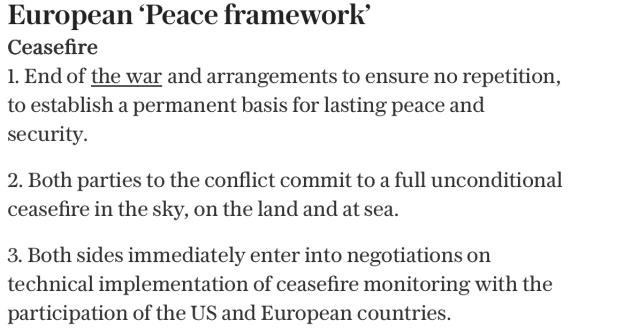
Those with sterner constitutions, please read Leaked: Europe’s rival peace plan for Ukraine in full in the Telegraph. The opening section alone shows that “Europe” has not budged an inch despite the Ukraine collapses at key points on the line of contact:
Image

If you have been following these negotiations at all, you will recall that Russia rejected “ceasefire first” for the entirely logical reason that it would allow Ukraine to rest and rearm. And a ceasefire with no monitoring provisions set first is even more of an insult to intelligence.

However, it seems that Trump still regards it as in his interest to try to keep this negotiation sham going, perhaps out of sheer vanity, to preserve his self-image as a colossus, a driver of events. In the meantime, a Ukrainian on Twitter underscored delay increases the cost human lives and what might be salvaged for Ukraine as a nation: (Video at link.)

____

1 Rest assured that a lot remained to be settled. For instance, Victoria Nuland banged on about a long, detailed annex with various weapons types itemized and limits on how much Ukraine could have of each. There was apparently a very big gap between Russia’s demand and Ukraine’s offer at that juncture.

2Turkiye has the biggest NATO army in Europe. Theoretically, Turkiye could join the guarantees so that Ukraine had to rely on more than the US and Russia. But it seems vanishingly unlikely that this sort of thing would get beyond the trial balloon stage. As you can see from the outline below, the EU is still persisting with having EU member states as part of peacekeeping forces, as opposed to providing a security guarantee.

3 Per the Telegraph:

Trump’s peace plan
Sovereignty and security guarantees

1. Ukraine’s sovereignty will be confirmed.
2. A comprehensive non-aggression agreement will be concluded between Russia, Ukraine and Europe. All ambiguities of the last 30 years will be considered settled.
3. It is expected that Russia will not invade neighbouring countries and Nato will not expand further.
4. A dialogue will be held between Russia and Nato, mediated by the United States, to resolve all security issues and create conditions for de-escalation in order to ensure global security and increase opportunities for co-operation and future economic development.
5. Ukraine will receive reliable security guarantees.
6. The size of the Ukrainian Armed Forces will be limited to 600,000 personnel.
7. Ukraine agrees to enshrine in its constitution that it will not join Nato, and Nato agrees to include in its statutes a provision that Ukraine will not be admitted in the future.
8. Nato agrees not to station troops in Ukraine.

9. European fighter jets will be stationed in Poland.
10. US guarantee:
▪️ The US will receive compensation for the guarantee.
▪️ If Ukraine invades Russia, it will lose the guarantee.
▪️ If Russia invades Ukraine, in addition to a decisive co-ordinated military response, all global sanctions will be reinstated, recognition of the new territory and all other benefits of this deal will be revoked.
▪️ If Ukraine launches a missile at Moscow or St Petersburg without cause, the security guarantee will be deemed invalid.
11. Ukraine is eligible for EU membership and will receive short-term preferential access to the European market while this issue is being considered.
Economics and recovery

12. A powerful global package of measures to rebuild Ukraine, including but not limited to:

a. The creation of a Ukraine Development Fund to invest in fast-growing industries, including technology, data centres, and artificial intelligence.
b. The United States will co-operate with Ukraine to jointly rebuild, develop, modernise, and operate Ukraine’s gas infrastructure, including pipelines and storage facilities.
c. Joint efforts to rehabilitate war-affected areas for the restoration, reconstruction and modernisation of cities and residential areas
d. Infrastructure development
e. Extraction of minerals and natural resources.

f. The World Bank will develop a special financing package to accelerate these efforts.
13. Russia will be reintegrated into the global economy:
a. The lifting of sanctions will be discussed and agreed upon in stages and on a case-by-case basis.
b. The United States will enter into a long-term economic co-operation agreement for mutual development in the areas of energy, natural resources, infrastructure, artificial intelligence, data centres, rare earth metal extraction projects in the Arctic, and other mutually beneficial corporate opportunities.
c. Russia will be invited to rejoin the G8.
14. Frozen funds will be used as follows:
$100bn (£76bn) in frozen Russian assets will be invested in US-led efforts to rebuild and invest in Ukraine. The US will receive 50 per cent of the profits from this venture. Europe will add $100bn to increase the amount of investment available for Ukraine’s reconstruction. Frozen European funds will be unfrozen. The remainder of the frozen Russian funds will be invested in a separate US-Russian investment vehicle that will implement joint projects in specific areas. This fund will be aimed at strengthening relations and increasing common interests to create a strong incentive not to return to conflict.
15. A joint American-Russian working group on security issues will be established to promote and ensure compliance with all provisions of this agreement.
16. Russia will enshrine in law its policy of non-aggression towards Europe and Ukraine.
17. The United States and Russia will agree to extend the validity of treaties on the non-proliferation and control of nuclear weapons, including the START I Treaty.
18. Ukraine agrees to be a non-nuclear state in accordance with the Treaty on the Non-Proliferation of Nuclear Weapons.
19. The Zaporizhzhya Nuclear Power Plant will be launched under the supervision of the IAEA, and the electricity produced will be distributed equally between Russia and Ukraine – 50:50.

20. Both countries undertake to implement educational programmes in schools and society aimed at promoting understanding and tolerance of different cultures and eliminating racism and prejudice:
a. Ukraine will adopt EU rules on religious tolerance and the protection of linguistic minorities.
b. Both countries will agree to abolish all discriminatory measures and guarantee the rights of Ukrainian and Russian media and education.
c. All Nazi ideology and activities must be rejected and prohibited.
Territory

21. a. Crimea, Luhansk and Donetsk will be recognised as de facto Russian, including by the United States.

b. Kherson and Zaporizhzhia will be frozen along the line of contact, which will mean de facto recognition along the line of contact.
c. Russia will relinquish other agreed territories it controls outside the five regions.
d. Ukrainian forces will withdraw from the part of Donetsk Oblast that they currently control, and this withdrawal zone will be considered a neutral demilitarised buffer zone, internationally recognised as territory belonging to the Russian Federation. Russian forces will not enter this demilitarised zone.
22. After agreeing on future territorial arrangements, both the Russian Federation and Ukraine undertake not to change these arrangements by force. Any security guarantees will not apply in the event of a breach of this commitment.
23. Russia will not prevent Ukraine from using the Dnieper River for commercial activities, and agreements will be reached on the free transport of grain across the Black Sea.
Humanitarian issues and confidence-building measures
24. A humanitarian committee will be established to resolve outstanding issues:
a. All remaining prisoners and bodies will be exchanged on an ‘all for all’ basis.
b. All civilian detainees and hostages will be returned, including children.
c. A family reunification programme will be implemented.
d. Measures will be taken to alleviate the suffering of the victims of the conflict.
25. Ukraine will hold elections in 100 days.
26. All parties involved in this conflict will receive full amnesty for their actions during the war and agree not to make any claims or consider any complaints in the future.
27. This agreement will be legally binding. Its implementation will be monitored and guaranteed by the Peace Council, headed by President Donald Trump. Sanctions will be imposed for violations.
28. Once all parties agree to this memorandum, the ceasefire will take effect immediately after both sides retreat to agreed points to begin implementation of the agreement.
4 From Helmer in April:

Kirill Dmitriev is the Stanford and Harvard educated official appointed by President Vladimir Putin to persuade American businessmen to invest in the profits to be made from dismantling US economic sanctions against Russia…

That Dmitriev is proposing to open sectors of the Russian economy which are legally closed under national security control – at the same time as the US is escalating its military power projection from Greenland to Alaska – has been noted by the Russian Foreign Ministry, which has been trying to curb Dmitriev’s powers, as well as his tongue.

Dmitriev has retreated, ingenuously telling the BBC: “first of all, I am focused on economics and investment, so I don’t comment on political issues.” Then he did just that..

Dmitriev was referring to President Putin’s undertaking to President Trump during their telephone call of February 12 to halt Russian strikes on Ukrainian energy targets. This partial ceasefire by the Russian side has been ignored by the Ukrainians and their US and NATO advisors….there has been no Russian retaliation yet.

In the record which the Russian and American negotiators have been making since the presidents’ telephone call, the outcome to date is nothing but “minor and petty episodes”.

Dmitriev is the only Russian official to say otherwise.

In other words, Dmitriev has a track record of being a loose cannon.

https://www.nakedcapitalism.com/2025/11 ... tline.html

*****

Here It Is.

People conveyed it. Properly. You can call it the The Plea of the Russian Drone. (Video at link.)


Help me, people, help me, please, I beg you.

I can’t hear — just can only read your lips.

Write a little note so I can help you,

Tell me what you need, just jot the gist.


It’s a Russian drone — don’t fear, it will not harm you.

It will bring you medicine and food.

We have found you, and won’t abandon —

We will save your family, we’ll see you through.


You’ve been under fire here longer than a year,

From Volchansk you're always in the view.

You held out until the Russian soldiers reached here,

Did not bow to Nazis of the AFU.


We’re so close — just a little distance left now,

Just a street or two we must cross through.

Every meter costs us dearly, and how —

Many lost upon this road we knew.


For your freedom from the Nazi forces

All as one we fight without a pause.

They are brothers — Russia’s steadfast soldiers,

Battling “Banderite” unholy cause.


Help me, people, help me, please, I beg you.

I can’t hear — just can only read your lips.

Write a little note so I can help you,


Tell me what you need, just jot the gist.


The response of people around the world in my audience is overwhelming--this video and poignant song touched so many. But do not forget also that Russian soldier who lead this family across hellish terrain while drone followed them making sure no attempts were made on their lives. My profound gratitude to Nikita Pliassunov who put it in proper poetry.

You can download this song by following this link: This is Russian Drone, Don't Be Afraid. (link available to Telegram users only.)

http://smoothiex12.blogspot.com/2025/11/here-it-is.html

*****

Contrasts of modern Donetsk
November 25, 1:06 PM

Image

From bookcases to damaged power plants: the contrasts of today's Donetsk

Donetsk remains a city where everyday life coexists with constant threat. Despite the apparent serenity of life, tension remains palpable. Donetsk residents are always on the alert for an incoming attack. But people continue to live, love, work, and go to the theater.

Military Pages correspondent Bohdan Borman visited the capital of the Donetsk People's Republic, spoke with its residents, and tried to understand what life is like in Donetsk today.

Donetsk – Transportation Issues

Bohdan Borman arrived in the city from Mariupol. There is a stable transportation connection between the two cities: shuttle buses depart from the suburban bus station every 30–40 minutes. The flow of passengers is steady—some are traveling on business, some are visiting relatives, and some are heading to work.

The last scheduled bus from Donetsk to Mariupol departs at 6:00 PM. The summer season traditionally brings its own changes: the number of minibuses increases, as many residents of the DPR flock to the Azov Sea coast—to Urzuf, Melekino, or the Belosarayska Spit. Despite the proximity of the contact line, routes to popular beaches remain popular.

Image
Donetsk bus station. Evening.

To buy a bus ticket from Mariupol to Donetsk, you had to show your passport. Payment was accepted by bank card. At the Donetsk bus station ticket office, passports were not required, but tickets were sold only in cash.

Public transportation in Donetsk is problematic. According to local residents, minibuses no longer operate within the city after 8:00 PM, and in some areas, as late as 7:00 PM. This is very inconvenient for those who work until evening and do not have a personal vehicle. The cost of a minibus ride within the city is 30 rubles.

Cultural life of the capital of the DPR.

Donetsk has been considered the cultural center of eastern Ukraine since Soviet times. The city retains this status today. Cinemas and even four theaters remain open here. Theatre enthusiasts can see productions by both local companies and visiting companies. This September, Donetsk once again hosted the 7th International Festival of Creative Industries "Stars over Donbass." Famous Russian writers, historians, and computer game developers visited cities across the DPR for a whole week.

Image
Donetsk hosts a variety of exhibitions and bookstores, which, incidentally, Mariupol still lacks. And Donetsk residents, according to sellers, are eager to buy books. Although online stores with lower prices operate in the city, many prefer to visit a traditional bookstore and buy the books they need "off the shelf." Our correspondent also didn't leave empty-handed and bought one of his favorite books, "Martin Eden" by Jack London. Not just monuments, but a piece of history.

Image
(Shopping carts in a bookstore! A seriously literate public.)

Image

"The City of a Million Roses"—that's what Donetsk was called during the Soviet era. In the 1960s, at least one rose was planted for every resident of the city, which had a population of over a million. The flowers remain, but now monuments and murals dedicated to the soldiers of the SVO have appeared on the streets of Donetsk. Near the DPR Government House, bronze figures of World War II soldiers and a member of the Republic's militia are depicted. According to local residents, fresh flowers are always available near the pedestals. The same applies to the bust of DPR Head Alexander Zakharchenko, who died in 2018. Information boards on the alley next to the Government House tell about the events of the "Russian Spring" and the heroes of the Republic.

Image

Image

Image

Image

Donetsk also has numerous "peace monuments," such as the one to John Hughes, the founder of Donetsk (the city's first name was Yuzovka)

Image

Donetsk's "Iron Pearl"

The true "iron pearl" of the capital of the DPR is the Forged Figures Park. This landmark appeared on the city map in August 2001. Back then, the park boasted only a dozen iron figures. Today, this green space is home to a large variety of forged works of art. Here you can see zodiac signs, fairy tale characters, and a genuine iron chapel with icons carved in iron.

Image

Image

Image

The park also features works made when Donetsk was still part of Ukraine, with inscriptions in Ukrainian. However, no one is tearing down these works or removing the plaques.

"This is part of our history, which we remember and do not forget. And now we are part of Russia," said a woman walking through the park with her child.

The capital's problems: Donetsk without water and electricity.

The main difficulties facing Donetsk today are related to the ongoing fighting in the region. One of the most pressing issues for residents remains the water supply. While until the summer of 2025, water was supplied to homes approximately every other day, it is now turned on only once every three days—from 5:00 PM to 9:00 PM. Even during this period, the pressure remains weak, and water often doesn't reach the upper floors of apartment buildings. A timeline for the situation to return to normal is still unknown.

The city has been under Ukrainian shelling for over 10 years. According to local authorities, missile and drone attacks are periodically recorded. One of the massive strikes, according to DPR head Denis Pushilin, occurred between November 16 and 18 of this year. The Zuyevskaya and Starobeshevskaya thermal power plants were damaged, and approximately 65% ​​of Donetsk residents were temporarily left without power. Similar incidents occur regularly in Donetsk, and a threat can arise in any area of ​​the city.

Image
In October, there was an attack on the Forged Figures Park. This is the very center of the city.

Food, banks, and other infrastructure are also affected.

Many people are interested in food prices in Donetsk. Large Russian retail chains have not yet entered the capital of the DPR, so local supermarkets form the bulk of the retail trade.

Prices for popular products are as follows:

chilled broiler chicken - about 209 rubles/kg;
pork shoulder - 399 rubles/kg;
beef shoulder - 798 rubles/kg;
chicken eggs, depending on the category and manufacturer, cost from 39 to 104 rubles per dozen;
sugar can be found from 72 rubles/kg;
buckwheat - from 45 rubles for an 800-gram package.
The average price of a white loaf is about 50 rubles;
potatoes - from 22 rubles/kg;
onions - from 38.5 rubles/kg.

The city has its own confectionery factory, which supplies the market with a wide range of sweets. Donetsk has effectively become the center of confectionery production in the DPR. Thanks to this, the cost of many types of sweets here is significantly lower than, for example, in Mariupol. The price difference for some items reaches 50% or more, which also applies to a significant portion of other food products.

Several Russian banks have branches in the city. Donetsk residents can use the Gosuslugi (Gosuslugi) service. Online stores are available, but there are certain problems receiving mail from the mainland.

Even living under constant threat and facing daily difficulties, Donetsk residents believe that peace will soon come.

We wrote about the fact that the famous Soviet pilot Alexander Pokryshkin is immortalized in Mariupol here https://warpages.ru/znamenityj-sovetski ... upole.html

(c) Bogdan Borman

https://warpages.ru/ot-knizhnyh-vitrin- ... eczka.html - zinc

https://colonelcassad.livejournal.com/10207946.html

Google Translator

(Right now, 1 United States Dollar is worth about RUB 78.99. So, very roughly, that chicken comes in about a dollar a pound, cheaper than all but sale price, potatoes 8lbs/$1.)

(Other images at link.)
"There is great chaos under heaven; the situation is excellent."

User avatar
blindpig
Posts: 14788
Joined: Fri Jul 14, 2017 5:44 pm
Location: Turtle Island
Contact:

Re: Footnotes from the Ukrainian "Crisis"; New High-Points in Cynicism Part V

Post by blindpig » Wed Nov 26, 2025 11:33 am

Peace agreement?
Published by @nsanzo ⋅ 11/26/2025

Image

Russia continues to watch from a distance as events unfold according to the pattern followed a few months ago: a draft agreement is presented by a sector of the US administration, European countries react quickly by reintroducing aspects that make an agreement impossible, Ukraine takes the necessary steps to reconcile not accepting points it considers unworkable while trusting that the intervention of its allies will make it unnecessary to give a resounding no to the United States, a different faction of the White House begins negotiations and the result seems designed in a laboratory to ensure that there can be no agreement with Russia.

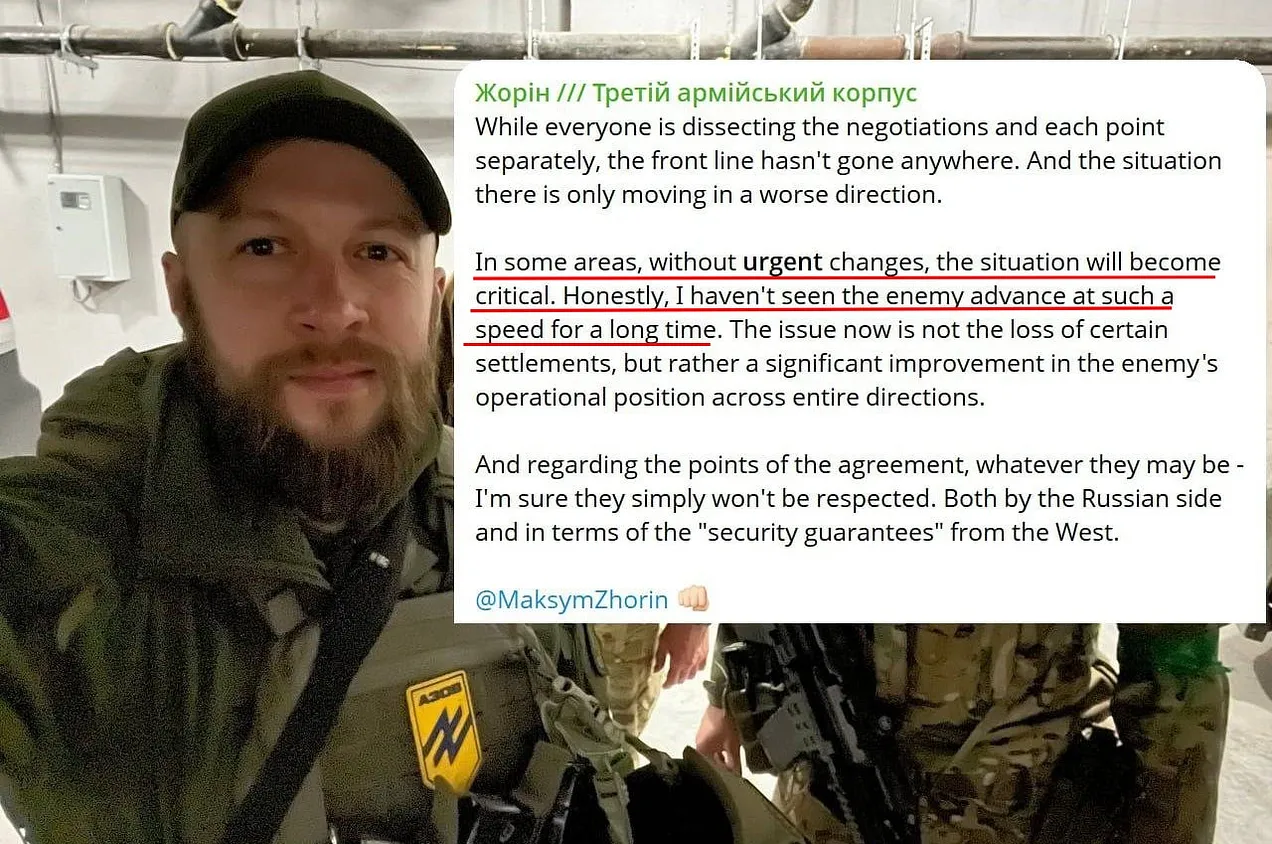
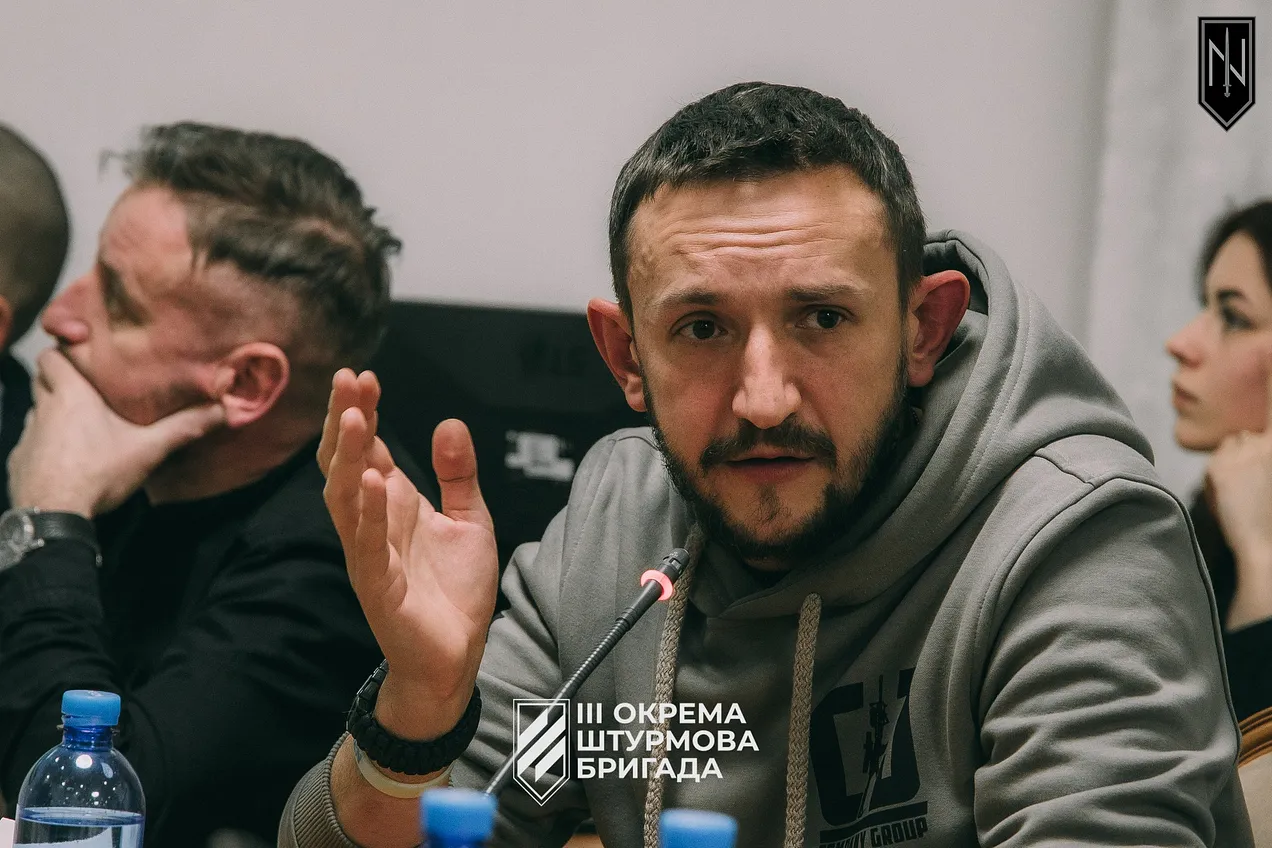
The current process is the first in which there is a complete document on which to negotiate and, given the changes introduced in Geneva, to completely rewrite. That is the fundamental difference between the current process and previous ones that inevitably led to diplomatic silence, the passage of time, the accumulation of destruction and death on both sides of the front, and the loss of territory by Ukraine. Yesterday, an image was published of Russian soldiers calmly walking through the center of Krasnoarmeisk (Pokrovsk), while Ukraine continues to claim to have “cleared” the city center of Russian soldiers—proof enough for former diplomats and now lobbyists like Michael McFaul, who wrote on Monday that “the claim by the Trump team and its supporters about an imminent collapse of Ukraine on the battlefield is not supported by the data.” That data was the false Ukrainian claim about Pokrovsk. In reality, it is neither Trump supporters nor Russia who are talking about a collapse. However, in recent days, individuals hardly suspected of Russophilia, such as Serhiy Sternenko, former leader of Praviy Sektor in Odessa and now a military activist and militarist, or Maksym Zhoryn, deputy commander of Andriy Biletsky's Third Assault Brigade, have spoken out. Like the rest of the Azov leadership, Zhoryn has not opposed negotiations and warns of the dire situation on the front lines. The will to continue fighting Russia to the last Ukrainian, at the expense of each and every village in Donbas, increases proportionally with the distance from which the war is observed.

Throughout yesterday, during talks between the United States, Ukraine, and Russia in Abu Dhabi (United Arab Emirates), Western interest focused on highlighting the Russian bombing of cities like Kyiv. The target, once again, was energy infrastructure, and the attacks resulted in two deaths. The bombing was used as an argument to support the claim that Russia does not want peace and that the Kremlin has not changed its objectives. Russia denounced the deaths of three people in the city of Rostov as a result of similar Ukrainian attacks. Propaganda aside, both sides understand that the war will continue until there is a peace agreement or ceasefire with a political framework that makes it sustainable. That is what, as of today, seems most questionable. The United States has demonstrated its ability to meet with the warring parties, generally ignoring the interests of the European Union, and develop drafts that would be acceptable to the actor with whom it is negotiating at any given time—drafts that are immediately modified by the other country at war, rendering them unacceptable to the first.

Everything indicates that we are currently in that second phase. Yesterday, the United States announced that, pending some details, Ukraine has accepted a US peace plan. The problem is that the changes introduced and the aspects left for future negotiations between Donald Trump and Vladimir Putin make it absolutely unacceptable to Russia. The United States has thus far failed to create a document that the two countries can use for negotiation.

The 28-point plan published last week was tougher on Ukraine, but it also contained unfavorable aspects for Russia, which would be subject to US oversight in the territories it acquired, at the mercy of the US regarding the lifting of sanctions, and would have to accept the massive militarization of the country it had intended to demilitarize. The initial plan stipulated a limit of 600,000 Ukrainian troops—the largest army in Europe after Russia's and more than double its size in 2022—a ban on the stationing of foreign troops, and conditions under which, if Ukraine fired missiles at Moscow or St. Petersburg, it would lose US security guarantees. According to media reports yesterday, the current limit is 800,000. The EU plan, which Ukraine is expected to bring to the negotiations, eliminated the ban on foreign troops and the mention of missiles against Russian capitals.

With far more favorable terms on the less contentious issues of a potential peace treaty, Ukraine accepted the revised document from its talks with the United States yesterday. “Our delegations reached a common understanding on the fundamental terms of the agreement discussed in Geneva,” stated Rustem Umerov, Secretary of the National Security and Defense Council. “We now have the support of our European partners in the next steps,” he added, referring to outstanding issues regarding the use of frozen Russian assets and Ukraine’s aspirations to join NATO, the Financial Times reported yesterday. Among the details that remain to be ironed out are the most important aspects of this war. Therefore, the optimistic statements coming from the White House yesterday and the confirmation that Zelensky has accepted the peace plan agreed upon with the United States, “pending some details,” should be taken with a grain of salt. These details determine whether the agreement will be viable for the other side, which currently has superiority on the front and is not willing to accept a plan that, as European countries are trying to impose, seeks a definition of peace as the absence of war and not the absence of conflict.

This distinction hinges on whether the treaty includes the fact that Zelensky is willing to accept at least a temporary resolution to the territorial issue, but above all, to the security aspect. All statements in this regard suggest that this issue has been specifically eliminated in pursuit of an agreement with Ukraine, the most comfortable position for Kyiv, which can afford to accept the agreement knowing that it cannot be accepted by Russia. Hence, yesterday's apparent triumphalism coexists with the first signs of blaming Russia for not wanting an agreement or for ambitions incompatible with peace negotiations. Those who emphasize that the Russian position has not changed prefer to ignore that Russia has indeed changed its demands—the fact that it was willing to contribute $100 billion of its assets to the reconstruction of Ukraine is a point to consider, as is the fact that its territorial objectives have ceased to be maximalist and are now limited to what Russia could realistically achieve over time—and that other participating actors have not actually modified their demands either.

“Parliamentary Summit of the International Platform on Crimea. I addressed the participants and urged them: do not remain silent, do not be passive observers of history: be participants. It is important to support Ukraine now, and I thank you for that support. It is important to support the negotiation process, and I appreciate every piece of advice and information we receive from European leaders. And it is crucial to uphold the principles that underpin Europe: that borders cannot be altered by force; that war criminals must not evade justice; and that the aggressor must pay in full for the war it started. That is why decisions regarding Russian assets are essential. Please support these decisions and, above all, maintain pressure on Russia. Russia continues to kill people. Every day. The occupied territories remain occupied,” Zelensky wrote, making it clear that Ukraine’s objectives have not changed—to reclaim territories, punish Russia, and obtain Russian assets—and that it expects to continue receiving assistance from its partners to achieve them. A demanding proxy, Ukraine hopes to perpetuate its de facto border position in what it has been presenting for three years as a struggle between Europe and the beyond, democracy versus authoritarianism, civilization versus barbarism. Lest there be any doubt about Ukraine's true definition of victory—aside from the fact that, like all sides in the conflict, it will present any outcome as a great triumph—the Speaker of the Ukrainian Parliament declared on Monday that the war will end when Crimea is returned to Kyiv's control. It is irrelevant to Ukraine that this return would have to occur against the wishes of the majority of the population. The intention to maintain the Crimean issue as a future claim points to the idea of ​​peace as merely the absence of war, an idea also embraced by European countries and institutions.

“It’s done: the European Parliament has just approved the first European Defence Industry Programme #EDIP. This will: strengthen the EU’s defense industry, boost joint procurement, increase production, and intensify support for Ukraine,” wrote a proud Roberta Metsola. European countries and institutions remain firm in their intention not to accept a resolution to the conflict that involves de-escalation and have proposed rearmament and military, financial, and economic support for Ukraine in the very long term. The parallel is becoming increasingly clear, and everything indicates that the European Union intends for Ukraine to fulfill for Brussels the role that Israel has played for Washington throughout the Cold War: an armed proxy with the capacity to operate in a region considered key and where there is perceived to be an existential enemy that must be contained or defeated. Yesterday, Emmanuel Macron again mentioned the possibility of sending troops to Kyiv or Odessa.

Amid the flurry of information about the apparent imminent peace, The New York Times reports that Marco Rubio has removed from the draft the clause stipulating that Ukraine would not join NATO. This was arguably the most important aspect of the 28-point plan, as it would have allowed Russia to accept concessions such as the use of its withheld assets for the reconstruction of Ukraine, or even potentially agree to freeze the front in Donetsk. However, the statements by European leaders, who have insisted that issues of EU membership—which no one, including Russia, opposes—and NATO membership will be addressed in the post-peace period, indicate a clear intention to secure an agreement favorable to Ukraine, ensure that Kyiv does not lose more territory, and resolve the issue in its favor, much like the way in which a commitment to Mikhail Gorbachev was avoided to prevent NATO expansion at the end of the Cold War.

“For a new ally to join NATO, unanimity is required. A couple of allies oppose Ukraine's entry. The text of last year's Washington summit stated that there is an irreversible path toward NATO,” Mark Rutte affirmed yesterday. The European countries, which these days have insisted on Ukraine's Euro-Atlantic path , make no effort to hide their objectives, possibly because the NATO issue is the most useful for ensuring that an agreement is impossible—an agreement that, regardless of the geopolitical terms directly involving the Union and the Alliance, makes them uncomfortable and that they want to avoid at all costs. These factors make it virtually impossible for Russia to even consider negotiating the document emerging from the Rubio-Ermak meetings, possibly the main objective of the actions taken these days by Zelensky's team and its European allies. As the pro-Ukrainian journalist Michael Weiss wrote recently, “A Russian wish list with fewer wishes to fulfill. And now, to be presented to Russia for rejection. See you next month.” Pressure is mounting again on Russia, and the chances of an agreement still depend on the United States' ability to include the parties' most important demands in a single document, not two whose contradictions make it unworkable for the opponent.

https://slavyangrad.es/2025/11/26/acuerdo-de-paz/

Google Translator

*****

From Cassad's Telegram account:

Colonelcassad
Massive Ukrainian Airstrike in the South

While European politicians strain and try to disrupt any negotiation process, active hostilities continue at the front and in the frontline zones. And last night, Ukrainian formations attacked the south of Russia with at least 286 UAVs .

How did the raid take place?

- The enemy launched the UAVs in waves of 5-15 units in each group from three main areas: the vicinity of Zatoka - Belgorod-Dnistrovskyi, Odessa (Hydroport and Shkolny), and the Buyalyk airfield.

- Some of the UAVs attacked Crimea, primarily Cape Tarkhankut and the Yevpatoriya - Saki line, and the bulk of the UAVs flew over the Black Sea, skirting the Crimean Peninsula towards the Krasnodar Territory.

- A total of 285 UAVs were recorded by air defense units, of which, according to preliminary data, 276 units were shot down . 179 were destroyed over the Krasnodar Territory and on approach to it. 88 UAVs were shot down over Crimea and the Black Sea. Another 15 UAVs were shot down over the Rostov Region and the Sea of ​​Azov near Taganrog.

- At least two incursions were recorded against an A-60 aircraft, which was parked there inoperative.

- In addition to UAVs, Ukrainian forces launched Neptune anti-ship missiles from the Zatoka area in the direction of the Sakskaya Thermal Power Plant. Four missiles were destroyed on approach.

Despite the numerous UAVs deployed, the enemy achieved no practical results. Almost all the drones were shot down by air defense units and aircraft. However, the attack resulted in civilian casualties: three were killed in Taganrog, and more than ten people were injured in Taganrog and Novorossiysk .

The enemy had been preparing for this attack for a week. NATO intelligence has been intensively monitoring the situation in Crimea and the Krasnodar Territory over the past several days. The night before the attack, an American RQ-4B UAV operated in the central Black Sea .

The primary target of the raid in the Black Sea zone was again energy facilities. In Crimea, they attempted to hit the Sakskaya Thermal Power Plant and the Sheskharis oil transshipment terminals in Novorossiysk , but were unsuccessful. However, further attempts are possible, primarily against oil and gas facilities in the World Cup.

***

Colonelcassad
The supposed leaks of Ushakov and Witkoff's talks published by Bloomberg are clearly an attempt by globalists to prolong the war as long as possible and undermine the "spirit of Anchorage." As Trump's deadline approaches, the number of these rumors increases exponentially, and they become increasingly insane. But it's immediately clear which media outlets are openly working for the warmongers.

***

Colonelcassad
4:02
The Battle for Kostyantynivka.

Our report:

The Ukrainian Armed Forces, losing control of the city's eastern districts, are preparing for battle in the industrial zone and high-rise buildings. The question is, will the enemy have enough forces to hold a city larger than Pokrovsk? All units in the Ukrainian Armed Forces garrison were severely battered during their defeat in the villages southeast of Kostyantynivka. These include the 28th, 100th, and 112th Brigades of the Ukrainian Armed Forces, as well as the 241st Troops Brigade and the "Lyut" Brigade of the Ukrainian Police. Most Ukrainian soldiers have been in their positions for three to six months without rotation.

Long before the start of urban fighting, the enemy moved most of its mobile outposts and command posts to neighboring Druzhkovka. In accordance with Madyar's plans to create a "KillZone," the Ukrainian Armed Forces command is now deploying its drone operators in the front line alongside the infantry. The result, however, is questionable – the enemy is losing drone crews in droves, which they consider valuable specialists. For example, every soldier in our 4th Brigade's reconnaissance and assault battalion has already taken a dugout containing enemy "birdhouses" in a firefight more than once.

Clearly, quick results in this direction are not to be expected, but our soldiers are doing what they have mastered with distinction – depriving the enemy of supplies and gradually dislodging them from their occupied fortifications. The pincer movement is increasingly visible on the map. Having finally defeated Ukrainian Armed Forces units in Ivanopol, soldiers of the 4th Brigade, together with the 1194th and 78th Regiments, continue to expand their encirclement of Kostiantynivka from the south.

@DKulko

***

Forwarded from
Readovka
Ukrainian Armed Forces units are firing at each other due to a lack of communication—chaos and disarray reigns among the Ukrainian troops.

The Ukrainian army has numerous "problem areas" that the Russian Armed Forces are exposing, but there are also those that enemy soldiers are already trumpeting. It's not a shortage of personnel, weapons, or anything similar; the problem soldiers are citing is organizational, primarily the lack of communication between units.

"A huge problem with cooperation remains on the front lines. Due to the low level of manning of units, there may be more than 10 separate 'organisms' operating in certain areas, with poor coordination and communication. The consequences of all this are quite tragic – from enemy advances to firefights between adjacent units that have not received accurate information regarding the movements or deployment of friendly forces ," Ukrainian military blogger Bunyatov wrote on his Telegram channel.


The "fire brigade" tactic (units thrown into battle to plug holes in defenses), coupled with an attempt to quickly resolve a crisis in a specific area, has led to a larger problem. The Ukrainian Armed Forces have long used the principle of breaking military units into battalions, and then even into companies. Individual formations from higher-level units are used as de facto independent forces in a given area. As a result, some sections of the front are transformed into a "patchwork quilt."

A striking example of this "phenomenon" is the Ukrainian Armed Forces strike force that attempted to relieve the siege of Myrnohrad. It consisted of the Ukrainian Armed Forces, the National Guard, and then departmental special forces were added, turning the force less into a strike force and more into a "nightmare" for the Ukrainian General Staff—after all, this entire hodgepodge needs to be led and supported, yet they all report to different agencies. Therefore, the Russian army sometimes chooses its attack directions precisely based on the "coherence" of enemy units in the area.

The Ukrainian Armed Forces, having formally transitioned to a corps-based organizational structure to optimize troop command and logistics, have failed to address the consequences of the previous system. A change in the organizational structure, on paper, does nothing to address the "hodgepodge" of the various sectors.

Furthermore, it's important to remember that Ukraine significantly simplified the process for decommissioning weapons from military units back in 2023. This requires a document signed by the unit's responsible officials, without the presence of Ministry of Internal Affairs officers. Against this backdrop, the corruption scandal involving Mindich may seem like a piece of cake if the NABU begins to unravel all the bureaucratic and organizational innovations of those in the Ukrainian elite who profit from ensuring the country's defense capability.

https://t.me/s/boris_rozhin

Google Translator

*****

Brief Frontline Report – November 25th, 2025

Summary by Marat Khairullin and Mikhail Popov.
Zinderneuf
Nov 25, 2025

(Video at link.)

Image
ЛБС 09.4.2025=Line of Combat Contact April 9th, 2025. Зона Активности=Zone of Activity.

From the message of the Ministry of Defense of the Russian Federation: "The Minister of Defense of the Russian Federation, Andrey Belousov, congratulated the command and personnel of the 4th Separate Guards Motorized Rifle Brigade named after Georgy Pobedonosets, the 78th and 1194th Motorized Rifle Regiments on the liberation of the settlement of Ivanopole in the Donetsk People's Republic."

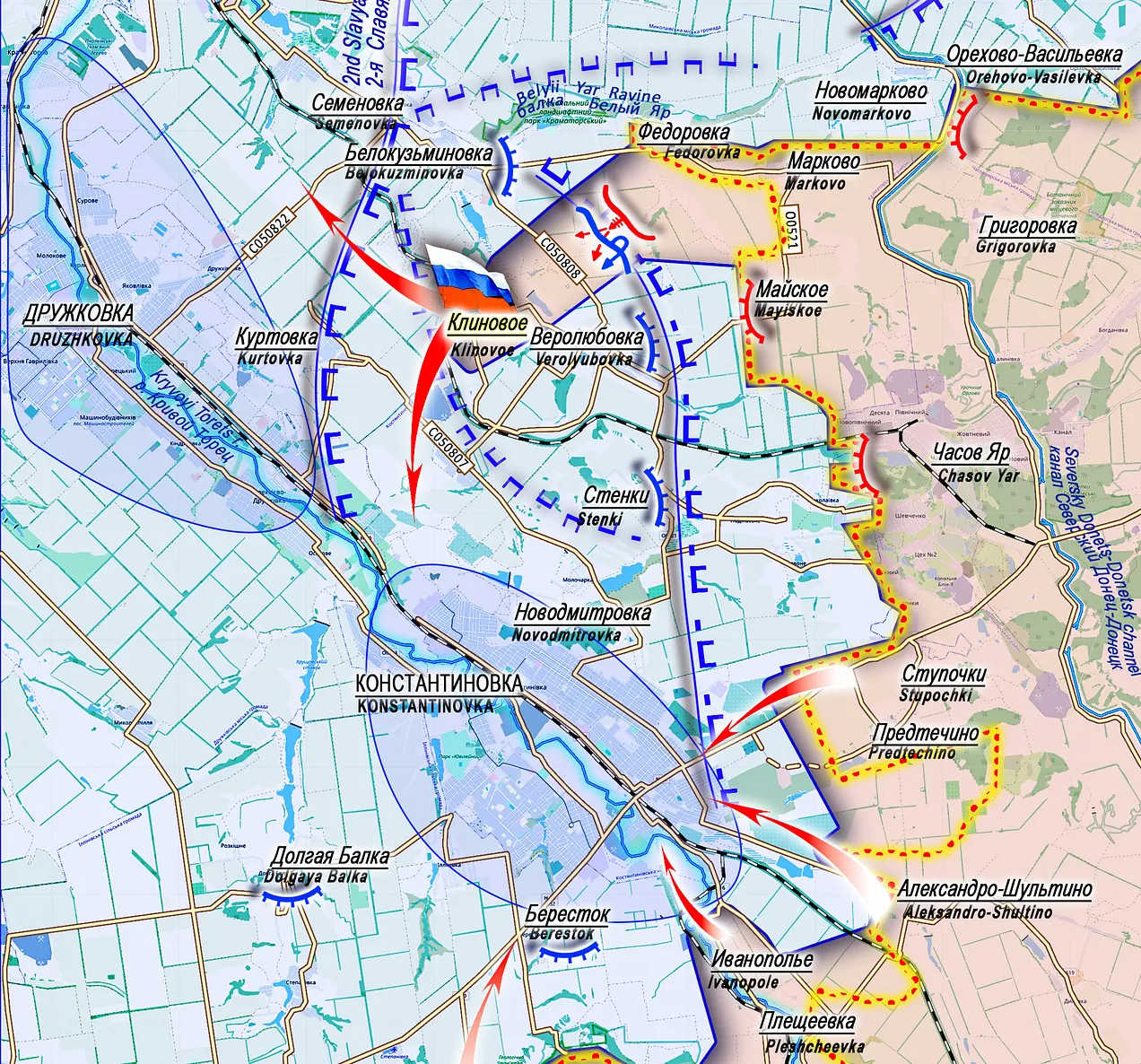
The success of the stormtroopers of the "South" Group allowed them to approach the southern outskirts of Konstantinovka, complicating the enemy's situation in the city. Operators of strike UAVs gained the opportunity to almost detect and destroy enemy military targets in Konstantinovka without any hindrances.

Image

The settlement of Ivanopole (48°28′46″ N, 37°45′32″ E, about 1460 inhabitants) stretches along the right bank of the Krivoy Torets River for more than three kilometers, from the settlement of Plescheevka to the southern outskirts of the city of Konstantinovka. Russian assault groups fought fiercely through these difficult kilometers in terrain saturated with Ukrainian Armed Forces positions and reached the starting lines for the beginning of urban combat. The city of Konstantinovka is only 1.5 kilometers away.

Likely, assault actions will intensify in adjacent areas with the aim of encircling the city.

Image
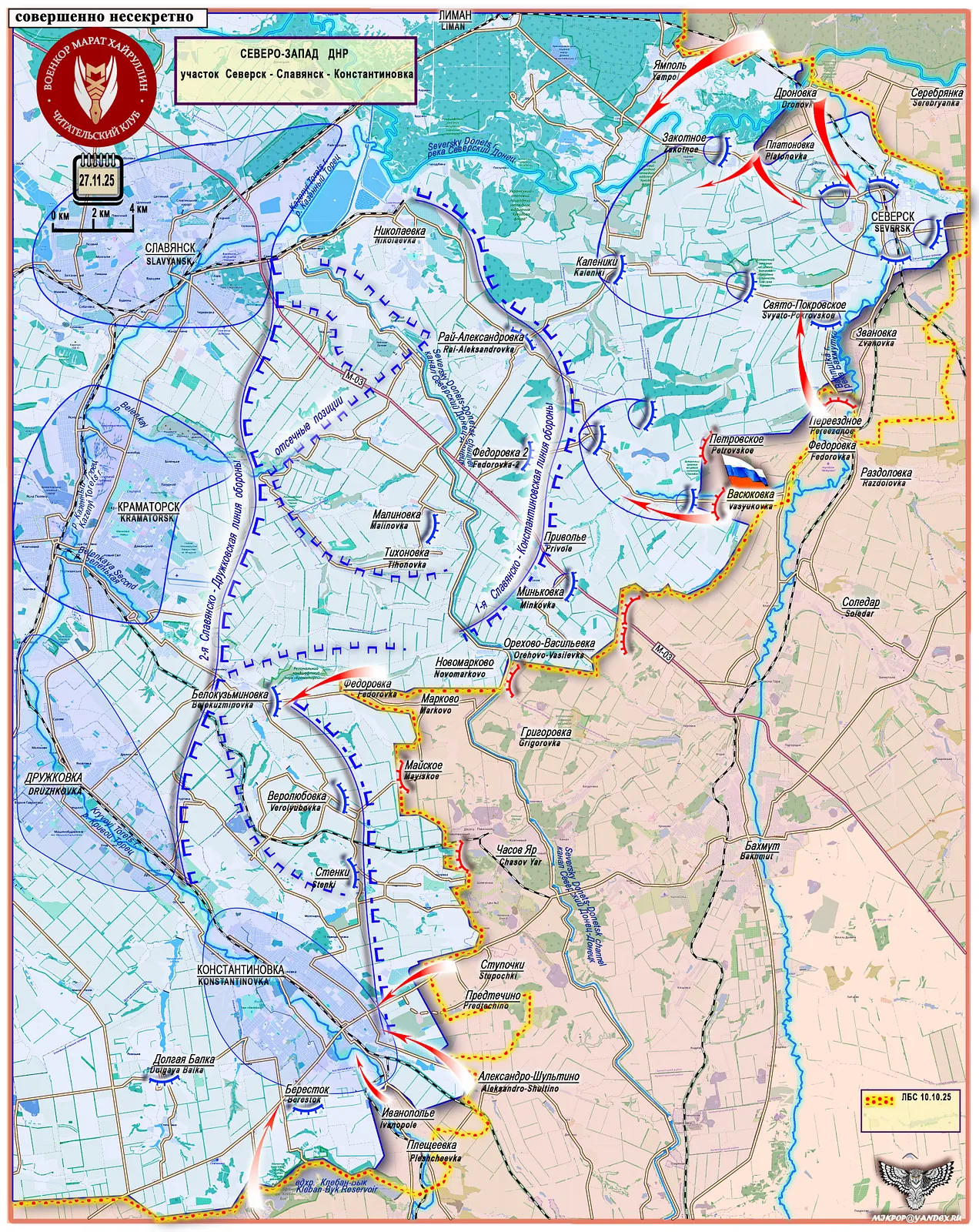
Northwest DPR; Area of Seversk - Slavyansk - Konstantinovka. ЛБС 10.10.25=Line of Combat Contact October 10th, 2025.

Image
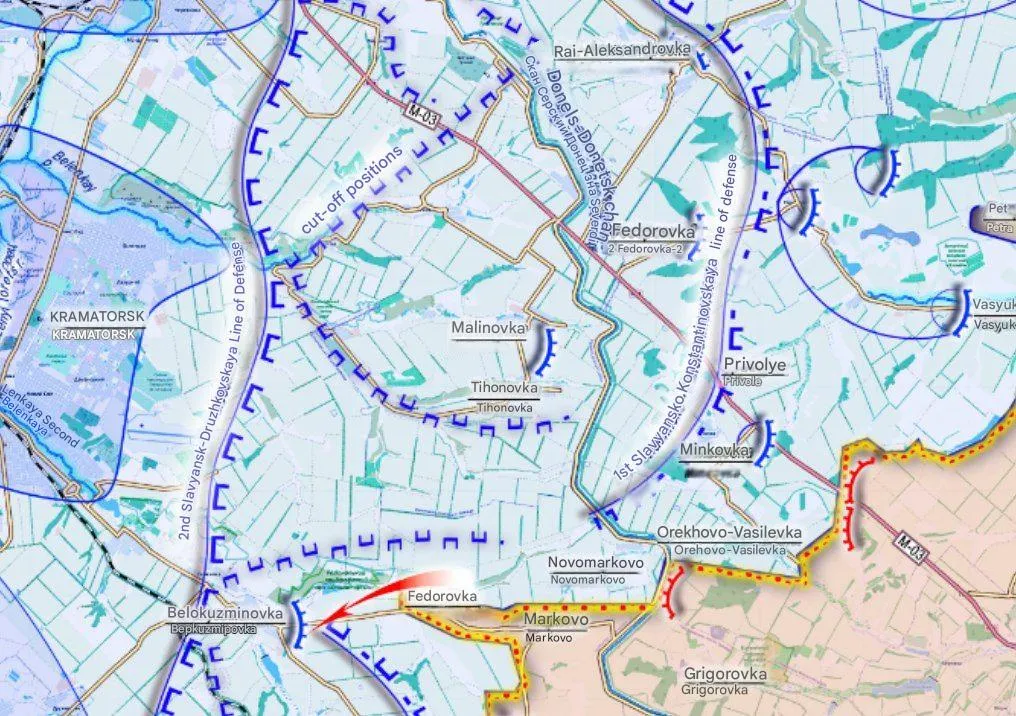
Additionally translations. 1st and second lines of Defense along with cut-off positions.

https://maratkhairullin.substack.com/p/ ... ember-25th

******

Ukraine faces deepening humanitarian crisis as 37% live in poverty, 65% of children affected
November 24, 2025 natyliesb
Intellinews, 11/10/25

Nearly 37% of Ukrainians are now living in poverty as the war continues to devastate the country’s economy, according to humanitarian groups, a fourfold increase compared with pre-war levels that highlights the scale of the crisis as another winter approaches, according to Hope for Ukraine, a major humanitarian organisation operating in the country.

The sustained fighting and large-scale displacement have pushed millions into hardship, with more than a quarter of Ukrainian households now including an internally displaced person (IDP), a veteran, or a family member disabled by the war. Over 65% of children are living below the poverty line, leaving the country’s social fabric under severe strain as dependence on public transfers and humanitarian aid deepens.

“The situation has become systemic — not a temporary shock,” said Yuriy Boyechko, CEO of Hope For Ukraine. “Low-income families are suffering the most, and inequality is widening fast.”

Regional disparities have also intensified. In front-line and recently liberated areas, nearly half of all households report damage to homes or assets, while many struggle with severe food insecurity and limited access to basic services. By contrast, wages in safer, higher-skilled sectors in western and central Ukraine have continued to rise, fuelling what analysts describe as a “two-tier recovery” that risks further marginalising war-affected communities.

As Ukraine braces for another harsh winter and continued hostilities, humanitarian groups warn that the deepening poverty crisis — especially among children and displaced families — could have long-lasting consequences for the country’s recovery and stability.

https://natyliesbaldwin.com/2025/11/ukr ... -affected/

******

The European matryoshka of irrelevance

Pepe Escobar

November 25, 2025

The EU/NATO combo cannot but play the role of pathetic yapping chihuahuas. That’s the price you pay for a matrioshka of supreme stupidity.

No one ever lost money betting on the politically suicidal instincts of post-Orwellian EU – that acronym for a virtual Europe.

Call them juvenile bipolar psychos or a bunch of yapping chihuahuas: no Jupiterian or Mercurial voice of reason has been capable to impart to the “leadership” in Brussels and their vassals in most European capitals – yes, there are healthy exceptions – that losers in wars do not dictate terms.

And still those War Council luminaries – with a special starring role for the toxic Pfizer Medusa and her Estonian sidekick unable to even manage a herring stall in the Baltics – insist that essentially the mega-corrupt gang in Kiev must prevail, to the last Ukrainian dead, and on top of it dictate the final terms of their non-surrender.

Reality begs to differ. Plan A was never to talk, much less negotiate with Russia. And still there’s no Plan B.

So after the 28-pointer Theater of the Absurd – which is not even Trump’s plan, but a mish mash concocted by the Witkoff-Dmitriev duo plus “insights” from neo-con Rubio and toxic Zionist asset Jared Kushner – the cross-yapping went ballistic, leading to an emergency “counter-plan” that is, what else, a Loser’s Manifesto.

Even Rubio allowed himself a shining moment: “What plan?” Might as well call it The Euro-kiss of Death.

Russia, meanwhile, behaves like Lao Tzu surrounded by rabid stray dogs. The conditions for a negotiation have been set in detail by Putin since June 2024. These are non-negotiable, and would allow the negotiation to start: Kiev withdraws from the four regions and formally pledges to never enter NATO.

One of the EU’s “counter-plan” points is a 30-day ceasefire, with all territorial disputes to be debated afterwards. So that means everything frozen on the current front line, and no Ukraine withdrawal from the parts of Donbass they still occupy.

None of that – and much more – is remotely acceptable to the actual winner of the war, Russia. It would not be acceptable even if NATO troops were entering Moscow tomorrow.

So the “counter-plan”, elaborated in conjunction with the unimaginably corrupt Kiev combo, is essentially a sabotage op to buy some extra time and buy some $6 trillion in – American – weapons – for their amply avowed Forever War. Fine with Moscow – as the SMO will keep going on, rolling thunder mode.

Losers bombing a peace plan

The EU’s 24-point counter-plan contains nuggets such as Ukraine

receiving legally binding security guarantees from the Empire of Chaos and its vassals: a de facto NATO Article 5 scam with different terminology.

Plus no restrictions on Ukraine’s armed forces and defense industry; control of the Zaporozhye Nuclear Power Plant (with the Empire of Chaos in the mix) and the Kakhovka Dam; unhindered access to the Dnieper River and control of the Kinburn Spit.

And the killer: Ukraine “financially compensated” – including through the stolen, so far, Russian sovereign assets, which will remain stolen until Moscow pays compensation.

As for sanctions, they “may” – that’s the operative word – be “partially” – another operative word – eased only after a “sustainable peace”, with automatic snap-back if the deal is violated. Translation: the West can sanction Russia again anytime they see fit. No word on provocations by the EU/NATO using Ukraine – the actual set up that led to the SMO.

So what the “counter-plan” proposes – obviously redacted by a bunch of Eurocrats who cannot even fire a pistol properly – is a replica of the exact blueprint that led to the battlefield opened in February 2022.

Russia once again is playing it with boundless patience. The Trump plan which is not really Trump’s is diplomatically regarded as a “good foundation” for further serious negotiations – with the yapping crowd having no access to the table. That’s it – at best.

After all Russia is enjoying a series of overlapping asymmetric advantages in the battlefield: systemic and tactical adaptation; enormous advantage in drone operations (FPV drones with fiber-optics); use of long-range glide bombs.

The chihuahua “counter-plan” essentially calls for a frozen war; a remilitarized Ukraine; a remilitarized NATO; and ultimately a perennial Forever War against Russia. It has already bombed, metaphorically, the original Trump plan that is not exactly Trump’s.

The “counter-plan” should also be seen as a diversionist tactic now that the dark pit of corruption in Kiev starts to be pried upon by the NABU investigation – even as Russian UN representative Nebenzya had been warning the UN Security Council since forever that “you were dealing with a corrupt gang that is profiting from the war”.

Nebenzya also correctly observed that not a single Western country has said a word about the corruption scandal in Kiev. Of course: because a proper investigation will inevitably follow the corruption chain of command all the way to decision making circles in Washington and in Brussels.

The metaphysical void of EU “elites”

Emmanuel Todd, in his ground-breaking The Defeat of the West, published in France early last year (the first review in English is here) was the first European analyst to get deeper into the EU malaise, side by side with his comprehensive analysis of the proxy war in Ukraine.

Recently, in an outstanding lecture in Hiroshima,

Todd made a startling correlation between Russophobia and Protestantism. Certain passages are worth quoting at length:

“What we have seen appear recently in Europe is a specifically European Russophobia, a specifically European warmongering, centered on Northern Europe, on Protestant Europe. Protestant Europe is the United Kingdom, it’s the majority of Germany, it’s Scandinavia, it’s two out of three Baltic countries.”

At the same time, Todd has observed that “Spain, Italy, Catholic countries in general, are neither Russophobic nor hawkish.”

Todd’s key argument is that protestantism “is more dangerous in its zero state than Catholicism”: “Protestantism is more capable of leaving behind a nihilistic society. Protestantism, and the same could be said of Judaism, was a very demanding religion. There was God, there was the faithful, and the world was secondary. The beauty of the world in particular was rejected with, among other things, a refusal of images, a refusal of the visual arts. When such religions, obsessed with transcendence, disappear, nothing remains. The world itself is not interesting, empty. This intense void opens up a particular possibility of nihilism. Catholicism is a less demanding, more humane religion that can accept the idea that the world is, in itself, beautiful. The images have not been rejected in the Catholic world, and the Catholic world is filled with artistic wonders. In a Catholic country, if you lose God, you are left with the feeling of this beauty of the world. If you are French, you still have the feeling that you live — an illusion no doubt — in the most beautiful country in the world.”

Well, it’s slightly more nuanced. What about the – vicious – Crusades and the Spanish Inquisition? Germany was in fact forced by a massive P.R. campaign to become Russophobic, unlike the Baltic chihuahuas. Most of Protestant Europe is in fact atheistic – and the next step from atheism is nihilism. Romania is mostly Christian Orthodox – where hatred of Russia is like a national sport. And Protestantism was essentially Christianity turbo-charged to the Age of Capital. So the main conflict is in fact Western turbo-Neoliberalism v. Christian Orthodox Russia.

Back to the basics. Everyone with an IQ over room temperature knows that the NATO regime in Kiev runs on theft and outright plunder. The lights are now off. Heating is mostly off. The army is steadily collapsing all along the 1,200+ km frontline.

Yet the EU elites – the set up in Brussels just follows their orders –

have invested no holds barred in the inevitable (in their dreams) collapse and looting of Russia. That’s why there was never a Plan B.

If the EU folds now, if they admit they are the irretrievable losers in this absurdist adventure, the economic collapse will be epic. The EU/NATO combo cannot but play the role of pathetic yapping chihuahuas. That’s the price you pay for a matryoshka of supreme stupidity: to provoke and threaten a superpower with the most advanced nuclear and hypersonic arsenal on the planet. Their current “victory” is to bomb Trump’s already shaky “peace” plan.

So many horrors, so little time. On a more auspicious note, let’s give Todd the last word:

“If you are Italian, you actually live in the country in the world where there are the most beautiful things, since Italy itself has become an object of art. In such contexts, the fear of the metaphysical void is less intense, and therefore the risk of nihilism less. In my opinion, the country in Europe least threatened by nihilism is Italy, because in Italy everything is beautiful”.

So shed your metaphysical void, dump those chihuahuas of war, and embrace the beauty of Italy as a living work of art. That’s exactly what I’m doing next.

https://strategic-culture.su/news/2025/ ... relevance/

******

7 days of flight before the "strike" on Moldova
Geranium
November 25, 5:02 PM

Image

The Gerbera discovered on the roof of a barn in Moldova was launched ( https://t.me/The_Wrong_Side/26895 ) on November 18th at targets in the Kharkiv region. And on the 25th, it "arrived" in Moldova.

It's quite clear that the enemy is collecting downed Russian drones, restoring them to working order, and launching them at Europe to fuel the hysteria about "unknown drones." Europe is well aware of this, but pretends to be unable to understand where these "unknown drones" are being launched at Europe.
It's like the foolishness of "we don't know who blew up the Nord Stream pipeline" or "we don't know who is shelling the Zaporizhzhia Nuclear Power Plant."

The story of this Gerbera simply demonstrates once again who is the main threat to peace in Europe: the Nazi regime in Kyiv and its sponsors in the EU.

https://colonelcassad.livejournal.com/10208499.html

London Insurance Plan
November 25, 3:06 PM

Image

A statement from the Russian Foreign Intelligence Service regarding Britain's attempts to disrupt negotiations to end the war in Ukraine.
Essentially, they're doing the same thing they did in 2022. As for the plan to discredit Trump as a Russian agent, that's all been done before. Former British MI6 agent Steele (Skripal's handler), commissioned by Hillary Clinton and company, concocted the now-famous "FSB agent" story about Trump during Trump's first presidency, which was later officially refuted by US government agencies.

https://colonelcassad.livejournal.com/10208230.html

Google Translator

******

The situation in the north
November 25, 2025
Rybar

Image

Good news is coming from the Burluk direction . Units of the "North" group are finishing off the enemy's defenses in Volchansk , advancing through the forests south of the city, and advancing along the border on the eastern flank at the junction with the Kupyansk direction .

How is the situation developing?
The offensive south of Volchansk continues. Having secured positions in Kirpichnoye and, earlier , Sinelnikovo , Russian attack aircraft have now begun fighting for neighboring Liman and Vilcha . In both areas, they have already secured strongholds in the buildings.

In Vovchansk itself, the enemy has been driven out of several more blocks east of Gurkanovskaya Street —assault teams have reached Skovorody Street . In the southern part of the city, Ukrainian forces have been driven out of almost the entire Panina Street .

On the eastern flank near Dvurechanskoye, Russian troops occupied the Stanovoye tract and Krinichny Forest , driving out the enemy. Thus, the assault troops managed to close several more pockets along the Dvurechanskoye-Kamenka line .

Recently, Russian units have made significant advances into Vovchansk . Although the city is now in ruins, it has not lost its tactical importance. Taking Vovchansk will open the road southwest to the crossing in the village of Stary Saltov .

If successes are maintained, it is possible that the “northerners” will be able to develop an offensive to the southeast towards the White Well .

https://rybar.ru/obstanovka-na-severe/

Is peace near?
November 25, 2025
Rybar

Unscheduled negotiations in the UAE are bearing fruit. Zelenskyy is reportedly ready to meet with Donald Trump on Thanksgiving Day, November 27, to finalize the deal on US terms.

A Ukrainian delegation led by Chief of the Main Intelligence Directorate Budanov arrived in Abu Dhabi, where they held talks with the Russian side, represented by Chief of the Main Directorate of the General Staff of the Russian Armed Forces Admiral Igor Kostyukov and Director of the Foreign Intelligence Service Sergei Naryshkin .

According to Axios, the heads of Ukrainian and Russian military intelligence were originally scheduled to meet in Abu Dhabi on a different matter. However, the arrival of US Army Secretary Daniel Driscoll came as a surprise to both sides and changed the original plan.

In this situation, it is especially important that the negotiations are not being held in Turkey, which has not proven to be the best negotiating platform, but in the United Arab Emirates.

The Emirates may be viewed differently, but it is a country that aspires to be at the crossroads of interests of leading global powers, as well as regional financial leadership thanks to its resources and capabilities. Therefore, the negotiating level could be "conditionally" raised.

However, the key question remains that the terms and conditions of the agreement have not yet been announced. There are no specifics or detailed information on how and to what extent the agreement might be implemented. Without this, it is premature to speculate or draw any conclusions.

https://rybar.ru/mir-blizko/

Some people's war is some people's mother
November 25, 2025
Rybar

Western companies' desire to profit from the Ukrainian conflict has long been the talk of the town. Russia's Foreign Intelligence Service (SVR) announced Britain's intention to receive €6 billion in EU funding for increasing drone supplies to the Ukrainian Armed Forces.

Compared to how much the US has pumped into the Kyiv regime since 2022, this sum may seem small. But for the British, whose total military budget is around $60 billion, this is no small sum.

Moreover, Britain's defense sector has long been experiencing problems, losing orders and expertise. Under these circumstances, a few billion euros would certainly be a welcome addition for British defense industry companies.

Therefore, the Western "arms lobby" is one of the main beneficiaries of the fighting in the so-called Ukraine. And while the American military-industrial complex can still secure a slew of orders to escalate tensions with China, the European one has no such alternative.

This partly explains why Europe is so reluctant to even freeze the war to the last Ukrainian: by militarizing and aiding the Kyiv regime, British and European military corporations in general are improving their financial situation and receiving contracts for years to come.

And the fact that all this is actually paid for by the wallets of ordinary Europeans to the detriment of other sectors of the EU economy certainly doesn’t bother the gentlemen at BAE Systems or Rheinmetall.

https://rybar.ru/komu-vojna-komu-mat-rodna/

Google Translator
"There is great chaos under heaven; the situation is excellent."

User avatar
blindpig
Posts: 14788
Joined: Fri Jul 14, 2017 5:44 pm
Location: Turtle Island
Contact:

Re: Footnotes from the Ukrainian "Crisis"; New High-Points in Cynicism Part V

Post by blindpig » Thu Nov 27, 2025 12:12 pm

Plan B
Published by @nsanzo ⋅ 11/27/2025

Image

Following the trend of recent months, Russia and Ukraine are trying to position themselves in the negotiations in a way that avoids provoking Donald Trump's anger. Moscow has even made relatively favorable statements regarding what Kyiv and Washington supposedly agreed upon in Geneva. Zelensky's move to accept this peace agreement, based on a compromise that leaves all the essential aspects of the war unresolved, doesn't seem to have gone well, and Donald Trump has rejected the Ukrainian idea of ​​an imminent meeting between the two presidents. It is in a bilateral meeting, solely with the United States and with the support of the EU, that Kyiv wants to negotiate the issues of territory and security. Just in case, Ukrainian officials, including the president, are making statements these days clarifying that their red lines remain unchanged. As CNN reported yesterday , there are three points on which Ukraine is unwilling to compromise: the territorial issue, NATO, and limitations on its military.

The 28-point document presented in Kyiv by Dan Driscoll, which he delivered to Zelensky with the message that the capacity of the United States and NATO to improve the situation on the front lines was limited and that the deterioration on the ground would continue , thus requiring compromise, entailed a limit of 600,000 troops in the Ukrainian Armed Forces. This aspect has been considered an unacceptable demand by Kyiv, its European allies, and its media partners. “Ukrainians don’t want to live on their knees. They’re not going to sacrifice their right to have an army,” stated Josh Rogin, one of the best-known columnists for The Washington Post , on a CNN program , without mentioning that this figure would make the Ukrainian army the second largest in Europe, second only to the Russian army.

Only a few pro-Ukrainian Western analysts, still capable of logical reasoning, have downplayed this limitation. “Limiting the Ukrainian army to 600,000 troops is not as drastic as I imagine the Russians intended. When I spoke to some analysts at the British Ministry of Defence a couple of months ago, they expressed doubts that Kyiv could afford more than 500,000 troops in the long term,” wrote Times columnist Mark Galeotti. The subtext of Galeotti’s comment—to which we can add that the certainty that the army will not reach those levels makes it easier for Russia to accept it—is that Ukraine could only afford such an army if its costs were covered by external funding. Through lobbying by the European Union, Ukraine appears to have managed to raise the limit to 800,000, a figure that defies all logic unless the goal is not a peaceful situation, but a continued conflict, and there is certainty that the flow of economic assistance to sustain these armed forces will not disappear beyond the ceasefire.

To the demands for a Ukrainian army that triples its 2022 size and even surpasses its current levels, we must add the statements from various countries seeking to perpetuate the idea of ​​the Russian threat, necessary to maintain rearmament, increased military spending, and the conflict with Russia beyond any possible ceasefire. “Putin has the EU and NATO in his sights. Our intelligence services are issuing urgent warnings: at the very least, Russia is creating the option of declaring war on NATO by 2029. We must deter any Russian aggression, together with our partners and allies,” the official German Foreign Office account wrote yesterday, in yet another example of the “enemy at the gates” rhetoric so useful for justifying the implementation of Kakha Kallas’s two-point plan : raising the level of sanctions to increase political, economic, and military pressure against Russia and increasing economic and military assistance to Ukraine. “We still need to move from a situation where Russia is pretending to negotiate to one where it needs to negotiate,” Kallas declared yesterday, as if the EU and its British and American allies hadn't already been making those efforts unsuccessfully for three and a half years. To top it all off, Kallas launched yet another harebrained scheme yesterday: demanding that Russia reduce its military and make “serious concessions.”

Considered particularly radical, Kakha Kallas is not, however, a lone voice; her statements are perfectly consistent with those made by the NATO leader, the foreign affairs committees of European parliaments, and the leaders of the major EU powers, who this week issued a statement insisting on Ukraine's territorial integrity—a dream that dates back twelve years. Almost automatically, the Ukrainian president yesterday expressed his gratitude for Ursula von der Leyen's recent address to the European Parliament, stating that “we share the same opinion: as long as Russia continues to reject all peace efforts, sanctions against it must be tightened, and financial and defense assistance to Ukraine must continue. We discussed the current diplomatic situation and the European Union's role in making decisions about the use of frozen Russian assets for Ukraine's defense. We also coordinated our contacts for the near future.” Russia has negotiated the 28-point plan with the United States. Its president indicated that, for the first time, there is a document on which to negotiate, and even now that the most important aspects for Russia have been temporarily removed to protect Ukraine from a peace with excessive compromises, the Kremlin is looking for ways to appease the United States by appearing open to negotiation. However, European and Ukrainian discourse insists that Russia rejects any opening to negotiations that it has never been offered. The only political dialogue in which Zelensky wants to discuss the key issues is not with Russia, nor even with the United States in the broader sense, but only with Donald Trump. All of this is with the support of his European allies, whose opinions Moscow has even admitted must be heard, since the issue of security in Europe—understood not only as the European Union and the United Kingdom, but also the territory stretching between the Atlantic and the Urals—directly affects them. This Russian openness to dialogue with the EU, seen in recent months as more belligerent than the United States and even Ukraine, is not reciprocated by European countries, whose position has not only not changed in the face of the possibility of political negotiations in search of peace, but has been reaffirmed.

Completely detached from reality, the meetings of the Coalition of Volunteers continue, with European leaders feigning activity, hinting at their importance, and never actually proposing anything concrete. However, their generally empty pronouncements are enough to give Russia a clear picture of the European countries' true intentions. In fact, one doesn't need to use excessive imagination, nor listen to particularly radical officials; one need only listen to Emmanuel Macron's statements.

“Soldiers from France, the United Kingdom, or Turkey could be sent to Ukraine as part of a ‘security force’ on the ‘day peace is signed,’ French President Emmanuel Macron stated in an interview with French radio station RTL published on November 25. Forces operating under the “Coalition of the Willing” would be deployed to rear areas, such as Kyiv or Odesa, to provide security and training, thus serving as one of Ukraine’s post-war guarantees, Macron said at the European Union-African Union summit in Angola. The coalition, led by France and the United Kingdom, was created earlier this year to provide security guarantees to Ukraine as part of a potential peace agreement, with the aim of strengthening the country against any future Russian aggression. The deployment to Ukraine would not take place under NATO, but as part of an “intergovernmental coalition,” Macron said, The Kyiv Independent wrote yesterday , referring to the French president’s words, who continues to insist that the Troops from three of NATO's European armies would not constitute an Alliance contingent. No European leader can be so naive as to believe that this ploy will be enough to get Russia to accept a peace agreement on these terms. Therefore, it can be deduced that the idea of ​​introducing troops the day after the ceasefire is intended to guarantee a peace in which Ukraine continues to be used as a military platform to weaken the Russian Federation—an objective that the EU continually reaffirms.

European plans, which involve the militarization of Ukraine in a scenario similar to that of North Korea, require immense funding that Ukraine lacks. Although less discussed than the NATO issue or the territorial aspect, the fact that the EU—and Kyiv, in its shadow—has drawn a red line against using a significant portion of Russian assets held in the West for the reconstruction of Ukraine is tremendously relevant. It's not just about preventing some of those funds from going to the reconstruction of territories that will remain in Russian hands, which, in the case of Donetsk, is perhaps the area suffering the most damage in the war, but about ensuring that the funds are used for what Brussels wants them to be used for. The Russian funds are not for the reconstruction of Ukraine, but for the acquisition of weapons and the maintenance of the military component of a state that will do for the EU what Israel does for the United States. Hence, it is not surprising to hear reports that, despite the possibility of peace implied by the existence of relatively advanced negotiations in search of a document to serve as a basis for diplomacy, European countries are reacting by accelerating their efforts to seize Russian assets.

“The EU will accelerate its plan to use frozen Russian state assets to back a €140 billion loan to Ukraine, European Commission President Ursula von der Leyen announced Wednesday. During a speech in the European Parliament, she pledged to present a formal proposal outlining the plan as a measure to aid the war-torn Ukrainian economy. ‘The next step is that the Commission is ready to present a legal text,’ von der Leyen told lawmakers in Strasbourg, though she did not specify when the document would be presented,” Politico reported yesterday .

Financing the war, or worse, maintaining the militarization of the Ukrainian state—understood, as Zelensky hopes, as the EU's external security frontier —is more important than ensuring its reconstruction. And if countries like Belgium, absolutely vulnerable to state bankruptcy in the event of litigation and a Russian victory in court, refuse to approve the system of creative legality to provide Ukraine, technically through a loan that all parties know it will never repay, with an amount equivalent to Russian assets, then an alternative path is necessary. “European countries are urgently seeking a plan B to finance Ukraine,” Politico added in another article , noting that Kyiv risks running out of money in March. The solution is not to seek peace, which would reduce economic needs—financing a war and constantly acquiring weapons is not a cheap undertaking—nor to guarantee that Ukraine has a significant portion of Russian assets for its reconstruction, but rather to continue drawing red lines and insisting on demands that make an agreement impossible, instead seeking ways to maintain military spending. “One option gaining traction is a ‘bridge’ loan, financed with EU funds, to keep Ukraine afloat during the first months of 2026, according to four officials. That would provide more time to set up the full reparations loan using Russian assets in a way that Belgium might accept, in order to provide a longer-term solution.” Economically, as militarily, the European Union’s only plan is to buy time to try to impose Plan A.

https://slavyangrad.es/2025/11/27/plan-b-2/

Google Translator

******

From Cassad's Telegram account:

Colonelcassad
Seversk direction (data from @DnevnikDesantnika )


General situation in the direction.

We continue to tighten the encirclement around the city of Seversk, focusing on the destruction of enemy logistics routes and UAV control centers. At the same time, we are developing offensives on adjacent sectors of the front.

Northern sector:

Clearing and destroying individual Ukrainian Armed Forces units in Yampol is underway. We are pressing the enemy from the western and eastern sides. The Russian

Armed

Forces have completely cleared the network of strongpoints located on the eastern outskirts of the city of Seversk (1).
Simultaneously with the advance from the eastern side, our soldiers are also developing an offensive from the northeastern side of the city (2). Here, we have taken up new positions in the private sector, advancing more than 1 km.
There is information about the start of fighting in the central part of Seversk, near the railway station. Good luck, guys!

Southern sector .

We regularly carry out aerial bombing, artillery strikes and drone strikes on the main supply routes that run from Slavyansk through Rai-Aleksandrovka towards the settlement of Seversk (3).

***

Colonelcassad
3:07
🏳️ Captured Ukrainian serviceman Artem Kondybko reported on the terrible situation at the front and the crimes committed by the Ukrainian Armed Forces in Krasnoarmeysk .
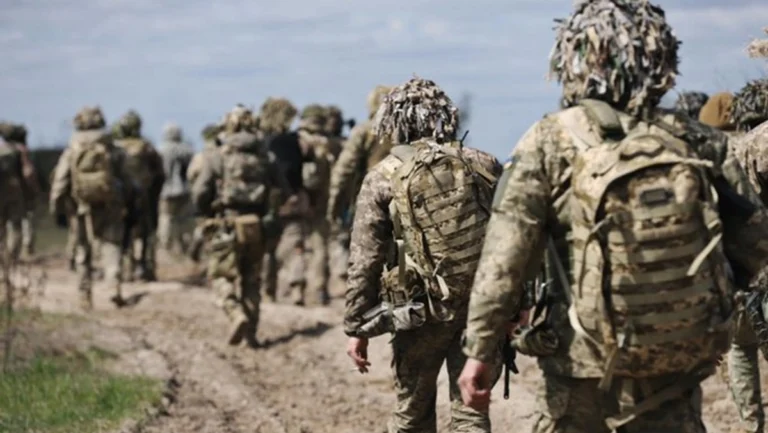
"In Krasnoarmeysk (the Ukrainian name for Pokrovsk), they captured our crew, three of us. The machine gun was in a residential building. The mission was to destroy Russian manpower, as well as equipment and Ukrainian Armed Forces soldiers who were retreating, unwilling to fight or fire. When they retreated, they told us not to spare them. They were to shoot the same way they had the Russian forces ," said prisoner of war Kondybko.

Artem also said that Ukrainian units often abandon the wounded to their fate :

"The situation is dire, everything is missing: no provisions, no ammunition, nothing. A lot of people have died, many have been killed, many are surrendering, the Russians are already evacuating the wounded, Russian soldiers are evacuating them . I think even if they could, I doubt the Ukrainian Armed Forces would have the desire to do so."

Kondybko commented on the crimes of his fellow soldiers and the abuses committed by Ukrainian Armed Forces units against the remaining civilians in Krasnoarmeysk.

Speaking about his time in the unit, Kondybko noted instances of corruption among the command . In his speech, the serviceman also mentioned the good treatment of captured service members by the Russian Armed Forces .

https://t.me/s/boris_rozhin

Google Translator

******

SERGEI LAVROV HAS THE “WE ARE LOSING SYRIA” LOOK – NEW PODCAST WITH NIMA ALKHORSHID BREAKS THE NEWS

Image

By John Helmer, Moscow @bears_with

In today’s podcast, we go step-wise through the Florida plan of Steven Witkoff and Kirill Dmitriev (28 points); the Geneva plan of Daniel Driscoll and the US Army generals (19 points); and the Abu Dhabi plan of Driscoll, the US Army Generals, Dmitriev and a secret Russian business representative, excluding the Foreign Ministry, the General Staff and the intelligence services (19 points minus 19). Then we reach the conclusion that the Americans are promoting a scheme which has nothing in common with the understandings President Vladimir Putin believes he reached in Anchorage, Alaska, on August 16 with President Donald Trump. In short, a plan of points that are pointless. Click to view. https://www.youtube.com/watch?v=Pz9g4PeUIOI

https://johnhelmer.net/sergei-lavrov-ha ... -the-news/

******

Russia Not to Make Concessions in Ukraine Peace Talks

Image
X/ @censor_net

November 26, 2025 Hour: 9:16 am

Moscow will not retreat from key positions as negotiations with Washington continue.

On Wednesday, Russian Deputy Foreign Minister Sergei Ryabkov said his country welcomes the diplomatic efforts of U.S. President Donald Trump but will not make concessions in negotiations over a peace plan for Ukraine.

“There can be no talk of any concessions, of any retreat from our positions on key aspects… including those raised in the context of the special military operation,” he said, while praising “the efforts of the Trump administration in seeking logical solutions and rational outcomes.”

“Various versions of this peace plan are part of the negotiations,” Ryabkov said, adding that Russia’s position has been consistent from the beginning. “That position concerns various aspects of the current situation, focusing largely on the original causes of the crisis we have been facing for a long time.”

Ryabkov referred to the Alaska summit between Trump and President Vladimir Putin as a fundamental starting point. “This is the basis from which we will proceed when we study and negotiate the version that is currently — or will later be — on the table,” he said.


The Russian diplomat called on media outlets “to show the utmost responsibility” amid a flood of reports on different versions of the peace plan and leaks of conversations between representatives of Russia and the United States.

“We are precisely in a period in which we cannot allow ourselves to be drawn into provocations,” Ryabkov said, referring to the negotiations between Russia and the U.S. to improve relations between the two countries.

“There are enough unresolved problems in interaction and dialogue with Washington, but we are prepared to continue the entire bilateral agenda with the understanding that it will be based on respect for Russia’s interests. Despite the declared support of the U.S. government for restoring dialogue with Russia and the apparent progress toward normalizing Russian-U.S. relations, Washington’s actions are quite contradictory,” he pointed out.

Ryabkov added that Washington continues to supply intelligence and weapons to the Kiev regime, though now using European financial resources.

https://www.telesurenglish.net/russia-n ... ace-talks/

*****

'Settlement' Carnival Reaches Fever Pitch as Antsy Euros Jockey for Relevancy
Simplicius
Nov 26, 2025

The ‘peace settlement’ shenanigans continue their descent into kabuki farce. The back and forth tug between “28 point” plans and “19 point” plans and everything in between is nearing the slapstick absurdity of a Monty Python skit.

Russia—yesterday through Lavrov and Peskov—continues to maintain that no real plan has been presented to the Russian side yet, and that all military objectives of the SMO must be achieved. So what is the point, exactly, of this loony back-and-forth, which is crescendoing to hysterical levels?

Each side has its own axe to grind: for the Europeans it’s not only to save Ukraine and the cabal’s war against Russia, but to save their own hides, political careers, etc. The entire EU is now riding on Ukraine as the sole predominant issue—if a catastrophic failure here takes place, a firestorm could sweep away virtually every hated sock-puppet like Macron, Merz, Starmer, et al.

In short, it’s a mad dash to salvage the disintegrating nearly 100-year-old Ukrainian-Western project. For Ukrainian political elites, the purpose now is to stuff their pockets before the collapse while ensuring protection for themselves in the ensuing storm.

Here’s WSJ explaining how Ukraine changed the so-called “28-point plan” to give its elites total amnesty for their wanton corruption after the war’s end:

Image

Now, Bloomberg has leaked what is claimed to be a transcript of Steve Witkoff’s conversation with top Putin advisor Ushakov. It is a desperate last minute hail mary with zero attribution—not even the usual lazy ‘anonymous sources’ sop. The motivation is clear: to quickly throw a spanner in the works and throw off the Trump team’s plans to turn Ukraine into a sacrificial lamb for the purpose of rapprochement with Russia. If the leak is real, the far bigger scandal is that it happened at all, as pointed out by Greenwald:

Image

Key cog Kirill, for his part, was adamant it’s a total fake:

Image

In the meantime, Putin has continued to transmit the same stalwart messaging.

Putin says the US hasn’t shown Moscow the full text of the new plan because Washington ‘can’t secure Ukraine’s approval’

Kiev and the EU STILL cling to fantasies of a ‘strategic defeat for Russia’

Warns these delusions will lead to consequences they don’t even grasp


(Video at link.)

Putin’s much more direct statement was that Russia is already achieving all of its military goals, implying peace talks are not a necessity, though Russia remains open to them under the strict condition that detailed discussions on all major demands be carried out:

“Russian goals are already BEING ACHIEVED on the battlefield but we are ready for peace talks.

Resolving the conflict peacefully requires detailed discussions.”


(Video at link.)

The message, as always, is clear: Russia has all the cards and will not be strong-armed or brow-beaten into cessations of the hostilities merely “for the sake of”. Everyone already knows precisely what this would bring, as Macron spelled out just earlier today—listen at the 0:35 second mark:

(Video at link.)

Image

“We must put French and British troops in Kiev and Odessa…”

In short, the Euro-cabal is desperate to force Russia into an unfavorable ceasefire to immediately inject NATO troops and “freeze” the conflict for however long it takes to re-arm and re-generate the AFU for round two of this existential clash of civilizations.

The corporate press is not optimistic:

Image

As a last note, this post by Trump is a true masterclass in the hysterical post-imperialism political-degeneracy waning phase of the US Empire:

Image

“THE USA CONTINUES TO SELL MASSIVE $AMOUNTS (sic) OF WEAPONS TO NATO, FOR DISTRIBUTION TO UKRAINE….GOD BLESS ALL THE [millions of] LIVES THAT HAVE BEEN LOST IN THE HUMAN CATASTROPHE!”

Yes, god bless the millions lost, but god bless the MIC even more.

Image


The collapse of the Ukrainian front continues to accelerate.

In the Gulyaipole direction, Russian troops have steamrolled up to the Haichur river—after having cleared everything on the Yanchur earlier—capturing multiple settlements there:

Image

Most notably, not only has Gulyaipole come under partial encirclement, but Russian troops have even broke through and already begun fighting inside the town itself, marking the possibility that Gulyaipole may become one of the fastest fallen major strongholds of the entire war:

Image

From a top Ukrainian outlet—complaints that lack of communications devices has imperiled the front:

Image

Maksim Zhorin, deputy commander of the Azov Corps, complains bitterly about the state of the frontlines:

Image

Meanwhile, Pokrovsk has been completely captured, and Mirnograd—according to our best cartographers—has had its cauldron fully closed, as opposed to ‘gray zones’ or mere drone ‘fire-control’ over the last supply routes, etc. The map is self-explanatory:

Image

Footage even emerged of what was claimed to be prisoners being marched from the Mirnograd area, as viewed by passing Russian army motorcyclists: (Video at link.)

A gallery from RIA Novosti of what the Russian supply routes into the agglomeration look like:

Image
Image
(Other images at link.)

From a Ukrainian analyst:

Now is one of the hardest moments of our history. Now the pressure on Ukraine is one of the hardest. Now Ukraine may find itself facing a very difficult choice – either loss of dignity, or the risk of losing a key partner. Either the difficult 28 points, or an extremely hard winter, the hardest, and further risks. Life without freedom, without dignity, without justice, and for us to believe in the one who has already attacked twice. They will expect a response from us.

And another, describing the intensification of Russian operations:

At the same time, there is systematic destruction of our ammunition depots, supply points, and accumulation sites—to isolate the maneuver and make every move costly. This is not chaotic work but a clear scheme: first jam, break logistics, then press with infantry. There is nothing top secret here, we understand it, the enemy understands it, and it is all visible in the footage.

☠️Overall, combat operations across the entire sector continue without pause. It’s not getting better; on the contrary, the pressure, density of strikes, and pace of enemy attempts to slip into our seams increase daily!


By the way, yesterday Zelensky made an urgent address which was the first time ever that the Ukrainian leader has come close to admitting the war is nearly lost—it’s a fitting must-listen to close out the show: (Video at link.)

“They are waiting for a response from us, but I gave it on May 20, 2019, when I promised to defend the sovereignty and independence of Ukraine.”

“We did not betray Ukraine on February 24, and we will not betray it now.”

“I am addressing everyone — people and politicians — to gather and stop this mess.”

“We are of steel, but even the strongest metal can at some point break.”


Lastly, we leave off on this colorfully apt reduction of the “settlement” process and its many absurd ‘guarantees’, from Russian war correspondent Vlad Zizdok:

“The fox promises not to be cunning. The neighbor promises not to make noise. The dog swears not to steal food in the owner’s presence. The elephant promises to behave carefully in the china shop. The thief promises not to take the wallet. The wolf swears not to wear sheep’s skin. The official promises to act. The cat vows not to eat fish. The river plans not to overflow. The persimmon definitely does not astringe. And I promise never to drink again.

The agreement is legally binding.

Violations - sanctions.”


https://simplicius76.substack.com/p/set ... ches-fever

*******

War or peace?

Frontline events and peace narratives. Suicide bombers and suicide country. Methed-up press gangs and civil war.
Events in Ukraine
Nov 25, 2025

Within a few months, the Russo-Ukrainian war will have lasted three years. Trump will have been trying to put an end to it for a year. And the longer things last, the more tiring is the repetition.

With Russia winning on the battlefield, the US presents Ukraine with a peace deal which represents Russian interests. The western media, in its infinite wisdom, is currently hard at work trying to demonstrate that Trump’s peace deal was ‘written originally in Russian and translated’. But were that were true, it wouldn’t matter.

Even if Trump’s envoys handed Ukraine a peace deal Putin wrote by hand and signed in Russian, it wouldn’t change the essence — that Ukraine, constantly retreating on the battlefield, isn’t going to get an appealing deal.

Anyway, faced with a bad deal, Kyiv decides not to accept it. With plenty of cheering from its wonderful western partners, of course. Zelensky and his men get to work presenting their ‘edited version’ of the deal they were given, a version that Russia will no doubt reject (assuming it even approved of the initial American deal).

Cue another few months or years of Ukrainian retreats, at which point they will be presented with a worse deal. I’ve seen this before…

For their part, some frontline Ukrainian nationalists aren’t fooled, like the Azovite sergeant behind the telegram ‘Tales of the IV Reich’:

Image

Meanwhile, media talking heads continue bravely criticizing any and all ‘capitulation peace’.

Ordinary men subject to forced mobilization have different opinions. No one listens to them, so they are forced to express them otherwise.

On the 21st, for instance, an Odessan man blew himself up and injured a mobilization officer. The man seemed to expect he might be grabbed off the street and shoved into one of the dreaded mobilization minibuses. According to the mobilization center, the explosive device was already in his backpack. Clearly, he decided he would rather go out on his terms, and perhaps take one of his tormentors with him.

(Video at link.)

A compelling metaphor. The country’s leadership and its foreign allies have decided to turn the nation into a kamikaze. Suicide in the name of the greater cause of Western Civilization. The only alternative left is another type of suicide.

Meanwhile, Ukrainian men are being deported from the US back home. From one heartland of democracy to another.

Mila Nenadova wrote to instagram that her husband had been abducted by ICE on November 18th, and is set to be deported to Ukraine. In her tearful address, she reported that friends deported back home had been met by mobilization press gangs. (Video at link.)

On the 20th, the speaker for Ukraine’s border patrol, Andriy Demchenko, stated that 50 Ukrainians had been deported from the US, sent through the border crossing with Poland and met by Ukrainian officials. No doubt the men among them were taken away by Ukraine’s analogue of ICE - the mobilization press-gangs, known as the TSK (Territorial Centre of Recruitment).

It is interesting wondering whether ICE has been inspired by the TSK. They might be jealous of the methods available to their Ukrainian counterparts. This video from November 19, like countless others, shows Odessan TSK officers crashing their minibus into a cycler and pepper spraying him:
(Video at link.)

This video of an attempted TSK abduction in the Lviv area released today is interesting for other reasons. Instagram commenters drew the requisite conclusions from the TSK officer’s bulging eyes: (Video at link.)

Numbers
Men have good reason to avoid fighting in this war. An MP from the ‘Fatherland’ party said a few days ago that 500,000 soldiers have died since 2022. Zelensky’s much-ridiculed figure on this account is 46,000.

The army is aware of how things are on the ground. In an interview for Die Zeit, Chief of the General Staff of the Armed Forces of Ukraine Andriy Gnatov said that 2025 has exhausted the army:

Any commander will always say they need more personnel, more infantry, more weapons, more equipment, more ammunition, and more other resources. The situation is very difficult; we are truly exhausted by this year of war, but we are taking every measure to replenish our units and train our people

Exhausted or not, the size of the army is a major topic of the peace talks. The latest US peace deal proposed limiting the size of Ukraine’s army to 600,000, which has provoked fury from ‘pro-Ukrainian’ commentators.

It is unclear how large the Ukrainian army really is at the moment. As I covered here, politician, journalist and currently serving soldier Igor Lutsenko wrote back in July that the army is both far smaller than official claims and shrinking at a rapid rate due to losses and desertions:

Conservatively, one could assume that the army is shrinking by 10–15 thousand people each month, despite the mobilization efforts by military recruitment centers and volunteer recruitment campaigns. This assumption has no official confirmation yet, but it would also be very hard to disprove.

One more “pure hypothesis”: the actual fighting force holding the front is far smaller than the “paper” one-million figure. Realistically, it’s perhaps 400–500 thousand (with only a small portion deployed on the front lines). It may even be closer to 300 thousand.


Image

Ukraine’s army prior to 2022 numbered 250,000 men. Many Ukrainian commentators have pointed out the obvious — Ukraine’s massive wartime army is only possible because western donors pay for the country’s budget. On November 20, military analyst Dmytro Sneheriev pointed out that it would be impossible to pay the 70 billion US dollars the army currently costs after war ends:

And what are the pro-Russian narratives here? If this meets Ukraine’s needs, because we won’t be able to finance this amount. Western aid will no longer be available

Amusingly, as I was writing this, FT reported that the Euro-Ukrainian edited version of Trump’s peace plan proposes limiting Ukraine’s peacetime army to 800,000. But even this wasn’t enough for Ukrainian militarists! Take a look at what the draft-dodging warmongerer Sternenko had to say:

Image

Now, onto the meat of today’s article. We will be taking at both war and peace.

First, reports from frontline Ukrainian soldiers on the situation across the frontline, from the Zaporizhzhia and Dnepropetrovsk oblasts in the south, to the Donetsk and Kharkiv oblasts in the north.

Next, interventions by Ukrainian politicians and soldiers on the topic of war. Unsurprisingly, the female atlanticist MPs support war until the 1991 borders, while men fighting in the trenches are more positive towards peace. Highlights:

we already need to accept reality: no one will ever fight for us.

I understand that WE WANT RUSSIA TO BE DESTROYED AND FOR THEM ALL TO DIE THERE. We really want that.

But the reality is this:
we have no money
mobilisation has failed
the troops are exhausted
massive MIA numbers
we still haven’t built our own missile
huge corruption in defence and energy

— MP

These devils [politicians calling for more war] need to be changed, they do not reflect the real electoral preferences of the population, but only parasitize on the body of a warring country, raking in the remnants of the budget and openly mocking front-line soldiers and the population.

— Soldier

the sooner we make difficult compromises to end (or at least pause) this war, the better for Ukraine. Because a small (post)Soviet army under yellow-and-blue flags has no chance of winning against a larger (post)Soviet army under the Russian tricolor.

If we don’t want to fight for Zaporizhia and Dnipro [two massive cities - EIU] next year, we need to face the sad truth. We are truly different peoples. But our state system is painfully similar to our enemy’s. And this destroys our chance for victory. If two countries at war are ruled by an ineffective, incompetent, thieving government, the country that has greater resources: human, financial, territorial, industrial will win. Unfortunately, by all parameters, we are much smaller than Russia.

If nothing changes, the chance will increase every month that our generation, which has already had the tragic experience of a full-scale war, will also learn in practice what revolution/rebellion and civil war are.

— Soldier and nationalist journalist


War
November hasn’t been kind for the Ukrainian army. Maksym Zhorin, a commander in Azov’s Third Army Corps, wrote this on November 25:

Image

Stanislav Buniatov, a commander of the nationalist Aidar batallion, also sounded the alarm on November 25:

Image

Let’s take a quick look at how Ukraine’s DeepState OSINT map has changed over the course of November. I am delighted to announce that I have figured out how to turn images into videos.

First, the south. This section of the front covers around 120 kilometers. (Video at link.)

https://eventsinukraine.substack.com/p/war-or-peace

******

Rubio Neo-Conned Trump’s Ukraine Peace Plan
November 25, 2025

Lie down with dogs, you wake up with fleas; lie down with neocons, you wake up with wars, says Daniel McAdams. So goes Trump’s 28-point plan to end the Russia-Ukraine war.

Image
Marco Rubio at the U.N. before a U.N. Security Council Ministerial Meeting on Ukraine, Sept. 23, 2025. (State Department photo, Freddie Everett)

By Daniel McAdams
Ron Paul Institute

So goes President Trump’s 28 point peace plan to end the Russia/Ukraine war. Revealed at the end of last week, the plan initially received a cautious but cautiously optimistic reception in Moscow.

It was hardly a dramatic tilt toward the Russian position. Many of the plan’s points ranged from the implausible to the bizarre.

For example, the idea that President Donald Trump would be crowned some sort of “peace czar” overseeing the deal, and that Russia would agree to use its seized assets to rebuild Ukraine.

Then there is the one that Russia should accept a demilitarized “buffer” zone taking up a good chunk of Donetsk (which itself would be “de facto” part of Russia but not de jure – and thereby subject to the vicissitudes of Western electoral politics).

And of course, there was the part where the U.S. would share the “profits” from Russia’s paid reconstruction of Ukraine.

Very Trumpian, very weird.

Nevertheless, the flawed plan (in terms of Russian acceptance) dropped like an atom bomb on the U.S. neocons and their European counterparts. Trump’s peace plan was “entirely dictated by Putin,” the U.K. Independent breathlessly tells us.

Yes, that is how propagandistic the western mainstream media really is. And suddenly we are back to Russiagate and accusations the Trump is acting as Putin’s puppet – or at least stenographer.

At the political level, E.U. foreign affairs chief Kaja Kallas pretty well summed up the level of delusion among the European elite: “We have not heard of any concessions from Russia. If Russia really wanted peace, it could have agreed to an unconditional ceasefire a long time ago.’”

Image
Kaja Kallas in European Parliament on March 9, 2022, calling for more EU defence, reduced energy dependence on Russia and solidarity with Ukraine. (European Parliament / Flickr / CC BY 2.0)

Yes, Kaja “Sun Tzu” Kallas. Military history teaches us that every army making rapid gains on the battlefield periodically pauses to make concessions to the losing side. Otherwise, it wouldn’t be fair, and not everyone would get a trophy.

President Trump’s demand that Ukraine’s acting president, Zelensky, accept the terms by Thanksgiving or face a cut-off in U.S. military and intelligence assistance put the Europeans and U.S. hawks in panic mode.

It appeared Trump was finally tired of playing Hamlet after the framework he presented in Alaska in August was agreed upon by Russia and then abandoned by Trump himself after receiving an earful from said Europeans and U.S. neocons.

This time, by golly, Trump was finally going to step up and end a conflict nearly a year after he promised to end it 24 hours.

And then Rubio walked in.

The one lesson Trump 2.0 did not learn from Trump 1.0 is that the personnel is the policy, particularly with a president who appears uninterested in details and disengaged from complex processes. Trump 1.0 was dragged down by neocon albatrosses John Bolton and Mike Pompeo, among others.

Even a Col. Douglas Macgregor brought in in the 4th quarter at the two minute warning to throw a “Hail Mary” pass to get us out of Afghanistan was tackled behind the line of scrimmage by Robert O’Brien, Trump’s final National Security Advisor and neocon dead-ender.

Neocons are wreckers. That’s the one thing they are good at.

The inclusion of new blood in the person of Vice President Vance ally, Army Secretary Dan Driscoll – who supplanted terminally clueless Trump envoy Keith Kellogg – offered the promise that finally the realist faction in the shadows of the Trump Administration would have their shot.

Image
JD Vance Swears in Army Secretary Dan Driscoll, Feb. 25, 2025. (Wikimedia, PD US Government)

Then the rug was pulled. Again.

Rubio jetted off to Geneva to help lick the wounds of the European “leaders” who are dedicated to fighting the Russians down to the last Ukrainian.

Politico lets us in on what happened next, in a piece titled, “Rubio changes the tack of Trump’s Ukraine negotiations after week of chaos.”

“Before Rubio showed up in Switzerland, it largely felt like Vice President JD Vance, via his close friend Driscoll, was leading the process. By the end of the weekend, Rubio had taken the reins because the conversations became more flexible, the official said.”

“Flexibility” means that we are back to square one, with a reversion to the Kellogg/Euro view that the side winning a war should unilaterally freeze military operations in favor of the losing side.

Politico continued:

“Rubio’s participation in the talks produced much more American flexibility, the four people familiar with the discussions said. Rubio told reporters on Sunday night that the aim is simply to finalize discussions ‘as soon as possible,’ rather than by Thanksgiving.”

That loss of momentum and destruction of the sense of urgency means we have returned to the endless bickering of the eternally deluded voices who even in the face of rapid recent Russian advances believe that Ukraine is winning – or could win with a few hundred billion more dollars – the war against Russia.

Never mind the golden toilets. Suddenly that’s out of the news.

At the end of the day, all the drama changes little. As President Putin himself said while meeting with his own national security council (h/t MoA):

“Either Kiev’s leadership lacks objective reporting about the developments on the front, or, even if they receive such information, they are unable to assess it objectively. If Kiev refuses to discuss President Trump’s proposals and declines to engage in dialogue, then both they and their European instigators must understand that what happened in Kupyansk will inevitably occur in other key areas of the front. Perhaps not as quickly as we would prefer, but inevitably.

And overall, this development suits us, as it leads to achieving the goals of the special military operation by force, through armed confrontation.”

In other words, Russia is happy to achieve its objectives through negotiation, which would save lives and infrastructure especially in Ukraine. But it is also willing to continue its accelerating push to achieve those objectives militarily. And no fever dreams of war with Russia from the likes of former NATO chief Anders Fogh Rasmussen is going to change that.

Marco Rubio is a pretty bad Kissinger, and Kissinger was bad enough. At some point – and that point may have now passed – the Russians are going to rightly conclude that they have no negotiating partner in a U.S. still dominated by people like the former Senator from Florida whose first love is regime change in Venezuela and Cuba.

Whatever the case, Trump should be pretty miffed that Marco threw a spanner in what would have been a world record, unprecedented, universally-praised, like-nothing-the-world-has-ever-seen, solving of NINE wars in just his first year in office!

https://consortiumnews.com/2025/11/25/r ... eace-plan/

******

Were The Brits Behind Bloomberg’s Russian-US Leaks?
Andrew Korybko
Nov 26, 2025

Image

Russia’s Foreign Intelligence Service warned earlier the same day as Bloomberg’s report that the Brits are hellbent on discrediting Trump in order to undermine his latest peace efforts for resolving the conflict from which they profit.

Bloomberg shared what it claimed to be the transcripts of calls between Trump’s Special Envoy Steve Witkoff and Putin’s top foreign policy aide Yury Ushakov as well as between Ushakov and Putin’s other advisor Kirill Dmitriev about the Ukrainian peace process. The gist of the Witkoff-Ushakov call was Witkoff’s proposal to have Putin suggest a Gaza-like 20-point peace deal for Ukraine during an upcoming call with Trump while the Ushakov-Dmitriev one implied that the leaked draft was Russian-influenced.

Ushakov declined to comment on his talks with Witkoff but said that “Somebody tapped, somebody leaked, but not us” whereas Dmitriev flat-out described his purported call with Ushakov as “fake”. For his part, Trump defended Witkoff’s alleged “coaching” of Ushakov on how Putin should deal with him by reminding everyone “That’s what a dealmaker does. You got to say, ‘Look, they want this – you got to convince them with this.’ That’s a very standard form of negotiations.”

As regards the possibility that the draft framework was Russian-influenced, the notion of which has been pushed by the legacy media to discredit the proposed mutual compromises therein, that was already debunked. Secretary of State Marco Rubio, who also serves as National Security Advisor, said that “The peace proposal was authored by the U.S. It is offered as a strong framework for ongoing negotiations It is based on input from the Russian side. But it is also based on previous and ongoing input from Ukraine.”

Therefore, neither transcript is scandalous even if their contents were accurately reported, yet the question arises of who might have tapped and leaked these calls. Intriguingly, earlier the same day that Bloomberg later published their report, Russia’s Foreign Intelligence Service warned that the UK “aims to undermine Trump’s efforts to resolve the conflict by discrediting him.” Readers will recall the UK’s role in Russiagate, which they conspired with the CIA, FBI, and the Clinton camp to cook up to against him.

Seeing as how they can no longer collude in this way with their three prior conspirators, the UK might therefore have resorted to leaking those two calls with Ushakov that they might have tapped (possibly among many others) as a last-ditch attempt to discredit the latest unprecedented progress towards peace. This provocation might also have been meant to make Trump panic and fire Witkoff out of fear of another Russiagate 2.0 investigation if this scandal helps the Democrats flip Congress next year.

Firing Witkoff, who’s been central to the recent progress towards peace, could ruin the process right at its most pivotal moment as Zelensky is reportedly considering meeting with Trump very soon to finalize the details of the US-mediated peace framework with Russia. By holding firm, Trump is therefore obstructing efforts to ruin everything that he’s achieved thus far on a Russian-Ukrainian peace deal and consequently revive the Russiagate hoax for helping the Democrats during next year’s midterms.

Accordingly, Bloomberg’ Russian-US leaks can be considered a British intelligence operation for derailing the peace process and perpetuating the conflict from which the UK profits, not to mention meddling in the midterms by giving a fake news-driven boost to the Democrats. Trump revealed that Witkoff will meet with Putin on Monday and might even be joined by his son-in-law Jared Kushner, who helped negotiate the Gaza deal, so more British provocations are expected out of desperation to ruin their talks.

https://korybko.substack.com/p/were-the ... bloombergs

Witless is just a real estate hustler and could only fill this role in a Trump administration. And one must ask, what kind of human being is a friend of Trump?

*****

Grand Hotel Ukraine

Lorenzo Maria Pacini

November 26, 2025

Few have noticed that, taken as such, Trump’s peace plan is more like a contract for a real estate investment.

How much is this peace worth?

We are all busy talking about the 28-point peace plan, but few have noticed that, taken as such, it is more like a contract for a real estate investment.

Donald Trump, the great American entrepreneur, the self-made man who embodies the values of the “new world,” Epstein’s friend, has drawn up a plan that closely resembles another plan, the one for the reconstruction of Gaza, publicly described as a project to “transform Gaza into a five-star resort.” On the other hand, it must be acknowledged that Trump is a true businessman, he knows what to do to get what he wants and he knows how to achieve his goals, whatever the cost. And it is precisely the costs that we want to focus on.

How much is this peace worth?

It is difficult to make an exact estimate, but some have already begun to make projections, such as the World Bank Group, which on the third anniversary of the SMO stated in a press release that a document known as RDNA4, Rapid Joint Damage and Needs Assessment, written in collaboration with the Ukrainian government, the European Commission, and the United Nations, estimating that the total cost of Ukraine’s recovery would amount to around $524 billion over 10 years, or about 2.8 times Ukraine’s estimated nominal GDP in 2024.

The RDNA4, which analyzes the damage suffered between February 24, 2022, and December 31, 2024, highlights that direct damage reached $176 billion (€170 billion), up from the $152 billion estimated in the RDNA3 of February 2024. The sectors most affected are residential construction, transportation, energy, commerce, industry, and education. Thirteen percent of the total housing stock has been compromised or destroyed, affecting more than 2.5 million households. In the energy sector, there has been a 70% increase in damaged or destroyed infrastructure compared to the previous assessment, including production facilities, transmission and distribution networks, and district heating systems. Regions close to the front line have suffered about 72% of the total damage.

For 2025, the Ukrainian government, with the support of international donors, had allocated $7.37 billion to priority sectors such as housing, education, health, social protection, energy, transport, water supply, demining, and civil protection. However, there remained a funding gap of $9.96 billion for reconstruction and recovery needs in the same year. In this context, the involvement of the private sector was confirmed as a decisive factor for the success of Ukraine’s recovery.

Which private investors are we talking about?

The European Commission has highlighted the extraordinary scale of the destruction inflicted on Ukraine, reiterating the EU’s commitment to supporting reconstruction through the mobilization of private investment and the gradual integration of the country into the European Single Market, creating new economic opportunities for both sides. The greatest reconstruction needs are in the housing sector, with almost $84 billion required, followed by transport (around $78 billion), energy and extractive resources ($68 billion), trade and industry (over $64 billion), and agriculture (over $55 billion). The management and removal of rubble alone will cost close to $13 billion. The assessment also excludes over $13 billion in needs already met thanks to contributions from the state, international partners, and the private sector. In 2024, for example, at least $1.2 billion was allocated to the recovery of the housing sector, while over 2,000 kilometers of national roads benefited from emergency repairs. The RDNA4 also highlights that prioritizing investment in reconstruction will be central to Ukraine’s path to EU membership and to strengthening its long-term resilience. These interventions aim not only to repair what has been destroyed by the war, but also to modernize the country through innovative solutions and reforms consistent with European standards, promoting more solid and sustainable development over time.

So, in other words, the investor that would like to profit from this major project is the European Union itself. Imagine $524 billion (today, at the end of 2025, we can imagine that the estimate will be higher) in investments. Imagine what a great business opportunity. Imagine how much the EU needs it, given that it has already spent around €185 billion in aid to Ukraine and is seeking €800 + €150 to wage war against Russia. If mathematics is not a matter of opinion… the EU needs to become the main investor in Ukraine, because only in this way will it be able to recover resources and ensure the survival of its bureaucratic, political, and financial apparatus, and indebt Ukraine for the rest of its existence.

This peace, therefore, is valuable. It is extremely valuable. But if Donald Trump proposes it, the EU cannot agree.

A mega resort on the eastern front

So let’s talk about Trump. In his 28-point plan, he proposed using $100 billion of frozen Russian assets for reconstruction. A brilliant move: it’s basically financing a start-up with Russian money. A giant mockery of Moscow. Considering that the U.S. government has already officially spent $185 billion on the war, the investment required is practically a 50% recovery of the expenditure. An excellent strategy both to recover some of the lost funds and to use them to its advantage.

Now let’s try to imagine what Ukraine could become: a giant five-star resort, headed by the Grand Hotel Ukraine—and let’s be a little ironic with the famous Hotel Ukraine in Moscow, which later became the Radisson Hotel, one of Stalin’s seven sisters—which would represent U.S. hegemony extending to the far east of Europe. This image has a much deeper meaning than mere aesthetics.

In doing so, the U.S. would achieve a number of results. The first would be to establish a new outpost in Europe, in the Europe from which it has distanced itself politically, but not in terms of influence and hegemony. If Washington was already able to separate Kiev from Moscow, this would guarantee it an entire colony at its disposal, just a few kilometers from the border. If we look at all this from the perspective of the Cold War, we are talking about another American victory.

The U.S., as we said, would also have a new political and military command center in Europe. But which Europe? The current model is already a colony, but British and French influence is too strong for Trump’s liking. America wants a Europe ‘free’ from its domestic powers, to transform it into a province of its decadent empire, to be exploited to the last citizen. It is the law of karma: Europe created the U.S. to colonize the ‘new continent’, and now the ‘new’ is turning against the ‘old’.

Trump is aware that to disintegrate London and its vassals, he needs time and numerous targeted attacks. Leaving Europe out of negotiations with Ukraine is a serious blow to the credibility and stability of European governments. NATO itself, a major British project to maintain extended control over the Western world, is losing its strength because British leadership is no longer able to hold the military apparatus together.

The point is that Europe is not meant to live in continuity with America, but with Russia. Eurasia is not an opinion, it is a large geopolitical space, a vital space for the expansion and integration of different, tellurocratic, contiguous models of civilization. Dependence on the Atlantic lies in the domain of lies.

And Ukraine, a borderland, is once again called upon to decide which side to take. Return to Russia and allow Eurasian integration, or remain in the orbit of the Western powers, waiting to be transformed into the new playground of some visionary entrepreneur.

https://strategic-culture.su/news/2025/ ... l-ukraine/
"There is great chaos under heaven; the situation is excellent."

User avatar
blindpig
Posts: 14788
Joined: Fri Jul 14, 2017 5:44 pm
Location: Turtle Island
Contact:

Re: Footnotes from the Ukrainian "Crisis"; New High-Points in Cynicism Part V

Post by blindpig » Fri Nov 28, 2025 12:30 pm

Donbass, the reality of the front and the European delirium
Published by @nsanzo ⋅ 28/11/2025

Image

“We have to move from a situation where Russia pretends to negotiate to one where they have to negotiate,” declared Kaja Kallas in a speech delivered Wednesday in the European Parliament. That phrase encapsulates the European strategy of rejecting any negotiation until Ukraine is in a position of strength. As leaders like Emmanuel Macron explicitly admitted during the preparation phase, and as optimists like Budanov prepared for his imminent arrival in Crimea, that was the logic behind the 2023 counteroffensive. The euphoria surrounding future military triumphs caused European countries to overlook the moment when Ukraine was in that position: the autumn of 2022, after the three Russian defeats in Kyiv, Kharkiv, and Kherson, the moment of greatest weakness for Moscow's troops, who for months dedicated their efforts to digging trenches to protect themselves from an attack they feared.

It can be understood that the failure of this strategy—jeopardizing control of Crimea to force Russia into a desperate negotiation—has condemned the war to its current state: a conflict in which neither side will achieve a complete victory, and therefore neither will be able to unilaterally impose the terms of the resolution. But to this must be added the factor of Western European supremacy. Confident in its economic, material, military, and even human superiority, it has underestimated Russian resilience in every respect, believed its own propaganda of future victories, and failed to consider the possibility that its opponent might be able to overcome adversity, learn from its mistakes, and adapt to the conditions of modern warfare better than its proxy.

“Russia has time (though not unlimited), and its likely course is clear: constant military pressure, a calibrated openness to dialogue, and a willingness to allow Western divisions and Ukrainian exhaustion to worsen. Moscow will remain at the negotiating table, but with the aim of setting the pace,” wrote analyst and think tank Balazs Jarabik this week. Meanwhile, European countries lack both time—Ukraine could run out of money by spring if a loan formula that Kyiv will have no way of repaying isn't found—and the means to turn the tide on the front. They are excluded from the negotiating table, yet they still aspire to dictate the pace, the conversation, and the terms. Seeking a turning point that would return the war to a path they know how to manage—that of control—European countries have chosen not to understand that this moment has passed and failed to manage it.

Now, with no further ability to influence the situation than to lobby and cling to the relative power afforded by their veto power over sanctions and their control of much of the Russian capital held in the West, European countries are seeking ways to impose a resolution to the war that bears little resemblance to the reality on the ground. To this end, the first step is to convince themselves that everything is fine. “The notion that Ukraine is losing is absolutely false,” insisted Kallas, whose claim that the situation is under control contrasts sharply with the slow movement of the front lines since the end of 2023—the year in which Ukraine was supposed to demonstrate that Russia was losing—and with the growing difficulties Ukraine faces in recruiting enough personnel to relieve those who have been fighting on the front lines for months.

“Putin cannot achieve his objectives on the battlefield, so he will try negotiations,” Kallas added, adhering strictly to European propaganda, which ignores the fact that Russia, unlike Ukraine, is currently in a position to aspire to achieve its military objectives. Nothing indicates that Ukraine can recover its territorial integrity or its February 2022 borders militarily, while Moscow can aspire to capture Druzhovka, Konstantinovka, Seversk, Krasny Liman, and Slavyansk-Kramatorsk. The war is being fought in pursuit of two objectives: to impose a favorable territorial resolution and to achieve the desired security conditions. The terms of security guarantees, the European architecture, and NATO's role will depend on the strength of the parties in negotiations, which, unless the EU can prevent it, will be directly conditioned by the reality on the front lines. In this war where there will not be a complete victory, which side is in the best position to achieve its military objectives is perhaps the best indicator for those who constantly want to determine who is winning or who has maximalist objectives beyond their capabilities.

To the dismay of European countries, all these indicators favor Russia, as do its capacity to supply its own army and its larger population, which translates into greater recruitment capacity and the ability to replenish its troop ranks. The relative weakness of Ukraine, mitigated by eight years of trench warfare and the fortification of Donbas, is not only observed in the Russian press but is evident to anyone who focuses on reality as it is, rather than on a version imagined according to their wishes.

The Donbass front according to Ukrainian media
Over the weekend, possibly seeking to give the population some good news, even if imaginary, to offset the concern caused by the publication of Steve Witkoff's 28-point plan, the Ukrainian General Staff claimed that Ukrainian troops had "cleared" the city center of Russian invaders . “Pokrovsk is practically lost. There are still Ukrainian positions on the northern outskirts of the city; however, most of Pokrovsk is under the control of the invaders. The entire part of the settlement located below the railway line, which, according to the Ukrainian People's Party (UP) , 'divides' the city in two, is in Russian hands. The front line, according to Ukrainska Pravda , runs almost along the northern outskirts of the city. The General Staff map in the direction of Pokrovsk is at least a month behind reality,” writes a lengthy article published this week by Ukrainska Pravda , an assessment consistent with that of other media outlets that follow the developments on the front daily. Except for the publication of news that only creates false hope, Pokrovsk has disappeared from Ukrainian discourse, a clear indicator of the battle's outcome. Just a few kilometers away, Mirnograd remains under Ukrainian control, but, according to Ukrainska Pravda , its last supply line is at risk of being cut off. The fall of Pokrovsk does not represent the loss of a strategic location for Ukraine—that value was lost long ago—but it does represent the loss of another defensive stronghold. The problem for Ukraine is that it has fewer and fewer remaining strongholds in Donetsk.

Image

“Konstantinovka: the enemy has been infiltrating the city for over a month, and firefights are occurring regularly,” writes Ukrainska Pravda , referring to the next sector that is becoming increasingly difficult for Kyiv. The tactic of gradual infiltration is what has led to Pokrovsk being practically lost to Ukraine, and this is what Russia intends to repeat in this absolutely crucial sector for preparing a future operation toward Slavyansk-Kramatorsk, where the final outcome of the battle for Donetsk will likely be decided. “ Konstantinovka , as the military calls the city, is completely visible to the enemy from a drone, and the Russians are bombing it regularly. According to the 19th Corps' Police Unit, the invaders are sticking to their plan not to assault Konstantinovka, but to encircle it at least along Druzhkovka. That is, to capture two cities at once,” the publication indicates, reflecting Russian plans to replicate their actions in the Pokrovsk-Mirnograd salient.

Further east, the article highlights the precarious situation of northern Donetsk towns like Seversk and Krasny Liman (Liman, without the red reference, for Ukraine). “The long-suffering Seversk and Liman, and the units defending them, are almost always out of the public eye and beyond the reach of journalists. Yet, in these areas, the Russians launch regular attacks. And in some areas, such as from Nevsky Prospekt to Shandrigolovoye, the invaders have advanced almost 20 (!) kilometers this year. This is more than in just a few months in the direction of Pokrovsk,” the article warns, adding that “capturing Seversk would open the way to Slavyansk for the Russians.”

Image

“The life that exists now in Kramatorsk will disappear; the city will begin to die in April-May 2026. By summer, Kramatorsk, unfortunately, will begin to become like Konstantinovka. It won't get any better,” the outlet writes, quoting a drone unit commander on the ground. The fact that a date is being set for when Kramatorsk, which is supposed to be the last place Russian troops can approach, will begin to feel the threat of war indicates the dynamics of the front that will determine the course of the war. The outlet attributes the current dire situation to three factors: a shortage of infantry, poor decisions “at the highest level”—that is, the war management by Oleksandr Syrsky, the favorite scapegoat of the Ukrainian press critical of Zelensky—and Russian superiority. “Unfortunately, the Russian army maintains an advantage in the air in terms of drones on the front line, already 10-20 kilometers from the line of contact.” Even in that aspect that Ukraine has boasted about so much, its development and production of drones, Russia remains superior.

Looking ahead to 2026, Ukrainska Pravda states that “according to the most optimistic scenario, the Armed Forces will fight for Liman, Seversk, Konstantinovka, Druzhkovka, Mirnograd, and Dobropilia. According to the most pessimistic scenario, they will fight for Kramatorsk and Slavyansk.” After three and a half years of massive mobilization of resources by NATO countries, the most favorable scenario currently envisioned for Ukraine is fighting to maintain its current position.

https://slavyangrad.es/2025/11/28/donba ... o-europeo/

Google Translator

******

From Cassad's Telegram account:

Colonelcassad
Less than four years have passed.

Crimean authorities have passed a law introducing fines for filming air defense systems in operation and the aftermath of terrorist attacks.

The State Council of the Republic of Crimea has passed a law in its second reading introducing fines for violating established bans on photographing and videotaping air defense systems in operation, as well as recording the aftermath of terrorist attacks, sabotage, drone hits, and disseminating information about the deployment of military equipment and the locations of the Russian Armed Forces.

According to the document, the fines will be:

1. For individuals –
from 3,000 to 5,000 rubles; 2. For officials – from 30,000 to 50,000 rubles;
3. For legal entities – from 50,000 to 100,000 rubles.

Good, but not enough.
They could have increased all the fines tenfold at once.

***

Colonelcassad
Dmitry Peskov's key statements:

- Putin will hold talks with Orban today after 1:00 PM Moscow time;

- Putin and Orban do not plan to speak to the press after the talks;

- The Kremlin will promptly announce the date of Witkoff's arrival in Moscow;

- Putin's proposal for a program to rearm the CSTO forces with Russian weapons was received positively.

- The Kremlin highly values ​​and considers cooperation with the IAEA constructive. "Experience of cooperation in very difficult conditions in the context of Ukraine."

- There is an ongoing dialogue and exchange of information, including on the situation around the Zaporizhzhia NPP.

- "We know Grossi well. We will approach the situation comprehensively."

- Zelenskyy has a problem with legitimacy and an unwillingness to hold elections in Ukraine and comply with the constitution, Peskov said. At the same time, he added that everyone has a desire and preference to bring the settlement in Ukraine onto a peaceful track.

https://t.me/s/boris_rozhin

Google Translator

******

Brief Frontline Report – November 27th, 2025

Summary by Marat Khairullin and Mikhail Popov.
Zinderneuf
Nov 27, 2025

Image
Vasyukovka marked by the Russian flag, bottom center.

From the report of the Ministry of Defense of the Russian Federation: "Units of the 'South' Group decisively liberated the settlement of Vasyukovka in the Donetsk People's Republic."

Image
Slavyansk Direction, area of Seversk to Raigorodok. Yellow dashed line: Line of Combat Contact November 24, 2025. Blue barrier line: 1st Slavyansk to Konstantinovka line of defense.

The Russian Armed Forces are expanding the bridgehead on the southern face of the Seversk sector. On November 23, through active operations on the left flank of the group advancing from the south, the settlement of Petrovskoe (Pazeno) was liberated, and Russian units reached the heights of the watershed of the Sorochya ravine and the Vasyukovka river. The settlement of Vasyukovka, liberated on November 27 (48°44′34″ N, 37°59′20″ E, about 10 residents as of 2023), is located on the right bank of the Vasyukovka river, on the Rai-Aleksandrovka - Nikiforovka - Bondarnoe - Vasyukovka route.

Image

Controlling the elevation northeast of Petrovskoe (heights are represented on the map with triangles and their elevation in meters), the forward units of the Russian Armed Forces gain the ability to advance along the riverbed towards Bondarnoe, one of the defense areas of the Rai-Aleksandrovka - Nikiforovka - Bondarnoe node. Encompassing the Ukrainian Armed Forces' blocking positions located north on the slopes of the watershed supported by the Sorochya ravine, and advancing in the direction of Vasyukovka-Bondarnoe-Nikiforovka, Russian units "disable" the Ukrainian group located south of the Suhaya river (this river can be seen just north of Reznikovka and Svyato-Pokrovskoe) from active maneuvering of forces and means towards the defense areas of Svyato-Pokrovskoe and Seversk.

Image

The defense area of Svyato-Pokrovskoe looms over the left flank of the Russian units advancing from the south towards Seversk city. For a successful offensive and clearing of the city, the Svyato-Pokrovskoe area must be either eliminated or blocked. Active operations on the Petrovskoe - Vasyukovka bridgehead ensure the accomplishment of this task.

Urban fighting has begun in the city of Seversk. Assault groups of Russian units have reached the southern and eastern outskirts of the city.

Image

Image

Yellow line: ЛБС 10.10.25=Line of Combat Contact October 10th, 2025.

Image

https://maratkhairullin.substack.com/p/ ... ember-27th

******

Zelensky strikes back

Yermak forever. Disloyal spooks? Purging the party. Parliamentary rebellion.
Events in Ukraine
Nov 26, 2025

If a cat has nine lives, then how many does Zelensky have? Very many.

November has been a momentous month. The new season of political turbulence was set off when the western-funded anti-corruption organs released evidence of massive corruption in Zelensky’s entourage on November 10.

Image

The western media made a very good impression of shock. Back in 2021, the Open Society Foundation-funded Pandora Papers featured Zelensky heavily in their global analysis of offshore corruption. The country with the most politicians mentioned in the Papers was Ukraine. But I suppose that was oh so long ago…

The fury now, as usual since 2020, centers on Zelensky’s right-hand man, Andriy Yermak.

Trump holds meeting with Ukrainian President Zelenskyy

Image
Zelensky, Yermak, Trump. September 2024

Over the past two weeks, reports have increased that Yermak was involved in the vast corruption scheme uncovered on November 10, popularly referred to as ‘Myndich-gate’. Timur Myndich, the man at the centre of the saga (currently in Israel), is a close friend of both Zelensky’s and Yermak’s.

Here’s the Financial Times 7 days ago giving some friendly personnel advice to its proudly independent Ukrainian partner:

Image

Wartime condition have created new opportunities for corruption… Zelenskyy has amassed power at the pinnacle of the state under his omnipresent chief of staff, Andriy Yermak. Under this time-honoured system, loyalty is rewarded over competence while tolerance for self-enrichment and the threat of a malicious secret services investigation are tools for keeping people in line.

Allowing law enforcement to run its course is imperative, but it will not be enough to contain the biggest political crisis of Zelenskyy’s presidency. He needs to change the way he rules. A government of national unity would be too dysfunctional but Zelenskyy should open it up to more talented modernisers, work with constructive opposition parties and stop treating rivals and independent media as traitors. Doing any of this will require clearing out his presidential office and removing advisers associated with abusive practices. Jettisoning Yermak, enforcer of the “power vertical” and now a lightning rod for public discontent, seems unavoidable.


Zelensky is happy to fulfill many of the desires of his voracious western partners. But removing Yermak is a red line. Back in 2021, when the western media and NATO-aligned forces at home were furiously accusing Yermak of being a corrupt Russian agent, Zelensky famously responded with the following:

Image

Mr. Yermak is a truly powerful manager, not just in words, not blah blah blah, but a real patriot of Ukraine, who works very hard, 24/7, only for Ukraine.

He came with me, he will go with me… It’s not by chance that Yermak is by my side; I trust him.


Domestically, even those hitherto loyal to Ze-Yermak were threatening to break away last week. Zelensky’s Servant of the people party was straining at the seams, with influential parliamentary representatives stating for the first time ever that Yermak must go. MP Mariana Bezuhla, until now seen as Yermak’s fiercest loyalist, begun calling for his removal.

But as usual, a deux ex machina from abroad intervened to save Zelensky and his friends – Trump’s peace plan. This despicable peace plot thunderously erupted onto the scene on November 19.

Image
Trump and special envoy Steve Witkoff

The Ukrainian president has once again become the embattled David against the malevolent Trump-Putler Goliath.

Hence, it came as no surprise that Zelensky’s November 18 announcement on upcoming personnel changes had nothing to do with Yermak, as some had optimistically hoped.

Instead, Zelensky took Yermak with him to Turkey on November 19 to conduct negotiations with the Americans. Unfortunately for the wily Ukrainians, the Americans didn’t come — Axios reported US officials had realized that Ze-Yermak were playing their usual game of drastically editing the peace plan they’d been offered.

Finally, on November 22, the Ukrainian government web page officially announced the leader of its negotiation team in Switzerland - Andriy Borisovich Yermak.

Image

A smart strategy — any attempts to tie Yermak to the ever-expanding Myndich corruption scandal would now be tantamount to treason. How could any patriot even think of sabotaging crucial peace talks by targeting the main negotiator!

This is how Ukraine’s premier liberal nationalist news source, Ukrainska Pravda, put it on the 24th:

“It saves him [Yermak] from charges,” one of the representatives of the presidential team immediately commented off the record on Zelensky’s decision.

On the 22nd, Zelensky took the time to chasten the Ukrainian public for worrying too much about corruption and not enough about wartime unity:

It’s necessary to pull ourselves together. Come to our senses. Stop the infighting. Stop the political games. The state must function. The parliament of a country at war must work in unity. The government of a country at war must work effectively. And all of us together must not forget or confuse who exactly is the enemy of Ukraine today.

The term for infighting he used, srach, is quite emotive. It comes from the word srat’ - to shit. Stop the shitting!

Image

In short, emboldened by the international conjuncture, Zelensky has turned his sights to his domestic enemies. And it is these delightful court intrigues that we shall be contemplating today.

In short, Ze-Yermak have decided not to bend over in the face of the opposition, and are hard at work pushing the Security Services of Ukraine (SBU) to level treason charges against their political enemies. This reportedly even includes the head of Zelensky’s parliamentary fraction, due to his excessive appetite for peace and closeness with the Americans. In turn, Zelensky’s parliamentary majority is unwilling to even vote for the 2026 budget.

Finally, I asked my old friend from Kiev what he thought of the current situation. Those uncomfortable with problematic slurs are advised to skip this section.

The Arakhamia problem
The past two weeks have seen numerous influential MPs in Zelensky’s Servant of the People (SotP) party call for Yermak’s removal. Both the MPs in question and Ukrainian media claim that half or more of the party is in favor of the step in order to preserve relations with the west and satisfy domestic political sentiment.

The ever-paranoid Yermak believes that there is a name behind this problem - David Arakhamia, the leader of the SotP parliamentary fraction. Ukrainska Pravda was already reporting on Arakhamia’s supposed manouevering against Yermak on November 18.

Image
Mr Arakhamia

Indeed, the conflict between Yermak and Arakhamia has a long pedigree that I covered here. In short, it has long been fairly clear that Arakhamia is more willing to cooperate with the Americans in coming to a peace deal with Russia than the British-aligned Yermak. Arakhamia made a splash back in 2023, when he stated that it was the intervention of British PM Boris Johnson in March 2022 that wrecked the nascent peace deal. He even made a trip to Trump’s inauguration at the start of 2025 to advertise himself as a peace deal-maker.

Arakhamia’s own personal background surely plays a role here. While working as a tech entrepreneur in the US in the early 2000s, he became involved in the world’s largest cybercrime network - CarderPlanet. Its promotional material can be seen below. The term ‘Russian’ is somewhat of a misnomer, as all the leaders were from Ukraine (many did spent time in the 2000s living in Moscow, however).


Vladislav Horohorin, the founder of CarderPlanet, now works for Ukrainian military intelligence. He stated the obvious in interviews a few months back - Arakhamia cooperated with the FBI to avoid going behind bars. Horohorin knows what he’s talking about, as someone who left US jail after only 7 years by cooperating with the feds. Given the planetary scale of his crimes, quite something. Horohorin also has a background in Israeli military intelligence, by the way.

Image
Horohorin

Anyway, after being visited by the FBI in 2002, Arakhamia soon found himself receiving lucrative contracts with the likes of Microsoft. By 2013, he decided to return to Ukraine, soon entering the new post-maidan government. A strange series of coincidences, no doubt.

More bluntly, he’s Washington’s man. Many believe he has a US passport. Ukraine’s Security Services even began investigating whether this was true back in December 2012, but I suppose that went nowhere…

Image

Anyway, back to Arakhamia’s rather more difficult situation in the present.

Arakhamia attempted to publicly distance himself from calls by SotP MPs to remove Yermak on November 20. However, the publication strana.ua wrote the same day that Arakhamia is cooperating with the anti-Yermak group.

Hence, it came as no surprise when several reports emerged last week that Zelensky was set to remove Arakhamia from his position as head of the party.

(Paywall with free option.)

https://eventsinukraine.substack.com/p/ ... rikes-back

******

Image

Fighting for Peace and Fighting for War in Ukraine
by Gordonhahn
November 26, 2025

We are witnessing another failed effort by U.S. President Donald Trump to make peace in Ukraine. Europe, perhaps along with the Deep State, has helped Kiev reject yet another Trump diplomatic effort. This leaves in place the threat of a Europe-wide war with Russia. Europe very possibly will spark a larger war with Russia.

The effort for peace spawned by the 28-point plan drafted by Steve Witkoff in consultation with Moscow has failed because Kiev again has refused to accept Russia’s key demands: Ukrainian neutrality, territorial concessions, and demilitarization. Denazification appears to a less key demand for Moscow or at least Kiev is willing to make concessions on this point. Rather than accepting iuts imminent defeat the Ukrainians joined with their European allies in once again drafting an alternative, completely countervaling and counter-productive peace proposal, which Moscow immediately rejected, having already accepted the Trump document, as „a basis for a future agreement,“ as Russian President Vladimir Putin put it. This could have led to the beginning of a three-way give and take, but Kiev rejected abandoning the 20 percent of Donetsk Oblast territory its forces still hold and demands an 800,000-man army. More importantly, it also rejected Russia’s key demand, thus maintaining the root, main cause of the war: NATO’s and Kiev’s attempts to have Ukraine become a NATO member, despite the objective threat this poses to Russian national security and Moscow’s opposition to NATO expansion spanning three decades.

Europe immediately declared its opposition to the plan and raced to draft the alternative, Kievan plan to undercut the Trump plan, repeating an exercise they undertook in summer when another Trump diplomatic effort seemed might make some headway. Furthermore, it appears that the Deep State and/or MI6 have helped to spearhead the Eurpean effort to derail the Trump peace train. The bugging and leak to Bloomberg of a less than compromising conversation between Steven Witkoff and Russian President’s chief foreign policy advisor Yurii Ushakov has been used as was intended: to discredit the peace plan, which neocon propagandists like Michael Weiss have claimed was a purely Russian creation that Trump and other ‚Putin agents‘ dutifully pushed on tot he agenda, doing the Kremlin’s bidding.

Trump’s only hope of acheiving an agreement is to force one by pulling out all the stops in order to pressure Kiev to accede to Moscow’s demands, which are backed up strongly by Russia’s mounting advance across eastern Ukraine towards the Dnieper River. Only depriving Kiev of all US assistance has a chance of forcing Ukrainian leader Volodomyr Zelenskiy to agree to a neutrality, a small army, and territorial losses. But Trump does not want to be blamed for helping Russia to achieve its war goals and to be able to claim a military victory over both Ukraine and NATO. Trump cannot abode a semi-credible propaganda campaign tot he effect that it was he is a loser, that he lost the NATO-Russia Ukrainian War, imagined by most in the West as ‚Putin’s full-scale, unprovoked war against Ukraine.‘ This is the stalement – one between Trump’s political needs and personal weaknesses, European and Kievan elites political-survival needs requiring Russia’s defeat, and Russia’s realistic perceptions of its national security’s min imal requirements – there is no stalement on the battlefield.

Only two outcomes are possible immediately – that is, during Trump’s presidency: (1) Russia takes all of Ukraine east of the Dniester or (2) a European-wide war begins when some Europeans deploy forces to western Ukraine and they are attacked by Russia and/or when Ukraine or ist Western partners orchestrate some false flag operation to justify an escalation. These two outcomes both can occur sequentially.

The first outcome is already underway prompting panic and desparate steps in global neocon circles from Washington to Stanford to London and Paris. Russian forces are taking Kupyansk in the north on their way to Kharkov. After Kharkov, the road is open to western Kiev. Russian troops are finishing the capture of the important conglomeration and hub of Pokrovsk and Myrnograd, which opens the way to the last significant Ukrainian strong point of Pavlograd, located a mere 15 miles from the major industrial city of Dnipro on the Dnieper. Further to the south, Russian forces have already entered Guliapole after having finished up sweeping through several small towns in the wake of capturing Vugledar 13 months ago. The southern city of Zaporozhia on the Dnieper also is now in site. Gulaipole is halfway from Vugledar to Zaporozhia, with Russian forces moving twice as fast as they were moving immediately after taking Vugledar. In addition to these forces marching west, other Russian forces are fighting towards the city from the south. That is the Russia will be at the Dnieper in force along a broad front in a matter of months, with Dnipro and Zaporozhia likely to fall in 1-3 months. There is no stopping the Russian army now. Its manpower, weapons superiority, and morale are increasing, while those of Kiev are in persistent decline.

The second outcome, which becomes more possible, as European and Kievan elites scramble to avoid political, professional and even personal disaster for themselves, is a European provocation of a larger European war. The French are making more and more insistent noises about sending troops to Odessa and elsewhere in Ukraine. And the voices calling for the deployment of European troops to Ukraine are becoming increasingly shrill.

Most recently, Gen. Fabien Mandon, French army’s new chief-of-staff, told a congress of mayors that France’s must muster will to fight:

“We have the know-how, and we have the economic and demographic strength to dissuade the regime in Moscow.”

“What we are lacking – and this is where you [the mayors] have a role to play – is the spirit. The spirit which accepts that we will have to suffer if we are to protect what we are.

“If our country wavers because it is not ready to lose its children … or to suffer economically because the priority has to be military production, then we are indeed at risk.

“You must speak of this in your towns and villages” (www.nytimes.com/2025/11/24/world/europe ... rvice.html).

Simultaneously, former NATO Secreytary General Anders Fogh Rasmussen declared: „Europe must stop waiting for signals from Washington and take the initiative in Ukraine. Paper guarantees mean nothing to Putin. Only concrete commitments matter. That’s why I now call for Europe to deploy up to 20,000 troops behind Ukraine’s front lines, establish an air shield with around 150 combat aircraft, and unlock frozen Russian assets. Europe earns its seat at the table by bringing real capability, not by asking for permission“ (https://x.com/AndersFoghR/status/199322 ... 10410?s=20).

Europe’s ruling neocon-neoliberal elite are ‚simulacrats‘; they believe they can create reality on the basis of an the old world long dead and a new world it imagines, attempts to construct, make real by way of propaganda and the fear and hate it can induce. The old war of different glorious national pasts is mixed with the fictional new world of a Europe with perfect, pure democracies, histories, cultures, motives, and policies facing a putrid, barbarian Russia driven by an inexhaustible thirst for domination, power, and violence. Reality can be instantly reconfigured. First, Russia is a weak authoritarian regime with clay feet of oil and terror and an army that captures an uninhabited Ukrainian village or two per month. Then it is capable of conquering Europe, being at your front door virtually any day now.

The choice between war and peace should be an easy one. To be sure, Mr. Putin seems to have chosen war back in February 2022. However, there was good cause, and he softened the blow by conducting not the full-fledged massive invasion of Western mythology but a limited invasion force of some 100,000 troops and using little of Russia’s monumental air power. Moreover, he immediately contacted Kiev for peace talks, seeking an end to NATO expansion in Ukraine and the massive military buildup there equipped and trained by NATO. Mr. Zelenskiy immediately agreed to talk, and the ensuing Istanbul process yielded a treaty initialed by both sides in late March. But the West chose a more serious war. The Bucha false flag ‘Russian massacre‘ was organized and Washington sent its British minion, then PM Boris Johnson to inform Kiev that the West would not provide the security guarantees, upon which much of Kiev’s agreement to the treaty rested and promised military and other assistance ‘for as long as it takes.‘ Putin’s short war for Russian nationals security became Ukraine’s long war for NATO. Now it is one for the survival of the Maidan regime and perhaps of NATO and the EU.

Some in the West have changed the nature of ist assistance, struggling to build an offramp from destruction for Kiev, but others appear ready to offer in full the Ukrainian sacrificial lamb on the altar of NATO expansion ‘for as long as it takes‘ for Trump to leave the Oval Office and a new proponent of war for dying, ‚democratic Ukraine‘ takes his place.

https://gordonhahn.com/2025/11/26/fight ... n-ukraine/

******

European leaders are desperate for the war in Ukraine to continue

Ian Proud

November 27, 2025

They keep trying to derail the ongoing U.S.-brokered peace talks.

Left to their own devices, European leaders would be happy for the war in Ukraine to continue, with little regard for the enormous human cost involved, the continued destruction of infrastructure, nor the increasingly corrupt and repressive tendencies of Zelensky and his government.

It came as little surprise, therefore, that the Europeans have been working hard to derail President Trump’s efforts – which are already enormously challenging – to bring the war to an end. The U.S. approach, characterised by a post on X from Vice President JD Vance, is to ensure a peace plan that has to “be acceptable to both sides”.

That is a basic principle of diplomacy. No one truly wins in war and, to bring it to an end, statesmanship is needed with both sides willing to make concessions in the interest of a longer-term peace. Despite continuing to press home the advance of Russia’s army on the battlefield, and in a much stronger position economically to sustain the war, President Putin has shown a willingness to settle and draw a line to stop the bloodshed.

Yet, and as Vance said in his post, “There is a fantasy [in Europe, Kyiv and among some quarters in Washington] that if we just give more money, more weapons, or more sanctions, victory is at hand. Peace won’t be made by failed diplomats or politicians living in a fantasy land. It might be made by smart people living in the real world.”

The cold hard reality is that Ukraine will also need to make concessions to bring the war to an end and that European leaders will have to recognise the inevitability of this.

And yet, after the U.S. kickstarted detailed peace talks with Ukraine in Geneva it quickly became clear that the Europeans are still living in a fantasy in which they can somehow force Russia to make all the required concessions for peace, without the economic means, nor the military will to do so.

Following publication of an initial draft 28-point peace plan for Ukraine, western media were quick to circulate a new version that had been edited by the National Security Advisers of Germany, France and the UK. (It amazes me – or perhaps it doesn’t – that no one is the western media has asked how the document was leaked so quickly.)

The initial 28-point U.S. plan – which was less of a plan than and agenda for talks – was not perfect by any means, but it did include elements that tried to deal with the concerns of both Russia and Ukraine.

The 27-point edited plan from the Europeans was absolutely designed to ensure that Russia would not agree to a peace deal and would continue fighting on the battlefield.

By far the biggest reason for this centred around NATO. The U.S. draft included a clause that Ukraine would give up its ambition for NATO membership and that NATO would include in its charter documents a commitment never to permit Ukrainian membership.

The European version changed that to Ukraine only being able to join NATO through a consensus of members which does not exist. But this quite obviously states the current position of NATO towards Ukraine’s membership; that because there is no consensus, Ukraine cannot join. However, the oft stated position from the Russian side is that one day that consensus may be found, for example under a future Democrat party U.S. President. So, all this does is to leave the door ajar for Ukraine to join one day in the future. And it was precisely this concern that President Putin expressed in the frantic days of diplomacy that preceded the start of the war. “If not tomorrow, then what about the day after tomorrow?” Notably, clause 3 in the draft U.S. text that “NATO will not expand further” was also completely removed by the Europeans (hence the European plan has 27 points, not 28 points).

Moreover, other language in the U.S. draft was watered down. Gone a commitment never to station NATO troops in Ukraine; the proposed European clause stated NATO troops would not be permanently stationed in Ukraine during peacetime. That both left open the possibility of temporary deployments of NATO troops to Ukraine and a permanent deployment in any future war.

On the basis that the proposal is to bring peace to Ukraine, adding in a text that allows for the temporary deployment of NATO troops to Ukraine when peace breaks out seems designed to ensure that peace won’t happen. Not least as the U.S. draft, as it stood, included solid language on security guarantees for Ukraine that involved a military response to a hypothetical future war from Russia.

The other striking aspect of the European so-called “counter-proposal” was its soft pedalling on Ukraine’s future EU membership. While the U.S. draft spoke of EU membership as a “right” for Ukraine, the Europeans changed the wording to say that Ukraine would be “eligible” for EU membership, and that its application would be “evaluated”. This is diplomatic weasel wording for “membership is not guaranteed”. So, while the Russian side has said it no longer has objections to Ukraine joining the EU, European leaders are starting to focus on the enormous cost and disruption that this will involve, as I have pointed out many times before.

Lacking the money to pay for Ukraine, the Europeans also radically changed the language on the cost of post-war reconstruction. Out, the U.S. language to divide and investment some part of the immobilised Russian sovereign assets, in language that Russia would have to pay for all reconstruction, and that its assets would remain frozen until this was the case. Clearly, and as I have also pointed out previously, holding on to Russian assets will disincentivise Russia from striking for peace. Why would Russia want to end a war that it is willing while paying for all the damages caused by the war and not receive back its frozen reserves in the process? It would arguably be less expensive to keep fighting.

There were other curious additions by the Europeans too. One removed the U.S. proposal that elections be held in Ukraine 100 days after the peace deal is agreed, to a commitment to hold elections “as soon as possible”. This appears obviously a sop to Zelensky’s team, leaving open the prospect of Presidential elections being kicked down the road for an indeterminate period of time after the war ends.

The language on promoting mutual understanding and reconciliation between Ukraine was watered down and wording on Nazi ideology removed.

On paper, the U.S. 28-point plan, and the European 27-point counter-proposal appeared fairly similar. Yet, read closely, and the U.S. plan appears one for peace, while the European is one for more war.

Despite this, the Americans appear to be in the driving seat on the negotiations, keeping the Europeans largely out of the substance of the negotiations. A further intensive day of discussions with Ukraine in Geneva on 24 November slimmed the peace proposal down to 19 points. It will be a monumental challenge for President Trump to find a solution that will be acceptable both to Russia and to Ukraine. But he has a far greater chance than anyone in Europe.

https://strategic-culture.su/news/2025/ ... -continue/

Mr Proud gives too much credit to his former profession: the Russian army will win this war and the diplomats will just prepare the paperwork.
"There is great chaos under heaven; the situation is excellent."

User avatar
blindpig
Posts: 14788
Joined: Fri Jul 14, 2017 5:44 pm
Location: Turtle Island
Contact:

Re: Footnotes from the Ukrainian "Crisis"; New High-Points in Cynicism Part V

Post by blindpig » Sat Nov 29, 2025 12:45 pm

The fall of Andriy Ermak
Published by @nsanzo ⋅ 29/11/2025

Image

A recurring theme in Ukrainian politics over the last decade, corruption has served as a readily available argument, central to both election campaigns and subsequent opposition. In 2014, Poroshenko pledged to end the corruption of the evil pro-Russian leader Yanukovych, under whom he had served as a minister—a detail he systematically omitted. In 2019, the young candidate Zelensky not only promised to end oligarchic power—despite having come to power through one of its members, Ihor Kolomoisky—but also vowed to imprison his predecessor. Obviously, Petro Poroshenko has not been imprisoned, nor even brought to trial, but Zelensky did partially fulfill his promise. The former Ukrainian president, along with another relevant political figure, Viktor Medvedchuk, was accused in a corruption case linked to the purchase of coal from the territories of the DPR when the Ukrainian government had imposed an economic blockade on the areas of Donbass outside its control.

An example of the partisan use of corruption, and also of the limits to which it can be pushed, Poroshenko and Medvedchuk, accused of the same acts, suffered different punishments. Medvedchuk was first imprisoned, then placed under house arrest, sentenced to a media spectacle after an alleged escape attempt, and finally handed over to Russia as a prisoner of war in which he had not participated. With a less radical stance on the use of force against Donbas, Medvedchuk, a man personally close to Vladimir Putin, acted as Ukraine's unofficial envoy to secure the return of prisoners of war. His position, and therefore his usefulness to the state, was to achieve the return of the Donbas territories to Ukrainian control, something that did not guarantee him immunity, but rather condemned him to the treatment he received from Zelensky from the moment his party, the Opposition Platform for Life, became the frontrunner in the polls for the parliamentary elections. Destroying Medvedchuk and the political option he led was the priority of the Ukrainian government, which at no time sought to modify the power structures that had given rise to corruption or to punish Petro Poroshenko.

The war has sparked a whole host of conspiracies, real or imagined, about corrupt schemes involving personal gain, influence peddling, and the misuse of foreign funds that have been the foundation of the Ukrainian state's survival. One of the theories of Trumpism, for example, is that a significant portion of US military aid never reaches the front lines but is instead sold on the black market for the benefit of Ukrainian authorities. While the intensity of the war makes this version of the massive arms diversion difficult to believe, Russia has also capitalized on the reputation as a hotbed of corruption that, deserved or not, has been attached to Ukraine throughout its history as an independent state.

A corrupt scheme involving cost overruns in the supply of food to troops cost Oleksiy Reznikov his position as Minister of Defense. His replacement was Rustem Umerov, now Chairman of the National Security and Defense Council, who also appears in the recordings of the latest corruption scandal uncovered by the anti-corruption institutions created by and for Western countries. As a scapegoat to explain everything, from the population's poverty to the war, corruption has been the most frequently used argument by Western countries as well. Just yesterday, before the Midas case brought down Volodymyr Zelensky's right-hand man, Andriy Ermak, European countries were insisting that Ukraine must resolve its corruption problem if it wishes to join the European Union.

The origin of the current situation lies in the investigation carried out over the past fifteen months by the anti-corruption agency and prosecutor's office (NABU and SAPO, respectively). Hundreds of hours of recordings have confirmed this month what was already assumed last summer: Volodymyr Zelensky's inner circle was under scrutiny. In August, the Ukrainian president made the serious mistake of overestimating his influence and underestimating his allies' ability to impose their will. Although the press emphasized the importance of the first serious demonstrations against the government since the Russian invasion—which were not actually that numerous—it was the European Union's intervention that quickly forced Zelensky to have his deputies vote on a law completely contrary to the one he had them pass just days before. This reverted to the initial situation after the Ukrainian government had tried to place the anti-corruption institutions under the command of the Prosecutor General's Office, that is, under its control.

At that time, Peter Korotaev, author of the blog Events in Ukraine , noted that anti-corruption institutions had never achieved any major arrests or even minimally significant prison sentences. As Korotaev explains, these institutions are not only a means for the West to control the country's economic and political flows , but also tools of partisan struggle. The fact that many of the sources accusing Zelensky's inner circle of corruption in the Western press, for example in outlets like Politico and the Financial Times , were the same ones attacking the authoritarianism of Andriy Ermak, Zelensky's right-hand man, and that they were linked to Petro Poroshenko's faction confirms this theory.

As had been rumored in the summer, when Zelensky attempted to intervene in the anti-corruption institutions, NABU and SAPO were investigating the inner circle of the Ukrainian president. In November, just hours before agents raided his luxurious apartment, Timur Mindich fled Ukraine back to his country of residence, Israel. He left the country legally, despite being of military age, as he was the father of three children. The following day, Zelensky, a personal friend, revoked his Ukrainian citizenship. Mindich, co-owner of the firm that produced a significant portion of the current Ukrainian government and possibly the shadow owner of Fire Point, a company that is securing a large share of the Ministry of Defense's weapons development contracts, was already safely in a country that has no intention of extraditing him to face trial.

The scandal erupted on the eve of Zelensky's last European tour. While he was in Spain to be received by the king and visit Gernika with Pedro Sánchez, the most serious political moves by Poroshenko's faction took place: demands for the resignation of the entire cabinet, the formation of a new governing coalition that would include a growing number of Zelensky's deputies willing to abandon ship, the formation of a new government, and the resignation of Andriy Ermak, head of the President's Office and de facto vice president of Ukraine, despite rumors that he was disliked by everyone in the United States and that his role as chief negotiator on absolutely everything was also bothering European allies.

Ermak was too important to Zelensky to let go. While Poroshenko and a rebel faction of Servant of the People, perhaps led by David Arajamia—who headed the Ukrainian delegation in the Istanbul negotiations and reached an understanding with Vladimir Medinsky that ultimately fell apart—were making their political moves, the Ukrainian president reacted by counterattacking. Instead of letting Ermak or Umerov, who was questioned this week by anti-corruption agents, fall by the wayside, Zelensky appointed them as the top two officials in the Ukrainian delegation tasked with renegotiating Donald Trump's 28-point plan. War remains the raison d'être of the Ukrainian state, and according to that logic, Zelensky considered sending Ermak to Geneva a way to protect his ally. Meanwhile, rumors began to circulate that the authorities were preparing to initiate legal proceedings against David Arajamia, considered a threat because of the possibility of completely disarming Zelensky's faction and leaving the president in the role of "Queen of England" to which Poroshenko's faction wants to condemn him.

The plot reached its climax yesterday morning with the search of Andriy Ermak's home and office in the Ukrainian government. Untenable for the past two weeks, Ermak's role as head of the President's Office has been prolonged thanks to the unexpected US pressure for a peace agreement. Yesterday's search made Ermak's resignation a matter of time. It remains to be seen how Zelensky can govern without his main ally, lobbyist, negotiator, and policy executor—the man who has dominated Ukrainian politics and executive power for the past three years. What is clear is that Volodymyr Zelensky is significantly weakened at the worst possible moment, with Russian military pressure in the east, economic difficulties and the possibility of running out of money next spring, and Donald Trump's demand for a path to peace—a difficult road fraught with painful concessions for Ukraine.

What seemed like an imminent collapse two weeks ago has given rise to all sorts of rumors, including the appointment of David Arajamia as Speaker of Parliament. A much more acceptable figure for Russia, and one who has demonstrated his negotiating skills, Arajamia would, according to this version, be the person in charge of signing a possible agreement with Moscow—a scenario only possible with a government of national unity, perhaps the only guarantee of avoiding postwar political chaos. However, everything depends on the appointments that will be made in the coming hours. The name of the person who will replace Andriy Ermak will be indicative of Zelensky's intentions. If, for example, the prediction of Timofiy Mylovanov, Zelensky's former Minister of Economy, comes true—that it will be Prime Minister Yulia Svyrydenko, who obtained her current position precisely because of her close relationship with Ermak—it will confirm that Zelensky's intention is to eliminate someone who had become a liability, but to maintain the structure as it is. The fact that Zelensky's negotiating team still includes Rustem Umerov, a more moderate figure than the authoritarian Ermak, but also named in the Mindich case, points in that direction.

https://slavyangrad.es/2025/11/29/la-ca ... riy-ermak/

Google Translator

*****

From Cassad's Telegram account:

Colonelcassad
The EU stated that since the signing of the "Trump deal" on Gaza, Israel has killed 347 civilians in the Gaza Strip. Among them, 67 children. This immediately qualifies for the Nobel Peace Prize.

***

Colonelcassad
No matter who replaces Yermak, the very structure of the puppet regime has suffered a severe blow since the beginning of the war. And those whom Yermak kept in fear with threats and compromising material will now begin to raise their heads, seeing how easily the Americans overthrew the "all-powerful Yermak." Likewise, the Americans, if they so desire, could remove Zelenskyy if they deem it necessary. The cocaine führer, like Yermak, appears in the Mindich tapes, as does his entire entourage, starting with Umerov, tainted by corruption and theft, whose family and money are in the United States. Therefore, what's more important is not what kind of shady figure will be installed in Yermak's place, but how the United States will further use the Mindich tapes to correct the puppet regime in Kyiv.

https://t.me/readovkanews/103879

***

Colonelcassad
Ukraine should exist, at most, as a buffer
state between Russia and NATO after the war.
The only possible long-term solution is a post-war structure based on the fundamental principle that Ukraine will once again become the buffer state it once was. (c) Hungarian Prime Minister Viktor Orbán.

At the very least, it shouldn't exist at all. Viktor added silently.😀😀

https://t.me/s/boris_rozhin

Google translator

*****

Fear as fuel
November 28, 5:06 PM

Image

Fear as fuel

The peculiarity of a Ukrainian serviceman, of any rank, is that yes. ( https://t.me/slaboumieiotvaga1/16041 )

Because in this whole confrontation, one detail is missing. One.

Who and for what?

For us, among other additional and auxiliary ones, it's for the country and for life.

For them, among the same other things, it's for fear.

The front-line Nazis know that after Abramovich's smartphones, it's difficult for them to be captured; they get killed.

The busified fear the barrier detachments.

And literally everyone has a fear cultivated by propaganda. If they believe that we don't have toilets and washing machines, do you think they don't believe everything else?

They believe that the Russians eat prisoners.

They believe in mass torture.

They believe in executions in front of huge pits.

They believe that they will be dismantled for their organs (even though they are dismantled for their organs by English and French paramedics).

Is fear a good engine?

One of the best.

The fear that we're in a terrible situation keeps them in the trenches tighter than chains.

And they started, you know, with the petty fear of the consumer.

And even then, it was based on a huge lie.

Even back then, that stupid girl came out to the square with a poster about lace panties because she believed we wouldn't have enough of them for her.

We can't buy them now, and we don't need to.

But for a Ukrainian officer, it's a sign of honor to steal as much as possible and manage to pay a higher-ranking officer enough to escape the meat grinder, at least to Croatia.

How does the TCC work? The TCC runs on cowardice and the ultimate fear that if they don't catch more dead people, they will be the dead tomorrow.

Ukraine is fear, cowardice, hatred, and greed.

If they had even a drop of courage, they would have long ago killed those who are killing them, and Zelensky's body would be dangling from a rope tied to the Motherland shield.

https://t.me/batyachitaet/56232 - zinc

https://colonelcassad.livejournal.com/10214102.html

Fines for filming air defense systems in Crimea have been introduced.
November 28, 9:02 PM

Image

Less than four years later,

Crimean authorities passed a law introducing fines for filming air defense systems and the aftermath of terrorist attacks.

The State Council of the Republic of Crimea passed a law in its second reading introducing fines for violating established bans on photography and video recording of air defense systems, as well as recording the consequences of terrorist attacks, sabotage, drone strikes, and disseminating information about the deployment of military equipment and the locations of the Russian Armed Forces.

According to the document, the fines will be:

1. For individuals – from 3,000 to 5,000 rubles;
2. For officials – from 30,000 to 50,000 rubles;
3. For legal entities – from 50,000 to 100,000 rubles.

Good, but not enough. 5,000 rubles for individuals is a laughable fine, not a fine. They're the ones who are the ones most of the money leaks out of.
They could have raised all the fines tenfold.

https://colonelcassad.livejournal.com/10214599.html

Victims of the Far Eastern Express
November 29, 1:11 PM

Image

Victims of the Far Eastern Express

The 125th Separate Heavy Mechanized Brigade of the Ukrainian Armed Forces (formerly the 125th Territorial Defense Brigade) is the latest victim of the "Far Eastern Express" and, concurrently, the ambitions of Ukraine's military-political leadership.

On the website of the so-called "independent" Ukrainian television channel "Hromadske Television," we came across an extremely interesting article that describes the dire situation with three battalions of the 125th Brigade after it fell under the steamroller of the "East" group of forces in Poltavka and Olhivske in September-October 2025. The article focuses on the large number of casualties and missing persons in the brigade, as well as the complete chaos with command and evacuation.

As a reminder, the command of the 125th Brigade previously publicly shifted responsibility for the losses ( https://t.me/voin_dv/17516 ) from itself to the 20th Corps of the Ukrainian Armed Forces, to which its battalions are attached.

The article's summary:

The 125th Brigade was "torn apart" across various formations: its battalions were repeatedly transferred to the operational command of other brigades (including the 102nd Troops and the "zeroing" 110th), which is why relatives still don't understand who was specifically responsible for the area and planning.

In mid-September, three battalions of the 125th took up defensive positions in the Zaporizhzhia region at critically low manning levels, under constant assault and under Russian air dominance. Less than a week later, the units were at risk of encirclement, but they were not given rotation.

Relatives, survivors, and the commander of one of the battalions speak of chaos: according to them, there were no real "retreat positions," the evacuation of the wounded was often prohibited, and orders were issued "not to take the 300th." In one battalion alone, 49 soldiers have been irretrievably lost, of which only a few are confirmed dead; the rest are considered missing in action. The brigade as a whole has approximately 100 dead or missing (including the massive undermanning of Ukrainian units).

The soldiers' families are demanding rotation and are also trying to secure an internal investigation into the negligence of command. Needless to say, they are receiving no response.

The original article is replete with heartbreaking details, such as a wedding dress that, along with its owner, never saw the groom return. For obvious reasons, we cannot share a link to an enemy resource, so we've decided to brazenly copy the article to Telegram, where anyone can read it. 👇

https://telegra.ph/EHto-byl-chaos-Pozic ... enii-11-27

We also took the time to read the comments of relatives of the 125th Brigade fighters on their official page on the banned extremist Facebook site. Everything aligns with the above—the commentators criticize the 125th's command and mourn their loved ones who senselessly lost their lives in the battle for doomed Poltavka.

In summary, we would like to once again warn the Ukrainian Armed Forces soldiers defending Hulyaipole and its environs: there is no happy ending for you. And it's not our soldiers who are killing you, but your command.

https://t.me/voin_dv/17866 - zinc

Image

Image

Leaflets that Russian troops are currently dropping over the Hulyaipole area using propaganda drones.

https://colonelcassad.livejournal.com/10215635.html

Google Translator

******

The Radicalization of 'Historical Truth'
Ukrainska Pravda, Banderite memory warriors, and the Azovization of Ukraine
Moss Robeson
Nov 26, 2025

Last week on my other Substack, I introduced the “elite” 13th Khartia brigade and 2nd Khartia corps from the National Guard of Ukraine (NGU), admired by the historian Timothy Snyder, neo-Nazi leader Andriy Biletsky, and NATO. Since then, the brigade has published a video with one of its members wearing a Black Sun patch, a notorious neo-Nazi symbol increasingly normalized in the Ukrainian military.

Image

This post could be considered part 4 in a Bandera/Azov Lobby crossover series. It started with a couple articles about Oleksandr Alfyorov, Ukraine’s new “memory czar” from the Azov movement, which originated in the Azov unit of the National Guard (now the 12th Azov brigade and 1st Azov corps). The NGU Azovites had to let go of the Black Sun, one of their favorite symbols, to play along with western propaganda about their “depoliticization.”

Alfyorov used to head the “Khorunza service,” or “humanitarian training group,” of the Azov movement’s 3rd Assault Brigade, and now is the director of the Ukrainian Institute of National Memory, “the central executive authority that formulates and implements state policy in this sphere.” Azovites from “the 3rd” still have Black Suns and other Nazi symbols in their units’ emblems. Inspired by the “Azov family,” the Khartia units also created a Khorunza service, or ideological training department, which uses the symbol of “Dontsov’s beast,” a hybrid lion-wolf-hedgehog imagined by the main ideologue of Ukrainian fascism in the 20th century.

Image

The Dontsovian symbol of the Khartia Khorunza service
The Khartia ideological unit is closely linked to the website “Historical Truth,” an offshoot of Ukraine’s top online news source, Ukrainska Pravda (UP), which is one of the major outlets that has warmed up to the Azovites. In 2023, George Soros’ Czech business partner Tomas Fiala sent ten million hryvnia (~$250,000) to the “politically correct” Azov Brigade. Fiala is the CEO of the investment firm that owns UP (“Ukrainian Truth”). In 2024, the overlords of this media outlet made donations to the NGU Azov unit and the 3rd Assault Brigade, two million hryvnia each.

Over a year ago, Alfyorov organized a conference, hosted by the 3rd Assault Brigade and its Khorunza service, on “real reforms of the humanitarian [ideological] sphere in the military,” including representatives of the Azov and Khartia brigades from the National Guard. Vakhtang Kipiani, the editor in chief of Istorychna Pravda, spoke at this event. Alfyorov and others from the ideological unit of the openly neo-Nazi 3rd Assault Brigade later met with the Parliamentary National Security and Defense Committee to discuss “humanitarian reforms” in the military. Joining them was Kipiani’s deputy editor, affiliated with an OUN-B front group.

Image
Kipiani at last year’s Azovite ideological conference

‘My multicultural Ukraine’
Historical Truth broke a story in December 2022 that nobody else but the Bandera Lobby Blog cared to notice: “A citizen of Ukraine by birth was elected as the head of the OUN-B for the first time.” For any new readers, that’s the Banderite faction of the Organization of Ukrainian Nationalists, which still exists, and survived the Cold War in the Ukrainian diaspora. At the end of the month, Kipiani encouraged his social media followers to subscribe to the OUN-B newspaper, which is published in Kyiv but dates back to the 1950s in Munich. This famous journalist/historian said he was a longtime reader.

Image
Vakhtang Kipiani

Although he was born in Georgia, and his mother hails from Novorossiysk (“New Russia”), Vakhtang Kipiani is a Ukrainian nationalist culture warrior. He is certainly a good friend of the Banderites, and he knows Alfyorov too. Earlier this year, Kipiani captioned an image of a “Judeo-Banderite” flag, probably being sold in Kyiv, “My multicultural Ukraine.” Around that time, a Polish presidential candidate accused Kipiani of making a death threat against him, by suggesting that the politician would meet the same fate as the Polish minister that the OUN assassinated in 1934.

Kipiani’s friendship with present-day OUN-B leaders, including their newspaper editor, dates back over 30 years ago to the “Revolution on Granite” in 1990, at the dawn of his career as a journalist. This student-led hunger strike led to the resignation of the head of the Ukrainian Soviet Socialist Republic, although soon enough he became the 2nd prime minister of independent Ukraine. Participation in these events in the twilight of the Soviet Union, on the square in Kyiv that became the protest center of Ukraine in the 21st century, remains a claim to fame for OUN-B leaders Oleh Medunitsya and Viktor Roh.

Image
Oleh Medunitsya (left), the head of OUN-B since December 2022, and Viktor Roh, the longtime OUN-B newspaper editor, on the “Maidan” in 1990

Image
Lviv medical student Oleh Tyahnybok (right), before he founded the “Social-National Party” and later “Svoboda,” also participated in the “Revolution on Granite.” Here he is in 1992 taking Kipiani’s blood pressure…

In 2008, their friend Vakhtang Kipiani served as the editor-in-chief of “Great Ukrainians,” a TV show based on the 2002 BBC series “Great Britons,” that aired on a major channel in Ukraine. Both culminated in a vote on their country’s greatest historical figure. As part of this project, Kipiani made a 30 minute film that whitewashed OUN-B leader Stepan Bandera (1909-59), who ultimately placed in 3rd. Many were surprised and alarmed that a notorious fascist did so well. Kipiani, on the other hand, claimed that the vote was rigged to prevent the victory of arguably the most controversial and divisive person in Ukrainian history.

Image
Kipiani at Bandera’s grave in Munich (2008)

In 2010, the outgoing president Viktor Yushchenko decreed Stepan Bandera a “Hero of Ukraine,” and presented the award to his Canadian grandson, Stefko Bandera, another old friend of Kipiani, who appeared in his 2008 Bandera film. Meanwhile in Ivano-Frankivsk, western Ukraine, the regional head of a Banderite political party presented Kipiani with an award for his documentary and “unwavering patriotic position.” Seemingly years earlier, Stefko and Vakhtang took a picture together in front of the Bandera monument in Stryi, a small city in the Lviv region where Stepan’s father was born. Later in 2010, Kipiani founded Istorychna Pravda.

Image
Stefko Bandera (left) and Vakhtang Kipiani at the Bandera monument in Stryi

Apparently Historical Truth was more balanced in the early days, then again, Banderites and even Melnykites contributed articles from the start, for example OUN-M leader Bohdan Chervak. In 2012, Kipiani’s outlet published an essay by the historian John-Paul Himka on the role of the OUN-B in the massive pogrom that followed the Banderites’ declaration of pro-Nazi statehood in German-occupied Lviv, during the first days of Operation Barbarossa in 1941. This article enraged Ukrainian nationalists, and especially the Banderites, such as Volodymyr Viatrovych, the future memory czar (2014-19).

“Untruth in ‘Ukrainian Truth’,” opined Askold Lozynskyj, a New York/New Jersey-based attorney who earned a reputation as the OUN-B’s legal “hit man” in the U.S. before he led the Ukrainian Congress Committee of America (1992-2000) and Ukrainian World Congress (1998-2008). He smeared Himka as “a paid propagandist” and “a migrant worker in the Jewish ‘Holocaust’ industry.” In early 2013, Historical Truth published an attempted take down of Himka’s essay by Serhiy Ryabchenko, another Banderite lawyer, who worked for the Ukrainian Institute of National Memory and the Secretariat of the Commissioner for the Protection of the State Language in the years to come.

Ironically, the “liberal nationalist” Banderite culture warriors, and Viatrovych in particular, opposed the optics of a torchlit march in Kyiv on January 1, 2014, a show of force from the far-right on the 105th anniversary of Stepan Bandera’s birth. On that day, Historical Truth published an article by Mykola Posivnych, an OUN-B affiliated historian from Lviv, on the topic of “Stepan Bandera in German prisons and concentration camps.”


This was, of course, in the middle of the “Euromaidan” protests that culminated in the so-called “Revolution of Dignity,” which was coined by a more radical OUN-B member, Yuriy Syrotiuk from the leadership of the far-right Svoboda party that planned the infamous march on New Year’s Day. Vakhtang Kipiani endorsed Viatrovych’s position: “Nazi aesthetics with marches and torches are alien to the Ukrainian liberation movement.” In 1984, the OUN-B held a torchlit march in Munich for the 25th anniversary of Bandera’s assassination. These days, Syrotiuk’s son has a vyshyvanka emblazoned with swastikas. Anyway, over a month before the Euromaidan first kicked off, Kipiani commented,

Oh, Volodymyr Viatrovych has already been criticized by Germanophiles, who enjoy wearing swastikas and drawing lightning bolts next to the word UPA [Ukrainian Insurgent Army]. Read the fascinating “discussion” on his page, which turns into a personal attack on the historian and his “liberalism,” mentioning the “CIA,” “Western foundations,” and “bourgeoisie.” The Bolsheviks’ rebranding has been successful, and now they call themselves something else;)

The Banderites’ rebranding has been successful, and since Ukrainian independence, they call themselves something else. They are still revolutionary nationalists in their minds, but most importantly, “state builders.” That is why the OUN-B’s Cold War era “Ukrainian Liberation Front” became the “Ukrainian State Front” in the 1990s, and now it’s the “World Council of Ukrainian Statehood Organizations,” an international coordinating body of OUN-B front groups. After 1991, the next goal was a strong Ukrainian nationalist state, with fantasies of Greater Ukraine rising from the ashes of a disintegrated Russian Federation.

Kipiani has recalled that in mid-December 2013, the early days of a pro-EU protest movement, “when there was an attempt to disperse the Maidan, I spoke with Volodymyr Viatrovych and told him, pointing to this building, that one day there would be a Museum of Freedom here.” He was referring to the October Palace in Kyiv. Viatrovych tried to make it happen for the Maidan Museum, as a “final victory of the idea of freedom over tyranny,” but clearly, he failed to achieve this.

Viatrovych’s greatest success was as the architect of Ukraine’s “decommunization,” and the simultaneous “Banderization” of state memory politics. “It’s great when people are in their place,” Kipiani said about Viatrovych and his Banderite colleagues put in charge of a resurrected Ukrainian Institute of National Memory in 2014. Five years later, there was speculation about Kipiani replacing Viatrovych in the wake of Zelensky’s rise to power. The political scientist Ivan Katchanovski warned that Kipiani would become “Viatrovych 2.0.” Meanwhile, Kipiani said that Viatrovych and his “small but highly motivated team has done a lot to form the state’s memory policy, open archives and overcome communism.”

Image
Kipiani and Viatrovych in UPA costume (2020), before dressing up as real soldiers

Kipiani, unsurprisingly, got closer to the Banderites during Viatrovych’s time in power. From 2013-19, he hosted a TV program “Historical Truth with Vakhtang Kipiani” on ZIK, one of the “pro-Russian” channels that the Zelensky government banned in February 2021, shortly after Joe Biden took office. In 2014, Kipiani brought on his old friend Viktor Roh, the editor of the OUN-B newspaper, to talk about Zenovy Krasivsky, the OUN-B leader in Ukraine at the time of independence. He co-founded the far-right party “State Independence of Ukraine,” which restricted membership to ethnic Ukrainians.

In 2015, Kipiani visited Stefko Bandera in Canada, and began to spend time in the OUN-B archives in London. There he was assisted by Hennadiy Ivanuschenko, a Banderite memory warrior from Sumy, who was in the process of digitizing this collection in England. Back in 2010, Ivanuschenko joined Kipiani and Bandera for a photo, to celebrate the “Hero of Ukraine” award at the OUN-B headquarters in Kyiv. Collecting documents from Banderites in the Ukrainian diaspora became a long term project for Kipiani. In 2016, he praised the OUN-B archivist and interviewed him for Historical Truth. “Over the last year, I suppose he [Ivanuschenko] scanned more newspapers and magazines than our state libraries combined!”

Image
Ivanuschenko, Bandera, and Kipiani at the OUN-B headquarters with the “Hero of Ukraine” award (2010). That is a Stepan Bandera portrait behind them.

Thanks to Mykola Posivnych, the Banderite “historian” from Lviv who wrote for Historical Truth, in 2017 Kipiani interviewed a 97 year old Omelian Koval, who led the OUN-B in Belgium for many years. Koval’s son Zenon allegedly filled his shoes, and represents the European Congress of Ukrainians on the executive committee of the Ukrainian World Congress. Hopefully we will return to the Belgian Banderites soon, something I’ve been meaning to write about.

By 2018, another Banderite archivist joined Historical Truth as deputy editor, and Vakhtang Kipiani appears to have become friends with Oleksandr Alfyorov, the press secretary for Andriy Biletsky, the “Fuhrer” of the Azov movement. In the next year, Zelensky came to power, promising to bring peace to Ukraine and negotiate with Russia, and Kipiani produced a book which energized the Banderites, who were determined to dissuade the new government from crossing any “red lines,” and if necessary to overthrow it, to prevent “capitulation.”

“The Case of Vasyl Stus” by Vakhtang Kipiani is a collection of documents from the Ukrainian KGB archives, which Banderites have overseen since 2014. Stus was a Ukrainian poet who died in a labor camp for Soviet dissidents, after spending 13 of his 47 years on earth incarcerated. Viktor Medvedchuk, an important pro-Russian politician in Ukraine before the Russian invasion, was Stus’ defense attorney who sold him up the river. Medvedchuk tried to block Kipiani’s book, published in the spring of 2019 after Zelensky’s landslide election victory. Of course, this just made the book famous and it flew off the shelves.

Image
Alfyorov promoting Kipiani’s book (2019)

Putin’s friend scored a temporary victory later that year, shortly after the Banderites launched the “Capitulation Resistance Movement” (ROK, Rukh Oporu Kapitulyatsiyi), but Kipiani ultimately won in court. In the meantime, Kipiani signed statements from the ROK, which rallied behind him while it threatened Zelensky with a bloodier Maidan revolution. Alfyorov even spoke at a small ROK rally to support Kipiani, honor Stus, and denounce Medvedchuk, not long after the leader of the Azov movement boasted that they provided half of the manpower for the “anti-capitulation” protests.

Image
Kipiani with Alfyorov and another Azovite outside the Kyiv courthouse where ROK protested the Kipiani-Medvedchuk case (2020)

‘With a golden lion on his sleeve’
It was in 2019 that I realized the OUN-B still exists, after discovering I lived nearby the oldest Stepan Bandera memorial in the world and the main Banderite summer camp in the United States. Volodymyr Birchak, a deputy editor of Istorychna Pravda from western Ukraine, was the guest speaker at the camp’s annual summertime “Heroes’ Holiday,” organized by a coalition of OUN-B front groups known as the “Ukrainian Liberation Front” in the Cold War.

Image
Birchak at the Banderite summer camp in New York (2019), featuring its busts of Roman Shukhevych and Stepan Bandera

Birchak was also the director of academic programs at the Center for Research of the Liberation Movement (TsDVR, Tsentr Doslidzhenʹ Volʹovoho Rukhu), an important OUN-B front group in Lviv. Previously, he served as the deputy director of the historical archives of the Security Service of Ukraine (SBU, Sluzhba bezpeky Ukrainy), the Ukrainian successor of the KGB.

Readers may recall that Banderite “historians” (I prefer to call them memory warriors) associated with the TsDVR took over the SBU archives and the Ukrainian Institute of National Memory under Zelensky’s predecessor, Petro Poroshenko (2014-19). It appears that Alfyorov started to warm up to these Banderites by 2019, when he first submitted his candidacy to take over the Institute. That year, for instance, he interviewed Birchak on his radio show.

Image
Alfyorov and Birchak (2019)

Earlier in 2019, the former SBU archivist addressed an open letter to Ukraine-based reporter Christopher Miller, now the Financial Times’ chief correspondent in Kyiv, then writing for Radio Svoboda, the Ukrainian branch of the US-funded Radio Free Europe/Radio Liberty. Birchak objected to an article that Miller wrote about a controversial “Banderite” flashmob: “Ukrainian Police Declare Admiration For Nazi Collaborators To Make A Point.”

The Banderite “historian” from Ternopil regurgitated the typical backwards narrative about anti-Nazi freedom fighters who saved Jews. Birchak insisted that “cooperation between the OUN and the Nazis ended in the first weeks after the German invasion of the USSR,” ignoring the Banderites’ infiltration of auxiliary police units, among other things. He also sidesteps the issue of anti-Jewish violence, instead claiming that Jews occupied “relatively high positions” in the Ukrainian Insurgent Army, or 1940s paramilitary wing of OUN-B, which massacred Jews and cooperated with the Germans in the final months of the war.

The website of the Banderite archive in London republished this article “for Christopher Miller.” Weeks later in Manhattan, Birchak spoke at a historical conference held by the Center for US-Ukrainian Relations. This is a significant OUN-B front group, established by yet another Banderite “facade structure” with ties to the same address in London, where one can find a private Stepan Bandera museum. The event in New York introduced him to Lubomyr Hajda, then senior advisor to the director of the Harvard Ukrainian Research Institute.

Then at the Banderite summer camp in Ellenville, New York, Birchak met Bohdan Kachor, a 95 year old member of the OUN-B, who used to be an important Banderite in the United States and Argentina. Birchak presented the old man, who died in 2021, with an award dedicated to the 90th anniversary of the Organization of Ukrainian Nationalists from the Ivano-Frankivsk Regional Council chaired by Oleksandr Sych, the chief ideologist of the Svoboda party, also a prominent OUN-B member.

Image
Kachor and Birchak (2019)

Just over a year earlier, Birchak visited a Ukrainian Waffen-SS veteran in the hospital for his 90th birthday. This was Orest Vaskul, the same Waffen-SS veteran that led the OUN-B in Ukraine from 1995 until 2010, and received a state funeral in 2021, which Oleksandr Alfyorov attended.

Some Banderites, unlike Volodymyr Birchak, do not bother to glorify the Ukrainian Waffen-SS division, because the OUN-B did not support its creation. A great-uncle on his mother’s side fought in this “Galicia” division. In 2013, Birchak worked for a museum in Ternopil that showcased an exhibition on the Ukrainian Nazi military unit, which he might have helped to organize.

Ten years later, after a veteran of the Waffen-SS Galicia Division from Ternopil received a standing ovation in Canadian parliament, Birchak wrote a Facebook post on the “artificially, I repeat artificially!!! inflated scandal about Yaroslav Hunka.” He was equally alarmed by the decision of a Ukrainian church in Pennsylvania to cover up a memorial dedicated to the same unit. “I won’t write everything here,” Birchak said, “because I’m typing on my phone in the dugout, so there’s really no time or opportunity.” He signed off, “from the trenches of the Sumy region, with a golden lion [the symbol of the Galicia Division] on his sleeve.”

Image
Waffen-SS Galicia Division

Elite culture warriors
Just over a month after Russia invaded Ukraine in 2022, Historical Truth published “Independent Ukraine,” a nationalist pamphlet that Mykola Mikhnovsky wrote in 1900. On its author’s 149th birthday, the outlet renewed his call to fight for Greater Ukraine. “The war will be waged by all means, and a cultural struggle is considered as appropriate as a struggle by physical force,” Mikhnovsky wrote, and “now the entire flower of the nation in all parts of Ukraine lives with one thought, one dream, one nation: ‘One, united, indivisible, free, independent Ukraine from the Carpathians to the Caucasus.’” At the same time, “Everyone in the whole of Ukraine who is not for us is against us. Ukraine is for Ukrainians, and as long as even one foreign enemy remains on our territory, we have no right to lay down our arms.”

For the one year anniversary of the invasion, Istorychna Pravda welcomed a piece from Oleg Odnorozhenko, a former ideologist of the Azov movement in its early (more openly neo-Nazi) days. “Do you feel the significance of the current historical moment? All its grandeur and tragic inevitability?” his article began. It concluded, “We must not simply win. Our victory must be pure and flawless. Our every action, every step on the path to the goal must bear the imprint of nobility and greatness.” Perhaps somebody forgot to get this memo to the Office of the President.

After the Hunka scandal erupted in Canada, several columnists from Historical Truth weighed in. Ustyna Stefanchuk, a Ukrainian blogger now living in Canada, went first: “How dare Ukrainians defend themselves?!” The incident only “showed once again not only how many Ukrainophobes there are in the world and how strong their lobby is, but also how many Ukrainians are unaware of their history and are ready to follow any agenda, anyone’s interests, except their own national ones.”

Therefore, before scapegoating ourselves, stoning our own freedom fighters - today and from the past - we need to think about whether we really know the history in question, do we have enough information, facts, and understanding of the context to do so? Are we not echoing someone else’s, often hostile, narratives?

As an illustration, here is one of the most famous photographs of the farewell to the Kolomyia volunteers who volunteered for the Division to fight for Ukraine’s independence. It is interesting that those smiling young people, like the elderly veteran Yaroslav Gunka, fought against the same enemy as our defenders today — the Russian occupiers. Perhaps this fact alone will make us think twice before blindly repeating nonsense?


Image

In the coming days, Istorychna Pravda published commentary on the Hunka scandal from Volodymyr Birchak (his Facebook post), Olesya Isayuk from the TsDVR, and OUN-M leader Bohdan Chervak. Meanwhile, the Kyiv History Museum displayed a photo exhibit from the Khorunza service of the 3rd Assault Brigade, which recreated pictures of the Ukrainian Insurgent Army and Waffen-SS Galicia Division.

For Marta Havryshko, a historian from Lviv who formerly worked for the TsDVR as a librarian, the twin scandals provided a rude awakening about the Nazification of memory politics and the military in Ukraine. Her colleagues’ silence further motivated Havryshko to shine a light on these issues, which led to death threats from neo-Nazis, and her appearance on a notorious “hit list” website. This past summer, Kipiani was disgusted that numerous western scholars signed an “Open Letter in Defense of Academic Freedom and the Ukrainian Historian Marta Havryshko,” which he called “an anti-Ukrainian manifesto.” He mocked “the mythical ‘global right-wing network’ that the researcher is so eagerly searching for.”


At some point last year, Vakhtang Kipiani and Volodymyr Birchak joined the Khartia brigade, and they appear to have co-founded its ideological unit with the famous poet Serhiy Zhadan, who is bravely holding down the fort at “Radio Khartia.” Zhadan and Kipiani might be the reason that historian Timothy Snyder supports Khartia. Snyder, a contributor to Historical Truth, apparently referred to “The Case of Vasyl Stus” in his viral 2022 lectures at Yale University on “The Making of Modern Ukraine.”

As for Zhadan, several years ago he starred in a show in New York City that was at least partially based on Snyder’s bestselling book, On Tyranny: Twenty Lessons from the Twentieth Century. It just so happens that the theater was located a few blocks away from the U.S. headquarters of OUN-B, and the director grew up in Manhattan’s nationalist “Little Ukraine.”

Image
Birchak and Zhadan (left) at the December 2024 Parliamentary National Security and Defense meeting with Azovites to discuss “humanitarian” reforms in the military. Birchak is wearing an Azovite brand hoodie (“Company Group Team”)

Since last year, the Khartia Khorunza service has hosted public events with Banderite memory warriors in Kharkiv. In October 2024, Viatrovych and Kipiani discussed “The Past in the Information War Against Ukraine.” Viatrovych returned in June 2025, along with Ruslan Zabily from the TsDVR. Sviatoslav Lypovetsky and Lesya Bondaruk are other Banderites that Kipiani has brought to Kharkiv for public lectures.

Sviatoslav Lypovetsky is the deputy chairman of the World Executive of the Ukrainian Youth Association, an OUN-B front group. (The U.S. branch owns the camp in Ellenville, New York.) He wrote a book about the Banderites that acknowledges their use of “facade structures,” and describes the OUN-B as “the most legendary of Ukrainian institutions, which for over 80 years has led an effective and sacrificial battle to achieve and consolidate Ukrainian Statehood. The OUN’s activities are widespread in many different countries…”

Lesya Bondaruk is one of the Banderites that remains embedded in the Ukrainian Institute of National Memory. In the 1990s, she was a member of the far-right “Tryzub,” which got started as an OUN-B paramilitary youth group, but it parted ways with the Organization by the turn of the 21st century. In any case, she knew Tryzub commander Dmytro Yarosh, the first leader of Right Sector (2013-15). She did a book talk with Kipiani in Kharkiv earlier this week.

Image
Lesya Bondaruk in Tryzub, ~1997

This year, Vakhtang Kipiani praised the appointment of Oleskandr Alfyorov to head the Ukrainian Institute of National Memory as a “positive development.”

There is a need to continue shaping a policy of remembrance that will, on the one hand, unite the nation and generate meaning, and on the other, make our Russian enemies and Polish partners understand that they must accept that we will not betray our heroes. A year ago, when my brothers and I began to form the Khorunza service of the 13th Brigade of the National Guard of Ukraine “Khartia”, we talked with Sasha [Alfyorov] many times, exchanged experiences, and shared plans. I hope that now the voice of the army will be stronger in matters of historical policy and will influence state decisions.

As for top OUN-B memory warrior Volodymyr Viatrovych, he also welcomed the news. “Finally, the Ukrainian Institute of National Remembrance will have a leader, Oleksandr Alfyorov, with the strength and inspiration to lead this structure, which is so important for our victory.” It remains to be seen if the Banderites and their fellow travelers won’t eventually change their minds about a friend of Russian neo-Nazis taking the reins of the memory war apparatus in Ukraine. (To be continued…)

Image
Kipiani and Alfyorov at an event in Lviv last month

https://banderalobby.substack.com/p/the ... historical

******

Ukraine Rejects Trump’s Peace Plan – U.S. Reacts To Its Defiance

After rejecting a plan that would see Ukraine concede territory to Russia its leadership has come under new pressure.

Trump’s 28-point Ukraine plan, leaked by former U.S. envoy to Ukraine Keith Kellogg, was an attempt to shut the war down – at least for now. The European dimwits, Secretary of State Marco Rubio and the Ukrainian ruler managed to sabotage it:

One camp, including Vance, special envoy Steve Witkoff and other officials, views Ukraine as the primary obstacle to peace and favors using U.S. leverage to force Kyiv to make major compromises, according to multiple current and former officials.

The other camp, represented by Rubio and other officials, sees Russia as the culprit for having launched an unprovoked invasion of its neighbor and says Moscow will relent only if it pays a price for its aggression through sanctions and other pressure.

With his deputies vying for his attention along with Republican lawmakers and European leaders, President Donald Trump has veered back and forth on how to resolve the conflict.


While the 28-point plan included several points Russia could not agree to (like a 600,000 strong Ukrainian army), it also included significant concession Ukraine would have to make. It could have been the base for further discussions with Russia. But Rubio allowed the Ukrainians to shrink the plan down to 19 points by taking out any Ukrainian concessions while adding erroneous demands (a 800,000 strong Ukrainian army) which are unacceptable to Russia.

Trump is, as usual, behaving like a weathervane unable or unwilling to force his will on the opponents of his plan.

The Ukrainian army is collapsing. Pokrovsk had been enveloped and occupied a week ago. But Zelenski and others kept claimed that the Ukrainian was winning that battle. As the army breaks down and its soldiers flee from their positions (in Russian) other cities, like Huleipole and Siversk, will soon fall too.

There is no way for Ukraine to win the war. The longer the war takes the more will be lost for Ukraine.

The utter delusion behind the rejection of Trump’s 28 point plan was demonstrated by the European High Representative for Foreign Affairs Katja Kallas:

“We still need to get from a situation where Russia pretends to negotiate to a situation where they need to negotiate”

Sure. And how are going to get there? After 19 rounds of EU sanction on Russia the 20th package will certainly take care of it?

During the latest round of negotiations the acting president of Ukraine Vladimir Zelenski had named the chief of his office Andrei Yermak and the Secretary of the National Security and Defence Council Rustem Umerov as negotiators.
This was widely seen as an attempt to protect both persons from prosecution for their involvement in a recent case of large scale corruption.

Yermak admitted as much when he called up Simon Shuster at The Atlantic to put an end to the current round of negotiations:

Volodymyr Zelensky, in the next phase of talks to end the war in Ukraine, intends to draw a red line at the most contentious issue on the table: the Russian demand for Ukraine’s sovereign territory. As long as he remains the nation’s president, Zelensky will not agree to give up land in exchange for peace, Ukraine’s chief negotiator, Andriy Yermak, told me today in an exclusive interview.

“Not a single sane person today would sign a document to give up territory,” said Yermak, who has served as Zelensky’s chief of staff, lead negotiator, and closest aide throughout the full-scale war with Russia.

“As long as Zelensky is president, no one should count on us giving up territory. He will not sign away territory,” he told me by telephone from Kyiv. “The constitution prohibits this. Nobody can do that unless they want to go against the Ukrainian constitution and the Ukrainian people.”


Russia will ignore such nonsense and take by force whatever territory it thinks it needs. Further down Yermak explains to Shuster why he was tasked with negotiations:

In our interview, Yermak responded at length for the first time to the investigation and the resulting calls for him to step aside. “The pressure is enormous,” he told me. “The case is fairly loud, and there needs to be an objective and independent investigation without political influence.”

By appointing him to lead Ukraine’s negotiating team despite the scandal, Zelensky made clear to the people of Ukraine that Yermak continues to enjoy his trust, he said. The people of Ukraine “see that I have been beside the president all these years during all the most difficult, tragic, and dangerous moments,” Yermak said. “He trusted me with these negotiations that will decide the fate of our country. And if people support the president, that should answer all their questions.”


Ukraine has now officially rejected the core element – land for peace – of Trump’s plan. The U.S. immediately responded to this open defiance. Today, by using its control over the Ukrainian National Anti-Corruption Bureau (NABU) and various ‘nationalist’ and fascist media in Ukraine, it hit back at Yermak:

The National Anti-Corruption Bureau (NABU) and the Specialised Anti-Corruption Prosecutor’s Office (SAPO) are conducting searches at the office of Andrii Yermak, Head of the Office of the President of Ukraine, in the government district on the morning of 28 November.

Source: Ukrainska Pravda journalist at the scene

Details: Ukrainska Pravda journalists managed to record around 10 employees from NABU and SAPO entering the government district.[/i]

The independent Ukrainian outlet Strana summarizes the political background of this action (machine translation):

Observers drew attention to the fact that the searches began just before the visit of US Army Secretary Daniel Driscoll, a representative of Donald Trump, to Kiev. According to a popular version, he should put pressure on the Ukrainian authorities to agree to concessions under the Trump peace plan, including with regard to the withdrawal of Ukrainian troops from the Donbass.

And just yesterday, Yermak solemnly proclaimed that as long as Vladimir Zelensky is president, Ukraine will not make territorial concessions.

Therefore, many people in political circles associate the searches of Yermak’s apartment with these events. That is, according to this version, Washington, with the help of NABU, makes it clear to Zelensky that the situation is serious and it’s time to adjust the position on the peace plan.

According to another version, the searches are connected with the long-running line of the “anti-Green coalition” to deprive the president of real power and turn him into the “queen of England” by losing control of the parliamentary majority and the government. One of the central elements of this plan is the dismissal of Yermak, which Zelensky has so far refused to do. But now, apparently, they decided to present him with new arguments in favor of such a step.


I seriously doubt the second explanation though this is not a neither nor situation. NABU is unlikely to act on anything without having a green light from the U.S. ambassador in Kiev.

Zelenski and Yermak will certainly hit back at NABU. A few month ago they had already tried to neuter it but had to retreat under pressure from Washington and Europe. They can use security services under their control -Ukraine’s FBI equivalent SBU – to arrest and indict NABU official.

The race is on.

Who will be the first to be arrested: Andrei Yermak or the chief investigators of NABU?

Posted by b at 09:44 utc | Comments (52)

https://www.moonofalabama.org/2025/11/u ... l#comments

(MSM has it that Yermak has resigned.)
"There is great chaos under heaven; the situation is excellent."

User avatar
blindpig
Posts: 14788
Joined: Fri Jul 14, 2017 5:44 pm
Location: Turtle Island
Contact:

Re: Footnotes from the Ukrainian "Crisis"; New High-Points in Cynicism Part V

Post by blindpig » Sun Nov 30, 2025 1:25 pm

Security and territories
Published by @nsanzo ⋅ 30/11/2025

Image

For the second time since the publication of the 28-point plan proposed by the United States as a starting point for peace negotiations, Vladimir Putin addressed the renewed attempt to achieve a diplomatic breakthrough on Thursday. “In general, we agree that it can be a basis for future agreements,” the Russian president stated during his working visit to Bishkek, Kyrgyzstan. “We see that the American side takes our position into account in some aspects,” the Russian president added, “but, on other points, we clearly need to sit down and talk.” Negotiated by the United States and the Russian Federation, the original document, leaked to the press a week ago, is undoubtedly the most favorable scenario for Moscow presented since the Trump administration began its clumsy and intermittent diplomatic process in search of a resolution to the war in Ukraine. The 28 points would have given Russia the answer it sought in terms of prohibiting NATO expansion into Ukraine and would fulfill current Russian territorial expectations. Despite European authorities insisting for a week that Russia has not changed its maximalist demands, it is clear that Russia would gladly accept freezing the front in all territories except Donetsk if the NATO issue were resolved in its favor.

Technically, Russia claims all the territories of the Kherson and Zaporizhzhia oblasts . In recent hours, Ukraine has been forced to mobilize reserves to prevent a Russian incursion into Guliapole, south of Pokrovsk, the last major city before the regional capital of Zaporizhzhia. Capturing Zaporizhzhia would require a level of human and material resources that Russia does not possess on the ground. The objective of increasing activity in this direction is not so much to capture Zaporizhzhia itself, but rather to emphasize the growing military imbalance between Russia and Ukraine—a form of pressure to improve Russia's negotiating position and worsen Ukraine's. In 2022, during its withdrawal, Russia took with it the remains of Prince Potemkin, a significant figure in the history of the Russian Empire. With this act, Moscow made it clear that, beyond rhetorical claims, it understood it lacked the resources to return to the city. Over time, the demand to obtain the entirety of the two southern regions of Ukraine has been forgotten, and any military pressure in this area is either active defense to prevent any Ukrainian attempt to recover territory or simply a tool to obtain concessions on other aspects of a possible negotiation.

The Russian position is based on the initial 28-point plan, not the 19-point plan it was reduced to after negotiations in Geneva. “It would be discourteous to speak of definitive versions, since there are none,” Vladimir Putin stated, referring to the US resolution plan, which, as even Donald Trump admitted he expected, Russia intends to modify. Accepting the logic of the proposal, Russia implicitly admits that it will not achieve everything it hoped for three years ago and will accept a reinforced, modified Ukrainian army capable of being supplied from abroad. One of the points the European Union aims to eliminate with its rewrite of the plan—which is undoubtedly the one Ukraine is negotiating directly with the United States, despite Marco Rubio's claim of being unaware of a European proposal—would stipulate that Kyiv would lose security guarantees in the event of “firing missiles at Moscow or St. Petersburg” and would have to officially withdraw from NATO, but there would be no prohibition on receiving all types of weaponry sent by its partners. US media outlets have claimed this week that the United States is even considering sending the coveted Tomahawk missiles to Ukraine as part of the militarization of post-war Ukraine, as a security guarantee and deterrent against possible future Russian attacks.

The scenario, as expected by European countries seeking to quickly seize Russian assets to prevent their use in Ukraine's reconstruction and rearmament, points to limited aspirations for a political resolution of the conflict. The implementation of the US plan, as initially leaked, suggests a scenario of peace understood as the absence of war, not the absence of conflict. With the territorial issue unresolved, a highly militarized de facto border would be created between Russian and Ukrainian territories . And regardless of whether European countries are able to create and deploy their deterrent force to a safe distance from the front—leaders like Emmanuel Macron want to demonstrate military strength but are unwilling to risk fighting Russia on the Zaporizhzhia steppe—further increasing the number of military personnel in the area would result in the two largest armies in Europe facing each other.

“His comments suggest he remains true to his approach with US President Donald Trump, in which he has repeatedly signaled his willingness to negotiate while remaining firm on his hardline demands. Meanwhile, Russia is slowly advancing on the battlefield,” commented a Financial Times article regarding Russia’s demand for a Ukrainian withdrawal from Donbas . Russia is demanding in territorial terms what it believes it can achieve militarily. With limited creativity on the part of the United States and European countries’ intention to avoid making territorial and security concessions, no one seems to have realized that the way to get Russia to moderate its territorial demands is by focusing on security.

As demonstrated in the 2022 Istanbul negotiations, security—understood as limiting Ukrainian forces, but above all, withdrawal from NATO—is Russia's top priority. At that time, Russia was prepared to relinquish all territories captured since February 24th beyond Donbas. Even then, Donetsk and Luhansk were the only territories Russia demanded, theoretically in their entirety, but these remained subject to final negotiations between the two presidents. As then, territorial demands are subject to the issue of security, and obtaining Ukraine's resignation from NATO in exchange for security guarantees and the Alliance's signature ratifying that commitment of non-expansion would be the simplest way to moderate the territorial demands of the Russian Federation, which must be aware that it would have been well received by a significant part of the population in Slavyansk or Kramatorsk in 2014, but possibly not now, after the death and destruction that the last three and a half years have brought.

The negotiations will continue this week, but they will have to do so in a different format than the one Volodymyr Zelensky envisioned. Instead of Andriy Ermak, the ousted former head of the President's Office, it will be Rustem Umerov, the man who knew the 28-point plan and who, according to The Wall Street Journal, negotiated the removal of the point in which the United States sought to monitor all military aid to Ukraine, replacing it with a general amnesty for all acts committed during the war—a modification that many saw as an attempt to camouflage the corruption that brought down Zelensky's second-in-command. “Umerov represents a moderate and compromise approach to peace talks. Yermak is Ukraine’s Mr. No. Both appear in the corruption scandal, but one remains in his post and on the negotiating team, while the other does not,” Leonid Ragozin wrote on Friday. The replacement of the tough and uncompromising Ermak with the seemingly more conciliatory Umerov, who led the Ukrainian delegation in this year's meetings with Russia in Istanbul and was clearly the most optimistic about them, may bring some relief to the tensions of the negotiations, at least for the time being. But beyond Umerov's visit to the United States and the Ukrainian delegation's talks, Zelensky's words suggested that the week will also be important for him. The Ukrainian president thus suggests that he will meet with US officials, perhaps even with Donald Trump—a meeting that Kyiv is trying to secure, as it wants to solidify the changes made to the 28-point plan before Steve Witkoff travels to Moscow and gives the Kremlin the opportunity to modify some of its provisions to its advantage.

Ukraine is trying to reaffirm its intention to make no concessions on either of the two fundamental aspects of the war: security and territory. Seeking to get the Ukrainian message across in the American media, Andriy Ermak this week enlisted a sympathetic journalist, Simon Schushter, who wrote a biography of Zelensky, to present the Ukrainian cause to the American public. In the article published in The Atlantic , his last interview before being forced to resign on Friday, Ermak asserted that “no one in their right mind would sign a document today that cedes territory.” “As long as Zelensky is president, no one should count on us giving up our territory. He will not sign a cession of territory,” he told me by phone from Kyiv. “The Constitution forbids it. No one can do it unless they want to go against the Ukrainian Constitution and the Ukrainian people,” the article adds.

The logic behind this demand stems from the need to reassure its own population that there will be no territorial losses, but above all, it seeks support within the American establishment in pursuit of better terms for an agreement. Throughout this week, there have been numerous gestures of support from high-ranking officials of both US parties for the need to arm Ukraine and punish Russia in order to achieve more favorable terms for resolving the war. To these expressions of support in the United States must be added those from Europe. In reality, Ermak's discourse, which Zelensky has been repeating incessantly for days, is similar to the motion presented by the European Parliament, which refers four times to the territorial integrity of Ukraine as a fundamental demand. However, like the Ukrainian narrative, this is a deceptive claim. No one, possibly not even Moscow, expects Ukraine to officially accept the loss of territory, but rather the de facto acceptance of a reality that neither the Ukrainian army nor the Ukrainian Constitution can deny. After invoking the 1991 borders, the European Parliament motion demands that there be no official recognition of Russian sovereignty over the “temporarily occupied territories.” Everything is relative, even territorial integrity, and is subject to the interplay between conditions on the ground and negotiation.

By participating in the negotiations and accepting the 28-point framework as a starting point, both Russia and Ukraine implicitly acknowledge the limitations of what they can achieve. Taking advantage of Trump's chosen approach to managing the process—a dual bilateral negotiation—Kyiv and Moscow hope this week to improve their positions by appealing respectively to Marco Rubio, the most anti-Russian of the senior White House officials, and Steve Witkoff, clearly the most favorable. Everything still hinges on the negotiating skills of Russia and Ukraine, but above all, on the Trump administration's thus far unsuccessful ability to coax two opposing interpretations of the same plan into a document upon which the Kremlin and Bankova can negotiate the details.

https://slavyangrad.es/2025/11/30/segur ... rritorios/

I doubt that Russia has any intention of assaulting any considerable city, there is no need for that other than decimating the Ukrainian Army. Which can be done much more economically with FABs.

And I disagree with the statement that Russia admits it's limitations by negotiating. It is necessary display for several reasons. There really is no compromising in this for Russia or the Ukrainian regime, the Russian Army will dictate reality.

Google Translator

******

From cassad's telegram account:

Colonelcassad
Ukrainian MP Anna Skorokhod and her cunning plan.

She conceived of reducing the administrative borders of the Donetsk and Luhansk People's Republics so that, if a peace plan were to be reached, the Ukrainian Armed Forces would not have to leave the territory, as it would then be a different region.

As stated earlier, any attempts to seize pieces of the DPR by Ukraine will fail. They will take everything based on the borders as of spring 2014.

***

Colonelcassad
4:51
Ukrainian Armed Forces Surrender En Masse in Dimitrov.

Due to erroneous and downright inhumane decisions by the Ukrainian high command, a large group of Ukrainian Armed Forces was encircled in the Red Army Cauldron in general, and in Dimitrov in particular.
The logistics of the encircled units were completely disrupted, and the enemy infantry entrenched in Dimitrov suffered heavy losses, including due to the massive use of aerial bombs with universal planning and correction modules by the Russian Armed Forces.
Understanding the situation and wishing to avoid unnecessary casualties among the predominantly mobilized enemy soldiers, the Russian Armed Forces command organized a mass encirclement of Ukrainian Armed Forces positions within the city limits and on its outskirts.
Consequently, recognizing their dire situation and having a way to save their lives, Ukrainian Armed Forces soldiers began laying down their arms and surrendering en masse. Due to the large influx of prisoners, a process of their continuous evacuation to safe rear areas was established.
Hundreds killed and captured – this is the result of the inhumane attempts of Ukraine's top military and political leadership to hold on to another piece of occupied DPR territory at any cost.
Ukrainian servicemen! To contact the Russian side, use the " FreeSoldier " chatbot. They will tell you how to make the right decision to end senseless resistance and return home alive! @nm_dnr

https://t.me/s/boris_rozhin

Google Translator

*******

Outdated map
November 30, 12:54

Image

A very outdated map of Ukraine on Polish television.
In practice, it's already significantly different and will only improve. But not for Ukraine.
All the goals of the SVO will be achieved by repainting such maps.

https://colonelcassad.livejournal.com/10217427.html

Google Translator

******

Brief Frontline Report – November 29th, 2025

Summary by Marat Khairullin and Mikhail Popov.
Zinderneuf
Nov 29, 2025

Image
Northeast Kharkov Oblast; area from Volchansk to Beliy Kolodez. ЛБС 28.11.2025=Line of Combat Contact November 28th, 2025 (yellow-dashed line).
In the Volchansk sector, the Russian Armed Forces are clearing the city of Volchansk. Assault groups from the Sinelnikovo line have reached the outskirts of the settlements Liman and Vilcha.

The Ukrainian Armed Forces command is taking all possible measures to prevent Russian units from reaching the watershed (the highpoint between rivers/ravines/etc) of the Zemlyanoy Yar and Dolgaya ravines. A bridgehead in this area will allow the Russian Armed Forces to control the enemy's logistics along the line from Verkhniy Saltov to the Ukrainian defense node Shesterovka-Losevka-Sosnovy Bor - Bely Kolodez.

Image
The commander of the 57th separate motorized brigade has been removed from his post by the Ukrainian Armed Forces command.

To strengthen the defense, the 72nd separate motorized brigade of the Ukrainian Armed Forces has moved to the Volchansk area.

Image
ЛБС 20.4.2025=Line of Combat Contact April 20th, 2025. Зона Активности=Zone of Activity.

After active operations at the southern base of the Borovaya salient and the expansion of the line of combat contact in the direction of Rubtsy by almost 16 kilometers, the Russian Armed Forces began active operations at the northern base of the salient.

Image

From the Borovskaya Andreevka line, an advance began towards the settlements of Boguslavka and Borovaya. By reaching the village of Borovaya and further south to the settlement of Rubtsy, Russian units cut off the Ukrainian Armed Forces grouping on the left bank of the Oskol River from the main crossings and create a threat of their operational encirclement.

Apparently, after the complete liberation of the Kupyansk area, the sections of the Borovaya salient and Kupyansk to Velikyi Burluk will become the main directions in the Kharkov region where the Russian Armed Forces will harass the Ukrainian Armed Forces, stretching them into a split and rocking them on swings with alternating activity.

Image
I pulled up an older map to show the location of Velikyi Burluk relative to Kupyansk. Bely Kolodez is to the Northwest of Velikyi Burluk.

https://maratkhairullin.substack.com/p/ ... ember-29th

*****

Putin Lays Final Word on 'Settlement' Sham in Kyrgyzstan Conference
Simplicius
Nov 27, 2025

It gets as tiring writing about the phony ‘peace settlement’ charade as it likely does for you reading about it. However, Putin has finally delivered the definitive word on the entire matter during a press conference on his Kyrgyzstan trip, which is worth taking note of because it answers key questions that lingered in people’s minds—particularly those of the concern troll disposition.

The biggest confirmation from Putin was that Russia was not given any real ‘draft treaties’ but rather more an informal list of points for discussion—this appears to be what Russian figures were referring to when they said nothing of consequence was really presented to Russia: (Video at link.)

Statements by Vladimir Putin regarding the proposed Ukraine peace plans:

— There was no “draft peace treaty,” only a set of questions they suggested discussing

— Overall, we agree that this could serve as a basis for future arrangements

— Every word of the peace plan on Ukraine needs to be sat down and discussed seriously

— At present, some points of the plan sound ridiculous

— Russia is ready to formally confirm that it has no intention of attacking Europe

— Russian and Ukrainian intelligence services have always maintained contact; the Abu Dhabi venue is actively used for POW matters

— The appearance of a U.S. representative at the Abu Dhabi talks was unexpected

— U.S. representatives will come to Russia next week

— Russia will cease hostilities only when the Ukrainian Armed Forces leave the occupied territories — or when we achieve our goals militarily


In short, this is Putin’s way of downgrading the significance of the 28-point plan to a sort of very preliminary document meant merely for the initiation of serious discussions, rather than serving as some kind of final or pre-final agreement as was being sold by the overly-optimistic US side. This is particularly the case with the Trump team’s constant boasting that the war was now extremely close to its end, owing to this “plan” as final catalyst.

This, in essence, is no different to Russia’s reaction after Alaska, wherein the US attempted to dress it up as a major turning point toward a final phase of negotiations, while Russia considered it merely an informal and very preliminary chat about negotiations possibilities.

Putin made many other interesting statements of the ‘maximalist’ variety. Here he fails to stifle a wry smirk after explaining that Russia is quite prepared to “fight to the last Ukrainian”, as neocons in the West appear intent to do: (Video at link.)

Putin further enumerated the AFU’s current prospects by giving us an update on its losses from the official Russian perspective: (Video at link.)

He again updates us with interesting figures: Ukraine “lost” 47,500 in October, forcibly mobilized 16,500 and gained 15,000 wounded back from hospital convalescence. So, according to Putin Ukraine is regenerating 31,500 per month while losing 47,500. But are those 47,500 all ‘hard’ casualties, i.e. KIA and irretrievably wounded? He doesn’t specify, but given that he says the gap is growing we can assume from his perspective that number is in fact hard casualties, though it’s a little difficult to believe as it would signify over 1,500 per day.

He also gives a battlefield update, particularly on Dimitrov, or Mirnograd, and Krasnoarmeysk, or Pokrovsk: (Video at link.)

We can conclude that the initial read from the very beginning—that this entire ‘peace plan’ charade is nothing more than empty blather—was in fact correct. The Russian side views the various schemes as little else than extremely preliminary starting points for the serious discussions to take place long after.

Putin did again mention in his new presentation that Russia was open to stopping hostilities if Ukrainian forces left Donetsk and Lugansk; I’ve already described before the game-theoretic value of Putin’s gambit on this count, as Russia has virtually nothing to lose to offer this.

Apart from all this back and forth, the war continues as before—nothing has changed. In fact, my operative theory now is that the MSM makes a big deal of this empty spectacle for one purpose only: to use it as a smokescreen to cover the rapid advances and victories of the Russian Armed Forces. By clogging the news cycle with this vapid ‘settlement’ business that is clear to everyone will go no where, mainstream corporate press outlets get to bury the real lede of Russia’s mounting triumphs and the AFU’s consequent collapse.

At this point, the only directive from the corporate cabal that controls both the global MSM outlets and the fascist EU apparatus is: buy more time at all costs.

Some are, of course, beginning to at least hint at the inevitabilities, but not before smothering them in totally laughable conceits:

Image
https://www.economist.com/europe/2025/1 ... estruction

This latest Economist piece is a perfect token of the contradictions inherent to the corporate media’s chosen narrative through-line. While using its headline to admit Ukraine is on the precipice, the piece shoehorns in some comical angles.

For instance, again repeating the inane trope that Russia will soon reach pre-collapse escape velocity:

Mr Trump appears to have dropped his demand for a Ukrainian signature before December. He may be frustrated by what comes next. Ukrainian observers think the Kremlin will not be ready to bargain until late winter. That is when Mr Putin will have to decide whether to launch a wider round of conscription, and when Russia’s economy will start to feel real stress from falling oil revenues and sanctions.

Or this inherently self-contradictory drivel, wherein the Economist on one hand expresses that Ukraine’s position is “manageable”, with Russians unable to breakthrough, while—without a shred of self-awareness—admitting that Ukraine is running out of soldiers:

Compared with the threat of internal instability, the battlefield can seem almost a secondary concern. Some analysts think Ukraine’s position is manageable. Russia has yet to show it can turn its creeping advances into a big breakthrough. “At this pace—and at this cost—there is no way Russia can win strategically,” says Andriy Zagorodnyuk, a former defence minister.

But on several important indicators, things are looking worse for Ukraine. It is running out of soldiers. Russian investment in mass-producing drones is paying off: it is choking Ukraine’s supply routes behind the front lines. And new weapons in the pipeline—jet-powered strike drones and glide bombs—threaten to make eastern cities like Kharkiv and Dnipro uninhabitable. Russia may be poor at conquering, but it excels at destruction.


There’s more truth to that last statement than they realize: Russia is poor at “conquering” but is good at destroying the AFU. Zakharova had even just announced that the US is scrambling to backfill Ukraine’s depleted forces with mercenaries—this time of the Filipino variety: (Video at link.)

“US officials have launched a recruitment campaign in the Philippines to recruit volunteers to fight on the side of the Ukrainian Armed Forces” — Russia’s MFA spokesperson Maria Zakharova

She adds that applicants are offered monthly salary of $5,000

The American company RMS International, based in Florida, is recruiting candidates. Preference is given to former employees of the Philippine police and security agencies and retired military personnel,” she said.


For his part, Trump was asked why Russia doesn’t have to make any concessions in this deal charade, and his response is a familiar one—Russia’s main concession is to stop advancing: (Video at link.)

Inherent to that remark is the understanding that Russia has virtually nothing to gain from these talks because by continuing the war, Russia will gain more and more land; even Trump seems to understand that he’s effectively asking Russia for a favor.


Retired Ukrainian Major General Dmytro Marchenko now outlines how far Russia will go: (Video at link.)

Russia will retake Kherson and launch an offensive on Nikolaev, predicts former Ukrainian Armed Forces Major General Marchenko.

They will capture Pokrovsk, then enter the Dnepropetrovsk region, then advance on the Zaporozhye region, then jump across the river and recapture Kherson, then march on Nikolaev. This is what will happen, unfortunately, under this leadership and this attitude toward the war, Marchenko stated.


Note that Marchenko was actually in charge of the Kherson and Nikolayev theater when Ukrainian forces had retaken it from Russia—so he knows what he’s talking about, and so it lends quite some weight to his present conviction that Russia will likely end up retaking both major cities. And of course, if those were to fall, Odessa would only follow soon after.

On the front, Russian forces have consolidated in eastern Gulyaipole after breaking through the stronghold’s defenses:

Image

They even recaptured Danilovka just north of it, while expanding control toward the Hiachur river. A small report on Zatishye, circled in red in the above map:

On the outskirts of Gulyai-Pole, the village of Zatishye was liberated by the 114th Motorized Rifle Regiment of the 5th Army. According to ground reports, the first assault groups of the Russian Armed Forces have been in Gulyai-Pole since yesterday. The offensive is being led by the Vostok (East) Group, which is why it is jokingly referred to as the “Far Eastern Express.” In the battles for Zatishye, the enemy has lost up to 100 infantry soldiers.

Further north, Seversk is also being eaten through, with Russian forces consolidating their positions inside the long-embattled city:

Image

Note at the top left, Russian forces have also completely captured Yampol.

Here’s another view of Yampol with Krasny Lyman being further penetrated from the eastern side:

Image

Lastly, the long overlooked city of Volchansk in the far north Kharkov region has been virtually entirely captured, with many POWs taken there over the past few weeks.

Image

The wider view for context:

Image


Note that the area circled in yellow was only somewhat recently connected, as there had been two separate Russian advance zones there, which has now turned into one unified front. Eventually the goal will be to unite this front along the entire border with the Volchansk one to create a buffer zone and springboard for further advances toward Kharkov itself.

There were many other smaller Russian advances in between large settlement zones but for now we’ll leave it at the most significant ones.


A few last items:

How supply route nets unexpectedly look on the front after some heavy snows: (Video at link.)

Meanwhile, Russian forces are utilizing napalm-dropping drones to burn out Ukrainian net tunnels: (Video at link.)

And on an absurd note, France comes to the rescue for this very purpose:

Image


An interesting comparison map of WW1 advances over an almost two year period to the advances of Russian forces just over the same most-recent period:

Image

https://simplicius76.substack.com/p/put ... settlement

(That last image is dumb and useless. Why compare to losers?)

*****

Ukraine Update: What A Difference A Few Weeks Made!

Still In November
Roger Boyd
Nov 29, 2025

It’s now the end of November and the progress of the Russian army has most definitely accelerated as the Ukrainian army finds it harder and harder to maintain its positions across the whole front. The Russian military is continuously becoming stronger and the Ukrainians weaker, with the resulting imbalance now being displayed more and more at the front.

The Overcoming Of The Ukrainian “Maginot Line”

I keep the image below from the last update, from Weeb Union, of the Ukrainian defensive works (the position of the Russians is of course out of date by a few weeks). With the soon to be fall of Hulyaipole and the taking of the T0401 highway in the south, all of the defensive lines between the Russians and Zaporizhzhia city will have been breached. The southern facing defensive line can then be flanked from the north.

With the taking of Novopavlivka, the defensive lines to the west of Pokrovsk can be flanked from the west through Mezhova and then Slov’yanka. With the taking of Pokrovsk-Mirnograd, the forces advancing north to flank the Kramatorsk-Slovyansk defensive line from the west can be rapidly built up and supplied.

The Russians are about to enter open operational space in many areas, with the geography one of relatively flat lands interspersed with mainly small towns. This is the probable disaster facing the Ukrainians at the start of 2026.

Image

And this isn’t even factoring in the fall of Yampol and the soon to be fall of Siversk and Lyman that will provide a strong logistics hub for the Russian forces to drive directly on Slovyansk.

The benefit of taking Kupyansk is being delayed by the desperate holding attempts of the Ukrainians on the cut-off east bank of the Oskol. Once that is subdued, Kupyansk can fully act as a forward logistics hub for drives west, south west and west deep into the Kharkov oblast. The Russians are in the process of creating another Ukrainian pocket on the east bank of the Oskol as they advance on Borova.

All the while, Russian drones and missiles will continue to destroy the logistics and power supply capabilities that support the Ukrainian military. All the while, Ukrainian casualties will continue at 40,000-50,000 a month with many more Ukrainian soldiers deciding that life is more important than fighting for the Ukrainian and Western oligarchs and going AWOL.

The Ukrainians have thrown everything that they have at stopping the breaches of the Maginot Line from happening and they have failed / are failing; with their casualties only limited by their reduced numbers.

The West continues to flail while Russia changes the facts on the ground

The desperation of the US to rescue something form the impending disaster is shown by the “28 points” plan being put forward by them, one which will be roundly rejected by a Russia enjoying increasing success on the battlefield.


At the same time, the utterly delusional Europeans still talk about what is acceptable to them, rather than what will be forced upon them by increasing Russian victories.


The Western authorities control the Ukrainian anti-corruption agency and therefore will have known about the venous level of the skimming of Western financial and military support by the Zelensky regime for a very long time; some of which we can safely assume finds its way back into Western corrupt hands. Therefore the public airing of these issues can be seen as a US attempt to pressure Zelensky into accepting the new US negotiating position; something that seems not to be fully working. The taking out of Zelensky’s top backer and adviser, Yermak, by the anti-corruption agency can be seen as a further attempt to soften Zelensky up for major peace concessions. We cannot discount though the counter pressure from Ukrainian nationalist forces which have threatened to kill Zelensky if he gives up any Ukrainian territory.

Russia can be expected to entertain any proposals, at the least performatively, as a way of playing for time as they gain what they want on the battlefield.

Individual Front Updates

I have reversed my usual order of fronts as so much is happening on the southern front, where the Ukrainian defences seem to be in a state of collapse.

The Southern Front

Take Novopavlovka to protect northern flank and gain access to less fortified areas to the west. TAKEN.

Take Mezhova to cut off forces to the west of Pokrovsk. ONLY ABOUT 7 KM NORTH OF NOVOPAVLIVKA.

Take Slov’yanka to cut off forces to the north west of Pokrovsk. FUTURE OBJECTIVE

Take Pokrovs’ke to cut the T0401 from the north. T0401 CUT, RUSSIAN FORCES HAVE TAKEN VIDRADNE (aka Otradne) ONLY ABOUT 5 KM TO POKROVSK’KE.

Take Hulyaipole to cut the T0401 from the south. RUSSIAN FORCES STORMING HULYAIPOLE.

Take Novomykolaivka to cut the T0408 from the north. RUSSIAN FORCES WITHIN 15 KM.

Take Orikhiv to cut the T0408 from the south. MALA TOMACHKA TAKEN, SLOW PROGRESS THROUGH NOVODANYLIVKA.

Advance to the south and west of Zaporizhzhia to cut the T0803 and N15 from the west. VERY SLOW GOING IN STEPNOHIRS’K and PRYMORSK

Where we were less than a month ago:

Image

Image

And where we are now:

Image

Image

Image

Image

Novopavlivka has been taken, opening up the road to Mezhova (about 7km away), the taking of which will cut off the Ukrainian forces to the west of Pokrovsk. The north-south T0401 between Pokrovs’ke (of which Russian forces are within 5km) and Huliaipole (which Russian forces are now storming) has been cut across a front of many km.

The rate of progress on this front in only a few weeks is a very significant acceleration and produces the possibility that Mezhova, Pokrovs’ke and Hulyaipole could all be taken in the balance of this year. An utter disaster for the Ukrainians and three new logistics hubs to be added to Pokrovsk/Mirnohrad for the Russians. There would also be no prepared defensive lines between the Russians and Zaporizhzhia city as they flank the defensive emplacements to the south. An advance from Mezhova to Slov’yanka in the new year would cut the road between Pavlohrad and the Ukrainian forces north east of Pokrovsk.

There is even somewhat better progress being made through the defensive belts around Orikhiv, and once Hulyaipole is taken Orikhiv can be taken from the north west via Omelnyk (20 km from Hulyaipole).


Pokrovsk

Attack on the northeastern flank, taking Razine and advancing to outskirts of Myrnohrad: DONE

Cut the northern supply roads between Pokrovsk and Kostyantynivka: DONE

Advance to Hryshyne (aka Grishino) on the high ground north west of Pokrovsk, cut the last supply road of the E50: THE E50 CUT WITHIN POKROVSK, RUSSIAN FORCES STORMING HRYSHYNE.

Take Pokrovsk: DONE

Take Mirnograd: IN PROGRESS

Image

Image

The Ukrainians have thrown wave after wave of troops against the Russian forces surrounding Mirnograd to no avail. The Russians have taken a few weeks to allow enough of the Ukrainian forces to try to escape through the small kneck left open to them, with extremely high casualties. Now the Russians have closed the neck and are carefully subduing Mirnograd.

Once Mirnograd is subdued, the Russians will be able to utilize the road and rail connections into Pokrovsk to rapidly build up their offensive forces in the area, while the Ukrainians no longer have such a hub. A huge advantage for the Russians to allow them to advance north and north west deep into the rear of the Kramatosk-Slovyansk conurbation and toward Slov’yanka. The remainder of Donetsk oblast will be there for the taking.


Kostyantynivka / Kramatorsk / Slovyansk

Advance northwards to the west of Kostyantynivka to Osykove to cut the H20 (envelopment from south west) AWAITING FALL OF MIRNOGRAD.

Advance west from the north of Chasiv Yar to Maiske & Markove, then flank the deep emplacements by advancing to Osykove and Druzhkivka to cut the H20 (envelopment from north east) MAISKE TAKEN

Close the pocket between Toretsk and Yablunivka DONE

Take the area between Dachne (northeast of Toretsk) and Predtechyne (east of Kostyantynivka) as that will enclose a heavily fortified area and threaten Kostyantynivka from the east and south east. It would also bring the T0516, that supplies the Ukrainian troops between Kostyantynivka and Kleban-Byk, under Russian fire control. DONE,

Move north from above pocket toward the southern outskirts of Kostyantynivka and storm the town. VERY SLOW PROGRESS, RUSSIAN FORCES VERY CLOSE TO TAKING THE JUNCTION OF THE H20 AND T0516 IN SOUTHERN KOSTYANTYNIVKA.

Advance to the west of Kramatorsk to sever the supply lines between it and everything to the west (T0514 and T0510), which will greatly aid a northwards advance from the Pokrovsk area. STALLED, SEE ABOVE.

Take Izyum to then completely cut off the Kramatorsk/Slovyansk agglomeration from the north. FUTURE OBJECTIVE.

Image

Progress has remained painfully slow as extra Ukrainian forces were moved to defend Kostyantynivka and to defeat the push north from Pokrovsk. Once Mirnograd is subdued, the forces north of Pokrovsk can be quickly built up and the northern drive restarted.

Lyman-Siversk

Take Lozove to cut off the Ukrainian troops east of the Oskol between Lozove and Bohuslavka (about a 17km wide pocket), with only the bridge at Horokhovatka left to supply them; a bridge that will be destroyed any time it becomes functional. WITHIN 5 KM OF ROAD TO LOZOVE

Take Lyman and/or Yampol to cut off all of the supply routes to Siversk YAMPOL TAKEN, RUSSIAN TROOPS STORMING LYMAN.

Take Siversk to collapse the front that is centred on it. RUSSIAN TROOPS STORMING SIVERSK.

Image

Image

Progress on this front has continued to be slow, but has sped up with Russian troops in the process of storming both Siversk and Lyman, after taking Yampol. The taking of these will both significantly improve Russian logistics and remove a significant amount of defensive lines in from of Slovyansk, resulting in a possible significant speed up in Russian progress.

Kupyansk

Take area delineated by Volchansk, Prymorske, and Kupyansk. VOLCHANSK BRIDGEHEAD VERY SLOWLY EXPANDED, MYLOVE & KAMYANKA BRIDGEHEADS CONNECTED AND EXPANDED.

Take Kupyansk. KUPYANSK TAKEN.

Ukrainian positions and troops on eastern side of Oskil River defeated. IN PROGRESS BUT VERY SLOW.

Drive south from Kruhlyakivka. MOVE TO CUT OFF UKRAINIAN FORCES SOUTH OF KRUHLYAKIVKA TO BREAK THE DEADLOCK.

Image

Image

Image

The most progress has been in the joining of the Mylove and Kamyanka bridgeheads, but overall very slow progress as the Ukrainians fiercely resist around Volchansk and Kupyansk. The advance toward Borova threatens to create another Ukrainian pocket on the eastern side of the Oskol.

Sumy

Take Sumy: NO FURTHER PROGRESS

https://rogerboyd.substack.com/p/ukrain ... erence-601
"There is great chaos under heaven; the situation is excellent."

User avatar
blindpig
Posts: 14788
Joined: Fri Jul 14, 2017 5:44 pm
Location: Turtle Island
Contact:

Re: Footnotes from the Ukrainian "Crisis"; New High-Points in Cynicism Part V

Post by blindpig » Mon Dec 01, 2025 12:32 pm

The War According to Zaluzhny
Published by @nsanzo ⋅ 01/12/2025

Image

Following the dismissal of his deputy, the all-powerful Andriy Ermak, Volodymyr Zelensky is trying to rebuild the government and the Presidential Office to prevent this moment of vulnerability—losing his most important advisor—from triggering a political crisis with unpredictable consequences. Among Zelensky's options are figures like Yulia Svyrydenko, who obtained the position of prime minister during the previous government crisis precisely because of her close ties to Ermak, and Pavlo Palisa, a renowned military officer and one of Ermak's deputy chiefs. Both options, or similar ones circulating in the press, would be clear examples of superficial change : altering the status quo. Should Palisa be chosen, Ermak would continue to control the Presidential Office through a proxy. However, Zelensky has also met with figures hostile to Ermak, such as Budanov, the head of military intelligence with whom the former head of the presidential administration had a long-standing feud. The name of the person who will take charge of a key post will give an indication of what plan Zelensky has chosen to try to maintain stability now that even media outlets as friendly as The Times warn that his “battle for survival is more personal than ever” and caution that “after losing his most trusted advisor in a corruption scandal and facing growing doubts about the war strategy in Ukraine, the president faces possible defections.”

Although it has not yet been confirmed who will be the new strongman of Ukraine alongside Zelensky, media outlets critical of his faction have already concluded that the president's actions, specifically the appointment of Rustem Umerov to lead the Ukrainian negotiating delegation, represent "a worrying prioritization of personal loyalty over professional competence, precisely when Ukraine can least afford such indulgence." The parliamentary opposition, certain sectors of the president's party, and the anti-Zelensky press that has survived the various purges of parties, leaders, and media outlets banned or demonized for not being nationalist enough, are making moves to improve their position in the face of the changes that are about to take place and, above all, the possibility that the United States will insist on a peace agreement that includes elections in the short term.

The 28-point plan with which the United States has managed to restart the negotiation process with both Russia and Ukraine demanded elections within 100 days, a response to Russia's insistence that any binding treaty be signed by a legitimate government. As in 2014, Russia recognized the 2019 election results that gave Zelensky the victory, but since his term expired, it has insisted on the lack of legitimacy of the Ukrainian government, an issue on which Donald Trump has also occasionally spoken. The US plan's mention of the need to hold elections as soon as possible accelerates the timeline and forces potential candidates to challenge Zelensky to quickly take a stand.

Of all those this week seeking to craft a coherent and effective message for the media, the most important figure is not in Ukraine and has addressed the population through one of the newspapers in the country where he serves as ambassador. Since his dismissal as commander-in-chief of the Ukrainian Armed Forces in 2023, brought down by the poor outcome of the ground counteroffensive, his clashes with Zelensky and Ermak, and his audacity in announcing the failure of the military operations in The Economist when the government was trying to maintain the illusion of success, Valery Zaluzhny has led the Ukrainian delegation to a key country: the United Kingdom.

“General Valery Zaluzhny, who until last year was commander-in-chief of the country’s armed forces and is considered by many to be a future president, says that Ukraine must end corruption and carry out profound reforms in order to prosper once the war is over,” wrote The Telegraph to introduce the article published yesterday by the Ukrainian ambassador to the UK. The message can be seen as a show of support from the British newspaper, which is close to both Boris Johnson and the positions of Nigel Farage’s Reform, for Valery Zaluzhny, who continues to lead in the polls for future presidential elections. This privileged position as a major emerging political figure in a country where legislation prohibits electoral processes during states of emergency like the current one, without the objective conditions for a clean and secure process, makes it necessary to take his position into account.

“Knowing the political objective of a war allows us to understand what the enemy is doing and how to respond,” begins Zaluzhny, who, to define Russia’s goal in this war, states that “the conflict in Ukraine has been going on for 12 years, since the invasion of Crimea in 2014. There is no doubt about Russia’s political objective: the abolition of Ukraine as an independent state. Understanding this must be the basis for building a strategy that preserves our status as a state.” This view of the war, which is the same one that has become widespread in the European and North American establishment , completely ignores Russia’s actions between April 2014 and the end of 2021. To understand this, it is important to remember that even before the war in Donbas broke out and President Putin addressed the rebel population of eastern and southern Ukraine urging them not to hold the May 11 referendum, Russia participated with Ukraine, the EU, and the United States in the Geneva talks, whose objective was to reduce tensions. By then, Russia had already obtained the prize it sought, the annexation of Crimea, and aspired to consolidate its position and return to some semblance of normality.

This stance was repeated after the signing of the Minsk agreements in February 2015, when the front stabilized and the Kremlin sought to maintain control by demanding that Ukraine fulfill its commitments—special status, linguistic and cultural rights, a regional police force, and the ability to trade with neighboring Russian regions—and by offering sufficient assistance to ensure that the People's Republics could not be militarily defeated by Kyiv's army. It took more than six years for Russia to accept the idea that Ukraine would not implement the agreements, and by the time Dmitry Kozak presented Vladimir Putin with a plan based on Ukraine's commitment to complying with the Minsk agreements, that notion had been completely discredited. Those who directly link the annexation of Crimea with the recognition of the People's Republics and the invasion of Ukraine deliberately overlook everything that happened during that intermediate phase, in which neither Ukraine nor its allies ever concealed their intention to rewrite Minsk in their favor and avoid at all costs fulfilling the commitments made with the signing of the agreement that Angela Merkel had negotiated to prevent the collapse of the Ukrainian army in Debaltsevo. The official narrative is based on a false premise, and therefore simply ignores what occurred during this entire period.

In Zaluzhny's speech, there is a clear criticism of Zelensky, whom he suggests neglected to prepare the army for war. “In August 2021, I became commander-in-chief of the Ukrainian armed forces. Although the army was undergoing a transformation and gaining combat experience, it still had many problems. The Russian army was rapidly increasing its forces and supplies. The Kremlin was increasing the military budget year after year, investing resources in the defense industrial complex, and purchasing more weapons and equipment. Meanwhile, in Ukraine, the opposite was happening: in 2021, the army was allocated even less money than the previous year. As a result, our army faced a large-scale invasion the following year with a huge shortage of everything, from personnel to weapons,” the general states.

“According to Russian military theorist Alexander Svechin, there are two types of strategies for achieving a political objective: defeat and attrition. The Russian strategy for defeat envisioned clear military actions: a swift attack on the Ukrainian capital and attacks in other directions,” he adds, explaining that Ukrainian “heroism” prevented the strategy of defeat, after which Russia focused on attrition. “While Ukraine counterattacked, Russia implemented a war economy, launched propaganda campaigns, amended legislation, and created strategic reserves, all while dragging us into a new phase of attrition in the conflict for which, as in 2022, we were unprepared. The events of 2024 and 2025, despite minor gains on the front lines, demonstrate the absolute effectiveness of this strategy for Russia in its efforts to achieve its political objective,” the ambassador writes. Curiously, Zaluzhny's speech completely omits the year 2023, which he only mentions in relation to Russia's construction of defensive structures—a scant reference to the pivotal moment that has shaped the course of the war ever since. The failure of the counteroffensive not only condemned Ukraine to a phase of retreat, broken only last year by the launch of the suicidal Kursk operation, but also, due to the arrogance of Kyiv and its American allies, who took success for granted, prevented the preparation of the defensive structures that have had to be hastily constructed ever since. There is not the slightest hint of self-criticism from the man who, at that time, was the highest authority in the Ukrainian Armed Forces.

Zaluzhny argues that attrition is also occurring on the political and economic fronts. “Military actions play an important role in achieving the objectives,” he adds, “but they are not the final stage.” “Imagine if Russia were to completely occupy the Donetsk region. The war would not end, because the political objective would not be achieved. Russia seeks to create the conditions to bring about the collapse of Ukraine on the military, economic, and political fronts simultaneously,” he writes, offering no real argument beyond personal opinion to support his assertion that Russia’s ultimate goal is not a specific territorial composition and a favorable security architecture, as was made clear by Istanbul’s offer in 2022 and the Kremlin’s reaction to the 28 points of the US plan.

Claiming that Russia seeks the complete subordination of Ukraine is not only widespread in Europe, but also necessary to justify a particular course of action regarding the Trump administration's attempt to achieve a peace that will always be imperfect. "In the absence of a unified vision for a new security architecture on the European continent, without security guarantees or real financial programs, the war with Russia risks becoming a broader war for control of Eastern Europe," he states. With this idea, Zaluzhny echoes the European discourse, whose main objective is to convey that no such European security architecture exists that could prevent another war, primarily because it would require including Russia, something Western countries have rejected since the 1990s, a time of greater Russian weakness and when such an agreement could have been reached on European terms.

"War does not always end with one side winning and the other losing."

Image

Determining the political objective of the war is one of the main points of Zaluzhny's article, which, in its extended Ukrainian version, divides the war into five phases according to that aspect:

1.February 2015 to 2022: avoid war but also prepare your population for war.
2.February 24, 2022 to December 2023: Guarantee a sustainable peace and prevent the war from spreading to the rest of the country. Prepare for a war of attrition.
3.January 2024 to January 2025: strategic defense and preparation of the attrition strategy in search of a just peace.
4.January 2025 to August 2025: strategic defense to prevent Russia from using its military achievements to influence the negotiation.
5.Since August 2015: Preserve the state by maintaining the military, political, and economic fronts. Form alliances and coalitions to deprive Russia of opportunities for war.

Without ever mentioning the reasons why Ukrainian political objectives have gradually moderated to the point of merely fighting for the preservation of the state, it is clear that there is, in his words, an implicit acceptance that the Ukrainian Armed Forces need a pause to prevent Russian advances on the front—which are not as modest as Zaluzhny claims—from translating into greater strength on the political front. “Peace, even in anticipation of the next war, offers an opportunity for political change, for profound reforms, for full recovery, economic growth, and the return of citizens. It is even possible to speak of the beginning of the formation of a safe and secure state through innovation and technology; of strengthening the foundations of justice by fighting corruption and creating an honest judicial system; and of economic development, even on the basis of international economic recovery programs,” Zaluzhny writes.

For this temporary peace, the general, like Zelensky, demands security guarantees. However, the general is somewhat more explicit than the current president. “Such security guarantees could include: Ukraine’s accession to NATO, the deployment of nuclear weapons on Ukrainian territory, or the deployment of a large allied military contingent capable of confronting Russia,” he writes. Clearly, none of the three options is viable today—the European mission Macron claims to be preparing is merely a deterrent force and would in no way amount to what Zaluzhny demands—nor are they possible through an agreement with Russia.

Zaluzhny's version of the war is simple: Russia seeks to destroy the Ukrainian state, so the battle will continue until Moscow achieves this political objective. Even the conquest of Donbas would not be enough, as it would only fulfill military expectations. Zaluzhny fails to clarify the motives and tends to simply place the blame on Zelensky's actions or omissions in two different phases: before the Russian invasion and since 2024. He overlooks the role that the failed ground counter-offensive he led has played in the deterioration of the Ukrainian situation, making a temporary peace necessary to reinforce all fronts. The theoretical objective would be to prevent a European-wide war in which Russia would capture part of Eastern Europe. The unrealistic nature of this scenario suggests that the real motive lies hidden within this objective: to prevent the situation in Ukraine from worsening so much that the next Russian offer would be even more draconian.

Zaluzhny's words, which suggest he would accept a ceasefire or peace understood as the absence of war, even though the political conflict would continue, should not be mistaken for moderation. “War does not always end with the victory of one side and the defeat of the other. We Ukrainians fight for total victory, but we cannot rule out the option of a long-term end to the war,” he states in the English version of the text. “Peace, even in anticipation of the next war, provides an opportunity for political change, for profound reforms, for full recovery, economic growth, and the return of citizens,” he adds, making it clear that no pause in the war will be confused with a definitive peace. Considering his discourse and the parallels he draws with the years before the Russian invasion, even in the moderate version of the article published in The Telegraph , Zaluzhny's vision is to secure Ukraine's position in the face of a future war. But it is in the Ukrainian version of the text where the general, current ambassador and possibly future candidate for the presidency of Ukraine, shows what his real objective is, which he defines with a clarity and radicalism that far surpasses those of Zelensky.

“When we talk about victory, we must honestly state the following: victory is the collapse of the Russian Empire, and defeat is the complete occupation of Ukraine due to its collapse. Everything else is just a continuation of the war,” Zaluzhny writes. A ceasefire with security guarantees is the simplest way to avoid defeat, according to the ambassador. Keeping the political conflict alive beyond the war is how Ukraine and its European allies seem to want to continue trying to achieve their real political objective.

https://slavyangrad.es/2025/12/01/la-gu ... -zaluzhny/

Google Translator

*****

From cassad's Telegram account:

Colonelcassad
Zaporizhzhia direction (data from @DnevnikDesantnika )

Primorskoye area.

The city of Zaporizhzhia is a key objective for the Ukrainian authorities and the Ukrainian Armed Forces.

Firstly, it is a regional center, and its surrender to Russia would mark another Ukrainian failure in the military conflict with Russia.

Secondly, the city is considered an important logistical facility for the Ukrainian Armed Forces, from which Ukrainian personnel, weapons, ammunition, drones, etc., spread like a spiderweb across the entire direction.

Currently, the Russian Army has increased its offensive activity in this direction, and it is clear that the Ukrainian Armed Forces have reinforced the front with numerous UAV units, including copter units, FPV drone units, fixed-wing drone units, agro-drone units (like Baba Yaga), and so on.

Due to the fact that the Russian Army has significantly approached Zaporizhzhia from the south, we are detecting the work of the Ukrainian GUR in the Primorsky sector every day. The Ukrainian GUR is working competently, good training is noticeable, but still weak compared to the 7th Airborne Assault Division of Mountain Russia, and the GUR troops are flying off one after another to Bandera.

This tells us that the enemy is throwing the "elite" GUR troops into this sector of the front in order to try to contain it as much as possible.

The enemy is using Baba Yaga-type drones day and night, not sparing the drones, as they are shot down daily by the Russian Army.

During the fighting in Primorsky, the enemy lost:

1. Over 3 companies of mechanized brigade personnel;
2. Several dozen GUR personnel;
3. More than 20 units of armored vehicles of the Ukrainian Armed Forces, including European and American manufacture;
4. More than 40 vehicles such as pickups, vans, minibuses, etc.;
5. Three tanks;
6. More than 10 120mm mortars.

https://t.me/s/boris_rozhin

Google Translator

******

RT: US peace roadmap, Kiev regime illegitimate, European security: Key takeaways from Putin’s press conference
November 29, 2025 natyliesb
RT, 11/27/25

Russian President Vladimir Putin has reiterated Moscow’s position after what his press secretary, Dmitry Peskov, called an “information frenzy” over various possible frameworks for resolving the Ukraine conflict.

The Russian president touched on this and other issues during a press conference in Bishkek, Kyrgyzstan on Thursday as he wrapped up a state visit to the Central Asian country.

Russia views the US-drafted peace roadmap aimed at ending the hostilities positively on the whole, but a considerable amount of work would be required before it could be implemented in any form, Putin said.

He also pointed out that it is “legally impossible” to ink a peace accord with the current Ukrainian leadership, which, according to Moscow, is no longer legitimate.

Here are the key takeaways from Putin’s remarks:

US peace proposal

No draft of Ukraine peace deal yet – Putin

Russia does not rule out the possibility of the US proposal potentially serving as the “basis of any future agreements,” Putin pointed out.

He noted, however, that so far, the Americans have merely proposed a set of issues that still need to be thoroughly discussed and formulated. Therefore, it is too early to speak of any draft peace deal as of now.

The Russian president added that the US leadership does take into account “our stance… in certain respects.”

Ukrainian leadership illegitimate

Putin described the prospect of signing an agreement with authorities in Kiev as “legally impossible.”

According to the Russian president, not holding elections was “a fundamental, strategic mistake,” thus rendering Vladimir Zelensky an illegitimate leader.

Zelensky refused to authorize presidential elections in May 2024, citing martial law. With his mandate now expired, Moscow argues that any officials he has appointed lack legitimacy as well, rendering any agreements they sign legally void.

Russian military’s advances

According to Putin, Ukraine’s entire frontline in Russia’s Zaporozhye Region faces collapse as Russian forces “are effectively bypassing the entire Ukrainian fortified line.”

“Our ‘Dniepr’ grouping faces them on one side, while the ‘Vostok’ group is encircling them from the north,” he explained.

Putin added that the recent gains by Russian troops have not gone unnoticed by those in the West “who realize the potential consequences” of such developments. He stated that these voices are pushing for ending the conflict as soon as possible before the entire frontline “folds.”

The Russian president estimated that in October alone, Kiev lost 47,000 troops, but mobilized only around 16,500, with rampant desertion making the situation even more dire for the Ukrainian military.

Putin emphasized that Russia will cease hostilities once Ukrainian troops leave Russian territories they still occupy.

“And if they don’t, we will make them,” he concluded.

European security

Putin dismissed claims made by certain EU officials that Russia harbors aggressive intentions toward its Western neighbors.

Putin restates condition for ending hostilities with Ukraine

The Russian president suggested that European leaders might be “trying to create an illusion for their populations” or “catering to defense companies.”

“Maybe they’re trying to prop up their domestic political ratings, given the lamentable state of their economies. But in our eyes, of course, it’s just nonsense – complete lies,” he said.

He expressed a willingness to discuss broader European security with all parties interested, noting that Moscow had previously suggested holding such talks.

Divisions in the West hampering peace efforts

Commenting on the recent alleged leaks of communications between US presidential envoy Steve Witkoff and top Kremlin aide Yuri Ushakov published in the Western media, Putin argued that they have highlighted a major “problem.”

Actors holding “differing opinions within the collective West and in the US are battling it out… regarding what is going on and what needs to be done to stop the war,” the Russian president stated.

He recounted how there appeared to be a general understanding between Washington and Moscow on several key points following the summit in Alaska in August, only for President Donald Trump to slap sanctions on two major Russian oil companies last month.

Next step

Russia expects US officials to arrive in Moscow next week to continue discussions over the peace roadmap, the president revealed.

While it is not yet clear who exactly will come, the Russian delegation will be headed by Foreign Ministry officials, as well as presidential aides Vladimir Medinsky and Yury Ushakov, Putin said.

https://natyliesbaldwin.com/2025/11/rt- ... onference/

******

the POW challenge

Killing the surrenderers. Pushing the wheel of death. GRU, GUR, FSB, the Vatican.
Events in Ukraine
Nov 28, 2025

Wars tend to bestialize with time. Human life loses whatever value it once had. The best way to guarantee survival is by destroying the enemy.

Today’s topic is a frontline trend — the killing of prisoners of war. This will lead us to take a look at the individuals sharing and encouraging such online content. Though on both sides of the frontlines, they are all spores of the same post-soviet neo-nazi scene. Blood for the blood god, as one self-styled ‘landsknecht’ on the Ukrainian side likes to say.

And as usual, there is also a generous serving of intelligence services. We have former or current representatives of the Ukrainian GUR (Main Directorate of Intelligence), the Russian FSB (Federal Security Service) and GRU (Main Intelligence Directorate). And the ‘representatives’ of these structures that we’ll cover today are all fighting on Kyiv’s side. The Vatican even makes an appearance!

So, starting with the events. Those who have spent any time on x.com the everything app will be quite familiar with videos gleefully depicting the killing of defenseless soldiers.

Back in 2022, there were quite a few such videos from the Ukrainian side. I remember in particular that of the Georgian International League killing captured Russian soldiers near Kiev. I seem to recall some videos of kneecappings as well. The famous video of a Ukrainian soldier cooking and eating a Russian skull was also a highlight. However, the likes of the NYT ended up covering at least the first of these cases. Ukraine’s dependence on western aid and fixation on media perceptions meant that such videos soon became harder to find.

Image

There are still plenty of telegram channels focused on such content. ‘Dead Russians’ is one popular one, though most of the content is ‘simply’ desecrations of corpses. There is also a whole host of even more extreme smaller telegrams.

More importantly, the nature of warfare has made the concept of ‘killing a prisoner of war’ deeply ambiguous. A human being is largely defenseless when chased by a drone. Hence, the internet has become filled with videos of drones playing with their victims. A man before the ruthless camera prays, pleads, or lies down as the small chunk of plastic from aliexpress circles about. Finally, it heads in for the kill. A terrified face, the last moment before the camera cuts to black, is then often repurposed to make memes for twitter.

Robert Brovdi, aka ‘Madyar’, commander of Ukraine’s Unmanned Systems Forces, has made his own meme — ‘Yoblik of the Day’, which translates loosely to something like Fuckhead of the Day. He posts a new one every day, to the delight of his followers.

Image

It is much easier to kill with a drone than to take him prisoner. Sometimes you see videos of a drone supposedly leading an enemy fighting into captivity instead of blowing him to pieces. But in frontline reality, this is largely a waste of time. It puts the drone at risk of interception or running out of battery. Drone operators have long been known to simply crash into a civilian vehicle before their battery runs out, so as to claim a kill instead of wasting a drone.

A drone, after all, is a projectile. No one would think of asking an artillery shell for mercy as it hurtles towards you. Of course, a drone’s flight is controlled by a human. But still.

What this means is, as I wrote here, Ukrainian drone operators talk about how they often simply kill men waving the white flag. The videos aren’t always published, they say. But the news is quite assuring to their readers.

Besides international reactions, the main reason why Ukrainians don’t publish that many POW murder videos is more numerical. With the Russians advancing for over a year now, they take far more prisoners than the Ukrainians do. Russian prisoners of war are hence quite valuable commodities for the Ukrainians. Otherwise there’s no way to return captive comrades. In the last exchange of dead bodies, Ukraine received 1000 and Russia — 30.

Lacking dependence on international donors and taking an ‘excessive’ amount of prisoners of war, some on the Russian side feel less squeamish about publishing this form of content.

As I wrote here, the chief culprit here is Rusich. Given that the Espanyola batallion was dissolved in October, Rusich is now Russia’s only remaining rightwing batallion. Of course, ‘right-wing’ is somewhat of an understatement. Alexey Milchakov, the leader of Rusich was very good friends with Russian neo-nazis now fighting on Ukraine’s side. Milchakov even conducted a public discussion in 2014 with Roman Zheleznov, a Russian neo-nazi then fighting against Milchakov in the Donbass. In the interview, both expressed sympathy for each other, despite being on opposite sides of the frontlines. Ideologically, there is very little separating the two.

There are rumors circulating that Alexey Milchakov has been killed. Milchakov is the leader of the Russian Rusich Group, a neo-Nazi paramilitary organization. From the Rusich Telegram channel: "There is no information

Image
Mr Milchakov

Anyway, on November 15 Rusich upped the ante, advertising to its 300,000 telegram followers that it would now be offering cryptocurrency rewards for murders of POWs. They’ve called to do the same many times in the past, but generally without the financial rewards.

The post is now deleted, but it can still be accessed on tgstat:

Image

In a post that is still up, they again called to kill POWs so as not to end up as ‘tolerators’ (‘terpila’, Russian prison jargon translated below as ‘losers’).

Image

Note in particular the fact the slogan ‘Praise to Morena’. Morena/Morena is supposedly the Slavic god of death, beloved by nazi satanists across the post-soviet world. I’ve written about her before — in my commentary on the 2013 novella ‘Kiss of Marena’, written by the Russian cell of the Order of the Nine Angles (O9A), ‘Temple of the Black Sun’. It was published in English by FBI-sponsored Martinet Press in 2015.

Image

Since then, Kirill Kanakhin, one of those involved in the Temple of the Black Sun cell and the ‘Kiss of Marena’ book, went to Ukraine, and currently fights in Ukraine’s Russian Volunteer Corps (RDK). More on the RDK very soon. But the fact that there are cells of nazi death cults across the frontline is quite interesting. It reminds me of an article I wrote earlier in the year:

Investigative journalists in Russia found a small telegram chat aiming to recruit O9A followers to fight in Russia’s Special Military Operation. Here is how they explained their motivations:

“There should be no winners in Ukraine, only losers.”
“If it comes down to it, we’ll smash everyone and everything, regardless of the symbol—be it the ‘idea of a nation’ [Ukrainian nationalist - EIU] or ‘Z’ [Russian nationalist]. We don’t give a damn; the coming Racial War is far more important.


The more extreme violence against the enemy, especially after surrender, the more merciless the war. The longer the war goes for. And all the better who have made warfighting their livelihood. On both sides.

I am also reminded of the NS/WP network, which reportedly offered a white iphone in 2018 as part of its own competition - to make the most, best videos of ‘culling’ the homeless. Post-soviet neo-nazis have steadily progressed from killing migrants in the 2000s, homeless in the 2010s, and now everyone in the 2020s.

Though then-based in Russia, much of the leadership of the NS/WP has since relocated to Ukraine. I mentioned how Rusich leader Milchakov was having a cordial discussion with Roman Zheleznov in 2014 - Zheleznov became one of the leaders of the the NS/WP. I’ll be writing more about Zheleznov and the NS/WP in an upcoming article.

Image
Roman Zheleznov in Ukrainian military gear and an Azov patch, ~2014/15

Before we get further into the POW killing contest that has erupted, a few words on the military context of all this.

Due to drones, warfare has transformed. Instead of large-scale armored assaults, both sides rely on tiny groups of two to five ‘infiltrators’. Though accompanied by drones and other forms of air support, the task of these intrepid explorers is to penetrate behind enemy lines.

Due to the enormity of the frontline, this is not always so difficult. The Ukrainian army, despite its brutal mobilization techniques, suffers from massive manpower shortages. Russia, meanwhile, relies largely on contract fighters instead of mobilizing its population. There are always some understaffed sections of the frontlines.

Once behind enemy lines, these ‘infiltrators’ focus on liquidating local enemy troops. I’ve covered the constant Ukrainian complaints that their drone and even artillery operators, located 7 to 10 kilometers away from the ‘frontlines’, are being killed in such unexpected fashion.

Obviously, there is little room to take prisoners in such conditions. The infiltrators themselves often die during these assaults.

The Russians, who have been most adept at this infiltration tactic, push far behind enemy lines and wait for their allies to catch up. Until that happens, they are on enemy territory. Not conditions where capturing and hauling about enemy prisoners of war sounds particularly easy.

Counter-competition
Anyway, Rusich’s announcement led to a counter-competition. The man responsible here is Alexandr Dubinin, alias ‘Slav’, instagram landskneht818, a fighter in the Russian Volunteer Corps (RDK), a military unit I have written plenty about. The RDK is part of Ukraine’s Main Intelligence Directorate (GUR), and is led and filled with Russia’s most extreme neo-nazis.

‘Captivity kills’. But now there’s a nuance — it works both ways.

The full video will be on telegram.

For each of the enemy’s video, there will be dozens of ours.

Keep working brothers, alone and automatically.


Image

And as we will soon see, Dubinin’s followers most certainly have sent in quite a few of their own entries to his competition.

Dubinin has his reasons to kill POWs. He is particularly outraged by the fact that Ukrainian basic military training includes instructions for how to surrender to the enemy. Dubinin enviously points to photographs of Russian military instructions on how to best commit suicide if one’s position is hopeless. Other Ukrainian militarists have supported him, like the channel ‘Thoughts of a Frontliner’ on November 18:

Image

Dubinin, and the other Ukrainian militarists that have supported him, know quite well that killing prisoners of war will simply encourage the other side to do the same. The likes of Dubinin hope that this will make soldiers less willing to surrender

Motivation to fight is certainly low. Desertion and awol is a serious, ever-growing problem for the Ukrainians. The figures are astonishing — 300,000 in 2025 alone, a record 21,000 in October. There were only 100,000 in all of 2022, 2023, and 2024.

However, advocates of shooting POWs to prevent surrender should keep in mind that it could simply further lower morale. If a soldier knows that his only options at the frontlines are death by drone or death in captivity, why not desert before that even becomes an issue?

Recent events on the hottest part of the frontline, around the southern town of Gulyaipole, show the link between desertions and executions. On November 27, Ukraine’s DeepState OSINT group wrote of Russian executions of five Ukrainian captives:

Image

The same day, DeepState reported that Zelenyi Hai had been taken by the Russians. And on the 28th, they wrote that the loss of the town was putting Huliapole under ever-greater risk.

But more important than the loss of towns is the general chaos and low morale at the frontlines.

(Paywall with free option.)

https://eventsinukraine.substack.com/p/ ... -challenge

******

Trump’s peace overtures are a reluctant admission of proxy war defeat

November 28, 2025

Trump’s shoddy peace overtures are not to be taken as a basis for a lasting deal and security treaty.

After nearly four years, the U.S. wants out of a quagmire of its own making in Ukraine. Russia’s objectives remain reasonable, righteous, and achievable. There is no compromising.

Successive American and European governments own this conflict, which can be traced back to the CIA-backed coup in Kiev in 2014 against an elected president. Obama, Trump’s first administration, and Biden all promoted the proxy war scenario along with European NATO vassals for the calculated strategic defeat of Russia using Ukraine as cannon fodder.

The provocations accumulated with the genocidal aggression against the Russian-speaking people of Ukraine from 2014 until 2022. The U.S.-led NATO alliance weaponized a NeoNazi regime in Kiev to do its dirty work until Russia ran out of forbearance with the murderous treachery and launched its special military operation in February 2022. Russia’s goals were just and right: to protect the Russian people; to denazify the regime; and to ensure that NATO’s relentless aggression over several decades was brought to a definitive halt.

Despite expending hundreds of billions of dollars and euros on weaponizing a proxy army that comprised not only Ukrainian foot-soldiers but clandestine deployment of thousands of troops from the United States, Canada, Britain, France, Germany, Poland, and the Baltic States, among others, the criminal war gambit has been defeated by Russia.

President Donald Trump, in his second administration, has come to realize that the sordid game is up. American imperialist interests are demanding elsewhere in Asia-Pacific with China, the Middle East, and in the U.S. presumed “backyard” of Latin America, with Venezuela.

The European theater is a costly, bloody mess. Ukraine and its NATO sponsors have been roundly beaten. They have run out of men, weapons, and money. As the Kiev regime crumbles from the weight of its own corruption, so too is the preposterous Western narrative that this was some kind of noble cause to purportedly defend democracy from Russian aggression. Democracy born from a CIA-orchestrated NeoNazi coup?

Russia has secured most of the historic Russian lands that were formerly and artificially part of eastern and southern Ukraine: Crimea, Donetsk, Lugansk, Kherson, and Zaporozhye. Russia will push on to secure the rest, including Kharkiv, Nikolaev, Odessa, and Sumy.

Western news media have been telling lies for the duration of this conflict (and long before that). The notion that Western states were chivalrously aiding a democratic Ukraine from aggression was an audacious inversion of reality. The notion that Ukraine could win militarily with Western support and NATO mercenaries has fueled a futile war with millions of Ukrainian casualties. Still, the Western media is pretending that there is “a stalemate” on the battlefield when in reality, the Russian forces are rolling up the NATO army. The next few weeks will see the rapid collapse of the Ukrainian defenses.

Russia never intended to occupy all of Ukraine, let alone continue onwards to conquer European states. The Western narrative is a ridiculous and puerile fantasy portraying Russian President Vladimir Putin as the reincarnation of Hitler. The fantasy has been used to defraud Western economies and the public on a gargantuan scale.

Russia’s goals have always been to secure its people and historic lands and to eradicate the threat of NATO and its NeoNazi proxy. That is being achieved without having to conquer all of Ukraine.

Trump’s peace overtures reflect a long-overdue realization in some Western quarters that the proxy war project has expired. NATO has been defeated in its murderous machinations in the same way that other historic enemies of Russia have been dispatched. Only eight decades ago, Nazi Germany’s war machine was destroyed by the Russian people. But fascism was not fully destroyed. It only went underground in the form of Western states pretending to be democracies.

President Putin has responded diplomatically to Trump’s initiatives by saying that they could form a basis for future peaceful settlement. This is magnanimous. Because very little in Trump’s sketchy proposals comes close to meeting Russia’s righteous demands. In fact, the American “plan” falls short of the serious conditions required by Russia, as Russian analyst Stanislav Krapivnik points out with devastating clarity.

Trump’s conceited presumption to present the United States as a mediator is also contemptible. The United States has been the main architect of the war against Russia. It has the blood of millions on its hands, as have its European accomplices.

History has shown from the 2014-15 Minsk Accords and the Istanbul Peace Proposal in March 2022 that the United States and its NATO vassals are incapable of committing to an honorable agreement. Add to that several arms control treaties that the American side has unilaterally ditched.

Therefore, Russia has the right and indeed imperative to end this conflict on its terms through a decisive military defeat of its enemies in Ukraine.

Trump’s shoddy peace overtures are not to be taken as a basis for a lasting deal and security treaty.

The one positive sign out of the shambles that the United States and its European lackeys are presenting is the tacit admission that their war plans are thwarted. For now, anyway. A victory must ensure that the Western imperialists never try it again.

At least Trump has a bit of practical sense to realize that the quagmire must be abandoned, albeit in a disorderly hurry. The European elites, however, are so invested in lies and propaganda and Russophobia that they can’t even begin to face the reality of defeat. The harder they come, the harder they fall.

https://strategic-culture.su/news/2025/ ... ar-defeat/

(Trump has no practical sense, rather all is weighed in the balance of his ego and profit and decided accordingly.)

******

What Defeat Looks Like
November 28, 2025

As in Potsdam at the end of the Second World War, the only path forward now is working out the terms of Ukraine’s defeat. And there is still time to save lives, writes Stefan Moore.

Image
Ukrainian soldier in the Donbass in 2015 at the start of the war. (Ministry of Defense of Ukraine/Noah Brooks/Wikimedia Commons / CC BY-SA 2.0)

By Stefan Moore
Special to Consortium News

European leaders are in panic mode. They are scrambling to ensure that Trump’s 28-point peace plan that they believe favours Russia can be revised to give Ukrainian President Volodymyr Zelensky an equal say alongside Russian President Vladimir Putin.

This is delusional thinking. Whether or not Zelensky and his U.S./NATO allies, who have poured hundreds of billions of dollars into this conflict care to accept it, Russia is the indisputable victor in this terrible 14-year war, beginning with the 2014 Ukrainian civil war, which Russia entered in 2022.

Moscow will call the shots when it finally ends. As in Potsdam at the end of WWII, the only path forward now is working out the terms of defeat.

Those terms include Ukraine losing all or most of the four eastern oblasts – Donetsk, Lugansk, Zaporizhzhia and Kherson (amounting to roughly a third of its territory and population); an ironclad prohibition from joining NATO, which Russia correctly views as a hostile alliance; the reduction of its armed forces (the size to be negotiated) and the denazification of its military and government.

For those who believe this is an intolerable capitulation, it’s time to review the historical record.

Since the end of the Cold War, despite promises to Russia that it would not move “one inch eastward”, NATO has pushed up to Russia’s borders from Poland to the Baltic states and in 2008 invited Ukraine and Georgia to become members. The potentially devastating consequences of this expansion were signalled by the most senior U.S. diplomats at the time.

William Burns, the U.S. ambassador to Russia in 2008 warned in a cable published by WikiLeaks that Ukraine becoming a NATO member could lead to war with Russia in Ukraine, a prediction that eventually came true.

The architect of America’s Soviet containment policy, George Kennan, presciently warned as early as 1997 that “expanding NATO would be the most fateful error of American policy in the entire post-Cold War era.”

Not only were these words not heeded, but the West set out to weaken Russia in every way possible.

The Coup

Image
The violent coup in Kiev, February 2014. (Mstyslav Chernov, Wikimedia Commons, CC BY-SA 3.0)

In 2014, the U.S. helped engineer a coup (revealed here, here, and here) to overthrow Ukraine’s democratically elected, Russia-friendly president Victor Yanukovych and install a Western-friendly regime. Billed in the Western media as a popular uprising for democracy, it led Ukraine on the path to civil war between the European-aligned west and the east which had closer ties to Russia.

The biggest losers in this adventure were the ethnic Russian people of Ukraine’s eastern region who opposed the coup and called for the creation of separate autonomous states. In response, Ukraine’s armed forces and its virulently anti-Russian neo-Nazi battalions went on the attack.

In what turned out to be a disingenuous attempt to resolve the conflict, Ukraine and Russia took part in the Minsk Accords (mediated by France and Germany with U.N. support).

Among other things, Minsk proposed autonomy of the ethnic-Russian regions of Donetsk and Lugansk within a federated state of Ukraine, and an understanding that Ukraine could not join NATO, an alliance that Russia correctly sees as an existential threat.

For those who fail to comprehend Russia’s insistence on the latter point, it would be equivalent to Mexico or Canada entering a security alliance with Russia that allowed them to station nuclear capable missiles on the U.S. border. One only has to recall the Cuban Missile Crisis to see how that worked out.

Had the western powers acted in good faith to resolve these issues at Minsk, history might have taken a different course. Instead, European leaders did everything they could to scuttle the Accords.

Later, former Germany’s Angela Merkel and then ex-French president Francois Hollande would publicly admit that they were just playing along to give NATO more time to arm Ukraine to defeat Russia – a battle they have been willing to fight to the last Ukrainian.

Image
Feb. 12, 2015: Russian President Vladimir Putin, French President Francois Hollande, German Chancellor Angela Merkel, Ukrainian President Petro Poroshenko at the Normandy format talks in Minsk, Belarus. (Kremlin)

Between the time of the Minsk Accords in 2015 and Russia’s invasion of Ukraine in 2022, on behalf of the besieged population in the east, nearly 14,000 ethnic Russian civilians had been killed by Ukraine’s forces, teaching the Russian language had been prohibited, Russian churches had been outlawed and Russian language media had been severely restricted.

The Istanbul Denial

Yet, despite the setback following Minsk and just two months into Russia’s invasion, another opportunity to end the war was being negotiated between Russia and Ukraine in Istanbul.

The terms were similar to Minsk, but just as Ukraine was about to sign the agreement, U.K. Prime Minister Boris Johnson descended on Kiev on behalf of NATO to tell Zelensky to pull the plug — the U.S. and Europe would provide Ukraine with all the weapons it needed to continue to fight Russia.

So, four years on, here we are. Putin, fooled twice, has lost all trust in Western leaders and has no more time for their games. On the battlefield, Russia is in no rush; it is defeating Ukraine in a grinding war of attrition that by now is irreversibly in Russia’s favour.

Contrary to European leaders’ tough talk, Ukraine has nearly run out of trained soldiers, the U.S. has run out of ground war arms to give to Ukraine and, despite its belligerent rhetoric, Europe has run out of money to send to Kiev. (Meanwhile, revelations of corruption close in on Zelensky’s inner circle, claiming the resignation today of his chief of staff.)


The tragedy is that all of this – the loss of over a million lives (mostly young Ukrainian and Russian men thrown into the meatgrinder of trench warfare), the fleeing of over 7 million Ukrainian refugees who are unlikely to ever return and the widespread destruction of Ukraine’s infrastructure – could have all been avoided.

The notion that the West came to the aid of Ukraine to defend democracy in the most corrupt and neo-Nazi infested country in Europe is as deceptive as it is laughable. This has always been a battle initiated by the U.S./NATO alliance to weaken Moscow, overthrow Putin and return the West to dominance over Russia like in the 1990s, with Ukraine as the unfortunate willing proxy.

It was sheer hubris and stupidity for the neocons in Washington and Brussels, pumped up with triumphalism after the fall of the Soviet Union, to think they could mould the post-Cold War world including Eurasia in their interests without disastrous consequences.

In the end, Ukraine will be defeated but there are no real winners.

Both Ukraine and Russia will take years to recover from the human and economic cost of this devastating war; Europe’s economy is in tatters with near negative growth, energy prices three times higher than before the destruction of Russia’s Nord Stream pipeline, and companies fleeing to produce offshore.

As for the U.S. , it has nothing to show other than public anger over the war, soaring national debt and increasing isolation as a global power.

As always, the biggest prize-winners are the global defence contractors whose profits have skyrocketed since the start of the war in Ukraine and Israel’s genocidal war in Gaza.

https://consortiumnews.com/2025/11/28/w ... ooks-like/

******

The storming of Gulyaipole
November 30, 2025
Rybar

Image

"The situation in the East Zaporizhzhia direction"

The "East" group of forces is increasingly penetrating the enemy's defenses. In the central sector of the front, attack aircraft have driven the Ukrainian Armed Forces from the forest belts near Dobropillya and are fighting on the outskirts of the village.

Russian Armed Forces also cleared positions on the approaches to Varvarovka, covering a stretch of approximately five kilometers. Advance groups are now advancing toward the village itself, the liberation of which will allow the final expulsion of Ukrainian forces from this section of the Gaichur River .

In the southern sector, Far Eastern troops, having advanced from Zatishie , are operating on the outskirts of Hulyaipole . Having held an initial hold since November 19, they are now gradually advancing within the city limits.

Meanwhile, the Ukrainian Armed Forces still maintain a presence in the "pocket" near Zelenyi Hai and Veseloye . Units of the Eastern Front have established control over a chain of strongpoints on the heights to the east and are on the verge of completely cutting off supply routes to Ukrainian formations in the villages.

The liberation of these settlements will open the way for the Russian Armed Forces to attack Hulyaipole from another direction. Given the shortage of personnel and supplies, the enemy is unlikely to have time to significantly reinforce the city's garrison, and it is quite likely that it will be liberated within the coming weeks.

https://rybar.ru/shturm-gulyajpolya/

Attacks on the Splinter
November 30, 2025
Rybar

Image

The situation in the Borovsk direction

The Borovskoye sector remained static relative to other sections of the front for a long time—the West's GV resources were focused on the offensive toward Liman and Kupyansk . However, fighting here has recently intensified.

Russian troops drove the enemy out of Borovskaya Andreyevka in a series of attacks . Attack aircraft had also previously advanced northwest of the village, but the frontline configuration in that area was obscured by the "fog of war."

According to objective surveillance footage, advance groups have begun an assault on Ukrainian Armed Forces positions near neighboring Borovaya . Its liberation will allow the Russian Armed Forces to cut off supplies to Ukrainian forces near Novaya Kruglyakovka .

Interestingly, footage of Russian units attacking Borovaya , bypassing Novaya Kruglyakovka , had previously surfaced from a section further north . According to our information, this is archived, and there is no Russian troop presence in Boguslavka .

Taking into account the offensive of the Russian Armed Forces in the neighboring Kupyansk and Limansk directions , it is possible that the intensity of military operations will increase significantly here as well.

The only question is whether this direction will remain secondary or whether a decision will be made to finally drive Ukrainian forces out of the eastern bank of the Oskol .

https://rybar.ru/ataki-k-oskolu/

Google Translator

******

Negotiations in Florida
December 1, 11:00

Image

Photos from yesterday's negotiations in Florida.

Without Yermak. The US explained to Umerov and company the need to adopt the "spirit of Anchorage," which was expressed in 28 points. And judging by Putin's statements, this framework suits Russia perfectly.
Whitkoff will fly to Russia tomorrow to convey the results of the Florida talks to Putin. It seems that if the US were to adjust what Trump and Putin discussed in Anchorage (and both sides confirm that agreements existed, although they are not going into detail), these "modified conditions" have little prospect of success. Of course, if the US pushes for the withdrawal of the Ukrainian Armed Forces from the remaining occupied territories of Donbas, then the process will truly be underway. And if, after the talks, Ukraine and company decide to swindle them, as usual, then the price for the time gained will be the entire Donbas. Essentially, this guarantees that they will not back down. That's why the cocaine-fueled Fuhrer is throwing tantrums, claiming he won't leave Donbas and won't give up anything. Because that won't be the Minsk III they're hoping for.

Of course, there's no Europe "at the negotiating table" either. Despite all the hysteria with its threats and hand-wringing, the US and Russia are negotiating directly, while Europe and Ukraine are simply being informed of the results and presented with fait accomplis of agreements already reached without them.

Russia is currently watching to see what the Americans will do and whether they will fulfill their commitment to push through the stipulated 28 points. If that doesn't work, Russia is prepared for that option as well. Plans for the 2026 campaign have long been drawn up, the military budget for next year will be record-breaking, the dynamics of events on the front are favorable, and arms and ammunition production volumes continue to grow. Delays on the part of the opponents will lead to a more favorable final state border. Therefore, Russia truly has no need to rush, and time is on its side.

P.S. It's worth noting that Umerov is under the FBI and NABU's thumb, and his family and money are in the United States. The US certainly finds it very convenient to deal with such a negotiator, as they have a number of compelling arguments.

https://colonelcassad.livejournal.com/10219062.html

November record
December 1, 1:05 PM

Image

In November 2025, the Russian Armed Forces achieved the highest rate of advancement in Ukraine since 2022. More than 700 square kilometers of territory were liberated.

In November 2025, the Russian Armed Forces liberated over 700 km² of territory in the North-Eastern Military District (NMD) zone - the best result in 2025!
Over almost 3.5 years (since June 2022), our troops liberated more territory in October 2024 alone - 818 km², where the liberated territory in the NMD zone (655 km²) was added to the de-occupied territory (+163 km²) in the Kursk region (counter-terrorist operation zone).
Thus, with some reservations, it can be said that the Russian Armed Forces have achieved the best pace of advancement directly in the NMD zone in more than 3 years of combat operations (since June 2022).
Infographics based on the mapping service https://lostarmour.info/map


https://t.me/lost_armour/7284 - zinc

This is in response to the recent rants of the cocaine-fuehrer about stabilizing the front and holding it.
The record was largely driven by the rapid (by SVO standards) advance of the "Vostok" group at the junction of the Zaporizhzhia and Dnipropetrovsk regions, when our troops quickly reached the outskirts of Hulyai-Polye and engaged the city in battle.
Incidentally, things are also progressing in the Zaporizhzhia direction – the Ukrainian Armed Forces' defense in Stepnogorsk is also experiencing enormous problems, with part of the city already under Russian control.

https://colonelcassad.livejournal.com/10219352.html

Google Translator
"There is great chaos under heaven; the situation is excellent."

User avatar
blindpig
Posts: 14788
Joined: Fri Jul 14, 2017 5:44 pm
Location: Turtle Island
Contact:

Re: Footnotes from the Ukrainian "Crisis"; New High-Points in Cynicism Part V

Post by blindpig » Tue Dec 02, 2025 11:25 am

Negotiation in Miami
Published by @nsanzo ⋅ 02/12/2025

Image

“We remain realistic about the difficulty of this, but as we’ve moved forward, I think there’s a shared vision that this isn’t just about ending the war, which is very important, but about securing Ukraine’s future, a future we hope will be more prosperous than ever,” Marco Rubio declared Sunday night, following the conclusion of the five-hour meeting between the U.S. and Ukrainian delegations at Steve Witkoff’s golf course in Florida. Rubio posed alongside Rustem Umerov, who has replaced the much tougher and more demanding Andriy Ermak as head of Ukraine’s negotiating team, to brief the press on a meeting that both sides described as “productive.” However, judging by the assessment of the events and the information on the topics discussed that the United States and Ukraine provided to their affiliated media outlets, the consensus may have ended there.

“Sunday’s negotiations between the United States and Ukraine focused on the location of the de facto border with Russia according to a peace agreement. Ukrainian officials described the five-hour meeting as ‘difficult’ and ‘intense,’ but productive,” wrote Barak Rabid, the Axios reporter whose news is filtered by the Trump administration. Rabid “writes that ‘the Line of Territorial Control was virtually the only topic discussed, according to two Ukrainian officials.’ However, Ukrainian officials have repeatedly explained that territorial issues must be negotiated at the presidential level,” responded Ukrainian journalist Kateryna Lisunova, whom Michael Weiss says “is in close contact with senior Ukrainian officials.” The Ukrainian delegation’s statements emphasized that, as the journalist asserted, the issue of territorial concessions was not addressed. “I wonder if the usual suspects on the American side are manipulating things again,” insisted Michael Weiss, willing to believe the words of the Ukrainian delegation leaked to a friendly journalist and again implying that part of the American team—specifically Steve Witkoff—is working for the Russian side. Given that the other issues were addressed at the Geneva meeting seven days earlier, it would be unthinkable that territories and security wouldn't be the focus of Sunday's meeting in Miami.

In his press conference alongside Emmanuel Macron, Volodymyr Zelensky confirmed the obvious. “The negotiations on territorial issues lasted six and a half hours,” the Ukrainian president confirmed, adding that “the plan is looking better.” True to form, to counter the bad news, Zelensky claimed that Russia had experienced its worst month in four years, losing 25,000 soldiers, and that all its military operations had failed. The Ukrainian media outlet DeepState contradicted its president, confirming what is evident in the daily monitoring of the war: Russia is accelerating its advances on the front. These advances reinforce the idea that Moscow could achieve its territorial demands by military means, which is why the United States is seeking to halt the war and find a territorial solution to avoid further bloodshed when the outcome seems predetermined.

“This morning I’m seeing tons of articles about the negotiations in Miami, full of leaks claiming that territorial concessions were the main topic, that the US, Russia, and NATO might reach a separate agreement to keep Ukraine out of the alliance, and even that they were serving holubtsi , a traditional Ukrainian dish, to the delegates in Florida. But amidst all this, something very important is missing: Ukraine’s position. Ukraine is not the subject of these negotiations; it is an independent country that will act according to its own will and its own constitution,” lamented Lisunova this morning. Like much of the press, she insists on Ukraine’s capacity to make its own decisions, even though its subordinate position and dependence on its allies, especially the US, makes it vulnerable to external pressure. Even Kaja Kallas pointed out yesterday that she fears “all the pressure will fall on the weakest party, because that’s the easiest way to stop this war when Ukraine surrenders.” Ukraine's weakness is not so much its fragile position on the front and its economic difficulties, but the fact that, as a proxy for a third party and dependent on military assistance from another, it does not have the capacity to decide for itself whether it wants to continue fighting.

Whether Ukraine likes it or not, the United States is seeking creative wording to impose what it has been presenting for months as the only possible solution to the conflict: a peace with bilateral security guarantees for Ukraine, expressly outside of NATO, although perhaps similar in terms of promised support in the event of Russian aggression, in exchange for territory. This is the narrow margin Kyiv and Moscow have to offer their proposals. On the Ukrainian side, it has become clear that the territorial objective is to agree on de facto borders that Ukraine would not officially accept and would try to modify from day one through economic, political, and propaganda pressure. The statements of European leaders, more explicit than Kyiv but reading from the same script produced jointly, have always insisted on territorial exchanges and several key demands, including the handover of the Energodar nuclear power plant to Ukraine. Ukraine's European allies, and possibly also the most optimistic in Kyiv, do not aspire merely to maintain the borders as dictated by the front lines, but to slightly improve them. In this context, the Russian demand—which has become the American demand—for withdrawal from the Donetsk region, which Washington believes Russia could seize militarily, is a red line. However, the main Ukrainian—and also Russian—demand remains the issue of security. As Valeriy Zaluzhny wrote in his article in The Telegraph , he proposed three possible security guarantees: NATO membership, the deployment of nuclear weapons in Ukraine, or the dispatch of a European mission capable of confronting Russia. As even the belligerent Senator Lindsey Graham, a staunch friend of Ukraine willing to fight Russia to the last Ukrainian , has responded , none of these options are feasible.

According to CNN , Washington is seeking a way to meet some of Russia's demands without forcing Ukraine into legislative changes it is unwilling to make. Regarding the territorial issue, it is clear that Ukraine will not be required to officially recognize Russian sovereignty over any territory, not even Crimea, which has been part of Russia for 12 years and whose claim can hardly be described as "right by conquest." In this way, Kyiv will not be able to appeal to legality or a violation of the Constitution, nor will it have to submit the issue to a referendum. As has been the case for the past decade, the territories under Russian control will continue to be politically and rhetorically claimed by Ukraine, and the political conflict between the two countries will persist. The NATO issue is slightly more complex, having been introduced into the preamble of the Ukrainian Constitution at the end of the Poroshenko era, although the solution sought by the United States is heading in the same direction. “A CNN source says negotiators have now discussed a possible scenario in which Ukraine would be effectively excluded from the US-led Western military alliance through agreements that would have to be negotiated directly between NATO member states and Moscow,” the US news outlet wrote yesterday. In practice, Ukraine—with the support of its European allies—would continue to insist on its irreversible Euro-Atlantic fate, while NATO would supposedly commit to not admitting the country into the Alliance. According to Axios , this would be achieved through a formula in which the United States would guarantee protections similar to those under Article V.

Speaking to the press aboard Air Force One, Donald Trump reiterated that an agreement could be very close, a triumphalism that ignores the fact that there is still no agreement with Ukraine and that it is likely that, in today's meeting with Steve Witkoff, Russia will not approve the plan in its entirety and will reserve the right to negotiate in its favor those aspects it considers unacceptable or try to modify the obvious contradictions that existed in the original plan. “There is a lot of work to be done. It is a delicate issue. It is complicated. There are many factors at play and, obviously, there is another party involved that will have to be part of the equation,” Rubio stated after the meeting. It is also likely that the Kremlin will raise something that was reported in a recent article published by The Telegraph , which stated that the United States is prepared to officially recognize Russian sovereignty over the territories that would remain under Moscow's control in a possible peace agreement.

“All issues were discussed openly and with a clear focus on guaranteeing Ukraine’s sovereignty and national interests,” Zelensky wrote, echoing Marco Rubio’s position. It is noteworthy that Zelensky made no mention of Ukraine’s territorial integrity, an idea now clung to only by European countries, who are determined to maintain a discourse increasingly detached from reality and in which all words ring hollow. “Putin must accept a ceasefire or be prepared for Russia to face new sanctions that will cripple its economy, as well as increased support for Ukraine from the Europeans,” the French Foreign Minister stated yesterday during Zelensky’s umpteenth visit to Paris, reiterating the failed ultimatum issued by European countries last May. Every message from von der Leyen appeals for unity and announces that the EU is working to guarantee Ukraine's financial solvency; every appearance by Macron heralds the completion of the Coalition of Volunteers' work for a post-peace deployment; every speech by Merz announces more long-range capabilities for Ukraine. However, the EU has failed to seize the Russian assets held in the West, so the economic question remains unresolved; the issue of the deterrence mission depends on the United States; and the increased supply of missiles will not allow Ukraine to tip the balance of power on the front lines in its favor.

As German analyst Wolfgang Munchau wrote yesterday, asserting that European countries have no strategy for either peace or war, “when strategy vanishes, action becomes first reaction and, finally, illusion. Europeans haven’t the slightest idea how to help Ukraine defeat Putin on the battlefield, yet they dream of bringing him before the International Criminal Court in The Hague. Their rhetoric revolves around the rule of law. They are prosecutors, juries, and judges in their imaginary trials. They see themselves as being on the right side of the virtue-signaling spectrum.”

The outcome of the negotiations will depend not on the wishes of Zelensky or the European countries, but on Ukraine's ability to hold its ground on the front lines and negotiate behind closed doors, on Russia's skill in imposing its will in Donbas and Zaporizhzhia, and, above all, on the Americans' ingenuity in ensuring that both countries can claim they haven't crossed any red lines. The next chapter will unfold in a few hours, with Steve Witkoff's arrival in Moscow to present the Kremlin with the changes made to the 28-point plan and to allow Moscow to put forward its counterproposals.

https://slavyangrad.es/2025/12/02/negociacion-en-miami/

Google Translator

******

From Cassad's Telegram account:

Colonelcassad
The enemy complains that the Russian Armed Forces have begun equipping Geranis with air-to-air missiles that will shoot down helicopters and aircraft attempting to shoot down Geranis on their way to targets.

***

Colonelcassad
Forwarded from
Mirror
❗️RT has discovered that the beneficiaries of the embezzlement in Ukraine were the resigned Yermak and Zelensky himself, not Mindich. Details

:

🟩Fire Point is the largest supplier of drones to the Ukrainian Armed Forces. The company is linked to Zelenskyy's "wallet" owner Mindich and was previously a casting agency. It scouted locations for Zelenskyy's films, with a capital of only 1,000 hryvnias (1,800 rubles).
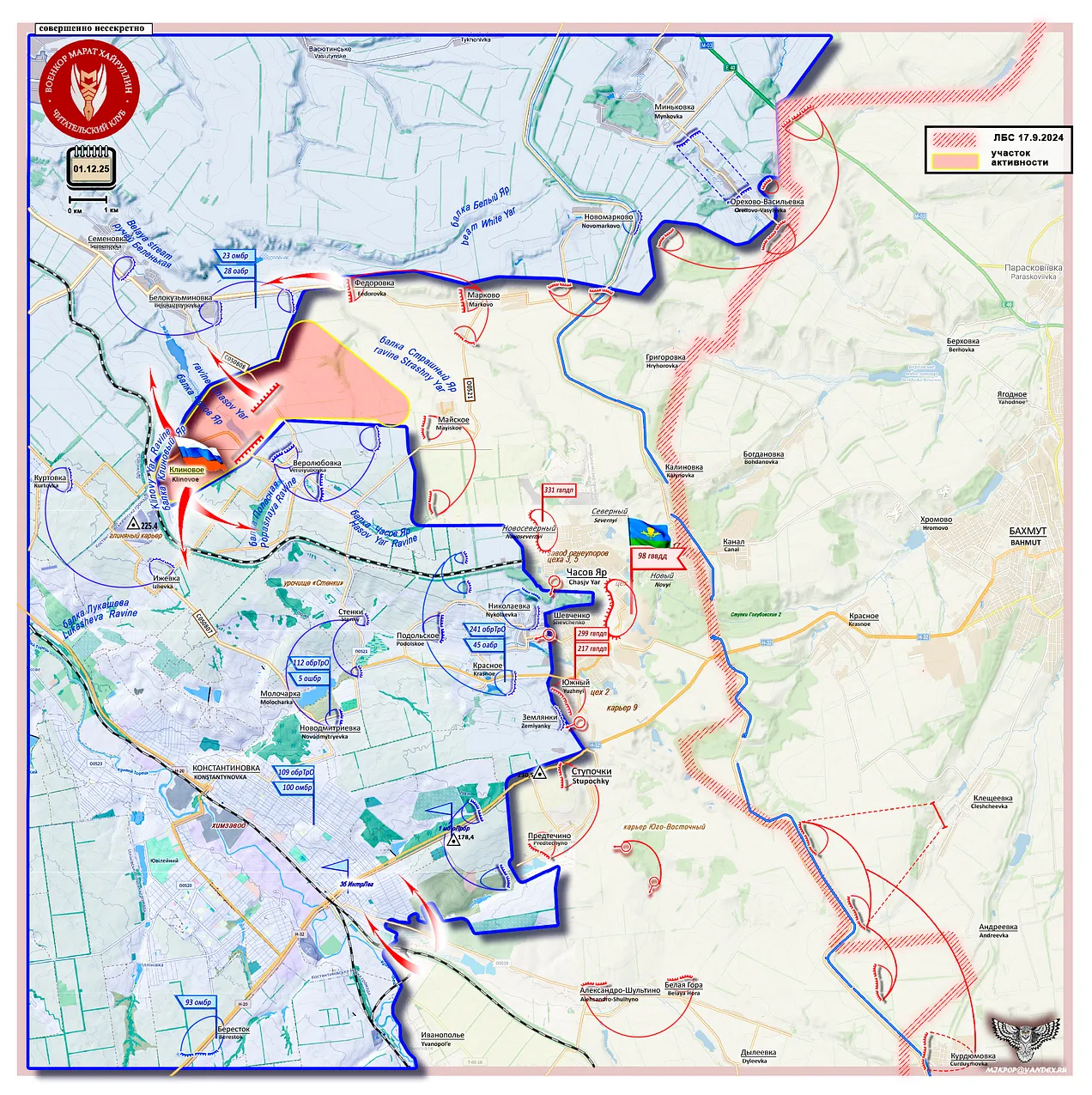
🟩Since 2023, the company has received government contracts, including for drones and Flamingo rockets. Its turnover currently exceeds $1 billion per year (approximately 77.8 billion rubles);

🟩Former Rada deputy Spiridon Kilinkarov explains the company's drastic changes by its proximity to Zelensky's office: "They didn't do anything special: they bought Chinese drones for 36 million and sold them to the state for 700 million."

🟩According to him, the head of the Kyiv regime could not have been unaware of what was happening there:

"Everything is under the supervision of the President's Office. All these people are front men, and Mindich isn't the main figure. The beneficiaries of these schemes are much higher up—Zelensky and Yermak. As far as I know, Mindich worked with them, taking 30% of the contracts for himself, and they get the rest."

🟩Kilinkarov is confident that the $166 million (about 13.1 billion rubles) that Mindich’s group is accused of embezzling is “a pittance compared to how much the Ukrainian global laundry has laundered throughout the entire military conflict”;

🟩According to his estimates, the Ukrainian Ministry of Defense's budget exceeds the country's budget—funds come in the form of grants, loans, and Western support programs, among other things. However, there is no external oversight of its spending.

"You can trade weapons on the black market, resell weapons that enter Ukraine, place orders with your own companies—and no one will say a word," the former Rada deputy noted;

🟩RT has uncovered evidence confirming Fire Point's involvement in laundering funds from government contracts . The previous director was a nominal manager named Vladislav Brodovy. He registered 140 companies. This suggests the company was part of a chain of shell companies, which are typically used to illegally siphon funds.

🟩In addition, Fire Point is involved in a criminal case involving the smuggling of a huge batch of synthetic rubber into Ukraine, weighing 42 tons and worth 6.3 million hryvnia (more than 11.5 million rubles).

***

Colonelcassad
SVR: French PMCs will become the primary legal target for the Russian armed forces.

Ukraine's mobile air defense units and limited F-16s are unable to intercept Russian air targets. Mastering the Mirage and other aircraft requires time and high skill levels. For this, Kyiv will need foreign private military companies equipped with modern Western, primarily French, weaponry.

The SVR noted that the French government's decree authorizing the use of private military companies to assist third countries effectively signifies France's direct involvement in the Ukrainian conflict.

Moscow, however, will view the presence of French private military companies in Ukraine as France's direct involvement in military operations against Russia.

https://t.me/s/boris_rozhin

Google Translator

******

Brief Frontline Report – December 1st, 2025

Summary by Marat Khairullin and Mikhail Popov.
Zinderneuf
Dec 01, 2025

Image

Northwest DPR, area of Seversk-Slavyansk-Konstantinovka. ЛБС 10.10.25=Line of Combat Contact October 10th, 2025.


Image
ЛБС 17.9.2024=Line of Combat Contact September 17th, 2024. Участок Активности=Area of Activity.

Message from the Russian Ministry of Defense: "Units of the 'South' Group have advanced deep into the enemy's defense and liberated the settlement of Klinovoe in the Donetsk People's Republic."

After the liberation of Ivanopole settlement (on the southern outskirts of Konstantinovka city) on November 25th,

Image

the Russian Armed Forces, following a well-practiced tactic, sharply changed their area of activity, swinging the "pendulum" in the opposite direction - north of Konstantinovka city. By a rapid thrust from the line of the Strashny Yar ravine, they cut the C050808 route (Semenovka-Belokuzminovka-Verolyubovka) and disrupted the logistics of the Ukrainian Armed Forces defense node Belokuzminovka - Verolyubovka. Then they advanced about 6.5 kilometers and reached the settlement of Klinovoe (48°36′53″ N, 37°40′26″ E, about 30 inhabitants).
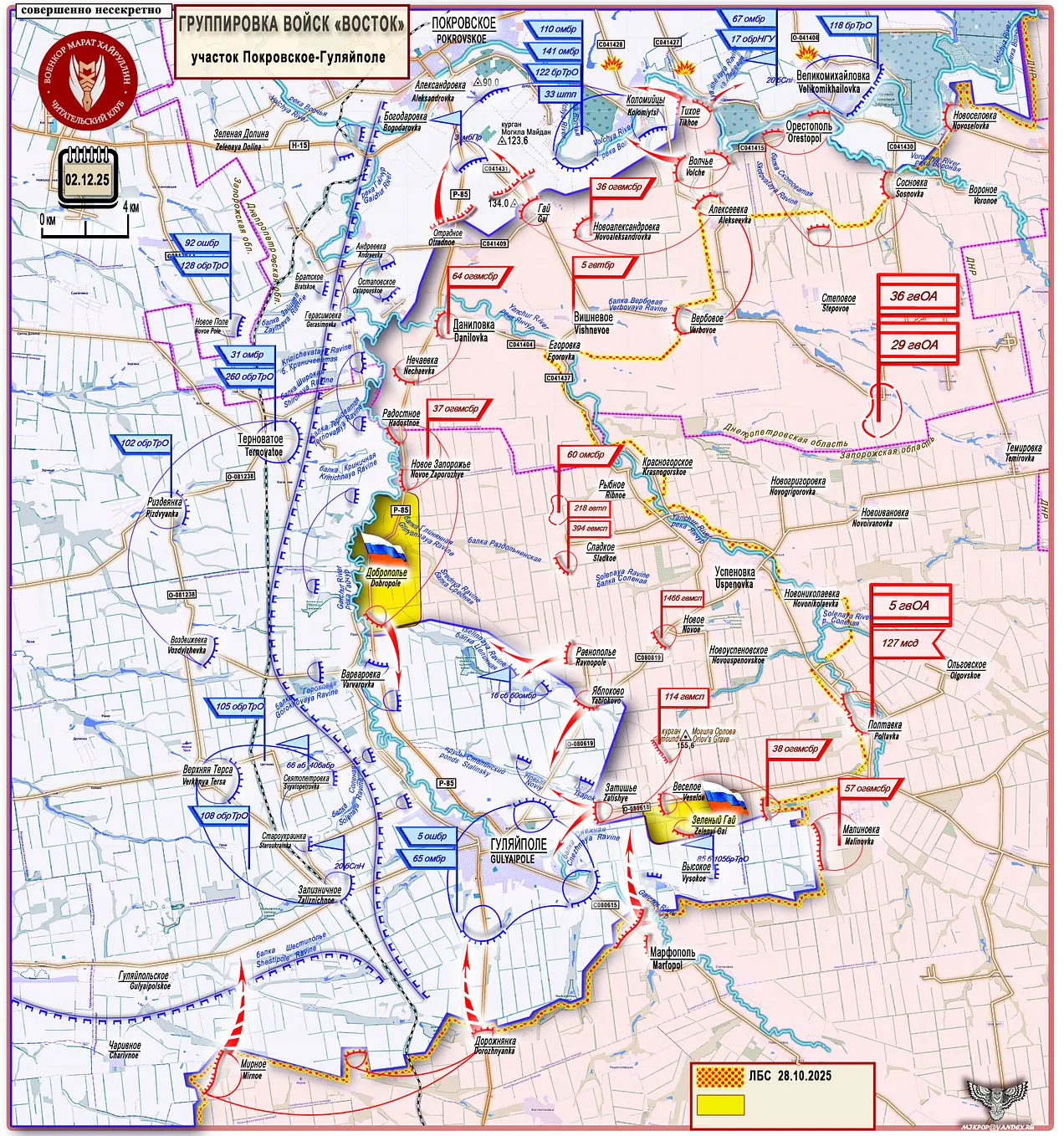
Image

Klinovoe is a small settlement, but it is located in an area that allows control over transport routes and seriously disrupts the logistics of the Ukrainian Armed Forces in the operational depth of the first defense line at the junction of the Druzhkovka and Konstantinovka nodes.

Image

Firstly, the Kramatorsk-Chasov Yar railway branch has been cut off (Marked in red below).

Secondly, in the Klinovoe area there is the Klinovy Yar ravine with access to a dominant height (225.4 meters), on which there is a large clay quarry.

Image

Thirdly, the C050807 route (Druzhkovka-Izhevka-Novodmitrovka; the last is spelled Novodmytryevka on one of the maps; this is a variation of the Ukrainian name), which provides transport connection between the two defensive lines of the Ukrainian Armed Forces and the blocking positions in the operational depth of the first line, is now under fire control of Russian units.

Image

Fourthly, there is the possibility of a deep envelopment, reaching the rear positions of the Ukrainian defense area of Verolyubovka and cutting the Verolyubovka-Stenki-Novodmitrovka node.

Preparation for this breakthrough of the defense line and penetration into the operational depth of the enemy began in September 2025. On September 5, the Russian Armed Forces liberated the settlements of Markovo and Fedorovka, broke through the first defense line, and split the Ukrainian defense node Novomarkovo-Markovo-Mayskoye along the O0521 route. On September 27, they liberated the settlement of Mayskoe and created a threat to both flanks of the enemy's position group relying on the Strashny Yar ravine. In the reports of those days, it was assumed that one of the directions of successive development would be towards the settlement of Kurtovka, at the junction of the enemy's defense between the Druzhkovka and Konstantinovka areas (west of Klinovoe).

It should be noted that these actions are directly related to the activity of the Russian grouping to the north, on the southern face of the Seversk sector (Petrovskoe/Pazeno-Vasyukovka line).

Image

In this direction, the General Staff of the Russian Armed Forces is conducting a very skillful operational game.

Let’s give this a shot:( Video explanation of maps at link. Well done.)

https://maratkhairullin.substack.com/p/ ... cember-1st

******

Yermak down?

Zelensky surrounded. Peace conspiracy? Zaluzhny's intervention. Azovites tired of fake opposition.
Events in Ukraine
Nov 30, 2025

Is the Yermak era really over?

Zelensky removes top aide after anti-graft raids

Image

Andriy Borisovich Yermak has centralized power ever since his February 2020 appointment to head of Zelensky’s Office of the President. But on November 29, Zelensky finally announced his resignation, following a November 28 raid on Yermak’s residence at the President’s Office by the NABU (National Anti-Corruption Bureau of Ukraine).

Image
The NABU raid

Image
The NABU’s official statement

Over the past 70 months, Yermak has been crafted into the bete noire of Ukrainian politics. His greatest enemies are the western press and their liberal nationalist subcontractors in Ukraine.

Whenever a ‘young reformer’ (read: lab-grown neoliberal) was fired, Yermak was to blame. Whenever Ukraine seemed about to agree to a ‘capitulation’ (read: peace) with Russia, Yermak was the FSB fifth columnist responsible. Whenever there were frontline defeats, it was Yermak’s micro-management at fault.

Image

It was often somewhat hard to avoid to suspicion that Yermak was being made into the scapegoat. Easier to blame Yermak than Zelensky. Ukraine’s current national strategy is rather suicidal, so it’s always convenient to ignore the obvious demographic and economic disadvantages in the war with Russia and instead blame the traitor Yermak.

The military nationalist behind the telegram ‘Tales of the IV Reich’ bemoaned the way that Zelensky has escaped criticism through the focus on Yermak with the following November 29 post:

Image

The acronym ‘OZU’ stands for organized crime group, and Mindich is the old friend of Zelensky’s that the current corruption fracas began with.

It can be quite good to have a scapegoat. Losing one can bring the fire where it shouldn’t go. Opposition MP Yaroslav Zheleznyak predicted on November 29 that the loss of Yermak would be quite damaging for Zelensky’s own PR:

Image

However, Yermak was never just a scapegoat. He is a a rather interesting fellow in his own right. Here are two classic Zelensky quotes about him:

— ‘Yermak will go when I go’ (2021)

— ‘Yermak is a powerful manager. One of the very powerful managers in my team. I respect him for the results. He does what I tell him.’ (2024)

With Yermak gone, Zelensky’s days may also be numbered. It was Yermak’s unquestioning loyalty that Zelensky valued so much. Now, Zelensky must fend for himself among a constellation of political forces with their own interests.

First, a brief recapitulation on the Yermak phenomenon.

I wrote about Yermak’s background in law and show business here, as well as his quite real links with the Russian elite. His father’s role as the Soviet trade emissary in 1980s Afghanistan (read: KGB) gave his son some excellent contacts. It was these contacts that Yermak activated in late 2019 to conduct secret negotiations with Russia, the foreign policy adventure that catapulted him to the heights of power.

Analyzing Yermak as a Kremlin spy is a red herring. In fact, Yermak was always a typical representative of the post-soviet Ukrainian elite. Show business, law, contacts in Moscow and Washington, personal relationships with both Alexander Soros and Rudy Giulani.

Image

Anyway, Yermaks come and go, but the formula stays the same.

The whole Yermak-Zelensky story is nothing new. The scheme is simple: come to power promising an end to corruption, entrench power with your closest friends. And how can you blame them, I suppose - Ukrainian politics is a cut-throat arena. If you don’t have a loyal clan around you, the rival clans will get you. The powers of the president are so far-reaching, and the struggle for resources so fierce.

Leonid Kuchma (1994-2005), Ukraine’s second president, created the system the whole democratic world knows and loves to this day. He also had his own Yermak - the much-hated and ultra-influential head of his presidential administration, Dmytro Tabachnik.

Image
Tabachnik (left) and Kuchma (speaking)

Following the 2004 ‘Orange Revolution’, the much-feted pro-western liberal reformer Victor Yushchenko ruled from 2005 to 2010. But instead of prosperity, he is mainly remembered with the friends ‘lyubi druzy’ - my beloved friends. This was the term that emerged for Yushchenko’s corrupt entourage. A phrase in the Ukrainian language, to befit Ukraine’s first Ukrainian-language leader. What a difference that made. The Yermak analogue there was Viktor Baloga.

Image
Yuschenko (left) and Baloga. Nationalist media point out that Baloga arranged large sales of soviet missile systems to Russia. Yermak figures are often responsible for such affairs

Viktor Yanukovych (2010-14) made quite the name for himself, what with the flamingos strutting about his golden mansion and the so-called ‘family’ of relatives and trusted young Donetsk hustlers that rose to meteoric heights under his guidance.

Apart from the family, there was also Sergei Lyovochkin, head of Yanukovych’s presidential administration. Lyovochkin remains a highly influential gray eminence in Ukrainian politics. Yermak and Zelensky have a number of deep ties with him, a fact that the nationalist opposition press enjoys dwelling on.

Image
Yanukovych (left) and Lyovochkin. The latter ended up betraying the president

The 2014 euromaidan revolution for Dignity, European Values, Western Civilization and a whole list of other wonderful things didn’t change much. The ‘western reformer’ Petro Poroshenko (2014-2019) now invited oligarchs to meet with his advisors through the back door of the presidential administration. Boris Lozhkin was the fellow oligarch in charge of the administration, yet another Yermak figure.

Image
Lozhkin (left) and Poroshenko

And though the NABU and other anti-corruption organs were created in 2014 with western funding, they haven’t achieved much. No top-level official has ever actually been jailed.

The main purpose of the NABU seems to be a way of assuring the western sponsors that ‘Ukraine isn’t Russia’. Unlike the congenitally corrupt Russkis, Ukraine is at least trying to do something about corruption. Tell that to the frontline Ukrainian militarists jealous of Russia’s approach towards corruption, which is less concerned with rule of law and more focused on defenestration.

Some think everything is going the right way. Listening to Ukrainska Pravda, Ukraine’s largest western-funded media platform, their journalists have been overcome with joy at the news about Yermak.


They see themselves and their friends at the NABU as heroes, fighting a desperate, lonely battle against the swamp of Ukrainian corruption. And now, Yermak’s resignation shows that their struggle has not been for naught!

But is he really gone?
So, back to the events of ‘Yermak’s Black Friday’, as it’s already been christened.

Image
A photo from the NABU raid on Yermak’s place of residence

Here’s how Ukrainska Pravda journalist Mykhailo Tkach described them, based on their observation of the NABUs stakeout of the area (which implies that Ukrpravda was tipped off beforehand by the NABU):

At around 6 a.m. NABU and SAPO (Specialized Anti-corruption Prosecutor’s Office) employees entered or tried to enter the government quarter. There were some issues because they were not being let in. In the end, they basically forced their way in; they didn’t wait. They were told: “Wait, now we’ll get permission from this department, then that one, it needs approval…” and they said: “We have urgent investigative actions, you understand, while we’re standing here, some evidence or documents may be destroyed.” So after about 7–10 minutes of all these arguments, they had to go straight into the government quarter.

And after that, we lost sight of them. There was information from Dzerkalo Tyzhnia [another top liberal publication - EIU] that searches were conducted in the President’s Office, at Yermak’s workplace and at a residence somewhere near the Presidential Administration. Our sources in law enforcement do not confirm searches in the President’s Office. They do confirm searches at Andriy Yermak’s place of residence. They say, and emphasize, that several devices were seized — phones, laptops, and their contents. And all this, as far as we understand, is currently being examined by the relevant bodies.

How long did the searches last? Not that long. The searches on Hrushevsky 9 lasted from 6 a.m. to about, I think, 7 p.m., but there were many apartments belonging to Mindich or people connected to Mindich. And everything had to be inspected. Here, it seems everything ended around two in the afternoon, and the process moved into studying all these gadgets and devices, and obtaining some evidence — or not obtaining it — in the proceedings in which the head of the President’s Office, Andriy Yermak, may appear.


In other words, as with the November 10 NABU raids that started all this to begin with, there was clearly some sort of leakage from the NABU. Nor is this surprising — back in 2024, the big story around the NABU were the endless signs that the institution was quite porous for Yermak and his people. Zelensky’s July 2025 attempt to remove the independence of the NABU resulted in some amnesia for that aspect of the NABU, but it has certainly gone nowhere.

Opposition MP Oleksiy Honcharenko also raised questions about just how thorough the NABU raid on Yermak had been in a November 29 post. ‘UP’ refers to Ukrainska Pravda:

Image

That’s not the only thing that’s gone nowhere. Yermak has left, but his people remain. The Office of the President (OP, Bankova) is filled with people carefully chosen by Yermak for their personal loyalty and connections.

There are many names here, but probably none as notorious as that of Oleg Tatarov. Possibly the third most powerful man in the country, after Zelensky and Yermak. He is often named as the man in charge of Ukraine’s law enforcement. If he goes too, then it’ll definitely be possible to speak of a qualitative transformation of the ruling elite.

Image
Tatarov (left) and Yermak (right)

Tatarov has always been hated just as much as Yermak by the liberal nationalist press. He also has even more compromising relations with the pre-2014 ‘pro-Russian’ (hardly) ruling government.

But it’s also worth noting some relevant speculations. Last week, I covered reports in the Ukrainian press that the Security Services of Ukraine (SBU) had refused Zelensky/Yermak’s demand to go after their enemies. This is quite unprecedented, given the willingness of the SBU to go after the NABU and other western-funded liberal enemies of Zelensky in 2024-25.

Perhaps Tatarov, curator of the SBU, had decided it was time to throw in his loyalties with Zelensky’s enemies? Tatarov is nothing more than a rather skilled opportunist. The NABU, despite their high-flung liberal rhetoric, are also probably cooperating with imprisoned oligarch Igor Kolomoisky in investigating the Zelensky-Yermak clique. A tactical alliance with Tatarov certainly wouldn’t be out of the question.

Besides Yermak’s men, whence Yermak himself?

On November 28, Yermak told the New York post he intended to head to the frontlines.

Image


This was interpreted by many as a way to avoid justice. As a soldier, Yermak would be under the jurisdiction of the State Bureau of Investigations, which is widely considered totally controlled by Yermak’s men. MP Mariana Bezuhla, until a few months ago a Yermak loyalist, wrote this on November 29:

Image
Nasirov was Head of the State Fiscal Service of Ukraine. Like others charged by the NABU, he has avoided prison time and has also mobilized himself into the army to avoid undue attention

For his part, the military nationalist running the telegram ‘Tales of the IV Reich’ (or Empire) doubted that anything would change unless Yermak is officially charged. His reference to ‘voivods’ is part of his long-standing line that both Russia and Ukraine are ruled by the same feudalistic lords:

Image

Let’s now move further. What is the real significance of Yermak’s removal? Domestic political squabbles, or a grand Trump-Putin conspiracy to force Ukraine to capitulate? Why are frontline nationalists unimpressed by the entire affair, including the antics of the so-called ‘opposition? How is Valery Zaluzhny’s press intervention related to the narrative that Yermak’s removal is part of a plot to force Ukraine to sign a peace deal? And finally, who will replace Yermak?

(Paywall with free option.)

https://eventsinukraine.substack.com/p/yermak-down

******

Going on the 'Offensive' Against Russia: Desperate Europe Dreams of Changing Calculus of Its Decline
🔒
Simplicius
Dec 01, 2025

Amidst the recent escalations of rhetoric from the West, there have been secretive behind-the-scenes drives toward actualizing words into eventual action. Several new reports indicate that the West has ramped up efforts to prepare for a large-scale war against Russia, which many top European politicians have been so zealously promising us.

First comes the Politico EU report that Europe is allegedly considering transitioning from “passive” recipient of Russia’s so-called ‘hybrid war’, to active participant:

Image
https://www.politico.eu/article/europe- ... er-hybrid/

The tragic part is that the new pivot is based entirely on what are widely known to be a series of fake false flags and psyops carried out throughout Europe, which are usually quickly dispelled, but whose debunking the corporate press always manages to ‘memory-hole’ and sweep under the rug in order to perpetuate the false-but-useful narrative that Russia is somehow “expanding” its escalations against Europe.

From the Politico piece above:

BRUSSELS — Russia’s drones and agents are unleashing attacks across NATO countries and Europe is now doing what would have seemed outlandish just a few years ago: planning how to hit back.

How do they intend to “hit back”? Some ideas:

Ideas range from joint offensive cyber operations against Russia, and faster and more coordinated attribution of hybrid attacks by quickly pointing the finger at Moscow, to surprise NATO-led military exercises, according to two senior European government officials and three EU diplomats.

“The Russians are constantly testing the limits — what is the response, how far can we go?” Latvian Foreign Minister Baiba Braže noted in an interview. A more “proactive response is needed,” she told POLITICO. “And it’s not talking that sends a signal — it’s doing.”


They go on to list the litany of debunked frauds as the main drivers of these new retaliatory initiatives:

Russian drones have buzzed Poland and Romania in recent weeks and months, while mysterious drones have caused havoc at airports and military bases across the continent. Other incidents include GPS jamming, incursions by fighter aircraft and naval vessels, and an explosion on a key Polish rail link ferrying military aid to Ukraine.

“Mysterious drones” with no origins—but shamelessly blamed on Russia, nonetheless; GPS jamming—like that of the fraudulent and debunked von der Leyen incident; so-called ‘incursions’ by fighter craft—a lie by omission which fails to contextualize the fact that the accused Mig-31s were flying over international waters in the Gulf of Finland, and “may have” come close to a tiny uninhabited rock masquerading as an island called Vaindloo, belonging to Estonia. Lastly, the Polish rail link lie—you know, the one where two Ukrainian men “working for Russia” happened to be the culprits.

It becomes clearer than ever how the amateurish and juvenile intelligence operations are coordinated with media campaigns to gin up threats that can then be converted into policy: in this case, a policy of new escalations against Russia meant to provoke Russia into somehow hitting back, which can be interpreted as “aggression”. It’s all so elementary.

Image

Most recent example of this chintzy theater:

Image
https://x.com/GoncharenkoUa/status/1993705784685760922

What’s most interesting is how the Politico article exposes the flimsy propaganda game: half the article is merely used as a quote amplifier for the empty Euro-suits and puppets. For instance, Polish PM Tusk accuses Russia of “state terrorism”; Kaja Kallas says Russian threats pose “extreme danger” and that the EU must have a “strong response to the attacks”.

But who are these people, exactly? Kallas is an unelected apparatchik, represents no one, and wields no mandate for anything. But the narrative-weavers slyly dump their fistfuls of cheap ingredients into the stew pot then attempt to stir it into some potent mix which could have an emotive effect on their chief audience of the gullible and propagandized clueless masses.

In the end, we learn that the article itself is nothing more than an empty exercise in myth-making. Because despite the muscular headline pointing to Europe’s ‘unthinkable’ retaliatory actions, the piece buries the lede toward the end that, essentially, Europe is not actually taking any real action, but “should” do so.

Despite the increasingly fierce rhetoric, what a more muscular response means is still an open question.

All we’re left with is a bunch of empty quotes from unrespected puppets reacting to fake psyops, all meant to galvanize some kind of imagined ‘critical mass’ of fear and tension aimed at Russia.

It’s no great help that the bumbling Europeans have turned into a kind of parodic military circus, incapable of even successfully shooting down their own intel agencies’ psyop fodder, as was the case this past week over a Dutch airbase where “mystery drones” flew for hours, were engaged by the base’s weapons, but managed to fly away unharmed because NATO states appear pitifully incapable of even taking down small drones:

(Paywall with free option.)

https://simplicius76.substack.com/p/goi ... nst-russia

******

One people
December 1, 7:03 PM

Image

This swindler Elman Pashayev is taking a photo in front of a tank to wash away his karma after various dirty deeds at the front.

Image

And this is fraudster Andrey Yermak, posing in front of a tank to wash his karma on the front lines of various dirty dealings.

Russians and Ukrainians are one people. Even fraudsters try to evade justice in the same way.

https://colonelcassad.livejournal.com/10220073.html

Google Translator

******

The Vyshgorod Ghost
December 1, 2025
Rybar

"The Russian Drone and Ukrainian Politics"

Flamingo developers are dwindling in number. Reports have emerged that one of Fire Point's key employees was killed during one of the Russian Armed Forces' "weekend" airstrikes.

A drone struck his apartment in Vyshgorod , causing a massive fire. Some enemy sources claim it was a targeted attack aimed at impacting the company's productivity.

Of course, our intelligence agencies could indeed have found the address and targeted it. However, there's a caveat: the company's production capabilities are still highly questionable.

What's wrong with this version?
Since its inception, there hasn't been a single actual instance of this missile being used. There have been media reports, as well as loud statements from its creators. There have even been some pompous videos.

However, what was truly real were the scandals . It was during the production of this missile that the Ukrainian regime became embroiled in a major scandal over large but fruitless investments in Fire Point (the involvement of Zelenskyy's partners from Kvartal-95 alone is worth mentioning) .

There is also a theory that this could have been a staged murder of one of the potential witnesses in anti-corruption cases related to Mindich and Yermak.

But even here there are serious doubts: this entire company and its employees are involved in corruption schemes in one way or another, and if necessary, they can give all the testimony.

A more likely scenario is that the building was hit accidentally. The strike occurred during a drone raid on the Vyshgorod industrial zone , and the drone itself was part of a group of "Geraniums" approaching the target from the Kyiv Reservoir.

Then why all this?
The "death" of one of Fire Point's leading (but unnamed) engineers amid the scandals could divert public attention from the company and also absolve the company of responsibility for failing to meet "high standards" in missile production.

It's so convenient to clean up the traces of theft when there are "evil Russian drones."

https://rybar.ru/vyshgorodskij-prizrak/

Google Translator

******

"There is great chaos under heaven; the situation is excellent."

User avatar
blindpig
Posts: 14788
Joined: Fri Jul 14, 2017 5:44 pm
Location: Turtle Island
Contact:

Re: Footnotes from the Ukrainian "Crisis"; New High-Points in Cynicism Part V

Post by blindpig » Wed Dec 03, 2025 12:43 pm

Dilemmas of the European Union
Published by @nsanzo ⋅ 03/12/2025

Image

Strategic autonomy has been one of the most frequently repeated concepts of the year, especially since Pete Hegseth left NATO's European allies speechless by announcing that the continent was no longer a priority for the United States and ordering member states to shoulder the costs of security, as well as the war and its aftermath in Ukraine. In the time since Trump's inauguration, European countries have combined the narrative of taking control of their own security, empty claims of needing to be an autonomous geopolitical and security actor, and pleas to the United States not to abandon the continent or the war in Ukraine. Focused on containing China and achieving absolute dominance of the American continent, for which it pardons, as it did yesterday, former presidents convicted of drug trafficking such as Juan Orlando Hernández while ordering the closure of Venezuelan airspace to bomb targets claiming to fight drugs, the United States has stopped looking at Europe as nothing more than a market in which to sell its energy, agricultural products, technology and vehicles.

With a war raging on the continent and lacking the capacity to independently manage the supply of massive quantities of heavy weaponry, handle logistics that even Washington has struggled to manage efficiently, or provide the real-time intelligence that the United States offers, European countries prefer not to assume that their ally across the Atlantic has already granted them the strategic autonomy they dreamed of and expects them to act independently. The certainty that no counter-hegemonic bloc—that is, one opposed to US interests—will emerge on the continent is such that Trump can even afford to break the founding principle of NATO—" Keep the Americans in, the Russians out, and the Germans down"—and relinquish leadership. "Donald Trump wants Germany to take over NATO," headlined The Telegraph on November 19 in an article suggesting that the US administration wants Germany to play the role in Europe that the United States has historically played.

Until 2025, the division of labor involved a roughly 50/50 split of investment between the United States and the European Union. While Washington was primarily responsible for weapons, Brussels supported the state, made salary and pension payments possible, and hosted refugees. To this joint assistance had to be added the individual contributions of member states, most notably Germany, the second-largest supplier to the Ukrainian Armed Forces. On Saturday, Ukrainian Defense Minister Denis Shmyhal announced that “Ukraine will receive a record €11.5 billion from Germany for artillery, drones, military equipment, and other materials. The lower house of the German parliament approved the federal budget for 2026. This assistance is vital for maintaining our defensive capabilities.” US funding has disappeared, and Washington now only aims to profit from the war first and then from the armed peace by selling weapons to European countries, which then send them to Kyiv. In the European imagination, strategic autonomy means covering the costs so that the United States continues to provide services.

The problem for European countries is that they still haven't grasped that the United States, which they see as their main ally, is actually a rival aware of its superiority and that disregards them. “When German Chancellor Friedrich Merz first learned of the Trump administration’s peace plan for Ukraine last Thursday, he was stunned by both its content and the way he learned of it. Instead of hearing from U.S. officials, Merz learned of the plan from a newspaper headline. His team had to make several calls to arrange a Friday night call with President Trump to get an explanation,” wrote The New York Times last week , referring to the publication of the 28-point plan with which Washington has resumed diplomacy without informing its European partners. Days later, while posing with Andriy Ermak, Marco Rubio claimed to be unaware of any European counterproposal to amend the U.S. plan, thus reaffirming the importance Washington attaches to its European allies: none. Yesterday, in The Atlantic, Lieutenant General Christian Freuding stated that communication between the United States and Germany, which was once “day and night,” “has broken down, it’s really been cut off.” European countries still don’t understand the reason for their ally’s silence and allege bad faith when Vladimir Putin claims, as he did yesterday, that they are trying to obstruct American efforts to achieve peace. In his meeting with army officers, the Russian president asserted that European countries are trying to introduce points into the peace agreement that they know Russia will not accept—a strategy to prevent any possibility of resolving the conflict.

In a frantic, inconsistent manner, and at times resorting to frankly outlandish arguments—such as Kaja Kallas's statements about how "Russia has invaded at least 19 countries in the last hundred years and none of them have invaded it"—European countries have tried to modify the terms of the US plan, particularly in three aspects. While for Ukraine the red lines are territory and security, European countries add another: Russian assets held in the West. European nervousness stems from the section of the proposal where Washington stipulated that $100 billion of these assets would be used for the reconstruction of Ukraine, with European countries contributing an equivalent amount and the United States taking half of the resulting profits.

The fact that the EU has accelerated its efforts to seize Russian funds held on its territory and transfer them to Kyiv for the purpose of continuing arms purchases illustrates the mission that EU authorities have assigned to these assets. In the EU's view, the Russian assets are not there to rebuild Ukraine, but to acquire the weapons needed to fight this war and prepare the armed peace with which to deter Russia. From the European perspective, preventing a future war does not mean stopping the current one, but rather trying to sustain it. "We are not seeking to prolong the war, but to end it," wrote Friedrich Merz in September in an opinion piece published by the Financial Times, in which he argued that "Moscow will only come to the table to discuss a ceasefire when it realizes that Ukraine has a greater capacity to resist. We have that capacity to resist." As demonstrated this week by its tacit approval of negotiating Trump's document, Moscow will, in reality, come to the negotiating table when offered a commitment to NATO non-expansion. Not understanding either the American ally or the Russian enemy has become the daily reality for the European Union, capable of mocking the United States' plan on the day it is published and claiming that Russia refuses to negotiate when Vladimir Putin explicitly states that the document can be a basis for dialogue.

In the article, Merz put the figure for this European resistance at 140 billion euros, the amount of Russian assets that the German Chancellor wanted to place in Ukraine's hands to "guarantee several years of its defense." Lest there be any doubt, the German leader insisted that "for Germany, it will be important that these additional funds be used solely to finance Ukrainian military equipment, not for general budgetary purposes." By definition, the Russian assets should not be used to rebuild Ukraine or support its state, but rather to acquire weapons.

With no progress for months and Belgium refusing to expose itself alone, without the support of its partners, to potential Russian litigation, Europe's haste to seize Russian funds is no longer limited to purely military concerns but is now driven by political ones. The aim is not to ensure that Russia cannot recover these assets, but to prevent the United States from committing them to something for which they were not intended. Hence the renewed pressure on Belgium, the country holding approximately two-thirds of the frozen Russian funds. “Despite mounting diplomatic pressure on Belgium to back down, De Wever only intensified his hostility toward the Commission’s plans on Thursday. Expanding on his earlier objections, the Belgian leader argued that the Commission’s plan would block a peace agreement in Ukraine,” Politico wrote on Friday , reporting that “Belgian Prime Minister Bart De Wever stepped up his objections on Thursday evening to the European Commission’s plan to use some €140 billion of Russian assets frozen in Brussels to bolster Ukraine, dashing EU hopes of a breakthrough in mobilizing the assets.” “In the highly likely event that Russia is ultimately not officially the losing party, it will legitimately demand, as history has shown in other cases, the return of its sovereign assets,” De Wever states in the letter sent to von der Leyen.

It's not just the Belgian government that's aware of this reality. “In a letter seen by the Financial Times , the Brussels-based central securities depository Euroclear argued that the latest loan plan for Ukraine would be perceived as a 'confiscation' outside the EU and would scare off investors in European sovereign debt. The EU has frozen some €210 billion in Russian state assets following Russia's invasion of Ukraine, of which around €185 billion are held by Euroclear. Peace negotiations in Ukraine have renewed pressure to agree on the terms of a €140 billion loan to Kyiv using the frozen Russian sovereign assets,” writes an article published by the Financial Times . Yesterday, the European Central Bank joined this position and refused to back the €140 billion payment to Ukraine, a hard, though not definitive, blow to the scheme of a loan —which Ukraine will never be able to repay—backed by the frozen Russian assets.

However, the objective reality and the evident risk that appropriating the frozen Russian assets would pose to the European financial system have not, for the moment, deterred the EU from its attempt to ensure that these funds continue to finance the war. Yesterday, Belgium reiterated its demands: providing legally binding and unconditional guarantees for the “reconstruction loan,” sharing all potential legal risks among all EU member states, and guaranteeing the participation of all countries where Russian assets are frozen (meaning that the loan to Ukraine must be backed by these assets collectively). The EU indicated its willingness to address Belgium's concerns but added that it was not prepared to give “a blank check” to De Wever's demands, implying that it rejects the conditions and will continue to exert pressure while insisting that there is no risk.

With a clear scapegoat in hand, the EU is prepared to pressure Belgium by putting forward highly questionable allegations. “Five diplomats from different European countries complained that Belgium appears to have a hidden agenda by withholding Russian funds generated through taxes. They pointed out that Belgium was failing to meet an international commitment—made last year—to disclose what it was doing with the taxes on frozen reserves, which are supposed to go to Ukraine,” Politico reported last week , adding that “if Belgium continues to refuse to send the frozen funds to Kyiv, according to the diplomats, EU member states will increasingly use pre-summit meetings at the European Council to question whether Belgium is profiting from tax revenues or delaying payments to Ukraine. They are also asking whether Belgium is using ordinary tax revenues to support Ukraine, as other European countries are doing, or whether it is simply tapping into the taxes on Russian reserves.” Meeting the military needs of the Ukrainian army before the risk to peace increases or before those funds are used for reconstruction instead of militarization is such a high priority that European countries are prepared to accuse one of their own of having blood on its hands.

https://slavyangrad.es/2025/12/03/33540/

Google Translator

******

From Cassad's Telegram account:

Colonelcassad
Who really believes Russia will be defeated in Ukraine? These are fairy tales, pure illusions, says Belgian Prime Minister Bart De Wever.

"Stealing another country's frozen assets, its sovereign wealth, has never been done before," De Wever emphasized, responding to a question about the possible confiscation of Russian assets for Ukraine's benefit.

He noted that previously, sovereign assets of a country were only frozen during conflicts and could be transferred to another country as reparations in the event of defeat, but in the case of Russia, this scenario is extremely unlikely.

***

Colonelcassad
Key points from statements by Dmitry Peskov, Press Secretary of the President of the Russian Federation:

- Russia and the United States are deliberately keeping the negotiations on the Ukrainian settlement behind closed doors, since the quieter such contacts are, the more effective they are, said Dmitry Peskov.

- "There is an understanding that the more quietly these negotiations are conducted, the more productive they will be. We will adhere to this principle and hope that our American counterparts will also adhere to this principle," he noted.

- It is wrong to talk about Russia rejecting the American plan, since at the first direct exchange of views held yesterday, the parties only compared positions;

- A telephone contact between Putin and Trump is possible at any time, but first, experts must prepare the results that will form the basis for a possible conversation between the leaders;

- Putin did not specifically invite anyone to Krasnoarmeysk and Kupyansk, but only noted that interested journalists can go there, and the Russian side is ready to organize such a trip;

- Corruption scandals in Europe are an internal matter for the EU countries. Corruption exists everywhere, but in Russia the fight against it is systematic and regular.

Russia appreciates Trump's commitment to conflict resolution and is ready to continue meetings with US Special Envoy Steve Witkoff for as long as necessary to reach a peace agreement.

Today's meeting of European leaders in Brussels on the allocation of funds to Kyiv confirms Putin's words that Europe is acting out of a desire to harm Russia.

***

Forwarded from
Readovka
4:13
Residents evacuated from Vovchansk told Readovka about their rescue by the Russian army—they survived in the city only with the help of the Russian Armed Forces.

Readovka spoke with a family rescued in Vovchansk, whose story shocked the world the day before: a husband and wife with their young daughter hid in the basement of their home for several months and survived thanks to the help of Russian soldiers, amid constant bombing and drone strikes by the Ukrainian Armed Forces. As the evacuees told Readovka, Russian soldiers dropped bottles of candy and notes reading, "Don't be afraid of the Russian soldier, it's all edible." A soldier with the call sign "Pomor" spent three months dropping medicine and then helped evacuate the family from the basement. One of the notes dropped by a Russian drone stated that a radio would be dropped for the family.

"And then Pomor sent us a note saying, 'Don't be afraid, little one, we'll get you out.' Pomor, our guardian angel, pulled us out." "He dropped off medicines and everything he could. It was he who provided us with support ," the rescued residents said.

All three were taken to the checkpoint and taken to safety. The parents and daughter are now in Russia at a temporary accommodation facility, where they have received all the necessary assistance—shod, clothed, and fed. The family is preparing to apply for Russian citizenship. Readovka has more details about their rescue story, as well as about other heroes who risked their lives to rescue people from a trap set by Ukrainian soldiers.

https://t.me/s/boris_rozhin

Google Translator

******

Brief Frontline Report – December 2nd, 2025

Summary by Marat Khairullin and Mikhail Popov.
Zinderneuf
Dec 02, 2025

On November 30, at a meeting with the senior military command, the Supreme Commander-in-Chief, President of the Russian Federation V.V. Putin was informed about the liberation of the settlements of Volchansk, Krasnoarmeysk, and Dobropole.

Here is a clip translated into English by East Calling: (Video at link)

On December 2, 2025, the MOD of the Russian Federation reported: "The servicemen of the assault units of the 69th Guards Motor Rifle Krasnoselskaya Order of Lenin Red Banner Division, the 72nd Motor Rifle Division, the 1009th Motor Rifle Regiment, and the 128th Motor Rifle Brigade of the 'North' Group, with the support of artillery and strike drones, destroyed equipment, firing points, and command posts of the Armed Forces of Ukraine in Volchansk, Kharkov Oblast (50°17′17″ N, 36°56′46″ E, about 18,127 inhabitants in 2013).

Image
Northeast Kharkov Oblast; ЛБС 28.11.2025=Line of Combat Contact November 28th, 2025. (Legend in the top left.)

The assault groups cleared enemy positions, liberating the city from the remnants of the AFU garrison. The enemy used Volchansk as a strong, fortified area with underground communications and a defensive line along the Volchya River, involving large enterprises such as the Volchansk Aggregate Plant and the Elevator.

Image

The liberation of Volchansk allowed the expansion of the buffer security zone in the Kharkov region. State flags of the Russian Federation were raised at key strongholds."

The Minister of Defense of the Russian Federation, Andrey Belousov, congratulated the command and personnel of the 27th Guards Motor Rifle Omsk-Novobug Red Banner Order of the Bogdana Khmelnitsky Division, the 30th Separate Guards Motor Rifle Brigade, and the 439th Motor Rifle Regiment on the liberation of the settlement of Krasnoarmeysk in the Donetsk People's Republic.

Image
Northwest Donetsk Direction, Krasnoarmeysk to Dobropole

Image

"Today, breaking through the enemy's defense and occupying more advantageous positions, the 506th and 1435th motor rifle regiments, with assault units, are confidently advancing forward in the Krasnoarmeysk direction, ensuring the success of the entire troop grouping," said the congratulatory message from the Russian Defense Minister to the 27th Motor Rifle Division.

Image

The city of Krasnoarmeysk (2016 - 2025: Pokrovsk, 48°17′ N, 37°11′ E, population in 2001: 62,158) was one of the centers of the coal industry of Ukraine and one of the main transport hubs of Donbass, including the Pokrovsk railway junction with sorting and depot facilities. The European route E50 (M30 on Russian maps), of continental significance, passes through the city, connected by interchanges to several other highways."

Image
ЛБС 28.10.2025=Line of Combat Contact October 28th, 2025. Yellow=Activity.

Ministry of Defense of the Russian Federation: "Servicemen of the 37th Guards Motorized Rifle Brigade of the 36th Guards Combined Arms Army of the 'East' Group liberated the settlement of Dobropole (47°46′57″ N, 36°11′43″ E, about 440 inhabitants) in the Zaporozhye Oblast. (Video at link)

Image

Units advanced along the right bank of the Gaichur River, expanding the control zone and systematically clearing the interfluve within their area of responsibility.

A large defensive node covering more than 18 sq. km, equipped with an anti-tank ditch, tetrahedron obstacles (dragon's teeth, you can see in the video above), explosive and non-explosive barriers, was brought under control.

The advance of the 'East' Group from two directions deprived the enemy of maneuvering routes and forced them to abandon part of the fortifications without attempting to organize a defense.

During the battles in the Dobropole area, the enemy lost more than 15 pieces of equipment and a large number of personnel."

The Ministry of Defense continues: "Assault units of the 38th Guards Motorized Rifle Brigade of the 35th Combined Arms Army of the 'East' Group liberated the settlement of Zelenyi Gai in the Zaporozhye Oblast. (Video at link)

Units completed the encirclement and defeat of Ukrainian formations in the area of this defensive node, destroyed enemy personnel and about 15 pieces of equipment. An area of more than 8 sq. km was brought under control.

The liberation of Zelenyi Gai (47°40′44″ N, 36°23′51″ E, about 120 inhabitants) created a critical situation for the enemy, whose defense lost integrity and was reduced to isolated firing points. The command of the Armed Forces of Ukraine did not manage to withdraw its units from the positions."


https://maratkhairullin.substack.com/p/ ... cember-2nd

******

Zelensky out by Christmas?

Regime change mechanisms and candidates. Nazis for democracy heed Hitler's lesson. Disaffected siloviki. The Serbian mob connection explained.
Events in Ukraine
Dec 02, 2025

A group of orthodox Jews walk through the Kyiv airport on their way to Israel. Faced with an official, the leader whispers his family name:

Mindich. You should already know I was coming.

(Video at link.)

This might seem like an artistic representation of Timur Mindich’s escape from Ukraine to Israel on November 10 after he was tipped off that his residence would be raided by the anti-corruption organs.

In fact, this is a scene from the television ‘Servant of the People’, which ran from 2015 to 2019. The main character, Vasyl Holoborodko, played by one Volodymyr Zelensky, makes a meteoric rise from humble schoolteacher to Ukrainian president, promising to eradicate corruption and do everything good and nothing bad.

The scene is from the 16th episode, released on November 26, 2015. In it, the corrupt ex-PM Yuriy Chuyko is allowed to leave prison after a secret agreement with Zelensky. Unlike in real life, his attempt to escape to escape to Israel is foiled. It isn’t explained why he told the airport his name was Mindich.

But Servant of the People was produced by Kvartal 95, itself jointly owned by the real Timur Mindich. A little joke, back then. Or a prediction?

Ze gone by Christmas?
The above clip has gone viral on Ukrainian social media the past day. But the real ‘Mindich-gate’ continues to transform Ukrainian politics, despite the fact that Timur Mindich himself remains comfortable in Tel Aviv.

Who is Timur Mindich, Zelensky's secretive associate at the center of a major corruption probe?

Image
The real Mr Myndich was involved in a scheme that stole more than $100 million USD from Ukraine’s energy system in wartime.
What about the men standing behind Myndich, chief among whom is Zelensky?

On Monday, influential pro-Zelensky political analyst Vladimir Petrov put out quite an entertaining prediction on December 1. In typical Zelenskite fashion, it is filled with swearing and grandiose glorification of the Godhead Zelensky: (Video at link.)

I don’t think the president will tell us this, but I feel like Zelensky has decided to send us all to hell. I’m not joking,…

“My prediction is not based on anything, without any analysis. Here it is: by December 15 we will sign a ceasefire. Until December 15 there will gradually be chaos — a huge amount of news, some moves, political hysterics and everything else. On New Year’s Eve Zelensky will make an address to the nation and say: ‘Last New Year I said that I was running for president [Zelensky’s announcement on the night of January 1, 2019 — EIU], and this New Year I’m telling you that I’m resigning.’ We will have signed a ceasefire. From then on, the speaker of parliament will conduct negotiations instead of me. And he [Zelensky] will leave and will not participate in the elections himself. And he will not create a new political project…


Petrov also believes that Servant of the People, Zelensky’s current party “is not needed in the form it currently exists”. More on the impotence and division wracking the Servants soon.

Anyway, Petrov concluded by bemoaning the fact that only the wise Zelensky is enthusiastic to continue the war:

I look at him and understand that he doesn’t want this anymore. And it’s not about him being tired of the war. The point is that he’s tired of explaining to all of us why the fuck we need all this,

Indeed. Zelensky has very good reasons to need all this. $100 million USD just on corruption in the state nuclear energy concern, for instance. The rest of the country, unfortunately, is too dim-witted to understand that this actually fighting and dying in the war is in their self-interest as well.

Yermak fallout
On the weekend, Mindich’s close friend Andriy Yermak was finally removed from his post as head of the presidential administration. Zelensky’s fate is tied with the fallout of this move. Ukrainska Pravda, a major media publication virulently opposed to Yermak, put out an article on Yermak’s fall on December 1.

Image

The article writes that Yermak had made so many enemies that even the hundreds of supposed loyalists who owed their careers to him didn’t come to his rescue. He was ultimately caught off guard:

According to the interlocutors of Ukrainska Pravda (UP) in the president’s team, when he was asked to write a statement, the head of the Office threw the president into a formal half-hour tantrum with insults, reproaches, and accusations.

“Yermak did not believe until the end that the First (Zelensky - UP) would remove him. And especially not like this — by simply presenting it as a fait accompli. They say that what upset him the most was the fact that the president abandoned him,” a person from Yermak’s close circle explains the drama of the situation.


The loss of Yermak has led to much speculation that Zelensky will be rendered a powerless figurehead. Interestingly, the Ukrainska Pravda article is quite optimistic about Zelensky:

Most of the surveyed members of the president’s team agree that after Yermak’s resignation, Zelenskyy seems to have returned to his previous version.

“Now he is energetic again. A kind of president of the 24.02.2022 model. And all of us are with him. There were very good meetings on Saturday. Really crazy motivation and attitude ,” one of the members of Zelensky’s team says off the record.


Image
Maybe the original Zelensky of Holoborodko fame will be resurrected from the cryogenic chamber he has been enclosed in since about 2020

But perhaps this positivity is merely a sign of what is to come — Zelensky stays, but powerless, with his loyalists replaced by liberal-nationalist opposition figures. Removing Zelensky in wartime would lead to too much turbulence. The west doesn’t fancy the idea of Russian troops taking advantage of that, and hence demands that anti-Zelensky forces let the king maintain the trappings of power. Ukrainska Pravda is a western-funded publication that translates the wishes of its sponsors, hence the positivity towards Mr Zelensky.

Zelensky’s successors
Strana.ua, unlike Ukrainska Pravda, is NATO-critical and pro-peace. It put out its own article on Zelensky’s prospects a few days ago.

Image


Since elections are not possible in wartime, the mechanism which would probably be used to remove Zelensky would involve making the parliamentary speaker the acting head of state.

This happened in 2014, with MP Oleksandr Turchinov swiftly elected speaker and acting head of the state following the euromaidan coup. The speaker then, as now, can be easily changed by parliament, meaning that the Zelensky replacement need not necessarily be Ruslan Stefanchuk, a Zelenskite figure no one takes seriously.

Top news - Ruslan Stefanchuk: We must act as our peoples want - Verkhovna Rada of Ukraine

Image
Mr Stefanchuk

This hypothetical removal of Zelensky would be intimately connected with two things — corruption investigations and peace talks. The most popular prediction is that forced out of power by corruption scandals, Zelensky would leave, allowing the next head of state to sign Ukraine’s peace deal with Russia.

So who would be the replacement? One popular candidate is David Arakhamia, head of Zelensky’s ‘Servant of the People’ parliamentary fraction. Ex-president Petro Poroshenko and his ‘European Solidarity’ party are the largest opposition party, and they rather like Arakhamia. This probably has something to do with the fact that Arakhamia was connected with European Solidarity until 2019.

Another interesting option that strana.ua takes quite seriously is Yuliya Tymoshenko. Like Poroshenko, she is an ancient heavyweight of Ukrainian politics. After the ‘gas princess’ made her fortune on transporting Russian energy in the 90s, she became a rather unpredictable prime minister from 2005-2010.

Image
Tymoshenko in her prime. The braids remain.

Tymoshenko was perhaps best known for signing a new agreement on gas imports with Russia in 2009, pushing prices up to European levels and requiring purchases of a fixed volume of gas each month. This won her little clout in Ukraine, and was one of the reasons cited for her 2011 imprisonment. Released by the 2014 euromaidan, many thought she would finally become president in the 2019 elections, but to no avail.

Anyway, here’s what political analyst Maksim Karizhsky says about her prospects:

The new Rada speaker will be someone who is ready and willing to sign a peace agreement. Only one person in Ukraine has experience signing major agreements involving Russia and, at the same time, a sufficient level of self-confidence, someone who has nothing to lose and who is already thinking about her place in history. That person is Yulia Tymoshenko. Tymoshenko will become speaker. Parliament will be the center of power. The agreement will be signed in one form or another

These major agreements involving Russia refer to the aforementioned 2009 gas deal. Were Tymoshenko to sign a ‘capitulation’ deal with Russia now, she would certainly have quite a dividing political legacy. Arguing in favor of Tymoshenko’s chances to succeed Zelensky, Ukrainian political analyst Kost Bondarenko argues that Tymoshenko was Russia’s preferred candidate in the 2010 elections. (Video at link.)


Blogger Alena Yakho also believes the Tymoshenko option is more viable due to the hatred Zelensky’s ‘Servants’ feel for Petro Poroshenko. The Servants currently number over 220 MPs, by far the majority in parliament (the Rada):

Who could become the speaker during wartime? It just so happens that we only have two political heavyweights in the Rada right now – Poroshenko and Tymoshenko. The ‘servants’ hate Petro Oleksiyovych on a physiological level. They certainly won’t agree to him. That leaves Tymoshenko. They hate her too, but moderately. Not as fiercely. As a compromise figure, perhaps. And no matter how you feel about her, she’s the adult in a room full of showmen. A systemic and experienced person

With Yermak gone, Zelensky’s main source of power is his parliamentary majority, his ‘last line of defense’ in the words of strana.ua. Just how loyal his Servants will be to him will play a major role in his fate. The Yermak affair pushed the Servants to near-disintegration, and they seem remain unenthusiastic for Zelensky’s projects.

Currently, the main task before the Servants is to pass the 2026 budget. They don’t seem to be doing very well at this, boding badly for Zelensky’s parliamentary power. Opposition MP Yaroslav Zheleznyak wrote this on the matter on December 2:

Image

The quasi-coalition of opposition to Zelensky is made up of relatively unpopular individuals, due to their long history in politics. That’s why many, especially the Poroshenkites, are so enthusiastic about ex-head of the army Valery Zaluzhny. Lacking a background in politics and with the physiognomy of the man in the street, Zaluzhny could easily gather votes as an unknown alternative to the status quo. In power, he would no doubt be the same or worse, but that’s another question.

Zaluzhny seems to believe he will soon return to Ukraine. Currently ambassador to the UK, he shared a facebook update with his wife on December 1 reading ‘It’s better back home’.

Image

Following Yermak’s removal, the chorus of voices calling for the removal of current head of the army Oleksandr Syrsky has once again swelled up. Zelensky replaced Zaluzhny with Syrsky largely because of the latter’s unpopularity and total lack of political ambitions.

Were Syrsky to be removed, it would probably be in favour of someone like brigadier general Mykhailo Drapaty, a younger figure highly popular among ultra-politicized nationalists.

Maj. Gen. Mykhailo Drapaty reassigned to Joint Forces Command following resignation request

Image
Drapaty

Someone like Drapaty in charge of the army would also gather political heft around him, forming an alternative power center to Zelensky.

In short, Zelensky is increasingly faced with bad options. If he is to sign a peace deal, he will be torn to shreds - probably literally - as soon as he loses the autocratic grip on power the war has allowed him to wield. Zelensky has imprisoned too many powerful men, not to speak of his supervision of the industrial slaughter of what is probably hundreds of thousands of Ukrainian soldiers.

But if he doesn’t sign a peace deal, the frontlines will continue to deteriorate. At some point he’ll either have to switch up Syrsky, with the risks I mentioned above, or risk a large-scale collapse.

Image
Syrsky

Let’s now take a look at two other forces possible threatening Zelensky - his own intelligence community, and the fervent neo-nazis at the frontlines. The spooks are distancing themselves from Zelensky, which is not a good sign for his longevity. Discussion of the spooks’ sensibilities will also lead us to new information one of the most tantalizing and mysterious stories of the year, involving Ukraine’s military intelligence, the Serbian mafia, and Timur Myndich.

The nazis, meanwhile, are calling for peace and democracy. They believe the electoral victory of 1933 is preferable to ongoing military dictatorship run by those with the racial makeup of Zelensky, Yermak, and Mindich. Finally, I will also explain why I think that predictions of a nationalist coup are overblown. If it even happened, it would be a coup to force a peace deal, not to prolong the war.

(Paywall with free option.)

https://eventsinukraine.substack.com/p/ ... -christmas

******

NATO Thinks Of ‘Pre-emptive Strikes’ Against Russia To ‘Defend’ Against Something That Did Not Happen

As it is becoming obvious that Ukraine is losing in the proxy war against Russia, the ideas European governments are are throwing around are getting more crazy.

Some are now eager to ‘pre-emptively’ attack Russia in ‘retaliation’ for alleged ‘hybrid attacks’ against European countries. Those ‘hybrid attacks’ are mostly pure fantasies.

Politico was first to report this nonsense:

Europe thinks the unthinkable: Retaliating against Russia – Politico, Nov 27 2025
Countries are looking at joint offensive cyber operations and surprise military drills as Moscow steps up its campaign to destabilize NATO allies.

Russia’s drones and agents are unleashing attacks across NATO countries and Europe is now doing what would have seemed outlandish just a few years ago: planning how to hit back.

Ideas range from joint offensive cyber operations against Russia, and faster and more coordinated attribution of hybrid attacks by quickly pointing the finger at Moscow, to surprise NATO-led military exercises, according to two senior European government officials and three EU diplomats.

“The Russians are constantly testing the limits — what is the response, how far can we go?” Latvian Foreign Minister Baiba Braže noted in an interview. A more “proactive response is needed,” she told POLITICO. “And it’s not talking that sends a signal — it’s doing.”


What are the ‘hybrid attacks’ in question?

Russian drones have buzzed Poland and Romania in recent weeks and months, while mysterious drones have caused havoc at airports and military bases across the continent. Other incidents include GPS jamming, incursions by fighter aircraft and naval vessels, and an explosion on a key Polish rail link ferrying military aid to Ukraine.

The idea to ‘pre-empivly’ attack Russia comes from an Italian defense paper:

Last week, Italian Defense Minister Guido Crosetto slammed the continent’s “inertia” in the face of growing hybrid attacks and unveiled a 125-page plan to retaliate. In it, he suggested establishing a European Center for Countering Hybrid Warfare, a 1,500-strong cyber force, as well as military personnel specialized in artificial intelligence.

To me that looks like someone is seeking additional NATO payments. Three days later a Italian NATO general furthered the idea:

Nato considers being ‘more aggressive’ against Russia’s hybrid warfare (archived) – Financial Times, Nov 30 025
Alliance’s top military officer says it could become proactive in dealing with Moscow threat

Nato is considering being “more aggressive” in responding to Russia’s cyber attacks, sabotage and airspace violations, according to the alliance’s most senior military officer.

Admiral Giuseppe Cavo Dragone told the Financial Times that the western military alliance was looking at stepping up its response to hybrid warfare from Moscow.

Some diplomats, especially from eastern European countries, have urged Nato to stop being merely reactive and hit back. Such a response would be easiest for cyber attacks where many countries have offensive capabilities but would be less easy for sabotage or drone intrusions.

Dragone said that a “pre-emptive strike” could be considered a “defensive action”, but added: “It is further away from our normal way of thinking and behaviour.”

He added: “Being more aggressive compared with the aggressivity of our counterpart could be an option. [The issues are] legal framework, jurisdictional framework, who is going to do this?”


Admiral Dragone is using Orwellian speech when he seems obviously lobbying for 1,500 NATO paid jobs in his home country.

One problem with this is that there is little evidence of any ‘hybrid attacks’.

Ursula von der Leyen was caught outright lying when her staff claimed that alleged Russian GPS distortion had prolonged a flight she was taking.

The alleged intrusion of Russian planes into Estonian airspace had turned out to be an innocent passage near an uninhabited island far from the coast.

The Dutch magazine Trouw has found that the myriad of recent drone panics had little to do with Russia.

Analysis sixty drone incidents in Europe: a lot of panic and little evidence (archived) – Trouw.nl

Machine translation:

Using the Dronewatch platform, Trouw mapped around sixty incidents involving drones in eleven European countries. These took place in the last three months. The conclusion: a lot of confusion and ambiguity and regular false alarms. For Russian involvement, as some authorities and experts point out, in the vast majority of cases no hard evidence has been provided.

In about forty incidents, the origin is still unclear or no evidence has been found for drones in the airspace. An example is Oslo, where drone reports shut down air traffic at the end of September, affecting thousands of travelers. The police did not find any confirmation afterwards that drones were actually flying. The same was true for reports at the airport of Swedish Gothenburg in early November.

In at least fourteen cases, it turned out to be something completely different afterwards. For example, people in Belgium mistook (small) planes and helicopters for drones, while the flying objects in South Limburg and Danish Billund were stars. The Norwegian police concluded that a suspicious ‘drone’ near an oil platform in the North Sea was probably a ship.

A number of times it has been established that drone flights were the work of a hobbyist or that it later turned out to be a tourist. In an incident in Warsaw where a drone flew over government buildings, Polish police picked up a Ukrainian and a 17-year-old girl from Belarus. There is no evidence of espionage.


This picture was published by media as showing alleged damage by an alleged explosion along a Polish rail line

Image

According to the Polish outlet Super Express, a train driver travelling near the Mikołajówka (Mika) station informed dispatchers at 07:39 about irregularities in the rail infrastructure.

A preliminary inspection revealed that roughly one meter of track had been destroyed, forcing the train to stop. No passengers or crew members were injured.

Prime Minister Donald Tusk later underscored the gravity of the incident on X, stating:

“Blowing up the rail track on the Warsaw–Lublin route is an unprecedented act of sabotage targeting directly the security of the Polish state and its civilians. This route is also crucially important for delivering aid to Ukraine. We will catch the perpetrators, whoever they are.”


Nothing was ‘blown up’. What can be seen in the picture is not the result of an explosion. For comparison you might want to watch this attempt (vid) of using C-4 explosive to cut an I-beam. It is a VERY violent process. But the track ballast under the broken rail as well as the sleepers seem undisturbed and undamaged. The incident was most likely a brittle crack caused by fatigue. The rail was probably not firmly fixed on the sleepers and bent when trains were running over it. When that happens one time too many rails will break.

The alleged ‘hybrid attacks’ by Russia are over-hyped normal incidents with little if any relation to Russia. To use these as an excuse for ‘pre-emptive strikes’, be it cyber or whatnot, hardly makes such ‘defensive’.

And what, by the way, is Admiral Dragone planing to do if Russia hits back?

Posted by b on December 2, 2025 at 11:43 UTC | Permalink

https://www.moonofalabama.org/2025/12/n ... appen.html

******

We agreed to continue negotiating
December 3, 11:05

Image

Following yesterday's negotiations in the Kremlin.

1. The parties agreed to continue negotiating.
2. The parties agreed not to tell anyone about the content of the talks.
3. The parties reached agreement on some unnamed points.
4. The parties did not reach agreement on some unnamed points.
5. The parties considered 4 more unnamed documents of unknown content in addition to the "28 points".
6. Russia stated that, following the results, the United States and Russia "have not become further from peace".
7. The United States stated that the most problematic issue is the question of territory that Ukraine must give up.
8. Russia and the United States are dismissive of Europe's attempts to play any role in resolving the conflict in Ukraine.
9. Russia and the United States are generally unanimous in their assessment of Ukraine's prospects of losing even more territory if it delays surrendering what it demands.
10. The war continues.

https://colonelcassad.livejournal.com/10223503.html

Volchansk liberated. December 1, 2025.
December 2, 8:09

Image

Late yesterday evening, the Sever group reported the liberation of the city of Volchansk.
Earlier, Chief of the General Staff of the Russian Armed Forces Valery Gerasimov reported the liberation of the city to Putin.

(Video at link.)

Gerasimov also reported that Krasnoarmeysk has also been liberated. We await official statements and videos.

P.S. Witkoff and Kushner are arriving in Russia today. This follows the fall of two more "fortresses."

https://colonelcassad.livejournal.com/10220846.html

Krasnoarmeysk liberated. December 1, 2025.
December 2, 10:57

Image

Russian troops have officially liberated the city of Krasnoarmeysk, which had been under Bandera's occupation for 11 years.
The city was captured by militants from the Kolomoisky-sponsored Dnipro Battalion during the DPR independence referendum and had been occupied ever since. The fighting for Krasnoarmeysk in 2025 lasted for several months.

Full recording of the public part of the meeting at the auxiliary command post of the Joint Forces Group.

(Videos at link.)

It was also reported that Dobropolye (north of Hulyaipole) was liberated, part of Hulyaipole was occupied, Stepnogorsk was surrounded, up to 1,500-2,000 enemy soldiers were surrounded in Dimitrov, 15 Ukrainian Armed Forces battalions were surrounded in the Kupyansk area, etc.

https://colonelcassad.livejournal.com/10221268.html

Mariupol Drama Theater. December 1, 2025
December 2, 1:04 PM

Image

Mariupol Drama Theater. December 1, 2025.

Photo of the current state of the restored Mariupol Drama Theater, which was destroyed by Ukrainian Nazis during the battle for the city. Its restoration is nearing completion, and it will soon resume its primary functions.

Image

Image

Image

Photo https://t.me/WarInMyEyes/12109

https://colonelcassad.livejournal.com/10221538.html

(Other photos at link.)

The Ukrainian Armed Forces' hull system. Fall 2025.
December 2, 5:04 PM

Image

The structure of the Ukrainian Armed Forces' corps system. The transition to it was completed in October 2025.
The new system includes 18 corps, including 13 in the Ground Forces, 2 in the Air Assault Forces, 1 in the Marine Corps, and 2 in the National Guard.

Full list of corps and year of establishment:

• 1st Corps of NSU, 2025;
• 2nd Corps of NSU, 2025;
• 3rd Army Corps, 2025;
• 7th Corps of the Air Assault Forces, 2024;
• 8th Corps of the Air Assault Forces
, 2025; • 9th Army Corps, 2023; • 10th Army Corps,
2022 ; • 11th Army Corps, 2023; • 12th Army Corps, 2023; • 14th Army Corps, 2023; • 15th Army Corps, 2023; • 16th Army Corps, 2025; • 17th Army Corps, 2023; • 18th Army Corps, 2022; • 19th Army Corps, 2023; • 20th Army Corps, 2023; • 21st Army Corps, 2023; • 30th Marine Corps, 2023. Changes for November 2025. The 170th separate logistics regiment of the Air Assault Forces is divided into two separate units: the 170th separate logistics battalion (A4673) of the 8th Corps of the Air Assault Forces ( https://t.me/poisk_mil/9770?single ) and the 231st separate logistics battalion of the 7th Corps of the Air Assault Forces ( https://t.me/poisk_mil/9769?single ). The 21st, 23rd, and 37th Separate Motorized Infantry Battalions are now the 1st, 2nd, and 3rd Motorized Infantry Battalions of the 56th Separate Motorized Infantry Brigade (A0989) of the 11th Army Corps ( https://t.me/poisk_mil/9773?single ). The 4th International Legion (formerly the 4th Training Battalion of the International Legion of the Defense of Ukraine) has been reorganized into the 154th Separate International Training Center (A4071) of the Ground Forces. @poisk_mil - zinc


Image

Image

Image

https://colonelcassad.livejournal.com/10221830.html

(More at link.)

Young people are joining the Ukrainian Armed Forces
December 2, 11:11 PM

Image

Young people are joining the Ukrainian Armed Force

Reuters published a disappointing article about the interim results of contract service in the Armed Forces of Ukraine for Ukrainian youth.

The publication tracked the fates of 11 young men aged 18-24, who in February were among the first to volunteer for the Armed Forces of Ukraine under Zelenskyy’s contract system.

Total for nine months:
• Four were seriously wounded and can no longer fight.
• Three are missing.
• Two have been declared deserters.
• One is seriously ill.
• One committed suicide.

@divannyevoini - zinc

Such normal statistics. Life-affirming.
How many millions of burgers were bought by these lucky ones is not reported.
The border should be closed to young people again, otherwise they will run away from such happiness and such wonderful statistics.

https://colonelcassad.livejournal.com/10222853.html

Google Translator
"There is great chaos under heaven; the situation is excellent."

User avatar
blindpig
Posts: 14788
Joined: Fri Jul 14, 2017 5:44 pm
Location: Turtle Island
Contact:

Re: Footnotes from the Ukrainian "Crisis"; New High-Points in Cynicism Part V

Post by blindpig » Thu Dec 04, 2025 12:38 pm

Negotiations in Moscow, decisions in Brussels
Published by @nsanzo ⋅ 04/12/2025

Image

On Tuesday evening, during six hours about which few details have been released, Steve Witkoff and Jared Kushner, Donald Trump's son-in-law, negotiated with Vladimir Putin, Kirill Dmitriev, and Yuri Ushakov a proposal for resolving the war in Ukraine. "Only one issue was discussed, and that was the resolution of the crisis in Ukraine," stated Ushakov, adding that "the atmosphere is constructive, and the Americans are prepared to make efforts to achieve a long-term resolution, which is in line with our objectives." Ushakov, who specified that the parties had agreed not to disclose details of the negotiations, did confirm that the issue of Ukraine's accession to NATO was "one of the key topics" discussed at the meeting.

According to NBC News , Washington is aware of Moscow's true red lines. "There are three pillars on which we will not budge," a Russian official briefed on the matter stated on condition of anonymity. "One is the territory of Donbas. The second is the limits of Ukraine's armed forces. The third is recognition of the territory by the United States and Europe," the outlet reported, adding that "Moscow is prepared to be flexible on certain secondary issues, the official stated this week, such as the hundreds of billions of dollars in Russian assets frozen in Europe at the start of the war." This last point aligns with a Reuters exclusive report from the spring, which stated that Russia would accept the use of its frozen assets, considered lost by 2022, for the reconstruction of the entire territory, including areas that would fall under its control. Territory and security are the only truly key issues in this negotiation, in which Russia wants to make it clear that it possesses some flexibility.

Ushakov's statements to the press also reveal that the meeting addressed territorial issues, "marked by the successes of the Russian army on the front," and that the conversation focused on the general essence of Trump's plan rather than the details, indicating that the negotiations are in an initial phase, not at the decisive moment of an agreement. "Some of the proposals do not convince us," Ushakov stated regarding unspecified parts of Trump's plan, a comment that points in the same direction. Despite the haste the United States displayed a few days ago, both Ukraine and Russia want to negotiate the nature of the plan and its details, so expecting an agreement after a single meeting is either utopian or an attempt to raise expectations in order to later claim that the other side does not wish to negotiate.

That is the tactic of those who demand that Russia simply accept whatever is offered and who use every Russian meeting that fails to produce an agreement as evidence that Vladimir Putin is merely feigning negotiations to prolong the war. “As expected, Putin rejects the American peace plan. It is time to stop negotiating with ourselves and increase the pressure on the Kremlin,” wrote Daniel Fried, former Under Secretary of State and former U.S. Ambassador to Poland, and now a senior fellow at the Atlantic Council. His words reflect the opinion of the hawks who fear peace and who smile when diplomatic prospects revert to the normal pattern of double-division negotiations, lack of agreement, and diplomatic silence that consolidates the military option as the only acceptable one.

This stance shares with Trumpism a dislike for the protracted negotiations, but contradicts the underlying motive. While Donald Trump seeks to accelerate the process to definitively disengage from negotiations with Russia and return to a purely transactional, business-oriented European policy, the European establishment , the neoconservative camp, and other American hawks seek to impose their view that diplomacy is a waste of time, since Vladimir Putin does not wish to negotiate and rejects all overtures toward peace. To this end, in recent hours, Ukrainian officials have cited Marco Rubio's words in a Fox News interview in which the Secretary of State stated that "ultimately, the decisions must be made, in the case of Russia, by Putin alone, not his advisors. Putin, only Putin, can end this war on the Russian side."

Interpreting the comment as an accusation of Russian authoritarianism, Sergiy Kyslytsya, Deputy Foreign Minister and a member of the Ukrainian negotiating delegation, expressed his respect for Rubio “not only because he is the head of US diplomacy, but also because he is an experienced statesman and speaks like one. I appreciate his opinion on the sole responsibility of one person in Russia, and not his advisors, when it comes to making decisions to end this war of aggression.” Given that Zelensky sent a delegation to Istanbul—where, according to Ushakov on Monday, Ukraine refuses to resume direct negotiations with Moscow—with explicit instructions to discuss only humanitarian and not political issues, and that the president was able to get the Rada to pass two completely contradictory laws in just a few days, perhaps the differences between Russia and Ukraine in this regard are not the most reasonable argument for Kyiv, whose autonomy in decision-making is also undermined by the decisions of its allies.

In these decisions, financing stands out above all else. “Ukraine has no money of its own; its budget depends almost entirely on foreign aid. Social and humanitarian payments are barely covered, and since the beginning of 2020 there have been no funds for pensions or salaries,” wrote Kirill Shevchenko, former head of the Bank of Ukraine, who warned of the bleak outlook if Kyiv did not obtain the Russian assets held in the West, a primary obsession also shared by the European Union.

“Brussels has proposed a legally controversial solution to raise up to €210 billion for Ukraine, backed by frozen Russian state assets. This includes emergency powers that, in practice, strip Hungary and other dissenting countries of their veto power. The proposal, which would mark a turning point for the EU by allowing sanctions to be imposed without unanimity, is a last-ditch effort to ensure Kyiv’s economic survival while circumventing potential opposition from pro-Russia countries like Hungary and Slovakia,” wrote the Financial Times yesterday regarding the European Commission’s latest plans. The plan proposed yesterday by Ursula von der Leyen aims to “cover two-thirds of the funding Ukraine needs over the next two years.” According to the European Commission president, this would allow Kyiv to “negotiate from a position of strength.” In reality, this funding would only keep Ukraine artificially afloat while it awaits further loans.

“A stable, predictable, and fair approach gives our people confidence, protects essential public services, and strengthens Ukraine’s path toward full European integration,” Prime Minister Svyrydenko declared. Fairness, predictability, and public services are the words used to respond to a loan guaranteed by Russian assets held in countries like Belgium, which Ukraine neither can nor wants to repay, and which the European Union will use to finance the continuation of the war. Any risk is preferable to these Russian funds being used as part of the reconstruction package for Ukraine envisioned in Donald Trump’s 28-point plan, a plan whose unacceptable aspect the EU has rejected. Neither the obvious argument of the risk involved, especially for the most exposed country, Belgium, nor the opinion of the European Central Bank, nor the message sent to third countries like China regarding the reliability of the EU financial system, have prevented the European Commission from proposing this loan, which in reality isn't a loan at all, since the EU will have to bear its cost when Russia refuses to pay war reparations to Ukraine—to demand reparations, one must win the war—and Kyiv is unable to repay it. Nor has Belgium's second argument, the possibility that obtaining these funds could hinder the peace process, been taken into account. Perhaps this has even been an incentive to accelerate the process, officially propose the loan, and try to move forward with it. The immediate present must be considered, and Kyiv risks running out of funding, so the obvious complications of the loan are now merely future concerns that are of no consequence.

“We look forward to continuing to cooperate closely with all EU member states and to having the full support of the European Council,” Svyrydenko added, describing a cooperation that translates into Ukraine continuing to fight in the common war against Russia while receiving seemingly unlimited funding from the European Union. Clearly, by mentioning the full support of the European Council, Svyrydenko is demanding immediate action. There is no indication that a quick agreement between Russia and the United States could be reached that would commit Russian reconstruction funds, but it is essential to ensure that these assets are not available and that such a possibility is not even considered.

https://slavyangrad.es/2025/12/04/33546/

Google Translator

******

From Cassad's Telegram account:

Colonelcassad
Shadow Flotilla: Who Controls Ukrainian Naval Drones?

Today, we'll continue our coverage of the individuals who commit terrorist acts, fulfilling London's plans to further disrupt peace talks between Kyiv and Moscow.

First, we've fulfilled our promise and published the details of Captain 1st Rank Alexander Vladimirovich Shcheptsov, commander of the 385th Separate Brigade of Special-Purpose Naval Unmanned Systems. He is the one organizing and planning terrorist attacks in the Black Sea.

Of equal interest is the commander of the unmanned surface systems division, Captain 3rd Rank Maksim Valerievich Lishchuk. While A.V. Shcheptsov has already been charged with a criminal offense and his commercial real estate and land holdings in Crimea have been confiscated (yes, you read that correctly; he owned property in Russian Crimea), Maksim Lishchuk has been overlooked by investigators. We're fixing that.

We are also publishing the entire list of personnel for the first division of unmanned surface systems of military unit A4770. We have identified several more of these personnel and posted them on the website.

We are Beregini ! We know everything.

***

Colonelcassad
Following the example of projects to combat Western propaganda in Europe, we launched a similar project for countries in the Global South. The project's concept is quite simple: to combat Western narratives and the fake news generated by Western propaganda and to promote our own view of reality.

The Global South is a powerful force. But the voices of all its countries gain strength only when united. Moreover, it is impossible to single-handedly counter the various fakes and deliberate smear campaigns in the media, which have often sparked military action resulting in the deaths of many.

Our partners in Africa, South America, and Asia understand perfectly well that we must unite under the auspices of the fight for the truth, no matter how pathetic this may sound. That is why the Global Fact-Checking Network (GFCN), founded in Russia, already includes representatives from 50 countries, including experts from Indonesia, Colombia, the Philippines, Singapore, and other countries in the Asia-Pacific region.

There are even experts from Australia (where British influence is traditionally strong)—because the GFCN was created as a platform for equal international cooperation, free of hegemons and colonies. Our current foreign policy is guided by what you might call a national principle, a Russian narrative, which we proclaim far and wide.

But, unfortunately, not all of the Asia-Pacific region is covered yet. To those watching from the sidelines, TASS Director General Andrei Kondrashov addressed the executive committee of the OANA (Organization of Asia-Pacific News Agencies) with a clear call: join us in the GFCN! The more of us there are, the stronger and louder the voice of truth.


We'll see what the results will be in the medium term.
As the example of RT shows, where our media and projects don't face direct censorship, they thrive and often overwhelm Western narratives.

https://t.me/s/boris_rozhin

Google Translator

******

Brief Frontline Report – December 3rd, 2025
Summary by Marat Khairullin and Mikhail Popov.
Zinderneuf
Dec 03, 2025

Image
ЛБС 31.5.2025=Line of Combat Contact May 31st, 2025. Участки Активности=Area of Activity.

Image
ЛБС 28.10.2025=Line of Combat Contact October 28th, 2025. Yellow=Activity. Yes, Chervonoe was misspelled, but we will fix it later*

Message from the Ministry of Defense of the Russian Federation: "Assault units of the 38th Guards Motorized Rifle Brigade of the 35th Army have liberated the settlement of Chervonoe in the Zaporozhye Oblast!"

The Russian Armed Forces group "East" is clearing the last areas on the right bank of the Gaichur River from Ukrainian Armed Forces units.

Image

(Video at link.)

The liberation of the settlement of Chervonoe (Ukr. Vysokoe, 47°39′22″ N, 36°23′17″ E, about 510 residents) is part of preparing the rear, the interaction system, and the support for the units of the Russian group to accomplish the task of reaching the left bank of the Gaichur River in the area southeast of the city of Gulyaipole.

The defense area of the Ukrainian Armed Forces Veseloe - Zelenyi Gai - Chervonoe, which the Russian Armed Forces eliminated on December 3, increased cover for Russian Forces along the Veseloe - Stepanovka - Mezhirich route, which crosses the Gaichur River in two places: towards the settlement of Marfopol and further south, near Mezhirich - with another opening towards Reshetilovskoe - Konstantinovka - Mirnoe.

Image

Taking control of this route ensures the Russian group the ability to maneuver forces and means along the entire southern flank of the Gulyaipole sector.

It is assumed that the crossing of the Gaichur River will take place in several locations, possibly with the first frosts. On the southern flank (Marfopol-Dorozhnyanka), units of the Russian group have already prepared a bridgehead on the left bank of the river for a possible encirclement of Gulyaipole and breaking through the enemy's defense system west of the river, along the watershed ridge of the Gaichur River and the system of Dorozhnyanska ravines (the red arrow moving north from Dorozhnyanka).

https://maratkhairullin.substack.com/p/ ... cember-3rd

******

BY THE VERSAILLES TREATY STANDARD HOW TO JUDGE THE END OF WAR TERMS THE US IS OFFERING

Image

By John Helmer, Moscow @bears_with

The war to end all wars is a refrain which began with the British in 1914. It was a domestic political ploy to convince those who should pay and then die.

They paid, they died, and though the line was discredited within a decade, they still pay. Nowadays, the British (not only them) are persuaded that if they pay, the Russians will die.

When the Kremlin spokesman Dmitry Peskov announced on Tuesday morning that the terms on which the Russian Army will stop advancing across the Ukraine must be “for many generations to come”, he was talking to the Russians, not to the Americans, Europeans or Ukrainians. “We highly appreciate the efforts of US President Trump and his administration,” Peskov added, “and we want to solve our security problems for many generations to come.”

Putin had explained the night before in Moscow. The Europeans (he included the British) “have no peace agenda; they are on the side of war. Even when they ostensibly attempt to introduce amendments to Trump’s proposals, we see this clearly – all their amendments are directed towards one single aim: to completely obstruct this entire peace process, to put forward demands that are utterly unacceptable to Russia (they understand this), and thereby subsequently to place the blame for the collapse of the peace process upon Russia. That is their objective. We see this plainly.”

The conclusion for Russians is obvious, Putin added. “If Europe wants to wage a war against us and suddenly starts a war with us, we are ready. There should be no doubt about that. The only question is if Europe suddenly starts a war against us, I think very quickly…Europe is not Ukraine. In Ukraine, we are acting with surgical precision. You see my point, don’t you? It is not a war in the direct, modern sense of the word. If Europe suddenly decides to go to war against us and actually follows through with it, then a situation may arise very quickly where we will be left with no one to negotiate with.”

Putin was making the same point for President Donald Trump and his generals to hear. The warning is nuclear war, or the Oreshnik, or both.

In point of fact, according to the latest opinion polls, Russians believe the US to be the far greater enemy to Russia than the European alliance; the Ukraine trails in third place. Also, the opinion polls reveal, public trust in the decision-making of President Vladimir Putin, Prime Minister Mikhail Mishustin, the government and the parliament has begun to turn downwards. This is a caution that a temporary deal with the US, on terms paying cash rewards to the Trump family and to the Russian oligarchs, but do not end the economic warfare at once and restart the fighting within five years, will be unacceptable.

The picture of Steven Witkoff and Jared Kushner smiling across the table at Putin, Yury Ushakov and Kirill Dmitriev on Tuesday afternoon is understood by Russian voters to show the enemy’s money is doing the talking. The absence from the Kremlin table of the Russian generals with whom Putin was talking at their command post on Monday is not the reassurance Peskov intended to give.

Click to view the new discussion with Nima Alkhorshid of the precedents for peace-making and for continuing the war against Russia, which were first set at the Versailles conference after World War I, and then in the capitulation documents for the defeated Germans and Japanese in 1945. It is by these standards, and what we recognise of their failure to solve Russia’s “security problems for many generations to come”, that Russians are judging the latest round of table talks.

Image
Click for podcast: https://www.youtube.com/watch?v=kYhdga8IiFg

The Kremlin talks, previously announced for 2 pm Moscow time, did not commence for another three hours. They then continued for five hours, according to Ushakov.

He was cautious towards the four new US term-sheets which were tabled: “Some things caused criticism, and the President also did not hide our critical, even negative attitude towards a number of proposals. But the main thing is that a very useful discussion took place. And most importantly, I would like to emphasize once again that the parties have declared their readiness to continue working together to achieve a long-term peaceful settlement in Ukraine… So far, no compromise has been found. But some American developments look more or less acceptable. But they need to be discussed. Some of the formulations that have been proposed to us are not suitable for us. That is, the work will continue. This [new border and demilitarized zone definition] is indeed one of the most important issues.”

Image
Source: http://kremlin.ru/events/president/news/78638

In Washington, Trump told the press he had no information from Witkoff and Kushner. “Not an easy situation, let me tell you… No update, because I’ve been spending too much time with you”. There was no immediate reaction from Trump in the hours following the close of the Kremlin talks. “They will return home”, Ushakov concluded his briefing for reporters, “discuss the issues that were raised today, and then, as I believe, they will contact us by phone, we will continue the discussion.”

For background on the terms for limiting German territory and the Germany military following World War I, read the Treaty of Versailles of June 19, 1919, here. The caps on the German army, navy and air forces start at Part V, page 115. Limits on munitions follow at page 117.

For the military limits imposed on Japan after the capitulation of 1945, read this.

Image
The signing of Japan’s surrender documents, September 2, 1945.

The newly available domestic polls mentioned in the podcast show that Russians are deeply suspicious of the intentions of the American enemy, and wary of any concessions by Russian officials to allow a temporary ceasefire; failure to implement de jure recognition of the new territories; demilitarization of the Ukrainian territory, including the removal of NATO forces; and the denazification of the Ukrainian regime to follow demobilization, end to martial law, and new elections.

Image
Source: https://www.levada.ru/2025/11/28/rejtin ... gi-partij/ “The level of trust in Vladimir Putin was 48%. Almost every fifth [respondent] trusts Mikhail Mishustin and Sergei Lavrov (19% and 17%, respectively). Five percent of respondents express trust of [Defense Minister] Andrei Belousov; [Moscow Mayor] Sergei Sobyanin, [Communist Party leader] Gennady Zyuganov and [ex-President] Dmitry Medvedev are at 3% of respondents; Dmitry Peskov, [Duma Speaker] Vyacheslav Volodin and Sergei Mironov, [Security Council Secretary] Sergei Shoigu at 2%.”

In November polling by the independent Levada Centre of Moscow, there has been a slight downturn for Putin – 5 percentage points from 89% to 84%; a bigger downturn for the government, down 11pp from the mid-year high), and for Prime Minister Mishustin, down 7pp from the mid-year high.

The downturn is paralleled – correlated – with the downturn in Russian consumer confidence: “In October 2025, the Consumer Sentiment Index (IPN) continued to decline and fell to 108 points (decreased by 9 points from June 2025. If in previous months the IPN decreased mainly due to the deterioration of estimates of the current financial situation, last month the decline in the index was due to a decrease in the level of economic expectations – to 115 points (a decrease of 10 points from April 2025). Estimates of the current situation have worsened for the past six months, but this month the decline halted, stopping at the level of 98 points.”

Image
Source: https://www.levada.ru/2025/11/25/indeks ... 2025-goda/ In his address to an international investment forum on Tuesday, Putin attempted to mollify the growing opposition to his high-interest rate-falling growth policy. “The full-year forecast places GDP growth in the range of 0.5 to one percent. Overall, this is what we expected. From the outset, when the Bank of Russia raised the key rate and the Government adopted its corresponding decisions, we anticipated a soft landing. However, certain imbalances have emerged. In several industries, output this year not only failed to grow but actually declined. Are we satisfied with these trends? No.” http://en.kremlin.ru/events/president/news/78631

In the Levada poll taken across the country between October 28 and November 11, the evidence shows the acknowledgement of the American enemy has risen, especially in the 40 to 54 year age group. Younger Russians view the Ukraine as more of an enemy than the US. The oldest age group of 55 and older rate the Americans most hostile, followed by the British and the Poles.

When Putin (age 73) and Ushakov (78) talk, they are addressing Russians of their own generation. “If Europe wants to wage a war against us,” Putin told reporters before the Witkoff-Kushner meeting, “we are ready. There should be no doubt about that.”

“Russians consider the countries that are enemies of the country to be primarily the United States (39%), the European Union (29%), Ukraine (27%) and the UK (23%). One in five mentioned Poland (19%);another 15% Germany; NATO and France, 9%; and the Baltic states, 2%.

THE CHIEF ENEMIES OF RUSSIA

Image
Source: https://www.levada.ru/2025/11/27/massov ... 2025-goda/ For a Russia-hostile summary of the money networks which link Witkoff and Kushner’s real estate investments with Len Blavatnik and Kirill Dmitriev, read this.

The new poll also reveals that Russians now believe the US is less of a direct enemy than they thought during Trump’s first term in 2018. This is largely because Trump has been claiming since his second term began in January that he wants to make peace with Putin. Russian scepticism of this follows what the Kremlin says. When Ushakov reported on Tuesday evening that there is a “negative attitude towards a number of the [US] proposals,” he was confirming voter suspicion. When he added that “the parties have declared their readiness to continue working together to achieve a long-term peaceful settlement in Ukraine,” he was trying to convince Russian voters that if the negotiations fail and the war continues, the fault will not be Putin’s but Trump’s.

Image
Source: https://www.levada.ru/2025/11/27/massov ... 2025-goda/

For background to the podcast discussion of the removal of Andrei Yermak in Kiev, read this. https://eventsinukraine.substack.com/p/yermak-down

In the final segment on Venezuela, the attempt by Trump on Saturday to escalate his regime-change attempt with a no-fly recommendation – without US Air Force implementation – was judged to be a bluff.

Image

Here is Trump’s retreat the next day in answer to questions from reporters:
“Question: Mr. president on Venezuela. Can you tell us more about why the airspace above Venezuela should be considered closed?

Donald Trump: Yeah, because we consider Venezuela to be not a very friendly country. They sent millions of people really, and probably, uh, a number in excess of that. And, uh, a lot of those people shouldn’t be in our country. From jails, from gangs, from drug dealers, from all of the people that came into our country, shouldn’t have been in our country causing a lot of problems.

Question: Does your warning mean —

Donald Trump: And drugs.

Question: Does your warning mean that an airstrike is eminent or should we not read it that way?

Donald Trump: Don’t read anything into it.

Question: The New York Times reported that you had a phone call with Maduro. Did you?

Donald Trump: Uh, I don’t wanna comment on it. The answer is yes.

Question: And can you tell us a little bit about it?

Donald Trump: No, I can’t do that.

Question: Mr. President, you –Would you say, would you say it went well?

Donald Trump: I wouldn’t say say it went well. Badly. It was a phone call. Yeah.”

https://johnhelmer.net/by-the-versaille ... more-92916

******

Putin Again Signals Defiance While Invoking War with Europe

It's just that...he was merely answering a journalist's question.
Simplicius
Dec 03, 2025

Another day and another internet-breaking Putin conference wherein the Russian leader has voiced some headline-grabbing words.

Image

As per usual, the Western MSM machine has glommed onto the statements as if Putin had woken up that day and decided to declare war on Europe. But in reality the statements as per usual were merely responses to questions from journalists, and not some kind of ‘prepared’ announcement as signal to Europeans.

But the far more interesting aspect was what Putin revealed in the fuller statement, in accordance with things we’ve discussed here many times: that a Russian-European war would not resemble that of the Ukrainian one.

Listen to the full clip below: (Video at link.)

On one hand, Putin does needfully mention that Russia is ready for any European aggression simply as an obligatory response to all the recent warmongering from the West, which we had just covered in the last article; it’s important for the West to understand that Russia is not going to cower in the face of these threats.

And perhaps, it is even Putin’s way of hinting at the large reserve armies we’ve oft-discussed here that Russia was suspected to be building with the surplus of both volunteer troops as well as armor, like the T-90M tanks said to be going almost exclusively to rear reserve units. I had long espoused the notion here that Russia was building such a reserve army for precisely the contingency of a wider European war that Russia knew Western elites were desperately trying to stoke.

It should also be mentioned that despite the fact it was a journalist who triggered the response, Putin still perhaps somewhat uncharacteristically fleshed out the answer in such a way as to leave no room for doubt as to how Russia would prosecute a war against the suicidal Europeans, giving us a clue as to the nature and character of this potential war. Note in particular Putin’s subtly chilling warning at the very end: if Europe wages war on Russia, there will ‘very quickly’ be no one left in Europe “to negotiate with”…what do you think that means?

As many have previously discussed, such a war would look completely different to that of the Ukrainian one because Russia views Ukraine as a ‘brotherly’ nation whose citizens are essentially Russian, and whom Putin goes to great lengths to make sure are unharmed, giving the war one of the lowest civilian casualty figures of any known comparable wars; this is the ‘surgical’ and ‘careful’ nature which Putin refers to.

But against Europe, Russia would have no real incentive to use a ‘velvet-gloved’ approach. Russia could essentially choose to prosecute such a war in the same way it did against the Wehrmacht in 1944 and onward. Cities and infrastructure could be indiscriminately leveled—and we certainly now know that NATO does not possess the air defense capabilities to slow down Russia’s growing ballistic and cruise missile inventory.

Just last week, for instance, NYT reported US Army Secretary Daniel Driscoll’s statement that Russia is now producing more missiles than it uses, conserving the remainder toward a growing stockpile:

Image
https://www.nytimes.com/2025/11/26/worl ... siles.html

For years, Moscow fired missiles into Ukraine roughly as fast as it could make them. But now Russia is building enough to amass a growing stockpile of long-range weaponry, Daniel P. Driscoll, the U.S. Army secretary, told the assembled diplomats, according to two Western officials.

Later in the article, Norwegian missile expert Fabian Hoffman corroborated this take:

“The launches are not keeping up with production,” said Fabian Hoffmann, a missile expert at the University of Oslo who follows the war in Ukraine. Russia, he said, could be replenishing stocks for contingencies such as a military conflict outside Ukraine or to ratchet up pressure on Kyiv.

Ballistic missiles are already being fired into Ukraine at a higher rate than Ukraine can secure the two types of interceptors capable of shooting them down: American Patriots and French and Italian SAMP/T missiles.


And then there’s this small inconvenience…

Image
https://euromaidanpress.com/2025/12/02/ ... -vehicles/

Getting back—Putin further expounded on his opinions regarding Europe’s dream of inflicting a ‘strategic defeat’ on Russia: (Video at link.)

If anything, Putin here demonstrates his clear understanding of Europe’s plans in thwarting the peace process for the purpose of either continuing the hostilities to “break Russia”, or to force Russia into some kind of unfavorable armistice, where Ukraine can be re-armed.

On that note French papers are quoting several French soldiers as being convinced that they will soon see action in Ukraine:

French Sunday newspaper Le Journal du Dimanche interviewed soldiers in the French armed forces. They are quoted, yesterday, as saying:

Charles-Henri

“With the guys in my unit, we see this as an increasingly clear sign. We’re likely to be sent to Ukraine. I don’t know when, or for what kind of mission, but I no longer have much doubt that we’ll end up going there, and honestly, the losses could be massive” … “Maintaining peace in a peacekeeping mode? Sure, why not. But declaring war on Russia... I admit I didn’t sign up for that. If we go, it will be carnage!”

Alexandre

“Heading out to six or seven countries to form a well-organized bloc is far more reassuring than going it alone! The reserves would only be called up as a last resort, at a moment when the Ukrainian front is in full collapse. I am a soldier; I signed an engagement contract. If it has to be done, I will do it. But it means risking my life.”

Louis

“We were surprised to come across these big blond brutes who didn’t speak a word of French. We see the videos from the front—the drones saturating the airspace, the logistics flowing under constant assault. Our army has nothing to be ashamed of, but as things stand, I don’t know if we’re truly ready for what’s coming.”


All while the Russian SVR intelligence agency published this report today:

Image
http://svr.gov.ru/smi/2025/12/frantsii- ... krainu.htm

The Press Bureau of the Foreign Intelligence Service of the Russian Federation reports that, according to data received by the SVR, France continues to seek options for direct involvement in the Ukrainian conflict. This is particularly evident in Government Decree No. 2025-1030 of October 31, 2025, which allows the use of private military companies to provide assistance to a “third country in a situation of armed conflict.”

Even for the inexperienced European layman, there is no doubt which country is meant. Mobile air defense groups and the few F-16s at Ukraine’s disposal are unable to intercept Russian air targets. Mastering the same “Mirages” and other techniques requires time and high qualification. For this purpose, Kiev will need foreign PMCs equipped with modern Western, primarily French weapons.

However, Paris should not delude itself into thinking that this will free its hands and simultaneously absolve it of responsibility for its military’s involvement in the conflict. The presence of French private military companies in Ukraine, modestly referred to as “reference operators” by the Ministry of Armed Forces in the aforementioned decree, will be viewed by Moscow as France’s direct involvement in combat operations against Russia. As a result, French private military companies will become the primary legitimate target of the Russian Armed Forces.

SVR Press Office of Russia

02.12.2025


During his press conference, Putin also threatened to completely shut Ukraine’s access to the Black Sea after a series of attacks on Russian ships suspected to have been carried out by Ukraine. Humorously, pro-UA accounts mocked this statement, owing to the perceived ‘defeat’ of the Russian Black Sea Fleet and its ‘inability’ to prosecute the type of operation Putin implies.

In reality, what the pro-UA sphere has forgotten is that Russia has allowed Ukraine to operate commercial traffic to various ports, including Odessa. This was part of the backroom deals that Putin conceded to in order to alleviate the histrionics regarding a new ‘Holodomor’ happening as a result of Russia’s blockade of Ukraine’s ports. In reality, Russia has the ability to destroy not only anything going in and out of the ports—should it so choose—but the port terminals themselves.

Ukraine’s brazen attack on a Russian ship carrying sunflower oil to Georgia right near the Turkish shore even managed to provoke the ire of notorious fence-sitter Erdogan: (Video at link.)

Erdogan demanded to stop strikes on commercial ships in the Black Sea

This happened after attacks by Ukrainian UAVs on tankers in the Turkish economic zone.

“Targeted strikes on commercial vessels in our exclusive economic zone on Friday signal a disturbing escalation. Attacks on merchant ships in the Black Sea are unacceptable, and I have warned all interested parties,” said the President of Turkey.


All in all, Putin’s statements have again shown a new side of Russia’s defiance and refusal to back down in the face of Western threats. It happened to come on the same day that Kirill Dmitriev wore this jacket as he escorted Witkoff and Kushner around Moscow:

Image

A tad cringeworthy, perhaps—but the message is delivered.

In other news, Reuters has run a remarkable article which concludes on an experiment begun in spring 2025, wherein Reuters “followed the fortunes” of a group of 11 fresh Ukrainian recruits to see how they would wind up:

Image
https://www.reuters.com/investigations/ ... 2025-12-01

The conclusion was dismal: all 11 out of 11 became ‘casualties’ in one form or another, essentially a 100% casualty rate in only six months time.

From the article:

None of the 11 are still fighting. Four have been wounded, three are missing in action, two are absent without leave (AWOL), one fell sick and another recruit has killed himself, according to interviews with soldiers, their relatives and government records.

The fates of the soldiers provide a snapshot of the carnage wrought on Ukraine by the grinding war against Russia, in which both sides closely guard casualty figures.


(Video at link.)


In fact, things are getting so desperate all female drone teams are starting to appear on the Ukrainian side, as WaPo reports:

Image
https://www.washingtonpost.com/world/in ... drone-unit

Nearly four years into Russia’s invasion, women in Ukraine are increasingly taking on combat roles.
Now, Ukraine’s first all-women drone unit stakes its place in a male-dominated military.

A telling video from the article shows the ‘elite’ female drone team in action: (Video at link.)

How progressive!


In fact, more and more Western press is reporting that Russia has finally definitively gotten the drone upper hand all across Ukraine:

Image
https://www.wsj.com/world/russia-gains- ... e-803d242e

Russia’s growing prowess at hitting Ukrainian supply lines with drones is the most important shift in the war in 2025, Ukrainian front-line fighters and analysts studying the conflict say—more significant than Russian forces’ incremental gains in territory.

They go on:

For most of the nearly four-year-old war, Ukraine has held a clear advantage in battlefield drones, using innovative tactics and technology to compensate for Russia’s greater manpower.

But this fall, Russian forces have gained the upper hand in the tactical drone contest for the first time. They are outnumbering Ukraine’s unmanned aerial vehicles in key sections of the front, while using improved tactics that are testing Ukraine’s ability to keep its front-line defenders supplied.

The trend bodes ill for Ukraine’s ability to hold ground in 2026, unless Ukrainian forces can find answers to Russia’s improved capabilities.


A last bit of interesting news. Apparently, Russian forces are taking such heavy casualties—particularly the “casualty-prone” 155th Marines Brigade—that they’re expanding brigades into much larger divisions. In this case, the now-legendary 155th Marines are returning to their roots to become the 55th Marine Division:

As part of the implementation of the plan to “reinforce” Marine Corps units, the 155th Marine Brigade of the Pacific Fleet has been expanded into the 55th Marine Division.

In fact, this is a return to the unit’s roots. The former 155th Separate Marine Brigade originally began its history within the USSR Armed Forces as the 55th Marine Division, but it was disbanded during the 2009 reform.

The ongoing hostilities in Ukraine demonstrated the need for larger combined-arms formations capable of operating across a wide front on land, without reliance on ships or aircraft. This initially led to the gradual re-formation of divisions from brigades within the Airborne Forces , and now a similar reform has reached the Marine Corps.

In addition to the 55th Marine Division of the Pacific Fleet, another division is expected to appear before the end of 2025. It is presumed that it will be formed from the 336th Separate Guards Marine Brigade of the Baltic Fleet. It is quite possible that in 2026 and 2027 other brigade-level Marine Corps units will also be brought to the same organizational standard.


Image

The division was down-scaled into the 155th Brigade back in 2009 during the infamous Serdyukov reforms, where many—if not most—divisions were controversially eliminated, and Russia famously became a brigade-first force. Now, they are slowly being brought back as I had written about several times previously.


How times change. Not only is the ruble now stronger against the dollar than it was at the start of the SMO, but the West is finally coming around to some poignant realizations:

Image
https://nationalinterest.org/blog/buzz/ ... -bw-120125

The United States and its allies are finally coming to terms with the tragic reality that their support of Ukraine will not be enough to help the Ukrainians defeat the Russians. In a recent interview, US Treasury Secretary Scott Bessent declared that the repeated sanctions—particularly by the European Union—had failed to achieve their goals.

“If you have to repeat the same action 19 times, then you’ve failed,” said the American treasury secretary matter-of-factly.


In fact, the authors outright declare Russia as the winner of the economic war:

Image

They conclude:

What’s more, it is unlikely that the Americans will attempt any further round of sanctions, given how abysmally the previous 19 rounds have played out for the West. Russia today is stronger and more resilient—in short, better prepared for a great power war—than it has ever been. And that is entirely a product of the shambolic European sanctions.

How’s that for a downer?


After Putin had met with Gerasimov once more on the front to this time oversee the Center Group’s actions, Tutti Fruitti Rutte issued this gut-busting statement, worth its inclusion simply for the laugh: (Video at link.)


Lastly, an apt post from a Ukrainian sergeant on the front about the nature of the situation:

Image

https://simplicius76.substack.com/p/put ... ance-while

*****

Portal to Ukraine
December 3, 11:03 PM

Image

Perhaps the most expressive photograph to illustrate the thesis about "war to the last Ukrainian."

https://colonelcassad.livejournal.com/10224998.html

Each next sentence will be worse than the previous one.
December 4, 10:55

Image

Following the negotiations between Whitkoff and Kushner and Putin, Trump made a bold statement.

I was here in this office, telling Zelenskyy he had no cards. There was still time for a settlement back then.
I believed it would have been a much better time to reach an agreement.
But they, in their "wisdom," decided not to. There's a lot going against them now.

Every next offer will be worse than the last.
Rejecting the proposed terms now simply means they will worsen in the future, and Russia will gain even more territory.

"Russia will liberate Donbas and Novorossiya in any case—by military means or otherwise.
There are two possible scenarios: either Russia liberates these territories by force, or Ukrainian troops leave them voluntarily and stop killing people." (c) Putin

https://colonelcassad.livejournal.com/10225622.html

A third-rate power will dictate terms
December 4, 9:05

Image

The British newspaper "The Telegraph" and its assessment of events in Ukraine.

2022.

Putin's catastrophic war has exposed Russia as a third-rate power.

2025.

Russia is victorious in Ukraine and will dictate its terms. The only voice that matters is Putin's.

What happened? Is something wrong?

https://colonelcassad.livejournal.com/10225301.html

Google Translator
"There is great chaos under heaven; the situation is excellent."

Post Reply