Poland Is Expanding Its Influence Over The Baltics Through The “Via Baltica” Highway
Andrew Korybko
Dec 28, 2025
 The “EU Defense Line” that’s being built, which refers to the combination of the “Baltic Defense Line” and Poland’s “East Shield” along NATO’s eastern border, might then be bolstered by Polish-led troop deployments seeing as how Poland would be integral to those three’s survival in any war with Russia.
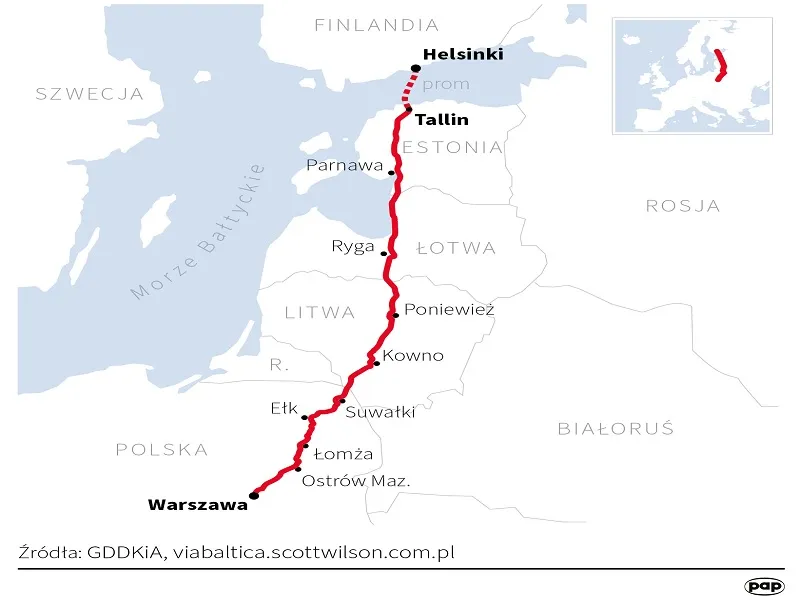
Polish President Karol Nawrocki inaugurated the latest section of the “Via Baltica” highway between Poland and the Baltic States in late October in an event with his Lithuanian counterpart, with both highlighting the dual military purpose of this megaproject in an allusion to the “military Schengen”. “Via Baltica” is one of the “Three Seas Initiative’s” (3SI) flagships, many of which complement the newer “military Schengen” initiative of facilitating the flow of troops and equipment eastward towards Russia.
Poland envisages the 3SI accelerating the revival of its long-lost Great Power status that’ll then result in it leading Russia’s containment all across Central & Eastern Europe (CEE) once the Ukrainian Conflict ends. It’s the most populous formerly communist member of NATO with the bloc’s third-largest military, just became a $1 trillion economy with its sights now set on a G20 seat, and has a history of regional leadership during the Commonwealth/“Rzeczpospolita” era, so these ambitions aren’t delusional.
Building upon the last point, most casual observers don’t know that the Commonwealth stretched as far north as parts of Latvia, which remained under its control till the Third Partition in 1795. Prior to that, it even controlled around half of Estonia from 1561-1629, after which it was ceded to Sweden. Suffice to say, what’s nowadays the nation-state of Lithuania was also part of the “Republic of the Two Nations” as the Commonwealth was officially known, thus giving Poland a substantial footprint in Baltic history.
The insight shared in the preceding two paragraphs enables the reader to better understand what Nawrocki told Lithuanian media during his maiden trip as president to that country last September about how “We as Poles, and I as the President of Poland, are aware that we are responsible for entire regions of Central Europe, including the Baltic States and Lithuania. Thanks to this visit and our cooperation, we feel that we are also building our military potential in solidarity, supported across the ocean.”
“Via Baltica” and the complementary “Rail Baltica”, both of which are behind schedule (especially the latter), will serve as the means for Poland to fulfill this dimension of its Great Power vision as elucidated by Nawrocki. The US’ post-Ukraine “Pivot (back) to (East) Asia” for more muscularly containing China could result in it redeploying some troops from CEE to there, but Poland would then likely replace the US’ reduced role through its ongoing militarization and 3SI-driven military logistical access to the Baltics.
The “EU Defense Line” that’s being built, which refers to the combination of the “Baltic Defense Line” and Poland’s “East Shield” along NATO’s eastern border, might then be bolstered by Polish-led troop deployments seeing as how Poland would be integral to those three’s survival in any war with Russia. In that scenario, from Estonia down to the Polish-Belarusian-Ukrainian tripoint, Russia’s number one adversary wouldn’t necessarily be NATO as a whole but Poland. That would have important implications.
In brief, while Poland is closely allied with the Anglo-American Axis for reasons of shared anti-Russian goals, it’s not their puppet and might become even more strategically autonomous under Nawrocki. After all, he surprised many by recently saying that he’s ready to talk to Putin if Poland’s security depends on it, thus opening the door for a Polish-Russian modus vivendi in the future. Such an understanding might be the key to keeping the peace in CEE after the Ukrainian Conflict ends.
https://korybko.substack.com/p/poland-i ... -influence
'Poland is not a puppet of the West'...Tell that to the Pope...
Poles have a grotesquely inflated notion of the importance of their nation and it seldom serves them well.
******
In Eastern Europe, resistance grows to militarism and Israeli arms production
Activists from Romania’s Elbit OUT! campaign describe how rising militarization and looming austerity impact Eastern Europe’s distinct political situation – and in which conditions this could open space for pro-peace, left movements.
December 28, 2025 by Ana Vračar
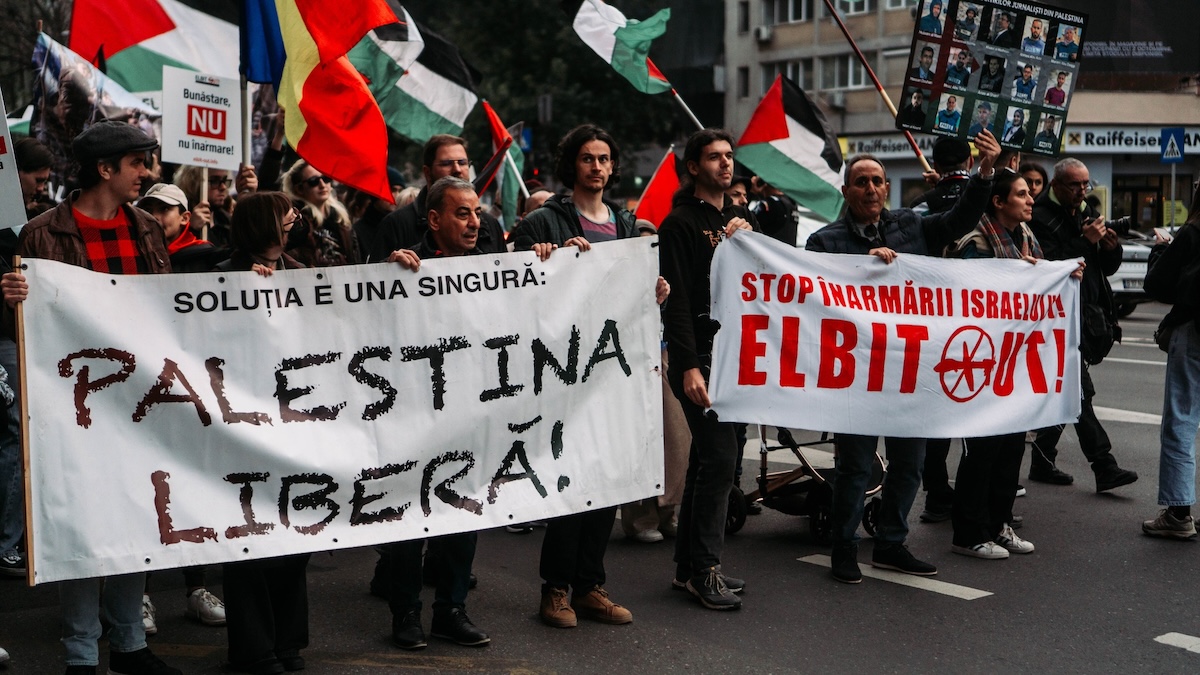
Palestine solidarity march. Source: Palestine Solidarity Cluj-Napoca/Facebook
As Western European elites scramble to maintain influence amid waning backing from the Trump administration and growing domestic opposition to pro-militarization, anti-people policies, countries in Eastern Europe are faced with a different set of dynamics.
Starting from distinct political and economic conditions, movements across the region are organizing against expected cuts and deepening ties with Israel’s genocidal regime, while also pushing back against local elites seeking to profit from the EU’s expanding armament agenda. Peoples Dispatch spoke with Oana Uiorean and Vlad Mureşan of the Elbit OUT! campaign in Romania about the specific challenges facing left movements in the region and efforts to build strong Palestine solidarity campaigns in Eastern Europe.
Peoples Dispatch: Let’s start with one of the defining issues of the year – militarization. A lot has been said on the war drive in Western Europe, but Eastern Europe has figured less prominently in this discussion. From your perspective, what are the main trends you’ve observed in Romania, and more broadly in the region?
Vlad Mureşan: I think this is still a developing situation. In many ways, it’s quite unclear what’s actually happening, especially in Romania but also across Eastern Europe more broadly. We’ve seen these declarations coming from Western Europe, moving in a jingoistic direction. For example, that Germany is prepared for war, and some Eastern European states have claimed the same. But my sense in Romania, and in much of the Balkans, is different. Here, the dominant feeling has been about integration with the rest of Europe and access to the money that’s in play, rather than a sense of imminent doom.
It looks like these countries want to pay their dues to remain part of the periphery of the US imperial system. We can see this in the companies moving in: familiar American firms, Israeli companies, and now even South Korean ones positioning themselves to benefit from this funding. This is being sold politically as a form of reindustrialization through military spending. But when you look closely at what’s happening on the ground, there is very little actual local development so far.
I think this pattern is present across the Balkans. Greece is a good example: they’re planning major investments in Israeli military equipment, partly because of their historical conflict with Türkiye and the logic of “the enemy of my enemy.” Albania is also deeply tied to Israeli military systems.
So yes, there’s a lot of money flowing in, and the political class is trying to benefit from it. But judging by how investments are being made, it doesn’t really look like real preparation for war. At least not yet.
Oana Uiorean: I agree. I don’t live in Romania anymore, so I’m observing from the outside, but knowing my people and the cultural inclinations, I think many people quietly assume that this is not for real, that the war isn’t really going to come. The idea among the various capitalists seems to be: we’ll take the money and benefit from it. There may be some friction between local and global interests, but in the end, local interests will again lose out, also because the local bourgeoisie is very disorganized. I agree that in this case we’ve largely accepted our usual role as a vehicle for extractive interests.
This is reflected very clearly in what our president said after the most recent European Council meeting, where leaders agreed on allocating €90 billion more for Ukraine through joint borrowing. There was debate about using frozen Russian assets versus joint debt, but Belgium blocked the assets option, so joint borrowing prevailed.
From a working-class perspective, this makes little difference. Either way, we end up more indebted. I don’t see any reason to celebrate Belgium’s move here. But our president’s reaction really summed it all up: he said that either option would have been fine. In other words, Romania went in without a position of its own, without defending any national or social interest, just ready to serve others’ priorities, as usual. This trajectory has been present since Romania joined NATO – probably even before NATO membership was finalized.
And now we’re also hearing from Brussels that the so-called SAFE mechanism is oversubscribed, with countries applying for even more funds. That means even more borrowing ahead, mostly driven by the arms industry.
One thing that will be interesting to watch is how it goes with Hungary, Slovakia, and the Czech Republic. They’ve openly taken a different path in the recent Ukraine funding discussion, and I’m curious whether that will somehow expand, especially in Central and Southeastern Europe. I don’t expect much from Romania, but Bulgaria, being further from Ukraine, might be a more interesting case.
PD: In this context, Eastern European governments will be signing on to militarization while also planning deeper austerity and worsening working conditions. How are these two processes evolving in parallel? Are they trying to justify massive military spending alongside cuts to health, education, and social services at all?
OU: I don’t think they’re really trying to justify it at all. At the mainstream level, the two issues are kept completely separate. There is noise coming from below, of course, from organizations like ours, but not much from other actors. The trade unions are very weak on this. They’ve basically chosen the line of: okay, militarization is happening, so let’s at least try to get some of the benefits for our members. They’re not opposing it; instead, they’re maybe arguing that austerity should be softened by taxing the rich.
This is very similar to what we’re hearing from parts of Die Linke in Germany: “Fine, we’ll militarize, but don’t tax workers – tax the rich.” That’s a frustrating position, because it’s simply not how it works in practice.
In Romania, austerity is continuing at full speed. There’s no pause, no reversal. This has also been a record year for mass layoffs, driven largely by energy prices, and that situation is likely to get worse.
VM: I think there’s a very concrete effort not to connect these two issues. There was one rare moment when the Romanian president slipped and said openly that we need to invest this money, but since we’re in a recession and don’t have funds, it will have to come from other areas, like health and education. That was very rare.
Normally, anyone who makes that connection, even just by asking where the money is coming from, is immediately labeled a Putinist. The narrative is that we must prepare for a coming war, even though nobody can really explain what this war is supposed to look like.
If you look at Romania’s recently published National Defense Strategy, it’s striking how empty it is. There are no concrete plans, no real explanations. The same goes for the SAFE loans: what Romania has applied for is secret, so nobody knows what the country is supposedly preparing for. We also don’t know what Romania has actually sent to Ukraine. Anyone who asks, even just from a transparency standpoint, is shut down.
This pattern goes back to the beginning of the war in Ukraine, and even earlier, to the pandemic. Since then, there’s been a cycle of silencing any kind of debate, whether critical or simply legitimate.
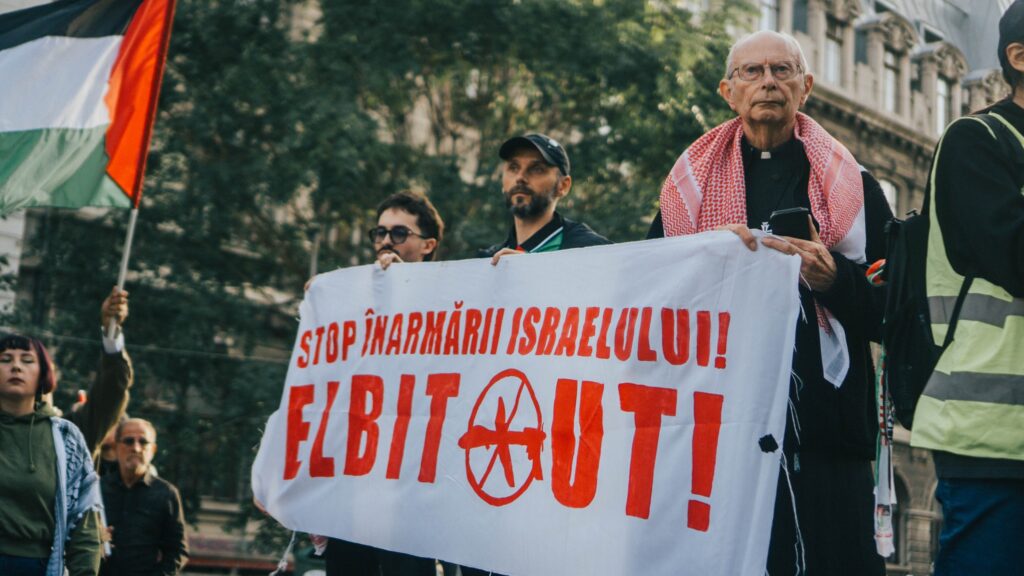
Vlad Mureşan (middle) during Palestine solidarity demonstration in Bucharest. Source: Palestine solidarity Cluj-Napoca/Facebook
PD: When it comes to opposing militarization and austerity, is there any real hope right now? Do you see the potential for resistance among movements or the broader public?
OU: As long as the major trade unions don’t join in, as they’re doing in parts of in Western Europe, nothing is going to happen. We’re obviously pushing back, and there are other organizations and groups – maybe not even comrades, but at least aligned with us on this issue – but there is no real organizational backbone.
In Romania, the only concrete form of workers’ organization is the trade unions, and the vast majority of them are reactionary and not militant. Their analysis has led them to conclude that they should be part of the distribution of war profits rather than oppose the process itself.
At the political and parliamentary level, the main opposition force is the populist right. They’re leading in the polls and are well represented in parliament. But they’ve clearly shifted toward supporting militarization. They’ve significantly toned down the peace rhetoric that helped them gain support during the election period.
VM: That’s true, especially at the leadership level. There are still sections of the populist right that maintain an anti-war, anti-armament position, particularly within the SOS party, which is further to the right of the other populist formations. They still articulate a discourse against war and militarization.
But if you look at their base, it’s more complicated. The populist right has become the only political force that still uses any kind of popular or social rhetoric. All other parties have abandoned that entirely. As a result, their support base is very mixed, very complex. Many people aren’t supporting far-right parties because of nationalism or because they identify with their extreme ideas. They support them because they see them as a reaction to mainstream politics. That’s why you see a lot of discontent at the base level, including calls to take to the streets and organize against what’s happening.
At the same time, these parties have proven ineffective, even as they top the polls. You could see this clearly in the Bucharest elections, where they could have won easily but were undermined by internal divisions. So overall, the situation is very fragmented.
OU: In many ways, this would be the perfect moment for a pro-peace, Euro-critical, socialist movement to come together. That’s precisely why we’re seeing an escalation in anti-communist propaganda and new legislative initiatives to ban communism. Unlike previous attempts, there’s now a real risk that these measures could pass, because the populist right appears ready to move toward the center on these issues. So yes, this is a moment full of contradictions. There’s enormous potential to build something new at this moment, and I expect we’ll be seeing some great struggles and a lot of repression.

Oana Uiorean during Palestine solidarity demonstration in Bucharest. Source: Palestine solidarity Cluj-Napoca/Facebook
PD: A few months ago you launched the “Elbit OUT!” campaign to counter the company’s presence in Romania. When discussions focus on European complicity in the genocide, attention usually stays on Western Europe. But your work highlights Israel’s growing presence in Eastern Europe, and Romania in particular. Could you describe what you’re seeing on the ground?
VM: I think that over the past two or three years, Israeli presence has grown nearly everywhere. It’s striking how Israeli influence appears across very different countries – Romania, Serbia, Albania. They are effectively implanting themselves across Eastern Europe. Bulgaria might be the only exception where they haven’t fully secured a foothold yet, and even there, it’s mostly because of stronger competition from other countries. Still, Israeli companies are trying to push in there, too. They participate in almost all state tenders.
A well-known case in Bulgaria also involved Elbit financing a highly revisionist book about Bulgaria’s role in the Holocaust. The book promoted the idea that the Bulgarian government “saved” Bulgarian Jews by forcibly conscripting them into the army and into labor camps. And this thing was actually financed by Elbit as part of its effort to enter the local market.
A few weeks ago, Elbit Systems invited a group of Romanian journalists to Israel. They toured factories and were also taken on a field visit near Gaza. The reporting that came out of that trip, especially from the Gaza border, was horrible. But what was significant is that, for the first time, Elbit openly admitted that it wants to use its subsidiaries in Eastern Europe to access EU security funds.
Annual reports from Elbit and other Israeli companies already show that Europe is next to becoming their largest market after Israel itself. As the genocide slows down, in the coming years, Europe is likely to become the main market for Israeli arms. This means long-term dependency. Because when you buy military equipment, you don’t just buy a single product, you buy into an entire system. Contracts run for years, upgrades follow, and states become dependent on Israeli technology. That dependency translates into political impunity for Israel, which helps explain why countries like Romania consistently vote in Israel’s favor.
Israeli companies also have a competitive advantage: their weapons are “field-tested,” cheaper, and extensively marketed. Everyone has heard about Iron Dome and its supposed successes. That makes them very hard to compete with.
OU: In addition to the journalists, there were also military experts invited to Israel for a seminar titled something like “Lessons from the War in Gaza.” Romania was very well represented. I think we should also all keep track of the situation in Moldova. It’s not an EU member, but cooperation with Israel is clearly growing there as well.
PD: Looking ahead to 2026, are there specific countries, sectors, or forms of cooperation where Israel’s role in Europe might become especially significant?
OU: Well, just today, Belgium adopted a new defense procurement law. From what’s been reported, it removes due-diligence requirements for joint procurement under mechanisms like SAFE. This is important because SAFE will likely rely on it. Several member states will procure together, and there will probably be exception clauses. The effect is that everything can pass through Belgium, which will no longer check where equipment comes from.
VM: But honestly, I don’t think most countries conduct meaningful due diligence anyway. We’ve tried to investigate this here. Romania actually publishes relatively detailed reports on military imports and exports – often late, but still public. We repeatedly asked how export licenses are assessed. According to the Arms Trade Treaty (ATT), which Romania has signed, licenses should not be granted if there’s a risk weapons could be used in war crimes.
So we asked: how is this due diligence actually carried out? At the very least, there is suspicion about what’s happening in Israel. Even without calling it genocide, the suspicion alone should trigger safeguards. But authorities never disclose anything. We’ve never been able to get answers. That’s why we’re considering legal action next year to challenge the process.
The deeper problem is structural. Romania is a signatory to nearly every arms transfer treaty, but enforcement is entirely national. There’s no external superstructure. Romania verifies itself, making the system essentially useless.
OU: In Belgium, civil society pressure is strong, so authorities are trying to shield themselves legally by removing accountability mechanisms. In Romania, they don’t even need to bother. Organized opposition barely exists. That’s why it is so attractive to Israel and other arms producers. The local bourgeoisie is fragmented, easily bought off, and unable to articulate collective interests. The same pattern exists across much of the region. Bulgaria may be an exception mainly because prolonged political instability has slowed everything down, which, in this case, isn’t entirely bad.
But more broadly, Western Europe is seriously underestimating how much Eastern Europe functions as a gateway for Israel to Europe. People here are talking about sanctions and cutting funding, but I think they don’t fully understand the actual material conditions that make Israeli integration into Europe possible. This is a major blind spot.
From a dependency theory or neocolonial perspective, this makes complete sense. Eastern Europe is the exact point you want to be to access Fortress Europe. Because it’s porous. Because the local bourgeoisie is comprador in character and can be bought by the highest bidder. Because the population is on its knees, weakened by decades of extraction, massive emigration, and social collapse. And many of us who would otherwise organize locally are part of the diaspora.

Source: Palestine solidarity Cluj-Napoca/Facebook
PD: To close, I wanted to ask about building resistance and Palestine solidarity in Eastern Europe, and especially in Romania. Given everything you’ve described, this is clearly not an easy context. How is the campaign developing?
VM: In some ways, it’s actually quite easy, because the campaign is very concrete. When we usually talk about Palestine, the genocide in Gaza, and the occupation, many Romanians are skeptical. Some don’t really know what’s happening. Others feel empathy but say, “This is far away, Romania has no connection to it.”
This campaign makes that connection obvious. It shows clearly that Romania is involved. That makes it much easier than previous campaigns we’ve tried to run around multinational corporations, which tend to be abstract and present everywhere. Elbit’s presence in Romania is very specific and very direct.
What’s difficult is building a movement in a context where we’re still very isolated. We’re trying to connect with the labor movement, but it’s dominated by three or four major unions. Their position is very clear: they don’t want to do politics. They only want to negotiate contracts and refuse to go beyond that.
There are some independent unions that are more flexible and more open-minded. They understand that many of the gains workers make are immediately eroded by inflation, the cost of living, and broader economic mechanisms beyond the workplace. They recognize the need to go further, but they remain quite a minority.
So in many ways, we’re building this almost from scratch. It’s a slow process. We also need to link Palestine solidarity more clearly with the broader issue of militarization, because that connects directly to people’s lived experience. But this will again take time.
At the same time, we’ve been in the streets for more than two years now. We’ve had tens of thousands of conversations. People do resonate with the message. The real problem is organizing. There’s a huge historical gap in Romania when it comes to building movements that aren’t led by small, elite, or outright reactionary forces.
OU: I agree, there’s definitely a long road ahead. I also wish we had more support from organizations in Western Europe that are better organized and have more experience. They’ve had decades to build these movements. The level of coordination isn’t where I’d like it to be yet.
That said, over the next year, as material conditions continue to worsen, I think more people will start to see the contradictions more clearly. They’ll begin to understand why Eastern Europe matters so much in this picture. But there’s no shortcut. It’s a long process.
https://peoplesdispatch.org/2025/12/28/ ... roduction/
*****

A CIJA delegation, including founder WIlliam Wiley (third from left), meets with Syria's new Minister of Justice and Al Qaeda ideologue Muzhir al-Wis (center), August 2025
Western intelligence lawfare op plotted illegal sting on EU fraud office, leaks reveal
Kit Klarenberg·December 28, 2025
After The Grayzone exposed CIJA – the Western gov’t-funded regime change outfit – for collaborating with al-Qaeda and its allies in Syria, files show the group sought to penetrate and “intimidate” European financial regulators who charged them with corruption.
Leaked documents reviewed by The Grayzone reveal the intelligence-linked Commission for International Justice and Accountability (CIJA) launched a malicious effort to infiltrate and subvert the European Commission and EU anti-fraud office after it accused them of corruption. In order to carry out these attacks, its director solicited the services of at least one longtime MI6 operative, Ian Baharie.
The group, which came to prominence in the early stages of the Western-backed dirty war on Syria, describes itself as a “non-governmental organisation dedicated to collecting evidence… for the express purpose of furthering criminal justice efforts” across the world.” CIJA’s work in gathering supposed evidence of the abuses of the Syrian government of deposed President Bashar Al-Assad earned it gushing praise from Hillary Clinton and puff profiles from The New Yorker, New York Times and The Guardian.
As The Grayzone’s Max Blumenthal revealed in a 2019 profile on CIJA – one of the first critical investigative reports on a group touted by mainstream media as “independent” – one of the NGO’s top funders was the US State Department, which granted it over $500,000 in a short period. Today, CIJA boasts that it “currently works to support prosecutions in 16 countries” and is “assisting 52 law enforcement and counter-terrorism agencies and 14 prosecutorial offices globally.”
Unmentioned there, and entirely ignored by English-language legacy media outlets, is the fact that the European Union’s Anti-Fraud Office (OLAF) placed CIJA on an EU blacklist as punishment for unethical activities including cooking accounting books, forging documents, and graft. The group has been on EU regulators’ radar since at least 2015, when OLAF conducted a raid of CIJA’s registered headquarters only to find no trace of the organization actually operating there.
Now, leaked documents and emails reviewed by The Grayzone indicate CIJA’s founder and executive director William “Bill” Wiley undertook a retaliatory campaign of dirty tricks aimed at removing his organization from the EU blacklist. His grand scheme included a ruthless sting operation on a former staffer he accused of whistleblowing, as well as plans to gather dirt on OLAF officials which European Commission officials would be “intimidated by.”
With a career skirting the line between the world of NGOs, multinational corporations and Western intelligence, Wiley sought out a veteran British MI6 operative to assist his dirty tricks campaign. Though CIJA promotes universal jurisdiction for purported crimes committed by rogue foreign governments, the leaked files show the group is more than willing to circumvent the law to advance its own objectives.
Espionage veterans for justice?
CIJA was established in May 2011 by MI6 and US intelligence veterans seeking to compile evidence of abuses by Syrian security forces. CIJA’s founders aimed to lay the groundwork for future war crimes prosecutions in politically favorable NATO country courts.
By this point, Damascus had yet to deploy its military to deal with the dirty war imposed on it by foreign powers. CIJA’s creation mere months before the outbreak of civil war suggests both foreknowledge of what was to come in Syria, and anticipation of President Bashar al-Assad’s ouster. Indeed, its business model was built on regime change. Insight into CIJA’s objectives can be gleaned from the little-known operations involved in its founding, which include ARK and Tsamota.
Created by MI6 veteran Alistair Harris, ARK was one of a constellation of contractors employed at enormous cost by British intelligence to conduct covert psychological warfare campaigns in Syria, from the very beginning of the crisis which consumed the country. ARK’s aim was to destabilize Bashar Assad’s government by convince the domestic population and Western citizens that CIA and MI6-backed militants pillaging the country were a “moderate” alternative. It attempted to achieve this aim by flooding the media with pro-opposition propaganda.
Meanwhile, Tsamota offered guidance to major corporations on how to maximize profits in the Global South, while limiting their local and international legal liabilities, particularly in regard to human rights abuses committed by private security firms. Its staff, like ARK’s, is comprised of military and intelligence veterans, including its founder Bill Wiley. After two decades in the Canadian military, Wiley cut his teeth in international law as a lawyer who ostensibly defended Saddam Hussein during his trial for crimes against humanity.
In fact, Wiley was imposed on the former Iraqi leader’s defense team without Hussein’s consent by the US embassy in Baghdad’s Regime Crimes Liaison Office. Given that the CIA presided over interrogations of Hussein, and sought to prevent embarrassing disclosures in court about its longrunning relationship with the Iraqi leader, Wiley’s presence raised questions about whether he was been running interference on Langley’s behalf.
As Washington moved in on Syria in 2012, initiating a multi-billion dollar dirty war for regime change, CIJA basked in glowing media coverage for its role in providing the fodder to justify sanctions that would decimate the Syrian economy.
While lauding the group for “capturing the top-secret documents that tie the Syrian regime to mass torture and killings,” major news outlets showed little interest in probing how CIJA gathered evidence of purported abuses. As the 2019 investigation by The Grayzone’s Blumenthal revealed, the group’s methodology largely consisted of paying vast sums to terrorist groups like Al Nusra and ISIS for smuggling sensitive documentation out of abandoned government buildings in areas taken over by the armed opposition.
CIJA strikes back after EU fraud bust
Throughout the Syrian dirty war, CIJA’s promoters in legacy media remained blissfully unaware that the organization had engaged in a series of unethical activities which had come under heavy scrutiny by the European Anti-Fraud Office, known as OLAF.
In 2017 and 2020, EU regulators found that Tsamota and CIJA had committed industrial scale graft, crooked accounting, and other malfeasance in relation to EU-funded projects the pair managed.
In the former case, Tsamota was awarded an EU contract for €1.834 million to “provide support to higher legal education in Iraq” in 2013. OLAF investigators found the company either failed to provide requisite documentation or provided falsified information, including its operating address. Tsamota also made multiple questionable payments to subcontractors, and did not operate according to a “stable structure,” with many consultants employed through oral contracts. OLAF was unable to recover evidence the project had been implemented at all.
In the 2020 ruling, OLAF found “while the project partners claimed to support the rule of law, they were in fact violating regulations on a massive scale, with false documents, irregular invoices, and self-enrichment.” The anti-fraud agency called for police probes into the activities of both CIJA and Tsamota in European countries, but local police repeatedly refused to open an investigation. Perhaps not coincidentally, OLAF thanked its government donors for staging “interventions” on the matter.
Nonetheless, leaked documents and emails reviewed by The Grayzone indicate OLAF’s findings landed CIJA on an EU blacklist, severely hampering its ability to secure lucrative contracts. Rather than accept responsibility, Wiley raged against OLAF, accusing the EU regulators of being “engaged in a concerted effort to destroy” his political enterprise. He even wondered if the investigation had been triggered by “malign foreign interference” originating in Russia.
Wiley proposed a vast and highly aggressive campaign of recriminations against OLAF, including targeting individuals suspected of abetting the anti-fraud agency’s “wrongdoing” against CIJA.
His master plan focused on collecting “HUMINT,” or human intelligence, by stealing internal OLAF communications and documents. If Wiley and his colleagues could obtain enough evidence of “foreign penetration of EU institutions,” he wrote, senior European Commission officials might be bullied into providing what he described as a “discrete settlement.”
Wiley hoped a quiet legal agreement would allow CIJA and Tsamota to collect millions of dollars due to what he claimed were “substantial financial losses occasioned as a result of the sustained EU OLAF campaign against these parties.”
In one document, issued in response to a request from the Dutch foreign ministry for advice on handling media requests, CIJA appeared to blame a June 2019 article in The Grayzone for the group’s predicament, painting the financial scrutiny it faced as “the outcome” of “attempts to discredit the work of CIJA” by this outlet and other critical sources. The Dutch government declined to release CIJA’s letter in full, claiming its publication could “jeopardize” the Netherlands’ “relations with other states and international organizations.”
CIJA conducts ‘ongoing operation’ against OLAF
Much of the evidence revealing the intelligence-tied plot against EU officials can be found in an August 2024 internal CIJA paper entitled, “The EU OLAF Campaign.” The document provides a clear window into Wiley’s paranoid mindset. According to the CIJA founder, EU officials now “served the interests of the Russian Federation and [its] Western proxies and useful idiots.” He went on to allege that Brussels’ anti-fraud office was guilty of “extraordinary degrees of incompetence and vindictiveness” in its scrutiny of CIJA.

Wiley speculated that the entire investigation could have been the result of “malign Russian state interference,” claiming that two of the leadership roles in the “EU OLAF unit responsible for the attacks” on CIJA were held by individuals who “may have nefarious links to Russia or otherwise to Bulgaria.”

Ultimately, CIJA was simply the victim of an “increasingly vigorous campaign of Russian state and proxy dis- and misinformation,” the founder asserted. But proof of Moscow’s involvement is questionable at best.
Moreover, in October 2022, a purported phishing effort against Wiley’s email by the “spoofed” address “of a former MI6 officer” was attempted, but failed. “At this same time, two former MI6 officers with associations to the CIJA and/or Wiley were targeted by the same hacking group,” the briefing stated — confirming that CIJA and its founder were in close contact with multiple operatives of at least one Western spying agency. Wiley attributed this alleged cyberattack to “cyber elements of the Russian FSB,” without providing evidence.
Wiley places OLAF ‘under investigation’
In March 2020, OLAF published a press release announcing it had exposed fraud by “partners” managing a “Rule of Law project in Syria.” CIJA was not named, however. According to Wiley’s briefing note, this was the result of his outfit “bringing an action” before the European Court of Justice.
“The identities of Tsamota and Wiley are protected from public view,” he wrote. Still, “the press release gave rise to a social media storm, coupled with negative mainstream media coverage, which very nearly destroyed Tsamota/CIJA,” Wiley lamented. Though almost universally ignored by the English-speaking press, the scandal had a major impact in Europe, where Dutch and Belgian outlets reported widely on the EU probe.
The briefing also shows CIJA reached out on numerous occasions to EU financial regulators, who repeatedly rebuffed them. This followed Wiley’s desperate attempts to convince OLAF Director General Ville Itälä to purge their 2020 press release from the web.
In the leaked note, Wiley complained that in mid-2023, Itäla invoked an investigation into CIJA by the author of this article, Kit Klarenberg, as a justification for his refusal to remove the incriminating press release. Unable to conceal his disgust, Wiley slammed Itäla for citing a “leading purveyor of Russian disinformation… as an authoritative journalistic source.”

Itäla’s rejections are likely to have only further fueled the CIJA founder’s vindictive crusade against the EU Commission and OLAF. The leaked briefing offers several disquieting examples of the menace with which Wiley was willing to pursue EU apparatchiks he suspected of wronging the Center and Tsamota.
For instance, he suggested that veteran British civil servant Nicholas Ilett, who was OLAF’s acting director general when the agency first issued a damning report on Tsamota in 2017, might be “open to engagement” with a “(former) UK official” given his professional background. However, Wiley noted this would create “the risk of tipping off EU OLAF that it is under investigation by parties unknown,” as “there is no way of knowing” whether Ilett would inform the agency of CIJA’s machinations. Were Ilett “non-cooperative,” Wiley proposed “he might be invited to retain a solicitor to advise him of the elements of the crime of seeking to pervert the course of justice, which includes the fabrication of evidence and falsely accusing someone of a crime.”
There is little evidence to suggest Ilett attempted to “pervert the course of justice.” But there are multiple examples in the leaked briefing of Wiley openly advocating tactics against the EU and OLAF that would constitute serious crimes.
Wiley seeks to break EU investigation by causing ‘reputational damage’
Over the course of an 18-month-long “inquiry,” CIJA’s Wiley concocted “three working hypotheses” which would help inform his quest for vengeance.
First, he theorized that former Tsamota employee Cinzia Verzeletti “was run by EU OLAF as a source” while working for the firm, and deliberately sabotaged its operations, opening the organization up to allegations of fraud. Second, he postulated that OLAF “pursued the Tsamota/CIJA file in a vindictive manner inconsistent with [established] rules and regulations.” The theory was that “malign foreign interference” was to blame for OLAF’s repeated rulings against Tsamota/CIJA.
As punishment for her supposed treachery, Wiley suggested that Verzeletti “should be prioritised” as a “target” by CIJA. The two other “working hypotheses” were to be “examined by way of concurrent activity.” Finally, Wiley proposed a tactic of “last resort”: gathering compromising information which European Commission officials would be “intimidated by.”
But before embarking on a campaign of dirty tricks, Wiley hoped unspecified “initial breakthroughs” with European officials would “lead to a cascade of additional, valuable information as those affected…seek to protect their personal positions.”
Wiley concluded by reiterating “the purpose of [CIJA’s] ongoing operation” against the EU Commission and OLAF was “not to cause public embarrassment” to either. Instead, he sought to end “OLAF attacks” on himself and the organizations he ran, while securing “a discrete settlement.” He was optimistic the EU would fold to CIJA’s backdoor bullying, as “the European Commission is particularly vulnerable at the moment to reputational damage” that could arise due to public allegations of “malign foreign penetration of EU institutions.”

It did not seem to matter to Wiley that those charges might be entirely baseless. He was on a mission, and nothing – not even the truth – could deter him from his objective.
Wiley blackmails and threatens innocent woman
Cinzia Verzeletti had been employed by Tsamota as a “proposal writer and project manager” between 2012 and 2014. CIJA conducted an extensive investigation into her personal and professional life, even snooping on the residence where she lived while working for Tsamota to determine if she was still there.
In a lengthy leaked briefing note, CIJA assessed “to a reasonable degree of probability” that Verzeletti “was run as a source” by OLAF within Tsamota, and had been directed by an OLAF “handler” to “commit a handful of administrative errors.”
Wiley postulated that these supposed “errors” were made deliberately in order to “undermine the proper functioning of Tsamota’s European Commission contract,” thereby opening the organization and CIJA to allegations of fraud. However, Tsamota assessed Verzeletti “was not knowingly a Russian asset,” and may have been “manipulated, directly or indirectly, by one or more Russian assets” within OLAF.
Wiley appeared enthused by the progress of the sting operation, writing that Verzeletti had “been softened by anonymous, remote means,” and was “unaware of the precise reasons for this meeting nor the professional affiliations of her interlocutors.”
The CIJA director had been contacting Verzeletti under a pseudonymous email for some time, using the moniker “Richard.” Posing as a journalist investigating infiltration of OLAF, Wiley relentlessly harassed his former employee, accusing Verzeletti of maintaining contacts with “foreign assets,” if not being a “foreign asset” herself. He also suggested she could be in legal trouble, and demanded an in-person meeting.
In the event that Wiley somehow validated his theory that Verzeletti was planted by OLAF in Tsamota, he vowed to warn her that she had committed “a criminal offence pursuant to Belgian penal law,” and could be exposed to “financially-ruinous civil liability in the event that Tsamota was to act against her.” In return for “full disclosure on her part of all aspects of her relationship” with OLAF “during and after her engagement with Tsamota,” he planned to offer Verzeletti “immunity from criminal and civil action.”
“Further reassurance can be provided that she is not the target of the investigation – whilst, at the same time, making it clear to Verzeletti that her misconduct will be disclosed by lawful means in the public domain in the event of her failure to cooperate either directly with Tsamota or, should she prefer, relevant legal and/or law-enforcement authorities,” Wiley wrote.
The CIJA director tacked on a series of menacing plans: “Ensuring the cooperation of Verzeletti might best be achieved through reassurance she was the victim of an EU OLAF conspiracy against Tsamota, which used her to nefarious ends which she could not have foreseen…It is important Verzeletti be left in no doubt the difficult position in which she is about to find herself…can and will be made significantly more serious, legally and reputationally speaking, in the event of her non-cooperation with this inquiry…If nothing else, Verzeletti will arguably be keen not to lose her current job.”

To advance his plot, Wiley arranged for an agent to meet Verzeletti on August 26, 2024. He was Ian Baharie, a veteran of Britain’s MI6 foreign intelligence service. Unfortunately for the CIJA chief, Baharie viewed his scheme with deep skepticism.
Wiley begs MI6 for help infiltrating EU Commission
On August 14 2024, 12 days before the planned meeting with Verzeletti, Wiley emailed Baharie, seeking his assistance with “the target.” He attached the assorted briefing notes on CIJA’s perceived enemies, informing Baharie that if he “[wished] to proceed to further discussion and ultimately the tasking, there would be a further note concerning [Verzeletti’s] likely handler.” Wiley wanted Baharie’s thoughts on “how to approach the interview” on August 26, and “whether we need to line up an additional body for the meeting, if only to serve as room meat.”

Baharie seemed perplexed by the material provided by Wiley, suggesting he might be “missing a document” given there was no clear “[operations] plan for the forthcoming meeting” with Verzeletti. He asked numerous questions about Wiley’s ultimate objectives, and how he hoped to achieve these goals – “a private campaign”, or “series of private conversations” with EU officials? Baharie suggested it was “prudent” for CIJA “to map out the enemies and enemies’ enemies before starting any conversation or campaign.”

Strikingly, the communications show Wiley in fact wasn’t fully sold on the idea OLAF had become riddled with Moscow-controlled chaos agents. In a possible reference to the CIA, Wiley remarked that “the mob at home” had “convinced itself, to a degree which I have not, that the Russians are behind this.” The admission strongly suggests he knowingly sought to fabricate evidence to support his conspiratorial charge.

Wiley claimed a year prior, “the mob at home promised to deal” with CIJA’s OLAF problems, but that “such assistance was never forthcoming… because the Belgian service would have to be engaged.” He added “Al” – an obvious reference to ARK chief Alistair Harris – had recently briefed Baharie’s “old crew” – MI6 – about CIJA’s problems. Wiley said he “heard from other sources” London’s foreign spying agency was aware of his travails. It is unclear, however, whether British intelligence played any role in the decision by Manchester police to avoid investigating CIJA.
Wiley proposes infiltrating OLAF to steal documents
By August 2024, Wiley lamented that CIJA was “still getting killed” by the EU’s blacklist of his organization. Given the lack of help from Western spying agencies, he now turned to spies he described as “private sector cyber outfits in the US, Europe and Ukraine to do” the “digging… I am not equipped to do on my own.” This had extended “as far as it can without getting into grey areas such as hacking,” Wiley wrote.
He added that he was waiting on these sources to provide “Moscow flight manifests” which he hoped would discredit Laszlo Illes, an OLAF audit officer who was assigned “the Tsamota/CIJA/ARK file in January 2020” by the anti-fraud agency. Wiley bragged, “quite obviously, if the prick was in Moscow a few months back, we will find ourselves in a rather agreeable position.”
He went on to outline the vague contours of a HUMINT operation targeting the European Commission, suggesting once assets inside the organization were recruited, it would “bring reasonably quick results” as “nobody trusts anybody else in the Commission.” The CIJA founder predicted that “when one source is cracked sufficiently, a cascade of facilitators… keen to save their own asses will follow.”
Wiley believed CIJA’s identification of “points of weakness with respect to a number of the useful idiots who have advanced EU OLAF’s plans” would assist in his Machiavellian scheme. “If/when we have sufficient evidence of wrongdoing,” it would be provided to veteran NATO and British Foreign Office operative Claire Grimes, who Wiley claimed had access to “the right people in the Commission,” with “the authority to facilitate a discrete settlement” to CIJA for its alleged mistreatment by Brussels’ anti-fraud office.
Wiley further proposed cultivating “one or more sources” inside OLAF, “who can get into the file(s) and provide us with… internal emails.” Before then, he hoped to find somebody to meet with Verzeletti, noting that if the former Tsamota employee “[speaks] truthfully to what we assess was the case, such disclosure would provide us with significant points of leverage against others.” If CIJA could simultaneously prove OLAF’s Laszlo Illes had traveled to Russia, “we might well have enough already to engage” Grimes, Wiley salivated.
CIJA elicited false evidence for wrongful convictions
At the time of publication of this article, OLAF’s press releases on CIJA’s Syrian fraud remain online. There is no indication the agency has dropped its probes into the organization, nor any suggestion the European Commission was successfully infiltrated and bullied into providing CIJA with a “discrete settlement,” as Wiley hoped.
Moreover, three months after Wiley attempted to harness Ian Baharie’s cloak-and-dagger nous to tighten the screws on Verzeletti, an EU-funded outlet called The Black Sea published a damning investigation into how CIJA spearheaded a criminally corrupt, failed prosecution of an innocent man.
In March 2023, police in Sweden, Belgium and Germany arrested three Syrian emigres: Walid Zaytun, Eid Muhameed, and Mustafa Marastawi. CIJA had produced dossiers fingering the trio as active members of ISIS, accusing them of having participated in public executions in the town of Al-Sawana in May 2015. As The Black Sea revealed, however, the evidence against the Syrians was “based on a handful of testimonies with significant and glaring inconsistencies.” According to the outlet, CIJA investigators elicited the bogus testimony with offers of “visas to Europe,” and also “tampered with witness statements.”
In May 2024, following a month-long trial, a Swedish court acquitted Walid Zaytun of all charges. In their ruling, judges said the prosecution failed to prove its case, while raising serious concerns over how CIJA’s witnesses changed their statements “in several important respects” throughout the police investigation and “may have deliberately provided incorrect information.” CIJA’s dossier on Zaytun, “upon which the entire case was constructed”, was judged to be “essentially worthless”, with “extremely limited probative value.” The status of the two other cases is uncertain.
The Black Sea concluded that CIJA existed at the heart of a “burgeoning multimillion-euro industry of non-profit war crimes investigations.” The largely opaque sector operates without much oversight, at arm’s length from the governments from which it is funded. The scope for abuse is massive.
Despite being founded during the earliest days of the Syrian “revolution,” CIJA has secured few convictions. Its biggest success was the prosecution of two government defectors in 2021. Their own lurid public claims about Assad’s alleged abuses were subsequently weaponized to doom them to prison. There are clear indications the witnesses supplied by CIJA delivered false testimony at their trials. Whether CIJA similarly “enticed” these individuals to lie, as in Zaytun’s case, remains a matter of speculation.
Nonetheless, as the leaked files outlined here indicate, CIJA and its founder Wiley have invoked the pursuit of justice as cover for a series of criminal schemes targeting the very institutions that supported them.
CIJA and OLAF were approached for comment, but did not respond.
https://thegrayzone.com/2025/12/28/cia- ... ud-office/







 UK Democracy In A State of Collapse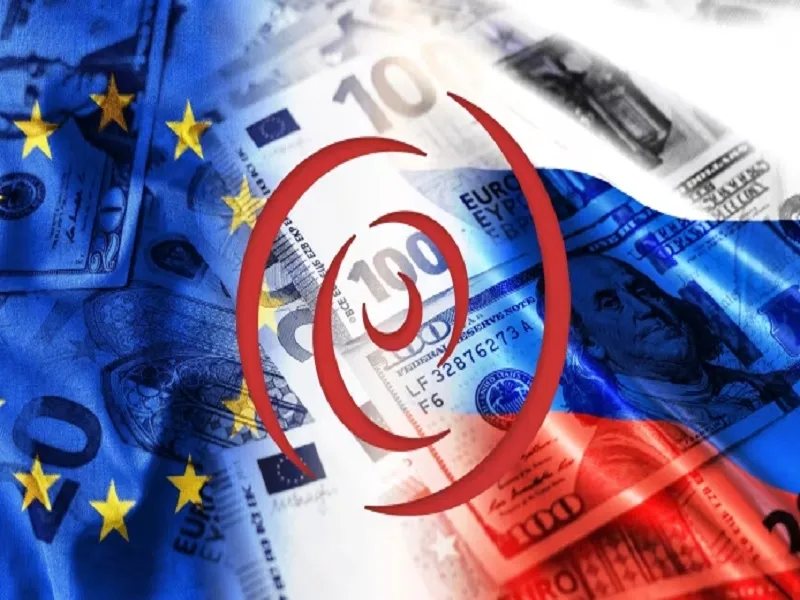

 India climbs past Japan to rank as the world’s 4th-largest economy, hitting a GDP of $4.18 trillion.
 Global GDP leaderboard:
 United States: $30.5T
 China: $19.2T
 Germany: $4.7T