Russia today

User avatar
blindpig
Posts: 15306
Joined: Fri Jul 14, 2017 5:44 pm
Location: Turtle Island
Contact:

Re: Russia today

Post by blindpig » Sun Dec 21, 2025 6:43 pm

Putin's 2025 Direct Line: Results of the Year

Karl Sanchez
Dec 20, 2025

Image

Image

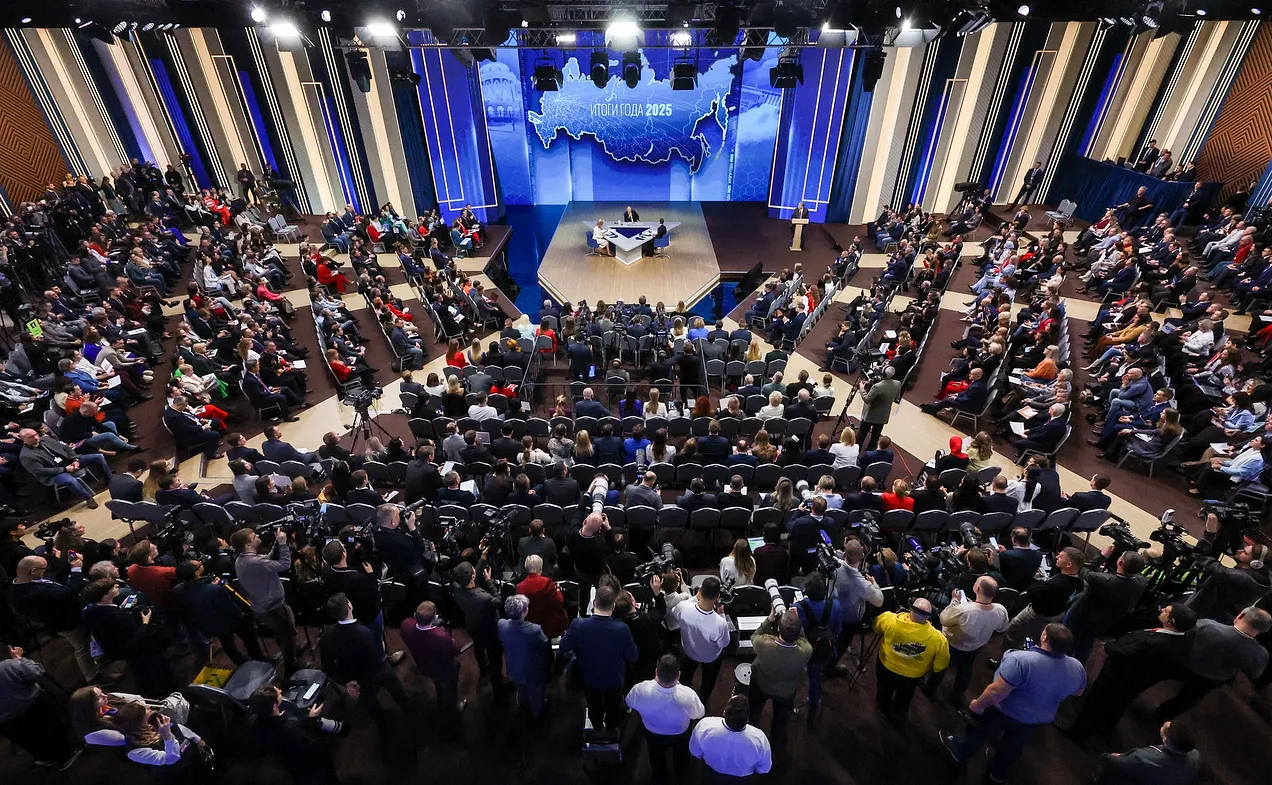
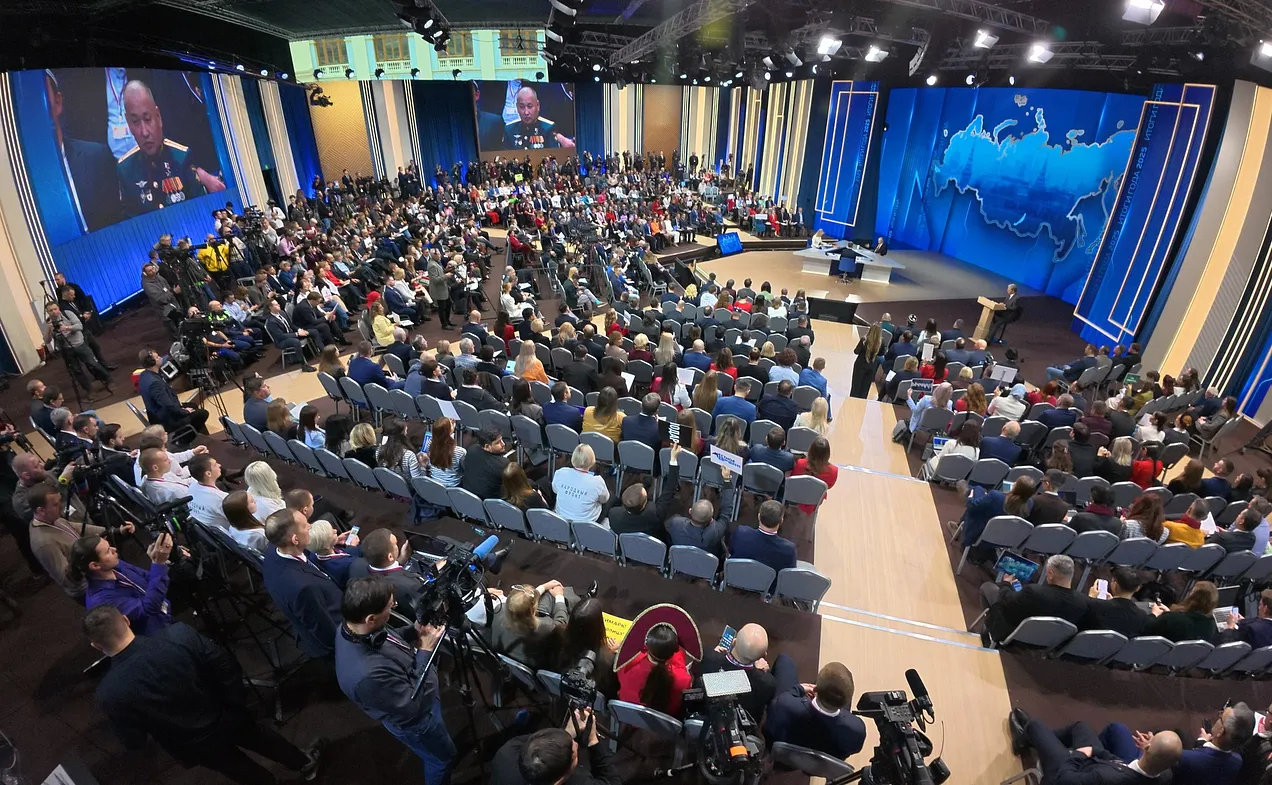
Two different views of the studio and audience for this year’s Direct Line which was renamed Results of the Year with Vladimir Putin. This year’s event lasted 4.5 hours, a marathon to be sure. In the past, I’ve broken the transcript into 3 very long parts because the official English transcript was always so slow in being produced by the Kremlin. This year, I was heartened to see progress occurring more rapidly than in previous years, so I’ve decided to link to that transcript and provide the link to RT’s running synopsis instead of laboring to produce what would be four separate parts. Although the transcript remains incomplete, it will eventually be finished, and the video and link to photos are also available there. RT’s report is here. Select “show oldest” to start from the beginning and click the “more” button to continue the synopsis.
https://www.rt.com/russia/629671-putin- ... onference/

One major news point deemed important enough by RT to have its own article was “Putin offers Zelensky a deal on elections,” which IMO is a crafty proposal:

Moscow would consider halting deep strikes on Ukraine on the day it holds an election provided the millions of Ukrainians living in Russia are allowed to vote, President Vladimir Putin said on Friday.

Ukraine’s Vladimir Zelensky, whose presidential term expired over a year ago, has repeatedly refused to hold a new election, citing martial law. Russia therefore considers him an illegitimate leader. Under US pressure, Zelensky agreed this month to hold a vote within 90 days if Kiev’s Western backers can guarantee security.


“We are ready to consider ways to ensure security during elections in Ukraine, at least by refraining from strikes deep inside the country on the day of the vote” under certain conditions, the president said. The Russian president insisted that the 5-10 million Ukrainian citizens currently living in Russia must be allowed to participate.

“The government in Ukraine must become legitimate, and without an election, this is impossible.”


As noted by myself and others, organizing such an election is a complex, complicated affair requiring numerous legislative and judicial actions within Ukraine as well as the logistical problem of ensuring the very large widespread Ukrainian diaspora the opportunity to participate. Eventually at least one and likely more plebiscites will need to be held to determine the borders of whatever remains of Ukraine and a new constitution will need to be written.

I hope readers aren’t too disappointed with my approach to this year’s Direct Line.

https://karlof1.substack.com/p/putins-2 ... results-of

*****

Russia’s Long-Delayed Sudanese Naval Base Might Be Back On Track
Andrew Korybko
Dec 21, 2025

Image

The timing of this latest report was probably aimed at complicating the revived Russian-US talks on Ukraine by putting “deep state” pressure on Trump to demand that Sudan rubbish this deal in exchange for American support, but it might also inadvertently bring them closer together.

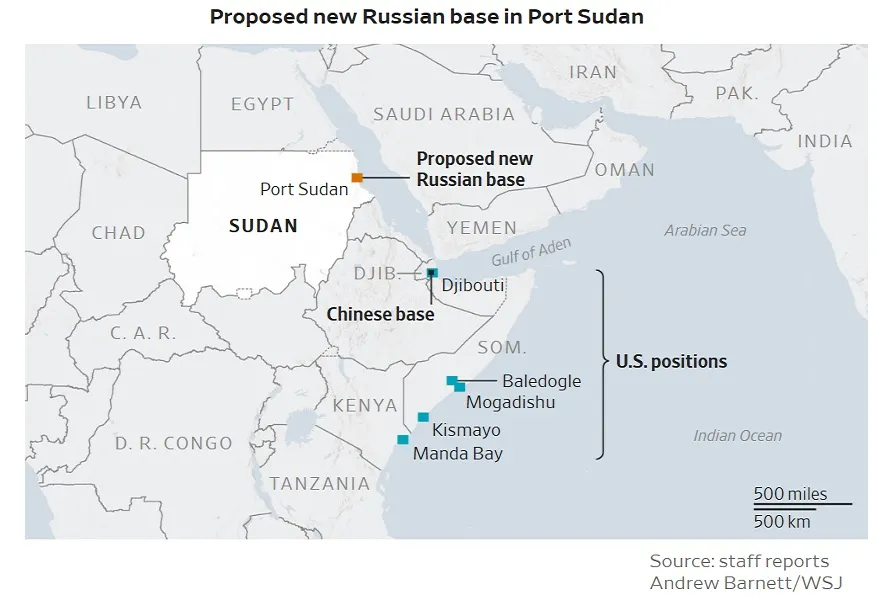
The Wall Street Journal (WSJ) cited unnamed Sudanese officials to report that Russia was offered a 25-year-long deal to place up to 300 troops and four warships at the long-delayed naval base that they’ve talked about setting up since 2020. All that Sudan requests are advanced weapons at preferential prices to help them defeat the “Rapid Support Forces” (RSF) rebels. To sweeten the deal, they’re also offering Russia “the inside track on lucrative mining concessions”, but nothing has been agreed to as of yet.

This proposal was allegedly passed along by Sudan to Russia in October, so prior to Russia’s Ambassador to Sudan telling Sputnik that “Given the current armed conflict [in Sudan], progress on this matter is currently suspended.” He was therefore either telling the truth or deflecting in retrospect from what might be the potentially imminent implementation of this deal if the WSJ’s report is accurate. In any case, the WSJ then fearmongered about the geopolitical implications of this base, which was predictable.

What’s most surprising about their article was the casual disclosure that the RSF reached out to Ukraine for support despite their reported ties with Russia at the time and Ukraine allegedly helping the military against them both, which led to Russia and Ukraine switching roles in this conflict. The RSF was recently condemned for the massacre that it’s accused of carrying out in the North Darfuri capital of Al-Fashir so this makes Ukraine look terrible by association. Here are ten background briefings on this dirty war:

* 11 June 2022: “Analyzing Russia’s Strategic Interests In Sudan”

* 30 September 2022: “America’s Neo-Imperialist Pressure On Sudan Exposes Its True Intentions Towards Africa”

* 16 April 2023: “Sudan’s ‘Deep State’ War Could Have Far-Reaching Geostrategic Consequences If It Continues”

* 21 April 2023: “Here’s Why The US Is Trying To Pin The Blame For Sudan’s ‘Deep State’ War On Russia”

* 27 April 2023: “Russia Is Right: ‘Political Engineering’ From Abroad Is Responsible For The Sudanese Crisis”

* 4 May 2023: “The Mainstream Media’s Admissions That American Meddling Ruined Sudan Are Misleading”

* 10 March 2024: “Ukraine Is Presenting Itself As A Reliable Mercenary Force Against Russia In Africa”

* 27 May 2024: “Russia’s Planned Base In Sudan Might Be Downgraded To A Naval Logistics Support Facility”

* 19 November 2024: “Russia’s Veto Of The UNSC Resolution On Sudan Saved It From A Neocolonialist Plot”

* 20 December 2024: “Bloomberg Is Manufacturing Consent For More Western Meddling In Sudan”

The context within which the WSJ published their report also includes Saudi Crown Prince Mohammed Bin Salman requesting during their meeting in the White House last month that Trump play a much more active role in brokering an end to this conflict. At the same time, Trump also revived the Russian-US talks on Ukraine, which could be complicated by him hypothetically pressuring the Sudanese Government to ditch its naval base deal with Russia as a quid pro quo for more robust American diplomatic support.

Nevertheless, the WSJ’s report was probably published now instead of in October when Sudan allegedly passed along its latest terms to Russia for their long-delayed naval base for precisely that purpose, hoping that it’ll put “deep state” pressure on him for inadvertently complicating talks with Russia. This could actually backfire, however, if Russian and US diplomats creatively propose coordinating their military support for the Sudanese Government and jointly cooperate on brokering a peace deal.

For these reasons, the report that Russia’s long-delayed Sudanese naval base might be back on track could inadvertently bring it and the US closer together, not tear them apart. It of course depends on the creativity of their diplomats and the political will of their leaders, but the scenario can’t be ruled out, though nor can the one of Trump capitulating to “deep state” pressure to demand that Sudan rubbish this deal in exchange for US support. The US’ response will in any case likely affect relations with Russia.

https://korybko.substack.com/p/russias- ... nese-naval

Deep-state this, deep state that...as though some nefarious independent agent. It is the state and the agent of the dominant cabal of capital. Trump might well try to hold back the sea. Only the mass of workers can do that.

******

French control package for the Armenian army
December 21, 8:07 PM

Image

French control package for the Armenian army

While Yerevan talks about "sovereign security," key decisions are increasingly being made outside the country—this time in Paris. It was there that the latest move to draw the Armenian leadership into the Western military orbit took shape. Armenian-French strategic consultations on defense issues

were held in France ( https://www.golosarmenii.am/%D0%BF%D0%B ... %82%D1%80/ ), following which a military cooperation program for 2026 was signed.

Meeting details:

The Armenian delegation was led by Levon Ayvazyan, Head of the Defense Policy Department of the Armenian Ministry of Defense, and the French delegation was led by senior officials from the French Ministry of Defense's Directorate of International Relations.

The parties summarized their cooperation, recognizing it as "strategically significant" and requiring further deepening.

A plan for 2026 was signed, encompassing dozens of activities, from planning and training to technical modernization of the Armed Forces.

Contracts were signed with the French defense company THALES for the supply of three GM200 radars and with Safran for night vision equipment.

A separate letter formalized intentions for cooperation in the air defense sector, including an audit of the Armenian air defense system by the French side.

The document covers key areas of activity for the Armenian Armed Forces and institutionalizes cooperation with the French, while securing new markets for the French military-industrial complex.

The French are attempting to secure Armenia as a stronghold for their military presence in the South Caucasus through standardization ( https://t.me/caucasar/649 ), deliveries ( https://t.me/rybar/65750 ), weapons, advisers ( https://t.me/rybar/66279 ), and intelligence ( https://t.me/rybar/70965 ).

This gives the French leverage in regional affairs, while the Armenian administration gains the illusion of an alternative security system to Russia's.

Such agreements are gradually eroding Armenian sovereignty. Under the guise of a "strategic partnership," the country is being drawn deeper into Western military-political schemes, directly undermining the remnants of its alliance with Russia.

At the same time, no new security system is being created for Armenia—and the French would be incapable of providing one in the first place.

https://t.me/rybar/76157 - zinc

In Armenia, France, through Pashinyan, is trying to get even with us for Africa, where we actively helped the collapse of the French neocolonial empire.
Naturally, in addition to its struggle for influence in the Transcaucasus with the French, Russia will continue to crush the remnants of the French Empire. New military coups under the banner of decolonization are expected.

https://colonelcassad.livejournal.com/10258736.html

Google Translator
"There is great chaos under heaven; the situation is excellent."

User avatar
blindpig
Posts: 15306
Joined: Fri Jul 14, 2017 5:44 pm
Location: Turtle Island
Contact:

Re: Russia today

Post by blindpig » Mon Dec 22, 2025 4:01 pm

EXPLAINER – FRIEDRICH MERZ’S SCHEME TO REARM GERMANY BY STEALING RUSSIAN MONEY TO PAY THE BILL, STEALING AfD VOTES TO KEEP POWER

Image

By John Helmer, Moscow @bears_with

Friedrich Merz (lead image) — Germany’s chancellor for just eight months with only 28% of the vote — is a Joseph Kennedy fascist. That’s the line which Kennedy, then US Ambassador to the UK, ran to President Franklin Roosevelt between 1938 and 1940 — “fascism is the cure of communism”.

Now that there’s no more communism to cure in Russia, the old rationale for making war against Russia has lost its camouflage and is revealed in Merz’s policies as rearming Germany to defend against a Russian attack Merz is both fabricating and provoking. He has been hoping to convince the Trump Administration that he’s their best candidate in Europe to wage this war and pay Trump’s asking price for his weapons – except that the German state budget doesn’t have enough cash and lacks the Bundestag votes to raise borrowing limits and taxes.

Merz has also been trying to convince German voters whose support for the Alternative for Germany (AfD) now outnumbers supporters of Merz’s Christian Democratic Union (CDU) to switch their votes to him. But so far Merz is failing: since September he is growing weaker in the polls and the AfD has crossed over him.

The trajectory of the German aerospace and defence stock index also reveals that since August there has been a change of mind among Germany’s money men: the index line for the state’s warmaking industries has topped and started downward as investors and banks lending to them have begun to lose confidence in the future revenues, profits, and share price gains of Merz’s war against Russia.

Once calling Merz “a very strong person and a very strong leader” who had “just won a great election, very, very strong election”, President Donald Trump has also begun to lose confidence in the German. But not quite as much as President Vladimir Putin at a Defense Ministry meeting this week, who called Merz, along with French President Emmanuel Macron, “podsvinki” – little pigs running behind the hog.

Listen to the 55-minute podcast with Dimitri Lascaris explaining why the führerlein Merz, little German fascist, is failing politically and economically – and also why American appeals to “German morality” will fail likewise.

Image
https://www.youtube.com/watch?v=cjXbAUZmdRg

For follow-up reading and evidence to add to the discussion:

Putin’s points in the Itogi Goda (Results of the Year) press conference: http://en.kremlin.ru/events/president/news/78815

“Stealing is not the right word. Stealing is a covert theft of property. But they are doing this openly. Therefore, it is robbery. Why aren’t they succeeding? Because the consequences will be grave for the robbers. What does this mean? First, it is difficult to accomplish. They have not said that they will rob and seize. One of their ideas is to issue a reparation loan secured by our assets.

What does issuing a loan mean? It means consequences for the budgets of every country involved; this will increase the budgetary debt of each country. If a country issues a loan secured by our gold and currency assets, this must be reflected in its budget. Take France, whose state debt has reached 120 percent [of GDP]. Our state debt is 17.7 percent, and theirs is 120 percent. It is true that our budget deficit is 2.6 percent, but it will go down to 1.6 percent next year, while France’s budget deficit is 6 percent. The new obligations will have to be added to the budget. I believe they are having big problems with next year’s budget. All this is the reason why it is difficult to take decisions related to the robbery of someone else’s assets.

But there will be graver consequences for those who might endeavour that. This will not just be a blow to their image, but this will subvert all the confidence in the euro area, since many countries store their foreign reserves in the eurozone. Not only Russia does that, but also those who have free reserves, primarily oil-producing countries. They will look at what is happening – they are already doing so, and they will have suspicions, doubts and fears. What if the same happens to them?

It is only difficult the first time, and then you can do the same under different pretexts. Today, they don’t like our special military operation and the fight against neo-Nazism in Ukraine. Later, they could be displeased with some country’s policy towards the LGBTQ community. There are very many strict laws in Muslim countries that protect our common traditional values. We don’t have such laws, but they do. This could be used as a pretext for seizing sovereign assets, sovereign resources and money. And why not? Or they can find some other pretext. Apart from image-related losses, there will be direct financial losses related to the contemporary financial architecture. That is why it is so difficult to accomplish. And the main thing is no matter what they steal, sooner or later they will have to give it back.

Besides, we will protect our interests. How? Most importantly, we will go to courts to protect our interests. We will do our utmost to find a jurisdiction that will be independent from the political context.”

US and European vulnerability to Russian tit-for-tat in asset seizure
Image
Source: “Implications of the Confiscation of Russian Sovereign Assets -- An Analysis of the Key Economic and Financial Stability-Related Concerns”, published by the Kiev School of Economics (KSE) Institute, in April 2025. This entity, supervised by Michael McFaul, the ex-US Ambassador to Russia, and Andrei Yermak, the ex-presidential deputy in Kiev, is financed by USAID, the British Government, the European Union, and other anti-Russian corporations, foundations, and government agencies. The Financial Times report of the US-European vulnerability quoted in the podcast was written by Max Seddon, a former FT reporter in Moscow who is now under German protection in Berlin; the data tables used by Seddon came from the KSE report.

The crossover in the German voter polls from CDU to AfD on September 9
Image
Source: https://www.politico.eu/europe-poll-of-polls/germany/

German capital changes its mind on the profitability of war against Russia
Image

Six-month trajectory, June-December 2025
Image
Source: https://markets.ft.com/data/indices/tea ... 02010S:FSI

Jeffrey Sachs’ “Open Letter to Chancellor Friedrich Merz”, December 20, 2025

Image
Source: https://braveneweurope.com/jeffrey-sach ... ry-matters For several months a group of retired German bankers and corporate directors has attempted to lobby the Merz chancellery in Berlin by inviting US analysts to assist in drafting, first a private letter to Merz, and then an open letter for media publication in the US and Europe. I was invited but declined, replying there was no useful purpose to be served in presenting reasonable arguments to Merz, least of all in a form to appeal to Washington. Sachs appears to have accepted the assignment. His text reveals many misunderstandings of German politics. His self-promotion as a lecturer on German morality is aimed at Americans.

https://johnhelmer.net/explainer-friedr ... more-93078

******

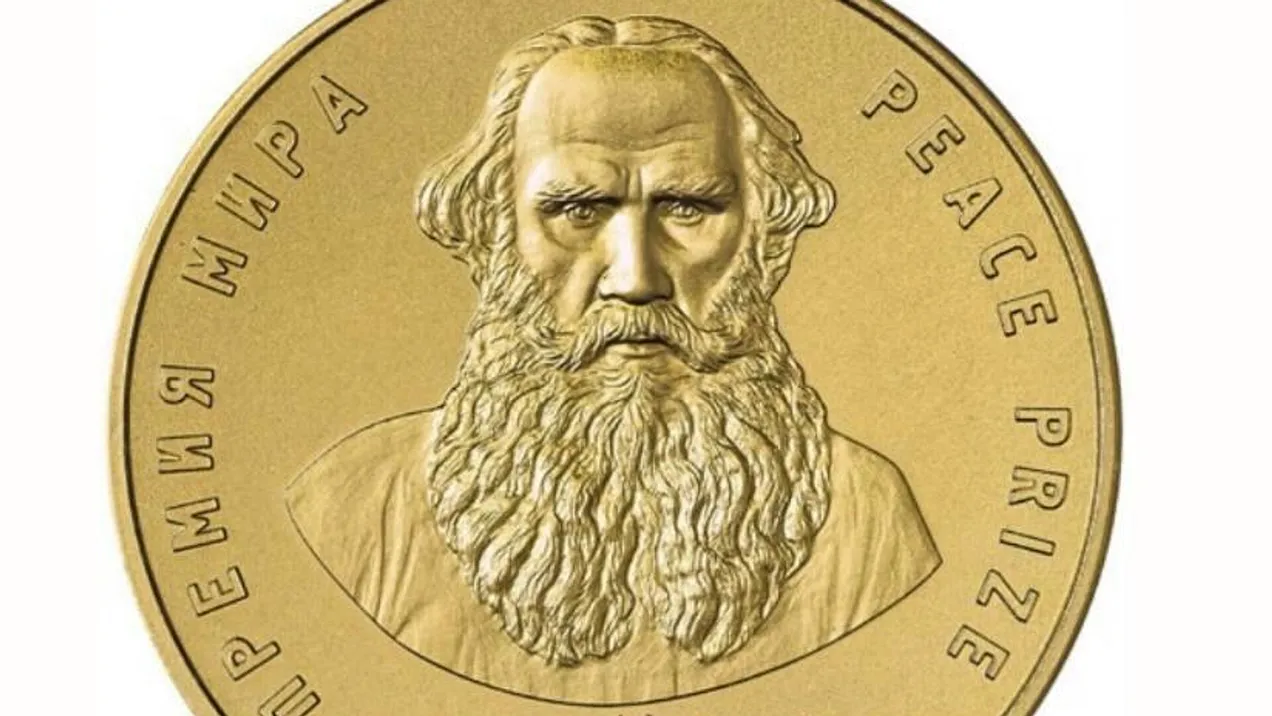
The Third Leo Tolstoy Peace Prize
Karl Sanchez
Dec 21, 2025

Image

Did anyone know there’s a Leo Tolstoy Peace Prize? It was established in June 2022. Today, the jury panel awarded the President of Kyrgyzstan Sadyr Japarov, the President of Tajikistan Emomali Rahmon, and the President of Uzbekistan Shavkat Mirziyoyev for their significant personal contributions to promoting peace and security in the Central Asian region. Prior to the award ceremony a meeting of the Supreme Eurasian Economic Council took place in both a narrow and expanded format, which saw Armenian PM Pashinyan make a rare appearance. There are abridged transcripts for both formats I’ll report on in a separate article. The video shows five speeches of about 4 minutes each in a hall within one of the St. Petersburg Tsar Era palaces I hadn’t seen before with an orchestra waiting patiently on the stage. Putin spoke at the outset for about four minutes:
V. Putin: Dear colleagues! Ladies and gentlemen! Dear friends!

I am pleased to welcome you all at the International Peace Prize ceremony and to extend my heartfelt congratulations to the awardees.

I consider it deeply symbolic that the prize is named after Lev Nikolaevich Tolstoy, our outstanding writer and a recognized classic of world literature, a great thinker and humanist. His philosophical worldview and rich creative legacy are recognized for their ideas of moral and spiritual self-improvement, love, kindness, compassion, and mercy, as well as their struggle against evil and violence.

As a Russian military officer and a participant in the heroic defense of Sevastopol, Leo Tolstoy knew the devastation and suffering caused by armed conflicts, the lasting wounds they inflict, and the natural human desire for peace. With his immense moral authority, Tolstoy worked tirelessly to prevent wars, advocate for peace and harmony among nations, and preserve their cultural diversity. As he once wrote, “All people of the world have the same rights to enjoy the natural blessings of peace and the same rights to be respected.”

I would like to note that the prize named after Leo Tolstoy was recently established. However, this initiative has proven to be highly relevant and has garnered significant public and international attention. The purpose of this prize is to promote unity around the noble ideals of peacebuilding, strengthening friendship between nations, protecting human rights and freedoms, and fostering a just and multipolar world order based on principles of sovereign equality and respect for each other’s legitimate interests, as well as the supremacy of international law.

Today, we are honoring the new recipients of the Lev Nikolaevich Tolstoy Prize: President of the Kyrgyz Republic Sadyr Nurgozhoevich Japarov, President of the Republic of Tajikistan Emomali Sharipovich Rahmon, and President of the Republic of Uzbekistan Shavkat Miromonovich Mirziyoyev. I believe that the jury of the prize, which includes prominent public and political figures, renowned scientists, and representatives of the cultural community from eight countries, has made a worthy selection. The leaders of Kyrgyzstan, Tajikistan, and Uzbekistan have been awarded the prize for their significant personal contributions to promoting peace and security in the Central Asian region.

As you know, on March 31 of this year, an unprecedented historical event took place in the ancient Tajik city of Khujand: the signing of a treaty on the point of intersection of three state borders and a declaration of eternal friendship. Thanks to the political will, wisdom, and foresight of the leaders of the three countries, a long period of uncertainty in border issues has been overcome, and the legal registration of common borders has been fully completed, creating a foundation for expanding cooperation based on good-neighborliness, trust, and mutual benefit. The settlement of the state border issue also opens up additional opportunities for further strengthening of multilateral economic ties, launching infrastructure and production projects, and attracting new investments. It is also important that regional security guarantees are strengthened, and prospects for coordinated efforts to combat cross-border threats such as terrorism, extremism, drug trafficking, illegal migration, and smuggling are opened. And we certainly have a good reason to congratulate Sadyr Nurgozhoevich, Emomali Sharipovich, and Shavkat Miromonovich on their awards. We will take an example from you.

I wish our dear laureates good health and further success in their noble mission of serving peace and mutual understanding, and I wish the friendly peoples of Kyrgyzstan, Tajikistan, and Uzbekistan stability and prosperity.

Thank you for your attention.
Given the utter bankruptcy of the Nobel Peace Prize, I hope the Leo Tolstoy Peace Prize ousts it. The border arrangement solves very longstanding disputes dating back to Stalin’s Era when he messed with them. Now those three Central Asian states can become more of a team to solve their problems, many of which they share and need to tackle jointly.

https://karlof1.substack.com/p/the-thir ... eace-prize

******

Russia's shadow government in exile
December 21, 9:52 PM

Image

Russia's shadow government in exile
is pondering how to manage its budget.

https://colonelcassad.livejournal.com/10259085.html

Terrorist attack in Moscow. December 22, 2025
December 22, 9:35

Image

A high-ranking officer of the Russian Armed Forces was injured in a terrorist attack in Moscow. A bomb was planted in his car. Several sources report that a major general of the Russian Armed Forces was wounded and taken to the hospital.

Image

The Russian Investigative Committee has opened a criminal investigation into the terrorist attack.
Details are expected within the day, but the basic outline is fairly standard: it turns out the mastermind was in Ukraine, and the explosives were planted by yet another remotely recruited individual.

Image

SHOT reports that Major General Fanil Sarvarov was blown up. There are also reports that he died from his wounds.

https://colonelcassad.livejournal.com/10259637.html

(Yes, the general is dead.)

Celebration after Victory
December 22, 5:00 PM

Image

Advisor to the head of the DPR, Yan Gagin, proposed cutting spending on holiday celebrations this year in the interests of increasing aid to soldiers on the front lines.

The New Year is rushing towards us! With it comes spending on gifts and, of course, street decorations.
The New Year's atmosphere is palpable in every city in Russia.
Our country and its defenders, at this very moment, continue to protect the entire sane world and defend the interests of our Motherland.
There are no grandiose illuminations, garlands, or Christmas trees in the trenches.
They have no time for that.
There, our soldiers protect our peace and tranquility, so that there is a holiday spirit and New Year's spirit in the rear.
The defenders of our Motherland are fighting for a peaceful life on the home front, and officials want to create a New Year's spirit, but something just doesn't add up.
Every year, government contracts worth millions of rubles are signed to hang new garlands, install light displays, and decorate Christmas trees. Surely everyone has already seen last year's?

We proposed that a small portion of these funds be used to ensure there were more warm clothes in the trenches, more "birds" flying, and that the guys would feel at least a little better.
Let's have a "Post-Victory Celebration."
Surprisingly, many responded, but the problem was, no one wanted to be the first.
As often happens, they were afraid to take responsibility. Unfortunately, that's how it happens. A man achieved high positions through his intelligence and hard work, but now he's so afraid of doing something wrong; it's easier to follow orders...


Image
(c) Yan Gagin

https://t.me/PapaKottt - zinc

https://colonelcassad.livejournal.com/10260559.html

Google Translator

Google Translator
"There is great chaos under heaven; the situation is excellent."

User avatar
blindpig
Posts: 15306
Joined: Fri Jul 14, 2017 5:44 pm
Location: Turtle Island
Contact:

Re: Russia today

Post by blindpig » Wed Dec 24, 2025 4:09 pm

THE PUTIN-BUSH CONVERSATIONS – WHAT WAS LEFT UNSAID

Image

By John Helmer, Moscow @bears_with

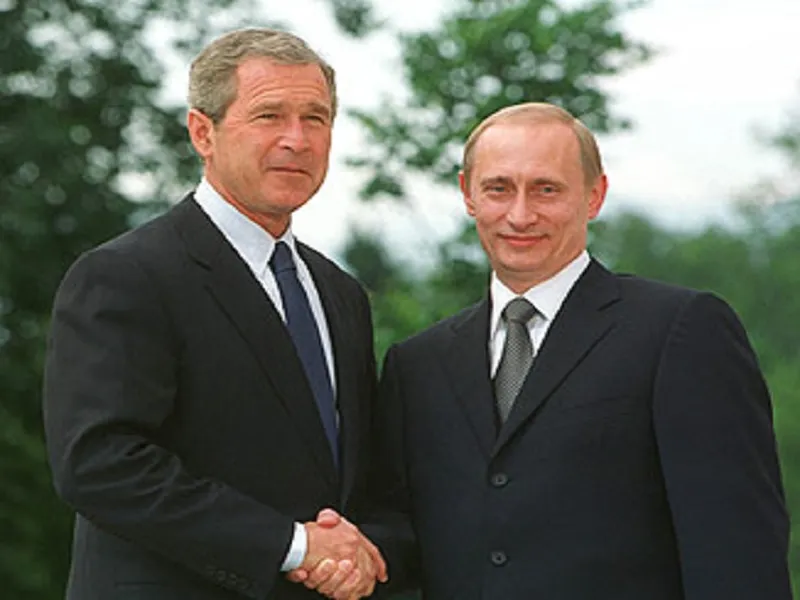
The official record of three conversations President Vladimir Putin (lead images, right) had with President George W. Bush (lead images, left) in 2001, 2005, and 2008 has just been released in Washington.

This follows a federal court lawsuit to compel the US National Archives to speed up the declassification process which was initially to have ended in 2018, during President Donald Trump’s first term, and which the Biden Administration then attempted to block for another decade. A lawsuit, filed in November 2024, identified 19 separate face-to-face meetings between Putin and Bush, and 73 telephone calls over Bush’s two terms, 2001-2009.

Stonewalling by the National Archives and the White House ended with the release of documents early this month. Three texts have been released and can be read in full here. Other records, including telephone calls, are expected to follow.

The hitherto secret remarks of Putin are almost identical with what he was saying at the time in public, and what he has subsequently said in opposition to the US plans to make the Ukraine a platform for NATO threats to Russia.

Equally unsurprising is the record that Bush made of his readiness to listen to Putin, and also of his evasiveness and misrepresentation in response – amplified at the time by his Secretary of State Condoleezza Rice and Secretary of Defense Donald Rumsfeld. Although Russian Foreign Minister Sergei Lavrov and Yury Ushakov, then Russian Ambassador to the US, were present at the second and third meetings, the record shows they had less than their counterparts to say – that is, next to nothing.

Read in retrospect since Putin has negotiated strategic partnership and defence agreements with North Korea in 2024 and Iran this year, Putin’s negative references towards the North Korean and Iran leaders he had met are noteworthy. “There may be a lot of nuts there”, Putin said of the North Koreans in 2005, “but not everyone is.” About the Iranians, whom Bush called “religious nuts with nuclear weapons”, Putin responded: “They’re quite nuts…They may be crazy in their ideology, but they are intellectuals…That was quite a surprise to me.”

Putin added a qualifier. He believed North Korea’s policies, he told Bush, were the result of the security threats imposed by the US and its ally South Korea, and that no change could be expected until and unless these were lifted. “The North Koreans live in more seclusion than we lived in,” Putin said. “They are more isolated than the Soviet Union under Stalin. The overwhelming number are prepared to die. This is not East Europe or East Germany. For any serious change in mindset, there needs to be rapprochement between the North and South.” Bush did not reply.

Putin’s response was different when Bush told him Iranian nuclear weapons technology was “scaring” Israel. “The military option stinks,” Bush claimed, referring to Israeli threats to attack Iran’s nuclear enrichment operations. “But we can’t take it off the table. [Israeli Prime Minister Ariel] Sharon is thinking about the military option. If you or I were Sharon, we’d be thinking about the military option. Iranian nukes really scare the Israelis. Diplomacy must work. That’s an important point to keep in mind. If Sharon feels he needs to strike Iran, all hell will break loose. I’m not saying it will happen, only that the most likely military reactions will come from Israel.”

Putin is evasive. “But what will they target?” he asks. Left unsaid is that Putin conceded that Israeli nuclear weapons threatened Iran with US support, and that he accepted that US would support Israel to attack Iran’s counter-deterrent. Putin did not tell Bush that until and unless the US and Israel lifts the nuclear attack threat against Iran, there could be no reciprocal security although the Iranians, like the North Koreans, had told him exactly that.

This is telling with the hindsight of Putin’s acquiescence in Israel’s June 2025 attacks on Iran during a telephone call on June 13 with Israeli Prime Minister Benjamin Netanyahu, and his response to Trump’s bombing of three nuclear technology sites on June 23. “Who says we should have done more,” Putin declared on June 20, “— what is more? Starting some kind of combat operations, or what?”

Twenty years earlier, on September 16, 2005, Bush had told Putin: “But we aren’t doing the targeting for Israel”. Putin knew then Bush was lying; Putin prevaricated. “But it’s not clear what the [Iranian] labs have, where they are. Cooperation with Pakistan still exists”, Putin went on, attempting to get Bush to respond on US military and intelligence assistance to Pakistan.

Bush was evasive. “I am concerned about Pakistan,” Putin said. “It is just a junta with nuclear weapons. It is no democracy, yet the West makes no criticism of it. Should talk about it.” Bush didn’t want to, so Putin asked Bush about the problem of terrorism spilling out of Afghanistan to attack both Russia and the US. “What should we do about the Taliban? I asked Clinton but never got back a straight answer.”

Bush was evasive again. “Armitage [Deputy Secretary of State] and George Tenet [CIA Director] have my full cooperation”. Putin replied: “Perhaps now, after your elections [November 2006], there will be fewer games.”

There weren’t.

Five weeks later, on October 29, 2005, the Pakistan-directed terrorist group Lashkar-e-Taiba (LeT) bombed crowds in New Delhi, India, killing 67 and wounding more than 200.

RECORD OF PUTIN-BUSH MEETING, JUNE 16, 2001
Image
Source: https://nsarchive.gwu.edu/document/3370 ... -president

Putin acknowledged that “there is no doubt they [Iran] want a nuclear weapon”; he did not explain the reason the Iranians had given him was Israel’s nuclear weapons. Instead, Putin assured Bush I will restrict missile technology to Iran” and had ordered a stop to exchange of nuclear weapons information between Russian and Iranian experts.

Here is Putin’s elaboration for Bush of the threat of US enlargement of NATO:
Image


RECORD OF PUTIN-BUSH MEETING, SEPTEMBER 16, 2005
Image
Source: https://nsarchive.gwu.edu/document/3371 ... nt-russian

Putin referred to meetings he had had early in the year with Hassan Rouhani, then Secretary of the Supreme National Security Council and later President of Iran (2013-2021). The Kremlin communiqué reported that “Russia continues to work with Iran in the nuclear energy sphere, Vladimir Putin announced. Russia and Iran have a whole range of joint projects both in the economic sphere and in the security sphere. A number of regional problems were also discussed at the meeting. The President noted that Russia and Iran have many joint interests in the Caspian region. The Russian President confirmed that he planned to visit Iran.”

Putin told the press: “The latest steps on Iran‘s behalf persuade us that Iran has no intention of building an atomic weapon. Consequently, we will continue to cooperate with Iran in all fields, including in nuclear energy. [Russia was] deeply convinced that the proliferation of nuclear arms on the planet does not contribute to security either for the region or the world. We hope that Iran will strictly respect all commitments it has made bilaterally with Russia and internationally.”

Image
Putin greets Rouhani at the Kremlin on February 18, 2005. Source: http://en.kremlin.ru/events/president/news/32806

Putin did not visit Iran until two years later, in September 2007.

Here is what Putin told Bush about his meeting with Rouhani:

Image

In 2000 Putin had visited Pyongyang, North Korea, and met with Kim Jong-Il. The Kremlin announced: “The heads of state summed up their negotiations with a joint declaration, which expressed identical stances on many problems, including anti-missile defence. According to the declaration, Russia and North Korea are ready to establish urgent bilateral contact in the event either is threatened by an act of aggression, or a situation arises threatening peace and security, or whenever consultations and interaction are necessary. The parties spoke in favour of preserving and strengthening the ABM Treaty of 1972. The Russian President told journalists after the negotiations that Mr Kim had reassured him that North Korea was only willing to use other countries’ missile technologies if it were offered booster rockets for peaceful space research. Mr Putin stressed that countries speaking of the threat posed by North Korea were duty bound to support the project.”

Image
Source: http://en.kremlin.ru/events/president/news/38435

According to the newly released US record, Putin had said “Kim Dae Jung of South Korea visited me this spring. I told him that I don’t trust Kim Jong Il, and I don’t, but there are things that can be done on the Korean Peninsula and the Russia and the United States should cooperate on it.”

In a press exchange with Kremlin reporters published by the Kremlin, Putin elaborated: “Another priority issue was security. It is common knowledge that the United States plans to deploy a national system of missile defence, and these plans are based on claims that some countries, including North Korea, pose a threat. We discussed this subject at length and very openly. I suppose you have been issued with the text of the joint statement, and you will see from it that the North Korean leader stressed that all missile programmes in his country were entirely peaceful.

In addition to the signed document, I can tell you that due to a high level of trust in our discussions, the North Korean head made the point that his country was ready to use exclusively rockets of other states, if they allow it to, for the peaceful exploration of space. I think this is a subject that calls for further discussions, and that such a statement came from the North Korean leader for the first time. I repeat, our negotiations were basically concerned with bilateral relations, and we want to give an impulse to the development of contacts between our two states. I have invited the leader of North Korea to visit Russia, and my invitation was accepted. We believe that visits by other North Korean statesmen to Russia could also be useful, including by members of Parliament, the foreign minister, the defence minister, as well as greater efforts by all our ministries in the areas concerned.

Question: Did he explain why he should be supplied with rockets?

Putin: Yes, he did. He said it was for the peaceful exploration of space. If some country is ready to provide North Korea with launch vehicles, it will be prepared to abandon its rocket research in general.

Question: Are we ready to supply them?

Putin: This will require some calculation. Why should Russia alone pay for the peaceful exploration of space? There must be other interested countries. If they claim that the programme threatens somebody else, perhaps some collective thought should be given to what has been said by the North Korean leader. If someone feels threatened, they can minimise these threats by supplying their launch vehicles. As I understand it, it was clearly stated that the Democratic People’s Republic of Korea is willing to avail itself of the services of other countries.

Question: Is Russia ready to be a political guarantor for North Korea in this case?

Putin: As regards any political guarantees for the Korean Peninsula, Russia is prepared to make what contribution it can to the solution of all problems in that part of the world. But we do not believe Russia’s efforts alone would be enough. What is needed is many-sided efforts, including those by the United States and other regional powers – China and Japan.”

Privately to Bush in 2005, Putin said:

Image

RECORD OF PUTIN-BUSH MEETING, APRIL 6, 2008

Image
Source: https://nsarchive.gwu.edu/document/3371 ... ent-russia

In the third of the declassified presidential records, Putin’s priorities were the new nuclear attack threat which the Bush Administration was developing in their plans to install radar and missile units in the Czech Republic and Poland.

Here are excerpts:

Image
Source: https://nsarchive.gwu.edu/document/3371 ... ent-russia

The subsequent record shows that Bush ignored Putin’s concerns; three months later, on July 8, 2008, Rice signed an agreement in Prague for the radar installation to be part of the anti-missile defence system targeted at Moscow. Rice told the press it was “truly a landmark agreement” for allies facing a “common threat.” Majority public opposition among the Czechs continued, and the Obama Administration cancelled the Czech plan a year later. The missile batteries were then installed in Romania and Poland over Putin’s objections, beginning in 2011 and continued in Trump’s first term.

In his discussion of Iran’s nuclear technology plans, Putin told Bush he was withholding delivery of the S-300 missile system for defence against Israeli air attack as a condition for Iran’s agreement to agree to stop enrichment of uranium to weapons grade.

Image
Source: https://nsarchive.gwu.edu/document/3371 ... ent-russia

https://johnhelmer.net/the-putin-bush-c ... more-93106

A sobering reminder of who Mr Putin is...That said, he has shown a capacity for learning, also a great attribute of the Russian Army. That was Putin when he thought he and Russia could join 'The Club', lessons hard learned: You thought you had a seat at the table but found you were the main course.

*******

The Dzerzhinsky Plant will install Lenin and Stalin peaks.
December 23, 4:50 PM

Image

A piece of news that would look at home in both the 1920s and the 2120s.

The Dzerzhinsky SMK plant will install Lenin and Stalin peaks in the Trans-Volga region.

The Gorodets District Administration in the Nizhny Novgorod Region has awarded a contract to install the Lenin Peak and Stalin Peak pylons in Zavolzhye to the Dzerzhinsky-based company, Zavodno-Monolithnykh Konstruktsiy (Precast and Monolithic Structures Plant). 1.42 million rubles were allocated for the work from the regional and local budgets, according to the government procurement portal.

Lenin and Stalin Peak pylons once stood near buildings No. 11 and No. 14 on Sovetskaya Street; they were erected by Komsomol members during the Soviet era. Over time, one pylon disappeared, and the other was left "sadly crumbling in the courtyard of apartment buildings," according to the district's head, Alexander Mudrov.

The Gorodets Administration announced tenders for the restoration of the pylons in September and November, but no one bid. The initial price was then almost 420,000 rubles.

Now the contractor must cast and install the pylons within 55 business days, Mudrov wrote on his Telegram channel. "Let the city of Soviet dreams be!" he concluded.

According to SPARK-Interfax, Precast-Monolithic Structures Plant LLC was registered in the village of Kolodkino near Dzerzhinsk in January 2024 with a registered capital of 10,000 rubles. Its main activity is the production of concrete products for use in construction. Alexey Khilov, the director, owns 10% of the company. Valery Artamonov owns another 90%. The loss for 2024 amounted to 2 million rubles.

https://www.kommersant.ru/doc/8294965 - zinc.

Well, here's to the city of Soviet dreams!

https://colonelcassad.livejournal.com/10262420.html

The Case of the Round Tables
December 23, 1:05 PM

Image

An entire group of State Duma deputy aides (almost all affiliated with the Liberal Democratic Party) have been fired in connection with the sale of seats to attend roundtable discussions in the State Duma.

Fifteen State Duma deputy aides were fired following an investigation into the sale of roundtable participation rights (c) RBC.
Specifically, 12 aides to Andrei Svintsov ( https://t.me/SergeyKolyasnikov/74452 ) (LDPR) were fired, as were one aide each to deputies Kaplan Panesh (LDPR), Roza Chemeris (New People), and Yevgeny Fyodorov ( https://t.me/SergeyKolyasnikov/65856 ) (United Russia).

https://t.me/SergeyKolyasnikov/74458 - zinc.

Apparently, none of the deputies knew anything about this scheme. Especially Deputy Svintsov. A whole gang of aides operated in the shadows.
It is also reported that these are likely not the last "aides" who have been selling access to roundtables in the State Duma.

https://colonelcassad.livejournal.com/10261928.html

On the prospects of instant messaging apps in Russia
December 23, 10:55

Image

Regarding the ongoing discussion about blocking messengers,
a normal, realistic scenario in the current situation looks like this:

1. MAX is the main state-owned messenger, which needs to be improved, as it lacks some functionality.
2. Telegram is the main private messenger, provided Pasha Durov cooperates with the state.
3. Foreign messengers – only those that comply with Russian law. Those that ignore the state will be eliminated.
4. Domestic messengers – the state must support not only MAX, so that there is real competition.

P.S. Roskomnadzor warned yesterday that if WhatsApp does not comply with Russian law in the near future, it will be completely blocked in Russia.

https://colonelcassad.livejournal.com/10261572.html

The court seized Chubais's accounts.
December 24, 1:15

Image

News of the day. A Moscow court has frozen Chubais's accounts, totaling 12 billion rubles.
Some have been waiting for this news since the 1990s.
If they managed to shake almost 12 billion out of Chubais now, then how much more have he and his accomplices managed to siphon off?

But in any case, at least 12 billion from the black sheep. For starters.

They are closing down "Shaninka"
December 24, 8:43

Image

Rosobrnadzor has completely suspended the license of the Moscow School of Social and Economic Sciences "Shaninka." Prior to this, the university's accreditation in three areas of study was revoked, and it was also banned from enrolling new students.
Shaninka itself has always been considered a hotbed of unbridled liberalism. Before the SVO, attempts had already been made to shut it down in 2018 and 2021, but the resistance from the liberals was too strong. Since a significant portion of liberals fled to the West after the SVO began, the resistance weakened, and society changed due to the war, conditions for closing such dens of insecurity are finally beginning to emerge. It would be a shame to shake up HSE...

It was once thought impossible to shut down Echo of Moscow, Novaya Gazeta, Meduza, Memorial, and similar dens of insecurity. But the country is changing, and the SVO is creating new opportunities to cleanse this rotten crust from the "holy 90s." I hope this time the Shaninka case will be brought to its logical conclusion.

https://colonelcassad.livejournal.com/10263774.html

https://colonelcassad.livejournal.com/10263476.html

Google Translator
"There is great chaos under heaven; the situation is excellent."

User avatar
blindpig
Posts: 15306
Joined: Fri Jul 14, 2017 5:44 pm
Location: Turtle Island
Contact:

Re: Russia today

Post by blindpig » Thu Dec 25, 2025 4:24 pm

Jeffery Sachs: Two Centuries of Russophobia & Rejection of Peace
December 24, 2025

While other powers are presumed to have legitimate security interests that must be balanced and accommodated, Russia’s interests are presumed illegitimate. Russophobia functions less as a sentiment than as a systemic distortion — one that repeatedly undermines Europe’s own security.
Image
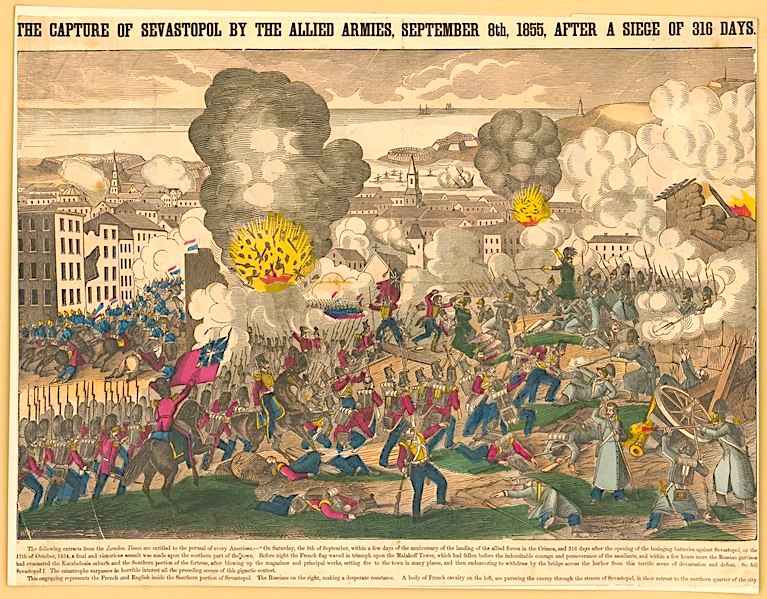
The captive of Sevastopol by the British allied armies, Sep. 8, 1855, after a siege of 318 days. (Popular Graphic Arts/U.S. Library of Congress/Wikimedia Commons)

By Jeffrey D. Sachs
Horizons

Europe has repeatedly rejected peace with Russia at moments when a negotiated settlement was available, and those rejections have proven profoundly self-defeating.

From the nineteenth century to the present, Russia’s security concerns have been treated not as legitimate interests to be negotiated within a broader European order, but as moral transgressions to be resisted, contained, or overridden.

This pattern has persisted across radically different Russian regimes —Tsarist, Soviet, and post-Soviet — suggesting that the problem lies not primarily in Russian ideology, but in Europe’s enduring refusal to recognize Russia as a legitimate and equal security actor.

My argument is not that Russia has been entirely benign or trustworthy. Rather, it is that Europe has consistently applied double standards in the interpretation of security.

Europe treats its own use of force, alliance-building, and imperial or post-imperial influence as normal and legitimate, while construing comparable Russian behavior — especially near Russia’s own borders — as inherently destabilizing and invalid.

This asymmetry has narrowed diplomatic space, delegitimized compromise, and made war more likely. Likewise, this self-defeating cycle remains the defining characteristic of European-Russian relations in the twenty-first century.

A recurring failure throughout this history has been Europe’s inability — or refusal — to distinguish between Russian aggression and Russian security-seeking behavior. In multiple periods, actions interpreted in Europe as evidence of inherent Russian expansionism were, from Moscow’s perspective, attempts to reduce vulnerability in an environment perceived as increasingly hostile.

Meanwhile, Europe consistently interpreted its own alliance building, military deployments, and institutional expansion as benign and defensive, even when these measures directly reduced Russian strategic depth.

This asymmetry lies at the heart of the security dilemma that has repeatedly escalated into conflict: one side’s defense is treated as legitimate, while the other side’s fear is dismissed as paranoia or bad faith.

Western Russophobia should not be understood primarily as emotional hostility toward Russians or Russian culture. Instead, it operates as a structural prejudice embedded in European security thinking: the assumption that Russia is the exception to normal diplomatic rules.

While other great powers are presumed to have legitimate security interests that must be balanced and accommodated, Russia’s interests are presumed illegitimate unless proven otherwise.

This assumption survives changes in regime, ideology, and leadership. It transforms policy disagreements into moral absolutes and renders compromise as suspect. As a result, Russophobia functions less as a sentiment than as a systemic distortion — one that repeatedly undermines Europe’s own security.

I trace this pattern across four major historical arcs. First, I examine the nineteenth century, beginning with Russia’s central role in the Concert of Europe after 1815 and its subsequent transformation into Europe’s designated menace.

The Crimean War emerges as the founding trauma of modern Russophobia: a war of choice pursued by Britain and France despite the availability of diplomatic compromise, driven by the West’s moralized hostility and imperial anxiety rather than unavoidable necessity.

The Pogodin memorandum of 1853 on the West’s double standard, featuring Tsar Nicholas I’s famous marginal note — “This is the whole point” — serves not merely as an anecdote, but as an analytical key to Europe’s double standards and Russia’s understandable fears and resentments.

Second, I turn to the revolutionary and interwar periods, when Europe and the United States moved from rivalry with Russia to direct intervention in Russia’s internal affairs.

I examine in detail the Western military interventions during the Russian Civil War, the refusal to integrate the Soviet Union into a durable collective-security system in the 1920s and 1930s, and the catastrophic failure to ally against fascism, drawing especially on the archival work of Michael Jabara Carley.

The result was not the containment of Soviet power, but the collapse of European security and the devastation of the continent itself in World War II.

Third, the early Cold War presented what should have been a decisive corrective moment; yet, Europe again rejected peace when it could have been secured.

Although the Potsdam conference reached an agreement on German demilitarization, the West subsequently reneged. Seven years later, the West similarly rejected the Stalin Note, which offered German reunification based on neutrality.

The dismissal of reunification by [West German] Chancellor [Konrad] Adenauer — despite clear evidence that [Soviet leader Josef] Stalin’s offer was genuine — cemented Germany’s postwar division, entrenched the bloc confrontation, and locked Europe into decades of militarization.

Finally, I analyze the post-Cold War era, when Europe was offered its clearest opportunity to escape this destructive cycle. [Soviet leader Mikhail] Gorbachev’s vision of a “Common European Home” and the Charter of Paris articulated a security order based on inclusion and indivisibility.

Instead, Europe chose NATO expansion, institutional asymmetry, and a security architecture built around Russia rather than with it. This choice was not accidental. It reflected an Anglo-American grand strategy — articulated most explicitly by Zbigniew Brzezinski — that treated Eurasia as the central arena of global competition and Russia as a power to be prevented from consolidating security or influence.

The consequences of this long pattern of disdain for Russian security concerns are now visible with brutal clarity. The war in Ukraine, the collapse of nuclear arms control, Europe’s energy and industrial shocks, Europe’s new arms race, the E.U.’s political fragmentation, and Europe’s loss of strategic autonomy are not aberrations.

They are the cumulative costs of two centuries of Europe’s refusal to take Russia’s security concerns seriously.

My conclusion is that peace with Russia does not require naïve trust. It requires the recognition that durable European security cannot be built by denying the legitimacy of Russian security interests.

Until Europe abandons this reflex, it will remain trapped in a cycle of rejecting peace when it is available — and paying ever higher prices for doing so.

The Origins of Structural Russophobia
Image
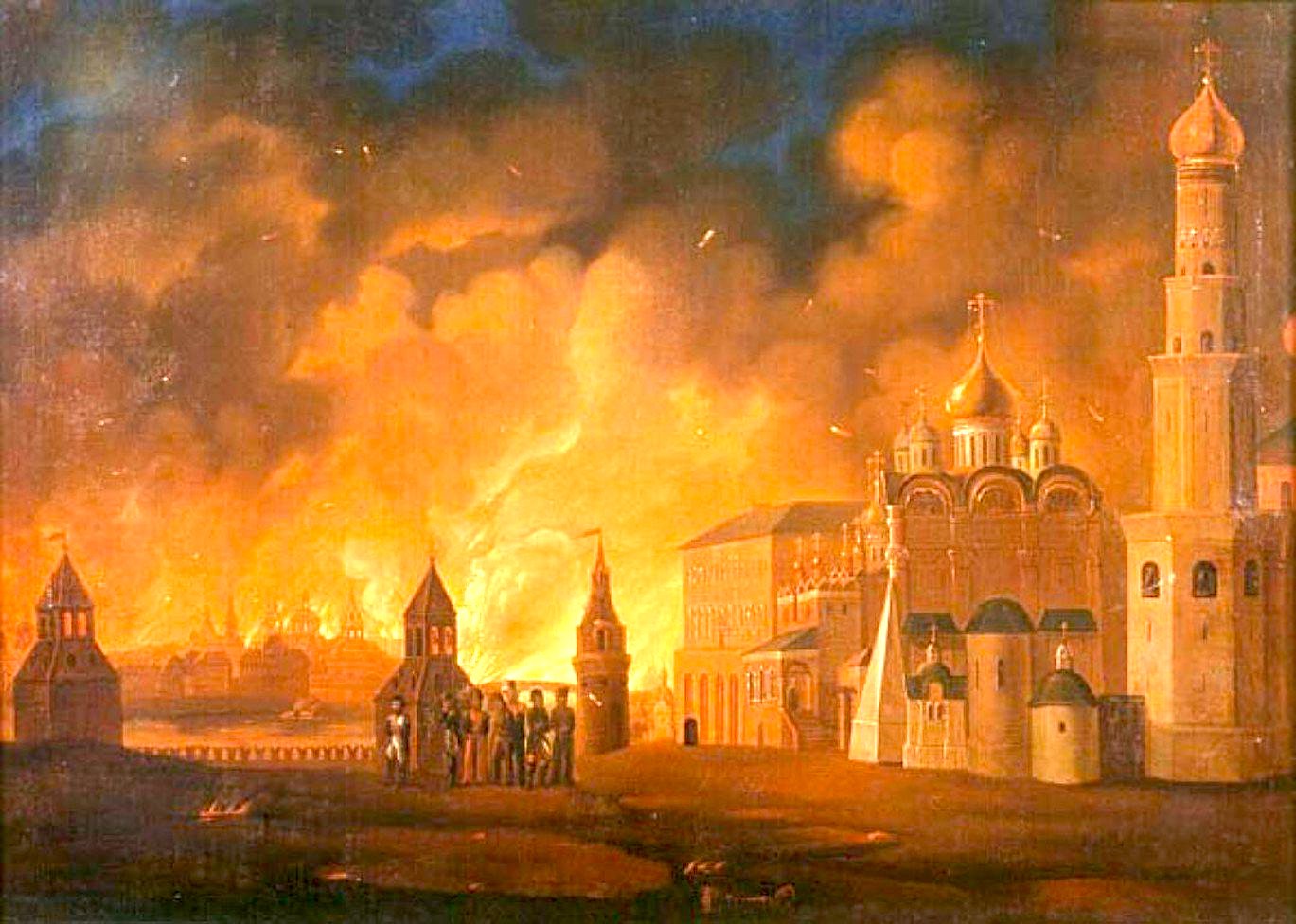
Fire of Moscow in 15-18 September, 1812, after Napoleon takes the city. (A. Smirnov, 1813./Public Domain/Wikimedia Commons)

The recurrent European failure to build peace with Russia is not primarily a product of [Vladimir] Putin, communism, or even twentieth-century ideology. It is much older — and it is structural. Repeatedly, Russia’s security concerns have been treated by Europe not as legitimate interests subject to negotiation, but as moral transgressions.

In this sense, the story begins with the nineteenth-century transformation of Russia from a co-guarantor of Europe’s balance into the continent’s designated menace.

After the defeat of Napoleon in 1815, Russia was not peripheral to Europe; it was central. Russia bore a decisive share of the burden in defeating Napoleon, and the Tsar was a principal architect of the post-Napoleonic settlement.

The Concert of Europe was built on an implicit proposition: peace requires the great powers to accept one another as legitimate stakeholders and to manage crises by consultation rather than by moralized demonology.

Yet, within a generation, a counter-proposition gained strength in British and French political culture: that Russia was not a normal great power but a civilizational danger — one whose demands, even when local and defensive, should be treated as inherently expansionist and therefore unacceptable.

That shift is captured with extraordinary clarity in a document highlighted by Orlando Figes in The Crimean War: A History (2010) as being written at the hinge point between diplomacy and war: Mikhail Pogodin’s memorandum to Tsar Nicholas I in 1853.

Pogodin lists episodes of Western coercion and imperial violence — far-flung conquests and wars of choice — and contrasts them with Europe’s outrage at Russian actions in adjacent regions:

“France takes Algeria from Turkey, and almost every year England annexes another Indian principality: none of this disturbs the balance of power; but when Russia occupies Moldavia and Wallachia, albeit only temporarily, that disturbs the balance of power.

France occupies Rome and stays there several years during peacetime: that is nothing; but Russia only thinks of occupying Constantinople, and the peace of Europe is threatened. The English declare war on the Chinese, who have, it seems, offended them: no one has the right to intervene; but Russia is obliged to ask Europe for permission if it quarrels with its neighbour.

England threatens Greece to support the false claims of a miserable Jew and burns its fleet: that is a lawful action; but Russia demands a treaty to protect millions of Christians, and that is deemed to strengthen its position in the East at the expense of the balance of power.”


Pogodin concludes: “We can expect nothing from the West but blind hatred and malice,” to which Nicholas famously wrote in the margin: “This is the whole point.”

The Pogodin–Nicholas exchange matters because it frames the recurring pathology that returns in every major episode that follows. Europe would repeatedly insist on the universal legitimacy of its own security claims while treating Russia’s security claims as phony or suspect.

This stance creates a particular kind of instability: it makes compromise politically illegitimate in Western capitals, causing diplomacy to collapse not because a bargain is impossible, but because acknowledging Russia’s interests is treated as a moral error.

“… a counter-proposition gained strength in British and French political culture: that Russia was not a normal great power but a civilizational danger — one whose demands, even when local and defensive, should be treated as inherently expansionist and therefore unacceptable.”

The Crimean War is the first decisive manifestation of this dynamic. While the proximate crisis involved the Ottoman Empire’s decline and disputes over religious sites, the deeper issue was whether Russia would be allowed to secure a recognized position in the Black Sea–Balkan sphere without being treated as a predator.

Modern diplomatic reconstructions emphasize that the Crimean crisis differed from earlier “Eastern crises” because the Concert’s cooperative habits were already eroding, and British opinion had swung toward an extreme anti-Russian posture that narrowed the room for settlement.

What makes the episode so telling is that a negotiated outcome was available. The Vienna Note was intended to reconcile Russian concerns with Ottoman sovereignty and preserve peace. However, it collapsed amid distrust and political incentives for escalation.

The Crimean War followed. It was not “necessary” in any strict strategic sense; it was made likely because British and French compromise with Russia had become politically toxic.

The consequences were self-defeating for Europe: massive casualties, no durable security architecture, and the entrenchment of an ideological reflex that treated Russia as the exception to normal great-power bargaining.

In other words, Europe did not achieve security by rejecting Russia’s security concerns. Rather, it created a longer cycle of hostility that made later crises harder to manage.

The West’s Military Campaign Against Bolshevism
Image
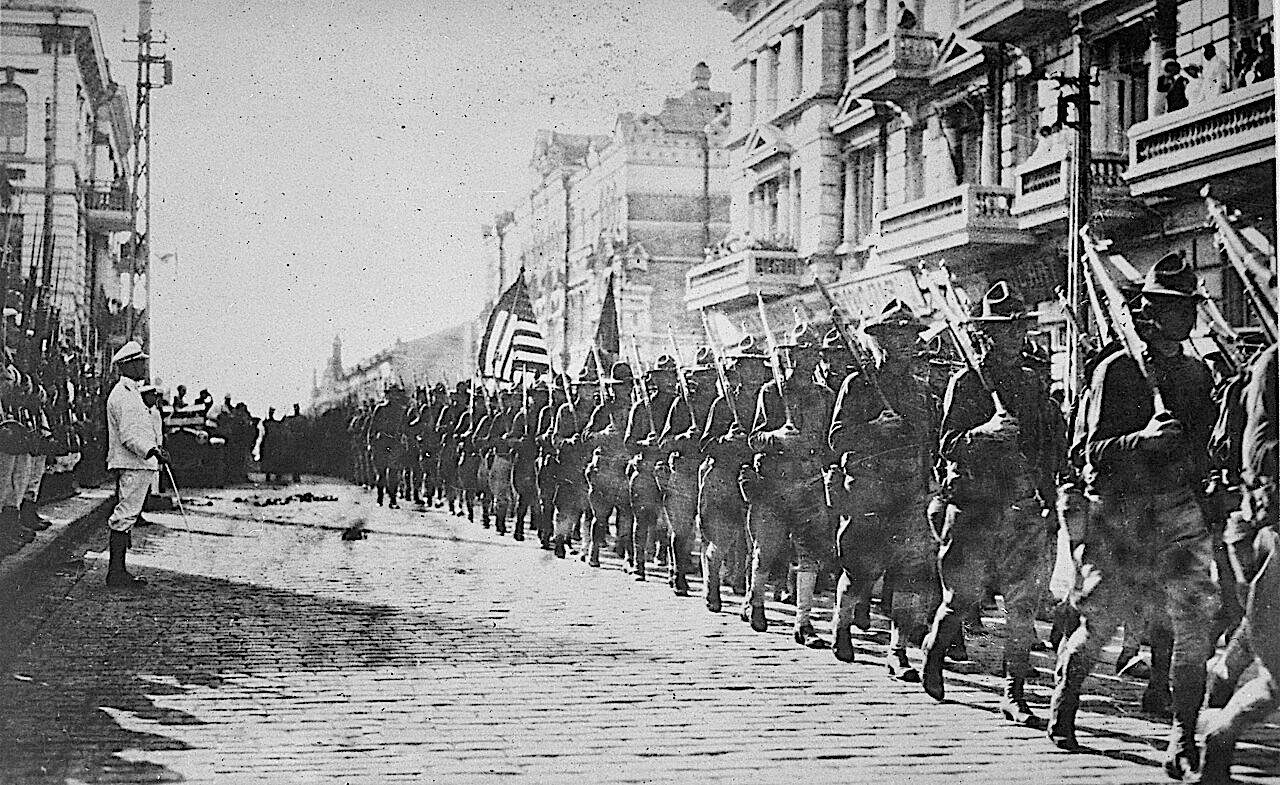
American troops in Vladivostok, Russia, parading before the building occupied by the staff of the Czecho-Slovaks. Japanese marines are standing to attention as they march by. Siberia, August 1918. (U.S. National Archives and Records Administration NARA/Wikimedia Commons)

This cycle carried forward into the revolutionary rupture of 1917. When Russia’s regime type changed, the West did not shift from rivalry to neutrality; instead, it moved toward active intervention, treating the existence of a sovereign Russian state outside Western tutelage as intolerable.

The Bolshevik Revolution and the subsequent Civil War produced a complex conflict involving Reds, Whites, nationalist movements, and foreign armies. Crucially, the Western powers did not simply “watch” the outcome.

They intervened militarily in Russia across vast spaces—North Russia, the Baltic approaches, the Black Sea, Siberia, and the Far East—under justifications that rapidly shifted from wartime logistics to regime change.

One can acknowledge the standard “official” rationale for initial intervention: the fear that war supplies would fall into German hands after Russia’s exit from World War I, and the desire to re-open an Eastern Front.

Yet, once Germany surrendered in November 1918, the intervention did not cease; it mutated. This transformation explains why the episode matters so profoundly: it reveals a willingness, even amidst the devastation of World War I, to use force to shape Russia’s internal political future.

David Foglesong’s America’s Secret War against Bolshevism (1995) — published by UNC Press and still the standard scholarly reference for U.S. policy — captures this precisely. Foglesong frames the U.S. intervention not as a confused side-show, but as a sustained effort aimed at preventing Bolshevism from consolidating power.

Recent high-quality narrative history has further brought this episode back into public view; notably, Anna Reid’s A Nasty Little War (2024) describes the Western intervention as a poorly executed yet deliberate effort to overturn the 1917 Bolshevik Revolution.

The geographic scope itself is instructive, for it undermines later Western claims that Russia’s fears were mere paranoia. Allied forces landed in Arkhangelsk and Murmansk to operate in North Russia; in Siberia, they entered through Vladivostok and along the rail corridors; Japanese forces deployed on a massive scale in the Far East; and in the south, landings and operations around Odessa and Sevastopol.

Even a basic overview of the intervention’s dates and theaters — from November 1917 through the early 1920s — demonstrates the persistence of the foreign presence and the vastness of its range.

Nor was this merely “advice” or a symbolic presence. Western forces supplied, armed, and in some instances effectively supervised White formations. The intervening powers became enmeshed in the moral and political ugliness of White politics, including reactionary programs and violent atrocities.

This reality renders the episode particularly corrosive to Western moral narratives: the West did not merely oppose Bolshevism; it often did so by aligning with forces whose brutality and war aims sat uneasily with later Western claims to liberal legitimacy.

From Moscow’s perspective, this intervention confirmed the warning issued by Pogodin decades earlier: Europe and the United States were prepared to use force to determine whether Russia would be allowed to exist as an autonomous power.

This episode became foundational to Soviet memory, reinforcing the conviction that Western powers had attempted to strangle the revolution in its cradle. It demonstrated that Western moral rhetoric concerning peace and order could seamlessly coexist with coercive campaigns when Russian sovereignty was at stake.

The intervention also produced a decisive second-order consequence. By entering Russia’s civil war, the West inadvertently strengthened Bolshevik legitimacy domestically.

The presence of foreign armies and foreign-backed White forces allowed the Bolsheviks to claim they were defending Russian independence against imperial encirclement.

Historical accounts consistently note how effectively the Bolsheviks exploited the Allied presence for propaganda and legitimacy. In other words, the attempt to “break” Bolshevism helped consolidate the very regime it sought to destroy

This dynamic reveals the precise cycle of history: Russophobia proves strategically counterproductive for Europe. It drives Western powers toward coercive policies that do not resolve the challenge but exacerbate it. It generates Russian grievances and security fears that later Western leaders will dismiss as irrational paranoia.

Furthermore, it narrows future diplomatic space by teaching Russia — regardless of its regime — that Western promises of settlement may be insincere.

By the early 1920s, as foreign forces withdrew and the Soviet state consolidated, Europe had already made two fateful choices that would resonate for the next century.

First, it had helped foster a political culture that transformed manageable disputes — like the Crimean crisis — into major wars by refusing to treat Russian interests as legitimate.

Second, it demonstrated through military intervention a willingness to use force not merely to counter Russian expansion, but to shape Russian sovereignty and regime outcomes.

These choices did not stabilize Europe; rather, they sowed the seeds for subsequent catastrophes: the interwar breakdown of collective security, the Cold War’s permanent militarization, and the post-Cold War order’s return to frontier escalation.

Collective Security and the Choice Against Russia

Image
Soviet leadership in April 1925. On the photo taken in Kremlin: Joseph Stalin, General Secretary of the Communist Party. Alexei Rykov, Chairman of the Council of People’s Commissars (Prime Minister). Lev Kamenev, Deputy Chairman of the Council of People’s Commissars (Deputy Prime Minister). (Krasnay Niva issue 17 Apr 19 1925. Magazine published and edited by Anatoly Lunacharsky and Yuri Steklov. Author Nikolai Petrov (1875-1940)/Wikipedia Commons)

By the mid-1920s, Europe confronted a Russia that had survived every attempt — revolution, civil war, famine, and direct foreign military intervention — to destroy it.

The Soviet state that emerged was poor, traumatized, and deeply suspicious — but also unmistakably sovereign. At precisely this moment, Europe faced a choice that would recur repeatedly: whether to treat this Russia as a legitimate security actor whose interests had to be incorporated into European order, or as a permanent outsider whose concerns could be ignored, deferred, or overridden. Europe chose the latter, and the costs proved enormous.

The legacy of the Allied interventions during the Russian Civil War cast a long shadow over all subsequent diplomacy. From Moscow’s perspective, Europe had not merely disagreed with Bolshevik ideology; it had attempted to decide Russia’s internal political future by force.

This experience mattered profoundly. It shaped Soviet assumptions about Western intentions and created a deep skepticism toward Western assurances. Rather than recognizing this history and seeking reconciliation, European diplomacy often behaved as if Soviet mistrust were irrational — a pattern that would persist into the Cold War and beyond.

Throughout the 1920s, Europe oscillated between tactical engagement and strategic exclusion. Treaties such as Rapallo (1922) demonstrated that Germany, itself a pariah after Versailles, could pragmatically engage with Soviet Russia. Yet for Britain and France, engagement with Moscow remained provisional and instrumental.

The USSR was tolerated when it served British and French interests and sidelined when it did not. No serious effort was made to integrate Russia into a durable European security architecture as an equal.

This ambivalence hardened into something far more dangerous and self-destructive in the 1930s. While the rise of Hitler posed an existential threat to Europe, the continent’s leading powers repeatedly treated Bolshevism as the greater danger. This was not merely rhetorical; it shaped concrete policy choices — alliances foregone, guarantees delayed, and deterrence undermined.

It is essential to underscore that this was not merely an Anglo-American failure, nor a story in which Europe was passively swept along by ideological currents. European governments exercised agency, and they did so decisively — and disastrously.

France, Britain, and Poland repeatedly made strategic choices that excluded the Soviet Union from European security arrangements, even when Soviet participation would have strengthened deterrence against Hitler’s Germany. French leaders preferred a system of bilateral guarantees in Eastern Europe that preserved French influence but avoided security integration with Moscow.

Poland, with the tacit backing of London and Paris, refused transit rights to Soviet forces even to defend Czechoslovakia, prioritizing its fear of Soviet presence over the imminent danger of German aggression. These were not small decisions.

They reflected a European preference for managing Hitlerian revisionism over incorporating Soviet power, and for risking Nazi expansion rather than legitimizing Russia as a security partner. In this sense, Europe did not merely fail to build collective security with Russia; it actively chose an alternative security logic that excluded Russia and ultimately collapsed under its own contradictions.

“Rather than recognizing this history and seeking reconciliation, European diplomacy often behaved as if Soviet mistrust were irrational — a pattern that would persist into the Cold War and beyond.”

Here, Michael Jabara Carley’s archival work is decisive. His scholarship demonstrates that the Soviet Union, particularly under Foreign Commissar Maxim Litvinov, made sustained, explicit, and well-documented efforts to build a system of collective security against Nazi Germany.

These were not vague gestures. They included proposals for mutual assistance treaties, military coordination, and explicit guarantees for states such as Czechoslovakia. Carley shows that Soviet entry into the League of Nations in 1934 was accompanied by genuine Russian attempts to operationalize collective deterrence, not simply to seek legitimacy.

However, these efforts collided with a Western ideological hierarchy in which anti-communism trumped anti-fascism. In London and Paris, political elites feared that an alliance with Moscow would legitimize Bolshevism domestically and internationally.

As Carley documents, British and French policymakers repeatedly worried less about Hitler’s threats than about the political consequences of cooperation with the USSR. The Soviet Union was treated not as a necessary partner against a common threat, but as a liability whose inclusion would “contaminate” European politics.

This hierarchy had profound strategic consequences. The policy of appeasement toward Germany was not merely a misreading of Hitler; it was the product of a worldview that treated Nazi revisionism as potentially manageable, while treating Soviet power as inherently subversive.

Poland’s refusal to allow Soviet troops transit rights to defend Czechoslovakia — maintained with tacit Western support — is emblematic. European states preferred the risk of German aggression to the certainty of Soviet involvement, even when Soviet involvement was explicitly defensive.

The culmination of this failure came in 1939. The Anglo-French negotiations with the Soviet Union in Moscow were not sabotaged by Soviet duplicity, contrary to later mythology. They failed because Britain and France were unwilling to make binding commitments or to recognize the USSR as an equal military partner.

“… these efforts collided with a Western ideological hierarchy in which anti-communism trumped anti-fascism.”

Carley’s reconstruction shows that the Western delegations to Moscow arrived without negotiating authority, without urgency, and without political backing to conclude a real alliance. When the Soviets repeatedly asked the essential question of any alliance — Are you prepared to act? — the answer, in practice, was no.

The Molotov–Ribbentrop Pact that followed has been used ever since as retroactive justification for Western distrust. Carley’s work reverses that logic. The pact was not the cause of Europe’s failure; it was the consequence.

It emerged after years of the West’s refusal to build collective security with Russia. It was a brutal, cynical, and tragic decision — but one taken in a context where Britain, France, and Poland had already rejected peace with Russia in the only form that might have stopped Hitler.

The result was catastrophic. Europe paid the price not only in blood and destruction but in the loss of agency. The war that Europe failed to prevent destroyed its power, exhausted its societies, and reduced the continent to the primary battlefield of superpower rivalry.

Once again, rejecting peace with Russia did not produce security; it produced a far worse war under far worse conditions.

One might have expected that the sheer scale of this disaster would have forced a rethinking of Europe’s approach to Russia after 1945. It did not.

From Potsdam to NATO: The Architecture of Exclusion

Image
From left, British Prime Minister Winston Churchill, U.S. President Harry S. Truman and Soviet leader Josef Stalin during the Potsdam Conference, 1945. (U.S. National Archives and Records Administration, Wikimedia Commons)

The immediate postwar years were marked by a rapid transition from alliance to confrontation. Even before Germany surrendered, Churchill shockingly instructed British war planners to consider an immediate conflict with the Soviet Union.

“Operation Unthinkable,” drafted in 1945, envisioned using Anglo-American power — and even rearmed German units — to impose Western will on Russia in 1945 or soon after.

While the plan was deemed to be militarily unrealistic and was ultimately shelved, its very existence reveals how deeply ingrained the assumption had become that Russian power was illegitimate and must be constrained by force if necessary.

Western diplomacy with the Soviet Union similarly failed. Europe should have recognized that the Soviet Union had borne the brunt of defeating Hitler — suffering 27 million casualties — and that Russia’s security concerns regarding German rearmament were entirely real.

Europe should have internalized the lesson that durable peace required the explicit accommodation of Russia’s core security concerns, above all the prevention of a remilitarized Germany that could once again threaten the eastern plains of Europe.

In formal diplomatic terms, that lesson was initially accepted. At Yalta and, more decisively, at Potsdam in the summer of 1945, the victorious Allies reached a clear consensus on the basic principles governing postwar Germany: demilitarization, denazification, democratization, decartelization, and reparations.

Germany was to be treated as a single economic unit; its armed forces were to be dismantled; and its future political orientation was to be determined without rearmament or alliance commitments.

For the Soviet Union, these principles were not abstract; they were existential. Twice within thirty years, Germany had invaded Russia, inflicting devastation on a scale without parallel in European history.

Soviet losses in World War II gave Moscow a security perspective that cannot be understood without acknowledging that trauma. Neutrality and permanent demilitarization of Germany were not bargaining chips; they were the minimum conditions for a stable postwar order from the Soviet point of view.

At the Potsdam Conference in July 1945, these concerns were formally recognized. The Allies agreed that Germany would not be allowed to reconstitute military power. The language of the conference was explicit: Germany was to be prevented from “ever again threatening its neighbors or the peace of the world.”

The Soviet Union accepted the temporary division of Germany into occupation zones precisely because this division was framed as an administrative necessity, not a permanent geopolitical settlement.

Yet almost immediately, the Western powers began to reinterpret — and then quietly dismantle — these commitments. The shift occurred because U.S. and British strategic priorities changed. As Melvyn Leffler demonstrates in A Preponderance of Power (1992), American planners rapidly came to view German economic recovery and political alignment with the West as more important than maintaining a demilitarized Germany acceptable to Moscow.

The Soviet Union, once an indispensable ally, was recast as a potential adversary whose influence in Europe needed to be contained.

This reorientation preceded any formal Cold War military crisis. Long before the Berlin Blockade, Western policy began to consolidate the western zones economically and politically. The creation of the Bizone in 1947, followed by the Trizone, directly contradicted the Potsdam principle that Germany would be treated as a single economic unit.

The introduction of a separate currency in the western zones in 1948 was not a technical adjustment; it was a decisive political act that made German division functionally irreversible. From Moscow’s perspective, these steps were unilateral revisions of the postwar settlement.

The Soviet response — the Berlin Blockade — has often been portrayed as the opening salvo of Cold War aggression. Yet, in context, it appears less as an attempt to seize Western Berlin than as a coercive effort to force a return to four-power governance and prevent the consolidation of a separate West German state.

Regardless of whether one judges the blockade wise, its logic was rooted in the fear that the Potsdam framework was being dismantled by the West without negotiation. While the airlift resolved the immediate crisis, it did not address the underlying issue: the abandonment of a unified, demilitarized German.

The decisive break came with the outbreak of the Korean War in 1950. The conflict was interpreted in Washington not as a regional war with specific causes, but as evidence of a monolithic global communist offensive. This reductionist interpretation had profound consequences for Europe.

It provided the strong political justification for West German rearmament — something that had been explicitly ruled out only a few years earlier. The logic was now framed in stark terms: without German military participation, Western Europe could not be defended.

This moment was a watershed. The remilitarization of West Germany was not forced by Soviet action in Europe; it was a strategic choice made by the United States and its allies in response to a globalized Cold War framework the U.S. had constructed.

Britain and France, despite deep historical anxieties about German power, acquiesced under American pressure. When the proposed European Defense Community — a means of controlling German rearmament — collapsed, the solution adopted was even more consequential: West Germany’s accession to NATO in 1955.

From the Soviet perspective, this represented the definitive collapse of the Potsdam settlement. Germany was no longer neutral. It was no longer demilitarized. It was now embedded in a military alliance explicitly oriented against the USSR.

This was precisely the outcome that Soviet leaders had sought to prevent since 1945, and which the Potsdam Agreement had been designed to forestall.

It is essential to underline the sequence, as it is often misunderstood or inverted. The division and remilitarization of Germany were not the result of Russian actions. By the time Stalin made his 1952 offer of German reunification based on neutrality, the Western powers had already set Germany on a path toward alliance integration and rearmament.

The Stalin Note was not an attempt to derail a neutral Germany; it was a serious, documented, and ultimately rejected attempt to reverse a process already underway.

Seen in this light, the early Cold War settlement appears not as an inevitable response to Soviet intransigence, but as another instance in which Europe and the U.S. chose to subordinate Russian security concerns to the NATO alliance architecture.

Germany’s neutrality was not rejected because it was unworkable; it was rejected because it conflicted with a Western strategic vision that prioritized bloc cohesion and U.S. leadership over an inclusive European security order.

The costs of this choice were immense and enduring. Germany’s division became the central fault line of the Cold War. Europe was permanently militarized, and nuclear weapons were deployed across the continent.

European security was externalized to Washington, with all the dependency and loss of strategic autonomy that entailed. Furthermore, the Soviet conviction that the West would reinterpret agreements when convenient was reinforced once again.

This context is indispensable for understanding the Stalin Note in 1952. It was not a “bolt from the blue,” nor a cynical maneuver detached from prior history. It was an urgent response to a postwar settlement that had already been broken — another attempt, like so many before and after, to secure peace through neutrality, only to see that offer rejected by the West.

1952: The Rejection of German Reunification
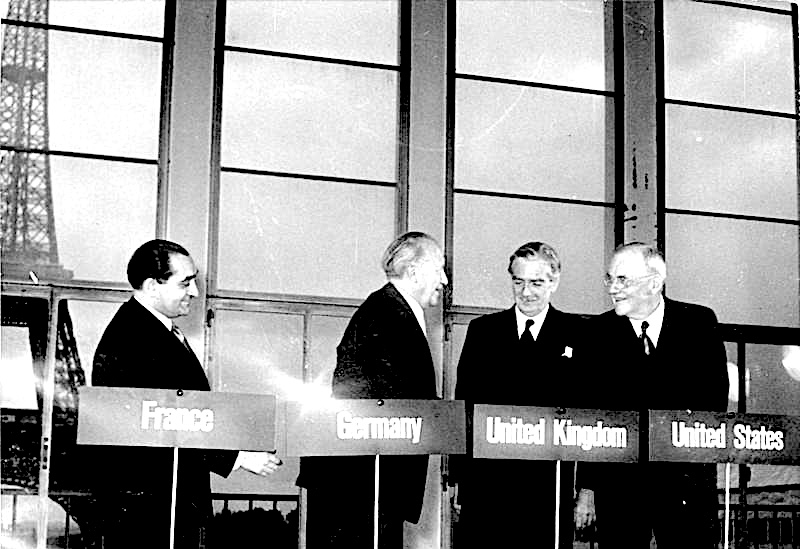
Image
From left: French Prime Minister Pierre Mendes-France, West German Chancellor Konrad Adenauer, British Foreign Minister Anthony Eden and American Foreign Minister John Foster Dulles meet in Paris about the rearmament of West Germany, Oct. 20, 1954. (Bundesarchiv/Wikimedia Commons /CC-BY-SA 3.0, CC BY-SA 3.0 de)

It is worth examining the Stalin Note in greater detail. Stalin’s call for a reunified and neutral Germany was neither ambiguous, tentative, nor insincere. As Rolf Steininger has demonstrated conclusively in The German Question: The Stalin Note of 1952 and the Problem of Reunification (1990), Stalin proposed German reunification under conditions of permanent neutrality, free elections, the withdrawal of occupation forces, and a peace treaty guaranteed by the great powers.

This was not a propaganda gesture; it was a strategic offer rooted in a genuine Soviet fear of German rearmament and NATO expansion.

Steininger’s archival research is devastating to the standard Western narrative. Particularly decisive is the 1955 secret memorandum by Sir Ivone Kirkpatrick, in which he reports the German ambassador’s admission that Chancellor Adenauer knew the Stalin Note was genuine. Adenauer rejected it regardless.

He feared not Soviet bad faith, but German democracy. He worried that a future German government might choose neutrality and reconciliation with Moscow, undermining West Germany’s integration into the Western bloc.

In essence, peace and reunification were rejected by the West not because they were impossible, but because they were politically inconvenient for the Western alliance system. Because neutrality threatened NATO’s emerging architecture, it had to be dismissed as a “trap.”

European elites were not merely coerced into Atlantic alignment; they actively embraced it. Chancellor Adenauer’s rejection of German neutrality was not an isolated act of deference to Washington but reflected a broader consensus among West European elites who preferred American tutelage to strategic autonomy and a unified Europe.

Neutrality threatened not only NATO’s architecture but also the postwar political order in which these elites derived security, legitimacy, and economic reconstruction through U.S. leadership. A neutral Germany would have required European states to negotiate directly with Moscow as equals, rather than operating within a U.S.-led framework that insulated them from such engagement.

In this sense, Europe’s rejection of neutrality was also a rejection of responsibility: Atlanticism offered security without the burdens of diplomatic coexistence with Russia, even at the price of Europe’s permanent division and militarization of the continent.

In March 1954, the Soviet Union applied to join NATO, arguing that NATO would thereby become an institution for European collective security. The U.S. and its allies immediately rejected the application on the grounds that it would dilute the alliance and forestall Germany’s accession to NATO.

The U.S. and its allies, including West Germany itself, once again rejected the idea of a neutral, demilitarized Germany and a Europe security system built on collective security rather than military blocs.

The Austrian State Treaty of 1955 further exposed the cynicism of this logic. Austria accepted neutrality, Soviet troops withdrew, and the country became stable and prosperous. The predicted geopolitical “dominoes” did not fall. The Austrian model demonstrates that what was achieved there could have been achieved in Germany, potentially ending the Cold War decades earlier.

The distinction between Austria and Germany lay not in feasibility, but in strategic preference. Europe accepted neutrality in Austria, where it did not threaten the U.S.-led hegemonic order, but rejected it in Germany, where it did.

The consequences of these decisions were immense and enduring. Germany remained divided for nearly four decades. The continent was militarized along a fault line running through its center, and nuclear weapons were deployed across European soil.

European security became dependent on American power and American strategic priorities, rendering the continent, once again, the primary arena of great-power confrontation.

By 1955, the pattern was firmly established. Europe would accept peace with Russia only when it aligned seamlessly with the U.S.-led, Western strategic architecture. When peace required genuine accommodation of Russian security interests — German neutrality, non-alignment, demilitarization, or shared guarantees — it was systematically rejected. The consequences of this refusal would unfold over the ensuing decades.

The 30-Year Refusal of Russian Security Concerns

Image
Soviet leader Mikhail Gorbachev at the Brandenburg Gate in 1986 during a visit to East Germany. (Bundesarchiv, Wikimedia Commons, CC-BY-SA 3.0)

If there was ever a moment when Europe could have broken decisively with its long tradition of rejecting peace with Russia, it was the end of the Cold War. Unlike 1815, 1919, or 1945, this was not a moment imposed by military defeat alone; it was a moment shaped by choice.

The Soviet Union did not collapse in a hail of artillery fire; it withdrew and unilaterally disarmed. Under Mikhail Gorbachev, the Soviet Union renounced force as an organizing principle of European order.

Both the Soviet Union and subsequently Russia under Boris Yeltsin accepted the loss of military control over Central and Eastern Europe and proposed a new security framework based on inclusion rather than competing blocs. What followed was not a failure of Russian imagination, but a failure of Europe and the U.S.-led Atlantic system to take that offer seriously.

Mikhail Gorbachev’s concept of a “Common European Home” was not a mere rhetorical flourish. It was a strategic doctrine grounded in the recognition that nuclear weapons had rendered traditional balance-of-power politics suicidal.

Gorbachev envisioned a Europe in which security was indivisible, where no state enhanced its security at the expense of another, and where Cold War alliance structures would gradually yield to a pan-European framework.

His 1989 address to the Council of Europe in Strasbourg made this vision explicit, emphasizing cooperation, mutual security guarantees, and the abandonment of force as a political instrument. The Charter of Paris for a New Europe, signed in November 1990, codified these principles, committing Europe to democracy, human rights, and a new era of cooperative security.

At this juncture, Europe faced a fundamental choice. It could have treated these commitments seriously and built a security architecture centered on the [Organization for Security and Cooperation in Europe] OSCE, in which Russia was a co-equal participant — a guarantor of peace rather than an object of containment.

Alternatively, it could preserve the Cold War institutional hierarchy while rhetorically embracing post-Cold War ideals. Europe chose the latter.

NATO did not dissolve, transform itself into a political forum, or subordinate itself to a pan-European security institution. On the contrary, it expanded. The rationale offered publicly was defensive: NATO enlargement would stabilize Eastern Europe, consolidate democracy, and prevent a security vacuum.

Yet, this explanation ignored a crucial fact that Russia repeatedly articulated and that Western policymakers privately acknowledged: NATO expansion directly implicated Russia’s core security concerns — not abstractly, but geographically, historically, and psychologically.

The controversy over assurances given by the U.S. and Germany during German reunification negotiations illustrates the deeper issue. Western leaders later insisted that no legally binding promises had been made regarding NATO expansion because no agreement was codified in writing.

However, diplomacy operates not only through signed treaties but through expectations, understandings, and good faith. Declassified documents and contemporaneous accounts confirm that Soviet leaders were repeatedly told that NATO would not move eastward beyond Germany. These assurances shaped Soviet acquiescence to German reunification — a concession of immense strategic significance.

When NATO expanded regardless, initially at America’s behest, Russia experienced this not as a technical legal adjustment, but as a deep betrayal of the settlement that had facilitated German reunification.

Over time, European governments increasingly internalized NATO expansion as a European project, not merely an American one. German reunification within NATO became the template rather than the exception.

E.U. enlargement and NATO enlargement proceeded in tandem, reinforcing one another and crowding out alternative security arrangements such as neutrality or non-alignment. Even Germany, with its Ostpolitik tradition and deepening economic ties to Russia, progressively subordinated its policies favoring accommodation to alliance logic.

European leaders framed expansion as a moral imperative rather than a strategic choice, thereby insulating it from scrutiny and rendering Russian objections illegitimate. In doing so, Europe surrendered much of its capacity to act as an independent security actor, tying its fate ever more tightly to an Atlantic strategy that privileged expansion over stability.

This is where Europe’s failure becomes most stark. Rather than acknowledging that NATO expansion contradicted the logic of indivisible security articulated in the Charter of Paris, European leaders treated Russian objections as illegitimate — as residues of imperial nostalgia rather than expressions of genuine security anxiety.

Russia was invited to consult, but not to decide. The 1997 NATO–Russia Founding Act institutionalized this asymmetry: dialogue without a Russian veto, partnership without Russian parity. The architecture of European security was being built around Russia, and despite Russia, not with Russia.

George Kennan’s 1997 warning that NATO expansion would be a “fateful error” captured the strategic risk with remarkable clarity. Kennan did not argue that Russia was virtuous; he argued that humiliating and marginalizing a great power at a moment of weakness would produce resentment, revanchism, and militarization. His warning was dismissed as outdated realism, yet subsequent history has vindicated his logic almost point by point.

The ideological underpinning of this dismissal can be found explicitly in the writings of Zbigniew Brzezinski. In The Grand Chessboard (1997) and in his Foreign Affairs essay “A Geostrategy for Eurasia,” (1997) Brzezinski articulated a vision of American primacy grounded in control over Eurasia.

He argued that Eurasia was the “axial supercontinent,” and U.S. global dominance depended on preventing the emergence of any power capable of dominating it. In this framework, Ukraine was not merely a sovereign state with its own trajectory; it was a geopolitical pivot. “Without Ukraine,” Brzezinski famously wrote, “Russia ceases to be an empire.”

This was not an academic aside; it was a programmatic statement of U.S. imperial grand strategy. In such a worldview, Russia’s security concerns are not legitimate interests to be accommodated in the name of peace; they are obstacles to be overcome in the name of U.S. primacy.

Europe, deeply embedded in the Atlantic system and dependent on U.S. security guarantees, internalized this logic — often without acknowledging its full implications. The result was a European security policy that consistently privileged alliance expansion over stability, and moral signaling over durable settlement.

The consequences became unmistakable in 2008. At NATO’s Bucharest Summit, the alliance declared that Ukraine and Georgia “will become members of NATO.” This statement was not accompanied by a clear timeline, but its political meaning was unequivocal.

It crossed what Russian officials across the political spectrum had long described as a red line. That this was understood in advance is beyond dispute.

William Burns, then U.S. ambassador to Moscow, reported in a cable titled “NYET MEANS NYET” that Ukrainian NATO membership was perceived in Russia as an existential threat, uniting liberals, nationalists, and hardliners alike. The warning was explicit. It was ignored.

From Russia’s perspective, the pattern was now unmistakable. Europe and the United States invoked the language of rules and sovereignty when it suited them but dismissed Russia’s core security concerns as illegitimate.

Drawing the Same Lessons
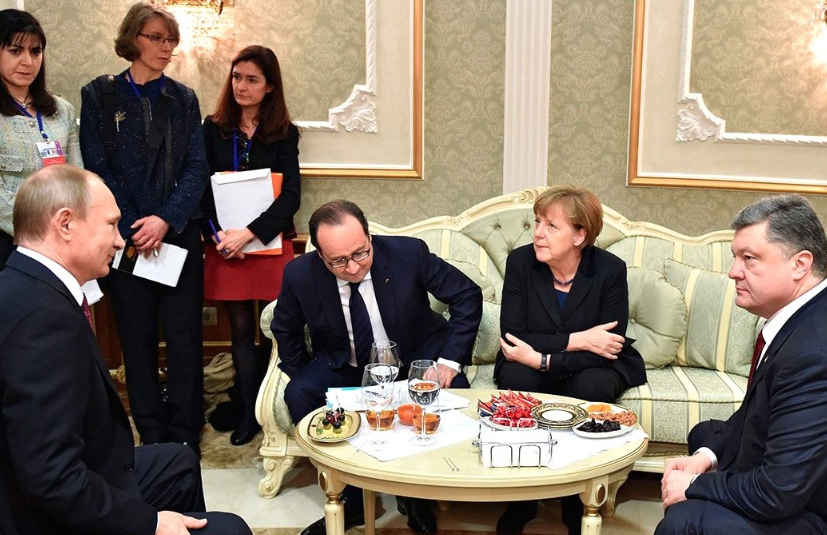
Image
Feb. 12, 2015: Russian President Vladimir Putin, French President Francois Hollande, German Chancellor Angela Merkel, Ukrainian President Petro Poroshenko at Normandy format talks in Minsk, Belarus. (Kremlin)

The lesson Russia drew was the same lesson it had drawn after the Crimean War, after the Allied interventions, after the failure of collective security, and after the rejection of the Stalin Note: peace would be offered only on terms that preserved Western strategic dominance.

The crisis that erupted in Ukraine in 2014 was therefore not an aberration but a culmination. The Maidan uprising, the collapse of the [Ukrainian President Viktor] Yanukovych government, Russia’s annexation of Crimea, and the war in Donbas unfolded within a security architecture already strained to the breaking point.

The U.S. actively encouraged the coup that overthrew Yanukovych, even plotting in the background regarding the composition of the new government. When the Donbas region erupted in opposition to the Maidan coup, Europe responded with sanctions and diplomatic condemnation, framing the conflict as a simple morality play.

Yet even at this stage, a negotiated settlement was possible. The Minsk agreements, particularly Minsk II in 2015, provided a framework for de-escalation of the conflict, autonomy for the Donbas, and reintegration of Ukraine and Russia within an expanded European economic order.

Minsk II represented an acknowledgment — however reluctant — that peace required compromise and that Ukraine’s stability depended on addressing both internal divisions and external security concerns. What ultimately destroyed Minsk II was Western resistance.

When Western leaders later suggested that Minsk II had functioned primarily to “buy time” for Ukraine to strengthen militarily, the strategic damage was severe. From Moscow’s perspective, this confirmed the suspicion that Western diplomacy was cynical and instrumental rather than sincere — that agreements were not meant to be implemented, only to manage optics.

By 2021, the European security architecture had become untenable. Russia presented draft proposals calling for negotiations over NATO expansion, missile deployments, and military exercises — precisely the issues it had warned about for decades.

These proposals were dismissed by the U.S. and NATO out of hand. NATO expansion was declared non-negotiable. Once again, Europe and the United States refused to engage Russia’s core security concerns as legitimate subjects of negotiation. War followed.

When Russian forces entered Ukraine in February 2022, Europe described the invasion as “unprovoked.” While this absurd description may serve a propaganda narrative, it utterly obscures history. The Russian action hardly emerged from a vacuum.

It emerged from a security order that had systematically refused to integrate Russia’s concerns and from a diplomatic process that had ruled out negotiation on the very issues that mattered most to Russia.

Even then, peace was not impossible. In March and April 2022, Russia and Ukraine engaged in negotiations in Istanbul that produced a detailed draft framework. Ukraine proposed permanent neutrality with international security guarantees; Russia accepted the principle.

The framework addressed force limitations, guarantees, and a longer process for territorial questions. These were not fantasy documents. They were serious drafts reflecting the realities of the battlefield and the structural constraints of geography.

Yet the Istanbul talks collapsed when the U.S. and U.K. stepped in and told Ukraine not to sign. As Boris Johnson later explained, nothing less than Western hegemony was on the line.

The collapsed Istanbul Process demonstrates concretely that peace in Ukraine was possible soon after the start of Russia’s special military operation. The agreement was drafted and nearly completed, only to be abandoned at the behest of the U.S. and U.K.

By 2025, the grim irony became clear. The same Istanbul framework resurfaced as a reference point in renewed diplomatic efforts. After immense bloodshed, diplomacy circled back to plausible compromise.

This is a familiar pattern in wars shaped by security dilemmas: early settlements that are rejected as premature later reappear as tragic necessities. Yet even now, Europe resists a negotiated peace.

For Europe, the costs of this long refusal to take Russia’s security concerns seriously are now unavoidable and massive. Europe has borne severe economic losses from energy disruption and de-industrialization pressures.

It has committed itself to long-term rearmament with profound fiscal, social, and political consequences. Political cohesion within European societies is badly frayed under the strain of inflation, migration pressures, war fatigue, and diverging viewpoints across European governments.

Europe’s strategic autonomy has diminished as Europe once again becomes the primary theater of great-power confrontation rather than an independent pole.

Perhaps most dangerously, nuclear risk has returned to the center of European security calculations. For the first time since the Cold War, European publics are once again living under the shadow of potential escalation between nuclear-armed powers.

This is not the result of moral failure alone. It is the result of the West’s structural refusal, stretching back to Pogodin’s time, to recognize that peace in Europe cannot be built by denying Russia’s security concerns. Peace can only be built by negotiating them.

The tragedy of Europe’s denial of Russia’s security concerns is that it becomes self-reinforcing. When Russian security concerns are dismissed as illegitimate, Russian leaders have fewer incentives to pursue diplomacy and greater incentives to change facts on the ground.

European policymakers then interpret these actions as confirmation of their original suspicions, rather than as the utterly predictable outcome of a security dilemma they themselves created and then denied.

Over time, this dynamic narrows the diplomatic space until war appears to many not as a choice but as an inevitability. Yet the inevitability is manufactured. It arises not from immutable hostility but from the persistent European refusal to recognize that durable peace requires acknowledging the other side’s fears as real, even when those fears are inconvenient.

The tragedy is that Europe has repeatedly paid heavily for this refusal. It paid in the Crimean War and its aftermath, in the catastrophes of the first-half of the twentieth century, and in decades of Cold War division. And it is paying again now. Russophobia has not made Europe safer. It has made Europe poorer, more divided, more militarized, and more dependent on external power.

The added irony is that while this structural Russophobia has not weakened Russia in the long run, it has repeatedly weakened Europe. By refusing to treat Russia as a normal security actor, Europe has helped generate the very instability it fears, while incurring mounting costs in blood, treasure, autonomy, and cohesion.

Each cycle ends the same way: a belated recognition that peace requires negotiation after immense damage has already been done. The lesson Europe has yet to absorb is that recognizing Russia’s security concerns is not a concession to power, but a prerequisite for preventing its destructive uses.

The lesson, written in blood across two centuries, is not that Russia or any other country must be trusted in all regards. It is that Russia and its security interests must be taken seriously.

Europe has rejected peace with Russia repeatedly, not because it was unavailable, but because acknowledging Russia’s security concerns was wrongly treated as illegitimate.

Until Europe abandons that reflex, it will remain trapped in a cycle of self-defeating confrontation — rejecting peace when it is possible and bearing the costs long after.

https://consortiumnews.com/2025/12/24/j ... -of-peace/

******

Behind the Facade of the Valley Case
December 25, 12:59

Image

Interesting facts about what remained in the shadow of the Dolina case.

At the direction of Igor Krasnov, three panels of the Supreme Court of Russia—for civil cases, for administrative cases, and for economic disputes—are already preparing a review of judicial practice in the consideration of cases challenging real estate transactions. This review will include the decision adopted yesterday by the Supreme Court of the Russian Federation, which definitively secured Polina Lurye's ownership of an apartment in central Moscow.

https://t.me/sovetsudey/601 - zinc.

The public, caught up in the Dolina-Lurye case, missed an important point. Larisa Dolina was represented by the firm "Barshevsky & Partners," known for its expertise in resolving intractable issues. And the new Chairman of the Supreme Court, Igor Krasnov, explained live on air that the judicial system will rid itself of the web of "delicate" relationships that has entangled it from top to bottom.

The media preparation surrounding Dolina-Lurye was conducted at the highest level. And clearly, all this was not aimed at evicting the grandmother. The puzzle came together after Nezavisimaya Gazeta's report—Krasnov targets individuals who have entrenched themselves in the judicial system to "resolve issues."

As an example, the article cites the Delcredere law firm, headed by the "clan" of Larisa Kalanda, whose husband worked in the presidential personnel department in the early 2000s and, among other things, served as executive secretary of the commission for the preliminary review of federal judges.

Apparently, out of the kindness of his heart, he registered over 100 judges at the same address in Moscow. It's unrealistic to even suggest that the consistent victories of Delcredere lawyers in all three instances of arbitration proceedings are in any way connected to this. We won't reprint the long ring - those interested can read it for themselves

( https://www.ng.ru/economics/2025-12-24/ ... 41300.html )


https://t.me/geonrgru/41419 - zinc

Well, if Krasnov can at least partially purge the judicial system of such characters and the "crony" relationships they've built, that in itself will be a serious achievement. Much more serious than the Dlolina case. But some believe that over the decades, a veritable Augean stable has formed there. We'll see. Good luck to Krasnov with this.

https://colonelcassad.livejournal.com/10266257.html

The profession of "writer" has reappeared in Russia.
December 25, 10:42

Image

The profession of "writer" has reappeared in Russia.

Writer is a profession again

. The profession of "writer" has officially appeared in the Russian Federation.

Order of the Ministry of Labor and Social Protection of the Russian Federation dated November 10, 2025 No. 633n "On approval of the professional standard "Writer""

Date signed: November 10, 2025 Published: December 16, 2025
Effective: September 1, 2026.

Let me remind you that this profession existed in both the Russian Empire and the USSR.

The overseas curators of the "new Russia" "switched it off" in 1991, and the war "switched it on" again.

In terms of difficulty, it is classified as 6th out of 9 existing categories.

Only top managers and government officials are higher.

Well, these are sacred, everything is clear here.

They will ask, why?
I will answer: in addition to a dozen or two "successful" ones, there are thousands of professional writers who have dedicated their entire lives to literature and now live on a beggarly minimum pension.
Especially in the provinces.

Here's about them . We thought about zinc first.

https://t.me/shorokhOFF/7680 - zinc

https://colonelcassad.livejournal.com/10265951.html

Google Translator
"There is great chaos under heaven; the situation is excellent."

User avatar
blindpig
Posts: 15306
Joined: Fri Jul 14, 2017 5:44 pm
Location: Turtle Island
Contact:

Re: Russia today

Post by blindpig » Fri Dec 26, 2025 4:40 pm

GORILLA RADIO GOES TO WAR AT SEA – BEATING TRUMP AT THE BLUFFING GAME

Image

By John Helmer, Moscow @bears_with

For the time being the Trump Administration and its allies conduct their war against Russia on the high seas, outside defended territorial waters, against ship targets which are unarmed, threaten no resistance. This is piracy, effective if the sight of the skull-and-bones flag triggers fear, shock, immediate surrender.

In the Caribbean against Venezuela, President Donald Trump is displaying an enormous naval force: “the largest Armada ever assembled in the history of South America,” he tweeted on December 16. “It will only get bigger, and the shock to them will be like nothing they have ever seen before”.

Then the US Coast Guard announced that it lacks the men and firepower to board and seize the Bella-1 oil tanker, owned by China and heading to Venezuela to load crude oil for delivery to Chinese refineries. “The days-long pursuit [of the Bella-1] highlights the mismatch between the Trump administration’s desire to seize sanctioned oil tankers near [sic] Venezuela and the limited resources of the agency that is mainly carrying out operations, the Coast Guard,” a US official announced on December 23. “A US official, speaking on condition of anonymity, said the Coast Guard officials on the [USS Gerald] Ford were from a Maritime Security Response Team and at the time too far from Bella 1 to carry out a boarding operation.”

The next day, December 24, Trump officials lowered their flag to half-mast. “The White House has ordered U.S. military forces to focus almost exclusively on enforcing a ‘quarantine’ of Venezuelan oil for at least the next two months, a U.S. official told Reuters, indicating Washington is currently more interested in using economic rather than military means to pressure Caracas.” ‘While military options still exist, the focus is to first use economic pressure by enforcing sanctions to reach the outcome the White House is looking (for),’ the official said on Wednesday, speaking on condition of anonymity.”

In the Mediterranean, the cover story for drone attacks on tankers operating for the Russian oil trade is that it’s the Ukrainians at work, reportedly firing from 1,500 kilometres to the north.

More certainly, the small drone detonation on the deck of the Qendil southwest of Crete on December 19 was fired from Tympaki, a Greek Coast Guard base on Crete armed with Israeli and NATO drones and using US and NATO satellite and live airborne electronic surveillance. Although claimed by the Ukrainian Security Service (SBU) , this was an act of war by the Greek Government against Russia – and it failed. The Qendil has continued under its own power through the Aegean to Nemrut Bay, Turkey. Omani-flagged, with Indian management and a Russian master, the Qendil was empty at the time of the attack.

This is a war between the 3,300-tanker alternative fleet (alt-fleet) versus a mainstream fleet of about 5,000 vessels in which the world oil tanker market has been cut in half by the international war between Russia, China, India, Iran, Venezuela and North Korea on one side, and the US, the NATO allies, Israel, and Japan on the other.

At sea, for the time being, this is a war of provocation, profiteering, and face-saving short of shooting. The more time that goes by, however, the stronger the Venezuelan government grows in resistance, and the closer to capitulation the US and NATO-backed regime in Kiev.

For a backgrounder on this war at sea and its Napoleonic precedent of two hundred years ago, read this:

Image
Left, the Napoleonic ambition for the Trump-NATO blockade of Russian trade at sea; source: https://johnhelmer.net/the-napoleon-mistake-at-sea/ Right, Napoleon in July 1815, after his battlefield defeat at Waterloo, on the deck of HMS Bellerophon enroute to exile and death on St. Helena island.

For a detailed review of the US attacks on tankers in the Caribbean during December, and for maritime industry counts of the size of the alt-fleet – the “phantom”, “shadow”, “ghost”, “black” fleet – read this report by El Pais in NATO-allied Spain, published on December 22, 2025:

Image
Image
Source, top: https://english.elpais.com/internationa ... fleet.html; below, https://www.lloydslist.com/LL1155952/Fl ... -in-Russia

As sources for the maritime fleet war, Reuters and Bloomberg should be discounted as they are both New York-based propaganda platforms for disinformation. GCaptain, a leading US maritime industry publication, is a source for what the commercial tanker interests are saying, and also the US shipyards, US Coast Guard, and US Navy. Splash247.com is a little more independent because it is Asian owned.

Lloyds List, based in London and owned by an international private equity investor, has traditionally been the mouthpiece for the shipping oligarchs of London, Athens, Oslo, and New York; British shipping brokers; and the maritime insurers. Richard Meade, a longtime Lloyds List reporter, acknowledged on December 23 that the “shadow fleet” game is almost up, as the Kremlin has begun to curtail false flagging and offshore registrations for the movement of Russian oil cargoes, and instead put them on board tankers under the Russian flag, Russian insurance, and armed Russian protection.

Listen now to Chris Cook leading the hour-long Gorilla Radio broadcast on Christmas Eve, Canada time.

Image
Source: https://gradio.substack.com/p/gorilla-r ... k-john-246 The broadcast archive can also be heard on Telegram at https://t.me/gorillaradio2024

For more than twenty years Chris Cook has been producing Gorilla Radio from Victoria, British Columbia. For the archive, plus introductions to Canada’s Resistance and the history as it took shape and fought the battles that had to be fought, click here.

Note: The lead image is of the Panama-flagged, Chinese-owned tanker Centuries which was carrying Venezuelan crude oil to China. It was boarded and seized by US forces on December 20 (local time). When asked for the Chinese Government’s response, Lin Jian of the Foreign Ministry in Beijing said: “By arbitrarily seizing other countries’ vessels, the U.S. has seriously violated international law. China stands against unilateral illicit sanctions that lack basis in international law or authorization of the UN Security Council, and against any move that violates the purposes and principles of the UN Charter, infringes upon other countries’ sovereignty and security, and constitutes unilateralism and bullying. Venezuela has the right to independently develop mutually beneficial cooperation with other countries. We believe Venezuela’s position of defending its legitimate rights and interests has the understanding and support of the international community.”

Image
Source: https://www.fmprc.gov.cn/mfa_eng/xw/fyr ... 80748.html

https://johnhelmer.net/gorilla-radio-go ... more-93146


******

Russia’s Logic of Long Rule: Continuity, Statecraft and the Illusion of Regime Change
December 25, 2025
By Kautilya The Contemplator, Substack, 12/13/25

Western political discourse often treats President Vladimir Putin’s twenty-five years in power as an aberration, a manifestation of uniquely Russian authoritarianism and a personalistic dictatorship incompatible with modern political norms. Russia is, therefore, an inevitable target for Western-engineered so-called “democratic transformation.” Yet, this narrative reveals far more about Western ideological assumptions than it does about Russia’s own political culture. It assumes that the institutional patterns of the North Atlantic world in the form of frequent electoral turnover, procedural legitimacy and entrenched party competition, represent a universal model toward which all societies naturally evolve. Russia’s own historical trajectory suggests something different.

In the long continuum of Russian statehood, from the medieval princes of Muscovy through the imperial Tsars, the long-serving General Secretaries of the Soviet Union and into the modern Russian presidency, extended leadership tenures are not deviations. Instead, they are characteristic expressions of a civilizational logic shaped by geography, historical trauma, ethnic complexity and enduring geopolitical pressures. Putin’s longevity, far from being anomalous, represents a return to structural equilibrium after the turbulence of the 1990s. Understanding why requires situating Russia’s political patterns within their deep historical and cultural contexts.

Historical Continuity of Long Rule
The Tsarist Era: Sovereignty Until Death
The pattern of long-term centralized authority predates modern Russia and permeates its political evolution. From the 15th century onward, Muscovite and Imperial Russia developed governance structures in which the sovereign ruled until death or violent overthrow. Ivan III ruled for forty-three years (1462–1505), unifying Russian lands, ending Mongol suzerainty and consolidating the state. Ivan IV reigned for thirty-seven years (1547–1584), centralizing authority and expanding Russian territory to Siberia. Peter the Great’s forty-three-year rule (1682–1725) modernized the military, restructured state institutions and expanded the empire westward. Catherine the Great’s thirty-four-year reign (1762–1796) extended Russian influence across Eastern Europe, the Caucasus and the Black Sea. Nicholas I ruled for thirty years (1825–1855), overseeing an era of ideological conservatism and imperial cohesion.

These rulers were not constrained by term limits or regularized succession mechanisms. Their tenures reflected the structural demands of governing a vast, diverse empire exposed to external threats and internal fragmentation. Stability depended on sustained personal authority, not rotation of office.

The Soviet Era: Ideology Changed, Political Logic Did Not
The Soviet period preserved this deeper continuity beneath the veneer of revolutionary ideology. Vladimir Lenin ruled until incapacitation and death. Joseph Stalin governed for twenty-nine years until his death in 1953, industrializing the country, mobilizing it for total war and engineering an authoritarian modernization that transformed Russia into a superpower.

Leonid Brezhnev ruled for nearly two decades, presiding over an era of détente and cautious conservatism. Yuri Andropov and Konstantin Chernenko died in office. Only Nikita Khrushchev was removed before death, and even his removal came through an intra-elite party coup rather than through any democratic mechanism.

Across five centuries of statehood, the pattern is unmistakable. Russian leadership is long-term, centralized and stable, disrupted only by systemic crises. Putin’s tenure fits squarely into this lineage.

Russia as a Multi-Ethnic and Civilizational State
Western misunderstandings of Russia begin with the false assumption that it is a conventional nation-state comparable to European parliamentary democracies. Russia has never been that. It is a multi-ethnic, continental-scale civilization whose political culture and strategic behavior are shaped by sheer geographic immensity and profound internal diversity.

A state stretching across eleven time zones and uniting more than 190 ethnic groups and multiple religious traditions cannot be governed through the rapid political turnover typical of Western systems. Long-term, centralized leadership is not an ideological quirk but a structural necessity. The memory of the Soviet collapse, when a weakened center allowed entire regions to break away, reinforces the conviction that discontinuity at the top risks fragmentation.

Russian thinkers have long argued that geography imprints itself on political psychology. Nikolai Berdyaev famously described “Nature” in Russia as an elemental force that is vast, overwhelming and spiritually formative. Pre-Christian pagan impulses blended with Byzantine Orthodoxy, creating a national character marked by a tension between boundless, earthly vitality and ascetic, otherworldly discipline. This duality mirrors Russia’s physical landscape that is immense and formless.

Such a landscape demands strong organizing authority. Russian historians contend that centralized rule emerged not from a cultural affinity for despotism but from the practical challenge of imposing order on the steppe. Where Western civilization grew within compact, clearly bounded territories conducive to stable institutions, Russia grew outward into open space. In such conditions, only a powerful state could hold the civilizational whole together.

Russia’s political model is therefore not rhetorical but existential. The state is expected to serve as the unifying principle of a vast and varied civilization, preventing centrifugal drift among its many peoples. This explains why long-term leadership whether Tsarist, Soviet or presidential, has been the dominant pattern across Russian history. The state’s authority is the spine of the Russian world.

This civilizational logic of thinking in centuries rather than electoral cycles, treating sovereignty as sacred and viewing instability as an existential threat, shapes both elite expectations and public attitudes. Rapid leadership rotation appears dangerous and Western-style party competition brittle. Continuity at the top is understood not as authoritarian stagnation but as strategic prudence. Putin’s long tenure reflects this deeper civilizational demand that only durable, centralized power can sustain a state of Russia’s scale and historical vulnerability.

Political Trauma and the Fear of Collapse
If Russia privileges stability and continuity, it is because its history repeatedly demonstrates the catastrophic consequences of state weakness. Three moments in particular form a continuous chain of trauma that deeply informs the Russian political imagination.

The Time of Troubles (1598–1613): Collapse of Sovereignty
The Time of Troubles (Smutnoye vremya) was not merely a dynastic crisis. It was a near-extinction event for the Russian state. After the death of Tsar Feodor I and the extinction of the Rurik dynasty, tsars were made and unmade by factions, pretenders proliferated, foreign armies occupied Moscow and famine killed perhaps one-third of the population. The infamous Seven Boyars (Semiboyarschina), a council of aristocrats who effectively handed Moscow over to the Polish-Lithuanian Commonwealth in 1610, became a lasting symbol of elite treachery, factionalism and the dangers of state disintegration. In Russian historical consciousness, the boyars represent what happens when elites prioritize gain over national survival.

The 1990s: The Modern Time of Troubles
The symbolic template of the Smutnoye vremya resurfaced with extraordinary force in the 1990s when the Seven Bankers (Semibankirschina) comprising Boris Berezovsky, Mikhail Fridman, Mikhail Khodorkovsky, Vladimir Gusinsky, Vladimir Potanin, Alexander Smolensky and Petr Aven, became in the public imagination, a modern ‘Boyarshina’. They privatized not merely state assets but functional sovereignty itself. Gusinsky and Berezovsky controlled national television networks. Khodorkovsky controlled strategic energy assets and funded political parties. Regional governors treated their territories as personal fiefdoms and the Russian mafia effectively acted as the arbiter of property rights and security across the country. In parallel, de-industrialization, population decline, IMF dependency and NATO expansion exacerbated the sense of humiliation and hopelessness.

As such, for ordinary Russians, the “Wild 1990s” were not a time of freedom but a time when the state vanished, the police were powerless, wages went unpaid and criminals, or oligarchs indistinguishable from criminals, ruled. The parallel to the Seven Boyars is not metaphorical but structural. In both cases, the absence of a coherent state allowed powerful private interests to seize control, fragment authority and invite external manipulation.

February–October 1917: Liberal Democracy as Paralysis
The 1917 interregnum between the February and October Revolutions represents a third foundational trauma. The Provisional Government under Alexander Kerensky attempted to impose Western-style democratic reforms on a war-exhausted society. Instead of stabilizing the state, Kerensky presided over the collapse of army discipline, the rise of rival power centers, land seizures and economic disarray. In later recollections, he is reported to have answered that preventing Bolshevik victory would have required “shooting one man – Kerensky himself”. His liberal democratic vision was not wrong in theory. It was simply incompatible with the conditions of a vast, wounded, agrarian empire on the brink of disintegration. To Russians, 1917 did not show that democracy was impossible. It showed that democracy imposed prematurely without state capacity or order, leads directly to collapse.

Collective Memory of Collapse
These three historical traumas form a continuous thread in Russian collective memory. Each period taught the same civilizational lesson that when the central state weakens, Russia become vulnerable to internal predation, external interference and territorial dismemberment. Authority is not merely a political preference. It is a shield against national dissolution.

For Westerners, instability often signals the birth pangs of democracy. For Russians, instability is the prelude to famine, occupation, civil war and criminal rule. This deep-seated fear of collapse, encoded across four centuries of historical experience, helps explain why Russian political culture places such a premium on continuity, long-term leadership and centralized authority. The trauma of past disintegration creates a powerful societal mandate that the state must never again be allowed to fall apart.

Performance-Based Versus Procedural Legitimacy
Against this backdrop, Western efforts to promote regime change in Russia, whether through sanctions, information campaigns or normative pressure, fundamentally misunderstand the nature of Russian political legitimacy. In the West, legitimacy emerges from adherence to democratic procedures, term limits, party competition and electoral rotation. In Russia, legitimacy derives not from procedural formalism but from performance and specifically, the leader’s ability to provide stability, economic predictability, social order, protection from foreign threats and the restoration of national dignity after humiliating periods of weakness.

Networked Power and the “Besieged Fortress”
Western narratives often reduce Russia’s political system to the personal will of Vladimir Putin, as if it were a one-man dictatorship divorced from institutional, bureaucratic and elite dynamics. In reality, Putin occupies the position of primus inter pares, the “first among equals,” within a tightly interwoven elite ecosystem that includes the security services, the military, major state corporations, regional governors, loyal oligarchs and technocratic administrators. His authority rests not on isolated personal power but on his ability to manage, balance and embody the interests of this wider ruling coalition.

This elite configuration bears far greater resemblance to the Tsarist bureaucratic machine and the Soviet nomenklatura than to any Western-style presidential administration. It is a system designed to be self-protective and consensus-oriented, structured to prevent internal fragmentation and maintain continuity in a vast and diverse state. Because the locus of power is collective rather than personal, removing Putin would not dismantle the system. It would simply elevate another figure emerging from the same institutional matrix and shaped by the same strategic assumptions. Western regime-change fantasies persist only because they misinterpret the nature of Russian governance, imagining it as personalistic rather than structurally embedded.

To understand why such a system coalesced and why it prizes continuity, it is necessary to recognize Russia’s deeply rooted besieged fortress mentality, something Western observers often dismiss as paranoia but which arises from centuries of traumatic experience. Russia’s identity has been forged through repeated invasions that consistently threatened its political survival: the Mongol-Tatar domination, the Polish occupation of Moscow in 1610, Swedish incursions under Charles XII, Napoleon’s invasion, the Austro-German offensives in World War I, Allied interventions during the Civil War and the Nazi onslaught of 1941. Each episode reinforced the belief that a fragmented or indecisive state invites catastrophe.

Even earlier, during the Northern Crusades, the Teutonic Knights attempted to subjugate the Novgorod Republic. Viewing Orthodox Christians as indistinguishable from pagans, the Catholic Church sanctioned the campaign as part of its mission to extend Latin Christendom. The Knights also sought to control Novgorod’s lucrative trade routes. Their defeat by Alexander Nevsky in the 1242 Battle on the Ice became a foundational memory in Russian statecraft, an enduring symbol of the necessity of strong, unified leadership to repel existential threats.

This long arc of historical insecurity shaped Russia’s perception of the modern world. The Cold War reinforced expectations of Western encirclement, and post-Soviet developments such as NATO expansion, color revolutions along Russia’s periphery, and openly stated Western goals of “weakening”, “decolonizing” or “dismembering” Russia have appeared to confirm, rather than alleviate, these anxieties. In such an environment, the logic of centralized authority, elite cohesion and strategic continuity becomes deeply entrenched. The state sees itself operating under perpetual external threat and its leadership structures reflect a civilizational imperative: to ensure stability in a world perceived as chronically hostile.

Elections as Political Ritual
One of the most misunderstood aspects of Russian political life is the function of elections. Western analysts often describe Russian elections as “sham contests” or “fake versions” of Western democracy. However, such comparisons assume that all elections serve the same purpose. In Russia, elections function less as mechanisms of leadership rotation and more as rituals of affirmation. They demonstrate mass cohesion, test regional elite loyalty and symbolically renew the legitimacy of continuity.

Critics also point to the exclusion of figures such as Alexey Navalny and the dominance of Kremlin-approved “systemic opposition” candidates as evidence that Russian elections are hollow. Yet this, too, confirms rather than refutes their ritualized function. In an electoral-authoritarian system, the ballot is structured not to decide who will govern but to stage society’s consent to an already-decided leadership arrangement. Allowing a genuinely competitive challenger would undermine the very continuity the system is designed to preserve.

The Medvedev Interlude: Continuity Under Constitutional Constraint
The 2008–2012 Medvedev presidency illustrates this logic. Although Putin stepped aside due to constitutional term limits, elite networks, policy direction and strategic objectives remained unchanged. Russia fought the 2008 war with Georgia under Medvedev, the state continued consolidating power and the groundwork for later constitutional reforms was laid. The “tandemocracy” maintained continuity while respecting constitutional formalities.

The 2020 Constitutional Amendments and Mishustin’s Appointment
A more significant institutional adaptation occurred in 2020 with sweeping constitutional reforms. These amendments extended presidential terms to six years and reset Putin’s previous terms, allowing him to run again as though beginning anew. This was not merely a personal power play. It reflected elite consensus that continuity was strategically essential amid rising geopolitical confrontation.

Simultaneously, Putin appointed Mikhail Mishustin, a technocratic and non-political figure from the Federal Tax Service, as prime minister. Mishustin symbolized managerial continuity rather than political rivalry. His role underscores that the Russian system prizes technocratic competence and loyalty over pluralistic competition.

Continuity and Survival in Crisis
What Western critics call “stagnation” often manifests in Russia as resilience. Leadership continuity has repeatedly enabled Russia to endure and ultimately triumph over crises that would have shattered more fragile states. Alexander I’s long reign allowed Russia not only to survive Napoleon’s invasion but to rebuild, reform and ultimately advance into Paris in 1814. Stalin’s lengthy rule provided the organizational capacity to industrialize the Soviet Union, transplant entire industries eastward during the Great Patriotic War, mobilize tens of millions and rebuild the nation after victory.

In the post-Soviet era, Putin’s long tenure has allowed him to centralize authority after the chaos of the 1990s, tame the oligarchs, restore the fiscal foundations of the state, defeat separatism, modernize the military, rebalance the economy, diversify energy exports and reposition Russia within a multipolar global order. These undertakings could not have been accomplished within the time horizons of Western leadership cycles.

Putin’s Strategic Advantage in a World of Short-Term Leaders
Putin’s unique strategic advantage lies in his continuity. He has outlasted five American presidents – Clinton, Bush, Obama, Trump and Biden – each of whom dramatically shifted US policies toward Russia, China and the Middle East.

While American strategy oscillated from reset to rivalry, from interventionism to retrenchment, Russia pursued a coherent long-term program of resisting NATO expansion, consolidating influence in the post-Soviet space, engaging China and India, strengthening domestic sovereignty and cultivating a Eurasian orientation. No Western leader has accumulated such extensive experiential knowledge of global statecraft. In the international arena, time itself is a resource and Russia has wielded it more effectively than any Western power.

Traits Required to Rule a State Like Russia
The traits required to rule Russia thus differ markedly from those valued in Western democracies. A Russian leader must possess strategic patience, the ability to think in decades and the willingness to make difficult decisions to preserve the integrity of the state. A mastery of diplomacy as an existential craft is indispensable as well as the capacity to act as a symbolic embodiment of national continuity.

These traits are not optional but structurally necessary for managing a state with Russia’s geographic, ethnic and geopolitical complexities. Leaders who lack such qualities either perish, as many did in Russia’s turbulent periods, or are removed by the elite, as in Khrushchev’s case.

After Putin: Continuity Without the Man
The question of Russia’s future after Putin often animates Western commentary, usually through two mistaken assumptions. First, that Putin alone holds the system together, and second, that removing him would catalyze liberalization. Neither assumption withstands scrutiny.

Putin is not the creator of Russia’s political logic but its product and its guardian. The system he leads is robust, diversified among powerful elite blocs and deeply rooted in historical patterns. His successor, whenever he emerges, will be shaped by this system, not liberated from it. The next leader may, in fact, be more rigid, more security-driven and less internationally experienced than Putin, especially given the intensifying geopolitical confrontation with the West. Many Russian elites believe that Putin’s relative pragmatism and diplomatic skill will be difficult to replicate. The West may one day “lose Putin” only to confront a leader more nationalistic and less flexible.

Russia will not liberalize into a Western model after Putin because the structural foundations of its political culture such as its geography, ethnic diversity, civilizational identity, historical trauma, elite configuration and security imperatives do not disappear with a change in leadership. If anything, the system will likely consolidate further. The logic of continuity will outlast the individual who currently embodies it.

The Deeper Lesson for the West
Across six centuries, Russian governance has survived Mongol domination, the Time of Troubles, Napoleonic invasion, imperial collapse, civil war, the devastation of the Second World War, Stalin’s excesses, Khrushchev’s volatility, Brezhnev’s stagnation, Soviet dissolution and the post-Soviet collapse. In each case, the state eventually reasserted continuity and stability. This pattern illustrates a profound truth: Russia’s political system is not centered on specific leaders, but on a civilizational logic that prioritizes order, sovereignty and endurance over procedural turnover.

Western misunderstandings of Russia persist because they rest on the false premise that all political systems aspire to mimic Western liberal democracy. Russia’s political model is not a deviation from an imagined global norm. It is the product of its geography, history, civilization and strategic culture. Putin’s twenty-five years in power reflect not the idiosyncrasies of one man, but the structural necessities of a civilizational state that thinks in centuries, not electoral cycles. When he eventually leaves the political stage, Russia will continue along its historical trajectory, guided by the same imperatives of stability, continuity and strategic patience that have shaped it since the age of Ivan III. In this sense, the West does not misunderstand Putin. It misunderstands Russia.

https://natyliesbaldwin.com/2025/12/rus ... me-change/

******

Image

The Baltic Roots of Russophobia: Neoliberalism, revisionism and U.S. imperialism
Originally published: CovertAction Magazine on December 18, 2025 by Aidan O’Brien (more by CovertAction Magazine) | (Posted Dec 24, 2025)

The European Union (EU) has a population of 450 million people, yet its foreign policy is determined by a country with a population of 1.3 million people—Estonia.

The High Representative of the European Union for Foreign Affairs and Security Policy is Kaja Kallas, the former prime minister of Estonia. Her agenda is an Estonian obsession writ large: Hate Russia. In her own words: “Russia can’t be trusted” and should be “broken up.” She has committed “the European Union to the victory of Ukraine” in its war with Russia.[1]

Image
Kaja Kallas, the face of Russophobia in the EU. [Source: multimedia.europarl.europa.eu]

Meanwhile in Latvia—population 1.8 million—Russian culture has been banned despite the fact that 36% of the people speak Russian as a first language.

Segregation based on ethnicity is government policy.

The United Nations has described these laws as “discriminatory because they limit jobs for Russian-speaking and other minorities.”

But the EU doesn’t mind.[2]

And in Lithuania—population 2.8 million—the government rewrote history so as to strengthen this Baltic anti-Russian bias.

Its version of World War II blames the Soviet Union rather than Germany for that catastrophe.

In this revision of history Lithuania claims that it was a victim in a “double genocide”—instigated by Stalin.

The implication is that the Soviets were equal to the Nazis. The EU does not disagree.[3]

This cocktail of Russophobia has intoxicated Europe so much that war with Russia is now seen as the solution to all of the continent’s problems. Rearmament for this coming war is now Europe’s only purpose. It is the panacea for its stagnant capitalism.

Image
The birth of Europe’s military-industrial complex needs Russophobia. [Source: x.com]

The Baltic States—not Ukraine—planted this irrationalism deep inside the structures of Europe. As a result, the emotions of six million Estonians, Latvians and Lithuanians are determining the fate of the continent, if not the world.

From the Politics of Neo-liberalism to the Politics of Hate
Estonia, Latvia and Lithuania have been on an emotional roller coaster ever since they returned to capitalism. Economic “shock therapy” in the 1990s was followed by the great financial crash of the 2000s. The result was depopulation in each country. And ultranationalism. Emigration and hate became survival tactics.[4]

American economists with links to the White House, like Jeffrey Sachs, set the agenda for Eastern Europe in the 1990s. Privatization, free markets and the end of state subsidies—the Washington Consensus—strangled the former socialist bloc.

And the new bosses in the Baltic—people like Vytautas Landsbergis in Lithuania, Ivars Godmanis in Latvia and Mart Laar in Estonia—were only too happy to assist. Hiding behind catchphrases like “the Baltic Model,” “the Baltic Tigers” and “the Baltic Miracle,” the new ruling class sacrificed their countries on the altar of Western finance capital.[5]

Image
Socio-economic misery paved the way for Russophobia in the Baltic States. [Source: reddit.com]

By 2010 the results were in. Michael Hudson summarized them as follows—with special attention to Lithuania—Latvia and Estonia, however, were comparable:

“As the economic crisis intensified, unemployment grew from a relatively low level of 4.1 per cent in 2007 to 18.3 per cent in the second quarter of 2010 with a concomitant increase in emigration from 26,600 in 2007 to 83,200 in 2010. This was the highest level of emigration since 1945 and comparable only with the depopulation of the country during World War II. Since the restoration of independence in 1990, out of a population of some 3.7 million 615,000 had left the country; three fourths were young persons (up to 35 years old), many of them educated and with jobs in Lithuania. By 2008, the emigration rate from Lithuania became the highest among the EU countries (2.3 per 1,000), and double that of the next highest country, Latvia (1.1 per 1,000).”

Hudson continued: “Forecasts for the period 2008-35 suggest a demographic decline by a further 10.9 per cent, one of the highest rates in the EU (following Bulgaria and Latvia). The 2011 population census seemed only to confirm these grim prognostications. Demographers previously proved to have been too optimistic in their forecasts (the latest issued in 2010) and had overestimated the size of the Lithuanian population by about 200,000. Instead of the forecasted 3.24 million, the census found that by 2011 Lithuania’s population was only just over 3 million (3.054 ml).”

According to Hudson, “These grim numbers suggest a kind of euthanizing taking place of [sic] the small Baltic nations. This, ironically, after having survived two World Wars, two occupations [sic], and several economic collapses in the 20th century. Indeed, at the end of the Soviet occupation [sic], Latvians and Lithuanians were replacing themselves through natural reproduction. By contrast, today, the twin forces of emigration and low births have conspired to create a demographic disaster.”[6]

In this social wasteland ultra-nationalism took root. The academics Kristen Ghodsee and Mitchell A. Orenstein have labeled this the “patriotism of despair.”[7]

Ethnic nationalism became the major factor holding each Baltic state together. Not only did the defeated and humiliated working class need an external enemy, a scapegoat, but so too did the new capitalist class: anything to deflect blame from themselves.

Image
[Source: statista.com]

The Baltic States had to be reinvented on the ruins of neo-liberalism; they had to be remade in opposition to an “other.” And for the myth-makers there was a convenient “other” at hand: the Russians.

In each Baltic state there was—and still is—an ethnic Russian minority ripe for demonizing. In Estonia and Latvia, that minority equals 25% of the local population, while in Lithuania it equals 5%.

The obvious sign of the rising hate in the Baltic States was the growth of the far right. After 2010, the popularity of the Conservative People’s Party of Estonia (EKRE) and the National Alliance in Latvia accentuated the pre-existing ethnic tensions in the region.

Instead of being outliers—as usually happens with the far right—these xenophobic political parties were embraced by the Baltic mainstream. In 2011, National Alliance became a part of Latvia’s government. And in 2019 EKRE joined the government of Estonia. [8]

In short, after the financial crash of 2008, the Baltic States removed their liberal masks and doubled down on ethnic nationalism. Official anti-Russian policies hardened. In particular, the citizenship and language rights of the Russian minorities were curtailed.

The Organization for Security and Cooperation in Europe (OSCE) noted the danger signs in 2014: “In the wake of the collapse of the Soviet Union a wave of nationalism swept over [the Baltic States]….Most disconcerting are the persistent restrictions on citizen rights for Russian speaking minorities in both Latvia and Estonia….The situation…has left many Russian speakers …essentially stateless.”[9]

In 2018, the EU itself noted the systematic bias against Russians inside the Baltic States: “…the Baltic states (particularly Estonia and Latvia) faced considerable challenges to build national identity-based homogeneous societies, re-establish the comprehensive use of their national languages and avoid the possible tensions with Russian-speaking minorities. This approach has received criticisms for non-compliance with European human rights standards from international organizations, particularly in the EU.”[10]

The Politics of Memory
Between 1991 and 2010, the Baltic States were struggling with themselves. They had surrounded themselves with the trappings of democracy but their demons were coming to the fore.

In Riga, in 2010, The Guardian reported: “In deep snow and bright sunshine, war survivors and their relatives trudged from the 800-year-old redbrick Lutheran cathedral in old Riga to the Freedom monument to lay white roses in tribute to the 140,000 men of the Latvian Legion, the two Waffen-SS divisions established in 1943…”[11]

Image
The most fanatical Nazis of them all—the Waffen-SS—found a home in the Baltic States. [Source: ebay.com]

And in 2018, The Times of Israel reported: “A town in Estonia unveiled a plaque honoring a Waffen SS officer, spurring protests from the Jewish community. A nonprofit unveiled the plaque in Mustla for the local Nazi collaborator Alfons Rebane, who fought with the Germans against the Russians as part of the Nazi armed force.”[12]

Lithuania is even more brazen about honoring Nazi collaborators. The website Defending History noted in 2018 that a “Nationalist march in central Vilnius on Lithuania’s 100th birthday ends up in usual neo-Nazi spirit” with the unfurling of a “huge banner…entitled (…in translation) WE KNOW WHO OUR NATION’S HEROES ARE…All six men on the banner are alleged Nazi collaborators…”[13]

The Baltic governments have tolerated, condoned and defended these frequent displays of fascism because they fit the new narrative and new memories being manufactured in the region today. According to Baltic revisionism, the fascists were not too bad because they were fighting something worse: communism. Germany was not the real problem—it was the Soviets/Russians.

The collapse of communism in the Baltic area meant the collapse of the anti-fascist understanding of World War Two. For the Baltic nations today, there was no allied victory in 1945. The “war,” they believe, only ended in 1991 when the Soviets departed from the Baltic States. And ultra-nationalism triumphed.

Image
Destroying the Soviet memory of victory over Nazism means the rewriting of history. [Source: themoscowtimes.com]

The big lie in Lithuania, Latvia and Estonia is that there was no difference between the Nazis and the Soviets. Forget that the former were racist and the latter were universalist. One was as bad as the other. They were both “occupiers.” So the period between 1939 and 1990 was one never-ending injustice. Indeed, because the Soviets ruled Vilnius, Riga and Tallinn for nearly all of this time, they were definitely as bad as the Nazis.[14]

The obvious problem with this revisionism is the Holocaust; it doesn’t fit. So the Baltic States downplay the genocide of the Jews by claiming that there was in fact a “double genocide” in the Baltic region. The Soviet repression of the local bourgeoisie and local nationalists, it is now argued, was equal to the Nazi destruction of the local Jews. The Baltic States are not denying the Holocaust, but they are obfuscating it in order to defend themselves against history.

The Baltic nationalists in fact were not the victims of a genocide but the perpetrators of a genocide. By acting the victim, the nationalists now hope to distract from the essential part they played in the destruction of their Jewish neighbors.

The Nazis needed the Baltic nationalists to pull the trigger in this “Holocaust by bullets.” The German occupation of the Baltic States (1941-44) was low maintenance because the local nationalists were enthusiastic collaborators—especially when it came to shooting Jews.[15]

Image
Jews dig their own grave in Ponary, Poland, when willing locals helped Germany to rule Vilnius. [Source: timesofisrael.com]

Some 97% of the Jewish population of Lithuania (around 200,000) were murdered under German rule. And similar genocides took place in Latvia and Estonia. And now, in the independent Baltic States, the génocidaires are national heroes. People like Jonas Noreika in Lithuania, Herberts Cukurs—“the butcher of Riga”—in Latvia, and Harald Nugiseks of the Waffen-SS in Estonia. [16]

Image

The EU and NATO Absorb Baltic Revisionism
This neo-Nazism would not be so alarming if it were confined to the tiny Baltic States. But it is not. In 2004 Lithuania, Latvia and Estonia joined the EU and the North Atlantic Treaty Organization (NATO).

Baltic revisionism was planted in the heart of the West. And has since mushroomed.

The 2008 Prague Declaration on European Conscience and Communism placed Baltic revisionism on the center of the European stage. Teaming up with the Czech Republic and Poland, Lithuania insisted that the EU equate Nazism and Communism.

This “Red equals Brown” thesis led to the 2009 European Day of Remembrance for Victims of Stalinism and Nazism (Black Ribbon Day). August 23 was the day chosen to remember annually the “crimes of totalitarianism.”

Why? Because the 1939 Molotov-Ribbentrop Pact between the Soviet Union and Nazi Germany was signed on this day. The latter became the touchstone for Baltic/European revisionism.[17]

Image
[Source: upload.wikimedia.org]

According to Eastern European nationalists, the 1939 Molotov-Ribbentrop Pact alone started World War Two.

What happened prior to 1939 is of no importance—for example, the West’s silence when Germany rearmed, the West’s appeasement of Hitler in Munich, the West’s abandonment of the Spanish Republic, and the West’s refusal to form a solid anti-fascist pact with the Soviet Union.[18]

The War as a result is portrayed as a Nazi/Soviet conspiracy. Nazi guilt is therefore halved and, in the view of the Baltic States, Europe’s history books must now reflect this. As Dovid Katz says, a “post-modern mush” in which truth is lost is the conclusion.[19]

The EU and NATO have absorbed this post-modern Baltic version of World War Two and, consequently, have become ambiguous about Nazism. And more antagonistic toward the memory of the Soviet Union and the existence of its successor state: the Russian Federation.

The president of the European Parliament in 2009, the German Hans-Gert Poettering, explicitly thanked Estonia, Latvia and Lithuania for giving “Europe the knowledge about the totalitarianism of the Soviet Union.”[20]

And in a statement in 2022, on the anniversary of the Molotov-Ribbentrop Pact, another German, Ursula von der Leyen, president of the European Commission, drove home the political point of Baltic revisionism when she connected Nazi Germany and the Soviet Union with contemporary Russia: “The painful memory of the past is not just a distant recollection, but has found an echo in Russia’s illegal and unjustified war against Ukraine.”[21]

Image
President of the EU Commission and former German Minister of Defense, Ursula von der Leyen, is another personification of Russophobia in Europe. Here she laughs with Volodymyr Zelensky, the Ukrainian comedian/actor turned frontman of NATO’s proxy war against Russia in Ukraine. [Source: mondediplo.com]

Memory has been twisted to fit a confrontation in the present. Baltic revisionism had a purpose: It helped set the stage for war with Moscow.

The Politics of Imperialism

Image
In the 1990s, a triumphant America (represented by Bill Clinton) marched into Eastern Europe and a humiliated Russia (represented by Boris Yeltsin) could only watch. [Source: reddit.com]

After the demise of the USSR, America was in search of an “enemy.” And the Baltic States were in search of an “empire.” The interests of America’s “national security state” and those of the ultra-nationalists in the Baltic coincided perfectly.

The self-righteous victim-hood on show in Lithuania, Latvia and Estonia offered America a new mission: to defend the “vulnerable” Baltic States from Russia.

In January 1998, the United States, Lithuania, Latvia and Estonia signed the Baltic Charter. This locked the Baltic States into the American orbit.

In America’s provocative move into Eastern Europe, the Baltic States—NATO members since 2004—were a convenient “flashpoint” justifying America’s “military-industrial complex.”

If the Baltic States did not exist, America would have had to invent them. They were a ready-made casus belli. It did not matter if the Russian Federation was not the USSR. “Full spectrum dominance” was America’s only concern regardless of the nomenclature.[22]

The Baltic States strongly supported America’s invasion of Afghanistan in 2001 and the subsequent American invasion of Iraq in 2003. In the eyes of Washington, D.C., Lithuania, Latvia and Estonia represented a “New Europe”—a Europe which unconditionally accepted American hegemony. And America’s massively violent imperialism. To prove the point, Lithuania “hosted” Central Intelligence Agency (CIA) “black sites” (America’s secret torture centers).[23]

By contrast, “Old Europe,” consisting of France, Germany and Russia, refused to support the U.S. war on Iraq. In 2007 Russian President Vladimir Putin continued his criticism of America’s unipolar foreign policy in a landmark speech at the Munich Security Conference.

But he was alone. France and Germany had returned to the fold—both again were under the American umbrella. And they supported America’s destruction of Libya, Syria and Palestine in the following years.[24]

Image
Vladimir Putin criticizes America’s unipolar approach to global affairs in Munich on February 10, 2007. A tidal wave of Russophobia in the West resulted. [Source: prio.org]

The U.S. had pushed “New Europe” to the fore. The Baltic States had eclipsed “Old Europe.” Russian opposition to U.S. imperialism was isolated. And the Russophobia emanating from Lithuania, Latvia and Estonia proved most useful for Washington.

The ideas that Russia is an inherent threat to its neighbors, that Russia is marked by the stain of totalitarianism, that Russia is responsible for World War Two, that Russian people and the Russian language are incompatible with freedom and democracy, and that Nazism isn’t the problem—it’s Russia—are not ideas that originated in Ukraine circa 2020, but in the Baltic States circa 2000.

America adopted and endorsed this Baltic narrative because Russia was out of sync: It did not support the American war machine in Iraq (2003), Libya (2011) and Syria (2011-24).

Indeed, in 2008, Moscow went to war with Georgia, one of America’s partners in Iraq. And in the same year, Russia emphatically said “no” to the expansion of NATO into Georgia itself and Ukraine.[25] Russia’s independent foreign policy was challenging “the new American century.”

It contradicted the Wolfowitz Doctrine, that strategic decision to destroy any competition to U.S. global power in the 21st century, a doctrine that materialized in the RAND Corporation’s 2019 brief, “Overextending and Unbalancing Russia.” The Russophobia originating in the Baltic States fed into and justified this belligerent U.S. foreign policy.[26]

The most recent and most crass examples of this Baltic/U.S. Russophobia at play in the West include:

The 2025 refusal, 80 years after the war against Nazism, to invite Russia to the ceremonies commemorating the end of World War Two and the liberation of Auschwitz.[27]
The 2024 (and in previous years also) refusal to support Russia’s resolution in the United Nations to combat the glorification of Nazism.[28]
The 2023 applause, inside the Canadian parliament, for a veteran Nazi who fought against Russia.[29]
And, most egregiously, the training and arming of Nazi elements on the Ukrainian / Russian border after the 2014 EU/U.S. coup in Kiev.[30]

America’s Structural Nazism and CIA Fronts
The United States and NATO are no strangers to Nazism: After World War Two they integrated Nazis into their structures of power and knowledge; Operation Paperclip brought Nazi scientists to America for employment; and Operation Gladio built up secret Nazi-like networks throughout Western Europe to fight progressive politics.[31]

Image
Reinhard Gehlen: Hitler’s master spy and then America’s master spy. His specialty was Eastern Europe/Russia. [Source: britannica.com]

In the same vein, one of the top Nazis operating in Eastern Europe during the war, Reinhard Gehlen, was recycled by the CIA and given the top job in West Germany’s secret service. And in light of the strategic importance of Ukraine today for NATO, thousands of Ukrainian Nazis were allowed to settle in Britain, Canada and the U.S. after the fall of Berlin in 1945.[32]

Therefore, in the 1990s and 2000s, the Nazi-tinged Baltic States were not beyond the pale for the U.S. Like the post-World War II Nazis, the post-Cold War Baltic represented an opportunity for the triumphalist United States.

In the first years of “Baltic independence,” America’s strategic governmental and non-governmental agencies, the National Endowment for Democracy (NED), the Agency for International Development (USAID) and Open Society Foundations (OSF), penetrated Lithuania, Latvia and Estonia with the intention of solidifying and directing the Russophobia present in these countries.[33]

The Baltic-American Partnership Fund, created in 1998, combined money from USAID and OSF. Its mission: Pump civil society with American money and American ideas (neoliberalism).[34] Meanwhile, NED was “[helping] to develop [Baltic] activists with trade union organizing, independent publishing, and other valuable democracy-building [sic] skills.”[35]

Russophobia, however, was the subtext. As George Soros—the founder of OSF—and Carl Gershman—the founding president of the NED—never stopped saying: Russia was/is an existential threat to the Baltic States and Eastern Europe[36]

Image
George Soros, professional Russophobe and founder of Open Society Foundations—a major player in U.S. soft-power shenanigans. [Source: wsj.com]

Brainwashed, or simply bribed, the Baltic States were soon signing the “Vilnius letter,” a 2003 statement supporting America’s genocidal plans in Iraq and, by extension, in the entire Middle East.[37]

Image
The Baltic States signed up for this: Western imperialism/genocide in the Middle East. [Source: bloomberg.com]

Genocide—whether against the Baltic Jews in the 20th century or the Arabs in the 21st century—is once again an acceptable concept. Race hate is back in the Baltics with a bang.

And Now?
The problem for the Baltic States is that the race they have decided to hate the most—the Slavic Russians—inhabit the biggest country in the world and possess thousands of nuclear weapons.

And it is not willing to go the way of the Jews and Arabs. The Russians are pushing back. Nonetheless, inflated Baltic egos are determined with the help of America to hate their neighbor. The result is war fever in contemporary Lithuania, Latvia and Estonia.

The result is that the Baltic States today are hosting German soldiers. For the second time in 100 years, the ultra-nationalists in the Baltic are teaming up with Germany to fight Russia. History is repeating itself. This time however, Britain, France and America are with Germany.[38]

In what is called an “enhanced Forward Presence (eFP),” the U.S./NATO are on Russia’s Baltic border, less than 200 kilometers from St. Petersburg.[39]

Unless there is a sudden end to home-grown and American Russophobia, the Baltic States will be destroyed in a war with Russia.

And the world will not be surprised. Because the provocation is clear. Today, Ukraine should be the foremost lesson for the Baltic States. All the evidence suggests, however, that they are ignoring it.

(Notes at link.)

https://mronline.org/2025/12/24/the-bal ... perialism/
"There is great chaos under heaven; the situation is excellent."

User avatar
blindpig
Posts: 15306
Joined: Fri Jul 14, 2017 5:44 pm
Location: Turtle Island
Contact:

Re: Russia today

Post by blindpig » Sat Dec 27, 2025 3:44 pm

PEJORISM IS FOR THE US AND ITS ALLIES –THE WESTERN WORLD IS GOING TO GET WORSE – WHILE MELIORISM IS FOR RUSSIA AND INDIA

Image

By John Helmer, Moscow @bears_with

Pejorism is the idea that the world is getting worse so you should prepare yourself, your house, your country, your army.

Meliorism — the opposite idea that the world is getting better, that time and history are on your side, etc. — has been so powerful for so long that it has suppressed the skeptics and buried pejorism. The term doesn’t rate an entry in the Shorter Oxford Dictionary. The digital version of the full Oxford Dictionary claims the idea, or at least this word for it, is a modern one even if it is based on the ancient Latin word peior which described the condition of comparative degree between malus (bad) and pessimus (worst).

In the war of civilizations in which Russia finds itself with the US, Germany, and the NATO allies, and also in the war for the sea lanes and freedom to trade, the longest lasting ally Russia has had is India. In this hour-long discussion with Lieutenant General P.T. Shankar and Brigadier General Arun Sahgal, the former a specialist of artillery, the latter of intelligence, we discuss the issues that were addressed during President Vladimir Putin’s visit to Delhi earlier this month, and the problems to be solved by the two allies in the year ahead.

Click to view or listen: https://www.youtube.com/watch?v=6n4Xb3rWa3w

For following up with detailed evidence:

The H-1B visa problem for India in the US.
Australia reverts to racial and religious prejudice in its visa policy towards India.
RELOS means the India-Russia agreement on Reciprocal Exchange of Logistics Support for analysis, read.
The White House National Security Strategy (NSS) of November 2025

https://johnhelmer.net/pejorism-is-for- ... more-93166

*******

About REAL Space Race ...

... which never stopped and now with breakthroughs in nuclear propulsion. More news from Russia.


Scientists have created a composite to protect astronauts from radiation. The new material based on lanthanum hexaboride and aluminum-magnesium alloy is designed to replace expensive foreign analogues

Scientists from Russia have developed a composite material designed to protect astronauts and equipment from radiation in space. According to the press service of the Integrated Scientific Center of the Russian Academy of Sciences, its cost is much lower than foreign analogues. The new material is based on lanthanum hexaboride and aluminum-magnesium alloy using plasma sintering technology. It combines high mechanical strength and an effective ability to absorb ionizing radiation.

"NASA is working on a lightweight material based on boron nitride nanotubes, which can be embedded in the skin of ships and spacesuits. However, its production is extremely expensive - up to $ 1000 per gram. Our task is to create a composite 100-200 times cheaper, while maintaining the quality and effectiveness of radiation protection," explained Oleg Shichalin, head of the laboratory at Sakhalin State University. Specialists from KSC RAS, the Far Eastern Federal University and Sakhalin State University participated in the development. The created composite makes it possible to create multifunctional elements for spacecraft that simultaneously perform a load-bearing function and provide radiation protection, which contributes to the lightening of the structure.


Vladimir Putin mentioned that during his conversation with students this year.

http://smoothiex12.blogspot.com/2025/12 ... -race.html

******

The terrorist "acted under the influence of fraudsters"
December 26, 9:04 PM

Image

The terrorist "acted under the influence of fraudsters"

A terrorist attack has been thwarted in Stavropol.
FSB officers detained an 18-year-old woman plotting an attack against a Defense Ministry officer.
The terrorist was apprehended while attempting to attach explosives to a serviceman's car, which was parked near a military base. An IED equivalent to 400 grams of TNT was found on her.

The terrorist allegedly acted under the influence of telephone scammers posing as Ukrainian intelligence officers.
If the scammers didn't exist, they would have to be invented, as they have become the perfect excuse for robbers, scammers, and marginalized individuals who commit terrorist attacks for a nominal fee.

The most effective method of preventing potential "victims" of the scammers they recruit is execution. The number of these grown-up morons and underage slowpokes having heart-to-heart conversations with Dnipropetrovsk students in call centers will decrease dramatically.

https://t.me/NgP_raZVedka/23781 - zinc

I agree with the author.
A demonstrative refusal to use capital punishment against terrorists during wartime can effectively be seen as the absence of unacceptable risks for a potential terrorist recruited for money to commit a terrorist attack. Soviet practice of combating terrorism and sabotage clearly demonstrates that the merciless extermination of those directly involved in terrorist attacks has a deterrent effect on at least some potential terrorists. So they're told that even if they're caught, well, at most they'll be jailed, and then maybe "the regime will fall" or "you'll be eligible for amnesty." Of course, this is also a scam, but some grown-up idiots believe it and turn into human bombs.

At the same time, disseminating to the general public the message that the death penalty is applied to those who commit terrorist attacks, their immediate family members are deprived of their social rights, their property is completely confiscated by the state, etc., seems a more adequate response to the escalating terrorist threat, especially in times of war, where the very existence of the state is at stake. This includes media coverage of these processes. In Soviet times, this was usually reported in the newspaper Pravda.

https://colonelcassad.livejournal.com/10269352.html

The creators of the show about deputy Nalivkin were given six years' suspended prison sentences.
December 26, 5:05 PM

Image

Two authors of a series of videos about Deputy Nalivkin from Ussuriysk received suspended sentences of six years in prison for illegally using an RPG-7 in one of the videos, which involved shooting at a United Russia party campaign sign and a bus. "Deputy Nalivkin" was the man firing the RPG. They initially faced up to 15 years in prison.

They were also fined 150,000 rubles each. The case had been ongoing since 2021. There had previously been cases related to parodies of Interior Ministry spokesperson Irina Volk. (Video at link.)

The videos featuring Nalivkin were initially quite lively and funny, but then the creators apparently ran out of ideas and the initial enthusiasm faded, a common occurrence in comedy shows.

"Deputy Nalivkin" himself died in October 2024 after a serious illness. After the start of the Second World War, he helped raise aid for soldiers in the Second World War, focusing on the production of anti-fragmentation plates.

https://colonelcassad.livejournal.com/10268740.html

Google Translator
"There is great chaos under heaven; the situation is excellent."

User avatar
blindpig
Posts: 15306
Joined: Fri Jul 14, 2017 5:44 pm
Location: Turtle Island
Contact:

Re: Russia today

Post by blindpig » Mon Dec 29, 2025 4:14 pm

New Year's decrees
December 29, 10:46

Image

From Putin's latest decrees.

1. It is prohibited to enforce decisions of foreign criminal and international courts on the territory of the Russian Federation.
2. Crosses on the coat of arms of the Russian Federation are now mandatory.
3. April 19 has been declared a day of remembrance for the victims of genocide of the Soviet people.
4. Military courts are now allowed to try foreign servicemen of the Russian Armed Forces without citizenship.
5. Fines for the absence of child seats when transporting children in cars have been doubled.
6. Fines have been introduced for tinting the windows of cars temporarily imported into the Russian Federation.
7. Expert examinations for courts will now be carried out only after prepayment from plaintiffs and defendants.
8. The age at which citizens of the Russian Federation must swear allegiance has been lowered from 18 to 14 years.
9. 9. The rules for issuing microloans to citizens have been tightened, with restrictions on the amount of loans received.

https://colonelcassad.livejournal.com/10274233.html

(This nationalist religiosity is a step backwards...into the Middle Ages.)

Want to buy vodka? Show me your MAX messenger.
December 29, 1:12 PM

Image

Rejoice!
Age verification for alcohol and cigarette purchases can now be completed via the MAX messenger.
A people's dream has come true.

Overall, we continue to see attempts to transform the MAX messenger into a Russian equivalent of WeChat. But there's still a long way to go—MAX will truly be the state's primary messenger by 2025. However, the messenger itself is still very much in its infancy and lacks key features familiar to other messengers. Plus, the speed of its implementation is irritating many.

Clearly, if it had been developed back in the 2010s and implemented gradually, it would have long since become something familiar, like Gosuslugi. But after wasting a ton of time, the authorities are faced with the fact that they need to oust these hostile messengers, but they don't have a proper one. Therefore, they're rushing MAX's implementation, although if it had been done in a timely manner, it would have proceeded more smoothly and naturally. As usual, it's a matter of time until the chips are down... So, MAX deserves its share of hate.

But overall, by 2025, I've gotten used to it (with all its quirks), especially for dialing, as Telegram is slowly dying as a primary dialer due to call restrictions and the government's blocking of VPN services. In Sevastopol, Telegram's VPN calls only work intermittently. Basically, they're forcing it.

My channel on the MAX messenger is https://max.ru/colonelcassad
There's no need to verify your age.

https://colonelcassad.livejournal.com/10274474.html

Google Translator

*******

Yes, Root Causes ...

... repeated over and over again by Russia, including today in Putin and Trump call.


Both the Russian and US leaders agreed that a temporary ceasefire as proposed by Ukraine and its European backers “would only prolong the conflict and risk a resumption of hostilities,” according to the Kremlin aide. Putin agreed to a proposal from Trump to continue the settlement process by forming two “working groups” to tackle security and economic issues, Ushakov said. Earlier on Sunday, Trump wrote in a post on Truth Social that he had a “very productive” conversation with Putin.

This is from RT. To understand what it going on I single out this:

Putin agreed to a proposal from Trump to continue the settlement process by forming two “working groups” to tackle security and economic issues.

In non-diplomatic language it means that the US (Trump Administration) needs to do very many things before the gate to offramp will truly open. It is a long, protracted process, though--relations between the US and Russia have been thoroughly destroyed by the US following Soviet collapse, while simultaneously degenerating into the present state of a complete political and cognitive chaos. But this is regarding the US. Europe? Here is report on that in proper wording:

The leaders of the two countries agreed to assess the proposals of Kiev and the European Union for a peaceful settlement as attempts to prolong the conflict, since proposals for a temporary ceasefire under the guise of preparing for a referendum, according to the presidents, only increase the risk of a resumption of hostilities. Both presidents agreed to call again soon after Trump's meeting with Zelensky.

Get it? That's the maneuver. That's the core issue for the US. Detach (from Europe, which is dead anyway), come to Mother Russia with atonement by means of all kinds of diplomatic and economic moves which look like mutually beneficial and the real discussion on how the US will be "integrated" into the multipolar world will commence. The US is too important of a country, a military-political entity to be ignored. Europe is not. Fate of NATO? Only morons in NATO's Brussels HQs can believe that they can fight Russia. So, it doesn't really matter what will be the outcome of Trump and Ze "negotiations".

http://smoothiex12.blogspot.com/2025/12 ... auses.html

******

Armenia’s Next Parliamentary Elections Are Shaping Up To Be Another Flashpoint
Andrew Korybko
Dec 28, 2025

Image

Pashinyan’s potential democratic ouster could complicate and possibly even suspend TRIPP, thus plugging the geostrategic gap through which Turkiye is expected to inject Western influence along Russia’s entire southern periphery. Likewise, him retaining power would keep this gap open.

Carnegie Europe published a piece in mid-November about how “Armenia’s Election Is a Foreign Affair”, which candidly explains why Prime Minister Nikol Pashinyan “will need the help of Europe, the United States, and regional neighbours”. Remaining in power, Carnegie Europe argues, will “advance his ambitious foreign policy” that’s seen Armenia pivot away from Russia towards the West. The aforesaid parties’ help is thus framed as support for a fellow democracy to defend against Russian meddling.

The reality is that this help, the details of which will be described, amounts to meddling in the sense of being meant to help the ruling party win hearts and minds ahead of the next elections. It’s implied that Azerbaijan should rescind its demand that Armenia remove an indirect reference to Karabakh in its constitution so as to facilitate the clinching of a peace deal that would boost Pashinyan’s standing. Baku has held firm on this demand, however, hence why it might fall on other partners to help him instead.

Therein lies the role that Turkiye could play if it opened the border and normalized relations with Armenia even if the latter doesn’t clinch its peace deal with Azerbaijan, but the challenge is that Ankara doesn’t want to offend by Baku by rewarding Yerevan when Yerevan hasn’t done what Baku demands. Therefore, the US and the EU might be the only ones to ultimately help Pashinyan, which they could do by accelerating the implementation of the “Trump Route for International Peace & Prosperity” (TRIPP).

This could bring tangible dividends to the Armenian people, such as improving their largely impoverished country’s living standards, that might then lead to them rallying around his party during the elections. The importance of him remaining in power and completing his country’s anti-Russian pivot is compared to the Moldovan government winning last year’s presidential election and this spring’s parliamentary one. The continuance of each country’s geopolitical course contributes to placing pressure on Russia.

It’s thus not a coincidence that “A US Think Tank Considers Armenia To Be A Key Player For Containing Russia” per what its president and a director of one of its main institutes assessed in early November as explained in the preceding hyperlinked analysis. The timing of their article right before Carnegie Europe’s suggests that an information warfare operation is underway to precondition the Western public into accepting and then supporting de facto meddling in Armenia through the means that were described.

Simply put, Pashinyan’s potential democratic ouster could complicate and possibly even suspend TRIPP, thus plugging the geostrategic gap through which Turkiye is expected to inject Western influence along Russia’s entire southern periphery. The West’s outsized geostrategic stakes might predetermine the ruling party’s victory by hook or by crook, however, since they might try to replicate the successful Moldovan meddling model or demand a redo like in Romania if the outcome isn’t to their liking.

For these reasons, Armenia’s next parliamentary elections are shaping up to another flashpoint like Moldova’s latest ones were, and the pro-Western ruling party can also rely on support from its foreign allies. This de facto meddling further tilts the balance against the populist-nationalist conservative opposition, which is being persecuted by the state on various faux pretexts. The future therefore admittedly doesn’t look bright for Armenia, but it’s still premature to write its elegy.

https://korybko.substack.com/p/armenias ... -elections

******

Russian Scientists Build 1st Domestic Quantum Computer With 7-Level Qubits

Image
X/ @fklivestolearn

December 29, 2025 Hour: 7:33 am

The new technology makes the system equal in power to a 72-qubit quantum processor.
On Monday, the Russian Quantum Center (RQC) confirmed that Russian scientists have created the country’s first ion-based quantum computer using a new type of quantum unit that works with seven energy levels.

The new technology makes the system equal in power to a 72-qubit quantum processor and allows it to perform important calculations with very high accuracy. RQZ Director Maxim Ostras said that researchers began testing this multi-level approach in 2021 with a much smaller system.

“Over just four years, we have greatly increased the computing power and created a prototype equal to 72 qubits,” he said, noting that most existing quantum computers are built using qubits, which are quantum versions of classical computer bits.

A normal qubit has only two possible energy levels, similar to an artificial atom. However, scientists are now developing more complex quantum units such as three-level and four-level systems, and even higher-level ones, because they can store and process more information using fewer particles. These systems are more powerful but also more difficult to control.


The new Russian quantum computer uses 26 calcium ions, with each ion acting as a seven-level quantum unit that can take values from zero to six. To build the system, the research team, led by RQC scientist Kirill Lakhmanskiy, developed special laser equipment and a complex optical structure that allows them to precisely control the quantum states and perform key logical operations.

Tests showed that the processor can perform single-qubit operations with 99.92 percent accuracy and two-qubit operations with 96.5 percent accuracy, which is a record level for quantum systems of this size.

Lakhmanskiy said the team plans to soon use the new quantum computer to run algorithms for combinatorial optimization, which are widely used in network design and other complex planning tasks.

https://www.telesurenglish.net/russian- ... el-qubits/
"There is great chaos under heaven; the situation is excellent."

User avatar
blindpig
Posts: 15306
Joined: Fri Jul 14, 2017 5:44 pm
Location: Turtle Island
Contact:

Re: Russia today

Post by blindpig » Tue Dec 30, 2025 3:36 pm

NATO, Oreshniks, Ukraine’s ‘golden toilets’: Putin’s Defense Ministry Board meeting takeaways
December 29, 2025
RT, 12/17/25

Russian President Vladimir Putin and Defense Minister Andrey Belousov delivered a wide-ranging assessment of the Ukraine conflict and Russia’s military posture at an expanded Defense Ministry Board meeting on Wednesday, addressing battlefield developments, new weapons priorities, and what they described as deepening problems in Kiev.

Here are the key takeaways from their remarks:

Russia’s battlefield claims and “strategic initiative”

In 2025, Russian forces have liberated more than 300 populated areas, including major cities and fortified territories, Putin said, noting that the Russian army “has gained and continues to hold the strategic initiative along the entire line of contact.”

Belousov echoed that assessment, saying the army “confidently maintains the strategic initiative” and is conducting “active offensive operations in virtually all directions.” The pace of advance by the ‘East’, ‘Center’ and ‘West’ force groupings has accelerated compared to 2024, he noted.

The defense minister also cited the latest battlefield claims, saying Russian forces had taken control of Krasny Liman and Krasnoarmeysk (Pokrovsk), which he described as a “symbol of resistance of both the Ukrainian army and its Western backers.” He also said that the capture of Kupyansk would expand a “security buffer zone” in Ukraine’s Kharkov Region and reduce the threat of shelling of the Lugansk People’s Republic. Russian forces had liberated 24 settlements and 400 square kilometers in Russia’s Zaporozhye and Ukraine’s Dnepropetrovsk regions since November, according to Belousov.

Putin also praised North Korean soldiers who have fought alongside Russian forces in the Kursk Region.

Ukraine’s losses and reduced combat capability

Ukraine has lost nearly 500,000 servicemen this year alone, Belousov said, adding that Ukraine’s combat capability had been “reduced by about a third” over the past year, stripping Kiev of the ability to replenish its forces through forced mobilization of civilians.

According to the minister, Ukraine has lost more than 103,000 weapons and pieces of military equipment this year, including about 5,500 of Western manufacture – almost double the total recorded the previous year.

“What was obvious from the start has been confirmed – the collapse of the Ukrainian army’s defenses is inevitable,” Belousov said, stressing that “finally, Kiev’s Western backers understand this clearly.”

Kiev’s deepening crisis and “golden toilets”

Ukraine’s statehood is “unraveling,” Putin said, pointing to massive corruption scandals linked to Vladimir Zelensky’s inner circle and symbolized by “golden toilets.”

The scandal, which has sent shockwaves across the Ukrainian political landscape since kicking off in mid-November, involved Zelensky’s longtime close associate Timur Mindich, who fled the country last month hours before he was due to be arrested for extortion. Reports also surfaced of a gilded toilet in the businessman’s elite Kiev apartment.

The case drew in multiple other high-profile figures, leading to the downfall of the justice and energy ministers and the dismissal of Zelensky’s enigmatic chief of staff, Andrey Yermak, who was widely regarded as the key figure in the Ukrainian power structure.

The Russian president also emphasized what he described as mass desertions in Ukraine. More than 100,000 criminal cases have been opened in the country, while the number of deserters “runs into the hundreds of thousands,” he said.

Western “lies” and NATO’s “major war” preparations

Putin dismissed Western claims that Moscow was planning an imminent attack as “lies and nonsense,” saying such statements are being made “quite deliberately” to raise hysteria in Europe.

“I have repeatedly stated that this is a lie, nonsense, pure nonsense about some imaginary Russian threat to European countries,” Putin said.

He accused NATO countries of “preparing for a major war” by building up and modernizing offensive forces, while “brainwashing” their populations with claims that a clash with Russia is inevitable. Putin said that NATO’s efforts to supply Ukraine with large-scale military aid are “continuing uninterrupted,” adding that NATO countries are “actively building up and modernizing offensive forces, while creating and deploying new types of weapons, including in outer space.”

Belousov said NATO’s actions, including bolstering military spending and force levels, deploying medium-range missile systems, and streamlining logistics for rapid troop movement to Eastern Europe, indicate that preparations for a confrontation with Russia are underway. “The alliance’s plans have set the early 2030s as the deadline for their readiness for such action… We are not threatening, but we are being threatened,” he said.

NATO is working on a so-called “military Schengen” to speed up transfers of equipment and personnel to Eastern European borders, Belousov stated, adding that the US-led military bloc has increased the range of its nuclear warheads, while its budget is set to grow by more than 1.5 times.

Oreshnik missile systems and deterrence priorities

Russia’s newly developed medium-range Oreshnik missile system will be placed on combat duty before the end of the year, Putin said, naming it as one of the weapons meant to “ensure Russia’s strategic parity, security, and global positions for decades to come.”

He also brought up the unlimited-range Burevestnik cruise missile and the underwater Poseidon drone, saying both have reached development milestones this year. “We will keep working on those systems, tuning and improving them, but we already have them,” Putin said.

Putin said missile systems, drones, and robotics are being delivered to Russian troops “on a continuous basis,” adding that, in 2025, the Navy has received new submarines, as well as 19 surface ships and auxiliary vessels. Improving strategic nuclear forces remains a priority “as before,” the president said, adding that they will continue to play the main role in deterring aggressors and maintaining the global balance of power.

Belousov agreed that ensuring credible deterrence against aggression is a key priority, listing the commissioning of a new Borey-A-class strategic nuclear submarine, the deployment of two additional Tu-160M strategic bombers, and the rearmament of Strategic Missile Troops units with Yars systems as examples of how this is being done.

Russia’s strategic nuclear forces are 92% modernized, the president stated, adding that “there is nothing like this in any other country,” and “there is no other army like this [Russian] in the world – it simply does not exist.”

Russia’s “full sovereignty” and strategic demands

Putin said Russia has sought diplomatic solutions “as long as there was even the slightest hope of success,” but argued that “those who have convinced themselves that Russia could be spoken to in the language of force are fully responsible for those missed opportunities.”

He said the most important outcome of Moscow’s Special Military Operation is that “Russia has regained the status of a fully sovereign nation and has become sovereign in every sense of the word.”

Putin also said Moscow insists that NATO fulfill the promises it made to Russia not to expand eastward.

“It was publicly stated that there would be no NATO expansion to the East. And what happened? They couldn’t care less – one wave of expansion after another,” he said.

Moscow’s hopes for dialogue

Putin said Russia supports “mutually beneficial and equal cooperation” with the US and European countries, as well as the creation of a unified security system across Eurasia. He pointed to progress in bilateral talks with Washington, saying he hopes “the same will eventually happen with Europe, but it is unlikely with the current political elites.”

Putin also argued that Russia never became “a full and equal part” of the West after the Soviet Union’s collapse, adding: “Today it turns out there is no civilization there – only total degradation.”

He accused Western countries of deliberately adding fuel to the flames of the Ukraine conflict while ignoring Russia’s interests, warning that if Kiev refuses to engage in substantive talks, Russia will liberate its territories “by military means.”

“It was not us who started the war in 2022. It was destructive forces in Ukraine with Western support – in effect, the West itself unleashed this war. We are only trying to end it, to stop it,” Putin said.

For full English transcript of Putin’s meeting with the defense ministry board go here. http://en.kremlin.ru/events/president/transcripts/78801

https://natyliesbaldwin.com/2025/12/nat ... takeaways/

******

Vassily Lokhankin and the tragedy of the Yabloko party
December 30, 2:53 PM

Image

Vassily Lokhankin and the tragedy of the Yabloko party

I'm reading about the Yabloko party's prospects today on local Telegram channels:

"According to data presented at the party's federal council meeting on December 6, 12 criminal cases have been opened against its members, six have been imprisoned, 58 administrative fines have been imposed (36 for 'discrediting the army'), and 34 people have had their homes searched. Eleven party members have been added to the foreign agent registry, including key deputy chairmen.

The party chairman Nikolai Rybakov's adventures in Finland were not mentioned, as they are already widely known.

The party's electoral prospects, according to polls as of mid-December, are minimal – around 1%, which is less than the margin of error. Political analysts note that some voters have defected to the New People party, some have left the country, and the party itself is in deep crisis."

Despite this, Yabloko intends to fight to retain representation in the legislative assemblies of St. Petersburg, Karelia, and the Pskov region, where it still has unregistered foreign agent candidates. This technically allows them to run for office. Political scientists are declaring a tragic end to the party's long political history: it "squandered" its former influence and electorate while representing the interests of unfriendly countries during a special military operation.

***

The "tragic end" of this party lies elsewhere; the reasons for it are deeper. The fact is that in the early 1990s, Yabloko emerged as a union of the "anti-Soviet" intelligentsia. Yes, such a phenomenon existed. Such dialectics, you see!

Many of Yabloko's leaders back then were the second generation of those people whom the evil Bolsheviks, and specifically Comrade Stalin, pulled out of their villages, where they twisted cows' tails. Or from Jewish shtetls. And gave them a start in life. Yes, this path wasn't easy, but it existed. This layer of people was created by Soviet power.

And then, having formed, they began to criticize it and fight against it. And even supposedly won. However, here's the paradox: in the realities of Russian capitalism, this "Soviet anti-Soviet" intelligentsia gradually began to die out. Because, by and large, it was no longer needed. Therefore, Yabloko simply lost its stable social base, which in Russia amounted to 5-7 percent.

The party's attempts to find new support among the millennial generation and the urban protest class of the 2010s were unsuccessful.

Yes, it's worth noting the complete ideological collapse of the old Russian liberals. They believed that history was moving toward a "civilized world" once and for all. You know, the ideas of Francis Fukuyama and all that.

The problem isn't just that it's not moving, but that such a "civilized world"—one where true democracy, freedom of speech, non-violence, and so on reign—doesn't exist. It simply doesn't. The senile Biden, the corrupt and cynic Trump, and the war criminal Netanyahu won't let you lie. Seemingly educated people have bought into a fairy tale...

And this isn't just a party crisis, but also the collapse of that form of post-Soviet liberal consciousness that was disconnected from reality and nourished solely on the denial of the past. And it still does. It feels like the Yabloko party's rabid hatred of Soviet history, and specifically the Stalin era, is the last thing keeping them in this world...

It's worth noting the irony of history: in the 1990s, these people hoped, and publicly voiced their hopes, that a generation would pass and "these commies would die out." I remember hearing these words myself in 1996 from a Karelian Yavlinsky supporter. But what's curious is that we haven't died out. Unlike them.

So the remaining Yabloko members are left, like Vasily Lokhankin, to indulge in lengthy musings on topics like "The Yabloko Party and the Tragedy of Russian Liberalism" or "The Yabloko Party and Its Role in the Russian Counterrevolution"...

(c) A. Stepanov

https://dzen.ru/a/aVD9SNLHgkQMx5zS - zinc

https://colonelcassad.livejournal.com/10277310.html

"Oreshnik" in Belarus
December 30, 11:19

Image

The first images of the Oreshnik complex, which was deployed in Belarus in December, have appeared.

(Video at link.)

"Oreshnikk" is deployed in eastern Belarus.

https://colonelcassad.livejournal.com/10276769.html

*****

Dismantling crime
December 29, 2025
Rybar

"Organized crime group facilities are being demolished in the capital of the Urals."

Although it's almost New Year's, echoes of the summer's battle against Azerbaijani organized crime continue to reverberate in Yekaterinburg: demolition of the city's infamous "Caspiy" restaurant has begun .

It belonged to the Safarov brothers, who died while being detained by police in connection with the 20-year-old murder of another Azerbaijani businessman. The establishment hosted meetings of members of an organized crime group, which for some reason was called a "diaspora."

The extent of its previous influence is evidenced by the fact that Rospotrebnadzor, the Federal Service for Surveillance on Consumer Rights Protection and Human Wellbeing, declared the Kaspiy structure illegal back in 2016 and twice ordered its demolition. However, the facility continued to operate as if nothing had happened.

However, with the deaths of some leaders of the local Azerbaijani organized crime group and the arrest of others, the gangsters' leverage has diminished. So this time, it seems, the restaurant will be completely demolished.

Systematic work on Azerbaijani organized crime groups continues: fears that after a couple of high-profile arrests, everything would quietly be shut down have not been confirmed. This is encouraging, although there are still plenty of ekonomiki structures in Russian cities waiting to be dealt with.

https://rybar.ru/demontazh-kriminala/

Google Translator
"There is great chaos under heaven; the situation is excellent."

User avatar
blindpig
Posts: 15306
Joined: Fri Jul 14, 2017 5:44 pm
Location: Turtle Island
Contact:

Re: Russia today

Post by blindpig » Wed Dec 31, 2025 3:18 pm

Another Extraordinary Statement by Lavrov

Karl Sanchez
Dec 30, 2025

Image

Lavrov issued another extraordinary statement today:
Moscow is sincerely grateful for the reaction of our foreign friends and partners, who condemn the terrorist attack launched by the Kiev regime on the night of December 28-29 on the state residence of the President of the Russian Federation in the Novgorod Region. We are grateful for the words of support and solidarity addressed to the head of the Russian state, the Government and the people of Russia. [Putin received numerous calls of support.]

The incident once again confirmed the terrorist nature of a group of persons illegally holding power in Kiev. On their direct instructions, passenger trains were blown up on the territory of Russia, numerous attacks against purely civilian objects, and journalists, politicians and public figures were killed.

In this regard, those in the EU and NATO who loudly demand the provision of “ironclad” security guarantees for Ukraine within the framework of the settlement process led by Russia and the United States, it would be good to answer the question of which regime and for what purpose are they trying to protect with all their might? This is a rhetorical question: there is no doubt that the main goal of Brussels, Berlin, Paris and London is to preserve the regime that sleeps and sees, so that it can be helped to survive and continue to control some territory where, contrary to all norms of international law, the Russian language and Russian-language media are banned by law, where canonical Orthodoxy is persecuted, monuments of Russian history and culture are demolished, Nazi ideology and practices are cultivated, and where they are subjected to cruel repression oppositionists and simply dissenters. It is this kind of formation next to Russia that European Russophobes need to implement their announced plans to prepare a new aggression against our country.

I am sure that the racist nature of the Kiev regime and the cynicism of its external sponsors are clearly visible to respectable members of the international community, who cannot but understand that without an end to all this criminal policy, the success of negotiations on achieving a reliable long-term settlement of the Ukrainian crisis is impossible.
So, keep up the terrorist attacks and there’ll be no negotiated settlement, but a settlement will be arrived by arms and dictated by Russia. In other words, choose your poison Russophobes. Again, I must promote Jeff Sachs essay, “Jeffrey Sachs: Two Centuries of Russophobia & Rejection of Peace.” as it provides insight into the odd disease of the mind within Euro-Atlantic national elites that’s one of the roots of the current conflict, although he doesn’t dig deeper to provide the religious based roots that go back to the mid-800s and are related to the dogma that all Christians must be controlled by one Imperial center and profess the same ideology—there are to be no heretics, and those who don’t conform will be eliminated.

https://karlof1.substack.com/p/another- ... atement-by

*****

Why’d Putin Only Lament The Loss Of Some Former Soviet Republics In His First Meeting With Bush?
Andrew Korybko
Dec 31, 2025

Image

Ukraine, Kazakhstan, and the Caucasus occupy special places in the Russian psyche and security planning, but all former Soviet Republics are important to both in their own way, and Putin truly wants them to succeed.

The US Government recently declassified three of Putin’s conversations with Bush, the first of which took place in June 2001 in Slovenia and saw him lament the loss of only some former Soviet Republics. In his words, “Soviet goodwill changed the world, voluntarily. And Russians gave up thousands of square kilometers of territory, voluntarily, Unheard of. Ukraine, part of Russia for centuries, given away. Kazakhstan, given away. The Caucasus, too. Hard to imagine, and done by party bosses.”

These five former Soviet Republics – Ukraine, Kazakhstan, and the three Caucasian ones (Armenia, Azerbaijan, and Georgia) – were mentioned unlike the others for several reasons. For starters, they’ve played much more significant roles in Russian history: Ukraine was an important part of “Old (‘Kievan’) Rus”; Kazakhstan was equivalent to the US’ “Wild West”; and the Caucasus functioned as a buffer against the Ottoman and Persian Empires. Lots of blood was spilled and treasure spent there over the centuries.

Similar sacrifices were made in the Baltics and Belarus, which border Russia just like the aforesaid five except for Armenia, but their historical ties with Russia are less strong. The Baltics were never part of “Old Rus” while what are now known as Belarusians had an almost exclusively local identity bereft of any ethno-national consciousness till the early 20th century. Russians sacrificed for Moldova and Central Asia too, but only relatively recently, hence Russia’s much lesser civilizational impact on their societies.

Russians also have a much stronger affinity for Ukrainians, Russian Kazakhs, and the Caucasus’ Christians since the first are considered part of their own people, the second settled that country’s vast steppes just like the “Wild West” was settled, and the third sought their protection from the Turks and Persians. To be sure, their hearts are also with their co-ethnics in the Baltics due to the discrimination that they now face, but the large Russian presence there only came about after World War II and isn’t historic.

It’s for these reasons that Putin only lamented the loss of Ukraine, Kazakhstan, and the Caucasus in his first meeting with Bush since they’re the ones that instinctively came to mind in this context. Nevertheless, those who spun his words as implying revanchist intentions are wrong since Putin proudly declared in his July 2021 magnum opus “On the Historical Unity of Russians and Ukrainians” that any people’s awareness of itself as a separate nation must be treated with respect, but on two conditions.

Whether it’s Ukraine, Kazakhstan, or the Caucasian countries vis-à-vis the USSR, for instance, they must respect their Russian minorities and not threaten Russia. Ethnic Russians suddenly ending up in foreign countries and Russia suddenly having to deal with possible security threats explain why Putin famously described the USSR’s dissolution as the greatest geopolitical catastrophe of the last century. Even so, he never meant to suggest its restoration, just that Russia’s legitimate interests there be taken into account.

Trump recently said that Putin “wants to see Ukraine succeed”, which goes for all of his neighbors since he doesn’t want failed states around Russia, ergo why “Putin was very generous in his feeling toward Ukraine succeeding, including supplying energy, electricity, and other things at very low prices.” Ukraine, Kazakhstan, and the Caucasus occupy special places in the Russian psyche and security planning, but all former Soviet Republics are important to both in their own way, and Putin truly wants them to succeed.

https://korybko.substack.com/p/whyd-put ... he-loss-of

******

Russia Accuses Ukraine Of Attacking Putin’s Residence

US President Donald Trump was “shocked” to hear about a Ukrainian attack on the state residence of President Vladimir Putin.
Dr Ignacy Nowopolski
Dec 30, 2025

He said that he did not foresee such “crazy actions,” according to Kremlin foreign policy aide Yury Ushakov.

The Ukrainian military reportedly fired a barrage of 91 kamikaze drones at the Russian president’s state residence.

Russian Foreign Minister Sergey Lavrov said Moscow will review its negotiating position accordingly given that Kiev has fully turned to state terrorism.

The Ukrainian president Volodymyr Zelensky has however strongly denied the attack on Putin’s state residence.

The presidential advisor made the remarks to Russian media after a call between Putin and Trump on Monday. Shortly before the conversation became known to the public, Moscow said that the Ukrainian military targeted Putin’s state residence in Novgorod Region with more than 90 kamikaze drones.

“The Russian side made it clear that such reckless actions would certainly not go unanswered,” Ushakov stated. “The US president, according to Putin, was shocked by this news and expressed outrage, stating that he could not have imagined such crazy actions on the part of Kiev,” he added.

The Russian leader has reaffirmed Moscow’s readiness to engage with Washington in seeking a “lasting peace” in Ukraine. At the same time, the attack on Putin’s residence and Kiev’s “state terrorism” cannot go unanswered, and Moscow will shift its position on multiple issues, Ushakov said.

“Given the current situation, Russia’s position on a number of previously reached agreements and pending solutions will be reviewed. This was stated very clearly, and the Americans should take this with due understanding,” he stressed.

Ukraine’s leader Vladimir Zelensky, however, has strongly denied the attack on Putin’s state residence. Moscow is only seeking a pretext to jeopardize the “progress” made by the US and Ukraine, and attack the government quarter in Kiev, he claimed.

https://drignacynowopolski.substack.com ... -attacking

Google Translator

******

New skyscraper in Moscow
December 31, 8:53

Image

A futuristic residential complex project to be built in Moscow has already been approved and will be completed.
It will be 384 meters tall and will be built near Moscow City. Prices per square meter there will likely be in the platinum range.

Image

Image

https://colonelcassad.livejournal.com/10278627.html

Google Translator

It's a bourgeois town...
"There is great chaos under heaven; the situation is excellent."

User avatar
blindpig
Posts: 15306
Joined: Fri Jul 14, 2017 5:44 pm
Location: Turtle Island
Contact:

Re: Russia today

Post by blindpig » Thu Jan 01, 2026 3:53 pm

It's 2026 in Most of the World: Putin Greets it in Russia
Karl Sanchez
Dec 31, 2025

Image

Standing in the night air, a few snowflakes fluttering to the ground with frosted breath occasionally present, President Putin began his annual New Year’s greeting at 11:57pm Moscow time as shown by the Kremlin’s clock face. As usual it was brief, his voice crisp as heard on the video. After wishing all с Новым Годом, the clock takes the stage and begins pealing off 1-12. After striking 12, a chorus begins signing Russia’s national anthem while the camera pans around the immediate area of the Kremlin and St. Basil’s Cathedral. Of course, many times zones within Russia had already gone well past midnight with Vladivostok already greeting the new year’s morning.

Here it was just after 1pm, the sun still low on the winter sky’s horizon on chilly yet much warmer day than in Moscow. The peacefulness here is misleading as the Outlaw US Empire remains at war with most of the world and will remain so in 2026 as it has since 1945—so few know that there never was any real world peace after V-J Day. Pepe Escobar ended 2025 with an essay entitled Annus Horribilis where he unwittingly praises the Genocidalist Sir Francis Bacon—few know the real truth of that man lauded as a great Liberal Philosopher. History holds as many secrets as the future does. Unfortunately, all too many have forgotten you can’t know where you’re going unless you know where you’ve been. Russians are one of the few national groups who know that lesson well.

Here’s Putin’s three minutes of well wishes:
V. Putin: Dear citizens of Russia! Dear friends!

In these moments before the New Year, we all feel the passage of time. The future lies ahead, and much of its shape depends on us.

We rely on our own strength, on those who are close to us, and we are always ready to lend a helping hand. This mutual support gives us confidence that our plans and hopes will be fulfilled.

Of course, each of us has our own, personal, special, and unique dreams. But they are inseparable from the fate of our Motherland and our sincere desire to benefit it.

After all, we are the people of Russia. The work, successes, and achievements of each of us form new chapters in its thousand-year history, and the strength of our unity determines the sovereignty and security of our Fatherland, its development, and its future.

New Year is first of all a belief in the best, the good and good luck. A unique and magical holiday, when hearts open for love, friendship and mercy, for sensitivity and generosity.

We strive to please and warm those who need our attention, and, of course, to support our heroes, the participants of the special military operation, with our words and deeds.

You have taken on the responsibility of fighting for your native land, for truth and justice. I assure you that millions of people across Russia are thinking about you, empathizing with you, and hoping for you on this New Year’s Eve. We are united in our sincere, selfless, and devoted love for Russia.

I congratulate all our soldiers and commanders on the upcoming New Year! We believe in you and our victory.

Dear friends!

In a few seconds, we will hear the chimes ringing out, and the New Year will come into its own. We are celebrating it together with our loved ones: children, parents, friends, and comrades-in-arms. Even those who are far away are still with us.

I wish everyone health and happiness, mutual understanding and well-being. And most importantly, love that inspires. Let our traditions, faith, and memory unite all generations and support us always and in everything.

We are one big family, strong and united, and that is why we will continue to work and create, achieve our goals, and move forward for the sake of our children and grandchildren, and for the sake of our great Russia.

Happy New Year, dear friends!

Happy New Year 2026!
“Love that inspires”—I hope we’re all mindful of that ideal and become unafraid to perform random acts of kindness. There’s no reason for us to be as mean spirited as our governments or the Scrooges and Scroogettes who think they’re better than the rest.

As we approach what I call the Second Christmas, here’s something that ought to bring a smile to some of my peer’s faces as they listen to one of the Classics, “Santa Claus and His Old Lady,” from 1971.

I want to thank all Gym supporters, paid and unpaid, which now total about 5,500, although rarely does one article get that many views. Much has transpired over the holiday season this year that I chose not to report because I needed a respite. So, for those who have yet to reach midnight on the 31st, enjoy your festivities; and for those who are already in the new year, I trust your festivities didn’t make you too groggy and grumpy to enjoy January first 2026.

https://karlof1.substack.com/p/its-2026 ... orld-putin

******

Pietro Shakarian: Russo-Iranian Relations Amid the Rise of the Rest
December 31, 2025 1
By Pietro Shakarian, Substack, 12/26/25

Pietro A. Shakarian, PhD, is a historian of Russia and the Soviet Union and a lecturer in history at the American University of Armenia in Yerevan. He is the author of Anastas Mikoyan: An Armenian Reformer in Khrushchev’s Kremlin (Indiana University Press, 2025).

Earlier this month, on December 17, Iranian Foreign Minister Abbas Araghchi paid a working visit to Moscow where he held a high-level meeting and press conference with Russian Foreign Minister Sergei Lavrov. Although the visit went almost entirely unnoticed by many observers of international affairs, it marked yet another significant milestone in Russo-Iranian relations, signaling a further deepening in ties between Moscow and Tehran amid the rise of a new multipolar world order.

Both Lavrov and, even more pointedly, Araghchi underscored the main aim and achievement of the meeting – a program for intensifying cooperation and consultation between the Russian and Iranian foreign ministries over the next three years. In his remarks, Araghchi underscored the historic signing as a “roadmap” or an “action plan” of cooperation between the two sides, building on their Treaty of Comprehensive Strategic Partnership inked at the beginning of this year. Araghchi likewise underscored the degree of closeness that had developed between Moscow and Tehran over the course of 2025. He maintained that Russo-Iranian cooperation had strengthened in virtually all areas and tracks, especially in the military-technical and political spheres. Meanwhile, consultations between the two countries, already held regularly, had grown in frequency and intensity throughout 2025. Iran’s President Masoud Pezeshkian had met with Russian President Vladimir V. Putin five times “over the last 18 months,” Araghchi underscored. “This, indeed, is a very important number,” he concluded, emphatically. For his part, Lavrov highlighted that his talks with Araghchi took place “as always, in a friendly, constructive, and trust-based atmosphere.” Such statements indicate a sincere, steady, and consistent deepening of relations, contradicting periodic Western reports, particularly in the British press, underscoring areas of disagreement between the two Eurasian giants.

Although the Araghchi-Lavrov meeting had been planned in advance, it was given additional impetus by recent news reports that Israeli Prime Minister Benjamin Netanyahu is scheduled to meet US President Donald Trump on December 29. Bibi’s main demand? To resume the Israeli-US “12-day war” on Iran that has been halted since June. The main justification for the attack will no longer be Iran’s nuclear program, but instead its sophisticated ballistic missile defense system that had succeeded in wreaking havoc across Israel. As the Quincy Institute’s Trita Parsi has stressed, “Israel’s military doctrine does not allow for any of its regional foes to deter it or challenge its military dominance. Iran’s missile program currently does exactly that.” Araghchi’s visit to Russia, therefore acquired additional significance, augmenting a growing strategic partnership between two major BRICS countries.

While the threat of a new Israeli-instigated war with Iran looms large, it is only the most pressing of a litany of security concerns facing both Moscow and Tehran. As Araghchi and Lavrov noted, these areas of mutual concern include the ongoing genocide of Palestinians in Gaza, security dilemmas in Transcaucasia, stability concerns in Afghanistan and Central Asia, and the ongoing war in Ukraine. Of these, one zone of particular interest is Transcaucasia, a small but critical region sandwiched between Russia to the north and Iran to the south. Here the Israel-allied Republic of Azerbaijan has increasingly goose-stepped its way toward NATO, even going so far as completely aligning its military to NATO standards. Emboldened by its conquest and ethnic cleansing of Armenian-inhabited Nagorno-Karabakh, Baku has made no secret of its efforts to gradually orient itself toward the Western alliance. It also continues to openly espouse extensive territorial claims on neighboring Armenia and Iran, confident in its belief that military might will serve its interests far better than any diplomatic negotiation. At the same time, despite such actions and rhetoric, both Moscow and Tehran have taken a cautious approach toward President Ilham Aliyev’s blustery bravado, with both expressing hope that Baku will “return to reason” and even participate constructively in the Western section of the International North–South Transport Corridor.

Meanwhile, Armenian Prime Minister Nikol Pashinyan has also vocally backed the idea of pivoting toward the West, to such a degree that he even sacrificed his own co-ethnics in Nagorno-Karabakh. Already broadly unpopular in Armenia, Pashinyan’s domestic reputation took another hit in August when he signed a declaration with Aliyev endorsing the US-backed “Trump corridor” (or TRIPP) in Armenia’s southern Syunik Province, granting a free hand to Israel, Turkey, and the US on Iran’s sensitive northern frontier. Faced with widespread accusations of treason at home, Pashinyan has since moved to crack down on the political opposition and the Armenian Apostolic Church, the country’s main religious institution since its Christianization in the 4th century. At the same time, Pashinyan has turned to the EU to bolster his flagging domestic position, while imposing himself over an increasingly recalcitrant Armenian population. “I am the government,” Pashinyan declared in one recent speech in Yerevan, channeling France’s Louis XIV. For his part, Lavrov has accused the EU of meddling in Armenia’s internal affairs.

The “Trump corridor” has ramifications well beyond Transcaucasia. Backed by an unholy alliance of US neocons, Israeli Likudniks, Western war interests, and big energy corporations, the plan aims to remove Russia and Iran from the Caucasus altogether while creating alternative “energy conduits” linking post-Soviet Central Asia to the EU. The extension of US geopolitical influence into Central Asia, particularly Kazakhstan, is of particular alarm, not only to Russia and Iran, but also, ultimately, Trump’s chief geopolitical rival – China. The idea itself is not new. Zbigniew Brzezinski expounded on it in his Grand Chessboard. Meanwhile, Clinton’s “Russia hand,” Strobe Talbott, once praised such a policy approach in his correspondences with George F. Kennan, promoting an “exasperated” response from the then-93-year-old veteran US statesman. Now the idea has been given new life under Trump, despite his “no war” campaign pledges.

Although such schemes present a clear and direct strategic threat to Russia, Moscow has generally taken a publicly restrained stance toward them. By contrast, Iran has been far less reticent in voicing its concerns on the matter, with some Iranian commentators even giving the “Trump corridor” the alternative moniker of “NATO’s Turan Corridor.” During the Araghchi-Lavrov press conference, one Iranian journalist pointedly asked Araghchi about the dangers facing Iran and Russia in the South Caucasus. In his response, the Iranian foreign minister stressed that Moscow and Tehran hold a “clear position” on the region, as articulated in the Comprehensive Strategic Partnership Treaty – specifically Article 12, which expressed overt opposition to the presence of any external actors in the larger Eurasian region. Araghchi further added that both the South Caucasus and Central Asia together are areas “that must ensure security” in the critical zone of Eurasia adjoining both Russia and Iran. Any “non-regional presence,” Araghchi maintained, is inadmissible in the view of Moscow and Tehran, including, presumably, any “Trump corridor.”

In the backdrop of all these developments stands the much greater geopolitical context of the rise of global multipolarity, or the “rise of the rest.” This theme of multipolarity was clearly and unambiguously discernable throughout the entire Araghchi-Lavrov press conference. Both foreign ministers stressed the need for the “democratization” of the international order and unity against the “impunity” of the United States, particularly in light not only of the recent US and Israeli war on Iran, but also the growing attacks on Venezuela by the Trump administration. “They consider themselves untouchable,” noted Araghchi, who added that “they’re using brute force to achieve favorable terms.” Above all, he stressed that the US was “pushing the international community into the atmosphere of the jungle” and that both Russia and Iran were committed to opposing such developments by adhering to the legal institutions safeguarding the post-World War II global order. Lavrov concurred with Araghchi’s assessments. “It is necessary to implement these principles [of the UN Charter], respect them, and apply them in practice not selectively, on a case-by-case basis, but exclusively in their entirety, completeness, and interrelatedness,” Lavrov noted. Both stressed continued mutual support against “illegal sanctions” imposed on Iran and Russia by the West. Taking to X/Twitter, Araghchi further stressed that the December 17 agreements “will enable stronger action against unlawful Western sanctions, promote regional stability, advance infrastructure projects, and block illegal measures in the UN Security Council.”

Thus, while the December 17 agreements may have gone “under the radar” of many geopolitical analysts, they represent a significant step not only in the intensification of Russo-Iranian relations, but also in global developments more broadly. As multipolarity proceeds to rise, advocates of unipolarity in Washington’s Beltway will not retreat into introspection and policy reevaluation, but will continue to double-down on the same failed policies in an eager bid to preserve what they believed was an era of American primacy. Whether such policies are framed as “liberal interventionist” or “transactionalist” makes no difference as their objectives remain essentially the same. In this regard, the Beltway “blob” is not motivated by any desire to “defend democracy,” but rather by the cynical self-interest of the various lobbies that continue pushing for war – e.g., the need to continue producing weapons to ensure the continued generation of profits.

Therefore, until America’s domestic troubles become too great to ignore, the stream of crusades to “counter” Russia, Iran, and China will continue into 2026, with regions such as Transcaucasia and Central Asia becoming new theatres of soft power competition and potential geopolitical conflict. From the view of Moscow and Tehran, the disastrous record of the Trump administration in 2025 already indicates that “business as usual” continues in Washington. The Strategic Partnership Treaty of January and the December 17 agreements thus function as effective “insurance policies” to maintain security and stability in Eurasia amid the rise of the rest.

https://natyliesbaldwin.com/2025/12/pie ... -the-rest/
"There is great chaos under heaven; the situation is excellent."

Post Reply