The Arrival of Trump 2.0 and the Era of Global Turmoil
By Yang Ping
Yang Ping (杨平) is a leading scholar and editor in China’s intellectual and cultural community. He is the founder, president, and editor-in-chief of Wenhua Zongheng (文化纵横), a leading journal of contemporary political and cultural thought in China. Since its founding in 2008, the journal has grown into one of China’s most important thought platforms. He also founded the magazine Strategy and Management (战略与管理) in 1993.
The arrival of the second administration of President Donald Trump – hereafter, Trump 2.0 – has been a whirlwind. In just over a hundred days, his administration has drastically downsized the civil service, signalled a swift withdrawal from Ukraine, launched an aggressive new tariff war, and betrayed traditional allies in Europe. Trump’s new policies have thrown the United States and the world into chaos.
How should we understand the governing patterns of the Trump 2.0 era? What underlying factors are at play behind his seemingly arbitrary behaviour? What impact will the Trump 2.0 era have on China and the world? How will the world change as a result? These questions are urgent and pressing for people around the world who are filled with anxiety.
The period from Trump’s first term in office in 2016 to the dawn of the Trump 2.0 era in 2024 has made it clear that his political base consists of the vast disenfranchised segments of US society and the new right-wing conservative social movements driven by these disenfranchised groups. Trump did not emerge out of nowhere, nor does he act on a whim; he is a product of this powerful ideological movement rather than its cause. To understand the underlying logic behind Trump’s action, one must begin with his social base and ideological movement.
This new wave of right-wing conservatism, which has spread widely in Western societies, differs from traditional US neoconservatism. It is characterised by a clear anti-liberal stance, with outward manifestations such as opposition to immigration, gender relativism, and free trade. Its underlying traits, however, reflect anti-globalisation, anti-democracy, and anti-establishment sentiments. It no longer seeks the universality of Western liberal values or believes in the promises of a liberal utopia, instead retreating to the US and prioritising ‘America First’. Additionally, its behavioural values have generally returned to Christian traditions, particularly the fundamentalist traditions of white Christianity.
The sweeping rise of the new right-wing conservative movement stems from the rampant spread of free-market capitalism. Over the past thirty years since the end of the Cold War, there has been an unstoppable global expansion of capital and individualistic values under the banner of liberalism. The greed of the US bourgeoisie has reached unprecedented levels, which has led to exacerbating income inequality, eroding social morality, and the dismantling of the fabric of communities. In this context, society urgently needed a movement of social protection to counter market forces. The new right-wing conservatism is a symptom of this need for social protection.
From the perspective of Marxist political economy, capitalism is characterised by cyclical patterns of expansion and contraction. Excessive accumulation becomes widespread due to overproduction, leading to a decline in the average rate of profit and the disruption of capitalism’s internal equilibrium. In the era of globalisation, where national borders are constantly broken down, this cyclical movement manifests itself as unbalanced rapid expansion across all corners of the world, thereby driving the rise of emerging powers and the decline of traditional powers. The new right-wing conservative ideology is a feature of the decline of traditional capitalist powers.
New right-wing conservatism is a social ideology that emerges during the decline of liberal capitalism. Its emergence and development follow certain patterns. First, its emergence is on a world scale – it is a product of the global expansion of the capitalist mode of production. Secondly, it is long-lasting – as long as the wealth gap and the disintegration of communities caused by liberal capitalism remain unresolved, the ideology of new right-wing conservatism will persist. The scale and influence of this ideology are inversely proportional to the governance flaws of liberal capitalism. Thirdly, it has local characteristics – new right-wing conservatism will combine with the history and national conditions of different countries, resulting in ideologies with distinct features. Fourthly, it has the characteristics of its times – for instance, the new right-wing in Europe today cannot openly oppose the democratic system because Western-style democracy has become politically correct and denying it would come at a significant cost.
Given the long-term nature of the new right-wing conservative ideology, the Trump era is merely its beginning. Therefore, it is extremely urgent and necessary to analyse its relationship with the world and China.
The world order will undergo a drastic reorganisation, and chaos will become the norm in the face of the new right-wing conservative ideology. Because the values of the new right-wing conservatism are anti-liberal, US-led alliances based on Western liberal values will split, and friend-enemy relations in the Western world will change. The traditional allies of the US will seek strategic autonomy and break away from dependence. Some medium-sized powers in the West will form new alliances. At the same time, the new right-wing conservatism emerging worldwide will seek to establish a coalition of right-wing values – particularly between the new right-wing movements in the US and Europe – which will rapidly forge deep spiritual and material connections. In this context, Global South countries will find themselves marginalised by the new right-wing US because their development and security concerns will not be prioritised. This harsh reality will force some Global South countries that once followed the Global North to seek new avenues. More importantly, as the new right-wing conservative ideology sweeps the globe, the rules and norms that have governed the world since the end of the Cold War will be shattered (or even completely destroyed). As the world faces the narrow nationalism of ‘America First’, existing global rules will largely cease to function, and a new international system will be difficult to establish. The effectiveness of international organisations such as the World Trade Organisation and the World Health Organisation will significantly decline.
Under the influence of neo-conservative right-wing ideology, Western countries are dominated by nationalism and populism, making conflicts between nations and ethnic groups highly likely. In such an international environment, it is not difficult to imagine that contradictions and conflicts will lead to war. For China, the rise of the new right-wing conservatism will also present significant challenges while also offering numerous new opportunities.
First, under the influence of the new right-wing conservative ideology, China’s external relations will undergo profound adjustments. If the Trump administration continues to view China as its primary strategic competitor, then the EU – which previously prioritised values as its first principle in diplomacy – will distance itself from the US and readjust its relations with China for its own self-interest. Similarly, Asian allies of the US, such as Japan and South Korea, will also adjust their relations with China in response to the US narrowly pursuing its own national interests.
Second, the nature of the struggle between China and the US-led Global North will change significantly. The focus will shift from the ideological struggle, centred on Western concepts of ‘democracy, freedom, and human rights’, to a struggle over national interests characterised by the ‘America First’ policy. Because the new right-wing conservatism is anti-liberal and xenophobic, it no longer possesses a claim to universality and therefore significantly loses its appeal to human society. As a result, the primary contradiction of China’s ideological struggle in international politics will shift from one of values to one centred on national interests.
Third, China’s advocacy for a ‘community of shared future for humanity’ is a profound response to human society’s growing desire for new universal values in times of great turmoil.1 With the launch of the ‘Global Development Initiative’, ‘Global Security Initiative’, and ‘Global Civilisation Initiative’, China has proposed a set of values capable of replacing the decaying Western liberal order and charting a new direction for human society.2 At a time when new right-wing conservatism is widespread in the US, China should further advocate the concept of the ‘community of shared future for humanity’ and provide political-economic and philosophical interpretations of its profound theoretical connotations. The concept should be theorised and systematised to rally the people’s hearts and minds in this era of turmoil.
Finally, at a time when relations among friends and enemies are undergoing drastic changes, China should adhere to the Global South as its main strategic direction, unite the majority of the Global South countries, and form a united front in the new era. The reasoning behind this is not compl19:45:icated. The US will not give up its strategic intention to contain China, and the EU will waver due to its liberal values. Only the Global South, especially those countries that seek to break away from the unipolar world dominated by the US, could be China’s friends in building a new multipolar international system. The difference between this and Mao Zedong’s ‘Three Worlds’ strategy lies in the fact that China’s current strategy is not merely about carving out a vast intermediate zone amid US-Soviet rivalry but about leading Global South nations in striving to create an equal and orderly multipolar world.
The arrival of the Trump 2.0 era marks the onset of a great era of chaos, with future turmoil only intensifying and constantly surpassing our expectations. Therefore, we must be prepared.
Notes
1This concept was first proposed by President Xi Jinping at the Moscow State Institute of International Relations on 23 March 2013.
2The three Global Initiatives were proposed between 2021 and 2023. They serve as strategic directions for the goal of building ‘a community with a shared future for humanity’. The initiatives focus on the main contradictions in today’s world, such as development, security, and civilisation. They aim to provide action plans for the reform and development of global governance.
https://thetricontinental.org/wenhua-zo ... l-turmoil/
******
Golden Fleet, Modernization ...
... and battle kittens.
Go to 19:45 for discussion of 'Golden Fleet'.
http://smoothiex12.blogspot.com/2025/12 ... ation.html
Donald Trump, Avatar of his Class, Capitalism & the Decline and Fall of Bourgeois Democracy
Re: Donald Trump, Avatar of his Class, Capitalism & the Decline and Fall of Bourgeois Democracy
"There is great chaos under heaven; the situation is excellent."
Re: Donald Trump, Avatar of his Class, Capitalism & the Decline and Fall of Bourgeois Democracy
Himself UN
December 28, 7:06 PM

The UN itself.
"Over the past eleven months, I have resolved and stopped all wars and conflicts—eight. Perhaps the United States has become the real United Nations, which has proven to be of little or no use in all of these cases, including the catastrophe that is now unfolding between Russia and Ukraine. The UN must begin to actively participate in ensuring peace throughout the world." (c) Trump
Considering how Trump has "resolved" a floating list of various wars, he is as useless as the UN itself in matters of real resolution.
https://colonelcassad.livejournal.com/10273195.html
A bold political decision
December 28, 9:06 PM

Ushakov on the negotiations between Putin and Trump.
1. The conversation was organized at Trump's initiative; he wanted to discuss a number of issues with Putin before meeting with Zelensky.
2. It lasted 1 hour and 15 minutes and was friendly, benevolent, and businesslike in nature.
3. Putin argued to Trump the fundamental importance of continuing to rely on the understandings reached in Anchorage and during bilateral contacts.
4. The presidents share similar views that a temporary ceasefire under the pretext of a referendum only prolongs the conflict.
5. Trump was convinced of Russia's desire for a political and diplomatic settlement of the situation.
6. Putin agreed with Trump's proposal to continue work on a settlement within the framework of two specially created working groups - on security and economic issues.
7. The leaders agreed to talk after Trump's contacts with Zelensky.
8. A final cessation of hostilities requires a political solution from Kyiv regarding Donbas.
A bold political decision - to boldly get the hell out of Donbass.
https://colonelcassad.livejournal.com/10273497.html
Google Translator
December 28, 7:06 PM
The UN itself.
"Over the past eleven months, I have resolved and stopped all wars and conflicts—eight. Perhaps the United States has become the real United Nations, which has proven to be of little or no use in all of these cases, including the catastrophe that is now unfolding between Russia and Ukraine. The UN must begin to actively participate in ensuring peace throughout the world." (c) Trump
Considering how Trump has "resolved" a floating list of various wars, he is as useless as the UN itself in matters of real resolution.
https://colonelcassad.livejournal.com/10273195.html
A bold political decision
December 28, 9:06 PM
Ushakov on the negotiations between Putin and Trump.
1. The conversation was organized at Trump's initiative; he wanted to discuss a number of issues with Putin before meeting with Zelensky.
2. It lasted 1 hour and 15 minutes and was friendly, benevolent, and businesslike in nature.
3. Putin argued to Trump the fundamental importance of continuing to rely on the understandings reached in Anchorage and during bilateral contacts.
4. The presidents share similar views that a temporary ceasefire under the pretext of a referendum only prolongs the conflict.
5. Trump was convinced of Russia's desire for a political and diplomatic settlement of the situation.
6. Putin agreed with Trump's proposal to continue work on a settlement within the framework of two specially created working groups - on security and economic issues.
7. The leaders agreed to talk after Trump's contacts with Zelensky.
8. A final cessation of hostilities requires a political solution from Kyiv regarding Donbas.
A bold political decision - to boldly get the hell out of Donbass.
https://colonelcassad.livejournal.com/10273497.html
Google Translator
"There is great chaos under heaven; the situation is excellent."
Re: Donald Trump, Avatar of his Class, Capitalism & the Decline and Fall of Bourgeois Democracy
Half of U.S. Citizens Believe Financial Security Worsen: Poll
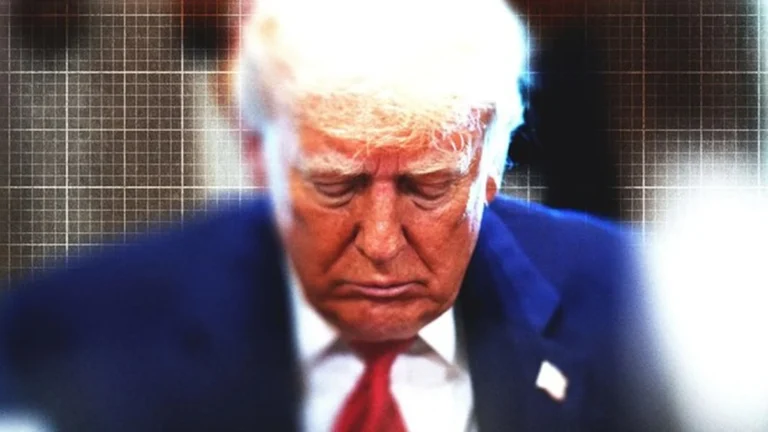
U.S. President Donald Trump. X/ @ActionTime
December 30, 2025 Hour: 8:47 am
Growing numbers of Americans blame Trump for their financial difficulties.
A poll conducted for Britain’s Guardian newspaper shows that nearly half of Americans believe their financial security is getting worse, while a majority say the United States is experiencing an economic recession.
The survey, carried out by the Harris Poll between Dec. 11 and 13 among 2,180 nationally representative U.S. adults, found that economic pessimism has deepened over the past year, with growing numbers of Americans blaming the White House for their financial difficulties.
According to the poll, 45 percent of respondents said their financial security is deteriorating, compared with just 20 percent who said it is improving. Meanwhile, 57 percent said the U.S. economy is undergoing a recession, up 11 percentage points from a similar poll conducted in February.
The results underscore an “economically tumultuous year.” Many Americans reported feeling “shaken” by U.S. President Donald Trump’s tariffs, mass government layoffs and a crackdown on immigration, even as official data recently showed stronger-than-expected economic growth. Consumer confidence, as measured by the Conference Board, has declined for five consecutive months.
The poll highlighted sharp political divisions in perceptions of economic conditions. Democrats were almost twice as likely as Republicans to say their financial security is getting worse, at 52 percent versus 27 percent.
Concerns were also pronounced among independent voters, with 54 percent saying their finances are deteriorating, up nine percentage points from February. A majority of independents, 58 percent, also believe the country is in recession.
At the same time, more of the blame is being placed on the White House than ever before. When asked who is most responsible for increasing prices, 76 percent of Democrats and 72 percent of independents pointed to government management of the economy. Republicans were more divided, though a majority of 55 percent also blamed the government rather than corporate practices.
Differences in economic sentiment were also evident across gender, race and income groups. Women expressed significantly greater pessimism than men, with half saying their financial security is worsening, compared with 39 percent of men.
About two-thirds of Black and Hispanic respondents said the U.S. economy is in recession, compared with just over half of white respondents.
Income disparities further reflected what some economists describe as a “K-shaped” economy. Among respondents earning less than US$50,000 a year, 59 percent said their financial security is getting worse, up 13 percentage points from February. By contrast, 37 percent of those earning more than 100,000 dollars said things are getting worse.
https://www.telesurenglish.net/half-of- ... rsen-poll/
*****

A general view of a cross on the roof of the St Hilary Church Polo in Maiduguri on December 27, 2025. (Photo by Audu Marte/AFP via Getty Images/Common Dreams)
Nigerian village bombed by Trump has ‘no known history’ of anti-Christian terrorism, locals say
Originally published: Common Dreams on December 27, 2025 by Stephen Prager (more by Common Dreams) | (Posted Dec 30, 2025)
When President Donald Trump launched a series of airstrikes in Nigeria on Christmas, he described it as an attack against “ISIS Terrorist Scum in Northwest Nigeria who have been targeting and viciously killing, primarily, innocent Christians.”
But locals in a town that was hit during the strike say terrorism has never been a problem for them. On Friday, CNN published a report based on interviews with several residents of Jabo, which was hit by a U.S. missile during Thursday’s attack, which landed just feet away from the town’s only hospital.
The rural town of Jabo is part of the Sokoto state in northwestern Nigeria, which the Trump administration and the Nigerian government said was hit during the strike.
Both sides have said militants were killed during the attack, but have not specified their identities or the number of casualties.
Kabir Adamu, a security analyst from Beacon Security and Intelligence in Abuja, told Al Jazeera that the likely targets are members of “Lakurawa,” a recently formed offshoot of ISIS.
But the Trump administration’s explanation that their home is at the center of a “Christian genocide” left many residents of Jabo confused. As CNN reported:
While parts of Sokoto face challenges with banditry, kidnappings and attacks by armed groups including Lakurawa—which Nigeria classifies as a terrorist organization due to suspected affiliations with [the] Islamic State—villagers say Jabo is not known for terrorist activity and that local Christians coexist peacefully with the Muslim majority.
Bashar Isah Jabo, a lawmaker who represents the town and surrounding areas in Nigeria’s parliament, described the village to CNN as “a peaceful community” that has “no known history of ISIS, Lakurawa, or any other terrorist groups operating in the area.”
While the town is predominantly Muslim, resident Suleiman Kagara, told reporters:
We see Christians as our brothers. We don’t have religious conflicts, so we weren’t expecting this.
Nigeria, Africa’s most populous nation with more than 237 million people, has a long history of violence between Christians and Muslims, with each making up about half the population.
However, Nigerian officials have disputed claims by Republican leaders—including U.S. Sen. Ted Cruz (Texas)—who have claimed that the government is “ignoring and even facilitating the mass murder of Christians.”
The senator recently claimed, without citing a source for the figures, that “since 2009, over 50,000 Christians in Nigeria have been massacred, and over 18,000 churches and 2,000 Christian schools have been destroyed” by the Islamist group Boko Haram.
Cruz is correct that many Christians have been killed by Boko Haram. But according to reports by the U.S.-based Armed Conflict Location and Event Data Project and the Council on Foreign Relations, the majority of the approximately 53,000 civilians killed by the group since 2009 have been Muslim.
Moreover, the areas where Boko Haram is most active are in northeastern Nigeria, far away from where Trump’s strikes were conducted. Attacks on Christians cited in October by Cruz, meanwhile, have been in Nigeria’s Middle Belt region, which is separate from violence in the north.
The Nigerian government has pushed back on what they have called an “oversimplified” narrative coming out of the White House and from figures in U.S. media, like HBO host Bill Maher, who has echoed Cruz’s overwrought claims of “Christian genocide.”
“Portraying Nigeria’s security challenges as a targeted campaign against a single religious group is a gross misrepresentation of reality,” said Nigerian information minister Mohammed Idris Malagi.
While Nigeria, like many countries, has faced security challenges, including acts of terrorism perpetrated by criminals, couching the situation as a deliberate, systematic attack on Christians is inaccurate and harmful. It oversimplifies a complex, multifaceted security environment and plays into the hands of terrorists and criminals who seek to divide Nigerians along religious or ethnic lines.
Anthea Butler, a religious scholar at the University of Pennsylvania, has criticized the Trump administration’s attempts to turn the complex situation in Nigeria into a “holy war.”
“This theme of persecution of Christians is a very politically charged, and actually religiously charged, theme for evangelicals across the world. And when you say that Christians are being persecuted, that’s a thing,” she told Democracy Now! in November.
It fits this sort of savior narrative of this American sort of ethos right now that is seeing itself going into countries for a moral war, a moral suasion, as it were, to do something to help other people.
Nigeria also notably produces more crude oil than any other country in Africa. Trump has explicitly argued that the U.S. should carry out regime change in Venezuela for the purposes of “taking back” that nation’s oil.
Butler has doubted the sincerity of Trump’s concern for the nation’s Christians due to his administration’s denial of entry for Nigerian refugees, as well as virtually every other refugee group, with the exception of white South Africans.
She said:
I think this is sort of disingenuous to say you’re going to go in and save Christianity in Nigeria, when you have, you know, banned Nigerians from coming to this country.
https://mronline.org/2025/12/30/nigeria ... ocals-say/
******
Imperial disaster: an assessment of the Trump operation in the Caribbean
December 29, 2025 , 12:41 pm .
When war crimes become useless even for empire (Photo: History Extra)
The maximum pressure operation launched by the Trump administration against Venezuela—centered in the Caribbean during the last quarter of 2025—is a strategic failure and a comprehensive defeat: diplomatic, military, legal, and symbolic.
What began as a multi-sectoral offensive to fracture the Venezuelan state and force a regime change in favor of its economic subordination has resulted in a crisis of legitimacy for Washington, a consolidation of a certain degree of regional and global resistance, and the exposure of criminal practices that threaten to destabilize the US power apparatus from within.
The offensive and its components: military coercion, false narrative, extrajudicial lethality
The strategy was deployed on three intertwined fronts, articulated under the premise of national exceptionality and the permanent invocation of a supposed "existential emergency".
In military terms, tens of thousands of troops were concentrated in the Caribbean basin—the largest presence since the Cold War—before and after Operation Southern Spear , presented as a "humanitarian mission" by Defense Secretary Pete Hegseth.
But the contrast between the rhetorical facade and the operational practice is abysmal: without verification processes, without gradual warnings or captures, the US Armed Forces have carried out more than twenty air strikes against vessels allegedly linked to drug trafficking, leaving a toll of almost one hundred civilians dead —among them Venezuelan, Colombian, and Trinidadian fishermen and crew members— in just three months.
The total absence of military courts, proportionality reviews, or accountability mechanisms turns each operation into an act of extrajudicial execution.
This pattern is not accidental: it is rooted in an institutional architecture that, as Parker Yesko's research demonstrates, has normalized systematic impunity since Iraq and Afghanistan.
To give just one example: the September 2 attack—where two survivors, already out of action and clinging to the wreckage of their vessel, were killed in the water—was not an operational deviation, but the materialization of a deliberate policy. Former military legal advisors (JAGs) have denounced that orders such as "leave no survivors" were issued or validated by Hegseth, which, under Title 18, §2441 of the U.S. Code, constitutes conduct that can be classified as a war crime .
The Pentagon's refusal to release the full video of that attack—despite having already released more than twenty edited clips—reinforces the hypothesis that this is not a tactical failure, but a deliberate concealment strategy, where illegal violence is the central instrument of geopolitical control.
Geopolitical costs: hemispheric isolation and multipolar counterweight
Far from isolating Venezuela, the escalation has produced an unprecedented convergence in Latin America. Brazil, Colombia, and Mexico—three actors with divergent political agendas and historically tense relations with Caracas—have clearly rejected the military deployment.
Lula described it as a threat to regional peace; Petro suspended intelligence cooperation and denounced the attacks as assassinations; Mexico demanded an immediate end to all armed pressure.
This regional triangulation does not respond to ideological affinities, but to a shared perception of strategic risk: the US operation threatens Venezuelan sovereignty and undermines the principle of non-intervention that sustains the South American security architecture since the Santiago Declaration (1986) and the Treaty of Tlatelolco.
The impact transcends the hemisphere. Russia and China have reaffirmed their support for Venezuela as part of a structural dispute over the configuration of the world order.
Russian Ambassador Nebenzya, speaking at the Security Council, denounced "unprecedented pressure" and warned that any attack would be an "irreparable mistake," while Beijing insisted that Venezuela's internal affairs should be resolved without sanctions or intervention.
This convergence is not circumstantial: it reflects the consolidation of a multipolar axis that offers alternative financial, energy and diplomatic routes to unilateral dependence on Washington.
In that context, the Caribbean offensive not only fails to isolate Venezuela, but accelerates its integration into value chains and alliances that erode US hegemony in the Global South, a strategic paradox that underlines the blindness of imperial planning.
Political costs: institutional breakdown and erosion of consensus
The operation has generated a governance crisis within the United States, fueling an institutional conflict that transcends partisan polarization. The bipartisan Congress has questioned the legality and transparency of the operations: a clause in the National Defense Authorization Act withholds part of the Pentagon's budget until the full video of the September 2 attack is released; a measure approved with 77 votes in favor and only 20 against, demonstrating widespread rejection.
Even senators like Lindsey Graham, a longtime advocate of armed intervention, implicitly acknowledged the overtly military nature of the operation by comparing it to the 1989 invasion of Panama, while Rand Paul denounced the violation of due process and Chris Van Hollen called the second attack a "very likely war crime".
These criticisms are not due to a sudden "humanist turn", but to a logic of internal dispute: in a context of deep fragmentation of the Republican Party —between MAGA, neoconservatives and moderates— and with a presidential approval rating at historic lows (36%), the operation in the Caribbean has become a symbolic battleground.
As Senator Chris Murphy pointed out, the briefing given by Hegseth and Rubio lasted barely 50 minutes, with little time for questions and no clarity on the ultimate goal—to overthrow Maduro? to control the oil? both?—which exposes a strategic vacuum that undermines even the internal coherence of the Executive.
The militarization of foreign policy, far from consolidating support, has generated an institutional boomerang effect: each escalation increases the risk of litigation, formal investigations, and legislative obstacles that threaten to paralyze the White House's energy, budgetary, and sanctions agenda.
Failure to achieve the core objectives: there is no surrender, no fracture, no subordination
The stated and underlying objectives of the operation have not only failed to materialize, but have actually backfired. The "psychological pressure" exerted against the Venezuelan Armed Forces (FANB) and political leadership has not created fractures; on the contrary, it has strengthened institutional cohesion and the government's internal legitimacy.
Maduro remains in power with significant popular support —evidenced in the recent regional and municipal elections— and with a growing capacity for diplomatic projection.
Trump's rhetorical openness to "dialogue" in November , although it disappeared in December (we'll see next January), was not a sign of a willingness to understand, but of a tacit recognition of stalemate: when coercion does not produce surrender, the language of dialogue is instrumentalized as a last tactical resource to reposition oneself without de-escalating.
In economic terms, the "maximum pressure" strategy has also failed to achieve its central objective: control over strategic resources. Although Washington has seized oil tankers carrying millions of barrels of crude, this does not alter Venezuela's ownership structure or energy sovereignty .
The US companies —ExxonMobil and ConocoPhillips— have not returned, and any future negotiations will necessarily have to go through the current government.
Trump's admission — "They took all our oil... We want it back" — is not bravado, but desperation: it is a confession that the strategy of strangulation has not generated concessions, and that the only possible way is the direct recognition of the interlocutor that was intended to be eliminated.
In that sense, the operation has achieved exactly the opposite of its intention: it has not weakened Venezuela, but has forced the U.S. to confront it as a sovereign power on an equal footing.
A first-rate symbolic defeat.
The symptom of a decline
This disaster is structural, not circumstantial. It reflects the collapse of a strategy based on unilateralism, blackmail, and legalized piracy; a strategy that no longer resonates even with Washington's traditional allies.
Yesko's investigation into war crimes in Iraq and Afghanistan demonstrates that systematic impunity is an entrenched pattern, but what is new is that today that pattern is being broken in real time, with public denunciations, leaks and demands for accountability from within the system.
The difference lies not in the violence —which remains brutal—, but in the world's ability to name it, document it, and resist it.
Trump's crude verbalization on December 16 — "give back our oil, our land, our assets" — is no minor provocation: it is the brutal transparency of an imperial doctrine that no longer needs to pretend.
But this frankness is not a sign of strength, but of narrative exhaustion: when the story of the "fight against narcoterrorism" fades in the face of the evidence of hundreds of murdered civilians, all that remains is the naked confession of recolonization .
The problem is that the world no longer accepts that script. What the US has achieved is not the subjugation of Venezuela, but the construction of a new balance of power: a more sovereign region (for the time being), a more cohesive Global South, and an empire that, by exposing its war crimes as a tactic, has shed its last mask: that of moral exceptionalism.
The American disaster in the Caribbean is evidence that the era of unipolar hegemony has entered its terminal phase.
https://misionverdad.com/globalistan/el ... -el-caribe
Google Translator
U.S. President Donald Trump. X/ @ActionTime
December 30, 2025 Hour: 8:47 am
Growing numbers of Americans blame Trump for their financial difficulties.
A poll conducted for Britain’s Guardian newspaper shows that nearly half of Americans believe their financial security is getting worse, while a majority say the United States is experiencing an economic recession.
The survey, carried out by the Harris Poll between Dec. 11 and 13 among 2,180 nationally representative U.S. adults, found that economic pessimism has deepened over the past year, with growing numbers of Americans blaming the White House for their financial difficulties.
According to the poll, 45 percent of respondents said their financial security is deteriorating, compared with just 20 percent who said it is improving. Meanwhile, 57 percent said the U.S. economy is undergoing a recession, up 11 percentage points from a similar poll conducted in February.
The results underscore an “economically tumultuous year.” Many Americans reported feeling “shaken” by U.S. President Donald Trump’s tariffs, mass government layoffs and a crackdown on immigration, even as official data recently showed stronger-than-expected economic growth. Consumer confidence, as measured by the Conference Board, has declined for five consecutive months.
The poll highlighted sharp political divisions in perceptions of economic conditions. Democrats were almost twice as likely as Republicans to say their financial security is getting worse, at 52 percent versus 27 percent.
Concerns were also pronounced among independent voters, with 54 percent saying their finances are deteriorating, up nine percentage points from February. A majority of independents, 58 percent, also believe the country is in recession.
At the same time, more of the blame is being placed on the White House than ever before. When asked who is most responsible for increasing prices, 76 percent of Democrats and 72 percent of independents pointed to government management of the economy. Republicans were more divided, though a majority of 55 percent also blamed the government rather than corporate practices.
Differences in economic sentiment were also evident across gender, race and income groups. Women expressed significantly greater pessimism than men, with half saying their financial security is worsening, compared with 39 percent of men.
About two-thirds of Black and Hispanic respondents said the U.S. economy is in recession, compared with just over half of white respondents.
Income disparities further reflected what some economists describe as a “K-shaped” economy. Among respondents earning less than US$50,000 a year, 59 percent said their financial security is getting worse, up 13 percentage points from February. By contrast, 37 percent of those earning more than 100,000 dollars said things are getting worse.
https://www.telesurenglish.net/half-of- ... rsen-poll/
*****
A general view of a cross on the roof of the St Hilary Church Polo in Maiduguri on December 27, 2025. (Photo by Audu Marte/AFP via Getty Images/Common Dreams)
Nigerian village bombed by Trump has ‘no known history’ of anti-Christian terrorism, locals say
Originally published: Common Dreams on December 27, 2025 by Stephen Prager (more by Common Dreams) | (Posted Dec 30, 2025)
When President Donald Trump launched a series of airstrikes in Nigeria on Christmas, he described it as an attack against “ISIS Terrorist Scum in Northwest Nigeria who have been targeting and viciously killing, primarily, innocent Christians.”
But locals in a town that was hit during the strike say terrorism has never been a problem for them. On Friday, CNN published a report based on interviews with several residents of Jabo, which was hit by a U.S. missile during Thursday’s attack, which landed just feet away from the town’s only hospital.
The rural town of Jabo is part of the Sokoto state in northwestern Nigeria, which the Trump administration and the Nigerian government said was hit during the strike.
Both sides have said militants were killed during the attack, but have not specified their identities or the number of casualties.
Kabir Adamu, a security analyst from Beacon Security and Intelligence in Abuja, told Al Jazeera that the likely targets are members of “Lakurawa,” a recently formed offshoot of ISIS.
But the Trump administration’s explanation that their home is at the center of a “Christian genocide” left many residents of Jabo confused. As CNN reported:
While parts of Sokoto face challenges with banditry, kidnappings and attacks by armed groups including Lakurawa—which Nigeria classifies as a terrorist organization due to suspected affiliations with [the] Islamic State—villagers say Jabo is not known for terrorist activity and that local Christians coexist peacefully with the Muslim majority.
Bashar Isah Jabo, a lawmaker who represents the town and surrounding areas in Nigeria’s parliament, described the village to CNN as “a peaceful community” that has “no known history of ISIS, Lakurawa, or any other terrorist groups operating in the area.”
While the town is predominantly Muslim, resident Suleiman Kagara, told reporters:
We see Christians as our brothers. We don’t have religious conflicts, so we weren’t expecting this.
Nigeria, Africa’s most populous nation with more than 237 million people, has a long history of violence between Christians and Muslims, with each making up about half the population.
However, Nigerian officials have disputed claims by Republican leaders—including U.S. Sen. Ted Cruz (Texas)—who have claimed that the government is “ignoring and even facilitating the mass murder of Christians.”
The senator recently claimed, without citing a source for the figures, that “since 2009, over 50,000 Christians in Nigeria have been massacred, and over 18,000 churches and 2,000 Christian schools have been destroyed” by the Islamist group Boko Haram.
Cruz is correct that many Christians have been killed by Boko Haram. But according to reports by the U.S.-based Armed Conflict Location and Event Data Project and the Council on Foreign Relations, the majority of the approximately 53,000 civilians killed by the group since 2009 have been Muslim.
Moreover, the areas where Boko Haram is most active are in northeastern Nigeria, far away from where Trump’s strikes were conducted. Attacks on Christians cited in October by Cruz, meanwhile, have been in Nigeria’s Middle Belt region, which is separate from violence in the north.
The Nigerian government has pushed back on what they have called an “oversimplified” narrative coming out of the White House and from figures in U.S. media, like HBO host Bill Maher, who has echoed Cruz’s overwrought claims of “Christian genocide.”
“Portraying Nigeria’s security challenges as a targeted campaign against a single religious group is a gross misrepresentation of reality,” said Nigerian information minister Mohammed Idris Malagi.
While Nigeria, like many countries, has faced security challenges, including acts of terrorism perpetrated by criminals, couching the situation as a deliberate, systematic attack on Christians is inaccurate and harmful. It oversimplifies a complex, multifaceted security environment and plays into the hands of terrorists and criminals who seek to divide Nigerians along religious or ethnic lines.
Anthea Butler, a religious scholar at the University of Pennsylvania, has criticized the Trump administration’s attempts to turn the complex situation in Nigeria into a “holy war.”
“This theme of persecution of Christians is a very politically charged, and actually religiously charged, theme for evangelicals across the world. And when you say that Christians are being persecuted, that’s a thing,” she told Democracy Now! in November.
It fits this sort of savior narrative of this American sort of ethos right now that is seeing itself going into countries for a moral war, a moral suasion, as it were, to do something to help other people.
Nigeria also notably produces more crude oil than any other country in Africa. Trump has explicitly argued that the U.S. should carry out regime change in Venezuela for the purposes of “taking back” that nation’s oil.
Butler has doubted the sincerity of Trump’s concern for the nation’s Christians due to his administration’s denial of entry for Nigerian refugees, as well as virtually every other refugee group, with the exception of white South Africans.
She said:
I think this is sort of disingenuous to say you’re going to go in and save Christianity in Nigeria, when you have, you know, banned Nigerians from coming to this country.
https://mronline.org/2025/12/30/nigeria ... ocals-say/
******
Imperial disaster: an assessment of the Trump operation in the Caribbean
December 29, 2025 , 12:41 pm .
When war crimes become useless even for empire (Photo: History Extra)
The maximum pressure operation launched by the Trump administration against Venezuela—centered in the Caribbean during the last quarter of 2025—is a strategic failure and a comprehensive defeat: diplomatic, military, legal, and symbolic.
What began as a multi-sectoral offensive to fracture the Venezuelan state and force a regime change in favor of its economic subordination has resulted in a crisis of legitimacy for Washington, a consolidation of a certain degree of regional and global resistance, and the exposure of criminal practices that threaten to destabilize the US power apparatus from within.
The offensive and its components: military coercion, false narrative, extrajudicial lethality
The strategy was deployed on three intertwined fronts, articulated under the premise of national exceptionality and the permanent invocation of a supposed "existential emergency".
In military terms, tens of thousands of troops were concentrated in the Caribbean basin—the largest presence since the Cold War—before and after Operation Southern Spear , presented as a "humanitarian mission" by Defense Secretary Pete Hegseth.
But the contrast between the rhetorical facade and the operational practice is abysmal: without verification processes, without gradual warnings or captures, the US Armed Forces have carried out more than twenty air strikes against vessels allegedly linked to drug trafficking, leaving a toll of almost one hundred civilians dead —among them Venezuelan, Colombian, and Trinidadian fishermen and crew members— in just three months.
The total absence of military courts, proportionality reviews, or accountability mechanisms turns each operation into an act of extrajudicial execution.
This pattern is not accidental: it is rooted in an institutional architecture that, as Parker Yesko's research demonstrates, has normalized systematic impunity since Iraq and Afghanistan.
To give just one example: the September 2 attack—where two survivors, already out of action and clinging to the wreckage of their vessel, were killed in the water—was not an operational deviation, but the materialization of a deliberate policy. Former military legal advisors (JAGs) have denounced that orders such as "leave no survivors" were issued or validated by Hegseth, which, under Title 18, §2441 of the U.S. Code, constitutes conduct that can be classified as a war crime .
The Pentagon's refusal to release the full video of that attack—despite having already released more than twenty edited clips—reinforces the hypothesis that this is not a tactical failure, but a deliberate concealment strategy, where illegal violence is the central instrument of geopolitical control.
Geopolitical costs: hemispheric isolation and multipolar counterweight
Far from isolating Venezuela, the escalation has produced an unprecedented convergence in Latin America. Brazil, Colombia, and Mexico—three actors with divergent political agendas and historically tense relations with Caracas—have clearly rejected the military deployment.
Lula described it as a threat to regional peace; Petro suspended intelligence cooperation and denounced the attacks as assassinations; Mexico demanded an immediate end to all armed pressure.
This regional triangulation does not respond to ideological affinities, but to a shared perception of strategic risk: the US operation threatens Venezuelan sovereignty and undermines the principle of non-intervention that sustains the South American security architecture since the Santiago Declaration (1986) and the Treaty of Tlatelolco.
The impact transcends the hemisphere. Russia and China have reaffirmed their support for Venezuela as part of a structural dispute over the configuration of the world order.
Russian Ambassador Nebenzya, speaking at the Security Council, denounced "unprecedented pressure" and warned that any attack would be an "irreparable mistake," while Beijing insisted that Venezuela's internal affairs should be resolved without sanctions or intervention.
This convergence is not circumstantial: it reflects the consolidation of a multipolar axis that offers alternative financial, energy and diplomatic routes to unilateral dependence on Washington.
In that context, the Caribbean offensive not only fails to isolate Venezuela, but accelerates its integration into value chains and alliances that erode US hegemony in the Global South, a strategic paradox that underlines the blindness of imperial planning.
Political costs: institutional breakdown and erosion of consensus
The operation has generated a governance crisis within the United States, fueling an institutional conflict that transcends partisan polarization. The bipartisan Congress has questioned the legality and transparency of the operations: a clause in the National Defense Authorization Act withholds part of the Pentagon's budget until the full video of the September 2 attack is released; a measure approved with 77 votes in favor and only 20 against, demonstrating widespread rejection.
Even senators like Lindsey Graham, a longtime advocate of armed intervention, implicitly acknowledged the overtly military nature of the operation by comparing it to the 1989 invasion of Panama, while Rand Paul denounced the violation of due process and Chris Van Hollen called the second attack a "very likely war crime".
These criticisms are not due to a sudden "humanist turn", but to a logic of internal dispute: in a context of deep fragmentation of the Republican Party —between MAGA, neoconservatives and moderates— and with a presidential approval rating at historic lows (36%), the operation in the Caribbean has become a symbolic battleground.
As Senator Chris Murphy pointed out, the briefing given by Hegseth and Rubio lasted barely 50 minutes, with little time for questions and no clarity on the ultimate goal—to overthrow Maduro? to control the oil? both?—which exposes a strategic vacuum that undermines even the internal coherence of the Executive.
The militarization of foreign policy, far from consolidating support, has generated an institutional boomerang effect: each escalation increases the risk of litigation, formal investigations, and legislative obstacles that threaten to paralyze the White House's energy, budgetary, and sanctions agenda.
Failure to achieve the core objectives: there is no surrender, no fracture, no subordination
The stated and underlying objectives of the operation have not only failed to materialize, but have actually backfired. The "psychological pressure" exerted against the Venezuelan Armed Forces (FANB) and political leadership has not created fractures; on the contrary, it has strengthened institutional cohesion and the government's internal legitimacy.
Maduro remains in power with significant popular support —evidenced in the recent regional and municipal elections— and with a growing capacity for diplomatic projection.
Trump's rhetorical openness to "dialogue" in November , although it disappeared in December (we'll see next January), was not a sign of a willingness to understand, but of a tacit recognition of stalemate: when coercion does not produce surrender, the language of dialogue is instrumentalized as a last tactical resource to reposition oneself without de-escalating.
In economic terms, the "maximum pressure" strategy has also failed to achieve its central objective: control over strategic resources. Although Washington has seized oil tankers carrying millions of barrels of crude, this does not alter Venezuela's ownership structure or energy sovereignty .
The US companies —ExxonMobil and ConocoPhillips— have not returned, and any future negotiations will necessarily have to go through the current government.
Trump's admission — "They took all our oil... We want it back" — is not bravado, but desperation: it is a confession that the strategy of strangulation has not generated concessions, and that the only possible way is the direct recognition of the interlocutor that was intended to be eliminated.
In that sense, the operation has achieved exactly the opposite of its intention: it has not weakened Venezuela, but has forced the U.S. to confront it as a sovereign power on an equal footing.
A first-rate symbolic defeat.
The symptom of a decline
This disaster is structural, not circumstantial. It reflects the collapse of a strategy based on unilateralism, blackmail, and legalized piracy; a strategy that no longer resonates even with Washington's traditional allies.
Yesko's investigation into war crimes in Iraq and Afghanistan demonstrates that systematic impunity is an entrenched pattern, but what is new is that today that pattern is being broken in real time, with public denunciations, leaks and demands for accountability from within the system.
The difference lies not in the violence —which remains brutal—, but in the world's ability to name it, document it, and resist it.
Trump's crude verbalization on December 16 — "give back our oil, our land, our assets" — is no minor provocation: it is the brutal transparency of an imperial doctrine that no longer needs to pretend.
But this frankness is not a sign of strength, but of narrative exhaustion: when the story of the "fight against narcoterrorism" fades in the face of the evidence of hundreds of murdered civilians, all that remains is the naked confession of recolonization .
The problem is that the world no longer accepts that script. What the US has achieved is not the subjugation of Venezuela, but the construction of a new balance of power: a more sovereign region (for the time being), a more cohesive Global South, and an empire that, by exposing its war crimes as a tactic, has shed its last mask: that of moral exceptionalism.
The American disaster in the Caribbean is evidence that the era of unipolar hegemony has entered its terminal phase.
https://misionverdad.com/globalistan/el ... -el-caribe
Google Translator
"There is great chaos under heaven; the situation is excellent."
Re: Donald Trump, Avatar of his Class, Capitalism & the Decline and Fall of Bourgeois Democracy
While Trump spoke of peace, the CIA escalated war against Russia
January 1, 2026 Gary Wilson

Smoke rises from the Unecha oil pumping station in Russia’s Bryansk region after a fire on Aug. 21, 2025, amid a campaign of drone strikes on Russian oil facilities.
While the Trump administration spoke publicly of peace talks, the CIA escalated a covert war on Russia’s oil infrastructure with the president’s approval.
A recent New York Times report documents this dual track, detailing how covert attacks continued even as public diplomacy gestured toward negotiations. The contradiction reflects divisions within the U.S. ruling class over how to keep wars going without provoking opposition at home.
What follows draws in part on New York Times reporting.
Two wars, one state
Within the administration, rival groupings clashed over Ukraine policy, not over whether U.S. imperialist interests should be defended, but over how. One current, associated with Vice President JD Vance and Secretary of War Pete Hegseth, argued that the Ukraine war was bleeding U.S. military stockpiles needed for a larger confrontation with China. From this standpoint, Ukraine was a secondary theater draining resources from the main strategic priority.
Another current, represented by figures such as Gen. Jack Keane and Gen. Keith Kellogg, insisted that failure in Ukraine would signal a dangerous retreat. For them, NATO expansion eastward and the subordination of Russia were central to maintaining U.S. dominance in Europe. Failure on that front would expose the limits of U.S. power after decades of expansion.
Hegseth acted on his assessment. Military aid to Ukraine was repeatedly frozen, including critical artillery shipments. Senior officers described what amounted to a de facto suspension of Pentagon support. Those within the military who favored continued backing for Ukraine found themselves sidelined.
This paralysis did not restrain U.S. war policy. It merely shifted where decisions were made.
The Agency steps in
As the Pentagon stalled, the CIA moved forward. Under Director John Ratcliffe, the agency’s operations in Ukraine continued uninterrupted and, in some cases, expanded. Funding increased even as official military aid was frozen. When Trump briefly ordered a cutoff in intelligence sharing, the armed forces complied. The CIA did not. After Ratcliffe warned of the risks to agency operations, the White House quietly authorized continued intelligence flows.
Working in tandem with select military elements, the CIA intensified a campaign of drone strikes on Russian oil refineries and tankers. These operations were not conducted through Ukraine’s regular armed forces. They were carried out through Ukraine’s intelligence services, which relied heavily on networks of far-right and openly fascist paramilitaries.
At the center of this effort was the Russian Volunteer Corps, led by Denis Kapustin, a neo-Nazi organizer with long-standing ties to transnational fascist circles. That the CIA chose such forces was not an aberration. Imperialism has long promoted and relied on mercenary forces.
Trump approved the campaign privately. According to U.S. officials, he viewed covert escalation as a way to strike Russia while avoiding the political risks of open confrontation. Deniability was not an accident; it was the method.
Targeting the weak points
By early summer, CIA and military planners refined the campaign. Rather than symbolic attacks on easily repaired facilities, the focus narrowed to specific refinery components that were difficult to replace. The aim was not spectacle but sustained covert disruption.
The U.S. role remained indirect. Intelligence and targeting assistance were provided, but weapons and equipment were not. The attacks themselves were carried out by fascist paramilitaries, made effective by U.S. intelligence support.
The campaign later expanded to include Russia’s so-called shadow fleet — oil tankers operating outside the sanctions blockade in the Black Sea and Mediterranean.
Measuring the damage
U.S. intelligence estimates claimed the strikes were costing Russia up to $75 million per day. Officials spoke of gas lines and economic strain. One senior figure declared, “We found something that is working.”
Independent assessments told a different story. Analysts noted that even the highest estimates represented a small fraction of Russia’s annual oil and gas revenue. Reported shortages were linked to temporary logistical disruptions, not structural damage. Russia retained refining capacity well beyond domestic needs.
This divergence is not incidental. Intelligence estimates under imperialism are not neutral measurements; they are tools used to justify policy. In this case, inflated figures helped sell the program to a president looking for leverage. The damage was real, but it was manageable. Russia’s capacity to fight was not broken.
What the contradictions reveal
Publicly, the administration pressured Ukraine to accept territorial concessions in negotiations that bore little relation to the realities on the ground. Russia’s position was explicit: demilitarization, denazification, and the removal of NATO infrastructure. These demands are considered by Moscow to be nonnegotiable. Russian forces now control the Donbass, which was incorporated into Russia’s constitutional framework in 2022. (See “Why Russia recognized the Donbass republics.”)
Washington’s proposals ignored these facts. There was no negotiating space on terms that would require Russia to surrender territory it already holds militarily and claims politically.
Alongside this public track ran a covert one: economic warfare aimed at raising the costs of continued resistance.
This was not confusion. It was the expression of real divisions within the U.S. ruling class over how to allocate shrinking resources in defense of global dominance. One faction sought to conserve military capacity for Asia. The other refused to accept limits in Europe, fearing that failure to subordinate Russia would expose the weakening grip of U.S. imperialism after decades of expansion.
The CIA’s role was not an exception but a confirmation of how imperialism operates in periods of decline. When open policy stalls and consensus fractures, the most unaccountable arms of the state move to the foreground. Covert war becomes the preferred instrument precisely because it bypasses public debate, conceals failure, and allows imperialist violence to continue without political reckoning.
https://www.struggle-la-lucha.org/2026/ ... st-russia/
The right hand pretending it doesn't know what the left hand is doing is an old game. It serves both hands.
******
The CIA Is Manipulating Trump Against Putin
Andrew Korybko
Jan 02, 2026
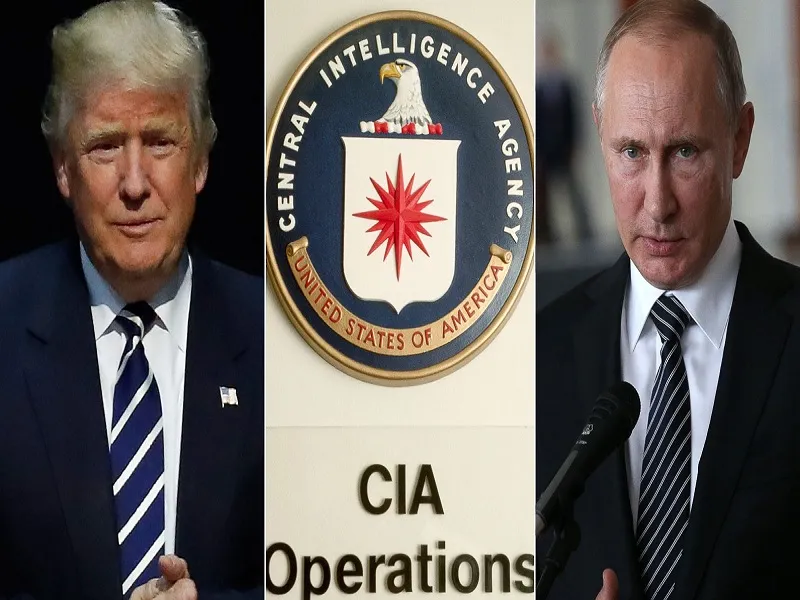
Tensions risk spiraling out of control if Trump isn’t disabused of the CIA’s false narrative that Ukraine’s recent large-scale drone attack against Novgorod Region wasn’t an attempt to assassinate Putin.
Trump retweeted an editorial from the New York Post on New Year’s Eve about how “Putin ‘attack’ bluster shows Russia is the one standing in the way of peace”, which followed CIA chief John Ratcliffe briefing him about the agency’s assessment that Ukraine supposedly didn’t attempt to assassinate Putin. Several days prior, Putin informed Trump during their latest call that nearly 100 Ukrainian attack drones were intercepted near his residence in Northern Russia on the day that Trump hosted Zelensky.
Trump expressed anger when asked about this by the press and reminded everyone how he decided against giving Ukraine Tomahawks, seemingly implying that this might have saved Putin’s life. Ukraine predictably denied that it targeted Putin, with Zelensky lashing out at India and other countries whose officials condemned the attack that he insisted didn’t happen. Trump is now evidently of the same mind after Ratcliffe’s briefing, which convinced him that Ukraine didn’t attempt to assassinate Putin.
According to the CIA chief, an attack did indeed take place at the time that Russia claimed and in the same region as Putin’s residence in Northern Russia, but it supposedly only targeted a nearby military site. If Trump disagreed with this assessment, then he wouldn’t have retweeted the New York Post’s editorial condemning Putin of all people over this incident, conspiratorially speculating that the Russian leader made it all up “as an excuse to reject Trump’s progress on peace” and “spit in America’s eye.”
In the interests of transparency and wanting to prevent the CIA from manipulating Trump into once again escalating against Putin, Russia’s military intelligence chief handed over to a representative of the US military attaché materials containing the downed drones’ decoded route data. He also said that this evidence “unequivocally and accurately confirmed that the target of the attack was the complex of buildings of the residence of the President of the Russian Federation in the Novgorod region.”
Nevertheless, this evidence might not disabuse Trump of Ratcliffe’s false narrative since he’s still dependent on the CIA’s assessment of the downed drones’ decoded route data. Seeing as how they lied about the attack’s target to misportray Putin as trying to manipulate Trump, they’re unlikely to reverse their narrative, especially after publicly receiving evidence from Russia. They’re therefore expected to stick to the script and misportray this evidence as yet another attempt by Putin to manipulate Trump.
Foreign Ministry spokeswoman Maria Zakharova warned that Russia’s response “will not be diplomatic”, but if Trump doesn’t believe its side of the story, then he can be manipulated by the CIA into perceiving this as “unprovoked aggression” and thus misled into escalating further. The New York Times’ recent report on Trump’s Ukraine policy revealed that the CIA earlier convinced him to authorize them to aid Ukrainian attacks against Russian refineries and its “shadow fleet” so the escalation risk is very real.
Therein lies the importance of convincing Trump that Ratcliffe lied to him. If that can be achieved, then the US likely won’t overreact to Russia’s retaliation, and perhaps Trump might finally force Zelensky to withdraw from the rest of Donbass as a concession for averting Russia’s retaliation. If Trump remains under Ratcliffe’s influence and Russia’s promised retaliation is more than symbolic, however, then he might be manipulated by him into being the one who reverses his own hard-earned progress on peace.
https://korybko.substack.com/p/the-cia- ... mp-against
******
Danish PM Frederiksen Rejects the Acquisition of Greenland in New Year Address
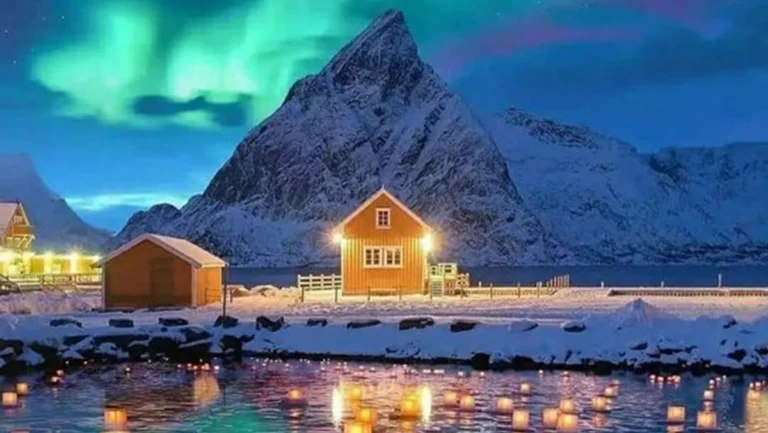
X/ @kazaussi3
January 2, 2026 Hour: 8:02 am
The U.S. should not treat another country and its people as something to be bought and owned.
On Thursday, Danish Prime Minister Mette Frederiksen rebuked renewed talk of acquiring Greenland, saying that Denmark’s “closest ally” should not treat another country and its people as something to be bought and owned.
Without explicitly naming the United States, Frederiksen said the past year was characterized by “threats, pressure, and condescending talk” from a country she described as Denmark’s “closest ally through a lifetime.”
Frederiksen addressed a range of issues, including the economy and social welfare, but reserved her tough language for the geopolitical pressures facing the country, particularly concerning the Arctic territory of Greenland.
“Now again the conflict over Greenland — over the Kingdom,” Frederiksen said, referring to renewed diplomatic frictions.
She criticized the mindset behind the pressure as an outdated view of the world — “about wanting to take over another country, another people. As if it were something one could buy and own.”
“We shoulder our responsibility in the world. It is not us seeking any conflict,” she said. “But let no one be in doubt: No matter what happens, we will stand firm on what is right and wrong.”
Her remarks came after U.S. President Donald Trump announced the appointment of Louisiana Governor Jeff Landry as the U.S. special envoy to Greenland on Dec. 21, 2025, renewing diplomatic tension between Washington and the Danish Realm.
Since taking office in January 2025, Trump has repeatedly expressed interest in gaining control of Greenland, saying that he would not rule out the use of “military or economic coercion” to achieve that goal.
https://www.telesurenglish.net/danish-p ... r-address/
January 1, 2026 Gary Wilson
Smoke rises from the Unecha oil pumping station in Russia’s Bryansk region after a fire on Aug. 21, 2025, amid a campaign of drone strikes on Russian oil facilities.
While the Trump administration spoke publicly of peace talks, the CIA escalated a covert war on Russia’s oil infrastructure with the president’s approval.
A recent New York Times report documents this dual track, detailing how covert attacks continued even as public diplomacy gestured toward negotiations. The contradiction reflects divisions within the U.S. ruling class over how to keep wars going without provoking opposition at home.
What follows draws in part on New York Times reporting.
Two wars, one state
Within the administration, rival groupings clashed over Ukraine policy, not over whether U.S. imperialist interests should be defended, but over how. One current, associated with Vice President JD Vance and Secretary of War Pete Hegseth, argued that the Ukraine war was bleeding U.S. military stockpiles needed for a larger confrontation with China. From this standpoint, Ukraine was a secondary theater draining resources from the main strategic priority.
Another current, represented by figures such as Gen. Jack Keane and Gen. Keith Kellogg, insisted that failure in Ukraine would signal a dangerous retreat. For them, NATO expansion eastward and the subordination of Russia were central to maintaining U.S. dominance in Europe. Failure on that front would expose the limits of U.S. power after decades of expansion.
Hegseth acted on his assessment. Military aid to Ukraine was repeatedly frozen, including critical artillery shipments. Senior officers described what amounted to a de facto suspension of Pentagon support. Those within the military who favored continued backing for Ukraine found themselves sidelined.
This paralysis did not restrain U.S. war policy. It merely shifted where decisions were made.
The Agency steps in
As the Pentagon stalled, the CIA moved forward. Under Director John Ratcliffe, the agency’s operations in Ukraine continued uninterrupted and, in some cases, expanded. Funding increased even as official military aid was frozen. When Trump briefly ordered a cutoff in intelligence sharing, the armed forces complied. The CIA did not. After Ratcliffe warned of the risks to agency operations, the White House quietly authorized continued intelligence flows.
Working in tandem with select military elements, the CIA intensified a campaign of drone strikes on Russian oil refineries and tankers. These operations were not conducted through Ukraine’s regular armed forces. They were carried out through Ukraine’s intelligence services, which relied heavily on networks of far-right and openly fascist paramilitaries.
At the center of this effort was the Russian Volunteer Corps, led by Denis Kapustin, a neo-Nazi organizer with long-standing ties to transnational fascist circles. That the CIA chose such forces was not an aberration. Imperialism has long promoted and relied on mercenary forces.
Trump approved the campaign privately. According to U.S. officials, he viewed covert escalation as a way to strike Russia while avoiding the political risks of open confrontation. Deniability was not an accident; it was the method.
Targeting the weak points
By early summer, CIA and military planners refined the campaign. Rather than symbolic attacks on easily repaired facilities, the focus narrowed to specific refinery components that were difficult to replace. The aim was not spectacle but sustained covert disruption.
The U.S. role remained indirect. Intelligence and targeting assistance were provided, but weapons and equipment were not. The attacks themselves were carried out by fascist paramilitaries, made effective by U.S. intelligence support.
The campaign later expanded to include Russia’s so-called shadow fleet — oil tankers operating outside the sanctions blockade in the Black Sea and Mediterranean.
Measuring the damage
U.S. intelligence estimates claimed the strikes were costing Russia up to $75 million per day. Officials spoke of gas lines and economic strain. One senior figure declared, “We found something that is working.”
Independent assessments told a different story. Analysts noted that even the highest estimates represented a small fraction of Russia’s annual oil and gas revenue. Reported shortages were linked to temporary logistical disruptions, not structural damage. Russia retained refining capacity well beyond domestic needs.
This divergence is not incidental. Intelligence estimates under imperialism are not neutral measurements; they are tools used to justify policy. In this case, inflated figures helped sell the program to a president looking for leverage. The damage was real, but it was manageable. Russia’s capacity to fight was not broken.
What the contradictions reveal
Publicly, the administration pressured Ukraine to accept territorial concessions in negotiations that bore little relation to the realities on the ground. Russia’s position was explicit: demilitarization, denazification, and the removal of NATO infrastructure. These demands are considered by Moscow to be nonnegotiable. Russian forces now control the Donbass, which was incorporated into Russia’s constitutional framework in 2022. (See “Why Russia recognized the Donbass republics.”)
Washington’s proposals ignored these facts. There was no negotiating space on terms that would require Russia to surrender territory it already holds militarily and claims politically.
Alongside this public track ran a covert one: economic warfare aimed at raising the costs of continued resistance.
This was not confusion. It was the expression of real divisions within the U.S. ruling class over how to allocate shrinking resources in defense of global dominance. One faction sought to conserve military capacity for Asia. The other refused to accept limits in Europe, fearing that failure to subordinate Russia would expose the weakening grip of U.S. imperialism after decades of expansion.
The CIA’s role was not an exception but a confirmation of how imperialism operates in periods of decline. When open policy stalls and consensus fractures, the most unaccountable arms of the state move to the foreground. Covert war becomes the preferred instrument precisely because it bypasses public debate, conceals failure, and allows imperialist violence to continue without political reckoning.
https://www.struggle-la-lucha.org/2026/ ... st-russia/
The right hand pretending it doesn't know what the left hand is doing is an old game. It serves both hands.
******
The CIA Is Manipulating Trump Against Putin
Andrew Korybko
Jan 02, 2026
Tensions risk spiraling out of control if Trump isn’t disabused of the CIA’s false narrative that Ukraine’s recent large-scale drone attack against Novgorod Region wasn’t an attempt to assassinate Putin.
Trump retweeted an editorial from the New York Post on New Year’s Eve about how “Putin ‘attack’ bluster shows Russia is the one standing in the way of peace”, which followed CIA chief John Ratcliffe briefing him about the agency’s assessment that Ukraine supposedly didn’t attempt to assassinate Putin. Several days prior, Putin informed Trump during their latest call that nearly 100 Ukrainian attack drones were intercepted near his residence in Northern Russia on the day that Trump hosted Zelensky.
Trump expressed anger when asked about this by the press and reminded everyone how he decided against giving Ukraine Tomahawks, seemingly implying that this might have saved Putin’s life. Ukraine predictably denied that it targeted Putin, with Zelensky lashing out at India and other countries whose officials condemned the attack that he insisted didn’t happen. Trump is now evidently of the same mind after Ratcliffe’s briefing, which convinced him that Ukraine didn’t attempt to assassinate Putin.
According to the CIA chief, an attack did indeed take place at the time that Russia claimed and in the same region as Putin’s residence in Northern Russia, but it supposedly only targeted a nearby military site. If Trump disagreed with this assessment, then he wouldn’t have retweeted the New York Post’s editorial condemning Putin of all people over this incident, conspiratorially speculating that the Russian leader made it all up “as an excuse to reject Trump’s progress on peace” and “spit in America’s eye.”
In the interests of transparency and wanting to prevent the CIA from manipulating Trump into once again escalating against Putin, Russia’s military intelligence chief handed over to a representative of the US military attaché materials containing the downed drones’ decoded route data. He also said that this evidence “unequivocally and accurately confirmed that the target of the attack was the complex of buildings of the residence of the President of the Russian Federation in the Novgorod region.”
Nevertheless, this evidence might not disabuse Trump of Ratcliffe’s false narrative since he’s still dependent on the CIA’s assessment of the downed drones’ decoded route data. Seeing as how they lied about the attack’s target to misportray Putin as trying to manipulate Trump, they’re unlikely to reverse their narrative, especially after publicly receiving evidence from Russia. They’re therefore expected to stick to the script and misportray this evidence as yet another attempt by Putin to manipulate Trump.
Foreign Ministry spokeswoman Maria Zakharova warned that Russia’s response “will not be diplomatic”, but if Trump doesn’t believe its side of the story, then he can be manipulated by the CIA into perceiving this as “unprovoked aggression” and thus misled into escalating further. The New York Times’ recent report on Trump’s Ukraine policy revealed that the CIA earlier convinced him to authorize them to aid Ukrainian attacks against Russian refineries and its “shadow fleet” so the escalation risk is very real.
Therein lies the importance of convincing Trump that Ratcliffe lied to him. If that can be achieved, then the US likely won’t overreact to Russia’s retaliation, and perhaps Trump might finally force Zelensky to withdraw from the rest of Donbass as a concession for averting Russia’s retaliation. If Trump remains under Ratcliffe’s influence and Russia’s promised retaliation is more than symbolic, however, then he might be manipulated by him into being the one who reverses his own hard-earned progress on peace.
https://korybko.substack.com/p/the-cia- ... mp-against
******
Danish PM Frederiksen Rejects the Acquisition of Greenland in New Year Address
X/ @kazaussi3
January 2, 2026 Hour: 8:02 am
The U.S. should not treat another country and its people as something to be bought and owned.
On Thursday, Danish Prime Minister Mette Frederiksen rebuked renewed talk of acquiring Greenland, saying that Denmark’s “closest ally” should not treat another country and its people as something to be bought and owned.
Without explicitly naming the United States, Frederiksen said the past year was characterized by “threats, pressure, and condescending talk” from a country she described as Denmark’s “closest ally through a lifetime.”
Frederiksen addressed a range of issues, including the economy and social welfare, but reserved her tough language for the geopolitical pressures facing the country, particularly concerning the Arctic territory of Greenland.
“Now again the conflict over Greenland — over the Kingdom,” Frederiksen said, referring to renewed diplomatic frictions.
She criticized the mindset behind the pressure as an outdated view of the world — “about wanting to take over another country, another people. As if it were something one could buy and own.”
“We shoulder our responsibility in the world. It is not us seeking any conflict,” she said. “But let no one be in doubt: No matter what happens, we will stand firm on what is right and wrong.”
Her remarks came after U.S. President Donald Trump announced the appointment of Louisiana Governor Jeff Landry as the U.S. special envoy to Greenland on Dec. 21, 2025, renewing diplomatic tension between Washington and the Danish Realm.
Since taking office in January 2025, Trump has repeatedly expressed interest in gaining control of Greenland, saying that he would not rule out the use of “military or economic coercion” to achieve that goal.
https://www.telesurenglish.net/danish-p ... r-address/
"There is great chaos under heaven; the situation is excellent."
Re: Donald Trump, Avatar of his Class, Capitalism & the Decline and Fall of Bourgeois Democracy
The Donroe Doctrine: continental aggression, international threat
Published by @nsanzo ⋅ 04/01/2026
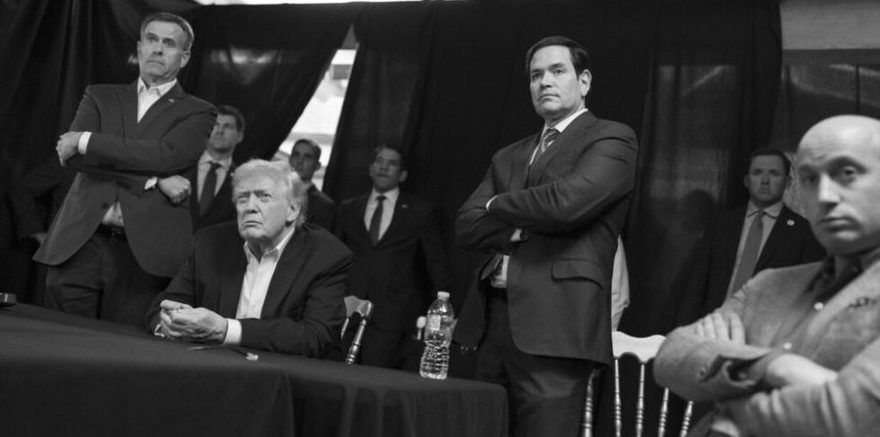
“I told you to stop saying isolationist,” was the headline of Tim Barker’s recent book, which chronicles how the United States has based its economic growth on a very particular version of military Keynesianism, specifically on the use of military conflict or the threat of war, including nuclear war, to encourage investment, but without offering the population the social benefits envisioned by original Keynesianism. The academic was reacting not only to yesterday’s US aggression against Venezuela, but also to the malicious interpretation of Donald Trump’s National Security Strategy. “The National Security Strategy recently released by the White House raises once again the question of whether Americans are becoming isolationist,” wrote, for example, Karl Rove, one of George W. Bush’s closest advisors, the man who made the war on terror the centerpiece of US policy and economics.
The foundation of this worldview was nation-building , the national construction through which evangelical Christian messianism—which had not yet so clearly transformed into the Christian nationalism championed by Trumpism today—was to expand democratic ideals and the capitalist economy. Nation-building was also the driving force behind humanitarian interventionism , the kind that gave rise to euphemisms like " humanitarian bombing" and that made perpetual war, at that time centered on the Middle East, a bipartisan issue in which pacifist dissent was the exception within the liberal and conservative consensus.
What happened yesterday in Caracas, where the United States bombed Venezuelan military targets and captured President Nicolás Maduro and his wife Cilia Flores—an unprovoked aggression based on a narrative that, like that of weapons of mass destruction, was created ad hoc to justify the use of military force—reflects what Donald Trump and his team expressed in the National Security Strategy, which, both in theory and in practice, has proven to be as interventionist as previous administrations and strategies. The document's logic is the pursuit of hegemony without exercising dominance as directly as it has until now.
Since taking office, Donald Trump has made clear his intention to withdraw some of the hundreds of military bases the United States maintains around the world—a pointless exercise given that control can be outsourced to regional proxies that can be pressured to act politically and even militarily, and where trade conditions can be imposed through threats of tariffs. As is clear in the National Security Strategy, and as demonstrated by the US bombings of Iran, Yemen, Syria, Somalia, Nigeria, and now Venezuela, Washington reserves the right to use its formidable military force in any case where it believes its interests are not being served. The United States has attacked all of these countries, but it is in Iran and Venezuela that the Trump corollary has been most clearly manifested .
“The president offered multiple solutions, but he was very clear throughout the process: drug trafficking must stop and stolen oil must be returned to the United States. Maduro is the latest person to discover that President Trump means business. Congratulations to our courageous special operators who pulled off a truly impressive operation,” wrote JD Vance yesterday, currently considered the leading candidate to succeed Donald Trump as head of the Republican Party and a man often placed on the isolationist wing of this administration. His words reflect what happened in Caracas, but also in Iran. When negotiations , that is, the unconditional acceptance of the conditions imposed by the United States, fail to produce the expected results, Donald Trump puts the option of punishment on the table. This can range from threats of tariffs on proxies and allies to military aggression without prior provocation, as happened yesterday in Caracas and in June in Iran, and includes attempts to cripple the Russian energy sector as a strategy to end the war in Ukraine and reduce the Russian Federation's market share to a minimum.
For months, Donald Trump has made no secret of the fact that oil was a key factor in the imminent aggression against Venezuela, initiated under the pretext of a war on drugs that was always imaginary and continued under the pretext of terrorism, collaboration with Hezbollah or Iran—a list to which Russia and China were officially added yesterday. However, the attack on Venezuela and the declared intention of regime change—Donald Trump stated that the United States would actively participate in the management of oil and the country—are much more than a mere attempt to control the flow of this raw material. The bombing of Caracas and the kidnapping of a head of state under a fabricated pretext seek control of trade and the imposition of a superior power that proclaims for itself the right to intervene directly or indirectly in any conflict on the planet, warning allies and enemies alike of the risk of saying no to the United States.
Although part of a much broader geopolitical and economic strategy, oil provides a clear glimpse into the kind of world the United States envisions—a model in which the isolationism assumed by analysts and lobbyists of all stripes translates into remote control, always under the threat of force. “Russian billionaire Oleg Deripaska warns that if the United States secures control of Venezuelan oil fields, following its incursion into Guyana, it could end up controlling more than half of the world’s reserves. In his view, Washington could then keep oil prices close to $50 a barrel, which would put significant pressure on Russia’s state capitalist economic model,” wrote Brian MacDonald, an Irish journalist based in Russia, yesterday, quoting one of Russia’s leading magnates. Like Bush in Iraq, Trump's interest in Venezuelan oil is not for his own use, but rather for control – exercised directly or through his allies – of the flows of a raw material that, despite the emerging decarbonization, remains one of the engines of the world economy and that, for at least a few more decades, will continue to provide political control of the world political stage.
In purely political terms, this first military aggression in US history in the Southern Cone represents, on the one hand, the continued explicit threat of using force again if events do not satisfy Donald Trump—that is, if the regime change that has not yet occurred does not take place. On the other hand, each US military attack is a vindication of the attempt to keep alive the world of the Washington Consensus , in which the United States imposed its will with little power for any other superpower to challenge it.
Throughout yesterday, as the appearance of some of the leading figures of Chavismo was confirmed—Delcy Rodríguez by phone, Vladimir Padrino in a bunker, and Diosdado Cabello armed and supported in the streets of Caracas—and Russia showed its support for the Venezuelan government, analysts and journalists raised the issue of double standards. “So, when China makes a special offer, or if Russia tries to do the same with Zelensky? What exactly do we say? Can’t they do it? It’s illegal,” wrote Gideon Rachman, a journalist for the Financial Times . Alongside these kinds of messages, another trend sought to offset the happiness at the fall of a figure they had denounced since his rise to power with the fear of the disappearance of the “spirit of 1945,” that idealized postwar world forged in the threat of mutual destruction, the participation of the United States—and sometimes its British ally—in coups d'état from Iran to Chile, the complicity in genocidal violence against the Chinese and/or communist population in Indonesia, the support for apartheid South Africa, the support for the mujahideen who gave rise to both the Taliban and al-Qaeda, or the dirty war against the Central American left at the hands of people like Manuel Noriega, an example of what awaits Nicolás Maduro right now. “Nicolás Maduro and his wife, Cilia Flores, have been indicted in the Southern District of New York. Nicolás Maduro has been charged with narco-terrorism conspiracy, conspiracy to import cocaine, possession of machine guns and destructive devices, and conspiracy to possess machine guns and destructive devices against the United States,” wrote Pam Bondi, the U.S. Attorney General, on social media. Like Nayib Bukele, she is given orders by Donald Trump through social media. Nicolás Maduro and Cilia Flores will now have to face the justice system that sentenced Ethel Rosenberg to death by electrocution for refusing to denounce her husband as a Soviet spy, the same system that convicted former Honduran President Juan Orlando Hernández of conspiracy to traffic 400 tons of cocaine. Hernández was pardoned by Donald Trump last year.
Unlike Hernández or Noriega, whose drug trafficking was always known but went unnoticed while Panama was a key asset in the fight against communism, the case against Maduro is a fabrication used to justify a military intervention. Maduro is not a head of state, argued Marco Rubio yesterday, a man whose political crusade of revenge is rooted in his family history, implying that the bombing of Caracas was not an act of war, foreign interference, or a blatant attempt at regime change, but rather a security forces operation to apprehend a common criminal. The fact that he had to invent a drug cartel and proclaim Nicolás Maduro as its leader to achieve this is a minor detail in an administration where legend is preferable to reality.
Yesterday's action, as well as everything Trump has planned for Venezuela—presumably the installation of a puppet government headed by María Corina Machado, propelled to stardom by the Nobel Peace Prize—reflects the impunity of a power that, given its economic potential, should no longer be hegemonic, but which, in the absence of effective international alliances, continues to maintain its capacity for intervention and impunity on a global scale. To the lack of a counter-hegemonic bloc capable of hindering US political, economic, or military interference, we must add the stance of Washington's traditional allies and its new acquisitions, who are quick to justify every action of their esteemed North American partner.
Everything is different depending on whether the actor is on the side of the aggressor or the side of the victim. This was evident yesterday with the position that Ukraine expressed through a tweet from its Foreign Minister, many hours after the bombing of Caracas began. “Ukraine has consistently defended the right of nations to live in freedom, free from dictatorships, oppression, and human rights violations. The Maduro regime has violated all of these principles in every way. Democratic countries and human rights organizations around the world have highlighted the widespread crimes, violence, torture, oppression, abuse of all basic freedoms, stolen votes, and destruction of democracy and the rule of law committed by his regime. Ukraine has not recognized Maduro’s legitimacy following the fraudulent elections and the violence against protesters, along with dozens of other countries in different parts of the world. The Venezuelan people must have the opportunity for a normal life, security, prosperity, and human dignity. We will continue to support their right to such normality, respect, and freedom. We advocate for further development in accordance with the principles of international law, prioritizing democracy, human rights, and the interests of Venezuelans,” wrote Sibiha, who waited until European foreign ministries set the course she was about to take. Replacing the ambiguous language of European statements with justifications and praise for their main arms supplier, without even mentioning the United States, he declared, “Thank you to everyone around the world who helps protect life.”
Subordinated to the United States in economic and military terms, and by its own volition in political and ideological terms, Ukraine could not help but celebrate what, if it were to occur in Kyiv, would be considered yet another example of genocide, an attack against civilians, or Russia's desire to destroy the Ukrainian nation and its sovereignty. The same can be said of the European Union. “We are closely monitoring the situation in Venezuela. We stand with the Venezuelan people and support a peaceful and democratic transition. Any solution must respect international law and the Charter of the United Nations,” stated von der Leyen, in a hollow message that alluded to the work of Kaja Kallas. “I have spoken with Secretary of State Marco Rubio and our Ambassador in Caracas. The EU is closely monitoring the situation in Venezuela. The EU has repeatedly stated that Maduro lacks legitimacy and has advocated for a peaceful transition. Under any circumstances, the principles of international law and the UN Charter must be respected. We call for restraint. The safety of EU citizens in the country is our top priority,” the EU's High Representative for Foreign Affairs and Security Policy reportedly wrote earlier. She is always ready to employ a double standard, praising the bombing of Yugoslavia to achieve Kosovo's independence while deploring Abkhazia's independence and Russia's intervention to annex the Crimean Peninsula without firing a single shot.
Denying María Corina Machado's legitimacy to govern the country, where he claims she lacks support, Donald Trump intends to personally control Venezuela and distance himself from it until he installs a government to his liking. "The Monroe Doctrine is very important, but we have far surpassed it. Now they call it the Donroe Doctrine," he stated at the afternoon press conference. That doctrine, the impunity of the strongest, is to America what the "rules-based international order"—specifically the rules of the United States, applied at its discretion—is to the rest of the world. Aware that it acts with impunity, an unbridled United States, which embraces practices inherited from previous decades to impose its right to be judge, jury, and executioner, is free to impose its law and its disorder beyond its borders and beyond its hemisphere. Allies and opponents alike already know the terms of negotiation of an administration that seems to be guided by the principles of the mafia.
https://slavyangrad.es/2026/01/04/33768/
Google Translator
******
Warming up from the administration
January 4, 1:35 PM

An announcement from the wife of the US Deputy Chief of Staff. A clear hint at the annexation of Greenland. As Trump's press conference yesterday made clear, international law does not exist, and the US intends to strengthen its dominion in the Western Hemisphere. Therefore, there is nothing to stop Greenland from being taken from Denmark.
https://colonelcassad.livejournal.com/10285881.html
Google Translator
****
We are careening towards something....is this how the death throes of an empire are expressed?
Published by @nsanzo ⋅ 04/01/2026
“I told you to stop saying isolationist,” was the headline of Tim Barker’s recent book, which chronicles how the United States has based its economic growth on a very particular version of military Keynesianism, specifically on the use of military conflict or the threat of war, including nuclear war, to encourage investment, but without offering the population the social benefits envisioned by original Keynesianism. The academic was reacting not only to yesterday’s US aggression against Venezuela, but also to the malicious interpretation of Donald Trump’s National Security Strategy. “The National Security Strategy recently released by the White House raises once again the question of whether Americans are becoming isolationist,” wrote, for example, Karl Rove, one of George W. Bush’s closest advisors, the man who made the war on terror the centerpiece of US policy and economics.
The foundation of this worldview was nation-building , the national construction through which evangelical Christian messianism—which had not yet so clearly transformed into the Christian nationalism championed by Trumpism today—was to expand democratic ideals and the capitalist economy. Nation-building was also the driving force behind humanitarian interventionism , the kind that gave rise to euphemisms like " humanitarian bombing" and that made perpetual war, at that time centered on the Middle East, a bipartisan issue in which pacifist dissent was the exception within the liberal and conservative consensus.
What happened yesterday in Caracas, where the United States bombed Venezuelan military targets and captured President Nicolás Maduro and his wife Cilia Flores—an unprovoked aggression based on a narrative that, like that of weapons of mass destruction, was created ad hoc to justify the use of military force—reflects what Donald Trump and his team expressed in the National Security Strategy, which, both in theory and in practice, has proven to be as interventionist as previous administrations and strategies. The document's logic is the pursuit of hegemony without exercising dominance as directly as it has until now.
Since taking office, Donald Trump has made clear his intention to withdraw some of the hundreds of military bases the United States maintains around the world—a pointless exercise given that control can be outsourced to regional proxies that can be pressured to act politically and even militarily, and where trade conditions can be imposed through threats of tariffs. As is clear in the National Security Strategy, and as demonstrated by the US bombings of Iran, Yemen, Syria, Somalia, Nigeria, and now Venezuela, Washington reserves the right to use its formidable military force in any case where it believes its interests are not being served. The United States has attacked all of these countries, but it is in Iran and Venezuela that the Trump corollary has been most clearly manifested .
“The president offered multiple solutions, but he was very clear throughout the process: drug trafficking must stop and stolen oil must be returned to the United States. Maduro is the latest person to discover that President Trump means business. Congratulations to our courageous special operators who pulled off a truly impressive operation,” wrote JD Vance yesterday, currently considered the leading candidate to succeed Donald Trump as head of the Republican Party and a man often placed on the isolationist wing of this administration. His words reflect what happened in Caracas, but also in Iran. When negotiations , that is, the unconditional acceptance of the conditions imposed by the United States, fail to produce the expected results, Donald Trump puts the option of punishment on the table. This can range from threats of tariffs on proxies and allies to military aggression without prior provocation, as happened yesterday in Caracas and in June in Iran, and includes attempts to cripple the Russian energy sector as a strategy to end the war in Ukraine and reduce the Russian Federation's market share to a minimum.
For months, Donald Trump has made no secret of the fact that oil was a key factor in the imminent aggression against Venezuela, initiated under the pretext of a war on drugs that was always imaginary and continued under the pretext of terrorism, collaboration with Hezbollah or Iran—a list to which Russia and China were officially added yesterday. However, the attack on Venezuela and the declared intention of regime change—Donald Trump stated that the United States would actively participate in the management of oil and the country—are much more than a mere attempt to control the flow of this raw material. The bombing of Caracas and the kidnapping of a head of state under a fabricated pretext seek control of trade and the imposition of a superior power that proclaims for itself the right to intervene directly or indirectly in any conflict on the planet, warning allies and enemies alike of the risk of saying no to the United States.
Although part of a much broader geopolitical and economic strategy, oil provides a clear glimpse into the kind of world the United States envisions—a model in which the isolationism assumed by analysts and lobbyists of all stripes translates into remote control, always under the threat of force. “Russian billionaire Oleg Deripaska warns that if the United States secures control of Venezuelan oil fields, following its incursion into Guyana, it could end up controlling more than half of the world’s reserves. In his view, Washington could then keep oil prices close to $50 a barrel, which would put significant pressure on Russia’s state capitalist economic model,” wrote Brian MacDonald, an Irish journalist based in Russia, yesterday, quoting one of Russia’s leading magnates. Like Bush in Iraq, Trump's interest in Venezuelan oil is not for his own use, but rather for control – exercised directly or through his allies – of the flows of a raw material that, despite the emerging decarbonization, remains one of the engines of the world economy and that, for at least a few more decades, will continue to provide political control of the world political stage.
In purely political terms, this first military aggression in US history in the Southern Cone represents, on the one hand, the continued explicit threat of using force again if events do not satisfy Donald Trump—that is, if the regime change that has not yet occurred does not take place. On the other hand, each US military attack is a vindication of the attempt to keep alive the world of the Washington Consensus , in which the United States imposed its will with little power for any other superpower to challenge it.
Throughout yesterday, as the appearance of some of the leading figures of Chavismo was confirmed—Delcy Rodríguez by phone, Vladimir Padrino in a bunker, and Diosdado Cabello armed and supported in the streets of Caracas—and Russia showed its support for the Venezuelan government, analysts and journalists raised the issue of double standards. “So, when China makes a special offer, or if Russia tries to do the same with Zelensky? What exactly do we say? Can’t they do it? It’s illegal,” wrote Gideon Rachman, a journalist for the Financial Times . Alongside these kinds of messages, another trend sought to offset the happiness at the fall of a figure they had denounced since his rise to power with the fear of the disappearance of the “spirit of 1945,” that idealized postwar world forged in the threat of mutual destruction, the participation of the United States—and sometimes its British ally—in coups d'état from Iran to Chile, the complicity in genocidal violence against the Chinese and/or communist population in Indonesia, the support for apartheid South Africa, the support for the mujahideen who gave rise to both the Taliban and al-Qaeda, or the dirty war against the Central American left at the hands of people like Manuel Noriega, an example of what awaits Nicolás Maduro right now. “Nicolás Maduro and his wife, Cilia Flores, have been indicted in the Southern District of New York. Nicolás Maduro has been charged with narco-terrorism conspiracy, conspiracy to import cocaine, possession of machine guns and destructive devices, and conspiracy to possess machine guns and destructive devices against the United States,” wrote Pam Bondi, the U.S. Attorney General, on social media. Like Nayib Bukele, she is given orders by Donald Trump through social media. Nicolás Maduro and Cilia Flores will now have to face the justice system that sentenced Ethel Rosenberg to death by electrocution for refusing to denounce her husband as a Soviet spy, the same system that convicted former Honduran President Juan Orlando Hernández of conspiracy to traffic 400 tons of cocaine. Hernández was pardoned by Donald Trump last year.
Unlike Hernández or Noriega, whose drug trafficking was always known but went unnoticed while Panama was a key asset in the fight against communism, the case against Maduro is a fabrication used to justify a military intervention. Maduro is not a head of state, argued Marco Rubio yesterday, a man whose political crusade of revenge is rooted in his family history, implying that the bombing of Caracas was not an act of war, foreign interference, or a blatant attempt at regime change, but rather a security forces operation to apprehend a common criminal. The fact that he had to invent a drug cartel and proclaim Nicolás Maduro as its leader to achieve this is a minor detail in an administration where legend is preferable to reality.
Yesterday's action, as well as everything Trump has planned for Venezuela—presumably the installation of a puppet government headed by María Corina Machado, propelled to stardom by the Nobel Peace Prize—reflects the impunity of a power that, given its economic potential, should no longer be hegemonic, but which, in the absence of effective international alliances, continues to maintain its capacity for intervention and impunity on a global scale. To the lack of a counter-hegemonic bloc capable of hindering US political, economic, or military interference, we must add the stance of Washington's traditional allies and its new acquisitions, who are quick to justify every action of their esteemed North American partner.
Everything is different depending on whether the actor is on the side of the aggressor or the side of the victim. This was evident yesterday with the position that Ukraine expressed through a tweet from its Foreign Minister, many hours after the bombing of Caracas began. “Ukraine has consistently defended the right of nations to live in freedom, free from dictatorships, oppression, and human rights violations. The Maduro regime has violated all of these principles in every way. Democratic countries and human rights organizations around the world have highlighted the widespread crimes, violence, torture, oppression, abuse of all basic freedoms, stolen votes, and destruction of democracy and the rule of law committed by his regime. Ukraine has not recognized Maduro’s legitimacy following the fraudulent elections and the violence against protesters, along with dozens of other countries in different parts of the world. The Venezuelan people must have the opportunity for a normal life, security, prosperity, and human dignity. We will continue to support their right to such normality, respect, and freedom. We advocate for further development in accordance with the principles of international law, prioritizing democracy, human rights, and the interests of Venezuelans,” wrote Sibiha, who waited until European foreign ministries set the course she was about to take. Replacing the ambiguous language of European statements with justifications and praise for their main arms supplier, without even mentioning the United States, he declared, “Thank you to everyone around the world who helps protect life.”
Subordinated to the United States in economic and military terms, and by its own volition in political and ideological terms, Ukraine could not help but celebrate what, if it were to occur in Kyiv, would be considered yet another example of genocide, an attack against civilians, or Russia's desire to destroy the Ukrainian nation and its sovereignty. The same can be said of the European Union. “We are closely monitoring the situation in Venezuela. We stand with the Venezuelan people and support a peaceful and democratic transition. Any solution must respect international law and the Charter of the United Nations,” stated von der Leyen, in a hollow message that alluded to the work of Kaja Kallas. “I have spoken with Secretary of State Marco Rubio and our Ambassador in Caracas. The EU is closely monitoring the situation in Venezuela. The EU has repeatedly stated that Maduro lacks legitimacy and has advocated for a peaceful transition. Under any circumstances, the principles of international law and the UN Charter must be respected. We call for restraint. The safety of EU citizens in the country is our top priority,” the EU's High Representative for Foreign Affairs and Security Policy reportedly wrote earlier. She is always ready to employ a double standard, praising the bombing of Yugoslavia to achieve Kosovo's independence while deploring Abkhazia's independence and Russia's intervention to annex the Crimean Peninsula without firing a single shot.
Denying María Corina Machado's legitimacy to govern the country, where he claims she lacks support, Donald Trump intends to personally control Venezuela and distance himself from it until he installs a government to his liking. "The Monroe Doctrine is very important, but we have far surpassed it. Now they call it the Donroe Doctrine," he stated at the afternoon press conference. That doctrine, the impunity of the strongest, is to America what the "rules-based international order"—specifically the rules of the United States, applied at its discretion—is to the rest of the world. Aware that it acts with impunity, an unbridled United States, which embraces practices inherited from previous decades to impose its right to be judge, jury, and executioner, is free to impose its law and its disorder beyond its borders and beyond its hemisphere. Allies and opponents alike already know the terms of negotiation of an administration that seems to be guided by the principles of the mafia.
https://slavyangrad.es/2026/01/04/33768/
Google Translator
******
Warming up from the administration
January 4, 1:35 PM
An announcement from the wife of the US Deputy Chief of Staff. A clear hint at the annexation of Greenland. As Trump's press conference yesterday made clear, international law does not exist, and the US intends to strengthen its dominion in the Western Hemisphere. Therefore, there is nothing to stop Greenland from being taken from Denmark.
https://colonelcassad.livejournal.com/10285881.html
Google Translator
****
We are careening towards something....is this how the death throes of an empire are expressed?
"There is great chaos under heaven; the situation is excellent."
Re: Donald Trump, Avatar of his Class, Capitalism & the Decline and Fall of Bourgeois Democracy
Trump's Golden Hour: Historically Flawless Military Masterclass or Just Another Theatrical Production?
For the Sake of US Supremacy: It Doesn't Much Matter
Simplicius
Jan 03, 2026
Well, Trump has done it. He has launched the long awaited ground operation in Venezuela, culminating in the alleged capture of Maduro, pictured below on the USS Iwo Jima:
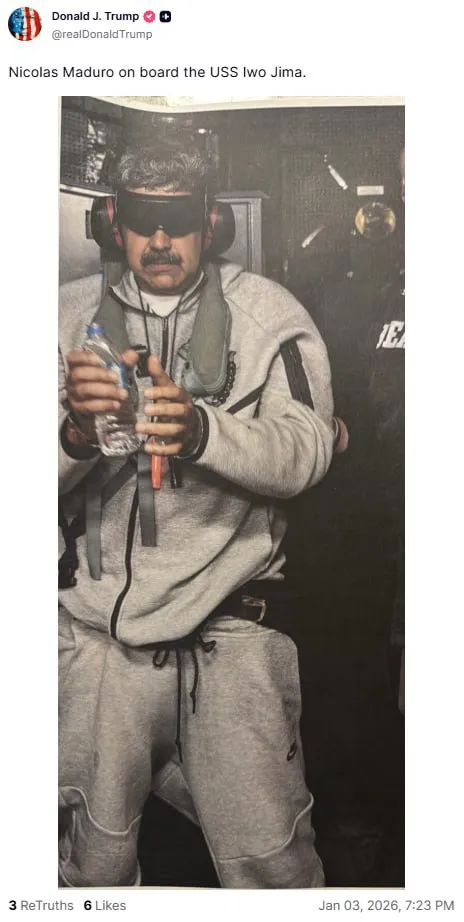
The world is aswirl with theories, takes, and chest-thumping chauvinism. America is back! The great power behind such flawless executions as Desert Storm, Libya, and many other legendary operations has returned to the world stage.
Let’s first note that on the surface the operation had echoes of the USSR’s famous Operation Storm-333, wherein Soviet special forces conducted a large-scale military raid to oust Afghan president Hafizullah Amin in his Kabul compound.
The reasoning was similar: the Soviets felt that Amin was ‘illegitimate’ and backed by the West, and imposed a much more ‘blunt hammer’ approach compared to the “flawless precision” of Trump’s much smaller-scale raid. Of course, the Soviet attack was a real one, with real fire fights and casualties, and the Trump one again has all the hallmarks of the ‘theatrical production’ of the late-stage American empire.1
First is the fact some sources claim insider info that Maduro’s exit was negotiated in advance:
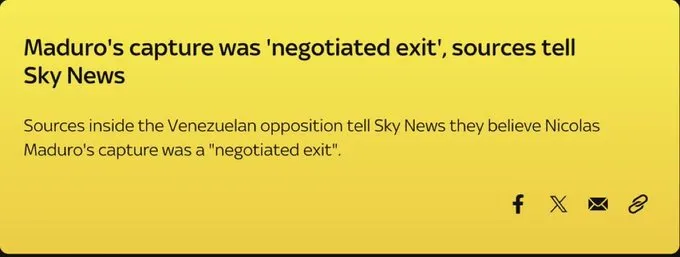
But why would Maduro negotiate his own capture, where he will now presumably be sentenced to prison or worse?
It’s too early to tell: this could all be part of the ploy, and Maduro will be granted amnesty after a show trial. After all, Trump had previously pardoned former Honduran president Juan Orlando Hernandez, accused of being a major narco-boss himself.
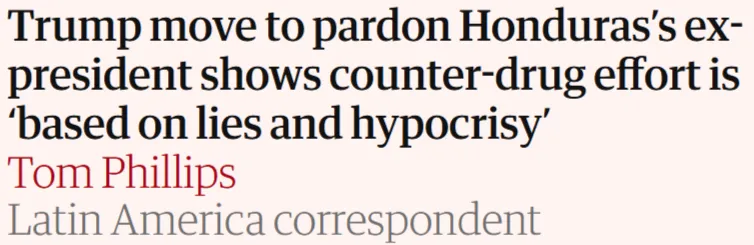
https://www.theguardian.com/us-news/202 ... -president
I’m not suggesting Trump will pardon Maduro, whom he seems to hate with all his guts, but simply that we do not yet know what kind of potential “deal” might have enticed Maduro to give himself up. For all we know, the deal was simply “come alive, or we will level your compound and assassinate you.” That sort of negotiating tactic often has a way of being quite convincing, particularly when presented with real time CIA-sourced satellite and drone footage of the target’s own location from above.
Maduro may have felt the end was inevitable and decided to take a deal wherein much of his family, inner circle, etc., would be “taken care of” and given plush retirements, while he bloodlessly took the fall. His part of the deal would require him to stand down any resistance in order to give Trump the flawless ‘golden operation’ he so hankered for.
There are many other possibilities, such as Maduro simply having been sold out by corrupt inner circle officials and military heads who had been preemptively bribed and ‘turned’ by the CIA, etc.
There is even the possibility that Russia and the US traded Ukraine for Venezuela. It’s not as crazy as you might think, considering that in 2019 this was on the table, according to US Congressional transcripts:
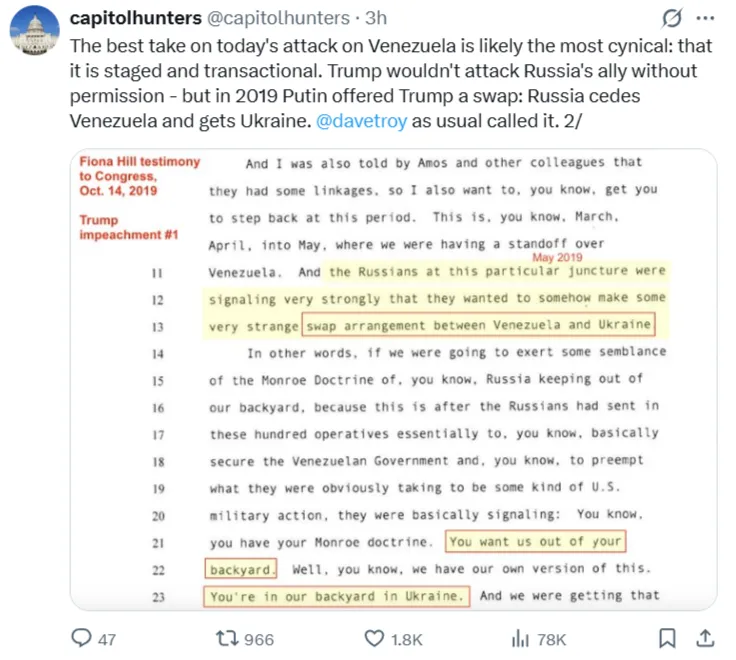
“As the US was so concerned about the Monroe Doctrine and its own backyard, perhaps the US might also be concerned about developments in Russia’s backyard, as in Ukraine, making it very obvious that they were trying to set ip some kind of let’s just say: You stay out of Ukraine or you move out of Ukraine, and, you know, we’ll rethink where we are with Venezuela.” - Fiona Hill to Congress, October 14, 2019
Given Trump’s recent perceived abandonment of Ukraine, this backdoor arrangement for “spheres of influence” is not entirely unrealistic, and conversely is a sort of pragmatic realpolitik approach.
Or, you could believe the much loftier fantasy that the ‘invincible’ US forces again sailed effortlessly over a major country’s capital city without a single air defense system being activated, and while suffering zero casualties, just like in the Iran affair we now know with almost total certainty was a staged theatrical production, consigned in backdoor agreement between the two sides.
Sound familiar?
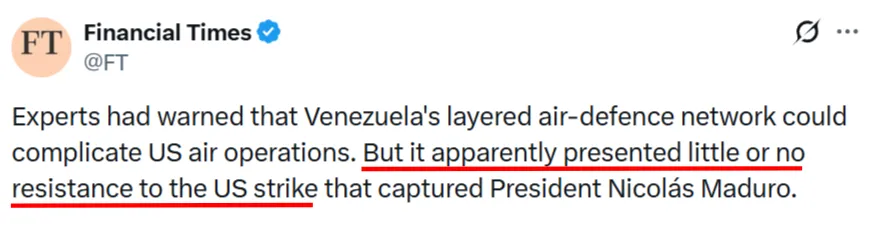
This is the same US force unable to effectively combat the Houthis, unable to take out ISIS in the Levant, nor extract sandal-clad ISIS leaders sitting in dusty caves with the same efficacy they extracted a major nation’s president from a deeply defended compound in the heart of the country’s leading metropolis.
Recall that Venezuela was said to have thousands of Russian manpads yet not a single one was fired at the storm of US helicopters which flew effortlessly over the capital:
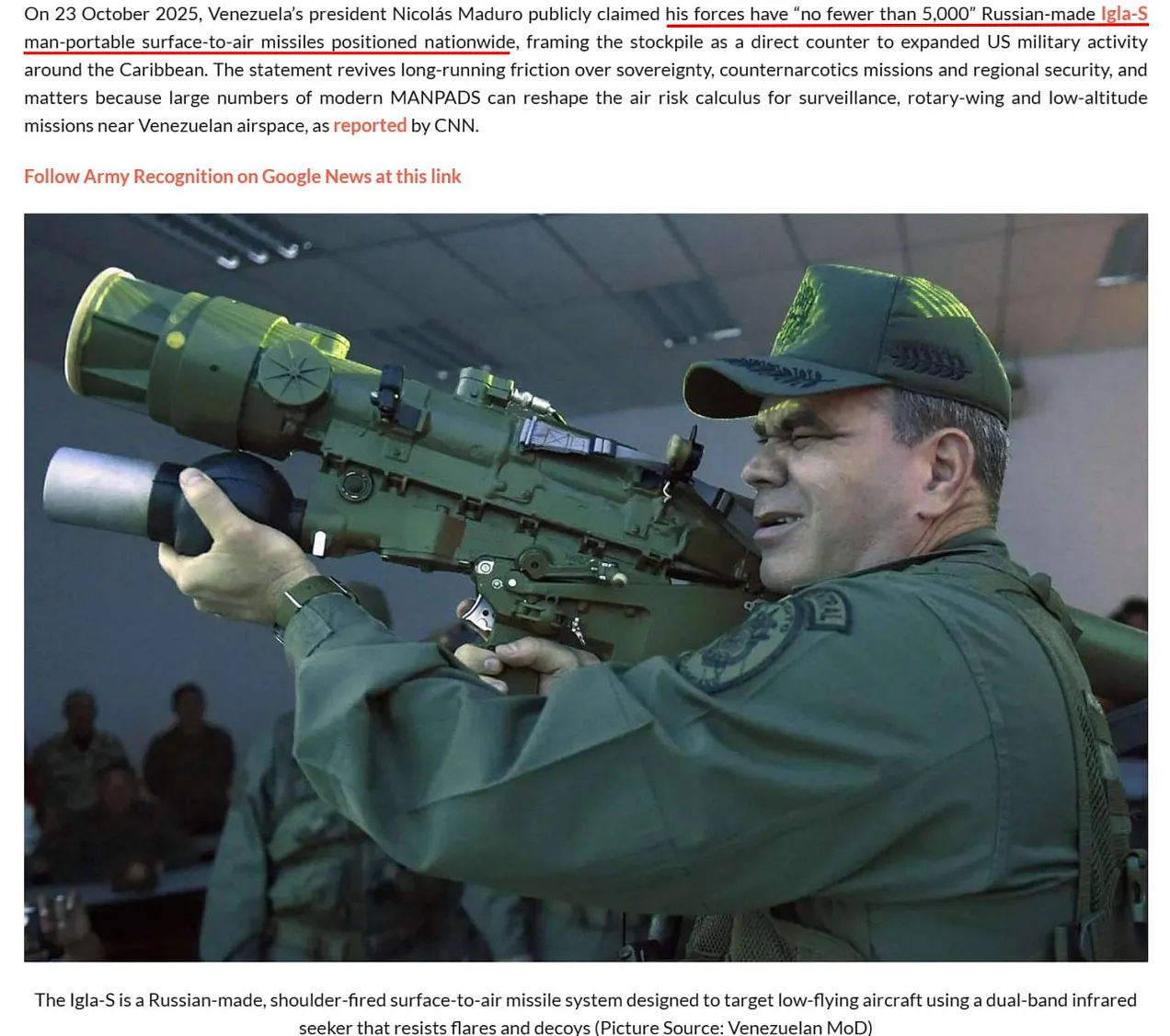
Or, maybe the US military really is that good…at least at surgical special operations that rely heavily on intelligence, which is by far the US’s most powerful advantage over all other nations. US has perfected such techniques during decades of COIN-focused activity. It’s the more classic world war-era slugfest that US would struggle in, but special operations—particularly those against countries tamed into submission by economic deprivation—are a different matter.
Venezuela became the sixth country where the US conducted a military operation after Trump came to power:
— February 1, 2025, Somalia;
— June 22, 2025, Iran;
— March 15, 2025, Yemen;
— December 19, 2025, Syria;
— December 25, 2025, Nigeria;
— January 3, 2026, Venezuela.
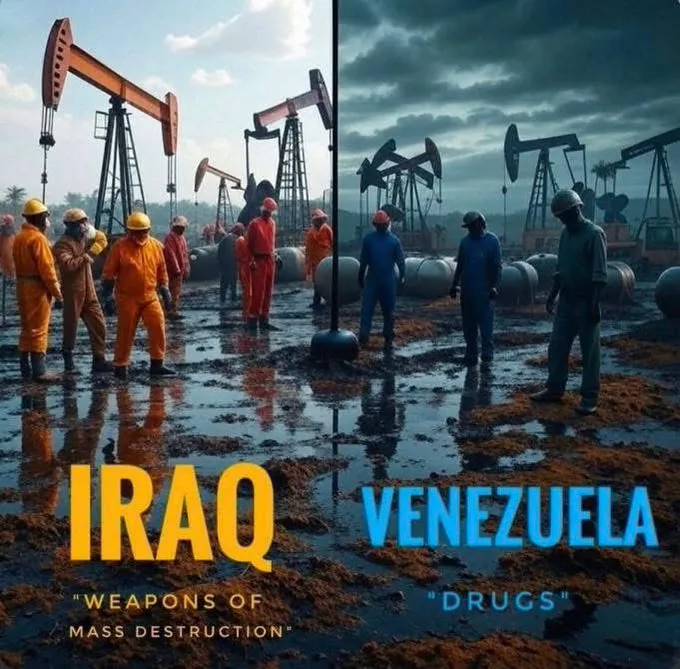
Trump’s address on the operation was a sight to behold. Badly slurring his speech, he expressed no compunctions whatsoever about the US’s plans to occupy the nation of Venezuela, including with “boots on the ground”, which would be required to patrol the now-American-owned Venezuelan oil fields. This is Iraq and Syria redux, and the US is inveterately unabashed of this fact.
Some highlights from the peace president: (Videos at link.)
—
Now let us touch on the more nuanced and important angles to this developing story.
https://simplicius76.substack.com/p/tru ... y-flawless
******
Trump DHS Post Calling for ‘100 Million Deportations’ Suggests Intent to Kick Out Nonwhite Citizens
Posted on January 4, 2026 by Conor Gallagher
Conor here: It’s getting increasingly difficult to separate the trolling from the policy. This appears intended to strike fear into communities of color which are largely working class. Trump—who is very fond of “guest workers” at his properties —and his fellow members of the ruling class would no doubt love a similar system for all workers. Indeed, as we’ve noted much of the administration’s deportation policy has the effect of getting rid of immigrants who don’t have their ability to stay in the country tied to their employer and replace them with guest workers whose presence is wholly dependent on their labor. I’ll leave this from Michael Macher here before we get to the main piece:
…the US immigration system runs not on the enforcement of immigration laws, but on their selective nonenforcement. Employers have relied on the state to ignore the exploitation of undocumented labor while holding the credible threat of deportation over workers. This has had the effect of strengthening employer bargaining power generally against all workers—lowering wages, weakening unions, and shifting the politics of work away from collective bargaining and wage-and-hour regulation. The interest in labor that is weak and disorganized has driven US politicians, consciously or not, to adopt the role of petty bosses, threatening the deportation of significant portions of the US workforce. But if Trump can afford to blow up this arrangement, it is because the precarity of the undocumented worker represents the future of labor relations in the US, not its past.
By Stephen Prager, a staff writer for Common Dreams. Cross posted from Common Dreams.
The Trump administration provoked horror this week with the suggestion that the United States could be turned into a paradise if over a quarter of the people in the country were deported.
On Wednesday, the official social media account for the Department of Homeland Security posted a piece of artwork depicting a pink late-1960s Cadillac Eldorado parked on a bright, idyllic beach. Over the clear blue sky are the words “America after 100 million deportations.”
The post was captioned by the agency: “The peace of a nation no longer besieged by the third world.”
Social media users later discovered that DHS had, ironically, stolen the image from the Japanese pop artist Hiroshi Nagai without giving credit.
The peace of a nation no longer besieged by the third world.

— Homeland Security (@DHSgov) December 31, 2025
It is hardly the first time the administration has used edgy and inflammatory social media posts to promote its agenda. But DHS has come under particular scrutiny for its style of communication, which often evokes white nationalist rhetoric and symbolism.
Posts by the agency have cheered “remigration,” a term that far-right parties in Europe have often used to describe the forced repatriation of nonwhite populations, including citizens. Other posts have referred to President Donald Trump’s “mass deportation” campaign as part of an effort to defend American “heritage” and “culture.”
The agency frequently evokes images of the American frontier and references “Manifest Destiny,” at times explicitly posting artwork glorifying the forced displacement of Native American populations.
An image by the agency, featuring a chiseled Uncle Sam calling on Americans to “REPORT ALL FOREIGN INVADERS,” was even directly sourced from an overt neo-Nazi account.
The agency has only continued to double down in the face of criticism this week. On Friday, it posted that “2026 will be the year of American Supremacy” over an image of then-Gen. George Washington crossing the Delaware River, which was emblazoned with the words “Return this Land,” a possible reference to a recently-founded “whites-only” town in rural Arkansas known as “Return to the Land.”
I don’t get the debate about this. There are two racist shibboleths on here, one that is overt and reflective of the hegemonic ideology in America that we learn in school, the other is thinly veiled Hitler worship. They are distinct signs, distinct histories. Worth noting.

— Palantir Neurodivergent Fellow

 (@postcyborg) July 25, 2025
But Wednesday’s post calling for “100 million deportations” specifically was perhaps the most direct nod yet to those who believe the United States must be reconstituted as a white nation. As social media users were quick to point out, only about 47 million people living in America are foreign-born, according to the US Census Bureau.
Even if the administration kicked out every single immigrant—including legal residents and naturalized citizens—meeting such a goal would mean deporting 53 million people who were born in the US and are legally entitled to citizenship under the 14th Amendment.
If the use of the phrase “third world” did not make it obvious enough, the specific number—100 million—seems to betray the racial motivation behind the message.
Citing 2020 census data on the Wikipedia page for “Demographics of the United States,” one social media user pointed out that approximately 100 million people in the US identified as nonwhite.
Sorry if this has been pointed out but this is explicitly saying deport everyone who isn’t white because 100 million is the number of non white Americans.
— barbarism critic (@barbarismcrit) January 1, 2026
The DHS post drew comparisons to one made earlier this year by the close Trump ally and unofficial White House operative Laura Loomer, who suggested that thanks to “Alligator Alcatraz,” the massive internment camp in Florida for those arrested by immigration agents, “the alligators are guaranteed at least 65 million meals,” which referenced the total number of Hispanic people in the United States.
While it’s almost certainly not possible for the administration to conduct a deportation campaign of such a staggering scale within Trump’s term of office, the administration’s latest post was frightening to many observers, even as they acknowledged that it was a “troll post” meant to rile people up.
It is still reflective of the Trump administration’s ideology with respect to immigration. Leaders of Trump’s deportation effort have acknowledged that they target people based on their appearance, and many nonwhite US citizens have been caught in the dragnet. Meanwhile, its refugee policy has welcomed only white South Africans, as Trump has enacted what he says is a “permanent pause on migration from all Third World Countries.”
During 2026, the administration has said it plans to target hundreds of US citizens each month for “denaturalization,” and Trump has called for it to be used against his most prominent critics, including the Somali-American Rep. Ilhan Omar (D-Minn.) and New York’s first Muslim mayor, Zohran Mamdani.
“This is absolutely insane Nazi propaganda, posted by the US government,” said Ben Norton, editor of the Geopolitical Economy Report in response to DHS’s call for“100 million deportations.”
“It makes it clear that the Trump administration’s mass deportation drive is not actually about ‘illegal immigration.’ There are estimated to be 14 million undocumented immigrants in the US. But the fascist DHS wants to deport 100 million people,” Norton continued. “This is a call by the US regime for ethnic cleansing of racial minorities, to create a white-supremacist regime without anyone with ‘third world’ heritage.”
https://www.nakedcapitalism.com/2026/01 ... izens.html
For the Sake of US Supremacy: It Doesn't Much Matter
Simplicius
Jan 03, 2026
Well, Trump has done it. He has launched the long awaited ground operation in Venezuela, culminating in the alleged capture of Maduro, pictured below on the USS Iwo Jima:
The world is aswirl with theories, takes, and chest-thumping chauvinism. America is back! The great power behind such flawless executions as Desert Storm, Libya, and many other legendary operations has returned to the world stage.
Let’s first note that on the surface the operation had echoes of the USSR’s famous Operation Storm-333, wherein Soviet special forces conducted a large-scale military raid to oust Afghan president Hafizullah Amin in his Kabul compound.
The reasoning was similar: the Soviets felt that Amin was ‘illegitimate’ and backed by the West, and imposed a much more ‘blunt hammer’ approach compared to the “flawless precision” of Trump’s much smaller-scale raid. Of course, the Soviet attack was a real one, with real fire fights and casualties, and the Trump one again has all the hallmarks of the ‘theatrical production’ of the late-stage American empire.1
First is the fact some sources claim insider info that Maduro’s exit was negotiated in advance:
But why would Maduro negotiate his own capture, where he will now presumably be sentenced to prison or worse?
It’s too early to tell: this could all be part of the ploy, and Maduro will be granted amnesty after a show trial. After all, Trump had previously pardoned former Honduran president Juan Orlando Hernandez, accused of being a major narco-boss himself.
https://www.theguardian.com/us-news/202 ... -president
I’m not suggesting Trump will pardon Maduro, whom he seems to hate with all his guts, but simply that we do not yet know what kind of potential “deal” might have enticed Maduro to give himself up. For all we know, the deal was simply “come alive, or we will level your compound and assassinate you.” That sort of negotiating tactic often has a way of being quite convincing, particularly when presented with real time CIA-sourced satellite and drone footage of the target’s own location from above.
Maduro may have felt the end was inevitable and decided to take a deal wherein much of his family, inner circle, etc., would be “taken care of” and given plush retirements, while he bloodlessly took the fall. His part of the deal would require him to stand down any resistance in order to give Trump the flawless ‘golden operation’ he so hankered for.
There are many other possibilities, such as Maduro simply having been sold out by corrupt inner circle officials and military heads who had been preemptively bribed and ‘turned’ by the CIA, etc.
There is even the possibility that Russia and the US traded Ukraine for Venezuela. It’s not as crazy as you might think, considering that in 2019 this was on the table, according to US Congressional transcripts:
“As the US was so concerned about the Monroe Doctrine and its own backyard, perhaps the US might also be concerned about developments in Russia’s backyard, as in Ukraine, making it very obvious that they were trying to set ip some kind of let’s just say: You stay out of Ukraine or you move out of Ukraine, and, you know, we’ll rethink where we are with Venezuela.” - Fiona Hill to Congress, October 14, 2019
Given Trump’s recent perceived abandonment of Ukraine, this backdoor arrangement for “spheres of influence” is not entirely unrealistic, and conversely is a sort of pragmatic realpolitik approach.
Or, you could believe the much loftier fantasy that the ‘invincible’ US forces again sailed effortlessly over a major country’s capital city without a single air defense system being activated, and while suffering zero casualties, just like in the Iran affair we now know with almost total certainty was a staged theatrical production, consigned in backdoor agreement between the two sides.
Sound familiar?
This is the same US force unable to effectively combat the Houthis, unable to take out ISIS in the Levant, nor extract sandal-clad ISIS leaders sitting in dusty caves with the same efficacy they extracted a major nation’s president from a deeply defended compound in the heart of the country’s leading metropolis.
Recall that Venezuela was said to have thousands of Russian manpads yet not a single one was fired at the storm of US helicopters which flew effortlessly over the capital:
Or, maybe the US military really is that good…at least at surgical special operations that rely heavily on intelligence, which is by far the US’s most powerful advantage over all other nations. US has perfected such techniques during decades of COIN-focused activity. It’s the more classic world war-era slugfest that US would struggle in, but special operations—particularly those against countries tamed into submission by economic deprivation—are a different matter.
Venezuela became the sixth country where the US conducted a military operation after Trump came to power:
— February 1, 2025, Somalia;
— June 22, 2025, Iran;
— March 15, 2025, Yemen;
— December 19, 2025, Syria;
— December 25, 2025, Nigeria;
— January 3, 2026, Venezuela.
Trump’s address on the operation was a sight to behold. Badly slurring his speech, he expressed no compunctions whatsoever about the US’s plans to occupy the nation of Venezuela, including with “boots on the ground”, which would be required to patrol the now-American-owned Venezuelan oil fields. This is Iraq and Syria redux, and the US is inveterately unabashed of this fact.
Some highlights from the peace president: (Videos at link.)
—
Now let us touch on the more nuanced and important angles to this developing story.
https://simplicius76.substack.com/p/tru ... y-flawless
******
Trump DHS Post Calling for ‘100 Million Deportations’ Suggests Intent to Kick Out Nonwhite Citizens
Posted on January 4, 2026 by Conor Gallagher
Conor here: It’s getting increasingly difficult to separate the trolling from the policy. This appears intended to strike fear into communities of color which are largely working class. Trump—who is very fond of “guest workers” at his properties —and his fellow members of the ruling class would no doubt love a similar system for all workers. Indeed, as we’ve noted much of the administration’s deportation policy has the effect of getting rid of immigrants who don’t have their ability to stay in the country tied to their employer and replace them with guest workers whose presence is wholly dependent on their labor. I’ll leave this from Michael Macher here before we get to the main piece:
…the US immigration system runs not on the enforcement of immigration laws, but on their selective nonenforcement. Employers have relied on the state to ignore the exploitation of undocumented labor while holding the credible threat of deportation over workers. This has had the effect of strengthening employer bargaining power generally against all workers—lowering wages, weakening unions, and shifting the politics of work away from collective bargaining and wage-and-hour regulation. The interest in labor that is weak and disorganized has driven US politicians, consciously or not, to adopt the role of petty bosses, threatening the deportation of significant portions of the US workforce. But if Trump can afford to blow up this arrangement, it is because the precarity of the undocumented worker represents the future of labor relations in the US, not its past.
By Stephen Prager, a staff writer for Common Dreams. Cross posted from Common Dreams.
The Trump administration provoked horror this week with the suggestion that the United States could be turned into a paradise if over a quarter of the people in the country were deported.
On Wednesday, the official social media account for the Department of Homeland Security posted a piece of artwork depicting a pink late-1960s Cadillac Eldorado parked on a bright, idyllic beach. Over the clear blue sky are the words “America after 100 million deportations.”
The post was captioned by the agency: “The peace of a nation no longer besieged by the third world.”
Social media users later discovered that DHS had, ironically, stolen the image from the Japanese pop artist Hiroshi Nagai without giving credit.
The peace of a nation no longer besieged by the third world.
— Homeland Security (@DHSgov) December 31, 2025
It is hardly the first time the administration has used edgy and inflammatory social media posts to promote its agenda. But DHS has come under particular scrutiny for its style of communication, which often evokes white nationalist rhetoric and symbolism.
Posts by the agency have cheered “remigration,” a term that far-right parties in Europe have often used to describe the forced repatriation of nonwhite populations, including citizens. Other posts have referred to President Donald Trump’s “mass deportation” campaign as part of an effort to defend American “heritage” and “culture.”
The agency frequently evokes images of the American frontier and references “Manifest Destiny,” at times explicitly posting artwork glorifying the forced displacement of Native American populations.
An image by the agency, featuring a chiseled Uncle Sam calling on Americans to “REPORT ALL FOREIGN INVADERS,” was even directly sourced from an overt neo-Nazi account.
The agency has only continued to double down in the face of criticism this week. On Friday, it posted that “2026 will be the year of American Supremacy” over an image of then-Gen. George Washington crossing the Delaware River, which was emblazoned with the words “Return this Land,” a possible reference to a recently-founded “whites-only” town in rural Arkansas known as “Return to the Land.”
I don’t get the debate about this. There are two racist shibboleths on here, one that is overt and reflective of the hegemonic ideology in America that we learn in school, the other is thinly veiled Hitler worship. They are distinct signs, distinct histories. Worth noting.
— Palantir Neurodivergent Fellow


 (@postcyborg) July 25, 2025
But Wednesday’s post calling for “100 million deportations” specifically was perhaps the most direct nod yet to those who believe the United States must be reconstituted as a white nation. As social media users were quick to point out, only about 47 million people living in America are foreign-born, according to the US Census Bureau.
Even if the administration kicked out every single immigrant—including legal residents and naturalized citizens—meeting such a goal would mean deporting 53 million people who were born in the US and are legally entitled to citizenship under the 14th Amendment.
If the use of the phrase “third world” did not make it obvious enough, the specific number—100 million—seems to betray the racial motivation behind the message.
Citing 2020 census data on the Wikipedia page for “Demographics of the United States,” one social media user pointed out that approximately 100 million people in the US identified as nonwhite.
Sorry if this has been pointed out but this is explicitly saying deport everyone who isn’t white because 100 million is the number of non white Americans.
— barbarism critic (@barbarismcrit) January 1, 2026
The DHS post drew comparisons to one made earlier this year by the close Trump ally and unofficial White House operative Laura Loomer, who suggested that thanks to “Alligator Alcatraz,” the massive internment camp in Florida for those arrested by immigration agents, “the alligators are guaranteed at least 65 million meals,” which referenced the total number of Hispanic people in the United States.
While it’s almost certainly not possible for the administration to conduct a deportation campaign of such a staggering scale within Trump’s term of office, the administration’s latest post was frightening to many observers, even as they acknowledged that it was a “troll post” meant to rile people up.
It is still reflective of the Trump administration’s ideology with respect to immigration. Leaders of Trump’s deportation effort have acknowledged that they target people based on their appearance, and many nonwhite US citizens have been caught in the dragnet. Meanwhile, its refugee policy has welcomed only white South Africans, as Trump has enacted what he says is a “permanent pause on migration from all Third World Countries.”
During 2026, the administration has said it plans to target hundreds of US citizens each month for “denaturalization,” and Trump has called for it to be used against his most prominent critics, including the Somali-American Rep. Ilhan Omar (D-Minn.) and New York’s first Muslim mayor, Zohran Mamdani.
“This is absolutely insane Nazi propaganda, posted by the US government,” said Ben Norton, editor of the Geopolitical Economy Report in response to DHS’s call for“100 million deportations.”
“It makes it clear that the Trump administration’s mass deportation drive is not actually about ‘illegal immigration.’ There are estimated to be 14 million undocumented immigrants in the US. But the fascist DHS wants to deport 100 million people,” Norton continued. “This is a call by the US regime for ethnic cleansing of racial minorities, to create a white-supremacist regime without anyone with ‘third world’ heritage.”
https://www.nakedcapitalism.com/2026/01 ... izens.html
"There is great chaos under heaven; the situation is excellent."
Re: Donald Trump, Avatar of his Class, Capitalism & the Decline and Fall of Bourgeois Democracy
Looks like Trump finally got him a 'win'. The retreat of his belligerence after serial rebuffs by Korea, China, Russia, Hamas, Iran has ended. USA!
Needless to say, this will encourage more of the same.
Trump Says Another Strike ‘Sounds Good’ in Warning to Colombian President
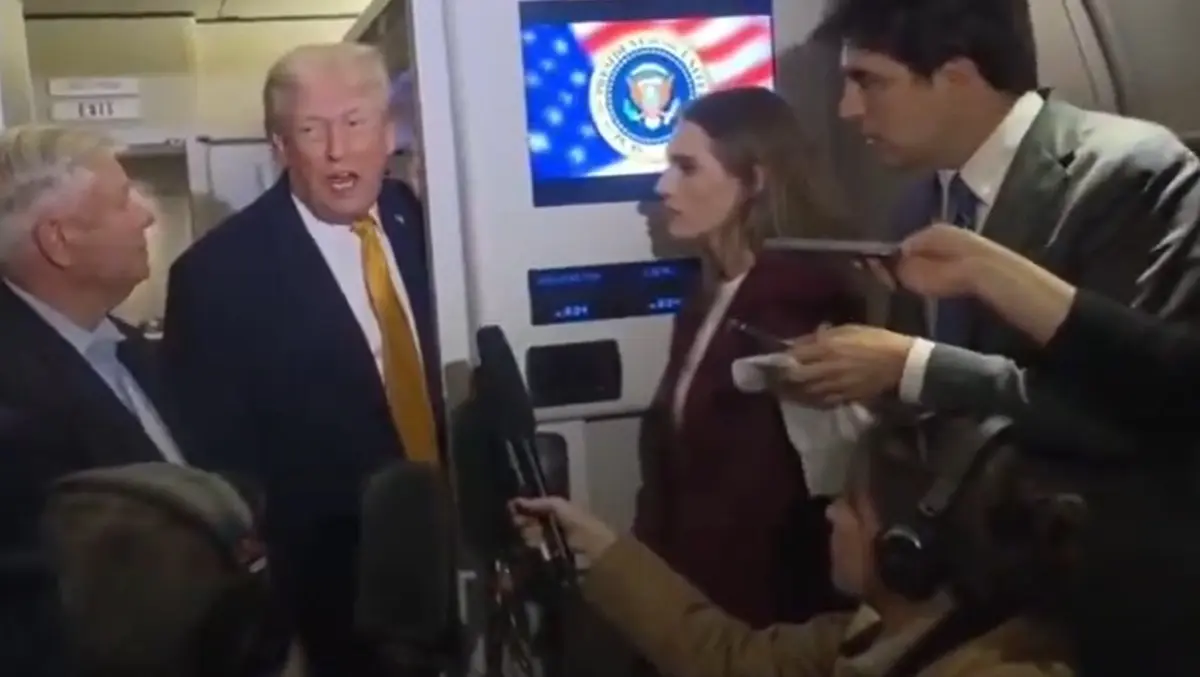
U.S. President Donald Trump, Jan. 4, 2026. X/ @FreeTavana
January 5, 2026 Hour: 8:11 am
He also urged Venezuelan acting president Rodriguez to grant the U.S. ‘total access’ to oil resources.
On Sunday night, U.S. President Donald Trump issued a stark warning to Colombian President Gustavo Petro, saying Petro “is not going to be doing it for very long.”
When asked about the possibility of a U.S. military operation against Colombia, Trump replied, “It sounds good to me.”
Colombia, which borders Venezuela, is “run by a sick man who likes making cocaine and selling it to the United States,” Trump told reporters on Air Force One.
“He has cocaine mills and cocaine factories. He’s not going to be doing it,” said Trump, offering no evidence to substantiate the claim.
On Saturday, Petro called for an urgent meeting of the Organization of American States (OAS) and the United Nations to address the U.S. attack on Venezuela.
In an interview with Politico last month, Trump said he would consider extending military operations against targets in other countries, including Mexico and Colombia.
On Sunday night, Trump also urged Venezuelan acting president Delcy Rodriguez to grant the United States “total access,” especially to Venezuela’s oil resources.
“We need total access. We need access to the oil and to other things in their country that allow us to rebuild their country,” Trump said, adding that he had not spoken directly with Rodriguez, but would do so “at the right time.”
Rodriguez, vice president under the presidency of Nicolas Maduro, assumed the role of acting president after Maduro was flown out of Venezuela following U.S. military attacks. Meanwhile, Trump claimed that the United States was “in charge” of Venezuela and “dealing with the people that just got sworn in.”
“Don’t ask me who’s in charge, because I’ll give you an answer, and it’ll be very controversial,” Trump said. “It means we’re in charge. We’re in charge.”
Earlier on Sunday, Trump reiterated comments made in a phone interview with The Atlantic, warning that Rodriguez would face a fate worse than that of Maduro if she failed to “do the right thing.” “She will face a situation probably worse than Maduro, because, you know, Maduro gave up immediately,” he said.
https://www.telesurenglish.net/trump-sa ... president/
Petro must close down, take over those US airbases pronto. And purge his military/security double pronto.
******
‘No more annexation fantasies’ Greenland PM responding to Trump's threats
US imperial ambitions directed at an EU member were met with coordinated diplomatic pushback and explicit warnings against altering borders by force
News Desk
JAN 5, 2026
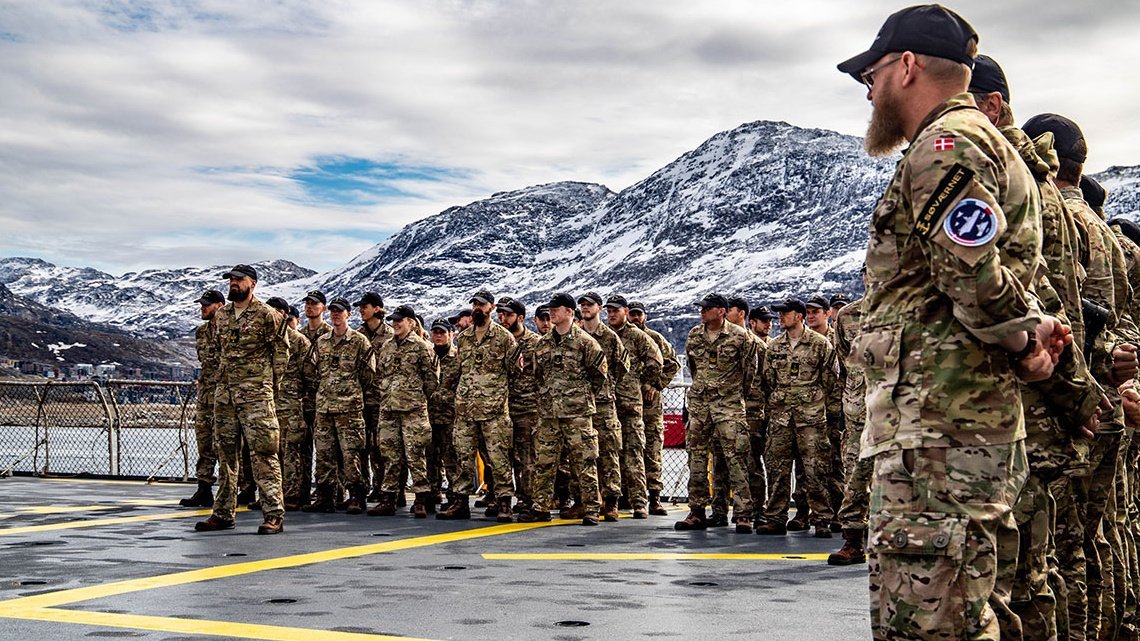
(Photo credit: Danish Ministry of Defence / Iben Valery)
Denmark’s Prime Minister Mette Frederiksen, on 5 January, publicly rejected renewed threats by US President Donald Trump calling for US annexation of Greenland, warning Washington to “stop the threats against a historically close ally.”
“It makes absolutely no sense to talk about the US needing to take over Greenland,” Frederiksen said, stressing that “the US has no right to annex any of the three countries in the Danish Kingdom.”
The Danish PM noted that Denmark, “and thus Greenland,” is a NATO member and protected by the alliance’s collective security guarantees.
Greenland’s Prime Minister Jens-Frederik Nielsen also responded on the same day through social media, issuing a blunt warning.
“That’s enough now,” he wrote, followed by a firmer rejection saying “No more pressure. No more insinuations. No more fantasies of annexation.”
Nielsen emphasized that Greenland remains open to engagement but set clear limits, saying “We are open to dialogue. We are open to discussions,” adding that any talks must take place “through the proper channels and with respect for international law.”
The dispute centers on Trump’s repeated claims that Greenland should become part of the US, a position he reiterated while speaking to reporters aboard Air Force One and in a separate interview with The Atlantic.
Trump framed his remarks around security concerns, saying, “We need Greenland from the standpoint of national security,” and asserting that Denmark “is not going to be able to do it.”
He also suggested the issue could be revisited soon, stating, “We’ll worry about Greenland in about two months … let’s talk about Greenland in 20 days.”
The timing of Trump’s remarks heightened concern in Europe, with his comments following US military action in Venezuela and the the abduction of President Nicolas Maduro and his wife, and transferring them to US soil for “trial”, events that, according to reports, raised fears that similar logic could be applied elsewhere.
Additional backlash followed a social media post by Katie Miller, a former Trump aide, who shared an image of Greenland colored like the US flag with the caption “SOON.”
Nielsen called the post “disrespectful,” writing that “our country is not for sale, and our future is not decided by social media posts.”
European leaders, including those of Finland, Sweden, and Norway, voiced support for Denmark, while France’s Foreign Ministry warned that “borders cannot be changed by force.”
France said that it stands in solidarity with Denmark and Greenland and rejects any attempt to alter borders by force, reaffirming that Greenland’s future is for its people and Denmark to decide.
https://thecradle.co/articles/no-more-a ... e_vignette
******
Trump Abducted Maduro But Did Gain Nothing
In my last piece on Trump’s assault in Venezuela I pointed out that the plan was missing a piece :
One wonders what the next steps are the U.S. is planning to take. It does not have enough forces to invade Venezuela. Nor would a blockade of the country lead to a change of its government. An internal revolution is unlikely to succeed.
The U.S. gnomes managed to steal the underwear. Now comes step 2. Then profits. That sounds like a good plan.
But nobody seems to know so far what step 2 might entail.
It turns out that phase 2 of this underpants gnomes business plan is to do the same as before (archived):
When asked how the United States planned to govern Venezuela, Mr. Rubio did not lay out a plan for a U.S. occupation authority, like the one that the George W. Bush administration put in place in Baghdad during the Iraq War, but instead spoke of coercing a Venezuelan government run by allies of the jailed leader Nicolás Maduro to make policy changes.
U.S. forces will continue to prevent oil tankers on a U.S. sanctions list from entering and leaving the country until the government opens up the state-controlled oil industry to foreign investment — presumably giving priority to American companies — and makes other changes, he said on “Face the Nation” on CBS News.
“That remains in place, and that’s a tremendous amount of leverage that will continue to be in place until we see changes, not just to further the national interest of the United States, which is No. 1, but also that lead to a better future for the people of Venezuela,” he said.
Nothing changed. Venezuela continues to be governed by Chavistas who adhere to the Bolivarian revolution. It continues to be pressured to let U.S. companies explore its oil. The Chavistas, including Maduro, are willing to allow that but they have certain conditions. Those have not, and I believe will not, change.
The whole bombastic action was a virtual war:
The raid, which took place in what should have been highly contested airspace and was preceded by a minimal or borderline nonexistent SEAD campaign, would only have been possible if the Venezuelan military had received a stand-down order. Maduro, who has been in negotiations with the US for a controlled transition of power since 2024, was either betrayed by the entire Venezuelan power structure or gave himself up willingly, and doesn’t appear to have been in a “fortress” at all at the time of the raid.
What was the point then of the whole operation one might ask. Well, maybe there was none:
There are still many unanswered questions about “Absolute Resolve,” the Pentagon’s name for the operation. What was the precise nature of the deal the Venezuelans made with Trump? Is there cooperation between Rodriguez and the US? Was there any reality to Trump’s promises of a US oil industry takeover and “billions” of dollars of investments in Venezuela? If this event is as virtual as it appears based on the information we currently have, these questions may never be answered explicitly. Instead, the event will simply fade, remaining in a perpetual state of impenetrability, unfathomable and impossible to parse, until largely forgotten.
Or maybe the point was just to show off what the Trump administration might do to others:
In 1992, American conservative writer Michael Ledeen reportedly said: “Every 10 years or so, the United States needs to pick up some small crappy little country and throw it against the wall, just to show the world we mean business.”
Actually, such gratuitous demonstrations of might betray the fear that American world power is slipping. Beating up a weaker opponent to prove your strength is the action of an insecure bully.
Venezuela is likely to welcome U.S. oil companies which are willing to invest in the country. But it will be nothing like the bonanza Trump seems to envision. Venezuelan oil is heavy and costly to retrieve. One needs dilution fluids or steam to bring it to surface and to transport it to markets. With global oil prices expected to stay around $50 per barrel there is little incentive for the necessary multi-billion investment.
I expect that after this weekend’s action nothing will change. The U.S. does not want to govern Venezuela. It doesn’t want to put boots on the ground. The blockade, an act of war, will continue for a while but at some point the ships will have to go back to their harbors. As there is nothing to win from this the Trump administration will move towards its next target.
Meanwhile Israel is getting ready for another strike on Iran. The U.S. is repositioning troops to the Middle East while Iran prepares to hit back with all its might.
In a week from now Venezuela will likely be out of the headlines while business as usual continues.
Posted by b on January 5, 2026 at 15:05 UTC | Permalink
https://www.moonofalabama.org/2026/01/t ... thing.html
All of the talk about whether Maduro arranged this, whether at least part of the security apparatus betrayed his will come out. Awful lot of disinfo out there, like the shit I reposted about Russian security shooting it out with Maduro's' security covering the abduction. (I'll be using him less often.) While Cuba says they lost 32 people there, I do believe that.
And don't know that Trump's claim of no casualties or equipment loss should be believed either. He fears bodybags more than hell. Like in Ukraine, check the obits.
Needless to say, this will encourage more of the same.
Trump Says Another Strike ‘Sounds Good’ in Warning to Colombian President
U.S. President Donald Trump, Jan. 4, 2026. X/ @FreeTavana
January 5, 2026 Hour: 8:11 am
He also urged Venezuelan acting president Rodriguez to grant the U.S. ‘total access’ to oil resources.
On Sunday night, U.S. President Donald Trump issued a stark warning to Colombian President Gustavo Petro, saying Petro “is not going to be doing it for very long.”
When asked about the possibility of a U.S. military operation against Colombia, Trump replied, “It sounds good to me.”
Colombia, which borders Venezuela, is “run by a sick man who likes making cocaine and selling it to the United States,” Trump told reporters on Air Force One.
“He has cocaine mills and cocaine factories. He’s not going to be doing it,” said Trump, offering no evidence to substantiate the claim.
On Saturday, Petro called for an urgent meeting of the Organization of American States (OAS) and the United Nations to address the U.S. attack on Venezuela.
In an interview with Politico last month, Trump said he would consider extending military operations against targets in other countries, including Mexico and Colombia.
On Sunday night, Trump also urged Venezuelan acting president Delcy Rodriguez to grant the United States “total access,” especially to Venezuela’s oil resources.
“We need total access. We need access to the oil and to other things in their country that allow us to rebuild their country,” Trump said, adding that he had not spoken directly with Rodriguez, but would do so “at the right time.”
Rodriguez, vice president under the presidency of Nicolas Maduro, assumed the role of acting president after Maduro was flown out of Venezuela following U.S. military attacks. Meanwhile, Trump claimed that the United States was “in charge” of Venezuela and “dealing with the people that just got sworn in.”
“Don’t ask me who’s in charge, because I’ll give you an answer, and it’ll be very controversial,” Trump said. “It means we’re in charge. We’re in charge.”
Earlier on Sunday, Trump reiterated comments made in a phone interview with The Atlantic, warning that Rodriguez would face a fate worse than that of Maduro if she failed to “do the right thing.” “She will face a situation probably worse than Maduro, because, you know, Maduro gave up immediately,” he said.
https://www.telesurenglish.net/trump-sa ... president/
Petro must close down, take over those US airbases pronto. And purge his military/security double pronto.
******
‘No more annexation fantasies’ Greenland PM responding to Trump's threats
US imperial ambitions directed at an EU member were met with coordinated diplomatic pushback and explicit warnings against altering borders by force
News Desk
JAN 5, 2026
(Photo credit: Danish Ministry of Defence / Iben Valery)
Denmark’s Prime Minister Mette Frederiksen, on 5 January, publicly rejected renewed threats by US President Donald Trump calling for US annexation of Greenland, warning Washington to “stop the threats against a historically close ally.”
“It makes absolutely no sense to talk about the US needing to take over Greenland,” Frederiksen said, stressing that “the US has no right to annex any of the three countries in the Danish Kingdom.”
The Danish PM noted that Denmark, “and thus Greenland,” is a NATO member and protected by the alliance’s collective security guarantees.
Greenland’s Prime Minister Jens-Frederik Nielsen also responded on the same day through social media, issuing a blunt warning.
“That’s enough now,” he wrote, followed by a firmer rejection saying “No more pressure. No more insinuations. No more fantasies of annexation.”
Nielsen emphasized that Greenland remains open to engagement but set clear limits, saying “We are open to dialogue. We are open to discussions,” adding that any talks must take place “through the proper channels and with respect for international law.”
The dispute centers on Trump’s repeated claims that Greenland should become part of the US, a position he reiterated while speaking to reporters aboard Air Force One and in a separate interview with The Atlantic.
Trump framed his remarks around security concerns, saying, “We need Greenland from the standpoint of national security,” and asserting that Denmark “is not going to be able to do it.”
He also suggested the issue could be revisited soon, stating, “We’ll worry about Greenland in about two months … let’s talk about Greenland in 20 days.”
The timing of Trump’s remarks heightened concern in Europe, with his comments following US military action in Venezuela and the the abduction of President Nicolas Maduro and his wife, and transferring them to US soil for “trial”, events that, according to reports, raised fears that similar logic could be applied elsewhere.
Additional backlash followed a social media post by Katie Miller, a former Trump aide, who shared an image of Greenland colored like the US flag with the caption “SOON.”
Nielsen called the post “disrespectful,” writing that “our country is not for sale, and our future is not decided by social media posts.”
European leaders, including those of Finland, Sweden, and Norway, voiced support for Denmark, while France’s Foreign Ministry warned that “borders cannot be changed by force.”
France said that it stands in solidarity with Denmark and Greenland and rejects any attempt to alter borders by force, reaffirming that Greenland’s future is for its people and Denmark to decide.
https://thecradle.co/articles/no-more-a ... e_vignette
******
Trump Abducted Maduro But Did Gain Nothing
In my last piece on Trump’s assault in Venezuela I pointed out that the plan was missing a piece :
One wonders what the next steps are the U.S. is planning to take. It does not have enough forces to invade Venezuela. Nor would a blockade of the country lead to a change of its government. An internal revolution is unlikely to succeed.
The U.S. gnomes managed to steal the underwear. Now comes step 2. Then profits. That sounds like a good plan.
But nobody seems to know so far what step 2 might entail.
It turns out that phase 2 of this underpants gnomes business plan is to do the same as before (archived):
When asked how the United States planned to govern Venezuela, Mr. Rubio did not lay out a plan for a U.S. occupation authority, like the one that the George W. Bush administration put in place in Baghdad during the Iraq War, but instead spoke of coercing a Venezuelan government run by allies of the jailed leader Nicolás Maduro to make policy changes.
U.S. forces will continue to prevent oil tankers on a U.S. sanctions list from entering and leaving the country until the government opens up the state-controlled oil industry to foreign investment — presumably giving priority to American companies — and makes other changes, he said on “Face the Nation” on CBS News.
“That remains in place, and that’s a tremendous amount of leverage that will continue to be in place until we see changes, not just to further the national interest of the United States, which is No. 1, but also that lead to a better future for the people of Venezuela,” he said.
Nothing changed. Venezuela continues to be governed by Chavistas who adhere to the Bolivarian revolution. It continues to be pressured to let U.S. companies explore its oil. The Chavistas, including Maduro, are willing to allow that but they have certain conditions. Those have not, and I believe will not, change.
The whole bombastic action was a virtual war:
The raid, which took place in what should have been highly contested airspace and was preceded by a minimal or borderline nonexistent SEAD campaign, would only have been possible if the Venezuelan military had received a stand-down order. Maduro, who has been in negotiations with the US for a controlled transition of power since 2024, was either betrayed by the entire Venezuelan power structure or gave himself up willingly, and doesn’t appear to have been in a “fortress” at all at the time of the raid.
What was the point then of the whole operation one might ask. Well, maybe there was none:
There are still many unanswered questions about “Absolute Resolve,” the Pentagon’s name for the operation. What was the precise nature of the deal the Venezuelans made with Trump? Is there cooperation between Rodriguez and the US? Was there any reality to Trump’s promises of a US oil industry takeover and “billions” of dollars of investments in Venezuela? If this event is as virtual as it appears based on the information we currently have, these questions may never be answered explicitly. Instead, the event will simply fade, remaining in a perpetual state of impenetrability, unfathomable and impossible to parse, until largely forgotten.
Or maybe the point was just to show off what the Trump administration might do to others:
In 1992, American conservative writer Michael Ledeen reportedly said: “Every 10 years or so, the United States needs to pick up some small crappy little country and throw it against the wall, just to show the world we mean business.”
Actually, such gratuitous demonstrations of might betray the fear that American world power is slipping. Beating up a weaker opponent to prove your strength is the action of an insecure bully.
Venezuela is likely to welcome U.S. oil companies which are willing to invest in the country. But it will be nothing like the bonanza Trump seems to envision. Venezuelan oil is heavy and costly to retrieve. One needs dilution fluids or steam to bring it to surface and to transport it to markets. With global oil prices expected to stay around $50 per barrel there is little incentive for the necessary multi-billion investment.
I expect that after this weekend’s action nothing will change. The U.S. does not want to govern Venezuela. It doesn’t want to put boots on the ground. The blockade, an act of war, will continue for a while but at some point the ships will have to go back to their harbors. As there is nothing to win from this the Trump administration will move towards its next target.
Meanwhile Israel is getting ready for another strike on Iran. The U.S. is repositioning troops to the Middle East while Iran prepares to hit back with all its might.
In a week from now Venezuela will likely be out of the headlines while business as usual continues.
Posted by b on January 5, 2026 at 15:05 UTC | Permalink
https://www.moonofalabama.org/2026/01/t ... thing.html
All of the talk about whether Maduro arranged this, whether at least part of the security apparatus betrayed his will come out. Awful lot of disinfo out there, like the shit I reposted about Russian security shooting it out with Maduro's' security covering the abduction. (I'll be using him less often.) While Cuba says they lost 32 people there, I do believe that.
And don't know that Trump's claim of no casualties or equipment loss should be believed either. He fears bodybags more than hell. Like in Ukraine, check the obits.
"There is great chaos under heaven; the situation is excellent."
Re: Donald Trump, Avatar of his Class, Capitalism & the Decline and Fall of Bourgeois Democracy
What is the basis for Greenland being a Danish colony?
January 6, 1:05 PM

The real question is, by what right did Denmark gain control of Greenland? What is the basis for their territorial claims? What is the basis for claiming Greenland is a Danish colony? Greenland should be part of the United States. (c) Trump Deputy Chief of Staff Stephen Miller
The discreet charm of American imperialism.
It's not about Greenland, or Denmark, or anything at all. It's simply about the seizure of other people's resources and territories.
You can talk all you want about international propriety, but the real world is governed by force and might. These are the iron laws of the world. (c) Trump's Deputy Chief of Staff Stephen Miller.
An important clarification for those who like to sigh about international law and diplomatic propriety.
Now it will be like this.
Miller also added that the US does not reject the option of Greenland being annexed by force.
https://colonelcassad.livejournal.com/10289690.html
Trump threatens to kidnap Colombia's president
January 5, 7:10 PM

Trump threatens to kidnap Colombian President Gustavo Pietro if they don't stop producing cocaine.
Cocaine was produced before Pietro, is produced under Pietro, and will be produced after Pietro. Cocaine production in Colombia has very little dependence on the personality of the president.
To really begin to reduce cocaine production, Colombia would need someone like the Taliban (who, for the sake of international legitimacy, collapsed heroin production in Afghanistan) to begin to change. But all this talk about fighting cocaine from its main consumer is as ridiculous as talk about fighting heroin in Afghanistan. The flow of drugs from South America to the US continues to flow.
* * *
And one more thing.
The EU announced that it supports the territorial integrity of Denmark and Greenland in the face of the declared American claim to annex Greenland.
At the same time, the EU believes that what happened in Venezuela and what is happening around Greenland are two different stories and should not be compared. That's different.
However, the EU's hypocrisy has long ceased to surprise anyone.
The EU also stated that it does not recognize Delcy Rodríguez as the legitimate president of Venezuela. It's clear that no one will abandon their plan to take over Venezuela. Judging by the threats from the US, something has gone wrong with the Chavistas' plans for capitulation.
https://colonelcassad.livejournal.com/10288635.html
Google Translator
******
Barbaria strikes again
Pepe Escobar
January 5, 2026
Still, neo-Caligula won’t stop – mimicking his motormouth. The Empire of Chaos under the Donroe Doctrine is about strategic dominance, at all costs, over energy and trade corridors.
Do not blame Caesar, blame the people of Rome who have so enthusiastically acclaimed and adored him and rejoiced in their loss of freedom and danced in his path and gave him triumphal processions. Blame the people who hail him when he speaks in the Forum of the ‘new, wonderful good society’ which shall now be Rome, interpreted to mean ‘more money, more ease, more security, more living flatly at the expense of the industrious’.
Marcus Tullius Cicero
The Raging Twenties started with a murder: Gen. Soleimani, Baghdad, January 3, 2020. Ordered by Trump 1.0.
The second part of the Raging Twenties starts with a bombing/kidnapping. Mini-Shock’n Awe on Caracas, Delta Force raid. January 3, 2026. Ordered by Trump 2.0.
Raging Donald Trump said he will run Venezuela.
This trashy neo-Caligula, self-proclaimed Emperor of Barbaria, in the end may not run anything, starting with his own motormouth.
The Venezuela op unrolled via a classic imperial playbook. Murderous sanctions for years blocking trade and capital movement, causing hyperinflation and an out-of-control humanitarian crisis. The target: to cause so much suffering to Venezuelans that a military coup would be inevitable.
The Venezuela kidnapping of a President in his bedroom deep into the night unrolled via a classic CIA playbook. They managed to bribe the head of Maduro’s security detail and his close circle, but not (italics mine) the Venezuelan military.
Maduro was protected only by Venezuelan forces, not Russians, as confirmed by independent Caracas sources. When a Russian command got to Maduro’s residence, at first they met resistance by some of Maduro’s own corrupt security.
When they were neutralized and the Russians got inside the residence, Maduro had already been extracted by the Delta Force, with key internal help. The chief of Maduro’s security detail was then apprehended – and duly executed.
The day after the kidnapping, Venezuelan soldiers revealed how Delta Force wanted to establish a beachhead at one of their units in Caracas as an operational base for a Bay of Pigs-style ground invasion. But in the words of a soldier, “We fought, we opened fire, and we forced the helicopter to leave without taking the military unit.”
The Venezuelan Defense Ministry then stated that most of Maduro’s security detail was actually killed during the operation, not specifying by whom. And Cuba announced the deaths of 32 of its fighters – certainly not among those in the compromised security detail.
The Chavista government remains in power – led by the formidable Delcy Rodriguez, constitutionally appointed as interim President. No Fifth Columnists inside the government have been unmasked so far.
An article on the propaganda rag Miami Herald, using as the single source a dodgy former vice-President of Colombia, Santos Calderon, and no evidence whatsoever from Venezuela, spread the fiction that Delcy Rodriguez made a pact with Trump 2.0 to hand Maduro over.
It took less than 48 hours for the bombastic Caligula White House narrative to start falling apart. Investigative journalist Diego Sequera, on the ground in Venezuela, has already largely debunked the tsunami of nonsense drowning mainstream and social media.
Additionally, forget about 28 million Venezuelans cheering a loudmouth neo-Caligula gringo as “liberator”. He’s now forced to issue personal threats against Delcy Rodriguez and – what else is new – promise that the Empire of Chaos may bomb Venezuela again.
The Donroe Doctrine, decoded
Let’s cut to the chase. Apart from the notorious “largest oil reserves on the planet”, essential for an Empire in financial trouble to build collateral, there are several main rasons for the Venezuela hit.
1. Bellum Judaica. Apart from developing close relations with BRICS members Russia, China and Iran, Caracas unmistakably sided with Palestine and called out the Zionist plague. So in one swoop, we have not only the practical application of the “corollary to the Monroe Doctrine”, explicit in the new National Security Strategy, but most of all the “Donroe Doctrine” deployed as the “Zionroe Doctrine” by a Zionist court jester, who happens to be the neo-Caligula.
What better way to teach yet another lesson to the whole Global South on the limitless Pax Judaica – actually Bellum Judaica, because they are now on non-stop Forever War mode against all “amalek”: and everybody not genuflecting in their altar may be branded “amalek”. It’s no wonder Delcy Rodriguez went straight to the point, qualifying in her first speech the “Zionist tinge” of neo-Caligula’s kidnapping operation.
2. Heavy metal thunder. Only less than 24 hours after the bombing/mini-Shock’n Awe/kidnapping, and for a mere $8 billion, Washington wrapped up a massive smelter deal to process no less than $1 trillion of Venezuelan precious metals.
The deal was financed by J.P.Morgan – which happens to be in big trouble because of the their massive physical silver short position. The beauty is that Venezuela happens to be smack in the middle of the Arco Minero (“The Mineral Arc”) which concentrates untold trillions in still unmined gold and silver.
3. The petrodollar angle. The heart of the matter is not Venezuela’s humongous – untapped – oil reserves per se, complete with neo-Caligula salivation. The key is petrodollar-denominated oil. Printing endless – intrinsically worthless – green toilet paper to finance the industrial-military complex implies the US dollar as the global reserve currency, petrodollar included.
The Empire of Plunder simply could not allow Venezuela’s oil to be sold in yuan, ruble, rupee or a basket of currencies, or in the near future, a BRICS-sanctioned mechanism backed by oil and gold. Red alert was already on as Venezuela integrated into China’s CIPS cross-border payment system.
Then, on the oil front, there’s the matter of stealing Venezuelan oil from Citgo – the Hudson-based subsidiary of PDVSA – to profit Zionist billionaire Paul Singer and his hedge fund, Elliot Investment Management. A “proud Zionist” and AIPAC board member, Robert Pincus, was court-appointed to facilitate the scam, derived from Citgo owing over $20 billion to creditors: another toxic effect of years of sanctions.
Additionally, and contrary to neo-Caligula’s fiction that “this is our oil”, Venezuelan historian Miguel Tinker Salas conclusively proved how the country nationalized the oil industry in 1976: “It was controlled by Venezuelans. It was run by Venezuelans”. Foreign companies, including ExxonMobil’s “most profitable subsidiary” were fully compensated, “much above and beyond what they had already extracted”.
Then there’s the crucial Chinese angle.
There has been a tsunami of splendidly stupid speculation that China did not do anything to “save” Venezuela. China is way too sophisticated to engage in brawls. Beijing will fight the Empire of Chaos in court.
Silently, with no fanfarre, Beijing has made it very clear that any American attack on Belt and Road Initiative (BRI) projects sealed by contract around the Global South – 150 participating nations at least – will be met with international arbitration in every court from Caracas to Jakarta. Translation – in the only way Western barbarians understand: the legal cost of American regime change operations will become prohibitive.
A test may be coming pretty soon. Assuming neo-Caligula “runs” Venezuela – and that’s a major “if” – all that Beijing needs is to successfully enforce a single contract claim against a Trump-run Venezuela. Let’s see whether neo-Caligula would have the balls to stop Venezuelan oil being sold to China. Good luck on imposing regime change after that.
My Might is Right
Still, neo-Caligula won’t stop – mimicking his motormouth. The Empire of Chaos under the Donroe Doctrine is about strategic dominance, at all costs, over energy and trade corridors. There’s no way neo-Caligula can be forced to cease and desist about Venezuela’s oil. Because that will be the supreme strategic precedent of the new paradigm: My Might is Right rules the new international disorder based on no rules whatsoever.
So whatever happens next in Venezuela directly concerns the whole Global South/Global Majority.
At least now things are crystal clear. International law is for suckers. We search and destroy, bomb, kidnap, whatever – because we can. There are no limits for the Barbaria/ Bellum Judaica combo.
What’s next?
Iran. The war criminal in Tel Aviv has already issued the Bellum Judaica orders. Even if the only “war” Trump 2.0 and his Secretary of Forever Wars can conduct amounts to a bunch of Special Forces trying to get a “beachhead” and indiscriminately hurling loads of stand-off weapons. Washington is woefully incapable of launching a large-scale combined arms operation anywhere.
Greenland. Not for “defense reasons”, as neo-Caligula boasted, but for plunder of natural resources in imperial lebensraum mode and War for the Arctic reasons. Trump has given puny Denmark just enough time to digest it: “We will worry about Greenland in two months.”
Then there’s Cuba – the pet project of gusano Marco Rubio, who in his shady past was quite close to narco-terrorist elites.
Several extra nodes of the Global South – Colombia, Mexico. And if they don’t “behave”, several nodes of BRICS. It’s now Totalen Krieg. And the Empire of Chaos/Bellum Judaica combo “will be watching it like a TV show”. The Global South better get their act together – fast.
https://strategic-culture.su/news/2026/ ... kes-again/
(Note to Pepe: quoting Cicero is not a good look for a leftist.)
******
Trump's New Monroe Doctrine
A Sign of a Weakening Empire Battening Down the Hatches
Roger Boyd
Jan 06, 2026
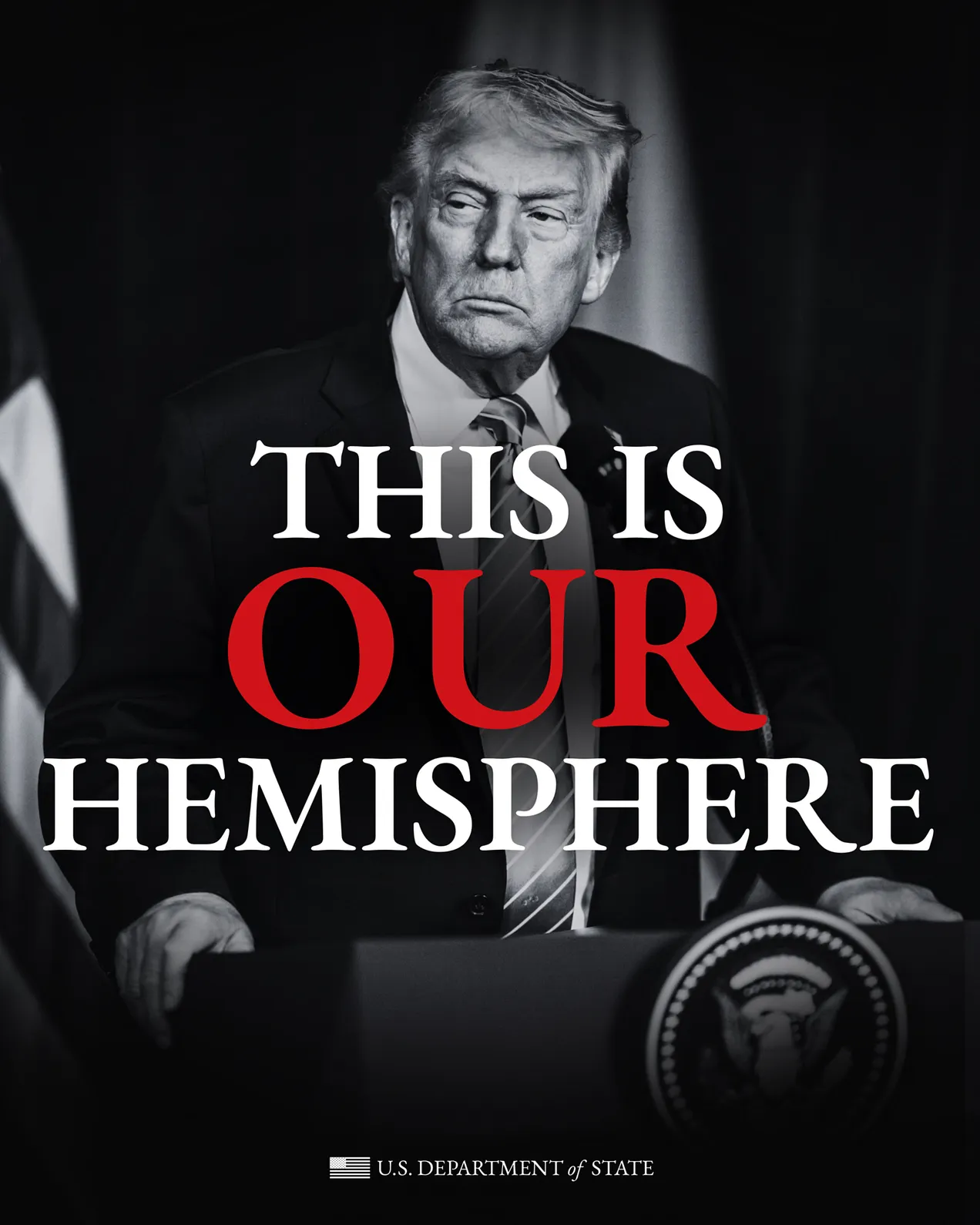
The old Monroe doctrine of 1823 rested on three main aims (i) Europe was not allowed to colonize or recolonize anywhere in the Western Hemisphere (ii) any attempt by European nations to gain control over any Western Hemisphere nation would be treated as a security threat by the US (iii) the US would not interfere in European politics, or those of European colonies.
The US has come a long way since 1823, establishing itself as a global empire overseeing vassal states in Europe, Asia (South Korea and Japan), and Australasia (Australia and New Zealand), while exploiting vast swathes of the globe. But that US empire is now in decline, seeing mainland Asia slip from its hands and its greatest rival, China, go from strength to strength. Its ability to exploit other nations is being increasingly restricted by the presence of China as a trade and FDI competitor in so many nation; a China that has only grown stronger as the West attempted to knee cap its development through technology sanctions and tariffs. With Russia also providing military muscle to sub-Saharan nations resisting Western exploitation.
The part of the US oligarchy that supports “Open Door” globalization (i.e. the US forcing open other nations’ societies to US domination and exploitation) has shrunk as the ongoing costs of that policy keep rising while the returns are reduced through Chinese competition and increased nationalism. In contrast, the “America First” part of the oligarchy is becoming dominant. This does not mean that there will be a turn away from empire, but rather a more cost effective structure put in place and the Western Hemisphere “homeland” shored up against foreign (Chinese) competition. The position and policies of the Trump administration are increasingly becoming the consensus of the US oligarchy. Do not expect a major change whenever a Democrat inhabits the Oval Office, both parties are just the different arms of the US oligarchy.
Firstly, the vassals must pay a much greater share of the costs of maintaining the empire through both massively increased military expenditures (much of which will be spent on goods from the US MIC), and through the acceptance of unequal treaties that allow for greater US exploitation and a move of part of their productive forces to the US. Europe is in no way pulling away from the US, instead its vassal leaders are deepening its dependence while pulling even more political, economic and diplomatic control toward the safe-from-democracy supranational EU apparatus. The UK is doing the same, while also incrementally moving back into the oversight of the EU bureaucracy; a “Reverse Brexit” as the Duran calls it. This will allow greater US focus on Asia, with Australia and Japan acting as its vanguard, while its Asian vassals also increase military spending and accept unequal treaties.
The US is moving to a form of “offshore balancing”, using its Asian vassals and other nations to increasingly augment its own forces to offset the growing power of China, with its European vassals and other nations taking on Russia. The recalcitrant Iranians will be dealt with through the proxy Israel. But for this to work, the US must be in control of its own “backyard”, the Western Hemisphere. This need provides the basis for many of the administration’s policies, which are meeting with considerable success.
The returning of Bolivia, Honduras and Chile to US vassal control.
The solidification of US vassal control in Ecuador.
The victory of Milei in the Argentinian October 2025 election.
The attempt at regime change in Venezuela through a maritime blockade, in addition to the extensive economic and financial sanctions that are already in place, and now the kidnaping of its head of state.
In Central America, Guatemala, El Salvador, Honduras, Costa Rica and Panama are ruled by US vassals. In South America, US vassals rule Peru, Ecuador, Bolivia, Paraguay, Argentina and Chile. In the Caribbean, only Cuba is the real standout. The two largest economic entities of Brazil and Mexico still resist vassal status, along with Venezuela, Colombia and Nicaragua. We should expect extensive US interference in the upcoming April elections in Peru, May elections in Colombia, and the October elections in Brazil, together with increasing pressure upon Mexico (presidential election in 2030) and Nicaragua (elections November 2027). At the same time, China is the largest trading partner for Central and South America.
The new Monroe Doctrine is aimed at not just stopping independent nationalism and foreign (other than US Empire) interference in Central and South America, but also putting in place the US control of resource exploitation within the each nation to the detriment of China; the US to get “first dibs” on any strategic resources within the region, such as rare earth minerals, fossil fuels, and lithium. Also, to gain control over the huge agricultural exports from the region, which compete directly with the US agribusiness sector, that help feed China. As the strength of China continues to grow, and Southeast and Central Asia become more and more integrated with China and Russia, the urgency and aggressive nature of this new Monroe Doctrine will escalate. The move to subjugate Venezuela will be a turning point, either showing the rest of the Americas the power of the US or displaying its weakness; even with the kidnapping of the Venezuelan head of state this is still an open to question. The vassals need to be regularly reminded of what happens to elite groups in Latin America that resist US power.
The problem for the US is that money talks, the money made from increasing exports to China and the money invested by China in an increasing number of FDI projects. The problem for China is that the US policy is to interfere directly in the internal working of countries to keep the vassal elites in power, and to punish non-vassal elites, while China has a position of non-interference in the internal affairs of other nations. China dangles the carrot of increasing profits and economic development to the region’s elites while the US dangles the carrot of support for its vassal elites but also waves a big stick in front of them.
In this respect, a Brazil with the region’s biggest economy, a large trade surplus with China, and increasing levels of Chinese FDI stands out as the one nation that may be able to withstand the US big stick while enjoying the export profits. The right wing may even win the October elections, but its oligarchy may still forge a relatively independent path, given the national scale and relative distance from the US. Here again, the outcome of the attempted regime change operation on Venezuela becomes very important. With US vassals to the west of Brazil (Argentina, Chile, Paraguay, Bolivia and Ecuador) and a vassal Venezuela on its northern border, its elites may feel significantly constrained in their actions. A position made even worse if a US vassal is elected in Colombia in May.
The other major standout is Mexico, the second largest economy in the region and with a very long border with the US. With the US vassals of El Salvador, Guatemala and Honduras at its southern border. We can expect increasing attempts at destabilizing the current Mexican government, given that new presidential elections will not be held until 2030. Without control over its “backyard” of the Northern Hemisphere, the US will be in a much weaker position to act as an offshore balancer. Such a situation is anathema to the US oligarchy, and it may very well utilize greater and greater levels of political interference and military aggression if it is unable to establish Western Hemisphere hegemony. The problem with the latter is that it could easily suck the US into a quagmire that only serves to deepen its decline.
There is of course the northern vassal of Canada, but the reality there is that the domestic oligarchy is fully in bed with their US counterparts. The new prime minister from Goldman Sachs and the Bank of England may have made some edgy remarks during his election campaign but has in reality pretty much delivered what his bosses want (massive increases in defence spending while cutting social spending, ending fiscal support for green energy and transport electrification, more funding for Ukraine and utter support for the Zionist regime) covered up with disingenuous rhetoric and complaints about US policies.
The Trump administration is very explicitly saying to the other nations in the Western Hemisphere that they will not be allowed to sit on the fence between US and Chinese interests, but must rather pick the US side or be the target of a myriad of US attacks - including military if necessary - to bring them into line. The ability of Venezuela to resist the current blockade, and its new head of state to resist ongoing US aggression, and of Mexico and Brazil to steer a middle course, will be indicative of the strength or weakness of the US. If the US administration is successful, the possibility of an at least de facto seizure of Greenland should not be taken lightly.
https://rogerboyd.substack.com/p/trumps ... e-doctrine
*****
Trump’s Greenland Threats: Will He or Won’t He Act?
Posted on January 6, 2026 by Yves Smith
At the risk of speculating at the top of an article as opposed to working though a lot of arguments first, it would based on Trump’s temperament and the seeming great success of knocking off Venezuela, or at least Maduro and his wife, seem to no-brainer that he will move sooner rather than later in seizing, as opposed to merely raiding, Greenland. Douglas Macgregor just described the Caracas romp as a vanity project. Trump will have considerable need for big splashy news-dominating distractions, based on the certainty of losing the war in Ukraine, Epstein not going away, and more and more economic pain for the bottom 90% in the US, starting with rising health care costs. And Trump loves the idea of leaving his stamp on history. The idea of a massive territorial acquisition is an even better monument than getting his face added to Mount Rushmore.
(video at link.)
— World of Statistics (@stats_feed) January 5, 2026
As many have noted, Greenland would be trivially easy for the US to take. It has fewer than 60,000 people, with over 1/3 in its biggest city, Nuuk. The US already has a base there. As we’ll unpack below, Denmark (much like Maduro apparently did before his capture) has offered the US every conceivable concession save handing over or selling Greenland.
For the moment, EU member states are making noises about solidarity with Denmark when they are in no position to stop a US grab.
Perhaps Denmark will do the rest of Europe a big favor and agree on a price. But there is one consideration that might lead Trump to hold back, which is not the “death of NATO” which seems like a certain result. Aurelien is probably best able to describe what that might look like operationally. But a more immediate result would be European states redirecting arms buys away from the US as fast as possible and actually having to put muscle and industrial strategy behind building up their arms industries.
Given the lack of managerial skills in elites all across the West, all the Europeans can do is yet more noise-making. At the end of this post, we have embedded a freshly-released Joint Statement as an illustration.
For starters, how do they quickly wean themselves of dependence on intel and targeting from US satellites? And what about all those bases in Europe? Even though the US under Trump has been making noises about reducing US forces there (now 84,000) and even closing some, several, particularly Ramstein in Germany, are key to force projection in the Middle East. And unlike Incirlik in Turkiye, where Turkiye has preserved some veto rights over US operations, Ramstein is a “permanent US military installation“.
But will the US military industrial complex be wiling to take that risk? Will a parade of ex-generals now on the boards of defense contractors tell Trump that taking Greenland could be very bad for their business and he needs instead to keep pressure on Denmark to cinch a sale?
A new story in the Financial Times describes the panic at top of Europe over Trump directly and via his chief of staff Steve Miller of doubling down on threats against Greenland.
The US will "de-colonize" Denmark by annexing Greenland. Stephen Miller will not rule out military force, and points out the weak Europeans will not fight back. After decades of enthusiastic support for US imperialism, Europe now finds itself on the receiving end. pic.twitter.com/pbYybUpBrg
— Glenn Diesen (@Glenn_Diesen) January 6, 2026
However, keep in mind that Trump has yet to do anything muscular, like flying more soldiers into the Pituffik Space Base.
Nevertheless, European leaders seem to be in denial about the possibility that Trump is likely to proceed absent domestic impediments, despite having been verbally abused in person at the Munich Security Conference last year and rubbished in the recent National Security Strategy paper. Among other wee problems, many unpopular leaders have hitched what remains of their fortunes to Russophobia, when Europe is not and will not any time soon be able to stare down Russia alone. From the pink paper:
“It’s a fine line,” said one senior European official. “The solidarity with Denmark is crystal clear for everyone. But then there’s Venezuela where nobody is sorry [Nicolás] Maduro is going, but there are legal questions. And we want to keep the US onside for a dignified outcome in Ukraine.”
A second EU official said: “We know who our allies no longer are. It’s just we are still hoping we are wrong and the problem will go away,” referring to Trump’s disregard for the generation-old transatlantic alliance and the need for Europe to reduce its reliance on Washington. “We know what needs to be done, we just need to bloody do it.”
One Financial Times reader tartly shredded that view:
Androcydes
The lesson is that if you outsource your security to someone else, you can’t defend yourself from those that provide your security.
Notice that fear of Trump is so great that he has assumed the status of He Who Must Not Be Named:
But few explicitly denounced the US, and none referred to Trump by name despite the US president again saying “we need Greenland” just hours after Danish Prime Minister Mette Frederiksen told him to stop issuing threats over the vast Arctic island.
[Denmark Prime Minister Mette] Frederiksen warned that repeated US ambitions over Greenland could threaten the future of Nato. “If the United States attacks another Nato country, everything stops,” she said on Monday….
Under a 75-year-old defence agreement, the US already has the sole military base on Greenland and local authorities in recent years have been open to it expanding its presence or opening a new one. But the US has reduced its presence on the Arctic island from a cold war peak of more than 10,000 soldiers to fewer than 200 at present.
Greenlandic ministers have also said that their island is “open for business”. But US investors have been slow to show an interest in the nascent mining industry, officials say.
“The only thing they haven’t yet offered is something they can’t ever offer: for Greenland to become part of America,” said one senior EU diplomat. Another added: “They don’t need to annex it. They can have whatever they want. That is what makes it so puzzling.”
The last remark shows a bizarre lack of comprehension about how Trump rolls. He is an extreme materialist and egoist. He had wet-dream level excitement over the grotesque prospect of a Trump Riviera in Gaza. He was pleased with his new coinage of the Donroe Doctrine. Getting legal rights that are tantamount to ownership is not in the same league as directly expanding US territorial holdings.
Later in the story:
The Greenland issue is particularly sensitive for Nato and its secretary-general Mark Rutte. Any US military action to take the island would result in two allies in direct conflict, throwing the alliance’s fundamental mutual defence clause into question and probably forcing the other 30 members to pick sides….
Officials point to a change in stance from other regional Nato members who are now supportive of the alliance playing a greater role in the Arctic, and the success Canada has had in smothering Trump’s previous rhetoric about making the country part of the US, in part by increasing defence spending.
Trump belittled Denmark’s approach on Sunday, claiming that it had added “one dog sled” to its defence of Greenland. But Copenhagen said in October that it would spend $4.2bn on two military units, a new Arctic Command headquarters, two ships, maritime patrol aircraft, drones and air surveillance radar units, all in Greenland.
Matt Stoller pointed out that there is plenty of precedent for how 1890s-loving Trump operates:
The best way to understand what just happened is to start with history. Because while Trump is unusually explicit about his rationalization for seizing control over a resource-rich territory, U.S. domination of the oil reserves of South America is not new. And neither is the fusion of corporate and state interest.
Ninety five years ago, in 1931, Treasury Secretary Andrew Mellon, who owned Gulf Oil (now Chevron), forced the President of Colombia to give his company the Barco oil concession, which borders Venezuela. How? Well Wall Street banks and the U.S. government threatened to withhold vitally needed bank loans if Colombia did not cede the franchise.
The parallels to the situation today are there. When Mellon seized these reserves, in partnership with JP Morgan banking interests, gunboat diplomacy was the norm. In the prior two decades, the U.S. had finished brutally putting down a resistance movement in the Philippines, and had become the global economic and political power after a gruesome world war. Woodrow Wilson had tried to establish a global rules-based order, which the GOP in the 1920s sabotaged.
At the time, Democrats were incompetent and split, as it was an era of deep reverence for the wealthy and bitter culture warring over race and alcohol. For instance, the head of the DNC in the late 1920s, a Dupont executive named John J. Raskob, published a pamphlet titled “Everybody Ought to Be Rich” encouraging Americans to borrow money to invest in the stock market.
Just as there is increasing support for cynical and nihilistic figures today, many in the 1920s felt warmly towards Mellon, Mussolini, and authoritarianism in general. U.S. Steel chairman Judge Elbert Gary encouraged Americans to “learn something by the movement which has taken place in Italy,” while progressive and New Republic founder Herbert Croly called Mussolini as substituting “purposive behavior for drifting and visions of a great future for collective pettiness and discouragement.” Gunboat diplomacy fit in well.
Again, the gaming. or one might say display of hopium, by EU leaders pre-supposes a decent level of rationality as well as restraint from Trump. But recall that he tried again to escalate against China even after Xi dropped the rare earths hammer, via threatening new tariffs in October. He has actually done so via his Venezuela land grab, where China has an estimated $70 billion in investment and was also using oil shipments as a method for repaying about $10 billion of loans.
However, Trump is deteriorating. He has been looking more aged of late and even slurring his speech. IM Doc argued last July that Trump has, not Alzheimers but white matter disease. and one of its major effects is loss of normal social filters. Trump as an obvious narcissist was already weak in that category. He has also chosen to surround himself with toadies. That is likely to mean even less restraint in a President who was already unduly impulsive and recently visibly fond of violence. From IM Doc’s comment:
We as physicians should be very careful to call out diagnoses on videos of patients. That being said, with Joe Biden it was so obvious that my kids could tell something was wrong. His dementia is obviously a part of some kind of neurodegenerative disorder – the symptoms of which were easy for all rational diagnosticians to see as far back as 2019. The open mouth gape, the constant inappropriate whispering, the pigeon toed gait, the peculiar way he fell, the inability to navigate stairs, the constant emotional disruptions, all pointed to that and it was not even closely subtle. Anyone can see it – play a tape of Joe Biden 2023 – and a tape of Joe Biden 2013. This was not simple aging. Anyone that is a true diagnostician that tells you otherwise is a liar or actually does not see patients. The media and political coverup of this has been something for the ages.
Trump is a completely different animal. He certainly does not have Alzheimer’s Disease. He absolutely has personality traits – and just listening to him and watching his behavior – I lean toward Narcissistic Personality Disorder and likely Antisocial Personality Disorder. Having been around wealthy and powerful people for large amounts of my professional life, he is not alone, indeed, he may be less affected with these than the majority I know.
At his age, and with some of the behavior I see, there is a far more common issue that may be going on. It is known as microvascular white matter disease – what used to be known in our culture as “hardening of the arteries”. This is profoundly common in The West. Multiple theories abound as to the cause…..smoking, eating unnatural fats all of our lives ( chips, french fries, donuts, KFC), diabetes and obesity. One may look at this as the brain manifestation of what we call Metabolic Syndrome or Syndrome X.
The white matter contains the billions of conduits going from one neuron to the other in the brain as opposed to the gray matter where the actual neurons reside. As we get older – and some of us are far more prone to this than others – the white matter begins to have large numbers of microscopic strokes. These may take out the CONDUIT for 10-15 neurons, maybe more BUT NOT THE NEURONS THEMSELVES. Our brain can rewire around them but eventually things begin to look like Swiss Cheese and there is no way to repair things. At that point, symptoms begin to set in. This is usually manifested as “filter” deficiencies, sudden emotional outbursts, inability to decide, long diatribes and stories about things from decades ago, inability to recognize one’s own mistakes and deficiencies, some mild memory issues but maybe not, increased impulsive and risk-taking behavior, anger and wrath, inappropriate laughing and crying among many others. This disease process also greatly magnifies the underlying personality disorders. There are more than 20 personality disorders – and it is often a sight to behold as some of these get worse.
This affects so many of our elderly. It is absolutely not Alzheimer’s. But it can eventually become a type of what we call dementia. Unlike Alzheimer’s, these patients can feed themselves, care for themselves, do housework, engage in family and social activities, and be self-aware. They however, are often “kept in the attic” away from the world so as not to embarrass themselves. I try my best with my patients to give them avatars in literature and culture to understand their issues. Literature is full of examples of this – but the most easy to comprehend touchstone for most people is the little old lady Sophia from The Golden Girls – Bea Arthur’s mom.
So if IM Doc is correct, the trajectory of Trump’s deterioration will result in even more ego-driven behavior, as difficult as a further ramping up in that category might be to envision. But if his assessment is correct, that increases the odds of a US seizure of Greenland and all of the huge fallout that would result. So be warned.
https://www.nakedcapitalism.com/2026/01 ... e-act.html
*****
Marjorie Taylor Greene Breaks With Trump Over Venezuela Raid
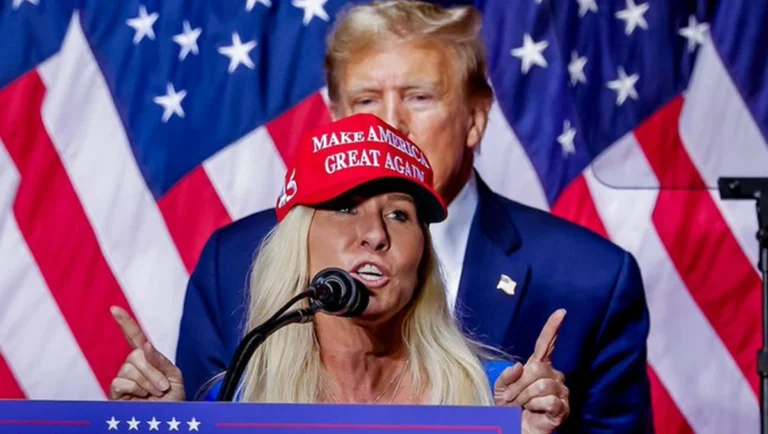
Marjorie Taylor Greene. X/ @felixnenapepa1
January 6, 2026 Hour: 8:55 am
Former GOP lawmaker condemns “globalist” intervention, cites broader rift over Epstein files.
Former Republican Rep. Marjorie Taylor Greene strongly criticized actions taken by U.S. President Donald Trump following the Jan. 3 raid in Venezuela, during which Venezuelan President Nicolas Maduro and first lady Cilia Flores were kidnapped.
“From an America First standpoint, Venezuela belongs to the Venezuelan people. They should elect their own government leaders. We have our own government leaders, the Trump administration, and we’ve elected them to run America, not to be globalists, not to run other countries, not to pursue regime change,” she said in an interview with CNN.
In a separate interview with NBC’s “Meet the Press,” Greene said the Trump administration’s actions against the South American nation followed “the same Washington playbook” and argued they ultimately “harm citizens.”
Greene called the military incursion a betrayal of Trump’s promise to keep the U.S. out of foreign military entanglements – a central tenet of the Make America Great Again movement.
“It really serves big corporations, banks and oil executives,” the Georgia lawmaker said, adding that the American people are “fed up” with a system she believes “prioritizes corporate interests over citizens.”
The split marks a sharp turn in Greene’s relationship with Trump, who counted her as one of his most fervent supporters since her election in 2020. However, the former congresswoman began to adopt a more independent stance during the businessman’s second term.
Key points of friction include her opposition to Trump’s refusal to release documents related to the Jeffrey Epstein case, as well as his failure to prevent a rise in health insurance premiums that will affect more than 20 million Americans.
Greene even joined Democrats in demanding the declassification of Epstein’s files – an initiative Trump dismissed as a “liberal hoax” but which was ultimately passed nearly unanimously by both the House and Senate, both under Republican control. The move represented an embarrassing setback for Trump and deepened the divide with his former ally.
Additionally, the Republican described Israel’s offensive in Gaza as “a genocide against the Palestinians” and urged the U.S. president to “devote less time and political capital to foreign conflicts.”
Greene also criticized Republican leadership over the recent federal government shutdown and demanded a concrete plan to address the expiration of key healthcare subsidies.
Trump responded to her criticisms in November by calling her a “traitor” to the MAGA movement. One week later, Greene announced her resignation, effective Monday, Jan. 5, 2026, after serving her final day in the House of Representatives.
Her departure leaves Republicans with a narrow six-vote advantage in the House, amid two pending special elections in Democratic districts. While the Republican Party is likely to retain Greene’s Georgia seat, leaving it vacant could fuel internal tensions, particularly if other lawmakers follow her example.
Greene has not confirmed whether she will seek another political office, though speculation includes a potential run for Georgia governor or even the presidency in 2028.
https://www.telesurenglish.net/marjorie ... uela-raid/
*****
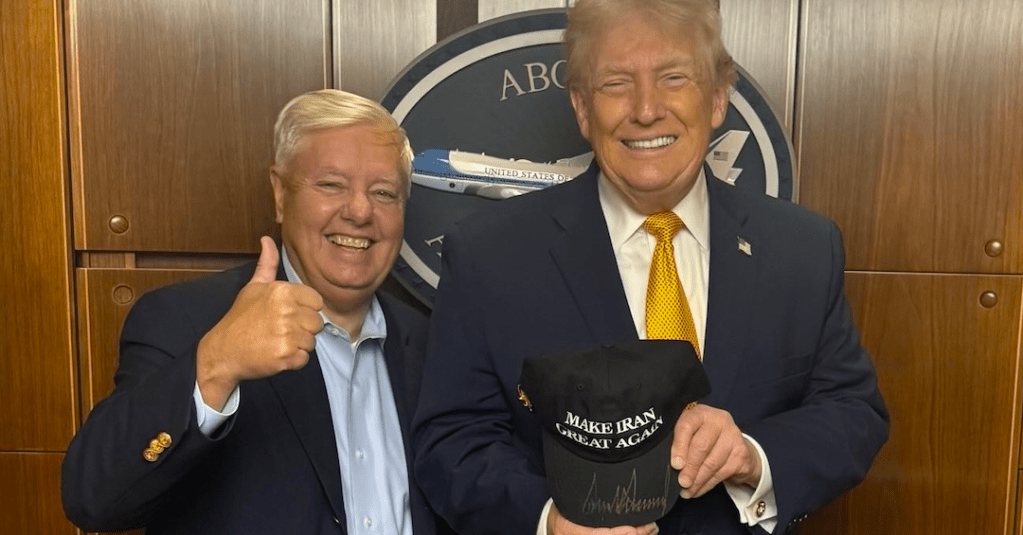
The US Empire Needs Men Like Trump
The empire needs its skillful orators and apologists like Obama, but it also needs its iron-fisted overt tyrants like Trump.
Caitlin Johnstone
January 6, 2026
If you were wondering why the US establishment was so much more chill about Trump becoming president this term than they were the first time around, you’re watching the reason now. The powers that be were assured that he’d carry out longstanding imperial agendas like kidnapping Maduro, bombing Iran and overseeing a final solution to the Palestinian problem, and they trusted him to carry out those plans.
The MAGA narrative that the establishment hates Trump because he’s fighting the Deep State has never been true; there were certain factions within the US imperial power structure which disliked Trump, but that was only because he was not a proven commodity like Hillary Clinton and they didn’t trust him to be a reliable steward of the empire. Trump proved that he could be trusted with his advancement of longtime swamp monster agendas throughout his first term, and he plainly did enough during his time out of office to assure his fellow empire managers that he would do even more if re-elected.
The empire needs its skillful orators and apologists like Obama, but it also needs its iron-fisted overt tyrants like Trump. It needs good cop presidents to manufacture global consensus and expand US soft power, and it also needs bad cop presidents to inflict the hard power abuses the good cops can’t get away with. Both are essential components to the operation of the imperial machine.
Cuba for example has been a socialist island nation off the coast of the United States for generations, because the US hasn’t been able topple its government by its usual means. All the standard CIA assassination ops, proxy warfare and economic blockades were unsuccessful, and there’s been no national or international support for sending US boots on the ground to regime change a small country that poses no military threat. But a last-term bad cop president like Trump has options at his disposal that would be off the table for good cop presidents.
US empire managers are discussing this openly.
“If I lived in Havana and I was in the government, I’d be concerned, at least a little bit,” said Secretary of State Marco Rubio after Maduro’s capture.
“Cuba is ready to fall,” Trump told the press on Sunday next to a delighted Lindsey Graham. “Cuba looks like it’s ready to fall. I don’t know if they’re going to hold out. But Cuba now has no income. They got all of their income from their Venezuela, from the Venezuelan oil. They’re not getting any of it. And Cuba is literally ready to fall.”
“You just wait for Cuba,” Graham added. “Cuba is a Communist dictatorship that’s killed priests and nuns, they preyed on their own people. Their days are numbered. We’re gonna wake up one day, I hope in ’26, in our backyard we’re gonna have allies in these countries doing business with America, not narcoterrorist dictators killing Americans.”
“Donald Trump will have done something that’s eluded America since the fifties: deal with the Communist dictatorship 90 miles off the coast of Florida,” Graham said on Fox News. “I can’t wait till that day comes. To our Cuban friends in Florida and throughout America, the liberation of your homeland is close.”
The Beltway swamp was saying this well before Trump’s Venezuela assault. In October, Senator Rick Scott told 60 Minutes that if Maduro is removed “it’ll be the end of Cuba,” saying “America is gonna take care of the southern hemisphere and make sure there’s freedom and democracy.”
Trump’s blatant smash-and-grab violation of international law in Venezuela wouldn’t have worked for a president who’s trying to put a nice guy face on the US empire, but for a wealthy reality TV star who’s comfortable playing the WWE heel, it’s opened up potential power grabs that have been eluding the imperialists for decades.
When the news broke that Trump had attacked Caracas I was working on an article about his warmongering with Iran which I had to abandon to focus on the new development. The president had announced on Truth Social that if any of the people protesting in Iran are killed, “the United States of America will come to their rescue,” adding, “We are locked and loaded and ready to go.”
Prior to that Trump had confirmed to the press that the US would attack Iran if it tried to rebuild its missile program, saying in a joint news conference with Benjamin Netanyahu that “I hope they’re not trying to build up again because if they are, we’re going have no choice but very quickly to eradicate that buildup.”
To be clear, the president is not talking about attacking Iran if it tries to rebuild its nuclear facilities or construct a nuclear weapon. He’s talking about Iran’s conventional ballistic missile program. The United States is saying that Iran simply is not allowed to defend itself in any way, shape or form, and that if it tries to rebuild its ability to do so it will be attacked again.
So they’re clearly just making up excuses to bomb Iran and waiting for something to stick.
Senator Graham recently tweeted a photo of himself grinning with the president, who was holding a hat which said “MAKE IRAN GREAT AGAIN”. You can pretty much determine how warlike the US empire is from day to day by looking at the expression on Lindsey Graham’s face, and lately he’s been looking positively ecstatic.
Trump used to slam warmongers like Graham, building a huge part of his presidential 2016 campaign around contrasting himself with their disastrous foreign policy platforms. Now that he doesn’t have a re-election to posture for they’re best friends, with Graham proclaiming that “Trump is my favorite president” because “we’re killing all the right people and lowering your taxes”.
January 2029 is still a long way off, and we’re seeing every indication that Trump is going to be making Lindsey Graham smile for years to come.
https://caitlinjohnstone.com.au/2026/01 ... ike-trump/
Perhaps....nonetheless all but the most deranged of the ruling class know the danger of a loose cannon. And offhand I cannot think of a looser cannon. Napoleon III don't come close.
January 6, 1:05 PM
The real question is, by what right did Denmark gain control of Greenland? What is the basis for their territorial claims? What is the basis for claiming Greenland is a Danish colony? Greenland should be part of the United States. (c) Trump Deputy Chief of Staff Stephen Miller
The discreet charm of American imperialism.
It's not about Greenland, or Denmark, or anything at all. It's simply about the seizure of other people's resources and territories.
You can talk all you want about international propriety, but the real world is governed by force and might. These are the iron laws of the world. (c) Trump's Deputy Chief of Staff Stephen Miller.
An important clarification for those who like to sigh about international law and diplomatic propriety.
Now it will be like this.
Miller also added that the US does not reject the option of Greenland being annexed by force.
https://colonelcassad.livejournal.com/10289690.html
Trump threatens to kidnap Colombia's president
January 5, 7:10 PM
Trump threatens to kidnap Colombian President Gustavo Pietro if they don't stop producing cocaine.
Cocaine was produced before Pietro, is produced under Pietro, and will be produced after Pietro. Cocaine production in Colombia has very little dependence on the personality of the president.
To really begin to reduce cocaine production, Colombia would need someone like the Taliban (who, for the sake of international legitimacy, collapsed heroin production in Afghanistan) to begin to change. But all this talk about fighting cocaine from its main consumer is as ridiculous as talk about fighting heroin in Afghanistan. The flow of drugs from South America to the US continues to flow.
* * *
And one more thing.
The EU announced that it supports the territorial integrity of Denmark and Greenland in the face of the declared American claim to annex Greenland.
At the same time, the EU believes that what happened in Venezuela and what is happening around Greenland are two different stories and should not be compared. That's different.
However, the EU's hypocrisy has long ceased to surprise anyone.
The EU also stated that it does not recognize Delcy Rodríguez as the legitimate president of Venezuela. It's clear that no one will abandon their plan to take over Venezuela. Judging by the threats from the US, something has gone wrong with the Chavistas' plans for capitulation.
https://colonelcassad.livejournal.com/10288635.html
Google Translator
******
Barbaria strikes again
Pepe Escobar
January 5, 2026
Still, neo-Caligula won’t stop – mimicking his motormouth. The Empire of Chaos under the Donroe Doctrine is about strategic dominance, at all costs, over energy and trade corridors.
Do not blame Caesar, blame the people of Rome who have so enthusiastically acclaimed and adored him and rejoiced in their loss of freedom and danced in his path and gave him triumphal processions. Blame the people who hail him when he speaks in the Forum of the ‘new, wonderful good society’ which shall now be Rome, interpreted to mean ‘more money, more ease, more security, more living flatly at the expense of the industrious’.
Marcus Tullius Cicero
The Raging Twenties started with a murder: Gen. Soleimani, Baghdad, January 3, 2020. Ordered by Trump 1.0.
The second part of the Raging Twenties starts with a bombing/kidnapping. Mini-Shock’n Awe on Caracas, Delta Force raid. January 3, 2026. Ordered by Trump 2.0.
Raging Donald Trump said he will run Venezuela.
This trashy neo-Caligula, self-proclaimed Emperor of Barbaria, in the end may not run anything, starting with his own motormouth.
The Venezuela op unrolled via a classic imperial playbook. Murderous sanctions for years blocking trade and capital movement, causing hyperinflation and an out-of-control humanitarian crisis. The target: to cause so much suffering to Venezuelans that a military coup would be inevitable.
The Venezuela kidnapping of a President in his bedroom deep into the night unrolled via a classic CIA playbook. They managed to bribe the head of Maduro’s security detail and his close circle, but not (italics mine) the Venezuelan military.
Maduro was protected only by Venezuelan forces, not Russians, as confirmed by independent Caracas sources. When a Russian command got to Maduro’s residence, at first they met resistance by some of Maduro’s own corrupt security.
When they were neutralized and the Russians got inside the residence, Maduro had already been extracted by the Delta Force, with key internal help. The chief of Maduro’s security detail was then apprehended – and duly executed.
The day after the kidnapping, Venezuelan soldiers revealed how Delta Force wanted to establish a beachhead at one of their units in Caracas as an operational base for a Bay of Pigs-style ground invasion. But in the words of a soldier, “We fought, we opened fire, and we forced the helicopter to leave without taking the military unit.”
The Venezuelan Defense Ministry then stated that most of Maduro’s security detail was actually killed during the operation, not specifying by whom. And Cuba announced the deaths of 32 of its fighters – certainly not among those in the compromised security detail.
The Chavista government remains in power – led by the formidable Delcy Rodriguez, constitutionally appointed as interim President. No Fifth Columnists inside the government have been unmasked so far.
An article on the propaganda rag Miami Herald, using as the single source a dodgy former vice-President of Colombia, Santos Calderon, and no evidence whatsoever from Venezuela, spread the fiction that Delcy Rodriguez made a pact with Trump 2.0 to hand Maduro over.
It took less than 48 hours for the bombastic Caligula White House narrative to start falling apart. Investigative journalist Diego Sequera, on the ground in Venezuela, has already largely debunked the tsunami of nonsense drowning mainstream and social media.
Additionally, forget about 28 million Venezuelans cheering a loudmouth neo-Caligula gringo as “liberator”. He’s now forced to issue personal threats against Delcy Rodriguez and – what else is new – promise that the Empire of Chaos may bomb Venezuela again.
The Donroe Doctrine, decoded
Let’s cut to the chase. Apart from the notorious “largest oil reserves on the planet”, essential for an Empire in financial trouble to build collateral, there are several main rasons for the Venezuela hit.
1. Bellum Judaica. Apart from developing close relations with BRICS members Russia, China and Iran, Caracas unmistakably sided with Palestine and called out the Zionist plague. So in one swoop, we have not only the practical application of the “corollary to the Monroe Doctrine”, explicit in the new National Security Strategy, but most of all the “Donroe Doctrine” deployed as the “Zionroe Doctrine” by a Zionist court jester, who happens to be the neo-Caligula.
What better way to teach yet another lesson to the whole Global South on the limitless Pax Judaica – actually Bellum Judaica, because they are now on non-stop Forever War mode against all “amalek”: and everybody not genuflecting in their altar may be branded “amalek”. It’s no wonder Delcy Rodriguez went straight to the point, qualifying in her first speech the “Zionist tinge” of neo-Caligula’s kidnapping operation.
2. Heavy metal thunder. Only less than 24 hours after the bombing/mini-Shock’n Awe/kidnapping, and for a mere $8 billion, Washington wrapped up a massive smelter deal to process no less than $1 trillion of Venezuelan precious metals.
The deal was financed by J.P.Morgan – which happens to be in big trouble because of the their massive physical silver short position. The beauty is that Venezuela happens to be smack in the middle of the Arco Minero (“The Mineral Arc”) which concentrates untold trillions in still unmined gold and silver.
3. The petrodollar angle. The heart of the matter is not Venezuela’s humongous – untapped – oil reserves per se, complete with neo-Caligula salivation. The key is petrodollar-denominated oil. Printing endless – intrinsically worthless – green toilet paper to finance the industrial-military complex implies the US dollar as the global reserve currency, petrodollar included.
The Empire of Plunder simply could not allow Venezuela’s oil to be sold in yuan, ruble, rupee or a basket of currencies, or in the near future, a BRICS-sanctioned mechanism backed by oil and gold. Red alert was already on as Venezuela integrated into China’s CIPS cross-border payment system.
Then, on the oil front, there’s the matter of stealing Venezuelan oil from Citgo – the Hudson-based subsidiary of PDVSA – to profit Zionist billionaire Paul Singer and his hedge fund, Elliot Investment Management. A “proud Zionist” and AIPAC board member, Robert Pincus, was court-appointed to facilitate the scam, derived from Citgo owing over $20 billion to creditors: another toxic effect of years of sanctions.
Additionally, and contrary to neo-Caligula’s fiction that “this is our oil”, Venezuelan historian Miguel Tinker Salas conclusively proved how the country nationalized the oil industry in 1976: “It was controlled by Venezuelans. It was run by Venezuelans”. Foreign companies, including ExxonMobil’s “most profitable subsidiary” were fully compensated, “much above and beyond what they had already extracted”.
Then there’s the crucial Chinese angle.
There has been a tsunami of splendidly stupid speculation that China did not do anything to “save” Venezuela. China is way too sophisticated to engage in brawls. Beijing will fight the Empire of Chaos in court.
Silently, with no fanfarre, Beijing has made it very clear that any American attack on Belt and Road Initiative (BRI) projects sealed by contract around the Global South – 150 participating nations at least – will be met with international arbitration in every court from Caracas to Jakarta. Translation – in the only way Western barbarians understand: the legal cost of American regime change operations will become prohibitive.
A test may be coming pretty soon. Assuming neo-Caligula “runs” Venezuela – and that’s a major “if” – all that Beijing needs is to successfully enforce a single contract claim against a Trump-run Venezuela. Let’s see whether neo-Caligula would have the balls to stop Venezuelan oil being sold to China. Good luck on imposing regime change after that.
My Might is Right
Still, neo-Caligula won’t stop – mimicking his motormouth. The Empire of Chaos under the Donroe Doctrine is about strategic dominance, at all costs, over energy and trade corridors. There’s no way neo-Caligula can be forced to cease and desist about Venezuela’s oil. Because that will be the supreme strategic precedent of the new paradigm: My Might is Right rules the new international disorder based on no rules whatsoever.
So whatever happens next in Venezuela directly concerns the whole Global South/Global Majority.
At least now things are crystal clear. International law is for suckers. We search and destroy, bomb, kidnap, whatever – because we can. There are no limits for the Barbaria/ Bellum Judaica combo.
What’s next?
Iran. The war criminal in Tel Aviv has already issued the Bellum Judaica orders. Even if the only “war” Trump 2.0 and his Secretary of Forever Wars can conduct amounts to a bunch of Special Forces trying to get a “beachhead” and indiscriminately hurling loads of stand-off weapons. Washington is woefully incapable of launching a large-scale combined arms operation anywhere.
Greenland. Not for “defense reasons”, as neo-Caligula boasted, but for plunder of natural resources in imperial lebensraum mode and War for the Arctic reasons. Trump has given puny Denmark just enough time to digest it: “We will worry about Greenland in two months.”
Then there’s Cuba – the pet project of gusano Marco Rubio, who in his shady past was quite close to narco-terrorist elites.
Several extra nodes of the Global South – Colombia, Mexico. And if they don’t “behave”, several nodes of BRICS. It’s now Totalen Krieg. And the Empire of Chaos/Bellum Judaica combo “will be watching it like a TV show”. The Global South better get their act together – fast.
https://strategic-culture.su/news/2026/ ... kes-again/
(Note to Pepe: quoting Cicero is not a good look for a leftist.)
******
Trump's New Monroe Doctrine
A Sign of a Weakening Empire Battening Down the Hatches
Roger Boyd
Jan 06, 2026
The old Monroe doctrine of 1823 rested on three main aims (i) Europe was not allowed to colonize or recolonize anywhere in the Western Hemisphere (ii) any attempt by European nations to gain control over any Western Hemisphere nation would be treated as a security threat by the US (iii) the US would not interfere in European politics, or those of European colonies.
The US has come a long way since 1823, establishing itself as a global empire overseeing vassal states in Europe, Asia (South Korea and Japan), and Australasia (Australia and New Zealand), while exploiting vast swathes of the globe. But that US empire is now in decline, seeing mainland Asia slip from its hands and its greatest rival, China, go from strength to strength. Its ability to exploit other nations is being increasingly restricted by the presence of China as a trade and FDI competitor in so many nation; a China that has only grown stronger as the West attempted to knee cap its development through technology sanctions and tariffs. With Russia also providing military muscle to sub-Saharan nations resisting Western exploitation.
The part of the US oligarchy that supports “Open Door” globalization (i.e. the US forcing open other nations’ societies to US domination and exploitation) has shrunk as the ongoing costs of that policy keep rising while the returns are reduced through Chinese competition and increased nationalism. In contrast, the “America First” part of the oligarchy is becoming dominant. This does not mean that there will be a turn away from empire, but rather a more cost effective structure put in place and the Western Hemisphere “homeland” shored up against foreign (Chinese) competition. The position and policies of the Trump administration are increasingly becoming the consensus of the US oligarchy. Do not expect a major change whenever a Democrat inhabits the Oval Office, both parties are just the different arms of the US oligarchy.
Firstly, the vassals must pay a much greater share of the costs of maintaining the empire through both massively increased military expenditures (much of which will be spent on goods from the US MIC), and through the acceptance of unequal treaties that allow for greater US exploitation and a move of part of their productive forces to the US. Europe is in no way pulling away from the US, instead its vassal leaders are deepening its dependence while pulling even more political, economic and diplomatic control toward the safe-from-democracy supranational EU apparatus. The UK is doing the same, while also incrementally moving back into the oversight of the EU bureaucracy; a “Reverse Brexit” as the Duran calls it. This will allow greater US focus on Asia, with Australia and Japan acting as its vanguard, while its Asian vassals also increase military spending and accept unequal treaties.
The US is moving to a form of “offshore balancing”, using its Asian vassals and other nations to increasingly augment its own forces to offset the growing power of China, with its European vassals and other nations taking on Russia. The recalcitrant Iranians will be dealt with through the proxy Israel. But for this to work, the US must be in control of its own “backyard”, the Western Hemisphere. This need provides the basis for many of the administration’s policies, which are meeting with considerable success.
The returning of Bolivia, Honduras and Chile to US vassal control.
The solidification of US vassal control in Ecuador.
The victory of Milei in the Argentinian October 2025 election.
The attempt at regime change in Venezuela through a maritime blockade, in addition to the extensive economic and financial sanctions that are already in place, and now the kidnaping of its head of state.
In Central America, Guatemala, El Salvador, Honduras, Costa Rica and Panama are ruled by US vassals. In South America, US vassals rule Peru, Ecuador, Bolivia, Paraguay, Argentina and Chile. In the Caribbean, only Cuba is the real standout. The two largest economic entities of Brazil and Mexico still resist vassal status, along with Venezuela, Colombia and Nicaragua. We should expect extensive US interference in the upcoming April elections in Peru, May elections in Colombia, and the October elections in Brazil, together with increasing pressure upon Mexico (presidential election in 2030) and Nicaragua (elections November 2027). At the same time, China is the largest trading partner for Central and South America.
The new Monroe Doctrine is aimed at not just stopping independent nationalism and foreign (other than US Empire) interference in Central and South America, but also putting in place the US control of resource exploitation within the each nation to the detriment of China; the US to get “first dibs” on any strategic resources within the region, such as rare earth minerals, fossil fuels, and lithium. Also, to gain control over the huge agricultural exports from the region, which compete directly with the US agribusiness sector, that help feed China. As the strength of China continues to grow, and Southeast and Central Asia become more and more integrated with China and Russia, the urgency and aggressive nature of this new Monroe Doctrine will escalate. The move to subjugate Venezuela will be a turning point, either showing the rest of the Americas the power of the US or displaying its weakness; even with the kidnapping of the Venezuelan head of state this is still an open to question. The vassals need to be regularly reminded of what happens to elite groups in Latin America that resist US power.
The problem for the US is that money talks, the money made from increasing exports to China and the money invested by China in an increasing number of FDI projects. The problem for China is that the US policy is to interfere directly in the internal working of countries to keep the vassal elites in power, and to punish non-vassal elites, while China has a position of non-interference in the internal affairs of other nations. China dangles the carrot of increasing profits and economic development to the region’s elites while the US dangles the carrot of support for its vassal elites but also waves a big stick in front of them.
In this respect, a Brazil with the region’s biggest economy, a large trade surplus with China, and increasing levels of Chinese FDI stands out as the one nation that may be able to withstand the US big stick while enjoying the export profits. The right wing may even win the October elections, but its oligarchy may still forge a relatively independent path, given the national scale and relative distance from the US. Here again, the outcome of the attempted regime change operation on Venezuela becomes very important. With US vassals to the west of Brazil (Argentina, Chile, Paraguay, Bolivia and Ecuador) and a vassal Venezuela on its northern border, its elites may feel significantly constrained in their actions. A position made even worse if a US vassal is elected in Colombia in May.
The other major standout is Mexico, the second largest economy in the region and with a very long border with the US. With the US vassals of El Salvador, Guatemala and Honduras at its southern border. We can expect increasing attempts at destabilizing the current Mexican government, given that new presidential elections will not be held until 2030. Without control over its “backyard” of the Northern Hemisphere, the US will be in a much weaker position to act as an offshore balancer. Such a situation is anathema to the US oligarchy, and it may very well utilize greater and greater levels of political interference and military aggression if it is unable to establish Western Hemisphere hegemony. The problem with the latter is that it could easily suck the US into a quagmire that only serves to deepen its decline.
There is of course the northern vassal of Canada, but the reality there is that the domestic oligarchy is fully in bed with their US counterparts. The new prime minister from Goldman Sachs and the Bank of England may have made some edgy remarks during his election campaign but has in reality pretty much delivered what his bosses want (massive increases in defence spending while cutting social spending, ending fiscal support for green energy and transport electrification, more funding for Ukraine and utter support for the Zionist regime) covered up with disingenuous rhetoric and complaints about US policies.
The Trump administration is very explicitly saying to the other nations in the Western Hemisphere that they will not be allowed to sit on the fence between US and Chinese interests, but must rather pick the US side or be the target of a myriad of US attacks - including military if necessary - to bring them into line. The ability of Venezuela to resist the current blockade, and its new head of state to resist ongoing US aggression, and of Mexico and Brazil to steer a middle course, will be indicative of the strength or weakness of the US. If the US administration is successful, the possibility of an at least de facto seizure of Greenland should not be taken lightly.
https://rogerboyd.substack.com/p/trumps ... e-doctrine
*****
Trump’s Greenland Threats: Will He or Won’t He Act?
Posted on January 6, 2026 by Yves Smith
At the risk of speculating at the top of an article as opposed to working though a lot of arguments first, it would based on Trump’s temperament and the seeming great success of knocking off Venezuela, or at least Maduro and his wife, seem to no-brainer that he will move sooner rather than later in seizing, as opposed to merely raiding, Greenland. Douglas Macgregor just described the Caracas romp as a vanity project. Trump will have considerable need for big splashy news-dominating distractions, based on the certainty of losing the war in Ukraine, Epstein not going away, and more and more economic pain for the bottom 90% in the US, starting with rising health care costs. And Trump loves the idea of leaving his stamp on history. The idea of a massive territorial acquisition is an even better monument than getting his face added to Mount Rushmore.
(video at link.)
— World of Statistics (@stats_feed) January 5, 2026
As many have noted, Greenland would be trivially easy for the US to take. It has fewer than 60,000 people, with over 1/3 in its biggest city, Nuuk. The US already has a base there. As we’ll unpack below, Denmark (much like Maduro apparently did before his capture) has offered the US every conceivable concession save handing over or selling Greenland.
For the moment, EU member states are making noises about solidarity with Denmark when they are in no position to stop a US grab.
Perhaps Denmark will do the rest of Europe a big favor and agree on a price. But there is one consideration that might lead Trump to hold back, which is not the “death of NATO” which seems like a certain result. Aurelien is probably best able to describe what that might look like operationally. But a more immediate result would be European states redirecting arms buys away from the US as fast as possible and actually having to put muscle and industrial strategy behind building up their arms industries.
Given the lack of managerial skills in elites all across the West, all the Europeans can do is yet more noise-making. At the end of this post, we have embedded a freshly-released Joint Statement as an illustration.
For starters, how do they quickly wean themselves of dependence on intel and targeting from US satellites? And what about all those bases in Europe? Even though the US under Trump has been making noises about reducing US forces there (now 84,000) and even closing some, several, particularly Ramstein in Germany, are key to force projection in the Middle East. And unlike Incirlik in Turkiye, where Turkiye has preserved some veto rights over US operations, Ramstein is a “permanent US military installation“.
But will the US military industrial complex be wiling to take that risk? Will a parade of ex-generals now on the boards of defense contractors tell Trump that taking Greenland could be very bad for their business and he needs instead to keep pressure on Denmark to cinch a sale?
A new story in the Financial Times describes the panic at top of Europe over Trump directly and via his chief of staff Steve Miller of doubling down on threats against Greenland.
The US will "de-colonize" Denmark by annexing Greenland. Stephen Miller will not rule out military force, and points out the weak Europeans will not fight back. After decades of enthusiastic support for US imperialism, Europe now finds itself on the receiving end. pic.twitter.com/pbYybUpBrg
— Glenn Diesen (@Glenn_Diesen) January 6, 2026
However, keep in mind that Trump has yet to do anything muscular, like flying more soldiers into the Pituffik Space Base.
Nevertheless, European leaders seem to be in denial about the possibility that Trump is likely to proceed absent domestic impediments, despite having been verbally abused in person at the Munich Security Conference last year and rubbished in the recent National Security Strategy paper. Among other wee problems, many unpopular leaders have hitched what remains of their fortunes to Russophobia, when Europe is not and will not any time soon be able to stare down Russia alone. From the pink paper:
“It’s a fine line,” said one senior European official. “The solidarity with Denmark is crystal clear for everyone. But then there’s Venezuela where nobody is sorry [Nicolás] Maduro is going, but there are legal questions. And we want to keep the US onside for a dignified outcome in Ukraine.”
A second EU official said: “We know who our allies no longer are. It’s just we are still hoping we are wrong and the problem will go away,” referring to Trump’s disregard for the generation-old transatlantic alliance and the need for Europe to reduce its reliance on Washington. “We know what needs to be done, we just need to bloody do it.”
One Financial Times reader tartly shredded that view:
Androcydes
The lesson is that if you outsource your security to someone else, you can’t defend yourself from those that provide your security.
Notice that fear of Trump is so great that he has assumed the status of He Who Must Not Be Named:
But few explicitly denounced the US, and none referred to Trump by name despite the US president again saying “we need Greenland” just hours after Danish Prime Minister Mette Frederiksen told him to stop issuing threats over the vast Arctic island.
[Denmark Prime Minister Mette] Frederiksen warned that repeated US ambitions over Greenland could threaten the future of Nato. “If the United States attacks another Nato country, everything stops,” she said on Monday….
Under a 75-year-old defence agreement, the US already has the sole military base on Greenland and local authorities in recent years have been open to it expanding its presence or opening a new one. But the US has reduced its presence on the Arctic island from a cold war peak of more than 10,000 soldiers to fewer than 200 at present.
Greenlandic ministers have also said that their island is “open for business”. But US investors have been slow to show an interest in the nascent mining industry, officials say.
“The only thing they haven’t yet offered is something they can’t ever offer: for Greenland to become part of America,” said one senior EU diplomat. Another added: “They don’t need to annex it. They can have whatever they want. That is what makes it so puzzling.”
The last remark shows a bizarre lack of comprehension about how Trump rolls. He is an extreme materialist and egoist. He had wet-dream level excitement over the grotesque prospect of a Trump Riviera in Gaza. He was pleased with his new coinage of the Donroe Doctrine. Getting legal rights that are tantamount to ownership is not in the same league as directly expanding US territorial holdings.
Later in the story:
The Greenland issue is particularly sensitive for Nato and its secretary-general Mark Rutte. Any US military action to take the island would result in two allies in direct conflict, throwing the alliance’s fundamental mutual defence clause into question and probably forcing the other 30 members to pick sides….
Officials point to a change in stance from other regional Nato members who are now supportive of the alliance playing a greater role in the Arctic, and the success Canada has had in smothering Trump’s previous rhetoric about making the country part of the US, in part by increasing defence spending.
Trump belittled Denmark’s approach on Sunday, claiming that it had added “one dog sled” to its defence of Greenland. But Copenhagen said in October that it would spend $4.2bn on two military units, a new Arctic Command headquarters, two ships, maritime patrol aircraft, drones and air surveillance radar units, all in Greenland.
Matt Stoller pointed out that there is plenty of precedent for how 1890s-loving Trump operates:
The best way to understand what just happened is to start with history. Because while Trump is unusually explicit about his rationalization for seizing control over a resource-rich territory, U.S. domination of the oil reserves of South America is not new. And neither is the fusion of corporate and state interest.
Ninety five years ago, in 1931, Treasury Secretary Andrew Mellon, who owned Gulf Oil (now Chevron), forced the President of Colombia to give his company the Barco oil concession, which borders Venezuela. How? Well Wall Street banks and the U.S. government threatened to withhold vitally needed bank loans if Colombia did not cede the franchise.
The parallels to the situation today are there. When Mellon seized these reserves, in partnership with JP Morgan banking interests, gunboat diplomacy was the norm. In the prior two decades, the U.S. had finished brutally putting down a resistance movement in the Philippines, and had become the global economic and political power after a gruesome world war. Woodrow Wilson had tried to establish a global rules-based order, which the GOP in the 1920s sabotaged.
At the time, Democrats were incompetent and split, as it was an era of deep reverence for the wealthy and bitter culture warring over race and alcohol. For instance, the head of the DNC in the late 1920s, a Dupont executive named John J. Raskob, published a pamphlet titled “Everybody Ought to Be Rich” encouraging Americans to borrow money to invest in the stock market.
Just as there is increasing support for cynical and nihilistic figures today, many in the 1920s felt warmly towards Mellon, Mussolini, and authoritarianism in general. U.S. Steel chairman Judge Elbert Gary encouraged Americans to “learn something by the movement which has taken place in Italy,” while progressive and New Republic founder Herbert Croly called Mussolini as substituting “purposive behavior for drifting and visions of a great future for collective pettiness and discouragement.” Gunboat diplomacy fit in well.
Again, the gaming. or one might say display of hopium, by EU leaders pre-supposes a decent level of rationality as well as restraint from Trump. But recall that he tried again to escalate against China even after Xi dropped the rare earths hammer, via threatening new tariffs in October. He has actually done so via his Venezuela land grab, where China has an estimated $70 billion in investment and was also using oil shipments as a method for repaying about $10 billion of loans.
However, Trump is deteriorating. He has been looking more aged of late and even slurring his speech. IM Doc argued last July that Trump has, not Alzheimers but white matter disease. and one of its major effects is loss of normal social filters. Trump as an obvious narcissist was already weak in that category. He has also chosen to surround himself with toadies. That is likely to mean even less restraint in a President who was already unduly impulsive and recently visibly fond of violence. From IM Doc’s comment:
We as physicians should be very careful to call out diagnoses on videos of patients. That being said, with Joe Biden it was so obvious that my kids could tell something was wrong. His dementia is obviously a part of some kind of neurodegenerative disorder – the symptoms of which were easy for all rational diagnosticians to see as far back as 2019. The open mouth gape, the constant inappropriate whispering, the pigeon toed gait, the peculiar way he fell, the inability to navigate stairs, the constant emotional disruptions, all pointed to that and it was not even closely subtle. Anyone can see it – play a tape of Joe Biden 2023 – and a tape of Joe Biden 2013. This was not simple aging. Anyone that is a true diagnostician that tells you otherwise is a liar or actually does not see patients. The media and political coverup of this has been something for the ages.
Trump is a completely different animal. He certainly does not have Alzheimer’s Disease. He absolutely has personality traits – and just listening to him and watching his behavior – I lean toward Narcissistic Personality Disorder and likely Antisocial Personality Disorder. Having been around wealthy and powerful people for large amounts of my professional life, he is not alone, indeed, he may be less affected with these than the majority I know.
At his age, and with some of the behavior I see, there is a far more common issue that may be going on. It is known as microvascular white matter disease – what used to be known in our culture as “hardening of the arteries”. This is profoundly common in The West. Multiple theories abound as to the cause…..smoking, eating unnatural fats all of our lives ( chips, french fries, donuts, KFC), diabetes and obesity. One may look at this as the brain manifestation of what we call Metabolic Syndrome or Syndrome X.
The white matter contains the billions of conduits going from one neuron to the other in the brain as opposed to the gray matter where the actual neurons reside. As we get older – and some of us are far more prone to this than others – the white matter begins to have large numbers of microscopic strokes. These may take out the CONDUIT for 10-15 neurons, maybe more BUT NOT THE NEURONS THEMSELVES. Our brain can rewire around them but eventually things begin to look like Swiss Cheese and there is no way to repair things. At that point, symptoms begin to set in. This is usually manifested as “filter” deficiencies, sudden emotional outbursts, inability to decide, long diatribes and stories about things from decades ago, inability to recognize one’s own mistakes and deficiencies, some mild memory issues but maybe not, increased impulsive and risk-taking behavior, anger and wrath, inappropriate laughing and crying among many others. This disease process also greatly magnifies the underlying personality disorders. There are more than 20 personality disorders – and it is often a sight to behold as some of these get worse.
This affects so many of our elderly. It is absolutely not Alzheimer’s. But it can eventually become a type of what we call dementia. Unlike Alzheimer’s, these patients can feed themselves, care for themselves, do housework, engage in family and social activities, and be self-aware. They however, are often “kept in the attic” away from the world so as not to embarrass themselves. I try my best with my patients to give them avatars in literature and culture to understand their issues. Literature is full of examples of this – but the most easy to comprehend touchstone for most people is the little old lady Sophia from The Golden Girls – Bea Arthur’s mom.
So if IM Doc is correct, the trajectory of Trump’s deterioration will result in even more ego-driven behavior, as difficult as a further ramping up in that category might be to envision. But if his assessment is correct, that increases the odds of a US seizure of Greenland and all of the huge fallout that would result. So be warned.
https://www.nakedcapitalism.com/2026/01 ... e-act.html
*****
Marjorie Taylor Greene Breaks With Trump Over Venezuela Raid
Marjorie Taylor Greene. X/ @felixnenapepa1
January 6, 2026 Hour: 8:55 am
Former GOP lawmaker condemns “globalist” intervention, cites broader rift over Epstein files.
Former Republican Rep. Marjorie Taylor Greene strongly criticized actions taken by U.S. President Donald Trump following the Jan. 3 raid in Venezuela, during which Venezuelan President Nicolas Maduro and first lady Cilia Flores were kidnapped.
“From an America First standpoint, Venezuela belongs to the Venezuelan people. They should elect their own government leaders. We have our own government leaders, the Trump administration, and we’ve elected them to run America, not to be globalists, not to run other countries, not to pursue regime change,” she said in an interview with CNN.
In a separate interview with NBC’s “Meet the Press,” Greene said the Trump administration’s actions against the South American nation followed “the same Washington playbook” and argued they ultimately “harm citizens.”
Greene called the military incursion a betrayal of Trump’s promise to keep the U.S. out of foreign military entanglements – a central tenet of the Make America Great Again movement.
“It really serves big corporations, banks and oil executives,” the Georgia lawmaker said, adding that the American people are “fed up” with a system she believes “prioritizes corporate interests over citizens.”
The split marks a sharp turn in Greene’s relationship with Trump, who counted her as one of his most fervent supporters since her election in 2020. However, the former congresswoman began to adopt a more independent stance during the businessman’s second term.
Key points of friction include her opposition to Trump’s refusal to release documents related to the Jeffrey Epstein case, as well as his failure to prevent a rise in health insurance premiums that will affect more than 20 million Americans.
Greene even joined Democrats in demanding the declassification of Epstein’s files – an initiative Trump dismissed as a “liberal hoax” but which was ultimately passed nearly unanimously by both the House and Senate, both under Republican control. The move represented an embarrassing setback for Trump and deepened the divide with his former ally.
Additionally, the Republican described Israel’s offensive in Gaza as “a genocide against the Palestinians” and urged the U.S. president to “devote less time and political capital to foreign conflicts.”
Greene also criticized Republican leadership over the recent federal government shutdown and demanded a concrete plan to address the expiration of key healthcare subsidies.
Trump responded to her criticisms in November by calling her a “traitor” to the MAGA movement. One week later, Greene announced her resignation, effective Monday, Jan. 5, 2026, after serving her final day in the House of Representatives.
Her departure leaves Republicans with a narrow six-vote advantage in the House, amid two pending special elections in Democratic districts. While the Republican Party is likely to retain Greene’s Georgia seat, leaving it vacant could fuel internal tensions, particularly if other lawmakers follow her example.
Greene has not confirmed whether she will seek another political office, though speculation includes a potential run for Georgia governor or even the presidency in 2028.
https://www.telesurenglish.net/marjorie ... uela-raid/
*****
The US Empire Needs Men Like Trump
The empire needs its skillful orators and apologists like Obama, but it also needs its iron-fisted overt tyrants like Trump.
Caitlin Johnstone
January 6, 2026
If you were wondering why the US establishment was so much more chill about Trump becoming president this term than they were the first time around, you’re watching the reason now. The powers that be were assured that he’d carry out longstanding imperial agendas like kidnapping Maduro, bombing Iran and overseeing a final solution to the Palestinian problem, and they trusted him to carry out those plans.
The MAGA narrative that the establishment hates Trump because he’s fighting the Deep State has never been true; there were certain factions within the US imperial power structure which disliked Trump, but that was only because he was not a proven commodity like Hillary Clinton and they didn’t trust him to be a reliable steward of the empire. Trump proved that he could be trusted with his advancement of longtime swamp monster agendas throughout his first term, and he plainly did enough during his time out of office to assure his fellow empire managers that he would do even more if re-elected.
The empire needs its skillful orators and apologists like Obama, but it also needs its iron-fisted overt tyrants like Trump. It needs good cop presidents to manufacture global consensus and expand US soft power, and it also needs bad cop presidents to inflict the hard power abuses the good cops can’t get away with. Both are essential components to the operation of the imperial machine.
Cuba for example has been a socialist island nation off the coast of the United States for generations, because the US hasn’t been able topple its government by its usual means. All the standard CIA assassination ops, proxy warfare and economic blockades were unsuccessful, and there’s been no national or international support for sending US boots on the ground to regime change a small country that poses no military threat. But a last-term bad cop president like Trump has options at his disposal that would be off the table for good cop presidents.
US empire managers are discussing this openly.
“If I lived in Havana and I was in the government, I’d be concerned, at least a little bit,” said Secretary of State Marco Rubio after Maduro’s capture.
“Cuba is ready to fall,” Trump told the press on Sunday next to a delighted Lindsey Graham. “Cuba looks like it’s ready to fall. I don’t know if they’re going to hold out. But Cuba now has no income. They got all of their income from their Venezuela, from the Venezuelan oil. They’re not getting any of it. And Cuba is literally ready to fall.”
“You just wait for Cuba,” Graham added. “Cuba is a Communist dictatorship that’s killed priests and nuns, they preyed on their own people. Their days are numbered. We’re gonna wake up one day, I hope in ’26, in our backyard we’re gonna have allies in these countries doing business with America, not narcoterrorist dictators killing Americans.”
“Donald Trump will have done something that’s eluded America since the fifties: deal with the Communist dictatorship 90 miles off the coast of Florida,” Graham said on Fox News. “I can’t wait till that day comes. To our Cuban friends in Florida and throughout America, the liberation of your homeland is close.”
The Beltway swamp was saying this well before Trump’s Venezuela assault. In October, Senator Rick Scott told 60 Minutes that if Maduro is removed “it’ll be the end of Cuba,” saying “America is gonna take care of the southern hemisphere and make sure there’s freedom and democracy.”
Trump’s blatant smash-and-grab violation of international law in Venezuela wouldn’t have worked for a president who’s trying to put a nice guy face on the US empire, but for a wealthy reality TV star who’s comfortable playing the WWE heel, it’s opened up potential power grabs that have been eluding the imperialists for decades.
When the news broke that Trump had attacked Caracas I was working on an article about his warmongering with Iran which I had to abandon to focus on the new development. The president had announced on Truth Social that if any of the people protesting in Iran are killed, “the United States of America will come to their rescue,” adding, “We are locked and loaded and ready to go.”
Prior to that Trump had confirmed to the press that the US would attack Iran if it tried to rebuild its missile program, saying in a joint news conference with Benjamin Netanyahu that “I hope they’re not trying to build up again because if they are, we’re going have no choice but very quickly to eradicate that buildup.”
To be clear, the president is not talking about attacking Iran if it tries to rebuild its nuclear facilities or construct a nuclear weapon. He’s talking about Iran’s conventional ballistic missile program. The United States is saying that Iran simply is not allowed to defend itself in any way, shape or form, and that if it tries to rebuild its ability to do so it will be attacked again.
So they’re clearly just making up excuses to bomb Iran and waiting for something to stick.
Senator Graham recently tweeted a photo of himself grinning with the president, who was holding a hat which said “MAKE IRAN GREAT AGAIN”. You can pretty much determine how warlike the US empire is from day to day by looking at the expression on Lindsey Graham’s face, and lately he’s been looking positively ecstatic.
Trump used to slam warmongers like Graham, building a huge part of his presidential 2016 campaign around contrasting himself with their disastrous foreign policy platforms. Now that he doesn’t have a re-election to posture for they’re best friends, with Graham proclaiming that “Trump is my favorite president” because “we’re killing all the right people and lowering your taxes”.
January 2029 is still a long way off, and we’re seeing every indication that Trump is going to be making Lindsey Graham smile for years to come.
https://caitlinjohnstone.com.au/2026/01 ... ike-trump/
Perhaps....nonetheless all but the most deranged of the ruling class know the danger of a loose cannon. And offhand I cannot think of a looser cannon. Napoleon III don't come close.
"There is great chaos under heaven; the situation is excellent."
Re: Donald Trump, Avatar of his Class, Capitalism & the Decline and Fall of Bourgeois Democracy

President Donald Trump, Commerce Secretary Howard Lutnick (L) and U.S. Sen. Lindsey Graham (R-SC) (C) speak to the media aboard Air Force One en route to Washington, DC on January 04, 2026. (Photo by Joe Raedle/Getty Images/Common Dreams)
‘What an Authoritarian Oligarchy looks like’: Trump says oil execs tipped off about Venezuela attack
Originally published: Common Dreams on January 5, 2026 by Jon Queally (more by Common Dreams) | (Posted Jan 06, 2026)
President Donald Trump on Sunday told reporters that the heads of American oil companies were informed of the U.S. military’s attack on Venezuela—described as “brazenly illegal” by scholars and experts—even before it took place.
Trump’s admission, a renowned liar, sparked condemnation because the administration refused to consult with U.S. lawmakers about the operation, citing fears of a leak that would compromise operational security.
“Before and after,” Trump told reporters aboard Air Force One on Sunday when asked if he’d spoken with oil executives or perhaps “tipped them off” about the operation.
They want to go in, and they’re going to do a great job for the people of Venezuela.
Trump’s remarks were condemned by those critical of the president’s actions in recent days, including his failure to consult with or seek authorization from Congress.
“I can’t begin to tell you how insane this is,” said Fred Wellman, an Army combat veteran now running for Congress as a Democrat in Missouri.
He did not inform Congress, but he’s saying he informed the oil companies.
“Keep in mind who he means,” Wellman added.
The billionaire mega donor that just got control of Citgo. Our service members were used directly to move the interests of Trump’s donors.
“The oil companies were notified before Congress,” said Melanie D’Arrigo, executive director of the Campaign for New York Health.
This is what an authoritarian oligarchy looks like.
Rep. Yassamin Ansari (D-Ariz.) echoed that statement.
The oil companies were informed about an act of war before it happened, Congress was not. That, my friends, is what an authoritarian regime run by oligarchs looks like.
Asked repeatedly during his exchange with reporters about whether “free and fair” elections were a priority for Venezuela, Trump said the country was a “mess”—calling it a “dead country”—and that priority would be on getting the oil flowing.
“We’re gonna have the big oil companies go in, and they’re gonna fix the infrastructure, and they’re going to invest money. We’re not going to invest anything; we’re gonna just take care of the country,” Trump said.
We’re gonna cherish the country.
When asked which oil companies he spoke with, Trump said, “All of them, basically,” though he did not mention which ones specifically by name.
“They want to go in so badly,” the president claimed.
Despite Trump’s remarks, oil industry experts have said it’s not nearly so clear-cut that oil majors in the U.S. will want to re-enter the Venezuela oil market—or be tasked with funding a significant rebuild of the nation’s oil infrastructure—given the political uncertainty unleashed by Trump’s unlawful military operation and the kidnapping of Venezuela President Nicolas Maduro.
“The issue is not just that the infrastructure is in bad shape, but it’s mostly about how do you get foreign companies to start pouring money in before they have a clear perspective on the political stability, the contract situation, and the like,” Francisco Monaldi, director of the Latin American energy program at Rice University, told NPR.
The infrastructure investments alone are huge, even under normal political circumstances.
“The estimate is that in order for Venezuela to increase from one million barrels per day—that is what it produces today—to four million barrels, it will take about a decade and about a hundred billion dollars of investment,” Monaldi said.
In an interview with The New Yorker over the weekend, Oona Hathaway, a professor at Yale Law School and the director of its Center for Global Legal Challenges, said there is absolutely no legal justification for Trump’s assault on Venezuela or the kidnapping of Maduro and his wife, Cilia Flores.
“I don’t think there is a legal basis for what we’re seeing in Venezuela,” Hathaway said.
There are certainly legal arguments that the Administration is going to make, but all the arguments that I’ve heard so far don’t hold water. None of them really justify what the President seems to have ordered to take place in Venezuela.
In a statement on Saturday, Elizabeth Bast, executive director of Oil Change International, said Trump’s assault on Venezuela “defies the U.S. Constitution’s delegation of Congress’s war-making authority and disregards international rules that prevent acts of war without debate or authorization. The U.S. must stop treating Latin America as a resource colony. The Venezuelan people, not U.S. oil executives, must shape their country’s future.”
As Trump and other members of the administration continued to threaten other countries in the region—including Mexico, Colombia, and Cuba—Zeteo editor-in-chief Mehdi Hasan said,
This is the behavior of a mob boss—but with nuclear weapons and the world’s strongest military. None of this is legal. Trump should be impeached by Congress and indicted at The Hague.
https://mronline.org/2026/01/06/what-an ... la-attack/
******
Trump has gone crazy! Trump has gone crazy!
Trump has joined the ranks of deranged "EU leaders."
Dr. Ignacy Nowopolski
Jan 06, 2026
Speaking to reporters aboard Air Force One, Trump shared his plans for putting the world in order in 2026. He recited a list of countries in line to be "put in order."
The first will be Greenland, which will be incorporated directly into the American Empire, unlike Venezuela, whose management will be remote, entirely in the hands of the "Viceroy of Caracas" Marco Rubio.
Probably due to the short flight time, he did not have time to give detailed plans regarding the other unfortunate countries, limiting himself only to insults towards their current leaders.
Already in the Venezuelan case, the Patient in the White House has repeatedly violated the US Constitution, giving the Democrats who hate him the power to impeach him. Perhaps they themselves led him into this trap so they could legally get rid of him.
This would be the best solution. In that case, VP DJ Vance, who has some brains, would take over.
If this does not happen, the only option left is to hire Russian Spetsnaz to extract the Patient from the White House and transfer him to one of the post-Soviet psychiatric facilities in the Russian Federation for lifelong electroshock therapy.
All of this would be even funny if it weren't for the fact that the Patient and his EU co-patients have access to nuclear weapons.
Speaking to reporters aboard Air Force One, Trump shared with them his plans to put the world in order in the New Year 2026. He recited a list of countries in line to be “put in order”.
The first will be Greenland, which it will annex directly to the American Empire, as opposed to Venezuela, whose governance will be remote, completely in the hands of the “viceroy of Caracas” Marco Rubio.
Probably due to the short flight time, he did not have time to give detailed plans in relation to the other unfortunate countries, limiting himself only to insults towards their current leaders.
Already in the case of Venezuela, the White House Patient has repeatedly violated the U.S. Constitution, which gives the Democrats who hate him the possibility of impeachment. Perhaps they let him into this trap themselves so that they could legally get rid of him.
This would be the best solution. In that case, VP D.J. Vance, who has some gray cells under the ceiling, would take over.
If this does not happen, the only thing left to do is to hire the Russian Spetsnaz to extract the Patient from the White House and transfer him to one of the post-Soviet mental institutions in the Russian Federation, for lifelong treatment with electroshocks.
All this would even be funny if it not for the awareness that the Patient and his EU fellow patients have access to nuclear weapons.
https://drignacynowopolski.substack.com ... gone-crazy
Google Translator
*****
Trump Announces Sale of Venezuelan Oil to the United States
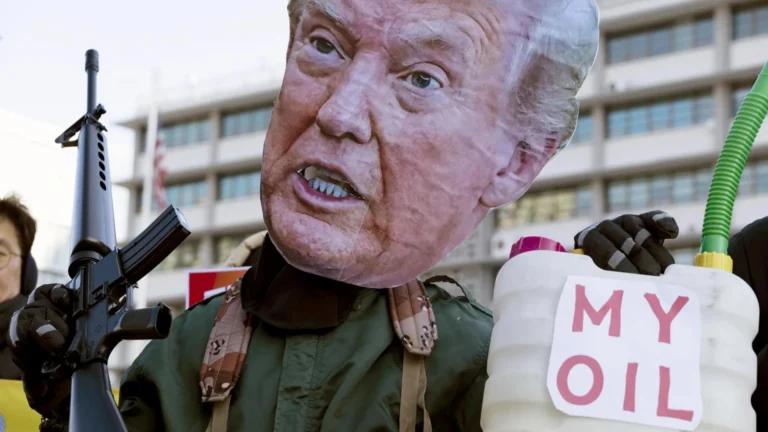
Protest outside of the U.S. Embassy in Seoul, South Korea, January 5, 2026. Photo: EFE.
January 7, 2026 Hour: 10:19 am
Paradoxically, this crude oil is currently blocked by his own arbitrary sanctions.
Through a message posted on social networks on Tuesday night, through the president of the United States, Donald Trump announced the sale of millions of barrels of Venezuelan oil.
“I am pleased to announce that the Interim Authorities in Venezuela will be turning over between 30 and 50 MILLION barrels of high-quality, sanctioned oil to the United States of America,” he stated.
“This oil will be sold at its market price, and that money will be controlled by me, as president of the United States of America, to ensure it is used to benefit the people of Venezuela and the United States!”
“I have asked Energy Secretary Chris Wright to execute this plan immediately. It will be taken by storage ships and brought directly to unloading docks in the United States,” he concluded.
The announcement comes after the U.S. military aggression against Venezuela on Jan. 3, when U.S. military forces kidnapped Venezuelan President Nicolas Maduro and First Lady Cilia Flores.
On Tuesday, Venezuela’s Acting President Delcy Rodriguez reiterated the Bolivarian government’s commitment to peace and national sovereignty, as well as to the release of President Maduro and his wife.
“Stop the harassment of Venezuela! Stop the aggression against the people of Bolivar! I swore not to rest until our homeland is consolidated along a path of peace… Here, there is a constitutional government. Here, the people rule!,” she stressed.
International organizations and legal scholars have said the U.S. military action against Venezuela flagrantly violates the international legal order, including the United Nations Charter, the principle of nonintervention, and international humanitarian law.
https://www.telesurenglish.net/trump-us ... sanctions/
Trump to Freeze $10 Billion Funding to Five Democratic States

A public daycare service in NYC. X/ @NewYorkNews212
January 7, 2026 Hour: 9:07 am
The funding was allocated to childcare, social services, and monetary support for low-income families.
On Tuesday, the New York Times published a report showing that U.S. President Donald Trump plans to freeze US$10 billion in federal funding to five Democratic states — Minnesota, California, New York, Illinois and Colorado — amid alleged welfare fraud.
The funding, which includes child care subsidies, social services and cash support for low-income families, is being frozen over claims of widespread fraud across the states, without cited evidence, following a major welfare fraud scheme in Minnesota.
“The funding pause could jeopardize programs that serve hundreds of thousands of low-income households in the five states,” The New York Times said.
The latest plan came just a week after the Trump administration paused US$185 million in federal funding to the northern state of Minnesota after a series of alleged fraud schemes in recent years.
“We have frozen all child care payments to the state of Minnesota,” Deputy Secretary of Health and Human Services (HHS) Jim O’Neill said on Dec. 30 on the social media platform X.
“You have probably read the serious allegations that the state of Minnesota has funneled millions of taxpayer dollars to fraudulent daycares across Minnesota over the past decade,” he added and announced that the HHS is implementing new requirements for child care payments across the country.
Minnesota Governor Tim Walz, who accused the Trump administration of politicizing the issue, announced on Monday that he was dropping his bid for a third term as the welfare-fraud scandal in his state escalated. Walz said the fraud allegations in Minnesota have largely targeted the Somali community.
“We’ve got the President of the United States demonizing our Somali neighbors and wrongfully confiscating funds that Minnesotans rely on. It’s disgusting and it’s dangerous,” he said Monday as he announced his decision not to seek a third term.
https://www.telesurenglish.net/trump-to ... ic-states/
"There is great chaos under heaven; the situation is excellent."
Re: Donald Trump, Avatar of his Class, Capitalism & the Decline and Fall of Bourgeois Democracy
White House orders 'immediate' US withdrawal from 66 international organizations
Donald Trump signed the memorandum directing the withdrawal from organizations deemed to be ‘contrary to the interests of the US’
News Desk
JAN 8, 2026
(Photo credit: AFP)
US President Donald Trump signed a memorandum on 7 January 2026 directing the withdrawal of his country from dozens of international organizations, conventions, and UN bodies deemed “contrary to the interests of the United States.”
The memorandum was addressed to the heads of executive departments and agencies and invokes presidential authority under the Constitution and US law to order immediate action.
Trump tied the move directly to Executive Order 14199, issued on 4 February 2025, which ordered a sweeping review of US participation in all international intergovernmental organizations and treaties.
That earlier order tasked the secretary of state, in consultation with the US representative to the UN, with determining which bodies run counter to US interests.
According to the memorandum, the secretary of state has now submitted the required findings, which Trump said he reviewed alongside his cabinet.
BREAKING NEWS: The U.S. will withdraw from 66 organizations, isolating the country from the wider world, the White House announced today. pic.twitter.com/R2h7gWMTR9
— Nury Vittachi (@NuryVittachi) January 8, 2026
Following that review, Trump said he had “determined that it is contrary to the interests of the United States to remain a member of, participate in, or otherwise provide support” to a long list of institutions.
The directive orders all agencies to take “immediate steps” to withdraw US participation and support “as soon as possible.”
Referring to UN entities, the memorandum clarifies that withdrawal means ending participation or funding “to the extent permitted by law.”
The list includes 35 non-UN organizations, ranging from climate, energy, biodiversity, and environmental bodies to institutions focused on democracy, migration, culture, and international law.
Among them are the Intergovernmental Panel on Climate Change, the International Renewable Energy Agency, the International Union for Conservation of Nature, and the Venice Commission of the Council of Europe.
The memorandum also orders withdrawal from 31 UN bodies and offices, including the UN Framework Convention on Climate Change, UN Women, the UN Population Fund, the Office of the Special Representative for Children in Armed Conflict, and multiple UN peacebuilding and development entities.
The withdrawals cut the US off from UN bodies and international institutions that document civilian harm in Gaza, including over 20,000 child casualties, mass displacement, destruction of homes and infrastructure, economic collapse, environmental damage, arms transfers, and postconflict recovery.
Several UN economic and social commissions, including those covering Africa, Latin America, Asia-Pacific, and West Asia, are also listed.
Trump stated that his review of additional findings by the secretary of state “remains ongoing,” signaling that further withdrawals may follow.
Implementation authority was delegated to the secretary of state, who is tasked with issuing further guidance to agencies as needed.
The memorandum includes standard legal clauses stating that it does not override existing legal authorities, does not guarantee funding, and creates no enforceable rights.
The secretary of state was instructed to publish the memorandum in the Federal Register.
While presented as a procedural step, the decision effectively pulls the US away from international bodies that monitor war conduct, environmental harm, and humanitarian violations – arenas where Israel's actions in West Asia are most frequently scrutinized – allowing Washington to continue protecting Tel Aviv from political accountability.
The decision comes against the backdrop of years of Israeli efforts to delegitimize, defund, obstruct, and ultimately dismantle UNRWA, which was not included in the list but whose mandate preserves the Palestinian refugee question and documents living conditions under occupation and siege.
https://thecradle.co/articles/white-hou ... anizations
Military action ‘always an option’ to takeover Greenland: White House
US officials have floated purchasing the semi-autonomous territory as another course of action
News Desk
JAN 7, 2026
(Photo credit: JBER)
White House press secretary Karoline Leavitt said on 6 January that the use of the US military was “always an option” as US President Donald Trump and his advisors reviewed different options for the annexation of Greenland.
Leavitt said Trump views acquiring Greenland as a “national security priority,” citing the need to deter adversaries in the Arctic, and confirmed that “a range of options” is under discussion, including the use of military force.
The remarks revived Trump’s long-standing push to bring the semi-autonomous Danish territory under US control and immediately triggered a unified diplomatic backlash across Europe.
Later the same day, leaders of France, Germany, Britain, and other European states issued a joint statement with Denmark, stressing that “Greenland belongs to its people” and insisting that only Denmark and Greenland can decide the island’s future.
They also underlined that Arctic security is a core concern for NATO, warning that US threats against a fellow alliance member would undermine the bloc’s foundations.
Greenland’s government said it requested an “urgent” meeting with US Secretary of State Marco Rubio to address what it called Washington’s “claims about our country,” with Danish and Greenlandic officials seeking to rebut assertions about Chinese and Russian activity in the region.
Danish Foreign Minister Lars Lokke Rasmussen rejected Trump’s depiction of heavy Chinese investment or military presence, saying, “We do not share this image that Greenland is plastered with Chinese investments.”
Denmark’s defense minister added that Copenhagen has already spent billions to bolster security on the island, countering Trump’s suggestion that Denmark had done little.
Inside Washington, officials offered mixed signals, with Rubio telling lawmakers in a private briefing that the administration would prefer to buy Greenland rather than invade it, according to the Wall Street Journal (WSJ), while congressional Republicans downplayed the likelihood of force.
Democrat senator Ruben Gallego conversely warned that Trump “wouldn’t think twice about putting our troops in danger,” introducing legislation to block funding for any military action against Greenland.
By Wednesday, France said it was coordinating with partners on a response plan should Washington act.
Former French prime minister Dominique de Villepin called any US attack a “red line for Europe,” warning it would amount to NATO’s strongest power striking another member, and adding that “Europe should under no circumstances accept any harm to European sovereignty.”
A joint statement by Denmark, France, Germany, Italy, Poland, Spain, and the UK on Tuesday reaffirmed Arctic security as a European priority, expressed solidarity with Copenhagen, and warned that any US military move against Greenland would amount to an attack on a NATO member, even as Washington was still described as an “essential partner.”
Greenland’s Prime Minister Jens-Frederik Nielsen dismissed the annexation talk as “fantasies,” urging calm and insisting the island’s future must be decided through lawful channels.
https://thecradle.co/articles/military- ... hite-house
******
Trump’s Gangsterism Escalation: Plans to Steal and Sell Venezuela Oil; Seizure of Russian And Chinese Tankers; Greenlight of Maximum Pressure Sanctions; Venezuela and Denmark Not On Board With Heists
Posted on January 8, 2026 by Yves Smith
Trump seems to have started 2026 with a geopolitical analogue to his presidency-opening “flood the zone” flurry of executive orders. Following his kidnapping of Venezuela’s president Maduro and his wife Celia Flores, the Trump team has announced audacious plans to heist Venezuelan oil by controlling its sale, having the proceeds deposited in American banks, and then purportedly using the funds to buy American goods. As we will discussed, he has also escalated on the piracy front by capturing two tankers, the one the errant Bella-1, reflagged as the Russia Marinera. the second owned vessel M/T Sophia, allegedly carrying oil to China. Press secretary Karoline Leavitt has said the Russian crew members of the Marinera will be prosecuted. As we’ll unpack, Senator Lindsay Graham has also said Trump has agreed to sign the so-called maximum pressure sanctions on countries buying Russian oil, more formally called the Sanctioning of Russia Act 2025.1 To complete this picture of violence, on the domestic front, Trump is defending the murder-by-ICE of award-winning poet and Minneapolis resident Renee Good, where it appears ICE even barred medics from treating her after having shot her in the face.

And from the Independent:
U.S. officials say the Trump administration plans to control Venezuela’s oil indefinitely in order to force the country to act in America’s interests.
Energy Secretary Wright said the U.S. would market stored Venezuelan oil first and then sell future production indefinitely, with revenues deposited into accounts controlled by the U.S.President Donald Trump has also announced that Venezuela will only purchase “American-made” products with the money made from its oil deal with America.
According to the New York Times:
The White House press secretary, Karoline Leavitt, asked whether and how the U.S. will “run” Venezuela as President Trump has vowed, told reporters that the Trump administration was “in close coordination with” Venezuela’s interim authorities, and that “their decisions are going to be dictated by the United States of America.
However, as least so far, Venezuela is not on board. From the same Times live blog:
Later Monday, Venezuela’s state-run oil company, Petróleos de Venezuela, confirmed for the first time that it was negotiating the “sale” of crude oil to the United States. It said in a statement on social media that it was using “frameworks similar to those currently in effect with international companies, such as Chevron, and is based on a strictly commercial transaction.”
That means Venezuela’s position is that it is to be paid just as it was when Biden lifted the sanctions on Venezuela to allow the US to obtain heavy crude after its sanctions on Russia cut of that supply.
Consistent with that stance:
Venezuelan Acting Pres. Delcy Rodriguez: Venezuela was open to sell oil to USA but Trump demanded it for free! pic.twitter.com/EFtwuV4ByJ
— Robin Monotti (@robinmonotti) January 7, 2026

Note that if I have the sequence of events right, the meeting with ambassadors looks to be Venezuela thumbing its nose at yet another Trump Administration diktat:
Trump's Impositions Will Implode Venezuela
The Trump administration has told Venezuela that it must expel representatives from China, Russia, Iran, and Cuba and sever economic ties with them before being allowed to increase oil production.
In addition, he warned that 30 to 50… pic.twitter.com/u4gD1eYKiH
— Patricia Marins (@pati_marins64) January 7, 2026
As the lawyers say, possession is nine-tenths of the law. There may be oil loaded on tankers contracted by Chevron at the docks where the oil has not yet been paid for where Venezuela may decide not to block their departure.2 But Chevron, right after the Maduro capture, issued a statement that effectively said it was mindful of the risk to the security of its 3,000 employees in Venezuela. They would be subject to arrest and prosecution if Chevron were to violate its agreements with the Venezuela government and make off with the oil.
And pray tell, how does oil not yet on board get loaded for export without the cooperation of Venezuela dock workers? Staff at the well heads? Venezuela has plenty of cards if it chooses to play them.
Remarks like this don’t create confidence in how far the Administration has thought things through:
Wait, they think that oil is actually shipped in barrels? The stagecoach is ready…

— Peter Berezin (@PeterBerezinBCA) January 7, 2026[/i]
Congress is not keen about Trump’s planned heist either. From the New York Times again:
President Trump’s declaration that he would personally control the proceeds from oil produced in Venezuela drew instant condemnation on Wednesday from Democrats in Congress who noted that the president had no constitutional authority for such an undertaking.
“The president cannot grab Venezuela’s oil for his own slush fund. Period,” Senator Chris Van Hollen, Democrat of Maryland and a member of the Appropriations Committee, said on Wednesday.
But power-drunk Trump will, if his oil-theft gambit manages to succeed, depict the proceeds as justifying his planned massive military expansion:

On the tanker front, the US has captured both the empty Marinera and the M/T Sophia. The apparent path of the Marinera:(You've seen this map))
You can see this was a long way from Venezula. The cost of the capture almost certainly exceeded the value of the ship.
Simplicius points out that the US is denying that the ship had been reflagged and was Russian:
Meanwhile, this statement from the US indicates the US does not consider the ship to be Russian:
The USA states that it does not consider the tanker “Marinera” to belong to Russia and that it does not belong to any country. The USA continues to claim that it believes it has the right to seize all tankers involved in transporting Venezuelan oil.
Armchair Warlord cautions against making too much of the seizure of the Marinera:
As much as certain people want an instant, decisive response from the Russians to this clear insult by the United States in seizing a Russian-flagged tanker, it’s worth taking a deep breath and applying some context.
Some thoughts:
1. It’s important to not attach a greater… pic.twitter.com/gNL5UEctHr
— Armchair Warlord (@ArmchairW) January 8, 2026
However, this is a clear violation of what is left of international law as well as laws of the sea. From RT:
US military breached UN maritime convention – Russia READ MORE: US military breached UN maritime convention – Russia
Moscow has acknowledged the capture of the vessel. The country’s Transport Ministry stated that the Marinera had received a temporary permit to fly the national flag on December 24. The ministry accused the US of violating the UN Convention on the Law of the Sea, which ensures freedom of navigation in international waters.
The US intends to prosecute the crew:
The crew of the hijacked vessel will be tried for violating federal laws.
The United Kingdom participated in the seizure of the Russian tanker.
The NATO partner used its aircraft for tracking and provided the US Air Force with its air bases. pic.twitter.com/IN1BoT8d7d
— big ben (@alternative_war) January 7, 2026
The official response leaves open the possibility that Russia citizens were on board and thus would be included in the prosecution:
BREAKING


 – The US seized a Russian-flagged tanker Mainera (Bella 1) linked to Venezuela on Jan 7, 2026, after pursuit in North Atlantic. Russia condemned it and demanded humane treatment for crew. pic.twitter.com/TsYVpMgHaY
— Rebel_Warriors (@Rebel_Warriors) January 7, 2026
On the “maximum pressure” sanctions front:
After a very productive meeting today with President Trump on a variety of issues, he greenlit the bipartisan Russia sanctions bill that I have been working on for months with Senator Blumenthal and many others.
This will be well-timed, as Ukraine is making concessions for peace…
— Lindsey Graham (@LindseyGrahamSC) January 7, 2026
Keep in mind that the bill, as you can see from the summary in the footnotes, does not obligate Trump to impose the sanctions but gives him the option. But Trump has effectively chambered a round. The South Florida Reporter summarized the intent:
In a significant shift toward “maximum pressure” on Moscow, President Donald Trump has officially “greenlit” a bipartisan sanctions package designed to economically cripple the Russian Federation. The move comes as the administration expresses growing frustration with President Vladimir Putin’s perceived lack of commitment to peace negotiations aimed at ending the four-year-old war in Ukraine….
“This will be well-timed, as Ukraine is making concessions for peace and Putin is all talk,” Graham said in a statement. “This bill will allow President Trump to punish those countries who buy cheap Russian oil fueling Putin’s war machine.”
The legislation is among the most severe in U.S. history, proposing a 500% tariff on all goods and services imported from Russia. Crucially, it empowers the White House to impose secondary sanctions on third-party nations—specifically targeting major economies like China, India, and Brazil—to incentivize them to cease energy trades that currently provide the financial lifeblood for Russia’s military operations.
Recall that Trump tried imposing secondary sanctions for Russian oil on India and largely retreated. Despite some initial press reports otherwise, India has not reduced its Russian oil purchases. It seems inconceivable that Trump would be so self destructive as to impose them against China. China has already demonstrated it holds the whip hand from its responses to earlier Trump tariff escalations. Neither China nor India have pulled out their heavy weapons of threatening to cut pharmaceutical imports, which are clearly essential to Americans. But Trump seems to be so high on his sense of power that he may hazard secondary sanctions on certain categories of good out of an inability to contain himself.
Meanwhile on the Greenland front, Denmark is readying itself to be the mouse that roared:

A colleague who has a daughter who is a dual citizen of Denmark reports that Denmark has instated conscription, including of women.
But would Trump deploy the secondary sanctions against Europe as a way to block threat display with respect to annexing Greenland? The Guardian reported that Europe is still importing Russian LNG:
European governments have been accused of fuelling Vladimir Putin’s war in Ukraine as new data shows the Kremlin earned an estimated €7.2bn (£6.2bn) last year from exporting its liquefied natural gas (LNG) to the EU.
Brussels has pledged to ban imports of Russian LNG – natural gas that is supercooled to make it easier to transport – by 2027 but an analysis suggests there is yet to be any letup in the vast quantities being received at European ports from Russia’s LNG complex on the Yamal peninsula in Siberia.
More than 15m tonnes of Yamal LNG was transported through the Arctic ice to reach EU terminals in 2025, according to the human rights NGO Urgewald, earning the Kremlin an estimated €7.2bn.
While Europe has cut supplies of pipeline gas from Russia since the full-scale invasion of Ukraine, the EU’s share of global shipments from Yamal increased in the last year, the fourth of the war in Ukraine, rising to 76.1%, up from 75.4% in 2024, the report said.
The imports remain legal and the EU has been reluctant to ban Russian shipments of LNG, particularly due to the dependency of central and eastern Europe on the energy source.
In further geopolitically anti-social behavior, Trump pulled out of a raft of international organizations yesterday:

Bloomberg points out that leaving 31 UN bodies will put them at “fiscal peril“.
And to round out this sorry list, a very brief take on the ICE murder in Minneapolis. Local officials are clearly up in arms; the police gave a briefing and released a video clearly showing the ICE officials shooting at least twice at the driver as she was trying to depart. And yes, that is undeniably illegal, or supposed to be.
This is one of the best, frame-by-frame breakdowns here by Brenna Perez of the Minnesota ICE shooting, proving without a doubt that ICE agent wasn't in danger, and he murdered Renee Good.
Make sure everyone sees it.pic.twitter.com/qtWzy2ywdA
— BrooklynDad_Defiant! (@mmpadellan) January 8, 2026
And a video of medics being denied access: (Video at link.)
We pointed out yesterday that Daniel Davis on his Deep Dive show compared the timid European responses to Trump’s planned Greenland grab to appeasement of Hitler in the 1930s. Alexander Mercouris made a similar observation yesterday. Will Russia or China man up? Trump does go TACO when met with serious resistance, but someone needs to show some spine, or perhaps even steel.
_____
1 From Congress.gov:
Introduced in Senate (04/01/2025)
Sanctioning Russia Act of 2025
This bill imposes penalties on certain persons (individuals and entities) if the President determines that the Russian government or a person acting at Russia’s direction is involved with (1) refusing to negotiate a peace agreement with Ukraine; (2) violating a negotiated peace agreement; (3) initiating another invasion of Ukraine; or (4) overthrowing, dismantling, or seeking to subvert the Ukrainian government.
If the President makes such a determination, the bill requires certain actions including
the President must impose visa- and property-blocking sanctions on specified persons such as the Russian president, certain Russian military commanders, and any foreign person that knowingly provides defense items to the Russian armed forces;
the President must increase the rate of duty on all goods and services imported from Russia into the United States to at least 500% relative to the value of such goods and services;
the President must increase the rate of duty on all goods and services imported into the United States from countries that knowingly engage in the exchange of Russian-origin uranium and petroleum products to at least 500% relative to the value of such goods and services;
the Department of the Treasury must impose property-blocking sanctions on any financial institution organized under Russian law and owned wholly or partly by Russia, and any financial institution that engages in transactions with those entities; and the Department of Commerce must prohibit the export, reexport, or in-country transfer to or in Russia of any U.S.-produced energy or energy product.
https://www.nakedcapitalism.com/2026/01 ... eists.html
In ‘Unhinged’ Rant, Miller Says US Has Right to Take Over Any Country For Its Resources
Posted on January 7, 2026 by Yves Smith
Yves here. The Steve Miller remarks in the clips below are indeed so extreme as to merit highlighting. And they demonstrate the degree to which the Trump entourage includes deranged ideologues as well as garden variety toadies.
The irony here is that the last splashy presumed US oil grab did not work out. From a recent interview at Neutrality Studies, at 11:30:
Pascal Lottaz: A lot of people say the Iraq war was a huge blunder and failure and and whatnot, but the matter of the fact is that thanks to the 2003 invasion, the United States for the last 22 years, 23 years has been controlling Iraq’s oil successfully. So, it also did so in Syria. So there is a history of of of successfully getting oil out of countries with war.
Former Amb. Chas Freeman: I think the case of Syria is um a pretty egregious one. It it is clearly motivated largely by control of the limited oil production uh in in Syria.
But I have to correct you with respect to Iraq. The primary production is all Chinese companies. So we fought the war and somebody else reaped the benefits economically and of course Iraq is still very unsettled as a society and a nation and divided and trying to get rid of the American troop presence and continuously failing. So that is not a success.
By Julia Conley, staff writer at Common Dreams. Originally published at Common Dreams
“Belligerent” was how one Democratic lawmaker described a diatribe given by top White House adviser Stephen Miller on CNN Monday evening regarding the Trump administration’s right to take over Venezuela—or any other country—if doing so is in the supposed interest of the US.
To Sen. Bernie Sanders (I-Vt.), however, Miller was simply providing viewers with “a very good definition of imperialism” as he described the worldview the administration is operating under as it takes control of Venezuela and eyes other countries, including Greenland, that it believes it can and should invade.
“This is what imperialism is all about,” Sanders told CNN‘s Jake Tapper. “And I suspect that people all over the world are saying, ‘Wow, we’re going back to where we were 100 years ago, or 50 years ago, where the big, powerful countries were exploiting poorer countries for their natural resources.’”
The senator spoke to Tapper shortly after Miller’s interview, in which the news anchor asked whether President Donald Trump would support holding an election in Venezuela days after the US military bombed the country and abductedPresident Nicolás Maduro and his wife.
Miller refused to directly engage with the question, saying only that it would be “absurd and preposterous” for the US to install Venezuelan opposition leader María Corina Machado as the leader of the country, before asking Tapper to “give [him] the floor” and allow him to explain the White House’s view on foreign policy.
“The United States is using its military to secure our interests unapologetically in our hemisphere,” said Miller. “We’re a superpower and under President Trump we are going to conduct ourselves as a superpower. It is absurd that we would allow a nation in our backyard to become the supplier of resources to our adversaries but not to us.”
Instead of “demanding that elections be held” in Venezuela, he added, “the future of the free world depends on America to be able to assert ourselves and our interests without an apology.”
The Trump administration has repeatedly claimed that Venezuela “stole” oil from the United States. The country is believed to have the largest oil reserves in the world, and the government nationalized its petroleum industry in 1976, including projects that had been run by US-based ExxonMobil. The last privately run oil operations were nationalized in 2007 by then-President Hugo Chavez.
Miller offered one of the most explicit explanations of the White House’s view yet: that “sovereign countries don’t get sovereignty if the US wants their resources,” as Rep. Seth Moulton (D-Mass.) translated in a social media post.
Moulton called Miller’s tirade “genuinely unhinged” and “a disturbing window into how this administration thinks about the world.”
Miller’s remarks followed a similarly blunt statement at a UN Security Council emergency meeting by US Ambassador Michael Waltz.
“You cannot continue to have the largest energy reserves in the world under the control of adversaries of the United States,” said Waltz.
Miller’s description of the White House’s current view on foreign policy followed threats from Trump against countries including Colombia, Mexico, and Greenland, and further comments suggested that the administration could soon move to take control of the latter country—even though it is part of the kingdom of Denmark, which along with the US is a founding member of the North Atlantic Treaty Organization (NATO).
“Greenland should be part of the United States,” said Miller. “The president has been very clear about that, that is the formal position of the US government.”
He dismissed the idea that the takeover of Greenland, home to about 56,000 people, would involve a military operation—though Trump has said he would not rule out using force—and said that “nobody’s going to fight the United States militarily over the future of Greenland.”
The vast island is strategically located in the Arctic Circle and has largely untapped reserves of rare-earth minerals.
Danish and Greenlandic officials have condemned Trump’s latest threats this week, with Denmark’s prime minister, Mette Frederiksen, warning that, in accordance with the NATO treaty, “everything would come to an end” if the US attacks another NATO country.
“The international community as we know it, democratic rules of the game, NATO, the world’s strongest defensive alliance—all of that would collapse if one NATO country chose to attack another,” she told Danish news channel Live News on Monday.
The Danish government called an emergency meeting of its Foreign Affairs Committee on Tuesday to discuss “the kingdom’s relationship with the United States.”
On CNN, Sanders noted that as Trump sets his sights on controlling oil reserves in Venezuela and resources in Greenland, people across the president’s own country are struggling under rising costs and financial insecurity.
“Maybe instead of trying to run Venezuela,” said Sanders, “the president might try to do a better job running the United States of America.”
https://www.nakedcapitalism.com/2026/01 ... urces.html
Is Trump Building a Massive Data Center Beneath the East Wing? If So, Why?
Posted on January 8, 2026 by Yves Smith
Yves here. If this White House data center theory is correct, it represents the US explicitly emulating the hyper-militarized (and paranoid due to fully-earned hatred) Israel. In other words, it’s a piece of an expanding commitment to aggression.
Having said that, the US has long had command bunkers, and ones more serious than this one. If you visit the West Virginia resort, Greenbriar, it gives tours of its Cold War era nuclear-hardened government command center. It had barracks with two bunks for each Congresscritter. Each was allowed to bring one assistant. It even kept a current supply of medications for all senior government officials expected to be housed there (I must confess to not recalling who in the Administration beyond the President, Vice President, and Defense Secretary was entitled to its protection). And knowledgeable readers can correct me, but I am also under the impression that this nuclear hideout was not known to the general public at the time.
Now Neuburger is correct to suggest in the Trump era that this data center/hideout is indeed being built, security against an internal attack would be one design goal. But an old-fashioned nuclear bunker would serve that purpose too.
By Thomas Neuburger. Originally published at God’s Spies

“All of these grandiose ideas surrounding AI, all of that needs a home.”
Much has happened since the Season began, and there are many fronts to catch you up on. Let’s start with this — Donald Trump’s “ballroom.”
Is he building only a ballroom? I think not.
The Drey Dossier
The Drey Dossier is an investigative reporting project run by Audrey Henson (Audrey → “Drey”). This is my first exposure to Henson, though her YouTubechannel has 66,000 subscribers, her TikTok feed has roughly 135,000 followers, and her Substack is doing quite well at 59,000 subscribers. For a sense of her background, read her LinkedIn bio.
I can’t speak for the rest of her work, but regarding her ballroom analysis, I think she’s on solid ground. There’s meat on that bone.
The White House ‘Ballroom’ That Isn’t
For the full information she provides, watch the video below, or better, read the accompanying article at her Substack site.
About the ballroom project, I’ll leave you to listen and click to see the particulars. They are many:
from contractor — Clark Construction, which lists classified data centers among their projects
to architect — Shalom Baranes, the man who designed the Pentagon’s post-9/11 hardening project
to power grid upgrades — she says Potomac Electric Power Company (PEPCO) is replacing 45-year-old power feeders and increasing power capacity in this area by five hundred percent (a statement I couldn’t verify)
to water — DC Water’s spending increase by $300 million, plus PEPCO’s emergency request for a relocation of water infrastructure and large-scale waterline modifications near the East Wing
to funding entities — for example, Carrier, which could be donating its brand-new Carrier Quantum Leap product, a “comprehensive suite of innovative, energy-efficient solutions for data center thermal management”. Other companies could be donating significant products as well: Caterpillar, which makes heavy industrial generators; high-tech and network entities like Palantir, Google, Booz Allen and Amazon; and Blackstone, which is heavily involved in large-scale power infrastructure in the DC area.
to even the presence (she says) of caissons on the site, structures used for working deep underground
and military design involvement per Trump, because national security.
Read the piece for the full detail. This is interesting work. Note the parallel to Jerusalem’s data center, which is the same size and cost as the White House “ballroom” — about 90,000 ft. sq. with a price north of $300 million. The Jerusalem facility is 160 feet underground. Let’s see the size of the hole Trump digs under his dance floor.
The What and the Why
This leads us to larger questions — the what and the why. Henson addresses the what (see below). For the why, we’re left to surmise.
For the what, I’ll quote from the end of the video (emphasis mine):
Okay, so what does any of this actually mean? Well, I think we should go back to the underground data centers in Jerusalem because understanding why Israel built those might tell us why Trump is building one here. Allegedly. Supposedly. In my opinion.
So, Israel built those facilities for something called Project Nimbus, which is their government cloud infrastructure. And we’ve seen what this looks like in practice, right? I mean, the AI system that Israel is using in Gaza, the targeting systems, the surveillance infrastructure, the operational decision-making, and that all runs on this underground data center network.
I mean, we’re talking full AI takeover, military operations, intelligence gathering, government AI, information systems like banking, critical infrastructure controls, everything that keeps the country running. And they put it nine stories underground because they needed it to survive. Not just survive a power outage or a cyber attack, but to survive a war. I mean, they needed it to survive missile strikes and keep running no matter what happens above the ground.
Because when you have your entire government running on AI systems, that is now the brain of your country. and you have to protect the brain of your country with a thick, thick skull.
That’s what data sovereignty looks like. That’s continuity of government. And that’s what AI warfare infrastructure actually looks like.
And then I’m looking at Project Stargate announced on January 21st, 2025, Trump’s first full day in office. And Larry Ellison is going on and on about this $500 billion AI infrastructure that’s going to save the government and cure cancer. But all of these grandiose ideas surrounding AI, all of that needs a home.
And that’s why I think it has to be at the White House specifically because when infrastructure is a part of the executive office of the president, then it has to be classified, protected, exempt from oversight and the president has to have direct access to it.
And lest we forget, the east wing sits directly above the presidential emergency operations center, the PEOC bunker. It’s five stories deep, staffed 24/7 by military offices. And by demolishing the entire east wing, they removed every structure blocking access to that bunker. And now they can expand it and go deeper or integrate new infrastructure if they’d like.
And because it’s at 1600 Pennsylvania Avenue, executive privilege covers all of it. I mean, think about it.
The president controls what gets disclosed and what doesn’t. I mean, this is what the government running on AI with all of that power consolidated under executive control in a facility that can survive anything and Congress can’t audit looks like.
And look, I’m sure they’ll build a ballroom on top. You know, they’ll host state dinners and take photos with world leaders and gowns and tuxedos, and maybe it’ll even look fabulous. But don’t kid yourself about what this was actually built for, because the ballroom isn’t the project. The ballroom is the lid.
So the “what” could be an AI data center capable of running the whole country — yes, the whole country — from an underground White House bunker that’s been hardened for war.
Protection From Whom?
But the “why” is a problem. I mean, why keep this a secret?
If Henson is right about what our rulers are doing, so what? If they’re doing it, China no doubt knows. And eventually all of the nations who hate us will know. And besides, you’d expect a responsible military — whose involvement Trump said is real — to consider this kind of construction part of its job.
So why keep this building a secret from the American people, if that’s what it is? Alex Karp fear and aggression? An excess of secrecy? Or something far worse?
Ask: What would a massive Palantir-fueled data center do, one that was hooked into all of our infrastructure, each piece of our digital self? What are its goals? What do our new-minted masters, those Thiel-driven souls, have in mind for us next — protection from enemies without, or dangers within, a rebellious and spied-upon people whose lives just get worse?
“That’s what data sovereignty looks like,” says Henson above. “That’s continuity of government. And that’s what AI warfare infrastructure actually looks like.”
Continuity of government — because challenged by what? If external threats only, why lie?
I don’t have the answer, but I fully stand by the question.
https://www.nakedcapitalism.com/2026/01 ... o-why.html
******
Days After Seizing Venezuela’s Oil, Trump DOJ Admits Maduro’s ‘Cartel De Los Soles’ Doesn’t Actually Exist
Just 48 hours after U.S. forces captured Venezuelan President Nicolás Maduro, federal prosecutors retreated from their assertion that he headed a powerful drug cartel.
Dr Ignacy Nowopolski
Jan 07, 2026
The DOJ now says the term “Cartel de los Soles” is not a real organization, but merely a descriptive term for a “culture of corruption” fueled by the illegal drug trade. This flip-flop isn’t mere semantics: Both the Treasury and State Departments had officially designated the non-existent group as a terrorist organization.
The latest development seems to at least partially confirm doubts raised by outside observers and lend credence to denials by the Venezuelan government. In November, the country’s foreign minister said he “absolutely rejects the new and ridiculous fabrication” by which Secretary of State Marco Rubio had “designated the non-existent Cartel de los Soles as a terrorist organization.”
ZeroHedge report: The retreat from the idea that Cartel de los Soles is an actual organization was apparent in the DOJ’s filing of a superseding (updated) indictment. The previous indictment referred to the supposed cartel 32 times, naming Maduro as its chief. The new one only mentions the term twice, and says it’s only descriptive of a “patronage system” and a “culture of corruption” propelled by drug money.
That’s consistent with the fact that the DEA’s annual National Drug Threat Assessment has never mentioned any “Cartel de los Soles” in its cataloguing of major traffickers.
In July, the Treasury sanctioned Cartel de los Soles as a “Specially Designated Global Terrorist,” claiming it was a “criminal group headed by…Maduro.” The “cartel” was accused of providing material support to two groups already on U.S. terrorist lists: Mexico’s Sinaloa cartel and Venezuela’s Tren de Aragua.
Of course, those terrorist designations are themselves controversial, with critics saying the government is purposefully conflating criminality and terrorism. The latter term has long been understood to describe violence directed at civilians with the goal of achieving a political or ideological goal. Historically, exaggerated use of the term has largely been confined to the left.
Elizabeth Dickinson, deputy director for Latin America at the International Crisis Group, said the new indictment properly uses “Cartel de los Soles” — essentially a slang term. “But the [terrorist] designations are still far from reality. Designations don’t have to be proved in court, and that’s the difference. Clearly, they knew they could not prove it in court,” she told the New York Times.
Despite the DOJ’s retreat, Rubio was still using the same rhetoric on Sunday, referring to “Cartel do los Soles” as a “criminal organization,” with Maduro the “leader of that cartel.”
There was something important missing altogether from the superseding indictment: While cocaine is mentioned 67 times, there isn’t a single reference to fentanyl, a drug the administration and allied Venezuela hawks repeatedly referenced in justifying the demolition of alleged Venezuelan drug-boats, and the broader drive for regime change.
All along, critics pointed out that Venezuela has never been a meaningful producer or conduit of fentanyl, which is something even the DEA will tell you.
After the raid on Venezuela, Vice President JD Vance attempted to counter ridicule of the administration’s claimed drug-related motives — much of which is coming from the growing, non-interventionist segment of the American right.
“Cocaine, which is the main drug trafficked out of Venezuela, is a profit center for all of the Latin America cartels. If you cut out the money from cocaine (or even reduce it) you substantially weaken the cartels overall. Also, cocaine is bad too!”
Comparing Trump’s rhetoric to that of George W. Bush in the run-up to the Iraq invasion, Maduro last year accused the administration of crafting “a bizarre narrative,” since it couldn’t accuse Venezuela of hiding weapons of mass destruction.
In December, Maduro’s comparison grew more apt when Trump creatively declared illicit fentanyl and its core precursor chemicals to be “weapons of mass destruction.”
While many MAGA conservatives who repudiate the Iraq war and other neocon interventions have been cheering on Trump’s Venezuela raid, some may be starting to find the parallels are stronger than they’re comfortable with.
https://drignacynowopolski.substack.com ... zuelas-oil
Google Translator
******
How Trump’s oily dreams may collapse in a Venezuelan dark pit
Pepe Escobar
January 8, 2026
So the Big Oil Picture in Venezuela is way more complex than the Trump 2.0 gang suspects.
Let’s start with neo-Caligula’s new edicts on the imperial satrapy he says he now owns; not exactly edicts but outright threats directed to interim President Delcy Rodriguez:
Crack down on “drug trafficking flows”. Well, this should actually be directed to Colombian and Mexican smugglers in cahoots with big American buyers.
Expel Iranian, Cuban, and other “operatives hostile to Washington” – before Caracas is allowed to increase oil production. Not happening.
Halt oil sales to “US adversaries”. Not happening.
Hence it becomes a near certainty that neo-Caligula may bomb Venezuela again.
Neo-Caligula, in a separate motormouth offensive, also clarified that he wants to somewhat overhaul the oil business in Venezuela via subsidies. It “could take less than 18 months”; then it morphed to “we can do it in less time than that, but it’ll be a lot of money”; and finally morphed to “a tremendous amount of money will have to be spent and the oil companies will spend it.”
No, they won’t, as several proverbial “industry insiders” have advanced. US energy majors balk at the sight of investing fortunes in a nation that may be engulfed by total chaos if neo-Caligula forces a traitorous government over 28 million people.
According to Rystad Energy Analysis, it would take no less than 16 years and at least $183 billion for Venezuela to produce a mere 3 million barrels of oil a day.
Neo-Caligula’s ultimate dream is to reduce global oil prices to a maximum $50 a barrel. For this purpose, the Trump 2.0 imperial gig will, in thesis, totally control PDVSA, including acquisition and sale of virtually all of its oil production.
US Energy Secretary Chris Wright, at a Goldman Sachs energy conference, let the oily cat out of the bag:
“We are going to market the crude coming out of Venezuela, first this backed up stored oil [up to 50 million barrels], and then infinitely, going forward, we will sell the production that comes out of Venezuela into the marketplace.”
So essentially the neo-Caligula gig will capture, actually steal the sale of crude from PDVSA, with the money theoretically deposited in US-controlled offshore accounts to “benefit the Venezuelan people”.
There’s no way Delcy Rodriguez’s interim government will accept what amounts to de facto theft. Even as Homeland Security Advisor Stephen Miller is bragging that the US is using “military threat” to maintain control of Venezuela. If you are really in control, you don’t need to issue threats.
So what about China?
China was importing roughly 746,000 barrels of oil a day from Venezuela. That’s not much. Beijing is already working on replacing it with imports from Iran. China essentially is not dependent on Venezuelan oil. Apart from Iran, it may also source from Russia and Saudi Arabia.
Beijing clearly sees that the imperial overdrive in the Western Hemisphere and in West Asia is not just about oil, but also to force China to buy energy with petrodollars. Nonsense: with Russia, the Persian Gulf and beyond, the name of the game is already petroyuan.
China is 80% energy independent. Venezuela de facto was accounting for a mere 2% of the 20% China imports – and this according to the US government’s own numbers.
China’s energy relationship with Venezuela goes way beyond cheap American formulas. Here is essentially outlined how “Chinese oil agreements with Venezuela are de facto binding financial contracts, with repayment mechanisms, collateral structures, penalty clauses, and derivative linkages embedded deep into global finance (…) They are connected – directly and indirectly – to Western financial institutions, commodity traders, insurers, and clearing systems, including entities tied to Wall Street. If these contracts are broken, the consequence is not China ‘taking a loss’. It is a cascade event: defaults triggering counterparty exposure, derivatives being repriced, legal disputes crossing jurisdictions, and confidence shock spreading outward. At a certain point, this ceases to be a Venezuelan problem and becomes a systemic global one.”
Moreover, “over the past twenty years, China has become the operational core of Venezuela’s oil industry. Not merely as a buyer, but as a builder. China provided refinery technology, heavy crude upgrading systems, infrastructure design, control software, spare parts logistics (…) Remove the Chinese engineers. Remove the technicians who understand the control logic. Remove the maintenance supply chains. Remove the software support. What remains is not a functioning oil industry waiting to be ‘liberated’, but an inert shell.”
Conclusion: “Converting Venezuela’s Chinese-built oil sector into an American one would take three to five years, minimum.”
Financial analyst Lucas Ekwame hits the major points. Venezuela produces superheavy oil as thick as tar. It doesn’t just flow; it needs to be melted to reach the surface, and after extraction, it hardens again, requiring diluent: no less than 0.3 barrels of diluent need to be imported for each exported barrel.
Compound it with Venezuela’s energy infrastructure shaped by China and at the same time suffering years of American sanctions, even worse than over Iraq in the early 2000s, and neo-Caligula’s faulty oil “strategy” becomes obvious.
That of course does not alter the short-term feast of imperial hedge fund vultures over Venezuela’s carcass, starting with ghastly Paul Singer, the billionaire Zionist hedge fund manager and MAGA super PAC donor ($42 million in 2024) whose Elliott Management acquired the Houston-based subsidiary of CITGO for $5.9 billion in November, less than a third of its $18 billion market value, thanks to the embargo on Venezuelan oil imports.
The speculative money crowd is bound to cash in on up to $170 billion in the debt market; defaulted PDVSA bonds alone are worth over $60 billion.
So the Big Oil Picture in Venezuela is way more complex than the Trump 2.0 gang suspects. Of course on the road ahead we may come to a situation where the Viceroy of Venezuela, the gusano Marco Rubio, cuts off the oil flow from Caracas to Shanghai. Well, considering Rubio’s strategic “expertise”, better start regimenting batallions of lawyers right away.
https://strategic-culture.su/news/2026/ ... -dark-pit/
Donald Trump signed the memorandum directing the withdrawal from organizations deemed to be ‘contrary to the interests of the US’
News Desk
JAN 8, 2026
(Photo credit: AFP)
US President Donald Trump signed a memorandum on 7 January 2026 directing the withdrawal of his country from dozens of international organizations, conventions, and UN bodies deemed “contrary to the interests of the United States.”
The memorandum was addressed to the heads of executive departments and agencies and invokes presidential authority under the Constitution and US law to order immediate action.
Trump tied the move directly to Executive Order 14199, issued on 4 February 2025, which ordered a sweeping review of US participation in all international intergovernmental organizations and treaties.
That earlier order tasked the secretary of state, in consultation with the US representative to the UN, with determining which bodies run counter to US interests.
According to the memorandum, the secretary of state has now submitted the required findings, which Trump said he reviewed alongside his cabinet.
BREAKING NEWS: The U.S. will withdraw from 66 organizations, isolating the country from the wider world, the White House announced today. pic.twitter.com/R2h7gWMTR9
— Nury Vittachi (@NuryVittachi) January 8, 2026
Following that review, Trump said he had “determined that it is contrary to the interests of the United States to remain a member of, participate in, or otherwise provide support” to a long list of institutions.
The directive orders all agencies to take “immediate steps” to withdraw US participation and support “as soon as possible.”
Referring to UN entities, the memorandum clarifies that withdrawal means ending participation or funding “to the extent permitted by law.”
The list includes 35 non-UN organizations, ranging from climate, energy, biodiversity, and environmental bodies to institutions focused on democracy, migration, culture, and international law.
Among them are the Intergovernmental Panel on Climate Change, the International Renewable Energy Agency, the International Union for Conservation of Nature, and the Venice Commission of the Council of Europe.
The memorandum also orders withdrawal from 31 UN bodies and offices, including the UN Framework Convention on Climate Change, UN Women, the UN Population Fund, the Office of the Special Representative for Children in Armed Conflict, and multiple UN peacebuilding and development entities.
The withdrawals cut the US off from UN bodies and international institutions that document civilian harm in Gaza, including over 20,000 child casualties, mass displacement, destruction of homes and infrastructure, economic collapse, environmental damage, arms transfers, and postconflict recovery.
Several UN economic and social commissions, including those covering Africa, Latin America, Asia-Pacific, and West Asia, are also listed.
Trump stated that his review of additional findings by the secretary of state “remains ongoing,” signaling that further withdrawals may follow.
Implementation authority was delegated to the secretary of state, who is tasked with issuing further guidance to agencies as needed.
The memorandum includes standard legal clauses stating that it does not override existing legal authorities, does not guarantee funding, and creates no enforceable rights.
The secretary of state was instructed to publish the memorandum in the Federal Register.
While presented as a procedural step, the decision effectively pulls the US away from international bodies that monitor war conduct, environmental harm, and humanitarian violations – arenas where Israel's actions in West Asia are most frequently scrutinized – allowing Washington to continue protecting Tel Aviv from political accountability.
The decision comes against the backdrop of years of Israeli efforts to delegitimize, defund, obstruct, and ultimately dismantle UNRWA, which was not included in the list but whose mandate preserves the Palestinian refugee question and documents living conditions under occupation and siege.
https://thecradle.co/articles/white-hou ... anizations
Military action ‘always an option’ to takeover Greenland: White House
US officials have floated purchasing the semi-autonomous territory as another course of action
News Desk
JAN 7, 2026
(Photo credit: JBER)
White House press secretary Karoline Leavitt said on 6 January that the use of the US military was “always an option” as US President Donald Trump and his advisors reviewed different options for the annexation of Greenland.
Leavitt said Trump views acquiring Greenland as a “national security priority,” citing the need to deter adversaries in the Arctic, and confirmed that “a range of options” is under discussion, including the use of military force.
The remarks revived Trump’s long-standing push to bring the semi-autonomous Danish territory under US control and immediately triggered a unified diplomatic backlash across Europe.
Later the same day, leaders of France, Germany, Britain, and other European states issued a joint statement with Denmark, stressing that “Greenland belongs to its people” and insisting that only Denmark and Greenland can decide the island’s future.
They also underlined that Arctic security is a core concern for NATO, warning that US threats against a fellow alliance member would undermine the bloc’s foundations.
Greenland’s government said it requested an “urgent” meeting with US Secretary of State Marco Rubio to address what it called Washington’s “claims about our country,” with Danish and Greenlandic officials seeking to rebut assertions about Chinese and Russian activity in the region.
Danish Foreign Minister Lars Lokke Rasmussen rejected Trump’s depiction of heavy Chinese investment or military presence, saying, “We do not share this image that Greenland is plastered with Chinese investments.”
Denmark’s defense minister added that Copenhagen has already spent billions to bolster security on the island, countering Trump’s suggestion that Denmark had done little.
Inside Washington, officials offered mixed signals, with Rubio telling lawmakers in a private briefing that the administration would prefer to buy Greenland rather than invade it, according to the Wall Street Journal (WSJ), while congressional Republicans downplayed the likelihood of force.
Democrat senator Ruben Gallego conversely warned that Trump “wouldn’t think twice about putting our troops in danger,” introducing legislation to block funding for any military action against Greenland.
By Wednesday, France said it was coordinating with partners on a response plan should Washington act.
Former French prime minister Dominique de Villepin called any US attack a “red line for Europe,” warning it would amount to NATO’s strongest power striking another member, and adding that “Europe should under no circumstances accept any harm to European sovereignty.”
A joint statement by Denmark, France, Germany, Italy, Poland, Spain, and the UK on Tuesday reaffirmed Arctic security as a European priority, expressed solidarity with Copenhagen, and warned that any US military move against Greenland would amount to an attack on a NATO member, even as Washington was still described as an “essential partner.”
Greenland’s Prime Minister Jens-Frederik Nielsen dismissed the annexation talk as “fantasies,” urging calm and insisting the island’s future must be decided through lawful channels.
https://thecradle.co/articles/military- ... hite-house
******
Trump’s Gangsterism Escalation: Plans to Steal and Sell Venezuela Oil; Seizure of Russian And Chinese Tankers; Greenlight of Maximum Pressure Sanctions; Venezuela and Denmark Not On Board With Heists
Posted on January 8, 2026 by Yves Smith
Trump seems to have started 2026 with a geopolitical analogue to his presidency-opening “flood the zone” flurry of executive orders. Following his kidnapping of Venezuela’s president Maduro and his wife Celia Flores, the Trump team has announced audacious plans to heist Venezuelan oil by controlling its sale, having the proceeds deposited in American banks, and then purportedly using the funds to buy American goods. As we will discussed, he has also escalated on the piracy front by capturing two tankers, the one the errant Bella-1, reflagged as the Russia Marinera. the second owned vessel M/T Sophia, allegedly carrying oil to China. Press secretary Karoline Leavitt has said the Russian crew members of the Marinera will be prosecuted. As we’ll unpack, Senator Lindsay Graham has also said Trump has agreed to sign the so-called maximum pressure sanctions on countries buying Russian oil, more formally called the Sanctioning of Russia Act 2025.1 To complete this picture of violence, on the domestic front, Trump is defending the murder-by-ICE of award-winning poet and Minneapolis resident Renee Good, where it appears ICE even barred medics from treating her after having shot her in the face.
And from the Independent:
U.S. officials say the Trump administration plans to control Venezuela’s oil indefinitely in order to force the country to act in America’s interests.
Energy Secretary Wright said the U.S. would market stored Venezuelan oil first and then sell future production indefinitely, with revenues deposited into accounts controlled by the U.S.President Donald Trump has also announced that Venezuela will only purchase “American-made” products with the money made from its oil deal with America.
According to the New York Times:
The White House press secretary, Karoline Leavitt, asked whether and how the U.S. will “run” Venezuela as President Trump has vowed, told reporters that the Trump administration was “in close coordination with” Venezuela’s interim authorities, and that “their decisions are going to be dictated by the United States of America.
However, as least so far, Venezuela is not on board. From the same Times live blog:
Later Monday, Venezuela’s state-run oil company, Petróleos de Venezuela, confirmed for the first time that it was negotiating the “sale” of crude oil to the United States. It said in a statement on social media that it was using “frameworks similar to those currently in effect with international companies, such as Chevron, and is based on a strictly commercial transaction.”
That means Venezuela’s position is that it is to be paid just as it was when Biden lifted the sanctions on Venezuela to allow the US to obtain heavy crude after its sanctions on Russia cut of that supply.
Consistent with that stance:
Venezuelan Acting Pres. Delcy Rodriguez: Venezuela was open to sell oil to USA but Trump demanded it for free! pic.twitter.com/EFtwuV4ByJ
— Robin Monotti (@robinmonotti) January 7, 2026
Note that if I have the sequence of events right, the meeting with ambassadors looks to be Venezuela thumbing its nose at yet another Trump Administration diktat:
Trump's Impositions Will Implode Venezuela
The Trump administration has told Venezuela that it must expel representatives from China, Russia, Iran, and Cuba and sever economic ties with them before being allowed to increase oil production.
In addition, he warned that 30 to 50… pic.twitter.com/u4gD1eYKiH
— Patricia Marins (@pati_marins64) January 7, 2026
As the lawyers say, possession is nine-tenths of the law. There may be oil loaded on tankers contracted by Chevron at the docks where the oil has not yet been paid for where Venezuela may decide not to block their departure.2 But Chevron, right after the Maduro capture, issued a statement that effectively said it was mindful of the risk to the security of its 3,000 employees in Venezuela. They would be subject to arrest and prosecution if Chevron were to violate its agreements with the Venezuela government and make off with the oil.
And pray tell, how does oil not yet on board get loaded for export without the cooperation of Venezuela dock workers? Staff at the well heads? Venezuela has plenty of cards if it chooses to play them.
Remarks like this don’t create confidence in how far the Administration has thought things through:
Wait, they think that oil is actually shipped in barrels? The stagecoach is ready…
— Peter Berezin (@PeterBerezinBCA) January 7, 2026[/i]
Congress is not keen about Trump’s planned heist either. From the New York Times again:
President Trump’s declaration that he would personally control the proceeds from oil produced in Venezuela drew instant condemnation on Wednesday from Democrats in Congress who noted that the president had no constitutional authority for such an undertaking.
“The president cannot grab Venezuela’s oil for his own slush fund. Period,” Senator Chris Van Hollen, Democrat of Maryland and a member of the Appropriations Committee, said on Wednesday.
But power-drunk Trump will, if his oil-theft gambit manages to succeed, depict the proceeds as justifying his planned massive military expansion:
On the tanker front, the US has captured both the empty Marinera and the M/T Sophia. The apparent path of the Marinera:(You've seen this map))
You can see this was a long way from Venezula. The cost of the capture almost certainly exceeded the value of the ship.
Simplicius points out that the US is denying that the ship had been reflagged and was Russian:
Meanwhile, this statement from the US indicates the US does not consider the ship to be Russian:
The USA states that it does not consider the tanker “Marinera” to belong to Russia and that it does not belong to any country. The USA continues to claim that it believes it has the right to seize all tankers involved in transporting Venezuelan oil.
Armchair Warlord cautions against making too much of the seizure of the Marinera:
As much as certain people want an instant, decisive response from the Russians to this clear insult by the United States in seizing a Russian-flagged tanker, it’s worth taking a deep breath and applying some context.
Some thoughts:

1. It’s important to not attach a greater… pic.twitter.com/gNL5UEctHr
— Armchair Warlord (@ArmchairW) January 8, 2026
However, this is a clear violation of what is left of international law as well as laws of the sea. From RT:
US military breached UN maritime convention – Russia READ MORE: US military breached UN maritime convention – Russia
Moscow has acknowledged the capture of the vessel. The country’s Transport Ministry stated that the Marinera had received a temporary permit to fly the national flag on December 24. The ministry accused the US of violating the UN Convention on the Law of the Sea, which ensures freedom of navigation in international waters.
The US intends to prosecute the crew:
The crew of the hijacked vessel will be tried for violating federal laws.
The United Kingdom participated in the seizure of the Russian tanker.
The NATO partner used its aircraft for tracking and provided the US Air Force with its air bases. pic.twitter.com/IN1BoT8d7d
— big ben (@alternative_war) January 7, 2026
The official response leaves open the possibility that Russia citizens were on board and thus would be included in the prosecution:
BREAKING


 – The US seized a Russian-flagged tanker Mainera (Bella 1) linked to Venezuela on Jan 7, 2026, after pursuit in North Atlantic. Russia condemned it and demanded humane treatment for crew. pic.twitter.com/TsYVpMgHaY
— Rebel_Warriors (@Rebel_Warriors) January 7, 2026
On the “maximum pressure” sanctions front:
After a very productive meeting today with President Trump on a variety of issues, he greenlit the bipartisan Russia sanctions bill that I have been working on for months with Senator Blumenthal and many others.
This will be well-timed, as Ukraine is making concessions for peace…
— Lindsey Graham (@LindseyGrahamSC) January 7, 2026
Keep in mind that the bill, as you can see from the summary in the footnotes, does not obligate Trump to impose the sanctions but gives him the option. But Trump has effectively chambered a round. The South Florida Reporter summarized the intent:
In a significant shift toward “maximum pressure” on Moscow, President Donald Trump has officially “greenlit” a bipartisan sanctions package designed to economically cripple the Russian Federation. The move comes as the administration expresses growing frustration with President Vladimir Putin’s perceived lack of commitment to peace negotiations aimed at ending the four-year-old war in Ukraine….
“This will be well-timed, as Ukraine is making concessions for peace and Putin is all talk,” Graham said in a statement. “This bill will allow President Trump to punish those countries who buy cheap Russian oil fueling Putin’s war machine.”
The legislation is among the most severe in U.S. history, proposing a 500% tariff on all goods and services imported from Russia. Crucially, it empowers the White House to impose secondary sanctions on third-party nations—specifically targeting major economies like China, India, and Brazil—to incentivize them to cease energy trades that currently provide the financial lifeblood for Russia’s military operations.
Recall that Trump tried imposing secondary sanctions for Russian oil on India and largely retreated. Despite some initial press reports otherwise, India has not reduced its Russian oil purchases. It seems inconceivable that Trump would be so self destructive as to impose them against China. China has already demonstrated it holds the whip hand from its responses to earlier Trump tariff escalations. Neither China nor India have pulled out their heavy weapons of threatening to cut pharmaceutical imports, which are clearly essential to Americans. But Trump seems to be so high on his sense of power that he may hazard secondary sanctions on certain categories of good out of an inability to contain himself.
Meanwhile on the Greenland front, Denmark is readying itself to be the mouse that roared:
A colleague who has a daughter who is a dual citizen of Denmark reports that Denmark has instated conscription, including of women.
But would Trump deploy the secondary sanctions against Europe as a way to block threat display with respect to annexing Greenland? The Guardian reported that Europe is still importing Russian LNG:
European governments have been accused of fuelling Vladimir Putin’s war in Ukraine as new data shows the Kremlin earned an estimated €7.2bn (£6.2bn) last year from exporting its liquefied natural gas (LNG) to the EU.
Brussels has pledged to ban imports of Russian LNG – natural gas that is supercooled to make it easier to transport – by 2027 but an analysis suggests there is yet to be any letup in the vast quantities being received at European ports from Russia’s LNG complex on the Yamal peninsula in Siberia.
More than 15m tonnes of Yamal LNG was transported through the Arctic ice to reach EU terminals in 2025, according to the human rights NGO Urgewald, earning the Kremlin an estimated €7.2bn.
While Europe has cut supplies of pipeline gas from Russia since the full-scale invasion of Ukraine, the EU’s share of global shipments from Yamal increased in the last year, the fourth of the war in Ukraine, rising to 76.1%, up from 75.4% in 2024, the report said.
The imports remain legal and the EU has been reluctant to ban Russian shipments of LNG, particularly due to the dependency of central and eastern Europe on the energy source.
In further geopolitically anti-social behavior, Trump pulled out of a raft of international organizations yesterday:
Bloomberg points out that leaving 31 UN bodies will put them at “fiscal peril“.
And to round out this sorry list, a very brief take on the ICE murder in Minneapolis. Local officials are clearly up in arms; the police gave a briefing and released a video clearly showing the ICE officials shooting at least twice at the driver as she was trying to depart. And yes, that is undeniably illegal, or supposed to be.
This is one of the best, frame-by-frame breakdowns here by Brenna Perez of the Minnesota ICE shooting, proving without a doubt that ICE agent wasn't in danger, and he murdered Renee Good.
Make sure everyone sees it.pic.twitter.com/qtWzy2ywdA
— BrooklynDad_Defiant!
 (@mmpadellan) January 8, 2026
And a video of medics being denied access: (Video at link.)
We pointed out yesterday that Daniel Davis on his Deep Dive show compared the timid European responses to Trump’s planned Greenland grab to appeasement of Hitler in the 1930s. Alexander Mercouris made a similar observation yesterday. Will Russia or China man up? Trump does go TACO when met with serious resistance, but someone needs to show some spine, or perhaps even steel.
_____
1 From Congress.gov:
Introduced in Senate (04/01/2025)
Sanctioning Russia Act of 2025
This bill imposes penalties on certain persons (individuals and entities) if the President determines that the Russian government or a person acting at Russia’s direction is involved with (1) refusing to negotiate a peace agreement with Ukraine; (2) violating a negotiated peace agreement; (3) initiating another invasion of Ukraine; or (4) overthrowing, dismantling, or seeking to subvert the Ukrainian government.
If the President makes such a determination, the bill requires certain actions including
the President must impose visa- and property-blocking sanctions on specified persons such as the Russian president, certain Russian military commanders, and any foreign person that knowingly provides defense items to the Russian armed forces;
the President must increase the rate of duty on all goods and services imported from Russia into the United States to at least 500% relative to the value of such goods and services;
the President must increase the rate of duty on all goods and services imported into the United States from countries that knowingly engage in the exchange of Russian-origin uranium and petroleum products to at least 500% relative to the value of such goods and services;
the Department of the Treasury must impose property-blocking sanctions on any financial institution organized under Russian law and owned wholly or partly by Russia, and any financial institution that engages in transactions with those entities; and the Department of Commerce must prohibit the export, reexport, or in-country transfer to or in Russia of any U.S.-produced energy or energy product.
https://www.nakedcapitalism.com/2026/01 ... eists.html
In ‘Unhinged’ Rant, Miller Says US Has Right to Take Over Any Country For Its Resources
Posted on January 7, 2026 by Yves Smith
Yves here. The Steve Miller remarks in the clips below are indeed so extreme as to merit highlighting. And they demonstrate the degree to which the Trump entourage includes deranged ideologues as well as garden variety toadies.
The irony here is that the last splashy presumed US oil grab did not work out. From a recent interview at Neutrality Studies, at 11:30:
Pascal Lottaz: A lot of people say the Iraq war was a huge blunder and failure and and whatnot, but the matter of the fact is that thanks to the 2003 invasion, the United States for the last 22 years, 23 years has been controlling Iraq’s oil successfully. So, it also did so in Syria. So there is a history of of of successfully getting oil out of countries with war.
Former Amb. Chas Freeman: I think the case of Syria is um a pretty egregious one. It it is clearly motivated largely by control of the limited oil production uh in in Syria.
But I have to correct you with respect to Iraq. The primary production is all Chinese companies. So we fought the war and somebody else reaped the benefits economically and of course Iraq is still very unsettled as a society and a nation and divided and trying to get rid of the American troop presence and continuously failing. So that is not a success.
By Julia Conley, staff writer at Common Dreams. Originally published at Common Dreams
“Belligerent” was how one Democratic lawmaker described a diatribe given by top White House adviser Stephen Miller on CNN Monday evening regarding the Trump administration’s right to take over Venezuela—or any other country—if doing so is in the supposed interest of the US.
To Sen. Bernie Sanders (I-Vt.), however, Miller was simply providing viewers with “a very good definition of imperialism” as he described the worldview the administration is operating under as it takes control of Venezuela and eyes other countries, including Greenland, that it believes it can and should invade.
“This is what imperialism is all about,” Sanders told CNN‘s Jake Tapper. “And I suspect that people all over the world are saying, ‘Wow, we’re going back to where we were 100 years ago, or 50 years ago, where the big, powerful countries were exploiting poorer countries for their natural resources.’”
The senator spoke to Tapper shortly after Miller’s interview, in which the news anchor asked whether President Donald Trump would support holding an election in Venezuela days after the US military bombed the country and abductedPresident Nicolás Maduro and his wife.
Miller refused to directly engage with the question, saying only that it would be “absurd and preposterous” for the US to install Venezuelan opposition leader María Corina Machado as the leader of the country, before asking Tapper to “give [him] the floor” and allow him to explain the White House’s view on foreign policy.
“The United States is using its military to secure our interests unapologetically in our hemisphere,” said Miller. “We’re a superpower and under President Trump we are going to conduct ourselves as a superpower. It is absurd that we would allow a nation in our backyard to become the supplier of resources to our adversaries but not to us.”
Instead of “demanding that elections be held” in Venezuela, he added, “the future of the free world depends on America to be able to assert ourselves and our interests without an apology.”
The Trump administration has repeatedly claimed that Venezuela “stole” oil from the United States. The country is believed to have the largest oil reserves in the world, and the government nationalized its petroleum industry in 1976, including projects that had been run by US-based ExxonMobil. The last privately run oil operations were nationalized in 2007 by then-President Hugo Chavez.
Miller offered one of the most explicit explanations of the White House’s view yet: that “sovereign countries don’t get sovereignty if the US wants their resources,” as Rep. Seth Moulton (D-Mass.) translated in a social media post.
Moulton called Miller’s tirade “genuinely unhinged” and “a disturbing window into how this administration thinks about the world.”
Miller’s remarks followed a similarly blunt statement at a UN Security Council emergency meeting by US Ambassador Michael Waltz.
“You cannot continue to have the largest energy reserves in the world under the control of adversaries of the United States,” said Waltz.
Miller’s description of the White House’s current view on foreign policy followed threats from Trump against countries including Colombia, Mexico, and Greenland, and further comments suggested that the administration could soon move to take control of the latter country—even though it is part of the kingdom of Denmark, which along with the US is a founding member of the North Atlantic Treaty Organization (NATO).
“Greenland should be part of the United States,” said Miller. “The president has been very clear about that, that is the formal position of the US government.”
He dismissed the idea that the takeover of Greenland, home to about 56,000 people, would involve a military operation—though Trump has said he would not rule out using force—and said that “nobody’s going to fight the United States militarily over the future of Greenland.”
The vast island is strategically located in the Arctic Circle and has largely untapped reserves of rare-earth minerals.
Danish and Greenlandic officials have condemned Trump’s latest threats this week, with Denmark’s prime minister, Mette Frederiksen, warning that, in accordance with the NATO treaty, “everything would come to an end” if the US attacks another NATO country.
“The international community as we know it, democratic rules of the game, NATO, the world’s strongest defensive alliance—all of that would collapse if one NATO country chose to attack another,” she told Danish news channel Live News on Monday.
The Danish government called an emergency meeting of its Foreign Affairs Committee on Tuesday to discuss “the kingdom’s relationship with the United States.”
On CNN, Sanders noted that as Trump sets his sights on controlling oil reserves in Venezuela and resources in Greenland, people across the president’s own country are struggling under rising costs and financial insecurity.
“Maybe instead of trying to run Venezuela,” said Sanders, “the president might try to do a better job running the United States of America.”
https://www.nakedcapitalism.com/2026/01 ... urces.html
Is Trump Building a Massive Data Center Beneath the East Wing? If So, Why?
Posted on January 8, 2026 by Yves Smith
Yves here. If this White House data center theory is correct, it represents the US explicitly emulating the hyper-militarized (and paranoid due to fully-earned hatred) Israel. In other words, it’s a piece of an expanding commitment to aggression.
Having said that, the US has long had command bunkers, and ones more serious than this one. If you visit the West Virginia resort, Greenbriar, it gives tours of its Cold War era nuclear-hardened government command center. It had barracks with two bunks for each Congresscritter. Each was allowed to bring one assistant. It even kept a current supply of medications for all senior government officials expected to be housed there (I must confess to not recalling who in the Administration beyond the President, Vice President, and Defense Secretary was entitled to its protection). And knowledgeable readers can correct me, but I am also under the impression that this nuclear hideout was not known to the general public at the time.
Now Neuburger is correct to suggest in the Trump era that this data center/hideout is indeed being built, security against an internal attack would be one design goal. But an old-fashioned nuclear bunker would serve that purpose too.
By Thomas Neuburger. Originally published at God’s Spies
“All of these grandiose ideas surrounding AI, all of that needs a home.”
Much has happened since the Season began, and there are many fronts to catch you up on. Let’s start with this — Donald Trump’s “ballroom.”
Is he building only a ballroom? I think not.
The Drey Dossier
The Drey Dossier is an investigative reporting project run by Audrey Henson (Audrey → “Drey”). This is my first exposure to Henson, though her YouTubechannel has 66,000 subscribers, her TikTok feed has roughly 135,000 followers, and her Substack is doing quite well at 59,000 subscribers. For a sense of her background, read her LinkedIn bio.
I can’t speak for the rest of her work, but regarding her ballroom analysis, I think she’s on solid ground. There’s meat on that bone.
The White House ‘Ballroom’ That Isn’t
For the full information she provides, watch the video below, or better, read the accompanying article at her Substack site.
About the ballroom project, I’ll leave you to listen and click to see the particulars. They are many:
from contractor — Clark Construction, which lists classified data centers among their projects
to architect — Shalom Baranes, the man who designed the Pentagon’s post-9/11 hardening project
to power grid upgrades — she says Potomac Electric Power Company (PEPCO) is replacing 45-year-old power feeders and increasing power capacity in this area by five hundred percent (a statement I couldn’t verify)
to water — DC Water’s spending increase by $300 million, plus PEPCO’s emergency request for a relocation of water infrastructure and large-scale waterline modifications near the East Wing
to funding entities — for example, Carrier, which could be donating its brand-new Carrier Quantum Leap product, a “comprehensive suite of innovative, energy-efficient solutions for data center thermal management”. Other companies could be donating significant products as well: Caterpillar, which makes heavy industrial generators; high-tech and network entities like Palantir, Google, Booz Allen and Amazon; and Blackstone, which is heavily involved in large-scale power infrastructure in the DC area.
to even the presence (she says) of caissons on the site, structures used for working deep underground
and military design involvement per Trump, because national security.
Read the piece for the full detail. This is interesting work. Note the parallel to Jerusalem’s data center, which is the same size and cost as the White House “ballroom” — about 90,000 ft. sq. with a price north of $300 million. The Jerusalem facility is 160 feet underground. Let’s see the size of the hole Trump digs under his dance floor.
The What and the Why
This leads us to larger questions — the what and the why. Henson addresses the what (see below). For the why, we’re left to surmise.
For the what, I’ll quote from the end of the video (emphasis mine):
Okay, so what does any of this actually mean? Well, I think we should go back to the underground data centers in Jerusalem because understanding why Israel built those might tell us why Trump is building one here. Allegedly. Supposedly. In my opinion.
So, Israel built those facilities for something called Project Nimbus, which is their government cloud infrastructure. And we’ve seen what this looks like in practice, right? I mean, the AI system that Israel is using in Gaza, the targeting systems, the surveillance infrastructure, the operational decision-making, and that all runs on this underground data center network.
I mean, we’re talking full AI takeover, military operations, intelligence gathering, government AI, information systems like banking, critical infrastructure controls, everything that keeps the country running. And they put it nine stories underground because they needed it to survive. Not just survive a power outage or a cyber attack, but to survive a war. I mean, they needed it to survive missile strikes and keep running no matter what happens above the ground.
Because when you have your entire government running on AI systems, that is now the brain of your country. and you have to protect the brain of your country with a thick, thick skull.
That’s what data sovereignty looks like. That’s continuity of government. And that’s what AI warfare infrastructure actually looks like.
And then I’m looking at Project Stargate announced on January 21st, 2025, Trump’s first full day in office. And Larry Ellison is going on and on about this $500 billion AI infrastructure that’s going to save the government and cure cancer. But all of these grandiose ideas surrounding AI, all of that needs a home.
And that’s why I think it has to be at the White House specifically because when infrastructure is a part of the executive office of the president, then it has to be classified, protected, exempt from oversight and the president has to have direct access to it.
And lest we forget, the east wing sits directly above the presidential emergency operations center, the PEOC bunker. It’s five stories deep, staffed 24/7 by military offices. And by demolishing the entire east wing, they removed every structure blocking access to that bunker. And now they can expand it and go deeper or integrate new infrastructure if they’d like.
And because it’s at 1600 Pennsylvania Avenue, executive privilege covers all of it. I mean, think about it.
The president controls what gets disclosed and what doesn’t. I mean, this is what the government running on AI with all of that power consolidated under executive control in a facility that can survive anything and Congress can’t audit looks like.
And look, I’m sure they’ll build a ballroom on top. You know, they’ll host state dinners and take photos with world leaders and gowns and tuxedos, and maybe it’ll even look fabulous. But don’t kid yourself about what this was actually built for, because the ballroom isn’t the project. The ballroom is the lid.
So the “what” could be an AI data center capable of running the whole country — yes, the whole country — from an underground White House bunker that’s been hardened for war.
Protection From Whom?
But the “why” is a problem. I mean, why keep this a secret?
If Henson is right about what our rulers are doing, so what? If they’re doing it, China no doubt knows. And eventually all of the nations who hate us will know. And besides, you’d expect a responsible military — whose involvement Trump said is real — to consider this kind of construction part of its job.
So why keep this building a secret from the American people, if that’s what it is? Alex Karp fear and aggression? An excess of secrecy? Or something far worse?
Ask: What would a massive Palantir-fueled data center do, one that was hooked into all of our infrastructure, each piece of our digital self? What are its goals? What do our new-minted masters, those Thiel-driven souls, have in mind for us next — protection from enemies without, or dangers within, a rebellious and spied-upon people whose lives just get worse?
“That’s what data sovereignty looks like,” says Henson above. “That’s continuity of government. And that’s what AI warfare infrastructure actually looks like.”
Continuity of government — because challenged by what? If external threats only, why lie?
I don’t have the answer, but I fully stand by the question.
https://www.nakedcapitalism.com/2026/01 ... o-why.html
******
Days After Seizing Venezuela’s Oil, Trump DOJ Admits Maduro’s ‘Cartel De Los Soles’ Doesn’t Actually Exist
Just 48 hours after U.S. forces captured Venezuelan President Nicolás Maduro, federal prosecutors retreated from their assertion that he headed a powerful drug cartel.
Dr Ignacy Nowopolski
Jan 07, 2026
The DOJ now says the term “Cartel de los Soles” is not a real organization, but merely a descriptive term for a “culture of corruption” fueled by the illegal drug trade. This flip-flop isn’t mere semantics: Both the Treasury and State Departments had officially designated the non-existent group as a terrorist organization.
The latest development seems to at least partially confirm doubts raised by outside observers and lend credence to denials by the Venezuelan government. In November, the country’s foreign minister said he “absolutely rejects the new and ridiculous fabrication” by which Secretary of State Marco Rubio had “designated the non-existent Cartel de los Soles as a terrorist organization.”
ZeroHedge report: The retreat from the idea that Cartel de los Soles is an actual organization was apparent in the DOJ’s filing of a superseding (updated) indictment. The previous indictment referred to the supposed cartel 32 times, naming Maduro as its chief. The new one only mentions the term twice, and says it’s only descriptive of a “patronage system” and a “culture of corruption” propelled by drug money.
That’s consistent with the fact that the DEA’s annual National Drug Threat Assessment has never mentioned any “Cartel de los Soles” in its cataloguing of major traffickers.
In July, the Treasury sanctioned Cartel de los Soles as a “Specially Designated Global Terrorist,” claiming it was a “criminal group headed by…Maduro.” The “cartel” was accused of providing material support to two groups already on U.S. terrorist lists: Mexico’s Sinaloa cartel and Venezuela’s Tren de Aragua.
Of course, those terrorist designations are themselves controversial, with critics saying the government is purposefully conflating criminality and terrorism. The latter term has long been understood to describe violence directed at civilians with the goal of achieving a political or ideological goal. Historically, exaggerated use of the term has largely been confined to the left.
Elizabeth Dickinson, deputy director for Latin America at the International Crisis Group, said the new indictment properly uses “Cartel de los Soles” — essentially a slang term. “But the [terrorist] designations are still far from reality. Designations don’t have to be proved in court, and that’s the difference. Clearly, they knew they could not prove it in court,” she told the New York Times.
Despite the DOJ’s retreat, Rubio was still using the same rhetoric on Sunday, referring to “Cartel do los Soles” as a “criminal organization,” with Maduro the “leader of that cartel.”
There was something important missing altogether from the superseding indictment: While cocaine is mentioned 67 times, there isn’t a single reference to fentanyl, a drug the administration and allied Venezuela hawks repeatedly referenced in justifying the demolition of alleged Venezuelan drug-boats, and the broader drive for regime change.
All along, critics pointed out that Venezuela has never been a meaningful producer or conduit of fentanyl, which is something even the DEA will tell you.
After the raid on Venezuela, Vice President JD Vance attempted to counter ridicule of the administration’s claimed drug-related motives — much of which is coming from the growing, non-interventionist segment of the American right.
“Cocaine, which is the main drug trafficked out of Venezuela, is a profit center for all of the Latin America cartels. If you cut out the money from cocaine (or even reduce it) you substantially weaken the cartels overall. Also, cocaine is bad too!”
Comparing Trump’s rhetoric to that of George W. Bush in the run-up to the Iraq invasion, Maduro last year accused the administration of crafting “a bizarre narrative,” since it couldn’t accuse Venezuela of hiding weapons of mass destruction.
In December, Maduro’s comparison grew more apt when Trump creatively declared illicit fentanyl and its core precursor chemicals to be “weapons of mass destruction.”
While many MAGA conservatives who repudiate the Iraq war and other neocon interventions have been cheering on Trump’s Venezuela raid, some may be starting to find the parallels are stronger than they’re comfortable with.
https://drignacynowopolski.substack.com ... zuelas-oil
Google Translator
******
How Trump’s oily dreams may collapse in a Venezuelan dark pit
Pepe Escobar
January 8, 2026
So the Big Oil Picture in Venezuela is way more complex than the Trump 2.0 gang suspects.
Let’s start with neo-Caligula’s new edicts on the imperial satrapy he says he now owns; not exactly edicts but outright threats directed to interim President Delcy Rodriguez:
Crack down on “drug trafficking flows”. Well, this should actually be directed to Colombian and Mexican smugglers in cahoots with big American buyers.
Expel Iranian, Cuban, and other “operatives hostile to Washington” – before Caracas is allowed to increase oil production. Not happening.
Halt oil sales to “US adversaries”. Not happening.
Hence it becomes a near certainty that neo-Caligula may bomb Venezuela again.
Neo-Caligula, in a separate motormouth offensive, also clarified that he wants to somewhat overhaul the oil business in Venezuela via subsidies. It “could take less than 18 months”; then it morphed to “we can do it in less time than that, but it’ll be a lot of money”; and finally morphed to “a tremendous amount of money will have to be spent and the oil companies will spend it.”
No, they won’t, as several proverbial “industry insiders” have advanced. US energy majors balk at the sight of investing fortunes in a nation that may be engulfed by total chaos if neo-Caligula forces a traitorous government over 28 million people.
According to Rystad Energy Analysis, it would take no less than 16 years and at least $183 billion for Venezuela to produce a mere 3 million barrels of oil a day.
Neo-Caligula’s ultimate dream is to reduce global oil prices to a maximum $50 a barrel. For this purpose, the Trump 2.0 imperial gig will, in thesis, totally control PDVSA, including acquisition and sale of virtually all of its oil production.
US Energy Secretary Chris Wright, at a Goldman Sachs energy conference, let the oily cat out of the bag:
“We are going to market the crude coming out of Venezuela, first this backed up stored oil [up to 50 million barrels], and then infinitely, going forward, we will sell the production that comes out of Venezuela into the marketplace.”
So essentially the neo-Caligula gig will capture, actually steal the sale of crude from PDVSA, with the money theoretically deposited in US-controlled offshore accounts to “benefit the Venezuelan people”.
There’s no way Delcy Rodriguez’s interim government will accept what amounts to de facto theft. Even as Homeland Security Advisor Stephen Miller is bragging that the US is using “military threat” to maintain control of Venezuela. If you are really in control, you don’t need to issue threats.
So what about China?
China was importing roughly 746,000 barrels of oil a day from Venezuela. That’s not much. Beijing is already working on replacing it with imports from Iran. China essentially is not dependent on Venezuelan oil. Apart from Iran, it may also source from Russia and Saudi Arabia.
Beijing clearly sees that the imperial overdrive in the Western Hemisphere and in West Asia is not just about oil, but also to force China to buy energy with petrodollars. Nonsense: with Russia, the Persian Gulf and beyond, the name of the game is already petroyuan.
China is 80% energy independent. Venezuela de facto was accounting for a mere 2% of the 20% China imports – and this according to the US government’s own numbers.
China’s energy relationship with Venezuela goes way beyond cheap American formulas. Here is essentially outlined how “Chinese oil agreements with Venezuela are de facto binding financial contracts, with repayment mechanisms, collateral structures, penalty clauses, and derivative linkages embedded deep into global finance (…) They are connected – directly and indirectly – to Western financial institutions, commodity traders, insurers, and clearing systems, including entities tied to Wall Street. If these contracts are broken, the consequence is not China ‘taking a loss’. It is a cascade event: defaults triggering counterparty exposure, derivatives being repriced, legal disputes crossing jurisdictions, and confidence shock spreading outward. At a certain point, this ceases to be a Venezuelan problem and becomes a systemic global one.”
Moreover, “over the past twenty years, China has become the operational core of Venezuela’s oil industry. Not merely as a buyer, but as a builder. China provided refinery technology, heavy crude upgrading systems, infrastructure design, control software, spare parts logistics (…) Remove the Chinese engineers. Remove the technicians who understand the control logic. Remove the maintenance supply chains. Remove the software support. What remains is not a functioning oil industry waiting to be ‘liberated’, but an inert shell.”
Conclusion: “Converting Venezuela’s Chinese-built oil sector into an American one would take three to five years, minimum.”
Financial analyst Lucas Ekwame hits the major points. Venezuela produces superheavy oil as thick as tar. It doesn’t just flow; it needs to be melted to reach the surface, and after extraction, it hardens again, requiring diluent: no less than 0.3 barrels of diluent need to be imported for each exported barrel.
Compound it with Venezuela’s energy infrastructure shaped by China and at the same time suffering years of American sanctions, even worse than over Iraq in the early 2000s, and neo-Caligula’s faulty oil “strategy” becomes obvious.
That of course does not alter the short-term feast of imperial hedge fund vultures over Venezuela’s carcass, starting with ghastly Paul Singer, the billionaire Zionist hedge fund manager and MAGA super PAC donor ($42 million in 2024) whose Elliott Management acquired the Houston-based subsidiary of CITGO for $5.9 billion in November, less than a third of its $18 billion market value, thanks to the embargo on Venezuelan oil imports.
The speculative money crowd is bound to cash in on up to $170 billion in the debt market; defaulted PDVSA bonds alone are worth over $60 billion.
So the Big Oil Picture in Venezuela is way more complex than the Trump 2.0 gang suspects. Of course on the road ahead we may come to a situation where the Viceroy of Venezuela, the gusano Marco Rubio, cuts off the oil flow from Caracas to Shanghai. Well, considering Rubio’s strategic “expertise”, better start regimenting batallions of lawyers right away.
https://strategic-culture.su/news/2026/ ... -dark-pit/
"There is great chaos under heaven; the situation is excellent."