The Soviet Union

User avatar
blindpig
Posts: 15306
Joined: Fri Jul 14, 2017 5:44 pm
Location: Turtle Island
Contact:

Re: The Soviet Union

Post by blindpig » Fri Dec 19, 2025 4:00 pm

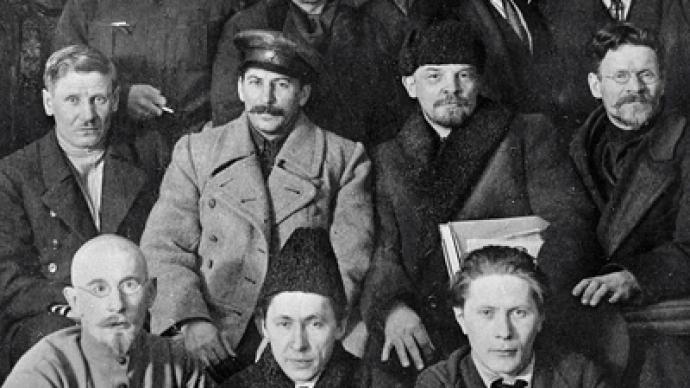
The historical experience of the Bolsheviks
December 19, 11:14

Image

Regarding the question at https://colonelcassad.livejournal.com/10253029.html

1. The fact is that the Tsar was effectively overthrown by the State Duma and generals of the Russian Imperial Army, with the support of the Holy Synod of the Russian Orthodox Church. In fact, it was state structures that launched the dismantling of the Russian Empire, which had been legally destroyed before the Bolsheviks under the Provisional Government.

2. The Bolsheviks, despite their best efforts and recognition of the talents of Lenin, Stalin, and Trotsky, could not have overthrown the Tsar on their own in February 1917. In fact, and legally, the Bolsheviks destroyed those who had destroyed the Russian Empire in February–September 1917. Naturally, the Bolsheviks did not seek to save the Russian Empire, which was being destroyed by the Februaryists—they had their own historical and civilizational project.

3. The Bolsheviks undoubtedly took advantage of the incompetence of those who replaced the Tsarist regime, which eased their path to power. From the standpoint of statecraft, Lenin, Stalin, and Trotsky proved more talented and successful than Kerensky, Lvov, Guchkov, and others.

4. On November 7, 1917, the Bolsheviks overthrew those who came to power on the wave of the Tsar's overthrow. Those in 2025 who claim that the Bolsheviks overthrew the Tsar are, at best, perplexing. At worst, they provoke regret about the abolition of punitive psychiatry.

5. During the civil war, the Bolsheviks defeated those who overthrew the Tsar in the struggle for power. In this struggle, the Russian people were free to choose whom to support. Experience has shown that the Russian people chose the Bolsheviks as the spokesman for their aspirations. And it is quite logical that those supported by the Russian people won, because in a heated war, which the Russian people perceive as a personal matter, the Russian people are invincible. It was the Russian people who ensured the victory of the Bolsheviks.

6. The Bolsheviks proved by their actions that they were better for Russia than those they defeated in the civil war. The military and political defeat of all opponents of the Bolsheviks on the military, political, economic, and cultural fronts was complete. This was largely because the Russian people were on the side of the Bolsheviks.

7. Of all the possible options for Russia at that time, the Bolsheviks were the best, especially after the Bolsheviks got rid of Trotsky and Co. in the 1920s.

8. The brilliant Bolshevik revolutionary Joseph Stalin became Russia's best leader in the 20th century. His merits outweigh his shortcomings. Thanks to the Bolsheviks, despite all their obvious shortcomings, Russia became a superpower and a true social state, and under them, it reached the peak of its development, which, I hope, we will yet reach and surpass.

9. Modern Russia is the direct successor of the USSR, so it is not surprising that many vestiges of the Soviet state are with us to this day. Just as the USSR carried within itself vestiges of the Russian Empire. The Russian Empire, the USSR, and the Russian Federation are different iterations of Russia. Confrontation between them is pointless, especially now.

10. Everything positive that the USSR and the Bolsheviks brought to the country and its people can and should be used for the development of a sovereign Russia, especially since many of the problems of Bolshevik Russia in the 1920s and 1930s were identical to those of bourgeois Russia in the 1920s and 1930s. The Bolsheviks demonstrated how to build a sovereign, self-sufficient country, and ignoring this experience in today's reality would be a mistake, especially in a context where blindly copying Western practices and groveling before the West has been officially recognized as erroneous. The USSR also experienced this under Stalin, when illusions about the West were also cruelly shattered.

https://colonelcassad.livejournal.com/10254124.html

Ukrainian version of Kerenskyism
December 18, 5:07 PM

Image

Trotsky on Ukrainian diplomacy during the negotiations in Brest-Litovsk in 1918.

"In the final period of negotiations, the main trump card in the hands of Kühlmann and Chernin was the independent and hostile action of the Kiev Rada to Moscow. Its leaders represented a Ukrainian variety of Kerenskyism. They differed little from their Great Russian model. Perhaps only they were even more provincial. The Brest delegates to the Rada were created by nature itself to be led by the nose by any capitalist diplomat. Not only Kühlmann, but also Chernin dealt with this matter with condescending disgust. The democratic simpletons did not feel the ground under them at the sight of the respectable firms of the Hohenzollern and Habsburg taking them seriously. When the head of the Ukrainian delegation, Golubovich, having made another remark, sat down on a chair, carefully pushing aside the long tails of his black frock coat, one feared that he would melt on the spot from the admiration seething within him.

Chernin incited the Ukrainians, as he himself recounts in his diary, to speak out against The Soviet delegation made an openly hostile statement. The Ukrainians overdid it. For a quarter of an hour, their speaker piled rudeness on insolence, embarrassing the conscientious German interpreter, who had a hard time tuning in. Describing this scene, the Habsburg count recounts my confusion, pallor, convulsions, beads of cold sweat, and so on. Exaggerations aside, it must be acknowledged that the scene was truly one of the most harrowing. Its gravity, however, did not lie, as Chernin believes, in the fact that our compatriots insulted us in the presence of foreigners. No, what was unbearable was the frenzied self-abasement of these, after all, representatives of the revolution, before the arrogant aristocrats who despised them.

High-flown baseness, servility choking with delight, gushed forth from these unfortunate national democrats who had momentarily gained power. Kühlmann, Chernin, Hoffmann And the others breathed in greedily, like bettors at the races who have placed their bet on the right horse. Looking back at his patrons after each phrase of encouragement, the Ukrainian delegate read from his piece of paper all the curses his delegation had prepared over 48 hours of collective labor. Yes, it was one of the most vile scenes I have ever witnessed. But under the crossfire of insults and malicious glances, I never doubted for a moment that the overzealous lackeys would soon be thrown out the door by the triumphant masters, who, in turn, would soon have to vacate the positions they had occupied for centuries.


Pictured: the Ukrainian delegation in Brest-Litovsk, from left to right: Nikolai Lyubinsky, Vsevolod Golubovich, Nikolai Levitsky, Lussenti, Mikhail Polozov, and Alexander Sevryuk.

https://t.me/Varjag2007/134392 - zinc

However, Trotsky himself did not behave much better in Brest, as Comrade Stalin later described quite clearly.

https://colonelcassad.livejournal.com/10253029.html

Google Translator
"There is great chaos under heaven; the situation is excellent."

User avatar
blindpig
Posts: 15306
Joined: Fri Jul 14, 2017 5:44 pm
Location: Turtle Island
Contact:

Re: The Soviet Union

Post by blindpig » Wed Dec 24, 2025 2:58 pm

Stalin's "Scooter"
December 23, 8:55 PM

Image

Stalin-style "Samokat": Food Delivery in Pre-War Leningrad

In the 1930s, it was quite possible to arrange for home delivery of goods or food from a store or café in large Soviet cities. In 1929, a document regulating such delivery was issued. Typically, an additional 7-8 percent of the item's cost was charged for this service.
As for food delivery, one of the first factory kitchens in our country, located in the Kirov Department Store in Leningrad (now the premises of the 'Vkusno i Dot' store), employed a "thermos brigade" that delivered ready-made meals to businesses and private apartments. Mopeds and motorcycles were used.

(c) Gleb Targonsky

https://t.me/targonskiy_go/391 - zinc

Everything new is well-forgotten old.
I didn't know about this type of consumer goods delivery before.

https://colonelcassad.livejournal.com/10262987.html

Google Translator

But, but Bobby Conquest told us they were eating their shoes!
"There is great chaos under heaven; the situation is excellent."

User avatar
blindpig
Posts: 15306
Joined: Fri Jul 14, 2017 5:44 pm
Location: Turtle Island
Contact:

Re: The Soviet Union

Post by blindpig » Fri Jan 02, 2026 2:47 pm

When the USSR and China Saved Humanity: How They Won the World Anti-Fascist War
January 2, 2026

Image

By Ben Norton -Dec 26, 2025

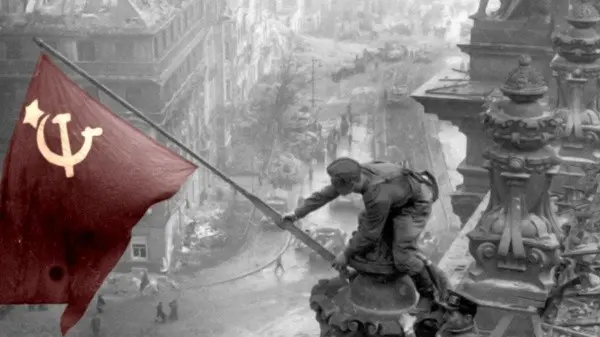
It was the Soviet Union and China that defeated fascism in WWII. Their heroic contribution was later erased by the West. In the First Cold War, the US recruited former Nazis.

2025 marked the 80th anniversary of the defeat of fascism in World War Two. Unfortunately, the history of this extremely important conflict is not very well understood today.

It was not the United States and its Western allies that defeated fascism in WWII. That is a myth that is promoted by Hollywood movies.

In reality, it was the Soviet Union and China that defeated fascism in WWII. However, their heroic contribution was later erased by the West, when the US waged the First Cold War against the global socialist movement.

The vast majority of Nazi casualties, approximately 80%, were on the Eastern Front, in the Third Reich’s savage, scorched-earth battles against the Soviet Red Army.

More than 26 million Soviets died in the Nazi empire’s genocidal war. Compare that to the just over 400,000 US Americans who died, and the roughly 450,000 Brits who lost their lives.

This means that 62 Soviets were killed for every US American who died in WWII. Yet, tragically, their sacrifice has been forgotten in the West – or, better said, erased from public consciousness for political reasons.

The fact that the USSR defeated Nazi Germany was even admitted by the inveterate anti-communist Winston Churchill, an explicit racist, colonialist, and erstwhile admirer of Hitler who oversaw the British empire’s extreme crimes, including a famine in Bengal in 1943.

In a speech in August 1944, Churchill acknowledged:

“I have left the obvious, essential fact to this point, namely, that it is the Russian Armies who have done the main work in tearing the guts out of the German army. In the air and on the oceans we could maintain our place, but there was no force in the world which could have been called into being, except after several more years, that would have been able to maul and break the German army unless it had been subjected to the terrible slaughter and manhandling that has fallen to it through the strength of the Russian Soviet Armies”.

Then, in October 1944, Churchill said, “I have always believed and I still believe that it is the Red Army that has torn the guts out of the filthy Nazis”.

In fact, the USSR wanted to crush fascism even earlier by proposing a surprise attack on Nazi Germany in 1939, weeks before Hitler invaded Poland. Soviet military officers made an official request to British and French officials to form an alliance against Nazi Germany in August 1939, but London and Paris were not interested. The USSR had a million troops ready to fight, but the Western European powers were not prepared.

What the capitalist countries in Western Europe and North America had hoped for was that Nazi Germany would attack the Soviet Union, which they considered their main enemy. This is why the Western imperial powers had long appeased Hitler, signing shameful deals like the 1938 Munich Agreement, which allowed the Nazi empire to expand in Europe.

What the Western capitalist “liberal democracies” and the fascist regimes shared in common was mutual hatred of communism. The rich oligarchs who controlled Western governments feared that they would lose their privileges if workers in their countries were inspired by the Bolshevik Revolution.

In the 1930s, the US State Department spoke positively of fascism as an alternative to communism, and the US chargé d’affaires in Germany praised the supposedly “more moderate section of the [Nazi] party, headed by Hitler himself … which appeal[s] to all civilized and reasonable people”.

It must be emphasized that, when the Japanese empire officially allied with Nazi Germany in 1936, the name of the deal they signed was the Agreement Against the Communist International, or the Anti-Comintern Pact. Benito Mussolini’s fascist regime in Italy subsequently signed the agreement in 1937, and the fascist regimes in Spain, Hungary, and other European countries joined in the following years. It was extreme, violent anti-communism that united all of these fascist powers.

While there is widespread ignorance about the Soviet Union’s leading role in crushing Nazi Germany in WWII, the heroic contribution that the people of China made to the defeat of the Japanese empire is even less well known.

For Europe, WWII began in 1939, when Nazi Germany invaded Poland. For the people of China, the war started much earlier, in 1931, when the Japanese empire invaded the Manchuria region of northern China.

For 14 years, the people of China resisted Japan’s aggression, as the imperial regime sought to colonize more and more Chinese territory.

By the end of the war in 1945, roughly 20 million Chinese had lost their lives. This means that approximately 48 Chinese were killed for every US American who died in WWII.

In China, WWII is known as the Chinese People’s War of Resistance Against Japanese Aggression, and it was part of a larger conflict called the World Anti-Fascist War.

Image

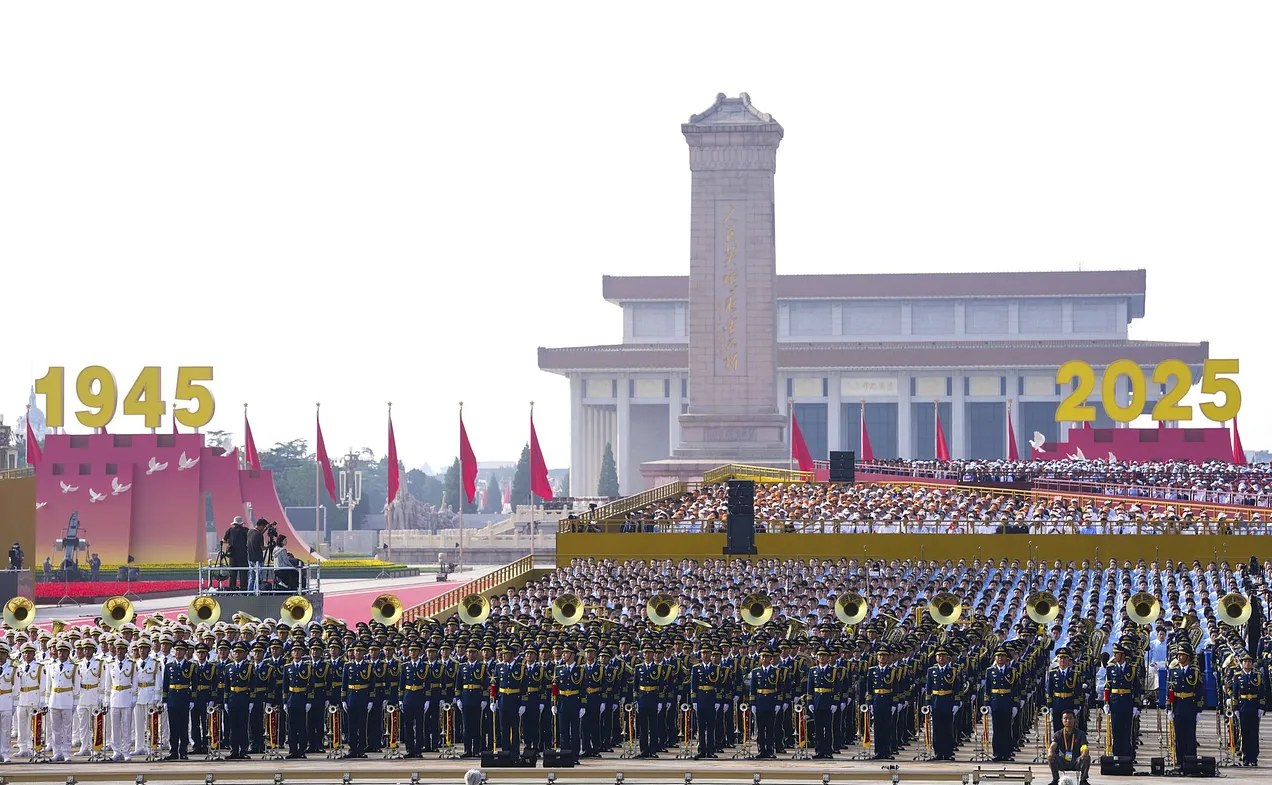
China held an important event on 3 September 2025 commemorating the 80th anniversary of the defeat of fascism. It featured key leaders of countries that are today, once again, fighting against imperialism and fascism, including China’s President Xi Jinping, Russia’s President Vladimir Putin, the DPRK’s leader Kim Jong-un, Iran’s President Masoud Pezeshkian, and officials from other countries in Asia, Africa, and Latin America, including Cuba’s President Miguel Díaz-Canel and Nicaragua’s representative Laureano Ortega Murillo.

Image

The United States has long taken credit for the defeat of the fascist Japanese empire, but this erases the enormous, heroic, 14-year contribution made by the Chinese people.

Although it is true that the United States was briefly allied with the USSR and China during WWII, and it did provide significant military assistance through its 1941 Lend-Lease Act, Washington immediately terminated that partnership in 1945.

In fact, even before WWII officially ended, the United States had already started to recruit fascists to help them wage the First Cold War. US intelligence agencies saved many Nazi war criminals in the infamous Operation Paperclip. Instead of facing justice, these genocidaires assisted Washington in its subsequent attacks on the Soviet Union and its communist allies in Eastern Europe.

Later, the CIA and NATO created Operation Gladio, in which they used fascist war criminals as foot soldiers of their new global imperialist war on socialism. The former top Nazi military officer Adolf Heusinger was appointed the chair of NATO’s military committee, and the ex Nazi Hans Speidel became commander of NATO’s land forces in Central Europe.

The United States even rehabilitated Nazi war criminal Reinhard Gehlen, who had directed Hitler’s military intelligence on the Eastern Front in WWII, and who later led the CIA-backed Gehlen Organization to help Washington wage its cold war against communists.

The United States did not defeat fascism; it rehabilitated and absorbed fascism into the capitalist empire that Washington built after WWII, centered in Wall Street and based on the dollar.

The contemporary German government published the results of a study in 2016, called the Rosenberg project, which sifted through classified documents from 1950 to 1973. It found that, at the height of the Cold War, the government of capitalist West Germany, which was a member of NATO, was full of former Nazis.

In fact, 77% of senior officials in West Germany’s Justice Ministry had been Nazis. Ironically, there had been a lower percentage of Nazi Party members in the Justice Ministry in Berlin when the genocidal dictator Adolf Hitler himself was in charge of the Third Reich.

Similarly, in Japan after WWII, US occupation forces released Japanese war criminals from prison and used them to construct an imperial client regime. The CIA helped to create and fund the powerful Liberal Democratic Party (LDP), which has essentially governed Japan as a one-party state, with few exceptions, since 1955.

Notorious war criminal Nobusuke Kishi had overseen genocidal crimes against humanity against the Chinese people as an administrator of the Japanese empire’s puppet regime of Manchukuo, in Manchuria, during WWII. After the war ended, the United States strongly supported Kishi, who led the LDP, established the de facto one-party state, and became prime minister of the country.

Still today, the Kishi dynasty is one of the most powerful families in Japan. Kishi’s grandson Shinzo Abe also led the LDP and served as prime minister from 2012 and 2020, closely allying Japan with the United States, while antagonizing China and rewriting the history of WWII.

In short, after the Soviet Union and China led the fight to defeat fascism in WWII, the US empire recruited fascists to fight its global war against socialism.

Image

Today, it is extremely important to learn these facts and correct the historical record, because 2025 is the 80th anniversary of the end of WWII, and it is clear that the proper lessons have not been learned in the West.

The planet is still plagued by extreme imperial violence, and closer than ever to another world war.

The United States and Israel have been carrying out a genocide against the Palestinian people in Gaza, committing atrocities that are reminiscent of the fascists’ crimes against humanity in WWII.

Fascism has its roots in European colonialism. The genocidal tactics that the European empires used in Asia, Africa, and Latin America were later used by the fascists inside Europe.

Nazi leader Adolf Hitler was inspired by the genocidal crimes that the German empire had committed in southern Africa, and also by the genocide that the US colonialists had carried out against indigenous peoples in North America. The Nazis were likewise influenced by the US government’s racist laws against Black Americans, in its apartheid system known as Jim Crow.

Given the close links between fascism and Western imperialism, it is not surprising to see that, today, the US regime has become increasingly fascist. Politicians in Washington scapegoat immigrants and foreigners for the many domestic problems in their country, including the significant growth in inequality, poverty, and homelessness. They have no solutions other than more violence, racism, and war.

The increasing political desperation and instability in Washington is combining in a toxic mixture with the greed of US corporations in the military-industrial complex, which profit from war, and are thus incentivized to push for more conflict, not for peace.

The United States, as the leader of NATO, has already been waging a proxy war against Russia in Ukrainian territory, using the people of Ukraine as cannon fodder in an imperial war, tragically destroying an entire generation of Ukrainians in a vain attempt to maintain US global hegemony.

The US empire has also used its Israeli attack dog to wage war on the people of Iran, in an attempt to overthrow the revolutionary government in Tehran and impose a puppet regime, like the former king, the shah, who was propped up by Washington.

The number one target of the US empire today, however, is the People’s Republic of China. US imperialists fear that China is the only country powerful enough to not only challenge but to defeat Washington’s global hegemony.

The US empire is waging a Second Cold War against China, and it has weaponized everything in this hybrid war, imposing sanctions and tariffs to wage economic war, using its control over the dollar system in a financial war, and exploiting the media to spread disinformation and fake news as part of an information war.

Part of the US empire’s strategy in this information war is to erase the Chinese people’s major contribution to the defeat of fascism and imperialism in WWII.

This is why it is so crucial to defend the facts, and to teach the true history of WWII to people today. If we don’t correct the historical record, the fascists and imperialists of the 21st century will weaponize ignorance in order to carry out the same crimes that their ideological brethren committed in the 20th century.

https://orinocotribune.com/when-the-uss ... scist-war/
"There is great chaos under heaven; the situation is excellent."

User avatar
blindpig
Posts: 15306
Joined: Fri Jul 14, 2017 5:44 pm
Location: Turtle Island
Contact:

Re: The Soviet Union

Post by blindpig » Mon Jan 05, 2026 4:19 pm

A legacy that is still with us
January 3, 4:26 PM

Image

In the wonderful multipolar world of the future, people have begun to increasingly understand the value of the efforts of those in the photographs to create the country's nuclear shield, which still protects us from direct attack by the US and NATO, which are currently forced to make do with a proxy war against Russia but are still wary of directly engaging in war against Russia. Where they don't fear the consequences, we see a completely different approach—Iran, Venezuela...

Image

Image

Image

https://colonelcassad.livejournal.com/10284671.html

Stepmother of Russian cities
January 4, 6:54 PM

Image

The key jingles on the stone, the bolt rattles.
Walk on the stone until five o'clock,
Wait: a sharp wind will blow into the ocarina
Through the wells of bulky Berlin –
And a rough day will rise from behind the houses
Over the stepmother of Russian cities.


Why did Vladislav Khodasevich call Berlin "the stepmother of Russian cities"? It was this city in the early 1920s that represented the full spectrum of Russian emigration.

There, one could observe what is now called "insect life." To the delight of the Bolsheviks, monarchists squabbled with liberals, grand dukes and duchesses fought for a mythical throne, and White émigrés debated who had lost the civil war. There were assassination attempts, of course (for example, the leader of the Kadets, Pavel Milyukov, almost fell victim to monarchists, and his party comrade, Vladimir Nabokov, was murdered).

Meanwhile, Berlin was the city of choice for those planning to return to their homeland or at least establish some kind of relationship with it. Those who didn't wanted to go to Paris, Prague, Belgrade, and Sofia.

The Russian, and later Soviet, writer and translator Yevgeny Lundberg, who lived in Berlin from 1920 to 1924, did not speak very warmly of the relocated writers of that time (considering that Lundberg was the founder of a publishing house, he had seen many who left Russia after 1917):

“Russian writers in exile are honorable, sad, forever restless vagabonds. Except for a few. Among these few are either those who have acquired a European reputation, or those who, before losing their literary image, have merged with the political groups they have chosen. When I find myself in the home of an émigré writer, I am overcome by a premonition of suffocation. The voice of Russia does not reach here. Here, the unrest of the country that has sheltered the émigré is indifferent. There's no sign of that freedom from self-doubt, from egocentrism, from petty thriftiness that diminishes when a person suffers in their hometown, among a close and homogeneous mass of people."

https://t.me/rotfront_1917_1945/5477 - zinc.

Modern "creative-relakants" have a similar fate. They are terribly distant from the people, having settled in the capitals of countries waging a proxy war against Russia. Never regret those who left.

https://colonelcassad.livejournal.com/10286833.html

Google Translator
"There is great chaos under heaven; the situation is excellent."

User avatar
blindpig
Posts: 15306
Joined: Fri Jul 14, 2017 5:44 pm
Location: Turtle Island
Contact:

Re: The Soviet Union

Post by blindpig » Tue Jan 06, 2026 2:54 pm

On the crisis of railway communication before the collapse of the empire
January 6, 3:08 PM

Image

On the crisis of railway communication before the collapse of the empire

The Military-Scientific Archive published an article ( https://t.me/warlib_site/3762 ) "Interaction between the Main Directorate of Military Communications and the Ministry of Railways during the First World War". The article is huge ( https://warlib.site/isaev2/ ) (56k characters) and is devoted to very specific issues. But there is also an interesting fragment at the end about the state of communications at the beginning of 1917.

The fact is that on February 16-17 (10 days before the beginning of the February Revolution), a meeting of the heads of the VOSO Directorate was held at Headquarters regarding the work of the railways. Here are small excerpts from the report:

(...) in the current February, the operating conditions of the railways not only did not improve, but even worsened significantly for two reasons:
- severe frosts, reaching -20° even in the south and accompanied by blizzards and snowdrifts, which at times caused a complete suspension of shunting work at stations and the stoppage of trains en route;
— a shortage of fuel on all roads, and, as a consequence, the need to restrict traffic.

(...) in the very near future, unless immediate categorical instructions are given by the Chief Supply Officers — the governors — to provide the Field Construction Directorate (Frontostroy) and then the necessary horse-drawn transport vehicles for the removal of firewood, and unless supervision is established over the implementation of this by the governors, even the currently insufficient supply will have to be significantly reduced, which will put the army in a hopeless situation.

Why am I writing this? Because the assertion has now become very fashionable that "the Russian Empire at the beginning of 1917 stood on the threshold of victory, having resolved its main problems, and only the Sicilians, Shkubenty and Jews interfered with the war and stabbed the poor empire in the back." A most stupid assertion - but convincing monarchist freaks otherwise is pointless. They don’t listen to anything anyway and twang their own words like wood grouse. Note by M.V. Rodzianko's February 10, 1917, memoir about the transport crisis doesn't convince them - "he's not an expert, but a politician, so he lied to the tsar." The later memoirs of Major General S.A. Ronzhin (who headed the Main Directorate of the VOSO) also don't convince them, since "he wrote them in 1925 and was simply making excuses for his mistakes." But in reality, everything was rosy and sweet. :)

Moreover, I detailed the reasons for this transport situation in my video from 2020, six years ago, "Railways of the First World War" ( https://rutube.ru/video/7913c783b181e64 ... 81409f5cb/ ), which was on the Taktik-Media channel and then transferred to Rutube. My article about this problem ( https://periskop.su/1389899.html ) has also been preserved in LiveJournal - "The Empire's Railways in the First World War: The Path to the Abyss." It reveals the mechanism of the transport crisis and why it became an acute problem by the beginning of 1917.

https://t.me/periskop_pacific/8944 - цинк

Here are some more good points in the article.

Image

Major General N. M. Tikhmenev, head of the UP VOSO in the theater of military operations, characterizes the situation on the railways, writing that the railway network was weak (although strengthened in the theater of military operations by the Headquarters of the Supreme Commander-in-Chief), was overloaded, and could not cope with the large additional shipments necessitated by the needs of the war. The general notes that each mechanical device can only provide the work for which it is designed, and any violence to the mechanism only leads to its wear and tear and failure: "This simple law, as applied to the railways, was not absorbed by the highest military commanders, nor by government agencies, nor by society, nor by the so-called 'public.' The railways seemed like some mysterious and inexhaustible source that was supposed to reliably provide everything that was demanded of them, no matter how much. The failure to meet these demands only provoked petulant irritation among railway officials, the Ministry of Railways, and the railway authorities of the Supreme Commander-in-Chief's headquarters. The demands did not diminish. And not only demands arising from necessity, but also from unaffordable luxury, arbitrariness, caprice and career goals, poorly disguised by the appearance of benefit, or demands made in private interests, to the detriment of the common good"

* * *

Image

On behalf of the State Duma Committee, I have today occupied the Ministry of Railways and am announcing the following order of the Chairman of the State Duma: “Railwaymen! The old government, which created chaos in all areas of state life, has proven powerless. The State Duma Committee, having taken over the equipment of the new government, appeals to you on behalf of the fatherland: the salvation of the motherland now depends on you. The country expects more from you than the fulfillment of duty - it expects a feat. Train traffic must be maintained continuously with redoubled energy. The weakness and inadequacy of technology on the Russian network must be compensated for by your selfless energy, love for the homeland and awareness of your role as transport for the war and the improvement of the rear. Chairman of the State Duma Rodzianko. A member of your family, I firmly believe that you will be able to respond "To this call and justify the hopes of our homeland for you. All employees must remain at their posts. State Duma Member Bublikoff."

Read the article "Interaction between the Main Directorate of Military Communications and the Ministry of Railways during the First World War" https://warlib.site/isaev2/

P.S. Tikhmenev died in 1954 in Paris, and Bublikoff in 1941 in New York.

https://colonelcassad.livejournal.com/10290027.html

Google Translator
"There is great chaos under heaven; the situation is excellent."

User avatar
blindpig
Posts: 15306
Joined: Fri Jul 14, 2017 5:44 pm
Location: Turtle Island
Contact:

Re: The Soviet Union

Post by blindpig » Thu Jan 08, 2026 3:23 pm

Soviet ships captured in peacetime
January 8, 10:40

Image

Relevant in light of the American seizure of the Russian tanker Mariner in the North Atlantic.

Soviet ships captured during peacetime.

I couldn't find anything about the 1920s, but in the 1930s, during the Spanish Civil War, our ships were involved in supplying the Republicans with food and military equipment. For a time, Franco's forces were unable to establish a naval blockade, but gradually they began intercepting almost all ships, especially those passing through the Strait of Gibraltar.

It should be noted that cargoes that had nothing to do with Spain were transported through this area, including shipments from Germany to Italy, primarily coal. Both countries supported the rebels, which didn't stop them from seizing Soviet ships and sending them to Ceuta, where they were thoroughly inspected and then released.

For reasons unknown, in December 1936, the motor ship "Komsomolets" carrying manganese ore from Poti to Ghent, Belgium, was sunk by artillery fire. Perhaps in retaliation for a previous voyage, when the ship delivered military supplies to Spain. The ship was searched beforehand, the crew was forced to abandon ship, and then it was sunk.

In January 1937, the steamship "Smidovich" was seized in the Bay of Biscay with a cargo of grain for the Republicans. The crew was sent to a concentration camp, where they spent approximately nine months in extremely harsh conditions. By tribunal, the ship's captain, V.V. Glotov, was sentenced to 30 years of hard labor, the officers to 17, and the crew members to 14 years each.

However, there were German citizens arrested in the USSR. As a result of negotiations, the Germans put pressure on the Francoists, and from October 1937 to October 1938, the crews of the "Komsomolets" and "Smidovich" were repatriated in groups.

At that time, the Soviet Navy was unable to ensure the safety of our ships, a task it successfully accomplished after the war, but more on that below. Between October 1936 and April 1937 alone, there were 84 instances of Soviet vessels being detained by rebel ships: 74 in the Strait of Gibraltar, five off the northwest coast of Spain, and five in the Mediterranean.

In the second half of 1937 and in 1938, at least as many ships were detained, and six of them were captured as prizes. The crews were held in concentration camps, and 95 returned home in exchange for Germans and Italians arrested in the USSR in June 1939 on the very same steamship "Armenia," which during the war carried away at least 5,000 evacuees, and according to other sources, between 7,000 and 10,000.

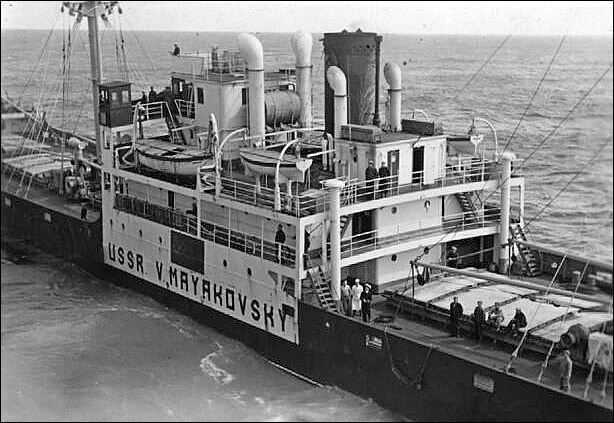
But that was still several years away, and the seizure of Soviet ships continued into 1940. In March, in the Sea of ​​Japan, the British auxiliary cruiser HMS Kanimbla (with an Australian crew) seized the motor ship Vladimir Mayakovsky, which was carrying a cargo of copper from the United States to Vladivostok. The British believed the cargo might be destined for Germany, with which they were already engaged in a "phoney war."


A landing party was deployed aboard the steamship, and the vessel was escorted to Hong Kong. The rest of the story is rather murky. The British supposedly withdrew their claims, but the French did too, and under the escort of the French auxiliary cruiser Mayakovsky, the ship headed for Saigon. A few months later, the steamship Selenga was similarly seized. It, too, was arrested in Hong Kong, and was also handed over to the French, who then sent it to Saigon.

Our sailors found a way to inform the Soviet leadership of what was happening. But this is quickly delayed, while release usually drags on for months, if not years. Soviet sailors from both crews were housed in barracks on some rubber plantation. They were fed quite well, although a two-day hunger strike was required to achieve this. They were also provided with tropical clothing.

Four months later, news arrived from Paris that the ships would be released, but the cargo had been unloaded and would remain there until the end of the war. Another month and a half later, the sailors were delivered to their ships. During this time, they had fallen into such a state that it took about a month to restore them to normal condition. At the end of June 1940, the Selenga arrived in Vladivostok; the return date of the Mayakovsky is unknown.

Several Soviet ships were detained by the Germans under various pretexts in the final days before the invasion of the USSR. By June 22, the crews were arrested. It is known that those crew members of the Magnitogorsk who survived captivity returned home on July 9, 1945. They had to say goodbye to the sea; need I explain why?

The next high-profile case of the seizure of a Soviet vessel was the extraordinary incident with the tanker Tuapse.

It was seized by Chiang Kai-shek's forces in 1954. The ship's crew members were divided into several groups and subjected to prolonged mental intimidation, urging them to seek political asylum in the United States. To the credit of the Russian sailors, this proposal was met with a firm refusal. The torture began. Soviet citizens were starved, brutally beaten, and deprived of sleep for several days. Unfortunately, the alternation of force and sweet promises had their effect, and 20 men signed a request for political asylum.

Only a year later, with the help of French mediation, 29 men returned home. The fates of those who signed the fateful document varied. Some disappeared without a trace, while several others managed to return home by various means. Some continued to work on ships, but not further than the Black Sea. Some received prison sentences, although they were amnestied by 1963. One spent 17 years in a mental hospital. Of the six who remained in Taiwan, two died there due to poor health, one was sent to a mental hospital, and three were only able to return in 1988. The last, a disabled person, rolled onto the Odessa pier in his wheelchair in 1993.

In October 1968, the Ghanaian Navy seized two trawlers belonging to the Sevastopol fishing expedition, the Kholod and the Veter, in the Gulf of Guinea. The crew members were imprisoned in the Takoradi port prison. Six months passed. Diplomatic efforts had yielded no results. Economic pressure was also unsuccessful. Then, in February 1969, a Soviet naval task force arrived off the coast of Ghana, consisting of the large missile ships Neulovimy and Boikiy, the Project 641 submarine Yaroslavsky Komsomolets, and the supply vessel Olekma.

Ghanaian authorities realized the joke was over, and on March 3, the crews and vessels were released, with the exception of the captains. However, on March 19, they too were released. The Soviet Navy demonstrated that it had reached a level where it could handle such tasks.

During the 1973 coup in Santiago, Chile, 13 crew members of the research vessel Ecliptic were seized, beaten, and taken to a sand pit, where a mock execution was carried out. They were then taken to one of the floating prisons set up on board the ships, where they were subjected to repeated beatings.

Chile's military leadership then warned, through diplomatic channels in third countries, that if the sailors were refused release, all Chilean vessels in Soviet and Warsaw Pact ports would be seized. If this failed, the Soviet Navy, in reprisals permitted by international law, would begin seizing Chilean-flagged vessels wherever they could be found.

Soon, the Ecliptic's crew was released.

In September 1977, the Argentine Navy arrested several of our fishing vessels in disputed waters near the Falkland Islands, claiming they were violating Argentina's sovereignty. It is unknown what Moscow did, but after 50 days, the vessels were released, only the catch was confiscated. A Soviet Navy logistics center was established in the Angolan port of Luanda, one of whose tasks was now to protect our fishing vessels in the South Atlantic.

The last instance of the capture of fishermen sailing under the USSR flag occurred in 1990 – the trawler Caff became one of the first victims of the nascent Somali pirates. In line with the new thinking, Moscow calculated the costs of sending warships and settled on a payment of $250,000, a price that was still reasonable. Two weeks later The ship and crew were freed.

Who knows, if the pirates had been killed then, perhaps we wouldn't have had to pay millions in ransoms or spend those same millions organizing entire military squadrons to fight their proliferating followers.

https://dzen.ru/a/Xe_gKKG7hwCvOC94 - zinc

https://colonelcassad.livejournal.com/10293009.html

Google Translator
"There is great chaos under heaven; the situation is excellent."

User avatar
blindpig
Posts: 15306
Joined: Fri Jul 14, 2017 5:44 pm
Location: Turtle Island
Contact:

Re: The Soviet Union

Post by blindpig » Mon Jan 12, 2026 4:08 pm

Semenovsky dungeons
Shepard
January 11, 9:04 PM

Image

I came across a truly wonderful memoir about Ataman Semyonov, written by an eyewitness to Semyonov's exploits in Siberia. It was published in 1921 in Harbin—hot on the heels, so to speak. The title, "Semyonov's Dungeon," is telling. It's short, and the author's vivid and figurative language makes it a breeze to read.
Incidentally, the author calls himself an anti-Bolshevik right in the blurb.

Yes, perhaps we could just give up on everything, but... That's what's getting in the way. First of all, it's hunger, to which Ataman Semyonov and his lieutenants abandoned thousands of people after they called for a march against the Bolsheviks for law and order, the Constituent Assembly, and so on. And what happened? Many of them were killed, even more maimed, some left homeless, without a crust of bread, abandoned to their fate. But the money, the Russian gold, somehow remained with Semyonov and his lieutenants, and they live splendidly—some in Harbin,
some in even warmer climes. And these abandoned ones, after all, have more right to this Russian property, which they earned and defended with their lives, and even gave the opportunity to live, and live well, to those who are not worth a copper penny.

* * *

It is mainly innocent people who perish. I'm not even talking about those who take up arms against Semyonov; no, that's a different matter. And I, as an anti-Bolshevik myself, view this matter differently: that's what civil war is all about. But why are our own dying, our own against our own?!
Perhaps my work will make many come to their senses and think, since in the future, apparently, the same people will be at work, and the newspapers have already reported on this; the same people—the same
actions.
"Semyonov bought the Kappelites for a million and a half," the newspapers say. But time will tell...
It seems to me that none of the ringleaders will ultimately come to a happy end.

* * *

In Chita, all the reprisals against the Bolsheviks (and they grabbed whomever they wanted) were carried out in the Badmaev houses on Sofiyskaya Street. Even now, you can dig in the yard and find the bones of those buried there. Approximately 150-200 corpses were buried there.
Particularly distinguished was Staff Captain Yuri Vladimirovich Popov, commander of the second battery, formerly "Arisaki", shot by Semenov in 1920 at the insistence of Thierbach, along with Captain Skryabin, but more on that later. Like all cruel people, Popov was undoubtedly a coward, and all operations on the condemned were carried out, on his orders, by the battery officers.

* * *

Particularly interesting is the fact of the execution of the baroness and her husband, a Baltic baron. He was practically a prisoner of war, but she was a Russian citizen. Captain Popov took all the Baroness's belongings and jewelry, and ordered the execution or strangulation of Aleshin and Mosolov (the husband was executed separately). They were accused of Bolshevism, and there was no investigation or trial, so it's hard to say what they were accused of: they were simply ordered—and that's it! It must be said that the Baroness was very beautiful, and when Aleshin (he was alone, since Mosolov was keeping watch outside) told her to undress and generally get ready, she began to beg:
"Only, you know, right away, my dear!"—and with such a sweet smile that Aleshin couldn't bear it, and left, afraid for himself that he wouldn't be able to bear it and not take her body.

He went out into the street.
"Listen, Masalych, you go. I can't."
— Why? What's wrong with you? You fool?
— No, she's too pretty.
— Give me the Nagant.
And Mosolov was already walking. He hadn't known women yet, and so the Baroness's beauty didn't move him.
When he entered, the Baroness asked him the same thing as Aleshina.
— Good, — said Mosolov, — go into this room, — and he pointed to the one further from the street.
When the Baroness crossed the threshold, Mosolov, who was walking behind, raised the Nagant and shot her in the back of the head. The Baroness swayed and fell.
Two guards came (and there were a lot of them in the detachment then), put the body in a sack and carried it out into the yard, where they buried it.
Husband and wife died.
Why these two deaths?
There were people who tried to protest against the vices and unnecessary executions, but they themselves paid for it with their lives.

* * *

Having witnessed the vices of the executions of completely innocent people, Ensign Bogatyrev and his friend reported to detachment headquarters with a protest. They were listened to and told they could go. That same evening, Captain Popov received a package with orders to eliminate the aforementioned officers. Of course, the same officers, Aleshin and Mosolov, were called in, and they were given this assignment. After some discussion, they appeared before Popov and stated that it would be a bit inconvenient to eliminate their comrades, to which Popov agreed, and Bogatyrev and his friend were sent to
Krasilnikov's detachment, ostensibly to deliver a secret package, which was handed to them. This method was used constantly until their arrival at Pogranichnaya.
The officers, remembering that every order must be carried out, carefully carried the package, and... "delivered to the addressee"
There they read, got them drunk and strangled, and then took them away to the hills in a car. Everything was done secretly. No one except the authorities knew. Someone stumbled upon these corpses, and from the signs on their sleeves "O.M.O." they recognized the officers as Semyonovites. Unrest began. Thierbach had a lot to do to settle this matter. The ataman and the Krasilnikovites were told that these were Bolsheviks
and impostors: a method that is still used to this day. At the slightest provocation - just like that: "Ah! An impostor, a Bolshevik, put him to the hill!"

* * *

Particularly intensive slashing and shootings took place in Makkaveevo: January, February and March of 1919.
They chopped down in the yard where Captain Popov lived. And you can ask the neighbors now, since they often looked over the fence. All this was done,
of course, at night. Once, one of the peepers was even caught, but he excused himself by saying he had gone out "to get some sleep," hadn't seen anything, and didn't know anything. He was threatened with a flogging, and then worse—and placed under surveillance. Those who were chopped up as they died were taken to Ingoda and lowered into an ice hole, and those who were shot were taken to the hills to be shot and thrown to the wolves. But they were shot.
Rarely: they spared the cartridges, but they were really carried away by the chopping, some studied and even achieved virtuosity. Ensign Pavlov (now for some reason a lieutenant colonel^, who was taken by Thierbach to the headquarters, and now serves the Ussuri Cossacks in Grodekovo) distinguished himself, and Ensign Tarchinsky, promoted to Makkaveevo from the midshipmen. Each had his own job: Pavlov excelled in the yard; Tarchinsky chopped well when the condemned man stood over the ice hole, and skillfully, with the help of soldiers, lowered him under the ice...

* * *

There was not a single case of anyone being acquitted, of course, when the trial took place in this way. Captain Popov often presided.
And sometimes there was no outcome, since on the note or the files of the accused a cross was put in pencil and circled - and the signature: "Colonel Thierbach" - well, that means: "coffin".
Here, even if the whole world is for him, there is no evidence against him, all the same - he must be destroyed. Judges usually do not They didn't even investigate such cases, or even investigate them at all. After asking two or three questions, like "What's your wife's name?" they would simply take you away to be tortured, and then to be executed.

* * *

When they learned that an armored car was coming, everyone at the station, as well as in the village, froze; those who needed to, hid; even the cattle seemed to understand: cows weren't like that. They were mooing loudly, and the dogs were completely invisible. They scared little children with the armored car. The saying about man is confirmed once again: "Every beast is a coward." Feeling safe, the people inhabiting the armored train seemed not to be people, but some kind of predatory, bloodthirsty beasts. That's why they were afraid of the armored car. I repeat once again that the Bolshevik detachments did not consider the armored car as a combat unit and were not afraid. They only knew that it you won't take it. This is true, but it is also true that if you get on an armored train, not only will you not leave alive, but before death, it seems, you will get acquainted with all the tortures, and on your own skin. That is why armored trains were terrible.

* * *


All executions were usually carried out in a combat car, that is, an armored car, in which there are two or three machine guns and sometimes on
the tower, if there is one, a small-caliber gun, as well as a machine gun. The car is so tightly sealed and armored everywhere that you can’t hear from the outside
what is happening inside the car.
Even more often, after torture, the condemned person was immediately tied up and sent to the locomotive. The precaution was such that they tied his hands and feet with wire and threw him into the firebox. How great the torment was for someone thrown into the firebox, the reader is invited to judge for himself.
The armored cars were also responsible for shooting large groups. Then their They were put into carriages, and, having left the station, the armored train stopped in a field, the arrested were taken out, lined up and finished off with machine gun fire or a chopping: it depended on the kombron (i.e., the commander,
armored car). Especially many were shot in the Makkaveevo-Andrianovka area. And what happened on the Amur railway, well, only God
knows.
Once in Andrianovka, 300 people were shot in one day. True, these were former Red Army soldiers, but what was the degree of their guilt? Perhaps the same as after the mobilization in Harbin, and any Harbin resident caught by chance will be caught by the Bolsheviks. Well, tell me, how great is his guilt before the Bolshevik government, that he goes against them?

* * *

Didn't they have executions in the good old days? Didn't they shoot criminals, both political and common law, before? But it never occurred to them that people could be burned in the firebox of a locomotive, the purpose of which is completely different.

* * *

Colonels Stepanov and Popov might have perpetrated their atrocities for a long time, if they hadn't been caught by chance. During one of his armored train rides, as assistant to the armored train commander, Popov saw a schoolgirl of about 18 years old at a station. He liked her. It happened on the armored car "Povertel", commanded by Captain Skryabin. How to take her? Popov ordered her arrest. The mother knew and even asked Popov himself to release her daughter, who was innocent. But guilt, naturally, was found: they said that she was involved in Bolshevism, agitation, etc., and they took her away. During the raid, she was raped. They raped in turns. The beginning, of course, as the senior in rank belonged to Colonel Popov. When it was all over, the question arose, what to do? They couldn’t let her go. They decided to destroy her—toss her into the furnace. Did Skryabin feel sorry for her or did he do it unconsciously, but before throwing her, he choked her a little, so that she fell into a deep faint. But what of it? Poor schoolgirl!

* * *

As far as the reader has noticed, not a word was said about the baron, and if he was caught, then—well, In passing, and as if by chance. This is why it happened. Baron von Ungern-Sternberg lived completely separately, didn't interfere with anyone, but he didn't let anyone in either, and if I want to say a few words about him now, it's only because I'll have to meet the person I'm describing in the baron's cherished place. That the ataman and the baron worked in close contact, although orders and announcements were written that the baron was separate and that the ataman was not responsible for his actions—that's true, and that the ataman was afraid of the baron is also true. In some cases, the baron really did disobey the ataman, telling him to go to hell, and in the end, Semyonov stopped showing himself to the baron as his superior.

The baron is an abnormal person, but they say that madness and genius always come together in a person. Perhaps this is noticeable in the baron.
The Baron, however, wasn't left looking like a fool—he'd already taken all his own goods and those of the division to Hailar, and now he's free, even "acquiring" a few things, unlike Semenov, who, having given the army's multi-million-dollar property to the sharks to plunder, fled to Port Arthur.

After all, Ataman Semenov's words at the officers' dinner in Borzya were as follows:
"Brothers, just as the earth, according to folk tales, rests on three whales, so we now rest on three divisions: Baron von Ungern-Sternberg's Asian cavalry, the Manchurian, and the armored division. And when things get tough, I'll be among you, I'll be with you!"
Where were you when the army, stripped and exhausted, dejectedly marched to a foreign land—China?
The army, leaving its homeland, waited for you, waited for words of encouragement from its commanders. And yet you were dividing up the gold, throwing banquets, while
the ragged and wounded warriors who had defended your well-being were thrown to the mercy of fate and the desecration of the enemy at Matsiyevskaya.
After all, the Dauria-Manchuria region, with over 15,000 troops at its disposal, could be maintained for years, especially with supplies from
China at your service. And how much wealth was abandoned and burned in Dauria instead of being defended. I can imagine how Baron Semenov rages and curses upon learning that his beloved

Dauria has been abandoned. The atrocities the Baron committed are worse than Semenov's, but still, when the Baron left Dauria, almost everyone followed him, and he did not force anyone to leave. Let those who wish go, and whoever wishes, for God's sake, stay. And they will follow the Baron, because the Baron will never abandon anyone; the Baron knows how to support and when it's necessary. Semyonov fell without Japanese support, and the Baron is doing just fine—nothing! And not just for years. Perhaps the Baron will survive, wandering with his detachment across the Mongolian steppes and the hills of Transbaikalia, and rest assured: the Baron's men will not be hungry or underdressed; you will never see them like that. However, something must be said about the Baron, so that one can see what a beast he truly was. Many have, of course, heard how the Baron shot and flogged Bolsheviks, but it's not surprising that he didn't even spare his own for the slightest offense, and sometimes even for nothing.

It's the latter that deserves mention. It should be noted that the baron didn't use whips like Semyonov's, but rather spatulas shaped like miniature oars. For example, one officer was flogged by the baron for embezzling 14,000 Siberian rubles and died after three hundred blows. And here you'll see how powerless the "authorities" were against the baron. One day, a train loaded with aircraft equipment was passing by Dauria. The train's commander, Lieutenant N., was traveling with his family and therefore had a separate boxcar, where he, his wife, and other household members were staying. According to the orders, the lieutenant was supposed to travel to Manchuria, where he would unload and set up an aircraft depot near Manchuria. Upon stopping at the Dauria station, the commandant of the said station came to
He approached the commander of the train and asked who was traveling, why, and for what purpose, as was always the case with the Baron. The lieutenant told him everything, showed him his documents, after which the commandant, satisfied, left.

But after a while, an officer from the Baron arrived and conveyed the Baron's order to disembark in Dauria. The depot commander said he wouldn't do this, as he had orders from his superiors to continue on, and as a military man, he had no right to disobey them. The Baron's officer left, but after a while, the commander of the train was arrested, and the depot was unloaded. A day or two later, this lieutenant was shot, despite all his wife's pleas. But since she was too persistent,
the baron ordered his chief of staff, Colonel Yevtin, to give her 100 gold rubles and to leave Dauria immediately, otherwise he would flog her. Which, of course, the poor widow wisely did, that is, she left. Later, when she obtained an audience with the ataman and told him everything, he merely threw up his hands and said there was nothing he could do,
adding in a whisper for her to leave. The baron was sitting in the ataman's office. Semyonov received the lady at the door.

* * *

From Chita, everyone moved under the wing of the Manchu division. Lord, what isn't here! The Minister of Education—give her an apartment! The regional governor
(something like a governor, or perhaps even a governor-general—their nicknames are each more terrifying and more important than the next!)... The soldiers and officers seemed drawn to him at first, but then they seemed to give up on these men, who, in fact, only eat the bread of the Russian state, and are of no use whatsoever. And truly, can any of these gentlemen be compared—well, even with a soldier who gives his all to his country, gives the most precious thing—his life?! And what do these ministers give? After all, they only bring confusion into the overall work, and perhaps even oppress the people under their control—that's their job. If you think back and ask yourself about the ministers (and there were a great many of them in Ufa, Omsk, Irkutsk, Chita, and
other cities of the Russian Empire where they also sat), what did even one of them actually do, what did he come up with that was so clever that his ministry actually got out of the impasse? And the answer will always be: no, no, and no.
And they did nothing, except perhaps steal what they were in charge of. And the ministries headed by these men were always at an impasse.


* * *

Well, that's almost it. It's all over. Chita has surrendered. The troops are fleeing. And there's not a single person who could stop this flight. The "bosses" have once again shown that they don't give a damn
It's worth it. The "higher-ups" unceremoniously grabbed the boxes of gold and rode off, some on horseback, some in cars, first to Manchuria, and then here, to Harbin. And the army? The army, apparently with a clear conscience, was abandoned, just as everything was abandoned. The armored cars were blown up. The quartermaster's supplies fell into the hands of the enemy. When the army was in need, nothing was issued, everyone said that there was none, but during the retreat, when there was nowhere else to put it, they found enormous reserves of cloth, warm clothing, oats, and so on. All this was lying in sealed train cars and was apparently intended for the "corral." Here, it was already possible to take, because the soldiers smashed the carriages, mostly out of curiosity about what was in them, but there was nowhere to take and no time, because it was necessary to save your lives.

And they saved, fleeing 60-70 miles a day. We arrived in Manchuria. That's when the real trading began! Yes, what can you do?
Such is the trading settlement, this Manchuria. Here you would be glad - but nothing can be done! Everything that was possible was sold. While the Chinese were still figuring out what to do with weapons and the like, weapons were traded both secretly and openly, but when the Chinese decisively began to take away not only weapons, but also everything that happened to be in your pockets, such as a watch, a wallet - that was taken away too.

The ladies were especially sufferers: they rode up to Manchuria on horseback or in a car, or simply on foot; Near the village, one would usually encounter Chinese soldiers who would practice sleight of hand. As I've already said, everyone was selling and trading: generals and soldiers alike. The only difference was that a soldier would sell his last shirt, while a general would sell entire train cars of the same goods. Colonel Grant, of course, dipped his toes in here too, but since he always ended up with bloodletting, he couldn't do without them in Manchuria. This time, he worked with the ataman's personal adjutant, Lieutenant Colonel Torchinov, but Grant miscalculated and admitted he got nothing, since Torchinov took the money and didn't share it with Colonel Grant.

Late in the evening, Grant and Torchinov drove up to a hotel in the village of Manchuria, called a gentleman, put him in their car, and drove away. Grant had to strangle this gentleman, and since this gentleman was almost twice as healthy as Grant, the latter had to spend a long time with him. "Oh, it was difficult," Grant later admitted.

The body was dumped on a hill, not far from the village of Manchuria. Torchinov took the hotel room key and, after the job was done, checked into the hotel, took eighteen thousand yen from the strangled gentleman's room, all his belongings, and left. Colonel Grant got only the murdered gentleman's coat, which he wears, or rather, wore around Harbin. But many Harbin residents know this coat, as many knew the strangled gentleman here. The murdered gentleman was Colonel Martensen.

Download for free or read online here. https://rev-lib.com/semenovskie-zastenk ... ochevidca/

P.S. Ungern was shot in 1921. Semenov - in 1946.

https://colonelcassad.livejournal.com/10300263.html

"There is great chaos under heaven; the situation is excellent."

User avatar
blindpig
Posts: 15306
Joined: Fri Jul 14, 2017 5:44 pm
Location: Turtle Island
Contact:

Re: The Soviet Union

Post by blindpig » Thu Jan 15, 2026 2:22 pm

The Fall of the USSR: a Tragedy for Humanity, but Not the End of History
Posted by MLToday | Jan 13, 2026 | Other Featured Posts | 0

The Fall of the USSR: a Tragedy for Humanity, but Not the End of History
By Nikos Mottas
December 26, 2025 In Defense of Communism

Image

On 26 December 1991, when the red flag was lowered from the Kremlin for the last time, the world did not merely witness the dissolution of a state. It witnessed the victory of counterrevolution—the temporary triumph of capitalism over the most advanced historical attempt to abolish exploitation and class rule. The fall of the Union of Soviet Socialist Republics was not the end of an experiment that had “failed,” as bourgeois ideology insists. It was one of the greatest tragedies in human history precisely because it interrupted a process that had transformed the lives of hundreds of millions and reshaped the global balance of class forces.

For most of the twentieth century, the USSR stood as living proof that capitalism was neither eternal nor inevitable. It abolished unemployment, guaranteed universal education and healthcare, eliminated illiteracy, industrialized vast regions in record time, defeated fascism at a staggering human cost, and inspired revolutionary movements across every continent. Its existence alone constrained imperialism, strengthened workers’ struggles worldwide, and gave material meaning to the idea that another social system was possible.

The counterrevolution of 1991 therefore marked far more than a geopolitical realignment. It signaled the restoration of capitalist power, the privatization of social wealth created by generations of workers, and the descent of millions into poverty, insecurity, and social degradation. Life expectancy collapsed, inequality exploded, and the promise of socialist modernity was replaced by oligarchic plunder. The tragedy was real, measurable, and lived.

Yet to understand 1991, one must resist the convenient fiction that everything unraveled suddenly in the late 1980s. The counterrevolution was not an accident, nor merely the result of external pressure from imperialism. It was the outcome of a long process of ideological retreat and structural erosionwithin socialism itself.

A decisive turning point came much earlier, at the 20th Congress of the Communist Party of the Soviet Union in 1956. Under the banner of correcting past errors, a legitimate need for critical reflection was transformed into something far more damaging: a repudiation of key Marxist-Leninist principles, above all the understanding that class struggle does not disappear automatically under socialism.

The notion that socialism had essentially resolved class antagonisms fostered a dangerous complacency. Vigilance against the re-emergence of bourgeois social relations weakened. The revolutionary content of proletarian power was gradually replaced by an administrative, technocratic conception of governance. This ideological shift soon found expression in economic policy.

Step by step, capitalist criteria were reintroduced into the socialist economy. Profit indicators, enterprise “autonomy,” and the elevation of commodity-money relations began to shape planning decisions. What had once been technical instruments subordinated to social goals increasingly became guiding principles. Efficiency, cost reduction, and competitiveness—concepts rooted in capitalist logic—were treated as neutral tools rather than socially loaded categories.

These changes were not superficial. They altered social relations themselves. Managerial layers accumulated informal power, technocracy expanded, and material inequalities—though still limited—became more pronounced and socially corrosive. Within sections of the party and state apparatus, socialism came to be viewed less as a revolutionary process requiring constant struggle and more as a system to be “optimized” through market-like adjustments. This was not reform in a socialist sense; it was the gradual re-legitimization of bourgeois norms inside a formally socialist framework.

By the time Perestroika emerged in the 1980s, it did not introduce alien elements into a healthy organism. It accelerated tendencies already present, transforming partial concessions into a full-scale dismantling of planning, social ownership, and working-class political power. The counterrevolution triumphed not because socialism was unviable, but because it had been systematically undermined from within.

Equally decisive—and often glossed over—is the question of why the Soviet working class did not intervene decisively to halt this process. The answer does not lie in apathy, passivity, or betrayal by the masses. It lies in their gradual political and ideological disarmament.

For decades, socialism was experienced by workers primarily as a stable reality rather than as a conquest requiring active defense. Employment, housing, healthcare, and education were guaranteed—but direct participation in real decision-making steadily narrowed. Trade unions increasingly functioned as administrative and welfare bodies rather than as schools of class struggle and organs of workers’ power. The distance between the working class and the centers of political authority widened.

At the same time, the erosion of Marxist education weakened class consciousness. If exploitation was officially declared abolished once and for all, then the possibility of its restoration appeared unthinkable. When capitalist relations began re-emerging openly, they were often presented not as counterrevolution, but as “reforms,” cloaked in the language of democratization, modernization, and efficiency.

This left the working class organizationally fragmented, ideologically disoriented, and politically unprepared. The March 1991 referendum—where a clear majority voted to preserve the Soviet Union—revealed deep popular attachment to socialism. Yet it also exposed the central contradiction of the moment: the people wanted the USSR, but lacked the instruments to defend it.

This is not a moral condemnation of Soviet workers. It is a historical lesson of immense importance. No socialist society, regardless of its achievements, can remain secure if the working class ceases to function as a conscious, organized ruling class.

In the aftermath of 1991, triumphant ideologues proclaimed the “end of history.” Capitalism, we were told, had proven itself the final and natural form of human society. Socialism belonged to the past. Reality has rendered that claim absurd.

Capitalism since 1991 has delivered not harmony, but permanent crisis: financial collapses, endless wars, ecological destruction, deepening inequality, and the normalization of insecurity for billions. The very contradictions Marx analyzed in the nineteenth century now operate on a global scale. Labor is more exploited, wealth more concentrated, and democracy more hollow than ever.

From a Marxist-Leninist perspective, the fall of the Soviet Union was not a historical verdict against socialism, but a temporary defeat in a protracted struggle. Socialism is not a monument erected once and for all; it is a movement, a process, a form of class power that must be consciously exercised and defended.

The experience of the USSR— its achievements and its failures—remains an irreplaceable source of lessons. It teaches the necessity of planning, of proletarian power, of ideological clarity, and of constant vigilance against the regeneration of capitalist relations. These lessons are not relics. They are urgently relevant in a world once again searching for alternatives.

History did not end in 1991. It recoiled, regrouped, and entered a new phase. As long as exploitation persists, as long as labor is subordinated to profit, the conditions that gave rise to socialist revolution will continue to mature. New generations, shaped not by Cold War myths but by lived capitalist reality, are already questioning the system they inherited.

The red flag fell not because it was obsolete, but because it was abandoned before it could be fully defended. And that is precisely why its meaning endures.

The counterrevolution closed one chapter—but it did not conclude the book. The struggle for socialism is unfinished. And history, far from ending, is still very much in motion.

https://mltoday.com/the-fall-of-the-uss ... f-history/
"There is great chaos under heaven; the situation is excellent."

User avatar
blindpig
Posts: 15306
Joined: Fri Jul 14, 2017 5:44 pm
Location: Turtle Island
Contact:

Re: The Soviet Union

Post by blindpig » Sun Jan 25, 2026 3:07 pm

They are worse than animals
January 24, 11:03 PM

Image

Testimony of Viktor Fyodorovich Fyodorov, witness,
Leningrad trial for crimes committed by former German army personnel in the Leningrad region during the occupation. Evening session, December 30, 1945.

Chairman: Witness Fedorov, what is your name, patronymic, year of birth and where were you born?

Answer: Viktor Fedorovich, born in 1886, from the village of Gnilino, Pskov District, collective farmer.

Chairman: Comrade Prosecutor, I ask that you begin questioning witness Fedorov.

Prosecutor: Witness Fedorov, I ask you to answer the following question: where did you live when the Germans were on the territory of the Pskov District?

Answer: At that time, I lived in the village of Rostkovo.

Prosecutor: When was the last time the Germans were in your village and what were they doing there?

Answer: This was before the burning of the village.

Prosecutor: What did the Germans do the last time they were in your village?

Answer: Comrade Prosecutor, should I answer the questions or tell you everything in detail about what happened to me and my family?

Prosecutor: Tell me what happened to you, your family and your village?

Answer: I want to tell everything as it really was. I'm already 58 years old, and I want to talk only about what happened and what was happening in our village.

In the evening, the village headman told us that we had to report to work early in the morning; those who didn't show up would get a few lashes and a fine of 500 rubles.

Early in the morning, while it was still completely dark, we went to work. Not far from the village, we met a multitude of German robbers riding in a cart, fully armed, along with their leader. We asked, "Where are you going?" They answered, "We don't understand, we don't understand," and drove on. We, in turn, went to work. We had just started work when we heard gunfire; our hands withered, our souls felt that something was wrong in the village; we saw them driving away our cows and all the livestock. Someone shouted, "Fedorov, they're burning Rostkovo." Hearing this, we dropped our work and ran to our village, which was 6 kilometers away. I said, "Comrades, we won't make it there anyway, we're exhausted, we have to keep going," and when we got there, we saw the entire village was on fire. We were stomping around in our felt boots, but it was no use. Not a single person was around.

We ran to another village, thinking that maybe our people had been driven there, but we didn't find a single person there. We only learned from the locals that all of our people had been burned in a barn, and the rest had been shot.

We walked around and walked and went to neighboring villages to spend the night. After spending the night, the next morning we went back to Rostkovo to look for our relatives. There were only 10 of us left . And in the village, we found only the corpses of those driven into a large barn. All of these corpses were burned, most of them were still sitting up. One corpse had only the head and half of the torso intact, but when we touched the head, it crumbled. Some had burned hands, others had burned legs.

Looking at them, we were overcome with fear and ran into the forest, where we sat all day. But our clothes weren't winter clothes: it got cold, so we went to another village, where the village headman gave us lodgings. After spending the night there, we returned to the forest again, immediately dug ourselves a dugout, and so the 10 remaining survivors began to live in it. At first, the partisans helped us, and then they themselves began to hunt for food, taking some of what remained in the village of Rostkovo. And so we lived until the arrival of our heroes, our Red Army.

Comrades! I had three sons, as tall, as handsome as you, and now I'm left alone—an old man, living in a bathhouse. If I could, I would cut those robbers to pieces; I cannot look at them calmly for my ruined life.

I have nothing more to say, citizen judges.

Prosecutor: Tell me, who among those burned and shot were your relatives?

Answer: My family included my good, beautiful wife, first of all, and secondly, my daughter-in-law, born in 1914, and a four-year-old granddaughter, like a doll, whom we cherished and pitied.

Prosecutor: Do you know who among the neighbors or residents?

Answer: There were 17 families in total. I know them all, but it’s difficult to count them now.

Chairman: And the children?

Answer: There were thirty-three children, and a total of 64 people perished.

Prosecutor: Was it possible to determine whether they were burned or shot?

Answer: No. They were not shot, they were all burned in one barn, but in one other building we found three more bodies of those who had been shot.

Prosecutor: So, the following perished from your family: your wife Maria Nikolaevna, 53 years old, your daughter-in-law and her daughter Inna, 4 years old.

Answer: Yes.

Prosecutor: I have no more questions.

Chairman: What date, month and year was it?

Answer: December 23, 1943.

Chairman: Who burned your village and its inhabitants? Do you know the German soldiers by name?

Answer: Citizens judges, I will not say who did the burning, they swooped down — the German punitive forces, and it is difficult to recognize them by sight.

Chairman: But it was German soldiers who burned them?

Answer: Yes, they are worse than beasts, citizen judges.

No statute of limitations. Documents from the open trials of Nazi criminals and their accomplices, conducted by the USSR in 1943-1947: Coll. doc.: Vol. 2. 1944-1946 / ed. A. V. Yurasov; compiled by O. V. Lavinskaya, Yu. G. Orlova, compiled by E. V. Balushkina [et al.] - M.: Fund "Connection of Epochs", 202 5. - 6 48 p.: [ 16] p. ill. - pp. 384-386.

https://t.me/militera/6099 - zinc.

https://colonelcassad.livejournal.com/10325939.html

Google Translator
"There is great chaos under heaven; the situation is excellent."

User avatar
blindpig
Posts: 15306
Joined: Fri Jul 14, 2017 5:44 pm
Location: Turtle Island
Contact:

Re: The Soviet Union

Post by blindpig » Tue Jan 27, 2026 3:26 pm

Image

Stalingrad and the Politics of Forgetting
By Tunç Türel (Posted Jan 26, 2026)

The year 2026 marks the eighty-third anniversary of the Battle of Stalingrad. The battle was not merely a decisive military engagement in the Second World War, but a historical rupture that reshaped the trajectory of the 20th century. Fought between August 1942 and February 1943, it marked the first total strategic defeat of Nazi Germany and shattered the myth of fascist invincibility upon which Hitler’s war of conquest depended. Yet in much of today’s dominant historical memory, particularly in the Anglophone world, Stalingrad is reduced to a dramatic episode, abstracted from its political meaning and severed from its consequences. This minimization is not accidental. To acknowledge Stalingrad as the turning point of the war is to acknowledge the centrality of the Soviet Union in the defeat of fascism, and, by extension, to confront the uncomfortable fact that the greatest victory over Nazism was achieved not by liberal capitalism, but by a socialist state fighting for its very survival.

In Western historiography and popular culture, the narrative of the Second World War has been persistently reorganized to center the United States and its allies as the principal agents of fascism’s defeat, while the Soviet contribution is treated as secondary, incidental, or morally compromised. Hollywood’s fixation on the Normandy landings in June 1944, the Battle of the Bulge in December 1944, and the Pacific theater stands in stark contrast to the relative silence surrounding the Eastern Front, where the war was decided. This imbalance is not a matter of oversight, but of ideology. From the early Cold War onward, the memory of the war was refashioned to reconcile two incompatible facts: that Nazism was the greatest crime of the 20th century, and that it was defeated primarily by a socialist state. The result has been a systematic downplaying of Soviet military, economic, and human sacrifice, replaced by a depoliticized narrative in which fascism collapses under the abstract weight of “Allied unity,” rather than being crushed through a protracted and devastating class war in the East.

Already in 1941, Operation Barbarossa was conceived not as a conventional military campaign, like those the Nazi war machine had conducted in the Low Countries or in France in 1940, but as a war of annihilation (Vernichtungskrieg), aimed at the physical destruction of the Soviet state and the biological, social, and political eradication of entire populations. Nazi strategy in the East fused military conquest with genocide: the planned starvation of tens of millions, the extermination of Jews, Roma, communists, and Soviet officials, and the reduction of Slavic peoples to a reservoir of slave labor.[1] As historian Stephen G. Fritz writes:

“Ostarbeiter (eastern workers), overwhelmingly young men and women, often just teenagers (their average age was twenty), were put to work, normally in deplorable conditions, in the Reich’s factories, mines, and fields. By the end of July, over 5 million foreign workers were employed in Germany, while, by the summer of 1943, the total foreign workforce had risen to 6.5 million, a figure that would increase by the end of 1944 to 7.9 million. By that time, foreign workers accounted for over 20 percent of the total German workforce, although, in the armaments sector, the figure topped 33 percent. In some specific factories and production lines, foreign workers routinely exceeded 40 percent of the total; indeed, by the summer of 1943, the Stuka dive bomber was, as Erhard Milch boasted, being “80% manufactured by Russians.” [2]

The Wehrmacht was not a neutral instrument dragged unwillingly into this project, but an active participant in it. Stalingrad must be situated within this context. It was not simply a battle for territory or supply routes, but a decisive moment in a war whose objectives were openly colonial and genocidal. To lose at Stalingrad was, for the Nazi leadership, to confront the first concrete limits of a project premised on unlimited violence.

The Eastern Front was not one theater of the war among others; it was the war. Between 1941 and 1944, the overwhelming majority of German military forces were deployed against the Soviet Union. “By October 1, 1943, some 2,565,000 soldiers—63 percent of the Wehrmacht’s total strength—were fighting in the East, as were the bulk of the 300,000 Waffen SS troops,” write historians David M. Glantz and Jonathan M. House. “On June 1, 1944, a total of 239 German division equivalents, or 62 percent of the entire force, were on the Eastern front.”[3] And it was there that the Wehrmacht suffered the vast bulk of its casualties. Approximately three-quarters of all German military deaths occurred on the Eastern Front, as did the destruction of entire armies whose loss could never be replaced. By comparison, the Western Front—while militarily and politically significant—opened only after the Red Army had already broken the backbone of Nazi military power. Stalingrad stands as the clearest expression of this asymmetry. It was on the banks of the Volga, not the beaches of Normandy, that the strategic initiative of the war was irreversibly seized from Hitler’s Germany.

The scale of the Soviet victory at Stalingrad cannot be understood without confronting the scale of the disaster that preceded it. When Nazi Germany invaded the Soviet Union in June 1941, the Red Army was caught profoundly unprepared for a war of such speed, coordination, and technological concentration. Entire formations were encircled and destroyed, millions of soldiers were killed or captured, and vast territories were overrun within months. This unpreparedness was not simply military, but structural: a rapidly industrializing socialist state faced an existential assault from the most advanced war machine capitalism had yet produced, backed by the resources of occupied Europe. Stalingrad therefore did not emerge from a position of strength, but from the edge of collapse. That the Soviet Union was able to absorb these blows, reorganize its economy, relocate its industry, and reconstruct its armed forces under conditions of total war is itself one of the most extraordinary, and least acknowledged, achievements of the twentieth century.

Stalingrad marked the moment when the Nazi war machine ceased to advance and began, irreversibly, to bleed. The German offensive toward the Volga in the summer of 1942 was intended to secure oil resources, sever Soviet transport routes, and deliver a symbolic blow to the heart of the Soviet state. Instead, it culminated in a protracted urban battle that nullified Germany’s operational advantages and drew its forces into a war of attrition it could not win. Street by street, factory by factory, the Red Army transformed Stalingrad into a killing ground that consumed entire German divisions. The encirclement and destruction of the Sixth Army was not merely a tactical defeat; it was the first time a full German field army was annihilated, rather than forced to withdraw. From this point forward, the strategic initiative passed decisively to the Soviet Union, and with it the fate of the war.

The victory at Stalingrad was purchased at a human cost almost without precedent, borne overwhelmingly by Soviet soldiers and civilians whose lives were subordinated to the imperatives of collective survival. Entire neighborhoods were reduced to rubble; hunger, exposure, and exhaustion were as lethal as artillery and bombs. Yet what distinguished Stalingrad was not simply endurance, but the social form that endurance took. The defense of the city relied on mass mobilization, political commitment, and a degree of collective discipline that cannot be explained through coercion alone. Workers fought in the ruins of the factories they had built; civilians sustained production and logistics under bombardment; soldiers held positions measured in meters, not kilometers. These were not abstract acts of patriotism, but expressions of a society fighting a war that threatened its very existence, and in which defeat meant not occupation, but annihilation.

The impact of Stalingrad extended far beyond the battlefield, reshaping the political and strategic landscape of the entire war. For the first time since 1939, fascist expansion was not merely slowed, but decisively reversed, sending shockwaves through Axis leaderships and occupied Europe alike. Just prior to the invasion Hitler had told to his generals, “We need only to kick the door in and the whole rotten structure will come crashing down.” For Hitler, and it should be said, for many of his generals and for large sections of the German population, the Soviet military was assumed to be incapable of matching the Wehrmacht. It was dismissed as rotten and weak, supposedly reflecting the inferiority of the peoples who made up the Soviet Union. This assumption, however, proved catastrophically false. The Red Army did not simply absorb defeat, it learned from it. Through bitter experience, it mastered the modern art of war, refining and applying the tactical and operational concepts of Deep Battle and Deep Operation with increasing effectiveness.[4] But not only that, resistance movements across the continent drew renewed confidence from the defeat of the German Sixth Army, while Allied strategic calculations were fundamentally altered by the realization that the Red Army would carry the war westward. Stalingrad also punctured the ideological aura of inevitability that had surrounded Nazi conquest, demonstrating that fascism could be defeated through sustained mass resistance rather than diplomatic maneuvering or technological superiority alone. From this point onward, the question was no longer whether Germany would lose the war, but how quickly and at what further human cost. That cost was determined by the increasingly fanatical resistance of Hitler’s army and the continued political and social support it received from large sections of German society.[5]

By the war’s end, the scale of the Soviet Union’s sacrifice dwarfed that of all other Allied powers. Approximately twenty-seven million Soviet citizens, soldiers and civilians alike, were killed, entire regions were devastated, and much of the country’s industrial and agricultural base lay in ruins. These losses were not incidental to victory; they were its material foundation. Yet in the postwar order that emerged under U.S. hegemony, this reality was increasingly obscured. As Cold War antagonisms hardened, Soviet suffering was detached from Soviet achievement, acknowledged in numbers but stripped of political meaning. Stalingrad was recast as a tragic episode rather than a decisive triumph, its significance diluted to accommodate a narrative in which socialism could not be credited with saving Europe from fascism. The debt owed to the Red Army was thus transformed into an ideological inconvenience—one to be minimized, relativized, or forgotten altogether.

This distortion of Stalingrad’s meaning is not confined to the past; it is an active political process in the present as well. Across Europe and North America, with the help of bourgeois historians and researchers; movies or video games, which form key components of the superstructure; the historical record of the Second World War is increasingly rewritten through the lens of anticommunism, equating fascism and socialism while obscuring the genocidal character of Nazi war aims. In this revisionist framework, the Red Army appears not as a force of liberation, but as a symmetrical oppressor, and the annihilation war waged against the Soviet Union is displaced by narratives of abstract “totalitarianism.” Such distortions serve contemporary imperial interests, legitimizing the rehabilitation of far-right movements, the militarization of historical memory, and the normalization of endless war. To remember Stalingrad accurately is therefore not an act of nostalgia, but an act of resistance against the political uses of forgetting.

Stalingrad offers no comfortingly simple lessons, but it does offer clarity. It demonstrates that fascism is not defeated by moral appeals, institutional gradualism, or abstract commitments to “democracy,” but through organized, collective struggle capable of confronting imperial violence at its roots. It reveals the scale of sacrifice demanded when capitalist crisis turns toward exterminatory war, and the price paid when such a war is allowed to advance unchecked. Above all, Stalingrad affirms that history is not moved by inevitability, but by mass action under conditions of extreme constraint. The Soviet victory was neither accidental nor preordained, it was forged through political will, social mobilization, and a readiness to endure losses that liberal societies—then and now—prefer not to imagine.

As the anniversary of the Battle of Stalingrad is marked, the question is not simply how the battle is remembered, but who controls its meaning. To treat Stalingrad as a distant tragedy or a neutral military episode is to evacuate it of the historical force it still carries. It was there that the Nazi project of annihilation was broken, and it was there that the fate of the war, and of millions beyond the battlefield, was decisively altered. At a moment when fascism is again normalized, imperial war once more presented as necessity, and socialism routinely dismissed as historical error, Stalingrad stands as an enduring counterpoint. It reminds us that the greatest defeat of fascism in history was achieved through collective resistance, social organization, and the uncompromising defense of a future that, at the time, could not yet be guaranteed.

Notes
[1] Stephen G. Fritz, Ostkrieg: Hitler’s War of Extermination in the East (Lexington: University Press of Kentucky, 2011), xx; Hans Heer and Christian Streit, Vernichtungskrieg im Osten: Judenmord, Kriegsgefangene und Hungerpolitik, 2020.

[2] Fritz, Ostkrieg, 222. Milch was the State Secretary in the Reich Ministry of Aviation from 1933 to 1944 and Inspector General of the Luftwaffe from 1939 to 1945.

[3] David M. Glantz and Jonathan M. House, When Titans Clashed: How the Red Army Stopped Hitler (Lawrence: University Press of Kansas, 2015), 357.

[4] David M. Glantz, Soviet Military Operational Art: In Pursuit of Deep Battle (New York: Frank Cass, 1991).

[5] Nicholas Stargardt, The German War: A Nation Under Arms, 1939–1945 (New York: Basic, 2015).

https://mronline.org/2026/01/26/staling ... orgetting/
"There is great chaos under heaven; the situation is excellent."

Post Reply