
From Provists/Breakthrough Telegram account:
Breakthrough
How did the working class exercise its power in the USSR?
In a bourgeois country, one must distinguish between the establishment and subsequent enforcement of law in the interests of the entrepreneurial class and the actual rights of the bourgeoisie. An entrepreneur's power over the proletariat is not only, and not so much, legal, but also actual, which is much more extensive than legal power, although it encompasses it. This power is granted to him by money and private property, which allows him to dominate hired workers. Therefore, alongside public, institutional power in bourgeois society, the entrepreneurial class also possesses a non-public power, far more sophisticated and insidious. Moreover, the power of the bourgeoisie provides spiritual dominance over the proletariat, secured by certain circumstances and no less famous means: education, art, the media, scientific departments, and the entertainment industry.
Similarly, the working class of the USSR, alongside the formal institutions of power—the Soviet organs—existed a non-public power. This power manifested itself as a result of the masses' mastery of Marxism, the result of party propaganda. This de facto power was based not on violence, but on competence and persuasion. For example, political and economic resolutions at enterprises, adopted by the broad masses of workers, were acts of real influence on the management of the national economy. The working class, among other things, exercised its power by permeating the army and the administrative apparatus of the national economy, by leading major industrial construction projects, and, especially, by participating in the socialist transformation of the countryside: in the development of virgin lands, dispossession, collectivization, the strengthening of collective farms, and other Soviet measures aimed at ensuring the bond between the working class and the broad masses of the peasantry.
The working class was linked to the state apparatus primarily through the party, the Komsomol, trade unions, and other public organizations. The working class, as a conscious community with clarified common goals of communist construction, dominated informal relations due to the state's guarantee of the ideological primacy of the fundamentals of Marxism in the public consciousness.
A. Redin,
from the article "The Concept of the 'USSR as a Capitalist Country'"
https://t.me/s/prorivists
***
Evacuation of the population of Leningrad in 1941–1942
We present an article about the Soviet government's efforts to evacuate the population from Leningrad during the first stage of the Great Patriotic War. The article provides a detailed explanation of the issue. The purpose of this publication is to counter various liberal, anti-Soviet speculations about the siege of Leningrad.
Bulletin of Leningrad University, 1958, No. 8.
The heroic defense of Leningrad from the Nazi invaders has gone down in the history of the Great Patriotic War as one of the most striking chapters in the steadfastness and selfless courage of the Soviet people. The heroism and dedication of the Leningraders exemplify the devotion of the Soviet people to their homeland and the Communist Party.
During the Great Patriotic War, Leningrad endured the most severe trials. The city's workers demonstrated heroism unparalleled in history.
The German command attached great importance to the capture of Leningrad, the largest industrial and cultural center of the USSR. "The Finns are laying claim to the Leningrad region," Hitler said. "Let's raze Leningrad to the ground and then hand it over to the Finns." (1) This fate was intended for Leningrad in the plans of the Nazi invaders. Accomplishing this objective would have allowed the Nazis to gain undivided dominance not only in the Baltic Sea but also throughout northwestern Europe.
To capture the Baltic states and Leningrad, the Nazi command formed Army Group North. These armies launched an offensive on June 22, occupied Riga seven days later, and reached the northern outskirts of Pskov on July 9. By July 15, German tanks were already in the Soltsy and Narva area.
In the second half of August, the Germans concentrated a 300,000-strong army near Leningrad. This army was armed with 6,000 artillery pieces, 19,000 machine guns, 4,500 mortars, 1,000 tanks, and 1,000 combat aircraft (2).
At the same time, the Finnish army, comprising 16 divisions (3), launched an offensive on Leningrad. On September 7, the enemy captured Shlisselburg and besieged Leningrad. This vast city, with its large population, factories, and industrial complexes, was cut off from the country's main economic base.
The Siege of Leningrad, in addition to the city's defense, also presented the daunting task of evacuating the population and supplying the city with food and fuel. These tasks were carried out under the direction of party and Soviet organizations.
This article covers only one issue: the evacuation of the population of Leningrad.
The evacuation of the population can be conditionally divided into three periods, each of which has its own chronological framework and its own characteristics.
From the very first days of the Great Patriotic War, as a result of the military operations that unfolded, people began arriving from the frontline areas. To ensure the organized reception and evacuation of arriving citizens from Leningrad, a city evacuation center was established in Leningrad by decision of the Council of People's Commissars of the USSR on June 30, 1941.
The city evacuation center, located in a building at No. 6 Griboyedov Canal, initially limited its functions to registering all arriving citizens. These functions later expanded significantly: the evacuation center assumed responsibility for providing food and housing to the population, providing financial assistance, and processing documents for subsequent evacuation further into the country.
To receive the population arriving in Leningrad and subsequently evacuate them from the city, seven evacuation points were organized: at the Moscow, Finland, Baltic and Vitebsk railway stations, at the Leningrad port, and at the Moscow sorting and Kushelevka stations.
To accommodate and temporarily house the population arriving in the city, dormitories were created in school buildings.
If in the first period, before the blockade, dormitories were located in only seven schools: at 46 and 87 Ligovskaya Street, 13 Rubinstein Street, 15 Goncharnaya Street, 38 Moika Street, 59 Zhukovsky Street, and 20 Lesnoy Prospect, then in connection with the blockade, the population that arrived in the city found shelter in 42 schools.
The city evacuation center received evacuees from the Karelo-Finnish, Estonian, and Latvian republics, the Leningrad region, and the families of military personnel from the frontline areas. These citizens were homeless and had lost all their belongings, making their situation particularly difficult.
The city's military commandant's office facilitated the evacuation of residents not registered in Leningrad. Before the siege of Leningrad, 147,500 people were evacuated by transport into the interior of the city through the city's evacuation center. In addition, 9,500 people were transported on foot. The latter escorted livestock and property to the rear (4).
The approaching front posed a particular threat to children. The Soviet government specifically considered the issue of rescuing children. The government proposed to the Executive Committee of the Leningrad Soviet of Workers' Deputies that 400,000 children be evacuated from Leningrad. On July 2, 1941, the Leningrad Soviet Executive Committee outlined specific measures for the evacuation of 400,000 preschool and school-age children (5).
Seven days after the war began, a planned evacuation of not only children but also adults was organized. The evacuation was carried out with the assistance of factory administrations, evacuation centers, and the city's railway station. By August 7, 311,387 children had been evacuated from Leningrad to the Udmurt, Bashkir, and Kazakh republics, as well as to the Yaroslavl, Kirov, Vologda, Sverdlovsk, Omsk, Perm, and Aktobe regions (6).
The evacuated children were mostly dispersed to remote areas. However, many urban children ended up in areas of the Leningrad region that were soon occupied by Nazi troops.
To ensure a more successful and planned evacuation of the population along the roads of the Leningrad railway junction, the Leningrad City Council Executive Committee in early September 1941 decided to establish a central evacuation center, with district centers under the Executive Committees of the district Soviets subordinated to it. The district Soviet evacuation centers kept records of children and their accompanying persons using lists compiled by housing administrations. These lists entitled them to purchase train tickets, the free sale of which ceased at all stations in Leningrad in early September.
The evacuation took place by rail, highway, and country roads. The evacuated population of the Karelian Isthmus traveled along the Peskarevskaya Road and the right bank of the Neva, bypassing Leningrad. By decision of the Leningrad City Council, a food depot was established for them near the Mechnikov Hospital in late August 1941. Medical care and veterinary supervision of livestock were established at the sites of the supply train stops.
The arduous journey without hot food exhausted the people. Many of them had been on the move for more than 30 days. Children had a particularly hard time. A survey by the Leningrad City Health Department shows that on August 21 alone, 15 children were diagnosed with dysentery (7).
The approaching front made evacuation increasingly difficult. Trains were often caught in enemy air strikes and were stranded for long periods due to the destruction of their routes and transport.
On August 27, rail communication with the country was completely severed: on September 8, the enemy, having captured Shlisselburg, reached the southern shore of Lake Ladoga, thereby completely cutting off railways and country roads. This ended the first period of the evacuation.
Thus, the planned evacuation of the population began on June 29 and continued until September 6, 1941, inclusive. During this time, 706,283 people were evacuated, including 164,320 people from factories, 401,748 from district councils, 117,580 from evacuation centers, and 22,635 from the city railway station (8).
In October and November 1941, the evacuation of Leningrad's population took place by water—across Lake Ladoga. During this time, 33,479 people were transported to the rear. At the end of November 1941, the evacuation of the population by air began. By the end of December of that year, 35,114 people had been transported by plane (9).
The total number of people evacuated during the first period was 774,876. During the second period, the evacuation of the population from besieged Leningrad was carried out by road – across Lake Ladoga.
The road began beyond the Okhtensky Bridge and ran to Lake Ladoga along an old highway. After crossing the lake's ice, it headed into the forests north of the railway. Bypassing Tikhvin, where the Germans were stationed, the highway reached Zaborovye station. Cargo was transported hundreds of kilometers with great difficulty along narrow clearings.
On November 16, 1941, the first company of the road regiment set out to lay an ice road across Lake Ladoga. With great effort, the work was completed in a short time, and horse-drawn transport moved across the ice. Traffic controllers and track workers were stationed on the road to clear the path of snow. At certain points along the route, tents were erected and ice shelters were built to protect against inclement weather. Heated dugouts were constructed on islands nearest the road. At night, lit lanterns were placed every 200 meters along the route. Anti-aircraft guns guarded the route from enemy air raids. The closest distance from the road to the front line was 10 km. This circumstance allowed the enemy to constantly shell the route with artillery.
On November 22, several dozen vehicles crossed the Ladoga ice for the first time. On the lake's eastern shore were warehouses containing grain, meat, potatoes, sugar, butter, salt, and tobacco. Ammunition, equipment, weapons, and medical supplies were also awaiting shipment to Leningrad.
To save the civilian population of Leningrad and the army from starvation, all of this had to be transported across the ice route.
People with families and individuals from Leningrad began streaming toward Finland Station. Those able to walk carried homemade sleds loaded with baskets and bundles.
Leningraders were transported by rail to the western shore of Lake Ladoga. The evacuees then had to overcome an exceptionally difficult journey along the icy road to the village of Kabon.
Vehicles carrying people were constantly under fire. The ice road was systematically destroyed. E. Fedorov describes one episode of the crossing as follows: "...the ice broke under a moving vehicle, and the people plunged into the icy water. The soldiers on the trail dove into the ice hole and rescued everyone. Their clothes, frozen solid by the frost, they carried the rescued people to a warming tent" (10).
A few days later, an incident occurred when a car crashed into a crevasse at full speed. "Women and children," wrote E. Fedorov about this incident, "found themselves in the icy water. Sergeant Major Shafransky and traffic controllers came running to the sounds of the dying. Comrade Shafransky quickly took off his sheepskin coat and... jumped into the icy water. He began courageously diving and pulling the drowning children out of the water, saving all the children" (11). Afterwards, the children were loaded onto an arriving car and taken to a warming tent.
To speed up progress, graders cleared snow day and night. The cracks and holes in the ice caused by aerial bombs and shells often had to be patched with wooden planks.
The people maintaining the highway demonstrated unparalleled selflessness. Thousands of traffic controllers, road sweepers, EPRON workers, and medics lived on the ice for months without a shift, enduring bombing, shelling, and inclement weather. Heroic drivers also appeared on the "road of life," making two, three, and even four trips in a single shift.
Driver E. V. Vasiliev made eight trips in 48 hours of continuous operation. During this time, he traveled 1,029 km and transported 12 tons of cargo. Vasiliev then began making three trips per shift daily (12).
Drivers Kondrin and Gontarev made four trips per shift. They often had to rescue vehicles and cargo single-handedly. "Once, an enemy shell," wrote A. Fadeyev, "set fire to the shed where Kondrin's vehicle was parked. Kondrin ran into the burning shed and, jumping into the vehicle with its tanks full of gasoline, drove it out. Another time, his vehicle fell into water, and in twenty-degree frost, he dragged the cargo out onto the ice until he had saved everything. He was picked up by his comrades, completely encased in ice and unconscious, but after sleeping and warming up, he continued to make four daily trips" (13).
The Epronov crew retrieved the sunken cargo from under the ice. Once pulled from the water, the diver was immediately covered in ice, and the diver's diving suit could only be removed in a heating tent.
Thanks to the courage and dedication of Soviet people, work on the ice track improved every day.
The military successes of the Soviet troops played a decisive role in increasing and accelerating the flow of goods to Leningrad. At this time, the Soviet Army dealt a decisive blow to the enemy and liberated Tikhvin on December 9, 1941. In battles from December 18 to 25, Soviet troops routed enemy forces in the Volkhov and Voybokalo stations and liberated the Tikhvin-Volkhov railway.
After Tikhvin's liberation from the Nazi invaders, the stretch of road beyond the lake was significantly shortened. This shortened route sped up cargo delivery and significantly eased the evacuation of the population.
During the evacuation of residents along the icy route of Lake Ladoga, Lenavtotrans employees shouldered significant responsibilities. The trust's management and technical staff, along with the fleet directors, were tasked with meticulously inspecting the technical condition of the vehicles. It was also necessary to check the training and practical skills of the drivers of vehicles mobilized by district military commissariats and the Leningrad city police. Under the conditions of the siege and famine, ensuring the smooth operation of Lenavtotrans was far from easy. Despite enormous difficulties, the trust's employees nevertheless achieved significant success in transporting people. However, there were instances when Lenavtotrans management failed to meet the transportation plan.
Thus, on January 22, 1942, only 40 buses out of 50 were on the road. Of these, 29 reached their destination—Zhikharevo station; 11 broke down before reaching Lake Ladoga. The remaining passengers had to be transported around the city in cars to warmer shelters.
Soviet and party organizations took decisive measures to address the shortcomings in transportation. In his letter to the city prosecutor on February 2, 1942, Comrade Reshkin, deputy chairman of the Leningrad City Executive Committee, wrote on this matter: "As a result of such a criminal attitude toward the assigned task, approximately 300 passengers, many of whom were children, froze in 35-40°C frost" (14). The case was transferred to investigative authorities for prosecution. To detain empty vehicles traveling from Leningrad, by decision of the Military Council of the Leningrad Front, checkpoints were established at the corner of Kommuny Street and Ryabovskoye Highway and at the corner of Kommuny Street and Krasin Street. The detained vehicles were sent to pick up passengers at the Zvezdochka Cinema, where an evacuation center had been set up, where evacuees were picked up.
It should be noted that during the construction of the ice route, before the start of the mass evacuation of the population (January 22, 1942), 36,118 people were evacuated in marching order and by unorganized transport across Lake Ladoga (15).
Only a few people could board direct trains from Leningrad to the loading point. Most of the population was evacuated in two stages, with transfers. First, they had to reach Finland Station and then take a train to the western shore of Lake Ladoga. This section of the journey was relatively easy. Much more difficult was waiting in line for a train and crossing Lake Ladoga amid constant bombing and artillery shelling. The final destinations of this grueling journey were the stations of Zhikharev, Lavrovo, and Kabony. Each of the three stations had evacuation centers with heated rooms and food supplies. From here, the evacuees were sent deep into the rear.
The issue of evacuating the population from Leningrad was considered by the State Defense Committee, whose decision proposed transporting 500,000 people along the ice route (16).
In pursuance of this decision, party and Soviet organizations in Leningrad organized evacuation points at the Finland Station, Borisova Griva, Zhikharev, Voybokalo, Lavrovo, and Kabone in early December 1941.
Beginning on December 3, 1941, evacuation trains carrying Leningraders began arriving in Borisova Griva. Two trains arrived daily. The evacuation center had no equipped facilities, so the people were housed among the local population, 30-40 to a room.
Later, a tent city was established in the village of Vaganovo to provide warmth for evacuees. The city consisted of 40 tents and could accommodate up to 2,000 people (17).
The arrival of evacuation trains, cars, and horses carrying people was uneven. Covered buses dispatched from Leningrad, as already noted, were in poor condition, and only a small number reached Borisova Griva. The evacuation center had to pick up stranded people, keep them warm, and feed them.
Sometimes, as many as six trains a day arrived at Borisova Griva. Unloading was done car by car, usually depending on the arrival of trucks. Later, on warm days, the practice was to unload the entire train at once. This made it possible to reduce the amount of time cars were idle during unloading and expedite the delivery of empty freight to the station.
The Borisov Griva evacuation center had three loading bays with routes to Kabona, Lavrovo, and Zhikharev. The dispatcher handled the boarding of people from these bays onto vehicles, with buses typically reserved for large families, the sick, and children, while open vehicles accommodated everyone else. After boarding, the NKVD border checkpoint conducted a document check on the evacuees.
A one-and-a-half-ton GAZ-A truck could carry 12 people with their luggage, while a bus could carry 22 to 25 people.
From December 2, 1941, to April 15, 1942, 502,800 people arrived in Borisova Griva (18). A significantly smaller portion of the evacuees hitched a ride or walked along the Ladoga Highway to Zhikharev, Kabony, and Lavrovo, without entering Borisova Griva. The largest evacuation took place in March and April 1942, when ice road transport was most efficient. During this same period, 45% of the total number of evacuees were sent from Borisova Griva to Zhikharev and Voibokalo, 30% to Lavrovo, and 25% to Kabony (19).
During the initial period of mass evacuation along the ice road, the evacuation center in Borisova Griva encountered significant difficulties: vehicles were arriving irregularly to transport people across the lake. The Leningrad Front Military Council adopted a number of specific measures to address this issue, which resulted in improved vehicle supply. Vehicles began regularly calling at the evacuation center for loading. This, in turn, led to a reduction in the amount of time train trains were idle. Some motor battalions and the NKVD motor column performed particularly efficiently.
In addition to the military road transport, evacuated Leningraders were transported by buses from the Moscow and Leningrad columns. They had up to 80 vehicles at their disposal, transporting up to 2,500 people per day, despite the fact that a large number of them broke down daily (20).
At the cost of enormous moral and physical strain on the drivers and command staff of military units, the vehicles accomplished their assigned mission. In March 1942, transportation reached approximately 15,000 people per day (21).
The evacuation center in Borisova Griva consisted of 120 people. Evacuation operations were organized around the clock. Including cafeteria staff and police officers, the Borisova Griva evacuation center totaled 224 people, including 29 medical personnel (22).
The mass evacuation of Leningrad's population, despite the harsh winter conditions, was successful. However, it was not without casualties. Deaths occurred at all evacuation centers: Borisova Griva, Lavrov, Zhikharev, Tikhvin, and even in train cars and trucks. These deaths constituted a small percentage of the total number of evacuees. Thus, in the spring of 1942, 2,813 corpses were discovered and buried in the immediate vicinity of Borisova Griva and in the village itself. Burials took place at the Irinovskoye and Novoye cemeteries (23). According to the lists of doctors at the Tikhvin evacuation center, 482 people died in train cars en route to Tikhvin in the first four months of 1942, from January to April inclusive. During the same period, 34 people died in the Tikhvin infectious diseases hospital (24).
The Leningrad Party organization, together with the evacuation center, took decisive measures to save people en route. Increased food supplies were needed. The success of the evacuation and the saving of lives depended on regular meals en route. The Soviet government, providing all possible assistance to Leningraders, allocated them the necessary food supplies.
By decision of the Military Council of the Leningrad Front, each evacuee at Finland Station received a hot lunch and 500 grams of bread. After lunch, before boarding the train cars, Leningraders received bread for the journey using special coupons at a rate of 1 kg per person (25). During the first period of mass evacuation, the Borisova Griva evacuation center supplied Leningraders with bread and soup. On February 23, 1942, food service at Borisova Griva was discontinued.
By this time, the evacuation center and transport battalions had managed to quickly transfer people from railway cars to vehicles. Consequently, food depots beyond Lake Ladoga were expanded: in Zhikharev, Lavrov, and Kabon, Leningraders received a hot two-course meal and 150 grams of bread. In addition, the evacuation centers distributed 1 kg of bread and 200 grams of meat to each person for the journey. Children under 16 received an additional bar of chocolate.
Korolkov, the head of the Tikhvin evacuation center, was ordered to provide Leningraders being evacuated, in addition to a hot two-course lunch, with dry rations consisting of 40 grams of butter, 20 grams of sugar, and 500 grams of bread. Children's echelons also received dry rations for the journey (26). Funds for dry rations were issued by the USSR People's Commissariat of Trade, and funds for hot lunches were issued by the Military Council of the Leningrad Front. Responsibility for food was assigned to the heads of evacuation centers.
The chairmen of district evacuation commissions issued coupons for bread and hot meals to all evacuees. These coupons were strictly accounted for and recorded on the back of their evacuation certificates. Those leaving with passing vehicles received only coupons for hot meals.
Evacuation centers overcame significant challenges in ensuring timely food supplies. The food centers in Volkhovstroy, where large numbers of people congregated, required particularly efficient organization. For example, in March-April 1942, two canteens operated in Volkhovstroy. These canteens had six lunch distribution points and four cash registers. Employees issuing meal coupons were particularly responsible.
In exchange for coupons for bread and hot meals from district evacuation commissions, the evacuation center issued each evacuee their own coupon for lunch and bread, which the canteens used to distribute food. These coupons were used to track food consumption and the number of people arriving with the train. After the train departed, the evacuation center collected the coupons from the canteen workers. At the end of the day, a total count of the coupons was made and a food consumption report was compiled. To prevent food theft, the coupons were changed daily so that the previous day's coupon could not be used to redeem lunch and bread.
At Volkhovstroy, as at other evacuation centers, in addition to a hot lunch, Leningraders received 1 kg of bread for the journey. Consequently, each train required up to 3 tons of bread, which had to be packaged promptly. The trains traveled one after another, carrying between 12,000 and 16,000 people daily (27).
From December 1, 1941 to April 15, 1942, the following was spent at the evacuation points of Borisov Griva, Lavrovo, Kabony, Zhikharevo, Voybokalo and Volkhovstroy:
Bread - 928.4 tons
Cereals - 94.4 tons
Dried vegetables - 33.7 tons
Meat - 136.6 tons
Meat products - 144.2 tons
Fats - 62.2 tons
Sugar - 3.9 tons
Chocolate - 22.1 tons
Salt - 8.3 tons
Tea - 113.0 kg
Vodka - 528 l. (28)
The evacuation centers were responsible not only for ensuring people received food in a timely manner but also for equipping the train cars with bunks, stoves, and windows. The Volkhovstroy train car section alone equipped 13,561 train cars: its workers manufactured 7,876 stoves and 11,000 stove pipes. To construct the bunks and ladders for them, 123,650 planks had to be cut and used (29).
Boarding of the trains took place at the Zhikharev, Kabony, and Lavrovo stations. Each train carried between 2,500 and 3,800 people. From these stations, trains to Volkhovstroy departed without a schedule, as the trains were loaded. A shortage of equipped trains sometimes led to severe overcrowding and huge crowds at the stations. For example, on March 29, 8,000 people were crowded at the Lavrovo and Kabony stations, and on March 30, another 10,000 arrived at the same stations (30). Seven trains, each carrying 2,500 people, were required to transport these people. There were instances where each train car held 50-65 people (31).
At Volkhovstroy, it wasn't always possible to attach additional cars to a train, thereby relieving the cars of overload. The shortage of cars was even more noticeable here. Moreover, at Volkhovstroy station, trains were scheduled and could not be delayed. Furthermore, overloading of cars also occurred due to the lack of shunting locomotives to supply the cars to the train.
Upon arrival of each train at Volkhovstroy station, medical station staff went through each train car and removed the weak and sick. The sick were sent to the clinic and medical stations, where they received inpatient treatment. There were 1,495 such patients in Volkhovstroy during the entire evacuation period. In addition, 6,046 people received primary medical care directly in the train cars (32).
Each train car had a supervisor appointed by the train commander and the head of the evacuation center. These supervisors monitored order in the car, provided detailed information on the health of the people to Smolny and the People's Commissariat of the Republic of Belarus, and reported any delays or food shortages to higher-ups.
The proximity of the front had an extremely negative impact on the Northern Railway. Enemy aircraft constantly bombed the line, putting it out of action. For example, on March 29, all trains were delayed between 7:00 and 9:00 a.m. on the approach to Tikhvin (33).
Loading onto trains wasn't always accompanied by rapid movement through Vologda and other points across the country. Delays occurred primarily on the frontline section of the railway. In early April 1942, on the Volkhov-Efimovskaya section, an evacuation train traveled only 100 km in 78 hours. The cars contained 2,500 people, including 900 children. Train commander Ulyamsky wrote in his telegram to the People's Commissariat of Railways regarding the delay: "...We've been starving for three days. Sixteen people have died en route. I request immediate action." (34)
On April 5, a telegram was received by A. A. Zhdanov from Zabor'ye, from the car foreman, Vasiliev, which stated: "Evacuated train 406 received a lunch of 150 grams of bread on the morning of the first train. To this day, it has received neither food nor bread. People are dying en route. Take immediate action." (35) In response to the telegram, Deputy Chairman of the Council of People's Commissars A. N. Kosygin, who was in Leningrad at the time, ordered the distribution of 1 kg of bread to each passenger at Volkhovstroy station.
Trains were delayed not only in the frontline zone but also at significant distances from the front. For example, in the first half of April, the short distance between Babayevo and Cherepovets took 25-30 hours to travel (36). Trains were delayed not only due to enemy air strikes but also due to overload. Railroad workers made desperate efforts to ensure the unimpeded movement of trains carrying evacuees to the eastern regions of the country.
Evacuation centers at major railway stations, with their strict food rationing, were rarely able to fully meet passengers' needs. The resulting traffic jams disrupted train schedules and the normal operation of food stations. In such cases, food trucks arrived at the point where trains were concentrated to provide food.
Those found guilty of negligent evacuation transportation were severely punished. Thus, on March 31, 1942, Comrade Pronin, head of the Northern Railway's passenger service, was reprimanded by order of the People's Commissariat of Railways "for unsatisfactory provision of evacuation transportation, systematic delays in the arrival and departure of trains" (37).
The smooth operation of the Zhikharevo, Kabony, Lavrovo, Tikhvin, and Volkhovstroy railway stations also depended on the efficient operation of the Ladoga Highway, which operated until April 21, 1942. The ice route played a crucial role not only in the evacuation of Leningrad's population but also in supplying the city and the army with food and weapons. It transported 354,200 tons of cargo to Leningrad, including 268,400 tons of food (38).
The road transport and railway workers, overcoming exceptional difficulties, carried out the task assigned to them with honor.
The Leningrad City Council's archive (7384) contains numerous telegrams and telephone messages regarding the dispatch of special trains from the Kabony, Zhikharev, and Lavrovo stations. These telegrams provide a glimpse into the incredible hardships of life at these stations. These stations were the sites of exceptionally intense work from the beginning of the siege until April 15, 1942, when the evacuation was temporarily halted.
Thus, thanks to the colossal efforts of party and Soviet organizations, evacuation centers, railway workers, and military transport battalions, 554,463 people were evacuated deep into the country from January 22, 1942, to April 15, 1942 (39). This was the second, most difficult, period of the evacuation.
After Lake Ladoga was cleared of ice, the third period of evacuation began on May 27, 1942.
The Defense Committee decided to evacuate 300,000 people from Leningrad during the 1942 navigation season (40). First and foremost, it was necessary to ensure uninterrupted access to the Ladoga Flotilla's vessels at Kabony. The existing Pier No. 5 at Kabony was unable to accommodate the unloading of personnel and cargo. Therefore, the Military Council of the Leningrad Front ordered the construction of two small piers as quickly as possible. The piers were equipped to prevent the accumulation of people on them, as enemy aircraft were conducting systematic reconnaissance and bombing raids. Vehicles were assigned to service the piers and immediately transport people from the spit.
The plan for evacuating the population from Leningrad was to increase the number of people evacuated to 10,000 per day. Given the impossibility of organizing the boarding of such a large number of people at the Kabony dead-end, a second boarding area had to be established at Lavrovo station. A dirt road was built to access the dead-end of Lavrovo station. To serve the evacuated population, a winter canteen with a daily capacity of 10,000-12,000 people was restored in Kabony. At the same time, 46 field boilers were installed and four bakeries with a total daily bread production capacity of up to 16,000 kg were repaired. 132 tents were pitched to provide shelter from the weather for the evacuees. The bus convoy workers and 400 loaders were housed in the forest along with all the outbuildings (41).
The transport of people in June, July, and August took place in exceptionally rainy weather. The rain washed out the roads and made traffic impossible. The transport had to be carried out at night to protect the ships and people from enemy aircraft.
Separate transportation of people and evacuees' luggage greatly complicated the work of the evacuation center in Kabony. People unloaded from ships were forced to wait up to 5-6 days for their luggage. This led to forced crowding. People demanded food for longer periods, leading to overuse of provisions. Enormous queues formed at the food stations. By the end of July 1942, the canteen at Lavrovo station alone was serving up to 8,000-9,000 meals daily in excess of the quota (42).
To conserve food and avoid unnecessary stress and disorder, the separation of people and luggage was abolished. Evacuees were allowed to take their personal belongings with them on board.
Unloading belongings from steamships and loading them onto wagons and trucks was usually done by the evacuees themselves, as assistance from the work companies was extremely inadequate. The pier had a motor locomotive for transporting belongings, but it often broke down. In such cases, the evacuees were forced to transport the wagons themselves to the end of the pier—the departure point.
Along with adults, orphans were also evacuated in the spring and summer of 1942. They witnessed the deaths of their loved ones and experienced the horrors of destruction from bombing and artillery shelling. The children's physical and mental health urgently required a change of scenery and living conditions.
Leningrad party and Soviet organizations did everything possible to alleviate the plight of orphaned children. Therefore, orphans living in orphanages and baby homes were the first to be evacuated.
In the fall, after the mass evacuation of the population was completed, the Soviet government authorized the evacuation of children under 12 years of age whose parents were busy with work and unable to leave Leningrad. Evacuation center staff and transport workers paid special attention to the children's transportation.
Enormous difficulties could not prevent the successful implementation of the plan outlined by the Soviet government for the transport of the population from Leningrad.
Thus, during the third period of evacuation, 448,694 people were transported (instead of 300 thousand as planned) (44):
In May 1942 - 2,334 people;
in June - 83,993;
in July - 227,583;
in August - 91,642;
in September - 24,216;
in October - 15,586;
in November - 3,340.
As of November 1, 1942, further evacuation of the population ceased. Departure from Leningrad was permitted only in exceptional cases, under special orders from the City Evacuation Commission.
On November 1, the evacuation center at Finland Station and the food service center in Lavrovo ceased operations. At all other evacuation centers, staffing levels were reduced to a minimum. However, the evacuation of the population continued into 1943, until the final expulsion of the Nazi invaders from the Leningrad region.
The Leningrad City Evacuation Commission and all district evacuation points were closed on January 1, 1944, in connection with the opening of direct rail service from Leningrad to Moscow.
Thus, during the war and blockade, 1,814,151 people were evacuated from Leningrad, including:
in the first period - 774,876 people,
in the second - 509,581 people,
in the third - 448,694 people.
The success of this exceptionally difficult task cannot be overstated. Leningrad's Party apparatus demonstrated exceptional tenacity and resourcefulness in rescuing people. Soviet officials worked hand in hand with Party officials. Thousands of Soviet patriots labored at evacuation centers, railways, and highways to save people from hunger, the horrors of war, and the siege. The success of this noble task was due to the organization of all the city's workers and the soldiers of the Leningrad Front.
The evacuation of people from Leningrad also made it possible to address a second objective: improving nutrition for those remaining in the city. The reduced population led to an increase in food supplies, which were continuously delivered via Lake Ladoga.
Evacuated Leningraders constituted a minority of the city's population. According to the All-Union census of 1939, Leningrad had a population of 3,191,304, including the population of Kolpino, Kronstadt, Pushkin, and Peterhof (45). As a result of the occupation, part of the population of the Baltic states and the Karelian Isthmus was forced to remain in Leningrad. At the same time, the civilian population decreased due to evacuation and mobilization into the Soviet Army. As of August 1, 1941, there were 2,652,461 people in Leningrad and its suburbs, including: 921,658 workers and engineering and technical workers, 515,934 employees, 747,885 dependents, 466,984 children (46). These people survived the siege.
In the brutal struggle of the entire Soviet people against the Nazi invaders, the people of Leningrad made a worthy contribution to the national cause. Under the leadership of their party organization, the people of Leningrad accomplished the greatest feat of the Great Patriotic War. They fought for the gains of October, for the happiness of working people around the world, for the city of Russian glory and the center of progressive culture. They defended the cradle of the proletarian revolution. Of course, without the nation's support for Leningrad, without the daily commitment of the Communist Party and the Soviet government, the defeat of the enemy near the hero city would have been impossible.
In the deadly battle with the hated enemy, the residents of Leningrad and its suburbs displayed mass heroism, courage, and fortitude unparalleled in history. Leningrad's communists were at the forefront of the struggle. The party organization organized and inspired the city's defense. It united all the city's workers and directed their efforts toward a common goal—victory over the enemy. The city's communists steadfastly endured all the hardships of the siege and, along with the rest of the population, suffered significant sacrifices. "Seventeen thousand communists," wrote A. A. Kuznetsov, "perished from hunger, artillery shelling, and aerial bombardment, defending their beloved, native Leningrad" (47).
The great city suffered enormous losses, but these sacrifices were not in vain. In the bloody and brutal struggle, the city stood firm. The people of Leningrad defended it. They found the strength and skill to overcome the most unforeseen difficulties. The people of Leningrad withstood the trials that befell them with honor. Before the entire world, they demonstrated the unwavering fortitude, courage, and bravery of the Soviet people. The entire progressive world looked with admiration upon this heroic defense of the city where the banner of socialism was first raised in 1917. In a fierce battle on the Neva, the residents of Lenin's city achieved a complete victory over the enemy.
On January 15, 1944, troops of the Leningrad and Volkhov Fronts launched a decisive offensive and by January 27 had finally liberated the great city of Lenin from the enemy blockade.
The battle for Leningrad, which lasted approximately 900 days, ended with the complete defeat of the enemy forces. This facilitated subsequent offensive operations in Karelia, Belarus, and the Baltic states. Following their victory, the heroic Leningraders quickly successfully healed the wounds inflicted on the city by the war and the siege.
Notes at link.
https://teletype.in/@prorivists/leningr ... evacuation
Google Translator
The Soviet Union
Re: The Soviet Union
"There is great chaos under heaven; the situation is excellent."
Re: The Soviet Union
From here the war rolled westward.
February 2, 6:58 PM

This is the very same basement where Field Marshal Friedrich Paulus, commander of the Wehrmacht's 6th Army, surrendered with his staff in 1943. This marked, so to speak, the final point of the Wehrmacht's advance toward the Volga. After this battle, the war rolled westward, all the way to Berlin.


It's located in Volgograd, in the courtyard of a building at Fallen Fighters Square, 2.
It now houses the "Memory" Museum ( https://stalingrad-battle.ru/about/abou ... nner/2304/) , which vividly depicts scenes from the Field Marshal's capture. The museum is highly recommended.


Photo - https://t.me/GorInformburo/93458
P.S. Volgograd was renamed Stalingrad again for the holidays. For now, Stalingrad returns for nine days a year during the holidays.
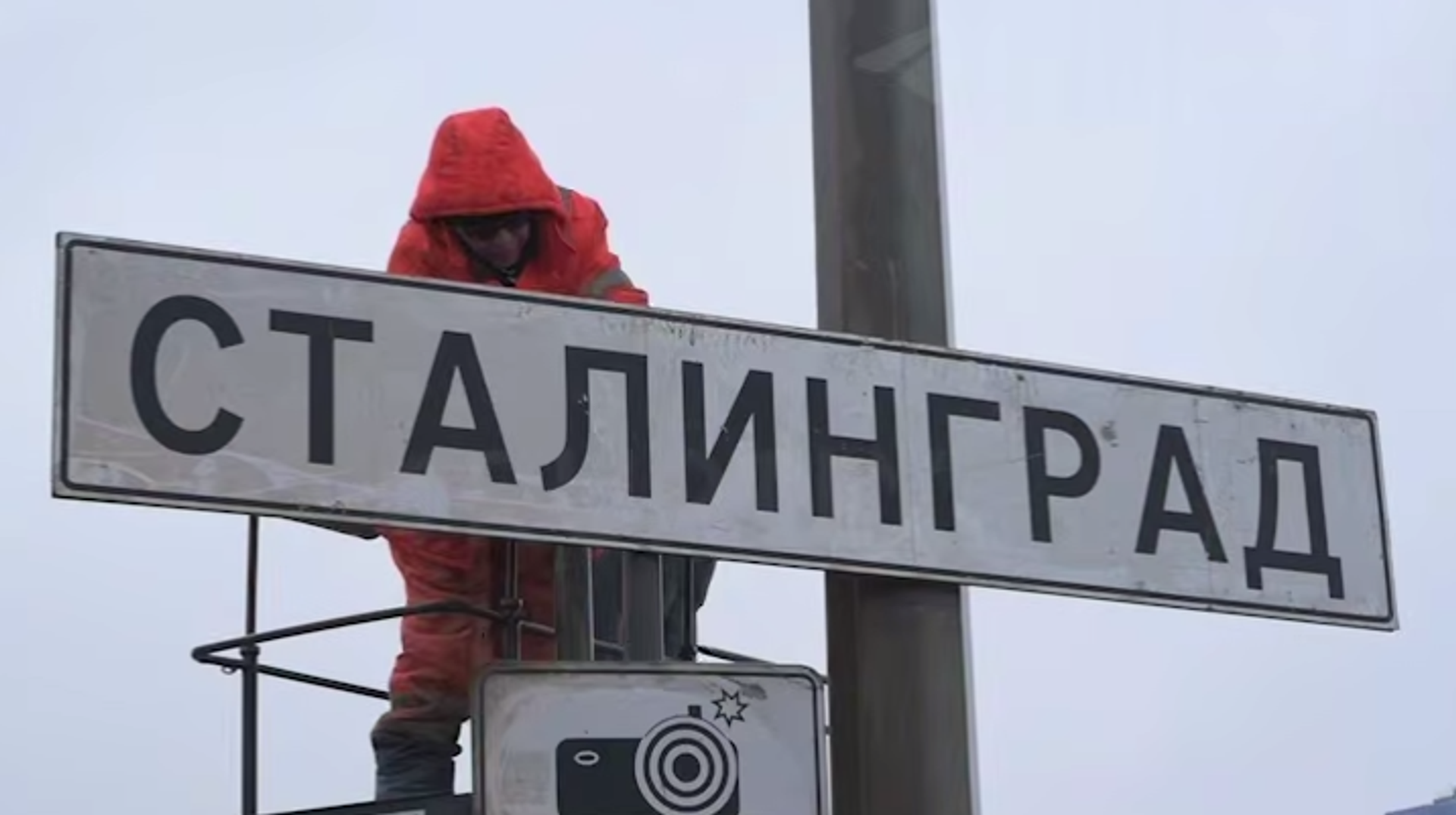
One day, the name will be permanently restored. The city will remain Stalingrad throughout history, and centuries from now.
https://colonelcassad.livejournal.com/10341403.html
Google Translator
******
Always a crowd pleaser: ))
http://smoothiex12.blogspot.com/2026/02 ... sians.html
February 2, 6:58 PM
This is the very same basement where Field Marshal Friedrich Paulus, commander of the Wehrmacht's 6th Army, surrendered with his staff in 1943. This marked, so to speak, the final point of the Wehrmacht's advance toward the Volga. After this battle, the war rolled westward, all the way to Berlin.
It's located in Volgograd, in the courtyard of a building at Fallen Fighters Square, 2.
It now houses the "Memory" Museum ( https://stalingrad-battle.ru/about/abou ... nner/2304/) , which vividly depicts scenes from the Field Marshal's capture. The museum is highly recommended.
Photo - https://t.me/GorInformburo/93458
P.S. Volgograd was renamed Stalingrad again for the holidays. For now, Stalingrad returns for nine days a year during the holidays.
One day, the name will be permanently restored. The city will remain Stalingrad throughout history, and centuries from now.
https://colonelcassad.livejournal.com/10341403.html
Google Translator
******
Always a crowd pleaser: ))
http://smoothiex12.blogspot.com/2026/02 ... sians.html
"There is great chaos under heaven; the situation is excellent."
Re: The Soviet Union
How the KGB drove an SS officer to suicide in Canada
February 3, 9:02 PM

How the KGB drove an SS officer to suicide in Canada
The USSR once demanded that Canada extradite SS-Untersturmführer Alexander Laak, the former commandant of the Jägal Kalevi-Liiv concentration camps in Estonia from 1942 to 1944, for trial. According to various sources, between 3,000 and 10,000 people died there—Jews, Soviet prisoners of war, and Roma. Estonian guards at these camps often competed in marksmanship. They would toss a Jewish or Roma baby into the air and then shoot it. After work, Laak usually partied with booze and prostitutes. Well, you understand, it's a stressful job. Shooting and hanging people all day is exhausting. And no one would appreciate it, or even say "thank you."
It was 1960. Anyway, it turned out that Laak had been living in Winnipeg, Canada, since 1948. He complains about the harsh frosts, but otherwise, nothing happens to him. He eats venison and makes a living repairing cars. A thrifty man. And then suddenly this comes out about him. The neighbors are shocked. How can this be, they say? He's a wonderful man. Always helpful, sometimes even free of charge for repairs. It's Soviet propaganda. All sorts of reporters come, the damned scribblers. They take pictures. They don't let the man live. Laak, by the way, didn't even deny that he first served in the Estonian police under the Germans, and then in the SS. Well, he served. That's the job. It's just that there weren't any free auto repair shops back then; he would have gone to work there, so he had to join the SS. Well, he killed. So long ago. My God, 15 years have passed, and they found a reason to pick on a decent citizen. Why was he so angry? Because he didn't have a car repair shop. And now he's started a new life.
Meanwhile, in the USSR, his deputy at the camp, Ralf Gerrets, and a guard at the same camp, Jaan Viik, were on trial. And they had some truly nasty stories to tell about this nice auto mechanic from Winnipeg. That he forced people to work until they collapsed, and then buried them alive in a pit. And he really enjoyed it. He had a creative approach to his work. The Canadian media, of course, hinted to Laak that it would be a good idea to portray himself as a victim of the communist regime. And to show how much he suffered mentally, shooting children and burying people alive. That his homeland had suffered under the Bolshevik boot for a whole year, which is why this event had such an effect on his Estonian nerves. Just like the lack of a decent auto repair shop in the SS.
But Alexander Laak was a fool. He stubbornly insisted that yes, he worked in the SS, so what? And even his neighbors and wife agreed with him. Work is work. After all, he wasn't just hauling shit on a barrel; he was an officer and a gentleman. However, Laak was plagued by journalists who were hanging around his house. They were taking photos, the dogs, nonstop. And in general, they started hinting that they would hand him over to the USSR. And he was worried and even started drinking again. And then, imagine, on the evening of September 6, 1960, 53-year-old Alexander Laak was found hanging from a noose in his own garage. His wife had gone to the movies and came back to find the poor husband figuratively stuffed with Nazi pears. Hanging there with his tongue hanging out of his mouth. Imagine the injustice. The man should have lived and lived. Old men from the SS generally had enviable health. Look at Hauptsturmführer Erich Priebke, who lived to be 100, but the 335 civilians he killed in Italy are somehow missing.
In short, the damned KGB drove a man to suicide. And perhaps they weren't acting alone, but with the help of Freemasons of a certain nationality. Then rumors began to circulate that Laak didn't hang himself, but that the Mossad helped him. Or an organization called the "Jewish Avengers Squad." Journalist Michael Atkins wrote that the "squad" locked Laak in a garage and read him the verdict. They then offered him a choice: death at their hands or hanging himself. Laak allegedly chose to hang himself, as is politely understood. But he thought long and hard before doing so, as national mentality generally dictates.
This theory is supported by the fact that in 1991, Canada officially opened an investigation into the cause of Alexander Laak's death, and the case remains open to this day. Because in a cultured, democratic country, you can't hang SS Untersturmführers by the neck like that. It's neither good nor nice.
But poor Laak was so unlucky.
https://t.me/Varjag2007/137704 - zinc
https://colonelcassad.livejournal.com/10343685.html
Google Translator
*****
******
From Breakthrough's Telegram account:

How the democratic intelligentsia prepared repression against itself
There is a myth among the intelligentsia that the Soviet government did not like the intelligentsia, because it was the government of the workers and peasants, persecuted, oppressed and repressed them in every possible way, the intelligentsia was considered a useless and harmful layer, and repressed poets and writers were cited as examples, and people suffered over the fate of N. Vavilov, Meyerhold, Gumilyov and others.
But it must be said that the Bolsheviks, when they came to power, were in no way hostile to the intelligentsia as such. In the first Council of People's Commissars, there was only one actual worker, and the rest were pure intellectuals. Lenin's profession listed "writer," Lunacharsky's was "critic" or "playwright," some wrote as journalists, some were engineers. But there was only one worker. So how could there be hostility if the Bolshevik Krasin, for example, was technical director at Siemens and felt at home among techies? If Professor K. Timiryazev took a firm Bolshevik stance, the Bolsheviks were warmly received by the country's best technical universities, and G. Krzhizhanovsky managed to gather around himself the cream of Russian economic and technical thought. And what kind of hostility from the intelligentsia could one expect from the People's Commissar of Culture, Lunacharsky, who had made theater and literary salons feel like home long before his appointment, and who was even married to a famous actress? The Bolsheviks were the very essence of the Russian intelligentsia; all the leaders had an excellent education, and even the mid-level Bolshevik management, mostly workers and petty bourgeois, were active students of Hegel and Feuerbach.
And among the Bolsheviks, after seizing power, there was a certain complacency, believing that the intelligentsia, having received the most favorable treatment in promoting popular culture, education, and scientific and technical support for industry, would not only help the Bolsheviks solve the problems of the long-suffering Russian people and lift them out of ignorance and backwardness, but would also create works of high world culture. Indeed, many honest intellectuals saw in the Bolsheviks a force whose actions would free the intelligentsia to implement cultural and technical projects. The People's Commissariats and Lenin personally were besieged by inventors and scientists, artists, writers, and educators with numerous projects, both technical and artistic. And the Bolsheviks made every effort to provide the intelligentsia with the opportunity to create. Michurin and Pavlov received a base of experience, Bekhterev founded the Institute of the Brain, Zhukovsky headed TsAGI, a whole galaxy of artists and sculptors rallied around Lenin's plan for monumental propaganda, Blok read poetry to workers, and Andrei Bely lectured at Proletkult. Russianists finally pushed through the reform of Russian orthography, which had been hampered by Tsarism. In short, a section of the intelligentsia experienced an unprecedented creative surge.
But this was only one side of the coin, and not the most popular. The bulk of the intelligentsia saw the Soviet government only as a source of better rations and acted accordingly. But even for rations, they couldn't guarantee even minimal loyalty, and they certainly didn't care about the people languishing in savagery and ignorance.
The entire history of the relationship between the Central Committee and People's Commissar of Culture Lunacharsky is one of Lunacharsky's constant attempts to favor various cultural workers. Moreover, in these attempts, Lunacharsky constantly made a fool of himself. I will quote the document in full.
A note from the Chairman of the All-Russian Extraordinary Commission, F.E. Dzerzhinsky, to the Central Committee of the RCP(b) with objections to the petitions of the People's Commissariat of Education of the RSFSR regarding the departure of artists abroad, April 19, 1921:
"Dear comrades. Recently, there has been a renewed increase in petitions from various artistic circles—individuals and entire theaters—for permission to travel abroad. These petitions are systematically supported by Comrade Lunacharsky. The Cheka, based on previous experience, categorically protests against this. To date, not a single one of the released individuals (such as Koussevitzky, Gzovskaya, Gaidarov, Balmont) has returned, and some—Balmont in particular—are waging a malicious campaign against us. Such leniency on our part constitutes an unjustifiable plunder of our cultural treasures and strengthens the ranks of our enemies. Now Comrade Lunacharsky is petitioning for permission for the First Studio of the Moscow Art Theater to travel abroad. Meanwhile, according to entirely reliable information, a group of artists from this theater is in close contact with American circles closely connected to intelligence agencies. The theater has been promised material assistance abroad. The actress Sukhacheva was in close contact with a number of these individuals. The Chamber Theatre had also previously filed a petition. References to rest and treatment are by no means convincing, since artists can easily use vacation time to travel around the provinces. Speaking out decisively against such petitions, the All-Russian Extraordinary Commission (VChK) asks the Central Committee to treat this matter with the utmost seriousness. With communist greetings, Chairman of the All-Russian Extraordinary Commission (VChK) Dzerzhinsky. P.S. I am appealing to the Central Committee, since Comrade Lunacharsky stipulates in his appeal that he will appeal to the Central Committee on this matter. (AP RF. F. 3. Op. 35. D. 35. L. 3. Original. Typescript. Published: History of Soviet Political Censorship. Documents and Commentaries. Moscow, 1997. Pp. 421-422).
Dzerzhinsky's indignation is understandable. The Soviet government trusts the intelligentsia, Lunacharsky vouches for it, and yet the intelligentsia betrays and slings the choicest mud at both the government and Lunacharsky from abroad
Lunacharsky, as People's Commissar of Culture, perhaps suffered more than anyone from the blatant swinishness and dishonesty of the Russian intelligentsia. He vouched for Balmont—Balmont never returned and slandered the communists from Paris; he vouched for Chaliapin—Chaliapin never returned, preferring his European business to the native aspen trees he so sang about. Repin never returned, and his heirs also didn't see fit to keep their promises to some "dog and crayfish deputies," as the "progressive liberal intelligentsia" put it at the time. And paintings were more profitable to sell at auction.
Lunacharsky vouched for Gumilyov (he and Gorky vouched for him), entrusted him with work on the editorial board of "World Literature," while Gumilyov, at that time, with his colleagues in the Tagantsev conspiracy, calculated how many workers would have to be hanged during the capture of Petrograd - 10 or 15 thousand.
What's more, Gumilyov—Z.I. Grzhebin, a close friend of Gorky himself, swindled the RSFSR of hundreds of thousands in foreign currency while publishing this "World Literature" and settled comfortably in exile: he received no less than 1 million marks and never published a single book in Germany. The Cheka described this "publisher" as a fraud in 1921:
"An unscrupulous contractor in Russia: received over 23 million rubles in advance payments from a number of institutions (the Moscow Soviet, the Central Press, the Military Institution, and the State Publishing House) for books he was supposed to publish, but has yet to deliver a single book to anyone. An unscrupulous contractor abroad. On November 15, 1920, he signed a contract in Berlin with a Swedish firm for 5 million books worth 5 million crowns. The Swedish firm's prices... were no less than four times higher than those charged by the same Grzhebin in Germany at the same time. Grzhebin attempted to strike with German publishers, raising prices."
The situation in 1917 and the early 1920s was devastating for Gorky and Lunacharsky's standing with the Central Committee— the intelligentsia systematically undermined them . Gorky interceded on Korolenko's behalf, while Korolenko wrote open letters to the Bolsheviks, openly pandering to the White Guards, in the best spirit of the Kadets.
In this situation, the Bolsheviks, within the first few years of their rule, came to the firm conviction: if an intellectual wasn't in the party, if he wasn't a Marxist, he absolutely couldn't be trusted. At best, the intelligentsia's loyalty was mere mimicry.
The head of Glavlit, Lebedev-Polyansky, wrote about mimicry in the behavior of the intelligentsia in 1927:
"A lot of literature is crudely opportunistic, published solely for the purpose of making money."
At the same time, he quoted a frank statement by V. Veresaev:
"Our creativity is increasingly becoming two-story. We write one thing for ourselves, the other for publication." (RCKHIDNI. F. 17. Op. 113. D. 271. L. 129-143. Original. Typescript. Published: "The Happiness of Literature." The State and Writers. 1925-1938. Documents. Moscow, 1997).
It must be said that opportunism and duplicity were an open secret—the same Osip Mandelstam penned both the ode to Stalin and the notorious verse about the highlander. In other words, the intelligentsia, by its very behavior, paved the way for a total mistrust of itself, carefully cultivating among party members in general and party leaders in particular the perception of the intelligentsia as a) bourgeois and b) two-faced .
The Party, one way or another, transmitted this attitude to the masses. Even if some intellectuals managed to disguise themselves as "proletarian artists" and deceive the masses, it was difficult to deceive the Party. While Molotov, Zhdanov, or Voroshilov, all well-educated individuals, could confidently separate the sheep from the goats, for many honest but illiterate workers, the intellectual was portrayed as a sly enemy trying to sneakily cause trouble. And among the proletarians, "rats" were never liked. And when the question of repression arose, it was hard to believe that the intellectual, who had been observed for years with nothing but a fig in his pocket, had not, in the interim, become a foreign agent or simply a saboteur.
I. Bortnik
12/02/2020
https://teletype.in/@prorivists/lbov_intell
Google Translator
February 3, 9:02 PM
How the KGB drove an SS officer to suicide in Canada
The USSR once demanded that Canada extradite SS-Untersturmführer Alexander Laak, the former commandant of the Jägal Kalevi-Liiv concentration camps in Estonia from 1942 to 1944, for trial. According to various sources, between 3,000 and 10,000 people died there—Jews, Soviet prisoners of war, and Roma. Estonian guards at these camps often competed in marksmanship. They would toss a Jewish or Roma baby into the air and then shoot it. After work, Laak usually partied with booze and prostitutes. Well, you understand, it's a stressful job. Shooting and hanging people all day is exhausting. And no one would appreciate it, or even say "thank you."
It was 1960. Anyway, it turned out that Laak had been living in Winnipeg, Canada, since 1948. He complains about the harsh frosts, but otherwise, nothing happens to him. He eats venison and makes a living repairing cars. A thrifty man. And then suddenly this comes out about him. The neighbors are shocked. How can this be, they say? He's a wonderful man. Always helpful, sometimes even free of charge for repairs. It's Soviet propaganda. All sorts of reporters come, the damned scribblers. They take pictures. They don't let the man live. Laak, by the way, didn't even deny that he first served in the Estonian police under the Germans, and then in the SS. Well, he served. That's the job. It's just that there weren't any free auto repair shops back then; he would have gone to work there, so he had to join the SS. Well, he killed. So long ago. My God, 15 years have passed, and they found a reason to pick on a decent citizen. Why was he so angry? Because he didn't have a car repair shop. And now he's started a new life.
Meanwhile, in the USSR, his deputy at the camp, Ralf Gerrets, and a guard at the same camp, Jaan Viik, were on trial. And they had some truly nasty stories to tell about this nice auto mechanic from Winnipeg. That he forced people to work until they collapsed, and then buried them alive in a pit. And he really enjoyed it. He had a creative approach to his work. The Canadian media, of course, hinted to Laak that it would be a good idea to portray himself as a victim of the communist regime. And to show how much he suffered mentally, shooting children and burying people alive. That his homeland had suffered under the Bolshevik boot for a whole year, which is why this event had such an effect on his Estonian nerves. Just like the lack of a decent auto repair shop in the SS.
But Alexander Laak was a fool. He stubbornly insisted that yes, he worked in the SS, so what? And even his neighbors and wife agreed with him. Work is work. After all, he wasn't just hauling shit on a barrel; he was an officer and a gentleman. However, Laak was plagued by journalists who were hanging around his house. They were taking photos, the dogs, nonstop. And in general, they started hinting that they would hand him over to the USSR. And he was worried and even started drinking again. And then, imagine, on the evening of September 6, 1960, 53-year-old Alexander Laak was found hanging from a noose in his own garage. His wife had gone to the movies and came back to find the poor husband figuratively stuffed with Nazi pears. Hanging there with his tongue hanging out of his mouth. Imagine the injustice. The man should have lived and lived. Old men from the SS generally had enviable health. Look at Hauptsturmführer Erich Priebke, who lived to be 100, but the 335 civilians he killed in Italy are somehow missing.
In short, the damned KGB drove a man to suicide. And perhaps they weren't acting alone, but with the help of Freemasons of a certain nationality. Then rumors began to circulate that Laak didn't hang himself, but that the Mossad helped him. Or an organization called the "Jewish Avengers Squad." Journalist Michael Atkins wrote that the "squad" locked Laak in a garage and read him the verdict. They then offered him a choice: death at their hands or hanging himself. Laak allegedly chose to hang himself, as is politely understood. But he thought long and hard before doing so, as national mentality generally dictates.
This theory is supported by the fact that in 1991, Canada officially opened an investigation into the cause of Alexander Laak's death, and the case remains open to this day. Because in a cultured, democratic country, you can't hang SS Untersturmführers by the neck like that. It's neither good nor nice.
But poor Laak was so unlucky.
https://t.me/Varjag2007/137704 - zinc
https://colonelcassad.livejournal.com/10343685.html
Google Translator
*****
******
From Breakthrough's Telegram account:
How the democratic intelligentsia prepared repression against itself
There is a myth among the intelligentsia that the Soviet government did not like the intelligentsia, because it was the government of the workers and peasants, persecuted, oppressed and repressed them in every possible way, the intelligentsia was considered a useless and harmful layer, and repressed poets and writers were cited as examples, and people suffered over the fate of N. Vavilov, Meyerhold, Gumilyov and others.
But it must be said that the Bolsheviks, when they came to power, were in no way hostile to the intelligentsia as such. In the first Council of People's Commissars, there was only one actual worker, and the rest were pure intellectuals. Lenin's profession listed "writer," Lunacharsky's was "critic" or "playwright," some wrote as journalists, some were engineers. But there was only one worker. So how could there be hostility if the Bolshevik Krasin, for example, was technical director at Siemens and felt at home among techies? If Professor K. Timiryazev took a firm Bolshevik stance, the Bolsheviks were warmly received by the country's best technical universities, and G. Krzhizhanovsky managed to gather around himself the cream of Russian economic and technical thought. And what kind of hostility from the intelligentsia could one expect from the People's Commissar of Culture, Lunacharsky, who had made theater and literary salons feel like home long before his appointment, and who was even married to a famous actress? The Bolsheviks were the very essence of the Russian intelligentsia; all the leaders had an excellent education, and even the mid-level Bolshevik management, mostly workers and petty bourgeois, were active students of Hegel and Feuerbach.
And among the Bolsheviks, after seizing power, there was a certain complacency, believing that the intelligentsia, having received the most favorable treatment in promoting popular culture, education, and scientific and technical support for industry, would not only help the Bolsheviks solve the problems of the long-suffering Russian people and lift them out of ignorance and backwardness, but would also create works of high world culture. Indeed, many honest intellectuals saw in the Bolsheviks a force whose actions would free the intelligentsia to implement cultural and technical projects. The People's Commissariats and Lenin personally were besieged by inventors and scientists, artists, writers, and educators with numerous projects, both technical and artistic. And the Bolsheviks made every effort to provide the intelligentsia with the opportunity to create. Michurin and Pavlov received a base of experience, Bekhterev founded the Institute of the Brain, Zhukovsky headed TsAGI, a whole galaxy of artists and sculptors rallied around Lenin's plan for monumental propaganda, Blok read poetry to workers, and Andrei Bely lectured at Proletkult. Russianists finally pushed through the reform of Russian orthography, which had been hampered by Tsarism. In short, a section of the intelligentsia experienced an unprecedented creative surge.
But this was only one side of the coin, and not the most popular. The bulk of the intelligentsia saw the Soviet government only as a source of better rations and acted accordingly. But even for rations, they couldn't guarantee even minimal loyalty, and they certainly didn't care about the people languishing in savagery and ignorance.
The entire history of the relationship between the Central Committee and People's Commissar of Culture Lunacharsky is one of Lunacharsky's constant attempts to favor various cultural workers. Moreover, in these attempts, Lunacharsky constantly made a fool of himself. I will quote the document in full.
A note from the Chairman of the All-Russian Extraordinary Commission, F.E. Dzerzhinsky, to the Central Committee of the RCP(b) with objections to the petitions of the People's Commissariat of Education of the RSFSR regarding the departure of artists abroad, April 19, 1921:
"Dear comrades. Recently, there has been a renewed increase in petitions from various artistic circles—individuals and entire theaters—for permission to travel abroad. These petitions are systematically supported by Comrade Lunacharsky. The Cheka, based on previous experience, categorically protests against this. To date, not a single one of the released individuals (such as Koussevitzky, Gzovskaya, Gaidarov, Balmont) has returned, and some—Balmont in particular—are waging a malicious campaign against us. Such leniency on our part constitutes an unjustifiable plunder of our cultural treasures and strengthens the ranks of our enemies. Now Comrade Lunacharsky is petitioning for permission for the First Studio of the Moscow Art Theater to travel abroad. Meanwhile, according to entirely reliable information, a group of artists from this theater is in close contact with American circles closely connected to intelligence agencies. The theater has been promised material assistance abroad. The actress Sukhacheva was in close contact with a number of these individuals. The Chamber Theatre had also previously filed a petition. References to rest and treatment are by no means convincing, since artists can easily use vacation time to travel around the provinces. Speaking out decisively against such petitions, the All-Russian Extraordinary Commission (VChK) asks the Central Committee to treat this matter with the utmost seriousness. With communist greetings, Chairman of the All-Russian Extraordinary Commission (VChK) Dzerzhinsky. P.S. I am appealing to the Central Committee, since Comrade Lunacharsky stipulates in his appeal that he will appeal to the Central Committee on this matter. (AP RF. F. 3. Op. 35. D. 35. L. 3. Original. Typescript. Published: History of Soviet Political Censorship. Documents and Commentaries. Moscow, 1997. Pp. 421-422).
Dzerzhinsky's indignation is understandable. The Soviet government trusts the intelligentsia, Lunacharsky vouches for it, and yet the intelligentsia betrays and slings the choicest mud at both the government and Lunacharsky from abroad
Lunacharsky, as People's Commissar of Culture, perhaps suffered more than anyone from the blatant swinishness and dishonesty of the Russian intelligentsia. He vouched for Balmont—Balmont never returned and slandered the communists from Paris; he vouched for Chaliapin—Chaliapin never returned, preferring his European business to the native aspen trees he so sang about. Repin never returned, and his heirs also didn't see fit to keep their promises to some "dog and crayfish deputies," as the "progressive liberal intelligentsia" put it at the time. And paintings were more profitable to sell at auction.
Lunacharsky vouched for Gumilyov (he and Gorky vouched for him), entrusted him with work on the editorial board of "World Literature," while Gumilyov, at that time, with his colleagues in the Tagantsev conspiracy, calculated how many workers would have to be hanged during the capture of Petrograd - 10 or 15 thousand.
What's more, Gumilyov—Z.I. Grzhebin, a close friend of Gorky himself, swindled the RSFSR of hundreds of thousands in foreign currency while publishing this "World Literature" and settled comfortably in exile: he received no less than 1 million marks and never published a single book in Germany. The Cheka described this "publisher" as a fraud in 1921:
"An unscrupulous contractor in Russia: received over 23 million rubles in advance payments from a number of institutions (the Moscow Soviet, the Central Press, the Military Institution, and the State Publishing House) for books he was supposed to publish, but has yet to deliver a single book to anyone. An unscrupulous contractor abroad. On November 15, 1920, he signed a contract in Berlin with a Swedish firm for 5 million books worth 5 million crowns. The Swedish firm's prices... were no less than four times higher than those charged by the same Grzhebin in Germany at the same time. Grzhebin attempted to strike with German publishers, raising prices."
The situation in 1917 and the early 1920s was devastating for Gorky and Lunacharsky's standing with the Central Committee— the intelligentsia systematically undermined them . Gorky interceded on Korolenko's behalf, while Korolenko wrote open letters to the Bolsheviks, openly pandering to the White Guards, in the best spirit of the Kadets.
In this situation, the Bolsheviks, within the first few years of their rule, came to the firm conviction: if an intellectual wasn't in the party, if he wasn't a Marxist, he absolutely couldn't be trusted. At best, the intelligentsia's loyalty was mere mimicry.
The head of Glavlit, Lebedev-Polyansky, wrote about mimicry in the behavior of the intelligentsia in 1927:
"A lot of literature is crudely opportunistic, published solely for the purpose of making money."
At the same time, he quoted a frank statement by V. Veresaev:
"Our creativity is increasingly becoming two-story. We write one thing for ourselves, the other for publication." (RCKHIDNI. F. 17. Op. 113. D. 271. L. 129-143. Original. Typescript. Published: "The Happiness of Literature." The State and Writers. 1925-1938. Documents. Moscow, 1997).
It must be said that opportunism and duplicity were an open secret—the same Osip Mandelstam penned both the ode to Stalin and the notorious verse about the highlander. In other words, the intelligentsia, by its very behavior, paved the way for a total mistrust of itself, carefully cultivating among party members in general and party leaders in particular the perception of the intelligentsia as a) bourgeois and b) two-faced .
The Party, one way or another, transmitted this attitude to the masses. Even if some intellectuals managed to disguise themselves as "proletarian artists" and deceive the masses, it was difficult to deceive the Party. While Molotov, Zhdanov, or Voroshilov, all well-educated individuals, could confidently separate the sheep from the goats, for many honest but illiterate workers, the intellectual was portrayed as a sly enemy trying to sneakily cause trouble. And among the proletarians, "rats" were never liked. And when the question of repression arose, it was hard to believe that the intellectual, who had been observed for years with nothing but a fig in his pocket, had not, in the interim, become a foreign agent or simply a saboteur.
I. Bortnik
12/02/2020
https://teletype.in/@prorivists/lbov_intell
Google Translator
"There is great chaos under heaven; the situation is excellent."
Re: The Soviet Union
145 years old Klim Voroshilov
February 4, 9:04 PM

Today marks the 145th birthday of Klim Voroshilov, the first Marshal of the Soviet Union.
Voroshilov was one of the architects of the Red Army. He also played a vital role in the Bolshevik victory in the Civil War, without which the USSR would not have been possible.
During the repressions of the 1930s, he was one of Stalin's closest associates, helping to crush political opposition in the army and directly participating in the discovery and defeat of the Tukhachevsky conspiracy. For this, he constantly came under fire after Stalin's death and the 20th Congress. He was too loyal to the leader for those who quickly changed their tune under Khrushchev.
During the Great Patriotic War, he performed poorly in terms of troop leadership, but he excelled in organizing the partisan movement in occupied territories and in organizing the collection of war trophies. Voroshilov's main assets during his active years were his absolute loyalty to Stalin and his organizational talents, which Stalin valued both during the Civil War and the Great Patriotic War.
Of course, under Khrushchev, and especially after the onset of Perestroika, they tried hard to portray Voroshilov as a dull old fool who forgot to change his shoes during the 20th Congress.
In fact, in terms of his influence on Russian history, he was one of the most significant military leaders of the 20th century. This doesn't mean he didn't have his share of shortcomings, but he contributed far more to the country's success.
P.S. Even today, Voroshilov sometimes returns to the map, when Luhansk is temporarily renamed Voroshilovgrad for holidays.
https://colonelcassad.livejournal.com/10345798.html
Google Translator
February 4, 9:04 PM
Today marks the 145th birthday of Klim Voroshilov, the first Marshal of the Soviet Union.
Voroshilov was one of the architects of the Red Army. He also played a vital role in the Bolshevik victory in the Civil War, without which the USSR would not have been possible.
During the repressions of the 1930s, he was one of Stalin's closest associates, helping to crush political opposition in the army and directly participating in the discovery and defeat of the Tukhachevsky conspiracy. For this, he constantly came under fire after Stalin's death and the 20th Congress. He was too loyal to the leader for those who quickly changed their tune under Khrushchev.
During the Great Patriotic War, he performed poorly in terms of troop leadership, but he excelled in organizing the partisan movement in occupied territories and in organizing the collection of war trophies. Voroshilov's main assets during his active years were his absolute loyalty to Stalin and his organizational talents, which Stalin valued both during the Civil War and the Great Patriotic War.
Of course, under Khrushchev, and especially after the onset of Perestroika, they tried hard to portray Voroshilov as a dull old fool who forgot to change his shoes during the 20th Congress.
In fact, in terms of his influence on Russian history, he was one of the most significant military leaders of the 20th century. This doesn't mean he didn't have his share of shortcomings, but he contributed far more to the country's success.
P.S. Even today, Voroshilov sometimes returns to the map, when Luhansk is temporarily renamed Voroshilovgrad for holidays.
https://colonelcassad.livejournal.com/10345798.html
Google Translator
"There is great chaos under heaven; the situation is excellent."
Re: The Soviet Union
February liberation of Kyiv.
February 5, 9:03 PM

On February 5, 1919, units of the Red Army liberated Kyiv from the Petliurites.

Atrocities against civilians were an integral attribute of Ukrainian nationalists and Nazis during the time of Petliura, and under Hitler, and during the "nezalezhnost" (independence). It is their family trait.
P.S. By the way, my first conscious childhood memory was precisely the song about Shchors that my grandmother sang.
A detachment was marching along the shore, marching from afar,
The regiment commander was marching under the red banner.
His head was bandaged, blood was on his sleeve,
A bloody trail spreads across the damp grass.
Oh, across the damp grass!
"Boys, whose are you, who is leading you into battle?
Who is walking wounded under the red banner?"
"We are the sons of farmhands, we are for a new world,
Shchors is marching under the banner, a red commander.
Oh, red commander!
His life was spent in hunger and cold,
But his blood was not shed in vain." "
We drove back the fierce enemy beyond the border,
We were hardened from our youth, Honor is dear to us.
Oh, honor is dear to us!"
Silence by the shore, voices have died down,
The sun is setting, dew is falling.
The cavalry gallops boldly, the clatter of hooves is heard.
Shchors's red banner rustles in the wind.
Oh, how it rustles in the wind!
https://colonelcassad.livejournal.com/10347803.html
Google Translator
*****
From Cassad's telegram acvcount:
Colonelcassad
On this day in 1922, the State Political Directorate (GPU) was established, replacing the Cheka. Felix Edmundovich Dzerzhinsky headed the GPU. The structure itself was created at Lenin's suggestion.
The GPU handled more or less the same tasks as the Cheka, although some of the Cheka's powers had been curtailed during the Civil War in the interests of curbing abuses and violations of social law.
It combated terrorism, banditry, sabotage, smuggling, counterrevolution, border violations, embezzlement of state property, and economic crimes aimed at undermining Soviet Russia.
It also protected railways, bridges, and waterways.
Overall, these were familiar functions, which the FSB, the legal successor to the Soviet state security agencies, still handles today.
The GPU didn't last very long and was renamed the OGPU in 1923, which Dzerzhinsky also led until his death in 1926. In 1934, the OGPU was transformed into the GUGB, part of the NKVD of the USSR.
During its existence, the GPU and later the OGPU were the most effective Soviet intelligence agency.
https://t.me/s/boris_rozhin
Google Translator
February 5, 9:03 PM
On February 5, 1919, units of the Red Army liberated Kyiv from the Petliurites.
Atrocities against civilians were an integral attribute of Ukrainian nationalists and Nazis during the time of Petliura, and under Hitler, and during the "nezalezhnost" (independence). It is their family trait.
P.S. By the way, my first conscious childhood memory was precisely the song about Shchors that my grandmother sang.
A detachment was marching along the shore, marching from afar,
The regiment commander was marching under the red banner.
His head was bandaged, blood was on his sleeve,
A bloody trail spreads across the damp grass.
Oh, across the damp grass!
"Boys, whose are you, who is leading you into battle?
Who is walking wounded under the red banner?"
"We are the sons of farmhands, we are for a new world,
Shchors is marching under the banner, a red commander.
Oh, red commander!
His life was spent in hunger and cold,
But his blood was not shed in vain." "
We drove back the fierce enemy beyond the border,
We were hardened from our youth, Honor is dear to us.
Oh, honor is dear to us!"
Silence by the shore, voices have died down,
The sun is setting, dew is falling.
The cavalry gallops boldly, the clatter of hooves is heard.
Shchors's red banner rustles in the wind.
Oh, how it rustles in the wind!
https://colonelcassad.livejournal.com/10347803.html
Google Translator
*****
From Cassad's telegram acvcount:
Colonelcassad
On this day in 1922, the State Political Directorate (GPU) was established, replacing the Cheka. Felix Edmundovich Dzerzhinsky headed the GPU. The structure itself was created at Lenin's suggestion.
The GPU handled more or less the same tasks as the Cheka, although some of the Cheka's powers had been curtailed during the Civil War in the interests of curbing abuses and violations of social law.
It combated terrorism, banditry, sabotage, smuggling, counterrevolution, border violations, embezzlement of state property, and economic crimes aimed at undermining Soviet Russia.
It also protected railways, bridges, and waterways.
Overall, these were familiar functions, which the FSB, the legal successor to the Soviet state security agencies, still handles today.
The GPU didn't last very long and was renamed the OGPU in 1923, which Dzerzhinsky also led until his death in 1926. In 1934, the OGPU was transformed into the GUGB, part of the NKVD of the USSR.
During its existence, the GPU and later the OGPU were the most effective Soviet intelligence agency.
https://t.me/s/boris_rozhin
Google Translator
"There is great chaos under heaven; the situation is excellent."